EQUALITY AND
DIVERSITY INTHE
CURRICULUM
Inclusive curriculum
Drivers
• Equality legislation
• Access and inclusion agenda
• Internationalisation
UoETask group
- Mapping current practices
- Benchmarking
- Consultation with staff and students
An inclusive curriculum is one “where all students’ entitlement to access and
participate in a course is anticipated, acknowledged and taken into
account”[1]
1. Morgan H. and Houghton,AM. (2011) Inclusive curriculum design in higher education.
https://www.heacademy.ac.uk/system/files/resources/introduction_and_overview.pdf
A model for embedding equality and
diversity in the curriculum
Embedding equality and diversity in the curriculum is:
the creating of learning, teaching and assessment environments and experiences
that proactively eliminate discrimination, promote equality of opportunity and
foster good relations in a manner that values, preserves and responds to diversity.
Inclusivity
Diversity
Inclusivity
Equality and
diversity
competence
Hanesworth, P. (2015) Embedding equality and diversity in the curriculum.
https://www.heacademy.ac.uk/system/files/eedc_model_for_learning_and_teaching_practitioners.pdf
Defintions
Inclusivity
Diversity
Inclusivity
Equality and
diversity
competence
“the ways in which
pedagogy, curricula and
assessment are designed
and delivered to engage
students in learning that
is meaningful, relevant
and accessible to all. It
embraces a view of the
individual and individual
difference as the source
of diversity that can
enrich the lives and
learning of others
(Hockings 2010, p. 1).
“ ‘the active, intentional, and ongoing engagement’ (p. 6) with differences in a purposeful manner so as to increase
one’s diversity-related competencies [where difference is] both individual, such as personality, learning styles, and
life experiences, and group or social, such as race/ethnicity, gender, country of origin, religion (p. 6). According to this
definition, diversity refers not to the presence of difference in student demographics or course content, but to the
act and process of engaging those differences in an intentional, purposeful
The ability to function
with awareness,
knowledge and
interpersonal skill when
engaging people of
different backgrounds,
assumptions, beliefs,
values and behaviours
(Hogan, 2007, p3)
Principles of Embedding Equality,
Diversity and Inclusivity in the Curriculum
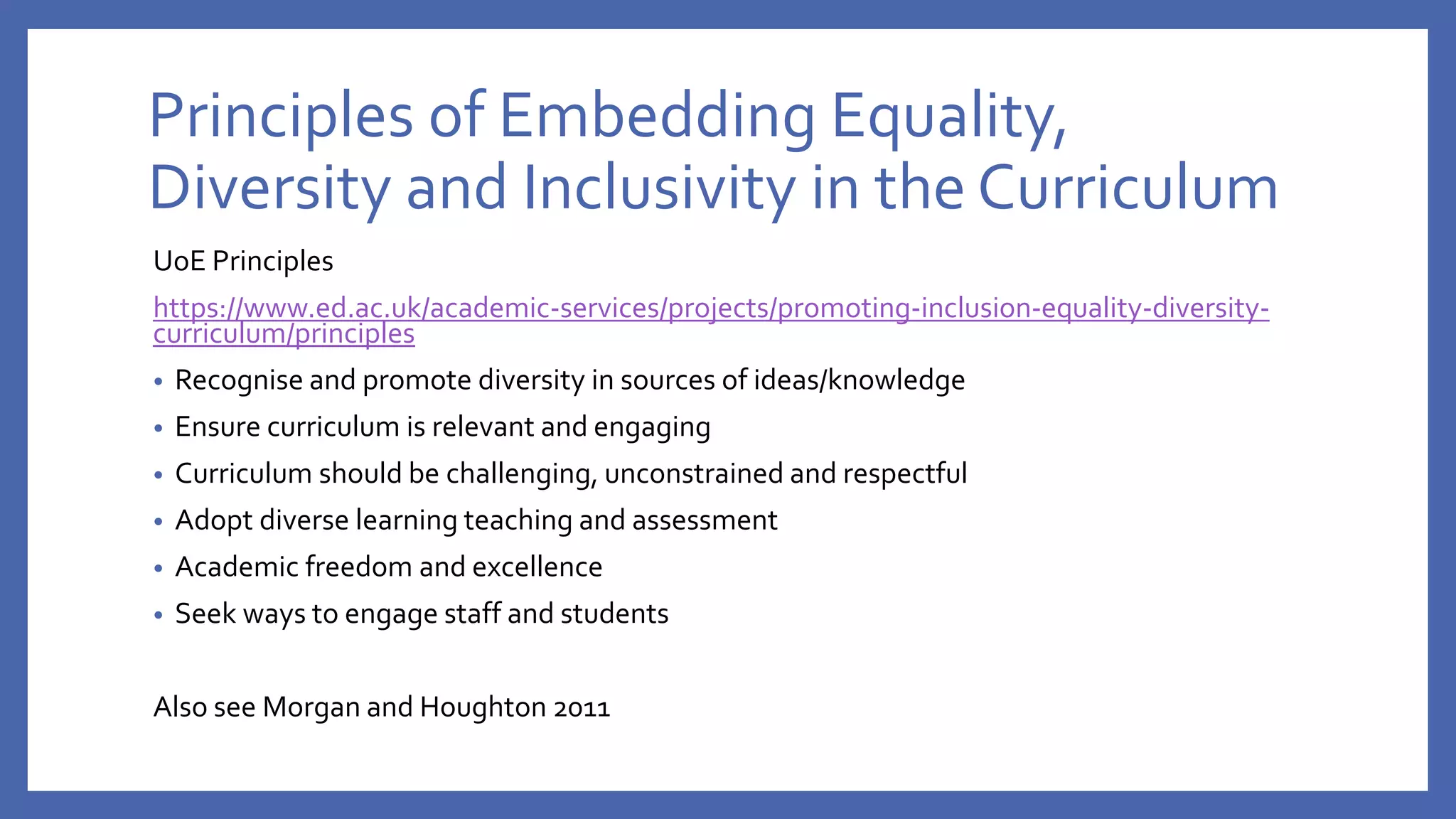
UoE Principles
https://www.ed.ac.uk/academic-services/projects/promoting-inclusion-equality-diversity-
curriculum/principles
• Recognise and promote diversity in sources of ideas/knowledge
• Ensure curriculum is relevant and engaging
• Curriculum should be challenging, unconstrained and respectful
• Adopt diverse learning teaching and assessment
• Academic freedom and excellence
• Seek ways to engage staff and students
Also see Morgan and Houghton 2011
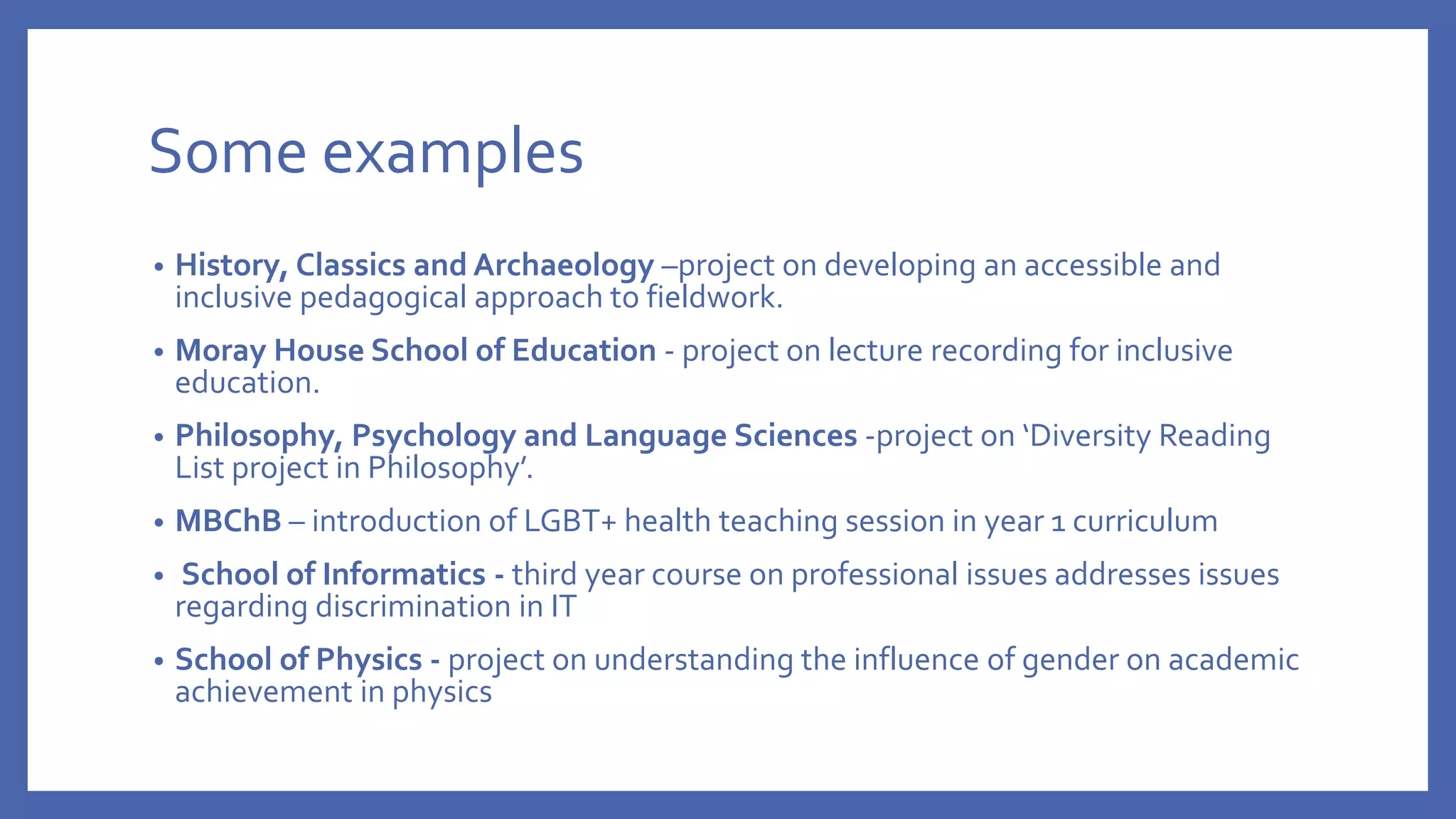
Some examples
• History, Classics and Archaeology –project on developing an accessible and
inclusive pedagogical approach to fieldwork.
• Moray House School of Education - project on lecture recording for inclusive
education.
• Philosophy, Psychology and Language Sciences -project on ‘Diversity Reading
List project in Philosophy’.
• MBChB – introduction of LGBT+ health teaching session in year 1 curriculum
• School of Informatics - third year course on professional issues addresses issues
regarding discrimination in IT
• School of Physics - project on understanding the influence of gender on academic
achievement in physics
Elements of curriculum design
AIMS AND
OBJECTIVES
LEARNING
OUTCOMES
ACADEMIC AND
COMPETENCE
STANDARDS
CONTENT/SYLLABUS
TEACHING
METHODS
LEARNING
ACTIVITIES
ASSESSMENT AND
FEEDBACK
TEACHING AND
LEARNING
MATERIALS
MBChB: Equality, Diversity and Inclusivity in
the Curriculum (EDIC) Working Group
• Staff-student partnership
• Remit
• to enhance learning, assessment and teaching approaches to promote equality and diversity
competence: “the ability to function with awareness, knowledge and interpersonal skill
when engaging people of different backgrounds, assumptions, beliefs, values and
behaviours” [2]
• Activities will include:
• Map current activities (curriculum content, assessment, learning and teaching approaches).
• Identify and develop ways to engage with equality and diversity within the curriculum
(modifying existing content and developing new content) in an intentional and purposeful
manner.
• Develop bespoke guidance for staff on embedding inclusion, equality, and diversity into the
MBChB curriculum
2. (Hogan 2007, Four skills of cultural diversity competence: a process for understanding and practice. Brooks/Cole Cengage Learning p. 3).
What does this
mean for us?
What do we
currently do?
What
can/should
we do?

inclusion_equality_and_diversity_in_the_curriculum.pptx

  • 1.
  • 2.
    Inclusive curriculum Drivers • Equalitylegislation • Access and inclusion agenda • Internationalisation UoETask group - Mapping current practices - Benchmarking - Consultation with staff and students An inclusive curriculum is one “where all students’ entitlement to access and participate in a course is anticipated, acknowledged and taken into account”[1] 1. Morgan H. and Houghton,AM. (2011) Inclusive curriculum design in higher education. https://www.heacademy.ac.uk/system/files/resources/introduction_and_overview.pdf
  • 3.
    A model forembedding equality and diversity in the curriculum Embedding equality and diversity in the curriculum is: the creating of learning, teaching and assessment environments and experiences that proactively eliminate discrimination, promote equality of opportunity and foster good relations in a manner that values, preserves and responds to diversity. Inclusivity Diversity Inclusivity Equality and diversity competence Hanesworth, P. (2015) Embedding equality and diversity in the curriculum. https://www.heacademy.ac.uk/system/files/eedc_model_for_learning_and_teaching_practitioners.pdf
  • 4.
    Defintions Inclusivity Diversity Inclusivity Equality and diversity competence “the waysin which pedagogy, curricula and assessment are designed and delivered to engage students in learning that is meaningful, relevant and accessible to all. It embraces a view of the individual and individual difference as the source of diversity that can enrich the lives and learning of others (Hockings 2010, p. 1). “ ‘the active, intentional, and ongoing engagement’ (p. 6) with differences in a purposeful manner so as to increase one’s diversity-related competencies [where difference is] both individual, such as personality, learning styles, and life experiences, and group or social, such as race/ethnicity, gender, country of origin, religion (p. 6). According to this definition, diversity refers not to the presence of difference in student demographics or course content, but to the act and process of engaging those differences in an intentional, purposeful The ability to function with awareness, knowledge and interpersonal skill when engaging people of different backgrounds, assumptions, beliefs, values and behaviours (Hogan, 2007, p3)
  • 5.
    Principles of EmbeddingEquality, Diversity and Inclusivity in the Curriculum UoE Principles https://www.ed.ac.uk/academic-services/projects/promoting-inclusion-equality-diversity- curriculum/principles • Recognise and promote diversity in sources of ideas/knowledge • Ensure curriculum is relevant and engaging • Curriculum should be challenging, unconstrained and respectful • Adopt diverse learning teaching and assessment • Academic freedom and excellence • Seek ways to engage staff and students Also see Morgan and Houghton 2011
  • 6.
    Some examples • History,Classics and Archaeology –project on developing an accessible and inclusive pedagogical approach to fieldwork. • Moray House School of Education - project on lecture recording for inclusive education. • Philosophy, Psychology and Language Sciences -project on ‘Diversity Reading List project in Philosophy’. • MBChB – introduction of LGBT+ health teaching session in year 1 curriculum • School of Informatics - third year course on professional issues addresses issues regarding discrimination in IT • School of Physics - project on understanding the influence of gender on academic achievement in physics
  • 7.
    Elements of curriculumdesign AIMS AND OBJECTIVES LEARNING OUTCOMES ACADEMIC AND COMPETENCE STANDARDS CONTENT/SYLLABUS TEACHING METHODS LEARNING ACTIVITIES ASSESSMENT AND FEEDBACK TEACHING AND LEARNING MATERIALS
  • 8.
    MBChB: Equality, Diversityand Inclusivity in the Curriculum (EDIC) Working Group • Staff-student partnership • Remit • to enhance learning, assessment and teaching approaches to promote equality and diversity competence: “the ability to function with awareness, knowledge and interpersonal skill when engaging people of different backgrounds, assumptions, beliefs, values and behaviours” [2] • Activities will include: • Map current activities (curriculum content, assessment, learning and teaching approaches). • Identify and develop ways to engage with equality and diversity within the curriculum (modifying existing content and developing new content) in an intentional and purposeful manner. • Develop bespoke guidance for staff on embedding inclusion, equality, and diversity into the MBChB curriculum 2. (Hogan 2007, Four skills of cultural diversity competence: a process for understanding and practice. Brooks/Cole Cengage Learning p. 3).
  • 9.
    What does this meanfor us? What do we currently do? What can/should we do?