Inbound vs. Outbound Calls: A
Deep Dive
Today we explore the key differences between inbound and outbound calls to
help you decide which approach is right for your business.
What are Inbound Calls?
Inbound calls are initiated by customers or potential
customers.
Customer Support Requests
Sales Inquiries
Billing Questions
Technical Support
What are Outbound Calls?
Outbound calls are initiated by a business or organization to
reach out to customers or potential customers.
Sales Calls
Follow-up Calls
Feedback Surveys
Promotional Calls
Role of Call Centers in Inbound &
Outbound Calls
Call Center Roles
Call centers are essential for handling both inbound and outbound calls.
They manage customer interactions and outreach, ensuring efficient
communication and customer satisfaction.
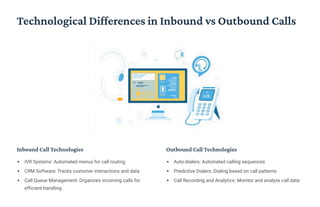
Technological Differences in Inbound vs Outbound Calls
Inbound Call Technologies
IVR Systems: Automated menus for call routing
CRM Software: Tracks customer interactions and data
Call Queue Management: Organizes incoming calls for
efficient handling
Outbound Call Technologies
Auto-dialers: Automated calling sequences
Predictive Dialers: Dialing based on call patterns
Call Recording and Analytics: Monitor and analyze call data
Agent Training & Skills Required for Inbound vs
Outbound Calls
Inbound Call Agents
Skills: Patience, problem-solving, active listening
Training Focus: Product knowledge, customer service,
handling complaints
Outbound Call Agents
Skills: Persuasion, communication, closing deals
Training Focus: Sales techniques, product knowledge,
overcoming objections
Difference in KPIs: Inbound vs Outbound Calls
Inbound Call KPIs
Customer Satisfaction (CSAT): Measures customer
happiness
First Call Resolution (FCR): Resolves issues on the first call
Average Handle Time (AHT): Average time spent on calls
Outbound Call KPIs
Conversion Rates: Percentage of calls that result in sales
Call Volume: Number of calls made
Lead Conversion: Number of leads converted to customers
Inbound or Outbound Calls:
Which is More Important for
Your Business?
The right approach depends on your specific business goals and customer
needs. Analyze your customer base, marketing objectives, and budget to
determine if inbound or outbound calling strategies will best support your
business objectives.

Inbound vs. Outbound Calls: A Deep Dive.

  • 1.
    Inbound vs. OutboundCalls: A Deep Dive Today we explore the key differences between inbound and outbound calls to help you decide which approach is right for your business.
  • 2.
    What are InboundCalls? Inbound calls are initiated by customers or potential customers. Customer Support Requests Sales Inquiries Billing Questions Technical Support
  • 3.
    What are OutboundCalls? Outbound calls are initiated by a business or organization to reach out to customers or potential customers. Sales Calls Follow-up Calls Feedback Surveys Promotional Calls
  • 4.
    Role of CallCenters in Inbound & Outbound Calls Call Center Roles Call centers are essential for handling both inbound and outbound calls. They manage customer interactions and outreach, ensuring efficient communication and customer satisfaction.
  • 5.
    Technological Differences inInbound vs Outbound Calls Inbound Call Technologies IVR Systems: Automated menus for call routing CRM Software: Tracks customer interactions and data Call Queue Management: Organizes incoming calls for efficient handling Outbound Call Technologies Auto-dialers: Automated calling sequences Predictive Dialers: Dialing based on call patterns Call Recording and Analytics: Monitor and analyze call data
  • 6.
    Agent Training &Skills Required for Inbound vs Outbound Calls Inbound Call Agents Skills: Patience, problem-solving, active listening Training Focus: Product knowledge, customer service, handling complaints Outbound Call Agents Skills: Persuasion, communication, closing deals Training Focus: Sales techniques, product knowledge, overcoming objections
  • 7.
    Difference in KPIs:Inbound vs Outbound Calls Inbound Call KPIs Customer Satisfaction (CSAT): Measures customer happiness First Call Resolution (FCR): Resolves issues on the first call Average Handle Time (AHT): Average time spent on calls Outbound Call KPIs Conversion Rates: Percentage of calls that result in sales Call Volume: Number of calls made Lead Conversion: Number of leads converted to customers
  • 8.
    Inbound or OutboundCalls: Which is More Important for Your Business? The right approach depends on your specific business goals and customer needs. Analyze your customer base, marketing objectives, and budget to determine if inbound or outbound calling strategies will best support your business objectives.