Improving Developer Productivity
With DORA, SPACE, and DevEx
Slides, Recording, and Contact
Info
https://getdx.com/talk/kcdnewyork-
2025/
Agenda
1) The Truths of 10x Development
● The Coding War Games
● Developer Experience Predicts Developer
Productivity
● Exercise 1 - Developer Experience Survey
2) A Brief History of Productivity Theory
● The Goal and the Theory of Constraints
● Deming, Lean, and the Factory Metaphor
● Exercise 2 - What metrics are you tracking?
Agenda
3) From DevOps to Platform Engineering
● DevOps and DORA
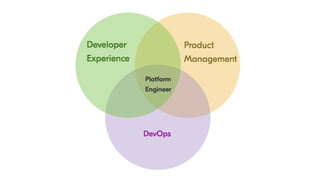
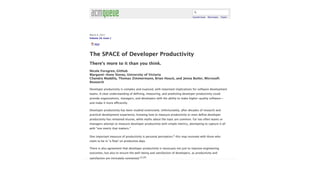
● Platform Engineering and SPACE
● Exercise 3 - How do you define productivity?
4) The Evolution of Productivity Metrics
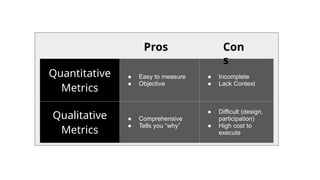
● Qualitative and Quantitative
● A Constellation of Metrics in Tension
● Exercise 4 - Learning to Run Effective Surveys
10x Developers are a myth…
But 10x Organizations are
real
10x
Engineers
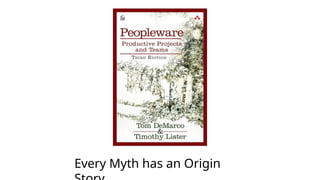
Every Myth has an Origin
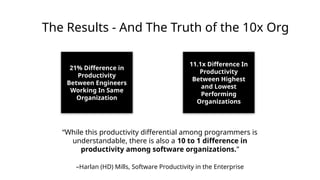
The Results - And The Truth of the 10x Org
21% Difference in
Productivity
Between Engineers
Working In Same
Organization
11.1x Difference In
Productivity
Between Highest
and Lowest
Performing
Organizations
“While this productivity differential among programmers is
understandable, there is also a 10 to 1 difference in
productivity among software organizations.”
–Harlan (HD) Mills, Software Productivity in the Enterprise
The best performers are clustering in some
organizations while the worst performers are
clustering in others.
The best performers are clustering in some
organizations while the worst performers are
clustering in others.
Some companies are doing a lot worse than
others.
The best performers are clustering in some
organizations while the worst performers are
clustering in others.
Some companies are doing a lot worse than
others.
Something about their environment and
corporate culture is failing to attract and keep
good people or is making it impossible for even
good people to work effectively.
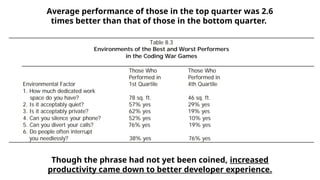
Average performance of those in the top quarter was 2.6
times better than that of those in the bottom quarter.
Though the phrase had not yet been coined, increased
productivity came down to better developer experience.
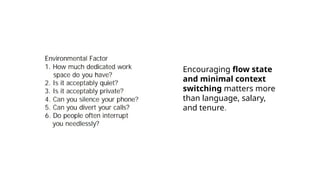
Encouraging flow state
and minimal context
switching matters more
than language, salary,
and tenure.
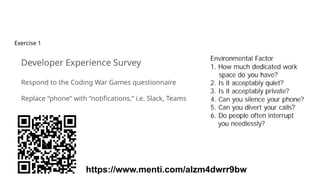
Exercise 1
Developer Experience Survey
Respond to the Coding War Games questionnaire
Replace “phone” with “notifications,” i.e. Slack, Teams
https://www.menti.com/alzm4dwrr9bw
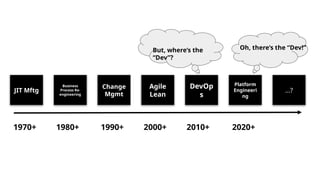
JIT Mftg
Business
Process Re-
engineering
Change
Mgmt
Agile
Lean
DevOp
s
Platform
Engineeri
ng
…?
But, where’s the
“Dev”?
Oh, there’s the “Dev!”
1970+ 1980+ 1990+ 2000+ 2010+ 2020+
The Ancient Business Wisdom
…Of the 70s and 80s
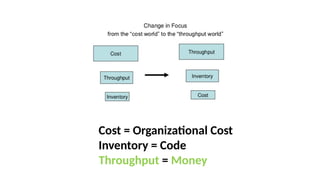
Cost = Organizational Cost
Inventory = Code
Throughput = Money
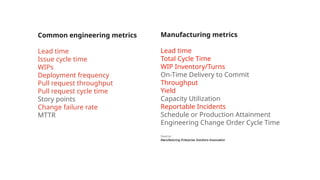
Manufacturing metrics
Lead time
Total Cycle Time
WIP Inventory/Turns
On-Time Delivery to Commit
Throughput
Yield
Capacity Utilization
Reportable Incidents
Schedule or Production Attainment
Engineering Change Order Cycle Time
Source:
Manufacturing Enterprise Solutions Association
Common engineering metrics
Lead time
Issue cycle time
WIPs
Deployment frequency
Pull request throughput
Pull request cycle time
Story points
Change failure rate
MTTR
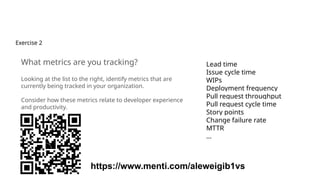
Exercise 2
What metrics are you tracking?
Looking at the list to the right, identify metrics that are
currently being tracked in your organization.
Consider how these metrics relate to developer experience
and productivity.
Lead time
Issue cycle time
WIPs
Deployment frequency
Pull request throughput
Pull request cycle time
Story points
Change failure rate
MTTR
…
https://www.menti.com/aleweigib1vs
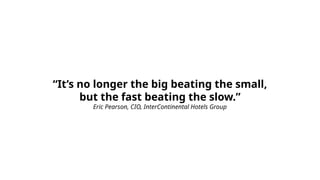
“It’s no longer the big beating the small,
but the fast beating the slow.”
Eric Pearson, CIO, InterContinental Hotels Group
DevOps, DORA, etc, have still not captured all
bottlenecks, friction, and obstacles to throughput
DevOps, DORA, etc, have still not captured all
bottlenecks, friction, and obstacles to throughput
Many are hiding in plain sight, in the developer
experience itself
DevOps, DORA, etc, have still not captured all
bottlenecks, friction, and obstacles to throughput
Many are hiding in plain sight, in the developer
experience itself
A 10x organization should consider every aspect of the
developer value stream, internal and external
Exercise 3
How do you define productivity?
Enter a few bullet points describing how your organization views
productivity.
https://www.menti.com/alikqgq6s37f
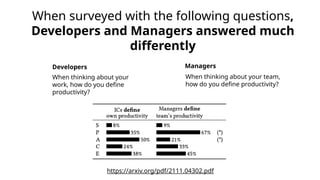
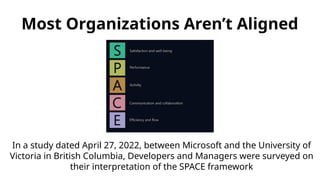
Most Organizations Aren’t Aligned
In a study dated April 27, 2022, between Microsoft and the University of
Victoria in British Columbia, Developers and Managers were surveyed on
their interpretation of the SPACE framework
When surveyed with the following questions,
Developers and Managers answered much
differently
https://arxiv.org/pdf/2111.04302.pdf
When thinking about your
work, how do you define
productivity?
Developers Managers
When thinking about your team,
how do you define productivity?
No one knows more about
the friction in the software
development lifecycle
than developers.
So what if we just asked
developers? …
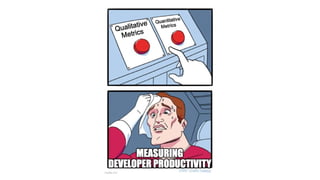
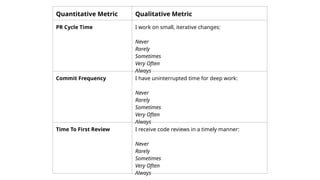
Quantitative Metric Qualitative Metric
PR Cycle Time I work on small, iterative changes:
Never
Rarely
Sometimes
Very Often
Always
Commit Frequency I have uninterrupted time for deep work:
Never
Rarely
Sometimes
Very Often
Always
Time To First Review I receive code reviews in a timely manner:
Never
Rarely
Sometimes
Very Often
Always
Quantitative
Metrics
● Easy to measure
● Objective
● Incomplete
● Lack Context
Qualitative
Metrics
● Comprehensive
● Tells you “why”
● Difficult (design,
participation)
● High cost to
execute
Pros Con
s
https://queue.acm.org/detail.cfm?id=3595878
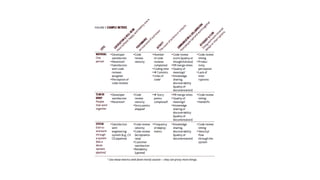
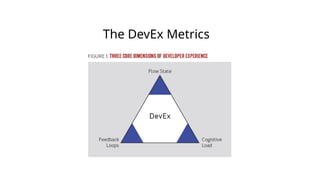
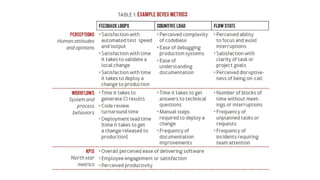
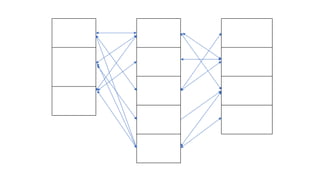
The DevEx Metrics
S
Satisfaction
P
Performance
A
Activity
C
Collaboration
E
Efficiency
DF
Deployment Frequency
LTFC
Lead Time for Changes
MTTR
Mean Time to Resolve
CFR
Change Failure Rate
FS
Flow State
FL
Feedback Loops
CL
Cognitive Load
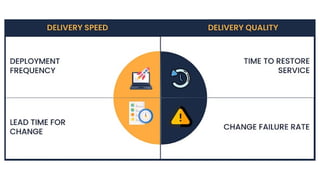
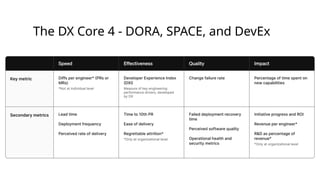
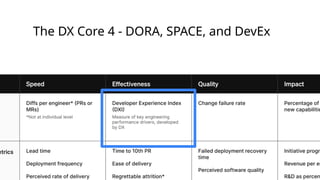
The DX Core 4 - DORA, SPACE, and DevEx
Each one-point gain in DXI score
translates to saving 13 minutes per week
per developer, equivalent to 10 hours
annually.
Each one-point gain in DXI score
translates to saving 13 minutes per week
per developer, equivalent to 10 hours
annually.
… and yes, we have the math proof. :)
Knowing how to measure productivity or
even define developer productivity has
remained elusive.
Knowing how to measure productivity or
even define developer productivity has
remained elusive.
But we’ve figured out the best
possible way available to do it.
Exercise 4
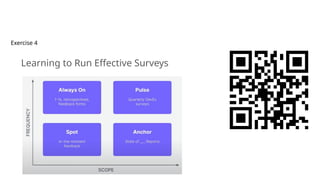
Learning to Run Effective Surveys
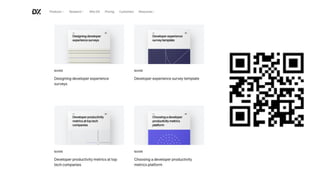
Download the Developer Experience Survey Template
https://tinyurl.com/mu93w7uj
We’ll review the instructions on Page 5
Exercise 4
Learning to Run Effective Surveys
Slides, Recording, and Contact
Info
https://getdx.com/talk/kcdnewyork-
2025/
Q & A

Improving Developer Productivity With DORA, SPACE, and DevEx

  • 1.
  • 2.
    Slides, Recording, andContact Info https://getdx.com/talk/kcdnewyork- 2025/
  • 3.
    Agenda 1) The Truthsof 10x Development ● The Coding War Games ● Developer Experience Predicts Developer Productivity ● Exercise 1 - Developer Experience Survey 2) A Brief History of Productivity Theory ● The Goal and the Theory of Constraints ● Deming, Lean, and the Factory Metaphor ● Exercise 2 - What metrics are you tracking?
  • 4.
    Agenda 3) From DevOpsto Platform Engineering ● DevOps and DORA ● Platform Engineering and SPACE ● Exercise 3 - How do you define productivity? 4) The Evolution of Productivity Metrics ● Qualitative and Quantitative ● A Constellation of Metrics in Tension ● Exercise 4 - Learning to Run Effective Surveys
  • 5.
  • 6.
    10x Developers area myth… But 10x Organizations are real
  • 7.
  • 8.
    Every Myth hasan Origin
  • 9.
    The Results -And The Truth of the 10x Org 21% Difference in Productivity Between Engineers Working In Same Organization 11.1x Difference In Productivity Between Highest and Lowest Performing Organizations “While this productivity differential among programmers is understandable, there is also a 10 to 1 difference in productivity among software organizations.” –Harlan (HD) Mills, Software Productivity in the Enterprise
  • 10.
    The best performersare clustering in some organizations while the worst performers are clustering in others.
  • 11.
    The best performersare clustering in some organizations while the worst performers are clustering in others. Some companies are doing a lot worse than others.
  • 12.
    The best performersare clustering in some organizations while the worst performers are clustering in others. Some companies are doing a lot worse than others. Something about their environment and corporate culture is failing to attract and keep good people or is making it impossible for even good people to work effectively.
  • 13.
    Average performance ofthose in the top quarter was 2.6 times better than that of those in the bottom quarter. Though the phrase had not yet been coined, increased productivity came down to better developer experience.
  • 14.
    Encouraging flow state andminimal context switching matters more than language, salary, and tenure.
  • 15.
    Exercise 1 Developer ExperienceSurvey Respond to the Coding War Games questionnaire Replace “phone” with “notifications,” i.e. Slack, Teams https://www.menti.com/alzm4dwrr9bw
  • 16.
    JIT Mftg Business Process Re- engineering Change Mgmt Agile Lean DevOp s Platform Engineeri ng …? But,where’s the “Dev”? Oh, there’s the “Dev!” 1970+ 1980+ 1990+ 2000+ 2010+ 2020+
  • 17.
    The Ancient BusinessWisdom …Of the 70s and 80s
  • 19.
    Cost = OrganizationalCost Inventory = Code Throughput = Money
  • 23.
    Manufacturing metrics Lead time TotalCycle Time WIP Inventory/Turns On-Time Delivery to Commit Throughput Yield Capacity Utilization Reportable Incidents Schedule or Production Attainment Engineering Change Order Cycle Time Source: Manufacturing Enterprise Solutions Association Common engineering metrics Lead time Issue cycle time WIPs Deployment frequency Pull request throughput Pull request cycle time Story points Change failure rate MTTR
  • 24.
    Exercise 2 What metricsare you tracking? Looking at the list to the right, identify metrics that are currently being tracked in your organization. Consider how these metrics relate to developer experience and productivity. Lead time Issue cycle time WIPs Deployment frequency Pull request throughput Pull request cycle time Story points Change failure rate MTTR … https://www.menti.com/aleweigib1vs
  • 26.
    “It’s no longerthe big beating the small, but the fast beating the slow.” Eric Pearson, CIO, InterContinental Hotels Group
  • 29.
    DevOps, DORA, etc,have still not captured all bottlenecks, friction, and obstacles to throughput
  • 30.
    DevOps, DORA, etc,have still not captured all bottlenecks, friction, and obstacles to throughput Many are hiding in plain sight, in the developer experience itself
  • 31.
    DevOps, DORA, etc,have still not captured all bottlenecks, friction, and obstacles to throughput Many are hiding in plain sight, in the developer experience itself A 10x organization should consider every aspect of the developer value stream, internal and external
  • 37.
    Exercise 3 How doyou define productivity? Enter a few bullet points describing how your organization views productivity. https://www.menti.com/alikqgq6s37f
  • 38.
    Most Organizations Aren’tAligned In a study dated April 27, 2022, between Microsoft and the University of Victoria in British Columbia, Developers and Managers were surveyed on their interpretation of the SPACE framework
  • 39.
    When surveyed withthe following questions, Developers and Managers answered much differently https://arxiv.org/pdf/2111.04302.pdf When thinking about your work, how do you define productivity? Developers Managers When thinking about your team, how do you define productivity?
  • 40.
    No one knowsmore about the friction in the software development lifecycle than developers.
  • 41.
    So what ifwe just asked developers? …
  • 42.
    Quantitative Metric QualitativeMetric PR Cycle Time I work on small, iterative changes: Never Rarely Sometimes Very Often Always Commit Frequency I have uninterrupted time for deep work: Never Rarely Sometimes Very Often Always Time To First Review I receive code reviews in a timely manner: Never Rarely Sometimes Very Often Always
  • 43.
    Quantitative Metrics ● Easy tomeasure ● Objective ● Incomplete ● Lack Context Qualitative Metrics ● Comprehensive ● Tells you “why” ● Difficult (design, participation) ● High cost to execute Pros Con s
  • 44.
  • 45.
  • 47.
    S Satisfaction P Performance A Activity C Collaboration E Efficiency DF Deployment Frequency LTFC Lead Timefor Changes MTTR Mean Time to Resolve CFR Change Failure Rate FS Flow State FL Feedback Loops CL Cognitive Load
  • 48.
    The DX Core4 - DORA, SPACE, and DevEx
  • 50.
    The DX Core4 - DORA, SPACE, and DevEx
  • 51.
    Each one-point gainin DXI score translates to saving 13 minutes per week per developer, equivalent to 10 hours annually.
  • 52.
    Each one-point gainin DXI score translates to saving 13 minutes per week per developer, equivalent to 10 hours annually. … and yes, we have the math proof. :)
  • 54.
    Knowing how tomeasure productivity or even define developer productivity has remained elusive.
  • 55.
    Knowing how tomeasure productivity or even define developer productivity has remained elusive. But we’ve figured out the best possible way available to do it.
  • 56.
    Exercise 4 Learning toRun Effective Surveys Download the Developer Experience Survey Template https://tinyurl.com/mu93w7uj We’ll review the instructions on Page 5
  • 57.
    Exercise 4 Learning toRun Effective Surveys
  • 59.
    Slides, Recording, andContact Info https://getdx.com/talk/kcdnewyork- 2025/
  • 60.

Editor's Notes

  • #6 The problem is that most organizations lack observability into the full value stream, and even organizations who are measuring parts of the value stream are often measuring the wrong things, or they don’t know how to take action on what they’ve measured.
  • #7  The myth of the 10x engineer is pervasive, but, as we will explore throughout this workshop, it is just that, a myth. We’ve all heard of the concept, that engineer that is somehow able to produce at 10x the rate of their peers, but in study after study of organizational productivity, engineers within a single organization tend not to significantly outperform one another, with a few exceptions.
  • #8 Every Myth has an Origin Story… In 1977, Tom DeMarco and Timothy Lister devised a study called the Coding War Games From 1984 – 1986, more than 600 developers from 92 companies participated The purpose was to discover the ”best” and “worst” traits of developers The competition unit was a pair of programmers from the same organization These were not peer programmers, in fact they competed against each other A program specification was fixed, and participants logged their time in completing it Participants used their own workspace using familiar tooling and languages This study is the foundation for an excellent book on building highly productive organizations, though part of why we are here today is that this book was last published in 2013!
  • #9 Unpaired programmers from the same organizations performed at roughly the same level The average difference was only 21% between participants at the same company They didn’t work together on the task, but they came from the same organization The best organization performed 11.1x better than the worst
  • #10 So, we don’t have 10x developers, *but we do have 10x organizations!* (11x, really)
  • #11 So, we don’t have 10x developers, *but we do have 10x organizations!* (11x, really)
  • #12 So, we don’t have 10x developers, *but we do have 10x organizations!* (11x, really)
  • #13 Look at what actually makes these top performing companies better. 10x organizations prioritize the experience of their developers, with huge productivity gains as a result. NOTES Tie these data back to flow state / cognitive load / here’s SPACE framework You’ve beent alkinga bout and know about these things, we have different language to label them “What we see here is a survey from 2000, a predecessor of seeing DevEx and SPACE at work here, same story different language now Light a fire to care about this, too slow and you’ll lose otherwise” Is this a talk about 10x engineers, how I win, how I improve developer experience? 10x developers don’t exist, but 10x organizations do Heres how you know I only trust DX to do this because they taught me
  • #14 Non-factors: Language - With the exception of assembly Salary - Only 10% diff in salary between top and bottom performers Experience - 2 - 10 years largely the same (dip at 6 months) Number of Defects - Top performers provided defectless code
  • #15 Do this as a Zoom poll or have answers in Zoom chat
  • #16 Despite knowing this, even the rise of DevOps didn’t fully include the experience of Developers. There’s a whole timeline, going back to the JIT Manufacturing in the 70s where we’ve tried to figure out ways to measure and optimize productivity, each phase adapting to new cultural norms, and iterating on and adapting what was learned in the past. NOTES Could we end with Developer Experience Agile Transform, DevOps Transform, DevEx Transform
  • #17 Let’s drill into these origins and Introduce The Theory of Constraints, talk about its modernization into The Phoenix Project
  • #18 Double down on the importance of this book
  • #19 Talk about Theory of Constraints as it forces us to the think about the *purpose* of the machine (throughput) as opposed to its subcomponents of Cost and Inventory, and map those concepts to a Software Organization
  • #20 The idea here is that physics is consistent across all complex machinery, even the complex machinery of a business, and it has formed much of the foundation for what we think of as DevOps practice and philosophy
  • #21 So we have tried to quantify and optimize everything in our processes to make it run something resembling a factory. Make fun of SAFe a little: “Agile Waterfall, the neverending Daily Standup, Agility through more process” - The Cathedral of SAFe
  • #22 Kidding aside, there are good ideas to take away from W Edwards Deming’s work on Systems Thinking, Variability, and other aspects of Profound Knowledge
  • #23 But as much similarity as there is here, opinionated knowledge workers as part of the value stream add a whole new dimension of complexity
  • #25 Now, just because these concepts form the underlying philosophy of DevOps, this is not to say that DevOps is bad, dead, or any of those existing hyperboles. The DevOps mindset must remain part of our thinking as we optimize for developer experience and productivity. And what was the origin of this? It was probably earlier than Patrick DeBois and DevOpsDays Ghent in 2009. It probably started with a mindset.
  • #26 And its this mindset, and it's a good mindset, but Speed isn’t the whole picture.
  • #27 DORA was really the first on the scene to try and measure DevOps outcomes. not only do the four key DORA metrics specifically apply to software engineering, but it gives a direction of what to do to get better. So this is where a lot of engineering leaders started, or do start today.
  • #28 DORA is over a decade old, an in addition to these four key metrics there is a lot more to the organization. These metrics were popularized in Accelerate. This is a book about software delivery and devops, not about developer productivity. and since then, our understanding of it has changed a lot. What were orgs struggling with in 2015? We live in a different world now. Would you rely on a webapp book from 10 years ago?
  • #32 And so we have witnessed the rise of the platform engineer, a role that includes disciplines learned from DevOps, and combines them with optimizing the experience of the platform user, i.e. the developer, and delivering these platforms in a way a product manager would deliver to customers. Developers become internal customers.
  • #33 And with this new focus on Developer Experience, we started to see the evolution of DORA. The industry got closer to a better definition of productivity in 2021 when the SPACE framework was released. SPACE was sort of a sleeper hit. Notice Nicole Forsgren who led the DORA initiative, and see that she is joined by a number of other researchers, Margaret-Anne (Peggy) Storey, and a number of researchers from Microsoft.
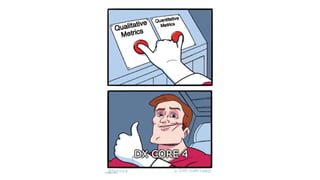
  • #34 A pervasive challenge for platform engineers is properly and effectively measuring the impact of their platform on things like developer experience and productivity. We’ve learned that no single metric can tell us exactly how effective our platform is, so we know we need to measure against multiple metrics. But should we measure the quantitative qualities of our platform, or should we rely on qualitative metrics such as survey data?
  • #35 And in considering that, the organization should seek to explore multiple measures and avoid Goodhart’s Law, which says that any measure which becomes a target ceases to be a good measure.
  • #36 SPACE expands upon DORA, learning that a single metric set will not be enough to gain a full understanding of developer experience and productivity. Rather, we must look at “a constellation of metrics in tension with one another”
  • #40 Developer experience is all about going to the developers for the answers. So we can start an improvement cycle by asking devs about current conditions, setting targets, using other metrics to track progress, and then evaluate whether we’re reaching our goals.
  • #43 Emphasize Cost of Qual metrics is high, time spent filling out surveys, etc, have to be repeated to get a trend
  • #47 Now we are getting somewhere!! We have some great sets of metrics with precedent, validated by real engineering teams… But could we streamline this even further? Each of these metrics can influence other metrics, we learned that from SPACE, could we reduce these based on those correlations?
  • #48 YES! Presenting: the most modern developer experience and productivity metric framework available, the DX Core 4. The most effective metrics have been pulled by these three major metric sets, and move into four new dimensions of Speed, Effectiveness, Quality, and Impact DX Core 4 is the diagnostic tool One ring tool
  • #50 Zooming in, we can see that our Key Metric for Effectiveness is something called the DXI
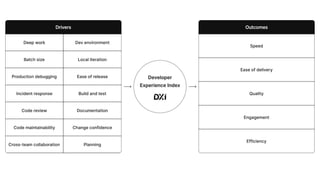
  • #53 The DXI is a formative measure of how, and to what extent, the right conditions exist for developers to be able to deliver effectively. The DXI measures 14 dimensions (Figure 2) found to be actionable (and changeable) at both the manager and organizational level, such as deep work, local iteration speed, release process, and confidence in making changes. DX uses linear regression analysis to assess the strength of the relationship between the DXI and time waste, and for modeling the predictive relationship between them. The most recent analysis of DXI was conducted in early 2024, based on a sample of 50,000 responses from 200 organizations. The DXI is calculated by taking the mean 16 items corresponding to key dimensions of developer experience. Efficiency is calculated through a self-reported outcome measure of time loss due to inefficiencies in the work environment. Past research by DX identified a comprehensive set of factors underlying developer experience. In designing the 14 dimensions included in the DXI, our researchers took into account both the actionability of issues for management and predictive power against outcomes such as engineering velocity, quality, and efficiency.
  • #54 But this is essential to building an 10x organization by way of optimal developer experience
  • #56 To use the survey template, load the questions into your preferred tool. If you’d like to use Google Forms, you can save time by making a copy of this ready-to-use template. Next, decide whether to make your survey anonymous or not. Either way can work, but anonymous surveys generally get better participation. Before sending out your survey, be sure to send out clear announcements over email or Slack to make sure that developers know (1) what the purpose of the survey is and (2) how the data will be used. To officially launch your survey, a short message like this works well: After you’ve collected responses, score the multiple choice questions using either mean or top box scoring. Mean scores are calculated by assigning each option a value between 1 and 5 and taking the average. Top box scores are calculated by the percentages of responses that choose one of the top two most favorable options. DX’s industry benchmarks use top-box scoring, if you’re interested in comparing your scores. Also be sure to carefully review open text responses, which can contain the most actionable bits of information. If you’ve collected a large number of comments, LLM tools such as ChatGPT can be useful for extracting core themes and suggestions. When you’ve finished analyzing results, be sure to publish your findings back to your organization so people feel that their time filling out the survey was worth while. I
  • #57 Reviewing the recommended frequency and scope of these surveys Google clip on rolling out metrics “An ally to developers”
  • #58 So what’s next? What can you start doing today? We have a ton of free resources available including survey templates and guides which can get you on your way to calculating and presenting metrics right now!
  • #60 NOTES A Decade of DORA talk - Nathen Equipped them to feel more confident in decision-making Before: I don’t know if what I’m doing is right After: I feel confident, well-researched, well-read Not seeing pain reflected in beginning part Getting questions about how to measure, whats platform, whats devops, how are they different? Know from the beginning about what their after picture looks like Set up pain at the beginning to bring them in, find empathy, know why they should listen Heavy on background theory at the beginning In spirit of WUB, spread more context/value throughout They are in a DORA (possibly SPACE) world Background lets us know that this is not unprecedented Works well as keynote, but workshop audience will want something more practical What decisions do I have to make