Importance of Creativity in
a Job
The experience of thinking, reacting, and
working in an imaginative way which is
characterized by a high degree of innovation
and originality, divergent thinking, and risk
taking.
Definition of Creativity
What is Creativity?
• Creativity refers to the act of making
something that previously did not exist.
• It is a way of thinking that involves the
imagination and intuition.
True Creativity and Innovation consist of
Seeing what everyone else has seen,
Thinking what no one else has thought and
Doing what no one has dared!
Creativity Always Involves Crossing
of Boundaries
So what makes creative people creative?
If we could look into the minds of creative geniuses, what would we see?
Joy of discovery
Questioning
Desire to interrelate
Tolerance of
ambiguity
Curiosity
Sense of challenge
Playfulness
Inquisitiveness
Willingness
to take risks
Positive
discontent
Desire to see
things differently
Desire to learn Willingness to
experiment
Wonder
Portrait of a Creative Person
“Creative people pay attention to their world,
see things differently, challenge assumptions,
take risks, are not afraid to fail, and strive to
generate multiple solutions to problems. They
are passionate about creativity and seek
opportunities to innovate.”
Creativity at Work
• Employers greatly value creative thinkers
because such employees can
– think of innovative work-related ideas and
approaches
– solve difficult or unusual problems
– relate meaningfully with co-workers and clients
and
– contribute positively to the growth of an
organization.
Developing your creativity will enable you to do
even the most mundane tasks in a mindful and
spirited way, opening up the possibilities for
innovation and self-fulfillment.
Creativity and Career Planning
• Creativity and Career Planning go hand in hand
as the new economy is largely based on the
exchange of knowledge.
• New employees must have the abilities to
– flow with change and opportunity
– continue to learn
– anticipate near and distant future trends and needs
– network and
– understand global change
Influences on Creativity
Discussion Point
A: What helps you
personally to be more
creative? B: What stops you
personally being more
creative?
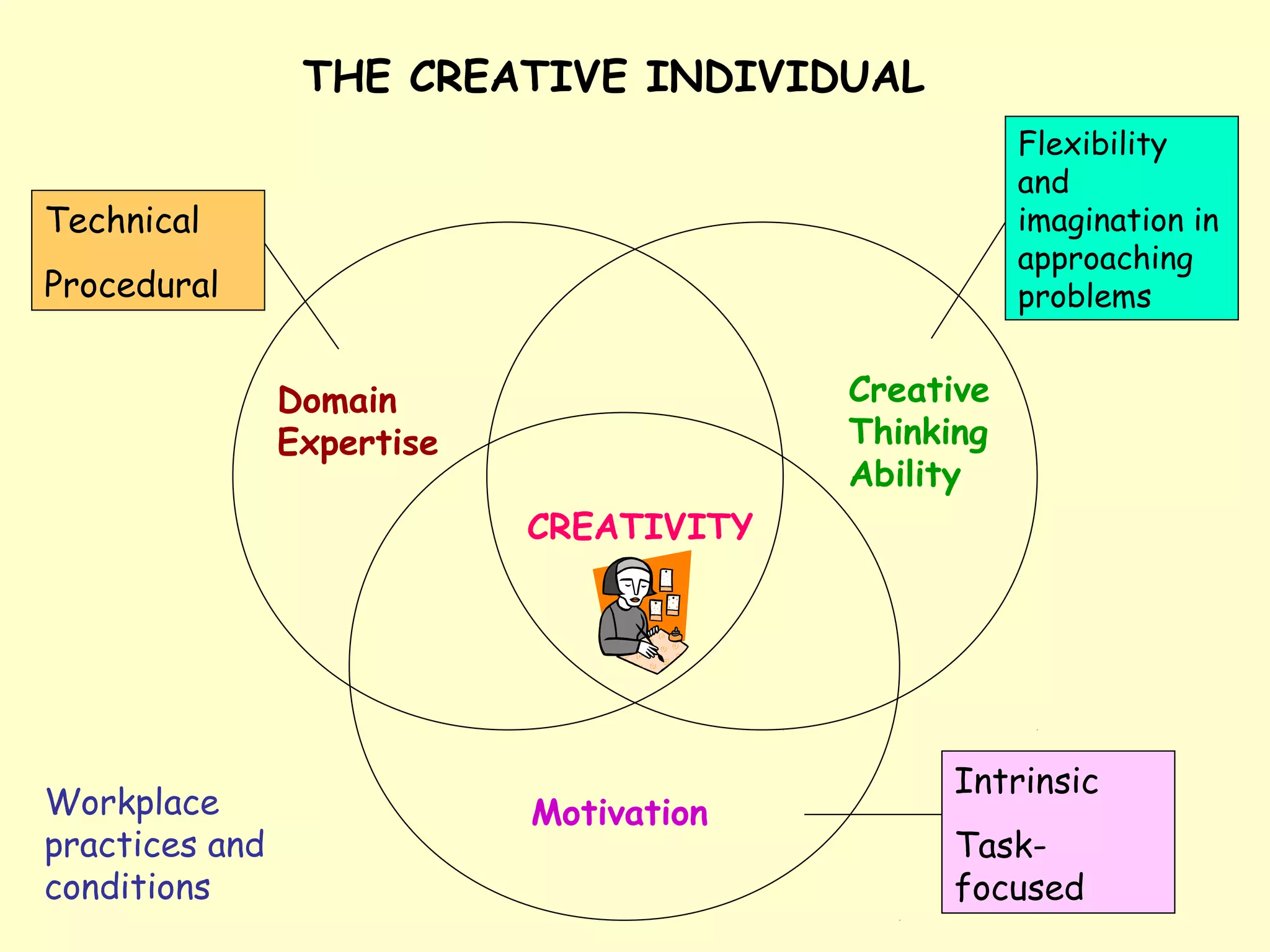
Domain
Expertise
Motivation
Creative
Thinking
Ability
CREATIVITY
Workplace
practices and
conditions
Flexibility
and
imagination in
approaching
problems
Technical
Procedural
Intrinsic
Task-
focused
THE CREATIVE INDIVIDUAL
Motivation
• Proposed that people will perform more creatively if
motivated by the work itself, rather than rewards
or punishments.
• Research evidence supports the idea that intrinsic
motivation produces more creative outcomes than
extrinsic ones.
•You must have knowledge of a field to
produce something novel within it!
• Importance of knowing the territory
• Development of problem solving methods
using exploration and trial and error
methods.
• Identification of problems / sensing gaps
Domain Expertise
Creative Thinking Ability
A range of skills identified by researchers as key to
creative thinking are:
• Problem or opportunity finding
• Seeing problems in new ways
• Generating a wide range of ideas (divergent thinking)
• Recognising which of one’s ideas are worth pursuing
(convergent thinking)
• Persuading others of the value of your ideas
Workplace Practices and Conditions
Research has shown a wide range of environmental
factors influencing individual creativity e.g
• Management support (e.g. gives positive informational feedback)
• Co-worker creativity
• Team or departmental climate for innovation
• Autonomy
• Access to resources
• Time to experiment
Gather
information
and
resources
Stage 2
Preparation
Produce one
or more
ideas or
products
Stage 3
Idea
Generation
Check ideas
against
criteria for the
task
Stage 4
Idea
Validation
STAGES OF INDIVIDUAL CREATIVITY
Stage 1
Task
Presentation
External
Source
Internal
Source
End
Stage 5
Outcome
Assessment
End
Back
to 1
Success
Failure
Progress
INDIVIDUAL
COMPONENT
A
Intrinsic
motivation to
do the task
INDIVIDUAL
COMPONENT
B
Skills in the
task domain
INDIVIDUAL
COMPONENT
C
Skills in
creative
thinking
Consequences of Creativity
Individual
• Self-esteem, job satisfaction, promotion, financial rewards
Team or group
• Team morale, achievement of team goals
Organisational
• Performance, investment, customer/client satisfaction
Societal
• Quality of life of general public, natural
environment
Six Tips To Help You Enhance Your
Creativity
1. Open Your Mind - Have one new experience every day; no
matter how small. New experiences stimulate the brain
and help you make new and original connections; critical
for boosting breakthroughs.
2. Diversify - Involve others in your problem-solving efforts
who bring a different perspective or cultural experience
than yours.
3. Mental Floss – Relax; Stress, exhaustion, boredom and
even pain can block our pathways to creativity.
4. Stop Looking For the Right Answer - Look for many
right answers.
5. Discover Your Creative Rhythm - Start paying attention
to when you get your best ideas.
6. Health Makes Wealth - Regular exercise not only
benefits your body, it boosts brain performance as well.
… and another one: Find what you
love to do
“We know that people do their most creative work when
they love doing what they’re doing. There’s no
substitute for intrinsic motivation, that is, motivation
that comes from within. Although such motivation
doesn’t guarantee creativity, dislike or lack of
interest in work practically guarantees non-
creativity.”
– Ten Keys to Creative Innovation by Robert J.
Sternberg
Thank You!

Importance of creativity in a job

  • 1.
  • 2.
    The experience ofthinking, reacting, and working in an imaginative way which is characterized by a high degree of innovation and originality, divergent thinking, and risk taking. Definition of Creativity
  • 3.
    What is Creativity? •Creativity refers to the act of making something that previously did not exist. • It is a way of thinking that involves the imagination and intuition.
  • 4.
    True Creativity andInnovation consist of Seeing what everyone else has seen, Thinking what no one else has thought and Doing what no one has dared!
  • 5.
    Creativity Always InvolvesCrossing of Boundaries
  • 6.
    So what makescreative people creative? If we could look into the minds of creative geniuses, what would we see? Joy of discovery Questioning Desire to interrelate Tolerance of ambiguity Curiosity Sense of challenge Playfulness Inquisitiveness Willingness to take risks Positive discontent Desire to see things differently Desire to learn Willingness to experiment Wonder
  • 7.
    Portrait of aCreative Person “Creative people pay attention to their world, see things differently, challenge assumptions, take risks, are not afraid to fail, and strive to generate multiple solutions to problems. They are passionate about creativity and seek opportunities to innovate.”
  • 8.
    Creativity at Work •Employers greatly value creative thinkers because such employees can – think of innovative work-related ideas and approaches – solve difficult or unusual problems – relate meaningfully with co-workers and clients and – contribute positively to the growth of an organization.
  • 9.
    Developing your creativitywill enable you to do even the most mundane tasks in a mindful and spirited way, opening up the possibilities for innovation and self-fulfillment.
  • 10.
    Creativity and CareerPlanning • Creativity and Career Planning go hand in hand as the new economy is largely based on the exchange of knowledge. • New employees must have the abilities to – flow with change and opportunity – continue to learn – anticipate near and distant future trends and needs – network and – understand global change
  • 11.
    Influences on Creativity DiscussionPoint A: What helps you personally to be more creative? B: What stops you personally being more creative?
  • 12.
  • 13.
    Motivation • Proposed thatpeople will perform more creatively if motivated by the work itself, rather than rewards or punishments. • Research evidence supports the idea that intrinsic motivation produces more creative outcomes than extrinsic ones.
  • 14.
    •You must haveknowledge of a field to produce something novel within it! • Importance of knowing the territory • Development of problem solving methods using exploration and trial and error methods. • Identification of problems / sensing gaps Domain Expertise
  • 15.
    Creative Thinking Ability Arange of skills identified by researchers as key to creative thinking are: • Problem or opportunity finding • Seeing problems in new ways • Generating a wide range of ideas (divergent thinking) • Recognising which of one’s ideas are worth pursuing (convergent thinking) • Persuading others of the value of your ideas
  • 16.
    Workplace Practices andConditions Research has shown a wide range of environmental factors influencing individual creativity e.g • Management support (e.g. gives positive informational feedback) • Co-worker creativity • Team or departmental climate for innovation • Autonomy • Access to resources • Time to experiment
  • 17.
    Gather information and resources Stage 2 Preparation Produce one ormore ideas or products Stage 3 Idea Generation Check ideas against criteria for the task Stage 4 Idea Validation STAGES OF INDIVIDUAL CREATIVITY Stage 1 Task Presentation External Source Internal Source End Stage 5 Outcome Assessment End Back to 1 Success Failure Progress INDIVIDUAL COMPONENT A Intrinsic motivation to do the task INDIVIDUAL COMPONENT B Skills in the task domain INDIVIDUAL COMPONENT C Skills in creative thinking
  • 18.
    Consequences of Creativity Individual •Self-esteem, job satisfaction, promotion, financial rewards Team or group • Team morale, achievement of team goals Organisational • Performance, investment, customer/client satisfaction Societal • Quality of life of general public, natural environment
  • 19.
    Six Tips ToHelp You Enhance Your Creativity 1. Open Your Mind - Have one new experience every day; no matter how small. New experiences stimulate the brain and help you make new and original connections; critical for boosting breakthroughs. 2. Diversify - Involve others in your problem-solving efforts who bring a different perspective or cultural experience than yours. 3. Mental Floss – Relax; Stress, exhaustion, boredom and even pain can block our pathways to creativity. 4. Stop Looking For the Right Answer - Look for many right answers. 5. Discover Your Creative Rhythm - Start paying attention to when you get your best ideas. 6. Health Makes Wealth - Regular exercise not only benefits your body, it boosts brain performance as well.
  • 20.
    … and anotherone: Find what you love to do “We know that people do their most creative work when they love doing what they’re doing. There’s no substitute for intrinsic motivation, that is, motivation that comes from within. Although such motivation doesn’t guarantee creativity, dislike or lack of interest in work practically guarantees non- creativity.” – Ten Keys to Creative Innovation by Robert J. Sternberg
  • 21.

Editor's Notes

  • #6 Boundaries may be more or less open or closed. Some are only closed in our minds. Some seem like mine fields. We hesitate and then we loose opportunities to be creative. The revolution in organizational design that is underway is attaching this problem. A synergy when working together produces something more than merely additive contributions. 1 + 1 = 1 indicates that neither additivity nor multiplicity are occuring – probably due to a closed boundary. Many things create closed boundaries, including biases, ignorance, policy, etc. Some boundaries are punishing to cross – like barbed wire. It make be a way to preserve identity, control, power, little kingdoms, etc., but think about what is lost.