IMPLEMENTING GUIDELINES
ON THE USE OF MELC PIVOT
4A BUDGET OF WORK (BOW)
IN ALL LEARNING AREAS IN KEY
STAGES 1-3
I. Rationale
1. The PIVOT 4A Budget of Work (BOW) is one of the prime
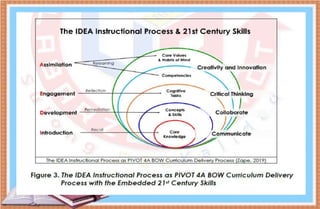
projects under the flagship program of the region, the Region IV-A
CALABARZON PIVOT to Quality Basic Education (R4AQUBE or
PIVOT 4A). The R4AQUBE or PIVOT 4A is a regional initiative
anchored to DepEd’s Sulong Edukalidad, a national program that
shifts to and focuses on quality basic education. This program is a
manifestation of significant shift of focus to improving quality of
basic education in the region with enhanced teacher performance
and improved mastery of learning competencies on the part of the
learners.
2. Anchored to its three (3) goals also known as the power
of E---Excellence, Empowerment and Excellence, the
R4AQUBE or PIVOT 4A circulates in its four (4) strategic
thrusts such as follows: (a) aligning focus and intervention,
(b) advancing handholding initiatives, (c) amplifying defined
technical assistance to target delivery units, and (d)
appraising stakeholders on progress of intervention. The
first strategic thrust---aligning focus and intervention---
focuses on curricular innovation and redirection which
involves careful analysis, review and mapping of the
curriculum leading to quality teaching-learning process and
outcomes.
3. In response to the first key reform area (KRA) of Sulong
Edukalidad known as K to 12 curriculum review and update,
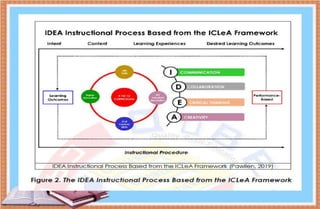
DepEd CALABARZON develops the MELC
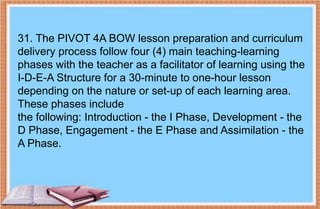
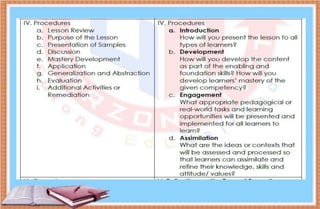
PIVOT 4A BOW which aims to redirect the teaching of the
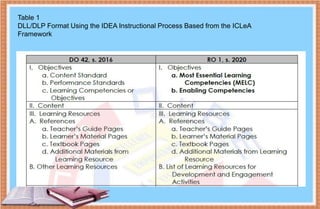
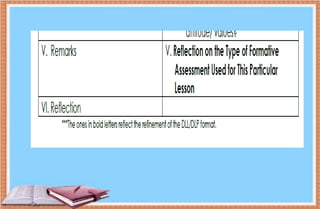
target learning competencies (LCs) into more precise and
quality-driven direction by placing
emphasis on the most essential learning competencies
(MELCs) involving more relevant knowledge, skills, and
attitudes/values (KSAVs) significant to the
everchanging21st century society. Also, this project directs
the adaptation and reformation of the curriculum to the
current demands of the society while the country is
adjusting to the emerging needs of the new normal.
4. Guided by the provisions of Republic Act 10533, Section
5, Paragraphs B and H and Rule II Section 10.2 Paragraphs
B and H of DepEd Order No. 43 s. 2013,
DepEd CALABARZON, through the CLMD, takes an
initiative in developing the PIVOT 4A BOW in making the
curriculum relevant, responsive and flexible by
localizing, indigenizing, contextualizing and enhancing it to
ensure mastery of the target LCs and MELCs and
promoting holistic development of learners’ knowledge,
skills and attitude/values (KSAVs) from Kindergarten to
Grade 10.
5. With the ever-changing demands of the 4th Industrial
Revolution classrooms and the differences in educational
structures from one region to another, the
development of the PIVOT 4A BOW takes the lead in
making the K to 12 Basic Education Curriculum suitable to
the needs of teachers and learners in CALABARZON as
this would guide them in re-structuring their lessons,
delivery and assessment.
6. The MELC PIVOT 4A BOW is a teaching resource
material and reference that contains LCs, MELCs and time
allotment arranged into columns for easy
reference and notation. This would guide teachers in
designing and planning their lessons. The design of the
MELC PIVOT 4A BOW is influenced by various teaching-
learning principles focusing on the following:
a. the nature of learners;
b. KSAVs learners should learn; and
c. brevity of KSAVs.
7. The PIVOT 4A BOW focuses on recalling, remediating,
reflecting and relearning principles attuned to diverse
learners (Zape, 2020). The context of this PIVOT4A BOW is
not only to decongest the curriculum but to refocus the
curricular direction in the region towards quality teaching-
learning processes and desired learning outcomes. This
also embodies the complete cycle of learning from
acquisition to reflection which is important in developing
holistic learners in the 21st century learning environment.
8. In understanding the contexts of the PIVOT 4A BOW,
identifying the enabling and enrichment competencies is
necessary (Pawilen, 2020). Enabling
competencies are important to bridge and guide teachers
and learners in the process of understanding complex
learning competencies while enrichment
learning competencies are necessary to further enhance the
KSAVs acquired/learned in the classroom.
9. The development of the PIVOT 4A BOW in each learning
area for Key Stages 1- 3 ensure the achievement of the
grade level and key stage standards in response to the
Department’s call to produce proficient and lifelong learners
who can apply their KSAVs in solving real-world problems.
II. Policy Objectives
10. This policy aims to:
a. Guide public elementary and secondary school teachers
in designing and preparing their lessons using the MELC
PIVOT 4A BOW grounded on the most
essential learning competencies (MELCs) and enabling
competencies; and
b. Redirect instruction in the classroom as to understanding
the MELCs by bridging them through the identified enabling
competencies as mapped
in the MELC PIVOT 4A BOW.
III. Scope of the Regional Policy
11. This policy is intended to guide public
elementary and secondary school teachers
and curriculum managers in the region in
effectively organizing, managing and
teaching the LCs and MELCs under the K
to 12 Basic Education Program.
IV. Definition of Terms
12. For the purposes of this policy, the following terms are
defined:
a. Budget of Work (BOW). This refers to a set of guide
providing the specific MELCs, LCs and their number of days
to be taught in reference to the targets of each learning area
and grade level. This provides greater
attention to more relevant learning competencies as to their
enabling and enrichment competencies.
b. Curriculum Managers. These refer to
instructional leaders who supervise and ensure
that the targets of the curriculum are well-
managed and implemented. These include
school heads (principals, officers-in-charge
(OICs) and/or teachers-in-charge (TICs), Public
Schools District Supervisors (PSDSs) and
Education Program Supervisors (EPSs).
c. Enabling Competencies. These are pre-
requisite skills, knowledge and values needed
by learners in learning/ understanding the target
competencies.
d. Enrichment Competencies. These are
additional skills, knowledge and values that
could enrich learner understanding/ learning.
e. Key Stage. This refers to stages of basic
education in the Philippines. These are
Key Stage 1 - Kindergarten to Grade 3,
Key Stage 2 - Grades 4 to 6,
KeyStage 3 - Grades 7 to 10 and
Key Stage 4 - Grades 11 to 12.
f. Kindergarten. This is the first stage of
compulsory and mandatory formal
education which consists of one (1) year of
preparatory education for children at least five
(5) years old as prerequisite for Grade One
(DepEd Order No. 47, s. 2016).
g. Learner. It refers to a pupil or student
enrolled in basic education of the
Department of Education (DepEd).
h. Learning Areas. These refer to the subjects
in the basic education curriculum
like Mother Tongue-Based Multilingual
Education (MTB-MLE), English, Filipino,
Mathematics, Science, Araling Panlipunan (AP),
Music, Arts, Physical Education and Health
(MAPEH), Edukasyon sa Pagpapakatao (EsP)
and Technology and Livelihood Education
(TLE).
i. Learning Competency. This refers to a
specific skill performed with varying
degrees of independence. It has different
degrees of difficulty and performance levels. It
also refers to the ability to perform activities
according to the standards expected by drawing
one’s knowledge, skills and attitude (DepEd
Order No. 21, s. 2019).
j. Learning Resources. These refer to any print,
non-print, offline and/or online
materials aligned to the contexts of the K to 12
Basic Education Curriculum. They are used by
learners as materials in meeting curriculum
expectations.
k. Most Essential Learning Competencies
(MELCs). These are the most important LCs in
each learning area and grade level needed by
each learner to learn, understand, use and
apply in an environment/ situation of varying
contexts.
l. PIVOT 4A. This refers to the flagship program
of the region known as the
Region IV-A CALABARZON PIVOT to Quality
Basic Education. Oftentimes, this
is also called the R4AQUBE.
V. Policy Statement
13. This policy is issued to ensure effective use
and implementation of the MELC PIVOT 4A
Budget of Work (BOW) in all learning areas in
Key Stages 1-3 in all public elementary and
secondary schools in the region. Schools
Division Offices (SDOs), through their
respective Curriculum Implementation Divisions
(CIDs), shall oversee the implementation of
these guidelines in all public schools under their
jurisdiction.
VI. Parts, Features and Use
14. Each MELC PIVOT 4A BOW has different
parts and/or features considering the
nature and uniqueness of each learning area.
Basically, designs of the PIVOT
4A BOW are grouped into three (3)---(a)
Kindergarten, (b) languages (English,
Filipino and MTB-MLE), and (c) other non-
language learning areas.
15. The MELC PIVOT 4A BOW for Kindergarten
consists of quarter, MELCs, domains of child
development, learning competencies and
assignment which may
either be first to appear or a follow-up
competency. The domains of child
development are considered as the basic
features and framework of early
childhood education.
16. The MELC PIVOT 4A BOWs in Mother
Tongue-Based Multilingual Education
(MTBMLE), English and Filipino contain the
following parts: quarter, MELCs, domains,
learning competencies and number of days
taught. The unique features of
these BOWs as compared to the other learning
are the language domains
which reflect the different learning targets
and/or macro skills. Domains vary
from one grade level to another.
17. The MELC PIVOT 4A BOWs in non-
Kindergarten and non-language learning
areas contain the following parts: quarter,
MELCs, learning competencies and
number of days taught. Meanwhile, PIVOT 4A
BOW in MAPEH is also divided into its four
components: Music, Arts, Physical Education
and Health. Also, PIVOT BOW in EPP/TLE is
also presented and categorized as to
components and/or specializations.
18. Number of days taught refer to the target number of
sessions learning competency/ies have to be taught (see
each MELC PIVOT 4A BOW).
Considering the differences in teachers’ timeframe and
learners’ abilities, the MELC PIVOT 4A BOWs provide
directions on how teachers would plan their
lessons in terms of curriculum implementation in their
classrooms. In most cases, one (1) learning competency or
MELC shall be taught for one meeting-session. For learning
areas with a bunch of learning competencies or MELCs,
they have been clustered/grouped and number of
days/meeting-sessions are assigned based on their
relationship and relevance.
19. In the K to 12 Curriculum Guide, each learning
competency code contains the number of days and/or
weeks as to the length an LC should be taught. These
MELC PIVOT 4A BOWs redesigned the number of days
indicated in the code without jeopardizing the actual K to 12
BEC LCs. As such, in writing their PIVOT
4A Detailed Lesson Plans (DLPs) or Daily Learning Logs
(DLLs), teachers shall not be asked to write the code of the
LCs or MELCs as the number of days for each
lesson has been redesigned to suit the needs of schools.
20. In each quarter, all target LCs and/or MELCs have to be
taught in specific mandatory/non-negotiable contact
days/weeks as reflected in the BOW.
Public elementary and secondary school teachers and
curriculum managers shall strictly observe this mandatory
contact period in a quarter. The excess
number of days, with reference to the total number of days
in a year as declared by the Department for SY 2020- 2021
shall then be used/designed by the school head on the
conduct of quarterly exams, co-curricular or culminating
activities subject to the existing guidelines or protocols of
the Central Office and other prevailing rules that may be
released under the new
normal.
21. Considering the unique features of each
learning area, MELC PIVOT 4A BOW
per learning area is presented with
preliminaries which explain and guide
teachers on how a specific BOW shall be used.
Specific guidelines would help
teachers teaching specific learning areas on
how they would prepare and design their
lessons.
VII. Most Essential Learning Competencies (MELCs)
22. The Central Office, through the Bureau of Curriculum
Development (BCD), due to prevailing situation in the
country on the Corona Virus Disease 2019 or COVID-19,
has identified the most essential learning competencies
(MELCs) in each learning area. MELCs are the most
important LCs in each learning area and grade level needed
by each learner to learn, understand, use and apply in an
environment/ situation of varying contexts. These are also
the standard LCs that teachers must focus on in terms of
delivery and assessment.
VII. Most Essential Learning Competencies (MELCs)
22. The Central Office, through the Bureau of Curriculum
Development (BCD), due to prevailing situation in the
country on the Corona Virus Disease 2019 or COVID-19,
has identified the most essential learning competencies
(MELCs) in each learning area. MELCs are the most
important LCs in each learning area and grade level needed
by each learner to learn, understand, use and apply in an
environment/ situation of varying contexts. These are also
the standard LCs that teachers must focus on in terms of
delivery and assessment.
23. MELCs are knowledge, skills and
attitudes/values that shall be mastered by each
learner to achieve the set content and
performance standards in each
quarter, grade level or key stage.
24. The MELC PIVOT 4A BOWs used the MELCs as the
key focus in each quarter in each learning area and grade
level. The number of MELCs varies from one
quarter to another and one grade level to another. In
planning lessons for each quarter, teachers shall look into
the MELC PIVOT 4A BOW and locate the
indicated MELCs. All LCs in the MELC PIVOT 4A BOW
shall still be taught with great emphasis on the MELCs. As
such, more activities and assessment procedures shall be
given in dealing with MELCs. Lists of MELCs can also be
accessed via https://tinyurl.com/PIVOT4ACLMD.
VIII. Enabling and Enrichment Competencies
25. Some MELCs and LCs in the MELC PIVOT
4A BOW are written as terminal competencies.
As such, these MELCs and LCs have to be
introduced and/or
taught using enabling competencies.
Meanwhile, some MELCs and LCs have to be
further enhanced with the help of enrichment
competencies.
26. Enabling competencies are pre-requisite
skills, knowledge and attitude/ values needed
by learners in learning/ understanding the target
learning
competencies, while enrichment competencies
are additional skills,
knowledge and values that could enrich learner
understanding/learning.
27. The MELC PIVOT 4A BOW employs review and
mapping principles to arrive at the specific learning
competencies for delivery with respect to the time
allotment per learning area and modality appropriate at this
time. These MELCs and LCs were identified using the
SMART test. Enabling and enrichment
competencies are written in objective form under
knowledge, skills and/or attitude/value targets. In the MELC
PIVOT 4A BOW, some LCs already function
as enabling competencies in achieving the MELCs or other
LCs. Other MELCs and LCs in need of enabling and
enrichment competencies are also identified
in the process.
28. Enabling and enrichment competencies shall be used
by teachers as their guide in writing their detailed lesson
plans (DLP) or daily lesson logs (DLLs).
Enabling competencies shall be used as a springboard to
meet the expectation of the MELC. Meanwhile, enrichment
competencies shall be used in classes in need of
remediation and enrichment activities.
29. The list of MELCs and LCs with corresponding enabling
and enrichment competencies for each learning area per
grade level can be accessed via
https://tinyurl.com/PIVOT4ACLMD at the beginning of the
school year.
IX. MELC PIVOT 4A BOW (DLL/DLP) Lesson
Preparation, Curriculum Design and Framework
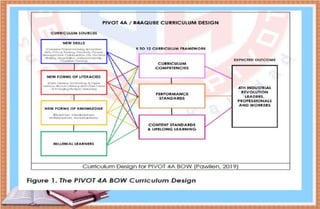
30. The MELC PIVOT 4A BOW uses the PIVOT 4A
Curriculum Design anchored to the
Intent-Content-Learning Experiences-Desired Learning
Outcomes (Assessment) or ICLeA Framework.
31. The PIVOT 4A BOW lesson preparation and curriculum
delivery process follow four (4) main teaching-learning
phases with the teacher as a facilitator of learning using the
I-D-E-A Structure for a 30-minute to one-hour lesson
depending on the nature or set-up of each learning area.
These phases include
the following: Introduction - the I Phase, Development - the
D Phase, Engagement - the E Phase and Assimilation - the
A Phase.
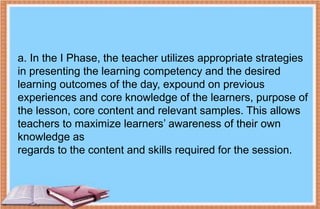
a. In the I Phase, the teacher utilizes appropriate strategies
in presenting the learning competency and the desired
learning outcomes of the day, expound on previous
experiences and core knowledge of the learners, purpose of
the lesson, core content and relevant samples. This allows
teachers to maximize learners’ awareness of their own
knowledge as
regards to the content and skills required for the session.
b. In the D Phase, the teacher presents
activities, tasks and contents of value
and interest to the learners. Most of these
activities and tasks must simply and directly
revolved around the concepts to develop and
master the skills or the competency.
c. In the E Phase, the teacher allows the
learners to be engaged in various tasks and
opportunities in building their KSAVs to
meaningfully connect their learnings. This
further requires teachers to engage and expose
all learners to real life situations that will ignite
their interests to meet the expectations, make
their performance satisfactory or produce a
product or performance.
d. In the A Phase, the teacher brings the
learners to a process where they
demonstrate ideas, interpretations, mindset or
values and create pieces of
information that will form part of their knowledge
in reflecting, relating or using it effectively in any
situation or context. This also requires teachers
to encourage learners in creating conceptual
structures giving them the avenue to integrate
new and old learnings.
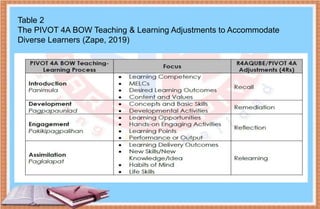
Table 2
The PIVOT 4A BOW Teaching & Learning Adjustments to Accommodate
Diverse Learners (Zape, 2019)
32. Starting June 1, all public elementary and
secondary school teachers in the region shall
prepare their Detailed Lesson Plan (DLPs) and/or
Daily Learning Logs (DLL) for MELCs and/or
enabling competencies using the IDEA Instructional
Process based from the ICLeA Framework format
(see Templates
for Lesson Preparation). This instructional process
design is an abridged and refined format based from
the provisions of DepEd Order No. 42, s. 2016
(Policy Guidelines on Daily Lesson Preparation for
the K to 12 Curriculum).
Table 1
DLL/DLP Format Using the IDEA Instructional Process Based from the ICLeA
Framework
33. In designing their PIVOT 4A DLLs/DLPs, all
public elementary and secondary school
teachers in the region may opt to prepare a
lesson in: (a) a daily basis or (b) a period when
an LC or MELC has to be taught, i.e. if an LC
and/or MELC has to be taught for five (5) days
based from the PIVOT 4A BOW, the teacher
may prepare a PIVOT 4A DLL/DLP good for five
(5) days.
34. An exemplar for each learning area will be
released by CLMD-4A by the end
of May as a guide for all teachers in preparing
their DLPs/DLLs. A separate
memo indicating the assigned MELCs and/or
LCs for each SDO shall also be
issued.
X. Learning Delivery (LD)
35. Regional Memorandum Nos. 11, s. 2015 and
233, s. 2016 enjoin that teachers should be
constructivist, inquiry-based, reflective, collaborative
and integrative in dealing with the teaching-learning
process as mandated by Republic Act 10533.
Teachers as guided by the IDEA instructional process
are also
encouraged to be creative in delivering their lessons
and make their approaches flexible, responsive and
relevant to the needs of the learners using any
applicable modalities at this time of pandemic.
36. Varying strategies must be applied in dealing with
enabling and enrichment competencies as careful
assessment on the needs of learners is necessary to
properly address their concerns towards quality. The
following learning delivery
options shall be applied in teaching these MELCs
and LCs:
a. Face-to-Face (F2F)
b. Distance Learning
- Online Distance Learning (ODL)
- Modular Distance Learning (MDL)
- Television/Radio-Based Instruction (TV-RBI)
c. Blended Learning
- F2F and ODL
- F2F and MDL
- F2F and TV/RBI
- F2F and Combination of ODL, MDL and TV/RBI
XI. Learning Resources (LRs)
37. Learning resources (LRs) are important in
instructional delivery. They are mainly used to
support teaching and learning. Resources vary from
print, non-print and online features. In the contexts of
the PIVOT 4A BOWs, LRs for each learning
competency have been mapped.
38. The lists of LRs designed for each LC in each
learning area per grade level can be accessed via
https://tinyurl.com/PIVOT4ACLMD at the beginning
of the school year. In this link, LRs are categorized
as Learners and Teachers’ Materials. Under these
categories, LRs are further grouped as materials for
the learning
delivery options stated in Item 36 of Part X –
Learning Delivery.
XII. Assessment (Multimodal Assessment
Strategies)
39. The basic assessment procedures in dealing with
the K to 12 LCs, MELCs and enabling and
enrichment competencies should comply with the
provisions of DepEd Order No. 8, s. 2015 (Policy
Guidelines on Classroom Assessment for the K to 12
Basic Education Program). Teachers are encouraged
to use a wide range of formative, summative,
authentic and performance assessment tools and
approaches involving the use of multimodal
assessment strategies to ensure that all learning
competencies are well-assessed.
40. In using multimodal assessment, teachers should
help learners in understanding the contexts of good
performance by providing them clear desired learning
outcomes, criteria, expected outputs and engaging
learners as active participants in the feedback
process where teachers act as responsible academic
partners.
41. Weeks (2018) mentioned that the use of
multimodal assessment is important to:
(a) keep up with a society that is increasingly digital
and ensure that assessment mirrors current and
future employment needs; (b) be in tune with
learners’ expectations and literacy practices; and (c)
offer choice and flexibility in assessment.
42. As an approach, multimodal assessment offers
significant amount of assessment strategies and
techniques to teachers to carefully assess learners’
performance in various manners relative to the
context of the K to 12 LCs and MELCs. This involves
the promotion of reflective learning as one of the key
agents of multimodal assessment. Thus, all teachers
are encouraged to facilitate the development of
learners’ portfolio per week on any modality
chosen by the learners and/or parents.
43. The use of reflective learning embedded in
multimodal assessment should not only direct
feedback process but also promote personal
reflection processes where learners reflect more on
their knowledge, skills, attitude/values,
aspirations and actions as contribution in making the
society a better place for
all. This allows learners to think about what they
have thought, read, seen, done and learned by
relating these concrete concepts to their own lives.
Through this, learners can make meaning on the
significance and relevance of what
they are doing and learning in the classroom to their
everyday lives.
44. As reflective learning emphasizes the importance of the
role of the ‘self’ in personal experiences and social contexts,
teachers should engage learners
into various reflective learning activities such as, but not
limited to, Schon’s (1983) reflection-in-action (reflecting on
personal or social actions as they
happen) and reflection-on-action (reflecting on personal or
social action after their occurrence to review, assess or
evaluate the situation). From the long-list of reflective
learning practices, teachers may choose any appropriate
reflective learning strategies relevant to the contexts and
level of the learners.
XIII. Teaching Observation Process
45. Curriculum managers shall strictly adhere to the
guidelines specified in each PIVOT 4A BOW. Considering
the COVID situation in the country, all learning leaders shall
create a mechanism on how teaching observations be
made in various modalities employed or used by each
school. They shall also check if the LCs and/or MELCs to
be taught in a lesson during teaching observation have
enabling and/or enrichment competencies which teachers
should use
during lesson planning and delivery.
46. Other teaching observation provisions shall follow the
mandates of the Philippine Professional Standards for
Teachers – Results-Based Performance
Management System (PPST-RPMS) and other RPMS-
related issuances including the directive indicated in DepEd
Memorandum No. 45, s. 2020 (Results-Based
Performance Management System Guidelines for School
Year 2019-2020 Yearend Activities in Light of COVID-19
Measures).
XIV. Monitoring and Evaluation
47. To monitor and evaluate the delivery and effective
implementation of the MELC PIVOT 4A BOW in all public
elementary and secondary schools,
curriculum managers shall peruse the PIVOT 4A BOW per
learning area per grade level in monitoring classroom
activities.
48. The CLMD and the CID shall monitor the full compliance
of all public elementary and secondary schools on the
provisions of these guidelines.
Monitoring and Evaluation Form shall be issued by CLMD
before the beginning of the school year. The M&E Form
shall be accomplished by school heads
which shall be then evaluated by the CID Education
Program Supervisors. A quarterly consolidated Division
M&E Report shall be submitted to the CLMD at
clmd.calabarzon@deped.gov.ph during the quarterly
examination week of each quarter as determined by the
DepEd Calendar.
XV. Effectivity
49. This Order provides direction and guidance to all public
elementary and secondary school teachers and curriculum
managers in the region relative to
its use and implementation. This shall immediately take
effect to prepare the schools and all stakeholders for the
opening of classes come August 24, 2020.
XVI. Enclosures
a. PIVOT 4A BOW for Kindergarten
b. PIVOT 4A BOW in MTB-MLE
c. PIVOT 4A BOW in Filipino
d. PIVOT 4A BOW in English
e. PIVOT 4A BOW in Science
f. PIVOT 4A BOW in Mathematics
g. PIVOT 4A BOW in Araling Panlipunan (AP)
h. PIVOT 4A BOW in Edukasyon sa Pagpapakatao (EsP)
i. PIVOT 4A BOW in Music, Arts, Physical Education and Health (MAPEH)
j. PIVOT 4A BOW in Edukasyong Pantahanan at Pangkabuhayan (EPP) and
Technology and Livelihood Education (TLE)
k. Teacher’s Guide in Using the I-D-E-A Structure
l. PIVOT 4A Daily Lesson Templates
m. Copyright Page
IMPLEMENTING-GUIDELINES-ON-THE-USE-OF-MELC-PIVOT.pptx

IMPLEMENTING-GUIDELINES-ON-THE-USE-OF-MELC-PIVOT.pptx

  • 1.
    IMPLEMENTING GUIDELINES ON THEUSE OF MELC PIVOT 4A BUDGET OF WORK (BOW) IN ALL LEARNING AREAS IN KEY STAGES 1-3
  • 2.
    I. Rationale 1. ThePIVOT 4A Budget of Work (BOW) is one of the prime projects under the flagship program of the region, the Region IV-A CALABARZON PIVOT to Quality Basic Education (R4AQUBE or PIVOT 4A). The R4AQUBE or PIVOT 4A is a regional initiative anchored to DepEd’s Sulong Edukalidad, a national program that shifts to and focuses on quality basic education. This program is a manifestation of significant shift of focus to improving quality of basic education in the region with enhanced teacher performance and improved mastery of learning competencies on the part of the learners.
  • 3.
    2. Anchored toits three (3) goals also known as the power of E---Excellence, Empowerment and Excellence, the R4AQUBE or PIVOT 4A circulates in its four (4) strategic thrusts such as follows: (a) aligning focus and intervention, (b) advancing handholding initiatives, (c) amplifying defined technical assistance to target delivery units, and (d) appraising stakeholders on progress of intervention. The first strategic thrust---aligning focus and intervention--- focuses on curricular innovation and redirection which involves careful analysis, review and mapping of the curriculum leading to quality teaching-learning process and outcomes.
  • 4.
    3. In responseto the first key reform area (KRA) of Sulong Edukalidad known as K to 12 curriculum review and update, DepEd CALABARZON develops the MELC PIVOT 4A BOW which aims to redirect the teaching of the target learning competencies (LCs) into more precise and quality-driven direction by placing emphasis on the most essential learning competencies (MELCs) involving more relevant knowledge, skills, and attitudes/values (KSAVs) significant to the everchanging21st century society. Also, this project directs the adaptation and reformation of the curriculum to the current demands of the society while the country is adjusting to the emerging needs of the new normal.
  • 5.
    4. Guided bythe provisions of Republic Act 10533, Section 5, Paragraphs B and H and Rule II Section 10.2 Paragraphs B and H of DepEd Order No. 43 s. 2013, DepEd CALABARZON, through the CLMD, takes an initiative in developing the PIVOT 4A BOW in making the curriculum relevant, responsive and flexible by localizing, indigenizing, contextualizing and enhancing it to ensure mastery of the target LCs and MELCs and promoting holistic development of learners’ knowledge, skills and attitude/values (KSAVs) from Kindergarten to Grade 10.
  • 6.
    5. With theever-changing demands of the 4th Industrial Revolution classrooms and the differences in educational structures from one region to another, the development of the PIVOT 4A BOW takes the lead in making the K to 12 Basic Education Curriculum suitable to the needs of teachers and learners in CALABARZON as this would guide them in re-structuring their lessons, delivery and assessment.
  • 7.
    6. The MELCPIVOT 4A BOW is a teaching resource material and reference that contains LCs, MELCs and time allotment arranged into columns for easy reference and notation. This would guide teachers in designing and planning their lessons. The design of the MELC PIVOT 4A BOW is influenced by various teaching- learning principles focusing on the following: a. the nature of learners; b. KSAVs learners should learn; and c. brevity of KSAVs.
  • 8.
    7. The PIVOT4A BOW focuses on recalling, remediating, reflecting and relearning principles attuned to diverse learners (Zape, 2020). The context of this PIVOT4A BOW is not only to decongest the curriculum but to refocus the curricular direction in the region towards quality teaching- learning processes and desired learning outcomes. This also embodies the complete cycle of learning from acquisition to reflection which is important in developing holistic learners in the 21st century learning environment.
  • 9.
    8. In understandingthe contexts of the PIVOT 4A BOW, identifying the enabling and enrichment competencies is necessary (Pawilen, 2020). Enabling competencies are important to bridge and guide teachers and learners in the process of understanding complex learning competencies while enrichment learning competencies are necessary to further enhance the KSAVs acquired/learned in the classroom.
  • 10.
    9. The developmentof the PIVOT 4A BOW in each learning area for Key Stages 1- 3 ensure the achievement of the grade level and key stage standards in response to the Department’s call to produce proficient and lifelong learners who can apply their KSAVs in solving real-world problems.
  • 11.
    II. Policy Objectives 10.This policy aims to: a. Guide public elementary and secondary school teachers in designing and preparing their lessons using the MELC PIVOT 4A BOW grounded on the most essential learning competencies (MELCs) and enabling competencies; and b. Redirect instruction in the classroom as to understanding the MELCs by bridging them through the identified enabling competencies as mapped in the MELC PIVOT 4A BOW.
  • 12.
    III. Scope ofthe Regional Policy 11. This policy is intended to guide public elementary and secondary school teachers and curriculum managers in the region in effectively organizing, managing and teaching the LCs and MELCs under the K to 12 Basic Education Program.
  • 13.
    IV. Definition ofTerms 12. For the purposes of this policy, the following terms are defined: a. Budget of Work (BOW). This refers to a set of guide providing the specific MELCs, LCs and their number of days to be taught in reference to the targets of each learning area and grade level. This provides greater attention to more relevant learning competencies as to their enabling and enrichment competencies.
  • 14.
    b. Curriculum Managers.These refer to instructional leaders who supervise and ensure that the targets of the curriculum are well- managed and implemented. These include school heads (principals, officers-in-charge (OICs) and/or teachers-in-charge (TICs), Public Schools District Supervisors (PSDSs) and Education Program Supervisors (EPSs).
  • 15.
    c. Enabling Competencies.These are pre- requisite skills, knowledge and values needed by learners in learning/ understanding the target competencies. d. Enrichment Competencies. These are additional skills, knowledge and values that could enrich learner understanding/ learning.
  • 16.
    e. Key Stage.This refers to stages of basic education in the Philippines. These are Key Stage 1 - Kindergarten to Grade 3, Key Stage 2 - Grades 4 to 6, KeyStage 3 - Grades 7 to 10 and Key Stage 4 - Grades 11 to 12.
  • 17.
    f. Kindergarten. Thisis the first stage of compulsory and mandatory formal education which consists of one (1) year of preparatory education for children at least five (5) years old as prerequisite for Grade One (DepEd Order No. 47, s. 2016). g. Learner. It refers to a pupil or student enrolled in basic education of the Department of Education (DepEd).
  • 18.
    h. Learning Areas.These refer to the subjects in the basic education curriculum like Mother Tongue-Based Multilingual Education (MTB-MLE), English, Filipino, Mathematics, Science, Araling Panlipunan (AP), Music, Arts, Physical Education and Health (MAPEH), Edukasyon sa Pagpapakatao (EsP) and Technology and Livelihood Education (TLE).
  • 19.
    i. Learning Competency.This refers to a specific skill performed with varying degrees of independence. It has different degrees of difficulty and performance levels. It also refers to the ability to perform activities according to the standards expected by drawing one’s knowledge, skills and attitude (DepEd Order No. 21, s. 2019).
  • 20.
    j. Learning Resources.These refer to any print, non-print, offline and/or online materials aligned to the contexts of the K to 12 Basic Education Curriculum. They are used by learners as materials in meeting curriculum expectations.
  • 21.
    k. Most EssentialLearning Competencies (MELCs). These are the most important LCs in each learning area and grade level needed by each learner to learn, understand, use and apply in an environment/ situation of varying contexts. l. PIVOT 4A. This refers to the flagship program of the region known as the Region IV-A CALABARZON PIVOT to Quality Basic Education. Oftentimes, this is also called the R4AQUBE.
  • 22.
    V. Policy Statement 13.This policy is issued to ensure effective use and implementation of the MELC PIVOT 4A Budget of Work (BOW) in all learning areas in Key Stages 1-3 in all public elementary and secondary schools in the region. Schools Division Offices (SDOs), through their respective Curriculum Implementation Divisions (CIDs), shall oversee the implementation of these guidelines in all public schools under their jurisdiction.
  • 23.
    VI. Parts, Featuresand Use 14. Each MELC PIVOT 4A BOW has different parts and/or features considering the nature and uniqueness of each learning area. Basically, designs of the PIVOT 4A BOW are grouped into three (3)---(a) Kindergarten, (b) languages (English, Filipino and MTB-MLE), and (c) other non- language learning areas.
  • 24.
    15. The MELCPIVOT 4A BOW for Kindergarten consists of quarter, MELCs, domains of child development, learning competencies and assignment which may either be first to appear or a follow-up competency. The domains of child development are considered as the basic features and framework of early childhood education.
  • 25.
    16. The MELCPIVOT 4A BOWs in Mother Tongue-Based Multilingual Education (MTBMLE), English and Filipino contain the following parts: quarter, MELCs, domains, learning competencies and number of days taught. The unique features of these BOWs as compared to the other learning are the language domains which reflect the different learning targets and/or macro skills. Domains vary from one grade level to another.
  • 26.
    17. The MELCPIVOT 4A BOWs in non- Kindergarten and non-language learning areas contain the following parts: quarter, MELCs, learning competencies and number of days taught. Meanwhile, PIVOT 4A BOW in MAPEH is also divided into its four components: Music, Arts, Physical Education and Health. Also, PIVOT BOW in EPP/TLE is also presented and categorized as to components and/or specializations.
  • 27.
    18. Number ofdays taught refer to the target number of sessions learning competency/ies have to be taught (see each MELC PIVOT 4A BOW). Considering the differences in teachers’ timeframe and learners’ abilities, the MELC PIVOT 4A BOWs provide directions on how teachers would plan their lessons in terms of curriculum implementation in their classrooms. In most cases, one (1) learning competency or MELC shall be taught for one meeting-session. For learning areas with a bunch of learning competencies or MELCs, they have been clustered/grouped and number of days/meeting-sessions are assigned based on their relationship and relevance.
  • 28.
    19. In theK to 12 Curriculum Guide, each learning competency code contains the number of days and/or weeks as to the length an LC should be taught. These MELC PIVOT 4A BOWs redesigned the number of days indicated in the code without jeopardizing the actual K to 12 BEC LCs. As such, in writing their PIVOT 4A Detailed Lesson Plans (DLPs) or Daily Learning Logs (DLLs), teachers shall not be asked to write the code of the LCs or MELCs as the number of days for each lesson has been redesigned to suit the needs of schools.
  • 29.
    20. In eachquarter, all target LCs and/or MELCs have to be taught in specific mandatory/non-negotiable contact days/weeks as reflected in the BOW. Public elementary and secondary school teachers and curriculum managers shall strictly observe this mandatory contact period in a quarter. The excess number of days, with reference to the total number of days in a year as declared by the Department for SY 2020- 2021 shall then be used/designed by the school head on the conduct of quarterly exams, co-curricular or culminating activities subject to the existing guidelines or protocols of the Central Office and other prevailing rules that may be released under the new normal.
  • 30.
    21. Considering theunique features of each learning area, MELC PIVOT 4A BOW per learning area is presented with preliminaries which explain and guide teachers on how a specific BOW shall be used. Specific guidelines would help teachers teaching specific learning areas on how they would prepare and design their lessons.
  • 31.
    VII. Most EssentialLearning Competencies (MELCs) 22. The Central Office, through the Bureau of Curriculum Development (BCD), due to prevailing situation in the country on the Corona Virus Disease 2019 or COVID-19, has identified the most essential learning competencies (MELCs) in each learning area. MELCs are the most important LCs in each learning area and grade level needed by each learner to learn, understand, use and apply in an environment/ situation of varying contexts. These are also the standard LCs that teachers must focus on in terms of delivery and assessment.
  • 32.
    VII. Most EssentialLearning Competencies (MELCs) 22. The Central Office, through the Bureau of Curriculum Development (BCD), due to prevailing situation in the country on the Corona Virus Disease 2019 or COVID-19, has identified the most essential learning competencies (MELCs) in each learning area. MELCs are the most important LCs in each learning area and grade level needed by each learner to learn, understand, use and apply in an environment/ situation of varying contexts. These are also the standard LCs that teachers must focus on in terms of delivery and assessment.
  • 33.
    23. MELCs areknowledge, skills and attitudes/values that shall be mastered by each learner to achieve the set content and performance standards in each quarter, grade level or key stage.
  • 34.
    24. The MELCPIVOT 4A BOWs used the MELCs as the key focus in each quarter in each learning area and grade level. The number of MELCs varies from one quarter to another and one grade level to another. In planning lessons for each quarter, teachers shall look into the MELC PIVOT 4A BOW and locate the indicated MELCs. All LCs in the MELC PIVOT 4A BOW shall still be taught with great emphasis on the MELCs. As such, more activities and assessment procedures shall be given in dealing with MELCs. Lists of MELCs can also be accessed via https://tinyurl.com/PIVOT4ACLMD.
  • 35.
    VIII. Enabling andEnrichment Competencies 25. Some MELCs and LCs in the MELC PIVOT 4A BOW are written as terminal competencies. As such, these MELCs and LCs have to be introduced and/or taught using enabling competencies. Meanwhile, some MELCs and LCs have to be further enhanced with the help of enrichment competencies.
  • 36.
    26. Enabling competenciesare pre-requisite skills, knowledge and attitude/ values needed by learners in learning/ understanding the target learning competencies, while enrichment competencies are additional skills, knowledge and values that could enrich learner understanding/learning.
  • 37.
    27. The MELCPIVOT 4A BOW employs review and mapping principles to arrive at the specific learning competencies for delivery with respect to the time allotment per learning area and modality appropriate at this time. These MELCs and LCs were identified using the SMART test. Enabling and enrichment competencies are written in objective form under knowledge, skills and/or attitude/value targets. In the MELC PIVOT 4A BOW, some LCs already function as enabling competencies in achieving the MELCs or other LCs. Other MELCs and LCs in need of enabling and enrichment competencies are also identified in the process.
  • 38.
    28. Enabling andenrichment competencies shall be used by teachers as their guide in writing their detailed lesson plans (DLP) or daily lesson logs (DLLs). Enabling competencies shall be used as a springboard to meet the expectation of the MELC. Meanwhile, enrichment competencies shall be used in classes in need of remediation and enrichment activities.
  • 39.
    29. The listof MELCs and LCs with corresponding enabling and enrichment competencies for each learning area per grade level can be accessed via https://tinyurl.com/PIVOT4ACLMD at the beginning of the school year.
  • 40.
    IX. MELC PIVOT4A BOW (DLL/DLP) Lesson Preparation, Curriculum Design and Framework 30. The MELC PIVOT 4A BOW uses the PIVOT 4A Curriculum Design anchored to the Intent-Content-Learning Experiences-Desired Learning Outcomes (Assessment) or ICLeA Framework.
  • 44.
    31. The PIVOT4A BOW lesson preparation and curriculum delivery process follow four (4) main teaching-learning phases with the teacher as a facilitator of learning using the I-D-E-A Structure for a 30-minute to one-hour lesson depending on the nature or set-up of each learning area. These phases include the following: Introduction - the I Phase, Development - the D Phase, Engagement - the E Phase and Assimilation - the A Phase.
  • 45.
    a. In theI Phase, the teacher utilizes appropriate strategies in presenting the learning competency and the desired learning outcomes of the day, expound on previous experiences and core knowledge of the learners, purpose of the lesson, core content and relevant samples. This allows teachers to maximize learners’ awareness of their own knowledge as regards to the content and skills required for the session.
  • 46.
    b. In theD Phase, the teacher presents activities, tasks and contents of value and interest to the learners. Most of these activities and tasks must simply and directly revolved around the concepts to develop and master the skills or the competency.
  • 47.
    c. In theE Phase, the teacher allows the learners to be engaged in various tasks and opportunities in building their KSAVs to meaningfully connect their learnings. This further requires teachers to engage and expose all learners to real life situations that will ignite their interests to meet the expectations, make their performance satisfactory or produce a product or performance.
  • 48.
    d. In theA Phase, the teacher brings the learners to a process where they demonstrate ideas, interpretations, mindset or values and create pieces of information that will form part of their knowledge in reflecting, relating or using it effectively in any situation or context. This also requires teachers to encourage learners in creating conceptual structures giving them the avenue to integrate new and old learnings.
  • 49.
    Table 2 The PIVOT4A BOW Teaching & Learning Adjustments to Accommodate Diverse Learners (Zape, 2019)
  • 50.
    32. Starting June1, all public elementary and secondary school teachers in the region shall prepare their Detailed Lesson Plan (DLPs) and/or Daily Learning Logs (DLL) for MELCs and/or enabling competencies using the IDEA Instructional Process based from the ICLeA Framework format (see Templates for Lesson Preparation). This instructional process design is an abridged and refined format based from the provisions of DepEd Order No. 42, s. 2016 (Policy Guidelines on Daily Lesson Preparation for the K to 12 Curriculum).
  • 51.
    Table 1 DLL/DLP FormatUsing the IDEA Instructional Process Based from the ICLeA Framework
  • 54.
    33. In designingtheir PIVOT 4A DLLs/DLPs, all public elementary and secondary school teachers in the region may opt to prepare a lesson in: (a) a daily basis or (b) a period when an LC or MELC has to be taught, i.e. if an LC and/or MELC has to be taught for five (5) days based from the PIVOT 4A BOW, the teacher may prepare a PIVOT 4A DLL/DLP good for five (5) days.
  • 55.
    34. An exemplarfor each learning area will be released by CLMD-4A by the end of May as a guide for all teachers in preparing their DLPs/DLLs. A separate memo indicating the assigned MELCs and/or LCs for each SDO shall also be issued.
  • 56.
    X. Learning Delivery(LD) 35. Regional Memorandum Nos. 11, s. 2015 and 233, s. 2016 enjoin that teachers should be constructivist, inquiry-based, reflective, collaborative and integrative in dealing with the teaching-learning process as mandated by Republic Act 10533. Teachers as guided by the IDEA instructional process are also encouraged to be creative in delivering their lessons and make their approaches flexible, responsive and relevant to the needs of the learners using any applicable modalities at this time of pandemic.
  • 57.
    36. Varying strategiesmust be applied in dealing with enabling and enrichment competencies as careful assessment on the needs of learners is necessary to properly address their concerns towards quality. The following learning delivery options shall be applied in teaching these MELCs and LCs: a. Face-to-Face (F2F) b. Distance Learning - Online Distance Learning (ODL) - Modular Distance Learning (MDL) - Television/Radio-Based Instruction (TV-RBI)
  • 58.
    c. Blended Learning -F2F and ODL - F2F and MDL - F2F and TV/RBI - F2F and Combination of ODL, MDL and TV/RBI
  • 59.
    XI. Learning Resources(LRs) 37. Learning resources (LRs) are important in instructional delivery. They are mainly used to support teaching and learning. Resources vary from print, non-print and online features. In the contexts of the PIVOT 4A BOWs, LRs for each learning competency have been mapped.
  • 60.
    38. The listsof LRs designed for each LC in each learning area per grade level can be accessed via https://tinyurl.com/PIVOT4ACLMD at the beginning of the school year. In this link, LRs are categorized as Learners and Teachers’ Materials. Under these categories, LRs are further grouped as materials for the learning delivery options stated in Item 36 of Part X – Learning Delivery.
  • 61.
    XII. Assessment (MultimodalAssessment Strategies) 39. The basic assessment procedures in dealing with the K to 12 LCs, MELCs and enabling and enrichment competencies should comply with the provisions of DepEd Order No. 8, s. 2015 (Policy Guidelines on Classroom Assessment for the K to 12 Basic Education Program). Teachers are encouraged to use a wide range of formative, summative, authentic and performance assessment tools and approaches involving the use of multimodal assessment strategies to ensure that all learning competencies are well-assessed.
  • 62.
    40. In usingmultimodal assessment, teachers should help learners in understanding the contexts of good performance by providing them clear desired learning outcomes, criteria, expected outputs and engaging learners as active participants in the feedback process where teachers act as responsible academic partners.
  • 63.
    41. Weeks (2018)mentioned that the use of multimodal assessment is important to: (a) keep up with a society that is increasingly digital and ensure that assessment mirrors current and future employment needs; (b) be in tune with learners’ expectations and literacy practices; and (c) offer choice and flexibility in assessment.
  • 64.
    42. As anapproach, multimodal assessment offers significant amount of assessment strategies and techniques to teachers to carefully assess learners’ performance in various manners relative to the context of the K to 12 LCs and MELCs. This involves the promotion of reflective learning as one of the key agents of multimodal assessment. Thus, all teachers are encouraged to facilitate the development of learners’ portfolio per week on any modality chosen by the learners and/or parents.
  • 65.
    43. The useof reflective learning embedded in multimodal assessment should not only direct feedback process but also promote personal reflection processes where learners reflect more on their knowledge, skills, attitude/values, aspirations and actions as contribution in making the society a better place for all. This allows learners to think about what they have thought, read, seen, done and learned by relating these concrete concepts to their own lives. Through this, learners can make meaning on the significance and relevance of what they are doing and learning in the classroom to their everyday lives.
  • 66.
    44. As reflectivelearning emphasizes the importance of the role of the ‘self’ in personal experiences and social contexts, teachers should engage learners into various reflective learning activities such as, but not limited to, Schon’s (1983) reflection-in-action (reflecting on personal or social actions as they happen) and reflection-on-action (reflecting on personal or social action after their occurrence to review, assess or evaluate the situation). From the long-list of reflective learning practices, teachers may choose any appropriate reflective learning strategies relevant to the contexts and level of the learners.
  • 67.
    XIII. Teaching ObservationProcess 45. Curriculum managers shall strictly adhere to the guidelines specified in each PIVOT 4A BOW. Considering the COVID situation in the country, all learning leaders shall create a mechanism on how teaching observations be made in various modalities employed or used by each school. They shall also check if the LCs and/or MELCs to be taught in a lesson during teaching observation have enabling and/or enrichment competencies which teachers should use during lesson planning and delivery.
  • 68.
    46. Other teachingobservation provisions shall follow the mandates of the Philippine Professional Standards for Teachers – Results-Based Performance Management System (PPST-RPMS) and other RPMS- related issuances including the directive indicated in DepEd Memorandum No. 45, s. 2020 (Results-Based Performance Management System Guidelines for School Year 2019-2020 Yearend Activities in Light of COVID-19 Measures).
  • 69.
    XIV. Monitoring andEvaluation 47. To monitor and evaluate the delivery and effective implementation of the MELC PIVOT 4A BOW in all public elementary and secondary schools, curriculum managers shall peruse the PIVOT 4A BOW per learning area per grade level in monitoring classroom activities.
  • 70.
    48. The CLMDand the CID shall monitor the full compliance of all public elementary and secondary schools on the provisions of these guidelines. Monitoring and Evaluation Form shall be issued by CLMD before the beginning of the school year. The M&E Form shall be accomplished by school heads which shall be then evaluated by the CID Education Program Supervisors. A quarterly consolidated Division M&E Report shall be submitted to the CLMD at clmd.calabarzon@deped.gov.ph during the quarterly examination week of each quarter as determined by the DepEd Calendar.
  • 71.
    XV. Effectivity 49. ThisOrder provides direction and guidance to all public elementary and secondary school teachers and curriculum managers in the region relative to its use and implementation. This shall immediately take effect to prepare the schools and all stakeholders for the opening of classes come August 24, 2020.
  • 72.
    XVI. Enclosures a. PIVOT4A BOW for Kindergarten b. PIVOT 4A BOW in MTB-MLE c. PIVOT 4A BOW in Filipino d. PIVOT 4A BOW in English e. PIVOT 4A BOW in Science f. PIVOT 4A BOW in Mathematics g. PIVOT 4A BOW in Araling Panlipunan (AP) h. PIVOT 4A BOW in Edukasyon sa Pagpapakatao (EsP) i. PIVOT 4A BOW in Music, Arts, Physical Education and Health (MAPEH) j. PIVOT 4A BOW in Edukasyong Pantahanan at Pangkabuhayan (EPP) and Technology and Livelihood Education (TLE) k. Teacher’s Guide in Using the I-D-E-A Structure l. PIVOT 4A Daily Lesson Templates m. Copyright Page