Implementing Organizational Change 3rd Edition
Spector Test Bank install download
https://testbankfan.com/product/implementing-organizational-
change-3rd-edition-spector-test-bank/
Download more testbank from https://testbankfan.com
We believe these products will be a great fit for you. Click
the link to download now, or visit testbankfan.com
to discover even more!
Implementing Organizational Change 3rd Edition Spector
Solutions Manual
https://testbankfan.com/product/implementing-organizational-
change-3rd-edition-spector-solutions-manual/
Implementing Organizational Change Theory Into Practice
3rd Edition Spector Test Bank
https://testbankfan.com/product/implementing-organizational-
change-theory-into-practice-3rd-edition-spector-test-bank/
Organizational Change An Action Oriented Toolkit 3rd
Edition Cawsey Test Bank
https://testbankfan.com/product/organizational-change-an-action-
oriented-toolkit-3rd-edition-cawsey-test-bank/
Managing Organizational Change A Multiple Perspectives
Approach 3rd Edition Palmer Test Bank
https://testbankfan.com/product/managing-organizational-change-a-
multiple-perspectives-approach-3rd-edition-palmer-test-bank/
Managing Organizational Change A Multiple Perspectives
Approach 3rd Edition Palmer Solutions Manual
https://testbankfan.com/product/managing-organizational-change-a-
multiple-perspectives-approach-3rd-edition-palmer-solutions-
manual/
Organizational Theory Design and Change 6th Edition
Jones Test Bank
https://testbankfan.com/product/organizational-theory-design-and-
change-6th-edition-jones-test-bank/
Organizational Theory Design and Change 7th Edition
Jones Test Bank
https://testbankfan.com/product/organizational-theory-design-and-
change-7th-edition-jones-test-bank/
Organizational Theory Design and Change Canadian
Edition 1st Edition Jones Test Bank
https://testbankfan.com/product/organizational-theory-design-and-
change-canadian-edition-1st-edition-jones-test-bank/
Managing Organizational Change A Multiple Perspectives
Approach 2nd Edition Palmer Test Bank
https://testbankfan.com/product/managing-organizational-change-a-
multiple-perspectives-approach-2nd-edition-palmer-test-bank/
Chapter 5 – People Alignment
MULTIPLE CHOICE
1. ____________ involves assuring that the skills and behaviors of employees
within the organization will enable the effective implementation of the
organization’s strategy
a. Business dynamics
b. Human development planning
c. People alignment
d. Job development
e. none of the above
(c: Easy; p. 101)
2. In developing required competencies, leaders can select a “____________” or
“____________” approach.
a. make; buy
b. performance; skills
c. performance; make
d. skills; buy
e. none of the above
(a: Moderate; p. 101)
3. Which statement is correct in regards to developing required competencies through
a “buy” approach?
a. injects the organization with new employees who possess the desired set of
competencies
b. implies developing the needed new set of competencies and behaviors in
current employees
c. assumes that employees are both capable of and motivated to acquire and
utilize new skills and engage in new behaviors
d. Both A and B
e. Both B and C
(a: Moderate; p. 102)
4. To be part of a change effort, training programs need to contain two components:
a. knowledge and skill development.
b. content and methods.
c. strategic focus and reinforcement.
d. support and skills training.
e. none of the above
(a: Difficult; p. 103)
Copyright © 2013 Pearson Education, Inc. publishing as Prentice Hall 67
5. ___________ training programs focus on behaviors and typically include
role‐playing and feedback.
a. Team
b. Experiential
c. On-the-job
d. Succession
e. Just-in-time
(b: Moderate; p. 103)
6. Training fade-out is reduced by which of the following factors?
a. supervisory support
b. peer support
c. work conditions
d. all of the above
e. none of the above
(d: Difficult; p. 104)
7. ______________ is the failure of newly learned behaviors to transfer to on-the-job
experiences.
a. Transfer dysfunction
b. Training failure
c. Training fade-out
d. Performance gap
e. none of the above
(c: Moderate; p. 104)
8. Feedback is a key opportunity for developing new skills, but it should:
a. move employees towards new behaviors.
b. effectively reinforce existing patterns.
c. be offered in a training setting only.
d. be a part of the formal appraisal process.
e. none of the above
(a: Difficult; p. 104)
9. ______________ is a formal, regularly scheduled mechanism designed to provide
employees with performance feedback.
a. Informal feedback
b. Performance enhancement training
c. On-the-job development
d. Performance appraisal
e. Group enhancement
(d: Easy; p. 105)
Copyright © 2013 Pearson Education, Inc. publishing as Prentice Hall
68
10. ______________ uses performance feedback gathered from peers, subordinates,
supervisors, and customers.
a. Formal performance appraisal
b. Informal performance appraisal
c. 360-degree performance appraisal
d. Self-appraisal
e. none of the above
(c: Easy; p. 106)
11. ________________ can be described as the process of “getting the right people on
the bus” and “the wrong people off the bus.”
a. Removal and replacement
b. Person-organization
c. People alignment
d. Transport scheduling
e. none of the above
(c: Easy; p. 109)
12. ________________a formal process in which top executives regularly review all
managers at or above a certain hierarchical level, looking at both performance and
potential, and devise developmental plans for their most promising individuals.
a. Performance appraisal
b. People alignment
c. Job rotation
d. Succession planning
e. none of the above
(d: Moderate; p. 107)
13. Person-task fit refers to:
a. when the organization has specific tasks that need to be done, it hires
individuals with the requisite skills.
b. human resource specialists’ work in a structured way to define the key
knowledge, skills and abilities required in the performance of core
organizational tasks.
c. individuals are sought, and often tested, to determine their competency
levels to perform specific tasks.
d. all of the above
e. both A and B
(d: Difficult; p. 110)
Copyright © 2013 Pearson Education, Inc. publishing as Prentice Hall 69
14. Person-organization fit looks:
a. at the current diversity of the organization.
b. beyond specific jobs to the desired future state of the organization.
c. at ways to better match organizational culture to employee desires.
d. both A and B
e. both B and C
(b: Moderate; pp. 119-110)
15. A ____________ test is self-administered and quantifiable, used in selection.
a. behaviorally anchored
b. simulation
c. standardized
d. valid reflection
e. none of the above
(c: Easy; p. 112)
16. Which of the following is correct about the strengths of behavioral simulation?
a. can focus on specific behaviors
b. valid supplement to other screening mechanisms
c. validity increases when multiple interviewers score results
d. focus on actual rather than recounted behaviors
e. both B and C
(d: Difficult; p. 114)
17. Which of the following is correct about the strengths of paper-and-pencil tests?
a. easy to administer and score
b. inexpensive to use on large scales
c. simple to compare
d. valid job success predictors when used in combination with other
mechanisms
e. all of the above
(e: Moderate; p. 114)
18. In order to ensure that top management supports strategic renewal:
a. it is always necessary to hire new executive leadership from the outside.
b. existing managers should remain in the job, do well, with large pay
increases.
c. a succession plan process with no required follow-up should be in place.
d. all of the above
e. none of the above
(e: Difficult; p. 107)
Copyright © 2013 Pearson Education, Inc. publishing as Prentice Hall
70
19. A selection tool that uses role plays and behavior demonstrations is called a:
a. paper and pencil test.
b. stress interview.
c. team selection.
d. behavioral simulation.
e. none of the above
(d: Easy; p. 113)
20. Patagonia’s statement that “it’s easier to teach dirt bags to do business than it is to
teach businessmen to be dirt bags” reflects what approach to employee selection?
a. behavioral simulation
b. person-organization fit
c. wilderness training
d. competency assessment
(b: Difficult; p. 114)
21. ____________ is a process in which top executives regularly review all managers
at or above a certain hierarchical level, looking at both performance and potential,
and devise developmental plans for their most promising individuals.
a. Task planning
b. Job planning
c. Policy planning
d. Process planning
e. None of the above
(e: Difficult; p. 116)
22. The statement of “delayering, increased span of control, matrix, or horizontal
structures—all of these work to develop generalists far earlier in their careers and
place a greater premium on interpersonal competencies” refers to which practices
for developing executives capable of adaptation and leading change?
a. structural and design changes
b. explicit international movement
c. career mazes
d. slower velocity to allow greater learning
e. none of the above
(a: Difficult; p. 108)
23. The statement of “explicit lateral movements replace rapid upward functional
mobility with a far broader set of experiences” refers to which practices for
developing executives capable of adaptation and leading change?
a. structural and design changes
b. explicit international movement
c. career mazes
Copyright © 2013 Pearson Education, Inc. publishing as Prentice Hall 71
d. slower velocity to allow greater learning
e. none of the above
(c: Difficult; p. 108)
24. ____________ deals with individuals who cannot or will not develop new
competencies and behaviors.
a. Removal and replacement
b. Career change
c. Training
d. Behavioral replacement
e. none of the above
(a: Moderate; p. 115)
25. ____________ is a widely shared perception that decisions are being made on the
basis of valid criteria.
a. Engagement
b. Fair process
c. Managerial manipulation
d. Sequential approach
(b: Easy; p. 117)
26. In order to accomplish fair process, removal and replacement decisions should be:
a. fair in process.
b. valid in content.
c. appropriate in sequence.
d. timely and accurate.
e. all of the above
f. A and B
g. A, B and C
(g: Moderate; p. 127)
27. When using removal and replacement as implementation tools in support of
strategic renewal and change, perceived fairness will be enhanced by a sequence
of actions that has already included ___________.
a. a shared diagnosis that has surfaced the relationship between past
behavioral patterns and current performance shortcomings.
b. a redesign process that has identified new patterns of behavior required for
sustained outstanding performance.
c. training and development that have been offered to employees as a way of
gaining and demonstrating required new behaviors.
d. all of the above
e. none of the above
(d: Difficult; p. 118)
Copyright © 2013 Pearson Education, Inc. publishing as Prentice Hall
72
28. Engagement, explanation and expectation clarity are 3 factors that contribute to:
a. removal and replacement.
b. fair process.
c. effective employee selection.
d. mutual engagement.
e. succession planning
(b: Moderate; p. 117)
29. Questions such as, “Give me an example of a work-related problem that you had to
deal with” or “talk about a recent group experience you had at work and the role
that you played” are examples of which type of interviews?
a. behavioral simulations
b. paper-and-pencil tests
c. behaviorally anchored interviews
d. human interaction tests
e. communication skill tests
(c: Moderate; p. 112)
30. Dealing with recounted rather than actual behaviors is a weakness of which
technique for person-organization fit screening?
a. behavioral simulation
b. paper-and-pencil test
c. behaviorally anchored interviews
d. human interaction test
e. communication skill test
(c: Difficult; p. 112)
31. Self-appraisal and data from multiple sources can increase the ____________ and
____________ of performance feedback
a. validity; reliability
b. cost; timeliness
c. validity; effectiveness
d. timeliness; effectiveness
(c: Moderate; p. 106)
32. Evaluating employees is important because:
a. it provides an assessment of human assets in the firm.
b. it identifies the gap between current and future skill needs.
c. it identifies poor performers and potential leaders.
d. it targets required T&D efforts.
e. all of the above
(e: Moderate; p. 105)
Copyright © 2013 Pearson Education, Inc. publishing as Prentice Hall 73
33. In succession planning, focusing on fast track managers is a good approach
because:
a. fast trackers are known to have skills associated with future performance
b. fast trackers have passed all of the written and behavioral tests
c. fast trackers are committed to staying with the company who invests in them
d. fast trackers come from the outside so they have fresh ideas
e. none of the above
(e: Difficult; p. 108)
34. ____________ refers to an awareness of the forces demanding strategic renewal
and change and the options available to the organization in response to those
forces.
a. Knowledge component
b. Skill development
c. Management development
d. Behavioral development
e. none of the above
(a: Moderate; p. 111)
TRUE / FALSE
35. A “making” approach to human resource development implies developing the
needed new set of competencies and behaviors in current employees. It assumes
that employees are both capable of and motivated to acquire and utilize new skills
and engage in new behaviors.
(True: Moderate; p. 102)
36. “Buying” involves injecting the organization with new employees who possess the
desired set of competencies.
(True: Easy; p. 102)
37. In order to develop required human resource competencies, organizational leaders
need to align the selection, training, development, and removal of employees with
the behavioral requirements of the desired change.
(True: Easy; p. 102)
38. Training can help convey to employees how their competitive environment is
changing and why their own behaviors need to be altered.
(True: Moderate; p. 103)
39. Training can, under the right circumstances, help employees gain new behavioral
competencies.
(True: Easy; p. 103)
Copyright © 2013 Pearson Education, Inc. publishing as Prentice Hall
74
40. The desired goal of the performance feedback process is alignment between the
future needs of the organization and the desires and motivations of employees.
(True: Moderate; p. 105)
41. The biggest advantages of formal appraisal are validity and accuracy.
(False: Moderate; p. 106)
42. Approximately 90% of Fortune 500 companies use some form of 360-degree
feedback.
(True: Moderate; p. 106)
43. On-the-job experience is less useful than behavioral and cognitive training in
developing new skills among executives.
(False: Easy; p. 107)
44. When supervisors seek to clone themselves, the effect is damaging for the
employees, not for the organization.
(False: Easy; p. 111)
45. When an organization is attempting to implement change, there is an urgent need
to attract employees whose behavior exemplifies the desired future state.
(True: Easy; p. 111)
46. The second component of the change effort and training programs is a knowledge
component: an awareness of the forces demanding strategic renewal and change
and the options available to the organization in response to those forces.
(False: Moderate; p. 103)
47. New behaviors acquired during experiential training will fade out unless the work
environment to which participants return supports new behaviors and participants
understand and accept the fact that outstanding performance will require those
behaviors.
(True: Moderate; p. 104)
48. Companies cannot manage the careers of executives in order to create a
continuous stream of leaders from inside the organization capable of implementing
change.
(False: Moderate; p. 108)
49. Workforce reductions and employee layoffs may be effective in improving short-
term performance but will not by themselves produce the human resource
competencies required to support strategic renewal and sustain outstanding
performance.
(True: Moderate; p. 115)
Copyright © 2013 Pearson Education, Inc. publishing as Prentice Hall 75
50. In behaviorally anchored interviews, applicants are asked to demonstrate job
behaviors.
(False: Moderate; p. 112)
51. Unless removal and replacement decisions are viewed by employees as being fair
in process, valid in content, and appropriate in sequence, the decisions can
undermine commitment to change implementation.
(True: Easy; p. 118)
52. Perceptions of fairness can also be impacted by the degree to which an
organization provides employees with due process and appeal mechanisms.
(True: Moderate; p. 117)
ESSAY QUESTIONS
53. What are the advantages and disadvantages of make/buy options for
changing human resources?
Make approach:
Advantages: Uses existing talents, knowledge and skills; builds commitment to the
organization
Disadvantages: Not all employees can or want to change; change process may be slow;
training can be costly
Buy approach:
Advantages: Quick; injects the organization with new talents, skills and ideas
Disadvantages: May undercut morale/commitment of existing employees (p. 111)
54. What are the strengths and weaknesses of behaviorally anchored interviews?
Strengths:
 Can focus on specific behaviors
 Valid supplement to other screening mechanisms
 Validity increases when multiple interviewers score results
Weaknesses:
 Deal with recounted rather than actual behaviors
 Can be slow and expensive to administer (Difficult; p. 112)
55. What are the sources of fairness in removal and replacement decisions?
What would be some key questions in determining each source?
Copyright © 2013 Pearson Education, Inc. publishing as Prentice Hall
76
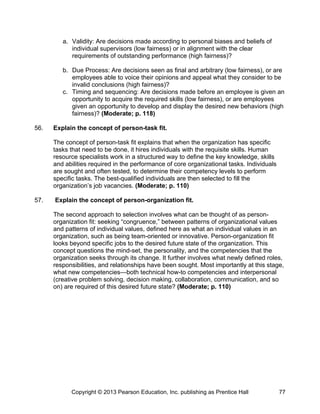
a. Validity: Are decisions made according to personal biases and beliefs of
individual supervisors (low fairness) or in alignment with the clear
requirements of outstanding performance (high fairness)?
b. Due Process: Are decisions seen as final and arbitrary (low fairness), or are
employees able to voice their opinions and appeal what they consider to be
invalid conclusions (high fairness)?
c. Timing and sequencing: Are decisions made before an employee is given an
opportunity to acquire the required skills (low fairness), or are employees
given an opportunity to develop and display the desired new behaviors (high
fairness)? (Moderate; p. 118)
56. Explain the concept of person-task fit.
The concept of person-task fit explains that when the organization has specific
tasks that need to be done, it hires individuals with the requisite skills. Human
resource specialists work in a structured way to define the key knowledge, skills
and abilities required in the performance of core organizational tasks. Individuals
are sought and often tested, to determine their competency levels to perform
specific tasks. The best-qualified individuals are then selected to fill the
organization’s job vacancies. (Moderate; p. 110)
57. Explain the concept of person-organization fit.
The second approach to selection involves what can be thought of as person-
organization fit: seeking “congruence,” between patterns of organizational values
and patterns of individual values, defined here as what an individual values in an
organization, such as being team-oriented or innovative. Person-organization fit
looks beyond specific jobs to the desired future state of the organization. This
concept questions the mind-set, the personality, and the competencies that the
organization seeks through its change. It further involves what newly defined roles,
responsibilities, and relationships have been sought. Most importantly at this stage,
what new competencies—both technical how-to competencies and interpersonal
(creative problem solving, decision making, collaboration, communication, and so
on) are required of this desired future state? (Moderate; p. 110)
Copyright © 2013 Pearson Education, Inc. publishing as Prentice Hall 77
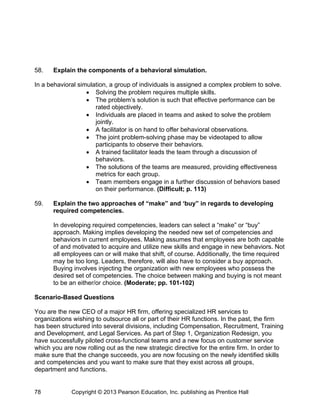
58. Explain the components of a behavioral simulation.
In a behavioral simulation, a group of individuals is assigned a complex problem to solve.
 Solving the problem requires multiple skills.
 The problem’s solution is such that effective performance can be
rated objectively.
 Individuals are placed in teams and asked to solve the problem
jointly.
 A facilitator is on hand to offer behavioral observations.
 The joint problem-solving phase may be videotaped to allow
participants to observe their behaviors.
 A trained facilitator leads the team through a discussion of
behaviors.
 The solutions of the teams are measured, providing effectiveness
metrics for each group.
 Team members engage in a further discussion of behaviors based
on their performance. (Difficult; p. 113)
59. Explain the two approaches of “make” and ‘buy” in regards to developing
required competencies.
In developing required competencies, leaders can select a “make” or “buy”
approach. Making implies developing the needed new set of competencies and
behaviors in current employees. Making assumes that employees are both capable
of and motivated to acquire and utilize new skills and engage in new behaviors. Not
all employees can or will make that shift, of course. Additionally, the time required
may be too long. Leaders, therefore, will also have to consider a buy approach.
Buying involves injecting the organization with new employees who possess the
desired set of competencies. The choice between making and buying is not meant
to be an either/or choice. (Moderate; pp. 101-102)
Scenario-Based Questions
You are the new CEO of a major HR firm, offering specialized HR services to
organizations wishing to outsource all or part of their HR functions. In the past, the firm
has been structured into several divisions, including Compensation, Recruitment, Training
and Development, and Legal Services. As part of Step 1, Organization Redesign, you
have successfully piloted cross-functional teams and a new focus on customer service
which you are now rolling out as the new strategic directive for the entire firm. In order to
make sure that the change succeeds, you are now focusing on the newly identified skills
and competencies and you want to make sure that they exist across all groups,
department and functions.
Copyright © 2013 Pearson Education, Inc. publishing as Prentice Hall
78
60. Since your priority right now is with people alignment, you need to decide what
comes first. The best approach would be:
a. make sure the right people are in the right places, then train.
b. get rid of all the dead wood and work with what is left.
c. train and develop, then assess, and move to removal and replacement.
d. to make sure that everyone is committed, keep everyone in the same place.
(c: Difficult; p. 102)
61. One of your first decisions is between a make or buy approach to HRD. You
decide:
a. buying is the quicker option, and besides, the organization needs lots of new
talent.
b. making is the only way to go – after all, the organization relies on
commitment from its long-time employees.
c. you decide on some combination between buying and making.
d. you heard that this whole process has something to do with people getting
on and off busses, so you propose a “share a ride” program for all
employees.
(c: Moderate; p 102)
62. Training and development is a key component of your strategic change process.
Because your budget is limited, you want to cut one or more of the following
training components. Which one would you cut?
a. skill development training, focusing on teamwork and customer service
b. skill development training, focusing on planning and budgeting
c. knowledge component, dealing with strategic renewal and adaptation
d. training in new behavior support for supervisors and peers
(b: Difficult; p. 103)
63. In order to enhance the validity and accuracy of appraisal and feedback, you
implement:
a. 360-degree feedback.
b. standardized assessment.
c. behavioral simulations.
d. removal and replacement.
(a: Moderate; p. 106)
64. As much as you are committed to developing your existing employees, several key
people have left the organization because they did not agree with the changes and
some others had to be let go because of serious performance challenges. The best
way to ensure that the removal part of the process goes well is:
a. handle it as quickly as possible and behind closed doors – that way no one
gets hurt.
b. involve people in the decision, explain the criteria and the reasoning, and
offer due process.
Copyright © 2013 Pearson Education, Inc. publishing as Prentice Hall 79
Copyright © 2013 Pearson Education, Inc. publishing as Prentice Hall
80
c. give the decision to the company lawyers – they know best how to deal with
these matters.
d. avoid removal altogether – the strategic change will take care of everything.
(b: Moderate; p. 117)
65. In planning replacement for these employees, you decide on which of the following
strategies?
a. The company has a tried-and-true system in place for employee selection –
don’t break what has been working well in the past.
b. Each of these jobs has an extensive job description and your supervisors
have been trained in behavioral interviewing and administering some good
tests that match the person to the job.
c. In light of the strategic change process, it is essential that you select people
who can see the new strategy – you try to pick people who can work well in
teams and know the importance of customer service.
d. You select people based on education and experience.
(c: Difficult; pp. 115-116)
Exploring the Variety of Random
Documents with Different Content
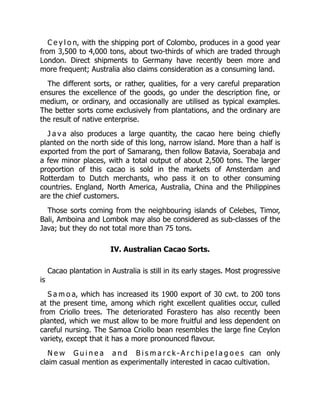
C e y l o n, with the shipping port of Colombo, produces in a good year
from 3,500 to 4,000 tons, about two-thirds of which are traded through
London. Direct shipments to Germany have recently been more and
more frequent; Australia also claims consideration as a consuming land.
The different sorts, or rather, qualities, for a very careful preparation
ensures the excellence of the goods, go under the description fine, or
medium, or ordinary, and occasionally are utilised as typical examples.
The better sorts come exclusively from plantations, and the ordinary are
the result of native enterprise.
J a v a also produces a large quantity, the cacao here being chiefly
planted on the north side of this long, narrow island. More than a half is
exported from the port of Samarang, then follow Batavia, Soerabaja and
a few minor places, with a total output of about 2,500 tons. The larger
proportion of this cacao is sold in the markets of Amsterdam and
Rotterdam to Dutch merchants, who pass it on to other consuming
countries. England, North America, Australia, China and the Philippines
are the chief customers.
Those sorts coming from the neighbouring islands of Celebes, Timor,
Bali, Amboina and Lombok may also be considered as sub-classes of the
Java; but they do not total more than 75 tons.
IV. Australian Cacao Sorts.
Cacao plantation in Australia is still in its early stages. Most progressive
is
S a m o a, which has increased its 1900 export of 30 cwt. to 200 tons
at the present time, among which right excellent qualities occur, culled
from Criollo trees. The deteriorated Forastero has also recently been
planted, which we must allow to be more fruitful and less dependent on
careful nursing. The Samoa Criollo bean resembles the large fine Ceylon
variety, except that it has a more pronounced flavour.
N e w G u i n e a a n d B i s m a r c k - A r c h i p e l a g o e s can only
claim casual mention as experimentally interested in cacao cultivation.
g) The Trade in Cacao and the Consumption of
Cacao Products; Statistics.
Although cacao and cacao products have always been held in the
highest esteem, ever since they first became known in Europe, yet price
considerations long prevented them from enjoying the same widespread
popularity among the lower classes as tea and coffee. Thanks, however,
to the improved means of transport established in the course of the last
fifty years, which has cheapened all exotic produce, the demand for
these wares has of late been more frequent and urgent, and is reflected
in the constantly increasing influx of cacao on the European markets and
the systematic opening out of new regions to the raw material, just as
corresponding extensions in the factory world contribute towards a
reduction in the cost of the products. Hence cacao may now be
described as a luxury within the reach of everyman. Its diffusion among
all grades of the population may be regarded as a great blessing, for in it
has arisen a new [Transcriber’s Note: a line is missing here] merely a
stimulant, like tea or coffee, but a beverage in the proper sense of the
term, analytically so established.
It will accordingly prove of interest to glance through the returns in
connection with the trade in these goods, their importation and
exportation, commercial values of the same, and the relative
consumption of cacao, tea and coffee.
Such figures are always at hand. The surprisingly rapid growth of the
cacao cultivation, and the manufacture of cacao products, is e. g. at once
apparent in statistics furnished by the French government. In 1857 the
number of 5,304,207 kilos of beans were consumed there. The
importations of the year 1895, on the other hand, amounted to
32,814,724 kilos, having in the space of 38 years increased more than
sixfold. Of this quantity, almost the half, comprising about 15,234,163
kilos, is disposed of retail.
Turning to the trade in Germany, the cacao industry here and its
consumption,19 we are again greeted with cheery prospects. According
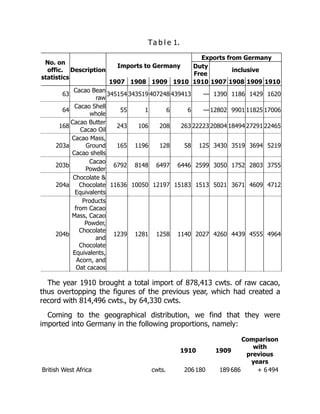
to the official inquiry, German trade in Cacao products for the years
1907-1910 is shown in the following table:
Ta b l e 1.
No. on
offic.
statistics
Description
Imports to Germany
Exports from Germany
Duty
Free
inclusive
1907 1908 1909 1910 1910 1907 1908 1909 1910
63
Cacao Bean
raw
345154 343519 407248 439413 — 1390 1186 1429 1620
64
Cacao Shell
whole
55 1 6 6 — 12802 9901 11825 17006
168
Cacao Butter
Cacao Oil
243 106 208 263 22223 20804 18494 27291 22465
203a
Cacao Mass,
Ground
Cacao shells
165 1196 128 58 125 3430 3519 3694 5219
203b
Cacao
Powder
6792 8148 6497 6446 2599 3050 1752 2803 3755
204a
Chocolate &
Chocolate
Equivalents
11636 10050 12197 15183 1513 5021 3671 4609 4712
204b
Products
from Cacao
Mass, Cacao
Powder,
Chocolate
and
Chocolate
Equivalents,
Acorn, and
Oat cacaos
1239 1281 1258 1140 2027 4260 4439 4555 4964
The year 1910 brought a total import of 878,413 cwts. of raw cacao,
thus overtopping the figures of the previous year, which had created a
record with 814,496 cwts., by 64,330 cwts.
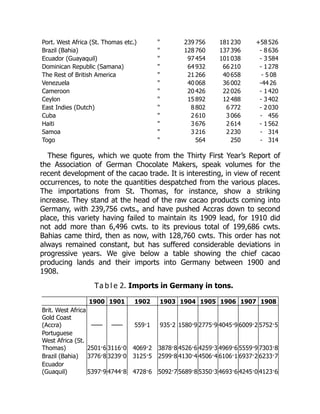
Coming to the geographical distribution, we find that they were
imported into Germany in the following proportions, namely:
1910 1909
Comparison
with
previous
years
British West Africa cwts. 206 180 189 686 + 6 494
Port. West Africa (St. Thomas etc.) " 239 756 181 230 +58 526
Brazil (Bahia) " 128 760 137 396 - 8 636
Ecuador (Guayaquil) " 97 454 101 038 - 3 584
Dominican Republic (Samana) " 64 932 66 210 - 1 278
The Rest of British America " 21 266 40 658 - 5 08
Venezuela " 40 068 36 002 -44 26
Cameroon " 20 426 22 026 - 1 420
Ceylon " 15 892 12 488 - 3 402
East Indies (Dutch) " 8 802 6 772 - 2 030
Cuba " 2 610 3 066 - 456
Haiti " 3 676 2 614 - 1 562
Samoa " 3 216 2 230 - 314
Togo " 564 250 - 314
These figures, which we quote from the Thirty First Year’s Report of
the Association of German Chocolate Makers, speak volumes for the
recent development of the cacao trade. It is interesting, in view of recent
occurrences, to note the quantities despatched from the various places.
The importations from St. Thomas, for instance, show a striking
increase. They stand at the head of the raw cacao products coming into
Germany, with 239,756 cwts., and have pushed Accras down to second
place, this variety having failed to maintain its 1909 lead, for 1910 did
not add more than 6,496 cwts. to its previous total of 199,686 cwts.
Bahias came third, then as now, with 128,760 cwts. This order has not
always remained constant, but has suffered considerable deviations in
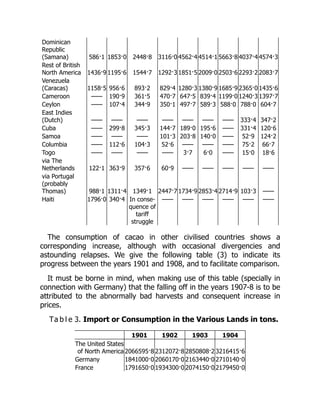
progressive years. We give below a table showing the chief cacao
producing lands and their imports into Germany between 1900 and
1908.
Ta b l e 2. Imports in Germany in tons.
1900 1901 1902 1903 1904 1905 1906 1907 1908
Brit. West Africa
Gold Coast
(Accra) —— —— 559·1 935·2 1580·9 2775·9 4045·9 6009·2 5752·5
Portuguese
West Africa (St.
Thomas) 2501·6 3116·0 4069·2 3878·8 4526·6 4259·3 4969·6 5559·9 7303·8
Brazil (Bahia) 3776·8 3239·0 3125·5 2599·8 4130·4 4506·4 6106·1 6937·2 6233·7
Ecuador
(Guaquil) 5397·9 4744·8 4728·6 5092·7 5689·8 5350·3 4693·6 4245·0 4123·6
Dominican
Republic
(Samana) 586·1 1853·0 2448·8 3116·0 4562·4 4514·1 5663·8 4037·4 4574·3
Rest of British
North America 1436·9 1195·6 1544·7 1292·3 1851·5 2009·0 2503·6 2293·2 2083·7
Venezuela
(Caracas) 1158·5 956·6 893·2 829·4 1280·3 1380·9 1685·9 2365·0 1435·6
Cameroon —— 190·9 361·5 470·7 647·5 839·4 1199·0 1240·3 1397·7
Ceylon —— 107·4 344·9 350·1 497·7 589·3 588·0 788·0 604·7
East Indies
(Dutch) —— —— —— —— —— —— —— 333·4 347·2
Cuba —— 299·8 345·3 144·7 189·0 195·6 —— 331·4 120·6
Samoa —— —— —— 101·3 203·8 140·0 —— 52·9 124·2
Columbia —— 112·6 104·3 52·6 —— —— —— 75·2 66·7
Togo —— —— —— —— 3·7 6·0 —— 15·0 18·6
via The
Netherlands 122·1 363·9 357·6 60·9 —— —— —— —— ——
via Portugal
(probably
Thomas) 988·1 1311·4 1349·1 2447·7 1734·9 2853·4 2714·9 103·3 ——
Haiti 1796·0 340·4 In conse-
quence of
tariff
struggle
—— —— —— —— —— ——
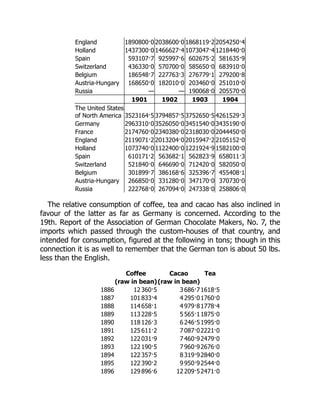
The consumption of cacao in other civilised countries shows a
corresponding increase, although with occasional divergencies and
astounding relapses. We give the following table (3) to indicate its
progress between the years 1901 and 1908, and to facilitate comparison.
It must be borne in mind, when making use of this table (specially in
connection with Germany) that the falling off in the years 1907-8 is to be
attributed to the abnormally bad harvests and consequent increase in
prices.
Ta b l e 3. Import or Consumption in the Various Lands in tons.
1901 1902 1903 1904
The United States
of North America 2066595·8 2312072·8 2850808·2 3216415·6
Germany 1841000·0 2060170·0 2163440·0 2710140·0
France 1791650·0 1934300·0 2074150·0 2179450·0
England 1890800·0 2038600·0 1868119·2 2054250·4
Holland 1437300·0 1466627·4 1073047·4 1218440·0
Spain 593107·7 925997·6 602675·2 581635·9
Switzerland 436330·0 570700·0 585650·0 683910·0
Belgium 186548·7 227763·3 276779·1 279200·8
Austria-Hungary 168650·0 182010·0 203460·0 251010·0
Russia — — 190068·0 205570·0
1901 1902 1903 1904
The United States
of North America 3523164·5 3794857·5 3752650·5 4261529·3
Germany 2963310·0 3526050·0 3451540·0 3435190·0
France 2174760·0 2340380·0 2318030·0 2044450·0
England 2119071·2 2013204·0 2015947·2 2105152·0
Holland 1073740·0 1122400·0 1221924·9 1582100·0
Spain 610171·2 563682·1 562823·9 658011·3
Switzerland 521840·0 646690·0 712420·0 582050·0
Belgium 301899·7 386168·6 325396·7 455408·1
Austria-Hungary 266850·0 331280·0 347170·0 370730·0
Russia 222768·0 267094·0 247338·0 258806·0
The relative consumption of coffee, tea and cacao has also inclined in
favour of the latter as far as Germany is concerned. According to the
19th. Report of the Association of German Chocolate Makers, No. 7, the
imports which passed through the custom-houses of that country, and
intended for consumption, figured at the following in tons; though in this
connection it is as well to remember that the German ton is about 50 lbs.
less than the English.
Coffee Cacao Tea
(raw in bean)(raw in bean)
1886 12 360·5 3 686·71618·5
1887 101 833·4 4 295·01760·0
1888 114 658·1 4 979·81778·4
1889 113 228·5 5 565·11875·0
1890 118 126·3 6 246·51995·0
1891 125 611·2 7 087·02221·0
1892 122 031·9 7 460·92479·0
1893 122 190·5 7 960·92676·0
1894 122 357·5 8 319·92840·0
1895 122 390·2 9 950·92544·0
1896 129 896·6 12 209·52471·0
1897 136 395·0 14 692·52852·0
1898 153 270·4 15 464·93661·9
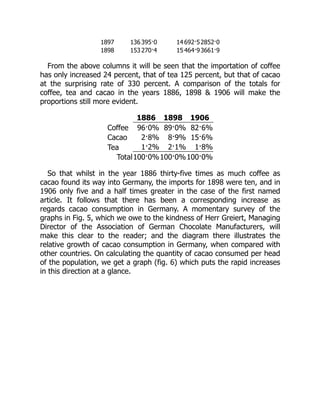
From the above columns it will be seen that the importation of coffee
has only increased 24 percent, that of tea 125 percent, but that of cacao
at the surprising rate of 330 percent. A comparison of the totals for
coffee, tea and cacao in the years 1886, 1898 & 1906 will make the
proportions still more evident.
1886 1898 1906
Coffee 96·0% 89·0% 82·6%
Cacao 2·8% 8·9% 15·6%
Tea 1·2% 2·1% 1·8%
Total100·0%100·0%100·0%
So that whilst in the year 1886 thirty-five times as much coffee as
cacao found its way into Germany, the imports for 1898 were ten, and in
1906 only five and a half times greater in the case of the first named
article. It follows that there has been a corresponding increase as
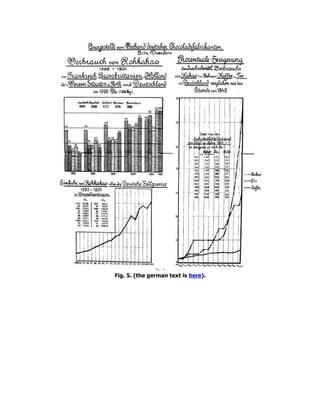
regards cacao consumption in Germany. A momentary survey of the
graphs in Fig. 5, which we owe to the kindness of Herr Greiert, Managing
Director of the Association of German Chocolate Manufacturers, will
make this clear to the reader; and the diagram there illustrates the
relative growth of cacao consumption in Germany, when compared with
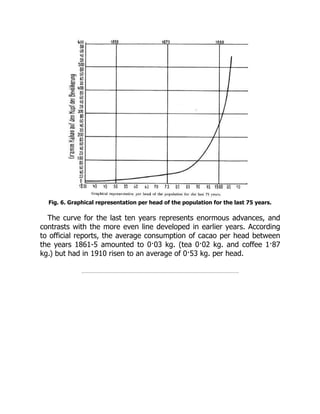
other countries. On calculating the quantity of cacao consumed per head
of the population, we get a graph (fig. 6) which puts the rapid increases
in this direction at a glance.
Fig. 5. (the german text is here).
Fig. 6. Graphical representation per head of the population for the last 75 years.
The curve for the last ten years represents enormous advances, and
contrasts with the more even line developed in earlier years. According
to official reports, the average consumption of cacao per head between
the years 1861-5 amounted to 0·03 kg. (tea 0·02 kg. and coffee 1·87
kg.) but had in 1910 risen to an average of 0·53 kg. per head.
B. Chemical Constitution of the Bean.
a) The Cacao Bean Proper.
Just as the beans of the cacao fruit are included under the botanical
concept “Seed”, so also their chemical constituents closely resemble
those common to every other seed. There are the usual reserve stuffs
inherited from the mother plant, which serve as sustenance for the yet
undeveloped organs, and compare with albumen in the feathered
world. Apart from the constituents incidental to all plant life at this
stage, such as albumin, starch, water, fat, sugar, cellulose and mineral
stuffs such as ash, the cacao seed has two other components peculiar
to itself; T h e o b r o m i n e and C a c a o - r e d. We adjoin a succession
of chemical determinations respecting the quantitative proportions of
these substances in the seed, and think further that we may be
allowed to cite the results of fore-time investigators in this sphere,
especially as their work has formed the basis for all future operations,
and again, in view of the doubt which still prevails in scientific circles
as to the “Normal” composition of the cacao bean.
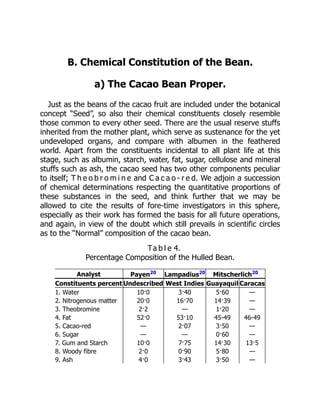
Ta b l e 4.
Percentage Composition of the Hulled Bean.
Analyst Payen20
Lampadius20
Mitscherlich20
Constituents percent Undescribed West Indies Guayaquil Caracas
1. Water 10·0 3·40 5·60 —
2. Nitrogenous matter 20·0 16·70 14·39 —
3. Theobromine 2·2 — 1·20 —
4. Fat 52·0 53·10 45-49 46-49
5. Cacao-red — 2·07 3·50 —
6. Sugar — — 0·60 —
7. Gum and Starch 10·0 7·75 14·30 13·5
8. Woody fibre 2·0 0·90 5·80 —
9. Ash 4·0 3·43 3·50 —
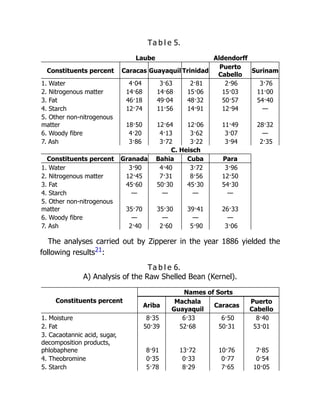
Ta b l e 5.
Laube Aldendorff
Constituents percent Caracas Guayaquil Trinidad
Puerto
Cabello
Surinam
1. Water 4·04 3·63 2·81 2·96 3·76
2. Nitrogenous matter 14·68 14·68 15·06 15·03 11·00
3. Fat 46·18 49·04 48·32 50·57 54·40
4. Starch 12·74 11·56 14·91 12·94 —
5. Other non-nitrogenous
matter 18·50 12·64 12·06 11·49 28·32
6. Woody fibre 4·20 4·13 3·62 3·07 —
7. Ash 3·86 3·72 3·22 3·94 2·35
C. Heisch
Constituents percent Granada Bahia Cuba Para
1. Water 3·90 4·40 3·72 3·96
2. Nitrogenous matter 12·45 7·31 8·56 12·50
3. Fat 45·60 50·30 45·30 54·30
4. Starch — — — —
5. Other non-nitrogenous
matter 35·70 35·30 39·41 26·33
6. Woody fibre — — — —
7. Ash 2·40 2·60 5·90 3·06
The analyses carried out by Zipperer in the year 1886 yielded the
following results21:
Ta b l e 6.
A) Analysis of the Raw Shelled Bean (Kernel).
Constituents percent
Names of Sorts
Ariba
Machala
Guayaquil
Caracas
Puerto
Cabello
1. Moisture 8·35 6·33 6·50 8·40
2. Fat 50·39 52·68 50·31 53·01
3. Cacaotannic acid, sugar,
decomposition products,
phlobaphene 8·91 13·72 10·76 7·85
4. Theobromine 0·35 0·33 0·77 0·54
5. Starch 5·78 8·29 7·65 10·05
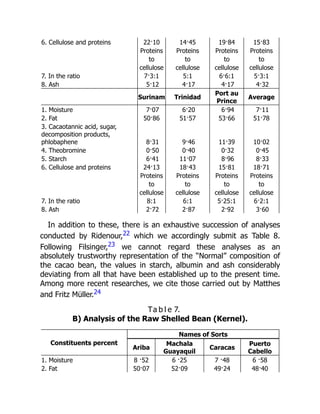
6. Cellulose and proteins 22·10 14·45 19·84 15·83
Proteins Proteins Proteins Proteins
to to to to
cellulose cellulose cellulose cellulose
7. In the ratio 7·3:1 5:1 6·6:1 5·3:1
8. Ash 5·12 4·17 4·17 4·32
Surinam Trinidad
Port au
Prince
Average
1. Moisture 7·07 6·20 6·94 7·11
2. Fat 50·86 51·57 53·66 51·78
3. Cacaotannic acid, sugar,
decomposition products,
phlobaphene 8·31 9·46 11·39 10·02
4. Theobromine 0·50 0·40 0·32 0·45
5. Starch 6·41 11·07 8·96 8·33
6. Cellulose and proteins 24·13 18·43 15·81 18·71
Proteins Proteins Proteins Proteins
to to to to
cellulose cellulose cellulose cellulose
7. In the ratio 8:1 6:1 5·25:1 6·2:1
8. Ash 2·72 2·87 2·92 3·60
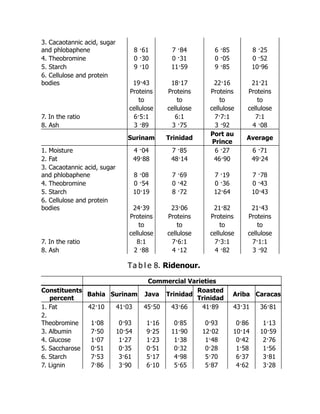
In addition to these, there is an exhaustive succession of analyses
conducted by Ridenour,22 which we accordingly submit as Table 8.
Following Filsinger,23 we cannot regard these analyses as an
absolutely trustworthy representation of the “Normal” composition of
the cacao bean, the values in starch, albumin and ash considerably
deviating from all that have been established up to the present time.
Among more recent researches, we cite those carried out by Matthes
and Fritz Müller.24
Ta b l e 7.
B) Analysis of the Raw Shelled Bean (Kernel).
Constituents percent
Names of Sorts
Ariba
Machala
Guayaquil
Caracas
Puerto
Cabello
1. Moisture 8 ·52 6 ·25 7 ·48 6 ·58
2. Fat 50·07 52·09 49·24 48·40
3. Cacaotannic acid, sugar
and phlobaphene 8 ·61 7 ·84 6 ·85 8 ·25
4. Theobromine 0 ·30 0 ·31 0 ·05 0 ·52
5. Starch 9 ·10 11·59 9 ·85 10·96
6. Cellulose and protein
bodies 19·43 18·17 22·16 21·21
Proteins Proteins Proteins Proteins
to to to to
cellulose cellulose cellulose cellulose
7. In the ratio 6·5:1 6:1 7·7:1 7:1
8. Ash 3 ·89 3 ·75 3 ·92 4 ·08
Surinam Trinidad
Port au
Prince
Average
1. Moisture 4 ·04 7 ·85 6 ·27 6 ·71
2. Fat 49·88 48·14 46·90 49·24
3. Cacaotannic acid, sugar
and phlobaphene 8 ·08 7 ·69 7 ·19 7 ·78
4. Theobromine 0 ·54 0 ·42 0 ·36 0 ·43
5. Starch 10·19 8 ·72 12·64 10·43
6. Cellulose and protein
bodies 24·39 23·06 21·82 21·43
Proteins Proteins Proteins Proteins
to to to to
cellulose cellulose cellulose cellulose
7. In the ratio 8:1 7·6:1 7·3:1 7·1:1
8. Ash 2 ·88 4 ·12 4 ·82 3 ·92
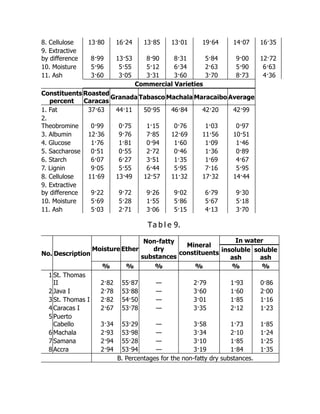
Ta b l e 8. Ridenour.
Commercial Varieties
Constituents
percent
Bahia Surinam Java Trinidad
Roasted
Trinidad
Ariba Caracas
1. Fat 42·10 41·03 45·50 43·66 41·89 43·31 36·81
2.
Theobromine 1·08 0·93 1·16 0·85 0·93 0·86 1·13
3. Albumin 7·50 10·54 9·25 11·90 12·02 10·14 10·59
4. Glucose 1·07 1·27 1·23 1·38 1·48 0·42 2·76
5. Saccharose 0·51 0·35 0·51 0·32 0·28 1·58 1·56
6. Starch 7·53 3·61 5·17 4·98 5·70 6·37 3·81
7. Lignin 7·86 3·90 6·10 5·65 5·87 4·62 3·28
8. Cellulose 13·80 16·24 13·85 13·01 19·64 14·07 16·35
9. Extractive
by difference 8·99 13·53 8·90 8·31 5·84 9·00 12·72
10. Moisture 5·96 5·55 5·12 6·34 2·63 5·90 6·63
11. Ash 3·60 3·05 3·31 3·60 3·70 8·73 4·36
Commercial Varieties
Constituents
percent
Roasted
Caracas
Granada Tabasco Machala Maracaibo Average
1. Fat 37·63 44·11 50·95 46·84 42·20 42·99
2.
Theobromine 0·99 0·75 1·15 0·76 1·03 0·97
3. Albumin 12·36 9·76 7·85 12·69 11·56 10·51
4. Glucose 1·76 1·81 0·94 1·60 1·09 1·46
5. Saccharose 0·51 0·55 2·72 0·46 1·36 0·89
6. Starch 6·07 6·27 3·51 1·35 1·69 4·67
7. Lignin 9·05 5·55 6·44 5·95 7·16 5·95
8. Cellulose 11·69 13·49 12·57 11·32 17·32 14·44
9. Extractive
by difference 9·22 9·72 9·26 9·02 6·79 9·30
10. Moisture 5·69 5·28 1·55 5·86 5·67 5·18
11. Ash 5·03 2·71 3·06 5·15 4·13 3·70
Ta b l e 9.
No. Description
Moisture Ether
Non-fatty
dry
substances
Mineral
constituents
In water
insoluble
ash
soluble
ash
% % % % % %
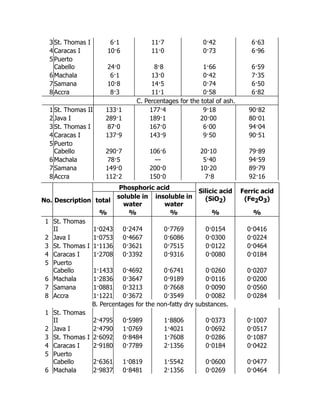
1 St. Thomas
II 2·82 55·87 — 2·79 1·93 0·86
2 Java I 2·78 53·88 — 3·60 1·60 2·00
3 St. Thomas I 2·82 54·50 — 3·01 1·85 1·16
4 Caracas I 2·67 53·78 — 3·35 2·12 1·23
5 Puerto
Cabello 3·34 53·29 — 3·58 1·73 1·85
6 Machala 2·93 53·98 — 3·34 2·10 1·24
7 Samana 2·94 55·28 — 3·10 1·85 1·25
8 Accra 2·94 53·94 — 3·19 1·84 1·35
B. Percentages for the non-fatty dry substances.
1 St. Thomas
II — — 41·36 6·536 4·672 1·864
2 Java I — — 43·34 8·306 3·692 4·614
3 St. Thomas I — — 42·68 7·053 4·311 2·742
4 Caracas I — — 43·55 7·692 4·868 2·824
5 Puerto
Cabello — — 43·37 8·254 3·989 4·265
6 Machala — — 43·09 7·767 4·900 2·867
7 Samana — — 42·78 7·246 4·325 2·921
8 Accra — — 43·12 7·398 4·267 3·131
C. Percentages for the total of ash.
1 St. Thomas
II — — — — 71·49 28·51
2 Java I — — — — 44·45 55·55
3 St. Thomas I — — — — 61·12 38·88
4 Caracas I — — — — 63·38 36·62
5 Puerto
Cabello — — — — 48·33 51·67
6 Machala — — — — 63·09 36·91
7 Samana — — — — 59·69 40·31
8 Accra — — — — 57·68 42·32
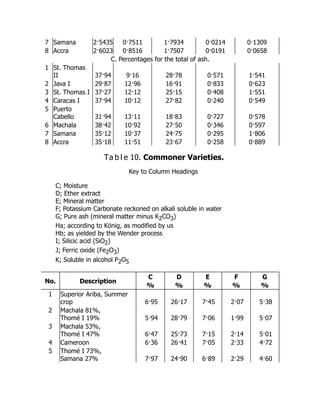
No. Description
Alkali strength
Potassium
Carbonate
reckoned from
Alkali
strength of
soluble ash
Pure ash
(mineral
stuffs
minus Pot.
Carb.)
of the
soluble ash
of the
insoluble ash
cb. mm. Nitric acid. % %
1 St. Thomas II 3·6 4·8 0·25 2·54
2 Java I 10·4 6·8 0·72 2·88
3 St. Thomas I 2·6 5·0 0·18 1·83
4 Caracas I 4·6 4·8 0·32 3·03
5 Puerto
Cabello 10·4 3·8 0·72 2·86
6 Machala 2·6 5·6 0·18 3·16
7 Samana 4·6 6·2 0·32 2·78
8 Accra 3·6 4·8 0·25 2·94
B. Percentages for the non-fatty dry substances.
1 St. Thomas II 8·7 11·6 0·60 5·94
2 Java I 24·0 15·7 1·66 6·65
3 St. Thomas I 6·1 11·7 0·42 6·63
4 Caracas I 10·6 11·0 0·73 6·96
5 Puerto
Cabello 24·0 8·8 1·66 6·59
6 Machala 6·1 13·0 0·42 7·35
7 Samana 10·8 14·5 0·74 6·50
8 Accra 8·3 11·1 0·58 6·82
C. Percentages for the total of ash.
1 St. Thomas II 133·1 177·4 9·18 90·82
2 Java I 289·1 189·1 20·00 80·01
3 St. Thomas I 87·0 167·0 6·00 94·04
4 Caracas I 137·9 143·9 9·50 90·51
5 Puerto
Cabello 290·7 106·6 20·10 79·89
6 Machala 78·5 — 5·40 94·59
7 Samana 149·0 200·0 10·20 89·79
8 Accra 112·2 150·0 7·8 92·16
No. Description
Phosphoric acid
Silicic acid
(SiO2)
Ferric acid
(Fe2O3)
total
soluble in
water
insoluble in
water
% % % % %
1 St. Thomas
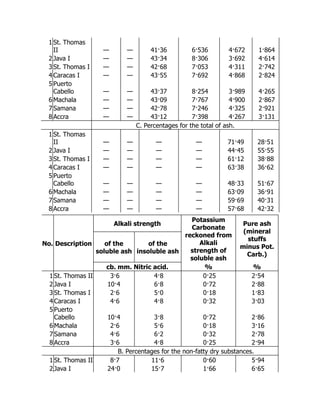
II 1·0243 0·2474 0·7769 0·0154 0·0416
2 Java I 1·0753 0·4667 0·6086 0·0300 0·0224
3 St. Thomas I 1·1136 0·3621 0·7515 0·0122 0·0464
4 Caracas I 1·2708 0·3392 0·9316 0·0080 0·0184
5 Puerto
Cabello 1·1433 0·4692 0·6741 0·0260 0·0207
6 Machala 1·2836 0·3647 0·9189 0·0116 0·0200
7 Samana 1·0881 0·3213 0·7668 0·0090 0·0560
8 Accra 1·1221 0·3672 0·3549 0·0082 0·0284
B. Percentages for the non-fatty dry substances.
1 St. Thomas
II 2·4795 0·5989 1·8806 0·0373 0·1007
2 Java I 2·4790 1·0769 1·4021 0·0692 0·0517
3 St. Thomas I 2·6092 0·8484 1·7608 0·0286 0·1087
4 Caracas I 2·9180 0·7789 2·1356 0·0184 0·0422
5 Puerto
Cabello 2·6361 1·0819 1·5542 0·0600 0·0477
6 Machala 2·9837 0·8481 2·1356 0·0269 0·0464
7 Samana 2·5435 0·7511 1·7934 0·0214 0·1309
8 Accra 2·6023 0·8516 1·7507 0·0191 0·0658
C. Percentages for the total of ash.
1 St. Thomas
II 37·94 9·16 28·78 0·571 1·541
2 Java I 29·87 12·96 16·91 0·833 0·623
3 St. Thomas I 37·27 12·12 25·15 0·408 1·551
4 Caracas I 37·94 10·12 27·82 0·240 0·549
5 Puerto
Cabello 31·94 13·11 18·83 0·727 0·578
6 Machala 38·42 10·92 27·50 0·346 0·597
7 Samana 35·12 10·37 24·75 0·295 1·806
8 Accra 35·18 11·51 23·67 0·258 0·889
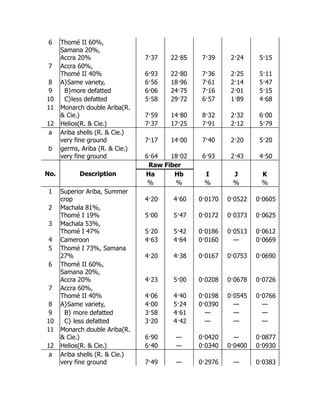
Ta b l e 10. Commoner Varieties.
Key to Column Headings
C; Moisture
D; Ether extract
E; Mineral matter
F; Potassium Carbonate reckoned on alkali soluble in water
G; Pure ash (mineral matter minus K2CO3)
Ha; according to König, as modified by us
Hb; as yielded by the Wender process
I; Silicic acid (SiO2)
J; Ferric oxide (Fe2O3)
K; Soluble in alcohol P2O5
No. Description
C D E F G
% % % % %
1 Superior Ariba, Summer
crop 6·95 26·17 7·45 2·07 5·38
2 Machala 81%,
Thomé I 19% 5·94 28·79 7·06 1·99 5·07
3 Machala 53%,
Thomé I 47% 6·47 25·73 7·15 2·14 5·01
4 Cameroon 6·36 26·41 7·05 2·33 4·72
5 Thomé I 73%,
Samana 27% 7·97 24·90 6·89 2·29 4·60
6 Thomé II 60%,
Samana 20%,
Accra 20% 7·37 22·85 7·39 2·24 5·15
7 Accra 60%,
Thomé II 40% 6·93 22·80 7·36 2·25 5·11
8 A}Same variety, 6·56 18·96 7·61 2·14 5·47
9 B}more defatted 6·06 24·75 7·16 2·01 5·15
10 C}less defatted 5·58 29·72 6·57 1·89 4·68
11 Monarch double Ariba(R.
& Cie.) 7·59 14·80 8·32 2·32 6·00
12 Helios(R. & Cie.) 7·37 17·25 7·91 2·12 5·79
a Ariba shells (R. & Cie.)
very fine ground 7·17 14·00 7·40 2·20 5·20
b germs, Ariba (R. & Cie.)
very fine ground 6·64 18·02 6·93 2·43 4·50
No. Description
Raw Fiber
Ha Hb I J K
% % % % %
1 Superior Ariba, Summer
crop 4·20 4·60 0·0170 0·0522 0·0605
2 Machala 81%,
Thomé I 19% 5·00 5·47 0·0172 0·0373 0·0625
3 Machala 53%,
Thomé I 47% 5·20 5·42 0·0186 0·0513 0·0612
4 Cameroon 4·63 4·64 0·0160 — 0·0669
5 Thomé I 73%, Samana
27% 4·20 4·38 0·0167 0·0753 0·0690
6 Thomé II 60%,
Samana 20%,
Accra 20% 4·23 5·00 0·0208 0·0678 0·0726
7 Accra 60%,
Thomé II 40% 4·06 4·40 0·0198 0·0545 0·0766
8 A}Same variety, 4·00 5·24 0·0390 — —
9 B} more defatted 3·58 4·61 — — —
10 C} less defatted 3·20 4·42 — — —
11 Monarch double Ariba(R.
& Cie.) 6·90 — 0·0420 — 0·0877
12 Helios(R. & Cie.) 6·40 — 0·0340 0·0400 0·0930
a Ariba shells (R. & Cie.)
very fine ground 7·49 — 0·2976 — 0·0383
b germs, Ariba (R. & Cie.)
very fine ground 7·42 — — — 0·0587
Ta b l e 11. Analysis of Cacao.
Dry product, defatted and free from alkali.
Key to Column Headings
C; Defatted and alkali-free dry products
D; Pure ash (mineral substances less K2CO3)
E; Ash insoluble in water
F; Alkalinity of the insoluble ash Nitric acid
Ga; total
Gb; soluble in water
Gc; insoluble in water
H; Silicic acid (SiO2)
I; Ferric oxide (Fe2O3)
J; P3O5 soluble in alcohol
K; after König (modified)
L; as yielded by the Weender process
No. Description
C D E F
% % % ccm
1 Thomé II 41·06 6·186 4·725 11·7
2 Java I 42·62 6·757 3·754 15·9
3 Thomé I 42·50 6·659 4·353 11·8
4 Caracas I 43·23 7·010 4·904 11·1
5 Puerto-Cabello 42·65 6·706 4·056 8·9
6 Machala 42·91 7·365 4·894 13·1
7 Samana 42·46 6·548 4·357 14·6
8 Accra 42·87 6·858 4·292 11·2
9 Ariba 64·81 8·301 — —
10 Machala +
Thomé I 63·28 8·013 — —
11 Thomé +
Machala 66·66 7·517 — —
12 Cameroon 64·90 7·273 — —
13 Thomé I +
Samana 64·84 7·095 — —
14 Thomé II,
Samana +
67·54 7·625 — —
Accra.
15 Accra +
Thomé II 68·02 7·513 — —
16 A 72·34 7·561 — —
17 B 67·18 7·666 — —
18 C 62·80 7·452 — —
19 Monarch Ariba (R. & Cie.) 75·29 7·969 — —
20 Helios Ariba (R. & Cie.) 73·39 8·880 — —
a Shells 76·63 6·786 — —
b Germs 72·91 6·173 — —
No. Description Phosphoric Acid (P205)
Ga Gb Gc H I
% % % % %
1 Thomé II 2·4947 0·6025 1·8922 0·0375 0·1013
2 Java I 2·5229 1·0950 1·4279 0·0704 0·0525
3 Thomé I 2·6202 0·8520 1·7682 0·0287 0·1091
4 Caracas I 2·9391 0·7846 1·1545 0·0185 0·0425
5 Puerto-Cabello 2·6807 1·1001 1·5806 0·0610 0·0480
6 Machala 2·9914 0·8499 2·1414 0·0270 0·0466
7 Samana 2·5626 0·7802 1·7824 0·0212 0·1319
8 Accra 2·6175 0·8565 1·7610 0·0191 0·0662
Raw fibre
J K L
9 Ariba 0·0933 6·48 7·10 0·0262 0·0806
10 Machala +
Thomé I 0·0984 7·90 8·64 0·0272 0·0590
11 Thomé +
Machala 0·0919 7·80 8·13 0·0280 0·0770
12 Cameroon 0·1030 7·13 7·15 0·0246 —
13 Thomé I +
Samana 0·1064 6·48 6·75 0·0258 0·1162
14 Thomé II,
Samana +
Accra. 0·1075 6·27 7·40 0·0308 0·1004
15 Accra +
Thomé II 0·1126 5·97 6·47 0·0290 0·0801
16 A — 5·53 7·24 — —
17 B — 5·33 6·87 — —
18 C — 5·10 7·04 — —
19 Monarch Ariba (R. & Cie.) 0·1165 9·16 — 0·0558 —
20 Helios Ariba (R. & Cie.) 0·1266 8·72 — 0·0446 —
a Shells 0·0499 9·77 — 0·3884 0·0545
b Germs 0·0805 10·18 — — —
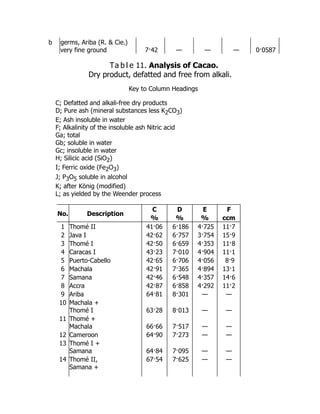
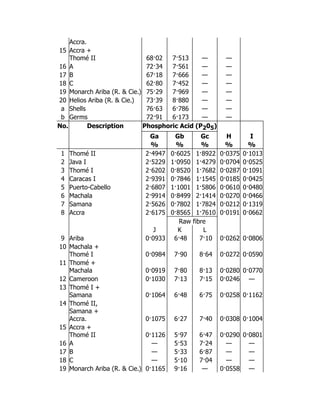
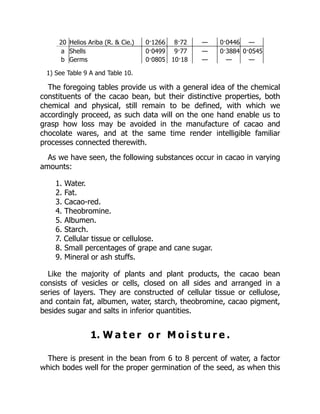
1) See Table 9 A and Table 10.
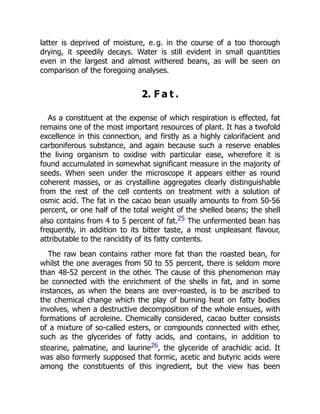
The foregoing tables provide us with a general idea of the chemical
constituents of the cacao bean, but their distinctive properties, both
chemical and physical, still remain to be defined, with which we
accordingly proceed, as such data will on the one hand enable us to
grasp how loss may be avoided in the manufacture of cacao and
chocolate wares, and at the same time render intelligible familiar
processes connected therewith.
As we have seen, the following substances occur in cacao in varying
amounts:
1. Water.
2. Fat.
3. Cacao-red.
4. Theobromine.
5. Albumen.
6. Starch.
7. Cellular tissue or cellulose.
8. Small percentages of grape and cane sugar.
9. Mineral or ash stuffs.
Like the majority of plants and plant products, the cacao bean
consists of vesicles or cells, closed on all sides and arranged in a
series of layers. They are constructed of cellular tissue or cellulose,
and contain fat, albumen, water, starch, theobromine, cacao pigment,
besides sugar and salts in inferior quantities.
1. W a t e r o r M o i s t u r e .
There is present in the bean from 6 to 8 percent of water, a factor
which bodes well for the proper germination of the seed, as when this
latter is deprived of moisture, e. g. in the course of a too thorough
drying, it speedily decays. Water is still evident in small quantities
even in the largest and almost withered beans, as will be seen on
comparison of the foregoing analyses.
2. F a t .
As a constituent at the expense of which respiration is effected, fat
remains one of the most important resources of plant. It has a twofold
excellence in this connection, and firstly as a highly calorifacient and
carboniferous substance, and again because such a reserve enables
the living organism to oxidise with particular ease, wherefore it is
found accumulated in somewhat significant measure in the majority of
seeds. When seen under the microscope it appears either as round
coherent masses, or as crystalline aggregates clearly distinguishable
from the rest of the cell contents on treatment with a solution of
osmic acid. The fat in the cacao bean usually amounts to from 50-56
percent, or one half of the total weight of the shelled beans; the shell
also contains from 4 to 5 percent of fat.25 The unfermented bean has
frequently, in addition to its bitter taste, a most unpleasant flavour,
attributable to the rancidity of its fatty contents.
The raw bean contains rather more fat than the roasted bean, for
whilst the one averages from 50 to 55 percent, there is seldom more
than 48-52 percent in the other. The cause of this phenomenon may
be connected with the enrichment of the shells in fat, and in some
instances, as when the beans are over-roasted, is to be ascribed to
the chemical change which the play of burning heat on fatty bodies
involves, when a destructive decomposition of the whole ensues, with
formations of acroleine. Chemically considered, cacao butter consists
of a mixture of so-called esters, or compounds connected with ether,
such as the glycerides of fatty acids, and contains, in addition to
stearine, palmatine, and laurine26, the glyceride of arachidic acid. It
was also formerly supposed that formic, acetic and butyric acids were
among the constituents of this ingredient, but the view has been
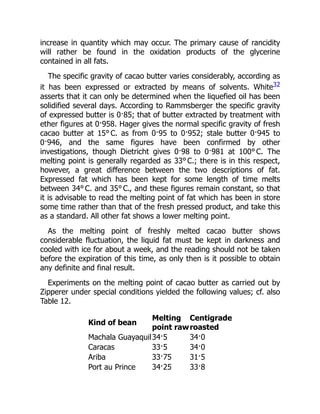
proved erroneous by Lewkowitsch27; similarly, the presence of
theobromic acid alleged by Kingzett28 has been called into question by
Graf.29
Cacao butter is a fairly firm fat of pleasant taste and smell, which
varies in colour between yellowish white and yellow. When freshly
expressed, it has frequently a brownish shade, passing after a short
time into a pale yellow, and turning almost white on long keeping. The
brown colour is due to pigment in suspension, which becomes
sediment in the course of melting, when the butter asumes a normal
colour, referrible to pigment dissolved in the butter oils, and
secondarily to a dissolution of the products of roasting in these liquids,
rather than to any matter in suspension. The pleasant smell and taste
of cacao butter is probably closely allied to the dissolved substances
mentioned.
The fat extracted from cacao by solvents differs essentially from
that obtained by hydraulic pressure, a fact overlooked in some of even
the most recent experiments, and which therefore cannot be too
strongly emphasised. Extracted fat is yellowish white, sometimes
approximating to grey, and after having been kept a long time, the
whole becomes tinged with an actual whiteness, which first attacks
the outer surface, and then rapidly progresses towards the centre in
concentric paths, and which is a sign of rancidity. Its fracture is partly
granular, the smell is not so pronounced as that of expressed fat,
being even unpleasant at times, as in the case of faulty wares (but
compare page), and it has a keen taste. Cacao butter does not, as is
generally supposed, keep better than other vegetable fats, but is
equally liable to become rancid, as Lewkowitsch30 demonstrates. By
rancidity is denoted that state of offensive taste and smell acquired by
fatty substances on longer or shorter keeping and especially when
they are not properly stored. What chemical re-arrangements of the
respective constituents this state presupposes is very questionable;
though it appears from the experiments of Lewkowitsch30 and
others31 that the formation of acids does not play as prominent a part
as the experimenter is inclined to think, nothwithstanding the marked
increase in quantity which may occur. The primary cause of rancidity
will rather be found in the oxidation products of the glycerine
contained in all fats.
The specific gravity of cacao butter varies considerably, according as
it has been expressed or extracted by means of solvents. White32
asserts that it can only be determined when the liquefied oil has been
solidified several days. According to Rammsberger the specific gravity
of expressed butter is 0·85; that of butter extracted by treatment with
ether figures at 0·958. Hager gives the normal specific gravity of fresh
cacao butter at 15° C. as from 0·95 to 0·952; stale butter 0·945 to
0·946, and the same figures have been confirmed by other
investigations, though Dietricht gives 0·98 to 0·981 at 100° C. The
melting point is generally regarded as 33° C.; there is in this respect,
however, a great difference between the two descriptions of fat.
Expressed fat which has been kept for some length of time melts
between 34° C. and 35° C., and these figures remain constant, so that
it is advisable to read the melting point of fat which has been in store
some time rather than that of the fresh pressed product, and take this
as a standard. All other fat shows a lower melting point.
As the melting point of freshly melted cacao butter shows
considerable fluctuation, the liquid fat must be kept in darkness and
cooled with ice for about a week, and the reading should not be taken
before the expiration of this time, as only then is it possible to obtain
any definite and final result.
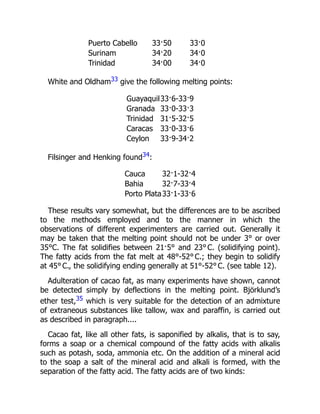
Experiments on the melting point of cacao butter as carried out by
Zipperer under special conditions yielded the following values; cf. also
Table 12.
Kind of bean
Melting
point raw
Centigrade
roasted
Machala Guayaquil34·5 34·0
Caracas 33·5 34·0
Ariba 33·75 31·5
Port au Prince 34·25 33·8
Puerto Cabello 33·50 33·0
Surinam 34·20 34·0
Trinidad 34·00 34·0
White and Oldham33 give the following melting points:
Guayaquil33·6-33·9
Granada 33·0-33·3
Trinidad 31·5-32·5
Caracas 33·0-33·6
Ceylon 33·9-34·2
Filsinger and Henking found34:
Cauca 32·1-32·4
Bahia 32·7-33·4
Porto Plata33·1-33·6
These results vary somewhat, but the differences are to be ascribed
to the methods employed and to the manner in which the
observations of different experimenters are carried out. Generally it
may be taken that the melting point should not be under 3° or over
35°C. The fat solidifies between 21·5° and 23° C. (solidifying point).
The fatty acids from the fat melt at 48°-52° C.; they begin to solidify
at 45° C., the solidifying ending generally at 51°-52° C. (see table 12).
Adulteration of cacao fat, as many experiments have shown, cannot
be detected simply by deflections in the melting point. Björklund’s
ether test,35 which is very suitable for the detection of an admixture
of extraneous substances like tallow, wax and paraffin, is carried out
as described in paragraph....
Cacao fat, like all other fats, is saponified by alkalis, that is to say,
forms a soap or a chemical compound of the fatty acids with alkalis
such as potash, soda, ammonia etc. On the addition of a mineral acid
to the soap a salt of the mineral acid and alkali is formed, with the
separation of the fatty acid. The fatty acids are of two kinds:
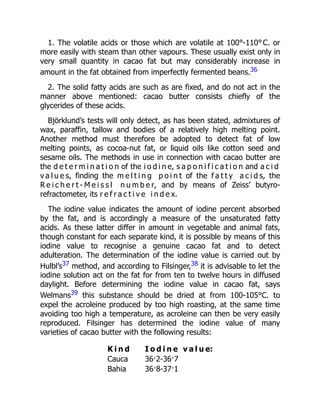
1. The volatile acids or those which are volatile at 100°-110° C. or
more easily with steam than other vapours. These usually exist only in
very small quantity in cacao fat but may considerably increase in
amount in the fat obtained from imperfectly fermented beans.36
2. The solid fatty acids are such as are fixed, and do not act in the
manner above mentioned: cacao butter consists chiefly of the
glycerides of these acids.
Björklund’s tests will only detect, as has been stated, admixtures of
wax, paraffin, tallow and bodies of a relatively high melting point.
Another method must therefore be adopted to detect fat of low
melting points, as cocoa-nut fat, or liquid oils like cotton seed and
sesame oils. The methods in use in connection with cacao butter are
the d e t e r m i n a t i o n of the i o d i n e, s a p o n i f i c a t i o n and a c i d
v a l u e s, finding the m e l t i n g p o i n t of the f a t t y a c i d s, the
R e i c h e r t - M e i s s l n u m b e r, and by means of Zeiss’ butyro-
refractometer, its r e f r a c t i v e i n d e x.
The iodine value indicates the amount of iodine percent absorbed
by the fat, and is accordingly a measure of the unsaturated fatty
acids. As these latter differ in amount in vegetable and animal fats,
though constant for each separate kind, it is possible by means of this
iodine value to recognise a genuine cacao fat and to detect
adulteration. The determination of the iodine value is carried out by
Hulbl’s37 method, and according to Filsinger,38 it is advisable to let the
iodine solution act on the fat for from ten to twelve hours in diffused
daylight. Before determining the iodine value in cacao fat, says
Welmans39 this substance should be dried at from 100-105°C. to
expel the acroleine produced by too high roasting, at the same time
avoiding too high a temperature, as acroleine can then be very easily
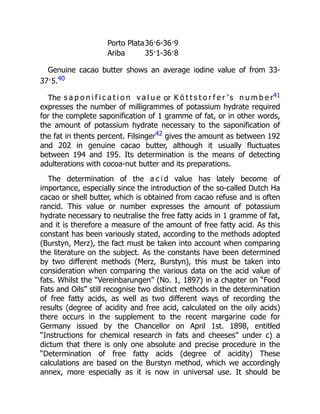
reproduced. Filsinger has determined the iodine value of many
varieties of cacao butter with the following results:
K i n d I o d i n e v a l u e:
Cauca 36·2-36·7
Bahia 36·8-37·1
Porto Plata36·6-36·9
Ariba 35·1-36·8
Genuine cacao butter shows an average iodine value of from 33-
37·5.40
The s a p o n i f i c a t i o n v a l u e or K ö t t s t o r f e r ’ s n u m b e r41
expresses the number of milligrammes of potassium hydrate required
for the complete saponification of 1 gramme of fat, or in other words,
the amount of potassium hydrate necessary to the saponification of
the fat in thents percent. Filsinger42 gives the amount as between 192
and 202 in genuine cacao butter, although it usually fluctuates
between 194 and 195. Its determination is the means of detecting
adulterations with cocoa-nut butter and its preparations.
The determination of the a c i d value has lately become of
importance, especially since the introduction of the so-called Dutch Ha
cacao or shell butter, which is obtained from cacao refuse and is often
rancid. This value or number expresses the amount of potassium
hydrate necessary to neutralise the free fatty acids in 1 gramme of fat,
and it is therefore a measure of the amount of free fatty acid. As this
constant has been variously stated, according to the methods adopted
(Burstyn, Merz), the fact must be taken into account when comparing
the literature on the subject. As the constants have been determined
by two different methods (Merz, Burstyn), this must be taken into
consideration when comparing the various data on the acid value of
fats. Whilst the “Vereinbarungen” (No. 1, 1897) in a chapter on “Food
Fats and Oils” still recognise two distinct methods in the determination
of free fatty acids, as well as two different ways of recording the
results (degree of acidity and free acid, calculated on the oily acids)
there occurs in the supplement to the recent margarine code for
Germany issued by the Chancellor on April 1st. 1898, entitled
“Instructions for chemical research in fats and cheeses” under c) a
dictum that there is only one absolute and precise procedure in the
“Determination of free fatty acids (degree of acidity) These
calculations are based on the Burstyn method, which we accordingly
annex, more especially as it is now in universal use. It should be


Implementing Organizational Change 3rd Edition Spector Test Bank

  • 1.
    Implementing Organizational Change3rd Edition Spector Test Bank install download https://testbankfan.com/product/implementing-organizational- change-3rd-edition-spector-test-bank/ Download more testbank from https://testbankfan.com
  • 2.
    We believe theseproducts will be a great fit for you. Click the link to download now, or visit testbankfan.com to discover even more! Implementing Organizational Change 3rd Edition Spector Solutions Manual https://testbankfan.com/product/implementing-organizational- change-3rd-edition-spector-solutions-manual/ Implementing Organizational Change Theory Into Practice 3rd Edition Spector Test Bank https://testbankfan.com/product/implementing-organizational- change-theory-into-practice-3rd-edition-spector-test-bank/ Organizational Change An Action Oriented Toolkit 3rd Edition Cawsey Test Bank https://testbankfan.com/product/organizational-change-an-action- oriented-toolkit-3rd-edition-cawsey-test-bank/ Managing Organizational Change A Multiple Perspectives Approach 3rd Edition Palmer Test Bank https://testbankfan.com/product/managing-organizational-change-a- multiple-perspectives-approach-3rd-edition-palmer-test-bank/
  • 3.
    Managing Organizational ChangeA Multiple Perspectives Approach 3rd Edition Palmer Solutions Manual https://testbankfan.com/product/managing-organizational-change-a- multiple-perspectives-approach-3rd-edition-palmer-solutions- manual/ Organizational Theory Design and Change 6th Edition Jones Test Bank https://testbankfan.com/product/organizational-theory-design-and- change-6th-edition-jones-test-bank/ Organizational Theory Design and Change 7th Edition Jones Test Bank https://testbankfan.com/product/organizational-theory-design-and- change-7th-edition-jones-test-bank/ Organizational Theory Design and Change Canadian Edition 1st Edition Jones Test Bank https://testbankfan.com/product/organizational-theory-design-and- change-canadian-edition-1st-edition-jones-test-bank/ Managing Organizational Change A Multiple Perspectives Approach 2nd Edition Palmer Test Bank https://testbankfan.com/product/managing-organizational-change-a- multiple-perspectives-approach-2nd-edition-palmer-test-bank/
  • 4.
    Chapter 5 –People Alignment MULTIPLE CHOICE 1. ____________ involves assuring that the skills and behaviors of employees within the organization will enable the effective implementation of the organization’s strategy a. Business dynamics b. Human development planning c. People alignment d. Job development e. none of the above (c: Easy; p. 101) 2. In developing required competencies, leaders can select a “____________” or “____________” approach. a. make; buy b. performance; skills c. performance; make d. skills; buy e. none of the above (a: Moderate; p. 101) 3. Which statement is correct in regards to developing required competencies through a “buy” approach? a. injects the organization with new employees who possess the desired set of competencies b. implies developing the needed new set of competencies and behaviors in current employees c. assumes that employees are both capable of and motivated to acquire and utilize new skills and engage in new behaviors d. Both A and B e. Both B and C (a: Moderate; p. 102) 4. To be part of a change effort, training programs need to contain two components: a. knowledge and skill development. b. content and methods. c. strategic focus and reinforcement. d. support and skills training. e. none of the above (a: Difficult; p. 103) Copyright © 2013 Pearson Education, Inc. publishing as Prentice Hall 67
  • 5.
    5. ___________ trainingprograms focus on behaviors and typically include role‐playing and feedback. a. Team b. Experiential c. On-the-job d. Succession e. Just-in-time (b: Moderate; p. 103) 6. Training fade-out is reduced by which of the following factors? a. supervisory support b. peer support c. work conditions d. all of the above e. none of the above (d: Difficult; p. 104) 7. ______________ is the failure of newly learned behaviors to transfer to on-the-job experiences. a. Transfer dysfunction b. Training failure c. Training fade-out d. Performance gap e. none of the above (c: Moderate; p. 104) 8. Feedback is a key opportunity for developing new skills, but it should: a. move employees towards new behaviors. b. effectively reinforce existing patterns. c. be offered in a training setting only. d. be a part of the formal appraisal process. e. none of the above (a: Difficult; p. 104) 9. ______________ is a formal, regularly scheduled mechanism designed to provide employees with performance feedback. a. Informal feedback b. Performance enhancement training c. On-the-job development d. Performance appraisal e. Group enhancement (d: Easy; p. 105) Copyright © 2013 Pearson Education, Inc. publishing as Prentice Hall 68
  • 6.
    10. ______________ usesperformance feedback gathered from peers, subordinates, supervisors, and customers. a. Formal performance appraisal b. Informal performance appraisal c. 360-degree performance appraisal d. Self-appraisal e. none of the above (c: Easy; p. 106) 11. ________________ can be described as the process of “getting the right people on the bus” and “the wrong people off the bus.” a. Removal and replacement b. Person-organization c. People alignment d. Transport scheduling e. none of the above (c: Easy; p. 109) 12. ________________a formal process in which top executives regularly review all managers at or above a certain hierarchical level, looking at both performance and potential, and devise developmental plans for their most promising individuals. a. Performance appraisal b. People alignment c. Job rotation d. Succession planning e. none of the above (d: Moderate; p. 107) 13. Person-task fit refers to: a. when the organization has specific tasks that need to be done, it hires individuals with the requisite skills. b. human resource specialists’ work in a structured way to define the key knowledge, skills and abilities required in the performance of core organizational tasks. c. individuals are sought, and often tested, to determine their competency levels to perform specific tasks. d. all of the above e. both A and B (d: Difficult; p. 110) Copyright © 2013 Pearson Education, Inc. publishing as Prentice Hall 69
  • 7.
    14. Person-organization fitlooks: a. at the current diversity of the organization. b. beyond specific jobs to the desired future state of the organization. c. at ways to better match organizational culture to employee desires. d. both A and B e. both B and C (b: Moderate; pp. 119-110) 15. A ____________ test is self-administered and quantifiable, used in selection. a. behaviorally anchored b. simulation c. standardized d. valid reflection e. none of the above (c: Easy; p. 112) 16. Which of the following is correct about the strengths of behavioral simulation? a. can focus on specific behaviors b. valid supplement to other screening mechanisms c. validity increases when multiple interviewers score results d. focus on actual rather than recounted behaviors e. both B and C (d: Difficult; p. 114) 17. Which of the following is correct about the strengths of paper-and-pencil tests? a. easy to administer and score b. inexpensive to use on large scales c. simple to compare d. valid job success predictors when used in combination with other mechanisms e. all of the above (e: Moderate; p. 114) 18. In order to ensure that top management supports strategic renewal: a. it is always necessary to hire new executive leadership from the outside. b. existing managers should remain in the job, do well, with large pay increases. c. a succession plan process with no required follow-up should be in place. d. all of the above e. none of the above (e: Difficult; p. 107) Copyright © 2013 Pearson Education, Inc. publishing as Prentice Hall 70
  • 8.
    19. A selectiontool that uses role plays and behavior demonstrations is called a: a. paper and pencil test. b. stress interview. c. team selection. d. behavioral simulation. e. none of the above (d: Easy; p. 113) 20. Patagonia’s statement that “it’s easier to teach dirt bags to do business than it is to teach businessmen to be dirt bags” reflects what approach to employee selection? a. behavioral simulation b. person-organization fit c. wilderness training d. competency assessment (b: Difficult; p. 114) 21. ____________ is a process in which top executives regularly review all managers at or above a certain hierarchical level, looking at both performance and potential, and devise developmental plans for their most promising individuals. a. Task planning b. Job planning c. Policy planning d. Process planning e. None of the above (e: Difficult; p. 116) 22. The statement of “delayering, increased span of control, matrix, or horizontal structures—all of these work to develop generalists far earlier in their careers and place a greater premium on interpersonal competencies” refers to which practices for developing executives capable of adaptation and leading change? a. structural and design changes b. explicit international movement c. career mazes d. slower velocity to allow greater learning e. none of the above (a: Difficult; p. 108) 23. The statement of “explicit lateral movements replace rapid upward functional mobility with a far broader set of experiences” refers to which practices for developing executives capable of adaptation and leading change? a. structural and design changes b. explicit international movement c. career mazes Copyright © 2013 Pearson Education, Inc. publishing as Prentice Hall 71
  • 9.
    d. slower velocityto allow greater learning e. none of the above (c: Difficult; p. 108) 24. ____________ deals with individuals who cannot or will not develop new competencies and behaviors. a. Removal and replacement b. Career change c. Training d. Behavioral replacement e. none of the above (a: Moderate; p. 115) 25. ____________ is a widely shared perception that decisions are being made on the basis of valid criteria. a. Engagement b. Fair process c. Managerial manipulation d. Sequential approach (b: Easy; p. 117) 26. In order to accomplish fair process, removal and replacement decisions should be: a. fair in process. b. valid in content. c. appropriate in sequence. d. timely and accurate. e. all of the above f. A and B g. A, B and C (g: Moderate; p. 127) 27. When using removal and replacement as implementation tools in support of strategic renewal and change, perceived fairness will be enhanced by a sequence of actions that has already included ___________. a. a shared diagnosis that has surfaced the relationship between past behavioral patterns and current performance shortcomings. b. a redesign process that has identified new patterns of behavior required for sustained outstanding performance. c. training and development that have been offered to employees as a way of gaining and demonstrating required new behaviors. d. all of the above e. none of the above (d: Difficult; p. 118) Copyright © 2013 Pearson Education, Inc. publishing as Prentice Hall 72
  • 10.
    28. Engagement, explanationand expectation clarity are 3 factors that contribute to: a. removal and replacement. b. fair process. c. effective employee selection. d. mutual engagement. e. succession planning (b: Moderate; p. 117) 29. Questions such as, “Give me an example of a work-related problem that you had to deal with” or “talk about a recent group experience you had at work and the role that you played” are examples of which type of interviews? a. behavioral simulations b. paper-and-pencil tests c. behaviorally anchored interviews d. human interaction tests e. communication skill tests (c: Moderate; p. 112) 30. Dealing with recounted rather than actual behaviors is a weakness of which technique for person-organization fit screening? a. behavioral simulation b. paper-and-pencil test c. behaviorally anchored interviews d. human interaction test e. communication skill test (c: Difficult; p. 112) 31. Self-appraisal and data from multiple sources can increase the ____________ and ____________ of performance feedback a. validity; reliability b. cost; timeliness c. validity; effectiveness d. timeliness; effectiveness (c: Moderate; p. 106) 32. Evaluating employees is important because: a. it provides an assessment of human assets in the firm. b. it identifies the gap between current and future skill needs. c. it identifies poor performers and potential leaders. d. it targets required T&D efforts. e. all of the above (e: Moderate; p. 105) Copyright © 2013 Pearson Education, Inc. publishing as Prentice Hall 73
  • 11.
    33. In successionplanning, focusing on fast track managers is a good approach because: a. fast trackers are known to have skills associated with future performance b. fast trackers have passed all of the written and behavioral tests c. fast trackers are committed to staying with the company who invests in them d. fast trackers come from the outside so they have fresh ideas e. none of the above (e: Difficult; p. 108) 34. ____________ refers to an awareness of the forces demanding strategic renewal and change and the options available to the organization in response to those forces. a. Knowledge component b. Skill development c. Management development d. Behavioral development e. none of the above (a: Moderate; p. 111) TRUE / FALSE 35. A “making” approach to human resource development implies developing the needed new set of competencies and behaviors in current employees. It assumes that employees are both capable of and motivated to acquire and utilize new skills and engage in new behaviors. (True: Moderate; p. 102) 36. “Buying” involves injecting the organization with new employees who possess the desired set of competencies. (True: Easy; p. 102) 37. In order to develop required human resource competencies, organizational leaders need to align the selection, training, development, and removal of employees with the behavioral requirements of the desired change. (True: Easy; p. 102) 38. Training can help convey to employees how their competitive environment is changing and why their own behaviors need to be altered. (True: Moderate; p. 103) 39. Training can, under the right circumstances, help employees gain new behavioral competencies. (True: Easy; p. 103) Copyright © 2013 Pearson Education, Inc. publishing as Prentice Hall 74
  • 12.
    40. The desiredgoal of the performance feedback process is alignment between the future needs of the organization and the desires and motivations of employees. (True: Moderate; p. 105) 41. The biggest advantages of formal appraisal are validity and accuracy. (False: Moderate; p. 106) 42. Approximately 90% of Fortune 500 companies use some form of 360-degree feedback. (True: Moderate; p. 106) 43. On-the-job experience is less useful than behavioral and cognitive training in developing new skills among executives. (False: Easy; p. 107) 44. When supervisors seek to clone themselves, the effect is damaging for the employees, not for the organization. (False: Easy; p. 111) 45. When an organization is attempting to implement change, there is an urgent need to attract employees whose behavior exemplifies the desired future state. (True: Easy; p. 111) 46. The second component of the change effort and training programs is a knowledge component: an awareness of the forces demanding strategic renewal and change and the options available to the organization in response to those forces. (False: Moderate; p. 103) 47. New behaviors acquired during experiential training will fade out unless the work environment to which participants return supports new behaviors and participants understand and accept the fact that outstanding performance will require those behaviors. (True: Moderate; p. 104) 48. Companies cannot manage the careers of executives in order to create a continuous stream of leaders from inside the organization capable of implementing change. (False: Moderate; p. 108) 49. Workforce reductions and employee layoffs may be effective in improving short- term performance but will not by themselves produce the human resource competencies required to support strategic renewal and sustain outstanding performance. (True: Moderate; p. 115) Copyright © 2013 Pearson Education, Inc. publishing as Prentice Hall 75
  • 13.
    50. In behaviorallyanchored interviews, applicants are asked to demonstrate job behaviors. (False: Moderate; p. 112) 51. Unless removal and replacement decisions are viewed by employees as being fair in process, valid in content, and appropriate in sequence, the decisions can undermine commitment to change implementation. (True: Easy; p. 118) 52. Perceptions of fairness can also be impacted by the degree to which an organization provides employees with due process and appeal mechanisms. (True: Moderate; p. 117) ESSAY QUESTIONS 53. What are the advantages and disadvantages of make/buy options for changing human resources? Make approach: Advantages: Uses existing talents, knowledge and skills; builds commitment to the organization Disadvantages: Not all employees can or want to change; change process may be slow; training can be costly Buy approach: Advantages: Quick; injects the organization with new talents, skills and ideas Disadvantages: May undercut morale/commitment of existing employees (p. 111) 54. What are the strengths and weaknesses of behaviorally anchored interviews? Strengths:  Can focus on specific behaviors  Valid supplement to other screening mechanisms  Validity increases when multiple interviewers score results Weaknesses:  Deal with recounted rather than actual behaviors  Can be slow and expensive to administer (Difficult; p. 112) 55. What are the sources of fairness in removal and replacement decisions? What would be some key questions in determining each source? Copyright © 2013 Pearson Education, Inc. publishing as Prentice Hall 76
  • 14.
    a. Validity: Aredecisions made according to personal biases and beliefs of individual supervisors (low fairness) or in alignment with the clear requirements of outstanding performance (high fairness)? b. Due Process: Are decisions seen as final and arbitrary (low fairness), or are employees able to voice their opinions and appeal what they consider to be invalid conclusions (high fairness)? c. Timing and sequencing: Are decisions made before an employee is given an opportunity to acquire the required skills (low fairness), or are employees given an opportunity to develop and display the desired new behaviors (high fairness)? (Moderate; p. 118) 56. Explain the concept of person-task fit. The concept of person-task fit explains that when the organization has specific tasks that need to be done, it hires individuals with the requisite skills. Human resource specialists work in a structured way to define the key knowledge, skills and abilities required in the performance of core organizational tasks. Individuals are sought and often tested, to determine their competency levels to perform specific tasks. The best-qualified individuals are then selected to fill the organization’s job vacancies. (Moderate; p. 110) 57. Explain the concept of person-organization fit. The second approach to selection involves what can be thought of as person- organization fit: seeking “congruence,” between patterns of organizational values and patterns of individual values, defined here as what an individual values in an organization, such as being team-oriented or innovative. Person-organization fit looks beyond specific jobs to the desired future state of the organization. This concept questions the mind-set, the personality, and the competencies that the organization seeks through its change. It further involves what newly defined roles, responsibilities, and relationships have been sought. Most importantly at this stage, what new competencies—both technical how-to competencies and interpersonal (creative problem solving, decision making, collaboration, communication, and so on) are required of this desired future state? (Moderate; p. 110) Copyright © 2013 Pearson Education, Inc. publishing as Prentice Hall 77
  • 15.
    58. Explain thecomponents of a behavioral simulation. In a behavioral simulation, a group of individuals is assigned a complex problem to solve.  Solving the problem requires multiple skills.  The problem’s solution is such that effective performance can be rated objectively.  Individuals are placed in teams and asked to solve the problem jointly.  A facilitator is on hand to offer behavioral observations.  The joint problem-solving phase may be videotaped to allow participants to observe their behaviors.  A trained facilitator leads the team through a discussion of behaviors.  The solutions of the teams are measured, providing effectiveness metrics for each group.  Team members engage in a further discussion of behaviors based on their performance. (Difficult; p. 113) 59. Explain the two approaches of “make” and ‘buy” in regards to developing required competencies. In developing required competencies, leaders can select a “make” or “buy” approach. Making implies developing the needed new set of competencies and behaviors in current employees. Making assumes that employees are both capable of and motivated to acquire and utilize new skills and engage in new behaviors. Not all employees can or will make that shift, of course. Additionally, the time required may be too long. Leaders, therefore, will also have to consider a buy approach. Buying involves injecting the organization with new employees who possess the desired set of competencies. The choice between making and buying is not meant to be an either/or choice. (Moderate; pp. 101-102) Scenario-Based Questions You are the new CEO of a major HR firm, offering specialized HR services to organizations wishing to outsource all or part of their HR functions. In the past, the firm has been structured into several divisions, including Compensation, Recruitment, Training and Development, and Legal Services. As part of Step 1, Organization Redesign, you have successfully piloted cross-functional teams and a new focus on customer service which you are now rolling out as the new strategic directive for the entire firm. In order to make sure that the change succeeds, you are now focusing on the newly identified skills and competencies and you want to make sure that they exist across all groups, department and functions. Copyright © 2013 Pearson Education, Inc. publishing as Prentice Hall 78
  • 16.
    60. Since yourpriority right now is with people alignment, you need to decide what comes first. The best approach would be: a. make sure the right people are in the right places, then train. b. get rid of all the dead wood and work with what is left. c. train and develop, then assess, and move to removal and replacement. d. to make sure that everyone is committed, keep everyone in the same place. (c: Difficult; p. 102) 61. One of your first decisions is between a make or buy approach to HRD. You decide: a. buying is the quicker option, and besides, the organization needs lots of new talent. b. making is the only way to go – after all, the organization relies on commitment from its long-time employees. c. you decide on some combination between buying and making. d. you heard that this whole process has something to do with people getting on and off busses, so you propose a “share a ride” program for all employees. (c: Moderate; p 102) 62. Training and development is a key component of your strategic change process. Because your budget is limited, you want to cut one or more of the following training components. Which one would you cut? a. skill development training, focusing on teamwork and customer service b. skill development training, focusing on planning and budgeting c. knowledge component, dealing with strategic renewal and adaptation d. training in new behavior support for supervisors and peers (b: Difficult; p. 103) 63. In order to enhance the validity and accuracy of appraisal and feedback, you implement: a. 360-degree feedback. b. standardized assessment. c. behavioral simulations. d. removal and replacement. (a: Moderate; p. 106) 64. As much as you are committed to developing your existing employees, several key people have left the organization because they did not agree with the changes and some others had to be let go because of serious performance challenges. The best way to ensure that the removal part of the process goes well is: a. handle it as quickly as possible and behind closed doors – that way no one gets hurt. b. involve people in the decision, explain the criteria and the reasoning, and offer due process. Copyright © 2013 Pearson Education, Inc. publishing as Prentice Hall 79
  • 17.
    Copyright © 2013Pearson Education, Inc. publishing as Prentice Hall 80 c. give the decision to the company lawyers – they know best how to deal with these matters. d. avoid removal altogether – the strategic change will take care of everything. (b: Moderate; p. 117) 65. In planning replacement for these employees, you decide on which of the following strategies? a. The company has a tried-and-true system in place for employee selection – don’t break what has been working well in the past. b. Each of these jobs has an extensive job description and your supervisors have been trained in behavioral interviewing and administering some good tests that match the person to the job. c. In light of the strategic change process, it is essential that you select people who can see the new strategy – you try to pick people who can work well in teams and know the importance of customer service. d. You select people based on education and experience. (c: Difficult; pp. 115-116)
  • 18.
    Exploring the Varietyof Random Documents with Different Content
  • 19.
    C e yl o n, with the shipping port of Colombo, produces in a good year from 3,500 to 4,000 tons, about two-thirds of which are traded through London. Direct shipments to Germany have recently been more and more frequent; Australia also claims consideration as a consuming land. The different sorts, or rather, qualities, for a very careful preparation ensures the excellence of the goods, go under the description fine, or medium, or ordinary, and occasionally are utilised as typical examples. The better sorts come exclusively from plantations, and the ordinary are the result of native enterprise. J a v a also produces a large quantity, the cacao here being chiefly planted on the north side of this long, narrow island. More than a half is exported from the port of Samarang, then follow Batavia, Soerabaja and a few minor places, with a total output of about 2,500 tons. The larger proportion of this cacao is sold in the markets of Amsterdam and Rotterdam to Dutch merchants, who pass it on to other consuming countries. England, North America, Australia, China and the Philippines are the chief customers. Those sorts coming from the neighbouring islands of Celebes, Timor, Bali, Amboina and Lombok may also be considered as sub-classes of the Java; but they do not total more than 75 tons. IV. Australian Cacao Sorts. Cacao plantation in Australia is still in its early stages. Most progressive is S a m o a, which has increased its 1900 export of 30 cwt. to 200 tons at the present time, among which right excellent qualities occur, culled from Criollo trees. The deteriorated Forastero has also recently been planted, which we must allow to be more fruitful and less dependent on careful nursing. The Samoa Criollo bean resembles the large fine Ceylon variety, except that it has a more pronounced flavour. N e w G u i n e a a n d B i s m a r c k - A r c h i p e l a g o e s can only claim casual mention as experimentally interested in cacao cultivation.
  • 20.
    g) The Tradein Cacao and the Consumption of Cacao Products; Statistics. Although cacao and cacao products have always been held in the highest esteem, ever since they first became known in Europe, yet price considerations long prevented them from enjoying the same widespread popularity among the lower classes as tea and coffee. Thanks, however, to the improved means of transport established in the course of the last fifty years, which has cheapened all exotic produce, the demand for these wares has of late been more frequent and urgent, and is reflected in the constantly increasing influx of cacao on the European markets and the systematic opening out of new regions to the raw material, just as corresponding extensions in the factory world contribute towards a reduction in the cost of the products. Hence cacao may now be described as a luxury within the reach of everyman. Its diffusion among all grades of the population may be regarded as a great blessing, for in it has arisen a new [Transcriber’s Note: a line is missing here] merely a stimulant, like tea or coffee, but a beverage in the proper sense of the term, analytically so established. It will accordingly prove of interest to glance through the returns in connection with the trade in these goods, their importation and exportation, commercial values of the same, and the relative consumption of cacao, tea and coffee. Such figures are always at hand. The surprisingly rapid growth of the cacao cultivation, and the manufacture of cacao products, is e. g. at once apparent in statistics furnished by the French government. In 1857 the number of 5,304,207 kilos of beans were consumed there. The importations of the year 1895, on the other hand, amounted to 32,814,724 kilos, having in the space of 38 years increased more than sixfold. Of this quantity, almost the half, comprising about 15,234,163 kilos, is disposed of retail. Turning to the trade in Germany, the cacao industry here and its consumption,19 we are again greeted with cheery prospects. According to the official inquiry, German trade in Cacao products for the years 1907-1910 is shown in the following table:
  • 21.
    Ta b le 1. No. on offic. statistics Description Imports to Germany Exports from Germany Duty Free inclusive 1907 1908 1909 1910 1910 1907 1908 1909 1910 63 Cacao Bean raw 345154 343519 407248 439413 — 1390 1186 1429 1620 64 Cacao Shell whole 55 1 6 6 — 12802 9901 11825 17006 168 Cacao Butter Cacao Oil 243 106 208 263 22223 20804 18494 27291 22465 203a Cacao Mass, Ground Cacao shells 165 1196 128 58 125 3430 3519 3694 5219 203b Cacao Powder 6792 8148 6497 6446 2599 3050 1752 2803 3755 204a Chocolate & Chocolate Equivalents 11636 10050 12197 15183 1513 5021 3671 4609 4712 204b Products from Cacao Mass, Cacao Powder, Chocolate and Chocolate Equivalents, Acorn, and Oat cacaos 1239 1281 1258 1140 2027 4260 4439 4555 4964 The year 1910 brought a total import of 878,413 cwts. of raw cacao, thus overtopping the figures of the previous year, which had created a record with 814,496 cwts., by 64,330 cwts. Coming to the geographical distribution, we find that they were imported into Germany in the following proportions, namely: 1910 1909 Comparison with previous years British West Africa cwts. 206 180 189 686 + 6 494
  • 22.
    Port. West Africa(St. Thomas etc.) " 239 756 181 230 +58 526 Brazil (Bahia) " 128 760 137 396 - 8 636 Ecuador (Guayaquil) " 97 454 101 038 - 3 584 Dominican Republic (Samana) " 64 932 66 210 - 1 278 The Rest of British America " 21 266 40 658 - 5 08 Venezuela " 40 068 36 002 -44 26 Cameroon " 20 426 22 026 - 1 420 Ceylon " 15 892 12 488 - 3 402 East Indies (Dutch) " 8 802 6 772 - 2 030 Cuba " 2 610 3 066 - 456 Haiti " 3 676 2 614 - 1 562 Samoa " 3 216 2 230 - 314 Togo " 564 250 - 314 These figures, which we quote from the Thirty First Year’s Report of the Association of German Chocolate Makers, speak volumes for the recent development of the cacao trade. It is interesting, in view of recent occurrences, to note the quantities despatched from the various places. The importations from St. Thomas, for instance, show a striking increase. They stand at the head of the raw cacao products coming into Germany, with 239,756 cwts., and have pushed Accras down to second place, this variety having failed to maintain its 1909 lead, for 1910 did not add more than 6,496 cwts. to its previous total of 199,686 cwts. Bahias came third, then as now, with 128,760 cwts. This order has not always remained constant, but has suffered considerable deviations in progressive years. We give below a table showing the chief cacao producing lands and their imports into Germany between 1900 and 1908. Ta b l e 2. Imports in Germany in tons. 1900 1901 1902 1903 1904 1905 1906 1907 1908 Brit. West Africa Gold Coast (Accra) —— —— 559·1 935·2 1580·9 2775·9 4045·9 6009·2 5752·5 Portuguese West Africa (St. Thomas) 2501·6 3116·0 4069·2 3878·8 4526·6 4259·3 4969·6 5559·9 7303·8 Brazil (Bahia) 3776·8 3239·0 3125·5 2599·8 4130·4 4506·4 6106·1 6937·2 6233·7 Ecuador (Guaquil) 5397·9 4744·8 4728·6 5092·7 5689·8 5350·3 4693·6 4245·0 4123·6
  • 23.
    Dominican Republic (Samana) 586·1 1853·02448·8 3116·0 4562·4 4514·1 5663·8 4037·4 4574·3 Rest of British North America 1436·9 1195·6 1544·7 1292·3 1851·5 2009·0 2503·6 2293·2 2083·7 Venezuela (Caracas) 1158·5 956·6 893·2 829·4 1280·3 1380·9 1685·9 2365·0 1435·6 Cameroon —— 190·9 361·5 470·7 647·5 839·4 1199·0 1240·3 1397·7 Ceylon —— 107·4 344·9 350·1 497·7 589·3 588·0 788·0 604·7 East Indies (Dutch) —— —— —— —— —— —— —— 333·4 347·2 Cuba —— 299·8 345·3 144·7 189·0 195·6 —— 331·4 120·6 Samoa —— —— —— 101·3 203·8 140·0 —— 52·9 124·2 Columbia —— 112·6 104·3 52·6 —— —— —— 75·2 66·7 Togo —— —— —— —— 3·7 6·0 —— 15·0 18·6 via The Netherlands 122·1 363·9 357·6 60·9 —— —— —— —— —— via Portugal (probably Thomas) 988·1 1311·4 1349·1 2447·7 1734·9 2853·4 2714·9 103·3 —— Haiti 1796·0 340·4 In conse- quence of tariff struggle —— —— —— —— —— —— The consumption of cacao in other civilised countries shows a corresponding increase, although with occasional divergencies and astounding relapses. We give the following table (3) to indicate its progress between the years 1901 and 1908, and to facilitate comparison. It must be borne in mind, when making use of this table (specially in connection with Germany) that the falling off in the years 1907-8 is to be attributed to the abnormally bad harvests and consequent increase in prices. Ta b l e 3. Import or Consumption in the Various Lands in tons. 1901 1902 1903 1904 The United States of North America 2066595·8 2312072·8 2850808·2 3216415·6 Germany 1841000·0 2060170·0 2163440·0 2710140·0 France 1791650·0 1934300·0 2074150·0 2179450·0
  • 24.
    England 1890800·0 2038600·01868119·2 2054250·4 Holland 1437300·0 1466627·4 1073047·4 1218440·0 Spain 593107·7 925997·6 602675·2 581635·9 Switzerland 436330·0 570700·0 585650·0 683910·0 Belgium 186548·7 227763·3 276779·1 279200·8 Austria-Hungary 168650·0 182010·0 203460·0 251010·0 Russia — — 190068·0 205570·0 1901 1902 1903 1904 The United States of North America 3523164·5 3794857·5 3752650·5 4261529·3 Germany 2963310·0 3526050·0 3451540·0 3435190·0 France 2174760·0 2340380·0 2318030·0 2044450·0 England 2119071·2 2013204·0 2015947·2 2105152·0 Holland 1073740·0 1122400·0 1221924·9 1582100·0 Spain 610171·2 563682·1 562823·9 658011·3 Switzerland 521840·0 646690·0 712420·0 582050·0 Belgium 301899·7 386168·6 325396·7 455408·1 Austria-Hungary 266850·0 331280·0 347170·0 370730·0 Russia 222768·0 267094·0 247338·0 258806·0 The relative consumption of coffee, tea and cacao has also inclined in favour of the latter as far as Germany is concerned. According to the 19th. Report of the Association of German Chocolate Makers, No. 7, the imports which passed through the custom-houses of that country, and intended for consumption, figured at the following in tons; though in this connection it is as well to remember that the German ton is about 50 lbs. less than the English. Coffee Cacao Tea (raw in bean)(raw in bean) 1886 12 360·5 3 686·71618·5 1887 101 833·4 4 295·01760·0 1888 114 658·1 4 979·81778·4 1889 113 228·5 5 565·11875·0 1890 118 126·3 6 246·51995·0 1891 125 611·2 7 087·02221·0 1892 122 031·9 7 460·92479·0 1893 122 190·5 7 960·92676·0 1894 122 357·5 8 319·92840·0 1895 122 390·2 9 950·92544·0 1896 129 896·6 12 209·52471·0
  • 25.
    1897 136 395·014 692·52852·0 1898 153 270·4 15 464·93661·9 From the above columns it will be seen that the importation of coffee has only increased 24 percent, that of tea 125 percent, but that of cacao at the surprising rate of 330 percent. A comparison of the totals for coffee, tea and cacao in the years 1886, 1898 & 1906 will make the proportions still more evident. 1886 1898 1906 Coffee 96·0% 89·0% 82·6% Cacao 2·8% 8·9% 15·6% Tea 1·2% 2·1% 1·8% Total100·0%100·0%100·0% So that whilst in the year 1886 thirty-five times as much coffee as cacao found its way into Germany, the imports for 1898 were ten, and in 1906 only five and a half times greater in the case of the first named article. It follows that there has been a corresponding increase as regards cacao consumption in Germany. A momentary survey of the graphs in Fig. 5, which we owe to the kindness of Herr Greiert, Managing Director of the Association of German Chocolate Manufacturers, will make this clear to the reader; and the diagram there illustrates the relative growth of cacao consumption in Germany, when compared with other countries. On calculating the quantity of cacao consumed per head of the population, we get a graph (fig. 6) which puts the rapid increases in this direction at a glance.
  • 26.
    Fig. 5. (thegerman text is here).
  • 27.
    Fig. 6. Graphicalrepresentation per head of the population for the last 75 years. The curve for the last ten years represents enormous advances, and contrasts with the more even line developed in earlier years. According to official reports, the average consumption of cacao per head between the years 1861-5 amounted to 0·03 kg. (tea 0·02 kg. and coffee 1·87 kg.) but had in 1910 risen to an average of 0·53 kg. per head.
  • 29.
    B. Chemical Constitutionof the Bean. a) The Cacao Bean Proper. Just as the beans of the cacao fruit are included under the botanical concept “Seed”, so also their chemical constituents closely resemble those common to every other seed. There are the usual reserve stuffs inherited from the mother plant, which serve as sustenance for the yet undeveloped organs, and compare with albumen in the feathered world. Apart from the constituents incidental to all plant life at this stage, such as albumin, starch, water, fat, sugar, cellulose and mineral stuffs such as ash, the cacao seed has two other components peculiar to itself; T h e o b r o m i n e and C a c a o - r e d. We adjoin a succession of chemical determinations respecting the quantitative proportions of these substances in the seed, and think further that we may be allowed to cite the results of fore-time investigators in this sphere, especially as their work has formed the basis for all future operations, and again, in view of the doubt which still prevails in scientific circles as to the “Normal” composition of the cacao bean. Ta b l e 4. Percentage Composition of the Hulled Bean. Analyst Payen20 Lampadius20 Mitscherlich20 Constituents percent Undescribed West Indies Guayaquil Caracas 1. Water 10·0 3·40 5·60 — 2. Nitrogenous matter 20·0 16·70 14·39 — 3. Theobromine 2·2 — 1·20 — 4. Fat 52·0 53·10 45-49 46-49 5. Cacao-red — 2·07 3·50 — 6. Sugar — — 0·60 — 7. Gum and Starch 10·0 7·75 14·30 13·5 8. Woody fibre 2·0 0·90 5·80 — 9. Ash 4·0 3·43 3·50 —
  • 30.
    Ta b le 5. Laube Aldendorff Constituents percent Caracas Guayaquil Trinidad Puerto Cabello Surinam 1. Water 4·04 3·63 2·81 2·96 3·76 2. Nitrogenous matter 14·68 14·68 15·06 15·03 11·00 3. Fat 46·18 49·04 48·32 50·57 54·40 4. Starch 12·74 11·56 14·91 12·94 — 5. Other non-nitrogenous matter 18·50 12·64 12·06 11·49 28·32 6. Woody fibre 4·20 4·13 3·62 3·07 — 7. Ash 3·86 3·72 3·22 3·94 2·35 C. Heisch Constituents percent Granada Bahia Cuba Para 1. Water 3·90 4·40 3·72 3·96 2. Nitrogenous matter 12·45 7·31 8·56 12·50 3. Fat 45·60 50·30 45·30 54·30 4. Starch — — — — 5. Other non-nitrogenous matter 35·70 35·30 39·41 26·33 6. Woody fibre — — — — 7. Ash 2·40 2·60 5·90 3·06 The analyses carried out by Zipperer in the year 1886 yielded the following results21: Ta b l e 6. A) Analysis of the Raw Shelled Bean (Kernel). Constituents percent Names of Sorts Ariba Machala Guayaquil Caracas Puerto Cabello 1. Moisture 8·35 6·33 6·50 8·40 2. Fat 50·39 52·68 50·31 53·01 3. Cacaotannic acid, sugar, decomposition products, phlobaphene 8·91 13·72 10·76 7·85 4. Theobromine 0·35 0·33 0·77 0·54 5. Starch 5·78 8·29 7·65 10·05
  • 31.
    6. Cellulose andproteins 22·10 14·45 19·84 15·83 Proteins Proteins Proteins Proteins to to to to cellulose cellulose cellulose cellulose 7. In the ratio 7·3:1 5:1 6·6:1 5·3:1 8. Ash 5·12 4·17 4·17 4·32 Surinam Trinidad Port au Prince Average 1. Moisture 7·07 6·20 6·94 7·11 2. Fat 50·86 51·57 53·66 51·78 3. Cacaotannic acid, sugar, decomposition products, phlobaphene 8·31 9·46 11·39 10·02 4. Theobromine 0·50 0·40 0·32 0·45 5. Starch 6·41 11·07 8·96 8·33 6. Cellulose and proteins 24·13 18·43 15·81 18·71 Proteins Proteins Proteins Proteins to to to to cellulose cellulose cellulose cellulose 7. In the ratio 8:1 6:1 5·25:1 6·2:1 8. Ash 2·72 2·87 2·92 3·60 In addition to these, there is an exhaustive succession of analyses conducted by Ridenour,22 which we accordingly submit as Table 8. Following Filsinger,23 we cannot regard these analyses as an absolutely trustworthy representation of the “Normal” composition of the cacao bean, the values in starch, albumin and ash considerably deviating from all that have been established up to the present time. Among more recent researches, we cite those carried out by Matthes and Fritz Müller.24 Ta b l e 7. B) Analysis of the Raw Shelled Bean (Kernel). Constituents percent Names of Sorts Ariba Machala Guayaquil Caracas Puerto Cabello 1. Moisture 8 ·52 6 ·25 7 ·48 6 ·58 2. Fat 50·07 52·09 49·24 48·40
  • 32.
    3. Cacaotannic acid,sugar and phlobaphene 8 ·61 7 ·84 6 ·85 8 ·25 4. Theobromine 0 ·30 0 ·31 0 ·05 0 ·52 5. Starch 9 ·10 11·59 9 ·85 10·96 6. Cellulose and protein bodies 19·43 18·17 22·16 21·21 Proteins Proteins Proteins Proteins to to to to cellulose cellulose cellulose cellulose 7. In the ratio 6·5:1 6:1 7·7:1 7:1 8. Ash 3 ·89 3 ·75 3 ·92 4 ·08 Surinam Trinidad Port au Prince Average 1. Moisture 4 ·04 7 ·85 6 ·27 6 ·71 2. Fat 49·88 48·14 46·90 49·24 3. Cacaotannic acid, sugar and phlobaphene 8 ·08 7 ·69 7 ·19 7 ·78 4. Theobromine 0 ·54 0 ·42 0 ·36 0 ·43 5. Starch 10·19 8 ·72 12·64 10·43 6. Cellulose and protein bodies 24·39 23·06 21·82 21·43 Proteins Proteins Proteins Proteins to to to to cellulose cellulose cellulose cellulose 7. In the ratio 8:1 7·6:1 7·3:1 7·1:1 8. Ash 2 ·88 4 ·12 4 ·82 3 ·92 Ta b l e 8. Ridenour. Commercial Varieties Constituents percent Bahia Surinam Java Trinidad Roasted Trinidad Ariba Caracas 1. Fat 42·10 41·03 45·50 43·66 41·89 43·31 36·81 2. Theobromine 1·08 0·93 1·16 0·85 0·93 0·86 1·13 3. Albumin 7·50 10·54 9·25 11·90 12·02 10·14 10·59 4. Glucose 1·07 1·27 1·23 1·38 1·48 0·42 2·76 5. Saccharose 0·51 0·35 0·51 0·32 0·28 1·58 1·56 6. Starch 7·53 3·61 5·17 4·98 5·70 6·37 3·81 7. Lignin 7·86 3·90 6·10 5·65 5·87 4·62 3·28
  • 33.
    8. Cellulose 13·8016·24 13·85 13·01 19·64 14·07 16·35 9. Extractive by difference 8·99 13·53 8·90 8·31 5·84 9·00 12·72 10. Moisture 5·96 5·55 5·12 6·34 2·63 5·90 6·63 11. Ash 3·60 3·05 3·31 3·60 3·70 8·73 4·36 Commercial Varieties Constituents percent Roasted Caracas Granada Tabasco Machala Maracaibo Average 1. Fat 37·63 44·11 50·95 46·84 42·20 42·99 2. Theobromine 0·99 0·75 1·15 0·76 1·03 0·97 3. Albumin 12·36 9·76 7·85 12·69 11·56 10·51 4. Glucose 1·76 1·81 0·94 1·60 1·09 1·46 5. Saccharose 0·51 0·55 2·72 0·46 1·36 0·89 6. Starch 6·07 6·27 3·51 1·35 1·69 4·67 7. Lignin 9·05 5·55 6·44 5·95 7·16 5·95 8. Cellulose 11·69 13·49 12·57 11·32 17·32 14·44 9. Extractive by difference 9·22 9·72 9·26 9·02 6·79 9·30 10. Moisture 5·69 5·28 1·55 5·86 5·67 5·18 11. Ash 5·03 2·71 3·06 5·15 4·13 3·70 Ta b l e 9. No. Description Moisture Ether Non-fatty dry substances Mineral constituents In water insoluble ash soluble ash % % % % % % 1 St. Thomas II 2·82 55·87 — 2·79 1·93 0·86 2 Java I 2·78 53·88 — 3·60 1·60 2·00 3 St. Thomas I 2·82 54·50 — 3·01 1·85 1·16 4 Caracas I 2·67 53·78 — 3·35 2·12 1·23 5 Puerto Cabello 3·34 53·29 — 3·58 1·73 1·85 6 Machala 2·93 53·98 — 3·34 2·10 1·24 7 Samana 2·94 55·28 — 3·10 1·85 1·25 8 Accra 2·94 53·94 — 3·19 1·84 1·35 B. Percentages for the non-fatty dry substances.
  • 34.
    1 St. Thomas II— — 41·36 6·536 4·672 1·864 2 Java I — — 43·34 8·306 3·692 4·614 3 St. Thomas I — — 42·68 7·053 4·311 2·742 4 Caracas I — — 43·55 7·692 4·868 2·824 5 Puerto Cabello — — 43·37 8·254 3·989 4·265 6 Machala — — 43·09 7·767 4·900 2·867 7 Samana — — 42·78 7·246 4·325 2·921 8 Accra — — 43·12 7·398 4·267 3·131 C. Percentages for the total of ash. 1 St. Thomas II — — — — 71·49 28·51 2 Java I — — — — 44·45 55·55 3 St. Thomas I — — — — 61·12 38·88 4 Caracas I — — — — 63·38 36·62 5 Puerto Cabello — — — — 48·33 51·67 6 Machala — — — — 63·09 36·91 7 Samana — — — — 59·69 40·31 8 Accra — — — — 57·68 42·32 No. Description Alkali strength Potassium Carbonate reckoned from Alkali strength of soluble ash Pure ash (mineral stuffs minus Pot. Carb.) of the soluble ash of the insoluble ash cb. mm. Nitric acid. % % 1 St. Thomas II 3·6 4·8 0·25 2·54 2 Java I 10·4 6·8 0·72 2·88 3 St. Thomas I 2·6 5·0 0·18 1·83 4 Caracas I 4·6 4·8 0·32 3·03 5 Puerto Cabello 10·4 3·8 0·72 2·86 6 Machala 2·6 5·6 0·18 3·16 7 Samana 4·6 6·2 0·32 2·78 8 Accra 3·6 4·8 0·25 2·94 B. Percentages for the non-fatty dry substances. 1 St. Thomas II 8·7 11·6 0·60 5·94 2 Java I 24·0 15·7 1·66 6·65
  • 35.
    3 St. ThomasI 6·1 11·7 0·42 6·63 4 Caracas I 10·6 11·0 0·73 6·96 5 Puerto Cabello 24·0 8·8 1·66 6·59 6 Machala 6·1 13·0 0·42 7·35 7 Samana 10·8 14·5 0·74 6·50 8 Accra 8·3 11·1 0·58 6·82 C. Percentages for the total of ash. 1 St. Thomas II 133·1 177·4 9·18 90·82 2 Java I 289·1 189·1 20·00 80·01 3 St. Thomas I 87·0 167·0 6·00 94·04 4 Caracas I 137·9 143·9 9·50 90·51 5 Puerto Cabello 290·7 106·6 20·10 79·89 6 Machala 78·5 — 5·40 94·59 7 Samana 149·0 200·0 10·20 89·79 8 Accra 112·2 150·0 7·8 92·16 No. Description Phosphoric acid Silicic acid (SiO2) Ferric acid (Fe2O3) total soluble in water insoluble in water % % % % % 1 St. Thomas II 1·0243 0·2474 0·7769 0·0154 0·0416 2 Java I 1·0753 0·4667 0·6086 0·0300 0·0224 3 St. Thomas I 1·1136 0·3621 0·7515 0·0122 0·0464 4 Caracas I 1·2708 0·3392 0·9316 0·0080 0·0184 5 Puerto Cabello 1·1433 0·4692 0·6741 0·0260 0·0207 6 Machala 1·2836 0·3647 0·9189 0·0116 0·0200 7 Samana 1·0881 0·3213 0·7668 0·0090 0·0560 8 Accra 1·1221 0·3672 0·3549 0·0082 0·0284 B. Percentages for the non-fatty dry substances. 1 St. Thomas II 2·4795 0·5989 1·8806 0·0373 0·1007 2 Java I 2·4790 1·0769 1·4021 0·0692 0·0517 3 St. Thomas I 2·6092 0·8484 1·7608 0·0286 0·1087 4 Caracas I 2·9180 0·7789 2·1356 0·0184 0·0422 5 Puerto Cabello 2·6361 1·0819 1·5542 0·0600 0·0477 6 Machala 2·9837 0·8481 2·1356 0·0269 0·0464
  • 36.
    7 Samana 2·54350·7511 1·7934 0·0214 0·1309 8 Accra 2·6023 0·8516 1·7507 0·0191 0·0658 C. Percentages for the total of ash. 1 St. Thomas II 37·94 9·16 28·78 0·571 1·541 2 Java I 29·87 12·96 16·91 0·833 0·623 3 St. Thomas I 37·27 12·12 25·15 0·408 1·551 4 Caracas I 37·94 10·12 27·82 0·240 0·549 5 Puerto Cabello 31·94 13·11 18·83 0·727 0·578 6 Machala 38·42 10·92 27·50 0·346 0·597 7 Samana 35·12 10·37 24·75 0·295 1·806 8 Accra 35·18 11·51 23·67 0·258 0·889 Ta b l e 10. Commoner Varieties. Key to Column Headings C; Moisture D; Ether extract E; Mineral matter F; Potassium Carbonate reckoned on alkali soluble in water G; Pure ash (mineral matter minus K2CO3) Ha; according to König, as modified by us Hb; as yielded by the Wender process I; Silicic acid (SiO2) J; Ferric oxide (Fe2O3) K; Soluble in alcohol P2O5 No. Description C D E F G % % % % % 1 Superior Ariba, Summer crop 6·95 26·17 7·45 2·07 5·38 2 Machala 81%, Thomé I 19% 5·94 28·79 7·06 1·99 5·07 3 Machala 53%, Thomé I 47% 6·47 25·73 7·15 2·14 5·01 4 Cameroon 6·36 26·41 7·05 2·33 4·72 5 Thomé I 73%, Samana 27% 7·97 24·90 6·89 2·29 4·60
  • 37.
    6 Thomé II60%, Samana 20%, Accra 20% 7·37 22·85 7·39 2·24 5·15 7 Accra 60%, Thomé II 40% 6·93 22·80 7·36 2·25 5·11 8 A}Same variety, 6·56 18·96 7·61 2·14 5·47 9 B}more defatted 6·06 24·75 7·16 2·01 5·15 10 C}less defatted 5·58 29·72 6·57 1·89 4·68 11 Monarch double Ariba(R. & Cie.) 7·59 14·80 8·32 2·32 6·00 12 Helios(R. & Cie.) 7·37 17·25 7·91 2·12 5·79 a Ariba shells (R. & Cie.) very fine ground 7·17 14·00 7·40 2·20 5·20 b germs, Ariba (R. & Cie.) very fine ground 6·64 18·02 6·93 2·43 4·50 No. Description Raw Fiber Ha Hb I J K % % % % % 1 Superior Ariba, Summer crop 4·20 4·60 0·0170 0·0522 0·0605 2 Machala 81%, Thomé I 19% 5·00 5·47 0·0172 0·0373 0·0625 3 Machala 53%, Thomé I 47% 5·20 5·42 0·0186 0·0513 0·0612 4 Cameroon 4·63 4·64 0·0160 — 0·0669 5 Thomé I 73%, Samana 27% 4·20 4·38 0·0167 0·0753 0·0690 6 Thomé II 60%, Samana 20%, Accra 20% 4·23 5·00 0·0208 0·0678 0·0726 7 Accra 60%, Thomé II 40% 4·06 4·40 0·0198 0·0545 0·0766 8 A}Same variety, 4·00 5·24 0·0390 — — 9 B} more defatted 3·58 4·61 — — — 10 C} less defatted 3·20 4·42 — — — 11 Monarch double Ariba(R. & Cie.) 6·90 — 0·0420 — 0·0877 12 Helios(R. & Cie.) 6·40 — 0·0340 0·0400 0·0930 a Ariba shells (R. & Cie.) very fine ground 7·49 — 0·2976 — 0·0383
  • 38.
    b germs, Ariba(R. & Cie.) very fine ground 7·42 — — — 0·0587 Ta b l e 11. Analysis of Cacao. Dry product, defatted and free from alkali. Key to Column Headings C; Defatted and alkali-free dry products D; Pure ash (mineral substances less K2CO3) E; Ash insoluble in water F; Alkalinity of the insoluble ash Nitric acid Ga; total Gb; soluble in water Gc; insoluble in water H; Silicic acid (SiO2) I; Ferric oxide (Fe2O3) J; P3O5 soluble in alcohol K; after König (modified) L; as yielded by the Weender process No. Description C D E F % % % ccm 1 Thomé II 41·06 6·186 4·725 11·7 2 Java I 42·62 6·757 3·754 15·9 3 Thomé I 42·50 6·659 4·353 11·8 4 Caracas I 43·23 7·010 4·904 11·1 5 Puerto-Cabello 42·65 6·706 4·056 8·9 6 Machala 42·91 7·365 4·894 13·1 7 Samana 42·46 6·548 4·357 14·6 8 Accra 42·87 6·858 4·292 11·2 9 Ariba 64·81 8·301 — — 10 Machala + Thomé I 63·28 8·013 — — 11 Thomé + Machala 66·66 7·517 — — 12 Cameroon 64·90 7·273 — — 13 Thomé I + Samana 64·84 7·095 — — 14 Thomé II, Samana + 67·54 7·625 — —
  • 39.
    Accra. 15 Accra + ThoméII 68·02 7·513 — — 16 A 72·34 7·561 — — 17 B 67·18 7·666 — — 18 C 62·80 7·452 — — 19 Monarch Ariba (R. & Cie.) 75·29 7·969 — — 20 Helios Ariba (R. & Cie.) 73·39 8·880 — — a Shells 76·63 6·786 — — b Germs 72·91 6·173 — — No. Description Phosphoric Acid (P205) Ga Gb Gc H I % % % % % 1 Thomé II 2·4947 0·6025 1·8922 0·0375 0·1013 2 Java I 2·5229 1·0950 1·4279 0·0704 0·0525 3 Thomé I 2·6202 0·8520 1·7682 0·0287 0·1091 4 Caracas I 2·9391 0·7846 1·1545 0·0185 0·0425 5 Puerto-Cabello 2·6807 1·1001 1·5806 0·0610 0·0480 6 Machala 2·9914 0·8499 2·1414 0·0270 0·0466 7 Samana 2·5626 0·7802 1·7824 0·0212 0·1319 8 Accra 2·6175 0·8565 1·7610 0·0191 0·0662 Raw fibre J K L 9 Ariba 0·0933 6·48 7·10 0·0262 0·0806 10 Machala + Thomé I 0·0984 7·90 8·64 0·0272 0·0590 11 Thomé + Machala 0·0919 7·80 8·13 0·0280 0·0770 12 Cameroon 0·1030 7·13 7·15 0·0246 — 13 Thomé I + Samana 0·1064 6·48 6·75 0·0258 0·1162 14 Thomé II, Samana + Accra. 0·1075 6·27 7·40 0·0308 0·1004 15 Accra + Thomé II 0·1126 5·97 6·47 0·0290 0·0801 16 A — 5·53 7·24 — — 17 B — 5·33 6·87 — — 18 C — 5·10 7·04 — — 19 Monarch Ariba (R. & Cie.) 0·1165 9·16 — 0·0558 —
  • 40.
    20 Helios Ariba(R. & Cie.) 0·1266 8·72 — 0·0446 — a Shells 0·0499 9·77 — 0·3884 0·0545 b Germs 0·0805 10·18 — — — 1) See Table 9 A and Table 10. The foregoing tables provide us with a general idea of the chemical constituents of the cacao bean, but their distinctive properties, both chemical and physical, still remain to be defined, with which we accordingly proceed, as such data will on the one hand enable us to grasp how loss may be avoided in the manufacture of cacao and chocolate wares, and at the same time render intelligible familiar processes connected therewith. As we have seen, the following substances occur in cacao in varying amounts: 1. Water. 2. Fat. 3. Cacao-red. 4. Theobromine. 5. Albumen. 6. Starch. 7. Cellular tissue or cellulose. 8. Small percentages of grape and cane sugar. 9. Mineral or ash stuffs. Like the majority of plants and plant products, the cacao bean consists of vesicles or cells, closed on all sides and arranged in a series of layers. They are constructed of cellular tissue or cellulose, and contain fat, albumen, water, starch, theobromine, cacao pigment, besides sugar and salts in inferior quantities. 1. W a t e r o r M o i s t u r e . There is present in the bean from 6 to 8 percent of water, a factor which bodes well for the proper germination of the seed, as when this
  • 41.
    latter is deprivedof moisture, e. g. in the course of a too thorough drying, it speedily decays. Water is still evident in small quantities even in the largest and almost withered beans, as will be seen on comparison of the foregoing analyses. 2. F a t . As a constituent at the expense of which respiration is effected, fat remains one of the most important resources of plant. It has a twofold excellence in this connection, and firstly as a highly calorifacient and carboniferous substance, and again because such a reserve enables the living organism to oxidise with particular ease, wherefore it is found accumulated in somewhat significant measure in the majority of seeds. When seen under the microscope it appears either as round coherent masses, or as crystalline aggregates clearly distinguishable from the rest of the cell contents on treatment with a solution of osmic acid. The fat in the cacao bean usually amounts to from 50-56 percent, or one half of the total weight of the shelled beans; the shell also contains from 4 to 5 percent of fat.25 The unfermented bean has frequently, in addition to its bitter taste, a most unpleasant flavour, attributable to the rancidity of its fatty contents. The raw bean contains rather more fat than the roasted bean, for whilst the one averages from 50 to 55 percent, there is seldom more than 48-52 percent in the other. The cause of this phenomenon may be connected with the enrichment of the shells in fat, and in some instances, as when the beans are over-roasted, is to be ascribed to the chemical change which the play of burning heat on fatty bodies involves, when a destructive decomposition of the whole ensues, with formations of acroleine. Chemically considered, cacao butter consists of a mixture of so-called esters, or compounds connected with ether, such as the glycerides of fatty acids, and contains, in addition to stearine, palmatine, and laurine26, the glyceride of arachidic acid. It was also formerly supposed that formic, acetic and butyric acids were among the constituents of this ingredient, but the view has been
  • 42.
    proved erroneous byLewkowitsch27; similarly, the presence of theobromic acid alleged by Kingzett28 has been called into question by Graf.29 Cacao butter is a fairly firm fat of pleasant taste and smell, which varies in colour between yellowish white and yellow. When freshly expressed, it has frequently a brownish shade, passing after a short time into a pale yellow, and turning almost white on long keeping. The brown colour is due to pigment in suspension, which becomes sediment in the course of melting, when the butter asumes a normal colour, referrible to pigment dissolved in the butter oils, and secondarily to a dissolution of the products of roasting in these liquids, rather than to any matter in suspension. The pleasant smell and taste of cacao butter is probably closely allied to the dissolved substances mentioned. The fat extracted from cacao by solvents differs essentially from that obtained by hydraulic pressure, a fact overlooked in some of even the most recent experiments, and which therefore cannot be too strongly emphasised. Extracted fat is yellowish white, sometimes approximating to grey, and after having been kept a long time, the whole becomes tinged with an actual whiteness, which first attacks the outer surface, and then rapidly progresses towards the centre in concentric paths, and which is a sign of rancidity. Its fracture is partly granular, the smell is not so pronounced as that of expressed fat, being even unpleasant at times, as in the case of faulty wares (but compare page), and it has a keen taste. Cacao butter does not, as is generally supposed, keep better than other vegetable fats, but is equally liable to become rancid, as Lewkowitsch30 demonstrates. By rancidity is denoted that state of offensive taste and smell acquired by fatty substances on longer or shorter keeping and especially when they are not properly stored. What chemical re-arrangements of the respective constituents this state presupposes is very questionable; though it appears from the experiments of Lewkowitsch30 and others31 that the formation of acids does not play as prominent a part as the experimenter is inclined to think, nothwithstanding the marked
  • 43.
    increase in quantitywhich may occur. The primary cause of rancidity will rather be found in the oxidation products of the glycerine contained in all fats. The specific gravity of cacao butter varies considerably, according as it has been expressed or extracted by means of solvents. White32 asserts that it can only be determined when the liquefied oil has been solidified several days. According to Rammsberger the specific gravity of expressed butter is 0·85; that of butter extracted by treatment with ether figures at 0·958. Hager gives the normal specific gravity of fresh cacao butter at 15° C. as from 0·95 to 0·952; stale butter 0·945 to 0·946, and the same figures have been confirmed by other investigations, though Dietricht gives 0·98 to 0·981 at 100° C. The melting point is generally regarded as 33° C.; there is in this respect, however, a great difference between the two descriptions of fat. Expressed fat which has been kept for some length of time melts between 34° C. and 35° C., and these figures remain constant, so that it is advisable to read the melting point of fat which has been in store some time rather than that of the fresh pressed product, and take this as a standard. All other fat shows a lower melting point. As the melting point of freshly melted cacao butter shows considerable fluctuation, the liquid fat must be kept in darkness and cooled with ice for about a week, and the reading should not be taken before the expiration of this time, as only then is it possible to obtain any definite and final result. Experiments on the melting point of cacao butter as carried out by Zipperer under special conditions yielded the following values; cf. also Table 12. Kind of bean Melting point raw Centigrade roasted Machala Guayaquil34·5 34·0 Caracas 33·5 34·0 Ariba 33·75 31·5 Port au Prince 34·25 33·8
  • 44.
    Puerto Cabello 33·5033·0 Surinam 34·20 34·0 Trinidad 34·00 34·0 White and Oldham33 give the following melting points: Guayaquil33·6-33·9 Granada 33·0-33·3 Trinidad 31·5-32·5 Caracas 33·0-33·6 Ceylon 33·9-34·2 Filsinger and Henking found34: Cauca 32·1-32·4 Bahia 32·7-33·4 Porto Plata33·1-33·6 These results vary somewhat, but the differences are to be ascribed to the methods employed and to the manner in which the observations of different experimenters are carried out. Generally it may be taken that the melting point should not be under 3° or over 35°C. The fat solidifies between 21·5° and 23° C. (solidifying point). The fatty acids from the fat melt at 48°-52° C.; they begin to solidify at 45° C., the solidifying ending generally at 51°-52° C. (see table 12). Adulteration of cacao fat, as many experiments have shown, cannot be detected simply by deflections in the melting point. Björklund’s ether test,35 which is very suitable for the detection of an admixture of extraneous substances like tallow, wax and paraffin, is carried out as described in paragraph.... Cacao fat, like all other fats, is saponified by alkalis, that is to say, forms a soap or a chemical compound of the fatty acids with alkalis such as potash, soda, ammonia etc. On the addition of a mineral acid to the soap a salt of the mineral acid and alkali is formed, with the separation of the fatty acid. The fatty acids are of two kinds:
  • 45.
    1. The volatileacids or those which are volatile at 100°-110° C. or more easily with steam than other vapours. These usually exist only in very small quantity in cacao fat but may considerably increase in amount in the fat obtained from imperfectly fermented beans.36 2. The solid fatty acids are such as are fixed, and do not act in the manner above mentioned: cacao butter consists chiefly of the glycerides of these acids. Björklund’s tests will only detect, as has been stated, admixtures of wax, paraffin, tallow and bodies of a relatively high melting point. Another method must therefore be adopted to detect fat of low melting points, as cocoa-nut fat, or liquid oils like cotton seed and sesame oils. The methods in use in connection with cacao butter are the d e t e r m i n a t i o n of the i o d i n e, s a p o n i f i c a t i o n and a c i d v a l u e s, finding the m e l t i n g p o i n t of the f a t t y a c i d s, the R e i c h e r t - M e i s s l n u m b e r, and by means of Zeiss’ butyro- refractometer, its r e f r a c t i v e i n d e x. The iodine value indicates the amount of iodine percent absorbed by the fat, and is accordingly a measure of the unsaturated fatty acids. As these latter differ in amount in vegetable and animal fats, though constant for each separate kind, it is possible by means of this iodine value to recognise a genuine cacao fat and to detect adulteration. The determination of the iodine value is carried out by Hulbl’s37 method, and according to Filsinger,38 it is advisable to let the iodine solution act on the fat for from ten to twelve hours in diffused daylight. Before determining the iodine value in cacao fat, says Welmans39 this substance should be dried at from 100-105°C. to expel the acroleine produced by too high roasting, at the same time avoiding too high a temperature, as acroleine can then be very easily reproduced. Filsinger has determined the iodine value of many varieties of cacao butter with the following results: K i n d I o d i n e v a l u e: Cauca 36·2-36·7 Bahia 36·8-37·1
  • 46.
    Porto Plata36·6-36·9 Ariba 35·1-36·8 Genuinecacao butter shows an average iodine value of from 33- 37·5.40 The s a p o n i f i c a t i o n v a l u e or K ö t t s t o r f e r ’ s n u m b e r41 expresses the number of milligrammes of potassium hydrate required for the complete saponification of 1 gramme of fat, or in other words, the amount of potassium hydrate necessary to the saponification of the fat in thents percent. Filsinger42 gives the amount as between 192 and 202 in genuine cacao butter, although it usually fluctuates between 194 and 195. Its determination is the means of detecting adulterations with cocoa-nut butter and its preparations. The determination of the a c i d value has lately become of importance, especially since the introduction of the so-called Dutch Ha cacao or shell butter, which is obtained from cacao refuse and is often rancid. This value or number expresses the amount of potassium hydrate necessary to neutralise the free fatty acids in 1 gramme of fat, and it is therefore a measure of the amount of free fatty acid. As this constant has been variously stated, according to the methods adopted (Burstyn, Merz), the fact must be taken into account when comparing the literature on the subject. As the constants have been determined by two different methods (Merz, Burstyn), this must be taken into consideration when comparing the various data on the acid value of fats. Whilst the “Vereinbarungen” (No. 1, 1897) in a chapter on “Food Fats and Oils” still recognise two distinct methods in the determination of free fatty acids, as well as two different ways of recording the results (degree of acidity and free acid, calculated on the oily acids) there occurs in the supplement to the recent margarine code for Germany issued by the Chancellor on April 1st. 1898, entitled “Instructions for chemical research in fats and cheeses” under c) a dictum that there is only one absolute and precise procedure in the “Determination of free fatty acids (degree of acidity) These calculations are based on the Burstyn method, which we accordingly annex, more especially as it is now in universal use. It should be