IMAX TECHNOLOGY
Under the guidance
of
Mr. Prasad S R
By
Venkatakrishna G
(1HK10EC021)
Contents
 Introduction
 What Is Imax?
 How is Imax achieved?
 IMAX camera
 IMAX Film Format
 IMAX Projectors
 3D Experience
 IMAX Sound
 IMAX Theatre
 Viewing Pyramid
 IMAX theater geometry
 Digital Re-mastering (DMR)
 Conclusion
 Reference
Introduction
It all began when a small group of Canadian experimental filmmakers came
together to produce a multi-screen film installation at EXPO ‘67 in Montreal.
The installation was part of a competition to create the first truly large-screen
film experience.
Over the next three years, IMAX technology was born, and its epic camera,
projector and domed screen system premiered at the Fuji Pavilion at EXPO '70
in Osaka, Japan.
What is IMAX?
 IMAX stands for IMAGE MAXIMUM.
 IMAX is a motion picture format with
the capacity for greater size and clearer
resolution than standard movie systems.
 IMAX movies have incredible clarity, even on huge screens
that are the hallmark of IMAX theaters worldwide
 IMAX is all about “ON-SCREEN PRESENATION” .
 IMAX is an entertainment experience so real you feel it in your
bones, so magical it takes you places you have never been.
 Behind it is a world of high technology – proprietary software,
architecture and equipment pioneered by IMAX.
 There are more than 837 theatres in 57 countries.
How is Imax achieved?
IMAX has the large film format.
 It has six-channel sound system that is separate from the
film.
 A unique projection system that is specifically designed and
custom-built for IMAX
 The theater itself which is specially designed.
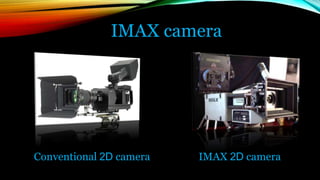
IMAX camera
Conventional 2D camera IMAX 2D camera
IMAX 2D camera
 IMAX developed its first 2D 15perf / 65mm film camera in 1976. To
this day, it remains the highest-resolution camera in the world.
 When captured with the IMAX® camera, the image projected in
IMAX features approximately 10x more resolution than conventional
35mm film
 delivering up to 40% more of the image than standard theatres with
unprecedented crispness, clarity and colour saturation for a truly
immersive experience.
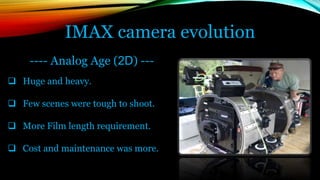
IMAX camera evolution
---- Analog Age (2D) ---
 Huge and heavy.
 Few scenes were tough to shoot.
 More Film length requirement.
 Cost and maintenance was more.
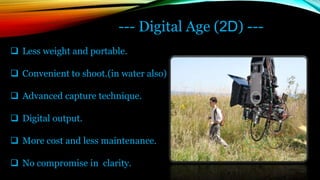
--- Digital Age (2D) ---
 Less weight and portable.
 Convenient to shoot.(in water also)
 Advanced capture technique.
 Digital output.
 More cost and less maintenance.
 No compromise in clarity.
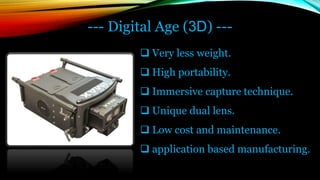
--- Digital Age (3D) ---
 Very less weight.
 High portability.
 Immersive capture technique.
 Unique dual lens.
 Low cost and maintenance.
 application based manufacturing.
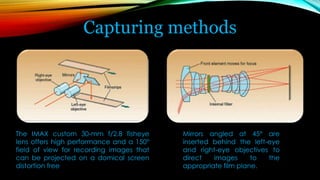
Capturing methods
The IMAX custom 30-mm f/2.8 fisheye
lens offers high performance and a 150°
field of view for recording images that
can be projected on a domical screen
distortion free
Mirrors angled at 45° are
inserted behind the left-eye
and right-eye objectives to
direct images to the
appropriate film plane.
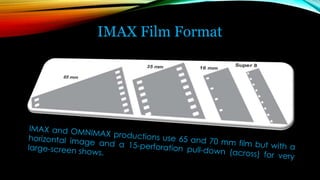
IMAX Film Format
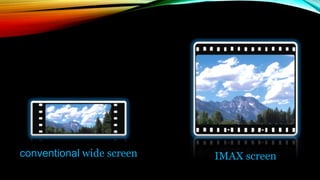
IMAX screenconventional wide screen
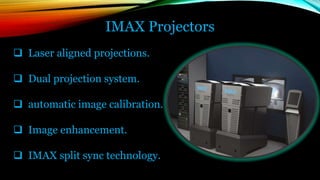
IMAX Projectors
 Laser aligned projections.
 Dual projection system.
 automatic image calibration.
 Image enhancement.
 IMAX split sync technology.
 Custom user interface.
 Alternative content input.
 Custom severs.
 Water cooled xenon projection system.
 4 types of projection system:
 GT (Grand Theatre)
 GT 3D (dual rotor)
 SR (Small Rotor)
 and MPX.
3D Experience
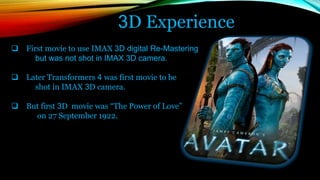
 First movie to use IMAX 3D digital Re-Mastering
but was not shot in IMAX 3D camera.
 Later Transformers 4 was first movie to be
shot in IMAX 3D camera.
 But first 3D movie was “The Power of Love”
on 27 September 1922.
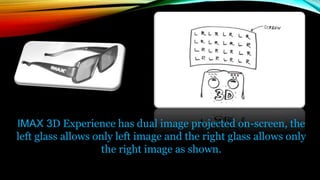
IMAX 3D Experience has dual image projected on-screen, the
left glass allows only left image and the right glass allows only
the right image as shown.
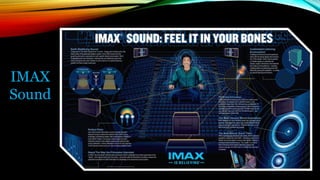
IMAX
Sound
Laser aligned surround sound system.
Immersive uncompressed bass.
20- 2000Khz sound freq. can be achieved.
Continuous feedback for sound perfection.
 frame to frame immersive audio sync.
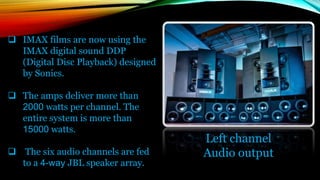
 IMAX films are now using the
IMAX digital sound DDP
(Digital Disc Playback) designed
by Sonics.
 The amps deliver more than
2000 watts per channel. The
entire system is more than
15000 watts.
 The six audio channels are fed
to a 4-way JBL speaker array.
Left channel
Audio output
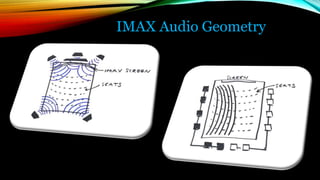
IMAX Audio Geometry
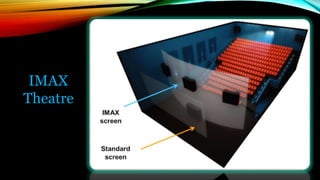
IMAX
Theatre
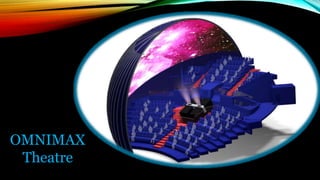
OMNIMAX
Theatre
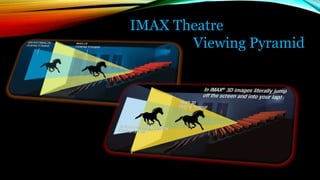
IMAX Theatre
Viewing Pyramid
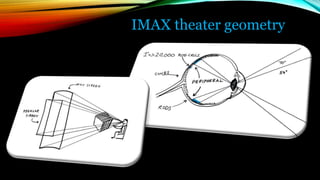
IMAX theater geometry
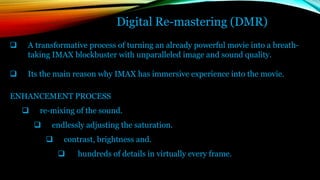
Digital Re-mastering (DMR)
 A transformative process of turning an already powerful movie into a breath-
taking IMAX blockbuster with unparalleled image and sound quality.
 Its the main reason why IMAX has immersive experience into the movie.
ENHANCEMENT PROCESS
 re-mixing of the sound.
 endlessly adjusting the saturation.
 contrast, brightness and.
 hundreds of details in virtually every frame.
Conclusion
IMAX is an not just an entertainment experience, it is
unmatched visual breath-taking and audio immersive
experience into the movie.
Reference
 http://www.google.com
 http://en.wikipedia.org/wiki/IMAX
 https://www.imax.com
 http://en.wikipedia.org/wiki/List_of_IMAX_DMR_films
 http://ieee.ca/millennium/imax/imax_birth.html
 http://www.greatscience.com/visit/omnihome.php
Imax technology

Imax technology

  • 1.
    IMAX TECHNOLOGY Under theguidance of Mr. Prasad S R By Venkatakrishna G (1HK10EC021)
  • 2.
    Contents  Introduction  WhatIs Imax?  How is Imax achieved?  IMAX camera  IMAX Film Format  IMAX Projectors  3D Experience  IMAX Sound  IMAX Theatre  Viewing Pyramid  IMAX theater geometry  Digital Re-mastering (DMR)  Conclusion  Reference
  • 3.
    Introduction It all beganwhen a small group of Canadian experimental filmmakers came together to produce a multi-screen film installation at EXPO ‘67 in Montreal. The installation was part of a competition to create the first truly large-screen film experience. Over the next three years, IMAX technology was born, and its epic camera, projector and domed screen system premiered at the Fuji Pavilion at EXPO '70 in Osaka, Japan.
  • 4.
    What is IMAX? IMAX stands for IMAGE MAXIMUM.  IMAX is a motion picture format with the capacity for greater size and clearer resolution than standard movie systems.  IMAX movies have incredible clarity, even on huge screens that are the hallmark of IMAX theaters worldwide
  • 5.
     IMAX isall about “ON-SCREEN PRESENATION” .  IMAX is an entertainment experience so real you feel it in your bones, so magical it takes you places you have never been.  Behind it is a world of high technology – proprietary software, architecture and equipment pioneered by IMAX.  There are more than 837 theatres in 57 countries.
  • 6.
    How is Imaxachieved? IMAX has the large film format.  It has six-channel sound system that is separate from the film.  A unique projection system that is specifically designed and custom-built for IMAX  The theater itself which is specially designed.
  • 7.
    IMAX camera Conventional 2Dcamera IMAX 2D camera
  • 8.
    IMAX 2D camera IMAX developed its first 2D 15perf / 65mm film camera in 1976. To this day, it remains the highest-resolution camera in the world.  When captured with the IMAX® camera, the image projected in IMAX features approximately 10x more resolution than conventional 35mm film  delivering up to 40% more of the image than standard theatres with unprecedented crispness, clarity and colour saturation for a truly immersive experience.
  • 9.
    IMAX camera evolution ----Analog Age (2D) ---  Huge and heavy.  Few scenes were tough to shoot.  More Film length requirement.  Cost and maintenance was more.
  • 10.
    --- Digital Age(2D) ---  Less weight and portable.  Convenient to shoot.(in water also)  Advanced capture technique.  Digital output.  More cost and less maintenance.  No compromise in clarity.
  • 11.
    --- Digital Age(3D) ---  Very less weight.  High portability.  Immersive capture technique.  Unique dual lens.  Low cost and maintenance.  application based manufacturing.
  • 12.
    Capturing methods The IMAXcustom 30-mm f/2.8 fisheye lens offers high performance and a 150° field of view for recording images that can be projected on a domical screen distortion free Mirrors angled at 45° are inserted behind the left-eye and right-eye objectives to direct images to the appropriate film plane.
  • 13.
  • 14.
  • 15.
    IMAX Projectors  Laseraligned projections.  Dual projection system.  automatic image calibration.  Image enhancement.  IMAX split sync technology.
  • 16.
     Custom userinterface.  Alternative content input.  Custom severs.  Water cooled xenon projection system.  4 types of projection system:  GT (Grand Theatre)  GT 3D (dual rotor)  SR (Small Rotor)  and MPX.
  • 17.
    3D Experience  Firstmovie to use IMAX 3D digital Re-Mastering but was not shot in IMAX 3D camera.  Later Transformers 4 was first movie to be shot in IMAX 3D camera.  But first 3D movie was “The Power of Love” on 27 September 1922.
  • 18.
    IMAX 3D Experiencehas dual image projected on-screen, the left glass allows only left image and the right glass allows only the right image as shown.
  • 19.
  • 20.
    Laser aligned surroundsound system. Immersive uncompressed bass. 20- 2000Khz sound freq. can be achieved. Continuous feedback for sound perfection.  frame to frame immersive audio sync.
  • 21.
     IMAX filmsare now using the IMAX digital sound DDP (Digital Disc Playback) designed by Sonics.  The amps deliver more than 2000 watts per channel. The entire system is more than 15000 watts.  The six audio channels are fed to a 4-way JBL speaker array. Left channel Audio output
  • 22.
  • 23.
  • 24.
  • 25.
  • 26.
  • 27.
    Digital Re-mastering (DMR) A transformative process of turning an already powerful movie into a breath- taking IMAX blockbuster with unparalleled image and sound quality.  Its the main reason why IMAX has immersive experience into the movie. ENHANCEMENT PROCESS  re-mixing of the sound.  endlessly adjusting the saturation.  contrast, brightness and.  hundreds of details in virtually every frame.
  • 28.
    Conclusion IMAX is annot just an entertainment experience, it is unmatched visual breath-taking and audio immersive experience into the movie.
  • 29.
    Reference  http://www.google.com  http://en.wikipedia.org/wiki/IMAX https://www.imax.com  http://en.wikipedia.org/wiki/List_of_IMAX_DMR_films  http://ieee.ca/millennium/imax/imax_birth.html  http://www.greatscience.com/visit/omnihome.php