Digital Image Processing
Dr.P.Mukilan
LEARNING OBJECTIVES:
This provides an overview of the image –processing system which includes various elements like image sampling,
quantization, Basic steps in image processing, image formation, storage and display.
After completing this unit, the reader is expected to be familiar with the following concepts:
1.Image sampling
2.Image sensors
3.Different steps in image processing
4.Image formation
1.DIGITAL IMAGE FUNDAMENTALS:
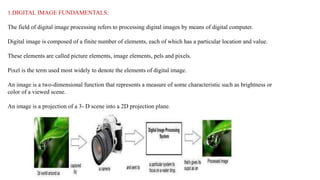
The field of digital image processing refers to processing digital images by means of digital computer.
Digital image is composed of a finite number of elements, each of which has a particular location and value.
These elements are called picture elements, image elements, pels and pixels.
Pixel is the term used most widely to denote the elements of digital image.
An image is a two-dimensional function that represents a measure of some characteristic such as brightness or
color of a viewed scene.
An image is a projection of a 3- D scene into a 2D projection plane.
An image may be defined as a two-dimensional function f(x,y), where x and y are spatial (plane) coordinates, and the
amplitude to f at any pair of coordinates (x,y) is called the intensity of the image at that point.
The term gray level is used often to refer to the intensity of monochrome images.
Color images are formed by a combination of individual 2-D images.
For example, the RGB color system, a color image consists of three (red, green and blue) individual component images.
For this reason, many of the techniques developed for monochrome images can be extended to color images by processing
the three component images individually.
An image may be continuous with respect to the x- and y- coordinates and also in amplitude.
Converting such an image to digital form requires that the coordinates, as well as the amplitude, be digitized.
APPLICATIONS OF DIGITAL IMAGE PROCESSING:
Since digital image processing has very wide applications and almost all of the technical fields are impacted by DIP, we will
just discuss some of the major applications of DIP.
Digital image processing has a broad spectrum of applications, such as
1.Remote sensing via satellites and other space crafts
2.Image transmission and storage for business applications
3.Medical processing
4.RADAR (Radio Detection and Ranging)
5.SONAR (Sound Navigation and Ranging)
6.Acoustic Image Processing (The study of underwater sound is known as
Underwater Acoustics or Hydro Acoustics)
7.Robotics and automated inspection of industrial parts
Images acquired by satellites are useful in tracking of
1.Earth resources
2.Geographical mapping
3.Prediction of agricultural crops
4.Urban growth and weather monitoring
5.Flood and fire control and many other environmental applications
Space image applications include:
1.Recognition and analysis of objects contained in images obtained from deep Space-probe missions.
2. Image transmission and storage applications occur in broadcast television
3. Teleconferencing
4. Transmission of facsimile images (Printed documents and graphics) for office automation
5. Communication over computer networks
6. Closed-circuit television-based security monitoring systems and
7. In military communications
Medical applications:
1.Processing of chest X-rays
2.Cineangiograms
3.Projection images of trans axial tomography and
4.Medical images that occur in radiology nuclear magnetic resonance (NMR)
5. Ultrasonic scanning
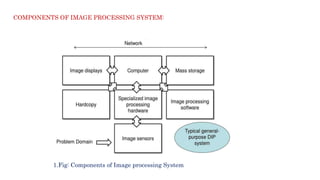
COMPONENTS OF IMAGE PROCESSING SYSTEM:
1.Fig: Components of Image processing System
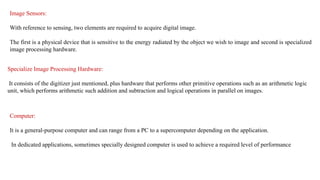
Image Sensors:
With reference to sensing, two elements are required to acquire digital image.
The first is a physical device that is sensitive to the energy radiated by the object we wish to image and second is specialized
image processing hardware.
Specialize Image Processing Hardware:
It consists of the digitizer just mentioned, plus hardware that performs other primitive operations such as an arithmetic logic
unit, which performs arithmetic such addition and subtraction and logical operations in parallel on images.
Computer:
It is a general-purpose computer and can range from a PC to a supercomputer depending on the application.
In dedicated applications, sometimes specially designed computer is used to achieve a required level of performance
Software:
It consists of specialized modules that perform specific tasks a well-designed package also includes capability for the user to
write code, as a minimum, utilizes the specialized module.
More sophisticated software packages allow the integration of these modules.
Mass Storage:
This capability is a must in image processing applications.
An image of size 1024 x1024 pixels, in which the intensity of each pixel is an 8- bit quantity requires one Megabytes of
storage space if the image is not compressed.
Image processing applications falls into three principal categories of storage.
•Short term storage for use during processing
•On line storage for relatively fast retrieval
•Archival storage such as magnetic tapes and disks
Image Display:
Image displays in use today are mainly color TV monitors.
These monitors are driven by the outputs of image and graphics displays cards that are an integral part of
computer system.
Hardcopy Devices:
The devices for recording image include laser printers, film cameras, heat sensitive devices inkjet units and digital units such
as optical and CD ROM disk.
Films provide the highest possible resolution, but paper is the obvious medium of choice for written applications.
Networking:
It is almost a default function in any computer system in use today because of the large amount of data inherent in image
processing applications.
The key consideration in image transmission bandwidth.
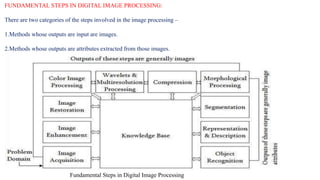
FUNDAMENTAL STEPS IN DIGITAL IMAGE PROCESSING:
There are two categories of the steps involved in the image processing –
1.Methods whose outputs are input are images.
2.Methods whose outputs are attributes extracted from those images.
Fundamental Steps in Digital Image Processing
Image Acquisition:
The image is captured by a sensor like camera or any analog device and digitized if the output of the camera or sensor is not
already in digital form, using analogue-to- digital converter.
It involves pre-processing of images.
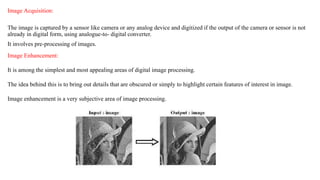
Image Enhancement:
It is among the simplest and most appealing areas of digital image processing.
The idea behind this is to bring out details that are obscured or simply to highlight certain features of interest in image.
Image enhancement is a very subjective area of image processing.
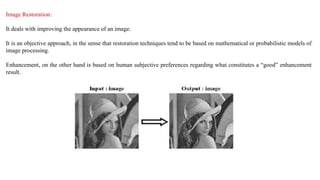
Image Restoration:
It deals with improving the appearance of an image.
It is an objective approach, in the sense that restoration techniques tend to be based on mathematical or probabilistic models of
image processing.
Enhancement, on the other hand is based on human subjective preferences regarding what constitutes a “good” enhancement
result.
Color Image Processing:
It is an area that is been gaining importance because of the use of digital images over the internet.
Color image processing deals with basically color models and their implementation in image processing applications.
Wavelets and Multiresolution Processing:
These are the foundation for representing image in various degrees of resolution.
It is used for image data compression and for representation of images in smaller regions
Compression:
It deals with techniques reducing the storage required to save an image, or the bandwidth required to transmit it over the
network.
It has to major approaches
1.Lossless Compression
2.Lossy Compression
Morphological Processing:
It deals with tools for extracting image components that are useful in the representation and description of shape and boundary
of objects.
It is majorly used in automated inspection applications.
Representation and Description:
It always follows the output of segmentation step that is, raw pixel data, constituting either the boundary of an image or points
in the region itself.
In either case converting the data to a form suitable for computer processing is necessary.
Recognition:
It is the process that assigns label to an object based on its descriptors.
It is the last step of image processing which use artificial intelligence of software.
Knowledge Base:
Knowledge about a problem domain is coded into an image processing system in the form of a knowledge base.
This knowledge may be as simple as detailing regions of an image where the information of the interest in known to be
located.
Thus, limiting search that has to be conducted in seeking the information.
The knowledge base also can be quite complex such interrelated list of all major possible defects in a materials inspection
problem or an image database containing high resolution satellite images of a region in connection with change detection
application.
Simple Image Model:
An image is denoted by a two dimensional function of the form f{x, y}.
The value or amplitude of f at spatial coordinates {x,y} is a positive scalar quantity whose physical meaning is
determined by the source of the image.
When an image is generated by a physical process, its values are proportional to energy radiated by a physical source.
As a consequence, f(x,y) must be nonzero and finite; that is o<f(x,y) <co The function f(x,y) may be characterized by
two components- The amount of the source illumination incident on the scene being viewed.
The amount of the source illumination reflected back by the objects in the scene
These are called illumination and reflectance components and are denoted by i(x,y) an r (x,y) respectively.
The functions combine as a product to form f(x,y). We call the intensity of a monochrome image at any coordinates (x,y)
the gray level (l) of the image at that point l= f (x, y.)
L min ≤ l ≤ Lmax Lminis to be positive and Lmax must be finite
Lmin =iminrmin
Lmax =imaxrmax
The interval [Lmin, Lmax] is called gray scale.
Common practice is to shift this interval numerically to the interval [0, L-l]
where l=0 is considered black and
l= L-1 is considered white on the gray scale.
All intermediate values are shades of gray of gray varying from black to white.
SAMPLING AND QUANTIZATION:
To create a digital image, we need to convert the continuous sensed data into digital from.
This involves two processes – sampling and quantization.
An image may be continuous with respect to the x and y coordinates and also in amplitude.
To convert it into digital form we have to sample the function in both coordinates and in amplitudes.
Digitalizing the coordinate values is called Sampling.
Digitalizing the amplitude values is called Quantization.
There is a continuous the image along the line segment AB.
To simple this function, we take equally spaced samples along line AB.
The location of each samples is given by a vertical tick back (mark) in the bottom part.
The samples are shown as block squares superimposed on function the set of these discrete locations gives the sampled
function.
In order to form a digital, the gray level values must also be converted (quantized) into discrete quantities.
So, we divide the gray level scale into eight discrete levels ranging from eight level values.
The continuous gray levels are quantized simply by assigning one of the eight discrete gray levels to each sample.
The assignment it made depending on the vertical proximity of a simple to a vertical tick mark.
Starting at the top of the image and covering out this procedure line by line produces a two- dimensional digital image.
Digital Image Definition:
A digital image f(m,n) described in a 2D discrete space is derived from an analog image f(x,y) in a 2D continuous space
through a sampling process that is frequently referred to as digitization.
The 2D continuous image f(x,y) is divided into N rows and M columns.
The intersection of a row and a column is termed a pixel.
The value assigned to the integer coordinates (m,n) with m=0,1,2..N-1 and n=0,1,2...N-1 is f(m,n).
In fact, in most cases, is actually a function of many variables including depth, color and time (t).
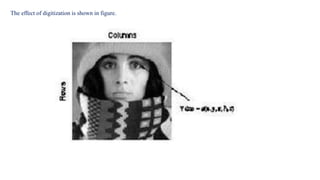
The effect of digitization is shown in figure.
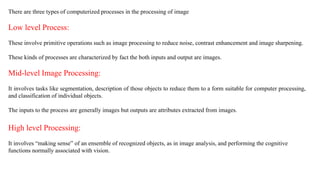
There are three types of computerized processes in the processing of image
Low level Process:
These involve primitive operations such as image processing to reduce noise, contrast enhancement and image sharpening.
These kinds of processes are characterized by fact the both inputs and output are images.
Mid-level Image Processing:
It involves tasks like segmentation, description of those objects to reduce them to a form suitable for computer processing,
and classification of individual objects.
The inputs to the process are generally images but outputs are attributes extracted from images.
High level Processing:
It involves “making sense” of an ensemble of recognized objects, as in image analysis, and performing the cognitive
functions normally associated with vision.
Representing Digital Images:
The result of sampling and quantization is matrix of real numbers.
Assume that an image f(x,y) is sampled so that the resulting digital image has M rows and N Columns.
The values of the coordinates (x,y) now become discrete quantities thus the value of the coordinates at origin become (x,y)
= (0,0)
The next Coordinates value along the first signify the image along the first row. it does not mean that these are the actual
values of physical coordinates when the image was sampled.
Thus, the right side of the matrix represents a digital element, pixel or pel.
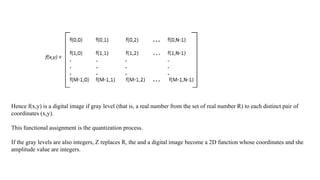
The matrix can be represented in the following form as well.
The sampling process may be viewed as partitioning the XY plane into a grid with the coordinates of the center of each grid
being a pair of elements from the Cartesian products Z2 which is the set of all ordered pair of elements (Zi, Zj) with Zi and
Zj being integers from Z.
Hence f(x,y) is a digital image if gray level (that is, a real number from the set of real number R) to each distinct pair of
coordinates (x,y).
This functional assignment is the quantization process.
If the gray levels are also integers, Z replaces R, the and a digital image become a 2D function whose coordinates and she
amplitude value are integers.
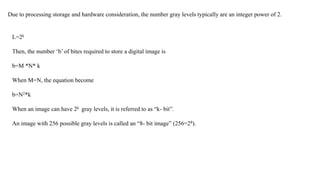
Due to processing storage and hardware consideration, the number gray levels typically are an integer power of 2.
L=2k
Then, the number ‘b’ of bites required to store a digital image is
b=M *N* k
When M=N, the equation become
b=N2*k
When an image can have 2k gray levels, it is referred to as “k- bit”.
An image with 256 possible gray levels is called an “8- bit image” (256=28).
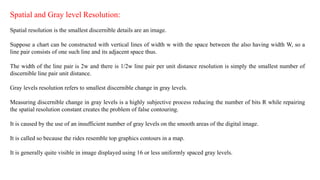
Spatial and Gray level Resolution:
Spatial resolution is the smallest discernible details are an image.
Suppose a chart can be constructed with vertical lines of width w with the space between the also having width W, so a
line pair consists of one such line and its adjacent space thus.
The width of the line pair is 2w and there is 1/2w line pair per unit distance resolution is simply the smallest number of
discernible line pair unit distance.
Gray levels resolution refers to smallest discernible change in gray levels.
Measuring discernible change in gray levels is a highly subjective process reducing the number of bits R while repairing
the spatial resolution constant creates the problem of false contouring.
It is caused by the use of an insufficient number of gray levels on the smooth areas of the digital image.
It is called so because the rides resemble top graphics contours in a map.
It is generally quite visible in image displayed using 16 or less uniformly spaced gray levels.
Image Sensing and Acquisition:
The types of images in which we are interested are generated by the combination of an “Illumination” source and the
reflection or absorption of energy from that source by the elements of the “scene” being imaged.
We enclose illumination and scene in quotes to emphasize the fact that they are considerably more general than the familiar
situation in which a visible light source illuminates a common everyday 3-D (three-dimensional) scene.
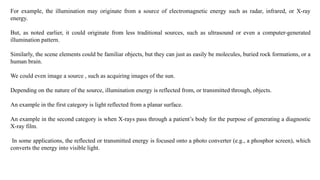
For example, the illumination may originate from a source of electromagnetic energy such as radar, infrared, or X-ray
energy.
But, as noted earlier, it could originate from less traditional sources, such as ultrasound or even a computer-generated
illumination pattern.
Similarly, the scene elements could be familiar objects, but they can just as easily be molecules, buried rock formations, or a
human brain.
We could even image a source , such as acquiring images of the sun.
Depending on the nature of the source, illumination energy is reflected from, or transmitted through, objects.
An example in the first category is light reflected from a planar surface.
An example in the second category is when X-rays pass through a patient’s body for the purpose of generating a diagnostic
X-ray film.
In some applications, the reflected or transmitted energy is focused onto a photo converter (e.g., a phosphor screen), which
converts the energy into visible light.
Electron microscopy and some applications of gamma imaging use this approach.
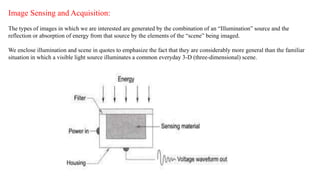
The idea is simple: Incoming energy is transformed into a voltage by the combination of input electrical power and sensor
material that is responsive to the particular type of energy being detected.
The output voltage waveform is the response of the sensor(s), and a digital quantity is obtained from each sensor by
digitizing its response.
In this section, we look at the principal modalities for image sensing and generation.
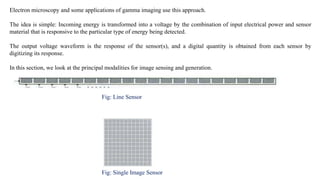
Fig: Line Sensor
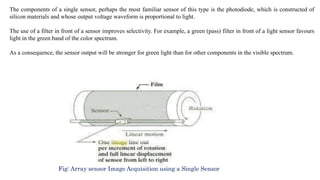
Fig: Single Image Sensor
The components of a single sensor, perhaps the most familiar sensor of this type is the photodiode, which is constructed of
silicon materials and whose output voltage waveform is proportional to light.
The use of a filter in front of a sensor improves selectivity. For example, a green (pass) filter in front of a light sensor favours
light in the green band of the color spectrum.
As a consequence, the sensor output will be stronger for green light than for other components in the visible spectrum.
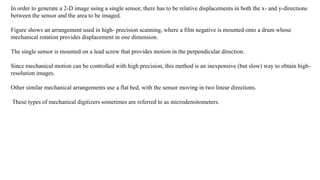
Fig: Array sensor Image Acquisition using a Single Sensor
In order to generate a 2-D image using a single sensor, there has to be relative displacements in both the x- and y-directions
between the sensor and the area to be imaged.
Figure shows an arrangement used in high- precision scanning, where a film negative is mounted onto a drum whose
mechanical rotation provides displacement in one dimension.
The single sensor is mounted on a lead screw that provides motion in the perpendicular direction.
Since mechanical motion can be controlled with high precision, this method is an inexpensive (but slow) way to obtain high-
resolution images.
Other similar mechanical arrangements use a flat bed, with the sensor moving in two linear directions.
These types of mechanical digitizers sometimes are referred to as microdensitometers.
Image Acquisition using a Sensor Strips:
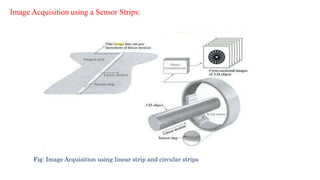
Fig: Image Acquisition using linear strip and circular strips
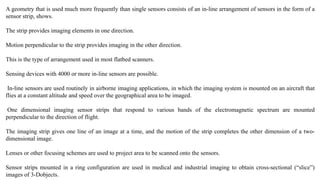
A geometry that is used much more frequently than single sensors consists of an in-line arrangement of sensors in the form of a
sensor strip, shows.
The strip provides imaging elements in one direction.
Motion perpendicular to the strip provides imaging in the other direction.
This is the type of arrangement used in most flatbed scanners.
Sensing devices with 4000 or more in-line sensors are possible.
In-line sensors are used routinely in airborne imaging applications, in which the imaging system is mounted on an aircraft that
flies at a constant altitude and speed over the geographical area to be imaged.
One dimensional imaging sensor strips that respond to various bands of the electromagnetic spectrum are mounted
perpendicular to the direction of flight.
The imaging strip gives one line of an image at a time, and the motion of the strip completes the other dimension of a two-
dimensional image.
Lenses or other focusing schemes are used to project area to be scanned onto the sensors.
Sensor strips mounted in a ring configuration are used in medical and industrial imaging to obtain cross-sectional (“slice”)
images of 3-Dobjects.
Image Acquisition using a Sensor Arrays:
The individual sensors arranged in the form of a 2-D array.
Numerous electromagnetic and some ultrasonic sensing devices frequently are arranged in an array format.
This is also the predominant arrangement found in digital cameras.
A typical sensor for these cameras is a CCD array, which can be manufactured with a broad range of sensing properties and
can be packaged in rugged arrays of elements or more.
CCD sensors are used widely in digital cameras and other light sensing instruments.
The response of each sensor is proportional to the integral of the light energy projected onto the surface of the sensor, a
property that is used in astronomical and other applications requiring low noise images.
Noise reduction is achieved by letting the sensor integrate the input light signal over minutes or even hours.
The two dimensional, its key advantage is that a complete image can be obtained by focusing the energy pattern onto the
surface of the array.
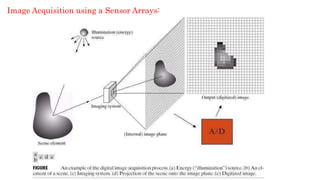
This figure shows the energy from an illumination source being reflected from a scene element, but, as mentioned at the
beginning of this section, the energy also could be transmitted through the scene elements.
The first function performed by the imaging system is to collect the incoming energy and focus it onto an image plane.
If the illumination is light, the front end of the imaging system is a lens, which projects the viewed scene onto the lens focal
plane.
The sensor array, which is coincident with the focal plane, produces outputs proportional to the integral of the light received
at each sensor.
Digital and analog circuitry sweeps these outputs and convert them to a video signal, which is then digitized by another
section of the imaging system.
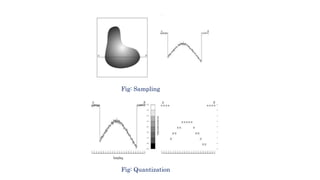
Image sampling and Quantization:
To create a digital image, we need to convert the continuous sensed data
into digital form. This involves two processes.
1.Sampling and
2.Quantization
A continuous image, f(x, y), that we want to convert to digital form.
An image may be continuous with respect to the x- and y- coordinates, and also in amplitude. To convert it to digital form, we
have to sample the function in both coordinates and in amplitude.
Digitizing the coordinate values is called Sampling.
Digitizing the amplitude values is called Quantization.
Fig: Sampling
Fig: Quantization
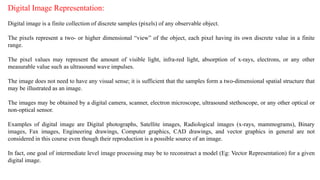
Digital Image Representation:
Digital image is a finite collection of discrete samples (pixels) of any observable object.
The pixels represent a two- or higher dimensional “view” of the object, each pixel having its own discrete value in a finite
range.
The pixel values may represent the amount of visible light, infra-red light, absorption of x-rays, electrons, or any other
measurable value such as ultrasound wave impulses.
The image does not need to have any visual sense; it is sufficient that the samples form a two-dimensional spatial structure that
may be illustrated as an image.
The images may be obtained by a digital camera, scanner, electron microscope, ultrasound stethoscope, or any other optical or
non-optical sensor.
Examples of digital image are Digital photographs, Satellite images, Radiological images (x-rays, mammograms), Binary
images, Fax images, Engineering drawings, Computer graphics, CAD drawings, and vector graphics in general are not
considered in this course even though their reproduction is a possible source of an image.
In fact, one goal of intermediate level image processing may be to reconstruct a model (Eg: Vector Representation) for a given
digital image.
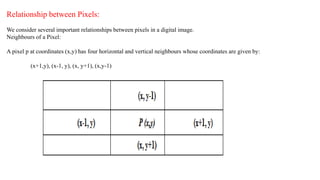
Relationship between Pixels:
We consider several important relationships between pixels in a digital image.
Neighbours of a Pixel:
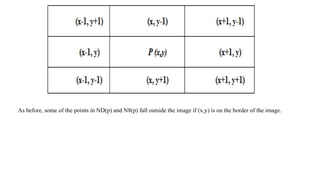
A pixel p at coordinates (x,y) has four horizontal and vertical neighbours whose coordinates are given by:
(x+1,y), (x-1, y), (x, y+1), (x,y-1)
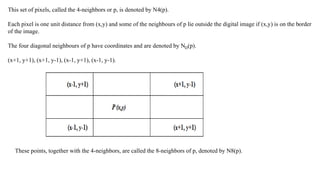
This set of pixels, called the 4-neighbors or p, is denoted by N4(p).
Each pixel is one unit distance from (x,y) and some of the neighbours of p lie outside the digital image if (x,y) is on the border
of the image.
The four diagonal neighbours of p have coordinates and are denoted by ND(p).
(x+1, y+1), (x+1, y-1), (x-1, y+1), (x-1, y-1).
These points, together with the 4-neighbors, are called the 8-neighbors of p, denoted by N8(p).
As before, some of the points in ND(p) and N8(p) fall outside the image if (x,y) is on the border of the image.
Adjacency and Connectivity:
Let v be the set of gray –level values used to define adjacency, in a binary image, V={1}.
In a gray-scale image, the idea is the same, but V typically contains more elements, for example, V= {180, 181, 182, ...,200}.
If the possible intensity values 0 – 255, V set can be any subset of these 256 values. if we are reference to adjacency of pixel
with value.
Distance measures
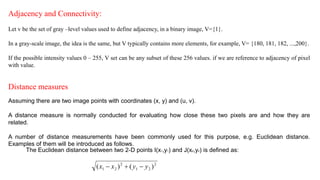
Assuming there are two image points with coordinates (x, y) and (u, v).
A distance measure is normally conducted for evaluating how close these two pixels are and how they are
related.
A number of distance measurements have been commonly used for this purpose, e.g. Euclidean distance.
Examples of them will be introduced as follows.
The Euclidean distance between two 2-D points I(x1,y1) and J(x2,y2) is defined as:
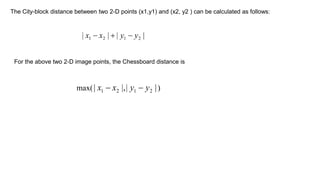
The City-block distance between two 2-D points (x1,y1) and (x2, y2 ) can be calculated as follows:
For the above two 2-D image points, the Chessboard distance is

Image Processing Fundamentals .ppt

  • 1.
  • 2.
    LEARNING OBJECTIVES: This providesan overview of the image –processing system which includes various elements like image sampling, quantization, Basic steps in image processing, image formation, storage and display. After completing this unit, the reader is expected to be familiar with the following concepts: 1.Image sampling 2.Image sensors 3.Different steps in image processing 4.Image formation
  • 3.
    1.DIGITAL IMAGE FUNDAMENTALS: Thefield of digital image processing refers to processing digital images by means of digital computer. Digital image is composed of a finite number of elements, each of which has a particular location and value. These elements are called picture elements, image elements, pels and pixels. Pixel is the term used most widely to denote the elements of digital image. An image is a two-dimensional function that represents a measure of some characteristic such as brightness or color of a viewed scene. An image is a projection of a 3- D scene into a 2D projection plane.
  • 4.
    An image maybe defined as a two-dimensional function f(x,y), where x and y are spatial (plane) coordinates, and the amplitude to f at any pair of coordinates (x,y) is called the intensity of the image at that point. The term gray level is used often to refer to the intensity of monochrome images. Color images are formed by a combination of individual 2-D images. For example, the RGB color system, a color image consists of three (red, green and blue) individual component images. For this reason, many of the techniques developed for monochrome images can be extended to color images by processing the three component images individually. An image may be continuous with respect to the x- and y- coordinates and also in amplitude. Converting such an image to digital form requires that the coordinates, as well as the amplitude, be digitized.
  • 5.
    APPLICATIONS OF DIGITALIMAGE PROCESSING: Since digital image processing has very wide applications and almost all of the technical fields are impacted by DIP, we will just discuss some of the major applications of DIP. Digital image processing has a broad spectrum of applications, such as 1.Remote sensing via satellites and other space crafts 2.Image transmission and storage for business applications 3.Medical processing 4.RADAR (Radio Detection and Ranging) 5.SONAR (Sound Navigation and Ranging) 6.Acoustic Image Processing (The study of underwater sound is known as Underwater Acoustics or Hydro Acoustics) 7.Robotics and automated inspection of industrial parts
  • 6.
    Images acquired bysatellites are useful in tracking of 1.Earth resources 2.Geographical mapping 3.Prediction of agricultural crops 4.Urban growth and weather monitoring 5.Flood and fire control and many other environmental applications
  • 7.
    Space image applicationsinclude: 1.Recognition and analysis of objects contained in images obtained from deep Space-probe missions. 2. Image transmission and storage applications occur in broadcast television 3. Teleconferencing 4. Transmission of facsimile images (Printed documents and graphics) for office automation 5. Communication over computer networks 6. Closed-circuit television-based security monitoring systems and 7. In military communications
  • 8.
    Medical applications: 1.Processing ofchest X-rays 2.Cineangiograms 3.Projection images of trans axial tomography and 4.Medical images that occur in radiology nuclear magnetic resonance (NMR) 5. Ultrasonic scanning
  • 9.
    COMPONENTS OF IMAGEPROCESSING SYSTEM: 1.Fig: Components of Image processing System
  • 10.
    Image Sensors: With referenceto sensing, two elements are required to acquire digital image. The first is a physical device that is sensitive to the energy radiated by the object we wish to image and second is specialized image processing hardware. Specialize Image Processing Hardware: It consists of the digitizer just mentioned, plus hardware that performs other primitive operations such as an arithmetic logic unit, which performs arithmetic such addition and subtraction and logical operations in parallel on images. Computer: It is a general-purpose computer and can range from a PC to a supercomputer depending on the application. In dedicated applications, sometimes specially designed computer is used to achieve a required level of performance
  • 11.
    Software: It consists ofspecialized modules that perform specific tasks a well-designed package also includes capability for the user to write code, as a minimum, utilizes the specialized module. More sophisticated software packages allow the integration of these modules. Mass Storage: This capability is a must in image processing applications. An image of size 1024 x1024 pixels, in which the intensity of each pixel is an 8- bit quantity requires one Megabytes of storage space if the image is not compressed. Image processing applications falls into three principal categories of storage. •Short term storage for use during processing •On line storage for relatively fast retrieval •Archival storage such as magnetic tapes and disks
  • 12.
    Image Display: Image displaysin use today are mainly color TV monitors. These monitors are driven by the outputs of image and graphics displays cards that are an integral part of computer system. Hardcopy Devices: The devices for recording image include laser printers, film cameras, heat sensitive devices inkjet units and digital units such as optical and CD ROM disk. Films provide the highest possible resolution, but paper is the obvious medium of choice for written applications. Networking: It is almost a default function in any computer system in use today because of the large amount of data inherent in image processing applications. The key consideration in image transmission bandwidth.
  • 13.
    FUNDAMENTAL STEPS INDIGITAL IMAGE PROCESSING: There are two categories of the steps involved in the image processing – 1.Methods whose outputs are input are images. 2.Methods whose outputs are attributes extracted from those images. Fundamental Steps in Digital Image Processing
  • 14.
    Image Acquisition: The imageis captured by a sensor like camera or any analog device and digitized if the output of the camera or sensor is not already in digital form, using analogue-to- digital converter. It involves pre-processing of images. Image Enhancement: It is among the simplest and most appealing areas of digital image processing. The idea behind this is to bring out details that are obscured or simply to highlight certain features of interest in image. Image enhancement is a very subjective area of image processing.
  • 15.
    Image Restoration: It dealswith improving the appearance of an image. It is an objective approach, in the sense that restoration techniques tend to be based on mathematical or probabilistic models of image processing. Enhancement, on the other hand is based on human subjective preferences regarding what constitutes a “good” enhancement result.
  • 16.
    Color Image Processing: Itis an area that is been gaining importance because of the use of digital images over the internet. Color image processing deals with basically color models and their implementation in image processing applications. Wavelets and Multiresolution Processing: These are the foundation for representing image in various degrees of resolution. It is used for image data compression and for representation of images in smaller regions Compression: It deals with techniques reducing the storage required to save an image, or the bandwidth required to transmit it over the network. It has to major approaches 1.Lossless Compression 2.Lossy Compression
  • 17.
    Morphological Processing: It dealswith tools for extracting image components that are useful in the representation and description of shape and boundary of objects. It is majorly used in automated inspection applications. Representation and Description: It always follows the output of segmentation step that is, raw pixel data, constituting either the boundary of an image or points in the region itself. In either case converting the data to a form suitable for computer processing is necessary. Recognition: It is the process that assigns label to an object based on its descriptors. It is the last step of image processing which use artificial intelligence of software.
  • 18.
    Knowledge Base: Knowledge abouta problem domain is coded into an image processing system in the form of a knowledge base. This knowledge may be as simple as detailing regions of an image where the information of the interest in known to be located. Thus, limiting search that has to be conducted in seeking the information. The knowledge base also can be quite complex such interrelated list of all major possible defects in a materials inspection problem or an image database containing high resolution satellite images of a region in connection with change detection application.
  • 19.
    Simple Image Model: Animage is denoted by a two dimensional function of the form f{x, y}. The value or amplitude of f at spatial coordinates {x,y} is a positive scalar quantity whose physical meaning is determined by the source of the image. When an image is generated by a physical process, its values are proportional to energy radiated by a physical source. As a consequence, f(x,y) must be nonzero and finite; that is o<f(x,y) <co The function f(x,y) may be characterized by two components- The amount of the source illumination incident on the scene being viewed. The amount of the source illumination reflected back by the objects in the scene These are called illumination and reflectance components and are denoted by i(x,y) an r (x,y) respectively. The functions combine as a product to form f(x,y). We call the intensity of a monochrome image at any coordinates (x,y) the gray level (l) of the image at that point l= f (x, y.)
  • 20.
    L min ≤l ≤ Lmax Lminis to be positive and Lmax must be finite Lmin =iminrmin Lmax =imaxrmax The interval [Lmin, Lmax] is called gray scale. Common practice is to shift this interval numerically to the interval [0, L-l] where l=0 is considered black and l= L-1 is considered white on the gray scale. All intermediate values are shades of gray of gray varying from black to white.
  • 21.
    SAMPLING AND QUANTIZATION: Tocreate a digital image, we need to convert the continuous sensed data into digital from. This involves two processes – sampling and quantization. An image may be continuous with respect to the x and y coordinates and also in amplitude. To convert it into digital form we have to sample the function in both coordinates and in amplitudes. Digitalizing the coordinate values is called Sampling. Digitalizing the amplitude values is called Quantization. There is a continuous the image along the line segment AB. To simple this function, we take equally spaced samples along line AB. The location of each samples is given by a vertical tick back (mark) in the bottom part. The samples are shown as block squares superimposed on function the set of these discrete locations gives the sampled function.
  • 22.
    In order toform a digital, the gray level values must also be converted (quantized) into discrete quantities. So, we divide the gray level scale into eight discrete levels ranging from eight level values. The continuous gray levels are quantized simply by assigning one of the eight discrete gray levels to each sample. The assignment it made depending on the vertical proximity of a simple to a vertical tick mark. Starting at the top of the image and covering out this procedure line by line produces a two- dimensional digital image. Digital Image Definition: A digital image f(m,n) described in a 2D discrete space is derived from an analog image f(x,y) in a 2D continuous space through a sampling process that is frequently referred to as digitization. The 2D continuous image f(x,y) is divided into N rows and M columns. The intersection of a row and a column is termed a pixel. The value assigned to the integer coordinates (m,n) with m=0,1,2..N-1 and n=0,1,2...N-1 is f(m,n). In fact, in most cases, is actually a function of many variables including depth, color and time (t).
  • 23.
    The effect ofdigitization is shown in figure.
  • 24.
    There are threetypes of computerized processes in the processing of image Low level Process: These involve primitive operations such as image processing to reduce noise, contrast enhancement and image sharpening. These kinds of processes are characterized by fact the both inputs and output are images. Mid-level Image Processing: It involves tasks like segmentation, description of those objects to reduce them to a form suitable for computer processing, and classification of individual objects. The inputs to the process are generally images but outputs are attributes extracted from images. High level Processing: It involves “making sense” of an ensemble of recognized objects, as in image analysis, and performing the cognitive functions normally associated with vision.
  • 25.
    Representing Digital Images: Theresult of sampling and quantization is matrix of real numbers. Assume that an image f(x,y) is sampled so that the resulting digital image has M rows and N Columns. The values of the coordinates (x,y) now become discrete quantities thus the value of the coordinates at origin become (x,y) = (0,0) The next Coordinates value along the first signify the image along the first row. it does not mean that these are the actual values of physical coordinates when the image was sampled. Thus, the right side of the matrix represents a digital element, pixel or pel. The matrix can be represented in the following form as well. The sampling process may be viewed as partitioning the XY plane into a grid with the coordinates of the center of each grid being a pair of elements from the Cartesian products Z2 which is the set of all ordered pair of elements (Zi, Zj) with Zi and Zj being integers from Z.
  • 26.
    Hence f(x,y) isa digital image if gray level (that is, a real number from the set of real number R) to each distinct pair of coordinates (x,y). This functional assignment is the quantization process. If the gray levels are also integers, Z replaces R, the and a digital image become a 2D function whose coordinates and she amplitude value are integers.
  • 27.
    Due to processingstorage and hardware consideration, the number gray levels typically are an integer power of 2. L=2k Then, the number ‘b’ of bites required to store a digital image is b=M *N* k When M=N, the equation become b=N2*k When an image can have 2k gray levels, it is referred to as “k- bit”. An image with 256 possible gray levels is called an “8- bit image” (256=28).
  • 28.
    Spatial and Graylevel Resolution: Spatial resolution is the smallest discernible details are an image. Suppose a chart can be constructed with vertical lines of width w with the space between the also having width W, so a line pair consists of one such line and its adjacent space thus. The width of the line pair is 2w and there is 1/2w line pair per unit distance resolution is simply the smallest number of discernible line pair unit distance. Gray levels resolution refers to smallest discernible change in gray levels. Measuring discernible change in gray levels is a highly subjective process reducing the number of bits R while repairing the spatial resolution constant creates the problem of false contouring. It is caused by the use of an insufficient number of gray levels on the smooth areas of the digital image. It is called so because the rides resemble top graphics contours in a map. It is generally quite visible in image displayed using 16 or less uniformly spaced gray levels.
  • 29.
    Image Sensing andAcquisition: The types of images in which we are interested are generated by the combination of an “Illumination” source and the reflection or absorption of energy from that source by the elements of the “scene” being imaged. We enclose illumination and scene in quotes to emphasize the fact that they are considerably more general than the familiar situation in which a visible light source illuminates a common everyday 3-D (three-dimensional) scene.
  • 30.
    For example, theillumination may originate from a source of electromagnetic energy such as radar, infrared, or X-ray energy. But, as noted earlier, it could originate from less traditional sources, such as ultrasound or even a computer-generated illumination pattern. Similarly, the scene elements could be familiar objects, but they can just as easily be molecules, buried rock formations, or a human brain. We could even image a source , such as acquiring images of the sun. Depending on the nature of the source, illumination energy is reflected from, or transmitted through, objects. An example in the first category is light reflected from a planar surface. An example in the second category is when X-rays pass through a patient’s body for the purpose of generating a diagnostic X-ray film. In some applications, the reflected or transmitted energy is focused onto a photo converter (e.g., a phosphor screen), which converts the energy into visible light.
  • 31.
    Electron microscopy andsome applications of gamma imaging use this approach. The idea is simple: Incoming energy is transformed into a voltage by the combination of input electrical power and sensor material that is responsive to the particular type of energy being detected. The output voltage waveform is the response of the sensor(s), and a digital quantity is obtained from each sensor by digitizing its response. In this section, we look at the principal modalities for image sensing and generation. Fig: Line Sensor Fig: Single Image Sensor
  • 32.
    The components ofa single sensor, perhaps the most familiar sensor of this type is the photodiode, which is constructed of silicon materials and whose output voltage waveform is proportional to light. The use of a filter in front of a sensor improves selectivity. For example, a green (pass) filter in front of a light sensor favours light in the green band of the color spectrum. As a consequence, the sensor output will be stronger for green light than for other components in the visible spectrum. Fig: Array sensor Image Acquisition using a Single Sensor
  • 33.
    In order togenerate a 2-D image using a single sensor, there has to be relative displacements in both the x- and y-directions between the sensor and the area to be imaged. Figure shows an arrangement used in high- precision scanning, where a film negative is mounted onto a drum whose mechanical rotation provides displacement in one dimension. The single sensor is mounted on a lead screw that provides motion in the perpendicular direction. Since mechanical motion can be controlled with high precision, this method is an inexpensive (but slow) way to obtain high- resolution images. Other similar mechanical arrangements use a flat bed, with the sensor moving in two linear directions. These types of mechanical digitizers sometimes are referred to as microdensitometers.
  • 34.
    Image Acquisition usinga Sensor Strips: Fig: Image Acquisition using linear strip and circular strips
  • 35.
    A geometry thatis used much more frequently than single sensors consists of an in-line arrangement of sensors in the form of a sensor strip, shows. The strip provides imaging elements in one direction. Motion perpendicular to the strip provides imaging in the other direction. This is the type of arrangement used in most flatbed scanners. Sensing devices with 4000 or more in-line sensors are possible. In-line sensors are used routinely in airborne imaging applications, in which the imaging system is mounted on an aircraft that flies at a constant altitude and speed over the geographical area to be imaged. One dimensional imaging sensor strips that respond to various bands of the electromagnetic spectrum are mounted perpendicular to the direction of flight. The imaging strip gives one line of an image at a time, and the motion of the strip completes the other dimension of a two- dimensional image. Lenses or other focusing schemes are used to project area to be scanned onto the sensors. Sensor strips mounted in a ring configuration are used in medical and industrial imaging to obtain cross-sectional (“slice”) images of 3-Dobjects.
  • 36.
    Image Acquisition usinga Sensor Arrays:
  • 37.
    The individual sensorsarranged in the form of a 2-D array. Numerous electromagnetic and some ultrasonic sensing devices frequently are arranged in an array format. This is also the predominant arrangement found in digital cameras. A typical sensor for these cameras is a CCD array, which can be manufactured with a broad range of sensing properties and can be packaged in rugged arrays of elements or more. CCD sensors are used widely in digital cameras and other light sensing instruments. The response of each sensor is proportional to the integral of the light energy projected onto the surface of the sensor, a property that is used in astronomical and other applications requiring low noise images. Noise reduction is achieved by letting the sensor integrate the input light signal over minutes or even hours. The two dimensional, its key advantage is that a complete image can be obtained by focusing the energy pattern onto the surface of the array.
  • 38.
    This figure showsthe energy from an illumination source being reflected from a scene element, but, as mentioned at the beginning of this section, the energy also could be transmitted through the scene elements. The first function performed by the imaging system is to collect the incoming energy and focus it onto an image plane. If the illumination is light, the front end of the imaging system is a lens, which projects the viewed scene onto the lens focal plane. The sensor array, which is coincident with the focal plane, produces outputs proportional to the integral of the light received at each sensor. Digital and analog circuitry sweeps these outputs and convert them to a video signal, which is then digitized by another section of the imaging system.
  • 39.
    Image sampling andQuantization: To create a digital image, we need to convert the continuous sensed data into digital form. This involves two processes. 1.Sampling and 2.Quantization A continuous image, f(x, y), that we want to convert to digital form. An image may be continuous with respect to the x- and y- coordinates, and also in amplitude. To convert it to digital form, we have to sample the function in both coordinates and in amplitude. Digitizing the coordinate values is called Sampling. Digitizing the amplitude values is called Quantization.
  • 40.
  • 41.
    Digital Image Representation: Digitalimage is a finite collection of discrete samples (pixels) of any observable object. The pixels represent a two- or higher dimensional “view” of the object, each pixel having its own discrete value in a finite range. The pixel values may represent the amount of visible light, infra-red light, absorption of x-rays, electrons, or any other measurable value such as ultrasound wave impulses. The image does not need to have any visual sense; it is sufficient that the samples form a two-dimensional spatial structure that may be illustrated as an image. The images may be obtained by a digital camera, scanner, electron microscope, ultrasound stethoscope, or any other optical or non-optical sensor. Examples of digital image are Digital photographs, Satellite images, Radiological images (x-rays, mammograms), Binary images, Fax images, Engineering drawings, Computer graphics, CAD drawings, and vector graphics in general are not considered in this course even though their reproduction is a possible source of an image. In fact, one goal of intermediate level image processing may be to reconstruct a model (Eg: Vector Representation) for a given digital image.
  • 42.
    Relationship between Pixels: Weconsider several important relationships between pixels in a digital image. Neighbours of a Pixel: A pixel p at coordinates (x,y) has four horizontal and vertical neighbours whose coordinates are given by: (x+1,y), (x-1, y), (x, y+1), (x,y-1)
  • 43.
    This set ofpixels, called the 4-neighbors or p, is denoted by N4(p). Each pixel is one unit distance from (x,y) and some of the neighbours of p lie outside the digital image if (x,y) is on the border of the image. The four diagonal neighbours of p have coordinates and are denoted by ND(p). (x+1, y+1), (x+1, y-1), (x-1, y+1), (x-1, y-1). These points, together with the 4-neighbors, are called the 8-neighbors of p, denoted by N8(p).
  • 44.
    As before, someof the points in ND(p) and N8(p) fall outside the image if (x,y) is on the border of the image.
  • 45.
    Adjacency and Connectivity: Letv be the set of gray –level values used to define adjacency, in a binary image, V={1}. In a gray-scale image, the idea is the same, but V typically contains more elements, for example, V= {180, 181, 182, ...,200}. If the possible intensity values 0 – 255, V set can be any subset of these 256 values. if we are reference to adjacency of pixel with value. Distance measures Assuming there are two image points with coordinates (x, y) and (u, v). A distance measure is normally conducted for evaluating how close these two pixels are and how they are related. A number of distance measurements have been commonly used for this purpose, e.g. Euclidean distance. Examples of them will be introduced as follows. The Euclidean distance between two 2-D points I(x1,y1) and J(x2,y2) is defined as:
  • 46.
    The City-block distancebetween two 2-D points (x1,y1) and (x2, y2 ) can be calculated as follows: For the above two 2-D image points, the Chessboard distance is