Subject:- Industrial Fluid Power (IFP)
CHAPTER NO: 04
INTRODUCTION TO AND COMPONNTS OF
PNEUMATIC SYTEMS (24 Marks (14)
BY
Prof. Kokare A.Y.
BABASAHEB PHADTARE POLYTECHNICKALAMB-WALCHANDNAGAR.
B.P.P. Kalamb-Walchandnagar Prof. Kokare A.Y.
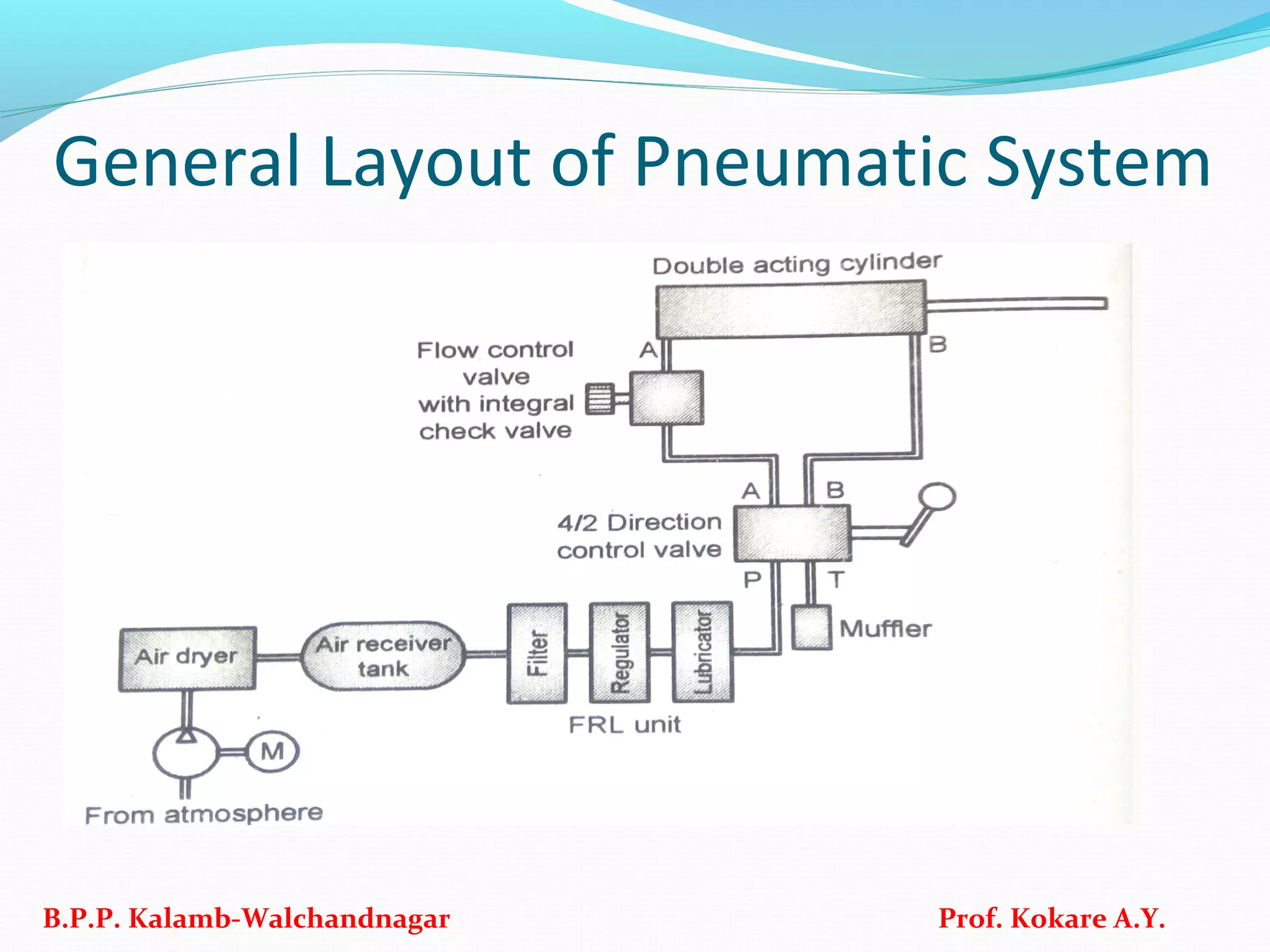
General Layout of Pneumatic System
B.P.P. Kalamb-Walchandnagar Prof. Kokare A.Y.
1. Operating pressure of compressed air.
2. Flow rate of compressed air.
3. Filter rating for selection of filter.
4. Stroke length required for selection of cylinder.
5. Force required and speed required by the actuator.
6. Compatibility, durability, cost etc.
7. Port size, pipe size etc. of connections.
8. Environmental conditions such as temperature, humidity etc.
9. Surrounding condition such as chemical, high temp. etc.
B.P.P. Kalamb-Walchandnagar Prof. Kokare
A.Y.
1. It is very fast in operation, because very low viscosity of
compressed air.
2. It can run continuously for long period.
3. It works better even in hot surrounding. It cools even at 125oc
4. Its better work in mines, because it does not generate any
spark and hence no chances of explosion and fire hazard.
5. It is very clean and absolutely dust free surrounding.
6. It is environment friendly.
7. Return line is absent, makes circuit simpler.
8. Leakage of compressed air does not have any problem.
9. If overloaded system is stalls. System will start working once
the load is reduced.
10.Automatic and safety circuits are possible.
B.P.P. Kalamb-Walchandnagar Prof. Kokare
A.Y.
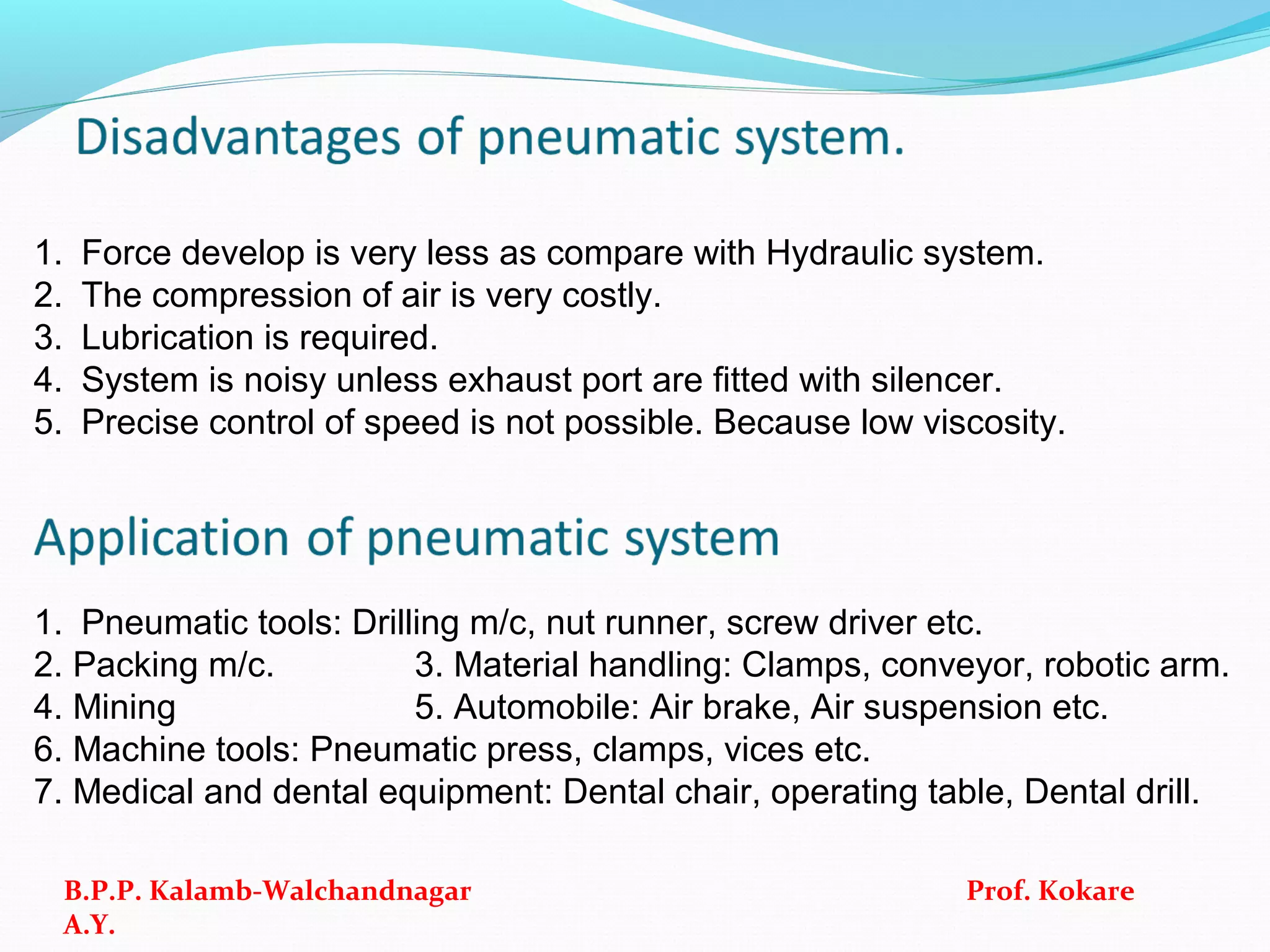
1. Force develop is very less as compare with Hydraulic system.
2. The compression of air is very costly.
3. Lubrication is required.
4. System is noisy unless exhaust port are fitted with silencer.
5. Precise control of speed is not possible. Because low viscosity.
1. Pneumatic tools: Drilling m/c, nut runner, screw driver etc.
2. Packing m/c. 3. Material handling: Clamps, conveyor, robotic arm.
4. Mining 5. Automobile: Air brake, Air suspension etc.
6. Machine tools: Pneumatic press, clamps, vices etc.
7. Medical and dental equipment: Dental chair, operating table, Dental drill.
B.P.P. Kalamb-Walchandnagar Prof. Kokare
A.Y.
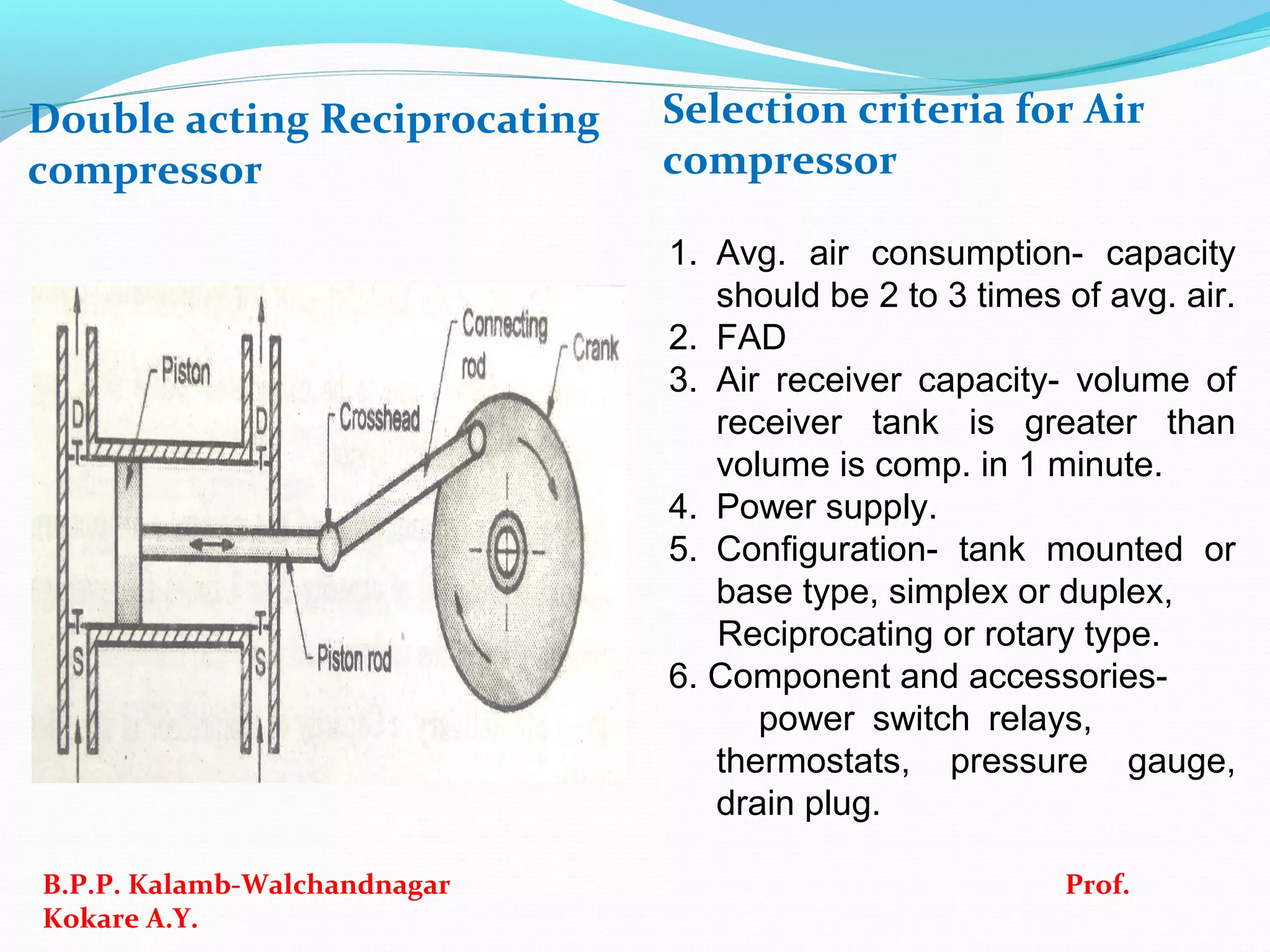
Double acting Reciprocating
compressor
Selection criteria for Air
compressor
B.P.P. Kalamb-Walchandnagar Prof.
Kokare A.Y.
1. Avg. air consumption- capacity
should be 2 to 3 times of avg. air.
2. FAD
3. Air receiver capacity- volume of
receiver tank is greater than
volume is comp. in 1 minute.
4. Power supply.
5. Configuration- tank mounted or
base type, simplex or duplex,
Reciprocating or rotary type.
6. Component and accessories-
power switch relays,
thermostats, pressure gauge,
drain plug.
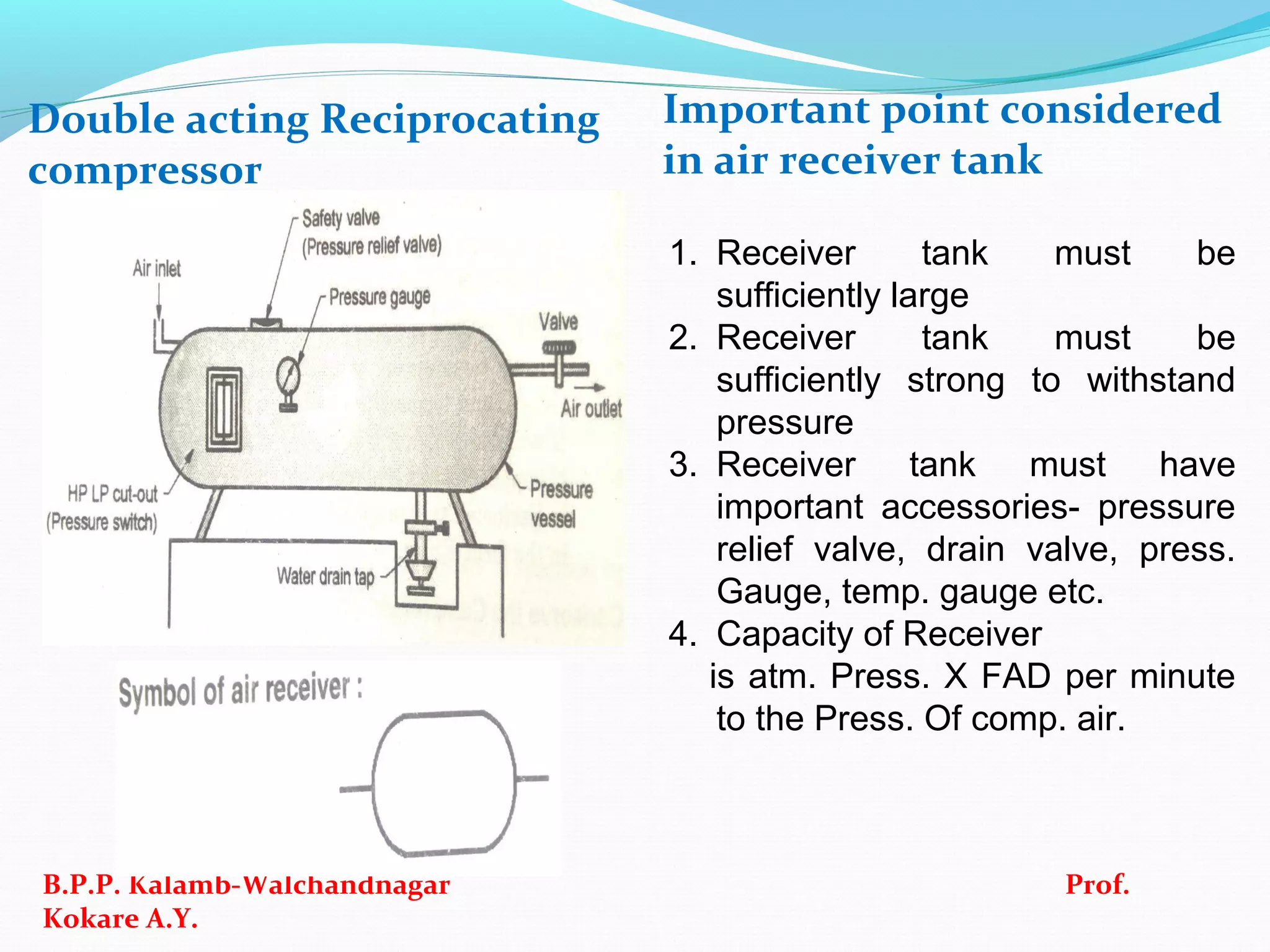
Double acting Reciprocating
compressor
Important point considered
in air receiver tank
B.P.P. Kalamb-Walchandnagar Prof.
Kokare A.Y.
1. Receiver tank must be
sufficiently large
2. Receiver tank must be
sufficiently strong to withstand
pressure
3. Receiver tank must have
important accessories- pressure
relief valve, drain valve, press.
Gauge, temp. gauge etc.
4. Capacity of Receiver
is atm. Press. X FAD per minute
to the Press. Of comp. air.
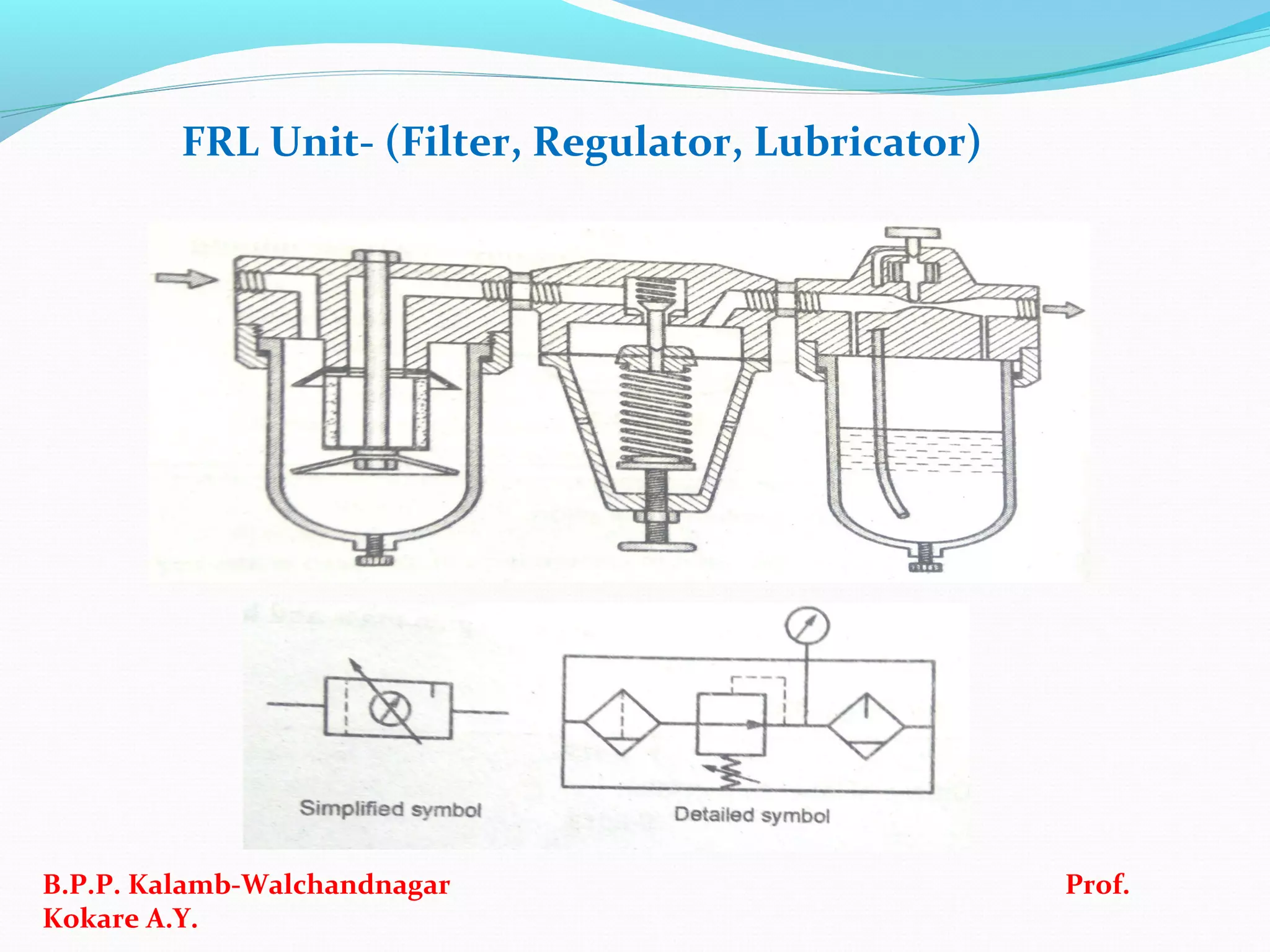
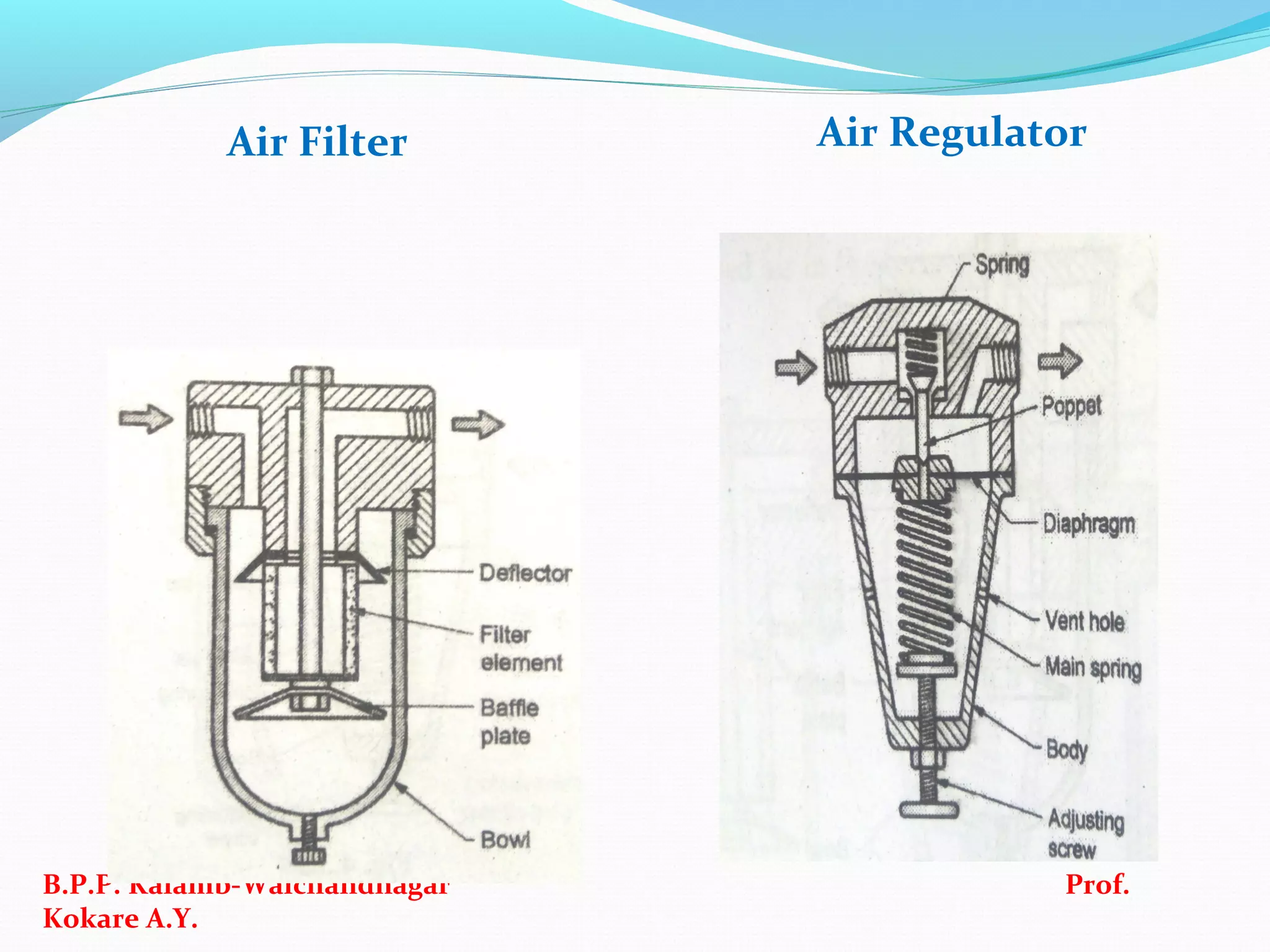
FRL Unit- (Filter, Regulator, Lubricator)
B.P.P. Kalamb-Walchandnagar Prof.
Kokare A.Y.
Air Filter Air Regulator
B.P.P. Kalamb-Walchandnagar Prof.
Kokare A.Y.
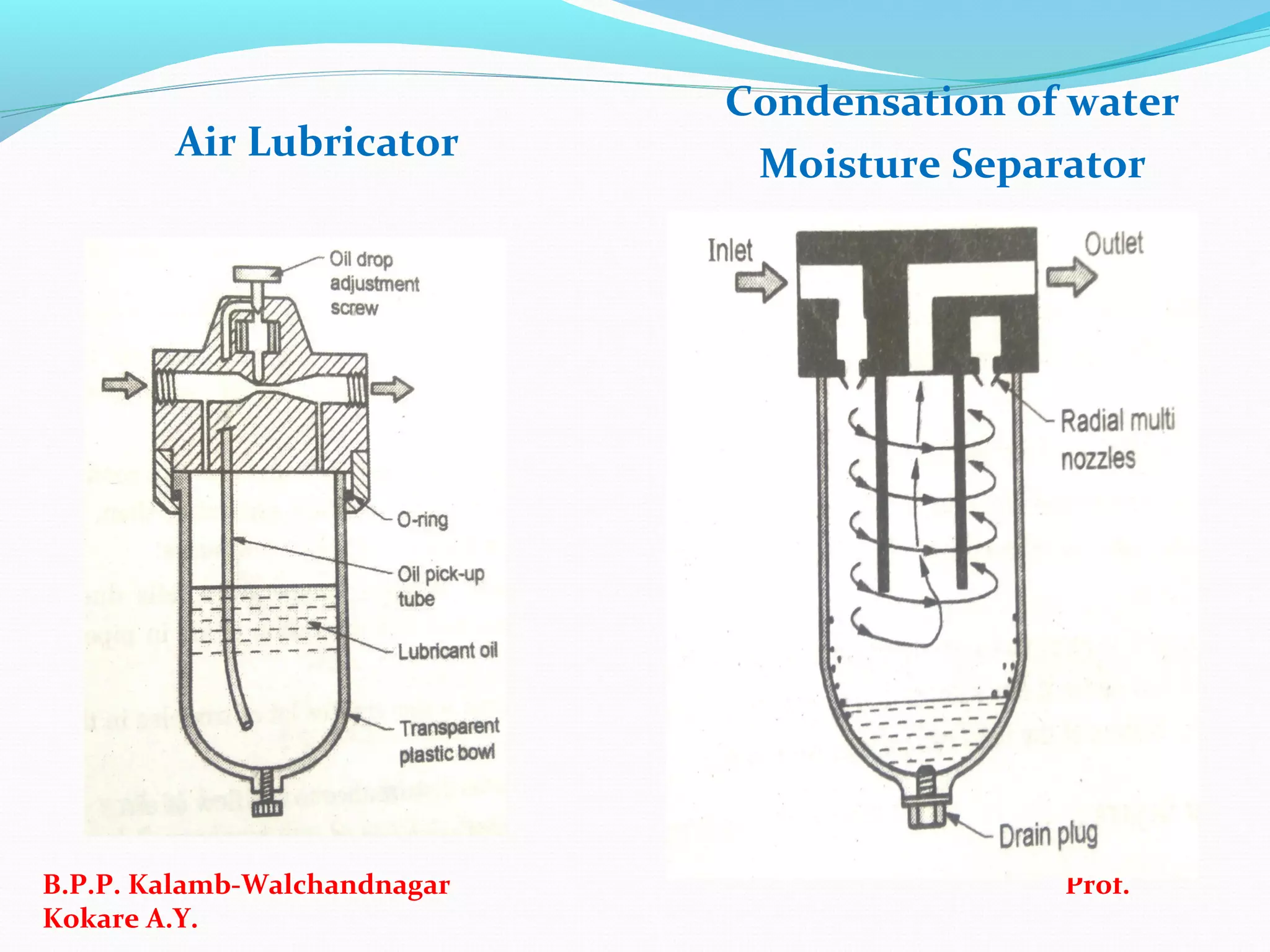
Air Lubricator
Condensation of water
Moisture Separator
B.P.P. Kalamb-Walchandnagar Prof.
Kokare A.Y.
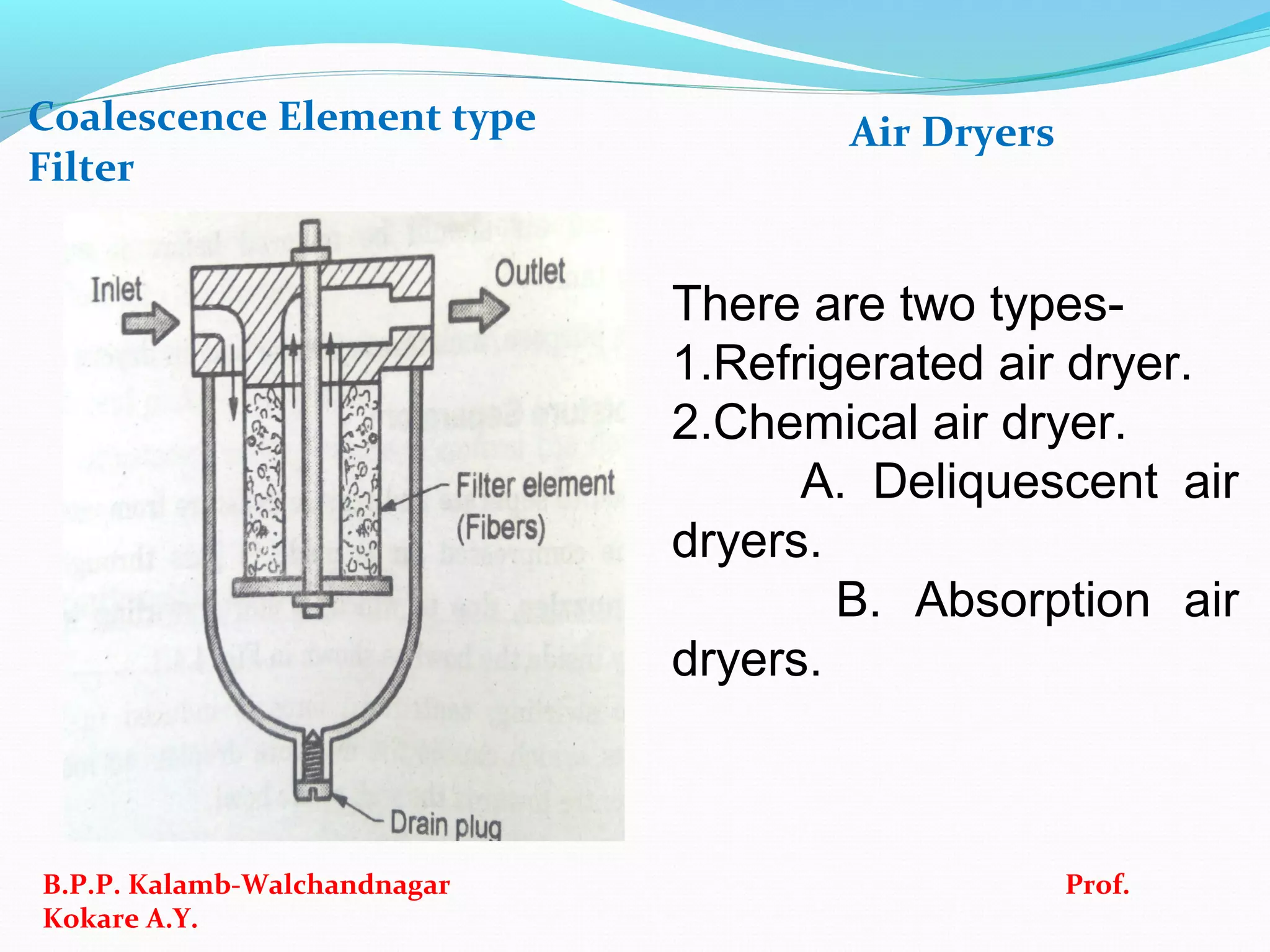
Coalescence Element type
Filter
Air Dryers
B.P.P. Kalamb-Walchandnagar Prof.
Kokare A.Y.
There are two types-
1.Refrigerated air dryer.
2.Chemical air dryer.
A. Deliquescent air
dryers.
B. Absorption air
dryers.
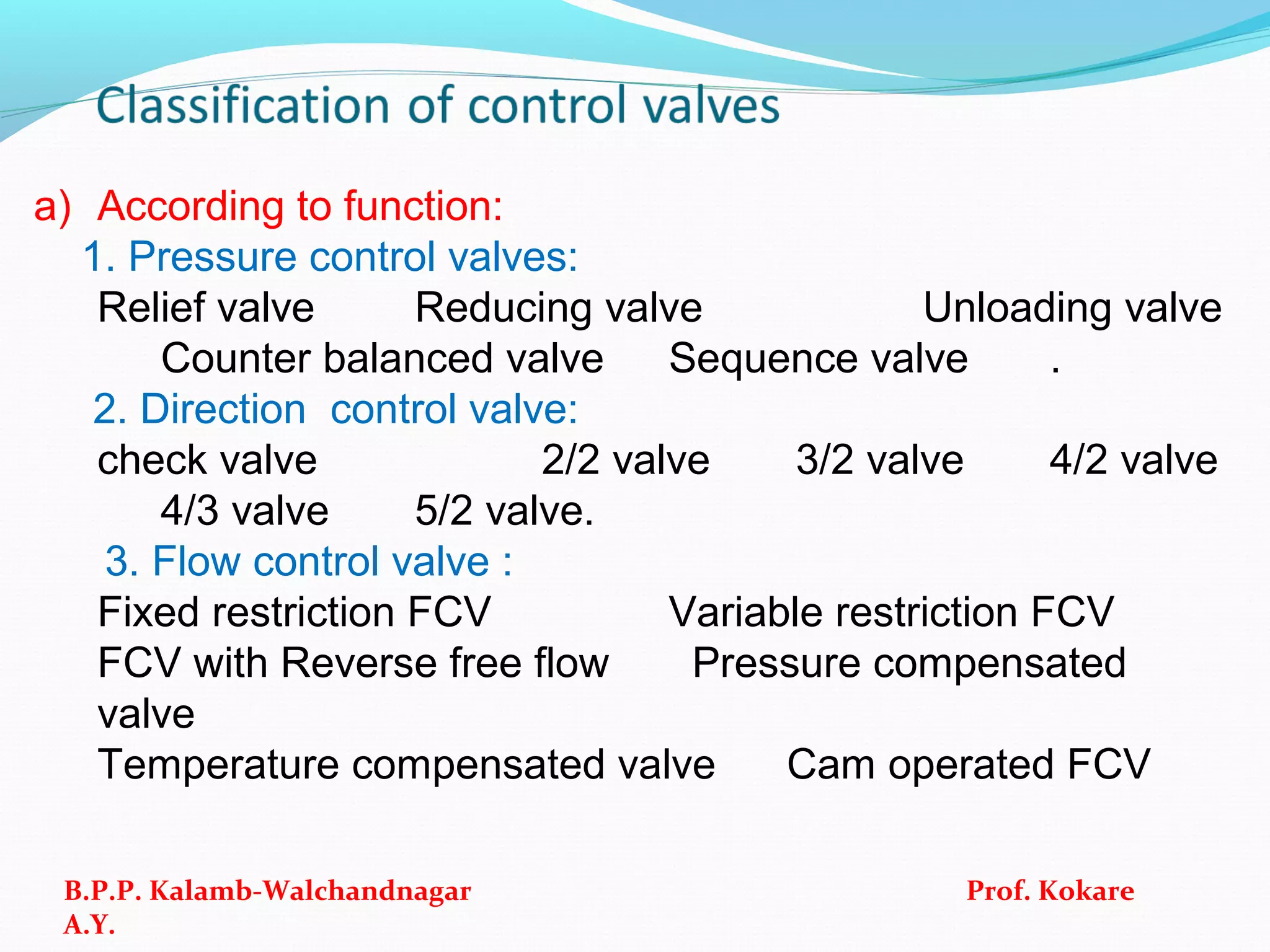
a) According to function:
1. Pressure control valves:
Relief valve Reducing valve Unloading valve
Counter balanced valve Sequence valve .
2. Direction control valve:
check valve 2/2 valve 3/2 valve 4/2 valve
4/3 valve 5/2 valve.
3. Flow control valve :
Fixed restriction FCV Variable restriction FCV
FCV with Reverse free flow Pressure compensated
valve
Temperature compensated valve Cam operated FCV
B.P.P. Kalamb-Walchandnagar Prof. Kokare
A.Y.
b) According to the method actuation:
1. Manual operated:
Palm operated Push button operated
Hand lever operated. Foot pedal
operated Cam(roller) operated
2. Pilot operated:
a.Single pilot b.Double pilot.
3. Solenoid operated:
Single solenoid Double solenoid.
c) According to construction:
1. Poppet type: Ball type, conical poppet type.
2. Spool type: Sliding spool type, rotary spool type.
3. Flow control : Gate valve, plug valve, needle valve, poppet
valve, butterfly valve etc.
B.P.P. Kalamb-Walchandnagar Prof. Kokare
A.Y.
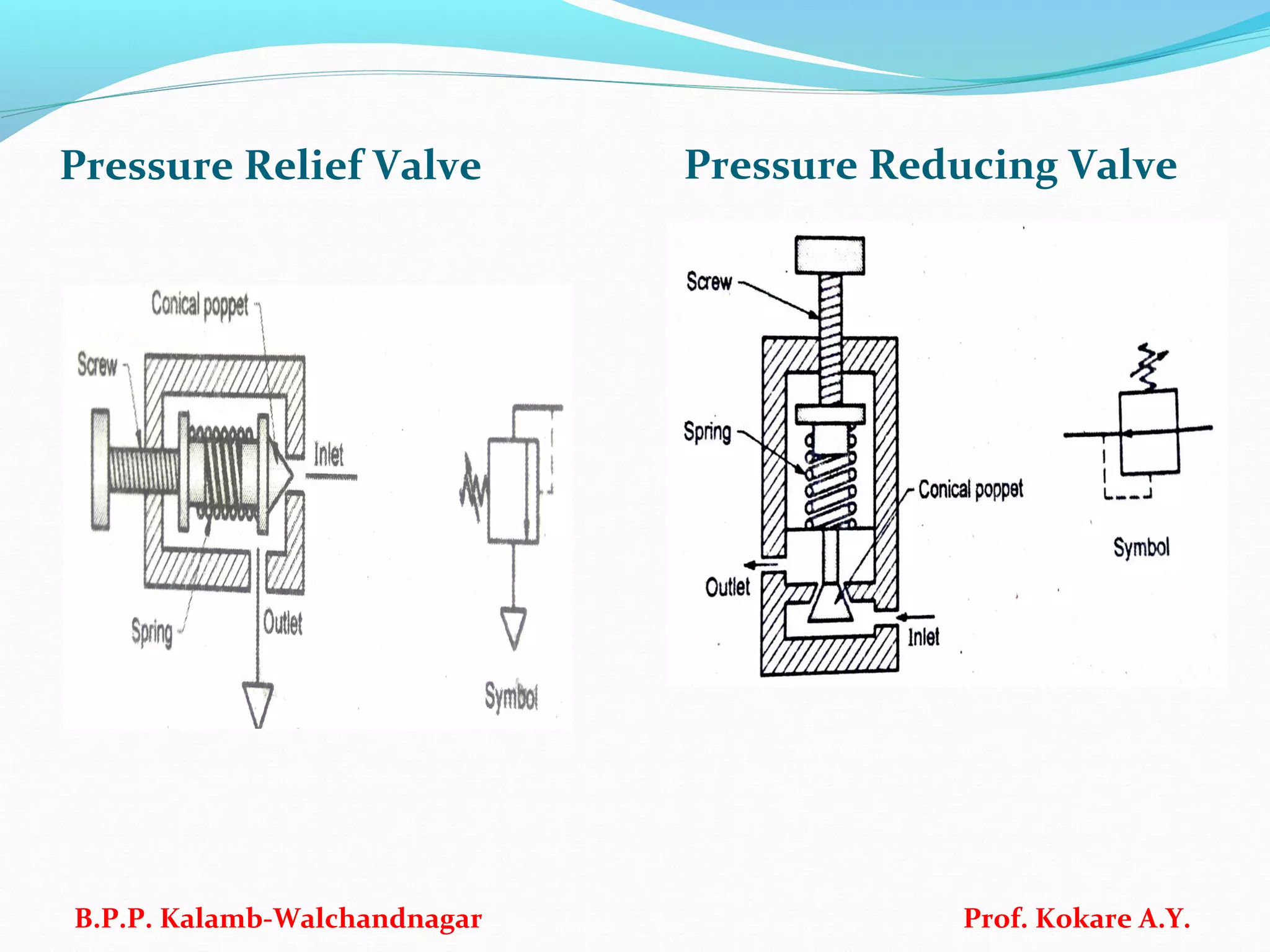
Pressure Relief Valve Pressure Reducing Valve
B.P.P. Kalamb-Walchandnagar Prof. Kokare A.Y.
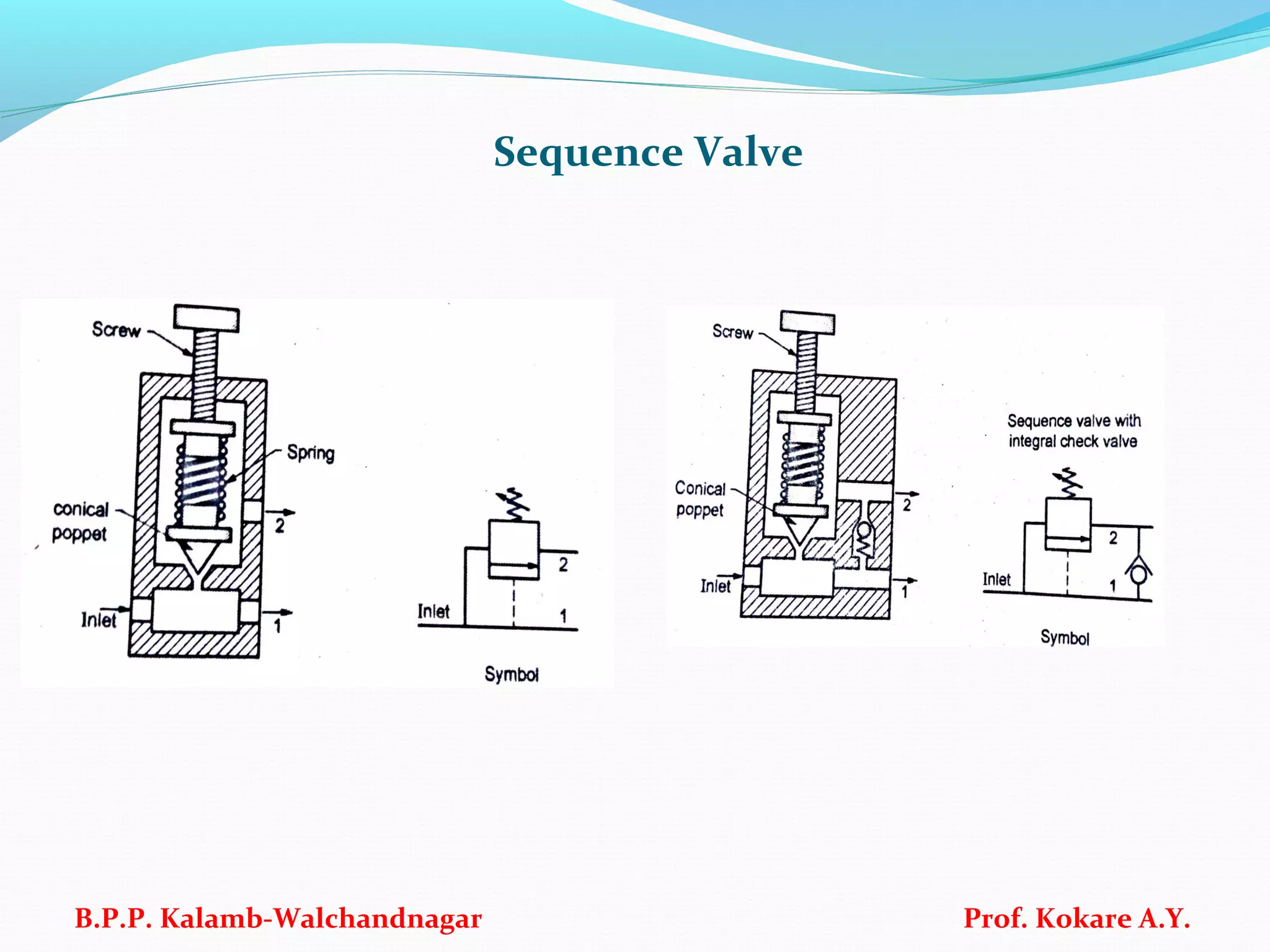
Sequence Valve
B.P.P. Kalamb-Walchandnagar Prof. Kokare A.Y.
a) According to the method actuation:
1. Manual operated:
Palm operated Push button operated
Hand lever operated. Foot pedal operated Cam(roller)
operated
2. Pilot operated:
a.Single pilot b.Double pilot.
3. Solenoid operated:
Single solenoid Double solenoid.
b) According to ype of spool:
1. Poppet type.
2. Sliding Spool type.
3. Rotary spool type.
a)According to number of ports and position:
check valve 2/2 valve 3/2 valve 4/2 valve
4/3 valve 5/2 valve.
B.P.P. Kalamb-Walchandnagar Prof. Kokare
A.Y.
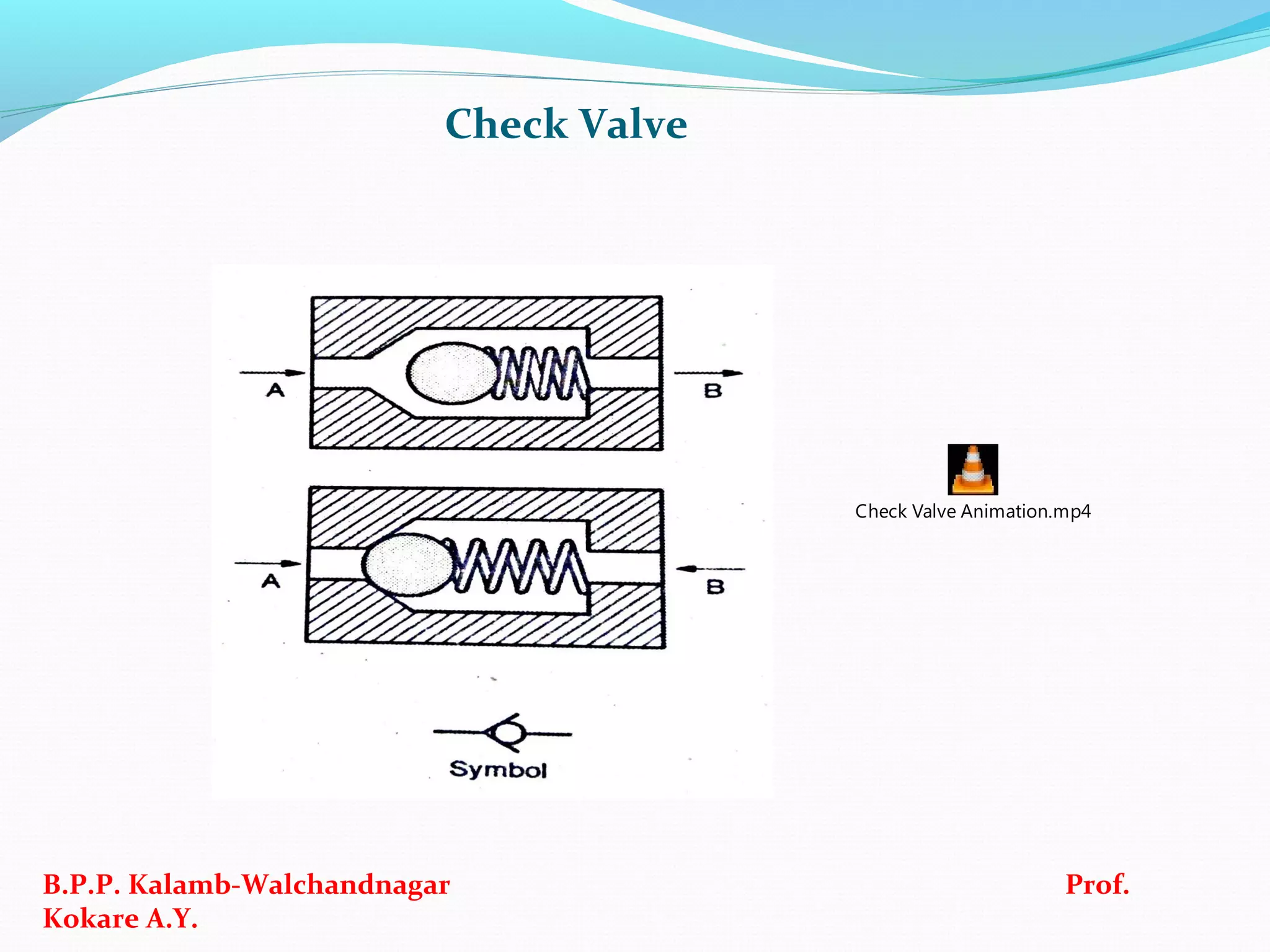
Check Valve
B.P.P. Kalamb-Walchandnagar Prof.
Kokare A.Y.
Check Valve Animation.mp4
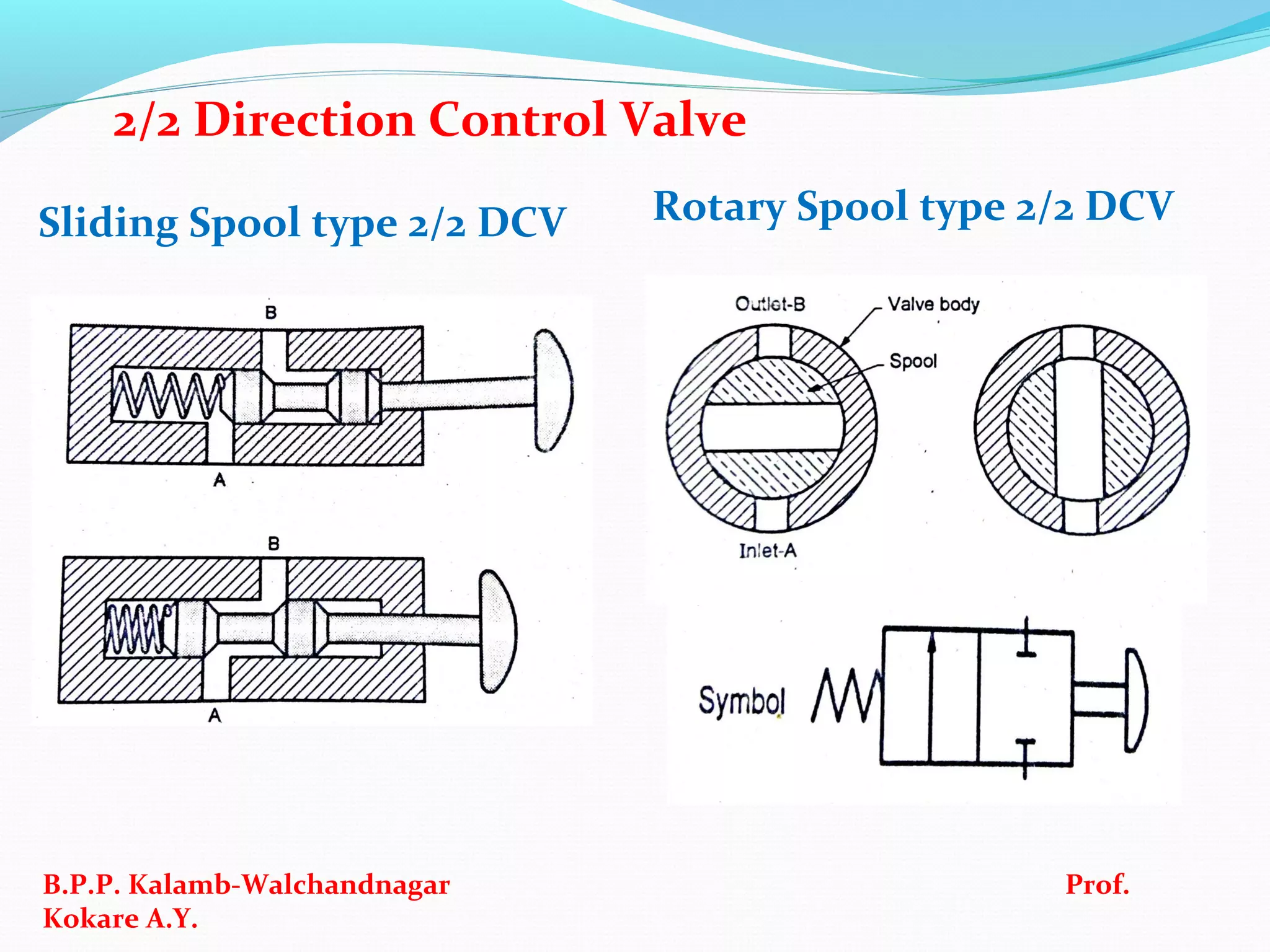
Sliding Spool type 2/2 DCV Rotary Spool type 2/2 DCV
B.P.P. Kalamb-Walchandnagar Prof.
Kokare A.Y.
2/2 Direction Control Valve
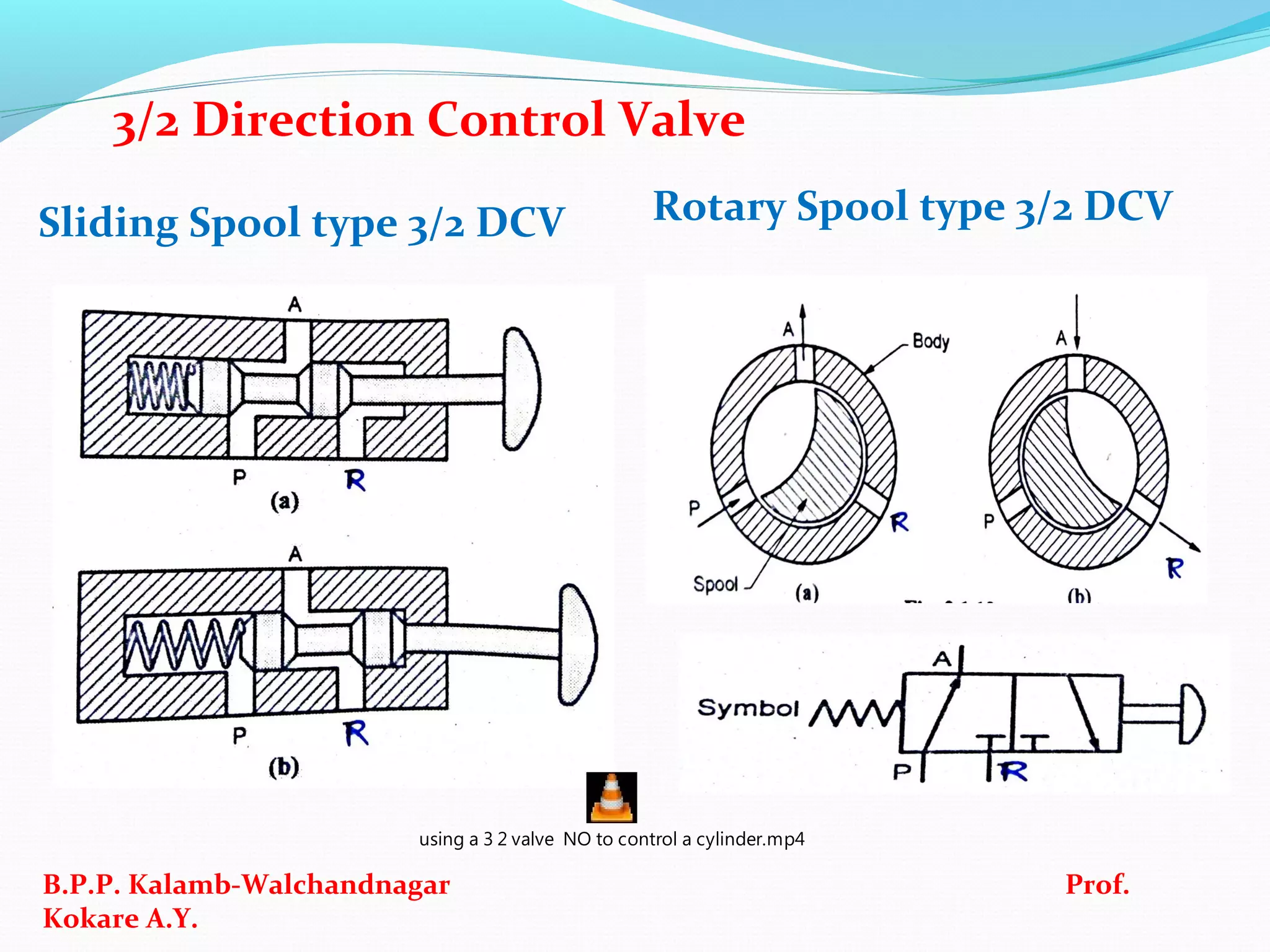
Sliding Spool type 3/2 DCV Rotary Spool type 3/2 DCV
B.P.P. Kalamb-Walchandnagar Prof.
Kokare A.Y.
3/2 Direction Control Valve
using a 3 2 valve NO to control a cylinder.mp4
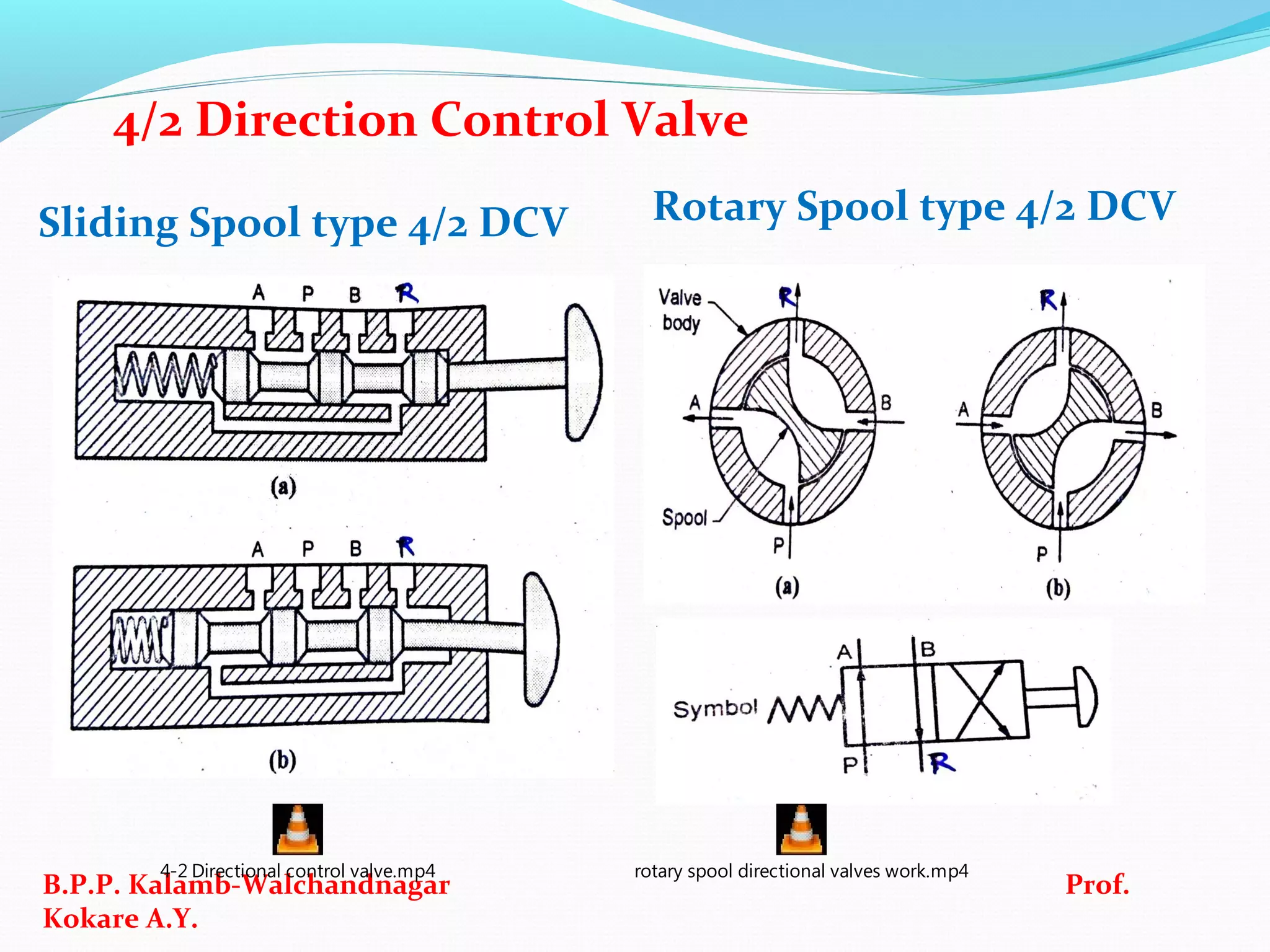
Sliding Spool type 4/2 DCV Rotary Spool type 4/2 DCV
B.P.P. Kalamb-Walchandnagar Prof.
Kokare A.Y.
4/2 Direction Control Valve
4-2 Directional control valve.mp4 rotary spool directional valves work.mp4
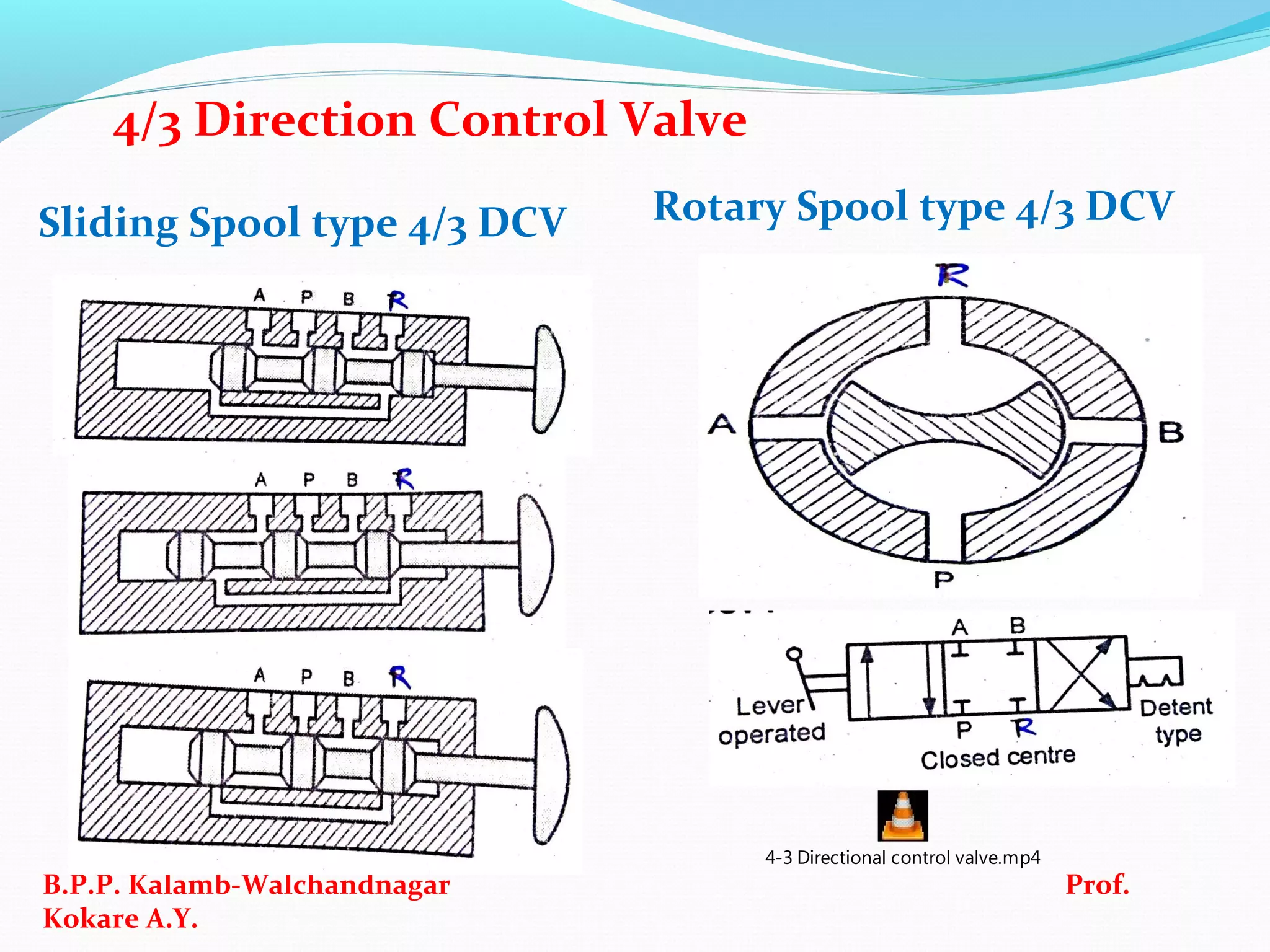
Sliding Spool type 4/3 DCV Rotary Spool type 4/3 DCV
B.P.P. Kalamb-Walchandnagar Prof.
Kokare A.Y.
4/3 Direction Control Valve
4-3 Directional control valve.mp4
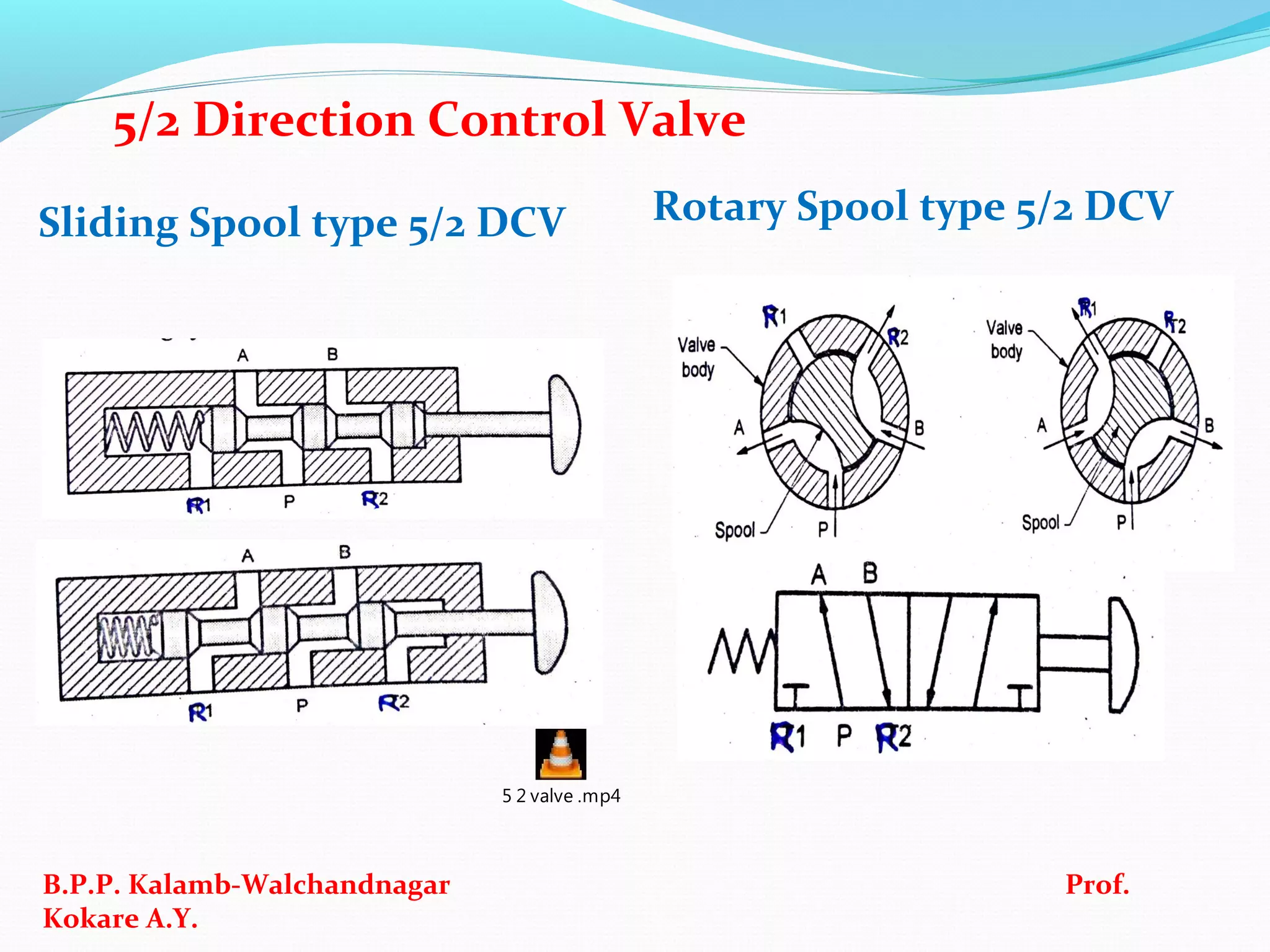
Sliding Spool type 5/2 DCV Rotary Spool type 5/2 DCV
B.P.P. Kalamb-Walchandnagar Prof.
Kokare A.Y.
5/2 Direction Control Valve
5 2 valve .mp4
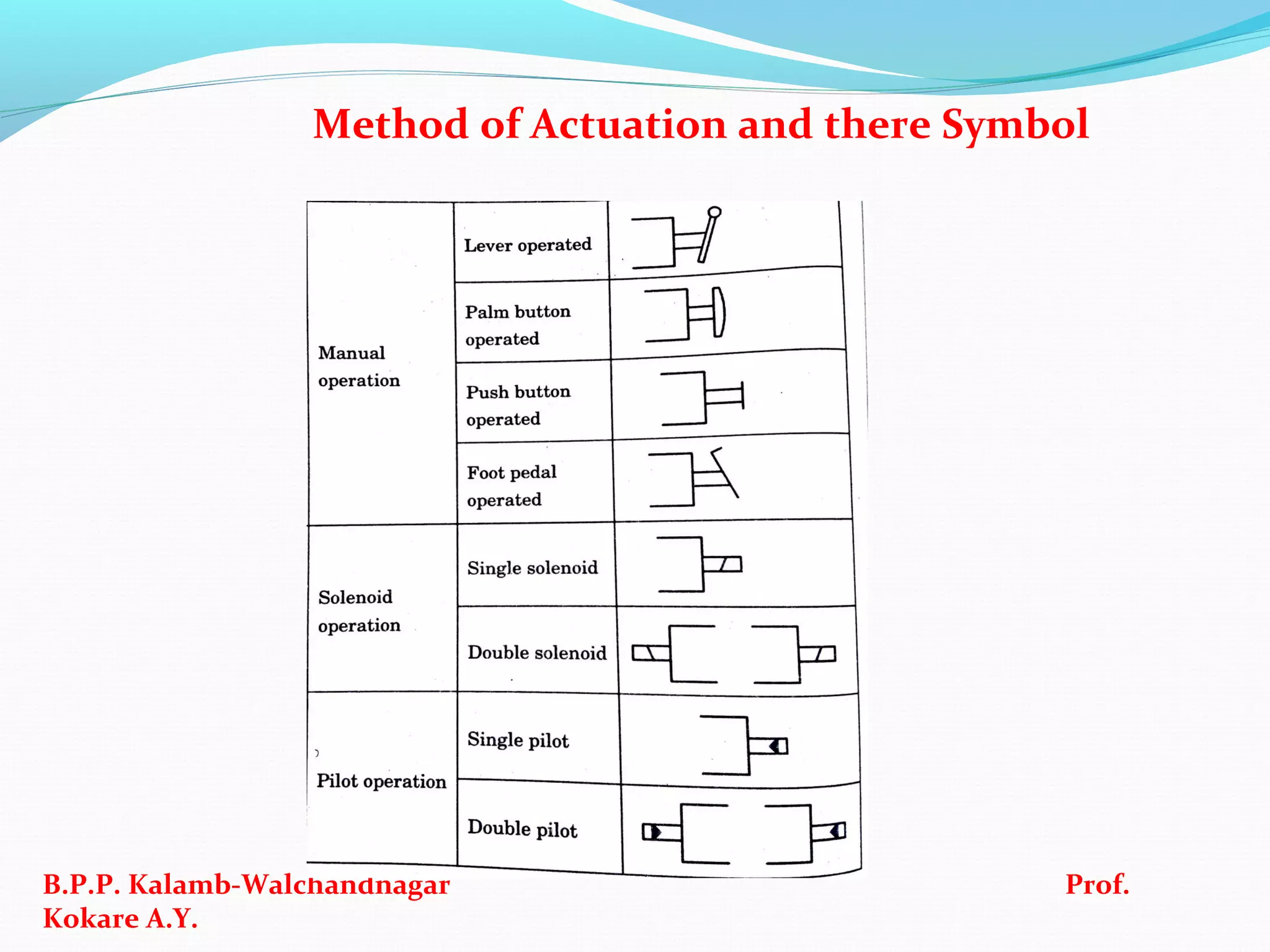
Method of Actuation and there Symbol
B.P.P. Kalamb-Walchandnagar Prof.
Kokare A.Y.
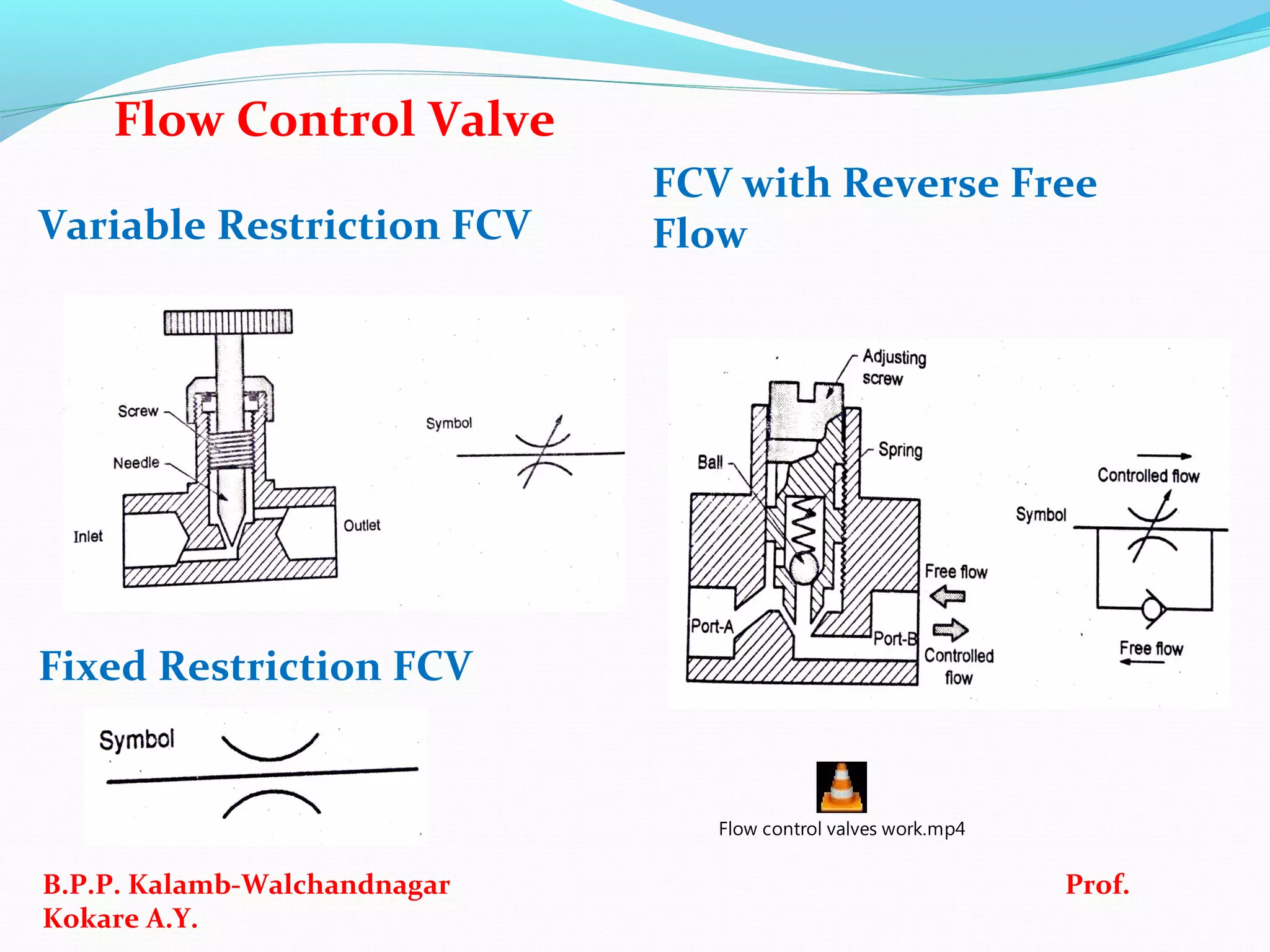
Variable Restriction FCV
FCV with Reverse Free
Flow
B.P.P. Kalamb-Walchandnagar Prof.
Kokare A.Y.
Flow Control Valve
Fixed Restriction FCV
Flow control valves work.mp4
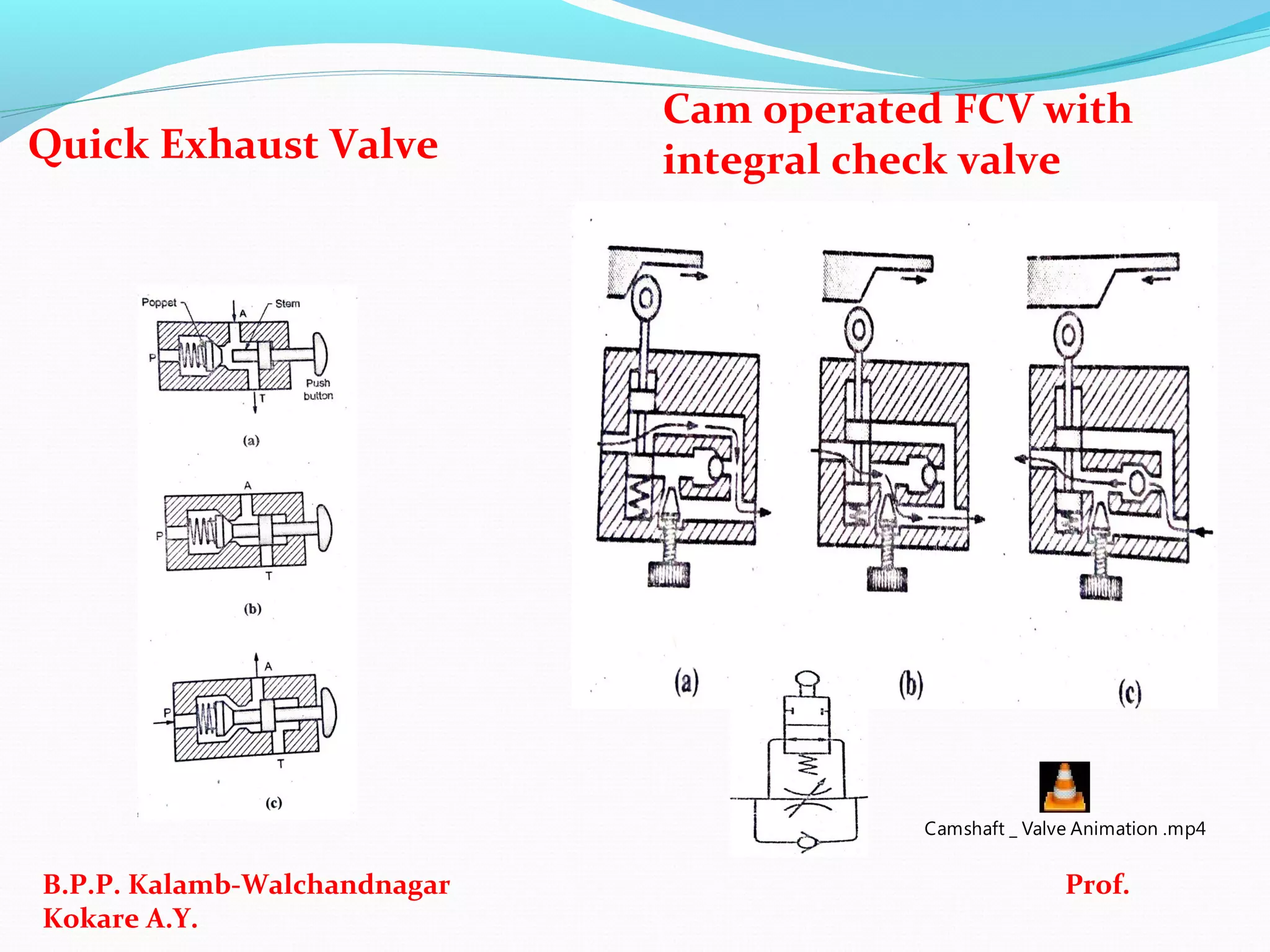
Quick Exhaust Valve
Cam operated FCV with
integral check valve
B.P.P. Kalamb-Walchandnagar Prof.
Kokare A.Y.
Camshaft _ Valve Animation .mp4
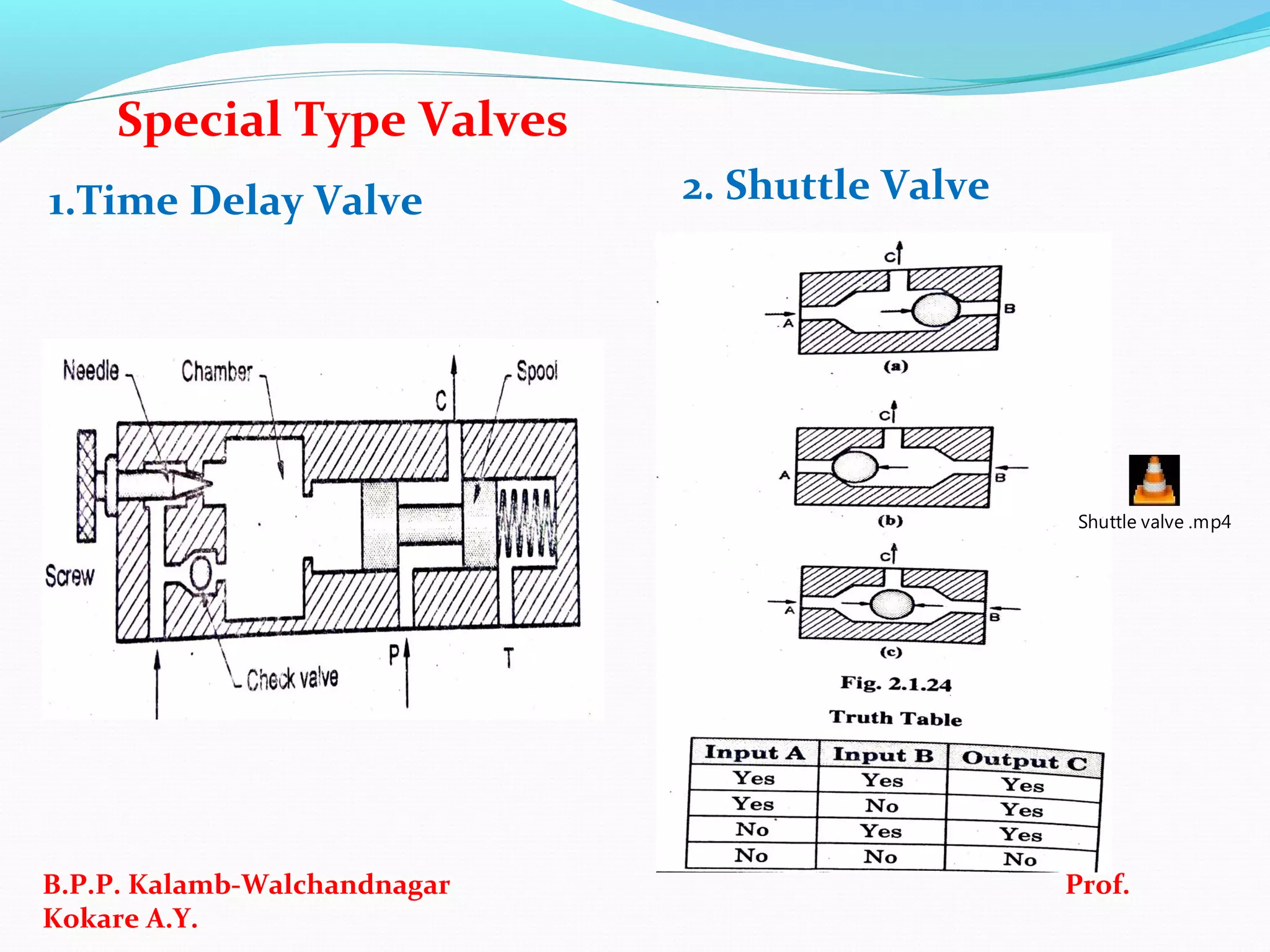
1.Time Delay Valve 2. Shuttle Valve
B.P.P. Kalamb-Walchandnagar Prof.
Kokare A.Y.
Special Type Valves
Shuttle valve .mp4
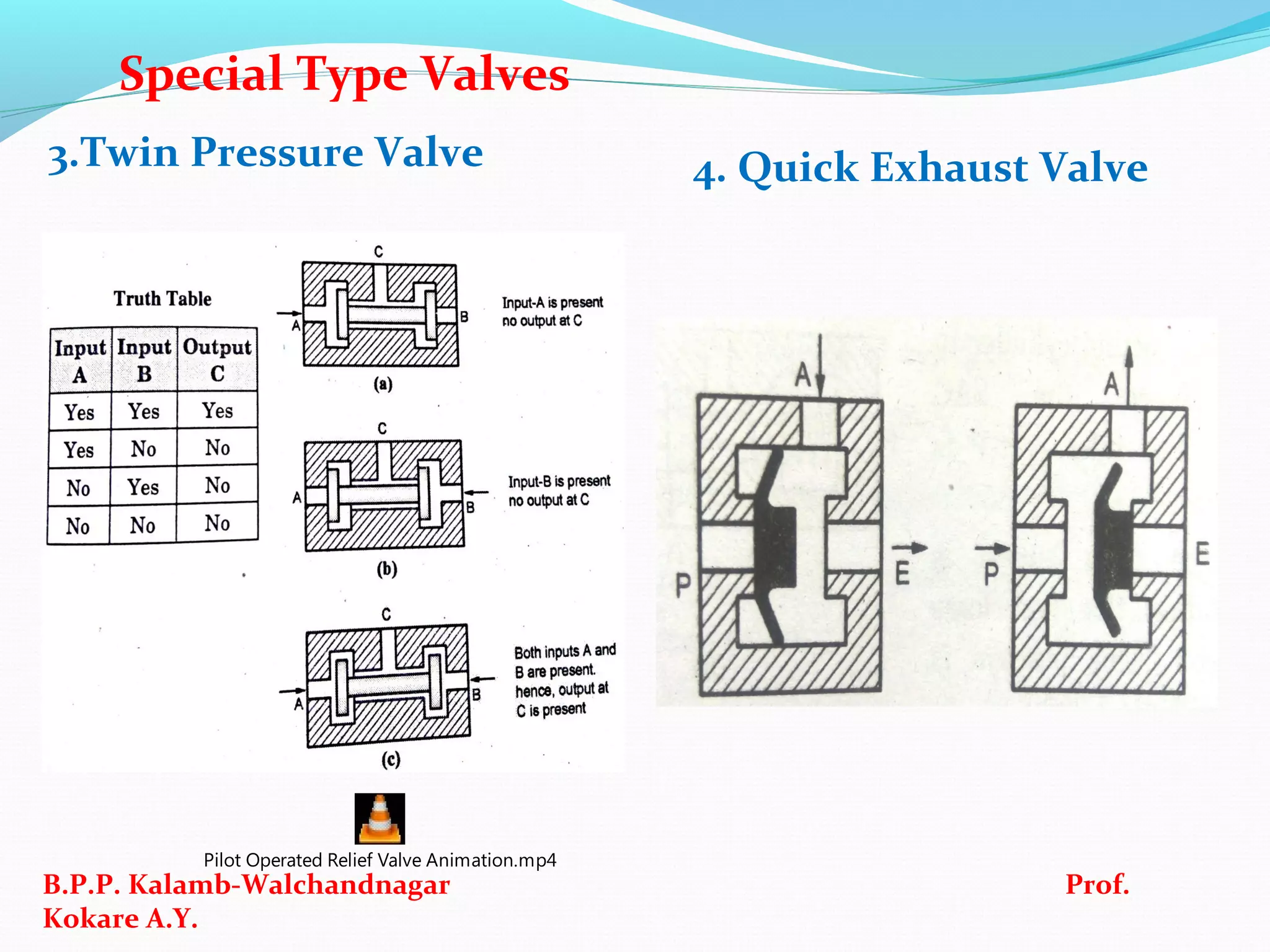
3.Twin Pressure Valve 4. Quick Exhaust Valve
B.P.P. Kalamb-Walchandnagar Prof.
Kokare A.Y.
Special Type Valves
Pilot Operated Relief Valve Animation.mp4
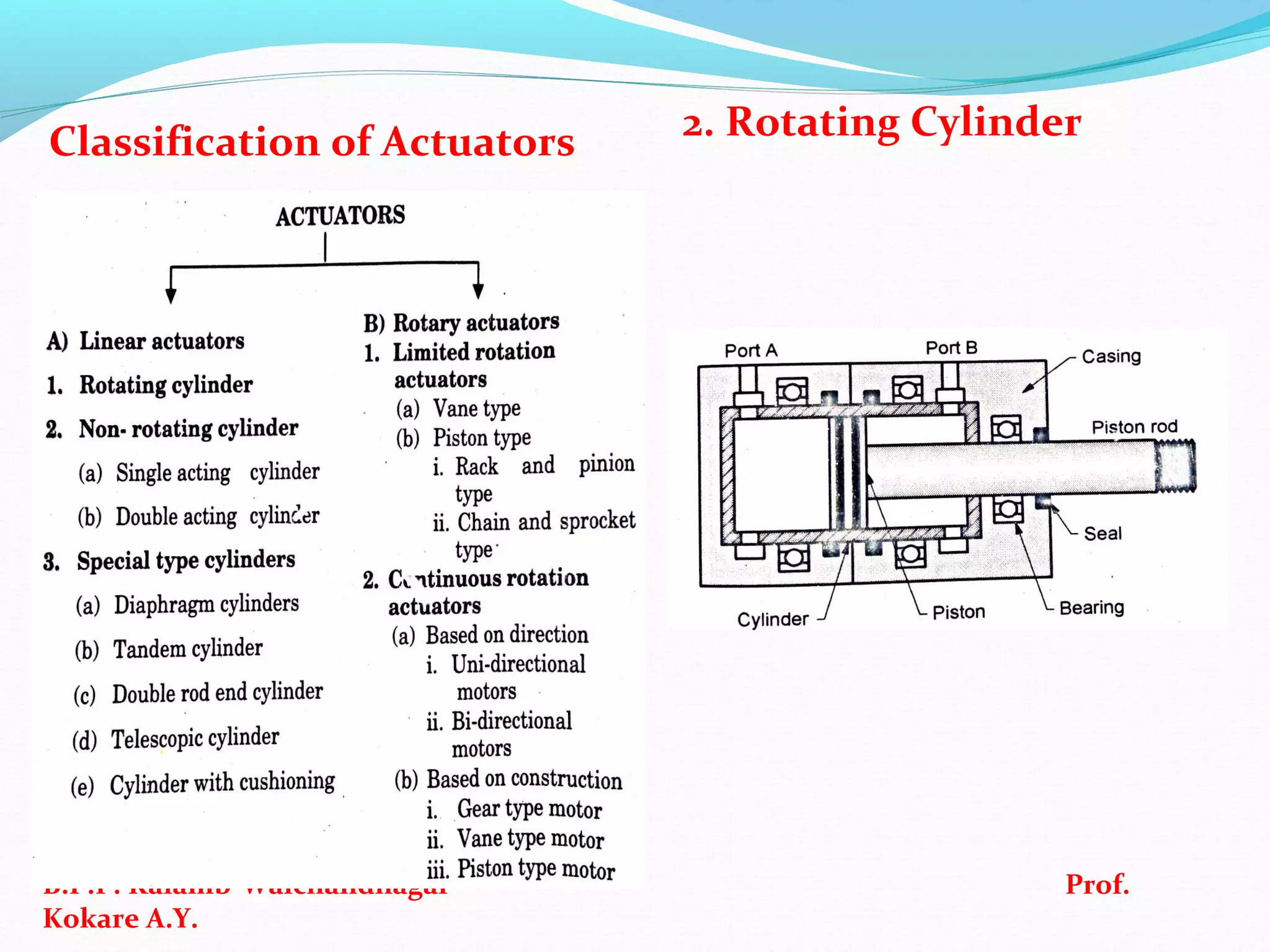
Classification of Actuators 2. Rotating Cylinder
B.P.P. Kalamb-Walchandnagar Prof.
Kokare A.Y.
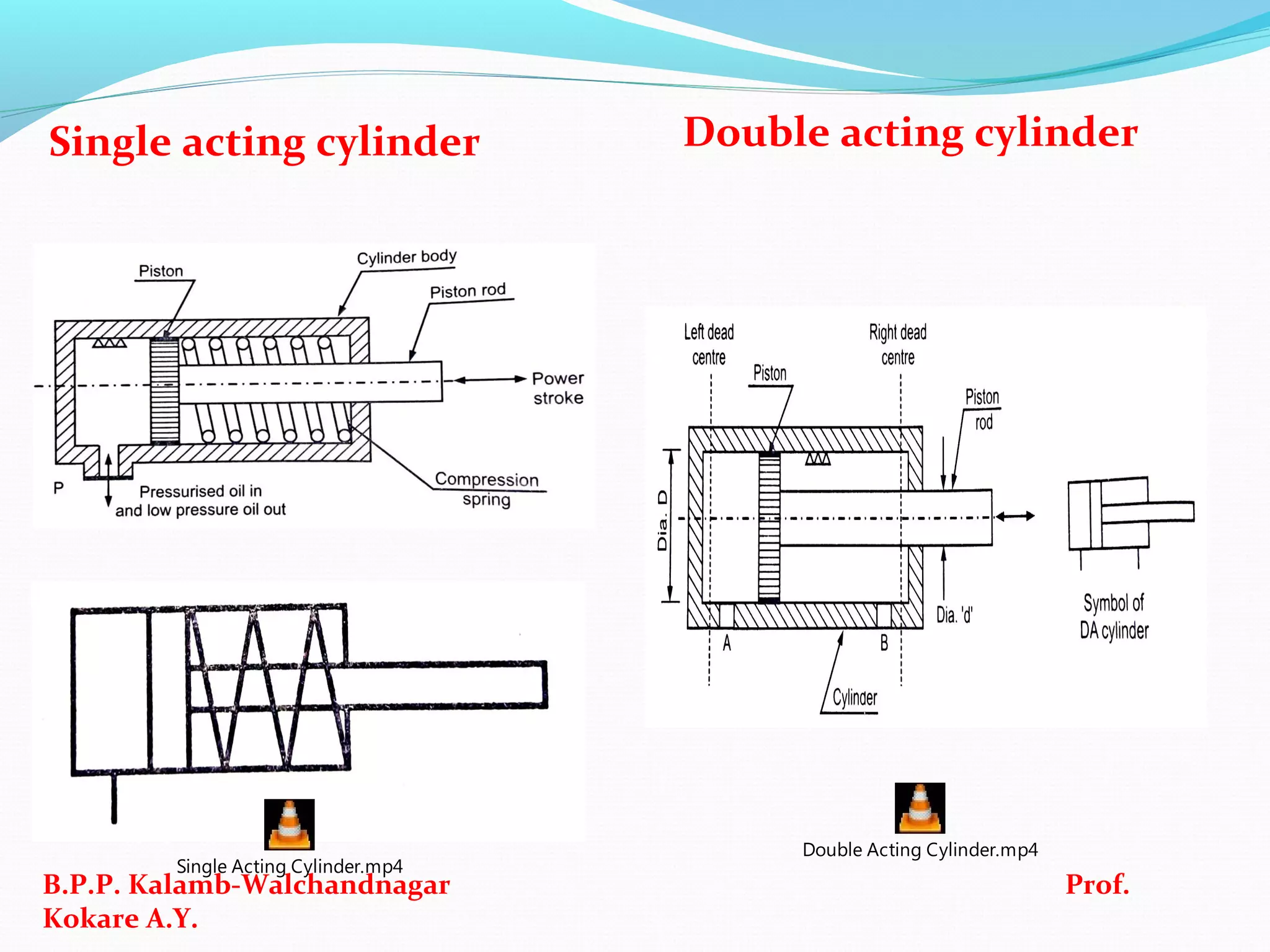
Single acting cylinder Double acting cylinder
B.P.P. Kalamb-Walchandnagar Prof.
Kokare A.Y.
Single Acting Cylinder.mp4
Double Acting Cylinder.mp4
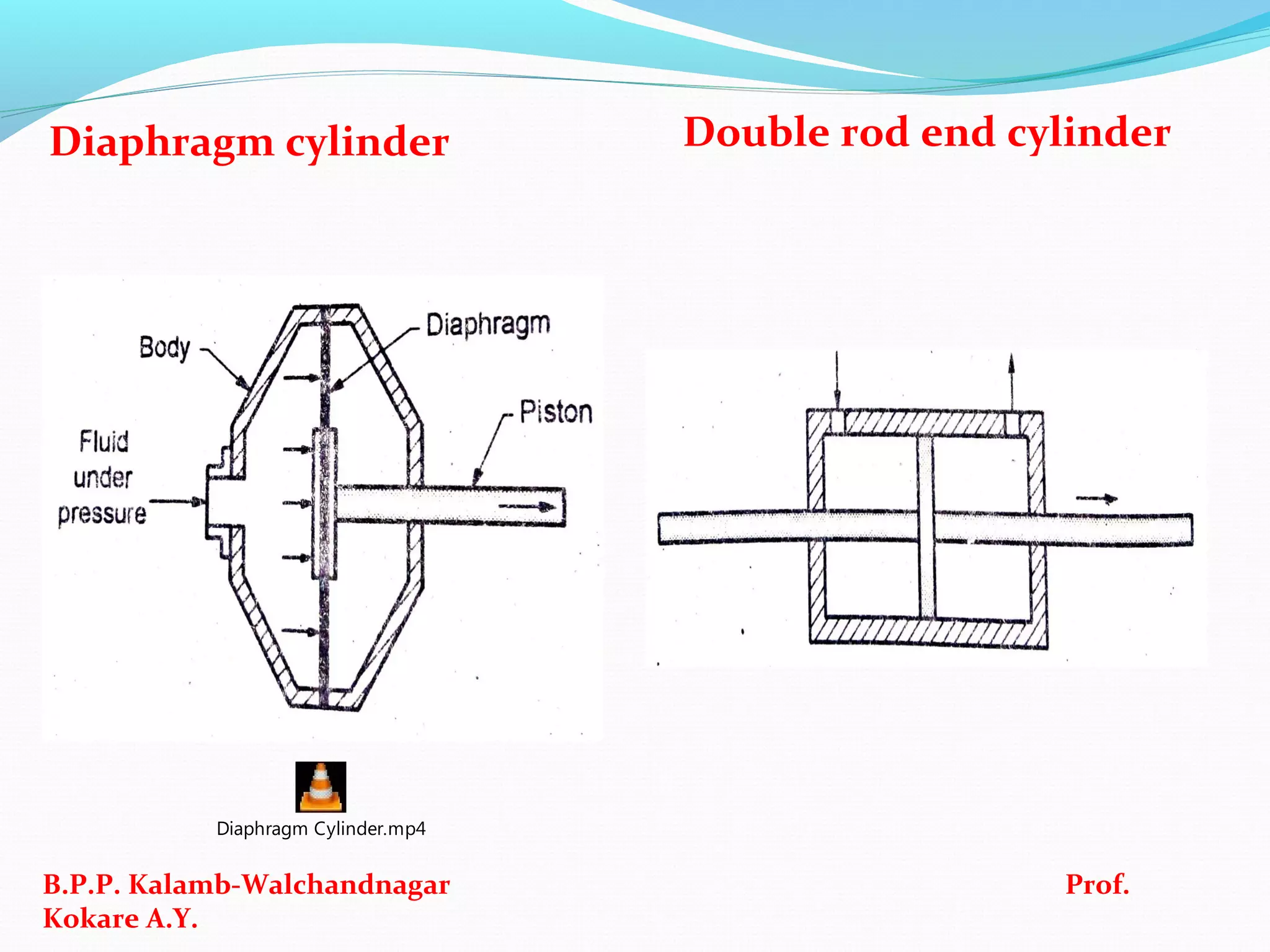
Diaphragm cylinder Double rod end cylinder
B.P.P. Kalamb-Walchandnagar Prof.
Kokare A.Y.
Diaphragm Cylinder.mp4
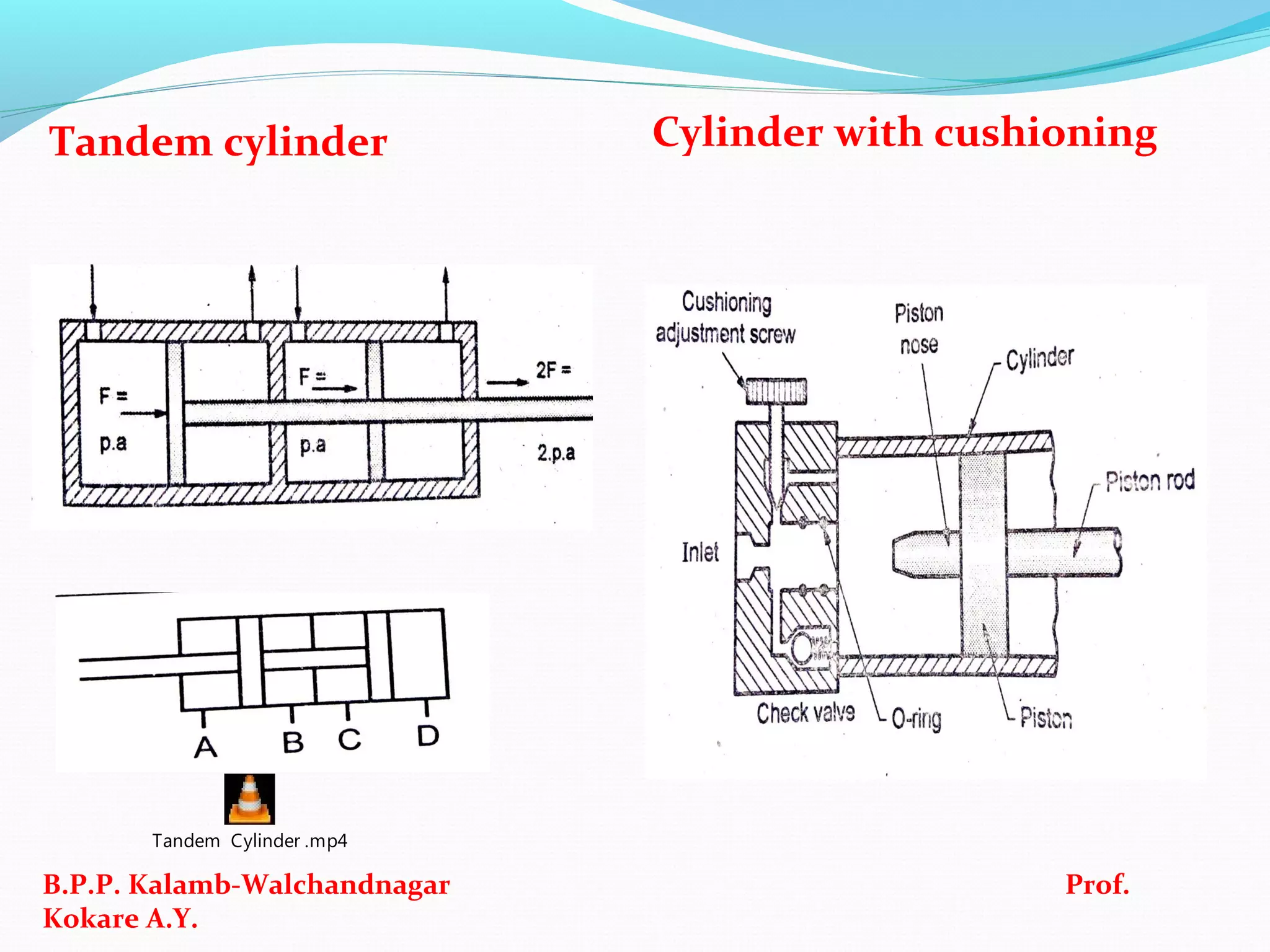
Tandem cylinder Cylinder with cushioning
B.P.P. Kalamb-Walchandnagar Prof.
Kokare A.Y.
Tandem Cylinder .mp4
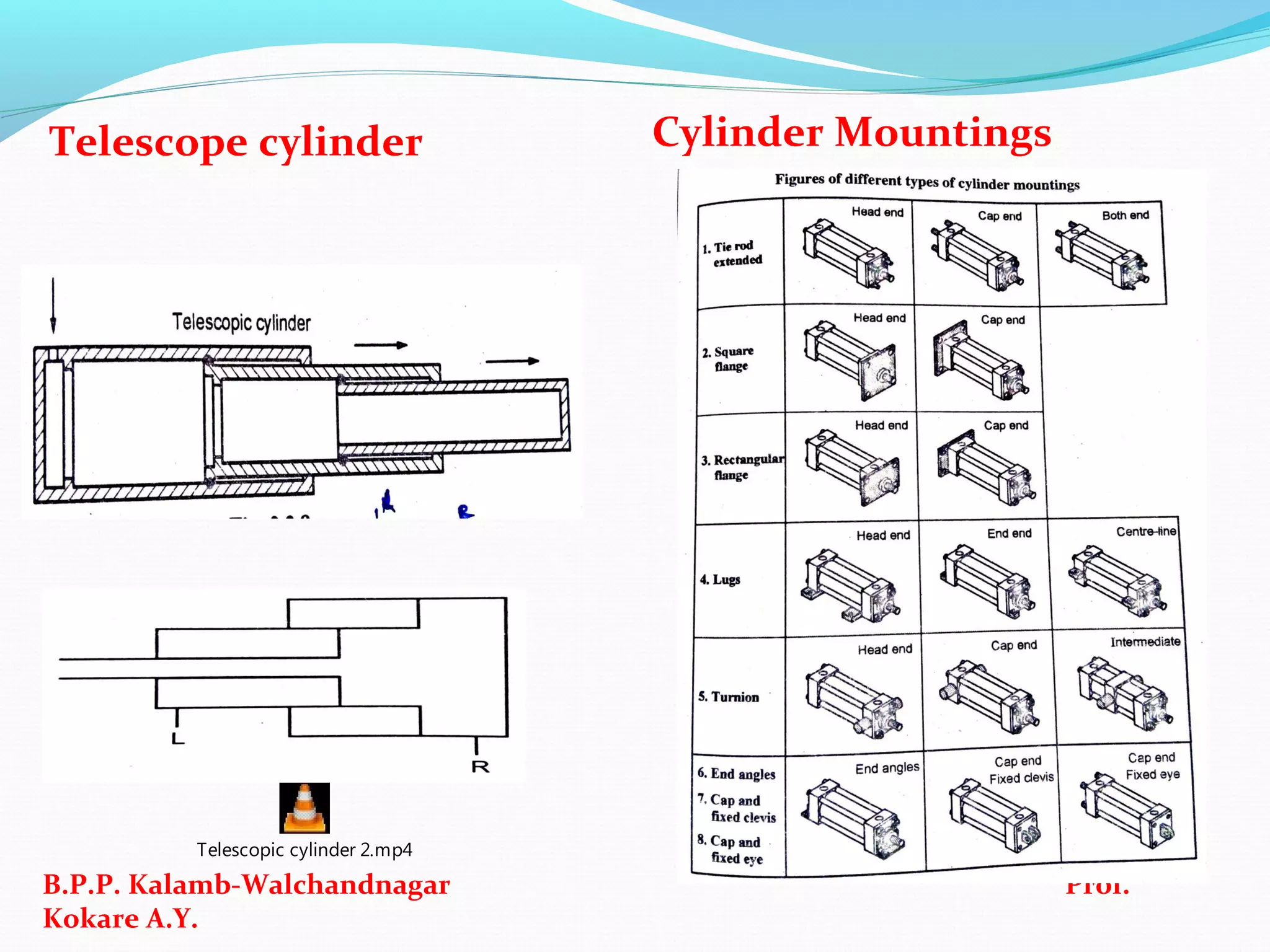
Telescope cylinder Cylinder Mountings
B.P.P. Kalamb-Walchandnagar Prof.
Kokare A.Y.
Telescopic cylinder 2.mp4
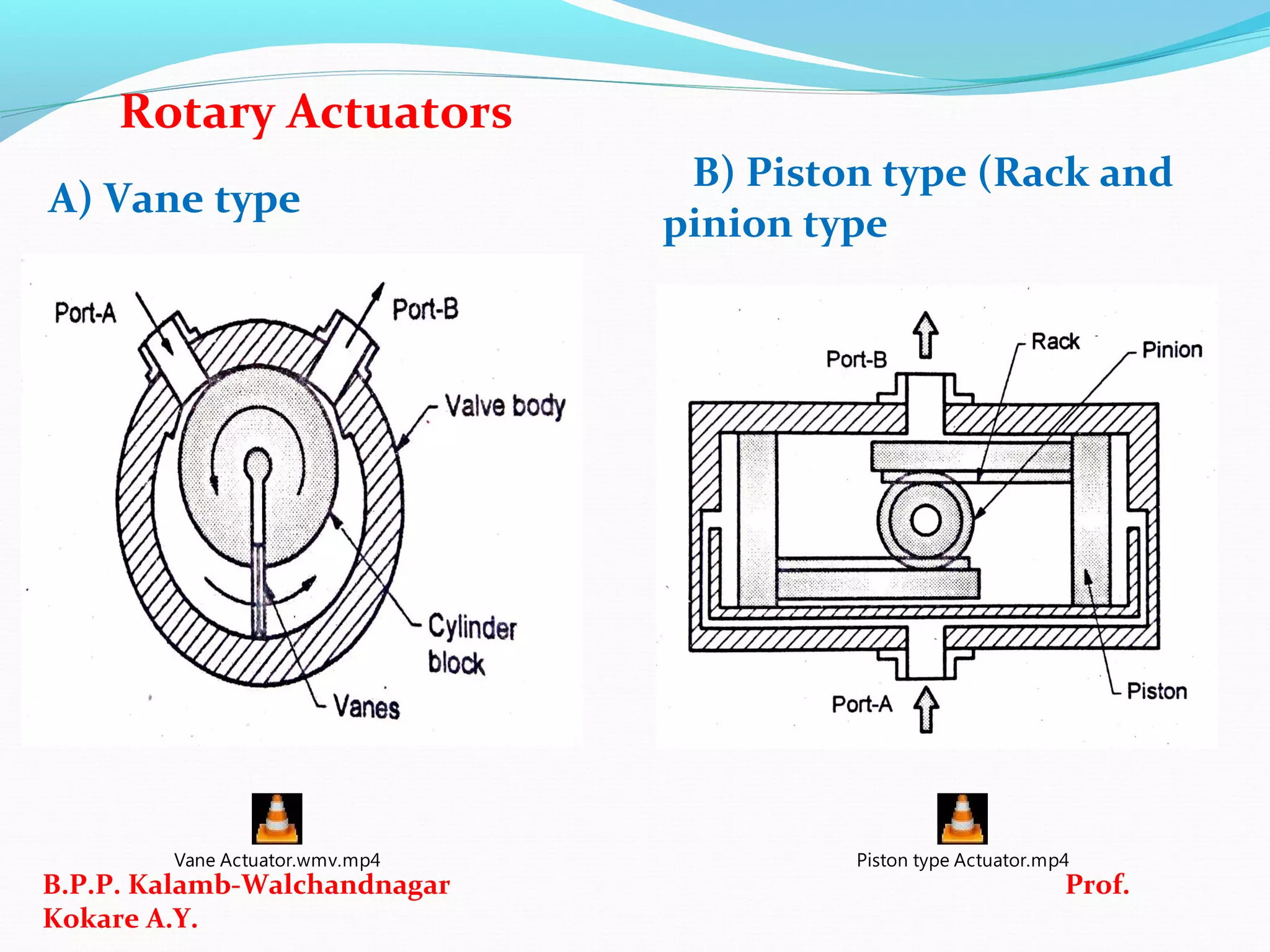
A) Vane type
B) Piston type (Rack and
pinion type
B.P.P. Kalamb-Walchandnagar Prof.
Kokare A.Y.
Rotary Actuators
Piston type Actuator.mp4Vane Actuator.wmv.mp4
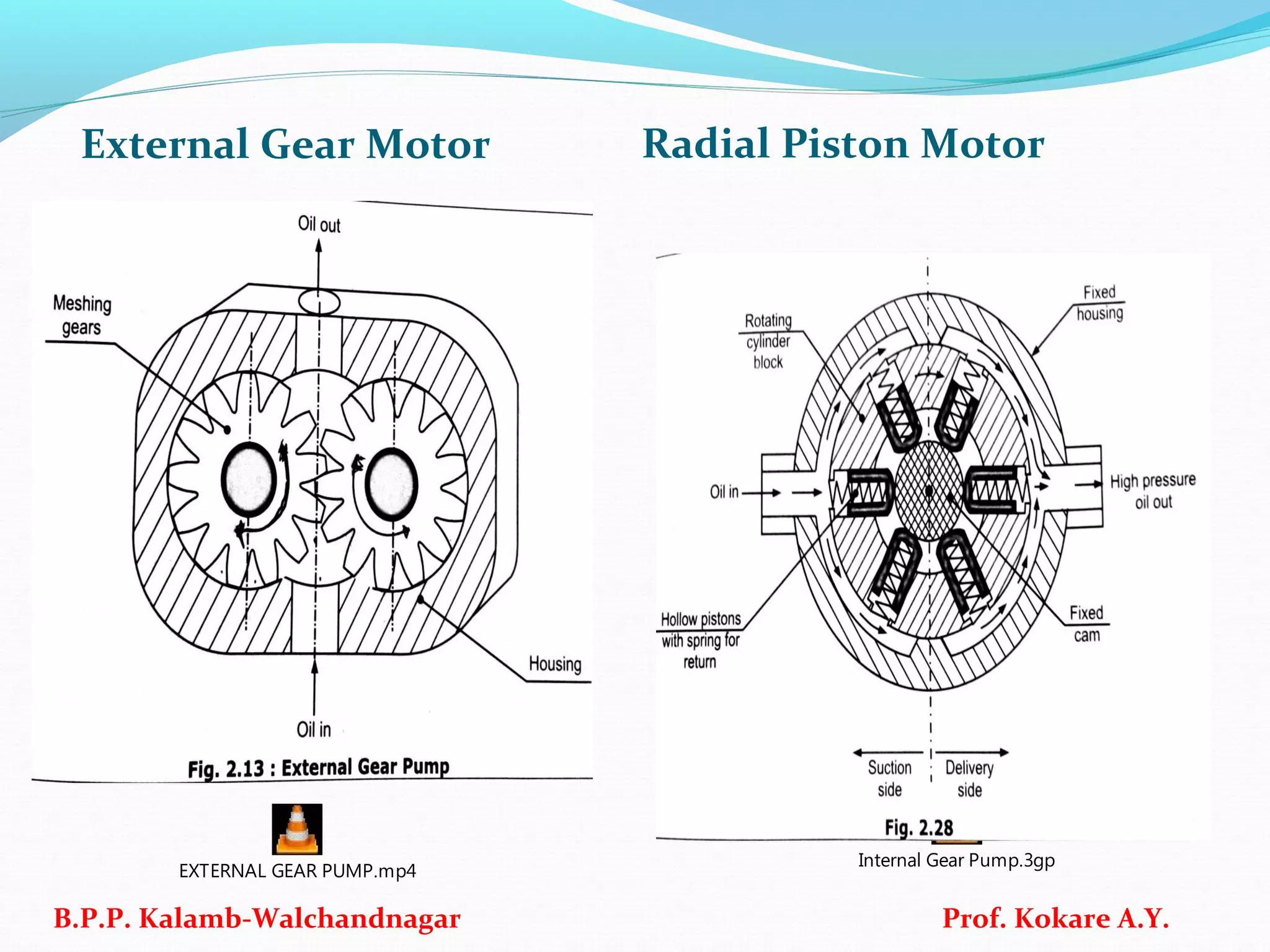
External Gear Motor Radial Piston Motor
B.P.P. Kalamb-Walchandnagar Prof. Kokare A.Y.
EXTERNAL GEAR PUMP.mp4
Internal Gear Pump.3gp
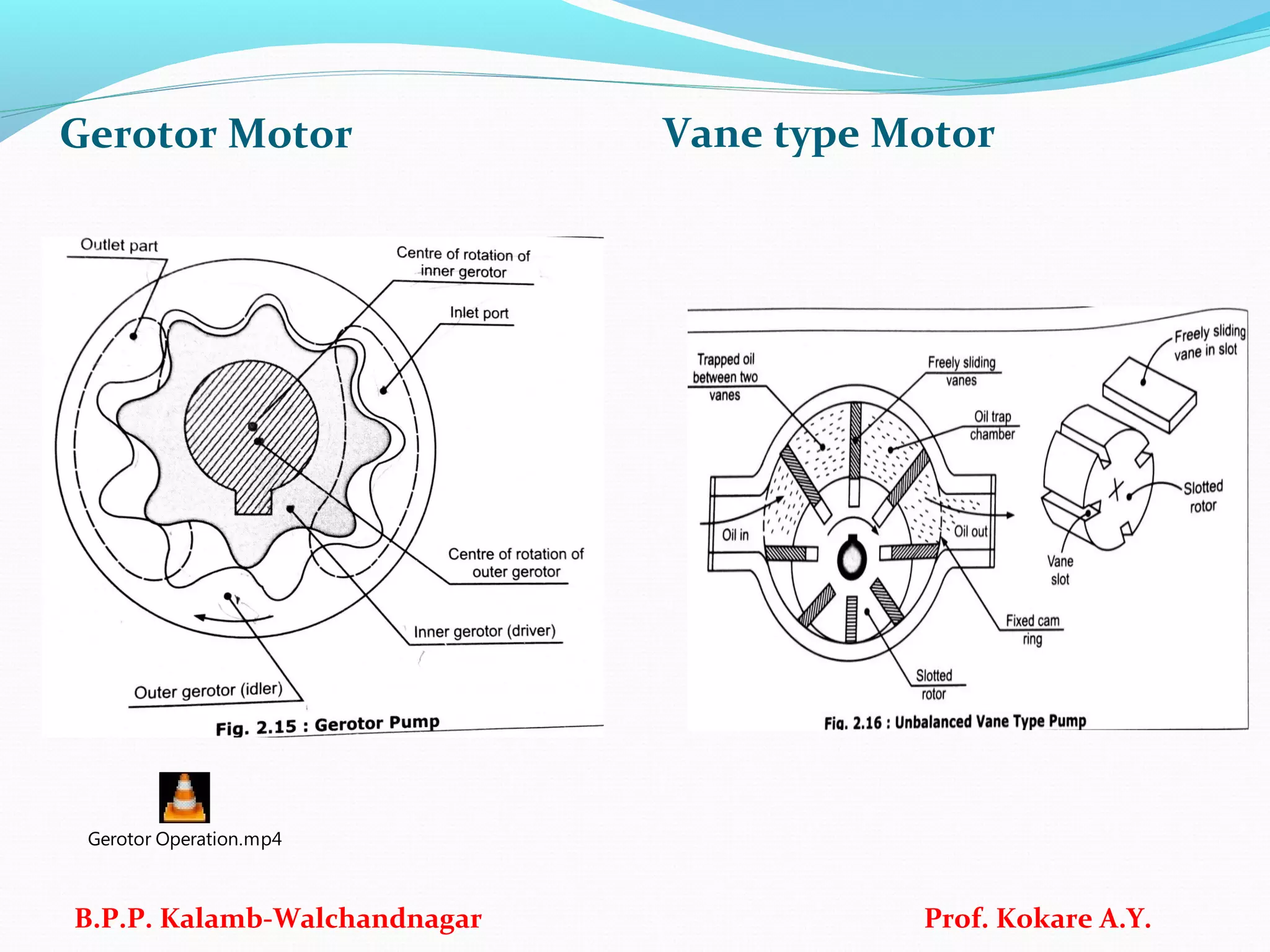
Gerotor Motor Vane type Motor
B.P.P. Kalamb-Walchandnagar Prof. Kokare A.Y.
Gerotor Operation.mp4
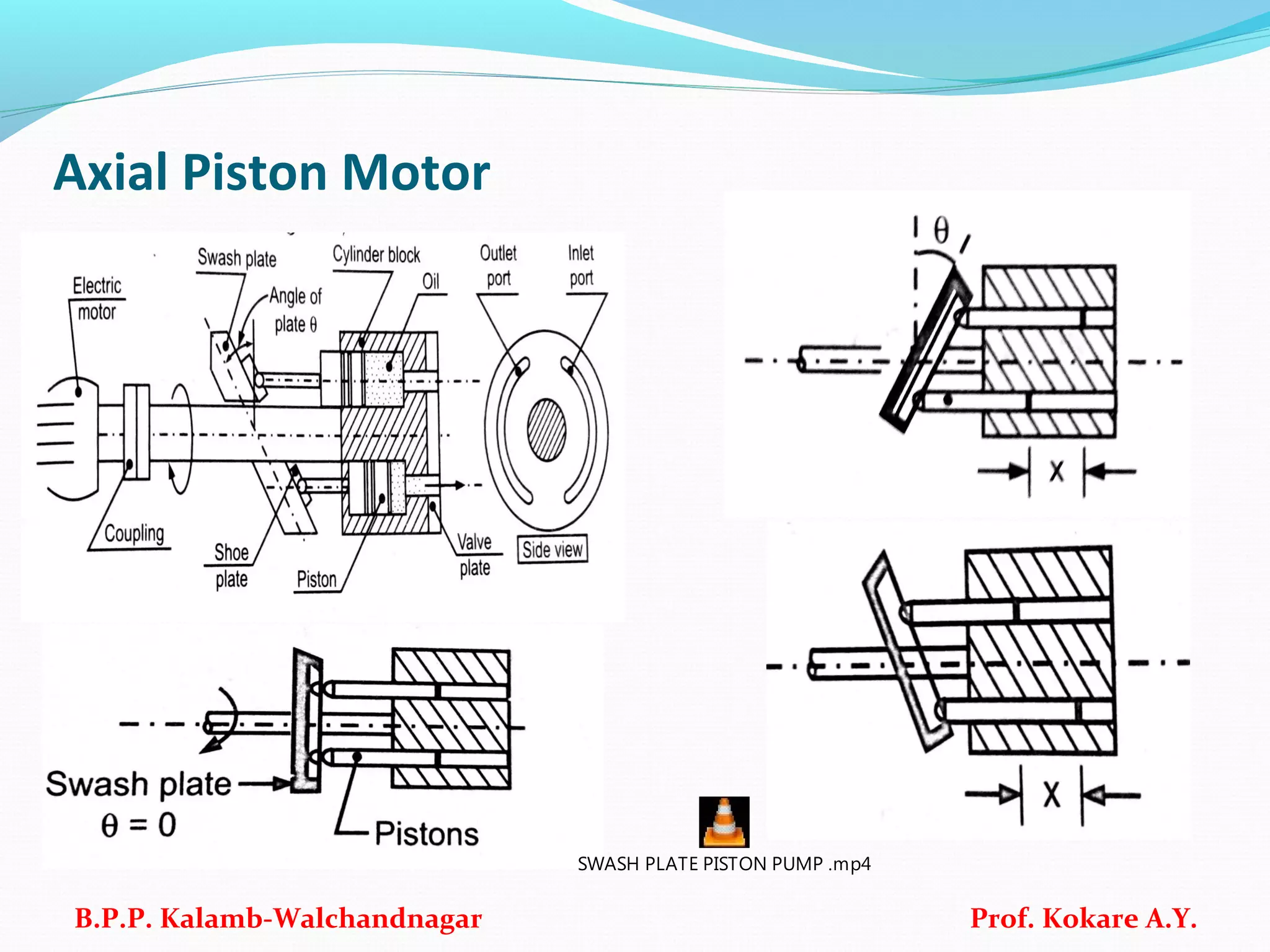
Axial Piston Motor
B.P.P. Kalamb-Walchandnagar Prof. Kokare A.Y.
SWASH PLATE PISTON PUMP .mp4
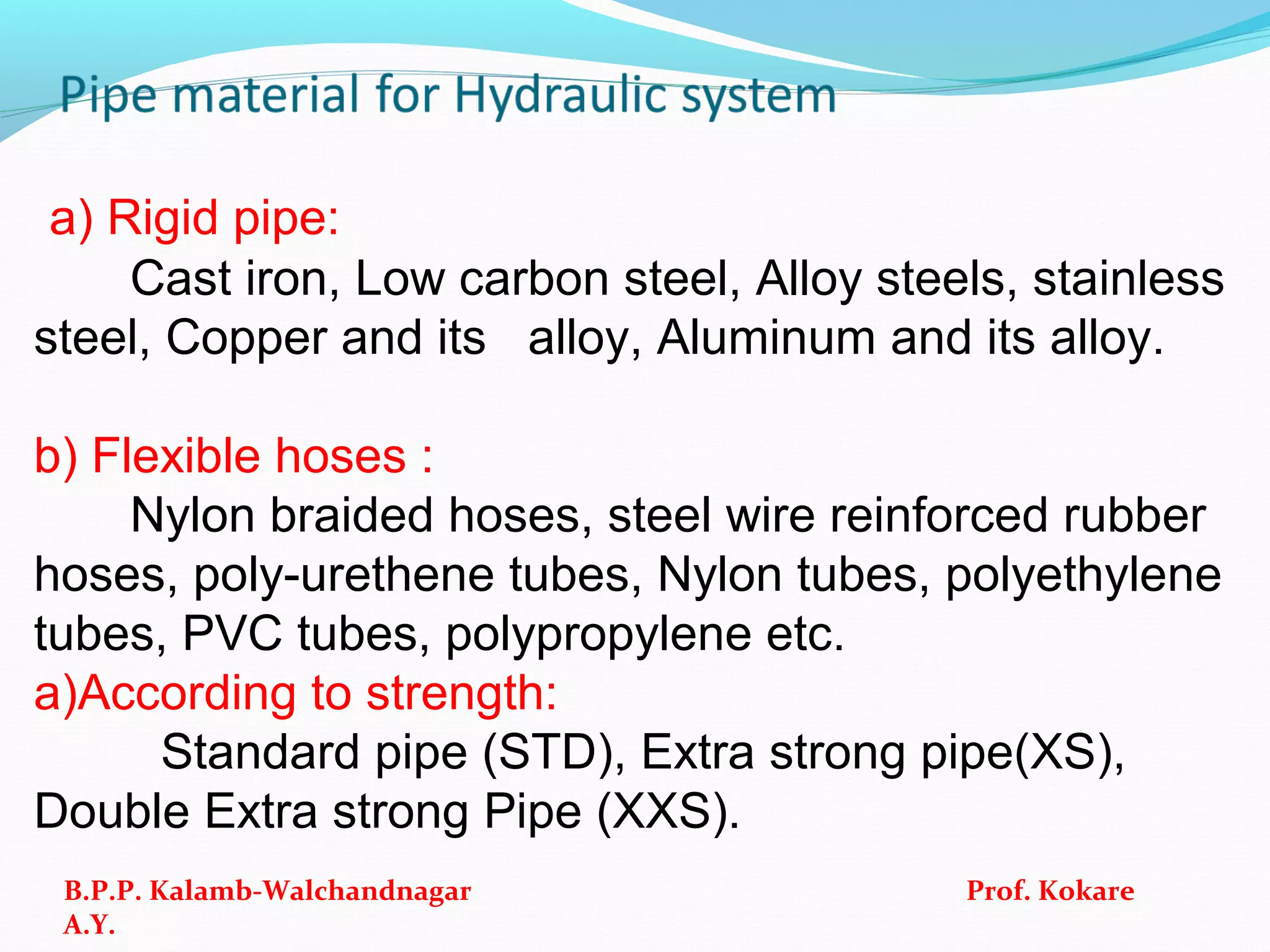
a) Rigid pipe:
Cast iron, Low carbon steel, Alloy steels, stainless
steel, Copper and its alloy, Aluminum and its alloy.
b) Flexible hoses :
Nylon braided hoses, steel wire reinforced rubber
hoses, poly-urethene tubes, Nylon tubes, polyethylene
tubes, PVC tubes, polypropylene etc.
a)According to strength:
Standard pipe (STD), Extra strong pipe(XS),
Double Extra strong Pipe (XXS).
B.P.P. Kalamb-Walchandnagar Prof. Kokare
A.Y.
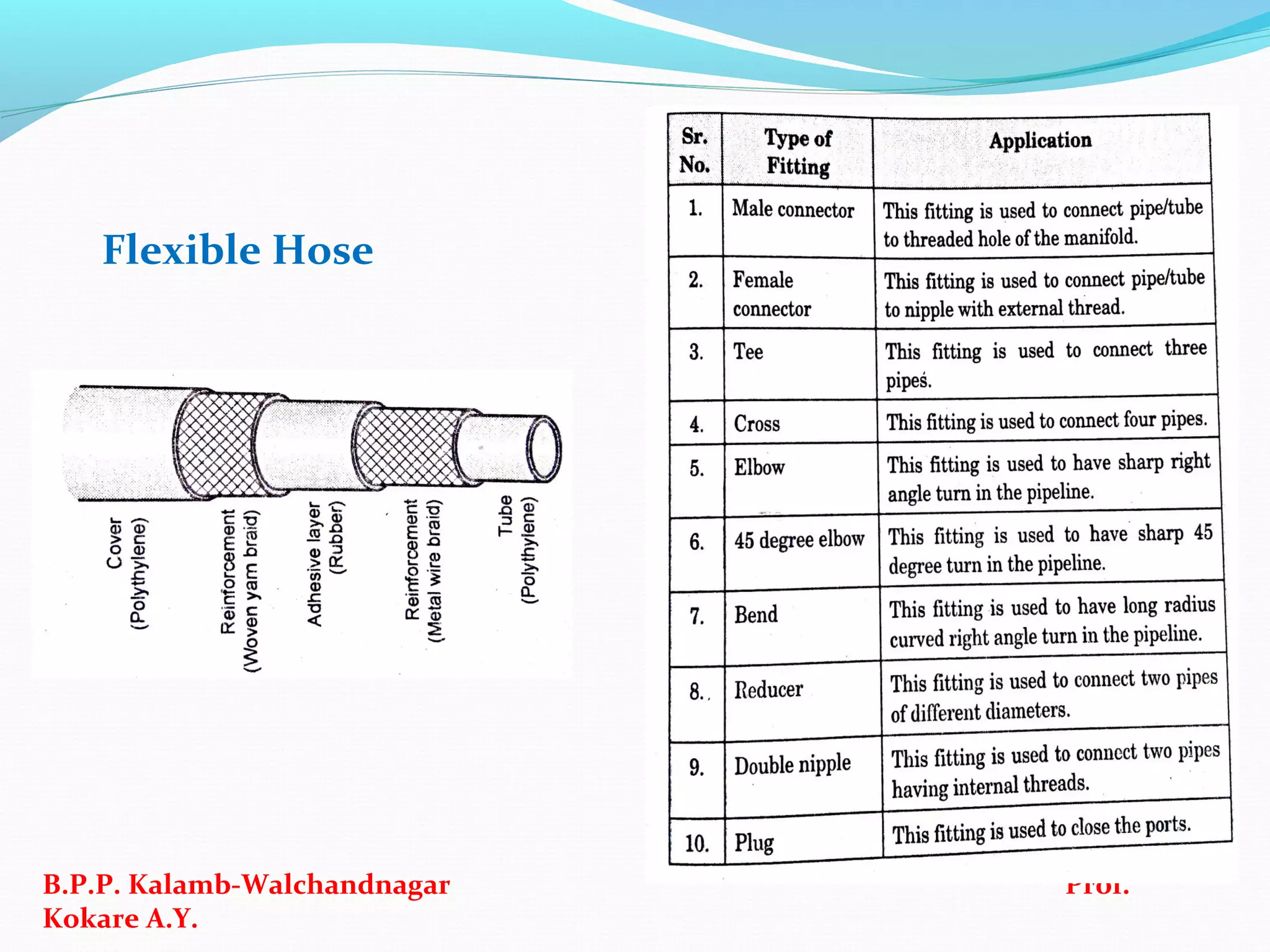
Flexible Hose
B.P.P. Kalamb-Walchandnagar Prof.
Kokare A.Y.
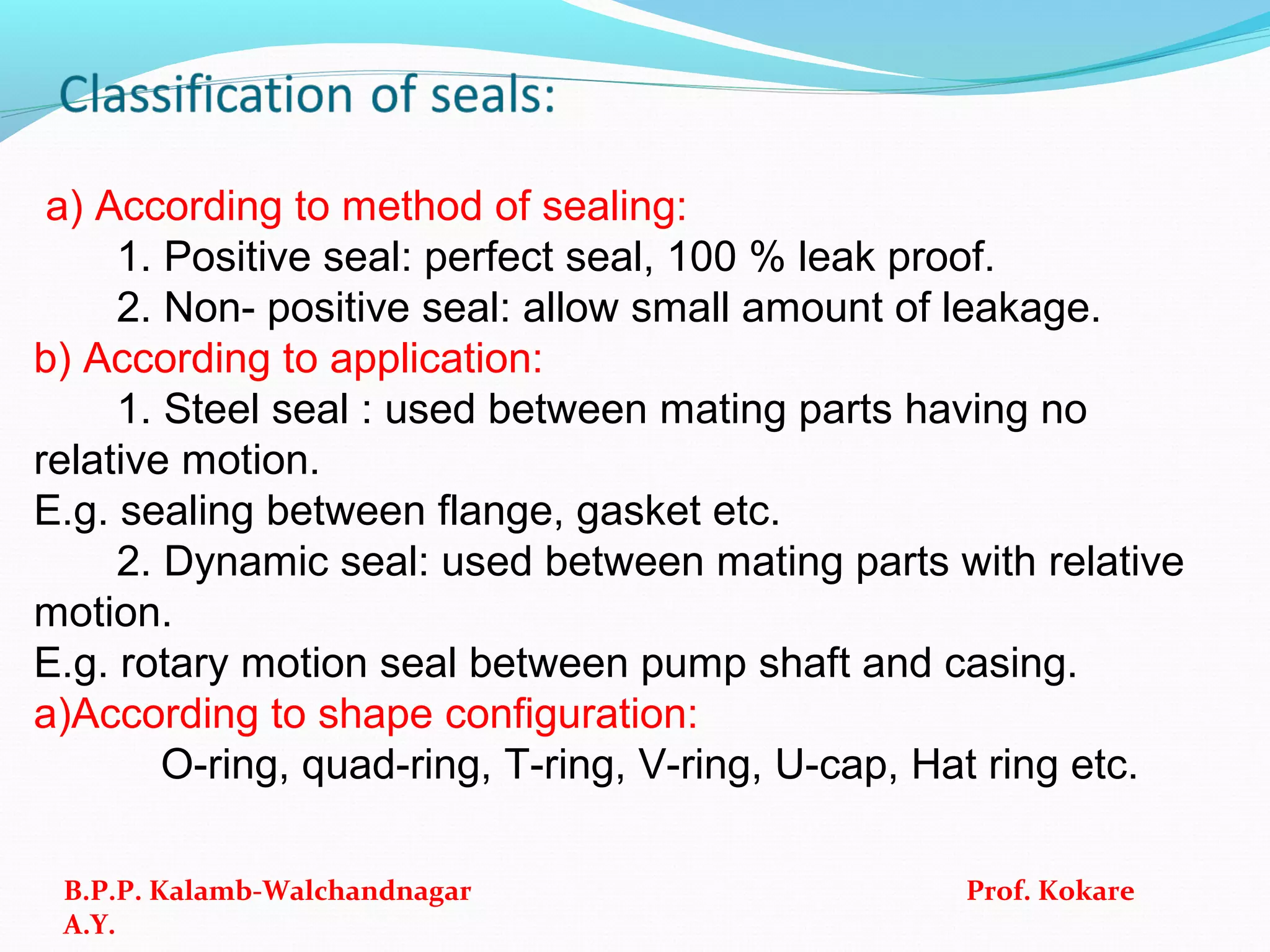
a) According to method of sealing:
1. Positive seal: perfect seal, 100 % leak proof.
2. Non- positive seal: allow small amount of leakage.
b) According to application:
1. Steel seal : used between mating parts having no
relative motion.
E.g. sealing between flange, gasket etc.
2. Dynamic seal: used between mating parts with relative
motion.
E.g. rotary motion seal between pump shaft and casing.
a)According to shape configuration:
O-ring, quad-ring, T-ring, V-ring, U-cap, Hat ring etc.
B.P.P. Kalamb-Walchandnagar Prof. Kokare
A.Y.
Following are the reason for failure of hydraulic seals.
Excessive heat.
Excessive load.
Excessive clearance.
Excessive pressure.
Improper fitting.
Improper groove gravity.
Improper filter rating.
Contamination of fluid.
Idle storage of seals
Age hardening.
Abrasion.
B.P.P. Kalamb-Walchandnagar Prof. Kokare
A.Y.
Thank youThank you
B.P.P. Kalamb-Walchandnagar Prof. Kokare A.Y.

Ifp ch. no. 4 intro. to & compon. of pneumatic system

  • 1.
    Subject:- Industrial FluidPower (IFP) CHAPTER NO: 04 INTRODUCTION TO AND COMPONNTS OF PNEUMATIC SYTEMS (24 Marks (14) BY Prof. Kokare A.Y. BABASAHEB PHADTARE POLYTECHNICKALAMB-WALCHANDNAGAR. B.P.P. Kalamb-Walchandnagar Prof. Kokare A.Y.
  • 2.
    General Layout ofPneumatic System B.P.P. Kalamb-Walchandnagar Prof. Kokare A.Y.
  • 3.
    1. Operating pressureof compressed air. 2. Flow rate of compressed air. 3. Filter rating for selection of filter. 4. Stroke length required for selection of cylinder. 5. Force required and speed required by the actuator. 6. Compatibility, durability, cost etc. 7. Port size, pipe size etc. of connections. 8. Environmental conditions such as temperature, humidity etc. 9. Surrounding condition such as chemical, high temp. etc. B.P.P. Kalamb-Walchandnagar Prof. Kokare A.Y.
  • 4.
    1. It isvery fast in operation, because very low viscosity of compressed air. 2. It can run continuously for long period. 3. It works better even in hot surrounding. It cools even at 125oc 4. Its better work in mines, because it does not generate any spark and hence no chances of explosion and fire hazard. 5. It is very clean and absolutely dust free surrounding. 6. It is environment friendly. 7. Return line is absent, makes circuit simpler. 8. Leakage of compressed air does not have any problem. 9. If overloaded system is stalls. System will start working once the load is reduced. 10.Automatic and safety circuits are possible. B.P.P. Kalamb-Walchandnagar Prof. Kokare A.Y.
  • 5.
    1. Force developis very less as compare with Hydraulic system. 2. The compression of air is very costly. 3. Lubrication is required. 4. System is noisy unless exhaust port are fitted with silencer. 5. Precise control of speed is not possible. Because low viscosity. 1. Pneumatic tools: Drilling m/c, nut runner, screw driver etc. 2. Packing m/c. 3. Material handling: Clamps, conveyor, robotic arm. 4. Mining 5. Automobile: Air brake, Air suspension etc. 6. Machine tools: Pneumatic press, clamps, vices etc. 7. Medical and dental equipment: Dental chair, operating table, Dental drill. B.P.P. Kalamb-Walchandnagar Prof. Kokare A.Y.
  • 6.
    Double acting Reciprocating compressor Selectioncriteria for Air compressor B.P.P. Kalamb-Walchandnagar Prof. Kokare A.Y. 1. Avg. air consumption- capacity should be 2 to 3 times of avg. air. 2. FAD 3. Air receiver capacity- volume of receiver tank is greater than volume is comp. in 1 minute. 4. Power supply. 5. Configuration- tank mounted or base type, simplex or duplex, Reciprocating or rotary type. 6. Component and accessories- power switch relays, thermostats, pressure gauge, drain plug.
  • 7.
    Double acting Reciprocating compressor Importantpoint considered in air receiver tank B.P.P. Kalamb-Walchandnagar Prof. Kokare A.Y. 1. Receiver tank must be sufficiently large 2. Receiver tank must be sufficiently strong to withstand pressure 3. Receiver tank must have important accessories- pressure relief valve, drain valve, press. Gauge, temp. gauge etc. 4. Capacity of Receiver is atm. Press. X FAD per minute to the Press. Of comp. air.
  • 8.
    FRL Unit- (Filter,Regulator, Lubricator) B.P.P. Kalamb-Walchandnagar Prof. Kokare A.Y.
  • 9.
    Air Filter AirRegulator B.P.P. Kalamb-Walchandnagar Prof. Kokare A.Y.
  • 10.
    Air Lubricator Condensation ofwater Moisture Separator B.P.P. Kalamb-Walchandnagar Prof. Kokare A.Y.
  • 11.
    Coalescence Element type Filter AirDryers B.P.P. Kalamb-Walchandnagar Prof. Kokare A.Y. There are two types- 1.Refrigerated air dryer. 2.Chemical air dryer. A. Deliquescent air dryers. B. Absorption air dryers.
  • 12.
    a) According tofunction: 1. Pressure control valves: Relief valve Reducing valve Unloading valve Counter balanced valve Sequence valve . 2. Direction control valve: check valve 2/2 valve 3/2 valve 4/2 valve 4/3 valve 5/2 valve. 3. Flow control valve : Fixed restriction FCV Variable restriction FCV FCV with Reverse free flow Pressure compensated valve Temperature compensated valve Cam operated FCV B.P.P. Kalamb-Walchandnagar Prof. Kokare A.Y.
  • 13.
    b) According tothe method actuation: 1. Manual operated: Palm operated Push button operated Hand lever operated. Foot pedal operated Cam(roller) operated 2. Pilot operated: a.Single pilot b.Double pilot. 3. Solenoid operated: Single solenoid Double solenoid. c) According to construction: 1. Poppet type: Ball type, conical poppet type. 2. Spool type: Sliding spool type, rotary spool type. 3. Flow control : Gate valve, plug valve, needle valve, poppet valve, butterfly valve etc. B.P.P. Kalamb-Walchandnagar Prof. Kokare A.Y.
  • 14.
    Pressure Relief ValvePressure Reducing Valve B.P.P. Kalamb-Walchandnagar Prof. Kokare A.Y.
  • 15.
  • 16.
    a) According tothe method actuation: 1. Manual operated: Palm operated Push button operated Hand lever operated. Foot pedal operated Cam(roller) operated 2. Pilot operated: a.Single pilot b.Double pilot. 3. Solenoid operated: Single solenoid Double solenoid. b) According to ype of spool: 1. Poppet type. 2. Sliding Spool type. 3. Rotary spool type. a)According to number of ports and position: check valve 2/2 valve 3/2 valve 4/2 valve 4/3 valve 5/2 valve. B.P.P. Kalamb-Walchandnagar Prof. Kokare A.Y.
  • 17.
    Check Valve B.P.P. Kalamb-WalchandnagarProf. Kokare A.Y. Check Valve Animation.mp4
  • 18.
    Sliding Spool type2/2 DCV Rotary Spool type 2/2 DCV B.P.P. Kalamb-Walchandnagar Prof. Kokare A.Y. 2/2 Direction Control Valve
  • 19.
    Sliding Spool type3/2 DCV Rotary Spool type 3/2 DCV B.P.P. Kalamb-Walchandnagar Prof. Kokare A.Y. 3/2 Direction Control Valve using a 3 2 valve NO to control a cylinder.mp4
  • 20.
    Sliding Spool type4/2 DCV Rotary Spool type 4/2 DCV B.P.P. Kalamb-Walchandnagar Prof. Kokare A.Y. 4/2 Direction Control Valve 4-2 Directional control valve.mp4 rotary spool directional valves work.mp4
  • 21.
    Sliding Spool type4/3 DCV Rotary Spool type 4/3 DCV B.P.P. Kalamb-Walchandnagar Prof. Kokare A.Y. 4/3 Direction Control Valve 4-3 Directional control valve.mp4
  • 22.
    Sliding Spool type5/2 DCV Rotary Spool type 5/2 DCV B.P.P. Kalamb-Walchandnagar Prof. Kokare A.Y. 5/2 Direction Control Valve 5 2 valve .mp4
  • 23.
    Method of Actuationand there Symbol B.P.P. Kalamb-Walchandnagar Prof. Kokare A.Y.
  • 24.
    Variable Restriction FCV FCVwith Reverse Free Flow B.P.P. Kalamb-Walchandnagar Prof. Kokare A.Y. Flow Control Valve Fixed Restriction FCV Flow control valves work.mp4
  • 25.
    Quick Exhaust Valve Camoperated FCV with integral check valve B.P.P. Kalamb-Walchandnagar Prof. Kokare A.Y. Camshaft _ Valve Animation .mp4
  • 26.
    1.Time Delay Valve2. Shuttle Valve B.P.P. Kalamb-Walchandnagar Prof. Kokare A.Y. Special Type Valves Shuttle valve .mp4
  • 27.
    3.Twin Pressure Valve4. Quick Exhaust Valve B.P.P. Kalamb-Walchandnagar Prof. Kokare A.Y. Special Type Valves Pilot Operated Relief Valve Animation.mp4
  • 28.
    Classification of Actuators2. Rotating Cylinder B.P.P. Kalamb-Walchandnagar Prof. Kokare A.Y.
  • 29.
    Single acting cylinderDouble acting cylinder B.P.P. Kalamb-Walchandnagar Prof. Kokare A.Y. Single Acting Cylinder.mp4 Double Acting Cylinder.mp4
  • 30.
    Diaphragm cylinder Doublerod end cylinder B.P.P. Kalamb-Walchandnagar Prof. Kokare A.Y. Diaphragm Cylinder.mp4
  • 31.
    Tandem cylinder Cylinderwith cushioning B.P.P. Kalamb-Walchandnagar Prof. Kokare A.Y. Tandem Cylinder .mp4
  • 32.
    Telescope cylinder CylinderMountings B.P.P. Kalamb-Walchandnagar Prof. Kokare A.Y. Telescopic cylinder 2.mp4
  • 33.
    A) Vane type B)Piston type (Rack and pinion type B.P.P. Kalamb-Walchandnagar Prof. Kokare A.Y. Rotary Actuators Piston type Actuator.mp4Vane Actuator.wmv.mp4
  • 34.
    External Gear MotorRadial Piston Motor B.P.P. Kalamb-Walchandnagar Prof. Kokare A.Y. EXTERNAL GEAR PUMP.mp4 Internal Gear Pump.3gp
  • 35.
    Gerotor Motor Vanetype Motor B.P.P. Kalamb-Walchandnagar Prof. Kokare A.Y. Gerotor Operation.mp4
  • 36.
    Axial Piston Motor B.P.P.Kalamb-Walchandnagar Prof. Kokare A.Y. SWASH PLATE PISTON PUMP .mp4
  • 37.
    a) Rigid pipe: Castiron, Low carbon steel, Alloy steels, stainless steel, Copper and its alloy, Aluminum and its alloy. b) Flexible hoses : Nylon braided hoses, steel wire reinforced rubber hoses, poly-urethene tubes, Nylon tubes, polyethylene tubes, PVC tubes, polypropylene etc. a)According to strength: Standard pipe (STD), Extra strong pipe(XS), Double Extra strong Pipe (XXS). B.P.P. Kalamb-Walchandnagar Prof. Kokare A.Y.
  • 38.
  • 39.
    a) According tomethod of sealing: 1. Positive seal: perfect seal, 100 % leak proof. 2. Non- positive seal: allow small amount of leakage. b) According to application: 1. Steel seal : used between mating parts having no relative motion. E.g. sealing between flange, gasket etc. 2. Dynamic seal: used between mating parts with relative motion. E.g. rotary motion seal between pump shaft and casing. a)According to shape configuration: O-ring, quad-ring, T-ring, V-ring, U-cap, Hat ring etc. B.P.P. Kalamb-Walchandnagar Prof. Kokare A.Y.
  • 40.
    Following are thereason for failure of hydraulic seals. Excessive heat. Excessive load. Excessive clearance. Excessive pressure. Improper fitting. Improper groove gravity. Improper filter rating. Contamination of fluid. Idle storage of seals Age hardening. Abrasion. B.P.P. Kalamb-Walchandnagar Prof. Kokare A.Y.
  • 41.
    Thank youThank you B.P.P.Kalamb-Walchandnagar Prof. Kokare A.Y.