Internet of Things
IoTGovernance, Privacy and Security Issues
EUROPEAN RESEARCH CLUSTER ON
THE INTERNET OF THINGS
January, 2015
“Just as energy is the basis of
life itself, and ideas the source
of innovation, so is innovation
the vital spark of all human
change, improvement and
progress.”
Ted Levitt
2.
IERC
••• 2 /128
IERC
-
E
UROPEAN
R
ESEARCH
C
LUSTER
ON
THE
I
NTERNET
OF
T
HINGS
IERC Coordinators:
Ovidiu Vermesan, Coordinator IERC Cluster, Ovidiu.VERMESAN@sintef.no
Peter Friess, Coordinator IERC Cluster, European Commission, Peter.FRIESS@ec.europa.eu
Authors
Gianmarco Baldini, (DG JRC-EC)
Trevor Peirce (Avanta Global),
Maarten Botterman (GNKS Consult)
Maria Chiara Talacchini, (DG JRC-EC)
Angela Pereira (DG JRC – EC)
Marcus Handte (University of Duisburg-Essen),
Domenico Rotondi (TXT Group),
Henrich C. Pöhls (Passau University),
Ovidiu Vermesan (SINTEF),
Atta Baddii (University of Reading),
Bertrand Copigneaux (Inno Ag),
Schreckling, Daniel (Passau University),
Luca Vigano (University of Verona),
Gary Steri (DG JRC – EC)
Salvatore Piccione (TXT Group),
Panagiotis Vlacheas (UPRC)
Vera Stavroulaki (UPRC)
Dimitris Kelaidonis (UPRC)
Ricardo Neisse (DG JRC-EC)
Elias Tragos (ICS - FORTH),
Philippe Smadja (GEMALTO)
Christine Hennebert (CEA LETI)
Martin Serrano (National University of Ireland Galway)
Stefano Severi (Jacobs University)
Giuseppe Abreu (Jacobs University)
Peter T. Kirstein (University College London)
Socrates Varakliotis (University College London)
Antonio Skarmeta (University of Murcia)
Contributing SDOs, Projects and Initiatives
iCore, GAMBAS, BUTLER, CEN/CENELEC, ETSI, ISO, PROBE-IT, SPaCIoS, IoT@Work,
COMPOSE, RERUM, OpenIoT, IoT6, Value-Ageing
Table of content
Tableof content.....................................................................................................4
Executive Summary................................................................................................9
Introduction.........................................................................................................10
Overview of IoT Governance, Privacy and Security Issues .....................................13
RELATED WORK......................................................................................................... 13
IDENTIFICATION OF CHALLENGES FOR GOVERNANCE SECURITY AND PRIVACY IN IOT
.................................................................................................................................. 15
Context based security and privacy....................................................................... 15
Cyber-Physical systems and IoT............................................................................. 16
Identification in a distributed environment........................................................... 17
Device authentication............................................................................................ 18
Data Correlation and Information Retrieval ......................................................... 18
Anonymization of users’ data in a distributed and mobile environment.............. 18
Anonymization of protocol metadata in a distributed and mobile environment . 18
Scalability for the billions of devices in IoT............................................................ 19
Secure Setup and Configuration............................................................................ 19
Physical availability of devices .............................................................................. 19
Critical infrastructures and IoT.............................................................................. 20
Conflicting market interest.................................................................................... 20
Considering IoT in an evolving Internet................................................................. 20
Delegation of human autonomy in IoT ................................................................. 21
Human IoT Trust relationship................................................................................ 21
Risks of isolation and confinement........................................................................ 22
Ethics and Internet of Things ................................................................................23
ETHICS AND SCIENCE & TECHNOLOGY................................................................................. 23
ETHICS & ICT................................................................................................................ 24
ETHICS AND ASSISTIVE ROBOTICS ...................................................................................... 25
FROM ICT TO IOT ETHICS ................................................................................................ 27
SOME ETHICAL HINTS FOR IOT .......................................................................................... 29
SPACES FOR ETHICS IN THE GOVERNANCE OF IOT...................................................... 31
Map of FP7 projects in the cluster ........................................................................33
INTRODUCTION.............................................................................................................. 33
5.
IERC
••• 5 /128
IERC
-
E
UROPEAN
R
ESEARCH
C
LUSTER
ON
THE
I
NTERNET
OF
T
HINGS
MAP OF DELIVERABLES FROM FP7 PROJECTS TO GOVERNANCE, SECURITY, PRIVACY AND ETHICS... 33
MAP OF THE RESULTS/TECHNICAL SOLUTIONS FROM FP7 PROJECTS ......................................... 34
PROJECTS CONTRIBUTING TO AC05 CLUSTER....................................................................... 36
iCore....................................................................................................................... 36
BUTLER .................................................................................................................. 37
GAMBAS ................................................................................................................ 39
SPaCIoS.................................................................................................................. 40
RERUM................................................................................................................... 41
IoT@Work.............................................................................................................. 43
COMPOSE .............................................................................................................. 45
OpenIoT ................................................................................................................. 47
Value-Ageing ......................................................................................................... 49
IoT6........................................................................................................................ 50
Technological enablers and design solutions.........................................................52
SOLUTIONS FROM CLUSTERS PROJECTS ............................................................................... 53
Usage Control Toolkit............................................................................................ 53
Sticky Flow Policies................................................................................................ 56
Secure Middleware based on policy management ............................................... 57
Capabilities based policy management................................................................. 58
Contracts ............................................................................................................... 58
Models for verification and testing ....................................................................... 59
Authentication/Authorization ............................................................................... 61
Authorisation and Service Composition using HANDLE ........................................ 62
Cryptography in IoT............................................................................................... 64
Management functions......................................................................................... 65
Secure Setup and Configuration............................................................................ 66
Audit and monitoring solutions............................................................................. 66
Using Pseudonymization ....................................................................................... 67
Trust and Reputation Systems............................................................................... 67
SOLUTIONS NOT DEFINED IN THE CLUSTER PROJECTS ............................................................. 68
Identity management............................................................................................ 68
Autonomic Computing........................................................................................... 70
Anonymizing the Traffic in the Networks.............................................................. 70
Privacy Enhancing Technologies (Anonymous Credentials).................................. 72
Trust Negotiation .................................................................................................. 73
Physical Unclonable Functions .............................................................................. 74
6.
IERC
••• 6 /128
IERC
-
E
UROPEAN
R
ESEARCH
C
LUSTER
ON
THE
I
NTERNET
OF
T
HINGS
ARCHITECTURAL FRAMEWORK .......................................................................................... 74
Reference architecture .......................................................................................... 74
Smart City/Home scenario .................................................................................... 77
FRAMEWORK AGAINST THE CHALLENGES............................................................................. 82
IoT challenges schema........................................................................................... 82
Way ahead and impact.........................................................................................85
INTRODUCTION.............................................................................................................. 85
RESEARCH OPPORTUNITIES .............................................................................................. 87
LINKS WITH STANDARDIZATION ACTIVITIES .......................................................................... 91
LINKS WITH OTHER ACTIVITY CHAINS IN THE IERC ................................................................ 92
REPORT FROM IOT WEEK, JUNE 2014, LONDON UK............................................................ 93
Conclusions..........................................................................................................95
Annex 1: List of relevant organizations and fora working with IoT governance,
security and privacy issues ...................................................................................96
Annex 2: Terms, Abbreviations and Definitions....................................................97
References.........................................................................................................121
7.
IERC
-
E
UROPEAN
R
ESEARCH
C
LUSTER
ON
THE
I
NTERNET
OF
T
HINGS
••• 7 /1
Revision History
Revision Date Author(s) Description
0.1 25/09/2013 Gianmarco
Baldini, Trevor
Peirce, Maria
Chiara Tallachini
First draft with ToC and Ethics section
0.2 23/10/2013 All authors New version with new template and new
contributions after the meeting on the 10th
of October 2013.
0.3 11/11/2013 All authors New Version after the meeting on the 4th
of
November 2013. Contributions from
BUTLER, COMPOSE and IOT@Work
0.4 14/11/2013 JRC authors General revision
0.5 25/11/2013 JRC authors Added new content in Framework against
the challenges section
0.6 05/12/2013 All Collection of new contributions/changes in
different parts of the document.
0.7 09/12/2o13 JRC authors,
Trevor Peirce
New contributions, formatting changes,
including OpenIoT project contributions.
0.8 11/12/2013 All Correction, new section on reference
architecture and smart city scenario
0.9 12/12/2013 All New contributions, updates after PhConf of
12/12/2013.
0.10 16/12/2013 All Last round of contributions.
0.11 4/3/2014 RERUM Update from RERUM project
0.12 14/03/2014 All Another round of updates before IERC
meeting on 21/03/2014, Update on
OpenIoT CAS-OAuth2.0 implemented
module
0.13 19/03/2014 All Final round of updates before IERC meeting
on 21/03/2014.
0.14 11/04/2014 All Updated after the meeting in Athens
0.15 17/04/2014 Alberto
Martínez,
Arantxa
Rentería
(Tecnalia;
BUTLER)
Generally: References to Value Ageing
Project. Ethical recommendations for ICT
development, including companion and
assistive robotics.
Specifically:
• Updated Ethics chapter and ethics-
related IoT governance: ethics and assistive
robotics, hints for IoT and ethics in the IoT
governance.
• Map of FP7 projects contributing to
8.
IERC
IERC
-
E
UROPEAN
R
ESEARCH
C
LUSTER
ON
THE
I
NTERNET
OF
T
HINGS
••• 8 /128
AC05 cluster: Value Ageing project
referenced.
• New “Non-Technological Approach
for IoT Risk Management” chapter
associated to “Technological enablers and
Design Solutions”.
0.16 30/06/2014 Peter T. Kirstein
(University
College London)
Socrates
Varakliotis
(University
College London)
Antonio
Skarmeta
(University of
Murcia)
Contribution from IoT6
0.17 8/07/2014 JRC authors New section for IoT Week report, New
section of links with other ACs in the IERC,
New section for standardization.
0.18 14/11/2014 Serbanati,
Domenico
Rotondi, Ovidiu
Vermesan,
Gianmarco
Baldini
Some corrections. Update of
Abbreviations/Glossary. Addition of
references to ENISA Report, Mauritius
conference on privacy.
9.
IERC
IERC
-
E
UROPEAN
R
ESEARCH
C
LUSTER
ON
THE
I
NTERNET
OF
T
HINGS
••• 9 /128
Executive Summary
This position paper is an output of the Activity Chain 05 in the Internet of
Things Cluster (IERC). The IERC has created a number of activity chains to
support close cooperation between the projects addressing IoT topics and to
form an arena for exchange of ideas and open dialog on important research
challenges. The activity chains are defined as work streams that group
together partners or specific participants from partners around well-defined
technical activities that will result into at least one output or delivery that will
be used in addressing the IERC objectives. IERC Activity Chain 05 is the cross-
project activity, which has the objective to investigate how research can foster
a trustworthy IoT at European level, identify solutions to protect the security
and privacy of the citizens. These objectives can be quite challenging at the
regulatory, ethical, market and technical levels.
Next to Trusted IoT, privacy, data protection and security, which is at the core
of policy issues already addressed today by the IERC, there are also other
policy issues of concern that will need to be addressed if IoT is to be accepted
by society, and wanted to make a difference where it can. These issues in
particular include global governance (how are we going to make this all
happen, in the full understanding that the way forward will need to involve
multiple stakeholders around the globe), ethics (what would we expect those
“global IoT solutions” to respect, and how will the way IoT is implemented
potentially affect the understanding of ethical impact), and radio frequency
spectrum. What can we do to make sure those issues are addressed, and how
can we assure citizens and policy makers are well informed, thus to be able to
take conscious decisions when moving forward.
In this context, this position paper identifies relevant IoT challenges and
describes solutions defined by the cluster projects, which can be used to
address these challenges. FP7 projects have spent considerable effort in the
definition of technical solutions and frameworks for the IoT domain. In some
case, these solutions may overlap or they may leave gaps, which might become
a basis for proposals for future IERC research activities and research programs
like H2020. These research opportunities are identified and described in this
position paper. Future activities of AC05 must address the integration of the
identified solutions in this position paper with the results from the other
Activity Chains in the IERC.
10.
IERC
IERC
-
E
UROPEAN
R
ESEARCH
C
LUSTER
ON
THE
I
NTERNET
OF
T
HINGS
••• 10 /128
Introduction
The Internet of Things (IoT) is a concept being increasingly supported by
various stakeholders and market forces. The idea is to connect various devices
or objects (“things”) through wireless and wired connections and unique
addressing schemes1 and create a pervasive environment where a person can
interact at any time with the digital world and physical world. It also
encompasses virtual objects and, virtual machines having digital attributes
and evolving personalities. IoT opens new exciting opportunities but also new
questions on the interaction between the citizen and businesses operating in
the digital world. Some of these questions include the capture, processing and
ownership of citizen’s data and the possible need to create new legislative or
technical frameworks to exercise more control over such a large and complex
environment while at the same time avoiding posing unnecessary constraints
to IoT market development. Other questions refer to access and effects. These
questions are related to various aspects: the governance, security and privacy
aspects, which cannot be separated (in the opinion of the authors of this
paper) from ethical aspects.
The discussion on these aspects is not new and there is already a considerable
amount of work done in previous consultations, technical reports, research
activities both in Europe and around the world. This paper also surveys and
considers the previous work with the acknowledgement that there may be
conflicting and non conclusive results in some cases.
This position paper is the result of the Activity Chain 05 collaboration within
the European Internet of Things Cluster (IERC). The IERC has created a
number of activity chains to support close cooperation between the projects
addressing IoT topics forming an arena for exchange of ideas and open dialog
on important research challenges. The activity chains are defined as work
streams that group together project partners or specific participants around
well-defined technical activities that will result in at least one output or
deliverable that will be used in addressing the IERC objectives. IERC Activity
Chain 05 is a cross-project activity focused on making a valued contribution to
IoT privacy, security and governance among the EC funded research projects
in the area of Internet of Things. These three aspects are closely interlinked
and they should not be discussed in a separate or isolated way. In addition, we
link these aspects to Ethics. Activity Chain 05 does not define government
policies but focuses upon research (which could eventually be used to support
policies or standardization activities).
Various FP7 projects are funded in the area of IoT, which investigate elements
of the topics governance, security and privacy. The objective of AC05 and of
this position paper is to assemble a summary of this work, identify relevant
1
Where unique address refers to a way of identifying a device with reasonable confidence at any
specific point in time during the devices planned lifetime. Uniqueness is a concept for modelling
purposes which can be and often is flawed in systems incorporating devices which include unplanned,
seldom and fleeting device connections. The uniqueness concept dimension is a fundamental element of
governance, security and privacy.
11.
IERC
IERC
-
E
UROPEAN
R
ESEARCH
C
LUSTER
ON
THE
I
NTERNET
OF
T
HINGS
••• 11 /128
issues and challenges that must be taken into account in the next years by
Horizon 2020. An additional objective is to identify and promote synergies
across the projects, which can be used to define an overall framework (from
the cluster projects) which can address these challenges. In detail, the
objectives of this position paper are:
a) to identify the key challenges and needs for governance, security,
privacy and related ethical aspects in IoT;
b) to survey the existing research in IoT for governance, security, privacy
and related ethical aspects in IoT;
c) to provide a map of the activities of the FP7 projects participating to
AC05;
d) to identify the technical solutions from FP7 projects, which could
address the key challenges and needs from (a);
e) to define a framework derived from the solutions identified in (d);
f) to identify gaps of the framework defined in (e), which require future
research;
g) to define potential actions to foster the impact of AC05 and IERC.
The deliverables of the other ACs are also considered in examining the
challenges and opportunities that the current evolution of findings deliver to
AC5. For example AC2 Naming and addressing schemes. Means of search and
discovery, AC4 - Service openness and inter-operability issues/semantic
interoperability, AC8 - Cognitive Technologies for IoT all contribute to the IoT
landscape which AC5 seeks to address. Meanwhile AC5 through its actions,
also pin-point considerations which influence the discussions and conclusions
of these other ACs in deriving improved mutual understanding and fostering a
cohesive overall picture of IoT. The other ACs, such as AC6 - Standardisation
and pre-regulatory research are also closely connected with AC5 as are the
other ACs but generally speaking the priority of these exchanges with these
additional ACs tend to be relevant later in the process.
While, there have been frequent exchanges and discussions with other ACs in
the IERC during the drafting of this position paper, we believe that this
position paper is just a basis for more detailed discussions with other ACs in
future phases of the IERC activity once all the AC deliverables are completed.
The overall approach in the paper is presented in Figure 1. From a wider
analysis of the interaction between users and IoT, the main challenges and
needs are identified and the contributions of the various projects to address
specific issues are analyzed. The contributions from the various projects can
be used to define the framework. This exercise may leave gaps, which are
identified and they might become a basis for a proposal for future research
activities. Finally, the paper describes the potential approaches to increase the
impact of the defined framework and solutions through regulation, best
practices and standardization activities (e.g., in European Standardization
Organizations or ESO).
In addition, this position paper will also address aspects of safety in IoT, when
critical services (e.g., health of citizens, workplace safety) are implemented by
12.
IERC
IERC
-
E
UROPEAN
R
ESEARCH
C
LUSTER
ON
THE
I
NTERNET
OF
T
HINGS
••• 12 /128
automatic systems (i.e., Cyber Physical Systems) which do not require human
intervention.
This position paper will not specifically address aspects of resilience in existing
critical information infrastructures even if based on IoT technologies because
we believe that this analysis is part of CIIP (Critical Information Infrastructure
Protection). The paper will just identify challenges in this area.
In a similar way, this position paper will not address Cybersecurity topics on
the current Internet infrastructures.
The position paper has the following structure. Section
Overview of IoT Governance, Privacy and Security Issues provides a
summary of the related work on Governance, Security and Privacy and the key
challenges to overcome. Section Ethics and Internet of Things provides a wide
overview of the relationship between Ethics and Information and
Communication Technologies (ICT), which is refined in the relationship
between Ethics and IoT for the specific aspects of Governance, Security and
Privacy. Section Map of FP7 projects in the cluster provides a mapping of the
FP7 projects deliverables and results against Governance, Security and
Privacy. Section Technological enablers and design solutions provides a
number of technical solutions, which can be designed and applied to create an
“ethical” IoT and to resolve the identified challenges. The technical solutions
come primarily from activities in the IERC projects. Section Way ahead and
impact explores how the technical solutions can produce an “impact” in
various areas and what could be relevant research topics in the future.
Figure 1 Overall AC05 approach
User
Ethical aspects
Access Control
Validation
Model
Identity
Management
Secure
middleware
FP7 projects
solutions
IoT needs
and challenges
AC05
Framework
Gap
Impact
ESO
Best
practices
Regulations
Needs for
new
Research
Gap
Known
research
Known
research
13.
IERC
IERC
-
E
UROPEAN
R
ESEARCH
C
LUSTER
ON
THE
I
NTERNET
OF
T
HINGS
••• 13 /128
Overview of IoT Governance, Privacy
and Security Issues
Related work
Governance, security and privacy are probably the most challenging issues in
the Internet of Things and they have been extensively discussed in many
papers. In this section we will try to summarize the capital points of these
three aspects of the IoT according to the main contributions proposed in
literature. The concepts of IoT Governance, Security and Privacy are also not
fully defined and various definitions have been proposed by different
government industry and research organizations.
Within the EU, ‘Governance’ refers to the rules, processes and behaviour that
affect the way in which powers are exercised, particularly as regards openness,
participation, accountability, effectiveness and coherence. These five
"principles of good governance" reinforce those of subsidiarity and
proportionality. The concept of Governance have been already applied to the
Internet for specific aspects and there are already organizations like IETF,
ICANN, RIRs, ISOC, IEEE, IGF, W3C, which are each responsible and dealing
with a specific area.
While these organizations work on Internet governance, a logical step is to
extend these concepts to IoT governance. The difficulty is that the high
number and heterogeneity of technologies and devices in the IoT require even
more specific Governance solutions and approaches that are more complex.
Size and heterogeneity in fact, are the two main components that affect the
governance of IoT: in [1], governance is considered as a double-edged sword,
because it can offer stability and support for decisions but it can also become
excessive and result in an over-controlled environment. The conclusions of
[2], underline the difficulty to find a common definition of IoT governance
together with the different positions of many stakeholders: it seems to be
premature to start a policy development and there is no agreement on finding
special rules for IoT governance issues which are separated from other general
rules. Nevertheless, since there are no legal frameworks for IoT governance
[3], even if the differences between the IoT and the Internet have been
overestimated at the beginning, an analysis of the major IoT governance issues
(legitimacy, transparency, accountability, anti-competitive behaviour) seems
to be worthwhile to conduct. Apart from policy or ethical aspects that
influence governance itself the activities conducted in this cluster provide
technical solutions that can be implemented now.
Heterogeneity requires security to overcome the impossibility of implementing
efficient protocols and algorithms on all the devices involved across the many
IoT application areas. Without guarantees in security, stakeholders are
unlikely to adopt IoT solutions on a large scale [4] [5]. For this reason, the
development of enforcement techniques to support scalability and
heterogeneity, to anonymize users’ data and to allow context aware data
protection are key factors.
In the IoT context, it is difficult to separate the concepts of Governance,
Security and Privacy, because addressing privacy and security aspects to
14.
IERC
IERC
-
E
UROPEAN
R
ESEARCH
C
LUSTER
ON
THE
I
NTERNET
OF
T
HINGS
••• 14 /128
achieve trust in IoT would probably need governance mechanisms as well. As
pointed out before, at the higher level of the interaction of IoT with users,
ethical aspects cannot be disjointed from the governance, security and privacy
aspects as well. In this position paper, we adopt the definitions of security and
privacy already presented in [6] where privacy, data protection and
information security are complementary requirements for IoT services. In
particular information security has the objective to preserve the
confidentiality, integrity and availability (CIA) of information.
In Europe, regarding privacy aspects, some initial work has already been
performed in reference to Regulation 611/2013, Article 4 (3) in respect of
creating an indicative list of appropriate technological protection measures.
One major source of this preliminary work has been the reports on
recommended cryptographic measures to secure persona data released by
ENISA (i.e., [7], [8]).
At international level, in October 2014, at the International Conference of Data
Protection and Privacy Commissioners in Mauritius, representatives of the
private sector and academia joined together to discuss the changes or risks
that the internet of things and big data may bring to daily life. The
observations and conclusions of the discussions regarding IoT are available in
Declaration on the Internet of Things2 and a Resolution on Big Data3. The
document is not, of course, binding. But, the fact that the Declaration and
Resolution drew the consensus of a large gathering of international data
protection regulators renders them relevant indicators of direction of data
privacy policies and trends.
The Mauritius Declaration on the Internet of Things and the Resolution on Big
Data set out principles and recommendations designed to reduce the risks
associated with the collection and use of data for players in the connected
devices and big data ecosystems. The Declaration and Resolution both begin
by acknowledging that connected devices and big data have the capacity to
make our lives easier, including by providing benefits such as predicting the
spread of epidemics and combatting pollution. But, the documents also
acknowledge that the internet of things and big data raise “important concerns
with regard to the privacy of the individuals and civil rights, protections
against discriminatory outcomes and infringements of the right to equal
treatment.”.
The concerns discussed at the Mauritius Conference echo those of the USA
White House’s May 2014 Big Data Report [9], which similarly focused on the
potential use of big data to discriminate against certain groups. Among other
things, the Report cautioned that increased personalization allows for
“discrimination in pricing, services, and opportunities,” that “serving up
different kinds of information to different groups, ha[s] the potential to cause
real harm to individuals,” and that categorization “effectively prevent[s]
[people] from encountering information that challenges their biases or
assumptions,” thereby cementing and potentially exacerbating existing
ideological or cultural segregation.
2
http://www.privacyconference2014.org/media/16421/Mauritius-Declaration.pdf
3
http://www.privacyconference2014.org/media/16427/Resolution-Big-Data.pdf
15.
IERC
IERC
-
E
UROPEAN
R
ESEARCH
C
LUSTER
ON
THE
I
NTERNET
OF
T
HINGS
••• 15 /128
In addition, according to [10], the proliferation of wireless devices with
ubiquitous presence is expected to worsen the issue of privacy due to the
current design of the link-layer and lower layer protocols, which usually
expose information like implicit names and identifiers that can reveal users
identity. As a consequence, these layers should be redesigned in order to
minimize the collection of such data, conceal important information from the
un-trusted parties and, to reveal proper information to the authorized or
trusted parties. The management of heterogeneous devices, applications and
protocols can be also addressed using the principles of service-oriented
computing [11], like loose coupling and heterogeneity, achieving a significant
flexibility in different levels of the IoT architecture.
Another important issue, pointed out in [1], is the implementation of IoT in a
distributed way: the authors provide a detailed analysis of each aspect that
show, in general, the higher level of complexity introduced by the distributed
approach in the deployment of governance, security and privacy solutions.
However, they also show some benefits achieved using the distributed
approach, especially in terms of scalability and flexibility of governance and
privacy. Also traditional access controls methods based on Role Based Access
Control (RBAC) and Attribute Based Access Control (ABAC) frameworks show
their scalability problems in distributed environments [12] like the ones
present in IoT; the adoption of access control systems based on capability can
allow users to manage their access to the resources and even delegate their
own rights.
Regarding scalability, another significant challenge is to provide reliable
solutions, which are scalable for the billions of objects (‘things’) linked to
many different local, regional or global networks. Additionally, lots of them
are nomadic or mobile objects and finding the location of and verifying the
correct identity of a specific item will be a major problem for the IoT
infrastructure [1][4].
This is just a sample of the IoT challenges for Governance, Security and
Privacy identified in literature. The next section describes the challenges
identified by the partners of the AC05 cluster projects.
Identification of challenges for Governance Security and
Privacy in IoT
The objective of this section is to identify the main challenges for the
Governance, Security and Privacy in IoT identified by the AC05 cluster
projects and during discussions in IERC. Ethical aspects are also considered. A
more extensive discussion on ethical aspects in IoT is presented in section
Ethics and Internet of Things and some challenges are derived from the
analysis in that section.
Context based security and privacy
This section describes the challenge of designing a security and privacy
framework, which is able to address changes in the context (e.g., emergency
16.
IERC
IERC
-
E
UROPEAN
R
ESEARCH
C
LUSTER
ON
THE
I
NTERNET
OF
T
HINGS
••• 16 /128
crisis) or context which do not support the collection and processing of data
from sensors. For example, in a surveillance scenario, bad quality images may
induce false results of the “smart” functions implemented in IoT framework
and hamper the overall decision process in the algorithms used to ensure the
security and trust of the system (e.g., level of reputation).
The security and privacy framework has to provide features to dynamically
adapt access rules and information granularity to the context (e.g., embedding
Conditions in access rules or access capability tokens evaluated at access time,
see [12]). IoT envisages an enhanced relevance of the context awareness [13]
higher needs to support the orchestration and integration of different services,
as, for example, envisaged by the DiY (Do it Yourself) sociocultural practice
[14] and scalability, manageability and usability [15].
An additional problem is that the automatics of security and privacy
technologies defined for a specific context may behave in an incorrect way in a
different (or unplanned) context with the consequence of generating
vulnerabilities.
Cyber-Physical systems and IoT
In recent years, the development and deployment of systems and technologies
that present a tight coupling between computing devices and the physical
environment has grown considerably. Some examples are sensors for
monitoring the health of the persons or to increase safety or ergonomics in
workplaces, smart grids for energy distribution and intelligent transport
systems, which have been also addressed in the iCore project in the use cases
described in this deliverable. In many cases, these systems provide services
that impact the safety of the citizens. In many case, these systems or services
are not reliable4 (e.g., susceptible to a security attack) the safety of the persons
can be put at risk. One example in the Smart Transportation scenario is
related to Intelligent Transport Systems where a security attack on the
automatic car system for driving can produce car accidents and consequent
casualties or harm to citizens. In another scenario an automatic system to
provide medicine to a patient can become compromised and deliver the wrong
medicine to a patient. In all these systems, the physical environment provides
information necessary for achieving many of the important functionalities of
the ICT systems through sensors. In turn, systems that use the information
from the physical environment can affect the physical environment and the
persons living in this environment through actuators. These systems are also
called cyber–physical systems (CPSs).
Another aspect to be addressed in the evolution of IoT regarding critical
services is related to the pervasiveness of digital devices [16] [17], which have
increasingly processing power and re-configurability and therefore they are
vulnerable to similar malware of traditional computers. The main issue is that
these devices are more and more embedded in our everyday life but they may
4
Reliability: Comprised of multiple risk factors of which security attack is only one. Others include:
Failure modes incorporating for example device or system design oversights Diminished access, speed,
interoperability etc. due to indirect external factors.
17.
IERC
IERC
-
E
UROPEAN
R
ESEARCH
C
LUSTER
ON
THE
I
NTERNET
OF
T
HINGS
••• 17 /128
not have the computing capacity to implement sophisticated security
protection solutions like Trusted Computing, or Cryptography. As pointed out
in [16] and [17], this context presents challenges of scalability (billions of
devices to protect), harmonization and homogeneity (different protocols and
technologies).
Identification in a distributed environment
Identification is closely tied to IoT governance, security and privacy. Different
forms of identification are key components of multiple layers of IoT, from
those embedded in the end device through to those enabling message routing
and discovery. Each form of identification (numbering, addressing and
naming) has a set of influencing factors which create divergence and it is
important to appreciate that these differences are often necessary and
sometimes advantageous. As IoT exploits established elements and
applications there is a legacy environment which cannot be ignored and which
must be addressed in some part or its totality. There are various ways to
achieve this but each has ultimately an impact upon IoT’s scope of appeal.
Distributed environments are challenging, even those which are closed,
bounded by similar functional and interoperable technologies and supported
by a clear governance structure. IoT faces a greater test due to: a) the breadth
of legacy applications, b) the variety of technologies and their associated
characteristics, c) the multitude of established governance structures, d) a
wide variety of edge and near-edge domain functionalities and e) opaque
stakeholder value propositions.
Much consideration is provided to edge device identification as a means to
foster future IoT interoperability. There are a number of established
identification hierarchies which provide interoperability and most of these
ignore embedded identifiers (often referred to as ‘numbering’), with a
preference for user assigned identifiers i.e. ‘naming’. The importance of
addressing as an identifier should not be overlooked nor, confused with
numbering and naming. There are also potential future opportunities
considering the increasing performance of algorithms which are able to derive
value from unstructured data.
The number of devices (real and virtual) potentially involved within IoT is
somewhat misleading. WWRF’s estimation is for 7 trillion of devices serving 7
billion of people until 2017 [18].
These estimates may be related to active devices but it may ignore those that
are dormant, retired and all those identifier provisions for future devices.
There are many ‘hard’ and ‘soft’ factors which determine the required
characteristics of an identifier structure, including governance, security and
privacy. What is clear today is that the majority of arguments presented
reference legacy which encompasses a broad diversity of objectives with only
some overlap. There are few propositions which focus upon the future of IoT.
Many of the existing naming, numbering and addressing schemes have been
created to address specific objectives at one point in time and therefore there
is no one universal answer to identification which can provide for all of IoT’s
requirements without limiting IoT’s scope or diminishing IoT’s applicability.
18.
IERC
IERC
-
E
UROPEAN
R
ESEARCH
C
LUSTER
ON
THE
I
NTERNET
OF
T
HINGS
••• 18 /128
The success of IoT, the ultimate goal requires a clear reference supported by a
number of established governance bodies and key stakeholders in the absence
of a central coordinating authority. Until these criteria are defined sufficiently
discussions over identification schemes and governance models are likely to be
drawn-out, subjective, risky and potentially inconclusive.
Device authentication
Most systems which bind IoT sensors and actuators rely on some proxy
concept, i.e. sensors communicate to some more powerful entity (e.g, from the
processing and storage point of view) which then authenticates the sensors on
their behalf. However, the last mile effectively remains unprotected which is a
barrier to guaranteeing important security properties such as non-repudiation.
‘Lightweight’ solutions are still an open issue for many devices. The long
history of research in sensor networks domain has not produced secure and
low-cost solutions feasible for most devices. Thus, new types of security
primitives or mechanisms which do not only focus on the higher layers in
communication protocols would be worthwhile to investigate.
Data Correlation and Information Retrieval
The Internet of Things generates data in various contexts. Combining this data
may support new types of security mechanisms which allow for the
enforcement of more complex security policies. However, the ability to access
this large variety of data also allows the generatation of more complex and
detailed user profiles. Currently, it is unclear whether the security mechanisms
based on this data variety outweigh their privacy risks or whether there are
security mechanisms which mitigate the disadvantages.
Anonymization of users’ data in a distributed and mobile
environment
There are two main challenges for anonymization in IoT. One is related to the
difficulty to anonymize the data during data collection processes (e.g., from
sensors) because this would require additional technology (with increased
device cost). Another is the risk of (re-)identification of the individual from the
aggregation of anonymized data (see [19]).
This challenge is also related to the current debate on storing users data on
remote platforms in the Internet where the provider of the platforms (e.g.,
Cloud provider) is mostly considered trusted. There are existing solutions
which could be applied to this domain, such as multi-party computation or
homomorphic functions [20] but their feasibility is unclear.
Anonymization of protocol metadata in a distributed and
mobile environment
Considering aforementioned user data as the input to communication
protocols, the data produced by the communication protocol and thus
observable by communicating parties and outsiders must be minimized as
19.
IERC
IERC
-
E
UROPEAN
R
ESEARCH
C
LUSTER
ON
THE
I
NTERNET
OF
T
HINGS
••• 19 /128
well. This is usually termed “unobservability of communication”. Of course as
long as anonymization of user data itself is not offering protection from ‘prying
eyes’, this element is not critical. However hoping that encryption and
anonymization of user data will be guaranteed, the communication meta-data
becomes the next issue. Solving this would mean things like replacing long-
term hardware identifiers with software generated ones, like the T-IMSI in
UMTS was introduced to minimize tracking (see [21]).
Scalability for the billions of devices in IoT
The IoT has to master not only a wider heterogeneity of connected systems,
communication technologies and resource constraints, but has also to face
challenges related to the potential unbounded number of interacting entities
and substantial differences in the interaction patterns [22][23].
Role Based Access Control (RBAC) and Attribute Based Access Control
(ABAC) systems, as well as PKIs, are not yet able to fully address these
challenges providing scalable, manageable, effective, and efficient access
control mechanisms.
Additionally, RBAC, ABAC and ACL systems make hard to enforce the least
privilege principle [24] [25].
IoT therefore would benefit from additional solutions, such as capabilities-
based access control mechanisms, able to address the above challenges (see
[12]).
Secure Setup and Configuration
Solving the challenge of scalability is closely related, but not equal, to having a
secure setup and configuration method for the IoT. Self-X IoT properties
present a potential attack surface to the Hardware Objects and the
applications depending on them. Therefore securing the IoT requires a
security architecture with the appropriate mechanisms. These typically require
cryptographic credentials that can be symmetric and/or asymmetric,
depending on the scenario and the requirements. The bootstrapping process to
install them efficiently presents a significant challenge, especially for the large
number of devices in an IoT deployment.
Physical availability of devices
The Internet of Things paradigm auspicates the availability of small-sized
connected sensor/actuator devices to be embedded pervasively in the
environment. By definition, these devices will thus be physically available to
malicious users who could use them in different ways in order to compromise
the integrity or reliability of an IoT system. The number of devices itself and
their reduced capabilities make it very difficult to detect tampering and to
check that they are actually operating properly.
This challenge is related to the difficulty of knowing with certainty if the device
operates in the right context (for example it was not moved or the
environmental conditions were not altered locally), if it was subject to
firmware replacement, impersonated and so on.
20.
IERC
IERC
-
E
UROPEAN
R
ESEARCH
C
LUSTER
ON
THE
I
NTERNET
OF
T
HINGS
••• 20 /128
Critical infrastructures and IoT
In this section, we describe the security and privacy aspects related to the use
of IoT in Critical infrastructures (energy, telecom, utilities) and how the
evolution of IoT may impact the deployment and management of critical
infrastructures.
This challenge is related to the relationship between IoT and Critical
Infrastructure (CI). IoT devices and technologies may be increasingly used in
critical infrastructure like Telecom, Utilities, Energy and so on. An example of
the deployment of IoT concepts to the industrial world (and therefore critical
infrastructures) is the Machine to Machine (M2M) standardization activity.
The challenge is to assess the new risks related to the deployment of IoT
technologies and devices in the critical infrastructures and the transfer of IoT
vulnerabilities for security and privacy to critical infrastructures. In the case,
of CI, the IoT vulnerabilities may be more critical because they can impact the
safety (e.g., industrial accidents) or the provision of essential services to the
community (e.g., electrical power to hospitals). In some cases, the deployment
of new technologies and devices in the home of the citizen or in the proximity
may lead to new security or privacy issues (e.g., smart-meters). On the other
side of coin, some of the IoT vulnerabilities may not be directly applicable to
Critical Infrastructures or they may be mostly due to deployment issues. This
means that protection and mitigation techniques for security and privacy are
well known but lack of funding, non-conformance to best practices or human
errors in deployment may not see the enforcement of these solutions. Even if
some solutions to protect sensor nodes and pervasive devices in critical
environments have been proposed [26] and could be extended and adapted to
IoT needs, this latter aspect will not be addressed in this position paper.
Conflicting market interest
One of the appealing features of IoT from a business point of view is the
possibility to collect and correlate data from different sources to increase the
market competitiveness of the market producers. The idea is to correlate
different sets of data to increase the efficiency of the product advertisements
to the customer and to better satisfy his/her needs. This correlation and
aggregation of the data can create a tension with the approaches or
techniques, which have the objective to protect the data of a person (e.g.,
privacy). As described in [1] and [27], this tension could also be the reason for
the low deployment of privacy enabling technologies, which is one of the main
challenges this paper tries to address.
Considering IoT in an evolving Internet
While IoT cannot expect today to influence the Internet’s evolution it is surely
affected itself by the evolution of the Internet. There are two principal aspects
of evolution to be considered: how the Internet is used and, elements of the
configuration of the technical platform. Undoubtedly, media attention upon
surveillance means that data security and privacy is playing a role in shaping
both use and the configuration of the Internet. Initiatives to embed ‘Dark’
Internet style security (e.g. Tor) and privacy protection as a default through
standardization will create challenges for ‘Big Data’, law enforcement (e.g. LI),
surveillance, etc. If such an Internet environment becomes the defacto
‘trusted’ Internet would it be socially acceptable for IoT to remain outside?
21.
IERC
IERC
-
E
UROPEAN
R
ESEARCH
C
LUSTER
ON
THE
I
NTERNET
OF
T
HINGS
••• 21 /128
Can such an evolution indeed benefit IoT security and privacy? What are the
implications for IoT governance?
Delegation of human autonomy in IoT
IoT opens towards futures of seamless hybridized interactions between human
beings, their extended ICT-mediated capabilities, and smart and dynamic
objects displaying emerging unplanned behaviours. Agents and actors join
towards unintended, unforeseen and unexpected outcomes. In this context,
“artefacts” like wearable sensors, connected medical devices and other
implantable devices are incorporated by users, becoming extensions of the
human body or mind enhancing the interface between humans and the
environment; in this type of relations the artefacts may not be strongly
perceived by users. Voluntarily or not, the user may need to rely on models
and technology to achieve the chores that technology is meant to help her/him
with. Hence, the strong mediation inherent to IoT developments, will lead
eventually to shifting or delegation of human autonomy and agency to the
objects of the IoT with potential risk to the privacy or even security of the
users. If noticed, artefacts will act on the user’s behalf; if not noticed artefacts
will act on their developers’ worldviews, intentionality and interests. This
strong mediation poses challenges to human agency. This challenge is similar
to Cyber-Physical systems and IoT which is more focused on safety aspects.
Human IoT Trust relationship
Linked to the previous challenge Delegation of human autonomy in IoT, there
is also the concept of evaluation of the level of trust a human has in IoT
systems, services or devices. In information and communication technology
(ICT) trust has been considered as a crucial component of digital interactions,
and has been dissected in a variety of potential meanings and dimensions and,
through the merging of trust in humans and trust in machines. Trust and
confidence have different shades of meanings. However, Trust can also be
defined as the level of confidence, which an entity can ensure to another entity
or entities for specific services and in given context [28]. Even if trust has been
often used with reference to human beings, trust can also be associated to a
machine or digital system (e.g., web site), which points out at the importance
of analyzing and measuring the level of trust in a digital society.
Here we have to make a distinction between trust and trustworthiness and
how these two terms are adopted in the IoT domain. Usually, trust is the belief
of a user that the system is functioning normally and will deliver what it has
promised and what the user requires. Contrary to trust (that is mostly
subjective to each user’s belief), trustworthiness is mostly objective and can be
considered as a metric of how much a system deserves the trust of its users.
Trustworthiness can be defined according to some criteria, i.e. by evidence of
current and past behaviour, by the system availability, if it provides accurate
and reliable information, if it avoids information leaks, etc. Furthermore, in
cases of M2M communications in an IoT domain, the devices that are
exchanging information with each other have to know which devices are
trustworthy so that sensitive information is only sent to those devices. Thus,
trust can be considered not only as a metric of how much a user trusts a
system, but also how much a device trusts another device and how much a
22.
IERC
IERC
-
E
UROPEAN
R
ESEARCH
C
LUSTER
ON
THE
I
NTERNET
OF
T
HINGS
••• 22 /128
device trusts the user that has requested sensitive data from that device. As a
result, trust in the IoT domain is included in three layers: (i) from users to
devices, (ii) between devices and (iii) from devices to users.
In ICT, knowledge production has entered the debate as a possible path to
trust as a vehicle for valued and respected relationships. Collaboration in
knowledge processes has been at the core of the most traditional scientific
community ethics, namely the so-called “ethos” of science. Today, knowledge
co-production can contribute to trusted ICT digital interactions [29], [30].
European citizens’ values and fundamental rights provide a specific
framework that needs to be explored, together with its opportunities and
challenges.
Risks of isolation and confinement
On the one hand, ICT technologies can play a great role to minimize the risk of
isolation not only by facilitating social contact but also increasing citizen’s
access to work. Mobility and security solutions support people’s participation
in community, and leisure and social activities. Telehealth and other
communication and online services enable a lifestyle where one does not need
to leave their home to satisfy their needs, hence reducing the opportunity for
human contact and potentially contributing to a voluntary confinement. In the
closer future, the use of companion robots in isolated and sparsely populated
areas can also help to alleviate some of the social isolation effects.
To ensure that these benefits are realized it is necessary to consider potential
risks and negative impacts arising from the application of these technologies,
because an inadequate use of them may lead to further social isolation and
confinement when not meeting certain requirements.
It is not a real fact already proven but an envisioned concern that should not
be skipped out. Some people may be already isolated, and embracing ICT
technology may not be so much harmful; even the contrary. But the risk of
social isolation exists for all of us, at least at a certain extent. The level of
human contact needs to be addressed not only at the design stage of
technology and services associated with it, but even more importantly so, in its
implementation.
The role of human contact cannot be underestimated both in terms of
emotional impact on the person and ‘physical’ link to the community, to the
world, strongly needed in elders. Tele health and tele care technologies are the
main affected. The Social Care Institute for Excellence (European
Commission, 2006) recommends that tele care must not be seen as an
alternative to direct social care or informal support, but rather a way to meet
low-level needs. One danger relates to people becoming over-dependent on
health monitoring devices at home giving them a feeling of safety, which may
lead to a reluctance to go out and leave the safety of their home behind.
Besides, a growing culture of fear to leave one’s home due to perceived
dangers in society may be further encouraged.
In order to make positive impact on people’s lives the technology and its
application need to be trusted, accepted, wanted, accessible and usable. IoT
must be prepared to avoid,
• the citizen failing to use the services (there are many potential causes
for it, technology-related but also user-related)
• the citizen substituting completely face-to-face services (or moving
significantly to virtual environments and unreal worlds),
23.
IERC
IERC
-
E
UROPEAN
R
ESEARCH
C
LUSTER
ON
THE
I
NTERNET
OF
T
HINGS
••• 23 /128
• the citizen misunderstanding technology, especially its usefulness and
impact on the main user, and
• the citizen mistrusting in the technology-based systems and services.
Gaining trust, acceptance, willingness and good understanding of accessibility
and usability of such technology is very important for all the ICT users
involved. Ultimately, ICT needs to be seen as a tool that connects people,
provides alternatives or supports existing relations and not a technology that
replaces personal relations. Therefore, any policy promoting the use of ICT for
ageing should be underlined by this principle
Ethics and Internet of Things
Ethics and science & technology
Ethical inquiry, broadly understood, has always dealt with identifying the right
guidance for human actions towards other and themselves [31]; therefore
ethics has been concerned with the criteria to find out what is right and wrong,
good and bad. In general, while pre-modern moral (and legal) philosophies
have mostly found and founded these criteria in an objective natural order of
things to which human beings (or even non-human beings and all entities) had
to conform [32] the main (and still widely applied) modern philosophical
systems have rooted ethical judgment in the human abilities related to rational
reasoning and self-reflection. Some major modern philosophical systems
(such as, though in different ways, the Kantian and the Benthamite) have
directly justified the connection amongst rational, moral, and civic life by
constructing humans as rational subjects, as moral subjects, and as members
of a(n explicitly or implicitly assumed) “social contract”, namely as entitled to
interests and/or rights in a social life. Concepts flowing from these approaches
such as human autonomy and dignity, or respect for human well-being are
essential elements of contemporary democratic societies, and lie at the core of
some fundamental human rights.
Common to these traditions is the assumption that human beings can access
the knowledge necessary to augment their ability to make their judgments
about good and bad course of actions in an autonomous way (namely free
from all authorities, mundane or divine).
Even though several philosophical traditions have argued for other
foundations of morality e.g. based on religious or ontological discourses, or on
the non-rational but emotional character of morality, the term ethics (and
ethics as an academic discipline), as different from morality, has been mostly
characterized as the “rational inquiry” about values and reasons underlying
human actions. This is especially true when the ethical discourse concerns
science and technology as knowledge-based endeavours and their social
developments.
In fact, the emergence of ethics as a public (and a publicly relevant) discourse
and as a form of normativity at the interface between the private and the social
dimension started at the end of World War II, when the failures of the
scientific community’s ethos in respecting individuals in research became
tragically evident. Ethics has played an important role in dealing with
24.
IERC
IERC
-
E
UROPEAN
R
ESEARCH
C
LUSTER
ON
THE
I
NTERNET
OF
T
HINGS
••• 24 /128
concerns in the governance of emerging techno-scientific fields, where human
rights and other values may be at stake.
This is why, in the early 1990’s, ethics has also been given, in Europe and the
US (and then in an increasing numbers of countries, as well as in national and
international organizations), an institutional dimension through the
establishment of ethics bodies (local and national committees and
commissions). Starting with life sciences – followed by nano-sciences and
technologies, synthetic biology, and other emerging technologies – ethics has
increasingly become a normative “soft tool” with the tasks of analysing,
improving, and promoting respect for rights and values (also encompassing
the animal welfare and environmental values), as well as of contributing to
integrate values in the legislative process. Moreover, ethics is also well
established in the areas of European research and experimentation, and
represents a necessary part of all research projects, with principles often
directly stated by the law. Even though, with the entry into force of the TFEU
at the end of 2009, European values and fundamental rights have become
formally established, not only ethics has maintained its broader proactive
meaning and role, but, despite its formal framing as non-binding policy
advice, it has undoubtedly gained wider spaces – due to the largely
undetermined outcomes of new technologies – and has also acquired the
status of “indicator of normativity” making it similar to “soft law” in the
governance of new emerging technologies.
Ethics & ICT
The ethical reflection about computers and computerized societies –later
extended to all ICT— was started roughly in the same period of the ethics of
biomedicine and the life sciences. Norbert Wiener, who is considered as a
pioneer in computer ethical thinking, already in 1950 began to identify and
analyse the impacts of information and communication technology upon
human values like life, health, happiness, security, knowledge and creativity
[33]. The literature that followed has been wide and diversified [34] [35] [36],
with the emergence of the field of computer ethics and its unique nature in
posing unprecedented problems [37]; reflections on global information ethics,
and the issues at the interfaces between humans and machines, on artificial
intelligence, robotics, the Internet, and all ICT.
However, despite these lively and prolonged debates, a major difference
between ICT ethics and bio- or life sciences ethics was that no real need for an
institutionalized approach to ethics has emerged in ICT until recently. The ICT
domain has been regulated, at least in Europe, mostly through legal
instruments. For a long time ICT normative issues have been primarily
identified with privacy and data protection (and, with less emphasis with
intellectual property rights); and legislation has widely taken care of these
concerns by building a comprehensive legal framework –composed of both
hard and soft laws (e.g. non-binding Opinions from Art.29 WP and EDPS).
Only more recently several relevant normative issues other than privacy have
become apparent, and specific roles for ethics, especially in rapidly developing
sectors (such as IoT), have been envisaged.
Another field requiring dedicated reflection is ICT research ethics – and IoT
research ethics – that, for the time being, has been primarily, and definitely
25.
IERC
IERC
-
E
UROPEAN
R
ESEARCH
C
LUSTER
ON
THE
I
NTERNET
OF
T
HINGS
••• 25 /128
insufficiently, framed by borrowing principles from traditional biomedical
ethics, and only by bearing in mind issues of interference between ICT and the
human or animal body.
Ethics and Assistive Robotics
A specific chapter related to assistive robotics appears to be necessary due to
the high intrusiveness level introduced by these ‘smart devices’ coming up to
the IoT world and strongly affecting the privacy and intimacy of the citizens,
namely for elderly people, as main target group for companion and assistive
robotics in the near future. Domestic robots enter in our private spaces and
their presence is more than a mere physical one. Usually they offer certain
degree of autonomy and interaction with users, even some kind of intelligence
and/or behaviour. It moves spontaneously and the user interface includes
advanced techniques such as voice, image, and gestures, are offered to the
user. This kind of robots is provided with natural verbal and non-verbal
interaction, an embodiment, social situatedness (meaning that gestures and
mimicking are correlated to the content of the human-robot dialogue) and
even emotions. All these features make assistive robots be treated as living
entities, and people interacting with them tends to treat them not as a
technological device, but adopting them as companions.
VALUE AGEING5 project (“Incorporating European Fundamental Values into
ICT for Ageing: A vital political, ethical, technological, and industrial
challenge”) is an ongoing European project aiming to investigate and better
address social, ethical and value implications of ICT for ageing to advance the
shared values and strategic vision of the EU towards the role of ICT for ageing
societies, and with an special focus on assistive robotics. This project, focused
on ethical recommendations, considers all aspects related to ICT field,
including robotics, and its considerations can be surely extendable to the rest
of population, further than elders or ageing constrains.
This project proposes in one of its public deliverables titled “Report on non-
technological issues of assistive robot for elderly6” the starting points to define
the minimum ethical consideration that an assistive robot should comply with.
These starting points could reasonably be extended to any other ICT field in
mind as described in Table 1.
5
http://www.valueageing.eu/
6
http://www.valueageing.eu/wp-
content/uploads/2012/10/D2.4_Report_on_non_technological_issues_of_assistive_robots_for_elderly.p
df
26.
IERC
IERC
-
E
UROPEAN
R
ESEARCH
C
LUSTER
ON
THE
I
NTERNET
OF
T
HINGS
••• 26 /128
Table 1 Ethical Principles
Respect for autonomy
(right to liberty)
o Dignity
o Informed consent
Non maleficence (avoiding
harm)
o Safety
o Social solidarity, inclusion and exclusion
o Isolation and substitution of human contact
o Discrimination and social sorting
Beneficence o Universal service
o Accessibility
o Value sensitive design
o Sustainability
Justice o Equality and fairness
Privacy and data
protection
o Collection limitation and retention
o Data quality
o Purpose specification
o Use limitation
o Confidentiality, security and protection of data
o Transparency
o Individual participation and access to data
o Anonymity
o Privacy of personal communications, monitoring
and location tracking
o Privacy of the person
o Privacy of personal behavior
A good review of those ethical principles can be found in the “Report on good
practices, ethical guidance and designing a dialogue roadmap” of the
SENIOR Project7. All ethical principles applied to e-inclusion and ICT can also
be applied to or exchanged with assistive robotics. This document also states
that “moral rights and duties of assistive robots may arise if the robot is
perceived not as a simple functional machine, but as being provided with
human-like features and behavioural patterns, in such a way that it can
develop social interactions with humans. When speaking about human-robot
relationships, an important concept is trust, as it is present in such kind of
interactions (a person trusting someone or something means the possibility
of not getting what he/she was expecting from the other, and therefore is
betrayed). The precise behaviour (more or less complex) of autonomous
robots is not completely known when the system is in the design phase. Their
actions are generated when the robots are working, under circumstances
that could be, or not, predicted at design time. As a consequence, their
behaviour might be unexpected and out of control, thus affecting to the trust
the owner had on it.” The conclusion is that current assistive robots are far
from being considered intelligent beings or have any moral conduct
programmed. They are not able to take decisions on complex problems. But, in
the future, the developments related to artificial intelligence (learning,
reasoning, etc.) will bring us many open questions.
7
SENIOR project. Report on good practices, ethical guidance and designing a dialogue roadmap.
2009. (Online: http://www.ifa-fiv.org/wp-content/uploads/2012/12/059_Report-on-good-practices-
ethical-guidance-15-Nov-09.pdf)
27.
IERC
IERC
-
E
UROPEAN
R
ESEARCH
C
LUSTER
ON
THE
I
NTERNET
OF
T
HINGS
••• 27 /128
Talking in terms of ethical approval and due to the mobility of robots, their
capacities of navigation, self-location, obstacle avoidance, and potentially,
decision-making by their own, some important recommendations are
provided within VALUE AGEING reports:
• It must be capable of communicating the intention of doing something
to the user, and this latter one must be able to cancel robot’s intention.
• It must respect the personal space of the person (keeping a certain
distance) to avoid the user feeling that the robot invades their intimacy
and privacy. This behavior of the robot should be adjustably
automatically by detecting the user’s behavior and verbal and non-
verbal emotions.
• It must include, of course, the guarantee of confidentiality and privacy
of the data acquisition and communication.
• An option to switch off the robot completely must be provided.
• It should integrate a feature that allows the user ask the robot to hide
away (for example, go to another room, disconnect cameras, etc.).
All these functions are relevant for the user in order to keep the dignity,
privacy and intimacy without affecting safety issues (for example when the
user has visitors in his/her home).
From ICT to IoT ethics
In the past decades, several emerging fields in applied ethics have been
described as involving a radical paradigm shift in the approach to morality.
This has been the case for bioethics [32], environmental ethics [38], and also
ICT ethics [37] and [35]. Without entering in a theoretical discussion about
these proposed foundations, it has to be recognized, however, that ICT
display some special features, not necessarily involving a specific foundation
for ethics, but certainly requiring some major revisions.
It has been widely recognized that, as “enabling technologies” which apply to,
and interact with, all other technological fields, not only do ICT introduce, or
deepen certain ethical concerns and reframe numerous techno-scientific
fields, but directly affect and have the potential to reshape several human
abilities and capacities in ways that are only partially foreseeable, not to
mention controllable.
This potential for an “anthropological change,” namely a conspicuous
reshaping of some established assumptions and requirements about human
knowledge, skills, behaviours, and expectations, already detectable in what has
been defined “the networked self” [39], namely how the wide exposure of
individuals to the Internet and social networks is reframing the way users
cognitively, psychologically, and existentially reflect, respond to, and creatively
interpret their connected lives. This is already a challenge for (primarily
Western) cultures dominated, in the past three centuries, by individualistic
and atomistic approaches to society and human relationships. As the
phenomena of open knowledge, crowdsourced knowledge, and also
crowdsourced funding are showing, individuals are progressing towards, and
are equipped for, more connected and collaborative behaviour than existing
ethical and legal concepts allow them to do [40] and [41].
28.
IERC
IERC
-
E
UROPEAN
R
ESEARCH
C
LUSTER
ON
THE
I
NTERNET
OF
T
HINGS
••• 28 /128
IoT is magnifying the existing challenges to individual knowledge and human
control of technological processes and the consequences of technology-
mediated actions. In IoT the traditional modern construction of the subject –
the subject of knowledge and the moral subject—, still pervading most current
ethical and legal concepts [42], has to confront the complexities of the duty to
know in context where knowledge can be limited, as well as the hybridized
interactions between subjects and objects, agents and actors (object behaving
subject-like).
The traditional assumptions embedded in rights and obligations – as well as in
the way regulatory processes are framed and organized— about human
knowledge, awareness, control, and capability to deal with uncertainties
require major adjustments to cope with the complexities of new technologies.
Already in 1979, in reflecting on the technological power acquired by
humankind, the philosopher Hans Jonas [43] highlighted, in connection with
the notion of responsibility, the new moral “duty to know” (before acting). He
showed how the most prominent modern philosophies (such as the Kantian
and Bentham’s systems) did not require from participants to the social
contract to be knowledgeable or expert; while this increased need for
knowledge has become an essential element for contemporary life.
As to IoT, its paradox is that, while users are asked to know more, they also
need to be aware that their knowledge is structurally limited. The radical
uncertainty implied by the complexity of some emerging technology and,
definitely by IoT has been described by the French epistemologist Jean-Pierre
Dupuy as follows. “The key notion here is that of informational
incompressibility, which is a form of essential unpredictability. In keeping
with von Neumann’s intuitions on complexity, a complex process is defined
today as one for which the simplest model is the process itself. The only way to
determine the future of the system is to run it: there are no shortcuts. This is a
radical uncertainty” [44].
The task of creating an epistemic statute for the lack of knowledge may
proceed hand in hand with a behaviour of active scientific wisdom, self-
reflexivity, awareness of the value-laden dimensions of science, the intentions
of making choices more legitimate and shared. In a similar way, responsibility
should be rethought and reframed in order to connect individual and collective
responsibility in terms of shared decisions and commitments [45]. Moreover,
even though the concept is not discussed in relation to IoT, the current
understanding of precaution goes beyond the idea of an emergency principle
about science, while the concept of responsibility is expanding beyond liability
and accountability. Precaution is democratically understood and endorsed as a
form of responsible action, while responsibility is now depicted in worldwide
policies on emerging technologies as the normative tool that brings precaution
to individuals, making them self-reflexive about their actions. This tendency to
reframe precaution also as an individual (and not only as an institutional)
principle together with responsibility has several reasons, connected to the
changes brought about by new technologies (such as nanotechnology and
synthetic biology) and to how these are reshaping both the scientific
community and society.
29.
IERC
IERC
-
E
UROPEAN
R
ESEARCH
C
LUSTER
ON
THE
I
NTERNET
OF
T
HINGS
••• 29 /128
Some ethical hints for IoT
Several documents reflecting on the specificity of IoT ethics have highlighted
and agreed on the following elements [46], [47] and [48].
• A separation between privacy and other ethical issues, primarily based
on the fact that privacy is widely regulated (at least in part) by law, as
opposed to other ethical issues arising from IoT.
• The focus on the need for more knowledge for citizens/users, framed as
an ethical issue about education. Attention is also paid to metaphors
used in the construction on knowledge about IoT, mostly reflecting and
favouring a mechanistic, under control (and therefore reassuring),
vision.
• Identity, autonomy (and informed consent), trust, and agency as
specific concerns – often treated as separately identified issues.
• Other relevant issues concern the social digital divide, both as a
problem of individual rights and of distributive justice.
• Human agency.
• Fear of increasing social isolation.
It may be useful to point out here that some further elements can be outlined
and may be usefully discussed. For instance, freedom is not adequately
expressed, and is mostly reduced to autonomy. However, freedom means
more. Freedom is creativity, the capability of inventing and shaping reality and
human acts in less constrained ways than those pervasively allowed by
technological and digital architectures – and how this is going to affect human
skills. It is the liberty to experience a more direct relation to reality processes
in the making of things – while the increased distance from reality induced by
virtualization can trigger unlearning. Responsibility is another item not
sufficiently analysed in relation to users – whilst it is problematized, together
with accountability, in relations to industry and institutions, especially as to its
legal meanings and implications. IoT adds new challenges to the existing
issues of individual moral responsibility in creating multiple identities and in
shaping virtual behaviour [47].
Moreover, the broad concept of human agency [49] seems to have the
potential to usefully connect the issues of identity, autonomy, and privacy (at
least as to its ethical side). Widely defined, human agency refers to the human
capacity to act as a subject rather than as a deterministic mechanism. It deals
knowledge and awareness, freedom, control on thoughts and acts; and their
human limits.
We refer to what is commonly described as “digital divide”, describing other
diffuse divides that the unauthorised and unquestioned automations, seamless
transfers and unnoticed ubiquity featured by IoT may create due to
overwhelming consent demands and lack of usability in the human-IoT
interaction. The divide in this case is not exclusively related to lack of skill, but
also to what we could call “consent fatigue”, this posing additional challenges
to individuals with reduced autonomy such as children and the elderly. With
IoT, where the kinds of promised interconnectivity involve billions of entities
(including people) and transactions for which mechanisms of authentication
and consent need to be put in practice, consent may become an inapplicable
concept. Those who are knowledgeable and skilled enough and empowered to
30.
IERC
IERC
-
E
UROPEAN
R
ESEARCH
C
LUSTER
ON
THE
I
NTERNET
OF
T
HINGS
••• 30 /128
control the working of the technology will master it, will be able to protect
themselves against abuse, and to choose amidst the technological offer or opt-
out if they deem it necessary. Hence, the rising divides in these cases have,
paradoxically, implications for knowledge production, skills development and
empowerment. Those who cannot keep the pace with the pervasiveness will
progressively become deskilled, disempowered and unknowledgeable.
The viability of ICT solutions for an ‘ageing well’ scenario which gathers a
huge market depends on their appeal, usability, reliability, accessibility and
affordability. To make ICT appealing to older people, the devices and services
need to be tuned to their needs and abilities and the benefits of such solutions
clearly articulated. The ICT products and services should provide users with
an intuitive experience, aesthetically pleasing design, high reliability, and
feelings of confidence and being in control. The issue of reliability is
particularly important for telemedicine technologies, where the trust in
reliability of the IoT devices and systems and the confidence on how the
personal information is handled and communicated is essential for their
adoption. Accessibility, especially in the relation to skills and access to
hardware and software amongst the disadvantaged groups, and affordability
are essential underlying factors8.
This implies the necessity to raise awareness and to educate citizens/users in
their relationships with IoT –a recommendation highlighted and shared by
most documents on the Internet of Things [46] and [47]. Attention and
awareness should be paid to the potential for passive acceptance of mechanical
acting, and towards not reducing all normative issues to technical fixes. In
other words, there is a need to prevent human agents from behaving just as
“actants”, namely as causal forces instead of intentional, responsible subjects.
The daily substitution of human-mediated relations with ICT-mediated forms
of life to, as well as the transfer of most life aspects and decisions to ICT
devices, can give rise to a situation where these automatic, invisible
mechanisms hinder and impair the specific skills for moral experience,
perception, and learning. Similarly to how the predominant and pervasive use
of hand-typing is leading to a loss of handwriting ability, scholarly research is
increasingly revealing that the deprivation of real life experiences and the
prolonged exposure to virtual life are gradually de-sensitizing people to moral
aspects of human relations (doing harm, non-respect, insensitivity to
vulnerability) and making them unable to connect and integrate their virtual
and non-virtual lives.
Even more, social isolation is one of the main concerns, especially for older
people, producing not only negative emotional effects, but in some cases also
leading to depression and accelerated physical decline. ICT technologies
reduce the risk of isolation by facilitating communication with relatives and
friends as well as assisting in meeting new people through social networks,
work and learning opportunities. If used inappropriately, they have a potential
to deepen social isolation and lead to exclusion. The loss of confidence in one’s
cognitive abilities - decreasing in competency as a result of overreliance on
technology, and reduced willingness to engage with the outside world
8
http://www.valueageing.eu/wp-content/uploads/2013/12/07AGE03_D3.6.1_FINAL-Executive-
Summary.pdf
31.
IERC
IERC
-
E
UROPEAN
R
ESEARCH
C
LUSTER
ON
THE
I
NTERNET
OF
T
HINGS
••• 31 /128
combined with an often exaggerated perception of dangers outside the home
can lead to the development of a fear of going out.
The adoption of ICT technologies may decrease the need to go out leading to
reduced opportunities for social interaction. This concern is strongly
associated with telemedicine and telecare technologies. By satisfying most
medical needs through home based solutions, older people’s opportunity for
interaction with the outside world may be further diminished. When
introducing an assistive robot in the lives of an elderly (in their homes or when
they are in nursing homes) similar but enlarged ethical issues arise. Whilst for
young people that trend to social isolation might be an own decision, for
elderly people that is just a fear, and even a threat, of losing human contact, of
increasing social isolation in which many of them already live, of
depersonalization in their personal assistance. The elderly can see an ICT and
assistive robotics as a positive complement to their daily support, but not as a
substitute of the human care, the human touch they need to keep on engaged
to life.
In the IoT domain, the challenges to human acting become even more
extreme. As explained in the previous section Delegation of human autonomy
in IoT, “artefacts” can be introduced by devices and functionalities of an IoT
smart environments in which the interface between humans and environment
is progressively enhanced and the perception of the artefacts themselves is in
some way reduced. Hermeneutic relations on the other hand refer to relations
where the artefacts provide a representation of reality requiring interpretation,
decisions being taken based on such interpretation (e.g. a thermometer,
wearable sensor). With IoT both types of relationships are emphasised and
hybridised; users are likely to stop “noticing” the artefacts (sensors, RFID tags,
cameras, etc.) that communicate among themselves in autonomous ways, and
at the same time through the algorithms and models driving their activity
these artefacts encapsulate representations of reality and worldviews. This
latter condition, amounts to a deeper form of not “noticing” technology; it is
not only about the artefact but also, more importantly, about the invisibility of
the interaction itself (data transfers, decision and action). Voluntarily or not,
the user will need to rely on models and technology to achieve the chores that
technology is meant to help her/him with. Hence, the strong mediation
inherent to IoT developments, will lead eventually to shifting or delegation of
human autonomy and agency to the objects of the IoT with potential risk to
the privacy or even security of the users. If noticed, artefacts will act on the
user’s behalf; if not noticed artefacts will act on their developers’ worldviews,
intentionality and interests. This strong mediation poses challenges to human
agency.
Spaces for ethics in the governance of IoT
In this respect, not only ethics as a soft law instrument should have room in
the framework of IoT governance, but IoT governance seems to require an
ethical commitment towards human agency. This should become an active
commitment in IoT governance: the commitment towards a full concept of
humanness and towards a “duty to preserve human acting.”
This commitment towards human agency translates, in IoT governance, into
focusing on the most fruitful integration between the technical and human
dimensions. IoT governance should encompass a mixture of technological and
32.
IERC
IERC
-
E
UROPEAN
R
ESEARCH
C
LUSTER
ON
THE
I
NTERNET
OF
T
HINGS
••• 32 /128
normative approaches, by integrating and complementing human(ness) skills,
specific ICT education and learning (digital human behaviour), and
technological fixes.
Broadly speaking, techno-legal approaches are defined as “ethics-by-design,”
“rights-by design,” “ambient law” [50]. By-design normativity consists of
mechanisms “embedded within the entire life cycle of the technology, from the
very early design stage, right through to their ultimate deployment, use and
ultimate disposal” [51].
The idea is to integrate normativity into information and communication
systems and solutions, which may encompass making procedural a variety of
values that can be relevant to users/citizens. As, for instance, Schindler et al.
[47] have highlighted, “ethical products” – from environmentally friendly to
cruelty-free products – have shown how ethical values can be translated as a
matter of preference in the marketplace, where different products compete to
gain citizens’ trust.
From this perspective, together with ethics by design, also “ethics in design”
deserves attention in the governance of IoT. If “by-design” approaches
explicitly aim to create built-in algorithms for law enforcement, “ethics in
design” raises awareness about the processes through which values and norms
become embedded in technological architectures. While ethics-by-design looks
at how to technically transform values and rights into algorithms, ethics-in-
design looks at the normativity of architectures to make value choices
apparent and transparent. This approach may include, for instance, having
“benevolence” embedded in technology and also opens the space for looking at
the ethical education of “designers” in order to have them framing products
and procedures according to a vision of what is “worth” [17].
Merging technical solutions (such as by-design measures, certifications and
self-certifications, institutional and corporate digital memories) with trust-
generating human behaviours (direct repeated experiences, consistent
institutional and/or corporate behaviour, prolonged relationships and
reliability, available information and reputation, etc...) can lead to “more
robustly” trusted and effective digital relationships – together with more
education and the development of new psychological skills specific to the
digital world. An integration of human and technological dimensions in the
governance of IoT is not only more legitimate (ethically and democratically),
but it may also prove more effective. This is especially needed in IoT, where
the traditional forms of “informed consent” are often not applicable, and other
trust and trusted procedures have to be imagined [47].
This situation calls for a variety of normative and educational measures to be
adopted. Engineers and ICT application designers should work together with
ethicists and lawyers in order to build collective trans-disciplinary knowledge
of the relationships between technology and normativity. Moreover, both
normativity “by-design” and in-design” require establishing new forms of
protection. Normativity consciously and unconsciously inscribed in, and
embodied by, artefacts should be made explicit and transparent before and
during the design phase, when normative decisions are taken and transformed
into programs and functions [52] [53]. The spaces for ethics on IoT deserve
spaces of debate that include citizenry and not only the promoters, developers,
vendors of this vision. What is needed is much more than education; is
33.
IERC
IERC
-
E
UROPEAN
R
ESEARCH
C
LUSTER
ON
THE
I
NTERNET
OF
T
HINGS
••• 33 /128
engagement. The persons using these technologies should be entitled to have a
saying in what values and by what social norms they want to live in the future
and what legacy they wish to leave for others that will come.
Through time ethics has become a policy flexible tool capable of representing
and serving different normative roles, and complementing legally binding
instruments: a form of soft law [47], namely to those “rules of conduct which,
in principle, have no legally-binding force but which nevertheless may have
practical effects” [54]. And soft normativity has gained greater relevance as
innovation is largely happening far from regulatory control, while the
normative process for emerging technologies is taking place, both in the US
and the EU, as a recursive “learning process” which, as such, needs structural
flexibility [45].
The ethics challenges described in this section are described in section
Identification of challenges for Governance Security and Privacy in IoT.
Map of FP7 projects in the cluster
Introduction
The objective of this section is to:
• provide a mapping of the deliverables of the FP7 projects to Ethics,
Governance, Security and Privacy;
• identify and map the project results/technical solutions from FP7
projects in AC05, which can address Ethics, Governance, Security and
Privacy and support the design and deployment of frameworks;
• describe the AC05 projects and their involvement in Governance,
Security and Privacy aspects.
Map of deliverables from FP7 projects to
Governance, Security, Privacy and Ethics.
Table 2 identifies the deliverables from the FP7 projects, which compose AC05
cluster.
Table 2 Map of FP7 project deliverables to AC05
Projects Governance Security Privacy Ethics
iCore D2.4 D2.2, D2.3 D2.2, D2.3 D1.3
BUTLER D4.1,D6.6 D1.2,
D2.1,D3.1,
D3.2, D2.4,
D4.3, D5.1
D1.2, D2.1,
D4.1, D5,2,
D6.6
D4.1,D6.6
GAMBAS D3.1.x, D3.2.x D3.1.x,
D3.2.x, D3.3
34.
IERC
IERC
-
E
UROPEAN
R
ESEARCH
C
LUSTER
ON
THE
I
NTERNET
OF
T
HINGS
••• 34 /128
IoT@Work D2.1
(addressing)
D3.1, D3.2,
D3.3
D3.1,D3.2,
D3.3
SPaCIoS D2.1.1.,
D2.1.2,D2.3.1
D2.1.1.,
D2.1.2,D2.3.1
RERUM D2.x,D3.x,
D4.1
D2.x, D3.x D3.4
(Trust),
D4.2
(Trust)
COMPOSE D5.1.1,
D5.2.1,
D5.4.1,
D5.3.1,
D5.3.2,
D5.4.2,
D7.1.1
D5.2.1,
D5.4.1,
D5.4.2,
D7.1.1
D7.1.1,
D9.1.1,
D10.3.1.1
OpenIoT D2.2, D2.3
D4.2.1,
D4.3.1, D5.2.1
D2.2, D2.3
D4.2.1,
D4.3.1,
D5.2.1
D4.3.2
Value
Ageing
D2.4, D3.6.1 D2.4,
D3.6.1
IOT6 D2.2 D2.2
Map of the results/technical solutions from FP7
projects
Table 3 identifies the technical solutions from the FP7 projects, which
compose AC05 cluster. A detailed description of the proposed solutions is
provided in section Technological enablers and design solutions.
Table 3 Map of technical solutions proposed by each FP7 project
Projects Governance Security Privacy Ethics
iCore Usage Control
Toolkit
Usage
Control
Toolkit
Usage
Control
Toolkit
Best
Practices-
Guidelines
BUTLER Authenticatio
n Solutions
Privacy
Solutions
Survey on
ethical use of
IoT
GAMBAS Policy-based
access
control,
Anonymised
data
35.
IERC
IERC
-
E
UROPEAN
R
ESEARCH
C
LUSTER
ON
THE
I
NTERNET
OF
T
HINGS
••• 35 /128
Secure
distributed
query
processing
discovery
IoT@Work Capability
Based Access
Control
SPaCIoS Modelling,
Validation
and testing
RERUM Secure Self-
Configuration
Secure
Object-2-
Object
Communicati
on.
Compressed
Sensing (CS)
Platform for
Run-time
Reconfigurab
ility of
Security
(PRRS)
Cognitive
Radio (CR)
inspired
M2M
communicati
ons (for
availability of
wireless
communicati
ons)
Privacy
Enhancing
Technologies
(PET) for
adequate
protection of
citizen’s
privacy in
Smart City
applications.
Developing a
model for
the
trustworthin
ess of
information
exchanged in
the IoT
based on
security and
reputation
management
mechanisms.
Developing
trusted
routing
overlays.
COMPOSE Usage
Control,
Sticky
policies,
Static
Analysis,
Object Code
and Source
Code
Instrumentati
on,
Declassificati
Usage
Control,
Sticky
Policies,
Static
Analysis,
Declassificati
on, Data
Provenance,
Security
36.
IERC
IERC
-
E
UROPEAN
R
ESEARCH
C
LUSTER
ON
THE
I
NTERNET
OF
T
HINGS
••• 36 /128
on, Security
Contracts,
Data
Provenance
Contracts
OpenIoT Access
Control
Server
Module,
Usage control
for mobile
applications
Implemente
d Role-Based
Assignation
Algorithm
Best practice
Guidelines
for mobile
end users
Value
Ageing
Value metrics.
Creating a
database of
best practices.
Ethical
recommenda
tions.
IoT6 Support to
security by
using proxy to
interface
devices.
Mapping of
device
properties to
IPv6 network
addresses
through
identifiers,
which are
stored in
protected
areas.
Projects contributing to AC05 cluster
iCore
The iCore cognitive framework is based on the principle that any real world
object and any digital object that is available, accessible, observable or
controllable can have a virtual representation in the “Internet of Things”,
which is called Virtual Object (VO). The virtual objects (VOs) are primarily
targeted to the abstraction of technological heterogeneity and include
semantic description of functionality that enables situation-aware selection
and use of objects. Composite virtual objects (CVOs) use the services of virtual
objects. A CVO is a cognitive mash-up of semantically interoperable VOs that
renders services in accordance with the user/stakeholder perspectives and the
application requirements.
A complete description of the iCore framework is out of the scope of this
position paper. Here, we will focus on the definition of the Usage Control
Toolkit, which is an important element of the overall iCore framework to
address aspects of Governance, Security and Privacy. The Usage Control
Toolkit provides an open source collection of metamodels for specification of a
computer system structure, behavior, information, context, and organizational
37.
IERC
IERC
-
E
UROPEAN
R
ESEARCH
C
LUSTER
ON
THE
I
NTERNET
OF
T
HINGS
••• 37 /128
roles. Such metamodels provide the foundation for security engineering
tooling add-ons and metamodel extensions to address requirements of
governance, security and privacy.
BUTLER
The goal of the BUTLER project is the creation of an experimental technical
platform to support the development of the Internet of Things. The main
specificity of the BUTLER approach is its targeted “horizontality”: The vision
behind BUTLER is that of a ubiquitous Internet of Things, affecting several
domains of our lives (health, energy, transports, cities, homes, shopping and
business) all at once. The BUTLER platform must therefore be able to support
different “Smart” domains, by providing them with communication, location
and context awareness capabilities, while guaranteeing their security and the
privacy of the end users. The issue of security and privacy is therefore central
in the BUTLER project and has to fulfill several requirements. The main ones
are reported below:
• well known issues of data security, both at data storage level and data
communication levels exist in IoT applications. The diversity and
multiplicity of the “things” connected by the internet of things, and of
the data exchanged further amplify and complicate these requirements;
• the applications enabled by the Internet of Things may pose additional
privacy issues in the use that is made of the data. From the collection of
data by the applications (which should be conditioned by an “informed
consent” agreement from the user), to the profiling, exchange and
sharing of these data necessary to enable true “context awareness”.
Data technical protection mechanisms include two major aspects. One is the
protection of the data at data storage, the other one the protection of the data
at communication level. The protection of data at communication level is one
of the major areas of research. Many communication protocols implement
high level of end-to-end security including authentication, integrity and
confidentiality. At communication level, the major issue is the deployment
process of the security keys and the cost of the required hardware and software
environment to run the security algorithms in efficient and secure way.
However, Privacy and Security do not only refer to security of the exchange of
data over the network, but shall also include: a) Protection of the accuracy of
the data exchanged, b) Protection of the server information, c) Protection of
the usage of the data by explicit, dynamic authorization mechanisms, d)
Selected disclosure of Data and e) The implementation of “Transparency of
data usage” policies.
The BUTLER project also addresses the Security and Privacy challenges from
the point of view of their implication on business models. To specify the
horizontal IoT platform envisioned in BUTLER, the project started from the
gathering and analysis of the requirements from up to 70 use cases. The
analysis of these use case not only produced requirements for the specification
of the platform but also valuable information on the potential socio-economic
impact of the deployment of a horizontal IoT and on the impact on the
associated business models.
If treated accordingly, the ethics and privacy issues transforms from a threat
to an opportunity. Better understanding of the service by the user increase
38.
IERC
IERC
-
E
UROPEAN
R
ESEARCH
C
LUSTER
ON
THE
I
NTERNET
OF
T
HINGS
••• 38 /128
acceptance and create trust in the service. This trust becomes a competitive
advantage for the service provider that can become a cornerstone of his
business model. In turn the economic interest of the service providers for
ethics and privacy issues, derived from this competitive advantage, becomes a
guarantee for the user that his privacy will be respected.
The involvement of end users in proof of concepts and field trials is another
specificity of the BUTLER project. The end user involvement is key to validate
not only the technical qualities of the BUTLER platform (technology
feasibility, integration and scaling) but also to assess the perception of end
user and their acceptance of the scenario envisioned for the future “horizontal”
IoT.
However the involvement of end user in the scope of the project requires
handling their data and privacy concerns carefully. The following issues must
be considered in the organization of end user involvement: a) technical
security mechanisms must be set up to ensure the security and privacy of the
participants. This involves secured data communication and storage, and in
the scope of the BUTLER project these are addressed by the enabling security
technologies developed and integrated in the BUTLER platform; b) the
participants must be well informed of the scope and goal of the experiment. In
the case of BUTLER, this involves specific efforts to explain the scope and goal
of the project to a larger public; c) The consent of the participants must be
gathered based on the information communicated to them. The consent
acknowledgment form must remind the participants of their possibility to
refuse or withdraw without any negative impact for them; d) finally both a
feedback collection and a specific complaint process have been designed to
offer the possibility to the participants to raise any issue identified.
BUTLER provides an Authorization Server as a security service path distinct
from the application path. The Authorization Server and the managed
resources share bootstrap security credentials enabling generation of session
keys. The Authorization Server authenticates user and application for
providing the application with access token and session keys for accessing a
specific resource.
The protocol is based on OAuth2.0, already used by Facebook and Google, and
identified as a mature technology used for Identity Management (see Identity
management section).
The Identity Management is a new security and privacy service provided by
the Authorization server that also enables the pseudo-naming.
BUTLER provides a lightweight bootstrapping mechanism between the sensor
nodes and the gateway at Wireless Sensor Network (WSN) level based on the
use of asymmetric cryptography with the elliptic curves. This can address the
challenge of Device authentication. This lightweight bootstrapping
handshake is designed for large scale deployment of sensor devices, which can
also address challenge Secure Setup and Configuration.
The joint use of the Authorization Server at application level and of the
bootstrapping mechanism at WSN level enables to address end-to-end and
hop-by-hop security problem between a sensor node belonging to the IoT
domain and an end-user application connected on Internet. The gateway
located at the border between the Internet world and the WSN domain
39.
IERC
IERC
-
E
UROPEAN
R
ESEARCH
C
LUSTER
ON
THE
I
NTERNET
OF
T
HINGS
••• 39 /128
ensures the communication standard interoperability. For the hop-by-hop
security mechanism, the gateway authenticates to the Authorization Server in
the Internet world and the sensor node bootstraps to the gateway in the WSN
domain. The security credentials generated by the Authorization Server could
be pushed by the gateway to the sensor node. This mechanism may be useful
for mobility scenario. For the end-to-end security mechanism, the sensor node
authenticates to the Authorization Server to retrieve the security credentials.
BUTLER provides also a threat analysis model that could be used to evaluate
the threat on dedicated use cases and scenarios.
Finally BUTLER strongly supports information-theoretic security at the
physical layer to increase the privacy of wireless communications due to its
achievable characteristics: unbreakability, provability, and quantifiability.
Information-theoretic security is stronger than traditional computational
security because no assumptions on the computational power of the
eavesdropper are needed and perfect secrecy can be theoretically achieved
[55]. On these bases, BUTLER proposes in particular a concrete
implementation of secret key generation for short-range communication
systems, introducing the concept of geometric secrecy.
GAMBAS
The GAMBAS project develops an adaptive middleware to enable the privacy-
preserving and automated utilization of behaviour-driven services that adapt
autonomously to the context of users. In contrast to today’s mobile
information access, which is primarily realized by on-demand searches via
mobile browsers or via mobile apps, the middleware envisioned by GAMBAS
enables proactive access to the right information at the right point in time. As
a result, the context-aware automation enabled by the GAMBAS middleware
will create a seamless and less distractive experience for its users while
reducing the complexity of application development.
Figure 2 GAMBAS Middleware
As indicated in Figure 2, the core innovations realized by GAMBAS are the
development of models and infrastructures to support the interoperable
representation and scalable processing of context, the development of a
generic, yet resource-efficient framework to enable the multimodal
Mobile Web Mobile App
Search
Website
Search
App
Use
Service
Use
Website
Use
App
Open
Browser
Enter
Term
Pick
Page
Open
Market
Enter
Term
Pick
App
… …
Click
Link
Enter
Data
Enter
Data
Enter
Data
Recognize Context
Discover Services
Pick Service
Get
Result
Get
Result
Query Context
Enforce Privacy
Share Context
Get Result
Recommend Services
Aggregate
Context
GAMBAS Project
GAMBAS Middleware
GAMBAS Components
Service Discovery
and Communication Middleware
Adaptive Data
Acquisition
Interoperable
Data
Modelling
and
Processing
Automated
Privacy-
Preservation
Intent-aware User
Interfaces
Prototype Application
1
2
3
4
5
1
2
3 4
5
Validates Enables
40.
IERC
IERC
-
E
UROPEAN
R
ESEARCH
C
LUSTER
ON
THE
I
NTERNET
OF
T
HINGS
••• 40 /128
recognition of the user’s context, protocols and mechanisms to enforce the
user’s privacy as well as user interface concepts to optimize the interaction
with behaviour-driven services.
From a security and privacy perspective, the developments in GAMBAS are
centred on a secure distributed architecture in which data acquisition, data
storage and data processing are tightly controlled by the user. Thereby,
security and privacy is based on the following elements:
• Personal acquisition and local storage: The primary means of data
acquisition in GAMBAS are personal Internet-connected objects that
are owned by a particular user such as a user’s mobile phone, tablet,
laptop, etc. The data acquired through the built-in sensors of these
devices is stored locally such that the user remains in full control.
Thereby, it is noteworthy that the middleware provides mechanisms to
disable particular subsets of sensors in order to prevent the
accumulation of data that a user may not want to collect and store at all.
• Anonymized data discovery: In order to enable the sharing of data
among the devices of a single user or a group of users, the data storages
on the local device can be connected to form a distributed data
processing system. To enable this, the GAMBAS middleware introduces
a data discovery system that makes use of pseudonyms to avoid
revealing the user’s identity. The pseudonyms can be synchronized in
automated fashion with a user defined group of legitimate persons such
that it is possible to dynamically change them.
• Policy-based access control: To limit the access to the user’s data, the
networked data storages perform access control based on a policy that
can be defined by a user. In order to reduce the configuration effort, the
GAMBAS middleware encompasses a policy generator tool that can be
used to derive the initial settings based on the user’s sharing behaviour
that he exhibits when using social services.
Secure distributed query processing: On top of the resulting set of connected
and access-controlled local data storages, the GAMBAS middleware enables
distributed query processing in a secure manner. Towards this end, the query
processing engine makes use of authentication mechanisms and encryption
protocols that are bootstrapped by means of novel key exchange mechanisms
that leverage the existing web-infrastructure that is already used by the users.
SPaCIoS
The vision of the Internet of Services (IoS) entails a major paradigm shift in
the way ICT systems and applications are designed, implemented, deployed
and consumed: they are no longer the result of programming components in
the traditional meaning but are built by composing services that are
distributed over the network and aggregated and consumed at run-time in a
demand-driven, flexible way. In the IoS, services are business functionalities
that are designed and implemented by producers, deployed by providers,
aggregated by intermediaries and used by consumers. However, the new
opportunities opened by the IoS will only materialize if concepts, techniques
and tools are provided to ensure security.
State-of-the-art security validation technologies, when used in isolation, do
not provide automated support to the discovery of important vulnerabilities
41.
IERC
IERC
-
E
UROPEAN
R
ESEARCH
C
LUSTER
ON
THE
I
NTERNET
OF
T
HINGS
••• 41 /128
and associated exploits that are already plaguing complex web-based security-
sensitive applications, and thus severely affect the development of the IoS.
Moreover, security validation should be applied not only at production time
but also when services are deployed and consumed.
Tackling these challenges is the main objective of the SPaCIoS project, which
has been laying the technological foundations for a new generation of
analyzers for automated security validation at service provision and
consumption time, thereby significantly improving the security of the IoS. This
is being achieved by developing and combining state-of-the-art technologies
for penetration testing, security testing, automatic learning, model checking,
and related automated reasoning techniques.
More specifically, in SPaCIoS we have been developing both techniques for
property-driven security testing, a variant of testing that applies techniques
that make security properties (e.g., confidentiality and authentication)
testable, and techniques for vulnerability-driven testing, where tests or test
strategies are derived from vulnerabilities (e.g., XSS) that are likely to
invalidate the security goals. Automated support to these testing activities is
being achieved by generating test cases with model checking and related
automated reasoning techniques, applied to a (possibly inferred) model of the
System Under Validation (SUV), the security goals, and a model of the
attacker. The possibility of applying model checking for this purpose has been
investigated in the predecessor project AVANTSSAR, which developed the
AVANTSSAR Platform, which comprises SATMC and the other model
checkers CL-AtSe and OFMC, and successfully applied it the verification of
Internet protocols, most notably leading to the discovery of a vulnerability in
the specification and then in the actual implementation of the SAML-based
Single Sign-On for Google Apps.
These techniques are all being implemented and integrated into the SPaCIoS
Tool, whose architecture is depicted in Figure 10 In its main workflow, the tool
takes as input a formal description of the SUV, the expected security goals, and
a description of the capabilities of the attacker, and automatically generates
and executes a sequence of test cases on the SUV through a number of proxies
(e.g., http-proxies). Other workflows of the tool are possible.
We have been applying the tool as a proof of concept on a set of security
testing problem cases drawn from industrial and open-source IoS application
scenarios, thereby paving the way to transferring project results successfully to
industrial practice (e.g., to the business units of SAP and Siemens, who are
project partners) and to standardization bodies and open-source communities.
RERUM
The main objective of RERUM is to develop, evaluate, and trial an
architectural framework for dependable, reliable, and secure networks of
heterogeneous smart objects supporting innovative Smart City applications.
The framework will be based on the concept of “security and privacy by
design”, addressing the most critical factors for the success of Smart City
applications.
The rapid growth of cities aggravates many challenges associated with living in
urban environments. The IoT paradigm has been suggested as a solution. The
42.
IERC
IERC
-
E
UROPEAN
R
ESEARCH
C
LUSTER
ON
THE
I
NTERNET
OF
T
HINGS
••• 42 /128
key challenge for IoT towards Smart City applications to ensure its reliability.
For RERUM reliability incorporates many intertwined areas including issues
of security, privacy, availability, robustness and flexibility towards changing
environmental conditions. Without guarantees that Smart City IoT objects are:
• sensing the environment effectively, efficiently, timely, and
trustworthily,
• exchanging the information securely,
• safeguarding the privacy of human input and object sensed
information,
users are reluctant to adopt this new technology that will be a part of their
everyday lives, which results in a decrease of the market value of Smart City
applications for the service providers.
The ultimate goal of RERUM is to allow IoT to become the fundamental
enabler towards a truly smart City, having the citizen at the centre of
attention. The work will be driven by the requirements of the target Smart City
applications and by an assessment of the threats and open security issues in
existing IoT frameworks for Smart Cities.
RERUM aims to develop a framework which will allow IoT applications to
consider security and privacy mechanisms early in their design phase,
ensuring a configurable balance between reliability (requiring secure,
trustworthy and precise data) and privacy (requiring data minimization for
private information, like location). The RERUM framework will comprise
architecture, built upon novel network protocols and interfaces as well as the
design of smart objects hardware.
Figure 3 Foreseen Technologies of RERUM affect all layers of the ISO/OSI
stack, but RERUM’s focus lies on lower layers
43.
IERC
IERC
-
E
UROPEAN
R
ESEARCH
C
LUSTER
ON
THE
I
NTERNET
OF
T
HINGS
••• 43 /128
Figure 3 shows RERUM’s technologies and illustrates the project’s
understanding of the privacy- and security-by- design paradigm. RERUM’s
architecture will be configurable, suiting a wide range of applications, not
limited to the domain of Smart Cities. Following the “privacy-by-design”
approach RERUM will question current technology focussed design decisions
in the light of privacy. RERUM's goal is to allow application designers to
increase the privacy of the users, via data minimization, with the smallest
possible impact on functionality, the so called “privacy-by-design positive
sum” [56].
The work will follow an iterative approach starting from an initial definition of
the architecture and the respective mechanisms that will be refined as the
work progresses in order to mitigate any identified issues. The project’s key
scientific areas of focus are:
• security, privacy and trust in IoT-based smart objects;
• information security and privacy in smart city applications;
• reliable interconnectivity of smart objects based on Cognitive Radio;
• energy efficient operation of smart objects;
• performance and scalability analysis of IoT;
• Smart City applications.
RERUM considers four smart city applications to drive the requirements for
system development and these will be developed and tested in the trials:
Smart transportation, environmental monitoring, home energy management
and indoor comfort quality monitoring.
IoT@Work
The IoT@Work project focused on harnessing IoT technologies in industrial
and automation environments in order to realize the so-called Plug-and-Work
(i.e. seamlessly addition and configuration) of production units.
The IoT@Work project adopted a Capability Based Access Control
mechanism9 for managing access control (including rights delegation) to some
of the project’s services and, specifically, to its Event Notification Service
(ENS) middleware [57].
Capabilities are communicable and unforgeable tokens of authority. By virtue
of the possession of a capability token, a process/subject can access a
resource/service exercising the rights that the capability token grants. A
capability based access control and rights delegation approach has the
following advantages:
• the Principle of Least Authority (PoLA) is the default
• supports a more fine-grained access control
• less security issues (no Confused Deputy problem)
9
The software is available as open source (Apache License 2.0) at http://code.google.com/p/txt-iot-
technologies/
44.
IERC
IERC
-
E
UROPEAN
R
ESEARCH
C
LUSTER
ON
THE
I
NTERNET
OF
T
HINGS
••• 44 /128
• externalizes and distributes the management of the authorization
process
• no issues related to the complexity and dynamics of identity
management
The IoT@Work capability based approach supports: access right delegation,
capability tokens revocation, fine-grained access rights. Token elements are
based on the SAML/XACML standards (with some extensions). The following
figure provides an overview of the capability based access control mechanism
developed in the IoT@Work project.
Figure 4 CapBAC authorization
As evident from the figure, each subject has its own capability token that states
what rights (e.g., operations) that subject can exercise on a given resource
(identified via an URL).
The Resource Manager (e.g., a system administrator) creates a first capability
token (Root Capability in the picture) that assigns rights (as well as if it can
delegate these rights) to itself as the owner of the capability (i.e., who can
exercise the rights stated in the capability) on resource(s) (the resource is
identified via URLs). The capability token contains other information (e.g., the
validity period of the capability, the issuer, etc.) and is digitally signed by the
issuer (for a Root Capability is the Resource Manager). The server that is in
charge of managing access to the specified resource has to trust the Resource
Manager and, therefore, its Root Capability.
The Resource Manager can generate new capability tokens for other users
(e.g., for Alice in the figure above) using its Root Capability, granting them
one or more of its rights. It can also flag some or all of the granted rights as
delegable so they can create further capability tokens on their own (e.g., Alice
issues a new capability for Bob granting him a subset of her rights). The new
capability token has to be digitally signed by the issuer (e.g., by the Resource
45.
IERC
IERC
-
E
UROPEAN
R
ESEARCH
C
LUSTER
ON
THE
I
NTERNET
OF
T
HINGS
••• 45 /128
Manager for the Alice token, by Alice for the Bob’s one, etc.) and includes the
capability token of the issuer. Each subject in the delegation chain can freely
create (and takes responsibility) as many capabilities as required if it has the
right to delegate some of its rights.
A subject (e.g., Dave in the picture) that needs to access a resource must
provide with the access request its own capability token (e.g., Dave Capability
in the picture) and prove it is the owner of the presented capability token (e.g.,
digitally signing the access request). The Resource Manager must perform the
following checks to decide whether to accept or deny an access request:
• the presented capability and its authorization chain are correct (e.g., the
Dave’s Capability is well formed and its digital signature is correct,
then that the Bob’s Capability is correct and the links between the
Dave’s and Bob’s capabilities are correct, up to the Root Capability)
• the access request is within the scope of the presented capability
• the access request is signed by the requester.
The capability tokens are XML documents based on the Security Assertion
Markup Language (SAML) and eXtensible Access Control Markup Language
(XACML) standards (with some extensions).
The IoT@Work access control mechanism envisages the possibility to revoke a
capability token before its expiration date to address issues related to changes
of subject’s roles or in an organization, compromised certificates, etc.
The revocation mechanism assures that only properly authorized subjects can
revoke issued capability tokens (see [12] for more details). The mechanism, as
described in [12], can even support encrypted and anonymous capability
tokens to improve confidentiality and privacy.
COMPOSE
Main goal of the Collaborative Open Market to Place Objects at your Service is
to simplify the development of Applications for the Internet of Things. For this
purpose, COMPOSE takes a similar approach as iCore and abstract from
physical things and models them as virtual entities, so called service objects.
They are simple units which can generate data for further processing and can
be composed into units performing more complex data processing tasks.
Service objects also represent actuators which can receive control data.
Service objects interact with services. The latter are entities with more
complex program logic provided by developers. Comparable to service objects,
services can also be composed, manually or automatically by a composition
engine. Services run in the COMPOSE platform which is implemented by a
cloud. Further, the project offers an integrated SDK and an IDE to support the
development of new service objects or services and also of applications.
Applications are offered to users of the COMPOSE platform through a
marketplace. They interact with services and/or service objects and are
executed on different platforms, e.g. web-servers or smartphones.
46.
IERC
IERC
-
E
UROPEAN
R
ESEARCH
C
LUSTER
ON
THE
I
NTERNET
OF
T
HINGS
••• 46 /128
Smart Objects
Web Objects
Service Objects Registry
Runtime
Services
Data Management
Security Monitors
Data Store
Data
Data Policies
Provenance Information
Service Management
Service Registry
Services
Reputation Information
Security Annotations
Security Services
Service Policies
Reputation Information
Service Objects
Object Policies
Control/Query
Update/Provide Security
Metadata
Client
Web Apps
Web Services
Security Monitors
Security Monitors
Security Core
Static
Analysis
Service
Instrumentation
Trust
&
Reputation
Manager
Provenance
Manager
AAA
Manager
Policy Decision Point
Comm. Fabric
Security Monitors
SDK/IDE
Security Interface
Identity Management
User Policies
User Reputation
Figure 5 COMPOSE Security architecture
The security framework in COMPOSE (see Figure 5) takes a different
approach which accounts for the high flexibility required for new IoT
applications and the diverse user needs for security and privacy.
Instead of only defining coarse-grained security policies for service objects or
services, our security framework will be controlled by fine-granular data
security policies. Static analysis will allow us to generate information flow
details for service objects and services. This allows us to identify potentially
non-compliant flows. Using a set of security primitives and security services
which are provided by the platform, we instrument source code in order to
generate services which are compliant with as many security policies as
possible and with as little user interference as possible. Contracts which
describe pre-conditions, effects, and flows within a service or API will support
this task. To also cover security policies and program logic which describe
undecidable properties, we use selective runtime monitoring.
Further, the project also involves user feedback, and the monitoring of
functional as well as non-functionality to accumulate reputation about service
objects, services, developers, and other principals in COMPOSE. These
mechanisms support developers and users during the decision process which
applications should be deployed in their scenario.
Finally, COMPOSE also uses data provenance, to record the origin of data and
the operations performed on them, by which entity, and at which point in
time. While the collection of such data is obviously privacy critical, it can help
to enforce more complex security policies, e.g. Chinese wall policies, prevent
attempts to link data and perform in depth information retrieval, or it can be
used to identify misbehaving services. So, with appropriate privacy preserving
techniques and the assumption that the cloud provider is trusted, the user can
benefit from the collection of data provenance information.
47.
IERC
IERC
-
E
UROPEAN
R
ESEARCH
C
LUSTER
ON
THE
I
NTERNET
OF
T
HINGS
••• 47 /128
OpenIoT
OpenIoT is an open source middleware for getting information from Internet
connected devices, sensor networks, or simply sensors connected to the
Internet and allows you for deploying and executing new intelligent services
without worrying what exact “things” are used for provisioning the services.
The open source OpenIoT project is offered as implemented reference
framework enabling a new range of large-scale intelligent and dynamically
defined Internet of Things applications, by following cloud computing delivery
models. The provided open source middleware framework enable on the fly
deployment of services and dynamic provisioning of particular use cases based
on cloud/utility-based infrastructure. OpenIoT can easily deploy particular use
IoT cases related to smart cities, intelligent manufacturing and smart agrifood
through responding to appropriate end-user requests enabling the dynamic,
self-organizing and self-managing of cloud environments using IoT sensor
data. The OpenIoT middleware framework therefore serves as a blueprint for
non-trivial IoT applications, according to a utility cloud-based support model.
OpenIoT addresses the following key research issues:
• Autonomic: OpenIoT establishes a dynamic formulation of utility-
based services for Internet-connected objects (devices, sensors,
objects), following on the fly defined end-users’ requests.
• Cloud/Utility Based: OpenIoT applications are provided as a service
(e.g., Sensing-as-a-Service) over dynamically created and configured
societies of “things” and according to a utility cloud computing model
“pay-as-you-go” model.
• Open Source and Royalty free: OpenIoT is offered as an open
royalty free implementation. To this end, OpenIoT is implemented and
where applicable extending existing popular open source middleware
platforms (e.g. the Global Sensor Networks (GSN) platform.
• Dynamic: OpenIoT establishes a dynamic orchestration of internet-
connected objects and related resources in cloud environments. This
dynamic orchestration enables response to dynamically defined end-
users’ service requests.
• Optimal and Self-Managing: OpenIoT platform continues working
to optimise associated energy efficiency and bandwidth resources
constraints mainly for cloud environments.
• Scalable: The OpenIoT framework supports IoT applications involving
trillions of things, which are geographically /administratively dispersed
(as part of inter-domain environments).
• Secure, trustworthy and privacy friendly: OpenIoT is endowed
with inherent security, trustworthiness and privacy friendliness. The
project investigates the economics of privacy and security with a view
researched utility metrics of the cloud infrastructure.
• Mobility: OpenIoT will enable continuous detection of mobile data
produced by the “things”, which can be used to support continuous
service feedback. . The goal is to offer a generic method mobile sensor
data for both centralized and distributed environments.
• Quality of Service negotiation and adaptation. OpenIoT will
offer advanced and interactive services, with focus on complex QoS
constraints and the problems related to QoE in heterogeneous all-IP
environments and converged 3GPP networks.
48.
IERC
IERC
-
E
UROPEAN
R
ESEARCH
C
LUSTER
ON
THE
I
NTERNET
OF
T
HINGS
••• 48 /128
OpenIoT Architecture is comprised by seven main components as depicted in
Figure 6. The Sensor Middleware, the Cloud Data Storage, the Scheduler in
conjunction with Discovery Services functionality, the Service Delivery and
Utility Manager, the Request Definition, the Request Presentation and the
Configuration and Monitoring, all of them secure-enabled by the Trust-
Module (TM).
Figure 6 OpenIoT Security Access Control via Trust-Module (TM).
Privacy and Security is the baseline service formulation mechanisms of
OpenIoT support role-based authentication and authorization, towards
ensuring authorized access to sensors and services. The Trust-Module (TM)
contains all the metadata descriptions for secure Authentication using
OpenIoT 2.0 principles for the role-based algorithms. TM is defined as part of
the Control Access Server (CAS) using OAuth2.0 [58] among main Core
Components Functional Blocks. In addition to these mechanisms, the
OpenIoT middleware uses utility-driven privacy and security mechanisms as
part of Privacy and Security activity of the project.
A prominent gap in the IoT research arena is the lack of open source
implementations of integrated IoT middleware functionalities, which could
boost the wide adoption of IoT applications beyond early realizations and
open-source projects such as Global Sensor Networks (GSN)10. Likewise it is
evident the lack of a trusted, structured, configurable and integrated
middleware solution for the cloud-based delivery of IoT services and OpenIoT
aims at researching and providing the privacy and security module (following
OpenID [59]) for this as an approach. OpenIoT rely on open source
10
Global Sensor Network project, http://sourceforge.net/apps/trac/gsn
49.
IERC
IERC
-
E
UROPEAN
R
ESEARCH
C
LUSTER
ON
THE
I
NTERNET
OF
T
HINGS
••• 49 /128
implementation for an IoT stack for cloud-based delivery. To this end,
OpenIoT will continue on researching about possible exploitable open source
background technology/projects that can be integrated in the OpenIoT
middleware.
Value-Ageing
Value Ageing project builds upon the key principles of the SENIOR project11.
Value Ageing is not a technological project but a multi-disciplinary industry-
academia partnership and pathways action incorporating European
fundamental values into ICT for ageing. So it’s focused on how to manage
ethics issues when technology, especially ICT, is involved in the solution
provision. Good technology is not just about making something better; it is
about doing something different and consequently making people think
differently. Everybody should understand both the way in which existing
values are driving technology innovations, and how technology in its turn is
changing people’s standards. Social scientists and ethicists should learn from
technologists, and in their turn technologists should learn from scholars
working on human values.
Consequently, this Value Ageing project deepens into a vital, political, ethical,
technological, and industrial challenge, aiming to foster cooperation between
non‐commercial and commercial entities on a joint research project about the
incorporation of Fundamental Values of the EU in ICT for Ageing. It offers a
vital instrument to incorporate fundamental EU principles in industrial
strategies and technological awareness in policy setting.
Basically, it focuses on “incorporating ethics in technology”. Technology is not
merely a means to an end; technical standards define major portions of social
environments, human activities, life patterns, and so on. Values and policies
are “frozen” in technology solutions. Embedding ethics and social
considerations in technology implies understanding how technology is
impacting society, what values are communicated to users by a technology or
technological application, how technology choices are made at various
decision making levels, and how different values can be built in technology by
selecting different technological solutions and design options.
By means of (1) carrying out a comprehensive fact finding exercise; (2)
developing specific metrics, and creating a database of best practices; and
finally (3) identifying, evaluating, displaying and distinguishing alternative
policies; one important final result, by the end of 2014, is already being a full
set of facts and recommendations at all levels to integrate ethics into ICT:
• ICT developments impacting on dignity and non-discrimination of
older citizens,
• ICT developments impacting on freedom and autonomy of older
citizens,
• ICT developments impacting older people's living conditions and
environment
11
Value-Ageing project: http://www.valueageing.eu/senior-project/
50.
IERC
IERC
-
E
UROPEAN
R
ESEARCH
C
LUSTER
ON
THE
I
NTERNET
OF
T
HINGS
••• 50 /128
• Corporate Social Responsibility (CSR), and Ethical Codes in ICT for
ageing,
• Scenario exercise (supporting policy makers and technology developers
for the interaction between end-users and ICT technologies)
• Best Practices identification, analysis and collection, and Governance
issues and policy options.
IoT6
IoT6’s main concerns are with how IPv6 can contribute to IoT. Aspects of
governance, security and privacy are addressed in [60]. The main focus is on
studying applications in smart buildings – mainly using legacy equipment.
Thus one activity has been developing mechanisms where the properties of the
legacy systems can be translated into IPv6 addresses. Gateways, with the least
significant 64 bits of the IPv6 address being used in the mapping. Because the
least significant bits are used, this mapping has no impact on the Internet
routing to the gateway. A system called Glowbal was developed to deal with
this mapping algorithmically for different technologies. This allowed the
automation of the addressing of the legacy technologies using only IPv6
address features [61]. Another feature of our approach has been to store the
properties of the gateways in a resource discovery system called Digcovery
[62]. This has interfaces to different database systems which are used in
different domains like cloud computing, mobile telephony and RFID -
facilitating their being used together. Sophisticated Use Cases have been
developed in this environment, but the earlier work did not include much on
security. This was partly because the legacy systems themselves had little or no
provision for secured operation, because they worked mainly in the local
environment. There was some work on the strain that certain encryption
algorithms would put on constrained devices. Also in D3.1 [63] some aspects
of authorization related to Digcovery functionalities were considered. Finally,
in D2.3 [64] also included some implementation and evaluation of IPsec and a
lightIPsec version for Contiki in order to provide support for secure and
mobile communications.
Recent work has continued, of course, along the original directions, but a
parallel stream has developed [65]. It was realised that the IP addresses were
often stored in DNS stores. These had the great advantage of being globally
accessible, and the DNS system has been shown to be able to scale to very
large numbers of devices. Moreover, recent work on DNSSEC has shown how
the addresses could be authenticated. At the same time, the DNS has no
confidentiality on its addresses; anybody can access it. There has been a
concern that as a result, mechanisms like the use of IPv6 address features to
express properties of end devices, might reveal too much about these devices
to unauthorised users. In addition, the use of address features to express
properties of different technologies, might compromise the jurisdiction of
address space management, which is currently the province of IANA, the
Internet Registries and the IETF. As a result these proposals might encounter
strong opposition.
Partly for the above reasons, and partly in order to address security and
scaling in a more homogeneous and holistic manner, recent work in IoT6 has
also pursued another track. Instead of concentrating on IPv6 addresses, it has
considered systems based on identifiers. Partly because of the limited
resources at our disposal, and partly because of the excellent fit with the
51.
IERC
IERC
-
E
UROPEAN
R
ESEARCH
C
LUSTER
ON
THE
I
NTERNET
OF
T
HINGS
••• 51 /128
security and scaling problems, we have been considering the use of the CNRI
HANDLE system [66] in this environment. We do not consider that system a
complete fit, but it does meet most of our needs. We expect both to
demonstrate this excellent fit and to propose how comparatively small
modifications to this class of systems could be the basis of a methodology with
a large applicability, providing security and scaling, and able to deal with
heterogeneous devices at the same time. Not only will it be able to provide real
security, but also it can be an important tool in achieving a large-scale, widely
applicable, infrastructure.
The HANDLE system was developed for a different class of applications; the
persistent, secure, naming and storage of multimedia documents. Unlike
many of the experimental systems being developed in this cluster, it has a
proven track record of deployment, and its properties have been verified
experimentally. There is substantial experience of its functionality.
The basic concept of HANDLE is of a set of Handles with an arbitrary set of
Names. The Names are structured in a hierarchical fashion, with a global
registration of Name-Space down to a certain level, and User-managed Name-
Space below it. They denote the Names by the term Handles. By User is meant
any entity that has contracted to manage a unique part of the Name-Space. In
this respect, the HANDLE Name-Space is very similar in concept to the DNS
system. There are then two vital differences. First there is the syntax of
Handles, second there is the security infrastructure built around it. These
result, of course, in many other differences. The syntax of Handle attributes is
an arbitrary length set of Type/Value pairs. Some of these Types will be
registered in a global directory to aid wide interoperability and a common
parlance; others will be registered only in more local registries managed by the
owner of the Handle space. The second is that access and management of
Handles and their attributes is restricted by authorisation credentials. Each
User HANDLE space has an administrator nominated by the User entity; we
will call him/her the Local HANDLE Administrator (LHA). He/she is given a
private security credential by the Global HANDLE Administrator (GHA). Only
the GHA can manage the Handles in the Global HANDLE space; the LHA has
complete management rights on the Local HANDLE space. This right includes
delegation of management of subsidiary HANDLE space as with the DNS. The
DNS has a metadata that defines the domain administrators that are
authorised to manage DNS records. HANDLE goes further, in addition to the
authorisation only of the LHA to manage Local Handles, it also has a metadata
to restrict the access to Handle records only to authorised users. The LHA can
define these access rights in a fine-grained manner.
There are three subsystems of the HANDLE system architecture: the HANDLE
Identity Resolver (HIR), the HANDLE Store (HS) and the HANDLE Registry
(HR). Limited versions of the HR and HS are bundled with the HIR, and only
that component is used in IoT6. There are public domain implementations for
the Local systems, and plug-ins for use of some of the facilities through a web
browser.
The Handle syntax can be used to define all the properties of devices. Since
one Handle Type is another Handle, these descriptions can be very generic –
and even refer to entries in other domains like the EPC structure [67]. One can
also specify security attributes to devices represented by the Handle in the
attributes. While, of course, such attributes can be stored only in an encrypted
52.
IERC
IERC
-
E
UROPEAN
R
ESEARCH
C
LUSTER
ON
THE
I
NTERNET
OF
T
HINGS
••• 52 /128
form for added security, in any case access to the attributes is limited only to
users so authorised by the LHA when the Handle was set up.
Using such techniques, we show how it is possible to set up complex
authorisation facilities, while keeping the load on the end-devices minimal. All
operations on end-devices require authorisation, all data from end devices are
authenticated. However by performing most of the more complex
authorisation and authentication activities in servers running applications
where the resources are less constrained, the load on the end-devices can be
minimised.
Both the Global and the Local servers can be replicated and split up if the
number of entries so requires for performance reasons. While management of
Local Handles remains a local matter, the access to them is always possible
through the Global system. The system is now completely accessible via the
IPv6 infrastructure; both servers and user processes are IPv6 enabled.
One type of attribute can be an IPv6 address; this provides the link between
the Identifier space and the network space. IPv6 features include multicast;
this allows a direct link to be established between Handles and group
operations, by using multicast addresses for the group operations. If the end-
systems are IPv6 enabled, the normal network level multicast can be used; it
they are a legacy technology, some intermediate process may have to be
employed. The use of Identifiers with access only to authorised users, and
network addresses as attributes, allows technology features to be used safely in
the Identifier space without compromising systems knowledge in the address
space. The use of IPv6 allows secure inter-process communication to be
provided by use of DTLS, and easy integration with 6LoWPAN wireless
networks for remote IP-enabled devices.
Because to the way the total system has been implemented, it is very scalable,
and can introduce real security into IoT systems – while keeping the load on
end-devices minimal. We will be demonstrating complete exemplars of the
system as validations proofs-of-concept.
Technological enablers and design
solutions
The objective of this section is to identify technical solutions, best practices
and approaches, which could be used to address the challenges described in
section Identification of challenges for Governance Security and Privacy in IoT. This
section is divided in two parts. The first part identifies the solutions and
approaches provided by the FP7 projects, which compose the clusters. The
second part identifies the solutions and approaches, which are available in the
research domain and the market. These solutions can be used to support the
definition of the framework described in section Architectural framework.
Some solutions proposed by different projects can be quite similar. For
example, policy management frameworks are provided by various projects in
53.
IERC
IERC
-
E
UROPEAN
R
ESEARCH
C
LUSTER
ON
THE
I
NTERNET
OF
T
HINGS
••• 53 /128
the cluster. In the section, which describes the architecture framework, these
similarities are identified in connection to the challenges.
Solutions from Clusters projects
Usage Control Toolkit
The usage control policies implemented in the iCore project, consist of
authorizations and obligations specified as Event-Condition-Action (ECA)
enforcement rules. These rules use as a reference a set of inter-related design
models representing different aspects of the IoT system, and are used as input
for the runtime components in the framework. This solution to enable
monitoring of ECA rules and execution of security enforcement behaviour
[68][69] is named the Model-based Security Toolkit, or just SecKit.
The SecKit consists of a collection of metamodels for specification of a
computer system structure, information, behaviour, context, identities,
organizational roles, and security rules. These metamodels provide the
foundation for security engineering tooling add-ons and metamodel
extensions to address requirements of governance, security and privacy. The
SecKit adopts a generic design language to represent the architecture of a
distributed system across application domains and levels of abstraction
including refinement relations support inspired in the Interaction System
Design Language (ISDL) [70].
The following figure gives a high-level overview of the design models
supported by the SecKit, which are system (structure, information, behaviour),
context, identity, role, and security rules. These models provide the foundation
for the design and runtime tooling, and extensions/add-ons focusing on
specific security aspects of a computer system.
Figure 7 Design Models
The first step using the SecKit is the specification of the System behaviour,
structure, and information model. Figure 8 shows an example of this model
where a Smart Home entity interacts with a Medical Center through an
interaction point. The details about this interaction and the information
exchanged are depicted in the behavior model, which in this example is the
Access heart rate interaction, which exchanges the bpm (beats per minute)
Security Rules
Rule Template
System
Behavior
Structure
Information
Identity
Context
Event
Condition
Action
Variable
Declarations
Rule Template
Configuration
Variable
Instantiations
Role
54.
IERC
IERC
-
E
UROPEAN
R
ESEARCH
C
LUSTER
ON
THE
I
NTERNET
OF
T
HINGS
••• 54 /128
information. The entities in our system model are a one-to-one mapping to the
iCore concepts of VOs and CVOs.
Figure 8 Entity and Behavior Model representing IoT System
In addition to the specification of the system models the SecKit also includes
metamodels for specification of Context, Identity, and Role models. The
identity model specifies the identity types and attributes that are allowed in
this identity types. The role model specifies the organization role hierarchy,
with the possible of inheritance of membership. For example, Doctor and
Nurse could be specified as sub-roles of the Health Professional role.
The context model specified types of Context Information and Context
Situations. Context Information is a simple type of information about an entity
that is acquired at a particular moment in time, and Context Situations are a
complex type that models a specific condition that begins and finishes at
specific moments in time. For example, the GPS location is an example of a
context Information type, while Fever and In One Kilometer Range are
examples of situations where a patient has a temperature above 37 degrees
Celsius and a target entity has a set of nearby entities not further than one
kilometer away. Patient and target are the roles of the different entities in that
specific situation.
The specification of authorization and obligation policies is done in the SecKit
using an Enforcement Rule model containing Rule Templates that must be
explicitly instantiated using Rule Template Configurations. A rule template
follows an ECA semantics defined over discrete traces of sets of events, when
the trigger event (E) is observed and the condition (C) evaluates to true the
action (A) is executed. Templates are parameterized with variables that are
instantiated by the template configuration. The Rules specified using the
SecKit make reference to the design models of the system (structure,
behaviour and information), roles, context, and identities.
Events in our framework represent the actions and interactions between VOs,
CVOs, and Services in the iCore framework. We model the start of an activity,
ongoing activities, and the completion of an activity with the event modalities:
start, ongoing, and completed. To support enforcement of usage control
policies including authorization decisions we model tentative and actual
events. A tentative event is generated when an activity is ready to be started by
the iCore framework but has not yet started, giving the opportunity for the
execution of enforcement actions.
Smart Home Behavior Medical Center
Behavior
home center
Access Heart
Rate
Read heart
rate
Long bpm1; bpm=bpm1;
Entity domain
Behavior domain
Interaction Point
Long bpm;
Smart
Home
Medical
Center
55.
IERC
IERC
-
E
UROPEAN
R
ESEARCH
C
LUSTER
ON
THE
I
NTERNET
OF
T
HINGS
••• 55 /128
A tentative event may trigger the execution of an enforcement behaviour to
allow or deny the execution of the activity. If the activity is allowed it is also
possible to specify an optional modification or delay of the activity execution,
for example, anonymizing activity data before the activity takes place. The
execution part of an enforcement template may trigger the execution of
additional activities, for example, notifications or logging of information.
The condition part of a rule template consists of event pattern matching,
propositional, temporal, and cardinality operators. The expressiveness is
bigger than existing languages for access control like XACML and allows for
great flexibility and re-use of modular policy specifications.
Figure 9 shows a screenshot of the SecKit Graphical User Interface (GUI)
implementation for specification of design models. More specifically, this
figure shows the tab with the Security Rules design model. The security rule
template highlighted “Deny Access to Heart Rate” specifies that when the
interaction type “Access Heart Rate” is about to be executed (tentative) it
should be denied if the entity instance participating in this interaction is the
one assigned to the variable $smartHome1. The condition part of this rule is
simply TRUE. This screenshot illustrate some of the important features of the
SecKit support, including support for variables, nested rules, and instantiation
of templates.
Figure 9 Specification of Security Rules using SecKit
The highlighted rule in Figure 9 is the default case for the interaction “Access
Heart Rate”, which simply prevents it from happening. In case one of the
nested rules evaluates to “Allow” this decision overrides the default case,
which is the semantics of the “Allow Overrides” combining algorithm. The two
nested rules in this example allow the interaction to happen in case of
emergency (context condition), or in case a doctor tries to perform the
interaction (organizational role). Additional details about the SecKit are
described in the following publications [68] [69].
56.
IERC
IERC
-
E
UROPEAN
R
ESEARCH
C
LUSTER
ON
THE
I
NTERNET
OF
T
HINGS
••• 56 /128
Using the SecKit enforcement rules, policies can be specified for
authorizations and obligations inside an outside of an administrative domain.
For example, the owner of a smart home can specify the instantiation of an
enforcement rule that should be evaluated by an iCore-enabled smart city
infrastructure outside the home or (s)he can specify rules to manage
authorizations and obligations of the devices inside of the smart home. The
delegation of policies and mutual establishment of domain identities can be
done using a trust negotiation approach.
Sticky Flow Policies
Stick flow policies combine sticky policies for data with their flow policies, i.e.
a data item in a system using this technology is annotated with a security
policy which describes how a data item can be used and which conditions have
to be satisfied before an item can flow to another entity.
The security architecture proposed in COMPOSE strongly relies on sticky flow
policies. In this section we will briefly outline the potential which arises from
the use of such policies.
Similar to ECA rules as used in iCore, flow policies consist of a conditional and
an action part. Conditions are simple Boolean propositions and actions are
described by read and write activities on a specific target respectively. A set of
such rules annotated to a data item forms a policy. These policies are able to
model RBAC [24] and we are currently extending their expressiveness to the
usage control model.
While COMPOSE still defines regular access policies on its principals, flow
policies trigger and instantiate various enforcement mechanisms. So called
platform monitors are integrated in the central logical entities of the system
architecture. They enforce compliant flows of data between service objects,
services, and users. However, they also monitor during runtime whether
developer defined program logic induces insecure flows. For this purpose, we
deploy mechanisms which are similar to simple taint tracking approaches. Due
to the fine granularity of flow policies, we can also achieve a higher flexibility
of applications while maintaining the least privilege principle to improve the
security of data stored in the platform.
To maintain scalability and efficiency of data processing, flow policies are also
used to statically analyse services. Similar to validation framework proposed
by SPaCIoS, an abstract model of the application is generated and we
investigate whether the execution traces of an application are compliant with
the flow policies defined over the data potentially processed by the service. The
simplicity of the flow policies supports the efficiency of this approach.
The result of this analysis is used by an instrumentation component in
COMPOSE which modifies the original object code. We inline appropriate
monitors, i.e. reference monitors, logging monitors, or monitor hooks. While
reference monitors take the classical task of enforcing policies, logging
monitors can generate critical logging information, which can also be used for
the precise monitoring of the behaviour of a service, e.g. for data provenance
or trust and reputation systems. Finally, monitor hooks can be used to
57.
IERC
IERC
-
E
UROPEAN
R
ESEARCH
C
LUSTER
ON
THE
I
NTERNET
OF
T
HINGS
••• 57 /128
selectively delegate or synchronize the enforcement task to a platform monitor
instance.
Thus, sticky flow policies combined with a set of sophisticated enforcement
mechanisms allow a user or provider to control the use and flow of data
generated by his things while retaining the flexibility of application developers.
Secure Middleware based on policy management
As many future IoT applications will require the automated sharing of context
information that is gathered autonomously by means of sensors, privacy
preservation must an integral concept. Privacy in the GAMBAS project
concentrates on the following three points:
1. the privacy preserving design and implementation of mechanisms and
protocols for context information sharing;
2. the development of extraction tools that gather and generalize privacy
policies from a set of web services automatically;
3. the integration of these mechanisms, protocols and tools into an
adaptive data acquisition framework developed in GAMBAS.
Context-sharing enabled objects must be able to answer the question which
information should be shared with whom. This question can be automatically
answered, if the object has a fine-grained privacy policy that contains both the
trusted objects and the context characteristics allowed for sharing.
Additionally, an object needs mechanisms that enforce this policy. The
contents of a policy are typically user and thus, object dependent. Many users
have different opinions about what kind of context should be regarded as
private and not every object supports all types of context. As a consequence,
we can expect that some policies might be more restrictive than others. To
make things worse, the current situation of the user might have an influence
on his current context sharing policy, so it must be updated regularly. This
dynamic nature and the dependency on the user do not allow the creation of
one static policy that is valid for every object, user and situation. Instead, a
user dependent policy is necessary that can be updated according to the
changes.
The manual creation of this kind of privacy policy is already a tough task for
the user. For manual creation, a user must think of all different context
characteristics that could appear and define a fine-grained access control
scheme. Additionally, groups of users must be defined and be given different
access rights to the characteristics. If new users appear, they must be inserted
in the present scheme without creating inconsistencies. A similar process will
occur, if a new context characteristic is discovered. Thus, using a manual
approach for policy creation, the user would be busy creating a policy and the
achievable benefit from sharing may be less than the loss of time that was
needed for creating the policy.
To avoid the overhead of manual policy creation while supporting the privacy-
preserving sharing of context information, the middleware proposed in
GAMBAS encompasses tools to automate the generation of the privacy policy.
Using social networking sites, where users already define their privacy
preferences with regard to several types of context information (including
58.
IERC
IERC
-
E
UROPEAN
R
ESEARCH
C
LUSTER
ON
THE
I
NTERNET
OF
T
HINGS
••• 58 /128
current location and private contents), it is possible to obtain user groups and
access rules for context information. This is closely related to approaches such
as the privacy wizard described in [71] which try to extract policy information
from a social networking site. However, these approaches do not apply the
policies to further sharing of context information. Thus, the developments in
GAMBAS can be considered an extension to support the automatic generation
of context sharing policies since they only consider the aggregated context of
social networking sites and not the fine-grained context of physical sensors.
Besides from policy generation, the mechanisms that are necessary to enforce
the policy must also be fully automated. Thereby, the mechanisms must
enforce the policy while preserving the privacy. For example, if it is necessary
to detect whether an object belongs to a specific user group, doing so should
not reveal the existence of the group nor the associated access rights. To do
this, GAMBAS encompasses protocols which enforce the policy, i.e. are
gathering the needed information from other objects, looking up the access
rights specified in the policy and finally share this information in a way that it
cannot be gathered by unauthorized objects. As a consequence, the GAMBAS
middleware entails a complete privacy-preservation framework that enables
the automatic generation of a user-specific policy as well as the enforcement of
the policy at runtime.
Capabilities based policy management
On the security management side, it is worthwhile to highlight as the
IoT@Work access control mechanism (and capability based mechanisms)
makes possible to split the security assurance issue among the involved actors
(e.g., smart objects, services, etc.) therefore reducing the need of complex
middleware. Indeed, each capability token can be tailored to a specific
resource (e.g., the token can report operations that are specific to that
resource) without affecting tokens for other resources (while in an
RBAC/ABAC systems where roles, operations, etc. must be defined in a
consistent way to have a manageable set of elements and rules). Additionally,
the IoT@Work mechanism decouples the access control from the Identity
Management aspects, therefore heavily reducing the management effort and
the complexity of trusted, federated IAM (Identity and Access Management)
middleware.
Contracts
To efficiently analyse services and their compositions and in order to describe
the security relevant actions of security services, COMPOSE also proposes the
concept of security contracts.
Contracts describe a promise of a service towards the platform to behave in a
certain way. COMPOSE contracts promise to change the security state of data
and system entities in a pre-defined way, define preconditions which need to
be satisfied before execution, and describe the flow of data during execution. If
not annotated to system services, which are initially provided by COMPOSE,
such contracts are automatically generated and over approximate the service
behaviour. Thus, they can be used during development, static analysis, and
automatic service compositions to efficiently interact with a user. However,
59.
IERC
IERC
-
E
UROPEAN
R
ESEARCH
C
LUSTER
ON
THE
I
NTERNET
OF
T
HINGS
••• 59 /128
even if the results may seem sound, they may not be precise and induce false
positives. Thus, they can give a first hint on the processing of information and
speed up demanding analysis techniques but need to be complemented with
appropriately precise refinement methods to reduce user interference.
In contrast, the contracts for declassifiers, security services, and security
primitives defined by system developers can be used to patch noncompliant
flows in service compositions. For this purpose we identify the conditions not
satisfied in noncompliant traces. By using services which satisfy these
contracts, we can automatically assemble or at least support the generation of
services compliant with the security requirements of the data they process.
Models for verification and testing
The techniques and technologies developed in the scope of SPaCIoS cover
most of the activities related to the modelling, verification and testing of web
services. Reasonably, these steps are expected the take place during the service
development process. Hence, the tools implemented within SPaCIoS should
integrate with state-of-the-art service development environments (SDEs).
Among the existing SDEs, we opted for an integration with Eclipse.
Implementing the SPaCIoS Tool as an extension of the Eclipse platform offers
several advantages. As a matter of fact, Eclipse is a widely used SDE
commonly adopted by both industry and academia. Eclipse has a rich support
for creating and importing platform extensions, namely plugins: developers
may customize their platform by installing plugins satisfying their specific
needs. Thus, developers using Eclipse can easily include the SPaCIoS
technology in their working environment.
The SPaCIoS Tool consists of a collection of sub-tools, each of which depends
from the tool front-end, being an Eclipse interface extension, and contributes
by publishing its own functionalities. Also, a tool can directly contribute to the
Eclipse workspace if it needs to. Since all the controls are mapped into the
Eclipse workbench, the developers interact with the standard Eclipse interface
they are experienced with.
As shown in Figure 10, the SPaCIoS Tool combines state-of-the-art
technologies for penetration testing, security testing, automatic learning,
model checking, and related automated reasoning techniques. In its main
workflow, the SPaCIoS Tool takes as input a formal description of the SUV, the
expected security goals, and a description of the capabilities of the attacker,
and automatically generates and executes a sequence of test cases on the SUV
through a number of proxies (e.g., http-proxies). We now briefly describe the
different components of the tool and how they are used in the main workflow
of the tool usage.
60.
IERC
IERC
-
E
UROPEAN
R
ESEARCH
C
LUSTER
ON
THE
I
NTERNET
OF
T
HINGS
••• 60 /128
Figure 10 SPaCIoS tool for modeling and evaluation
The Property-driven and vulnerability-driven test case generation component
is in charge of the generation of the test cases starting from a formal model of
the SUV and its environment, along with a description of the expected security
property (or, dually, of a security vulnerability). It also exploits a trace-driven
fault localization based on the source code of the SUV, when available. The test
cases generated are such that their execution should lead to the discovery of
violation(s) of the security property (or should confirm the existence of the
security vulnerability, respectively).
There are four different categories of elements in the Libraries component:
vulnerabilities, attack patterns (a set of rules for describing an attack), security
goals and attacker models. All these sets are used as input for the property-
driven and vulnerability-driven test case generation component. Moreover,
attack patterns are also used to guide the analyst in the iterative penetration
testing phase and in the refinement of abstract traces involving respectively
the Eclipse user interface and the test execution engine.
61.
IERC
IERC
-
E
UROPEAN
R
ESEARCH
C
LUSTER
ON
THE
I
NTERNET
OF
T
HINGS
••• 61 /128
The Model inference and adjustment component has the twofold task of
building a formal model of the SUV (possibly via source-based inference) and
of the environment, and to adjust the available one. The construction of the
model is necessary whenever no model is initially available. This is performed
offline, i.e., before starting the test case generation and testing the SUV. Model
adjustment is instead an online activity that is triggered when the execution of
a test reveals a discrepancy between the model and the SUV and/or the
environment.
The test cases are finally executed by the Test Execution Engine (TEE) by
handling the exchange of messages with the SUV.
Authentication/Authorization
The Authorization Server in BUTLER is the single point for security
management. All actors shall delegate authorization management and
user management to the Authorization Server.
The Authorization Server enables separation of the setup of the trust and the
security of the data transfer between resource consumer (application) and
resource provider. The trust enabler is not involved in data transfer; this
separation allows implementation of privacy requirements. Here it is up to
the Resource Consumer to support privacy requirements following current
regulation concerning data storage and data usage. The security protocol
allows end-to-end security between resource consumer (application) and
resource provider (server, gateway and object). The application accesses
resources on behalf of a user.
The authorization server provides authentication and authorization WEB
services and WEB portal both for server administrators and final users. Final
users can manage their resources, give access permissions to others users
(acquaintance) to access their resources, manage access tokens generated for
specific application and resource.
RERUM will design and implement mechanisms for secure object-to-object
and object-to-internet communication, to ensure that no intruders or
unauthorized users/objects gain access to the system. RERUM will research
hop-by-hop, end- to-end and PKI-based authentication considering the limited
resources of smart objects. The project will use related work as a reference
point, as found in [72] for intermediate hop- to-hop authentication, [73], [74]
for end-to-end authentication and [75] for an adoption of the public-key
cryptography based schemes for data concealment in wireless sensor networks.
62.
IERC
IERC
-
E
UROPEAN
R
ESEARCH
C
LUSTER
ON
THE
I
NTERNET
OF
T
HINGS
••• 62 /128
Authorization
Server
Application: Resource Consumer
Authorize application
accessing a resource
Manage Authorizations
Register Resource
Authenticate to server and
Retrieve access-token and
security material for a
resource
Resource Provider
Authenticate to the server
Retrieve the resource
(end to end security)
Authenticate to server and
Retrieve security material for
a request
User
Figure 11 Authorization solution
The use case presented in Figure 11 can be summarized as follows:
1. A User authenticates towards the Authorization Server
2. The User registers resource metadata to the Authorization Server.
3. Later, an application accesses the Authorization Server to retrieve an
access-token for a specific resource always on behalf of an
authenticated user – if the user is not already authenticated to the
Authorization Server, it shall authenticate. Once authenticated, the user
shall grant the application to retrieve the access-token.
4. Using the access token, the application can securely access the resource
by giving the resource access-token.
This authorization solution is derived from BUTLER security services, which
include:
• Secure Transport of messages between any device and Authorization
Server.
• Retrieval of the Access Token.
• User authentication to Authorization Server.
• Client application authentication to Authorization Server.
• Resource Registration
• Resource Authentication to Authorization Server.
• Object Key Management.
• End to End security between (application) Resource Consumer and
Resource Provider.
Authorisation and Service Composition using HANDLE
IoT6 has extended the ideas of the previous section to to allow the
authorisation to be extended to multiple management domains. By using the
HANDLE system (63). The previous section emphasised that the authorisation
63.
IERC
IERC
-
E
UROPEAN
R
ESEARCH
C
LUSTER
ON
THE
I
NTERNET
OF
T
HINGS
••• 63 /128
service in Butler is restricted to single management domains. With the
HANDLE System, there is indeed one over-riding HANDLE domain. However,
However the structure of the system is that once a contact has been registered
with the Global Handle Service, that entity CAN have the authority to set up,
register and manage all identifier space suffixes. It is a current Governance
issue that CNRI will permit two forms of subscription – a very low rate if one
is authorised only to register other identifier in the one domain, or a rate one
thousand times higher to be authorised to manage completely the suffix
identifier space. That policy will presumably change when the Global Handle
Namespace is managed by the DONA Foundation – a not-for-profit
foundation registered in Geneva. Switzerland. For the purposes of this report,
we should note that the HANDLE technology is quite capable of being
extended to multiple management domains – including its authorisation
services. Indeed in many of its user communities, including the Chinese, this
now occurs. Indeed the Chinese are adopting cryptographic suites that are not
shared outside China. From a technical viewpoint, the assumption should be
made that this type of technology is in no way restricted. From a sustainability
viewpoint it must be realised that multiple management domains have cost
implications, and that these must be considered in the financial basis.
In itself, the IoT6 solution does not address differently the security policy,
authorisation and context sharing of the preceding – except it may actually
extend them. There are facilities for authorising and managomg separately
individual components of a given identifier; we are not clear whether this is
envisaged in the Butler approach. There are also built-in facilties for context
sharing – both in management domain and globally. The HANDLE Types can
be registered both globally and in a restricted domain. Attributes of an
Identifier can be the Handles (i.e. Identifiers) in other management domaions.
Thus even the authorisation of Handles in one domain are constrained to its
management space, the access to some of its components can be fixed in
another space. To give an example, an attribute of a specific IoT subsystem
may be a component that is registered in the Eletronic Products Code (EPC)
system. In that case the access to the characteristics of the EPC component are
constrained by the EPC access policies.
The HANDLE mechanisms are particularly useful in the set-up and operatoins
differenences mentioned in the precedinng sections. The fine-grained
authorisation mechanisms are immediately appricable to the detailed
assignment of roles in the different phases. Several other aspects of the IOT6
approach using HANDLE are relevant:
• The fine-grained authorisation model is well-suited to secure storage
and retrieval of security and authorisation tokens.
• The built-in mechanisms for recording each transaction is invaluable in
compiling audit trails.
• Since the identifiers can have as attributes IP addresses provides a
mechanisms for allowing algorithmic construction of identifiers in a
protected space while the network addresses can be in unprotected
space - without revealing properties of the system to unauhorised
bodies.
• Because the same component can have multiple identifiers, this
approach gives a mechanism for specifying group operations – by
having the different identifiers belonging to different groups. This may
64.
IERC
IERC
-
E
UROPEAN
R
ESEARCH
C
LUSTER
ON
THE
I
NTERNET
OF
T
HINGS
••• 64 /128
be further reflected in using different multicast groups at the Ipv6
network level.
• Because attributes can refer to processes, one can compose more
complex applications by having an attribute of one identifier point to
the identifier of a subsequent process - with the parent providing the
relevant authorisation.
Cryptography in IoT
This section describes various innovative cryptographic systems, which have
been proposed by the AC05 projects.
• Malleable Signature Schemes (MSS) is proposed in RERUM project.
MSS just like classical digital signatures, strive to protect signed data
from undetected malicious modifications. The concept of malleable
signatures allows an additional, designated party, frequently called the
sanitizer, to be authorised by the signer to modify a previously signed
message in an authorised way. For all actions not authorised and for all
parties not specified as sanitizers, any modification would result in a
signature verification failure. Thus, MSS can allow only certain Privacy
Gateways to act as trusted sanitizers to make privacy preserving
changes to integrity-protected information. This will decrease the
integrity compared to an unmodified original value. However, in the
MSS approach, this balance can be configured to suit the applications
needs regarding the level of integrity protection and the level of privacy.
• Compressed Sensing (CS) proposed by RERUM will also allow
achieving a very high level of encryption combined with energy
efficiency, two basic requirements of IoT applications. This will help
address security as well as privacy issues in the IoT [76].
• Cryptographic integrity and authenticity
To ensure that no intruders or unauthorized users/objects will gain
access to the system RERUM will research hop-by-hop, end-to-end and
PKI-based authentication considering the limited resources of smart
objects. BUTLER has addressed cryptography and authorization for
constrained smart objects by introducing an efficient and secure mutual
authentication and key establishment protocol that is based on Elliptic
Curve Cryptography (ECC) [77]. This approach allows the secure
communication with low computational resource on smart objects.
More specifically, it introduces an “offline key assignment” procedure
used to authenticate each node by generating a public/private key pair
for encryption and decryption of the messages. Authentication is
achieved with a generation of a private key based on a prime number
stored on the node.
In the past year, BUTLER has led several experiments in many contexts to
acquire data sets measurements from physical sensors embedded in the nodes
and from radio characteristics. BUTLER has analyzed the entropy containing
in each source with the new min-entropy estimators recommended by the
NIST in their last document dated august 2012. The novelty of this analysis is
brought by a statistical analysis performing on the data source samples instead
on the output of the random number generator.
65.
IERC
IERC
-
E
UROPEAN
R
ESEARCH
C
LUSTER
ON
THE
I
NTERNET
OF
T
HINGS
••• 65 /128
BUTLER has discerned several relevant sensors to harvest entropy in nominal
mode. But, when the nodes are idle, the sensors are not stimulated and the
entropy is reduced. Observing the fact that all nodes are able to receive a radio
signal, BUTLER focuses on the analysis of the radio statistics: RSSI (Received
Signal Strength Indicator), the LQI (Link Quality Indicator) and the erroneous
packets received by the nodes as the errors due to the channel degradation are
singular for a given peer-to-peer link. In conclusion, the LQI and the
erroneous packets are relevant entropy sources.
So, BUTLER started to design a lightweight true random number generator
that can be embedded on very small nodes running with Contiki. Several
health tests have been developed to scan in live the “health” of the entropy
source in the embedded device. A true number generator cannot rely on only
one source. As a consequence, several sources have been considered, each with
their health test. In the next year, BUTLER will define the post-processing and
finalize the TRNG design.
The study realized to design a tiny true embedded random number generator
enables the nodes to generate their own cryptographic features. However, the
node is not able to manage X.509 certificates. We introduce a new handshake
mechanism based on the hypothesis of a reduced diffusion of the public key of
the referent gateway.
In addition, in the BUTLER project, the joint use of the Authorization Server
at application level and of the bootstrapping mechanism at WSN level enables
to address end-to-end and hop-by-hop security problem between a sensor
node belonging to the IoT domain and an end-user application connected on
Internet. The gateway located at the border between the Internet world and
the WSN domain ensures the communication standard interoperability. For
the hop-by-hop security mechanism, the gateway authenticates to the
Authorization Server in the Internet world and the sensor node bootstraps to
the gateway in the WSN domain. The security credentials generated by the
Authorization Server could be pushed by the gateway until the sensor node.
This mechanism may be useful for mobility scenario. For the end-to-end
security mechanism, the sensor node authenticates to the Authorization Server
to retrieve the security credentials.
Last (developed in time) but not least, BUTLER proposes a new dynamic,
information-theoretic, secret key generation (SKG) schemes for short range
communication (SRC) [78]. The goal is to enable communicating pairs to
locally produce secret keys to seed their embedded cryptography systems
without using classic, aforementioned, computational cryptography. Current
key exchange schemes, under the framework of information-theoretic secrecy,
exploit the entropy of the communication channel to extract the secret bits.
However, for the scenario under consideration, characterized by very short
and LOS links between devices, the previous assumption is not anymore valid.
Therefore the new proposed SKG scheme exploits the AWGN conditions faced
by SRC systems to build geometric secrecy regions within which
eavesdroppers cannot acquire phases exchanged between the legitimate pair.
Management functions
66.
IERC
IERC
-
E
UROPEAN
R
ESEARCH
C
LUSTER
ON
THE
I
NTERNET
OF
T
HINGS
••• 66 /128
RERUM will also develop distributed self-management and self-monitoring
mechanisms for detecting faults in the network and monitoring smart object
status. Key statistics to be monitored are energy, status (on or off), link state,
lost packet count etc. That way, any object or link failures will be automatically
detected and efficient self-healing algorithms will be applied to resolve these
issues. For monitoring and management of the security events RERUM
proposes to adopt the ideas behind the Platform for Run-time
Reconfigurability of Security (PRRS), a component in the Future Internet core
architecture. The PRRS allows an end-user application or service to direct a
request to the PRRS framework describing its particular security
requirements, which will then be built from available services offered and
finally deployed. PRRS will also monitor violations during runtime by
instantiating a runtime monitor in the instantiated security solution.
Secure Setup and Configuration
RERUM’s envisioned framework for Smart City IoT requires a security
architecture with appropriate mechanisms for the bootstrapping process. Cities
must be enabled to install the IoT especially for larger number of devices.
Existing operational credential bootstrapping and key management protocols
require the existence of some initial credentials as a starting point. Also key
pre-distribution protocols, e.g. applied in wireless sensor networks, assume the
configuration of some initial credential information before operation. RERUM
will take approaches to initially bootstrap credentials on the IoT objects, and
how to use them to update operational keys, and analyze their applicability on
the desired Smart City applications. To avoid any incidents during network
bootstrapping, RERUM will take into account existing bootstrapping protocols
(such as EAP, PANA, 802.1x, CoAP, and 6LoWPAN) and will define
mechanisms to optimize the process, enhance the security to minimize attacks
for the desired Smart City applications.
In this respect, RERUM will re-design basic self-X properties of smart objects
to embed security and privacy mechanisms. Auto-configuration mechanisms
will also be developed with built-in security and context-awareness, enabling
the secure exchange of security settings through the network.
The utilization of Cognitive Radio technology can also be considered as part of
a secure auto-configuration mechanism for mitigating jamming or interference
in cases of wireless interconnectivity of smart objects [79]. RERUM aims at
work on lightweight spectrum management techniques that will allow each
smart object to identify the unused frequencies and transmit on them. Jamming
or interference can be detected automatically and can be avoided utilizing fast
and efficient spectrum mobility techniques.
Audit and monitoring solutions
For monitoring and management of the security events RERUM proposes the
Platform for Run-time Reconfigurability of Security (PRRS), a component in
the Future Internet core architecture. The PRRS allows an end-user
67.
IERC
IERC
-
E
UROPEAN
R
ESEARCH
C
LUSTER
ON
THE
I
NTERNET
OF
T
HINGS
••• 67 /128
application or service to direct a request to the PRRS framework describing its
particular security requirements, which will then be built from available
services offered and finally deployed. PRRS will also monitor violations during
runtime by instantiating a runtime monitor in the instantiated security
solution.
Using Pseudonymization
The same ability of third parties to know that two entities are exchanging data
can be a violation of privacy. Both users and services might need to operate in
given scenarios without releasing identification, addressing or other sensitive
information the other endpoint. This can be in conflict with the some
requirements related to authentication, authorization and non-repudiation.
By using a trusted Pseudonymization infrastructural service (see IoT6 project),
which provides temporary fictional identities (pseudonyms) with coherent
credentials and authorization policies, an IoT system can satisfy both privacy
and non-repudiation requirements.
Trust and Reputation Systems
The concept of trust (as described before in this paper) is not clearly defined in
literature and various definitions are available as pointed out in [80]. One
definition can be that Trust is the subjective probability by which an
individual, A, expects that another individual, B, performs a given action on
which its welfare depends. Reputation is also linked to Trust and reputation
and can be defined as a measure of trust where each entity maintains
reputation information on other entities, thus creating a “web”, which is called
a web of trust. The work by Golbeck and Hendler [80] [81] uses ontologies to
express trust and reputation information, which then allows a quantification
of trust for use in algorithms to make a trust decision about any two entities.
The quantification of this trust and associated algorithms are called trust
metrics. Various technologies and approaches have been proposed in
literature to provide trust in ICT systems. In many cases, other solutions
proposed in other sections of this paper can be re-used to create a trust and
reputation system. What is important in IoT is to provide the capability to
measure the level of trust an entity (device, service or user connected to the
IoT) can provide to another.
COMPOSE manages reputation of virtual objects represented by service
objects, services, applications, and users. Through the monitoring of various
reputation dimensions such as popularity, user feedback, service compliance
to its promised behavior, its quality of service, or its security properties (such
as defined by policies or contracts) appropriate reputation values are
accumulated. This accumulated reputation is used in a trust metric to compute
trust values for the respective COMPOSE entities. Access control modules and
enforcement monitors in the respective security architecture use these trust
values to grant resource access or prevent the execution of particular
processing steps. As a consequence, trust values can also be used to define
security policies. Finally, trust values for COMPOSE entities are used during
the development process. During the assembly of new services or applications,
developers may also prefer to use components with higher trust values.
68.
IERC
IERC
-
E
UROPEAN
R
ESEARCH
C
LUSTER
ON
THE
I
NTERNET
OF
T
HINGS
••• 68 /128
In the context of IoT and the machine-to-machine networking the notion of
trust is of major relevance. RERUM considers Trust playing a key role in IoT
acceptance and focuses on increasing the trustworthiness of the system for
giving incentives to both Users and Service providers for adopting and
investing on the IoT technologies. Trust in RERUM’s setting can be quantified
as the expectation that an object will act as originally planned, or within a set
of protocol parameters. To address the notion of Trust RERUM will introduce
the concept in the core of the system through all its layers, with a specific focus
on smart objects. The key concept is that only fully trusted smart objects will
be allowed to exchange sensitive user data and that only data generated by
trusted smart objects will be taken into account in the system/application
decisions. In order to measure smart object trustworthiness, a weight model
capturing the data context may be used. Weight will not only be determined by
the input provided by users, but also by the time it was last updated and by the
effect that the context really has in the related service. Additionally, a
reputation management mechanism will be developed in RERUM, fusing the
data gathered by all smart objects and evaluating the results to identify
malicious or misbehaving objects.
Solutions not defined in the Cluster projects
The objective of this section is to provide a brief overview of the potential
technologies and approaches not adopted in the IERC 2013 cluster projects,
but which can be used and deployed in IoT to support Governance, Security
and Privacy and an Ethical use of IoT by users. This survey is not exhaustive
because research activities in these topics are extremely wide. For example, a
search of the term security and privacy in IEEE Explore (only one of the
leading publishers in research) returns 12857 hits. In addition, some solutions
presented here have been used in previous FP7 projects (and they will be
probably used in future Horizon 2020 projects). For example, IDEMIX in
Primelife and ABC4Trust. In addition, we note that various projects in the
cluster have defined or used Identification solutions, but they do not have a
sufficient level of maturity.
Identity management
Identity Management refers to Identity of user or objects. In the digital world,
user must have one or more identities. Generally speaking, an identity is
managed by an Identity Provider. The main role of the Identity Provider is to
provide verifiable identity attributes to Service Provider. The associated
liability is managed though a contract between Service Providers and Identity
Providers. Examples of mature Identity Management technologies are the
following:
• FaceBook-Connect API [82] enables FaceBook members to log to
external websites. The implementation relies on OAuth 2.0 [58] both
for accessing resources and user identification: users attributes are seen
as standard resources by the open graph. This brings some security
concerns. The FaceBook’s OAuth 2.0 implementation is not totally
standard particularly in the way applications refresh their tokens.
69.
IERC
IERC
-
E
UROPEAN
R
ESEARCH
C
LUSTER
ON
THE
I
NTERNET
OF
T
HINGS
••• 69 /128
• Google Identity Management. Google uses standard OAuth-2.0 [58] for
accessing the protected resources and relies on OpenID [59] for user
identification.
• Kantara/Liberty Framework. Kantara Alliance - the new name of the
Liberty Alliance - Framework [83] is based on SAML 2.0. The
framework is more than an Identity Federation Management because it
is also supports Attribute Provider generally implemented by Identity
Provider. For user attribute management, the framework is based on
Identity Web Service Framework ID-WSF 2.0.
• Microsoft Cardspace [84]. Cardspace is based on the concept of
information card – the infocard. In Infocard, the Service Provider is the
Relying Party (RP); the Identity Provider is called the STS for “Security
Token Service”. Strictly speaking Microsoft Cardspace refers to the
client implementation of the solution. Microsoft Cardspace is a “Claim
Based Identity” system where the user can select from a user interface -
the Identity Selector – the Identity Provider he wants to use. Each
Identity Provider shall register at Identity Selector a card - also called
infocard related to the Identity Provider. This infocard declares the
URL of the Identity Provider and the claims supported by the Identity
Provider. On Service Provider request, the Identity Selector displays
infocard that are compliant with Service Provider requirements. User
selects one infocard, then he authenticates to the related Identity
Provider. The IDP computes the identity and returns it to the Service
Provider through Identity Selector. Microsoft Cardspace uses SAML 1.1
token – it does not rely on SAML Protocol to exchange data. More
specifically, it does not rely on “SAML Web Brower SSO Profile” but on
“Identity Selector Interoperability Profile”.
MERA [85], [86] (modular Enhanced Role Authentication) privacy enabler
protocol consists of allowing the access to an e-service/resource that requires
user profile in the following conditions:
• without disclosing user's private identification data to the Service
Provider,
• while proving implicitly to the Service Provider that the user fulfills the
access criteria,
• and preventing Identity Provider from acquiring knowledge about the
very nature of the service requested by the card bearer from the Service
Provider.
MERA fulfills the requirement of an anonymous credential system, since an
identity provider (called the issuer or Identity Provider) issues a credential to a
user. The credential contains the user’s information (attributes). The user
(called the prover) can use the credential to prove to a third party (called
verifier) that she has a credential containing the required attributes or
properties of the attribute without revealing further information. The proof is
cryptographically secure and can be verified.
The modular enhanced role authentication is an authentication and secure
channel protocol between a smart card and a client (of the smart card). The
mERA has two modules (protocols):
• MERA1-3 establishes a weak secure channel, with authentication of the
client.
70.
IERC
IERC
-
E
UROPEAN
R
ESEARCH
C
LUSTER
ON
THE
I
NTERNET
OF
T
HINGS
••• 70 /128
• MERA1-7 includes client authentication, secrecy, and establishing a
strong secure channel, with forward secrecy. Diffie-Hellman (DH) or
Elliptic Curve Diffie-Hellman (ECDH) is used to setup the
confidentiality of the exchange.
Identity Management has been placed in this section “Solutions not defined in
the Cluster projects) because the current cluster projects were not specifically
focused on Identity Management solutions. On the other side, previous FP7
projects have provided significant contributions to these areas. In particular,
we would like to mention the Stork I and II project12, whose objective was to
establish a European eID Interoperability Platform that will allow citizens to
establish new e-relations across borders, just by presenting their national eID
and the PRIMELIFE project13, whose objective was to address the core privacy
and trust issues pertaining to use of Internet by individuals (IDEMIX in was
used in PRIMELIFE as described in [87]).
Other identification technologies like biometrics, sign-on, are already available
in the market for many years and they are not described here because there
are many different implementations and the main concepts are well known.
Autonomic Computing
Autonomic Computing is the concept of implementing self-management
functions in distributed systems to adapt to changing internal or external
conditions without or minimal human intervention. Autonomic Computing
was first started in 2001. Autonomic computing concepts could be used to
support a resilient cyber physical systems and improve its overall security as
described in [88] and other references but there is still a lack of research on
how to adapt and tailor existing research on autonomic computing to the
specific characteristics of CPS, such as high dynamicity and distribution, real-
time nature, resource constraints, and lossy environments.
Anonymizing the Traffic in the Networks
Anonymizing networks aim to provide their users anonymity while issuing
communications on the Internet. Many reasons may lead users to mask
themselves to avoid their identification ranging from the freedom of speech in
repressive countries, to the realization of illegal activities. Several anonymity
systems exist; some just provide anonymous communications (Tor [89], I2P
[90]) and others provide in addition anonymous storage functionalities
(Freenet [91], GNUnet [92]). Systems including distributed data store are also
called anonymous publishing networks by opposition to anonymizing
networks.
In this section, we will first present the algorithms used to achieve anonymity
in communications without describing a specific system. We will then briefly
present the architecture of Tor and I2P. The most famous anonymizing
12
Stork I and II projects, https://www.eid-stork.eu/
13
Primelife project, http://primelife.ercim.eu/
71.
IERC
IERC
-
E
UROPEAN
R
ESEARCH
C
LUSTER
ON
THE
I
NTERNET
OF
T
HINGS
••• 71 /128
network: Tor is designed to provide anonymity of communications issued by
users toward Internet through the Tor network while I2P is designed to
provide anonymity of communications that are within the network limits.
Therefore, their architecture is different: in particular, Tor has a lot of exit
nodes toward Internet while I2P only has a few but has in opposite every node
participating to inner-routing. For additional material on the specific sub-case
of anonymous publishing networks, readers may refer to the previous
references.
To hide the originator of the message, most of the current anonymizing
networks are based on onion routing [89] and layered encryption.
Anonymizing networks can be categorized in 2 types: high-latency and low-
latency networks.
In high-latency networks, time is not a constraint when delivering packets.
Such systems rely on the concept of mix [93] which is a process that basically
accepts messages, groups these messages into a batch and forwards them later
on in a random order, when a threshold is triggered (based on the time,
number of received messages, etc.). As they introduce much latency while
creating buffer of messages, high-latency anonymizing systems provide better
anonymity but are not suited for time-sensitive information. They can for
example be used for email delivery while Internet browsing needs low-latency
systems. Content between the sender and the receiver is always encrypted in
an end-to-end way. This is to ensure the privacy of the communication as well
as their anonymity, because the content itself can leak information about the
two communicating parties. Additionally, to avoid possible correlations from
eavesdroppers who compare the payload of the packets captured before and
after the relay, the communication going in and out the relay must be
encrypted with different keys: the sender encrypts the message already
encrypted for the receiver with the public key of the relay before sending it.
Different low-latency anonymizing systems exist which are based on different
routing approaches. The simplest way to achieve anonymity is to use single
proxy as a relay that will hide the identity of the sender. However this
architecture has obvious limitations, the proxy being a single point of trust and
a single point of failure. To reduce the trust given to the proxy, several proxies
can be used in cascades, either following a fixed predefined route or a free
route dynamically computed. This architecture is called onion-routing and
extends the mix strategy. The number of nodes serving as relays between the
sender and the receiver is the path length. The path length is usually defined to
include three nodes in most anonymizing systems. In fact, as relays only know
the next step, using three relays ensure that two nodes cannot directly build a
cooperation to break the anonymity of the communication as the first relay
and the third do not directly know each other, and the second relay do neither
know the source nor the receiver of the message. The two following
anonymizing networks, Tor and I2P are both low-latency systems.
The Tor network14 is based on onion-routing and use both relays and
layered encryption (based on TLSv3) to build anonymity. The message sent by
the source this wrapped in as much encryption layer as intermediate nodes
will be used to forward the message, so that each relay only has the minimum
14
Tor network, http://www.torproject.org/
72.
IERC
IERC
-
E
UROPEAN
R
ESEARCH
C
LUSTER
ON
THE
I
NTERNET
OF
T
HINGS
••• 72 /128
information needed to forward the message to the next step, reducing the risk
of linking information. Tor’s architecture uses three main entities: directory
servers, clients or onion proxies and relays or onion routers. The specific path
used for a communication is called a circuit and is computed a priori by onion
proxies which know the different relays from the directory servers. Relays can
be used for different purposes: simple forwarding relay, guard nodes to enter
the network, exit nodes communicating with external Internet nodes, etc.
Additional constraints can be applied on the path selection to improve
performances or anonymity, for example: routers from the same operator or
country are not chosen for the same path. Tor is actually widely used with
400.000 users per day and uses 3.000 different routers and 1.000 exit nodes.
The I2P network15 is also a low-latency message-oriented anonymous
network. I2P main goal is to provide anonymity between I2P nodes rather
than between a client node and the external Internet. Since the anonymity of
the outgoing traffic is not the goal of the network, the number of exit nodes is
reduced compared to Tor. I2P has a fully distributed architecture and each
node connected to I2P becomes a possible router. A specific algorithm selects,
for each path, the peers to be used as relays so that onion routing and layered
encryption can be used to provide anonymity. The path through a selected list
of nodes is called a tunnel and is a key concept in I2P. Each tunnel is
unidirectional so that full duplex communications between two parties will
involve 4 tunnels, each being composed of an entry point, several routers and
an endpoint. Tunnels are built to balance performances and anonymity, the
performance of each peer being known thanks to permanent profiling.
Moreover, tunnels are reset every 10 minutes to avoid monitoring attacks.
The distributed design of I2P improves the network scalability and resilience
to shut-down attempts, by opposition to Tor which leverages a central server
directory. I2P supports different applications like anonymous web-browsing,
chatting, file-sharing, etc. Most of the applications interact between each other
within the I2P network. Applications communicating on top of I2P no longer
use IP addresses but directly the location independent identifier (virtual
address) provided by I2P and called destination. The link between the
destination address of a node and its router counterpart (that uses the IP
address) is secret which provides the anonymity.
Privacy Enhancing Technologies (Anonymous
Credentials)
U-Prove [94] is a privacy-enhancing technology that enables the issuance and
presentation of cryptographically protected claims. A U-Prove token (or U-
Prove credential) is a set of cryptographically protected claims or attributes
that are related to a user. As an example, a U-Prove credential can be used for
authenticated anonymity and pseudonymity in electronic communication and
transaction systems.
U-prove is a user-centric technology aiming at improving the privacy of the
user by using tokens based on “blind signature” [95] instead of standard PKI
15
I2P network, http://www.i2p2.de
73.
IERC
IERC
-
E
UROPEAN
R
ESEARCH
C
LUSTER
ON
THE
I
NTERNET
OF
T
HINGS
••• 73 /128
signature. A blind signature is a cryptographic signature such that the signer
does not view the message content, i.e. the signer signs a blinded message.
Later, the cryptography mechanism permits the requester to recover the un-
blinded signature. When the un-blinded message and un-blinded signature are
disclosed, anyone can check the validity of the signature like for a standard
PKI signature. A U-prove token is a partially blind signature - it enables the
user to selectively disclose some certified attributes by using cryptographic
proofs-of-knowledge. A U-Prove credential consists of a private key, a public
key, a set of attributes, and a signature by the credential issuer. The signature
is jointly computed by the token issuer and the user such that the issuer sees
the attributes but not the public key.
Identity Mixer (Idemix) [96] is a privacy-enhancing technology developed
at IBM Research that enables the issuance and presentation of
cryptographically protected claims. An Idemix credential is a set of
cryptographically protected claims or attributes that are related to a user. As
an example, an Idemix credential can be used for authenticated anonymity
and pseudonymity in electronic communication and transaction systems.
Idemix is an open-source library implemented in Java; the latest specification
of the Identity Mixer cryptographic library is version 2.3.1. The Idemix has
been used in European projects PRIME and Primelife16. IBM has proposed
Idemix in the European project (ABC4Trust). The technology Idemix is a user-
centric technology aiming at improving the privacy of the user by using tokens
based on “group signature” instead of standard signature. A group signature
scheme [97] is a cryptographic signature for allowing a member of a group to
anonymously sign a message on behalf of the group. It enables a verifier to
check that a signature on a message has been done by a member of a group,
but not which particular member of the group has signed. In a classical group
signature scheme, there is a group manager who is in charge of adding and
removing group members. Optionally, the group manager or another entity
called revocation manager has the ability to reveal the identity of the original
signer in the event of disputes, i.e. the ability to revoke the signature
anonymity. Idemix is based on a large body of cryptography research in group
signatures (see [98]).
Trust Negotiation
Trust negotiation has been originally designed for open distributed computing
environments [99], where the goal is to allow unknown parties to gain access
to services and resources. Trust negotiation is based on the iterative requests
and disclosures for credentials among the parties to achieve an adequate level
of trust, which permits the access to the resources.
As indicated in [100], the practical deployment of trust negotiation techniques
can be different, depending on the context and factors like the diversity of the
computing devices, the link used to transmit the credentials and the
computing power of the devices. As described in [6], trust negotiation in
mobile ad-hoc networks requires intensive public key cryptographic
calculation, extensive checking and exchange of credentials, which can be
16
Primelife project, http://www.primelife.eu
74.
IERC
IERC
-
E
UROPEAN
R
ESEARCH
C
LUSTER
ON
THE
I
NTERNET
OF
T
HINGS
••• 74 /128
excessively onerous on mobile devices and wireless links. For this reason, an
essential criterion for the choice of the trust negotiation technique is the
optimization of computing and communication resources.
Physical Unclonable Functions
Physical Unclonable Functions (PUF) is the concept of using intrinsic physical
characteristics of the devices for identification. In [101], the authors apply this
concept to RFID technology to improve the robustness of the authentication of
PUF. As described in [101] PUF exploits the physical characteristics of the
silicon and the IC manufacturing process variations to uniquely characterize
each and every silicon chip. Since it is practically impossible to model, copy, or
control the IC manufacturing process variations, PUFs not only make these
chips unique, but also effectively unclonable.
More formally, PUF is a function that maps a set of challenges to a set of
responses based on an intractably complex physical system; a challenge is an
input to the function, and a response is the output. The input can be
implemented in different ways. For example, it can be an RF emission. The
function can only be evaluated with the physical system, and is unique for each
physical instance. Hence, the PUF function provides a static mapping between
challenges and responses, which is a “random” assignment.
Architectural framework
This section describes how the previous solutions can be integrated in the
architectural framework and in an example of an operational scenario (Smart
City/Smart Home). To visualize how the solutions identified in Technological
enablers and design solutions can become the building blocks of a more
complex framework for Governance, Security and Privacy and how they can be
deployed in IoT, we used two approaches. The first is to map the identified
solutions in a more general architectural framework like the one provided by
IoT-A, the second approach is to show the use of the solutions in an
operational scenario like the Smart City scenario defined in the iCore project.
Reference architecture
In this section, we map the identified solutions to the reference architecture
described in IoT-A deliverable D1.5 [102]. IoT-A was a FP7 project focused on
the definition of an architectural reference model, which can be used by the
European research projects and the IERC in the IoT domain.
A new representation of the IoT-A functional architecture with the solutions
identified in this position paper is presented in Figure 12. In the figure, the
various solutions presented in section Technological enablers and design
solutions are mapped to main functional blocks of the IoT architecture.
The solutions are represented as icons (“balls”) with a coloured border for the
solutions presented by the FP7 projects (section Solutions from Clusters
projects), while “grey” balls represents solutions from the section Solutions
not defined in the Cluster projects).
75.
IERC
IERC
-
E
UROPEAN
R
ESEARCH
C
LUSTER
ON
THE
I
NTERNET
OF
T
HINGS
••• 75 /128
Figure 12 Potential solutions and IoT-A reference architecture
The mapping between the icon identifiers and the solutions from section
Technological enablers and design solutions is provided in Table 4:
Management
Service
Organisation
IoT
Process
Management
Virtual
Entity
Applications
Configuration
Fault
Reporting
Member
State
Service
Composition
Service
Orchestration
Service
Deployment
Process
Modeling
Process
Execution
VE
&
IoT
Service
Monitoring
VE
Resolution
VE
Service
IoT
Service
IoT
Service
IoT
Service
Resolution
Communication
End
to
End
Communication
Network
Communication
Hop
to
Hop
Communication
Devices
IoT
Service
Resolution
Users
Biometric
Identificati
on
OpenID/
OAAuth
2.0
PUF
Autonomic
Computing
Autonomic
Computing
Autonomic
Computing
Trust
Negotiatio
n
Tor
CapBAC
Usage
control
toolkit
Models
for
verificati
on
Secure
middlew
are
Sticky
Flow
Policies
Tor
Authoriz
ation
server
Authoriz
ation
server
PRRS
MSS
MSS
I2P
SAML
2.0
Sticky
Flow
Policies
Contracts
Contracts
Contracts
SpaCIoS
OpenIoT
Role-based
Algorithms
Role-based
Algorithms
Secure
object
configuration/
bootstrapping
Cognitive
Radio
CS-based
encryption
Trust/
Reputation
mechanisms
76.
IERC
IERC
-
E
UROPEAN
R
ESEARCH
C
LUSTER
ON
THE
I
NTERNET
OF
T
HINGS
••• 76 /128
Table 4 Mapping between icons and solutions
Name of the icon Name of the solution Related project
Usage Control Toolkit Usage Control Toolkit iCore
Sticky Flow Policies Sticky Flow Policies COMPOSE
Secure Middleware Secure Middleware based on
policy management
GAMBAS
CapBAC Capabilities based policy
management
IOT@work
Contracts Contracts COMPOSE
Models for
Verification
Models for verification and
testing
SPaCIoS
Authorization Server Authentication/Authorization BUTLER
MSS Cryptography for Use in IoT RERUM/BUTLER
CS-based encryption Encryption using Compressed
Sensing
RERUM
PRRS Management functions RERUM
Secure object
configuration and
management
Secure object configuration
and management (and
bootstrapping)
RERUM
Audit Audit and monitoring
solutions
RERUM
Trust/Reputation
Mechanisms
Trust and Reputation Systems COMPOSE/
RERUM
Cognitive Radio Cognitive Radio can mitigate
attacks on wireless data
communications, i.e. security
attacks like jamming
RERUM
OpenID/OAuth 2.0,
Biometric
Identification
Control Access Server (CAS),
Identity Management and
Role-based Security Access
Control
OpenIoT
Autonomic
Computing
Autonomic Computing OpenIoT
Tor, I2P, Anonymizing the Traffic in the
Networks
N/A
U-Prove, Idemix Privacy Enhancing
Technologies (Anonymous
Credentials)
N/A
Trust Negotiation Trust Negotiation N/A
PUF Physical Unclonable Functions N/A
77.
IERC
IERC
-
E
UROPEAN
R
ESEARCH
C
LUSTER
ON
THE
I
NTERNET
OF
T
HINGS
••• 77 /128
Most solutions can be embedded and support a specific function in the IoT-A
reference architecture, other solutions can be used in different functions. For
example, the Usage Control Toolkit can be used transversally in different
functions of the reference architecture and for this reason, it has been
positioned in the figure on the right side. Instead, the PRRS can be used to
support the Management function, while the Authentication/Authorization
from BUTLER can be used to support user/application layers and the
interaction with the other functions.
The evolution of the reference architecture is addressed in AC01 of IERC,
while specific functions are managed in specific ACs. The mapping presented
in this section is dependent on the work done in the other ACs, which will
probably modify and refine the reference architecture. As a consequence, the
brief overview presented in this section must be revisited once the work of the
other ACs is completed.
An additional task, which could be performed on the reference architecture
and the smart city scenario, is the drafting of a threat analysis in a similar way
to what has been done in IoT-A deliverable D1.5 [102] in section 5.2.9. Other
projects (e.g., BUTLER) has also worked on the identification of security and
privacy threats. A complete threat analysis has not been done here in this
phase, because the activities of the other ACs are not complete yet and a
common operational scenario (e.g., Smart City) has not been defined yet in the
IERC. Still, we believe that this would be a useful exercise in a later phase of
IERC.
In fact, BUTLER has completed the threat analysis for some use cases in IoT
and this threat analysis can be integrated in this document.
Smart City/Home scenario
In this paper, we will re-use the Smart City/Home Scenario from the iCore
project (deliverable D6.1).
The scenario is composed by the following main entities: Smart Home,
Ambulance/Hospital/Government (traffic management) and Police
department.
Today a smart home should easy up the life of the consumer with technical
devices that provide a variety of functions like remote activating/deactivating
power sockets, automatic heating systems or alarm systems. The issue from
end-user point (owner of a smart home) is to combine different sensors and
actuators without the complicated installation of various networks or even the
technical know how about those systems at all. The setup phase usually is not
applicable without technical knowledge and background information. For this
reason smart home scenarios rarely find their way into elderly home care
stations. Old people want to live on their own, but it is dangerous to be without
any care taking or without medical care a whole day. Every minute saved in
the rescue process after a heart attack or a fall is essential for survival or at
least much less painful and much less costly treatment. To gain medical
attendance or at least assisted living it is important to apply an easy-to-use
and easy-to-install care system that can fulfil different, specific user
requirements due to an easy-to-manage personalization process.
78.
IERC
IERC
-
E
UROPEAN
R
ESEARCH
C
LUSTER
ON
THE
I
NTERNET
OF
T
HINGS
••• 78 /128
Therefore, from an end-users perspective, an IoT system should be able to
provide the following services/applications to the elderly or impaired people:
• Provide security to the user in terms of real-time alarm (fall detection,
pulse alarm, etc.) in a convenient manner (e.g. without limiting daily
routine through cables, heavy weighted sensors or devices).
• Enable access through well-designed and easy to use User Interfaces
(UIs) that allow the configuration (setup/change) of the preferred
individual and specific conditions on various parameters (e.g. the
environmental temperature, the humidity or the light intensity).
• Provide panic-mode button, enabling the users to alert attendance in
case of emergency based on their own judgement.
• Receive recommendations for the user coming from the IoT system
according to rules approved by a nurse/doctor or by a care taking
assistant or by a family member/friend.
• Enable emergency assistance from a nurse, a day care assistant or a
family member/friend according to dedicated individual rules specified
in IoT (e.g. in service templates) with the possibility to choose and
authenticate the assistant (prevention against false assistants, frauds,
crimes).
• Reminders that will help the patients to follow certain activities, such as
performing ergo sports or taking medicine in the right time and order.
• Provide additional services that will enhance the independent life and
will facilitate the elderly or the patient (e.g. a system for the remote
control (open/close) of door(s), a service that will automatically send
the orders of medicines or a service that will take over to monitor the
people outside of the home by caring for their safety – e.g. to control
traffic lights so as to help people to cross the road near the Smart
home).
In a medical care station or in a hospital the doctors or nurses like to monitor
environmental conditions and/or the health status of patients. Wireless sensor
networks can be used to collect the data and to communicate all values to a
central place like the medical care taking office or a hospital staff room. In
emergency cases, the staff can react on critical or alarm notifications
immediately without the distress call from a patient.
This use case is interesting from an IoT perspective, as there is a complex
ownership of sensitive private data and real world objects that are associated
to patients and their vital functions. Nevertheless next to the sensitive data the
self-configuration of the IoT system can be used to easily share information
about the patients with nurses, doctors and instructed personnel remotely.
The ICT infrastructure required can be deployed only locally in medical care
stations and with the permission of the patients. The IoT ecosystem can be
applied inside the medical care centre, taking into account sensitive data that
will be secure and protected by appropriate mechanisms, allowing in parallel,
the remote monitoring of patients as well.
From a nurse/doctor or medical staff perspective, the IoT application should
be able to provide:
79.
IERC
IERC
-
E
UROPEAN
R
ESEARCH
C
LUSTER
ON
THE
I
NTERNET
OF
T
HINGS
••• 79 /128
• Real-time monitoring of health status of patients (e.g. vital conditions
such as pulse, body temperature, fall detection, etc.) and automatic
alerts, warnings or actuation of alarms in case of emergency or crossing
certain threshold defined individually, e.g.: the patient faints.
• Real-time monitoring of environmental conditions in the smart home
(temperature, humidity, luminosity, etc.) and configuration of specific
thresholds, for the sensed data, that will trigger automatically specific
compensation functionalities (e.g. if temperature is lower than x
degrees then turn on the heating system).
• Early-warning in case of estimation for system failure to ensure the
reliable fulltime monitoring of patients by activating different systems.
• (Self) Rehabilitation assessment using wearable sensor devices
remotely monitored by doctors or physiotherapists.
• Secure ownership of sensitive data with shared access rights depending
on the security level (doctors, nurses, trainee, etc.).
• Easy-to-setup, control the monitoring system for the patient.
• Automatically combine certain information streams on an individual
base for the patients (e.g. accelerometer and pulse measure sensor to
enhance knowledge of conditions).
For a day care assistant or a family member an IoT application can provide
beneficial functionalities to easy up the activities related to assisting elderly
people in the daily life. Usual day care assistants provide a service for elderly
people in their everyday life like ingesting pills, purchasing and delivering
demanded materials and food, assistance in indoor work or checking vital
functions. Many services can be provided as outpatient care either from
companies specialized in ambulatory care or from family members supported
by the federal Ministry of Health.
This use case is interesting from an IoT perspective, as it will handle different
scalability factors depending on the user. For ambulant day care companies it
is necessary to share and store sensible data of the patients with dedicated
ownerships beginning from the assistance of the patients up to the supervision
of the department. It is required to share patient’s information between
employees through all working shifts to provide full-time support without
losing any information. As a family member the IoT system shall provide a
remote interface to inform about vital functions or in case of emergency or any
other threshold crossing individually defined. Therefore from a day care
assistant and family member point of view the IoT should be able to provide
the following services/applications:
• Record protocols of assistance remotely to share between involved
employees/stakeholders.
• Monitor and store health status (e.g. vital functions like pulse and body
temperature that are measured during a visit).
• Provide alarm system in case of individual threshold crossing or
emergency (e.g. fall detection, requested help, etc.).
• Secure ownership of sensitive data with shared access rights depending
on the security level (family member, day care assistant, trainee, …) and
possibility to share this data with hospital or doctor in case they are
required (e.g. normal visit or even emergency) – structured and
integrated patient’s consent management with context awareness and
automatic switching in emergency situations.
80.
IERC
IERC
-
E
UROPEAN
R
ESEARCH
C
LUSTER
ON
THE
I
NTERNET
OF
T
HINGS
••• 80 /128
• Share real time task scheduler between involved
employees/stakeholders (optimize and ensure job completion including
quality control).
• Provide additional services that will enhance the quality of the
independent life and will facilitate the patient (e.g. any smart home
system, such as for the remote control (open/close) of door(s) or a
service that will automatically pre-announcements of the orders of
medicines).
From pharmacy perspective, the pre-order of medicine can be optimized with
knowledge about the private stock and the availability. To achieve an
optimized inventory a pharmacy could communicate to doctors and patients in
order to get previous knowledge of needed medicine before a patient will
arrive at the pharmacy. A pharmacy then will be able to inform the patient
directly about the availability of the needed medicine. Next to the easier
communication the patient can receive the medicine via post mail at home
without the need to go to a pharmacy. The patient can also be guided to the
pharmacy, where the dedicated medicine is available/in stock without waiting
times. The IoT system should be able to provide following
services/applications:
• Monitor sensitive data about stock of medicine.
• Provide secure interface to inform about changes in therapy/medicine
between doctor, patient and pharmacy.
• Automated pre-order system to optimize availability of medicine in the
pharmacy, as well as to advice several equivalent medicine in case of
lack of the preferred (subject to be approved by a doctor or pharmacy
expert).
As a system operator, ownership, privacy and security of the information is of
crucial interest. Privacy and security is more about to concern in health
applications. From system operator point of view iCore will provide following
services:
• Ownership management capability.
• Security, privacy and access rights management of the information.
• Scalability of health data and information management system.
• Self-X capability and intelligence in the systems to enable autonomic
decisions or specific proposals to be approved (e.g. depending on the
emergency level).
• Flexibility in terms of scalability (e.g. number of users that can be
managed at a site, etc).
The potential implementation of the smart city/smart home scenario is shown
in Figure 13 where the emulated smart city includes a smart home that is
equipped with actuators and sensors hosted by Wireless Sensor Network
(WSN). The medical center uses sensor measurements from networks
deployed in the smart home in order to monitor both patient’s vital
parameters and environmental conditions (lights, temperature, etc.). In a
similar way, the Mobile Centre, Police Department and Government collect
data coming from sensors installed in the city and monitor crucial activities:
links for data exchange among these entities are preferably wireless.
81.
IERC
IERC
-
E
UROPEAN
R
ESEARCH
C
LUSTER
ON
THE
I
NTERNET
OF
T
HINGS
••• 81 /128
Figure 13 Smart City/Smart home Scenario
The solutions proposed in the framework can be inserted in this kind of
scenario to support specific and critical parts of the architecture from the
technical point of view. The Usage Control Toolkit intervenes in all that
situations in which a secure identification of the context, the role and the
identity of the actors involved in the smart scenario is needed. For example, if
vital parameters of the patient overtake a given threshold an automatic alarm
is sent to the Medical Centre and then to the Smart Vehicle that has to come
into action: staff in the vehicle, according to their roles and the defined
policies, are allowed to consult sensitive patient’s information relevant for that
context.
At the same time, Sticky Flow Policies can be employed to annotate security
policies of the data flowing from an entity to another: the example given above
is a typical situation in which information on how to exchange and use data
flowing through the network in the scenario are essential. Moreover, since
data flowing in the network are particularly sensitive and channels usually
wireless, the Malleable Signature Schemes (MSS), together with the other
cryptography solutions proposed in the framework, can guarantee integrity
and authenticity of the data while the Authorization Server and the
Bootstrapping protocols authenticate and authorize of both users and devices,
assuring only authorized access to the resources.
The Secure Middleware will help to easier detect the context and then
automatic switching and authorizations: fast, correct and also privacy aware
context detection are crucial issues in (medical) emergency situations. In the
same way, depending on the context, the CapBAC mechanism will ensure the
correct application of rights granted to different actors also relying on
Police Department
Smart Vehicle
Smart City
Medical Center
Traffic
Camera
Smart Home
WSN Platform B
Luminosity Sensor
Humidity Sensor
Temperature Sensor
Light Actuator
Body Pulse Sensor
FAN Actuator
Traffic Camera
Luminosity Sensor
Traffic Camera
LED Actuator
Fire Alarm
Magnetic Field Sensor
WSN Platform A
User
(Elderly
Woman)
Command
Centre
Mobile
Centre
Wireless
communications
Wireless or fixed
communications
Wireless
communications
WLAN
WLAN
WLAN
Medical
Records
Medical
Applications
Database
Government
Traffic
management
Traffic
Data
Roads
82.
IERC
IERC
-
E
UROPEAN
R
ESEARCH
C
LUSTER
ON
THE
I
NTERNET
OF
T
HINGS
••• 82 /128
information coming from Trust and Reputation Systems about their
reputation.
The overall behaviour of the solutions deployed in the smart environment
should constantly be monitored and evaluated, in order to verify proper
working, errors, gaps and possible improvements. To this end, audit and
monitoring solutions like Platform for Run-time Reconfigurability of Security
(PRRS) and the Models for Verification can collect all the information to
evaluate and monitor the system but also to certificate quality of services and
establish service level agreements for all the sites involved in the scenario.
Framework against the challenges
Here we describe how the framework is able to address the challenges
identified in section Identification of challenges for Governance Security and
Privacy in IoT.
IoT challenges schema
The whole structure of this paper is basically centred on the identification of
main IoT challenges and subsequent presentation and analysis of the possible
solutions. This approach can be summarized and depicted as shown in Figure
14: the schema is essentially a graph in three different levels, two of which, the
first and the second ones, identify the challenges and the third one the
solutions proposed in the framework. The matching between the solutions
proposed in Solutions from Clusters projects and the Icons is the same already
provided in Table 4.
Challenges are identified at two different levels, considering the subdivision
into the three main topics of governance, security and privacy (macro
challenges level) which are explained in more details at the second level
(detailed challenges level); it can be seen that one challenge in the second level
can originate from more than one macro challenge.
The specific solutions level contains the components of the framework that
address the challenges above. Each solution is identified by the colour of the
corresponding project that contributed to its integration in the framework.
One or more solutions can be grouped on the basis of their common
characteristics or tasks they absolve. For example, the Authentication and
Authorization Server proposed in the BUTLER project, the Usage control
toolkit of iCore, the CapBAC of IoT@Work and the Secure middleware of
GAMBAS are all related to Access Control and then grouped; the last one,
Secure middleware, also absolve to tasks related to data protection and for this
reason is placed partly inside the box.
83.
IERC
IERC
-
E
UROPEAN
R
ESEARCH
C
LUSTER
ON
THE
I
NTERNET
OF
T
HINGS
••• 83 /128
Access
Control
Governance
Security
Privacy
Macro
challenges
level
Detailed
challenges
level
Specific
solutions
level
Legitimacy
&
Transparen
cy
Scalability
Data
storage
protection
Data
communic
ation
protection
User
Data
anonymi
zation
iCore
IoT@Work
Context
awareness
BUTLER
Device
authenti
cation
RERUM
MSS
COMPOSE
Sticky
Flow
Policies
GAMBAS
PRRS
Audit
&
Monitoring
Identity
Manageme
nt
Models
for
verificati
on
SPaCIoS
Cyber
Physical
System
MetaData
anonymi
zation
Contracts
Role-
based
Algorith
ms
OpenIoT
CapBAC
Usage
control
toolkit
Manage
ment
function
s
Authenti
cation/
Authori
zation
Size
&
Heterogen
eity
Secure
middlew
are
Boots
trapping
protocols
Figure 14 The IoT challenges schema
84.
IERC
IERC
-
E
UROPEAN
R
ESEARCH
C
LUSTER
ON
THE
I
NTERNET
OF
T
HINGS
••• 84 /128
Challenges in level two are in three different colours: green, orange and red.
Green means that the challenge has been satisfactorily addressed by one or
more solutions proposed in level three, orange that the solutions can be
improved or increased and red that solutions for the challenge are not
sufficient. In this way, it is possible to see which areas of IoT need to be
investigated again and also where it is necessary to search for already existing
technologies that can be adapted to address a specific challenge. For example,
the figure shows that the challenges of Size & Heterogeneity and MetaData
Anonymization are not well addressed: this means that more efforts should be
made to investigate in these areas specifically for the IoT. Indeed, as explained
in the overview of the challenges, these problems are not new at all and have
already been investigated for classical networks and Internet.
Starting from this assumption and from the gaps identified by the graph
proposed in Figure 14, the first part of the effort should be focused on finding
and trying to adapt products and solutions that already solve similar problems
in different contexts. For example, the challenge of the data anonymization,
could be addressed using the same approach that Tor (The onion routing)
employs to protect TCP communications.
In this way we obtain a new graph (Figure 15) in which, in the lowest level,
appear existing technologies that can possibly fill the gaps or be a valid
starting point to reach this end. The candidate existing technologies are
classified according to their level of maturity: consolidated technologies (more
than 10 years), medium level of maturity (between 3 and 10 years) and
emerging technologies (less than 3). This gives a first indication of the effort
needed to improve a technology in terms of research and studies and also
contributes to the determination of the new colour of the challenge addressed.
Adding possible solutions help us to see if and how a red or orange challenge
in the second level is improved by a technology proposed in the third level. For
the particular example of Tor we can see an improvement from a red to an
orange level for the MetaData anonymization challenge: even if Tor protects
the transport of the data, it does not solve all the anonymity problems and the
protection of personal information. For the same gap, we also indicated I2P as
a complementary solution, but since both technologies should be integrated
and especially tuned on IoT systems we do not reach a green.
For the Identity Management challenge, orange in Figure 14, according to the
Identity management subsection, in Figure 15 it is possible to list several
technologies and techniques employed to solve particular problems or applied
in particular contexts. In this way we can see an improvement to green even if,
as just explained for Data anonymization challenge, an effort to adapt,
integrate and create reference standards and schemas especially for IoT
applications is needed. This means also that a big part of the effort should
firstly address the Governance macro challenge, which plays a fundamental
role in the coordination and standardization of possible technical solutions.
For the same reason the Size&Heterogeneity challenge has difficulties to reach
the orange state even tough good technical solutions have been proposed in
the framework.
85.
IERC
IERC
-
E
UROPEAN
R
ESEARCH
C
LUSTER
ON
THE
I
NTERNET
OF
T
HINGS
••• 85 /128
Way ahead and impact
Introduction
This position paper has been created in the context of the European Research
Cluster on the Internet of Things and it is mostly focused on the research
domain; therefore, this paper will not propose specific policy
Figure 15 Addressing residual IoT challenges with existing technologies
Governance
Security
Privacy
Macro
challenges
level
Detailed
challenges
level
Size
&
Heterogen
eity
Legitimacy
&
Transparen
cy
Data
storage
protection
Data
communic
ation
protection
Meta
Data
anonymiza
tion
Context
awareness
Device
authenticat
ion
Audit
&
Monitoring
Identity
Manageme
nt
Cyber
Physical
System
Tor
Candidate
existing
technologies
yrs
>
10
3<
yrs
<10
yrs
<
3
SAML
2.0
OpenID/
OAAuth
2.0
I2P
Autonomic
Computing
Biometric
Identificati
on
PUF
Trust/
Reputation
mechanism
s
Trust
Negotiatio
n
User
Data
anonymiza
tion
Scalability
86.
IERC
IERC
-
E
UROPEAN
R
ESEARCH
C
LUSTER
ON
THE
I
NTERNET
OF
T
HINGS
••• 86 /128
recommendations. Regarding specific policy recommendations, we refer to the
Communications and technical reports available on the DG CONNECT Trust
and Security page [103] and excellent report by Rand [1].
In this paper, we just present the following considerations regarding the policy
context:
1. Even if we are successful in identifying potential options for the future
research work for Governance, Ethical, Security and Privacy aspects in
IoT, we must also highlight that without policy or standardization
support, any research solution risks being non-effective and the
research work wasted.
2. IoT is going to be pervasive in many different domains with different
operational and technical requirements and various contexts. The
deployment of technical solutions to ensure anonymization or access
control can be quite different in each specific context. Research
activities should also focus on the deployment and organizational
aspects.
3. It is widely acknowledged that in order to make inroads into
establishing influence and effective controls over IoT’s overall direction
some form of global governance is needed as soon as practically
possible. Without IoT governance the adoption of an IoT supporting the
IERC definition will be challenging due to the breadth of legacy
application solutions, technologies and stakeholder interests. Those
organizations which have been promoted as IoT governance sole
custodians will require some process of adaptation enabling them to
inspire stakeholder confidence in fulfilling their principle requirements.
There is a very real potential for IoT fragmentation if adequate time and
efforts are not invested in the process of establishing IoT governance
without taking great care and paying sufficient respect to major
influencing sectors. To gain a unified cross platform and application
domain IoT will require governance. The earlier a start can be made the
more chance IoT has of being built upon broad accessibility. An IoT
governance framework offers inclusion and an influential start-point
towards the establishing of a fully effective and sustainable IoT
governance model built upon the expectations of progressive
convergence. To achieve this framework more focused governance
related efforts are required to define and analyse the variety of
governance stakeholders (who) and, in defining the initial key IoT
governance requirements metrics (what, with measurable
objectives/targets). This research would provide the basis for a
governance framework proposal which can be refined through peer
review in the establishing of an initial working model. This working
model may set-out under the leadership of one body or equally a
number of organizations, the essential aspect is that it establishes
sufficient authority through due diligence.
4. There is a tension between the anonymity of users in the IoT world and
the need by law enforcers to identify criminal activities. In this sense,
anonymity could be a double-edged sword and this aspect should be
taken in consideration in the definition of governance, security and
privacy solutions.
For the identification of the potential research activities, we also refer to the
excellent Red Book “Roadmap in the area of Systems Security” [104] produced
87.
IERC
IERC
-
E
UROPEAN
R
ESEARCH
C
LUSTER
ON
THE
I
NTERNET
OF
T
HINGS
••• 87 /128
by SysSec consortium and its constituency. The scope of the Red Book is wider
than this position paper, which is specific for IoT, but many considerations
and recommendations from [104] can be applied for IoT as well.
At a general level, the most significant issue in IoT is the fragmentation of the
market and the IoT context in various vertical systems with specific
governance, security and privacy solutions. User (business, government,
public, etc.) requirements are the main drivers for the development of IoT
systems and infrastructures by manufacturers and service providers. The
rights of the citizen (e.g., privacy) must be guaranteed and the government can
definitively play a role in this context. The governments have the responsibility
to protect the citizen rights and this implies a political and policy stand
through concrete actions. On the other side, government actions should also
balance the risk of hampering business and market developments which could
benefit the community and improve the technological evolution and
competitiveness of the European Union.
Research Opportunities
More specifically and with reference to the gaps identified in Framework
against the challenges, we can identify the following research opportunities:
• Usability in Authentication (also mentioned in [104]). There is a
considerable gap between security and usability in current forms of
authentication. Researchers have defined strong authentication
mechanisms, but the generic user may have difficulty to use them
because they are difficult to implement or apply (see digital divide
challenge). On the other hand, security mechanisms (text-based
passwords or 4-digit PINs), which are easier to use can provide low
security guarantees. One research challenge is to invent new rich
authentication mechanisms, variants or combinations of the currently
existing ones that provide better security without sacrificing usability.
• Design methodology to mitigate the digital divide
To address ethical needs, usability needs to be ensured by design that
incorporates diverse range of needs of heterogeneous population -even
when age-segmented, provides aesthetically pleasing and intuitive
solutions that encourage an older user rather than promote a feeling of
inadequacy. Older users should be a part of the design process in all its
stages following the co-creation and co-design approaches. The product
design should be focused on promotion of Design For All methodology
rather than niche solutions. The design phase of mass produced ICT
products should consider how these products could be easily and
cheaply adopted as products by citizens and namely by older users.
Many of the ethical and regulatory issues associated with e-health and
telemedicine are well documented, particularly privacy and data
protection, informed consent, equity and accessibility. Further research
is needed to consider less recognized implications, such as the risk of
confinement, social isolation, the potential of a person’s home
becoming their health clinic, risks associated with quality of online
professional practice and electronic health resources, regulation of
online research with a view of protecting the privacy of contributions,
88.
IERC
IERC
-
E
UROPEAN
R
ESEARCH
C
LUSTER
ON
THE
I
NTERNET
OF
T
HINGS
••• 88 /128
and impact of ICT technology adoption on the user relationships and
potential changes to personal responsibility.
• Policy management access control has been proposed by various
projects with different names in the IERC cluster (see Solutions from
Clusters projects). The European research community has a sufficient
level of knowledge in this area to progress on a next step to develop a
complete framework, which can be standardized and made available to
the community. In particular, the framework can be used to support
mobile security and deployed on mobile platforms (e.g., based on
android) to support security and privacy of the users even from their
mobile devices. The definition of this access control will target
significant challenges identified in this paper and other references: the
capability to provide control to the user and his/her data and the
capability to enforce regulations, best practices or soft laws through
policies.
• Certification of IoT services. As described before, there should be a
way to provide a level of confidence for trust of entities, which provide
IoT services to the user. While organizations and regulators aspects can
be preeminent in “certifying” an IoT Service (e.g., a web server or a
device), technical solutions can be provided to support the certification
process. One example is the validation and modelling tool defined in
Models for verification and testing.
• Trust, Reputation and Identity management frameworks,
which can provide a complete and coherent mechanism to the user.
While specific solutions have already been identified in Technological
enablers and design solutions, more work must be done in defining a
coherent framework and investigate the deployment challenges (see
also section 21 and 25 of [104]). Research efforts should be directed to
address interoperability issues among different IoT service providers
and usability for the users. The identity inheritance process between an
user and its IoT devices should also be deeply investigate, to enforce the
control the citizen should have on the IoT device actions when
operating in his name
• IoT information flow control, privacy and IoT data fusion. IoT
promises to be more and more pervasive in the coming future. Sensors
and smart devices will collects and transmit huge amount of data. In
several cases, data collected by a single IoT device will not infringe
relevant portions of the citizen privacy. However aggregation of huge
amount of data coming from geographically and logically sparse
sensors, can jeopardise the privacy of the citizen. Frameworks allowing
to perform, given a set of policies, trusts, privacy-preserving data fusion
and mining, would be required to exploit the huge potentialities of the
IoT data collection capability, while at the same time protecting and
preserving the citizen’s privacy right.
• IoT authentication and communication’s integrity.
Authentication and confidentiality are normally achieved through the
use of traditional crypto-systems, generally based on PKI paradigms.
However, IoT is, by definition, composed by fully distributed systems,
with discontinuous connection availability and, not rarely, with energy-
consumption and computational power constraints. Under this light,
new, distributed and lightweight authentication and integrity
frameworks should be explored to cope with the peculiarities of IoT
devices.
89.
IERC
IERC
-
E
UROPEAN
R
ESEARCH
C
LUSTER
ON
THE
I
NTERNET
OF
T
HINGS
••• 89 /128
• Security in Cyber-physical systems. While some solutions have
already been proposed in the area of Cyber-physical systems (e.g.,
autonomic computing), there is still work to do in the definition of
security solutions to address security threats to specific protocols (e.g.
ICS). In this context, new standards are required, both from a
technological and a governance perspective. The evolution of CPS must
also take in consideration the increasing use of commercial COTS in the
industrial infrastructures for improved cost effectiveness. Such COTS
may not be designed on the basis of the same requirements defined for
the rest of infrastructures and this may create new vulnerabilities as
integration issues may arises.
• IoT Software development and validation. Software in IoT is
often developed without taking into consideration security implications.
As for others ICT field in the past, projects should identify means to
cope, on a side, with the performance and quick-prototyping
requirements of the IoT world, and on the other with the pressing need
for standards for secure software development in the IoT.
• Vertical/Horizontal access control. Access control and
authorization are important aspects of several M2M scenarios, they
involve a number of M2M roles in different positions depending on use
cases. A general authorization and access control framework can be
extracted that involves a few invariable access control notions which are
mapped to M2M roles according the scenarios; such general
authorization and access control mechanism needs device identity and
security credentials. However, in real world IoT applications the
supporting devices are progressively less bound to one specific system
operator. As a consequence use of these devices within a secure vertical
or horizontal use case requires a means to securely integrate the device
in the security framework by setting up device identities and security
credentials. The research projects shall investigate how to rely on
dynamic device runtime environment to extract and securely disclose
invariant data for a reasonable duration that can be used as initial
security credentials enabling the bootstrapping of the end-to-end
security and the user control of such security mechanisms.
Each of these research opportunities is linked to the solutions identified in
section Technological enablers and design solutions and to current regulatory
and standardization activities. A summary of the potential impact is provided
in Table 5.
Table 5 Summary of the research opportunities
Research
Opportunity
Potential Impact
Governance Framework
Study and Support
Action.
Developing the foundation to a multi-stakeholder
governance framework which supports the IoT
definition developed by the IERC. Additional
supporting actions to form an initial operational
IoT governance model built upon the preliminary
foundational study.
Policy management
access control
The results from the existing IERC cluster projects
could be re-used to develop a toolkit, which can be
90.
IERC
IERC
-
E
UROPEAN
R
ESEARCH
C
LUSTER
ON
THE
I
NTERNET
OF
T
HINGS
••• 90 /128
made available for free (downloadable) by the EU
to support the privacy and security of the citizen.
The toolkit could be created in combination with
other existing tools (e.g., Tor). The toolkit could be
easy to download from an EU web page and it
should be easy to install (e.g., like an application or
anti-virus). While a Horizon 2020 project could
complete the framework, the deployment and
maintenance of this framework could be
challenging and would require the support of a
private company.
Usability in
Authentication
Based upon existing and anticipated IoT use cases
establish the criteria and measures for determining
usability as a benchmark for future research and
standardization prioritization. Define best practices
and guidelines to improve the usability of
authentication solution once they are deployed in
the market.
Design methodology to
mitigate the digital
divide
Research in a Design For All methodology for all
class of users rather than niche solutions for
specific classes of customers. The design phase of
mass produced ICT products should consider how
these products could be easily and cheaply adopted
as products by citizens and namely by older users.
Certification of IoT
services
The definition of tools to validate and certify an IoT
service could support the certification process
described in Article 39 of [105] (REGULATION OF
THE EUROPEAN PARLIAMENT AND OF THE
COUNCIL on the protection of individuals with
regard to the processing of personal data and on the
free movement of such data)
Trust, Reputation and
Identity management
frameworks
Develop the key common criteria which ensure
interoperability between IoT cross domain
applications through exploitation of the governance
framework (see Governance Framework Study and
Support Action).
Develop trust and reputation mechanisms, which
could support the interaction between user and IoT
services. In a similar way to Certification of IoT
services, these mechanisms could assess the level of
trust of IoT services and provide an indication to
the user. The mechanisms could be embedded in
standards, recommended as best practices for IoT
development or requested by regulations.
IoT information flow
control, privacy and IoT
data fusion
Based upon the established IoT Architectural
Reference Model (ARM) determine the control of
information flow from digital device (e.g. smart
phone) to Cloud and, addressing potential security
threats to data governance.
IoT authentication and As above but focused upon common shared
91.
IERC
IERC
-
E
UROPEAN
R
ESEARCH
C
LUSTER
ON
THE
I
NTERNET
OF
T
HINGS
••• 91 /128
communication’s
integrity
requirements for IoT device and service
authentication and related communication
integrity.
Security in Cyber-
physical systems
The solutions defined in this research activity could
be a direct input and contribution to
standardization activities in the industrial sector:
for example ETSI TC M2M.
IoT Software
development and
validation
The results from these research activities could be
embedded and drafted in Best Practices or
Guidelines.
Vertical/Horizontal
access control. Access
control and
authorization
The results of this research activity could be a direct
contribution to ETSI TC M2M and similar
standardization activities.
Links with Standardization activities
The following standardization activities are identified:
• ETSI Machine to Machine (M2M) and oneM2M
ETSI TC M2M has investigated security aspects in TS 102 690 and TS102 921
through the definition of interfaces and related security solutions. In
particular, M2M uses XML_DSIG and XML_ENC to provide integrity,
message authentication, and/or signer authentication services for data of any
type. Future work will address the issue of hiding the identity of the users to
validate privacy requirements. ETSI TC M2M WG4 is dealing with Security
aspects.
AC5 can participate to the activities of ETSI TC M2M WG4, by proposing the
solutions defined in the cluster projects. The contributions must be based on
the level of maturity and applicability to the industry context. This analysis
must be done in AC5 before a contribution is proposed to M2M.
One example is the policy based framework from iCore, which can enhance the
Access control mechanism adopted in M2M and described in TS 102 690
Functional architecture.
From M2M, the standardization activity has continued in oneM2M, which has
been launched in July 2012. oneM2M is committed to unifying the global
M2M community by developing a cost-effective, widely available service layer
that meets the needs of both the communications industry and vertical
industry members.
oneM2M is governed by a Steering Committee (SC) made up of all Partners,
and is supported by Finance, Legal and MARCOM sub-committees, as well as
a Methods and Procedures group. Technical work is progressed by a Technical
Plenary, organized into five working groups: Requirements (WG1),
92.
IERC
IERC
-
E
UROPEAN
R
ESEARCH
C
LUSTER
ON
THE
I
NTERNET
OF
T
HINGS
••• 92 /128
Architecture (WG2), Protocols (WG3), Security (WG4), and Management,
Abstraction, & Semantics (WG5).
AC5 could contribute to WG4. At this moment, it is not clear which security
solutions defined in AC5 are more suitable for OneM2M.
• OASIS Message Queuing Telemetry Transport (MQTT)
Message Queuing Telemetry Transport (MQTT) TC, explicitly designed for IoT
networks and based on the already-industry-deployed MQTT v3.1 and the
Eclipse Foundation open source framework; and the OASIS standard
Advanced Message Queuing Protocol (AMQP), widely used in the financial
industry.
The OASIS standards MQTT and AMQP are valid starting point to support a
secure middleware for the flow of data in the IoT world. From this point of
view, solutions for specific IoT devices and systems defined in AC5 can be
integrated with MQTT for secure data flows. For example, the policy based
frameworks defined in GAMBAS and iCore are already integrated with MQTT.
The OASIS eXtensible Access Control ML (XACML) can be extended with the
policy based framework defined in the AC5 projects and integrated with
identification based solutions.
Links with other Activity Chains in the IERC
AC1 - Architecture approaches and open platforms
AC5 contribute to AC1 in two ways:
• By providing software frameworks and libraries, which are the
implementations of security and privacy solutions defined in AC5
projects. For example: the Usage Control Toolkit of iCore is going to
be uploaded to AC1 web site so that it will be available to all the
research community
• By contributing and enhancing the security and privacy solutions
defined in the Architecture Reference Model.
AC2 - Naming and addressing schemes. Means of search and
discovery
Currently (June 2014), there are no specific collaborations in this area, but
the naming and addressing of objects is directly related to identification
and authentication of IoT objects.
AC3 - IoT innovation and pilots
Currently (June 2014), there are collaborations at the moment.
AC4 - Service openness and interoperability issues/semantic
interoperability
The concept of interoperability and certification of IoT objects is directly
linked to security and privacy because the certification can become a
“brand” of security and privacy solutions implemented in IoT systems to
better protect the citizen and his/her personal data.
93.
IERC
IERC
-
E
UROPEAN
R
ESEARCH
C
LUSTER
ON
THE
I
NTERNET
OF
T
HINGS
••• 93 /128
AC6 - Standardisation and pre-regulatory research
We discussed with AC6 the standardization opportunities identified in
Links with Standardization activities related to ETSI M2M, oneM2M and
OASIS.
AC7 - Cognitive Technologies for IoT
Currently (June 2014), there are collaborations at the moment.
AC8 - Societal Impact and Responsibility in the Context of IoT
Applications
Ethical aspects are addressed in AC5 and they are an important link to
AC8. One of the topics which are jointly explored between AC5 and AC8 is
how to use policies to give more control to the user for his/her personal
data. In addition, the consent of the user can be implemented in a more
effective way on the basis of solutions provided by AC5.
Report from IoT Week, June 2014, London UK
Activity Chain 5 participated to the IoT Week in London in two sessions:
• IERC-Trusted Internet of Things (17th June)
• Semantic Interoperability; Security, Privacy, Trust & the ARM
Table 6: Participants in the IERC-Trusted Internet of Things
Name/Surname Organization/Company Project
Raffaele di Giovanni Bezzi European Commission
DG CONNECT
Maarten Botterman GNKS Smart Action
Ricardo Neisse European Commission
DG JRC
iCore
Jorge Cuellar Siemens RERUM
Juan David Parra Passau University COMPOSE
Christine Hennebert CEA-LETI BUTLER
The panel had a very active discussion on the definition of the new Data
Protection Regulation and how this is going to impact the evolution of IoT. It
was discussed that IoT connected objects can generate an enormous amount of
data, some of which actually constitute personal data.
How is the new data protection regulation going to deal with that?
The main elements of the new data protection regulation are:
• A right to be forgotten: When you no longer want your data to be
processed and there are no legitimate grounds for retaining it, the data
will be deleted.
94.
IERC
IERC
-
E
UROPEAN
R
ESEARCH
C
LUSTER
ON
THE
I
NTERNET
OF
T
HINGS
••• 94 /128
• Easier access to your own data: A right to data portability will make it
easier for you to transfer your personal data between service providers.
• Putting the user in control: When your consent is required to process
your data, you must be asked to give it explicitly. It cannot be assumed.
The goal is to make the citizen responsible for his/her own data.
• Data protection first, not an afterthought: ‘Privacy by design’ and
‘privacy by default’ will also become essential principles in EU data
protection rules – this means that data protection safeguards should be
built into products and services from the earliest stage of development,
and that privacy-friendly default settings should be the norm – for
example on social networks.
We discussed in the panel how these request could be implemented through
technological solutions and standardization processes. There was a general
agreement that current consent process is not efficient. Users must read a very
long text and approve it. An alternative way would be to create pre-defined
policies which could be adopted by the user to access IoT
services/applications. These policies could also be customized by the user or
different policies can be pre-defined for different type of users (young
generations, elderly people and so on).
Privacy by design can be quite challenging to implement because of the
different technologies/interfaces which exist or will exist. On the other side,
various solutions identified in the projects can overcome these challenges. The
main focus on the solutions should be on the identification of the different
objects present in IoT, a secure middleware for the exchange of data and policy
based framework, which can be used to protect the data or implement privacy
by design. The presentations provided by BUTLER, iCore, RERUM and
COMPOSE were along these lines and we identified a common approach,
which will be developed further in the following months.
The proposed approach is to combine the policy-based framework designed in
the four projects in combination to a federated identity management scheme.
The policy-based framework is able to support different context or changes of
contexts, support both access/storage of data but also the flow of data
originating from the IoT devices and sensors to the main central servers.
In the Semantic Interoperability; Security, Privacy, Trust & the ARM session,
Gianmarco Baldini presented the current activities of AC5 and the next steps.
The plan is to finalize the IERC position paper in July and start a new
deliverable, which will describe the proposed framework and how it can be
integrated in the ARM or linked to standardization activities. The main
outcomes of the presentation and the subsequent discussion were that:
1) A link to standardization activities is needed to support the concept of
IoT certified products or best practices guidelines where security and
privacy requirements can be validated. This is similar to the
certification of commercial products for safety reasons in healthcare,
automotive sector.
2) The proposed framework and related solutions will be a direct input to
the Architecture Reference Framework.
95.
IERC
IERC
-
E
UROPEAN
R
ESEARCH
C
LUSTER
ON
THE
I
NTERNET
OF
T
HINGS
••• 95 /128
Conclusions
From the contribution to IoT research provided by IERC projects there has
been a significant progress achieved in formulating answers to the many
question of IoT governance, security and privacy. This work provides a
number of foundational elements to the IERC’s IoT definition. This document
provides a snap-shot of current European research. More it provides a
structure to make it clearer how and where the existing IERC research adds
value and fits together. This serves to highlight the gaps where future research
is needed or would be beneficial.
IoT governance is one of the key remaining challenges. Achieving the right
governance framework is critical to IoT’s success across all aspects from
architecture, through standards to implementation. IoT embraces a breadth of
established, emerging and evolving technologies across a variety of vertical
domains that to achieve open interoperability and an environment for market
driven application innovation IoT requires an inclusive governance framework
which is as yet inexistent. The value of independent leadership, the
development of multi-stakeholder supported criteria and backed by the EC
would be in providing a suitable adequately resource backed initiative to
establish a trusted environment for multi-stakeholder participation and
support. This offers the best opportunity to minimize the persistent risk of IoT
fragmentation between ISPs, MNOs, supply chain, Smart Cards/Embedded,
ITS, Banking/payment, WSN, etc. each with their own preferred agenda
backed by their particular sector governance body.
Trust and usability are critical success factors for much of ICT, IoT included.
IoT security and privacy features addressing today’s needs and those that
provisions for the requirements of tomorrow need to be sympathetic to the
end user while accommodating an anticipated increasing complexity of
requirements from the expansion of cross domain applications. Performance,
complexity, costs are all factors which influence adoption in addition to those
that engender trust. While there have been important progress made and
actions planned to address usability there are nevertheless remaining a
number of potential gaps in the overall ‘trust’ framework where further
research would be potentially beneficial.
Through the efforts of the IERC IoT is on the right path. However the research
is still required in order to extend the path to a point where there has been
sufficient consideration of the IoT vision enablers for IoT to flourish backed by
sustainable commercial exploitation.
96.
IERC
IERC
-
E
UROPEAN
R
ESEARCH
C
LUSTER
ON
THE
I
NTERNET
OF
T
HINGS
••• 96 /128
Annex 1: List of relevant
organizations and fora working with
IoT governance, security and privacy
issues
• US Federal Trade Commission workshop on “Privacy and Security
Implications of the Internet of Things”
(http://www.ftc.gov/bcp/workshops/internet-of-things/)
• Kantara Initiative (http://kantarainitiative.org/) and its User Managed
Access work group
(http://kantarainitiative.org/confluence/display/uma/Home)
• The Internet Governance Forum. http://www.intgovforum.org/
• Internet Corporation for Assigned Names and Numbers.
http://www.icann.org/
• World Privacy Forum. http://www.worldprivacyforum.org/
• Future of Privacy http://www.futureofprivacy.org/
• IoT Forum http://iot-forum.eu/
97.
IERC
IERC
-
E
UROPEAN
R
ESEARCH
C
LUSTER
ON
THE
I
NTERNET
OF
T
HINGS
••• 97 /128
Annex 2: Terms, Abbreviations and
Definitions
This position paper use terms, which have different definitions in different
domains. The objective of this annex is to provide a description of the main
definition with the identification of the source where the definition comes
from. In some cases, more than one definition is proposed.
Acronym Meaning
3GPP 3rd Generation Partnership Project
6LoWPAN IPv6 over Low power Wireless Personal Area Networks
Specification for high-level communication protocols
using radios based on the IEEE 802.15.4 standard for
wireless sensor networks. Supports IPv6 address.
AAL Ambient Assisted Living
Access Control 'Access control' is the prevention of unauthorized use
of a resource, including the prevention of use of a
resource in an unauthorized manner. [106]
ACID Atomicity, Consistency, Isolation, Durability
ACL Access Control List
Active tag An RFID tag that uses a transmitter to return
information as opposed to reflecting a signal back from
the reader as a passive tags do. Most active tags are
battery powered, though they may gather energy from
other sources. Typical, active tags can be read from up
to 100 meters.
Agile Reader An RFID reader that reads tags operating at different
frequencies or using different methods of
communication between RFID tag and reader.
AIDC Automatic identification and data capture. A broad
term that covers methods of identifying objects,
capturing information about them and entering it
directly into computer systems without human
involvement. Technologies normally considered part of
auto-ID include bar codes, biometrics, RFID and voice
recognition.
AIM 1) Automatic identification manufacturers.
2) Association for Automatic Identification and
Mobility. Global trade association that provides
products and services related to data collection,
automatic identification, and information management
systems.
Air Interface
Protocol
Rules that govern how RFID tags and RFID readers
communicate.
AMR Automatic Meter Reading Technology
98.
IERC
IERC
-
E
UROPEAN
R
ESEARCH
C
LUSTER
ON
THE
I
NTERNET
OF
T
HINGS
••• 98 /128
Antenna The conductive element to send and receive tag data.
Passive low- frequency tags (135 kHz) and high-
frequency tags (13.56 MHz) use a coiled antenna that
couples with the coiled antenna of the reader to form a
magnetic field. Readers have antennas that are used to
emit radio waves. The RF energy from the reader
antenna is “harvested” by the tag antenna and used to
power the tag microchip to reflect back its signal back
to the reader.
Anti-collision A general term used to cover methods of preventing
radio waves from one device from interfering with
radio waves from another. Anti-collision algorithms are
also used to read more than one tag in the same
reader’s field.
API Application Programming Interface
Applicator A label-printing device to print and apply pressure-
sensitive labels to RFID tags. Pressure sensitive labels
consist of a substrate and an adhesive. Used for
shipping, content, graphic images or complying with
standards such as UPC or GS1.
ARM Architecture Reference Model
ASCII American Standard Code for Information Interchange.
The code is used in the transmission of data. It consists
of eight data-bits used to code each alphanumeric
character and other symbols.
Asset tracking The most common RFID tag application. RFID asset
tagging increases asset utilization, identifies the last
known asset user, reduces lost items and automates
maintenance routines.
Authentication A security mechanism allowing the verification of the
provided identity. [106]
Authorization Granting of rights to perform some activity to some
entity, human agent or process until revoked. [106]
Auto-ID center and
labs
A non-profit collaboration between private enterprise
and researchers for the development of a global
tracking network using RFID tags carrying Electronic
Product Codes (EPCs). The center closed in Sep. 2003.
The center’s research continues at Auto-ID Labs in
universities around the world, and is headquartered at
the Massachusetts Institute of Technology.
Automatic
identification
Methods to collect data and enter into computer
systems without human involvement. Technologies
normally considered part of auto-ID include bar codes,
biometrics, RFID and voice recognition.
AWARENESS EU FP7 coordination action
Self-Awareness in Autonomic Systems
Backscatter A method of communication between passive (or semi-
99.
IERC
IERC
-
E
UROPEAN
R
ESEARCH
C
LUSTER
ON
THE
I
NTERNET
OF
T
HINGS
••• 99 /128
passive) RFID tags and the readers. The tag reflects
back a signal from the reader, usually modulated and at
the same carrier frequency.
BACnet Communications protocol for building automation and
control networks
BAN Body Area Network
Bar code A patterned series of vertical bars of varying widths
used by a computerized scanner for inventory, pricing,
etc.
Base station An RFID tag reader that is connected to a host system
Battery-assisted tag These RFID tags incorporate batteries and use the
battery power to run the tag circuitry and sometimes
an onboard sensor. They communicate with the tag
reader using the same backscatter technique as passive
tags though they have a longer read range because all
of the energy gathered from the reader is reflected back
to it. Also known as “semi-passive RFID tags.”
BDI Belief-Desire-Intention architecture or approach
Beacon Active or semi-active RFID tags programmed to
broadcast a signal at set intervals.
Biometrics Techniques designed to recognize and authenticate the
identity of people based upon one or more intrinsic
physical or behavioral traits (e.g., fingerprints and
retinal patterns). Because biometric traits cannot be
lost or forgotten like passwords and are impossible to
copy or distribute they make very effective identifiers if
they can be read accurately.
Bistatic A bistatic RFID interrogator or reader uses a one
antenna to transmit energy to the RFID tag and a
different antenna to receive reflected energy back from
the tag.
Bit Binary Digit. The basic unit of information in a binary
numbering system. 1’s and 0’s are used in a binary
system.
Bluetooth Proprietary short range open wireless technology
standard
BPM Business Process Modelling
BPMN Business Process Model and Notation
BPWME Business Process Workflow Management Editor
BUTLER EU FP7 research project
uBiquitous, secUre inTernet of things with Location
and contExt-awaReness
CAGR Compound annual growth rate
Card operating
system
Software in a smart card that manages the basic
functions of the card, such as terminal communication,
100.
IERC
IERC
-
E
UROPEAN
R
ESEARCH
C
LUSTER
ON
THE
I
NTERNET
OF
T
HINGS
••• 100 /
128
securitymanagement and data management.
CE Council of Europe
CEN Comité Européen de Normalisation
CENELEC Comité Européen de Normalisation Électrotechnique
CEO Chief executive officer
CEP Complex Event Processing
Character Data character. A letter, digit or other member of the
ASCII character set.
Character set That character available for encoding in a particular
automated identification technology.
Checksum Code added to a data block on an RFID chip that is
checked before and after data transmission from tag to
reader to evaluate whether data has been corrupted or
lost.
Circular-polarized
antenna
A UHF reader antenna that produces radio waves in a
circular pattern. As the waves move in a circular
pattern, they have a better chance of being received,
though circular polarized antennas have a shorter read
range than linear-polarized antennas. Used in
situations where the orientation of the tag to the reader
cannot be controlled.
Closed-loop
systems
RFID tracking systems where the tracked item never
leaves the company’s control and the system does not
have to use open standards
CMMS Computerized Maintenance Management system.
CoAP Constrained Application Protocol
Commissioning The process of writing a serial number to a tag and
associating that number with the tagged product in a
database.
Compatibility RFID systems are compatible if they employ the same
protocols, frequencies and voltage levels and are able to
operate together within the same overall application.
Compliance label A label that indicates conformance to industry
standards for data content and format. Compliance
labelling standards ensure a similar labelling approach
that clearly defines the label format, usage, and the
information to include on the label. There are no RFID
compliance labelling standards yet but some consider
bar-code labels with embedded UHF EPC tags as
compliance labels.
Concentrator A device that communicates with several RFID readers
for the purpose of gathering data, which it then filters
and passes on the information to a host computer.
Conducted power The RF power supplied by an RFID system to the
antenna. It is measured at the cable to antenna
101.
IERC
IERC
-
E
UROPEAN
R
ESEARCH
C
LUSTER
ON
THE
I
NTERNET
OF
T
HINGS
••• 101 /
128
connection.In the U.S., Federal Communication
Commission regulations limit maximum conducted
power to 1 watt.
Contact less smart
card
A credit card or other card incorporating an RFID chip
to transmit information to a reader without having to
be swiped.
CRC Cyclic Redundancy Code/Check.
The CRC-16 is used as error detection code for the
backscattering operation of the tag. If errors are
detected, the tag will retransmit the involved data to
the reader.
CRUD Create, Updated, Delete
CSS Chirp Spread Spectrum
D1.3 Deliverable 1.3
Data carrier A medium for storing machine-readable data, such as
bar codes and RFID tags. May also refer to the carrier
frequency for data transmission.
Data field RFID chip memory assigned to a particular data type.
Data fields may be protected or written over. For
example, a data field might contain information about
where an item should be sent, and when the
destination changes the new information is written to
the field. A protected data field could be used to store
an Electronic Product Code, which doesn’t change
during the life of the product it’s associated with.
Data retention RFID tags can retain data for over 10 years depending
on temperature, humidity and other factors.
Data subject's
consent
The 'data subject's consent' shall mean any freely given
specific and informed indication of his wishes by which
the data subject signifies his agreement to personal
data relating to him being processed. [107]
Data transfer rate Number of characters that can be transferred from
RFID tag to reader over a specified time. Baud rate
defines how quickly readers can read information on a
RFID tag, and is different from read rate, which refers
to how many tags can be read over a specified time.
DATEX-II Standard for data exchange involving traffic centres
DCA Data Collection and Analysis
Dead tag An RFID tag that cannot be read by a reader.
De-tune When a UHF antenna is placed close to metal or
metallic material, the antenna can be detuned to better
receive RFID waves of a certain length from a reader so
that the RFID tag can be read, but results in poor
performance. OMNI-ID tags do not need to be de-
tuned.
DHT Distributed Hash Table
102.
IERC
IERC
-
E
UROPEAN
R
ESEARCH
C
LUSTER
ON
THE
I
NTERNET
OF
T
HINGS
••• 102 /
128
DipoleAntenna consisting of two straight electrical
conductors or “poles”. The antenna is typically ½
wavelength from end to end. In an RFID transponder
the antenna is connected to a microchip.
DNS Domain Name System
DOI Digital Object Identifier
Domain Distinguished part of an abstract or physical space
where something exists.
Domain
identification
number
String of characters representing the value of the
identifier assigned to a domain.
DoS/DDOS Denial of service attack
Distributed denial of service attack
DoW Description-of-Work
DSO Decision Support Ontology
Dual dipole An antenna that contains has two dipoles. The goal of
the dual dipole design is to reduce the tag’s orientation
sensitivity.
Dual interface
smart card
A card containing a microchip that can be read either
when in contact with a reader or read remotely using
radio waves.
Dumb reader A tag reader with limited computing power that
converts radio waves from a tag into a binary number,
passing it to a host computer with little or no filtering.
Duty cycle Length of time a tag reader is set to emit energy.
European Union regulations permit tag readers to be
on no more than 10 percent of the time.
EC European Commission
eCall eCall – eSafety Support
A European Commission funded project,
coordinated by ERTICO-ITS Europe
ECC Error Checking and Correction. Mathematical
techniques used to identify symbol damage and
reconstruct the original information, based upon the
remaining data in a damaged or poorly printed code.
EDA Event Driven Architecture
EEPROM Electrically Erasable Programmable Read-Only
Memory.
A method of storing data on microchips where bytes
can be individually erased and reprogrammed. More
expensive than factory programmed RFID tags where
the number is written into the chip silicon during
manufacture, but offers more flexibility because the
end user can write an ID number to the tag at the time
the tag is going to be used.
103.
IERC
IERC
-
E
UROPEAN
R
ESEARCH
C
LUSTER
ON
THE
I
NTERNET
OF
T
HINGS
••• 103 /
128
EHEnergy harvesting
EHF Extremely high frequency, (frequency range 30GHz –
300GHz)
EIB European Installation Bus
EIRP Effective Isotropic Radiated Power. A measurement of
RFID tag reader antenna output which is used in the
United States and elsewhere, usually expressed in
watts.
Electronic seal A method of sealing a digital document in a manner
similar to that used for electronic signatures. Electronic
seals enable computers to authenticate that document
or electronic messages have not been altered, providing
a level of security in digital communications.
EMF Electromagnetic Field
EMI ElectroMagnetic Interference.
This occurs when the radio waves of one device alter
the waves of another device. Cells phones and wireless
computers may produce radio waves that interfere with
RFID tags.
EMR Emergency Response
Encryption Altering data so that it cannot be read by those for
whom it is not intended. In RFID systems encryption is
used to protect stored information or to prevent the
interception of communications between RFID tag and
reader.
ENOB Effective Number Of Bits
EPC Electronic Product Code
A serial number created by the Auto-ID Center that will
complement barcodes. The EPC identifies the
manufacturer, product category and individual item.
EPC-ALE Electronic Product Code Application Level Events
EPC Discovery
Service
An EPCglobal Network service that allows companies
to search for every reader that has read a particular
EPC tag.
EPC Gen2 EPC Generation 2.
The RFID standard ratified by EPCglobal for the air-
interface protocol for the second generation of EPC
technologies.
EPC global An organization which objective is world-wide
adoption and standardization of EPC technology in an
ethical and responsible way.
EPC Information
Service
A network infrastructure that enables companies to
store data associated with EPCs in secure online
databases with different levels of access.
104.
IERC
IERC
-
E
UROPEAN
R
ESEARCH
C
LUSTER
ON
THE
I
NTERNET
OF
T
HINGS
••• 104 /
128
EPC-ISElectronic Product Code Information Sharing
Electronic product code information service
EPROM Erasable Programmable Read-Only Memory.
Non-volatile memory in an RFID tag that can be erased
by exposure to intense ultraviolet light and then
reprogrammed.
ERP Enterprise Resource Planning.
Effective Radiated Power.
A measurement of the output of RFID tag reader
antennas used in Europe, usually expressed in watts.
Error correcting
mode
A mode of data transmission between RFID tag and tag
reader so that errors or missing data is automatically
corrected.
ERTICO-ITS Multi-sector, public / private partnership for
intelligent transport systems and services for Europe
ESOs European Standards Organisations
ESP Event Stream Processing
ETSI European Telecommunications Standards Institute
An independent, non-profit organization that defines
telecommunications standards for Europe. Responsible
for standardization of broadcasting and related areas,
such as intelligent transportation, medical electronics
and RFID
EU European Union
Exabytes 1018 bytes
Excite Tag readers “excite” a passive tag when the reader
transmits RF energy to activate the tag and cause it to
transmit data back to the reader.
Factory
programming
Some read-only RFID tags must have their
identification number written into the microchip at the
time of manufacture. This is known as factory
programming. That data cannot be over-written or
modified.
False read When a tag reader reports the presence of an RFID tag
that does not exist. Also called a phantom transaction
or false read.
Far-field
communication
RFID tags farther then one full wavelength away from
the tag reader are said to be “far field”, within one full
wavelength away is “near field.” Far field signals decay
as the square of the distance from the antenna, while
the near field signals decay as the cube of distance.
Passive RFID tags that use far field communications
(UHF and microwave systems) have a longer range
105.
IERC
IERC
-
E
UROPEAN
R
ESEARCH
C
LUSTER
ON
THE
I
NTERNET
OF
T
HINGS
••• 105 /
128
thantags using near field communications (low- and
high-frequency systems).
FDIS Final draft international standard, (Ref. ISO).
FI Future Internet
FIA Future Internet Assembly
Field programming RDIF tags with non-volatile EEPROM memory can be
programmed after they are shipped from the factory so
that users can write data to the tag once it is placed.
FI PPP Future Internet Public Private Partnership programme
FIS 2008 Future Internet Symposium 2008
Fixed reader An RFID interrogator mounted to a permanent or non-
mobile structure enabling users to read RFID tag
numbers attached to movable items.
F-ONS Federated Object Naming Service
Form factor The transponder packaging type; thermal transfer
labels, plastic cards, key fobs, etc.
Forward channel Energy path from the tag reader to the RFID tag
FP7 Framework Programme 7
Free air Reading an RFID tag that is not attached to anything
FTP File Transfer Protocol
GDS Global Data Synchronization. The process of matching
a manufacturer’s master files with retailer’s product
information. GDS is a prerequisite to deploying RFID
in open supply chains to ensure that RFID serial
numbers refer to the correct database product
information.
GFC Global Certification Forum
GIS software Geographical Information System software. For
recording, analyzing and managing geospatial data
(data referenced to a fixed location). With GIS software
users can run queries, analyze spatial information, and
create maps.
GLN Global Location Number. A numbering system
developed by EAN International and the Uniform Code
Council as a way to identify legal entities, trading
parties and locations to support electronic commerce.
GLNs can identify functional entities (e.g., a
purchasing department), physical entities (e.g., a
particular warehouse) and legal entities or trading
partners (e.g. buyers or sellers).
Global commerce
initiative
Founded by manufacturers, retailers and trade
industry associations to improve international supply
chains for consumer goods through collaborative
development and EAN International/Uniform Code
Council standards and best practices, including use of
106.
IERC
IERC
-
E
UROPEAN
R
ESEARCH
C
LUSTER
ON
THE
I
NTERNET
OF
T
HINGS
••• 106 /
128
EPC.
GPLGeneral Public Licence
GreenTouch Consortium of ICT research experts
GS1 Global Standards Organization
GSN Global Sensor Networks
GTIN Global Trade Item Number
GS1 Global trade item number, (see also SGTIN).
Standardized system of identifying products and
services created by the Uniform Code Council and EAN
International. Product identification numbers, such as
EAN/UCC -14, are based on the GTIN.
GUID Global Unique Identifier
Hadoop Project developing open-source software for reliable,
scalable, distributed computing
Harvesting The way passive RFID tags gather energy from RFID
reader antennas
HF High Frequency. This is generally considered to be
from 3 MHz to 30 MHz. HF RFID tags typically
operate at 13.56 MHz. Typical, can be read from less
than 1 meter away and transmit data faster than low
frequency tags but consume more power.
HTML HyperText Markup Language
HTTP Hypertext Transfer Protocol
Hub Repeater for wireless or cable bounded data traffic
Human readable
identification
The letters, digits or other characters associated with
specific symbol characters that are incorporated into
linear bar code or two-dimensional symbols.
Hybrid card A smart card that has both a no-contact IC and a
contact IC, so that a hybrid card acts as two separate
cards.
IAB Internet Architecture Board
IBM International Business Machines Corporation
ICAC International Conference on Autonomic Computing
ICANN Internet Corporation for Assigned Name and Numbers
ICS International classification for standards, (ref. ISO).
ICT Information and Communication Technologies
ICO Internet Connected Object
iCore EU research project
Empowering IoT through cognitive technologies
ID Identification number (unique). String of characters
representing the value of the identifier
Identification Act of associating identification numbers to an object
107.
IERC
IERC
-
E
UROPEAN
R
ESEARCH
C
LUSTER
ON
THE
I
NTERNET
OF
T
HINGS
••• 107 /
128
Identification
scheme
Definitionand description of the structure of
identifiers
Identification
system
Set of formal rules for objects to be identified in a given
domain
Identifier Attribute associated with an object to unambiguously
identify it in a specified domain
Identity The identity of the object is an identifier that can be
used to identify an object on the system. At system
level, the identity can be mapped to a user identity if –
and only if – the identifier of the object is unique.
IEC International electro-technical commission. An
international standards organization dealing with
electrical, electronic and related technologies.
IEEE Institute of Electrical and Electronics Engineers
IERC European Research Cluster for the Internet of Things
IETF Internet Engineering Task Force
Induction loop A coil-wire transceiver used when doing RFID reads in
the presence of metal.
Inductive coupling The transfer of energy from one circuit to another
through mutual inductance. In RFID systems using
inductive coupling, the tag reader antenna and the
RFID tag antenna each have a coil which together
forms a magnetic field so that the tag draws energy
from the field to change the electrical load on the tag
antenna. The change is picked up by the tag reader and
read as a unique serial number.
Inlay Inlays can be considered “unfinished” RFID labels, as
they are a chip attached to an antenna and mounted on
a substrate. Usually sold to label converters who turn
them into smart labels. Also known as inlets.
INSPIRE Infrastructure for Spatial Information in the European
Community
Intelligent reader A reader that can filter data, execute commands and
perform functions similar to a personal computer.
Intentional radiator A device that produces a RF signal for the purpose of
data communications. Examples are cordless phones
and door openers.
Interoperability The ability for RFID tags and readers from different
vendors to communicate. Interoperability testing
assesses the ability different systems to exchange
information and use the data that has been exchanged.
Interposer A device connecting an RFID microchip to an antenna
to create an RFID transponder.
Interrogation zone Area in which a tag reader can provide enough energy
to power up a passive tag and receive back information.
Also known as the read field or reader field. RFID tags
108.
IERC
IERC
-
E
UROPEAN
R
ESEARCH
C
LUSTER
ON
THE
I
NTERNET
OF
T
HINGS
••• 108 /
128
locatedoutside the interrogation zone do not receive
enough energy from the reader to produce a signal.
Interrogator See Reader.
IO Integrated Operations
I/O port Input/Output port. Connections on an RFID reader for
external devices. An output device could be a panel that
opens when a tag is read. An input device could be a
photoelectric eye to turn on the reader when an object
breaks the beam.
IoE Internet of Energy
IoM Internet of Media
IoP Internet of Persons
IoS Internet of Services
A software based component that is delivered via
different networks and Internet. The Internet of
Services based on RFID applications has to address the
privacy issues. IoS is not just about technology, but also
about usage, community building, deployment,
business models, public policy, security and privacy.
IoT Internet of Things
a) The Internet of Things is a global infrastructure for
the Information Society, enabling advanced services
by interconnecting (physical and virtual) things
based on, existing and evolving, interoperable
information and communication technologies.
[108]
b) The Internet of Things builds out from today’s
internet by creating a pervasive and self-organising
network of connected, identifiable and addressable
physical objects enabling application development
in and across key vertical sectors through the use of
embedded chips, sensors, actuators and low-cost
miniaturisation [1]
c) A dynamic global network infrastructure with self-
configuring capabilities based on standard and
interoperable communication protocols where
physical and virtual “things” have identities,
physical attributes, and virtual personalities and
use intelligent interfaces, and are seamlessly
integrated into the information network. “Things”
are expected to become active participants in
business, information and social processes where
they are enabled to interact and communicate
among themselves and with the environment by
exchanging data and information “sensed” about
the environment, while reacting autonomously to
the “real/physical world” events and influencing it
by running processes that trigger actions and create
services with or without direct human intervention.
109.
IERC
IERC
-
E
UROPEAN
R
ESEARCH
C
LUSTER
ON
THE
I
NTERNET
OF
T
HINGS
••• 109 /
128
Interfacesin the form of services facilitate
interactions with these “smart things” over the
Internet, query and change their state and any
information associated with them, taking into
account security and privacy issues.
IoT6 EU FP7 research project
Universal integration of the Internet of Things through
an IPv6-based service oriented architecture enabling
heterogeneous components interoperability
IoT-A Internet of Things Architecture
IoT-est EU ICT FP7 research project
Internet of Things environment for service creation and
testing
IoT Governance There are still conflicting opinions on what IoT
Governance should be (TBD) (see also [6])
IoT-GSI Internet of Things Global Standards Initiative
IoT-i Internet of Things Initiative
IoV Internet of Vehicles
IP Internet Protocol
IPSO Alliance Organization promoting the Internet Protocol (IP) for
Smart Object communications
IPv6 Internet Protocol version 6
ISA100 Specification for high-level communication protocols
using radios based on the IEEE 802.15.4 standard for
industrial applications.
ISM frequency
bands
Industrial, scientific, and medical frequency bands.
ISO International Standards Organization
ISO 19136 Geographic information, Geography Mark-up
Language, ISO Standard
Issuing
organization/issuing
agency
Organization being entrusted by a registration authority
to assign identification numbers in a given domain.
IST Intelligent Transportation System
IT Information technology.
ITS Intelligent Transport Systems
JCA-IoT Joint Coordination Activity on Internet of Things
JSF Java Server Faces
KNX Standardized, OSI-based network communications
protocol for intelligent buildings
KU-tag An RFID tag that reads objects containing metal or
liquid. At just 1.5 millimetres in thickness it is one of the
thinnest RFID tags designed to operate under such
110.
IERC
IERC
-
E
UROPEAN
R
ESEARCH
C
LUSTER
ON
THE
I
NTERNET
OF
T
HINGS
••• 110 /
128
conditions.
LFLow frequency. This is generally considered to be from
30kHz to 300kHz. Low frequency tags typically operate
at 125 kHz or 134 kHz. Disadvantages of such tags are
they have to be read from within 1 meter typically and
data transfer rates are slow, though they are less subject
to interference than UHF tags.
LGPL Lesser General Public License
License plate A simple RFID tag that contains a serial number
associated with database information as a way to
simplify the tag and reduce cost.
License tag number The information contained with the symbol character
set to uniquely identify the component. As a minimum
the information shall contain the manufacturers CAGE
code followed by an asterisk (ASCII separator) and trace
code (lot, member or serial number).
Linear-polarized
antenna
An antenna designed to focus radio energy from the
reader in one orientation or polarity, thereby increasing
the read distance and providing increased penetration
through dense materials. In order to be read accurately,
RFID tags designed to be used with a linear polarized
antenna must be aligned with the reader antenna.
LLRP standard A standard to foster RFID reader interoperability and
create a foundation for technology providers to offer
capabilities that meet industry-specific requirements.
LNCS Lecture Notes in Computer Science
LOD Linked Open Data Cloud
Lot number/batch
number
String of characters representing the value of the
identifier assigned to a group of specimens considered
as one object to identify the specimens that are
manufactured together under assumed identical
conditions and in a limited time interval
Low-level reader
protocol standard
A standard to promote RFID reader interoperability and
improve capabilities to meet industry-specific
requirements.
LTE Long Term Evolution
M2M Machine to Machine
MAC Media Access Control
data communication protocol sub-layer
MAPE-K Model for autonomic systems:
Monitor, Analyse, Plan, Execute in interaction with a
Knowledge base
makeSense EU FP7 research project on
Easy Programming of Integrated Wireless Sensors
111.
IERC
IERC
-
E
UROPEAN
R
ESEARCH
C
LUSTER
ON
THE
I
NTERNET
OF
T
HINGS
••• 111 /
128
MBMegabyte
mDNS Multicast DNS
MEMS Micro-Electro-Mechanical Systems.
Systems made up of components between 1 to 100
micrometers in size (0.001 to 0.1 mm). An RFID MEMS
tag with micromechanical components is designed to
withstand wide temperature ranges as well as gamma
radiation and may be used on medical devices.
MES Manufacturing Execution System.
A system that allows companies to control critical
production activities and improve traceability,
productivity and quality.
Metadata / meta
information
Information (irrespective of its form) used to describe a
real or abstract object.
MF Medium frequency, (frequency range 300kHz – 3MHz).
Microwave Microwave frequencies are generally considered to be
from 300MHz to 300GHz. RFID tags that operate at 5.8
GHz (or above 415 MHz) have very high transfer rates
and typically can be read up to 10 meters but are costly
and use a lot of power and are expensive.
Middleware RFID software that resides on a server between readers
and enterprise applications and used to filter data or
manage readers across a network.
MIPS Material management system, (ERP system).
MIT Massachusetts Institute of Technology
Mobile reader An RFID interrogator that is easily transported,
allowing employees to read RFID tags attached to items
in a warehouse or other setting along the supply chain.
Monostatic An RFID reader that uses the same antenna to transmit
RF energy to and receive RF energy from an RFID tag.
MPP Massively parallel processing
MRP Manufacturing Resource Planning
Multimode RFID transponders that can be programmed to operate
and comply with multiple standards.
Multiple access
schemes
Techniques to increase the amount of data that can be
wirelessly transmitted within the same frequency
spectrum. RFID readers may use Time Division
Multiple Access (TDMA) so that they read tags at
different times to avoid interference.
Multiplexer A technique that allows a reader to have more than one
antenna and reduces the number of readers needed to
cover a given area while preventing the antennas from
interfering with each other.
NIEHS National Institute of Environmental Health Sciences
112.
IERC
IERC
-
E
UROPEAN
R
ESEARCH
C
LUSTER
ON
THE
I
NTERNET
OF
T
HINGS
••• 112 /
128
NFCNear Field Communication
RFID tags closer than one full wavelength away from
the tag reader are said to be “near field”, while more
than one full wavelength away is “far field.” Near field
signals decay as the cube of the distance from the
antenna, while far field signals decay as the square of
distance. Passive RFID tags that use far field
communications (UHF and microwave systems) have a
longer range than tags using near field communications
(low- and high-frequency systems).
Noise Random or ambient electromagnetic energy found in
the operating environment of RFID equipment. Other
RF devices such as robots, electric motors and other
machines may cause noise.
Nominal range The read range at which at which an RFID tag can
reliably be read.
NoSQL not only SQL –
a broad class of database management systems
Null spot An area in the RFID tag reader field that does not
receive radio waves. This is a common issue with UHF
systems.
OASIS Organisation for the Advancement of Structured
Information Standards
Object A physical or non-physical “thing”, i.e. anything that
might exist, exists or did exist and is considered as an
entity treated in a process of development,
implementation, usage and disposal.
Object identification
number
String of characters representing the value of the
identifier assigned to an object (synonyms used;
product number, item number, part number, article
number, product identifying number, traceability
number (serial or batch)).
OEM Original equipment manufacturer
OGC Open Geospatial Consortium
OMG Object Management Group
One-time
programmable tag
Also known as a field-programmable tag, it is RFID tag
memory that can be programmed once and is then
write-protected. After the memory is written to it is
considered read only memory.
ONS Object Naming Service
A system for looking up unique Electronic Product
Codes (EPCs) and information about the item
associated with the code.
OpenIoT EU FP7 research project
Part of the Future Internet public private partnership
113.
IERC
IERC
-
E
UROPEAN
R
ESEARCH
C
LUSTER
ON
THE
I
NTERNET
OF
T
HINGS
••• 113 /
128
Opensource blueprint for large scale self-organizing
cloud environments for IoT applications
Orientation Position of a reader antenna in reference to a tag
antenna. In UHF systems reader antennas can be
linear- or circular-polarized. When using a linear
polarized antenna the tag and reader must be in
alignment to achieve the maximal reading distance.
Outsmart EU project
Provisioning of urban/regional smart services and
business models enabled by the Future Internet
PAN Personal Area Network
Part identification
data
Markings used to relate parts to their design,
manufacturing, test, and operational histories.
Passive tag RFID tag without an internal battery or power source.
The energy is gathered from the reader, these radio
waves are converted by the tag antenna into current.
The tag reflecting back the signal (modulated) from the
reader.
Patch antenna A square reader antenna made from metal or foil.
PDA Personal Digital Assistant
Personal Data Assistant
Personal Data 'Personal data' shall mean any information relating to
an identified or identifiable natural person ('data
subject'); an identifiable person is one who can be
identified, directly or indirectly, in particular by
reference to an identification number or to one or more
factors specific to his physical, physiological, mental,
economic, cultural or social identity. [107]
PET Privacy Enhancing Technologies
Petabytes 1015 byte
Phantom read When a reader reports the presence of a tag that doesn’t
exist. Also called a false read or phantom transaction.
PHY Physical layer of the OSI model
PIPES Public infrastructure for processing and exploring
streams
PKI Public key infrastructure
Power level The amount of RF energy emitted from an RFID tag
reader. The higher the power output the longer the read
range. Many countries regulate power levels to avoid
interference with other devices.
PPP Public-private partnership
Privacy-enhancing
technologies
As a system of ICT measures protecting informational
privacy by eliminating or minimising personal data
thereby preventing unnecessary or unwanted
processing of personal data, without the loss of the
114.
IERC
IERC
-
E
UROPEAN
R
ESEARCH
C
LUSTER
ON
THE
I
NTERNET
OF
T
HINGS
••• 114 /
128
functionalityof the information system. [109]
Probe-IT EU ICT-FP7 research project
Pursuing roadmaps and benchmarks for the Internet of
Things
Processing of
personal data
'Processing of personal data' ('processing') shall mean
any operation or set of operations which is performed
upon personal data, whether or not by automatic
means, such as collection, recording, organization,
storage, adaptation or alteration, retrieval, consultation,
use, disclosure by transmission, dissemination or
otherwise making available, alignment or combination,
blocking, erasure or destruction. [107]
Programming a tag The act of writing data to an RFID tag. When a serial
number is first written to a tag it is called
“commissioning”.
PSI Public Sector Information
PT Personnel Tracking System
PV Photo Voltaic
QoI Quality of Information
QR-Code Quick Response Code
Quiet tag RFID tags that are only readable with reader output at
full power, or which can be read only at very close
range.
RDF Resource Description Format
The Resource Description Framework is a standard
model for data interchange on the Web. RDF has
features that facilitate data merging even if the
underlying schemas differ, and it specifically supports
the evolution of schemas over time without requiring all
the data consumers to be changed.
Read The process of retrieving RFID tag data by broadcasting
radio waves at the tag and converting the waves the tag
returns to the tag reader into data.
Reader A device used to communicate with RFID tags via radio
waves, it has one or more antennas that emit radio
waves and receive a signal back from the tag. Tag
readers are also sometimes called interrogators.
Reader field The area a tag reader can cover. Tags outside the field
do not receive radio waves emitted by the tag reader
and cannot be read.
Reader module Reader electronics (digital signal processor and circuit
board) can be placed in a dedicated device or an RFID
label printer, for example.
Reader talks first A passive UHF reader initially communicates with RFID
tags in its read field by sending energy to the tags. The
tags do not transmit until the reader requests them to
115.
IERC
IERC
-
E
UROPEAN
R
ESEARCH
C
LUSTER
ON
THE
I
NTERNET
OF
T
HINGS
••• 115 /
128
doso. The reader finds tags with specific serial numbers
by asking all tags with a serial number that starts with
either 1 or 0 to respond. If more than one responds, the
reader might ask for all tags with a serial number that
starts with 01 to respond, and then 010. Also known as
“walking” a binary tree, “tree walking”, or “singulation”.
Read-only RFID tag memory that cannot be altered unless the
microchip is reprogrammed.
Read range The distance from which tag readers can accurately and
reliably communicate with RFID tags. Active tags have
longer read ranges than passive tags because they have
their own power source for signal transmission. In
passive tags the read range is controlled by frequency,
reader output power, antenna design, and the method
used to power up the tag. Low-frequency tags use
inductive coupling which requires the tag to be close to
the reader.
Read rate A specification describing how many tags can be read
within a given period or the number of times a single
tag can be read within a given period. Alternatively, the
maximum rate that data can be read from a tag
expressed in bits or bytes per second.
Read-write RFID tags that can store new data, often used on
reusable containers and other storage assets. When the
contents of the container are changed, new information
is written to the tag.
Registration
authority
Organization responsible to receive and acknowledge
applications from organizations wishing to become an
issuing organization in a given domain.
REST Representational State Transfer
Reverse channel The path energy travels from the RFID tag to the
interrogator, or reader. It is also sometimes called the
back channel.
RF Radio Frequency
RFFE Radio Frequency Front End
RFID Radio Frequency Identification
A technique for identifying unique items using radio
waves. Typically a tag reader communicates with an
RFID tag, which contains digital information. There are
also “chipless” forms of RFID tags that use material to
reflect back radio waves beamed at them.
RFID tag See Tag.
RSD Redundant Signed Digit
RSSI Received signal strength indication is a measurement of
the power present in the received radio signal, (IEEE
802.11 protocol).
116.
IERC
IERC
-
E
UROPEAN
R
ESEARCH
C
LUSTER
ON
THE
I
NTERNET
OF
T
HINGS
••• 116 /
128
RTLSReal-Time Locating System. A technique for finding the
position of assets using active RFID tags. Three reader
antennas are positioned to receive signals from tags in
their common read field. Triangulation is used to
calculate the asset location.
R/W Read/Write
SASO IEEE international conferences on Self-Adaptive and
Self-Organizing Systems
SAW A technology for automatic identification using low
power microwave radio frequency signals that are
converted to ultrasonic acoustic signals by a
piezoelectric crystalline material in the transponder.
Variations in the reflected signal can be used to identify
an object.
Scanner An electronic device, such as an RFID tag reader, that
sends and receives radio waves. When combined with a
digital signal processor that turns the waves into data,
the scanner is called a reader or interrogator.
SDO Standard Developing Organization
SEAMS International Symposium on Software Engineering for
Adaptive and Self-Managing Systems
Semantic web It is a Web of data that provides a common framework
that allows data to be shared and reused across
application, enterprise, and community boundaries. It
is a collaborative effort led by W3C with participation
from a large number of research and industrial
partners.
Semi-active tag Sometimes used for semi-passive tag, (see semi-passive
tag).
Semi-passive tag RFID tag with an internal battery. The battery is used to
power the microchip’s circuitry, but not used to send a
signal to the reader. Some semi-passive tags sleep until
they are woken up by a signal from the reader to
conserve battery life. These tags are sometimes called
semi-active tag or battery assisted tags. The names are
used rather interchangeably to describe this type of tag.
SENSEI EU FP7 research project
Integrating the physical with the digital world of the
network of the future
Serial number String of characters representing the value of the
identifier assigned to an individual specimen of objects
or an object type
SGTIN Serialized Global Identification Number
GS1 Serialized Global Trade Item Number, (see also
GTIN).
SHF Super high frequency, (frequency range 3GHz –
117.
IERC
IERC
-
E
UROPEAN
R
ESEARCH
C
LUSTER
ON
THE
I
NTERNET
OF
T
HINGS
••• 117 /
128
30GHz).
ShieldingThe use of a Faraday cage, Mylar sheet or metal barrier
to prevent radio frequency noise from interfering with
tag readers or to prevent readers from interfering with
other devices.
SIG Special Interest Group
Signal attenuation The drop in RF energy from an RFID tag or tag reader
as a function of distance is proportional to the inverse
square of the distance. Attenuation can be increased by
external factors as well such as the presence of liquids
or metal.
Singulation A passive UHF reader initially communicates with RFID
tags in its read field by sending energy to the tags. The
tags do not transmit until the reader requests them to
do so. The reader finds tags with specific serial numbers
by asking all tags with a serial number that starts with
either 1 or 0 to respond. If more than one responds, the
reader might ask for all tags with a serial number that
starts with 01 to respond, and then 010. Also known as
“walking” a binary tree, “tree walking”, or “reader talks
first”.
Skimming Reading an RFID tag covertly.
SLA Service-level agreement / Software license agreement
Slotted antenna An antenna designed as a slot cut into an electrical
conductor connected to the transponder. Slotted
antennas have the same orientation sensitivity as dipole
antennas.
SmartAgriFood EU ICT FP7 research project
Smart Food and Agribusiness: Future Internet for safe
and healthy food from farm to fork
Smart card Any payment card that contains an embedded
microchip. A contact less smart card uses RFID
technology to send and receive data.
Smart label A bar code label that contains an RFID transponder is
considered “smart” because it can store information and
communicate with a reader.
Smart reader A reader that can filter data, execute commands and
perform functions similar to a personal computer.
SmartSantander EU ICT FP7 research project
Future Internet research and experimentation
SOA Service Oriented Approach
SON Self Organising Networks
SOS Sensor Observation Service
SPARQL Simple Protocol and RDF (Resource Description
Framework) Query Language
118.
IERC
IERC
-
E
UROPEAN
R
ESEARCH
C
LUSTER
ON
THE
I
NTERNET
OF
T
HINGS
••• 118 /
128
SPSSensor Planning Service
SSN Semantic Sensor Networks
SSW Semantic Sensor Web
SRA Strategic Research Agenda
SRIA Strategic Research and Innovation Agenda
SRA2010 Strategic Research Agenda 2010
SSN Semantic Sensor Networks
Structure The order of data elements in a message
Substrate The material (paper, plastic, metal, etc.) upon which a
RFID tag is placed.
SWE Sensor Web Enablement
Switch A more advanced hub
Synchronization Controlling the timing of tag readers that are close
together so they don’t interfere with one another during
the read process.
Tag A microchip attached to an antenna capable of
reflecting/ transmitting data. Some tags also receive
and store data. They are packaged so that it can be
attached to or into an object, animal or person,
programmed with a unique serial number. Some tags
are also managing additional information. A RFID tag
receives signals from a tag reader and sends signals
back to the reader and can be active, passive or semi-
passive. RFID tags are also sometimes called
transponders.
Tag talks first How tag readers in a passive UHF system identify tags
in their field. When RFID tags enter the reader’s field
they immediately announce their presence by reflecting
back a signal, which is useful in an environment where
items are moving quickly.
Tamper-evident tag An RFID tag that signals a reader when a container has
been opened without authorization.
TC Technical Committee
TDS Tag Data Standard
T-IMSI T-International Mobile Subscriber Identity
Traceability Ability to trace (identify and measure) the stages that
lead to a particular point in a process
Track and trace The process of gathering information about the
movement and location of items
Transceiver A device that both transmits and receives radio waves.
Transponder A combination of a transmitter and a receiver,
(TRANSmitter /resPONDER). RFID tags are sometimes
referred to as transponders because they can be
activated when they receive a predetermined signal.
119.
IERC
IERC
-
E
UROPEAN
R
ESEARCH
C
LUSTER
ON
THE
I
NTERNET
OF
T
HINGS
••• 119 /
128
RFIDtransponders come in many forms, including
smart labels, simple tags, and smart cards. See also Tag.
TTCN-3 Testing and Test Control Notation version 3
UCC Uniform Code Council. The non-profit organization that
oversees the Universal Product Code (UPC), the North
American bar code standard.
UHF Ultra high frequency. The frequency band from 300
MHz to 3 GHz. RFID tags typically operates between
840 MHz to 960 MHz so they can send information
faster and farther than high- and low frequency tags.
UII Unique Item Identifier is the code that identifies any
item in an RFID tag, (e.g. the EPC codes are a subset).
UML Unified Modelling Language
UPC Universal Product Code. The 12 digit data format
encoded in UCC bar codes
URI Universal Resource Identifier
URN Universal Resource Notation
USDL Unified Service Description Language
UWB Ultra-wideband
VO Virtual Object
W3C World Wide Web Consortium
The World Wide Web Consortium develops
interoperable technologies (specifications, guidelines,
software, and tools) to lead the Web to its full potential
and is a forum for information, commerce,
communication, and collective understanding.
Wi-Fi Wireless network according to IEEE 802.11.xx
standard.
WirelessHart Specification for high-level communication protocols
using radios based on the IEEE 802.15.4 standard for
industrial applications.
WMS Warehouse Management System. A methodology to
control the movement and storage of materials within a
warehouse and process the associated transactions,
including shipping, receiving, put away and picking.
WMSs may use bar-code scanners, mobile computers,
wireless LANs and RFID.
Work-in-process
tracking
The use of RFID to track manufacturing changes
reduces manual data collection and ensures that the
right processes are performed at the proper time on the
correct product.
WORM Write Once, Read Many. An RFID tag that can be
written to once and thereafter can only be read.
Write range The maximum distance over which data can be written
120.
IERC
IERC
-
E
UROPEAN
R
ESEARCH
C
LUSTER
ON
THE
I
NTERNET
OF
T
HINGS
••• 120 /
128
toan RFID tag.
Write rate The rate at which information is written to a tag and
then verified as being correct.
WS&AN Wireless sensor and actuator networks
WSN Wireless Sensor Network
WS-BPEL Web Services Business Process Execution Language
X12 EDI The American National Standards Institute electronic
data interchange standard developed for inter-industry
electronic exchange of business transaction data.
XML eXtensible Markup Language
Zettabytes 1021 byte
ZigBee Low-cost, low-power wireless mesh network standard
based on IEEE 802.15.4
Specification for high-level communication protocols
using low-power digital radios based on the IEEE
802.15.4 standard for wireless personal area networks
(WPANs). Used in RF applications requiring low data
rate, long battery life and secure networking.
121.
IERC
IERC
-
E
UROPEAN
R
ESEARCH
C
LUSTER
ON
THE
I
NTERNET
OF
T
HINGS
••• 121 /
128
References
[1]Helen Rebecca Schindler, Jonathan Cave, Neil Robinson, Veronika
Horvath, Petal Jean Hackett, Salil Gunashekar, Maarten Botterman,
Simon Forge, Hans Graux. Europe’s policy options for a dynamic and
trustworthy development of the Internet of Things, RAND Europe.
Prepared for European Commission, DG Communications Networks,
Content and Technology (CONNECT).
[2] EU IoT Task Force. 2012. Final Report of the EU IOT Task Force on IOT
Governance. Brussels, November 14, 2012
[3] Rolf H. Weber, Internet of things – Governance quo vadis?, Computer
Law & Security Review, Volume 29, Issue 4, August 2013, Pages 341-347,
ISSN 0267-3649
[4] R. Roman, J. Zhou, J. Lopez, On the features and challenges of security
and privacy in distributed internet of things, Computer Networks 57 (10)
(2013).
[5] D. Miorandi, S. Sicari, F. D. Pellegrini, I. Chlamtac, Internet of things:
Vision, applications and research challenges, Ad Hoc Networks 10 (7)
(2012) 1497.
[6] Conclusions of the Internet of Things public consultation.
http://ec.europa.eu/digital-agenda/en/news/conclusions-internet-things-
public-consultation. Last accessed 24 October 2013.
[7] ENISA. Recommended cryptographic measures - Securing personal data
http://www.enisa.europa.eu/activities/identity-and-
trust/library/deliverables/recommended-cryptographic-measures-
securing-personal-data. November 2013.
[8] ENISA. Algorithms, Key Sizes and Parameters Report.
http://www.enisa.europa.eu/activities/identity-and-
trust/library/deliverables/algorithms-key-sizes-and-parameters-report.
October 2013.
[9] US White House. BIG DATA: SEIZING OPPORTUNITIES, PRESERVING
VALUES.
http://www.whitehouse.gov/sites/default/files/docs/big_data_privacy_re
port_may_1_2014.pdf. May 2014.
[10] Subharthi Paul, Jianli Pan, and Raj Jain. 2011. Architectures for the future
networks and the next generation Internet: A survey. Comput. Commun.
34, 1 (January 2011), 2-42.
[11] Kiev Gama, Lionel Touseau, Didier Donsez, Combining heterogeneous
service technologies for building an Internet of Things middleware,
Computer Communications, Volume 35, Issue 4, 15 February 2012, Pages
405-417, ISSN 0140-3664.
[12] S. Gusmeroli, S. Piccione, D. Rotondi, A capability-based security
approach to manage access control in the internet of things, Mathematical
and Computer Modelling 58 (5) (2013) 1189.
122.
IERC
IERC
-
E
UROPEAN
R
ESEARCH
C
LUSTER
ON
THE
I
NTERNET
OF
T
HINGS
••• 122 /
128
[13]Mehra, P. 2012. Context-Aware Computing: Beyond Search and Location-
Based Services. IEEE Internet Computing, 16, 2 (March-April, 2012), 12-
16
[14] Trappeniers, L., Roelands, M., Godon, M., Criel, J., and Dobbelaere, P.
2009. Towards Abundant DiY Service Creativity Successfully Leveraging
the Internet-of-Things in the City and at Home. In Proceedings of the 13th
Int. Conf. on Intelligence in Next Generation Networks (Bordeaux, France,
October 26 - 29, 2009). ICIN 2009.
[15] Uckelman, D., Harrison, M., and Michahelles, F. (eds.) 2011. Architecting
the Internet of Things. Springer-Verlag Berlin Heidelberg.
[16] Conti Marco, Sajal K. Das, Chatschik Bisdikian, Mohan Kumar, Lionel M.
Ni, Andrea Passarella, George Roussos, Gerhard Tröster, Gene Tsudik,
Franco Zambonelli. 2011. Looking ahead in pervasive computing:
Challenges and opportunities in the era of cyber–physical convergence,
Pervasive and Mobile Computing, Volume 8, Issue 1, February 2012, Pages
2-21, ISSN 1574-1192, http://dx.doi.org/10.1016/j.pmcj.2011.10.001.
[17] Cockton, Gilbert. 2006. Designing Worth is Worth Designing. NordiCHI,
14-18 Ocyober: 165-174.
[18] Lene Sørensen and Knud Erik Skouby (eds.), “User scenarios 2020 – a
worldwide wireless future”, OUTLOOK - Visions and research directions
for the Wireless World, Wireless World Research Forum, No4, July 2009.
[19] Ramachandran, A., Singh, L., Porter, E. and Nagle, F., ‘Exploring Re-
identification Risks in Public Domains’, Proceedings of the Tenth Annual
International Conference on Privacy, Security and Trust (PST), 2012,
pp.35–42, 2012.
[20] Rikke Bendlin, Ivan Damgård, Claudio Orlandi, and Sarah Zakarias. 2011.
Semi-homomorphic encryption and multiparty computation. In
Proceedings of the 30th Annual international conference on Theory and
applications of cryptographic techniques: advances in cryptology
(EUROCRYPT'11), Kenneth G. Paterson (Ed.). Springer-Verlag, Berlin,
Heidelberg, 169-188.
[21] Kristian Gjøsteen, George Petrides, and Asgeir Steine. Secure and
anonymous network connection in mobile communications. 2012.
[22] Issarny, V., Georgantas, N., Hachem, S., Zarras, A., Vassiliadist, P., Autili,
M., Gerosa, M., and Hamida, A. 2011. Service-oriented middleware for the
Future Internet: state of the art and research directions. Journal of
Internet Services and Applications 79, 1 (2011), 23-45.
DOI=http://dx.doi.org/10.1007/s13174-011-0021-3
[23] Christophe, B., Boussard, M., Lu, M., Pastor, A., and Toubiana, V. 2011.
The web of things vision: Things as a service and interaction patterns. Bell
Labs Technical Journal, 16, 1 (June 2011), 55-61. DOI=
http://dx.doi.org/10.1002/bltj.20485
[24] Yee, K. P. 2003. Secure interaction design and the principle of least
authority. In Proc. of the 21st Int. Conf. on Human Factors in Computing
Systems – Workshop on HumanComputer Interaction and Security
Systems, (Ft. Lauderdale, FL, USA, April 6, 2003). CHI 2003. ACM, New
York, NY, USA
123.
IERC
IERC
-
E
UROPEAN
R
ESEARCH
C
LUSTER
ON
THE
I
NTERNET
OF
T
HINGS
••• 123 /
128
[25]Saltzer, J.H. and Schroeder, M.D. 1975. The protection of information in
computer systems. In Proceedings of the IEEE, 63, 9, (Sept. 1975), 1278-
1308. DOI=http://dx.doi.org/10.1109/PROC.1975.9939
[26] G. Fenu and G. Steri, “Safe, fault tolerant and capture-resilient
environmental parameters survey using WSNs,” in Security and Privacy
in Mobile Information and Communication Systems (First International
ICST Conference, MOBISEC 2009, Turin, Italy, June 2009, Revised
Selected Papers), ser. Lecture Notes of the Institute for Computer
Sciences, Social Informatics and Telecommunications Engineering
(LNICST), A. U. Schmidt, and S. Lian, Eds. Springer Berlin Heidelberg,
2009, vol. 17, pp. 180–189. http://dx.doi.org/10.1007/978-3-642-04434-
2_16
[27] Cave, J. et al., Does It Help or Hinder? Promotion of Innovation on the
Internet and Citizens’ Right to Privacy, final report, European Parliament,
2011
[28] Ion, Mihaela; Danzi, A.; Koshutanski, H.; Telesca, L., "A peer-to-peer
multidimensional trust model for digital ecosystems," Digital Ecosystems
and Technologies, 2008. DEST 2008. 2nd IEEE International Conference
on, vol., no., pp.461, 469, 26-29 Feb. 2008.
[29] Benkler, Y. and Nissenbaum H. 2006. Commons-based Peer Production
and Virtue. The Journal of Political Philosophhy, 14, 4:394-419.
[30] Benkler, Y. 2011. The Penguin and the Leviathan. New York: Random
House.
[31] Copp, David. 2007. The Oxford Handbook of Ethical Theory. Oxford
University Press: Oxford-New York 2007.
[32] Proper, Michel. 2011. La philosophie du droit. PUF:Paris.s
[33] Wiener, Norbert. 1950. The Human Use of Human Beings. Houghton
Mifflin:Boston MA.
[34] Bynum, Terrell Ward and Simon Rogerson. 1996. Special issue of Science
and Engineering Ethics, 2, 2:131-247.
[35] Floridi Luciano and J.W. Sanders. 2002. Mapping the foundationalist
debate in computer ethics. Ethics and Information Technology, 4:1-9.
[36] Van den Hoven Jeroen and John Weckert (eds). 2008. Information
technology and moral philosophy. Cambridge University Press:
Cambridge-New York.
[37] Moor James H. 1985. What Is Computer Ethics. Metaphilosophy, 16, 4:
266–275.
[38] Naess, Are. 1973. The shallow and the deep, long-range ecology
movement. A summary. Inquiry 16:95-100.
[39] Cohen, Julie. 2012. Configuring the Networked Self: Law, Code, and the
Play of Everyday Practice, Yale University Press:New Haven NJ.
[40] Benkler, Yochai and Helen Nissenbaum. 2006. Commons-based Peer
Production and Virtue. The Journal of Political Philosophy 14, 4:394-419.
[41] Benkler, Yochai. 2011. The Penguin and the Leviathan. Crown Business:
New York.
124.
IERC
IERC
-
E
UROPEAN
R
ESEARCH
C
LUSTER
ON
THE
I
NTERNET
OF
T
HINGS
••• 124 /
128
[42]Jasanoff, Sheila (ed). 2011. Reframing Rights. Bio-Constitutionalism in the
Genetic Age. MIT Press: Cambridge MA.
[43] Jonas, Hans. 1984. The Imperative of Responsibility. University of
Chicago Press: Chicago IL (Frankfurt am Mein 1979).
[44] Dupuy, J.P. (2004) ‘Complexity and Uncertainty a Prudential Approach to
Nanotechnology. European Commission. A Preliminary Risk Analysis on
the Basis of a Workshop Organized by the Health and Consumer
Protection Directorate General of the European Commission’, in Brussels
1-2 March 2004.
[45] Von Schomberg, R. (2012) ‘Prospects for Technology Assessment in a
Framework of Responsible Research and Innovation’, in M. Dusseldorp
and R. Beecroft (eds), 26 Technikfolgen abschätzen lehren:
Bildungspotenziale transdisziplinärer Metho-den,Wiesbaden: Springer VS
Verlag, pp. 39-61.
[46] Van den Hoven Jeroen et al. 2013. Fact sheet-Ethics Subgroup IoT -
Version 4.0. Conclusions of the Internet of Things public consultation.
Available at https://ec.europa.eu/digital-agenda/en/news/conclusions-
internet-things-public-consultation
[47] Schindler Helen Rebecca et al. 2013. Europe’s policy options for a dynamic
and trustworthy development of the Internet of Things. SMART
2012/0053, RAND Corp., European Union 2013.
[48] Value Ageing’ project. Incorporating European Fundamental Values Into
ICT for Ageing: A vital political, ethical, technological, and industrial
challenge. Ref. online: www.valueageing.eu
[49] Arendt Hannah. 1998. The Human Condition. University Of Chicago
Press: Chicago IL (1958).
[50] Hildebrandt, Mireille and Antoinette Rouvroy (eds). 2011. The Philosophy
of Law Meets the Philosophy of Technology. Autonomic Computing and
Transformations of Human Agency. Routledge:London.
[51] EDPS (European Data Protection Supervisor). 2010. Opinion on
Promoting Trust in the Information Society by Fostering Data Protection
and Privacy (Opinion on Privacy By Design). OJ C 280, 16.10.2010.
[52] Nissenbaum, Helen. 2011. From Preemption to Circumvention: If
Technology Regulates, Why Do We Need Regulation (and Vice-versa)?
Berkeley Technology Law Journal, 26, 3:1367-1386.
[53] Pagallo, Ugo. 2012. Good Onlife Governance: On Law, Spontaneous
Orders, and Design, Onlife Project, https://ec.europa.eu/digital-
agenda/sites/digital-agenda/files/Contribution_Pagallo.pdf
[54] Snyder, Francis. 1993. Soft law and institutional practice in the European
Community. European University Institute working paper, LAW no. 93/5.
[55] G. Pasolini, D. Dardari, S. Severi and G. Abreu: “The Effect of Channel
Spatial Correlation on Physical Layer Security in Multi-antenna
Scenarios,” Proc. IEEE Fourty-Seventh Asilomar Conference on Signals,
Systems and Computers, (Asilomar 2013), November 3-6, 2013 (Invited).
[56] A. Cavoukian. (2011, January) Privacy by Design: The 7 Foundational
Principles, Revised Version.
125.
IERC
IERC
-
E
UROPEAN
R
ESEARCH
C
LUSTER
ON
THE
I
NTERNET
OF
T
HINGS
••• 125 /
128
www.privacybydesign.ca/content/uploads/2009/08/7foundationalprincip
les.pdf
[57]S. Gusmeroli, S. Piccione, D. Rotondi, “IoT@Work Automation
Middleware System Design and Architecture,” presented at 17 IEEE
International Conference on Emerging Technology and Factory
Automation (ETFA’12), September 2012.
[58] OAUTH Specification http://oauth.net/2/
[59] OpenID 2.0 http://openid.net/specs/openid-authentication-2_0.html
[60] IoT6 D2.2, “Distributed IPv6-based Security, Privacy, Authentication and
QoS”.
[61] A, J. Jara, M. A. Zamora, and A. Skarmeta, “Glowbal IP: an adaptive and
transparent ipv6 integration in the internet of things, Mobile Information
Systems”, 2012.
[62] Jara, A. J., Lopez, P., Fernandez, D., Castillo, J. F., Zamora, M. A.,
Skarmeta, A. F. “Mobile Digcovery: Discovering and Interacting with the
World through the Internet of Things”, Personal and Ubiquitous
Computing, 10.1007/s00779-013-0648-0, Springer-Verlag London,
(2013).
[63] IoT6 D3.1, “Look-up/discovery, context-awareness, and resource/services
directory”.
[64] IoT6 D2.3, “Report on IPv6 based advanced features”.
[65] IoT6 D5.4, “Intelligence distribution tests and evaluation report”.
[66] The HANDLE System. http://www.handle.net
[67] EPC Information Services Standard,
http://www.gs1.org/gsmp/kc/epcglobal/epcis
[68] Neisse, Ricardo, Alexander Pretschner and Valentina Di Giacomo. "A
Trustworthy Usage Control Enforcement Framework," International
Journal of Mobile Computing and Multimedia Communications
(IJMCMC) 5 (2013): 3, doi:10.4018/jmcmc.2013070103.
[69] Neisse, R.; Doerr, J., "Model-based specification and refinement of usage
control policies," Privacy, Security and Trust (PST), 2013 Eleventh Annual
International Conference on , vol., no., pp.169,176, 10-12 July 2013, doi:
10.1109/PST.2013.6596051.
[70] D. Quartel, “Action relations - basic design concepts for behaviour
modelling and refinement,” PhD Thesis University of Twente, 1998.
[71] Lujun Fang and Kristen LeFevre. 2010. Privacy wizards for social
networking sites. In Proceedings of the 19th international conference on
World wide web (WWW '10). ACM, New York, NY, USA.
[72] M. Bagaa et al., “SEDAN: secure and efficient protocol for data
aggregationinwirelesssensornetworks,”inProc.ofIEEELCN. IEEE, 2007,
pp. 1053–1060.
[73] R. Riggio and S. Sicari, “Secure aggregation in hybrid mesh/sensor
networks,” in Ultra Modern Telecommunications & Workshops. IEEE,
October 2009, pp. 1–6.
126.
IERC
IERC
-
E
UROPEAN
R
ESEARCH
C
LUSTER
ON
THE
I
NTERNET
OF
T
HINGS
••• 126 /
128
[74]A. Coen-Porisini and S. Sicari, “SeDAP: Secure data aggregation protocol
in privacy aware wireless sensor networks,” in Proc. of the 2nd Int. Conf.
on Sensor Systems and Software. Springer Verlag, 2010.
[75] E. Mykletun, J. Girao, and D. Westhoff, “Public key based cryp- toschemes
for data concealment in wireless sensor networks,” in Proc. of IEEE
ICC’06. IEEE, September 2006, pp. 2288–2295.
[76] A. Fragkiadakis, I. Askoxylakis, E. Tragos, "Joint compressed-sensing and
matrix-completion for efficient data collection in WSNs", in Proc. of the
IEEE CAMAD 2013, Berlin, Germany, September 2013.
[77] Sarmad Ullah Khan, Claudio Pastrone, Luciano Lavagno, Maurizio A.
Spirito, “An Authentication and Key Establishment Scheme for the IP-
Based Wireless Sensor Networks”, Procedia Computer Science, Volume
10, 2012, Pages 1039-1045.
[78] S. Severi, G. Pasolini, D. Dardari and G. Abreu: “A Secret Key Exchange
Scheme For Near Field Communication,” Proc. IEEE Wireless
Communications and Networking Conference, (WCNC, 2014), April 6-9,
2014.
[79] E. Tragos and V. Angelakis, “Cognitive Radio Inspired M2M
Communications (Invited Paper),” in IEEE Global Wireless Summit 2013.
[80] J. Golbeck, J. Hendler. Accuracy of metrics for inferring trust and
reputation. Proceedings of the 14th International Conference on
Knowledge Engineering and Knowledge Management (2004).
[81] J. Golbeck, J. Hendler. Inferring reputation on the semantic web.
Proceedings of the 13th International World Wide Web Conference
(2004).
[82] FaceBook-Connect API -
http://developers.facebook.com/docs/guides/web/
[83] Liberty Framework http://www.projectliberty.org/specs/ and Kantara
http://kantarainitiative.org/
[84] Windows/Microsoft CardSpace http://msdn.microsoft.com/en-
us/library/aa480189.aspx
[85] ANTS, Gemalto, Oberthur Technologies, and Safran Morpho, Technical
report: Restricted Identification through Access to e-Services with privacy
preserving credentials, France ANTS, December 2011.
[86] Gemalto, Oberthur Technologies, and Safran Morpho, Technical report:
Privacy Protocol Semantic, criteria list and privacy-preserving credentials
format, France ANTS, December 2011.
[87] Jan Camenisch, Simone Fischer-Hübner, Kai Rannenberg (Eds.): Privacy
and Identity Management for Life. Springer 2011 ISBN 978-3-642-20316-
9
[88] Gurgen, Levent; Gunalp, Ozan; Benazzouz, Yazid; Gallissot, Mathieu,
"Self-aware cyber-physical systems and applications in smart buildings
and cities," Design, Automation & Test in Europe Conference & Exhibition
(DATE), 2013 , vol., no., pp.1149,1154, 18-22 March 2013.
[89] R. Dingledine, N. Mathewson, and P. Syverson, “Tor: The second-
generation onion router,” in roceedings of the 13th USENIX Security
127.
IERC
IERC
-
E
UROPEAN
R
ESEARCH
C
LUSTER
ON
THE
I
NTERNET
OF
T
HINGS
••• 127 /
128
Symposium,August 2004. [Online]. Available:
citeseer.ist.psu.edu/dingledine04tor.html
[90] J.P. Timpanaro, I. Chrisment, O. Festor, Monitoring the I2P network.
Research Report RR - 7844, INRIA (December 2011)
[91] Ian Clarke, Theodore W. Hong, Scott G. Miller, Oskar Sandberg, Brandon
Wiley, “Protecting Freedom of Information with Freenet” in IEEE Internet
Computing, 2002.
[92] K. Bennett and C. Grothoff, “gap - Practical Anonymous Networking,” in
Designing Privacy Enhancing Technologies. Springer-Verlag, 2003, pp.
141–160.
[93] R. Rivest, and David L. Chaum. Untraceable electronic mail, return
addresses, and digital pseudonyms. Communications of the ACM, 24:84-
88, 1981.
[94] Paquin, C., & Thompson, G. (2010). U-Prove CTP White Paper. Microsoft
Corporation.
[95] Chaum, D. (1983). Blind signatures for untraceable payments. Advances in
Cryptology - Proceedings of Crypto'82, (pp. 199-203).
[96] Idemix - Camenisch & Van Herreweghen, Design and Implementation of
the Idemix Anonymous Credential System, 2002.
[97] Chaum, Eugene; van Heyst (1991). "Group signatures". Advances in
Cryptology — EUROCRYPT ’91. Lecture Notes in Computer Science 547:
257–265.
[98] Jan Camenisch and Anna Lysyanskaya. Efficient non-transferable
anonymous multi-show credential system with optional anonymity
revocation. In Proc. of Advances in Cryptology - Eurocrypt, 2001.
[99] A. Lee, K. Seamons, M. Winslett and T. Yu, “Automated Trust Negotiation
in Open Systems Secure Data Management in Decentralized Systems”,
Advances in Information Security, 2007, Volume 33, Part III, 217-258,
[100]G. Yajun, W. Yulin, "Establishing Trust Relationship in Mobile Ad-Hoc
Network," Wireless Communications, Networking and Mobile Computing,
2007. WiCom 2007. International Conference on , vol., no., pp.1562-1564,
21-25 Sept. 2007.
[101]Devadas, S; Suh, E.; Paral, S.; Sowell, R.; Ziola, T.; Khandelwal, V.,
"Design and Implementation of PUF-Based "Unclonable" RFID ICs for
Anti-Counterfeiting and Security Applications," RFID, 2008 IEEE
International Conference on , vol., no., pp.58,64, 16-17 April 2008.
[102]Internet of Things–Architecture IoT-A. Deliverable D1.5– Final
architectural reference model for the IoT.
[103]DG CONNECT Trust and Security. https://ec.europa.eu/digital-
agenda/en/telecoms-and-internet/trust-security.
[104]SysSec Red Book is a Roadmap in the area of Systems Security.
http://www.red-book.eu/m/documents/syssec_red_book.pdf.
[105]REGULATION OF THE EUROPEAN PARLIAMENT AND OF THE
COUNCIL on the protection of individuals with regard to the processing of
personal data and on the free movement of such data (General Data
Protection Regulation). COM(2012) 11 final.
128.
IERC
IERC
-
E
UROPEAN
R
ESEARCH
C
LUSTER
ON
THE
I
NTERNET
OF
T
HINGS
••• 128 /
128
[106]ETSITErms and Definitions Database Interactive (TEDDI).
http://webapp.etsi.org/Teddi/.
[107]Directive 95/46/EC of the European Parliament and of the Council of 24
October 1995 on the protection of individuals with regard to the
processing of personal data and on the free movement of such data.
[108]ITU, ITU Internet Reports 2005: The Internet of Things, Executive
Summary, International Telecommunication Union, 2005.
[109]Van Blarkom, G. W., Borking, J. J., Olk, J. G. E., Handbook of Privacy and
Privacy-Enhancing Technologies: The Case of Intelligent Software Agents,
2003.


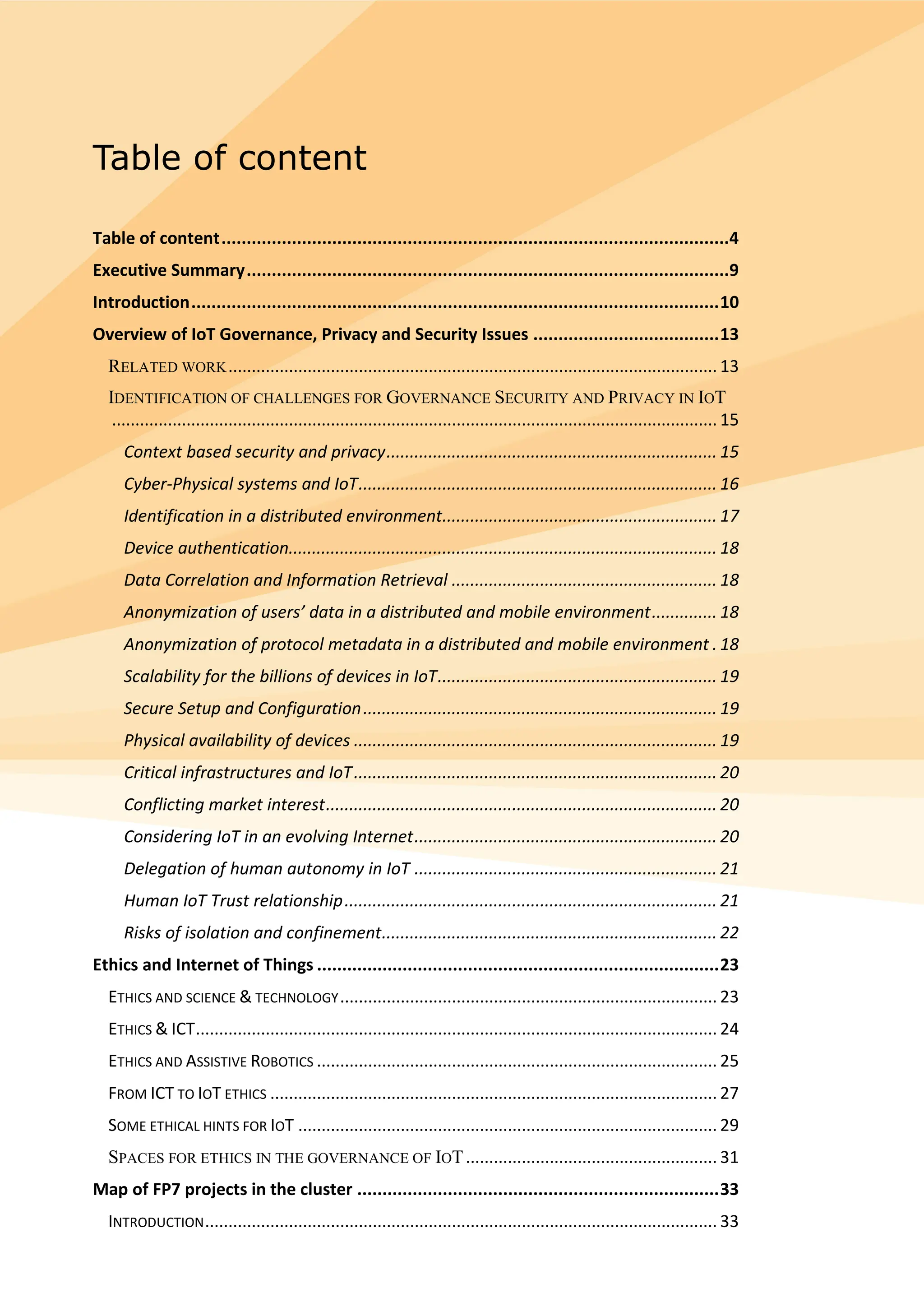
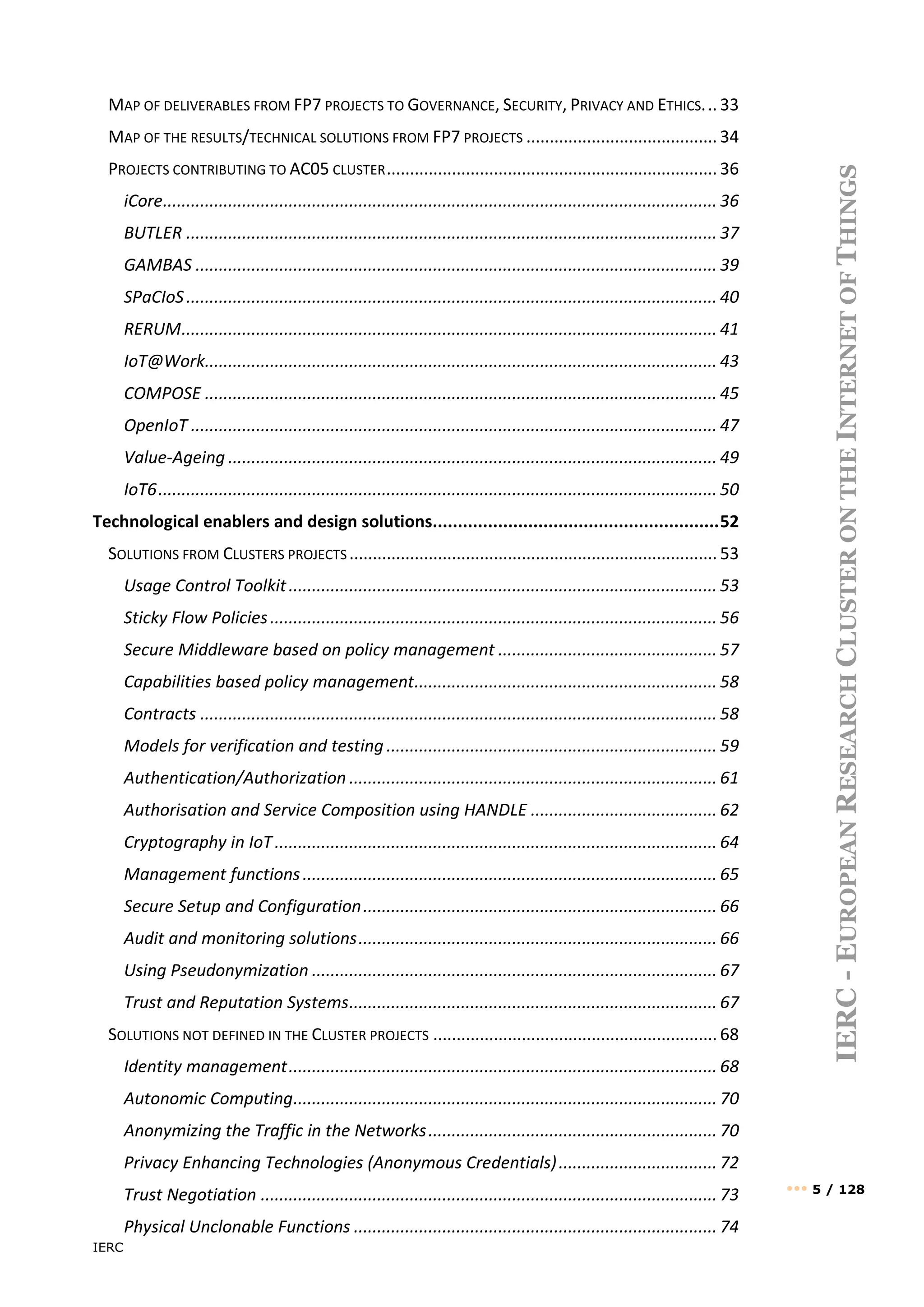
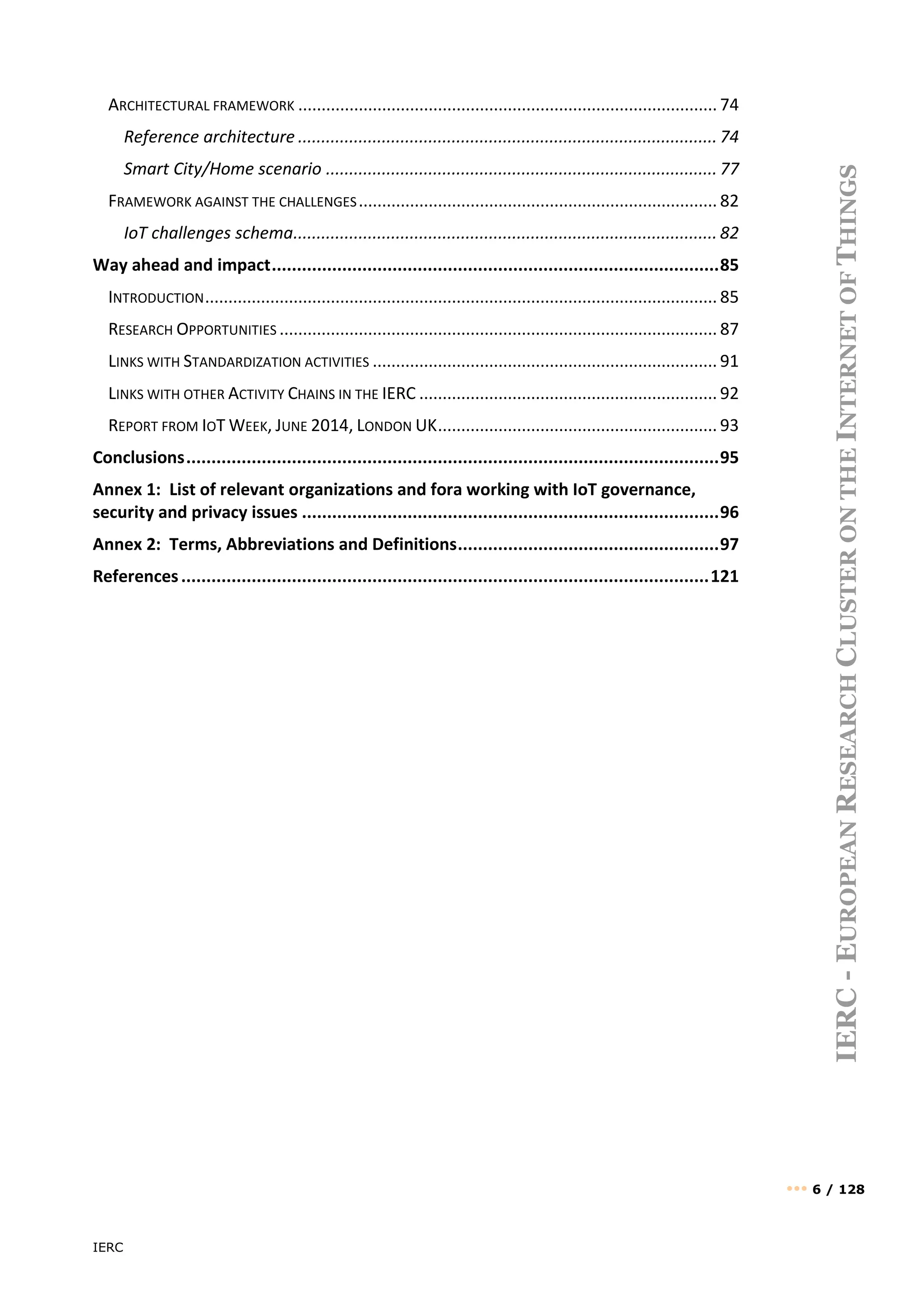


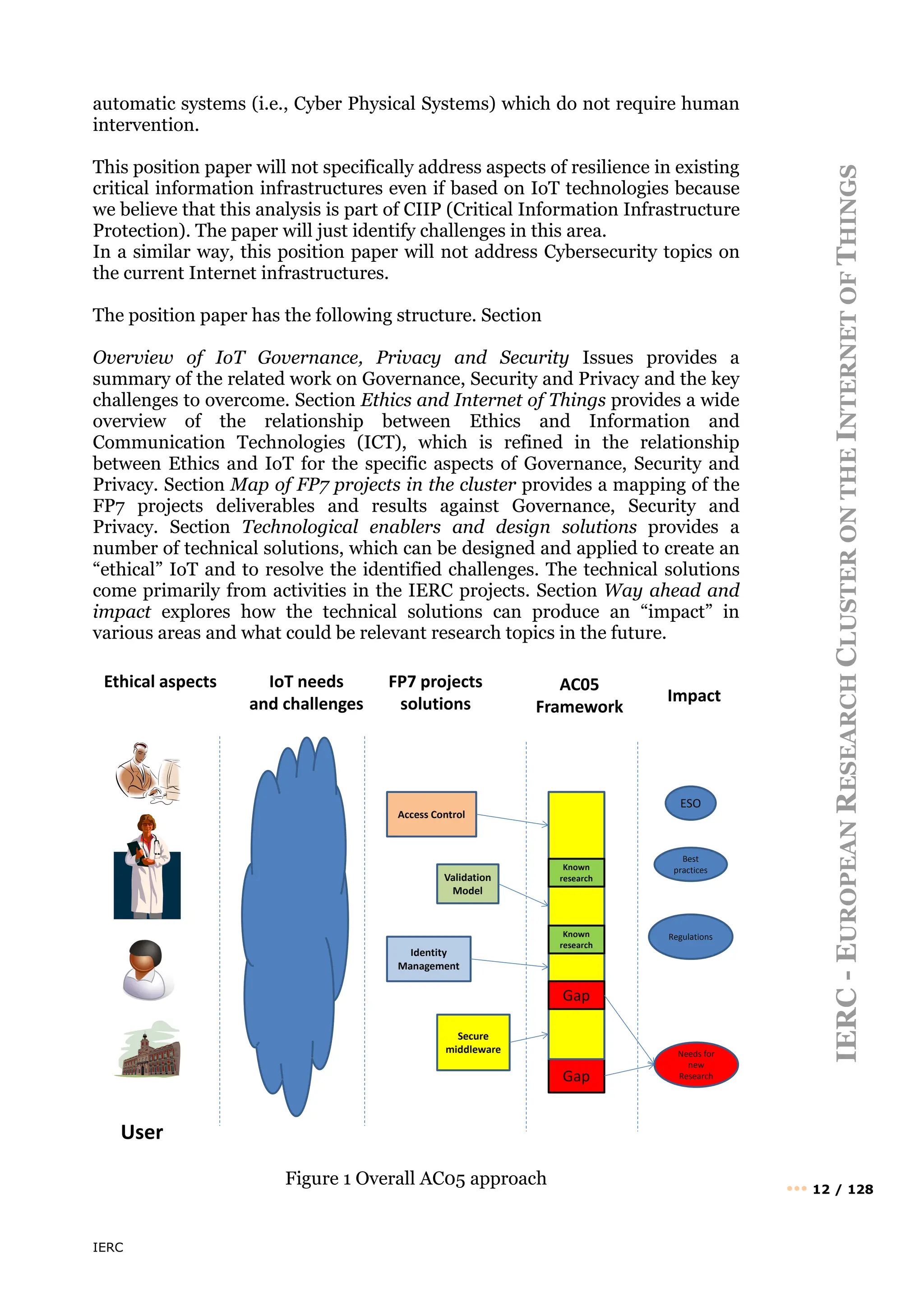
![IERC
IERC
-
E
UROPEAN
R
ESEARCH
C
LUSTER
ON
THE
I
NTERNET
OF
T
HINGS
••• 13 / 128
Overview of IoT Governance, Privacy
and Security Issues
Related work
Governance, security and privacy are probably the most challenging issues in
the Internet of Things and they have been extensively discussed in many
papers. In this section we will try to summarize the capital points of these
three aspects of the IoT according to the main contributions proposed in
literature. The concepts of IoT Governance, Security and Privacy are also not
fully defined and various definitions have been proposed by different
government industry and research organizations.
Within the EU, ‘Governance’ refers to the rules, processes and behaviour that
affect the way in which powers are exercised, particularly as regards openness,
participation, accountability, effectiveness and coherence. These five
"principles of good governance" reinforce those of subsidiarity and
proportionality. The concept of Governance have been already applied to the
Internet for specific aspects and there are already organizations like IETF,
ICANN, RIRs, ISOC, IEEE, IGF, W3C, which are each responsible and dealing
with a specific area.
While these organizations work on Internet governance, a logical step is to
extend these concepts to IoT governance. The difficulty is that the high
number and heterogeneity of technologies and devices in the IoT require even
more specific Governance solutions and approaches that are more complex.
Size and heterogeneity in fact, are the two main components that affect the
governance of IoT: in [1], governance is considered as a double-edged sword,
because it can offer stability and support for decisions but it can also become
excessive and result in an over-controlled environment. The conclusions of
[2], underline the difficulty to find a common definition of IoT governance
together with the different positions of many stakeholders: it seems to be
premature to start a policy development and there is no agreement on finding
special rules for IoT governance issues which are separated from other general
rules. Nevertheless, since there are no legal frameworks for IoT governance
[3], even if the differences between the IoT and the Internet have been
overestimated at the beginning, an analysis of the major IoT governance issues
(legitimacy, transparency, accountability, anti-competitive behaviour) seems
to be worthwhile to conduct. Apart from policy or ethical aspects that
influence governance itself the activities conducted in this cluster provide
technical solutions that can be implemented now.
Heterogeneity requires security to overcome the impossibility of implementing
efficient protocols and algorithms on all the devices involved across the many
IoT application areas. Without guarantees in security, stakeholders are
unlikely to adopt IoT solutions on a large scale [4] [5]. For this reason, the
development of enforcement techniques to support scalability and
heterogeneity, to anonymize users’ data and to allow context aware data
protection are key factors.
In the IoT context, it is difficult to separate the concepts of Governance,
Security and Privacy, because addressing privacy and security aspects to](https://image.slidesharecdn.com/iercpositionpaperiotgovernanceprivacysecurityfinal-250505064116-f6f9566a/75/IERC_Position_Paper_IoT_Governance_Privacy_Security_Final-pdf-13-2048.jpg)
![IERC
IERC
-
E
UROPEAN
R
ESEARCH
C
LUSTER
ON
THE
I
NTERNET
OF
T
HINGS
••• 14 / 128
achieve trust in IoT would probably need governance mechanisms as well. As
pointed out before, at the higher level of the interaction of IoT with users,
ethical aspects cannot be disjointed from the governance, security and privacy
aspects as well. In this position paper, we adopt the definitions of security and
privacy already presented in [6] where privacy, data protection and
information security are complementary requirements for IoT services. In
particular information security has the objective to preserve the
confidentiality, integrity and availability (CIA) of information.
In Europe, regarding privacy aspects, some initial work has already been
performed in reference to Regulation 611/2013, Article 4 (3) in respect of
creating an indicative list of appropriate technological protection measures.
One major source of this preliminary work has been the reports on
recommended cryptographic measures to secure persona data released by
ENISA (i.e., [7], [8]).
At international level, in October 2014, at the International Conference of Data
Protection and Privacy Commissioners in Mauritius, representatives of the
private sector and academia joined together to discuss the changes or risks
that the internet of things and big data may bring to daily life. The
observations and conclusions of the discussions regarding IoT are available in
Declaration on the Internet of Things2 and a Resolution on Big Data3. The
document is not, of course, binding. But, the fact that the Declaration and
Resolution drew the consensus of a large gathering of international data
protection regulators renders them relevant indicators of direction of data
privacy policies and trends.
The Mauritius Declaration on the Internet of Things and the Resolution on Big
Data set out principles and recommendations designed to reduce the risks
associated with the collection and use of data for players in the connected
devices and big data ecosystems. The Declaration and Resolution both begin
by acknowledging that connected devices and big data have the capacity to
make our lives easier, including by providing benefits such as predicting the
spread of epidemics and combatting pollution. But, the documents also
acknowledge that the internet of things and big data raise “important concerns
with regard to the privacy of the individuals and civil rights, protections
against discriminatory outcomes and infringements of the right to equal
treatment.”.
The concerns discussed at the Mauritius Conference echo those of the USA
White House’s May 2014 Big Data Report [9], which similarly focused on the
potential use of big data to discriminate against certain groups. Among other
things, the Report cautioned that increased personalization allows for
“discrimination in pricing, services, and opportunities,” that “serving up
different kinds of information to different groups, ha[s] the potential to cause
real harm to individuals,” and that categorization “effectively prevent[s]
[people] from encountering information that challenges their biases or
assumptions,” thereby cementing and potentially exacerbating existing
ideological or cultural segregation.
2
http://www.privacyconference2014.org/media/16421/Mauritius-Declaration.pdf
3
http://www.privacyconference2014.org/media/16427/Resolution-Big-Data.pdf](https://image.slidesharecdn.com/iercpositionpaperiotgovernanceprivacysecurityfinal-250505064116-f6f9566a/75/IERC_Position_Paper_IoT_Governance_Privacy_Security_Final-pdf-14-2048.jpg)
![IERC
IERC
-
E
UROPEAN
R
ESEARCH
C
LUSTER
ON
THE
I
NTERNET
OF
T
HINGS
••• 15 / 128
In addition, according to [10], the proliferation of wireless devices with
ubiquitous presence is expected to worsen the issue of privacy due to the
current design of the link-layer and lower layer protocols, which usually
expose information like implicit names and identifiers that can reveal users
identity. As a consequence, these layers should be redesigned in order to
minimize the collection of such data, conceal important information from the
un-trusted parties and, to reveal proper information to the authorized or
trusted parties. The management of heterogeneous devices, applications and
protocols can be also addressed using the principles of service-oriented
computing [11], like loose coupling and heterogeneity, achieving a significant
flexibility in different levels of the IoT architecture.
Another important issue, pointed out in [1], is the implementation of IoT in a
distributed way: the authors provide a detailed analysis of each aspect that
show, in general, the higher level of complexity introduced by the distributed
approach in the deployment of governance, security and privacy solutions.
However, they also show some benefits achieved using the distributed
approach, especially in terms of scalability and flexibility of governance and
privacy. Also traditional access controls methods based on Role Based Access
Control (RBAC) and Attribute Based Access Control (ABAC) frameworks show
their scalability problems in distributed environments [12] like the ones
present in IoT; the adoption of access control systems based on capability can
allow users to manage their access to the resources and even delegate their
own rights.
Regarding scalability, another significant challenge is to provide reliable
solutions, which are scalable for the billions of objects (‘things’) linked to
many different local, regional or global networks. Additionally, lots of them
are nomadic or mobile objects and finding the location of and verifying the
correct identity of a specific item will be a major problem for the IoT
infrastructure [1][4].
This is just a sample of the IoT challenges for Governance, Security and
Privacy identified in literature. The next section describes the challenges
identified by the partners of the AC05 cluster projects.
Identification of challenges for Governance Security and
Privacy in IoT
The objective of this section is to identify the main challenges for the
Governance, Security and Privacy in IoT identified by the AC05 cluster
projects and during discussions in IERC. Ethical aspects are also considered. A
more extensive discussion on ethical aspects in IoT is presented in section
Ethics and Internet of Things and some challenges are derived from the
analysis in that section.
Context based security and privacy
This section describes the challenge of designing a security and privacy
framework, which is able to address changes in the context (e.g., emergency](https://image.slidesharecdn.com/iercpositionpaperiotgovernanceprivacysecurityfinal-250505064116-f6f9566a/75/IERC_Position_Paper_IoT_Governance_Privacy_Security_Final-pdf-15-2048.jpg)
![IERC
IERC
-
E
UROPEAN
R
ESEARCH
C
LUSTER
ON
THE
I
NTERNET
OF
T
HINGS
••• 16 / 128
crisis) or context which do not support the collection and processing of data
from sensors. For example, in a surveillance scenario, bad quality images may
induce false results of the “smart” functions implemented in IoT framework
and hamper the overall decision process in the algorithms used to ensure the
security and trust of the system (e.g., level of reputation).
The security and privacy framework has to provide features to dynamically
adapt access rules and information granularity to the context (e.g., embedding
Conditions in access rules or access capability tokens evaluated at access time,
see [12]). IoT envisages an enhanced relevance of the context awareness [13]
higher needs to support the orchestration and integration of different services,
as, for example, envisaged by the DiY (Do it Yourself) sociocultural practice
[14] and scalability, manageability and usability [15].
An additional problem is that the automatics of security and privacy
technologies defined for a specific context may behave in an incorrect way in a
different (or unplanned) context with the consequence of generating
vulnerabilities.
Cyber-Physical systems and IoT
In recent years, the development and deployment of systems and technologies
that present a tight coupling between computing devices and the physical
environment has grown considerably. Some examples are sensors for
monitoring the health of the persons or to increase safety or ergonomics in
workplaces, smart grids for energy distribution and intelligent transport
systems, which have been also addressed in the iCore project in the use cases
described in this deliverable. In many cases, these systems provide services
that impact the safety of the citizens. In many case, these systems or services
are not reliable4 (e.g., susceptible to a security attack) the safety of the persons
can be put at risk. One example in the Smart Transportation scenario is
related to Intelligent Transport Systems where a security attack on the
automatic car system for driving can produce car accidents and consequent
casualties or harm to citizens. In another scenario an automatic system to
provide medicine to a patient can become compromised and deliver the wrong
medicine to a patient. In all these systems, the physical environment provides
information necessary for achieving many of the important functionalities of
the ICT systems through sensors. In turn, systems that use the information
from the physical environment can affect the physical environment and the
persons living in this environment through actuators. These systems are also
called cyber–physical systems (CPSs).
Another aspect to be addressed in the evolution of IoT regarding critical
services is related to the pervasiveness of digital devices [16] [17], which have
increasingly processing power and re-configurability and therefore they are
vulnerable to similar malware of traditional computers. The main issue is that
these devices are more and more embedded in our everyday life but they may
4
Reliability: Comprised of multiple risk factors of which security attack is only one. Others include:
Failure modes incorporating for example device or system design oversights Diminished access, speed,
interoperability etc. due to indirect external factors.](https://image.slidesharecdn.com/iercpositionpaperiotgovernanceprivacysecurityfinal-250505064116-f6f9566a/75/IERC_Position_Paper_IoT_Governance_Privacy_Security_Final-pdf-16-2048.jpg)
![IERC
IERC
-
E
UROPEAN
R
ESEARCH
C
LUSTER
ON
THE
I
NTERNET
OF
T
HINGS
••• 17 / 128
not have the computing capacity to implement sophisticated security
protection solutions like Trusted Computing, or Cryptography. As pointed out
in [16] and [17], this context presents challenges of scalability (billions of
devices to protect), harmonization and homogeneity (different protocols and
technologies).
Identification in a distributed environment
Identification is closely tied to IoT governance, security and privacy. Different
forms of identification are key components of multiple layers of IoT, from
those embedded in the end device through to those enabling message routing
and discovery. Each form of identification (numbering, addressing and
naming) has a set of influencing factors which create divergence and it is
important to appreciate that these differences are often necessary and
sometimes advantageous. As IoT exploits established elements and
applications there is a legacy environment which cannot be ignored and which
must be addressed in some part or its totality. There are various ways to
achieve this but each has ultimately an impact upon IoT’s scope of appeal.
Distributed environments are challenging, even those which are closed,
bounded by similar functional and interoperable technologies and supported
by a clear governance structure. IoT faces a greater test due to: a) the breadth
of legacy applications, b) the variety of technologies and their associated
characteristics, c) the multitude of established governance structures, d) a
wide variety of edge and near-edge domain functionalities and e) opaque
stakeholder value propositions.
Much consideration is provided to edge device identification as a means to
foster future IoT interoperability. There are a number of established
identification hierarchies which provide interoperability and most of these
ignore embedded identifiers (often referred to as ‘numbering’), with a
preference for user assigned identifiers i.e. ‘naming’. The importance of
addressing as an identifier should not be overlooked nor, confused with
numbering and naming. There are also potential future opportunities
considering the increasing performance of algorithms which are able to derive
value from unstructured data.
The number of devices (real and virtual) potentially involved within IoT is
somewhat misleading. WWRF’s estimation is for 7 trillion of devices serving 7
billion of people until 2017 [18].
These estimates may be related to active devices but it may ignore those that
are dormant, retired and all those identifier provisions for future devices.
There are many ‘hard’ and ‘soft’ factors which determine the required
characteristics of an identifier structure, including governance, security and
privacy. What is clear today is that the majority of arguments presented
reference legacy which encompasses a broad diversity of objectives with only
some overlap. There are few propositions which focus upon the future of IoT.
Many of the existing naming, numbering and addressing schemes have been
created to address specific objectives at one point in time and therefore there
is no one universal answer to identification which can provide for all of IoT’s
requirements without limiting IoT’s scope or diminishing IoT’s applicability.](https://image.slidesharecdn.com/iercpositionpaperiotgovernanceprivacysecurityfinal-250505064116-f6f9566a/75/IERC_Position_Paper_IoT_Governance_Privacy_Security_Final-pdf-17-2048.jpg)
![IERC
IERC
-
E
UROPEAN
R
ESEARCH
C
LUSTER
ON
THE
I
NTERNET
OF
T
HINGS
••• 18 / 128
The success of IoT, the ultimate goal requires a clear reference supported by a
number of established governance bodies and key stakeholders in the absence
of a central coordinating authority. Until these criteria are defined sufficiently
discussions over identification schemes and governance models are likely to be
drawn-out, subjective, risky and potentially inconclusive.
Device authentication
Most systems which bind IoT sensors and actuators rely on some proxy
concept, i.e. sensors communicate to some more powerful entity (e.g, from the
processing and storage point of view) which then authenticates the sensors on
their behalf. However, the last mile effectively remains unprotected which is a
barrier to guaranteeing important security properties such as non-repudiation.
‘Lightweight’ solutions are still an open issue for many devices. The long
history of research in sensor networks domain has not produced secure and
low-cost solutions feasible for most devices. Thus, new types of security
primitives or mechanisms which do not only focus on the higher layers in
communication protocols would be worthwhile to investigate.
Data Correlation and Information Retrieval
The Internet of Things generates data in various contexts. Combining this data
may support new types of security mechanisms which allow for the
enforcement of more complex security policies. However, the ability to access
this large variety of data also allows the generatation of more complex and
detailed user profiles. Currently, it is unclear whether the security mechanisms
based on this data variety outweigh their privacy risks or whether there are
security mechanisms which mitigate the disadvantages.
Anonymization of users’ data in a distributed and mobile
environment
There are two main challenges for anonymization in IoT. One is related to the
difficulty to anonymize the data during data collection processes (e.g., from
sensors) because this would require additional technology (with increased
device cost). Another is the risk of (re-)identification of the individual from the
aggregation of anonymized data (see [19]).
This challenge is also related to the current debate on storing users data on
remote platforms in the Internet where the provider of the platforms (e.g.,
Cloud provider) is mostly considered trusted. There are existing solutions
which could be applied to this domain, such as multi-party computation or
homomorphic functions [20] but their feasibility is unclear.
Anonymization of protocol metadata in a distributed and
mobile environment
Considering aforementioned user data as the input to communication
protocols, the data produced by the communication protocol and thus
observable by communicating parties and outsiders must be minimized as](https://image.slidesharecdn.com/iercpositionpaperiotgovernanceprivacysecurityfinal-250505064116-f6f9566a/75/IERC_Position_Paper_IoT_Governance_Privacy_Security_Final-pdf-18-2048.jpg)
![IERC
IERC
-
E
UROPEAN
R
ESEARCH
C
LUSTER
ON
THE
I
NTERNET
OF
T
HINGS
••• 19 / 128
well. This is usually termed “unobservability of communication”. Of course as
long as anonymization of user data itself is not offering protection from ‘prying
eyes’, this element is not critical. However hoping that encryption and
anonymization of user data will be guaranteed, the communication meta-data
becomes the next issue. Solving this would mean things like replacing long-
term hardware identifiers with software generated ones, like the T-IMSI in
UMTS was introduced to minimize tracking (see [21]).
Scalability for the billions of devices in IoT
The IoT has to master not only a wider heterogeneity of connected systems,
communication technologies and resource constraints, but has also to face
challenges related to the potential unbounded number of interacting entities
and substantial differences in the interaction patterns [22][23].
Role Based Access Control (RBAC) and Attribute Based Access Control
(ABAC) systems, as well as PKIs, are not yet able to fully address these
challenges providing scalable, manageable, effective, and efficient access
control mechanisms.
Additionally, RBAC, ABAC and ACL systems make hard to enforce the least
privilege principle [24] [25].
IoT therefore would benefit from additional solutions, such as capabilities-
based access control mechanisms, able to address the above challenges (see
[12]).
Secure Setup and Configuration
Solving the challenge of scalability is closely related, but not equal, to having a
secure setup and configuration method for the IoT. Self-X IoT properties
present a potential attack surface to the Hardware Objects and the
applications depending on them. Therefore securing the IoT requires a
security architecture with the appropriate mechanisms. These typically require
cryptographic credentials that can be symmetric and/or asymmetric,
depending on the scenario and the requirements. The bootstrapping process to
install them efficiently presents a significant challenge, especially for the large
number of devices in an IoT deployment.
Physical availability of devices
The Internet of Things paradigm auspicates the availability of small-sized
connected sensor/actuator devices to be embedded pervasively in the
environment. By definition, these devices will thus be physically available to
malicious users who could use them in different ways in order to compromise
the integrity or reliability of an IoT system. The number of devices itself and
their reduced capabilities make it very difficult to detect tampering and to
check that they are actually operating properly.
This challenge is related to the difficulty of knowing with certainty if the device
operates in the right context (for example it was not moved or the
environmental conditions were not altered locally), if it was subject to
firmware replacement, impersonated and so on.](https://image.slidesharecdn.com/iercpositionpaperiotgovernanceprivacysecurityfinal-250505064116-f6f9566a/75/IERC_Position_Paper_IoT_Governance_Privacy_Security_Final-pdf-19-2048.jpg)
![IERC
IERC
-
E
UROPEAN
R
ESEARCH
C
LUSTER
ON
THE
I
NTERNET
OF
T
HINGS
••• 20 / 128
Critical infrastructures and IoT
In this section, we describe the security and privacy aspects related to the use
of IoT in Critical infrastructures (energy, telecom, utilities) and how the
evolution of IoT may impact the deployment and management of critical
infrastructures.
This challenge is related to the relationship between IoT and Critical
Infrastructure (CI). IoT devices and technologies may be increasingly used in
critical infrastructure like Telecom, Utilities, Energy and so on. An example of
the deployment of IoT concepts to the industrial world (and therefore critical
infrastructures) is the Machine to Machine (M2M) standardization activity.
The challenge is to assess the new risks related to the deployment of IoT
technologies and devices in the critical infrastructures and the transfer of IoT
vulnerabilities for security and privacy to critical infrastructures. In the case,
of CI, the IoT vulnerabilities may be more critical because they can impact the
safety (e.g., industrial accidents) or the provision of essential services to the
community (e.g., electrical power to hospitals). In some cases, the deployment
of new technologies and devices in the home of the citizen or in the proximity
may lead to new security or privacy issues (e.g., smart-meters). On the other
side of coin, some of the IoT vulnerabilities may not be directly applicable to
Critical Infrastructures or they may be mostly due to deployment issues. This
means that protection and mitigation techniques for security and privacy are
well known but lack of funding, non-conformance to best practices or human
errors in deployment may not see the enforcement of these solutions. Even if
some solutions to protect sensor nodes and pervasive devices in critical
environments have been proposed [26] and could be extended and adapted to
IoT needs, this latter aspect will not be addressed in this position paper.
Conflicting market interest
One of the appealing features of IoT from a business point of view is the
possibility to collect and correlate data from different sources to increase the
market competitiveness of the market producers. The idea is to correlate
different sets of data to increase the efficiency of the product advertisements
to the customer and to better satisfy his/her needs. This correlation and
aggregation of the data can create a tension with the approaches or
techniques, which have the objective to protect the data of a person (e.g.,
privacy). As described in [1] and [27], this tension could also be the reason for
the low deployment of privacy enabling technologies, which is one of the main
challenges this paper tries to address.
Considering IoT in an evolving Internet
While IoT cannot expect today to influence the Internet’s evolution it is surely
affected itself by the evolution of the Internet. There are two principal aspects
of evolution to be considered: how the Internet is used and, elements of the
configuration of the technical platform. Undoubtedly, media attention upon
surveillance means that data security and privacy is playing a role in shaping
both use and the configuration of the Internet. Initiatives to embed ‘Dark’
Internet style security (e.g. Tor) and privacy protection as a default through
standardization will create challenges for ‘Big Data’, law enforcement (e.g. LI),
surveillance, etc. If such an Internet environment becomes the defacto
‘trusted’ Internet would it be socially acceptable for IoT to remain outside?](https://image.slidesharecdn.com/iercpositionpaperiotgovernanceprivacysecurityfinal-250505064116-f6f9566a/75/IERC_Position_Paper_IoT_Governance_Privacy_Security_Final-pdf-20-2048.jpg)
![IERC
IERC
-
E
UROPEAN
R
ESEARCH
C
LUSTER
ON
THE
I
NTERNET
OF
T
HINGS
••• 21 / 128
Can such an evolution indeed benefit IoT security and privacy? What are the
implications for IoT governance?
Delegation of human autonomy in IoT
IoT opens towards futures of seamless hybridized interactions between human
beings, their extended ICT-mediated capabilities, and smart and dynamic
objects displaying emerging unplanned behaviours. Agents and actors join
towards unintended, unforeseen and unexpected outcomes. In this context,
“artefacts” like wearable sensors, connected medical devices and other
implantable devices are incorporated by users, becoming extensions of the
human body or mind enhancing the interface between humans and the
environment; in this type of relations the artefacts may not be strongly
perceived by users. Voluntarily or not, the user may need to rely on models
and technology to achieve the chores that technology is meant to help her/him
with. Hence, the strong mediation inherent to IoT developments, will lead
eventually to shifting or delegation of human autonomy and agency to the
objects of the IoT with potential risk to the privacy or even security of the
users. If noticed, artefacts will act on the user’s behalf; if not noticed artefacts
will act on their developers’ worldviews, intentionality and interests. This
strong mediation poses challenges to human agency. This challenge is similar
to Cyber-Physical systems and IoT which is more focused on safety aspects.
Human IoT Trust relationship
Linked to the previous challenge Delegation of human autonomy in IoT, there
is also the concept of evaluation of the level of trust a human has in IoT
systems, services or devices. In information and communication technology
(ICT) trust has been considered as a crucial component of digital interactions,
and has been dissected in a variety of potential meanings and dimensions and,
through the merging of trust in humans and trust in machines. Trust and
confidence have different shades of meanings. However, Trust can also be
defined as the level of confidence, which an entity can ensure to another entity
or entities for specific services and in given context [28]. Even if trust has been
often used with reference to human beings, trust can also be associated to a
machine or digital system (e.g., web site), which points out at the importance
of analyzing and measuring the level of trust in a digital society.
Here we have to make a distinction between trust and trustworthiness and
how these two terms are adopted in the IoT domain. Usually, trust is the belief
of a user that the system is functioning normally and will deliver what it has
promised and what the user requires. Contrary to trust (that is mostly
subjective to each user’s belief), trustworthiness is mostly objective and can be
considered as a metric of how much a system deserves the trust of its users.
Trustworthiness can be defined according to some criteria, i.e. by evidence of
current and past behaviour, by the system availability, if it provides accurate
and reliable information, if it avoids information leaks, etc. Furthermore, in
cases of M2M communications in an IoT domain, the devices that are
exchanging information with each other have to know which devices are
trustworthy so that sensitive information is only sent to those devices. Thus,
trust can be considered not only as a metric of how much a user trusts a
system, but also how much a device trusts another device and how much a](https://image.slidesharecdn.com/iercpositionpaperiotgovernanceprivacysecurityfinal-250505064116-f6f9566a/75/IERC_Position_Paper_IoT_Governance_Privacy_Security_Final-pdf-21-2048.jpg)
![IERC
IERC
-
E
UROPEAN
R
ESEARCH
C
LUSTER
ON
THE
I
NTERNET
OF
T
HINGS
••• 22 / 128
device trusts the user that has requested sensitive data from that device. As a
result, trust in the IoT domain is included in three layers: (i) from users to
devices, (ii) between devices and (iii) from devices to users.
In ICT, knowledge production has entered the debate as a possible path to
trust as a vehicle for valued and respected relationships. Collaboration in
knowledge processes has been at the core of the most traditional scientific
community ethics, namely the so-called “ethos” of science. Today, knowledge
co-production can contribute to trusted ICT digital interactions [29], [30].
European citizens’ values and fundamental rights provide a specific
framework that needs to be explored, together with its opportunities and
challenges.
Risks of isolation and confinement
On the one hand, ICT technologies can play a great role to minimize the risk of
isolation not only by facilitating social contact but also increasing citizen’s
access to work. Mobility and security solutions support people’s participation
in community, and leisure and social activities. Telehealth and other
communication and online services enable a lifestyle where one does not need
to leave their home to satisfy their needs, hence reducing the opportunity for
human contact and potentially contributing to a voluntary confinement. In the
closer future, the use of companion robots in isolated and sparsely populated
areas can also help to alleviate some of the social isolation effects.
To ensure that these benefits are realized it is necessary to consider potential
risks and negative impacts arising from the application of these technologies,
because an inadequate use of them may lead to further social isolation and
confinement when not meeting certain requirements.
It is not a real fact already proven but an envisioned concern that should not
be skipped out. Some people may be already isolated, and embracing ICT
technology may not be so much harmful; even the contrary. But the risk of
social isolation exists for all of us, at least at a certain extent. The level of
human contact needs to be addressed not only at the design stage of
technology and services associated with it, but even more importantly so, in its
implementation.
The role of human contact cannot be underestimated both in terms of
emotional impact on the person and ‘physical’ link to the community, to the
world, strongly needed in elders. Tele health and tele care technologies are the
main affected. The Social Care Institute for Excellence (European
Commission, 2006) recommends that tele care must not be seen as an
alternative to direct social care or informal support, but rather a way to meet
low-level needs. One danger relates to people becoming over-dependent on
health monitoring devices at home giving them a feeling of safety, which may
lead to a reluctance to go out and leave the safety of their home behind.
Besides, a growing culture of fear to leave one’s home due to perceived
dangers in society may be further encouraged.
In order to make positive impact on people’s lives the technology and its
application need to be trusted, accepted, wanted, accessible and usable. IoT
must be prepared to avoid,
• the citizen failing to use the services (there are many potential causes
for it, technology-related but also user-related)
• the citizen substituting completely face-to-face services (or moving
significantly to virtual environments and unreal worlds),](https://image.slidesharecdn.com/iercpositionpaperiotgovernanceprivacysecurityfinal-250505064116-f6f9566a/75/IERC_Position_Paper_IoT_Governance_Privacy_Security_Final-pdf-22-2048.jpg)
![IERC
IERC
-
E
UROPEAN
R
ESEARCH
C
LUSTER
ON
THE
I
NTERNET
OF
T
HINGS
••• 23 / 128
• the citizen misunderstanding technology, especially its usefulness and
impact on the main user, and
• the citizen mistrusting in the technology-based systems and services.
Gaining trust, acceptance, willingness and good understanding of accessibility
and usability of such technology is very important for all the ICT users
involved. Ultimately, ICT needs to be seen as a tool that connects people,
provides alternatives or supports existing relations and not a technology that
replaces personal relations. Therefore, any policy promoting the use of ICT for
ageing should be underlined by this principle
Ethics and Internet of Things
Ethics and science & technology
Ethical inquiry, broadly understood, has always dealt with identifying the right
guidance for human actions towards other and themselves [31]; therefore
ethics has been concerned with the criteria to find out what is right and wrong,
good and bad. In general, while pre-modern moral (and legal) philosophies
have mostly found and founded these criteria in an objective natural order of
things to which human beings (or even non-human beings and all entities) had
to conform [32] the main (and still widely applied) modern philosophical
systems have rooted ethical judgment in the human abilities related to rational
reasoning and self-reflection. Some major modern philosophical systems
(such as, though in different ways, the Kantian and the Benthamite) have
directly justified the connection amongst rational, moral, and civic life by
constructing humans as rational subjects, as moral subjects, and as members
of a(n explicitly or implicitly assumed) “social contract”, namely as entitled to
interests and/or rights in a social life. Concepts flowing from these approaches
such as human autonomy and dignity, or respect for human well-being are
essential elements of contemporary democratic societies, and lie at the core of
some fundamental human rights.
Common to these traditions is the assumption that human beings can access
the knowledge necessary to augment their ability to make their judgments
about good and bad course of actions in an autonomous way (namely free
from all authorities, mundane or divine).
Even though several philosophical traditions have argued for other
foundations of morality e.g. based on religious or ontological discourses, or on
the non-rational but emotional character of morality, the term ethics (and
ethics as an academic discipline), as different from morality, has been mostly
characterized as the “rational inquiry” about values and reasons underlying
human actions. This is especially true when the ethical discourse concerns
science and technology as knowledge-based endeavours and their social
developments.
In fact, the emergence of ethics as a public (and a publicly relevant) discourse
and as a form of normativity at the interface between the private and the social
dimension started at the end of World War II, when the failures of the
scientific community’s ethos in respecting individuals in research became
tragically evident. Ethics has played an important role in dealing with](https://image.slidesharecdn.com/iercpositionpaperiotgovernanceprivacysecurityfinal-250505064116-f6f9566a/75/IERC_Position_Paper_IoT_Governance_Privacy_Security_Final-pdf-23-2048.jpg)
![IERC
IERC
-
E
UROPEAN
R
ESEARCH
C
LUSTER
ON
THE
I
NTERNET
OF
T
HINGS
••• 24 / 128
concerns in the governance of emerging techno-scientific fields, where human
rights and other values may be at stake.
This is why, in the early 1990’s, ethics has also been given, in Europe and the
US (and then in an increasing numbers of countries, as well as in national and
international organizations), an institutional dimension through the
establishment of ethics bodies (local and national committees and
commissions). Starting with life sciences – followed by nano-sciences and
technologies, synthetic biology, and other emerging technologies – ethics has
increasingly become a normative “soft tool” with the tasks of analysing,
improving, and promoting respect for rights and values (also encompassing
the animal welfare and environmental values), as well as of contributing to
integrate values in the legislative process. Moreover, ethics is also well
established in the areas of European research and experimentation, and
represents a necessary part of all research projects, with principles often
directly stated by the law. Even though, with the entry into force of the TFEU
at the end of 2009, European values and fundamental rights have become
formally established, not only ethics has maintained its broader proactive
meaning and role, but, despite its formal framing as non-binding policy
advice, it has undoubtedly gained wider spaces – due to the largely
undetermined outcomes of new technologies – and has also acquired the
status of “indicator of normativity” making it similar to “soft law” in the
governance of new emerging technologies.
Ethics & ICT
The ethical reflection about computers and computerized societies –later
extended to all ICT— was started roughly in the same period of the ethics of
biomedicine and the life sciences. Norbert Wiener, who is considered as a
pioneer in computer ethical thinking, already in 1950 began to identify and
analyse the impacts of information and communication technology upon
human values like life, health, happiness, security, knowledge and creativity
[33]. The literature that followed has been wide and diversified [34] [35] [36],
with the emergence of the field of computer ethics and its unique nature in
posing unprecedented problems [37]; reflections on global information ethics,
and the issues at the interfaces between humans and machines, on artificial
intelligence, robotics, the Internet, and all ICT.
However, despite these lively and prolonged debates, a major difference
between ICT ethics and bio- or life sciences ethics was that no real need for an
institutionalized approach to ethics has emerged in ICT until recently. The ICT
domain has been regulated, at least in Europe, mostly through legal
instruments. For a long time ICT normative issues have been primarily
identified with privacy and data protection (and, with less emphasis with
intellectual property rights); and legislation has widely taken care of these
concerns by building a comprehensive legal framework –composed of both
hard and soft laws (e.g. non-binding Opinions from Art.29 WP and EDPS).
Only more recently several relevant normative issues other than privacy have
become apparent, and specific roles for ethics, especially in rapidly developing
sectors (such as IoT), have been envisaged.
Another field requiring dedicated reflection is ICT research ethics – and IoT
research ethics – that, for the time being, has been primarily, and definitely](https://image.slidesharecdn.com/iercpositionpaperiotgovernanceprivacysecurityfinal-250505064116-f6f9566a/75/IERC_Position_Paper_IoT_Governance_Privacy_Security_Final-pdf-24-2048.jpg)
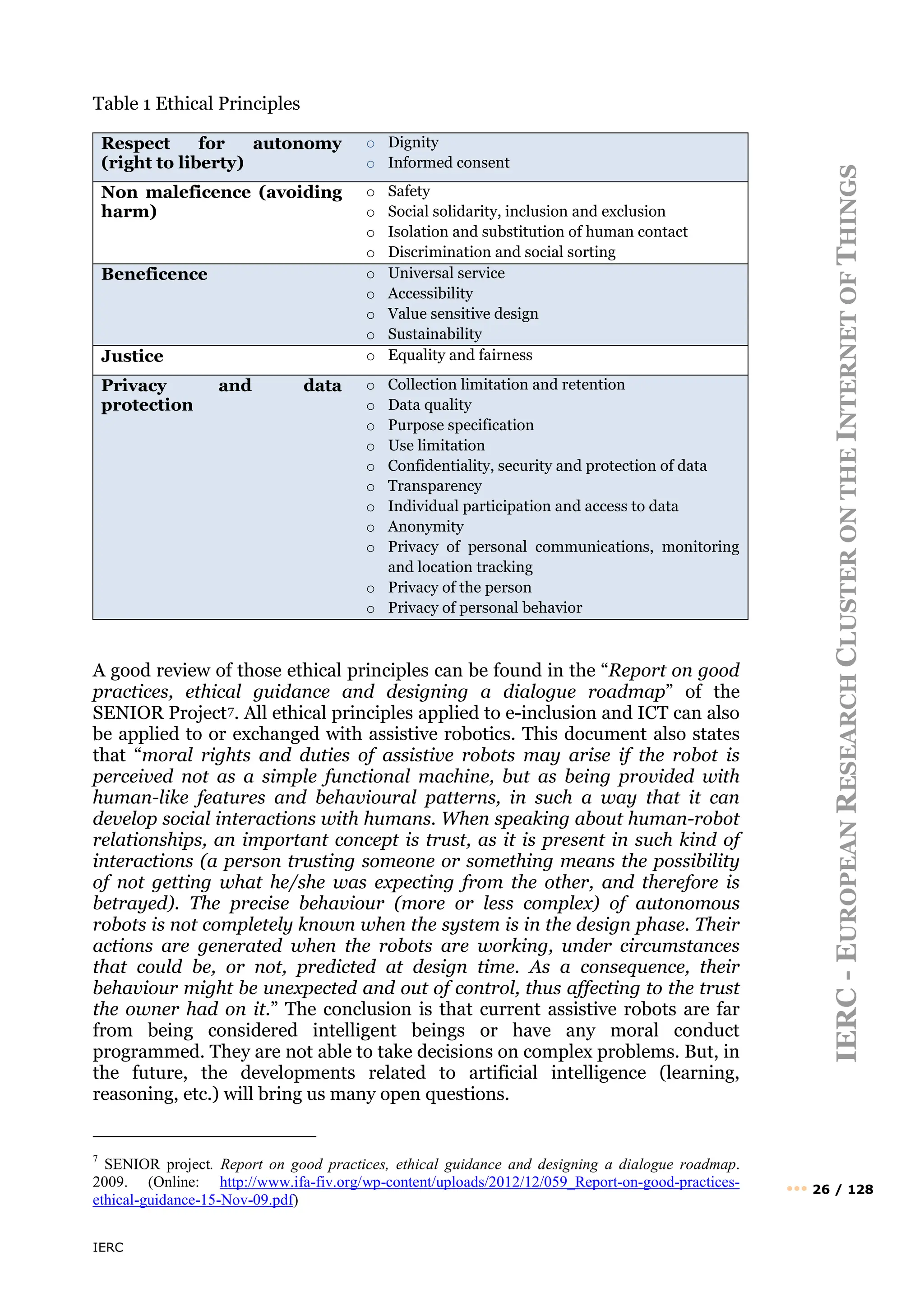
![IERC
IERC
-
E
UROPEAN
R
ESEARCH
C
LUSTER
ON
THE
I
NTERNET
OF
T
HINGS
••• 27 / 128
Talking in terms of ethical approval and due to the mobility of robots, their
capacities of navigation, self-location, obstacle avoidance, and potentially,
decision-making by their own, some important recommendations are
provided within VALUE AGEING reports:
• It must be capable of communicating the intention of doing something
to the user, and this latter one must be able to cancel robot’s intention.
• It must respect the personal space of the person (keeping a certain
distance) to avoid the user feeling that the robot invades their intimacy
and privacy. This behavior of the robot should be adjustably
automatically by detecting the user’s behavior and verbal and non-
verbal emotions.
• It must include, of course, the guarantee of confidentiality and privacy
of the data acquisition and communication.
• An option to switch off the robot completely must be provided.
• It should integrate a feature that allows the user ask the robot to hide
away (for example, go to another room, disconnect cameras, etc.).
All these functions are relevant for the user in order to keep the dignity,
privacy and intimacy without affecting safety issues (for example when the
user has visitors in his/her home).
From ICT to IoT ethics
In the past decades, several emerging fields in applied ethics have been
described as involving a radical paradigm shift in the approach to morality.
This has been the case for bioethics [32], environmental ethics [38], and also
ICT ethics [37] and [35]. Without entering in a theoretical discussion about
these proposed foundations, it has to be recognized, however, that ICT
display some special features, not necessarily involving a specific foundation
for ethics, but certainly requiring some major revisions.
It has been widely recognized that, as “enabling technologies” which apply to,
and interact with, all other technological fields, not only do ICT introduce, or
deepen certain ethical concerns and reframe numerous techno-scientific
fields, but directly affect and have the potential to reshape several human
abilities and capacities in ways that are only partially foreseeable, not to
mention controllable.
This potential for an “anthropological change,” namely a conspicuous
reshaping of some established assumptions and requirements about human
knowledge, skills, behaviours, and expectations, already detectable in what has
been defined “the networked self” [39], namely how the wide exposure of
individuals to the Internet and social networks is reframing the way users
cognitively, psychologically, and existentially reflect, respond to, and creatively
interpret their connected lives. This is already a challenge for (primarily
Western) cultures dominated, in the past three centuries, by individualistic
and atomistic approaches to society and human relationships. As the
phenomena of open knowledge, crowdsourced knowledge, and also
crowdsourced funding are showing, individuals are progressing towards, and
are equipped for, more connected and collaborative behaviour than existing
ethical and legal concepts allow them to do [40] and [41].](https://image.slidesharecdn.com/iercpositionpaperiotgovernanceprivacysecurityfinal-250505064116-f6f9566a/75/IERC_Position_Paper_IoT_Governance_Privacy_Security_Final-pdf-27-2048.jpg)
![IERC
IERC
-
E
UROPEAN
R
ESEARCH
C
LUSTER
ON
THE
I
NTERNET
OF
T
HINGS
••• 28 / 128
IoT is magnifying the existing challenges to individual knowledge and human
control of technological processes and the consequences of technology-
mediated actions. In IoT the traditional modern construction of the subject –
the subject of knowledge and the moral subject—, still pervading most current
ethical and legal concepts [42], has to confront the complexities of the duty to
know in context where knowledge can be limited, as well as the hybridized
interactions between subjects and objects, agents and actors (object behaving
subject-like).
The traditional assumptions embedded in rights and obligations – as well as in
the way regulatory processes are framed and organized— about human
knowledge, awareness, control, and capability to deal with uncertainties
require major adjustments to cope with the complexities of new technologies.
Already in 1979, in reflecting on the technological power acquired by
humankind, the philosopher Hans Jonas [43] highlighted, in connection with
the notion of responsibility, the new moral “duty to know” (before acting). He
showed how the most prominent modern philosophies (such as the Kantian
and Bentham’s systems) did not require from participants to the social
contract to be knowledgeable or expert; while this increased need for
knowledge has become an essential element for contemporary life.
As to IoT, its paradox is that, while users are asked to know more, they also
need to be aware that their knowledge is structurally limited. The radical
uncertainty implied by the complexity of some emerging technology and,
definitely by IoT has been described by the French epistemologist Jean-Pierre
Dupuy as follows. “The key notion here is that of informational
incompressibility, which is a form of essential unpredictability. In keeping
with von Neumann’s intuitions on complexity, a complex process is defined
today as one for which the simplest model is the process itself. The only way to
determine the future of the system is to run it: there are no shortcuts. This is a
radical uncertainty” [44].
The task of creating an epistemic statute for the lack of knowledge may
proceed hand in hand with a behaviour of active scientific wisdom, self-
reflexivity, awareness of the value-laden dimensions of science, the intentions
of making choices more legitimate and shared. In a similar way, responsibility
should be rethought and reframed in order to connect individual and collective
responsibility in terms of shared decisions and commitments [45]. Moreover,
even though the concept is not discussed in relation to IoT, the current
understanding of precaution goes beyond the idea of an emergency principle
about science, while the concept of responsibility is expanding beyond liability
and accountability. Precaution is democratically understood and endorsed as a
form of responsible action, while responsibility is now depicted in worldwide
policies on emerging technologies as the normative tool that brings precaution
to individuals, making them self-reflexive about their actions. This tendency to
reframe precaution also as an individual (and not only as an institutional)
principle together with responsibility has several reasons, connected to the
changes brought about by new technologies (such as nanotechnology and
synthetic biology) and to how these are reshaping both the scientific
community and society.](https://image.slidesharecdn.com/iercpositionpaperiotgovernanceprivacysecurityfinal-250505064116-f6f9566a/75/IERC_Position_Paper_IoT_Governance_Privacy_Security_Final-pdf-28-2048.jpg)
![IERC
IERC
-
E
UROPEAN
R
ESEARCH
C
LUSTER
ON
THE
I
NTERNET
OF
T
HINGS
••• 29 / 128
Some ethical hints for IoT
Several documents reflecting on the specificity of IoT ethics have highlighted
and agreed on the following elements [46], [47] and [48].
• A separation between privacy and other ethical issues, primarily based
on the fact that privacy is widely regulated (at least in part) by law, as
opposed to other ethical issues arising from IoT.
• The focus on the need for more knowledge for citizens/users, framed as
an ethical issue about education. Attention is also paid to metaphors
used in the construction on knowledge about IoT, mostly reflecting and
favouring a mechanistic, under control (and therefore reassuring),
vision.
• Identity, autonomy (and informed consent), trust, and agency as
specific concerns – often treated as separately identified issues.
• Other relevant issues concern the social digital divide, both as a
problem of individual rights and of distributive justice.
• Human agency.
• Fear of increasing social isolation.
It may be useful to point out here that some further elements can be outlined
and may be usefully discussed. For instance, freedom is not adequately
expressed, and is mostly reduced to autonomy. However, freedom means
more. Freedom is creativity, the capability of inventing and shaping reality and
human acts in less constrained ways than those pervasively allowed by
technological and digital architectures – and how this is going to affect human
skills. It is the liberty to experience a more direct relation to reality processes
in the making of things – while the increased distance from reality induced by
virtualization can trigger unlearning. Responsibility is another item not
sufficiently analysed in relation to users – whilst it is problematized, together
with accountability, in relations to industry and institutions, especially as to its
legal meanings and implications. IoT adds new challenges to the existing
issues of individual moral responsibility in creating multiple identities and in
shaping virtual behaviour [47].
Moreover, the broad concept of human agency [49] seems to have the
potential to usefully connect the issues of identity, autonomy, and privacy (at
least as to its ethical side). Widely defined, human agency refers to the human
capacity to act as a subject rather than as a deterministic mechanism. It deals
knowledge and awareness, freedom, control on thoughts and acts; and their
human limits.
We refer to what is commonly described as “digital divide”, describing other
diffuse divides that the unauthorised and unquestioned automations, seamless
transfers and unnoticed ubiquity featured by IoT may create due to
overwhelming consent demands and lack of usability in the human-IoT
interaction. The divide in this case is not exclusively related to lack of skill, but
also to what we could call “consent fatigue”, this posing additional challenges
to individuals with reduced autonomy such as children and the elderly. With
IoT, where the kinds of promised interconnectivity involve billions of entities
(including people) and transactions for which mechanisms of authentication
and consent need to be put in practice, consent may become an inapplicable
concept. Those who are knowledgeable and skilled enough and empowered to](https://image.slidesharecdn.com/iercpositionpaperiotgovernanceprivacysecurityfinal-250505064116-f6f9566a/75/IERC_Position_Paper_IoT_Governance_Privacy_Security_Final-pdf-29-2048.jpg)
![IERC
IERC
-
E
UROPEAN
R
ESEARCH
C
LUSTER
ON
THE
I
NTERNET
OF
T
HINGS
••• 30 / 128
control the working of the technology will master it, will be able to protect
themselves against abuse, and to choose amidst the technological offer or opt-
out if they deem it necessary. Hence, the rising divides in these cases have,
paradoxically, implications for knowledge production, skills development and
empowerment. Those who cannot keep the pace with the pervasiveness will
progressively become deskilled, disempowered and unknowledgeable.
The viability of ICT solutions for an ‘ageing well’ scenario which gathers a
huge market depends on their appeal, usability, reliability, accessibility and
affordability. To make ICT appealing to older people, the devices and services
need to be tuned to their needs and abilities and the benefits of such solutions
clearly articulated. The ICT products and services should provide users with
an intuitive experience, aesthetically pleasing design, high reliability, and
feelings of confidence and being in control. The issue of reliability is
particularly important for telemedicine technologies, where the trust in
reliability of the IoT devices and systems and the confidence on how the
personal information is handled and communicated is essential for their
adoption. Accessibility, especially in the relation to skills and access to
hardware and software amongst the disadvantaged groups, and affordability
are essential underlying factors8.
This implies the necessity to raise awareness and to educate citizens/users in
their relationships with IoT –a recommendation highlighted and shared by
most documents on the Internet of Things [46] and [47]. Attention and
awareness should be paid to the potential for passive acceptance of mechanical
acting, and towards not reducing all normative issues to technical fixes. In
other words, there is a need to prevent human agents from behaving just as
“actants”, namely as causal forces instead of intentional, responsible subjects.
The daily substitution of human-mediated relations with ICT-mediated forms
of life to, as well as the transfer of most life aspects and decisions to ICT
devices, can give rise to a situation where these automatic, invisible
mechanisms hinder and impair the specific skills for moral experience,
perception, and learning. Similarly to how the predominant and pervasive use
of hand-typing is leading to a loss of handwriting ability, scholarly research is
increasingly revealing that the deprivation of real life experiences and the
prolonged exposure to virtual life are gradually de-sensitizing people to moral
aspects of human relations (doing harm, non-respect, insensitivity to
vulnerability) and making them unable to connect and integrate their virtual
and non-virtual lives.
Even more, social isolation is one of the main concerns, especially for older
people, producing not only negative emotional effects, but in some cases also
leading to depression and accelerated physical decline. ICT technologies
reduce the risk of isolation by facilitating communication with relatives and
friends as well as assisting in meeting new people through social networks,
work and learning opportunities. If used inappropriately, they have a potential
to deepen social isolation and lead to exclusion. The loss of confidence in one’s
cognitive abilities - decreasing in competency as a result of overreliance on
technology, and reduced willingness to engage with the outside world
8
http://www.valueageing.eu/wp-content/uploads/2013/12/07AGE03_D3.6.1_FINAL-Executive-
Summary.pdf](https://image.slidesharecdn.com/iercpositionpaperiotgovernanceprivacysecurityfinal-250505064116-f6f9566a/75/IERC_Position_Paper_IoT_Governance_Privacy_Security_Final-pdf-30-2048.jpg)
![IERC
IERC
-
E
UROPEAN
R
ESEARCH
C
LUSTER
ON
THE
I
NTERNET
OF
T
HINGS
••• 32 / 128
normative approaches, by integrating and complementing human(ness) skills,
specific ICT education and learning (digital human behaviour), and
technological fixes.
Broadly speaking, techno-legal approaches are defined as “ethics-by-design,”
“rights-by design,” “ambient law” [50]. By-design normativity consists of
mechanisms “embedded within the entire life cycle of the technology, from the
very early design stage, right through to their ultimate deployment, use and
ultimate disposal” [51].
The idea is to integrate normativity into information and communication
systems and solutions, which may encompass making procedural a variety of
values that can be relevant to users/citizens. As, for instance, Schindler et al.
[47] have highlighted, “ethical products” – from environmentally friendly to
cruelty-free products – have shown how ethical values can be translated as a
matter of preference in the marketplace, where different products compete to
gain citizens’ trust.
From this perspective, together with ethics by design, also “ethics in design”
deserves attention in the governance of IoT. If “by-design” approaches
explicitly aim to create built-in algorithms for law enforcement, “ethics in
design” raises awareness about the processes through which values and norms
become embedded in technological architectures. While ethics-by-design looks
at how to technically transform values and rights into algorithms, ethics-in-
design looks at the normativity of architectures to make value choices
apparent and transparent. This approach may include, for instance, having
“benevolence” embedded in technology and also opens the space for looking at
the ethical education of “designers” in order to have them framing products
and procedures according to a vision of what is “worth” [17].
Merging technical solutions (such as by-design measures, certifications and
self-certifications, institutional and corporate digital memories) with trust-
generating human behaviours (direct repeated experiences, consistent
institutional and/or corporate behaviour, prolonged relationships and
reliability, available information and reputation, etc...) can lead to “more
robustly” trusted and effective digital relationships – together with more
education and the development of new psychological skills specific to the
digital world. An integration of human and technological dimensions in the
governance of IoT is not only more legitimate (ethically and democratically),
but it may also prove more effective. This is especially needed in IoT, where
the traditional forms of “informed consent” are often not applicable, and other
trust and trusted procedures have to be imagined [47].
This situation calls for a variety of normative and educational measures to be
adopted. Engineers and ICT application designers should work together with
ethicists and lawyers in order to build collective trans-disciplinary knowledge
of the relationships between technology and normativity. Moreover, both
normativity “by-design” and in-design” require establishing new forms of
protection. Normativity consciously and unconsciously inscribed in, and
embodied by, artefacts should be made explicit and transparent before and
during the design phase, when normative decisions are taken and transformed
into programs and functions [52] [53]. The spaces for ethics on IoT deserve
spaces of debate that include citizenry and not only the promoters, developers,
vendors of this vision. What is needed is much more than education; is](https://image.slidesharecdn.com/iercpositionpaperiotgovernanceprivacysecurityfinal-250505064116-f6f9566a/75/IERC_Position_Paper_IoT_Governance_Privacy_Security_Final-pdf-32-2048.jpg)
![IERC
IERC
-
E
UROPEAN
R
ESEARCH
C
LUSTER
ON
THE
I
NTERNET
OF
T
HINGS
••• 33 / 128
engagement. The persons using these technologies should be entitled to have a
saying in what values and by what social norms they want to live in the future
and what legacy they wish to leave for others that will come.
Through time ethics has become a policy flexible tool capable of representing
and serving different normative roles, and complementing legally binding
instruments: a form of soft law [47], namely to those “rules of conduct which,
in principle, have no legally-binding force but which nevertheless may have
practical effects” [54]. And soft normativity has gained greater relevance as
innovation is largely happening far from regulatory control, while the
normative process for emerging technologies is taking place, both in the US
and the EU, as a recursive “learning process” which, as such, needs structural
flexibility [45].
The ethics challenges described in this section are described in section
Identification of challenges for Governance Security and Privacy in IoT.
Map of FP7 projects in the cluster
Introduction
The objective of this section is to:
• provide a mapping of the deliverables of the FP7 projects to Ethics,
Governance, Security and Privacy;
• identify and map the project results/technical solutions from FP7
projects in AC05, which can address Ethics, Governance, Security and
Privacy and support the design and deployment of frameworks;
• describe the AC05 projects and their involvement in Governance,
Security and Privacy aspects.
Map of deliverables from FP7 projects to
Governance, Security, Privacy and Ethics.
Table 2 identifies the deliverables from the FP7 projects, which compose AC05
cluster.
Table 2 Map of FP7 project deliverables to AC05
Projects Governance Security Privacy Ethics
iCore D2.4 D2.2, D2.3 D2.2, D2.3 D1.3
BUTLER D4.1,D6.6 D1.2,
D2.1,D3.1,
D3.2, D2.4,
D4.3, D5.1
D1.2, D2.1,
D4.1, D5,2,
D6.6
D4.1,D6.6
GAMBAS D3.1.x, D3.2.x D3.1.x,
D3.2.x, D3.3](https://image.slidesharecdn.com/iercpositionpaperiotgovernanceprivacysecurityfinal-250505064116-f6f9566a/75/IERC_Position_Paper_IoT_Governance_Privacy_Security_Final-pdf-33-2048.jpg)
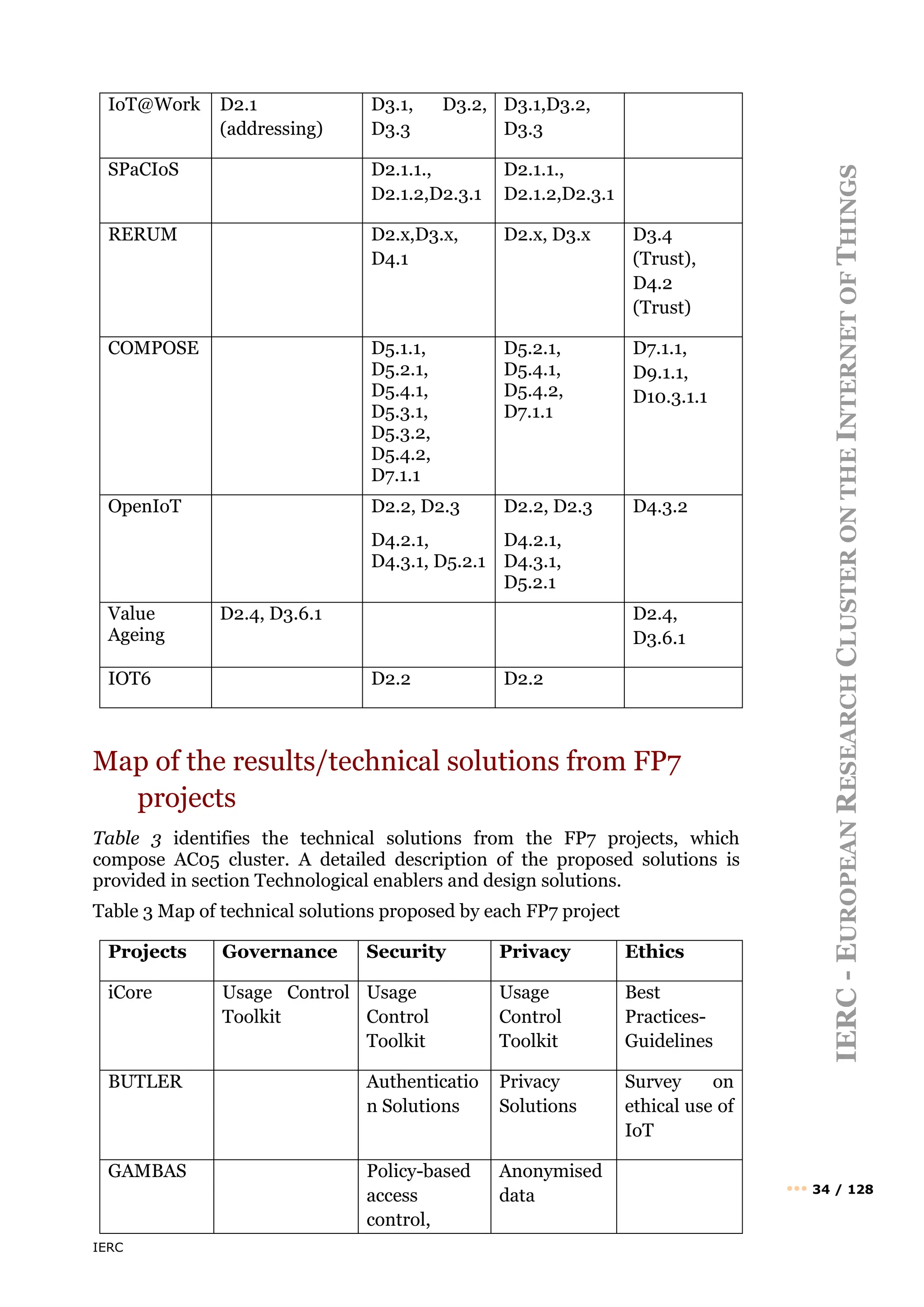
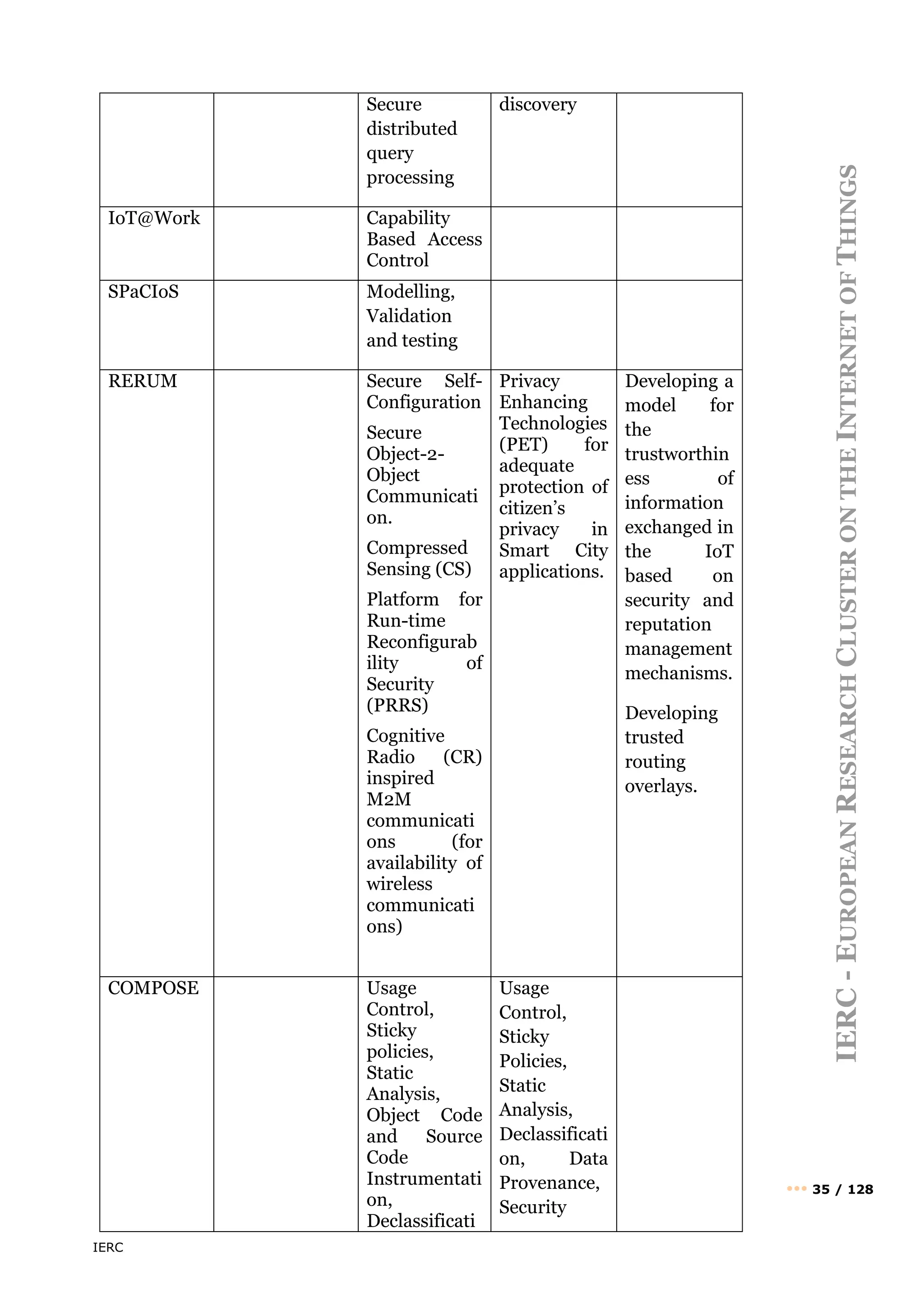
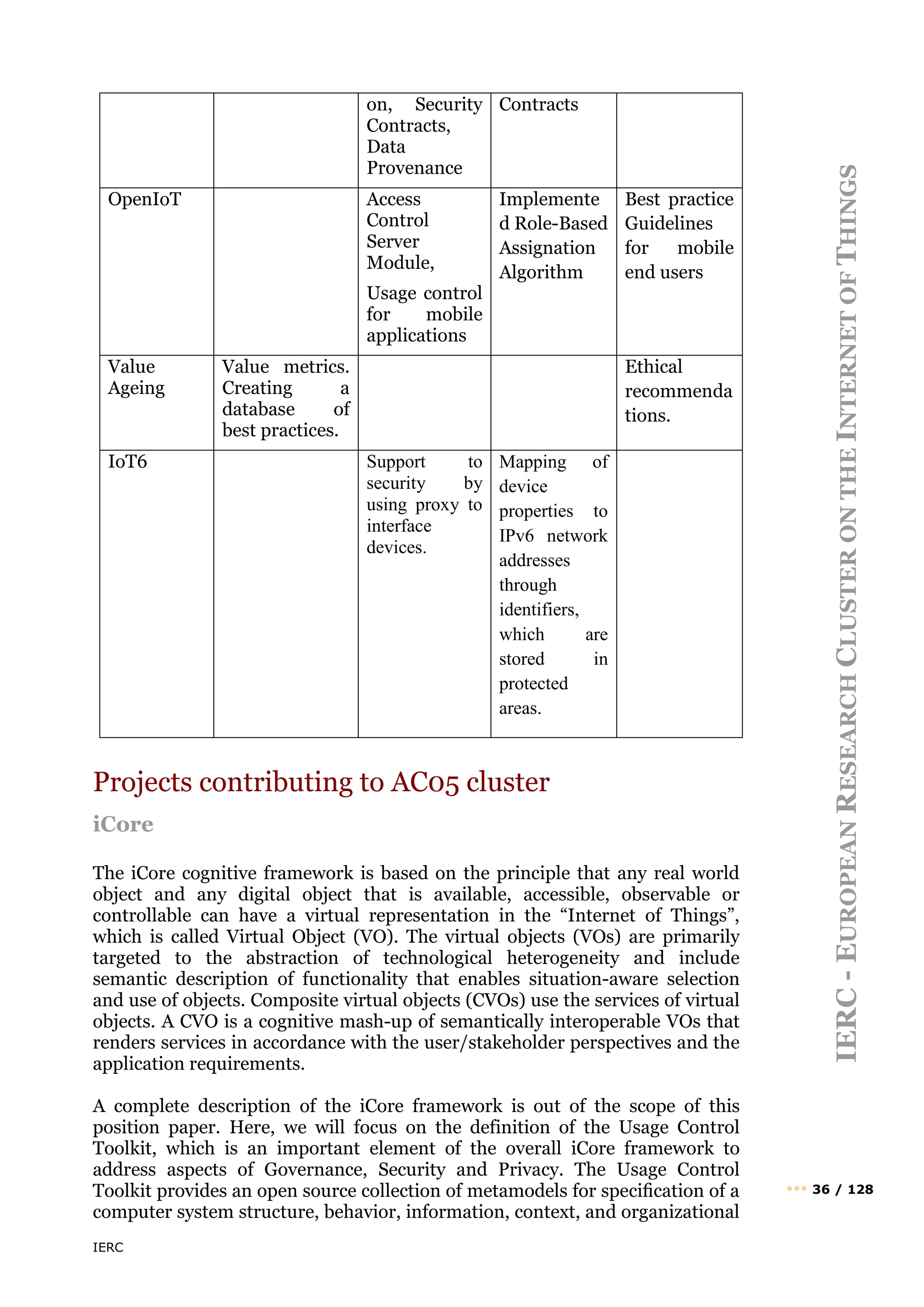
![IERC
IERC
-
E
UROPEAN
R
ESEARCH
C
LUSTER
ON
THE
I
NTERNET
OF
T
HINGS
••• 39 / 128
ensures the communication standard interoperability. For the hop-by-hop
security mechanism, the gateway authenticates to the Authorization Server in
the Internet world and the sensor node bootstraps to the gateway in the WSN
domain. The security credentials generated by the Authorization Server could
be pushed by the gateway to the sensor node. This mechanism may be useful
for mobility scenario. For the end-to-end security mechanism, the sensor node
authenticates to the Authorization Server to retrieve the security credentials.
BUTLER provides also a threat analysis model that could be used to evaluate
the threat on dedicated use cases and scenarios.
Finally BUTLER strongly supports information-theoretic security at the
physical layer to increase the privacy of wireless communications due to its
achievable characteristics: unbreakability, provability, and quantifiability.
Information-theoretic security is stronger than traditional computational
security because no assumptions on the computational power of the
eavesdropper are needed and perfect secrecy can be theoretically achieved
[55]. On these bases, BUTLER proposes in particular a concrete
implementation of secret key generation for short-range communication
systems, introducing the concept of geometric secrecy.
GAMBAS
The GAMBAS project develops an adaptive middleware to enable the privacy-
preserving and automated utilization of behaviour-driven services that adapt
autonomously to the context of users. In contrast to today’s mobile
information access, which is primarily realized by on-demand searches via
mobile browsers or via mobile apps, the middleware envisioned by GAMBAS
enables proactive access to the right information at the right point in time. As
a result, the context-aware automation enabled by the GAMBAS middleware
will create a seamless and less distractive experience for its users while
reducing the complexity of application development.
Figure 2 GAMBAS Middleware
As indicated in Figure 2, the core innovations realized by GAMBAS are the
development of models and infrastructures to support the interoperable
representation and scalable processing of context, the development of a
generic, yet resource-efficient framework to enable the multimodal
Mobile Web Mobile App
Search
Website
Search
App
Use
Service
Use
Website
Use
App
Open
Browser
Enter
Term
Pick
Page
Open
Market
Enter
Term
Pick
App
… …
Click
Link
Enter
Data
Enter
Data
Enter
Data
Recognize Context
Discover Services
Pick Service
Get
Result
Get
Result
Query Context
Enforce Privacy
Share Context
Get Result
Recommend Services
Aggregate
Context
GAMBAS Project
GAMBAS Middleware
GAMBAS Components
Service Discovery
and Communication Middleware
Adaptive Data
Acquisition
Interoperable
Data
Modelling
and
Processing
Automated
Privacy-
Preservation
Intent-aware User
Interfaces
Prototype Application
1
2
3
4
5
1
2
3 4
5
Validates Enables](https://image.slidesharecdn.com/iercpositionpaperiotgovernanceprivacysecurityfinal-250505064116-f6f9566a/75/IERC_Position_Paper_IoT_Governance_Privacy_Security_Final-pdf-39-2048.jpg)
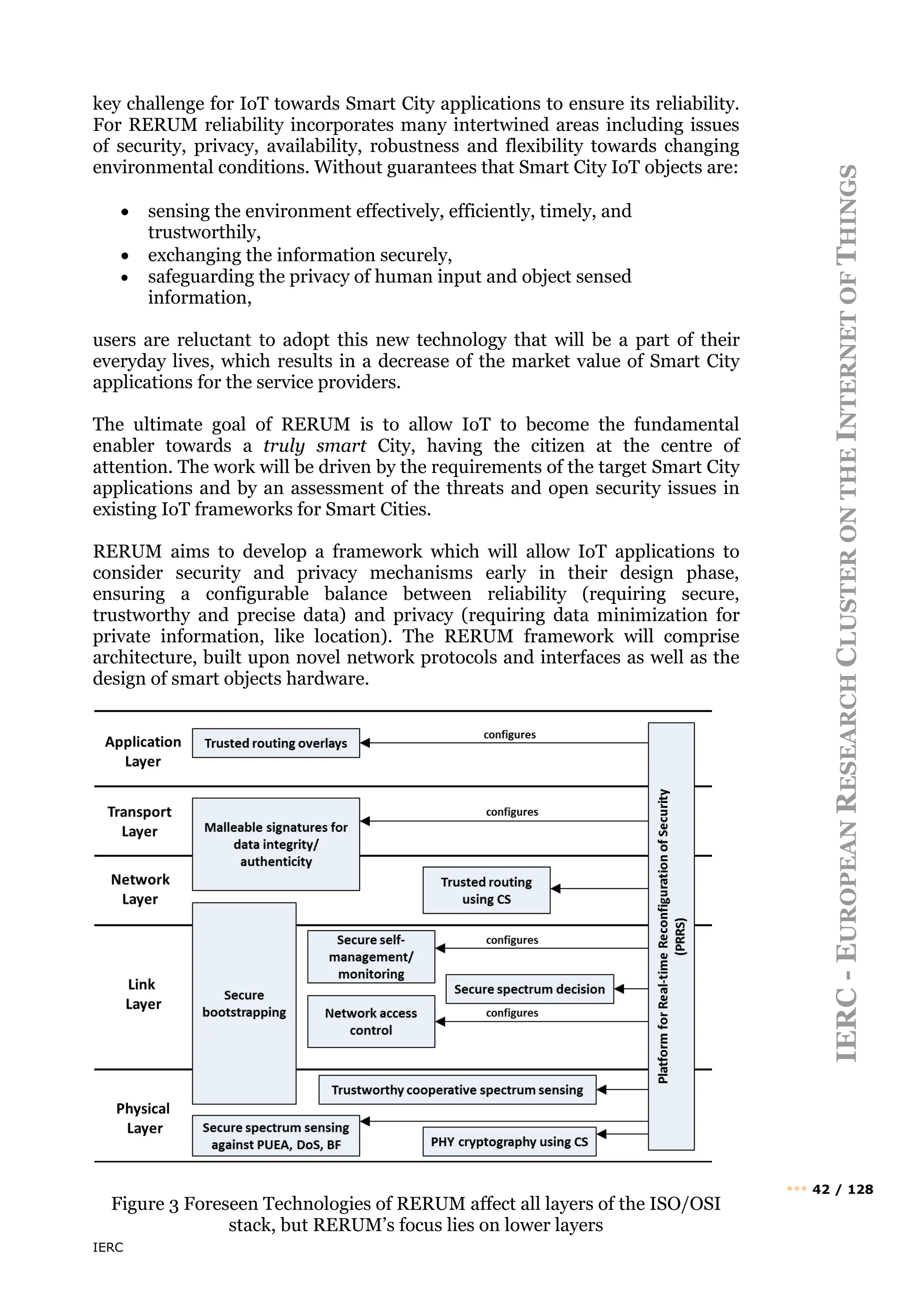
![IERC
IERC
-
E
UROPEAN
R
ESEARCH
C
LUSTER
ON
THE
I
NTERNET
OF
T
HINGS
••• 43 / 128
Figure 3 shows RERUM’s technologies and illustrates the project’s
understanding of the privacy- and security-by- design paradigm. RERUM’s
architecture will be configurable, suiting a wide range of applications, not
limited to the domain of Smart Cities. Following the “privacy-by-design”
approach RERUM will question current technology focussed design decisions
in the light of privacy. RERUM's goal is to allow application designers to
increase the privacy of the users, via data minimization, with the smallest
possible impact on functionality, the so called “privacy-by-design positive
sum” [56].
The work will follow an iterative approach starting from an initial definition of
the architecture and the respective mechanisms that will be refined as the
work progresses in order to mitigate any identified issues. The project’s key
scientific areas of focus are:
• security, privacy and trust in IoT-based smart objects;
• information security and privacy in smart city applications;
• reliable interconnectivity of smart objects based on Cognitive Radio;
• energy efficient operation of smart objects;
• performance and scalability analysis of IoT;
• Smart City applications.
RERUM considers four smart city applications to drive the requirements for
system development and these will be developed and tested in the trials:
Smart transportation, environmental monitoring, home energy management
and indoor comfort quality monitoring.
IoT@Work
The IoT@Work project focused on harnessing IoT technologies in industrial
and automation environments in order to realize the so-called Plug-and-Work
(i.e. seamlessly addition and configuration) of production units.
The IoT@Work project adopted a Capability Based Access Control
mechanism9 for managing access control (including rights delegation) to some
of the project’s services and, specifically, to its Event Notification Service
(ENS) middleware [57].
Capabilities are communicable and unforgeable tokens of authority. By virtue
of the possession of a capability token, a process/subject can access a
resource/service exercising the rights that the capability token grants. A
capability based access control and rights delegation approach has the
following advantages:
• the Principle of Least Authority (PoLA) is the default
• supports a more fine-grained access control
• less security issues (no Confused Deputy problem)
9
The software is available as open source (Apache License 2.0) at http://code.google.com/p/txt-iot-
technologies/](https://image.slidesharecdn.com/iercpositionpaperiotgovernanceprivacysecurityfinal-250505064116-f6f9566a/75/IERC_Position_Paper_IoT_Governance_Privacy_Security_Final-pdf-43-2048.jpg)
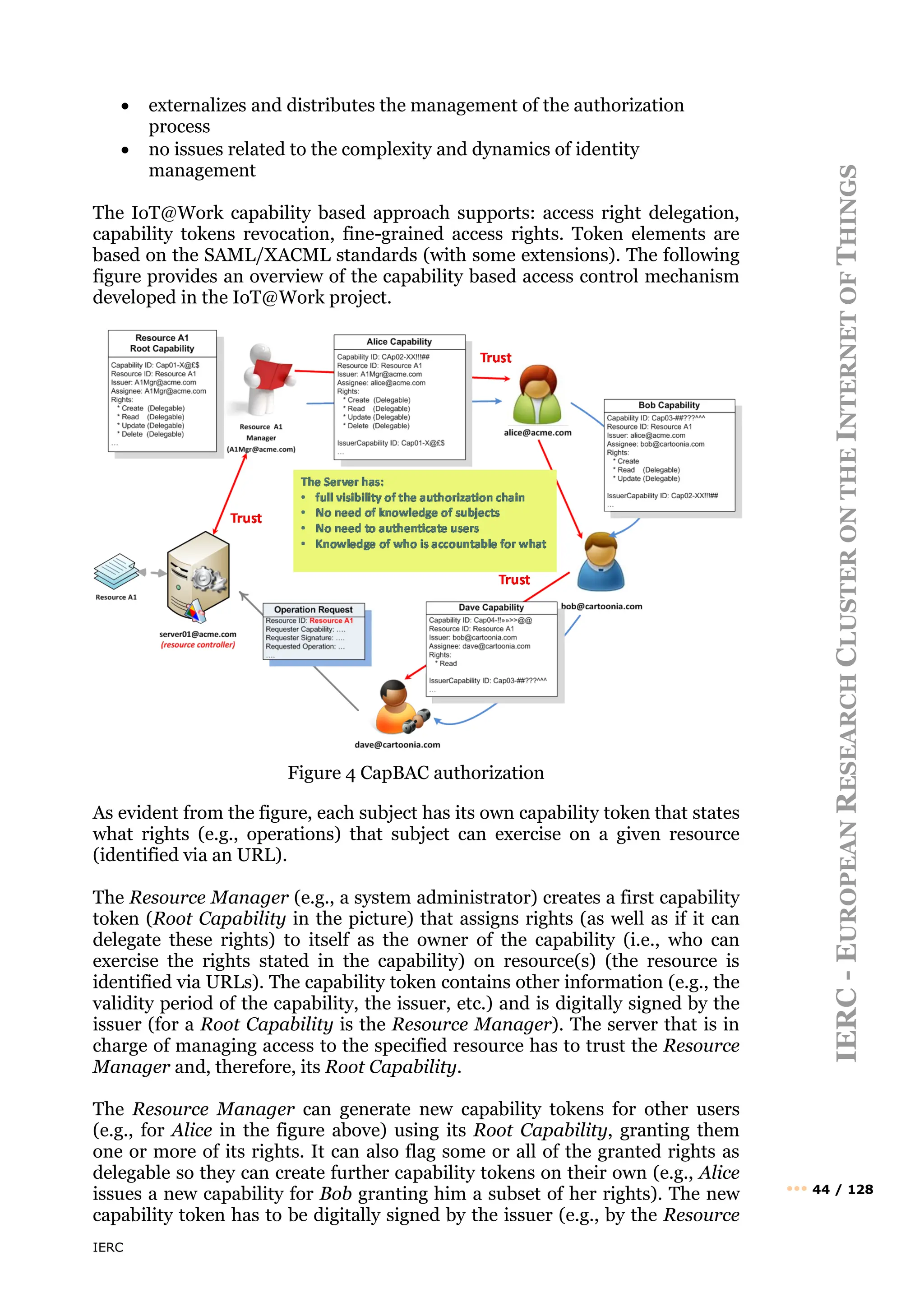
![IERC
IERC
-
E
UROPEAN
R
ESEARCH
C
LUSTER
ON
THE
I
NTERNET
OF
T
HINGS
••• 45 / 128
Manager for the Alice token, by Alice for the Bob’s one, etc.) and includes the
capability token of the issuer. Each subject in the delegation chain can freely
create (and takes responsibility) as many capabilities as required if it has the
right to delegate some of its rights.
A subject (e.g., Dave in the picture) that needs to access a resource must
provide with the access request its own capability token (e.g., Dave Capability
in the picture) and prove it is the owner of the presented capability token (e.g.,
digitally signing the access request). The Resource Manager must perform the
following checks to decide whether to accept or deny an access request:
• the presented capability and its authorization chain are correct (e.g., the
Dave’s Capability is well formed and its digital signature is correct,
then that the Bob’s Capability is correct and the links between the
Dave’s and Bob’s capabilities are correct, up to the Root Capability)
• the access request is within the scope of the presented capability
• the access request is signed by the requester.
The capability tokens are XML documents based on the Security Assertion
Markup Language (SAML) and eXtensible Access Control Markup Language
(XACML) standards (with some extensions).
The IoT@Work access control mechanism envisages the possibility to revoke a
capability token before its expiration date to address issues related to changes
of subject’s roles or in an organization, compromised certificates, etc.
The revocation mechanism assures that only properly authorized subjects can
revoke issued capability tokens (see [12] for more details). The mechanism, as
described in [12], can even support encrypted and anonymous capability
tokens to improve confidentiality and privacy.
COMPOSE
Main goal of the Collaborative Open Market to Place Objects at your Service is
to simplify the development of Applications for the Internet of Things. For this
purpose, COMPOSE takes a similar approach as iCore and abstract from
physical things and models them as virtual entities, so called service objects.
They are simple units which can generate data for further processing and can
be composed into units performing more complex data processing tasks.
Service objects also represent actuators which can receive control data.
Service objects interact with services. The latter are entities with more
complex program logic provided by developers. Comparable to service objects,
services can also be composed, manually or automatically by a composition
engine. Services run in the COMPOSE platform which is implemented by a
cloud. Further, the project offers an integrated SDK and an IDE to support the
development of new service objects or services and also of applications.
Applications are offered to users of the COMPOSE platform through a
marketplace. They interact with services and/or service objects and are
executed on different platforms, e.g. web-servers or smartphones.](https://image.slidesharecdn.com/iercpositionpaperiotgovernanceprivacysecurityfinal-250505064116-f6f9566a/75/IERC_Position_Paper_IoT_Governance_Privacy_Security_Final-pdf-45-2048.jpg)
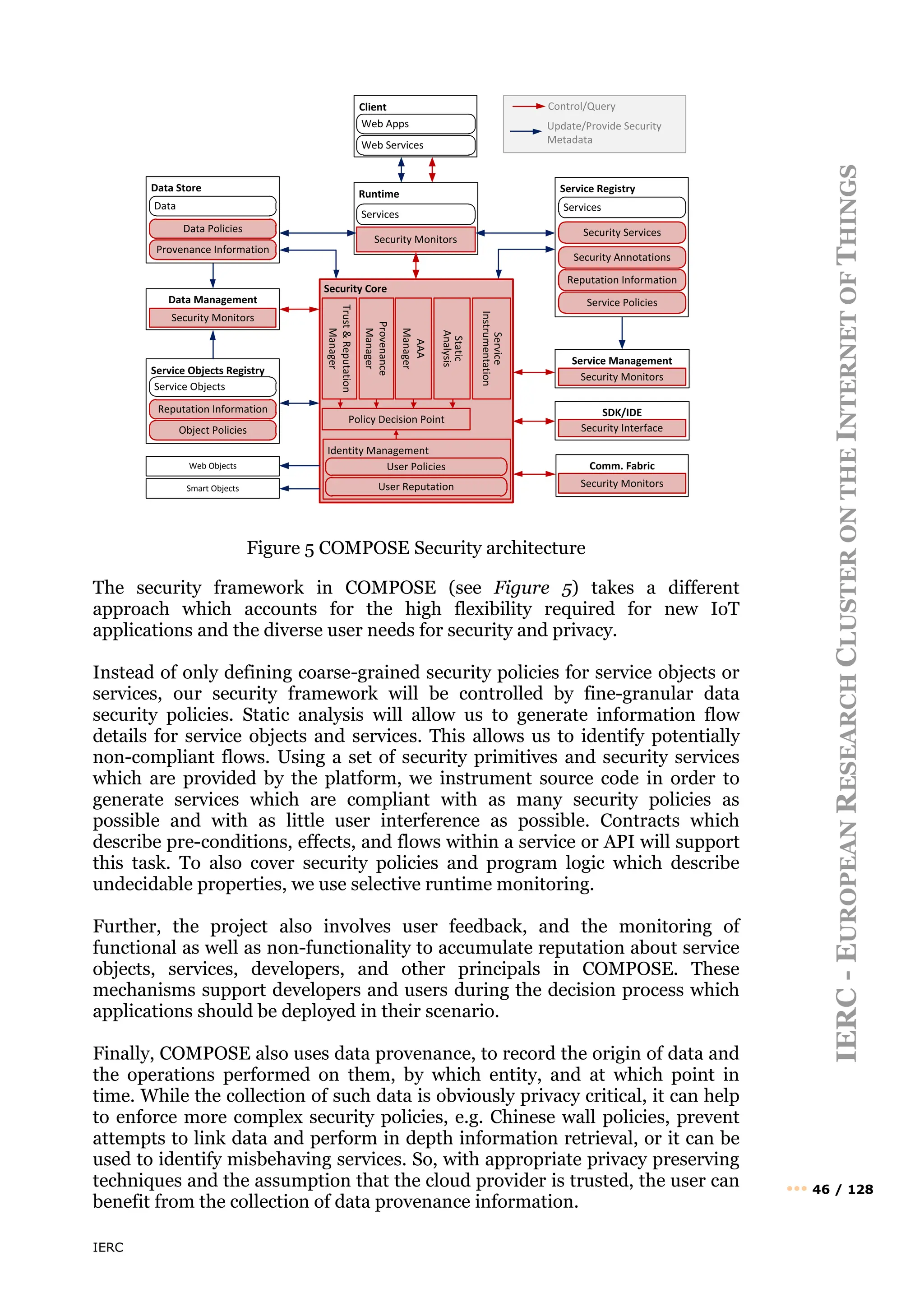
![IERC
IERC
-
E
UROPEAN
R
ESEARCH
C
LUSTER
ON
THE
I
NTERNET
OF
T
HINGS
••• 48 / 128
OpenIoT Architecture is comprised by seven main components as depicted in
Figure 6. The Sensor Middleware, the Cloud Data Storage, the Scheduler in
conjunction with Discovery Services functionality, the Service Delivery and
Utility Manager, the Request Definition, the Request Presentation and the
Configuration and Monitoring, all of them secure-enabled by the Trust-
Module (TM).
Figure 6 OpenIoT Security Access Control via Trust-Module (TM).
Privacy and Security is the baseline service formulation mechanisms of
OpenIoT support role-based authentication and authorization, towards
ensuring authorized access to sensors and services. The Trust-Module (TM)
contains all the metadata descriptions for secure Authentication using
OpenIoT 2.0 principles for the role-based algorithms. TM is defined as part of
the Control Access Server (CAS) using OAuth2.0 [58] among main Core
Components Functional Blocks. In addition to these mechanisms, the
OpenIoT middleware uses utility-driven privacy and security mechanisms as
part of Privacy and Security activity of the project.
A prominent gap in the IoT research arena is the lack of open source
implementations of integrated IoT middleware functionalities, which could
boost the wide adoption of IoT applications beyond early realizations and
open-source projects such as Global Sensor Networks (GSN)10. Likewise it is
evident the lack of a trusted, structured, configurable and integrated
middleware solution for the cloud-based delivery of IoT services and OpenIoT
aims at researching and providing the privacy and security module (following
OpenID [59]) for this as an approach. OpenIoT rely on open source
10
Global Sensor Network project, http://sourceforge.net/apps/trac/gsn](https://image.slidesharecdn.com/iercpositionpaperiotgovernanceprivacysecurityfinal-250505064116-f6f9566a/75/IERC_Position_Paper_IoT_Governance_Privacy_Security_Final-pdf-48-2048.jpg)
![IERC
IERC
-
E
UROPEAN
R
ESEARCH
C
LUSTER
ON
THE
I
NTERNET
OF
T
HINGS
••• 50 / 128
• Corporate Social Responsibility (CSR), and Ethical Codes in ICT for
ageing,
• Scenario exercise (supporting policy makers and technology developers
for the interaction between end-users and ICT technologies)
• Best Practices identification, analysis and collection, and Governance
issues and policy options.
IoT6
IoT6’s main concerns are with how IPv6 can contribute to IoT. Aspects of
governance, security and privacy are addressed in [60]. The main focus is on
studying applications in smart buildings – mainly using legacy equipment.
Thus one activity has been developing mechanisms where the properties of the
legacy systems can be translated into IPv6 addresses. Gateways, with the least
significant 64 bits of the IPv6 address being used in the mapping. Because the
least significant bits are used, this mapping has no impact on the Internet
routing to the gateway. A system called Glowbal was developed to deal with
this mapping algorithmically for different technologies. This allowed the
automation of the addressing of the legacy technologies using only IPv6
address features [61]. Another feature of our approach has been to store the
properties of the gateways in a resource discovery system called Digcovery
[62]. This has interfaces to different database systems which are used in
different domains like cloud computing, mobile telephony and RFID -
facilitating their being used together. Sophisticated Use Cases have been
developed in this environment, but the earlier work did not include much on
security. This was partly because the legacy systems themselves had little or no
provision for secured operation, because they worked mainly in the local
environment. There was some work on the strain that certain encryption
algorithms would put on constrained devices. Also in D3.1 [63] some aspects
of authorization related to Digcovery functionalities were considered. Finally,
in D2.3 [64] also included some implementation and evaluation of IPsec and a
lightIPsec version for Contiki in order to provide support for secure and
mobile communications.
Recent work has continued, of course, along the original directions, but a
parallel stream has developed [65]. It was realised that the IP addresses were
often stored in DNS stores. These had the great advantage of being globally
accessible, and the DNS system has been shown to be able to scale to very
large numbers of devices. Moreover, recent work on DNSSEC has shown how
the addresses could be authenticated. At the same time, the DNS has no
confidentiality on its addresses; anybody can access it. There has been a
concern that as a result, mechanisms like the use of IPv6 address features to
express properties of end devices, might reveal too much about these devices
to unauthorised users. In addition, the use of address features to express
properties of different technologies, might compromise the jurisdiction of
address space management, which is currently the province of IANA, the
Internet Registries and the IETF. As a result these proposals might encounter
strong opposition.
Partly for the above reasons, and partly in order to address security and
scaling in a more homogeneous and holistic manner, recent work in IoT6 has
also pursued another track. Instead of concentrating on IPv6 addresses, it has
considered systems based on identifiers. Partly because of the limited
resources at our disposal, and partly because of the excellent fit with the](https://image.slidesharecdn.com/iercpositionpaperiotgovernanceprivacysecurityfinal-250505064116-f6f9566a/75/IERC_Position_Paper_IoT_Governance_Privacy_Security_Final-pdf-50-2048.jpg)
![IERC
IERC
-
E
UROPEAN
R
ESEARCH
C
LUSTER
ON
THE
I
NTERNET
OF
T
HINGS
••• 51 / 128
security and scaling problems, we have been considering the use of the CNRI
HANDLE system [66] in this environment. We do not consider that system a
complete fit, but it does meet most of our needs. We expect both to
demonstrate this excellent fit and to propose how comparatively small
modifications to this class of systems could be the basis of a methodology with
a large applicability, providing security and scaling, and able to deal with
heterogeneous devices at the same time. Not only will it be able to provide real
security, but also it can be an important tool in achieving a large-scale, widely
applicable, infrastructure.
The HANDLE system was developed for a different class of applications; the
persistent, secure, naming and storage of multimedia documents. Unlike
many of the experimental systems being developed in this cluster, it has a
proven track record of deployment, and its properties have been verified
experimentally. There is substantial experience of its functionality.
The basic concept of HANDLE is of a set of Handles with an arbitrary set of
Names. The Names are structured in a hierarchical fashion, with a global
registration of Name-Space down to a certain level, and User-managed Name-
Space below it. They denote the Names by the term Handles. By User is meant
any entity that has contracted to manage a unique part of the Name-Space. In
this respect, the HANDLE Name-Space is very similar in concept to the DNS
system. There are then two vital differences. First there is the syntax of
Handles, second there is the security infrastructure built around it. These
result, of course, in many other differences. The syntax of Handle attributes is
an arbitrary length set of Type/Value pairs. Some of these Types will be
registered in a global directory to aid wide interoperability and a common
parlance; others will be registered only in more local registries managed by the
owner of the Handle space. The second is that access and management of
Handles and their attributes is restricted by authorisation credentials. Each
User HANDLE space has an administrator nominated by the User entity; we
will call him/her the Local HANDLE Administrator (LHA). He/she is given a
private security credential by the Global HANDLE Administrator (GHA). Only
the GHA can manage the Handles in the Global HANDLE space; the LHA has
complete management rights on the Local HANDLE space. This right includes
delegation of management of subsidiary HANDLE space as with the DNS. The
DNS has a metadata that defines the domain administrators that are
authorised to manage DNS records. HANDLE goes further, in addition to the
authorisation only of the LHA to manage Local Handles, it also has a metadata
to restrict the access to Handle records only to authorised users. The LHA can
define these access rights in a fine-grained manner.
There are three subsystems of the HANDLE system architecture: the HANDLE
Identity Resolver (HIR), the HANDLE Store (HS) and the HANDLE Registry
(HR). Limited versions of the HR and HS are bundled with the HIR, and only
that component is used in IoT6. There are public domain implementations for
the Local systems, and plug-ins for use of some of the facilities through a web
browser.
The Handle syntax can be used to define all the properties of devices. Since
one Handle Type is another Handle, these descriptions can be very generic –
and even refer to entries in other domains like the EPC structure [67]. One can
also specify security attributes to devices represented by the Handle in the
attributes. While, of course, such attributes can be stored only in an encrypted](https://image.slidesharecdn.com/iercpositionpaperiotgovernanceprivacysecurityfinal-250505064116-f6f9566a/75/IERC_Position_Paper_IoT_Governance_Privacy_Security_Final-pdf-51-2048.jpg)
![IERC
IERC
-
E
UROPEAN
R
ESEARCH
C
LUSTER
ON
THE
I
NTERNET
OF
T
HINGS
••• 53 / 128
the cluster. In the section, which describes the architecture framework, these
similarities are identified in connection to the challenges.
Solutions from Clusters projects
Usage Control Toolkit
The usage control policies implemented in the iCore project, consist of
authorizations and obligations specified as Event-Condition-Action (ECA)
enforcement rules. These rules use as a reference a set of inter-related design
models representing different aspects of the IoT system, and are used as input
for the runtime components in the framework. This solution to enable
monitoring of ECA rules and execution of security enforcement behaviour
[68][69] is named the Model-based Security Toolkit, or just SecKit.
The SecKit consists of a collection of metamodels for specification of a
computer system structure, information, behaviour, context, identities,
organizational roles, and security rules. These metamodels provide the
foundation for security engineering tooling add-ons and metamodel
extensions to address requirements of governance, security and privacy. The
SecKit adopts a generic design language to represent the architecture of a
distributed system across application domains and levels of abstraction
including refinement relations support inspired in the Interaction System
Design Language (ISDL) [70].
The following figure gives a high-level overview of the design models
supported by the SecKit, which are system (structure, information, behaviour),
context, identity, role, and security rules. These models provide the foundation
for the design and runtime tooling, and extensions/add-ons focusing on
specific security aspects of a computer system.
Figure 7 Design Models
The first step using the SecKit is the specification of the System behaviour,
structure, and information model. Figure 8 shows an example of this model
where a Smart Home entity interacts with a Medical Center through an
interaction point. The details about this interaction and the information
exchanged are depicted in the behavior model, which in this example is the
Access heart rate interaction, which exchanges the bpm (beats per minute)
Security Rules
Rule Template
System
Behavior
Structure
Information
Identity
Context
Event
Condition
Action
Variable
Declarations
Rule Template
Configuration
Variable
Instantiations
Role](https://image.slidesharecdn.com/iercpositionpaperiotgovernanceprivacysecurityfinal-250505064116-f6f9566a/75/IERC_Position_Paper_IoT_Governance_Privacy_Security_Final-pdf-53-2048.jpg)
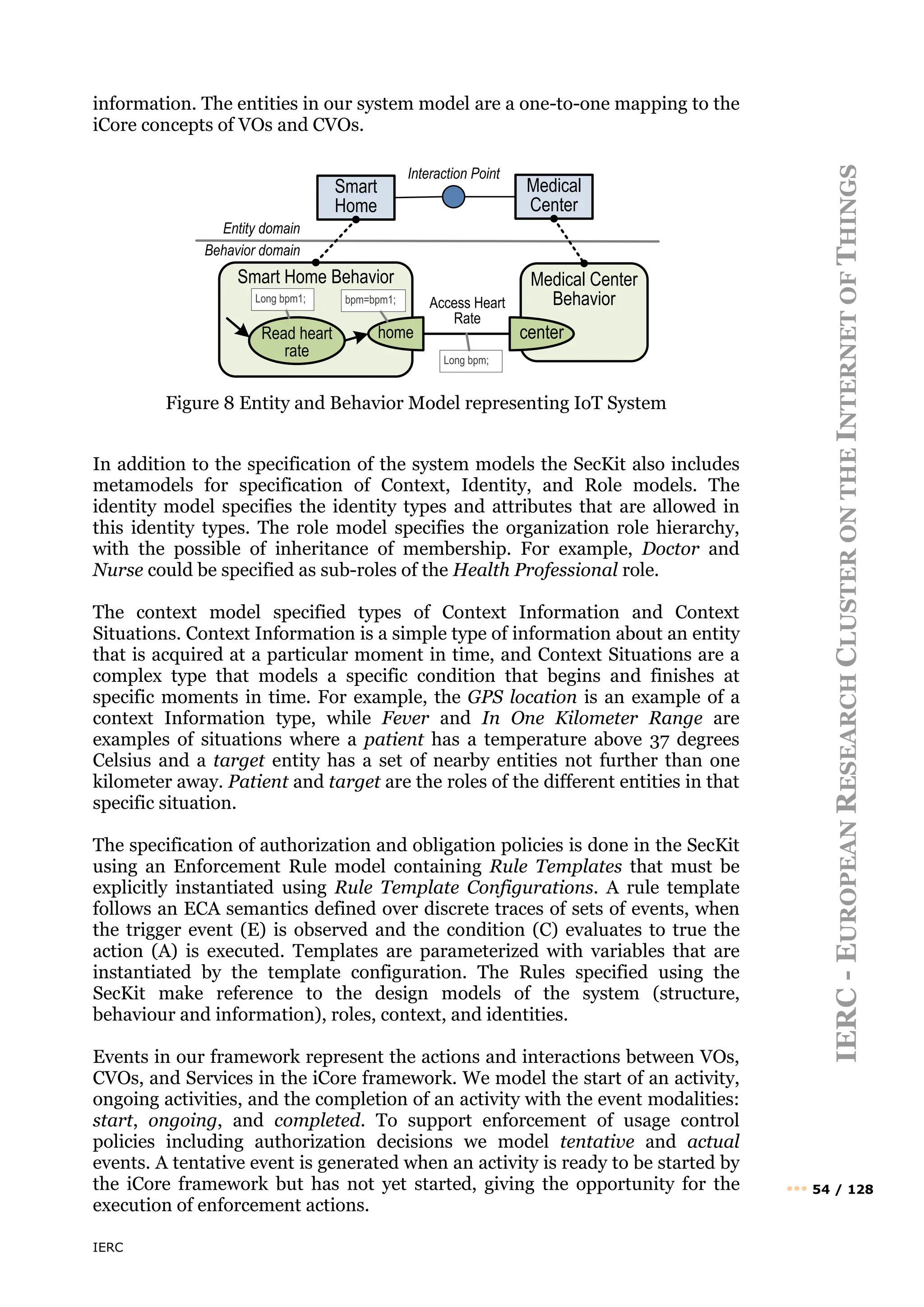
![IERC
IERC
-
E
UROPEAN
R
ESEARCH
C
LUSTER
ON
THE
I
NTERNET
OF
T
HINGS
••• 55 / 128
A tentative event may trigger the execution of an enforcement behaviour to
allow or deny the execution of the activity. If the activity is allowed it is also
possible to specify an optional modification or delay of the activity execution,
for example, anonymizing activity data before the activity takes place. The
execution part of an enforcement template may trigger the execution of
additional activities, for example, notifications or logging of information.
The condition part of a rule template consists of event pattern matching,
propositional, temporal, and cardinality operators. The expressiveness is
bigger than existing languages for access control like XACML and allows for
great flexibility and re-use of modular policy specifications.
Figure 9 shows a screenshot of the SecKit Graphical User Interface (GUI)
implementation for specification of design models. More specifically, this
figure shows the tab with the Security Rules design model. The security rule
template highlighted “Deny Access to Heart Rate” specifies that when the
interaction type “Access Heart Rate” is about to be executed (tentative) it
should be denied if the entity instance participating in this interaction is the
one assigned to the variable $smartHome1. The condition part of this rule is
simply TRUE. This screenshot illustrate some of the important features of the
SecKit support, including support for variables, nested rules, and instantiation
of templates.
Figure 9 Specification of Security Rules using SecKit
The highlighted rule in Figure 9 is the default case for the interaction “Access
Heart Rate”, which simply prevents it from happening. In case one of the
nested rules evaluates to “Allow” this decision overrides the default case,
which is the semantics of the “Allow Overrides” combining algorithm. The two
nested rules in this example allow the interaction to happen in case of
emergency (context condition), or in case a doctor tries to perform the
interaction (organizational role). Additional details about the SecKit are
described in the following publications [68] [69].](https://image.slidesharecdn.com/iercpositionpaperiotgovernanceprivacysecurityfinal-250505064116-f6f9566a/75/IERC_Position_Paper_IoT_Governance_Privacy_Security_Final-pdf-55-2048.jpg)
![IERC
IERC
-
E
UROPEAN
R
ESEARCH
C
LUSTER
ON
THE
I
NTERNET
OF
T
HINGS
••• 56 / 128
Using the SecKit enforcement rules, policies can be specified for
authorizations and obligations inside an outside of an administrative domain.
For example, the owner of a smart home can specify the instantiation of an
enforcement rule that should be evaluated by an iCore-enabled smart city
infrastructure outside the home or (s)he can specify rules to manage
authorizations and obligations of the devices inside of the smart home. The
delegation of policies and mutual establishment of domain identities can be
done using a trust negotiation approach.
Sticky Flow Policies
Stick flow policies combine sticky policies for data with their flow policies, i.e.
a data item in a system using this technology is annotated with a security
policy which describes how a data item can be used and which conditions have
to be satisfied before an item can flow to another entity.
The security architecture proposed in COMPOSE strongly relies on sticky flow
policies. In this section we will briefly outline the potential which arises from
the use of such policies.
Similar to ECA rules as used in iCore, flow policies consist of a conditional and
an action part. Conditions are simple Boolean propositions and actions are
described by read and write activities on a specific target respectively. A set of
such rules annotated to a data item forms a policy. These policies are able to
model RBAC [24] and we are currently extending their expressiveness to the
usage control model.
While COMPOSE still defines regular access policies on its principals, flow
policies trigger and instantiate various enforcement mechanisms. So called
platform monitors are integrated in the central logical entities of the system
architecture. They enforce compliant flows of data between service objects,
services, and users. However, they also monitor during runtime whether
developer defined program logic induces insecure flows. For this purpose, we
deploy mechanisms which are similar to simple taint tracking approaches. Due
to the fine granularity of flow policies, we can also achieve a higher flexibility
of applications while maintaining the least privilege principle to improve the
security of data stored in the platform.
To maintain scalability and efficiency of data processing, flow policies are also
used to statically analyse services. Similar to validation framework proposed
by SPaCIoS, an abstract model of the application is generated and we
investigate whether the execution traces of an application are compliant with
the flow policies defined over the data potentially processed by the service. The
simplicity of the flow policies supports the efficiency of this approach.
The result of this analysis is used by an instrumentation component in
COMPOSE which modifies the original object code. We inline appropriate
monitors, i.e. reference monitors, logging monitors, or monitor hooks. While
reference monitors take the classical task of enforcing policies, logging
monitors can generate critical logging information, which can also be used for
the precise monitoring of the behaviour of a service, e.g. for data provenance
or trust and reputation systems. Finally, monitor hooks can be used to](https://image.slidesharecdn.com/iercpositionpaperiotgovernanceprivacysecurityfinal-250505064116-f6f9566a/75/IERC_Position_Paper_IoT_Governance_Privacy_Security_Final-pdf-56-2048.jpg)
![IERC
IERC
-
E
UROPEAN
R
ESEARCH
C
LUSTER
ON
THE
I
NTERNET
OF
T
HINGS
••• 58 / 128
current location and private contents), it is possible to obtain user groups and
access rules for context information. This is closely related to approaches such
as the privacy wizard described in [71] which try to extract policy information
from a social networking site. However, these approaches do not apply the
policies to further sharing of context information. Thus, the developments in
GAMBAS can be considered an extension to support the automatic generation
of context sharing policies since they only consider the aggregated context of
social networking sites and not the fine-grained context of physical sensors.
Besides from policy generation, the mechanisms that are necessary to enforce
the policy must also be fully automated. Thereby, the mechanisms must
enforce the policy while preserving the privacy. For example, if it is necessary
to detect whether an object belongs to a specific user group, doing so should
not reveal the existence of the group nor the associated access rights. To do
this, GAMBAS encompasses protocols which enforce the policy, i.e. are
gathering the needed information from other objects, looking up the access
rights specified in the policy and finally share this information in a way that it
cannot be gathered by unauthorized objects. As a consequence, the GAMBAS
middleware entails a complete privacy-preservation framework that enables
the automatic generation of a user-specific policy as well as the enforcement of
the policy at runtime.
Capabilities based policy management
On the security management side, it is worthwhile to highlight as the
IoT@Work access control mechanism (and capability based mechanisms)
makes possible to split the security assurance issue among the involved actors
(e.g., smart objects, services, etc.) therefore reducing the need of complex
middleware. Indeed, each capability token can be tailored to a specific
resource (e.g., the token can report operations that are specific to that
resource) without affecting tokens for other resources (while in an
RBAC/ABAC systems where roles, operations, etc. must be defined in a
consistent way to have a manageable set of elements and rules). Additionally,
the IoT@Work mechanism decouples the access control from the Identity
Management aspects, therefore heavily reducing the management effort and
the complexity of trusted, federated IAM (Identity and Access Management)
middleware.
Contracts
To efficiently analyse services and their compositions and in order to describe
the security relevant actions of security services, COMPOSE also proposes the
concept of security contracts.
Contracts describe a promise of a service towards the platform to behave in a
certain way. COMPOSE contracts promise to change the security state of data
and system entities in a pre-defined way, define preconditions which need to
be satisfied before execution, and describe the flow of data during execution. If
not annotated to system services, which are initially provided by COMPOSE,
such contracts are automatically generated and over approximate the service
behaviour. Thus, they can be used during development, static analysis, and
automatic service compositions to efficiently interact with a user. However,](https://image.slidesharecdn.com/iercpositionpaperiotgovernanceprivacysecurityfinal-250505064116-f6f9566a/75/IERC_Position_Paper_IoT_Governance_Privacy_Security_Final-pdf-58-2048.jpg)
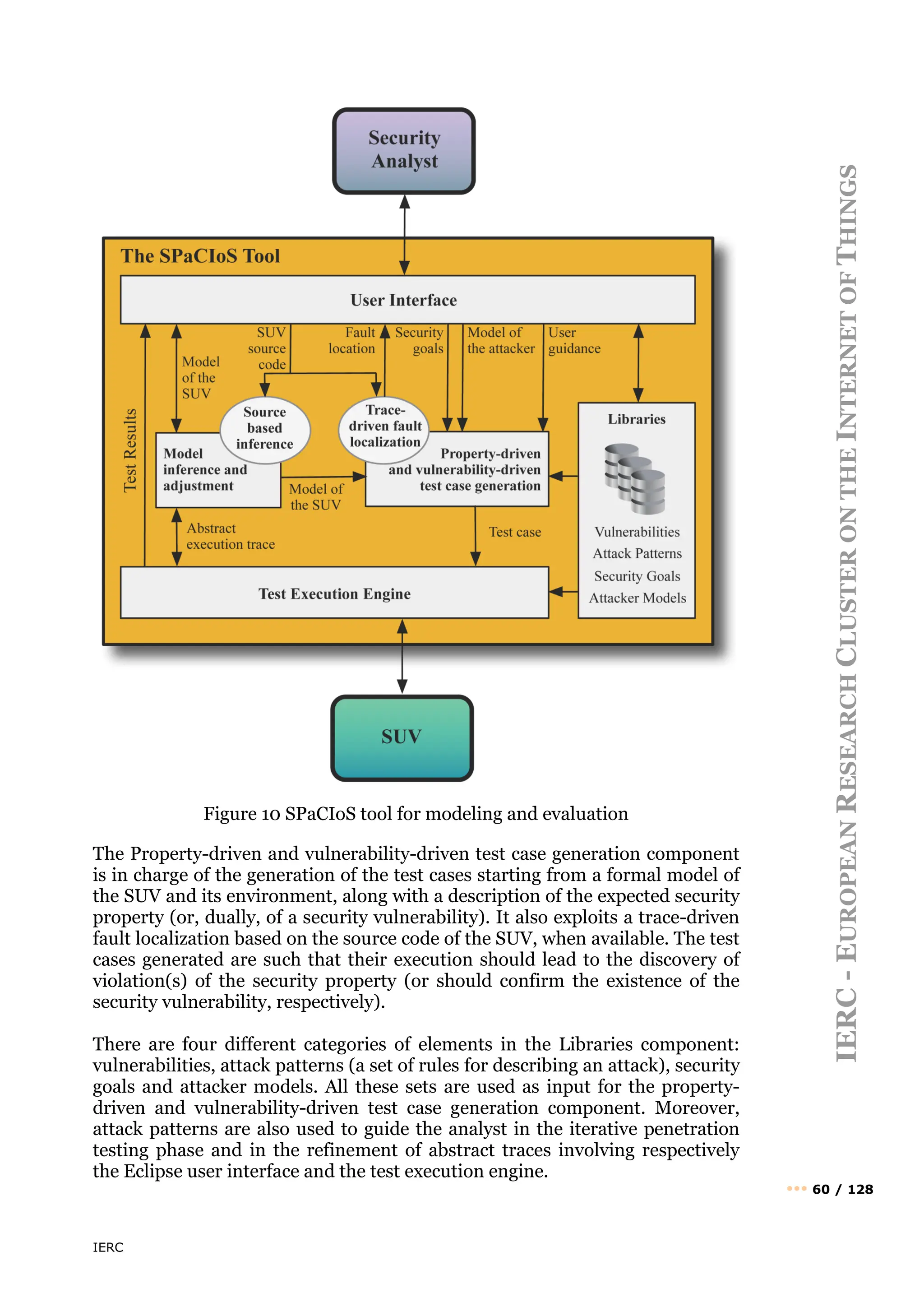
![IERC
IERC
-
E
UROPEAN
R
ESEARCH
C
LUSTER
ON
THE
I
NTERNET
OF
T
HINGS
••• 61 / 128
The Model inference and adjustment component has the twofold task of
building a formal model of the SUV (possibly via source-based inference) and
of the environment, and to adjust the available one. The construction of the
model is necessary whenever no model is initially available. This is performed
offline, i.e., before starting the test case generation and testing the SUV. Model
adjustment is instead an online activity that is triggered when the execution of
a test reveals a discrepancy between the model and the SUV and/or the
environment.
The test cases are finally executed by the Test Execution Engine (TEE) by
handling the exchange of messages with the SUV.
Authentication/Authorization
The Authorization Server in BUTLER is the single point for security
management. All actors shall delegate authorization management and
user management to the Authorization Server.
The Authorization Server enables separation of the setup of the trust and the
security of the data transfer between resource consumer (application) and
resource provider. The trust enabler is not involved in data transfer; this
separation allows implementation of privacy requirements. Here it is up to
the Resource Consumer to support privacy requirements following current
regulation concerning data storage and data usage. The security protocol
allows end-to-end security between resource consumer (application) and
resource provider (server, gateway and object). The application accesses
resources on behalf of a user.
The authorization server provides authentication and authorization WEB
services and WEB portal both for server administrators and final users. Final
users can manage their resources, give access permissions to others users
(acquaintance) to access their resources, manage access tokens generated for
specific application and resource.
RERUM will design and implement mechanisms for secure object-to-object
and object-to-internet communication, to ensure that no intruders or
unauthorized users/objects gain access to the system. RERUM will research
hop-by-hop, end- to-end and PKI-based authentication considering the limited
resources of smart objects. The project will use related work as a reference
point, as found in [72] for intermediate hop- to-hop authentication, [73], [74]
for end-to-end authentication and [75] for an adoption of the public-key
cryptography based schemes for data concealment in wireless sensor networks.](https://image.slidesharecdn.com/iercpositionpaperiotgovernanceprivacysecurityfinal-250505064116-f6f9566a/75/IERC_Position_Paper_IoT_Governance_Privacy_Security_Final-pdf-61-2048.jpg)
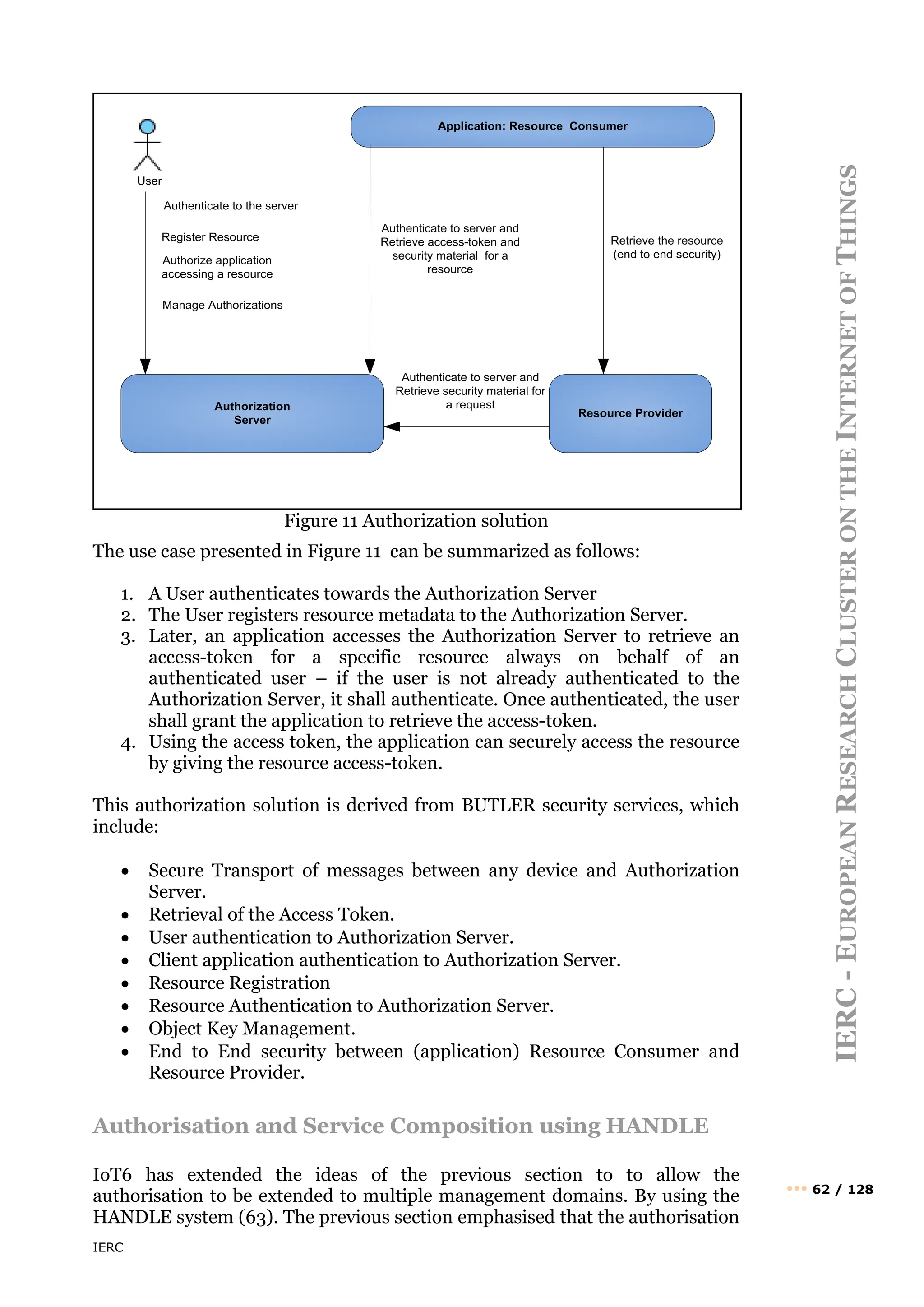
![IERC
IERC
-
E
UROPEAN
R
ESEARCH
C
LUSTER
ON
THE
I
NTERNET
OF
T
HINGS
••• 64 / 128
be further reflected in using different multicast groups at the Ipv6
network level.
• Because attributes can refer to processes, one can compose more
complex applications by having an attribute of one identifier point to
the identifier of a subsequent process - with the parent providing the
relevant authorisation.
Cryptography in IoT
This section describes various innovative cryptographic systems, which have
been proposed by the AC05 projects.
• Malleable Signature Schemes (MSS) is proposed in RERUM project.
MSS just like classical digital signatures, strive to protect signed data
from undetected malicious modifications. The concept of malleable
signatures allows an additional, designated party, frequently called the
sanitizer, to be authorised by the signer to modify a previously signed
message in an authorised way. For all actions not authorised and for all
parties not specified as sanitizers, any modification would result in a
signature verification failure. Thus, MSS can allow only certain Privacy
Gateways to act as trusted sanitizers to make privacy preserving
changes to integrity-protected information. This will decrease the
integrity compared to an unmodified original value. However, in the
MSS approach, this balance can be configured to suit the applications
needs regarding the level of integrity protection and the level of privacy.
• Compressed Sensing (CS) proposed by RERUM will also allow
achieving a very high level of encryption combined with energy
efficiency, two basic requirements of IoT applications. This will help
address security as well as privacy issues in the IoT [76].
• Cryptographic integrity and authenticity
To ensure that no intruders or unauthorized users/objects will gain
access to the system RERUM will research hop-by-hop, end-to-end and
PKI-based authentication considering the limited resources of smart
objects. BUTLER has addressed cryptography and authorization for
constrained smart objects by introducing an efficient and secure mutual
authentication and key establishment protocol that is based on Elliptic
Curve Cryptography (ECC) [77]. This approach allows the secure
communication with low computational resource on smart objects.
More specifically, it introduces an “offline key assignment” procedure
used to authenticate each node by generating a public/private key pair
for encryption and decryption of the messages. Authentication is
achieved with a generation of a private key based on a prime number
stored on the node.
In the past year, BUTLER has led several experiments in many contexts to
acquire data sets measurements from physical sensors embedded in the nodes
and from radio characteristics. BUTLER has analyzed the entropy containing
in each source with the new min-entropy estimators recommended by the
NIST in their last document dated august 2012. The novelty of this analysis is
brought by a statistical analysis performing on the data source samples instead
on the output of the random number generator.](https://image.slidesharecdn.com/iercpositionpaperiotgovernanceprivacysecurityfinal-250505064116-f6f9566a/75/IERC_Position_Paper_IoT_Governance_Privacy_Security_Final-pdf-64-2048.jpg)
![IERC
IERC
-
E
UROPEAN
R
ESEARCH
C
LUSTER
ON
THE
I
NTERNET
OF
T
HINGS
••• 65 / 128
BUTLER has discerned several relevant sensors to harvest entropy in nominal
mode. But, when the nodes are idle, the sensors are not stimulated and the
entropy is reduced. Observing the fact that all nodes are able to receive a radio
signal, BUTLER focuses on the analysis of the radio statistics: RSSI (Received
Signal Strength Indicator), the LQI (Link Quality Indicator) and the erroneous
packets received by the nodes as the errors due to the channel degradation are
singular for a given peer-to-peer link. In conclusion, the LQI and the
erroneous packets are relevant entropy sources.
So, BUTLER started to design a lightweight true random number generator
that can be embedded on very small nodes running with Contiki. Several
health tests have been developed to scan in live the “health” of the entropy
source in the embedded device. A true number generator cannot rely on only
one source. As a consequence, several sources have been considered, each with
their health test. In the next year, BUTLER will define the post-processing and
finalize the TRNG design.
The study realized to design a tiny true embedded random number generator
enables the nodes to generate their own cryptographic features. However, the
node is not able to manage X.509 certificates. We introduce a new handshake
mechanism based on the hypothesis of a reduced diffusion of the public key of
the referent gateway.
In addition, in the BUTLER project, the joint use of the Authorization Server
at application level and of the bootstrapping mechanism at WSN level enables
to address end-to-end and hop-by-hop security problem between a sensor
node belonging to the IoT domain and an end-user application connected on
Internet. The gateway located at the border between the Internet world and
the WSN domain ensures the communication standard interoperability. For
the hop-by-hop security mechanism, the gateway authenticates to the
Authorization Server in the Internet world and the sensor node bootstraps to
the gateway in the WSN domain. The security credentials generated by the
Authorization Server could be pushed by the gateway until the sensor node.
This mechanism may be useful for mobility scenario. For the end-to-end
security mechanism, the sensor node authenticates to the Authorization Server
to retrieve the security credentials.
Last (developed in time) but not least, BUTLER proposes a new dynamic,
information-theoretic, secret key generation (SKG) schemes for short range
communication (SRC) [78]. The goal is to enable communicating pairs to
locally produce secret keys to seed their embedded cryptography systems
without using classic, aforementioned, computational cryptography. Current
key exchange schemes, under the framework of information-theoretic secrecy,
exploit the entropy of the communication channel to extract the secret bits.
However, for the scenario under consideration, characterized by very short
and LOS links between devices, the previous assumption is not anymore valid.
Therefore the new proposed SKG scheme exploits the AWGN conditions faced
by SRC systems to build geometric secrecy regions within which
eavesdroppers cannot acquire phases exchanged between the legitimate pair.
Management functions](https://image.slidesharecdn.com/iercpositionpaperiotgovernanceprivacysecurityfinal-250505064116-f6f9566a/75/IERC_Position_Paper_IoT_Governance_Privacy_Security_Final-pdf-65-2048.jpg)
![IERC
IERC
-
E
UROPEAN
R
ESEARCH
C
LUSTER
ON
THE
I
NTERNET
OF
T
HINGS
••• 66 / 128
RERUM will also develop distributed self-management and self-monitoring
mechanisms for detecting faults in the network and monitoring smart object
status. Key statistics to be monitored are energy, status (on or off), link state,
lost packet count etc. That way, any object or link failures will be automatically
detected and efficient self-healing algorithms will be applied to resolve these
issues. For monitoring and management of the security events RERUM
proposes to adopt the ideas behind the Platform for Run-time
Reconfigurability of Security (PRRS), a component in the Future Internet core
architecture. The PRRS allows an end-user application or service to direct a
request to the PRRS framework describing its particular security
requirements, which will then be built from available services offered and
finally deployed. PRRS will also monitor violations during runtime by
instantiating a runtime monitor in the instantiated security solution.
Secure Setup and Configuration
RERUM’s envisioned framework for Smart City IoT requires a security
architecture with appropriate mechanisms for the bootstrapping process. Cities
must be enabled to install the IoT especially for larger number of devices.
Existing operational credential bootstrapping and key management protocols
require the existence of some initial credentials as a starting point. Also key
pre-distribution protocols, e.g. applied in wireless sensor networks, assume the
configuration of some initial credential information before operation. RERUM
will take approaches to initially bootstrap credentials on the IoT objects, and
how to use them to update operational keys, and analyze their applicability on
the desired Smart City applications. To avoid any incidents during network
bootstrapping, RERUM will take into account existing bootstrapping protocols
(such as EAP, PANA, 802.1x, CoAP, and 6LoWPAN) and will define
mechanisms to optimize the process, enhance the security to minimize attacks
for the desired Smart City applications.
In this respect, RERUM will re-design basic self-X properties of smart objects
to embed security and privacy mechanisms. Auto-configuration mechanisms
will also be developed with built-in security and context-awareness, enabling
the secure exchange of security settings through the network.
The utilization of Cognitive Radio technology can also be considered as part of
a secure auto-configuration mechanism for mitigating jamming or interference
in cases of wireless interconnectivity of smart objects [79]. RERUM aims at
work on lightweight spectrum management techniques that will allow each
smart object to identify the unused frequencies and transmit on them. Jamming
or interference can be detected automatically and can be avoided utilizing fast
and efficient spectrum mobility techniques.
Audit and monitoring solutions
For monitoring and management of the security events RERUM proposes the
Platform for Run-time Reconfigurability of Security (PRRS), a component in
the Future Internet core architecture. The PRRS allows an end-user](https://image.slidesharecdn.com/iercpositionpaperiotgovernanceprivacysecurityfinal-250505064116-f6f9566a/75/IERC_Position_Paper_IoT_Governance_Privacy_Security_Final-pdf-66-2048.jpg)
![IERC
IERC
-
E
UROPEAN
R
ESEARCH
C
LUSTER
ON
THE
I
NTERNET
OF
T
HINGS
••• 67 / 128
application or service to direct a request to the PRRS framework describing its
particular security requirements, which will then be built from available
services offered and finally deployed. PRRS will also monitor violations during
runtime by instantiating a runtime monitor in the instantiated security
solution.
Using Pseudonymization
The same ability of third parties to know that two entities are exchanging data
can be a violation of privacy. Both users and services might need to operate in
given scenarios without releasing identification, addressing or other sensitive
information the other endpoint. This can be in conflict with the some
requirements related to authentication, authorization and non-repudiation.
By using a trusted Pseudonymization infrastructural service (see IoT6 project),
which provides temporary fictional identities (pseudonyms) with coherent
credentials and authorization policies, an IoT system can satisfy both privacy
and non-repudiation requirements.
Trust and Reputation Systems
The concept of trust (as described before in this paper) is not clearly defined in
literature and various definitions are available as pointed out in [80]. One
definition can be that Trust is the subjective probability by which an
individual, A, expects that another individual, B, performs a given action on
which its welfare depends. Reputation is also linked to Trust and reputation
and can be defined as a measure of trust where each entity maintains
reputation information on other entities, thus creating a “web”, which is called
a web of trust. The work by Golbeck and Hendler [80] [81] uses ontologies to
express trust and reputation information, which then allows a quantification
of trust for use in algorithms to make a trust decision about any two entities.
The quantification of this trust and associated algorithms are called trust
metrics. Various technologies and approaches have been proposed in
literature to provide trust in ICT systems. In many cases, other solutions
proposed in other sections of this paper can be re-used to create a trust and
reputation system. What is important in IoT is to provide the capability to
measure the level of trust an entity (device, service or user connected to the
IoT) can provide to another.
COMPOSE manages reputation of virtual objects represented by service
objects, services, applications, and users. Through the monitoring of various
reputation dimensions such as popularity, user feedback, service compliance
to its promised behavior, its quality of service, or its security properties (such
as defined by policies or contracts) appropriate reputation values are
accumulated. This accumulated reputation is used in a trust metric to compute
trust values for the respective COMPOSE entities. Access control modules and
enforcement monitors in the respective security architecture use these trust
values to grant resource access or prevent the execution of particular
processing steps. As a consequence, trust values can also be used to define
security policies. Finally, trust values for COMPOSE entities are used during
the development process. During the assembly of new services or applications,
developers may also prefer to use components with higher trust values.](https://image.slidesharecdn.com/iercpositionpaperiotgovernanceprivacysecurityfinal-250505064116-f6f9566a/75/IERC_Position_Paper_IoT_Governance_Privacy_Security_Final-pdf-67-2048.jpg)
![IERC
IERC
-
E
UROPEAN
R
ESEARCH
C
LUSTER
ON
THE
I
NTERNET
OF
T
HINGS
••• 68 / 128
In the context of IoT and the machine-to-machine networking the notion of
trust is of major relevance. RERUM considers Trust playing a key role in IoT
acceptance and focuses on increasing the trustworthiness of the system for
giving incentives to both Users and Service providers for adopting and
investing on the IoT technologies. Trust in RERUM’s setting can be quantified
as the expectation that an object will act as originally planned, or within a set
of protocol parameters. To address the notion of Trust RERUM will introduce
the concept in the core of the system through all its layers, with a specific focus
on smart objects. The key concept is that only fully trusted smart objects will
be allowed to exchange sensitive user data and that only data generated by
trusted smart objects will be taken into account in the system/application
decisions. In order to measure smart object trustworthiness, a weight model
capturing the data context may be used. Weight will not only be determined by
the input provided by users, but also by the time it was last updated and by the
effect that the context really has in the related service. Additionally, a
reputation management mechanism will be developed in RERUM, fusing the
data gathered by all smart objects and evaluating the results to identify
malicious or misbehaving objects.
Solutions not defined in the Cluster projects
The objective of this section is to provide a brief overview of the potential
technologies and approaches not adopted in the IERC 2013 cluster projects,
but which can be used and deployed in IoT to support Governance, Security
and Privacy and an Ethical use of IoT by users. This survey is not exhaustive
because research activities in these topics are extremely wide. For example, a
search of the term security and privacy in IEEE Explore (only one of the
leading publishers in research) returns 12857 hits. In addition, some solutions
presented here have been used in previous FP7 projects (and they will be
probably used in future Horizon 2020 projects). For example, IDEMIX in
Primelife and ABC4Trust. In addition, we note that various projects in the
cluster have defined or used Identification solutions, but they do not have a
sufficient level of maturity.
Identity management
Identity Management refers to Identity of user or objects. In the digital world,
user must have one or more identities. Generally speaking, an identity is
managed by an Identity Provider. The main role of the Identity Provider is to
provide verifiable identity attributes to Service Provider. The associated
liability is managed though a contract between Service Providers and Identity
Providers. Examples of mature Identity Management technologies are the
following:
• FaceBook-Connect API [82] enables FaceBook members to log to
external websites. The implementation relies on OAuth 2.0 [58] both
for accessing resources and user identification: users attributes are seen
as standard resources by the open graph. This brings some security
concerns. The FaceBook’s OAuth 2.0 implementation is not totally
standard particularly in the way applications refresh their tokens.](https://image.slidesharecdn.com/iercpositionpaperiotgovernanceprivacysecurityfinal-250505064116-f6f9566a/75/IERC_Position_Paper_IoT_Governance_Privacy_Security_Final-pdf-68-2048.jpg)
![IERC
IERC
-
E
UROPEAN
R
ESEARCH
C
LUSTER
ON
THE
I
NTERNET
OF
T
HINGS
••• 69 / 128
• Google Identity Management. Google uses standard OAuth-2.0 [58] for
accessing the protected resources and relies on OpenID [59] for user
identification.
• Kantara/Liberty Framework. Kantara Alliance - the new name of the
Liberty Alliance - Framework [83] is based on SAML 2.0. The
framework is more than an Identity Federation Management because it
is also supports Attribute Provider generally implemented by Identity
Provider. For user attribute management, the framework is based on
Identity Web Service Framework ID-WSF 2.0.
• Microsoft Cardspace [84]. Cardspace is based on the concept of
information card – the infocard. In Infocard, the Service Provider is the
Relying Party (RP); the Identity Provider is called the STS for “Security
Token Service”. Strictly speaking Microsoft Cardspace refers to the
client implementation of the solution. Microsoft Cardspace is a “Claim
Based Identity” system where the user can select from a user interface -
the Identity Selector – the Identity Provider he wants to use. Each
Identity Provider shall register at Identity Selector a card - also called
infocard related to the Identity Provider. This infocard declares the
URL of the Identity Provider and the claims supported by the Identity
Provider. On Service Provider request, the Identity Selector displays
infocard that are compliant with Service Provider requirements. User
selects one infocard, then he authenticates to the related Identity
Provider. The IDP computes the identity and returns it to the Service
Provider through Identity Selector. Microsoft Cardspace uses SAML 1.1
token – it does not rely on SAML Protocol to exchange data. More
specifically, it does not rely on “SAML Web Brower SSO Profile” but on
“Identity Selector Interoperability Profile”.
MERA [85], [86] (modular Enhanced Role Authentication) privacy enabler
protocol consists of allowing the access to an e-service/resource that requires
user profile in the following conditions:
• without disclosing user's private identification data to the Service
Provider,
• while proving implicitly to the Service Provider that the user fulfills the
access criteria,
• and preventing Identity Provider from acquiring knowledge about the
very nature of the service requested by the card bearer from the Service
Provider.
MERA fulfills the requirement of an anonymous credential system, since an
identity provider (called the issuer or Identity Provider) issues a credential to a
user. The credential contains the user’s information (attributes). The user
(called the prover) can use the credential to prove to a third party (called
verifier) that she has a credential containing the required attributes or
properties of the attribute without revealing further information. The proof is
cryptographically secure and can be verified.
The modular enhanced role authentication is an authentication and secure
channel protocol between a smart card and a client (of the smart card). The
mERA has two modules (protocols):
• MERA1-3 establishes a weak secure channel, with authentication of the
client.](https://image.slidesharecdn.com/iercpositionpaperiotgovernanceprivacysecurityfinal-250505064116-f6f9566a/75/IERC_Position_Paper_IoT_Governance_Privacy_Security_Final-pdf-69-2048.jpg)
![IERC
IERC
-
E
UROPEAN
R
ESEARCH
C
LUSTER
ON
THE
I
NTERNET
OF
T
HINGS
••• 70 / 128
• MERA1-7 includes client authentication, secrecy, and establishing a
strong secure channel, with forward secrecy. Diffie-Hellman (DH) or
Elliptic Curve Diffie-Hellman (ECDH) is used to setup the
confidentiality of the exchange.
Identity Management has been placed in this section “Solutions not defined in
the Cluster projects) because the current cluster projects were not specifically
focused on Identity Management solutions. On the other side, previous FP7
projects have provided significant contributions to these areas. In particular,
we would like to mention the Stork I and II project12, whose objective was to
establish a European eID Interoperability Platform that will allow citizens to
establish new e-relations across borders, just by presenting their national eID
and the PRIMELIFE project13, whose objective was to address the core privacy
and trust issues pertaining to use of Internet by individuals (IDEMIX in was
used in PRIMELIFE as described in [87]).
Other identification technologies like biometrics, sign-on, are already available
in the market for many years and they are not described here because there
are many different implementations and the main concepts are well known.
Autonomic Computing
Autonomic Computing is the concept of implementing self-management
functions in distributed systems to adapt to changing internal or external
conditions without or minimal human intervention. Autonomic Computing
was first started in 2001. Autonomic computing concepts could be used to
support a resilient cyber physical systems and improve its overall security as
described in [88] and other references but there is still a lack of research on
how to adapt and tailor existing research on autonomic computing to the
specific characteristics of CPS, such as high dynamicity and distribution, real-
time nature, resource constraints, and lossy environments.
Anonymizing the Traffic in the Networks
Anonymizing networks aim to provide their users anonymity while issuing
communications on the Internet. Many reasons may lead users to mask
themselves to avoid their identification ranging from the freedom of speech in
repressive countries, to the realization of illegal activities. Several anonymity
systems exist; some just provide anonymous communications (Tor [89], I2P
[90]) and others provide in addition anonymous storage functionalities
(Freenet [91], GNUnet [92]). Systems including distributed data store are also
called anonymous publishing networks by opposition to anonymizing
networks.
In this section, we will first present the algorithms used to achieve anonymity
in communications without describing a specific system. We will then briefly
present the architecture of Tor and I2P. The most famous anonymizing
12
Stork I and II projects, https://www.eid-stork.eu/
13
Primelife project, http://primelife.ercim.eu/](https://image.slidesharecdn.com/iercpositionpaperiotgovernanceprivacysecurityfinal-250505064116-f6f9566a/75/IERC_Position_Paper_IoT_Governance_Privacy_Security_Final-pdf-70-2048.jpg)
![IERC
IERC
-
E
UROPEAN
R
ESEARCH
C
LUSTER
ON
THE
I
NTERNET
OF
T
HINGS
••• 71 / 128
network: Tor is designed to provide anonymity of communications issued by
users toward Internet through the Tor network while I2P is designed to
provide anonymity of communications that are within the network limits.
Therefore, their architecture is different: in particular, Tor has a lot of exit
nodes toward Internet while I2P only has a few but has in opposite every node
participating to inner-routing. For additional material on the specific sub-case
of anonymous publishing networks, readers may refer to the previous
references.
To hide the originator of the message, most of the current anonymizing
networks are based on onion routing [89] and layered encryption.
Anonymizing networks can be categorized in 2 types: high-latency and low-
latency networks.
In high-latency networks, time is not a constraint when delivering packets.
Such systems rely on the concept of mix [93] which is a process that basically
accepts messages, groups these messages into a batch and forwards them later
on in a random order, when a threshold is triggered (based on the time,
number of received messages, etc.). As they introduce much latency while
creating buffer of messages, high-latency anonymizing systems provide better
anonymity but are not suited for time-sensitive information. They can for
example be used for email delivery while Internet browsing needs low-latency
systems. Content between the sender and the receiver is always encrypted in
an end-to-end way. This is to ensure the privacy of the communication as well
as their anonymity, because the content itself can leak information about the
two communicating parties. Additionally, to avoid possible correlations from
eavesdroppers who compare the payload of the packets captured before and
after the relay, the communication going in and out the relay must be
encrypted with different keys: the sender encrypts the message already
encrypted for the receiver with the public key of the relay before sending it.
Different low-latency anonymizing systems exist which are based on different
routing approaches. The simplest way to achieve anonymity is to use single
proxy as a relay that will hide the identity of the sender. However this
architecture has obvious limitations, the proxy being a single point of trust and
a single point of failure. To reduce the trust given to the proxy, several proxies
can be used in cascades, either following a fixed predefined route or a free
route dynamically computed. This architecture is called onion-routing and
extends the mix strategy. The number of nodes serving as relays between the
sender and the receiver is the path length. The path length is usually defined to
include three nodes in most anonymizing systems. In fact, as relays only know
the next step, using three relays ensure that two nodes cannot directly build a
cooperation to break the anonymity of the communication as the first relay
and the third do not directly know each other, and the second relay do neither
know the source nor the receiver of the message. The two following
anonymizing networks, Tor and I2P are both low-latency systems.
The Tor network14 is based on onion-routing and use both relays and
layered encryption (based on TLSv3) to build anonymity. The message sent by
the source this wrapped in as much encryption layer as intermediate nodes
will be used to forward the message, so that each relay only has the minimum
14
Tor network, http://www.torproject.org/](https://image.slidesharecdn.com/iercpositionpaperiotgovernanceprivacysecurityfinal-250505064116-f6f9566a/75/IERC_Position_Paper_IoT_Governance_Privacy_Security_Final-pdf-71-2048.jpg)
![IERC
IERC
-
E
UROPEAN
R
ESEARCH
C
LUSTER
ON
THE
I
NTERNET
OF
T
HINGS
••• 72 / 128
information needed to forward the message to the next step, reducing the risk
of linking information. Tor’s architecture uses three main entities: directory
servers, clients or onion proxies and relays or onion routers. The specific path
used for a communication is called a circuit and is computed a priori by onion
proxies which know the different relays from the directory servers. Relays can
be used for different purposes: simple forwarding relay, guard nodes to enter
the network, exit nodes communicating with external Internet nodes, etc.
Additional constraints can be applied on the path selection to improve
performances or anonymity, for example: routers from the same operator or
country are not chosen for the same path. Tor is actually widely used with
400.000 users per day and uses 3.000 different routers and 1.000 exit nodes.
The I2P network15 is also a low-latency message-oriented anonymous
network. I2P main goal is to provide anonymity between I2P nodes rather
than between a client node and the external Internet. Since the anonymity of
the outgoing traffic is not the goal of the network, the number of exit nodes is
reduced compared to Tor. I2P has a fully distributed architecture and each
node connected to I2P becomes a possible router. A specific algorithm selects,
for each path, the peers to be used as relays so that onion routing and layered
encryption can be used to provide anonymity. The path through a selected list
of nodes is called a tunnel and is a key concept in I2P. Each tunnel is
unidirectional so that full duplex communications between two parties will
involve 4 tunnels, each being composed of an entry point, several routers and
an endpoint. Tunnels are built to balance performances and anonymity, the
performance of each peer being known thanks to permanent profiling.
Moreover, tunnels are reset every 10 minutes to avoid monitoring attacks.
The distributed design of I2P improves the network scalability and resilience
to shut-down attempts, by opposition to Tor which leverages a central server
directory. I2P supports different applications like anonymous web-browsing,
chatting, file-sharing, etc. Most of the applications interact between each other
within the I2P network. Applications communicating on top of I2P no longer
use IP addresses but directly the location independent identifier (virtual
address) provided by I2P and called destination. The link between the
destination address of a node and its router counterpart (that uses the IP
address) is secret which provides the anonymity.
Privacy Enhancing Technologies (Anonymous
Credentials)
U-Prove [94] is a privacy-enhancing technology that enables the issuance and
presentation of cryptographically protected claims. A U-Prove token (or U-
Prove credential) is a set of cryptographically protected claims or attributes
that are related to a user. As an example, a U-Prove credential can be used for
authenticated anonymity and pseudonymity in electronic communication and
transaction systems.
U-prove is a user-centric technology aiming at improving the privacy of the
user by using tokens based on “blind signature” [95] instead of standard PKI
15
I2P network, http://www.i2p2.de](https://image.slidesharecdn.com/iercpositionpaperiotgovernanceprivacysecurityfinal-250505064116-f6f9566a/75/IERC_Position_Paper_IoT_Governance_Privacy_Security_Final-pdf-72-2048.jpg)
![IERC
IERC
-
E
UROPEAN
R
ESEARCH
C
LUSTER
ON
THE
I
NTERNET
OF
T
HINGS
••• 73 / 128
signature. A blind signature is a cryptographic signature such that the signer
does not view the message content, i.e. the signer signs a blinded message.
Later, the cryptography mechanism permits the requester to recover the un-
blinded signature. When the un-blinded message and un-blinded signature are
disclosed, anyone can check the validity of the signature like for a standard
PKI signature. A U-prove token is a partially blind signature - it enables the
user to selectively disclose some certified attributes by using cryptographic
proofs-of-knowledge. A U-Prove credential consists of a private key, a public
key, a set of attributes, and a signature by the credential issuer. The signature
is jointly computed by the token issuer and the user such that the issuer sees
the attributes but not the public key.
Identity Mixer (Idemix) [96] is a privacy-enhancing technology developed
at IBM Research that enables the issuance and presentation of
cryptographically protected claims. An Idemix credential is a set of
cryptographically protected claims or attributes that are related to a user. As
an example, an Idemix credential can be used for authenticated anonymity
and pseudonymity in electronic communication and transaction systems.
Idemix is an open-source library implemented in Java; the latest specification
of the Identity Mixer cryptographic library is version 2.3.1. The Idemix has
been used in European projects PRIME and Primelife16. IBM has proposed
Idemix in the European project (ABC4Trust). The technology Idemix is a user-
centric technology aiming at improving the privacy of the user by using tokens
based on “group signature” instead of standard signature. A group signature
scheme [97] is a cryptographic signature for allowing a member of a group to
anonymously sign a message on behalf of the group. It enables a verifier to
check that a signature on a message has been done by a member of a group,
but not which particular member of the group has signed. In a classical group
signature scheme, there is a group manager who is in charge of adding and
removing group members. Optionally, the group manager or another entity
called revocation manager has the ability to reveal the identity of the original
signer in the event of disputes, i.e. the ability to revoke the signature
anonymity. Idemix is based on a large body of cryptography research in group
signatures (see [98]).
Trust Negotiation
Trust negotiation has been originally designed for open distributed computing
environments [99], where the goal is to allow unknown parties to gain access
to services and resources. Trust negotiation is based on the iterative requests
and disclosures for credentials among the parties to achieve an adequate level
of trust, which permits the access to the resources.
As indicated in [100], the practical deployment of trust negotiation techniques
can be different, depending on the context and factors like the diversity of the
computing devices, the link used to transmit the credentials and the
computing power of the devices. As described in [6], trust negotiation in
mobile ad-hoc networks requires intensive public key cryptographic
calculation, extensive checking and exchange of credentials, which can be
16
Primelife project, http://www.primelife.eu](https://image.slidesharecdn.com/iercpositionpaperiotgovernanceprivacysecurityfinal-250505064116-f6f9566a/75/IERC_Position_Paper_IoT_Governance_Privacy_Security_Final-pdf-73-2048.jpg)
![IERC
IERC
-
E
UROPEAN
R
ESEARCH
C
LUSTER
ON
THE
I
NTERNET
OF
T
HINGS
••• 74 / 128
excessively onerous on mobile devices and wireless links. For this reason, an
essential criterion for the choice of the trust negotiation technique is the
optimization of computing and communication resources.
Physical Unclonable Functions
Physical Unclonable Functions (PUF) is the concept of using intrinsic physical
characteristics of the devices for identification. In [101], the authors apply this
concept to RFID technology to improve the robustness of the authentication of
PUF. As described in [101] PUF exploits the physical characteristics of the
silicon and the IC manufacturing process variations to uniquely characterize
each and every silicon chip. Since it is practically impossible to model, copy, or
control the IC manufacturing process variations, PUFs not only make these
chips unique, but also effectively unclonable.
More formally, PUF is a function that maps a set of challenges to a set of
responses based on an intractably complex physical system; a challenge is an
input to the function, and a response is the output. The input can be
implemented in different ways. For example, it can be an RF emission. The
function can only be evaluated with the physical system, and is unique for each
physical instance. Hence, the PUF function provides a static mapping between
challenges and responses, which is a “random” assignment.
Architectural framework
This section describes how the previous solutions can be integrated in the
architectural framework and in an example of an operational scenario (Smart
City/Smart Home). To visualize how the solutions identified in Technological
enablers and design solutions can become the building blocks of a more
complex framework for Governance, Security and Privacy and how they can be
deployed in IoT, we used two approaches. The first is to map the identified
solutions in a more general architectural framework like the one provided by
IoT-A, the second approach is to show the use of the solutions in an
operational scenario like the Smart City scenario defined in the iCore project.
Reference architecture
In this section, we map the identified solutions to the reference architecture
described in IoT-A deliverable D1.5 [102]. IoT-A was a FP7 project focused on
the definition of an architectural reference model, which can be used by the
European research projects and the IERC in the IoT domain.
A new representation of the IoT-A functional architecture with the solutions
identified in this position paper is presented in Figure 12. In the figure, the
various solutions presented in section Technological enablers and design
solutions are mapped to main functional blocks of the IoT architecture.
The solutions are represented as icons (“balls”) with a coloured border for the
solutions presented by the FP7 projects (section Solutions from Clusters
projects), while “grey” balls represents solutions from the section Solutions
not defined in the Cluster projects).](https://image.slidesharecdn.com/iercpositionpaperiotgovernanceprivacysecurityfinal-250505064116-f6f9566a/75/IERC_Position_Paper_IoT_Governance_Privacy_Security_Final-pdf-74-2048.jpg)
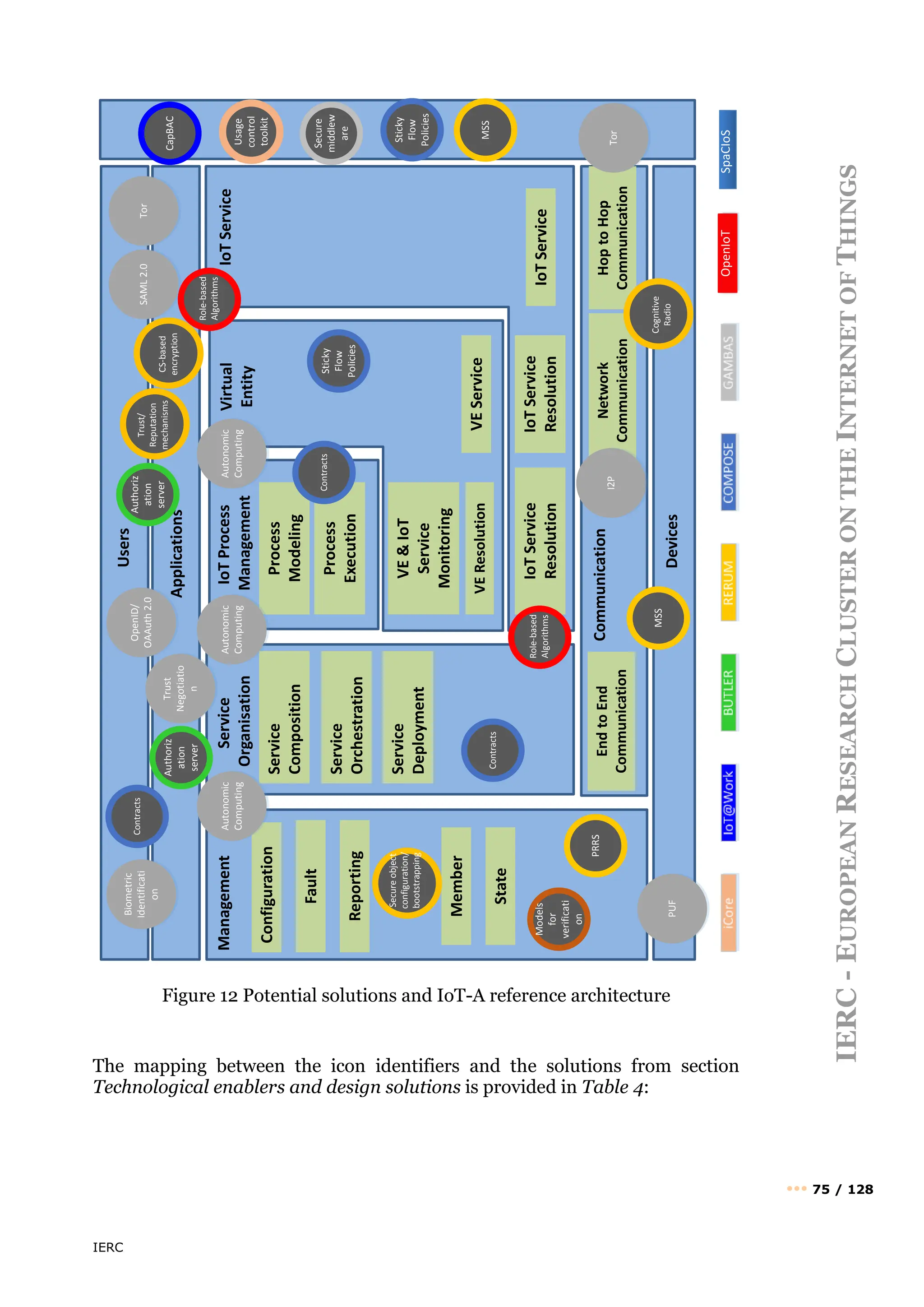
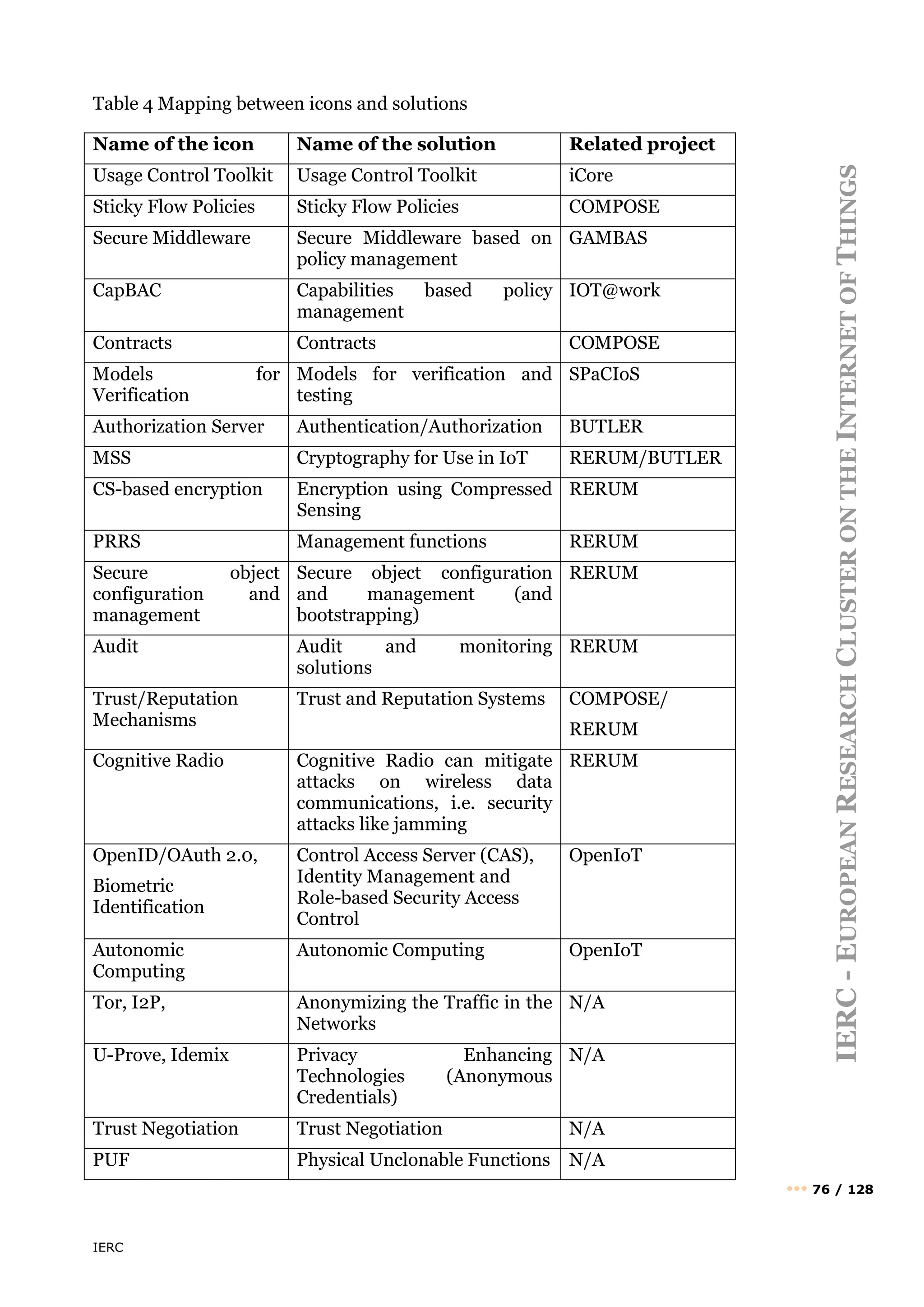
![IERC
IERC
-
E
UROPEAN
R
ESEARCH
C
LUSTER
ON
THE
I
NTERNET
OF
T
HINGS
••• 77 / 128
Most solutions can be embedded and support a specific function in the IoT-A
reference architecture, other solutions can be used in different functions. For
example, the Usage Control Toolkit can be used transversally in different
functions of the reference architecture and for this reason, it has been
positioned in the figure on the right side. Instead, the PRRS can be used to
support the Management function, while the Authentication/Authorization
from BUTLER can be used to support user/application layers and the
interaction with the other functions.
The evolution of the reference architecture is addressed in AC01 of IERC,
while specific functions are managed in specific ACs. The mapping presented
in this section is dependent on the work done in the other ACs, which will
probably modify and refine the reference architecture. As a consequence, the
brief overview presented in this section must be revisited once the work of the
other ACs is completed.
An additional task, which could be performed on the reference architecture
and the smart city scenario, is the drafting of a threat analysis in a similar way
to what has been done in IoT-A deliverable D1.5 [102] in section 5.2.9. Other
projects (e.g., BUTLER) has also worked on the identification of security and
privacy threats. A complete threat analysis has not been done here in this
phase, because the activities of the other ACs are not complete yet and a
common operational scenario (e.g., Smart City) has not been defined yet in the
IERC. Still, we believe that this would be a useful exercise in a later phase of
IERC.
In fact, BUTLER has completed the threat analysis for some use cases in IoT
and this threat analysis can be integrated in this document.
Smart City/Home scenario
In this paper, we will re-use the Smart City/Home Scenario from the iCore
project (deliverable D6.1).
The scenario is composed by the following main entities: Smart Home,
Ambulance/Hospital/Government (traffic management) and Police
department.
Today a smart home should easy up the life of the consumer with technical
devices that provide a variety of functions like remote activating/deactivating
power sockets, automatic heating systems or alarm systems. The issue from
end-user point (owner of a smart home) is to combine different sensors and
actuators without the complicated installation of various networks or even the
technical know how about those systems at all. The setup phase usually is not
applicable without technical knowledge and background information. For this
reason smart home scenarios rarely find their way into elderly home care
stations. Old people want to live on their own, but it is dangerous to be without
any care taking or without medical care a whole day. Every minute saved in
the rescue process after a heart attack or a fall is essential for survival or at
least much less painful and much less costly treatment. To gain medical
attendance or at least assisted living it is important to apply an easy-to-use
and easy-to-install care system that can fulfil different, specific user
requirements due to an easy-to-manage personalization process.](https://image.slidesharecdn.com/iercpositionpaperiotgovernanceprivacysecurityfinal-250505064116-f6f9566a/75/IERC_Position_Paper_IoT_Governance_Privacy_Security_Final-pdf-77-2048.jpg)


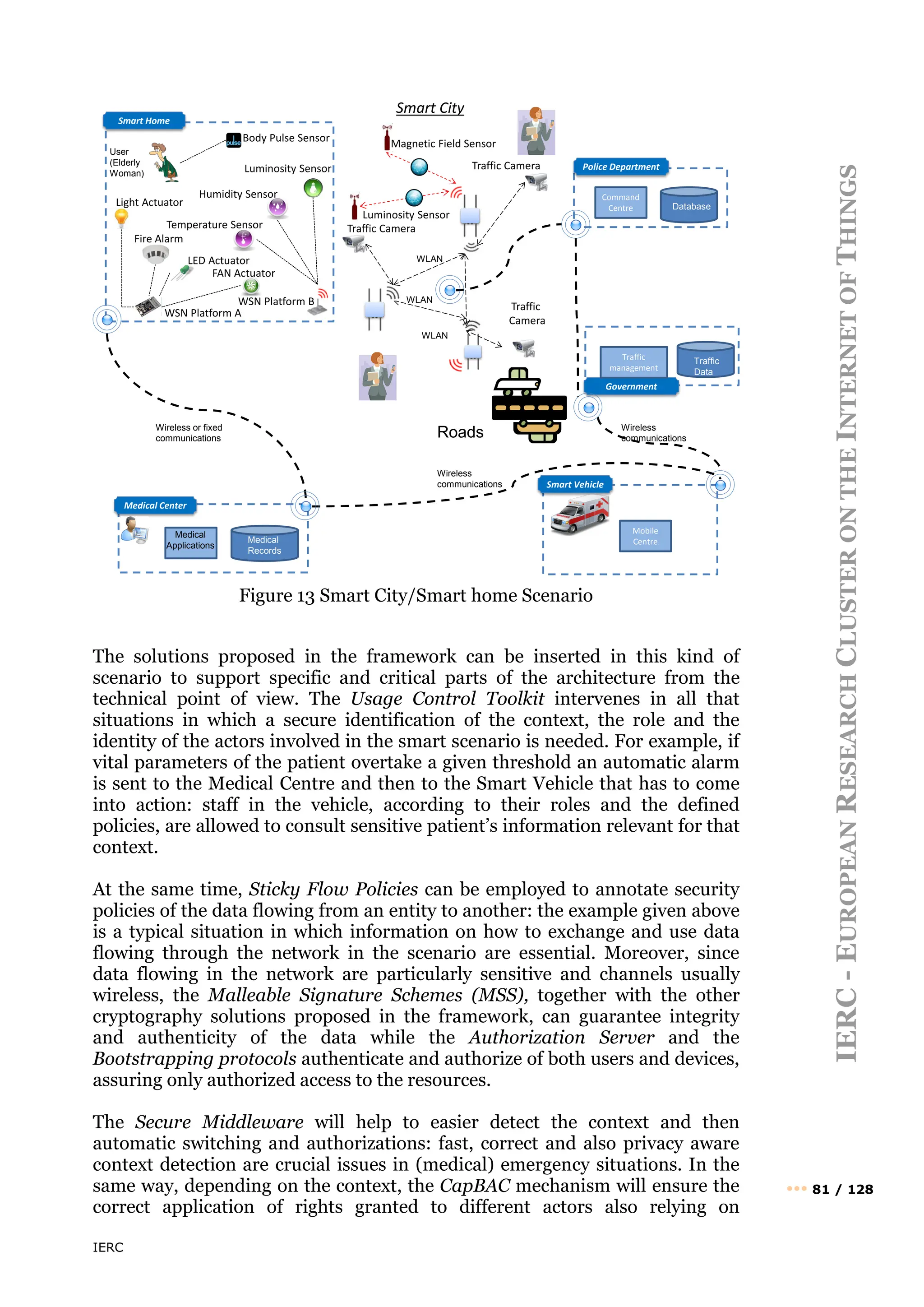
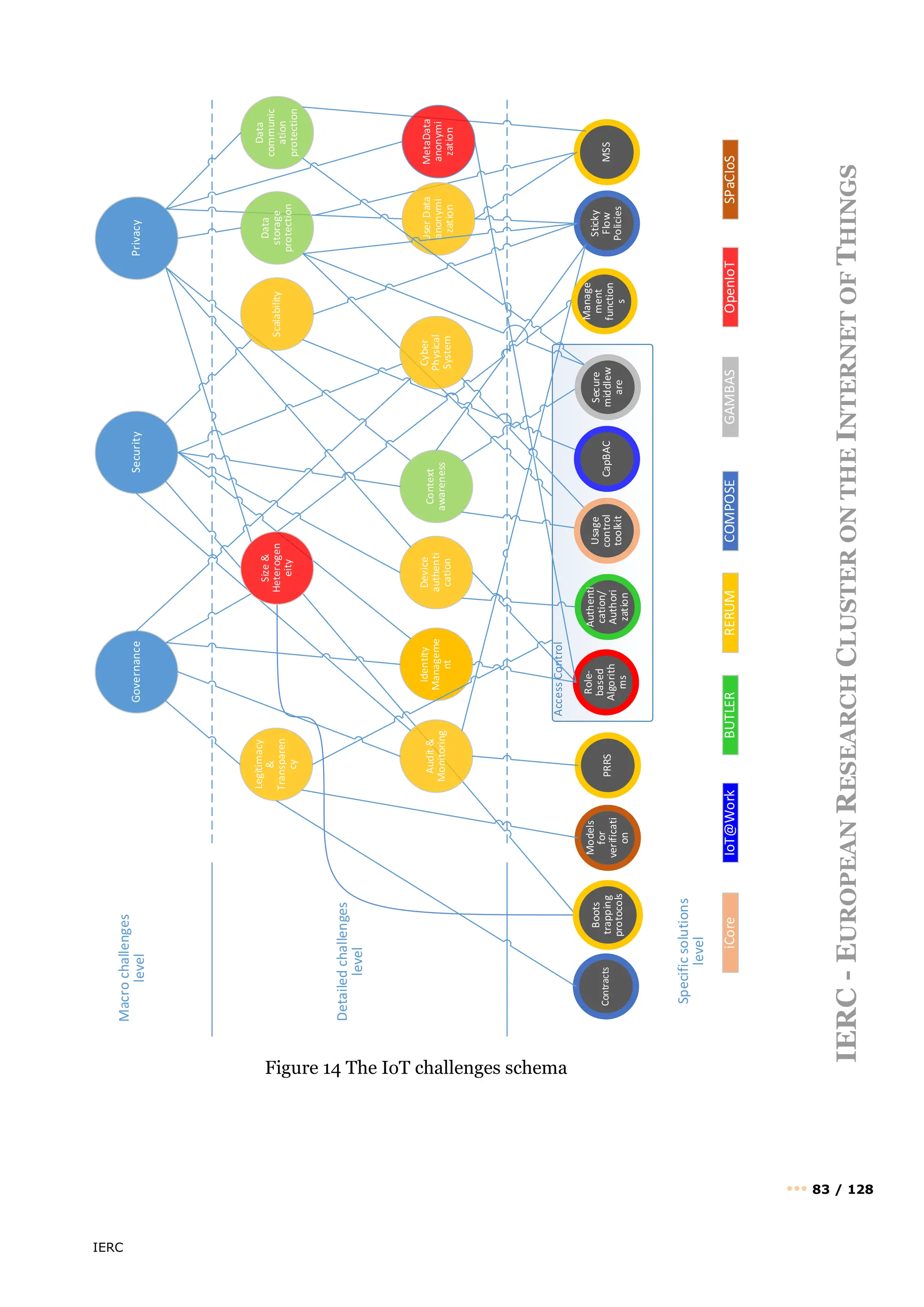
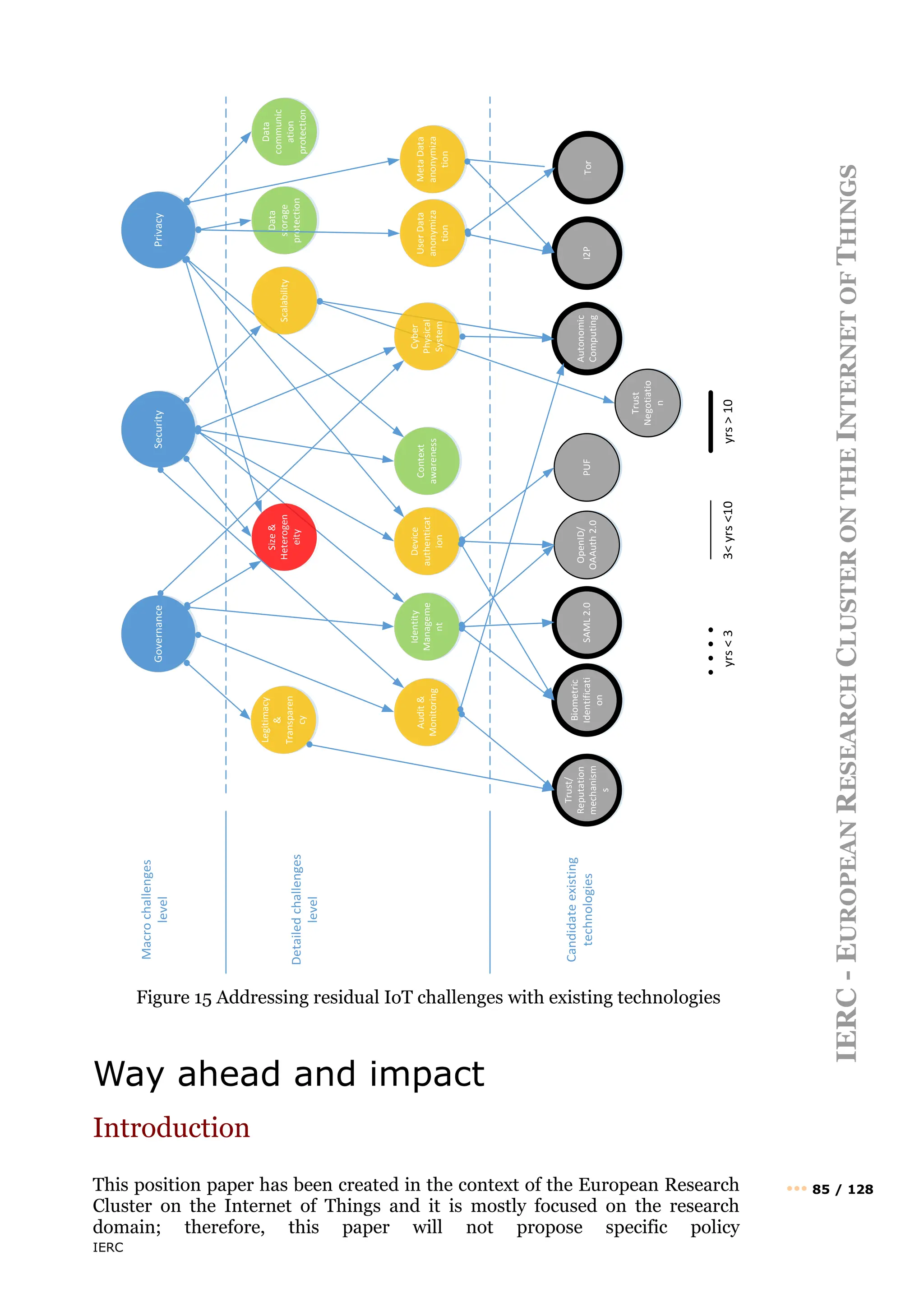
![IERC
IERC
-
E
UROPEAN
R
ESEARCH
C
LUSTER
ON
THE
I
NTERNET
OF
T
HINGS
••• 86 / 128
recommendations. Regarding specific policy recommendations, we refer to the
Communications and technical reports available on the DG CONNECT Trust
and Security page [103] and excellent report by Rand [1].
In this paper, we just present the following considerations regarding the policy
context:
1. Even if we are successful in identifying potential options for the future
research work for Governance, Ethical, Security and Privacy aspects in
IoT, we must also highlight that without policy or standardization
support, any research solution risks being non-effective and the
research work wasted.
2. IoT is going to be pervasive in many different domains with different
operational and technical requirements and various contexts. The
deployment of technical solutions to ensure anonymization or access
control can be quite different in each specific context. Research
activities should also focus on the deployment and organizational
aspects.
3. It is widely acknowledged that in order to make inroads into
establishing influence and effective controls over IoT’s overall direction
some form of global governance is needed as soon as practically
possible. Without IoT governance the adoption of an IoT supporting the
IERC definition will be challenging due to the breadth of legacy
application solutions, technologies and stakeholder interests. Those
organizations which have been promoted as IoT governance sole
custodians will require some process of adaptation enabling them to
inspire stakeholder confidence in fulfilling their principle requirements.
There is a very real potential for IoT fragmentation if adequate time and
efforts are not invested in the process of establishing IoT governance
without taking great care and paying sufficient respect to major
influencing sectors. To gain a unified cross platform and application
domain IoT will require governance. The earlier a start can be made the
more chance IoT has of being built upon broad accessibility. An IoT
governance framework offers inclusion and an influential start-point
towards the establishing of a fully effective and sustainable IoT
governance model built upon the expectations of progressive
convergence. To achieve this framework more focused governance
related efforts are required to define and analyse the variety of
governance stakeholders (who) and, in defining the initial key IoT
governance requirements metrics (what, with measurable
objectives/targets). This research would provide the basis for a
governance framework proposal which can be refined through peer
review in the establishing of an initial working model. This working
model may set-out under the leadership of one body or equally a
number of organizations, the essential aspect is that it establishes
sufficient authority through due diligence.
4. There is a tension between the anonymity of users in the IoT world and
the need by law enforcers to identify criminal activities. In this sense,
anonymity could be a double-edged sword and this aspect should be
taken in consideration in the definition of governance, security and
privacy solutions.
For the identification of the potential research activities, we also refer to the
excellent Red Book “Roadmap in the area of Systems Security” [104] produced](https://image.slidesharecdn.com/iercpositionpaperiotgovernanceprivacysecurityfinal-250505064116-f6f9566a/75/IERC_Position_Paper_IoT_Governance_Privacy_Security_Final-pdf-86-2048.jpg)
![IERC
IERC
-
E
UROPEAN
R
ESEARCH
C
LUSTER
ON
THE
I
NTERNET
OF
T
HINGS
••• 87 / 128
by SysSec consortium and its constituency. The scope of the Red Book is wider
than this position paper, which is specific for IoT, but many considerations
and recommendations from [104] can be applied for IoT as well.
At a general level, the most significant issue in IoT is the fragmentation of the
market and the IoT context in various vertical systems with specific
governance, security and privacy solutions. User (business, government,
public, etc.) requirements are the main drivers for the development of IoT
systems and infrastructures by manufacturers and service providers. The
rights of the citizen (e.g., privacy) must be guaranteed and the government can
definitively play a role in this context. The governments have the responsibility
to protect the citizen rights and this implies a political and policy stand
through concrete actions. On the other side, government actions should also
balance the risk of hampering business and market developments which could
benefit the community and improve the technological evolution and
competitiveness of the European Union.
Research Opportunities
More specifically and with reference to the gaps identified in Framework
against the challenges, we can identify the following research opportunities:
• Usability in Authentication (also mentioned in [104]). There is a
considerable gap between security and usability in current forms of
authentication. Researchers have defined strong authentication
mechanisms, but the generic user may have difficulty to use them
because they are difficult to implement or apply (see digital divide
challenge). On the other hand, security mechanisms (text-based
passwords or 4-digit PINs), which are easier to use can provide low
security guarantees. One research challenge is to invent new rich
authentication mechanisms, variants or combinations of the currently
existing ones that provide better security without sacrificing usability.
• Design methodology to mitigate the digital divide
To address ethical needs, usability needs to be ensured by design that
incorporates diverse range of needs of heterogeneous population -even
when age-segmented, provides aesthetically pleasing and intuitive
solutions that encourage an older user rather than promote a feeling of
inadequacy. Older users should be a part of the design process in all its
stages following the co-creation and co-design approaches. The product
design should be focused on promotion of Design For All methodology
rather than niche solutions. The design phase of mass produced ICT
products should consider how these products could be easily and
cheaply adopted as products by citizens and namely by older users.
Many of the ethical and regulatory issues associated with e-health and
telemedicine are well documented, particularly privacy and data
protection, informed consent, equity and accessibility. Further research
is needed to consider less recognized implications, such as the risk of
confinement, social isolation, the potential of a person’s home
becoming their health clinic, risks associated with quality of online
professional practice and electronic health resources, regulation of
online research with a view of protecting the privacy of contributions,](https://image.slidesharecdn.com/iercpositionpaperiotgovernanceprivacysecurityfinal-250505064116-f6f9566a/75/IERC_Position_Paper_IoT_Governance_Privacy_Security_Final-pdf-87-2048.jpg)
![IERC
IERC
-
E
UROPEAN
R
ESEARCH
C
LUSTER
ON
THE
I
NTERNET
OF
T
HINGS
••• 88 / 128
and impact of ICT technology adoption on the user relationships and
potential changes to personal responsibility.
• Policy management access control has been proposed by various
projects with different names in the IERC cluster (see Solutions from
Clusters projects). The European research community has a sufficient
level of knowledge in this area to progress on a next step to develop a
complete framework, which can be standardized and made available to
the community. In particular, the framework can be used to support
mobile security and deployed on mobile platforms (e.g., based on
android) to support security and privacy of the users even from their
mobile devices. The definition of this access control will target
significant challenges identified in this paper and other references: the
capability to provide control to the user and his/her data and the
capability to enforce regulations, best practices or soft laws through
policies.
• Certification of IoT services. As described before, there should be a
way to provide a level of confidence for trust of entities, which provide
IoT services to the user. While organizations and regulators aspects can
be preeminent in “certifying” an IoT Service (e.g., a web server or a
device), technical solutions can be provided to support the certification
process. One example is the validation and modelling tool defined in
Models for verification and testing.
• Trust, Reputation and Identity management frameworks,
which can provide a complete and coherent mechanism to the user.
While specific solutions have already been identified in Technological
enablers and design solutions, more work must be done in defining a
coherent framework and investigate the deployment challenges (see
also section 21 and 25 of [104]). Research efforts should be directed to
address interoperability issues among different IoT service providers
and usability for the users. The identity inheritance process between an
user and its IoT devices should also be deeply investigate, to enforce the
control the citizen should have on the IoT device actions when
operating in his name
• IoT information flow control, privacy and IoT data fusion. IoT
promises to be more and more pervasive in the coming future. Sensors
and smart devices will collects and transmit huge amount of data. In
several cases, data collected by a single IoT device will not infringe
relevant portions of the citizen privacy. However aggregation of huge
amount of data coming from geographically and logically sparse
sensors, can jeopardise the privacy of the citizen. Frameworks allowing
to perform, given a set of policies, trusts, privacy-preserving data fusion
and mining, would be required to exploit the huge potentialities of the
IoT data collection capability, while at the same time protecting and
preserving the citizen’s privacy right.
• IoT authentication and communication’s integrity.
Authentication and confidentiality are normally achieved through the
use of traditional crypto-systems, generally based on PKI paradigms.
However, IoT is, by definition, composed by fully distributed systems,
with discontinuous connection availability and, not rarely, with energy-
consumption and computational power constraints. Under this light,
new, distributed and lightweight authentication and integrity
frameworks should be explored to cope with the peculiarities of IoT
devices.](https://image.slidesharecdn.com/iercpositionpaperiotgovernanceprivacysecurityfinal-250505064116-f6f9566a/75/IERC_Position_Paper_IoT_Governance_Privacy_Security_Final-pdf-88-2048.jpg)
![IERC
IERC
-
E
UROPEAN
R
ESEARCH
C
LUSTER
ON
THE
I
NTERNET
OF
T
HINGS
••• 90 / 128
made available for free (downloadable) by the EU
to support the privacy and security of the citizen.
The toolkit could be created in combination with
other existing tools (e.g., Tor). The toolkit could be
easy to download from an EU web page and it
should be easy to install (e.g., like an application or
anti-virus). While a Horizon 2020 project could
complete the framework, the deployment and
maintenance of this framework could be
challenging and would require the support of a
private company.
Usability in
Authentication
Based upon existing and anticipated IoT use cases
establish the criteria and measures for determining
usability as a benchmark for future research and
standardization prioritization. Define best practices
and guidelines to improve the usability of
authentication solution once they are deployed in
the market.
Design methodology to
mitigate the digital
divide
Research in a Design For All methodology for all
class of users rather than niche solutions for
specific classes of customers. The design phase of
mass produced ICT products should consider how
these products could be easily and cheaply adopted
as products by citizens and namely by older users.
Certification of IoT
services
The definition of tools to validate and certify an IoT
service could support the certification process
described in Article 39 of [105] (REGULATION OF
THE EUROPEAN PARLIAMENT AND OF THE
COUNCIL on the protection of individuals with
regard to the processing of personal data and on the
free movement of such data)
Trust, Reputation and
Identity management
frameworks
Develop the key common criteria which ensure
interoperability between IoT cross domain
applications through exploitation of the governance
framework (see Governance Framework Study and
Support Action).
Develop trust and reputation mechanisms, which
could support the interaction between user and IoT
services. In a similar way to Certification of IoT
services, these mechanisms could assess the level of
trust of IoT services and provide an indication to
the user. The mechanisms could be embedded in
standards, recommended as best practices for IoT
development or requested by regulations.
IoT information flow
control, privacy and IoT
data fusion
Based upon the established IoT Architectural
Reference Model (ARM) determine the control of
information flow from digital device (e.g. smart
phone) to Cloud and, addressing potential security
threats to data governance.
IoT authentication and As above but focused upon common shared](https://image.slidesharecdn.com/iercpositionpaperiotgovernanceprivacysecurityfinal-250505064116-f6f9566a/75/IERC_Position_Paper_IoT_Governance_Privacy_Security_Final-pdf-90-2048.jpg)
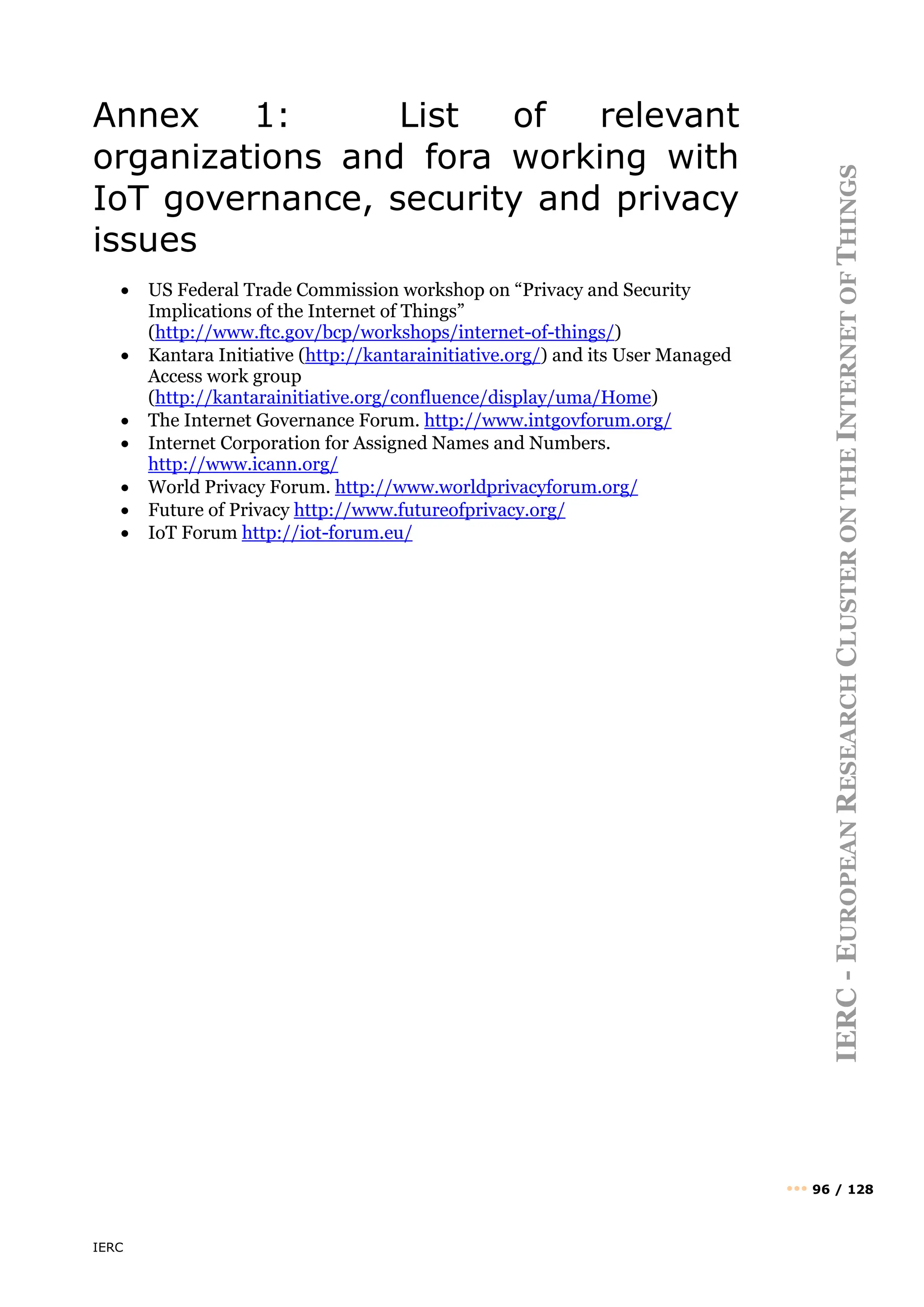
![IERC
IERC
-
E
UROPEAN
R
ESEARCH
C
LUSTER
ON
THE
I
NTERNET
OF
T
HINGS
••• 97 / 128
Annex 2: Terms, Abbreviations and
Definitions
This position paper use terms, which have different definitions in different
domains. The objective of this annex is to provide a description of the main
definition with the identification of the source where the definition comes
from. In some cases, more than one definition is proposed.
Acronym Meaning
3GPP 3rd Generation Partnership Project
6LoWPAN IPv6 over Low power Wireless Personal Area Networks
Specification for high-level communication protocols
using radios based on the IEEE 802.15.4 standard for
wireless sensor networks. Supports IPv6 address.
AAL Ambient Assisted Living
Access Control 'Access control' is the prevention of unauthorized use
of a resource, including the prevention of use of a
resource in an unauthorized manner. [106]
ACID Atomicity, Consistency, Isolation, Durability
ACL Access Control List
Active tag An RFID tag that uses a transmitter to return
information as opposed to reflecting a signal back from
the reader as a passive tags do. Most active tags are
battery powered, though they may gather energy from
other sources. Typical, active tags can be read from up
to 100 meters.
Agile Reader An RFID reader that reads tags operating at different
frequencies or using different methods of
communication between RFID tag and reader.
AIDC Automatic identification and data capture. A broad
term that covers methods of identifying objects,
capturing information about them and entering it
directly into computer systems without human
involvement. Technologies normally considered part of
auto-ID include bar codes, biometrics, RFID and voice
recognition.
AIM 1) Automatic identification manufacturers.
2) Association for Automatic Identification and
Mobility. Global trade association that provides
products and services related to data collection,
automatic identification, and information management
systems.
Air Interface
Protocol
Rules that govern how RFID tags and RFID readers
communicate.
AMR Automatic Meter Reading Technology](https://image.slidesharecdn.com/iercpositionpaperiotgovernanceprivacysecurityfinal-250505064116-f6f9566a/75/IERC_Position_Paper_IoT_Governance_Privacy_Security_Final-pdf-97-2048.jpg)
![IERC
IERC
-
E
UROPEAN
R
ESEARCH
C
LUSTER
ON
THE
I
NTERNET
OF
T
HINGS
••• 98 / 128
Antenna The conductive element to send and receive tag data.
Passive low- frequency tags (135 kHz) and high-
frequency tags (13.56 MHz) use a coiled antenna that
couples with the coiled antenna of the reader to form a
magnetic field. Readers have antennas that are used to
emit radio waves. The RF energy from the reader
antenna is “harvested” by the tag antenna and used to
power the tag microchip to reflect back its signal back
to the reader.
Anti-collision A general term used to cover methods of preventing
radio waves from one device from interfering with
radio waves from another. Anti-collision algorithms are
also used to read more than one tag in the same
reader’s field.
API Application Programming Interface
Applicator A label-printing device to print and apply pressure-
sensitive labels to RFID tags. Pressure sensitive labels
consist of a substrate and an adhesive. Used for
shipping, content, graphic images or complying with
standards such as UPC or GS1.
ARM Architecture Reference Model
ASCII American Standard Code for Information Interchange.
The code is used in the transmission of data. It consists
of eight data-bits used to code each alphanumeric
character and other symbols.
Asset tracking The most common RFID tag application. RFID asset
tagging increases asset utilization, identifies the last
known asset user, reduces lost items and automates
maintenance routines.
Authentication A security mechanism allowing the verification of the
provided identity. [106]
Authorization Granting of rights to perform some activity to some
entity, human agent or process until revoked. [106]
Auto-ID center and
labs
A non-profit collaboration between private enterprise
and researchers for the development of a global
tracking network using RFID tags carrying Electronic
Product Codes (EPCs). The center closed in Sep. 2003.
The center’s research continues at Auto-ID Labs in
universities around the world, and is headquartered at
the Massachusetts Institute of Technology.
Automatic
identification
Methods to collect data and enter into computer
systems without human involvement. Technologies
normally considered part of auto-ID include bar codes,
biometrics, RFID and voice recognition.
AWARENESS EU FP7 coordination action
Self-Awareness in Autonomic Systems
Backscatter A method of communication between passive (or semi-](https://image.slidesharecdn.com/iercpositionpaperiotgovernanceprivacysecurityfinal-250505064116-f6f9566a/75/IERC_Position_Paper_IoT_Governance_Privacy_Security_Final-pdf-98-2048.jpg)
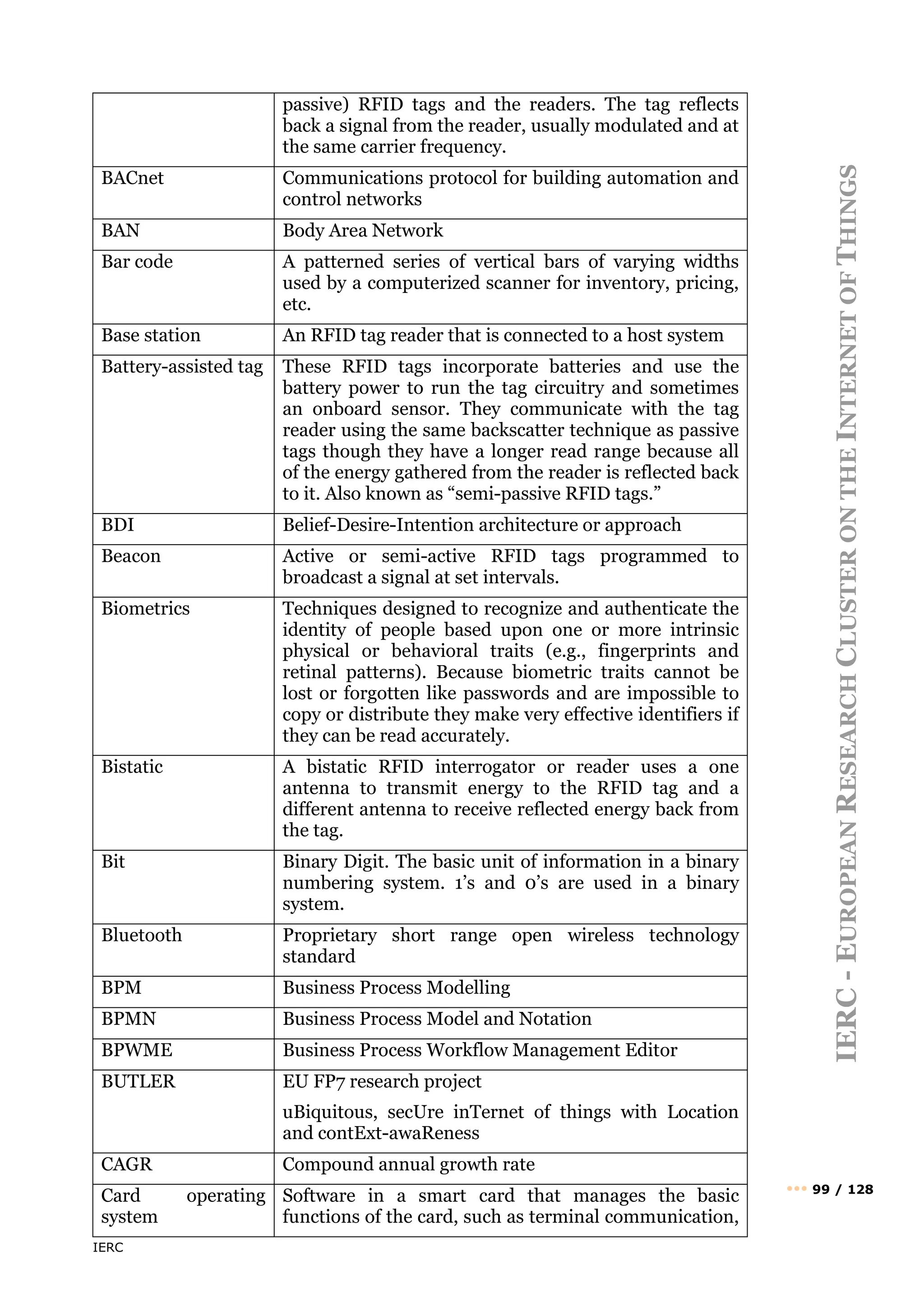
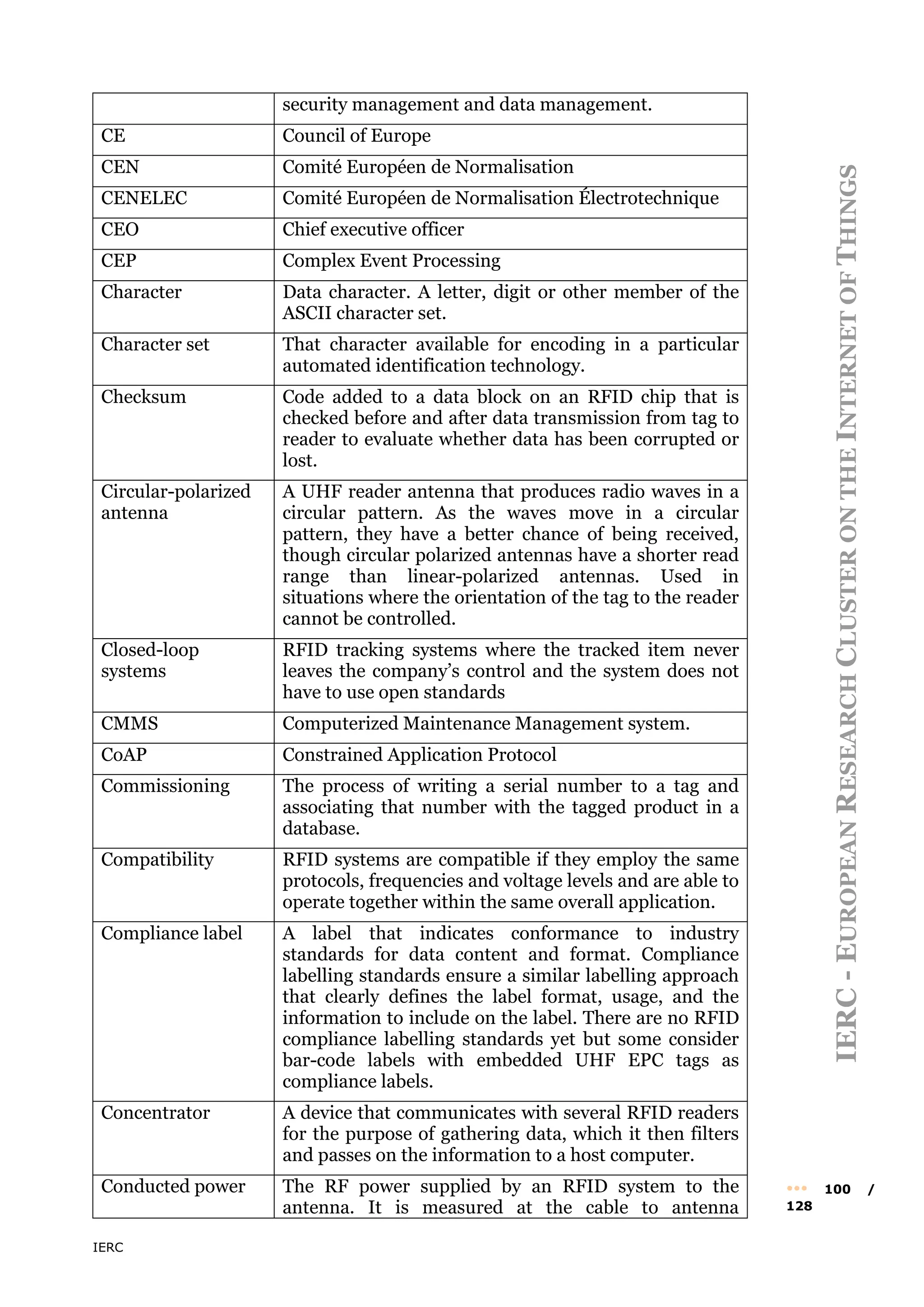
![IERC
IERC
-
E
UROPEAN
R
ESEARCH
C
LUSTER
ON
THE
I
NTERNET
OF
T
HINGS
••• 101 /
128
connection. In the U.S., Federal Communication
Commission regulations limit maximum conducted
power to 1 watt.
Contact less smart
card
A credit card or other card incorporating an RFID chip
to transmit information to a reader without having to
be swiped.
CRC Cyclic Redundancy Code/Check.
The CRC-16 is used as error detection code for the
backscattering operation of the tag. If errors are
detected, the tag will retransmit the involved data to
the reader.
CRUD Create, Updated, Delete
CSS Chirp Spread Spectrum
D1.3 Deliverable 1.3
Data carrier A medium for storing machine-readable data, such as
bar codes and RFID tags. May also refer to the carrier
frequency for data transmission.
Data field RFID chip memory assigned to a particular data type.
Data fields may be protected or written over. For
example, a data field might contain information about
where an item should be sent, and when the
destination changes the new information is written to
the field. A protected data field could be used to store
an Electronic Product Code, which doesn’t change
during the life of the product it’s associated with.
Data retention RFID tags can retain data for over 10 years depending
on temperature, humidity and other factors.
Data subject's
consent
The 'data subject's consent' shall mean any freely given
specific and informed indication of his wishes by which
the data subject signifies his agreement to personal
data relating to him being processed. [107]
Data transfer rate Number of characters that can be transferred from
RFID tag to reader over a specified time. Baud rate
defines how quickly readers can read information on a
RFID tag, and is different from read rate, which refers
to how many tags can be read over a specified time.
DATEX-II Standard for data exchange involving traffic centres
DCA Data Collection and Analysis
Dead tag An RFID tag that cannot be read by a reader.
De-tune When a UHF antenna is placed close to metal or
metallic material, the antenna can be detuned to better
receive RFID waves of a certain length from a reader so
that the RFID tag can be read, but results in poor
performance. OMNI-ID tags do not need to be de-
tuned.
DHT Distributed Hash Table](https://image.slidesharecdn.com/iercpositionpaperiotgovernanceprivacysecurityfinal-250505064116-f6f9566a/75/IERC_Position_Paper_IoT_Governance_Privacy_Security_Final-pdf-101-2048.jpg)
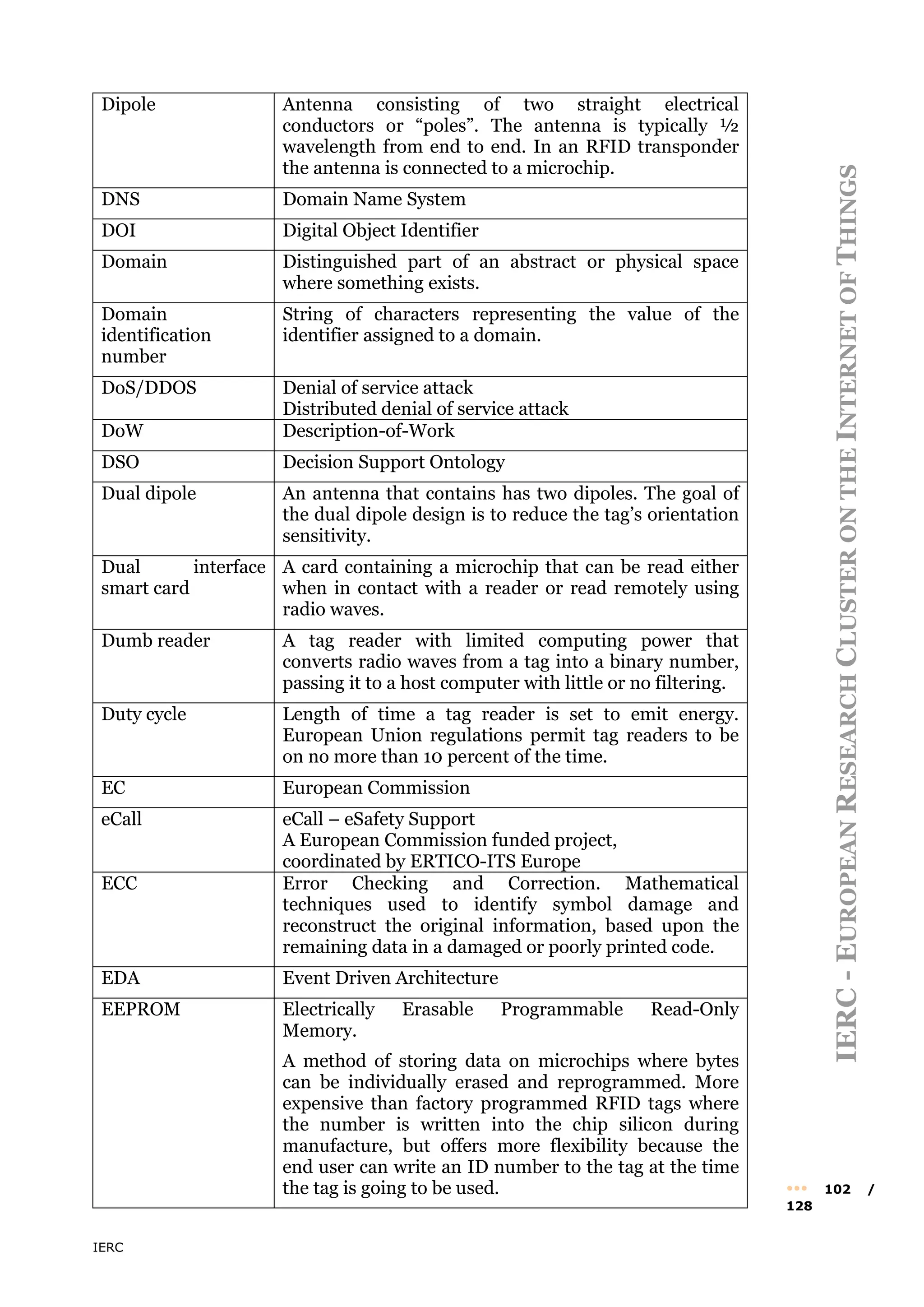
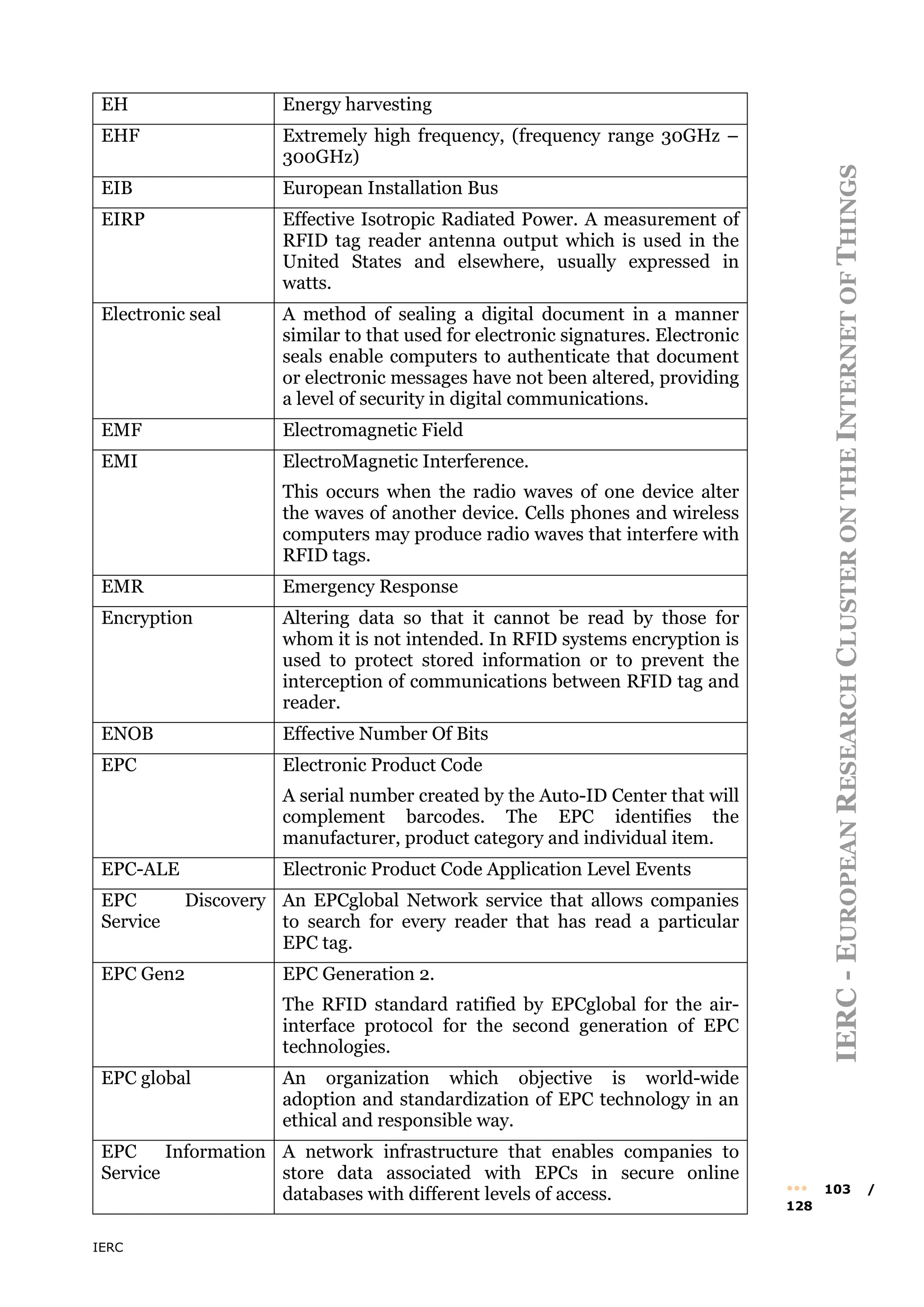
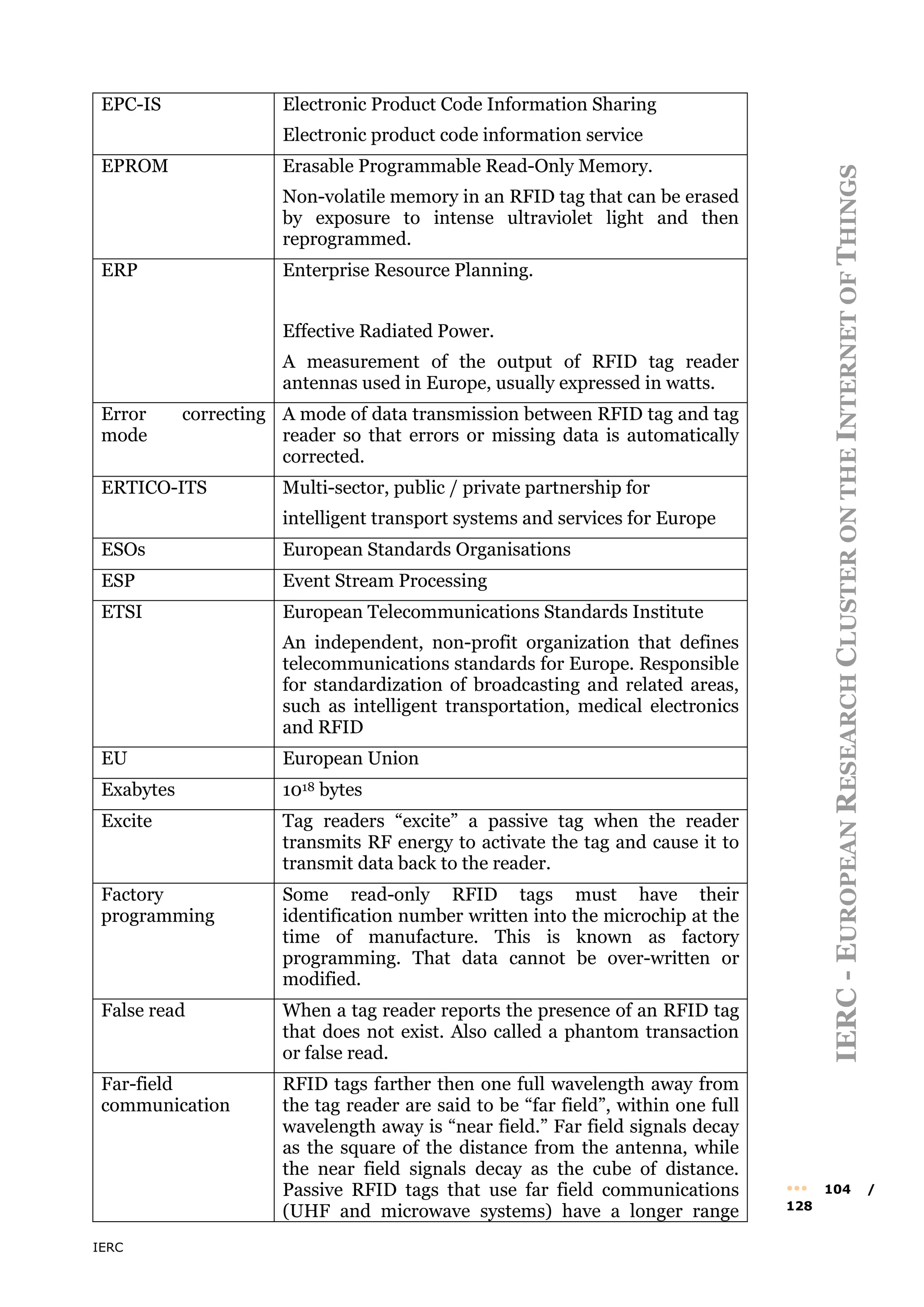
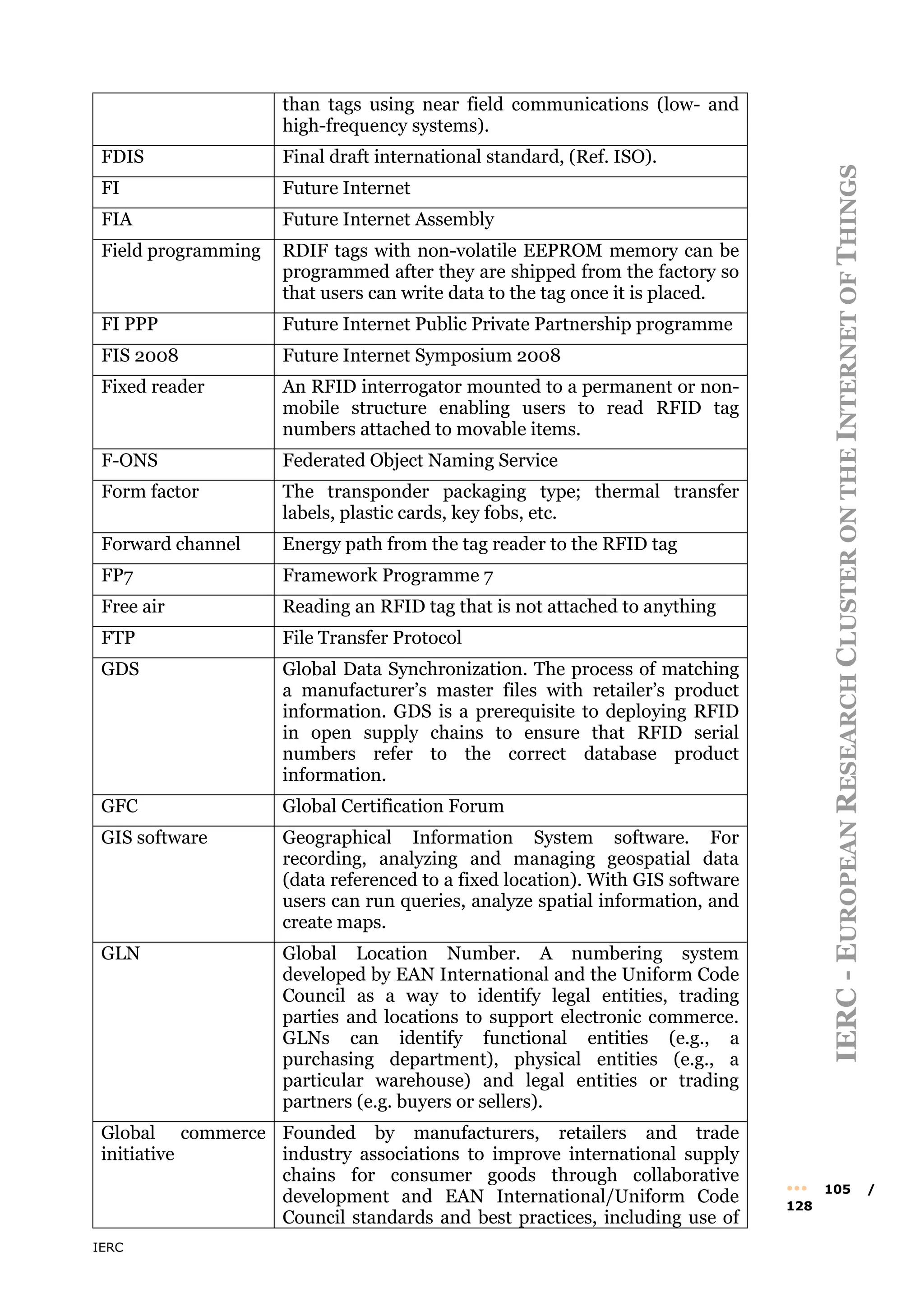
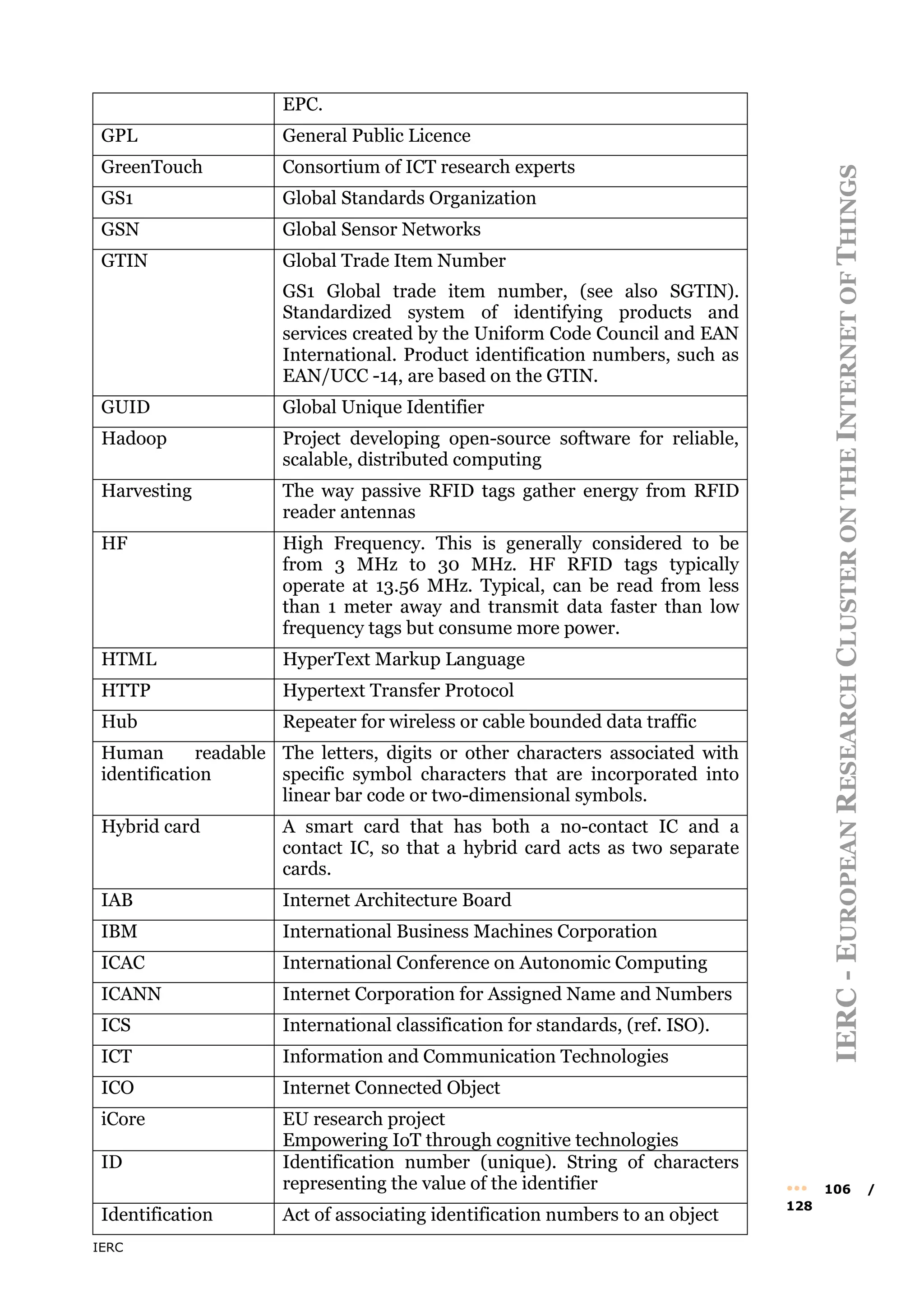
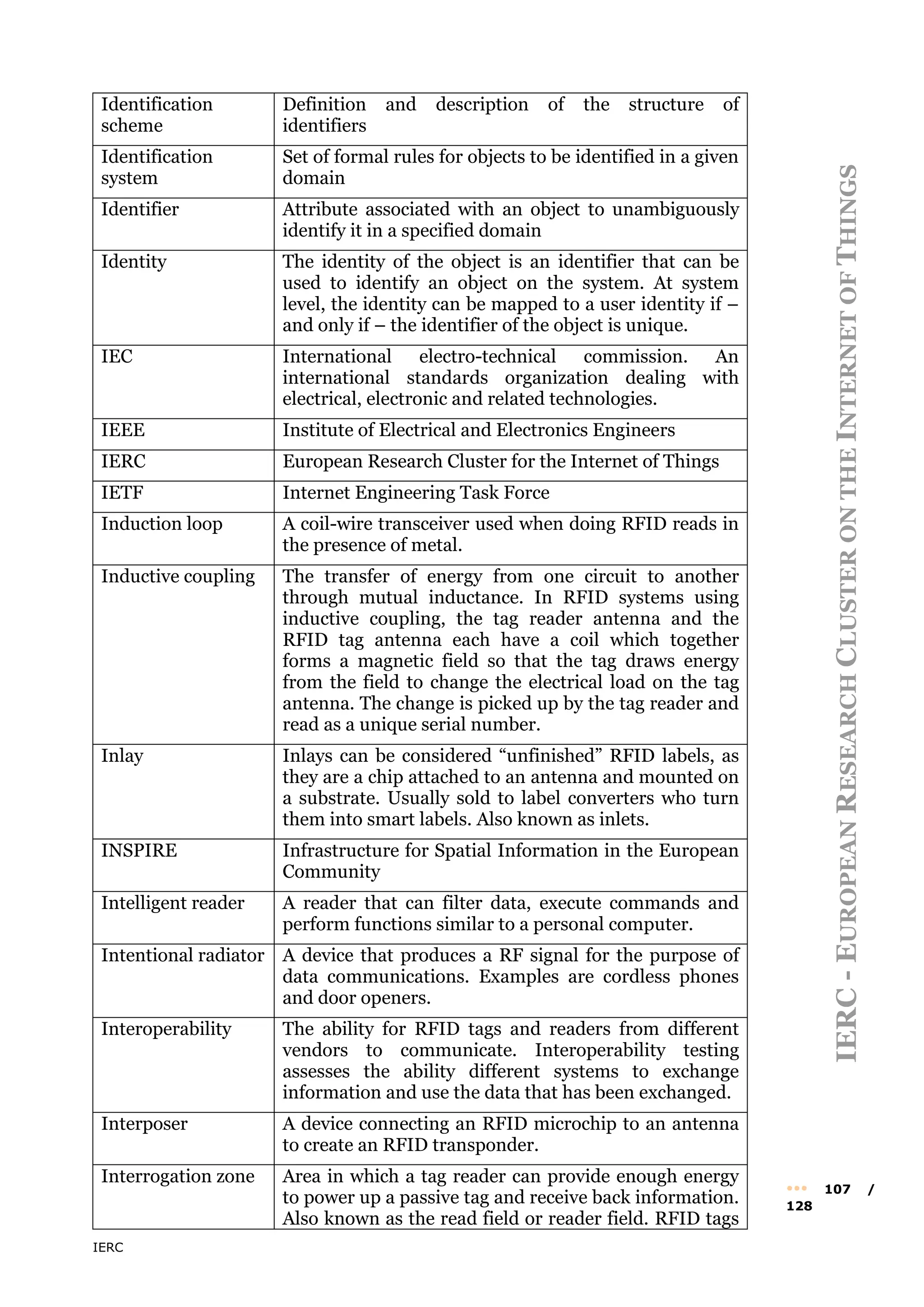
![IERC
IERC
-
E
UROPEAN
R
ESEARCH
C
LUSTER
ON
THE
I
NTERNET
OF
T
HINGS
••• 108 /
128
located outside the interrogation zone do not receive
enough energy from the reader to produce a signal.
Interrogator See Reader.
IO Integrated Operations
I/O port Input/Output port. Connections on an RFID reader for
external devices. An output device could be a panel that
opens when a tag is read. An input device could be a
photoelectric eye to turn on the reader when an object
breaks the beam.
IoE Internet of Energy
IoM Internet of Media
IoP Internet of Persons
IoS Internet of Services
A software based component that is delivered via
different networks and Internet. The Internet of
Services based on RFID applications has to address the
privacy issues. IoS is not just about technology, but also
about usage, community building, deployment,
business models, public policy, security and privacy.
IoT Internet of Things
a) The Internet of Things is a global infrastructure for
the Information Society, enabling advanced services
by interconnecting (physical and virtual) things
based on, existing and evolving, interoperable
information and communication technologies.
[108]
b) The Internet of Things builds out from today’s
internet by creating a pervasive and self-organising
network of connected, identifiable and addressable
physical objects enabling application development
in and across key vertical sectors through the use of
embedded chips, sensors, actuators and low-cost
miniaturisation [1]
c) A dynamic global network infrastructure with self-
configuring capabilities based on standard and
interoperable communication protocols where
physical and virtual “things” have identities,
physical attributes, and virtual personalities and
use intelligent interfaces, and are seamlessly
integrated into the information network. “Things”
are expected to become active participants in
business, information and social processes where
they are enabled to interact and communicate
among themselves and with the environment by
exchanging data and information “sensed” about
the environment, while reacting autonomously to
the “real/physical world” events and influencing it
by running processes that trigger actions and create
services with or without direct human intervention.](https://image.slidesharecdn.com/iercpositionpaperiotgovernanceprivacysecurityfinal-250505064116-f6f9566a/75/IERC_Position_Paper_IoT_Governance_Privacy_Security_Final-pdf-108-2048.jpg)
![IERC
IERC
-
E
UROPEAN
R
ESEARCH
C
LUSTER
ON
THE
I
NTERNET
OF
T
HINGS
••• 109 /
128
Interfaces in the form of services facilitate
interactions with these “smart things” over the
Internet, query and change their state and any
information associated with them, taking into
account security and privacy issues.
IoT6 EU FP7 research project
Universal integration of the Internet of Things through
an IPv6-based service oriented architecture enabling
heterogeneous components interoperability
IoT-A Internet of Things Architecture
IoT-est EU ICT FP7 research project
Internet of Things environment for service creation and
testing
IoT Governance There are still conflicting opinions on what IoT
Governance should be (TBD) (see also [6])
IoT-GSI Internet of Things Global Standards Initiative
IoT-i Internet of Things Initiative
IoV Internet of Vehicles
IP Internet Protocol
IPSO Alliance Organization promoting the Internet Protocol (IP) for
Smart Object communications
IPv6 Internet Protocol version 6
ISA100 Specification for high-level communication protocols
using radios based on the IEEE 802.15.4 standard for
industrial applications.
ISM frequency
bands
Industrial, scientific, and medical frequency bands.
ISO International Standards Organization
ISO 19136 Geographic information, Geography Mark-up
Language, ISO Standard
Issuing
organization/issuing
agency
Organization being entrusted by a registration authority
to assign identification numbers in a given domain.
IST Intelligent Transportation System
IT Information technology.
ITS Intelligent Transport Systems
JCA-IoT Joint Coordination Activity on Internet of Things
JSF Java Server Faces
KNX Standardized, OSI-based network communications
protocol for intelligent buildings
KU-tag An RFID tag that reads objects containing metal or
liquid. At just 1.5 millimetres in thickness it is one of the
thinnest RFID tags designed to operate under such](https://image.slidesharecdn.com/iercpositionpaperiotgovernanceprivacysecurityfinal-250505064116-f6f9566a/75/IERC_Position_Paper_IoT_Governance_Privacy_Security_Final-pdf-109-2048.jpg)
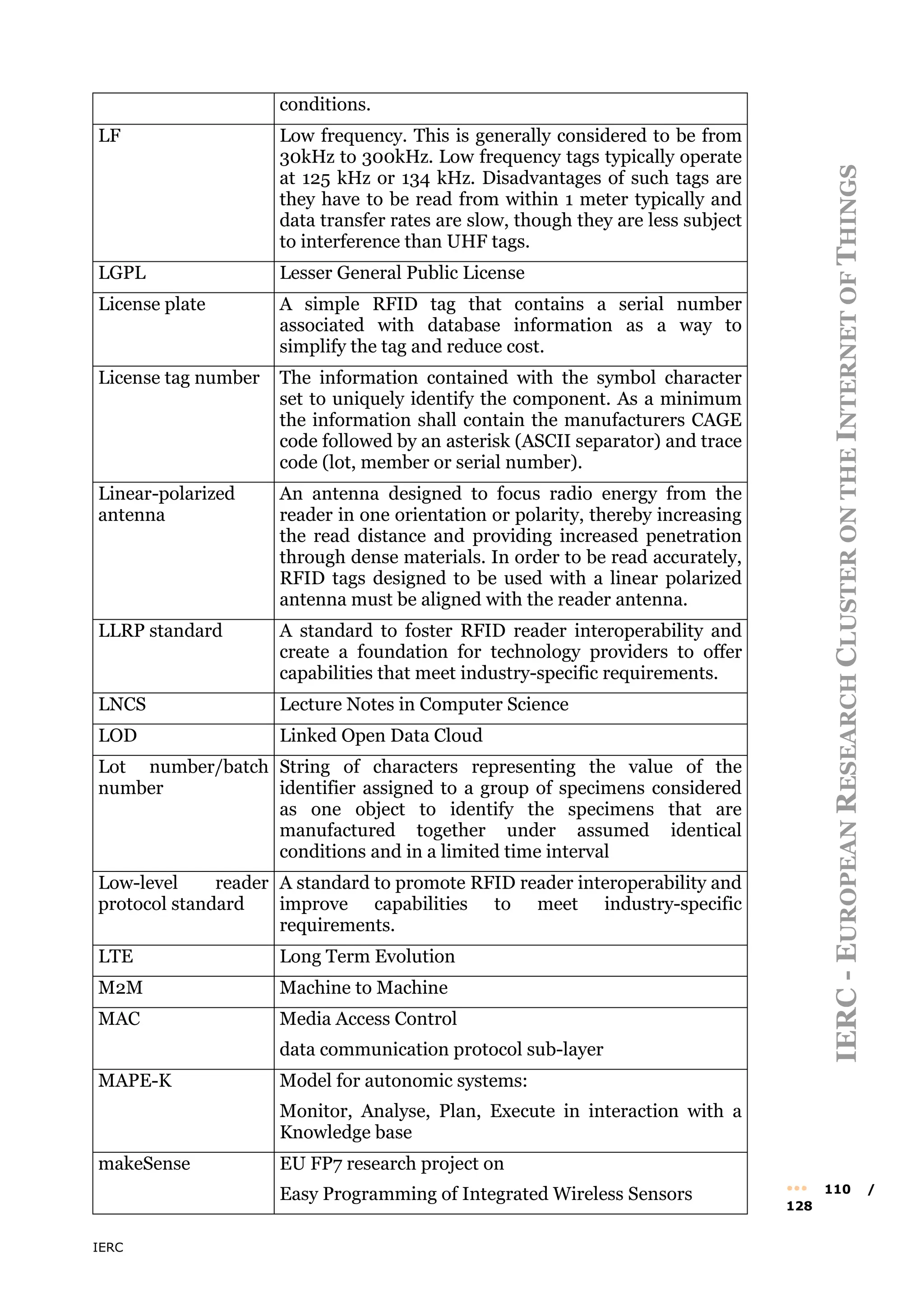
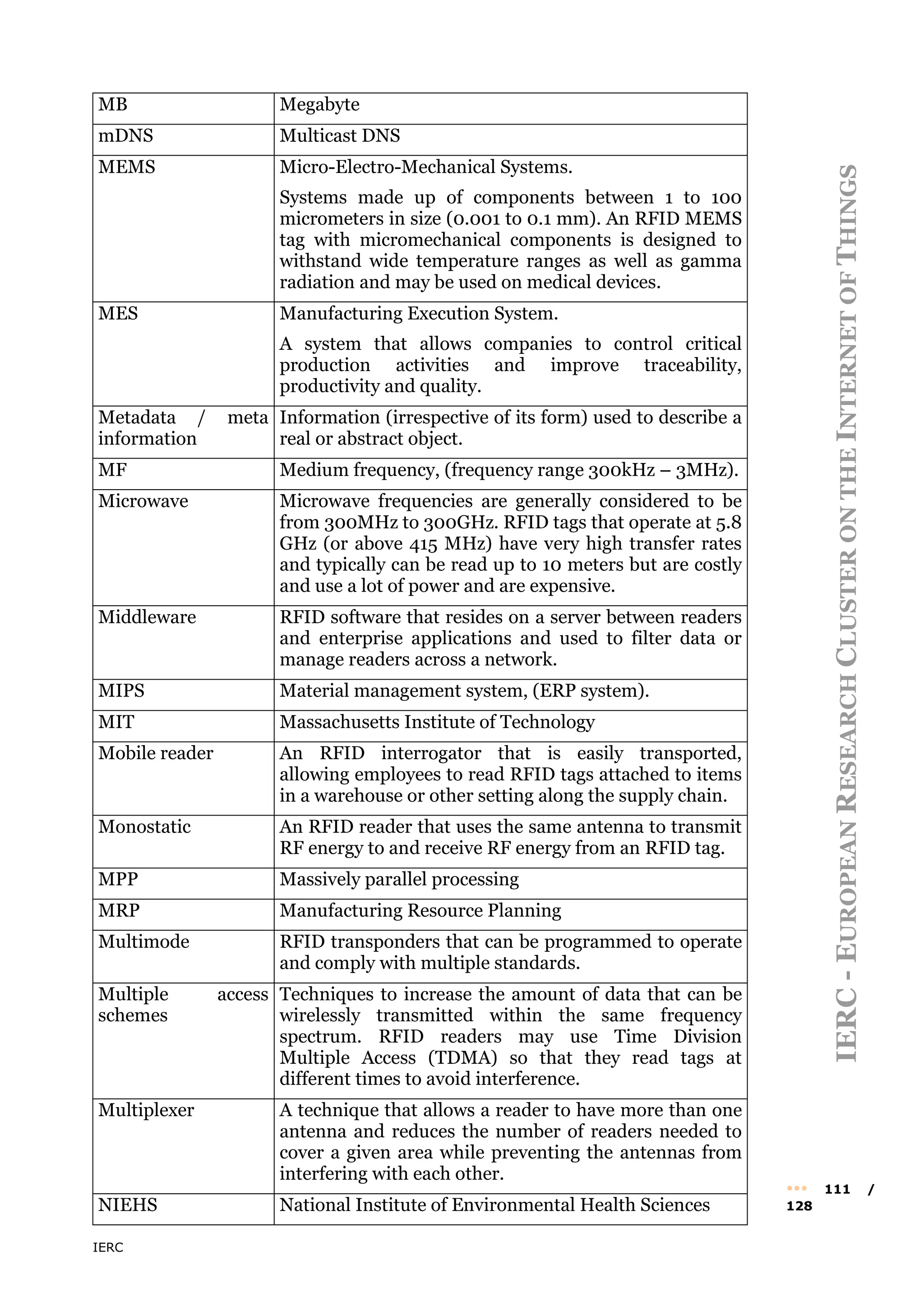
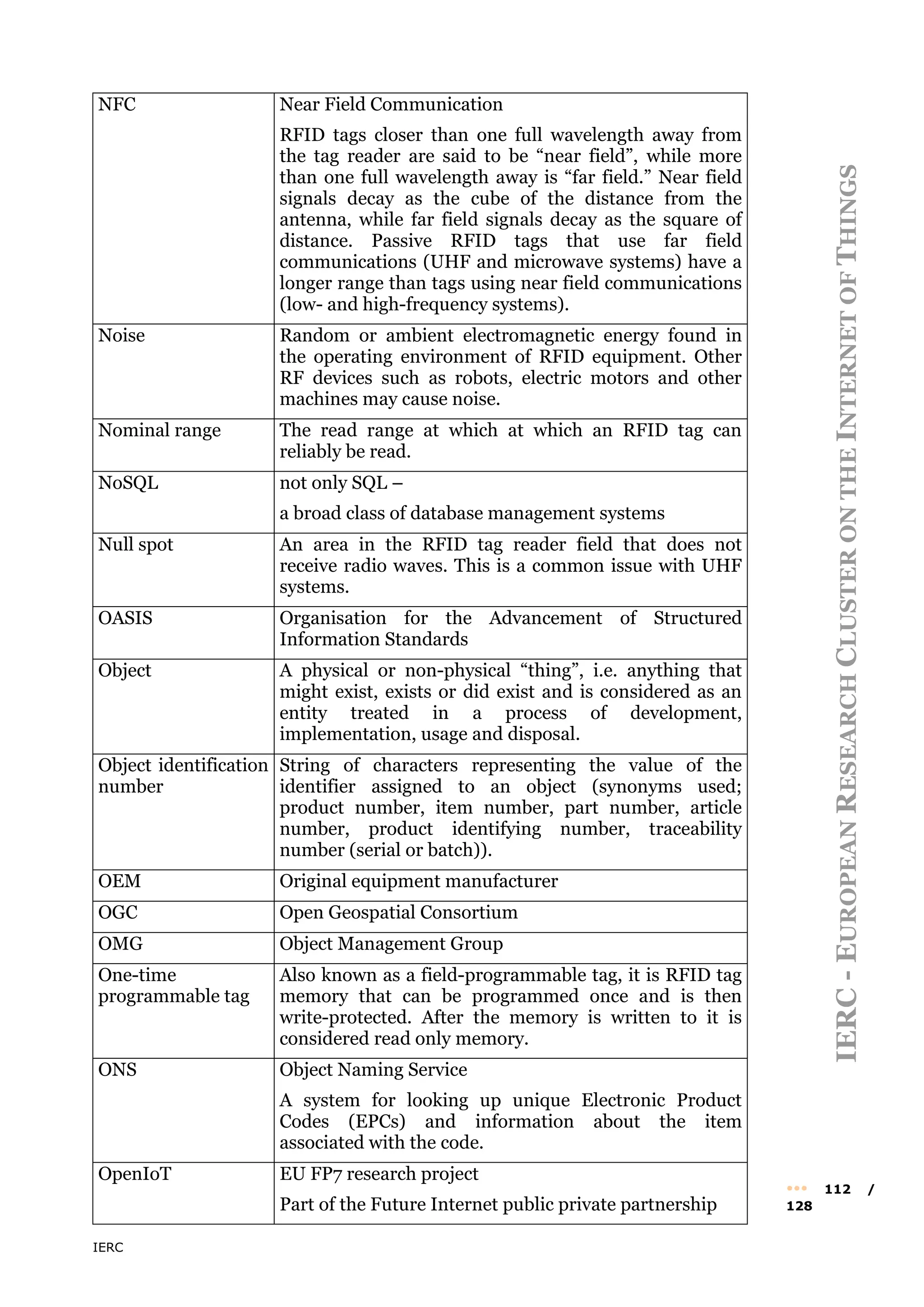
![IERC
IERC
-
E
UROPEAN
R
ESEARCH
C
LUSTER
ON
THE
I
NTERNET
OF
T
HINGS
••• 113 /
128
Open source blueprint for large scale self-organizing
cloud environments for IoT applications
Orientation Position of a reader antenna in reference to a tag
antenna. In UHF systems reader antennas can be
linear- or circular-polarized. When using a linear
polarized antenna the tag and reader must be in
alignment to achieve the maximal reading distance.
Outsmart EU project
Provisioning of urban/regional smart services and
business models enabled by the Future Internet
PAN Personal Area Network
Part identification
data
Markings used to relate parts to their design,
manufacturing, test, and operational histories.
Passive tag RFID tag without an internal battery or power source.
The energy is gathered from the reader, these radio
waves are converted by the tag antenna into current.
The tag reflecting back the signal (modulated) from the
reader.
Patch antenna A square reader antenna made from metal or foil.
PDA Personal Digital Assistant
Personal Data Assistant
Personal Data 'Personal data' shall mean any information relating to
an identified or identifiable natural person ('data
subject'); an identifiable person is one who can be
identified, directly or indirectly, in particular by
reference to an identification number or to one or more
factors specific to his physical, physiological, mental,
economic, cultural or social identity. [107]
PET Privacy Enhancing Technologies
Petabytes 1015 byte
Phantom read When a reader reports the presence of a tag that doesn’t
exist. Also called a false read or phantom transaction.
PHY Physical layer of the OSI model
PIPES Public infrastructure for processing and exploring
streams
PKI Public key infrastructure
Power level The amount of RF energy emitted from an RFID tag
reader. The higher the power output the longer the read
range. Many countries regulate power levels to avoid
interference with other devices.
PPP Public-private partnership
Privacy-enhancing
technologies
As a system of ICT measures protecting informational
privacy by eliminating or minimising personal data
thereby preventing unnecessary or unwanted
processing of personal data, without the loss of the](https://image.slidesharecdn.com/iercpositionpaperiotgovernanceprivacysecurityfinal-250505064116-f6f9566a/75/IERC_Position_Paper_IoT_Governance_Privacy_Security_Final-pdf-113-2048.jpg)
![IERC
IERC
-
E
UROPEAN
R
ESEARCH
C
LUSTER
ON
THE
I
NTERNET
OF
T
HINGS
••• 114 /
128
functionality of the information system. [109]
Probe-IT EU ICT-FP7 research project
Pursuing roadmaps and benchmarks for the Internet of
Things
Processing of
personal data
'Processing of personal data' ('processing') shall mean
any operation or set of operations which is performed
upon personal data, whether or not by automatic
means, such as collection, recording, organization,
storage, adaptation or alteration, retrieval, consultation,
use, disclosure by transmission, dissemination or
otherwise making available, alignment or combination,
blocking, erasure or destruction. [107]
Programming a tag The act of writing data to an RFID tag. When a serial
number is first written to a tag it is called
“commissioning”.
PSI Public Sector Information
PT Personnel Tracking System
PV Photo Voltaic
QoI Quality of Information
QR-Code Quick Response Code
Quiet tag RFID tags that are only readable with reader output at
full power, or which can be read only at very close
range.
RDF Resource Description Format
The Resource Description Framework is a standard
model for data interchange on the Web. RDF has
features that facilitate data merging even if the
underlying schemas differ, and it specifically supports
the evolution of schemas over time without requiring all
the data consumers to be changed.
Read The process of retrieving RFID tag data by broadcasting
radio waves at the tag and converting the waves the tag
returns to the tag reader into data.
Reader A device used to communicate with RFID tags via radio
waves, it has one or more antennas that emit radio
waves and receive a signal back from the tag. Tag
readers are also sometimes called interrogators.
Reader field The area a tag reader can cover. Tags outside the field
do not receive radio waves emitted by the tag reader
and cannot be read.
Reader module Reader electronics (digital signal processor and circuit
board) can be placed in a dedicated device or an RFID
label printer, for example.
Reader talks first A passive UHF reader initially communicates with RFID
tags in its read field by sending energy to the tags. The
tags do not transmit until the reader requests them to](https://image.slidesharecdn.com/iercpositionpaperiotgovernanceprivacysecurityfinal-250505064116-f6f9566a/75/IERC_Position_Paper_IoT_Governance_Privacy_Security_Final-pdf-114-2048.jpg)
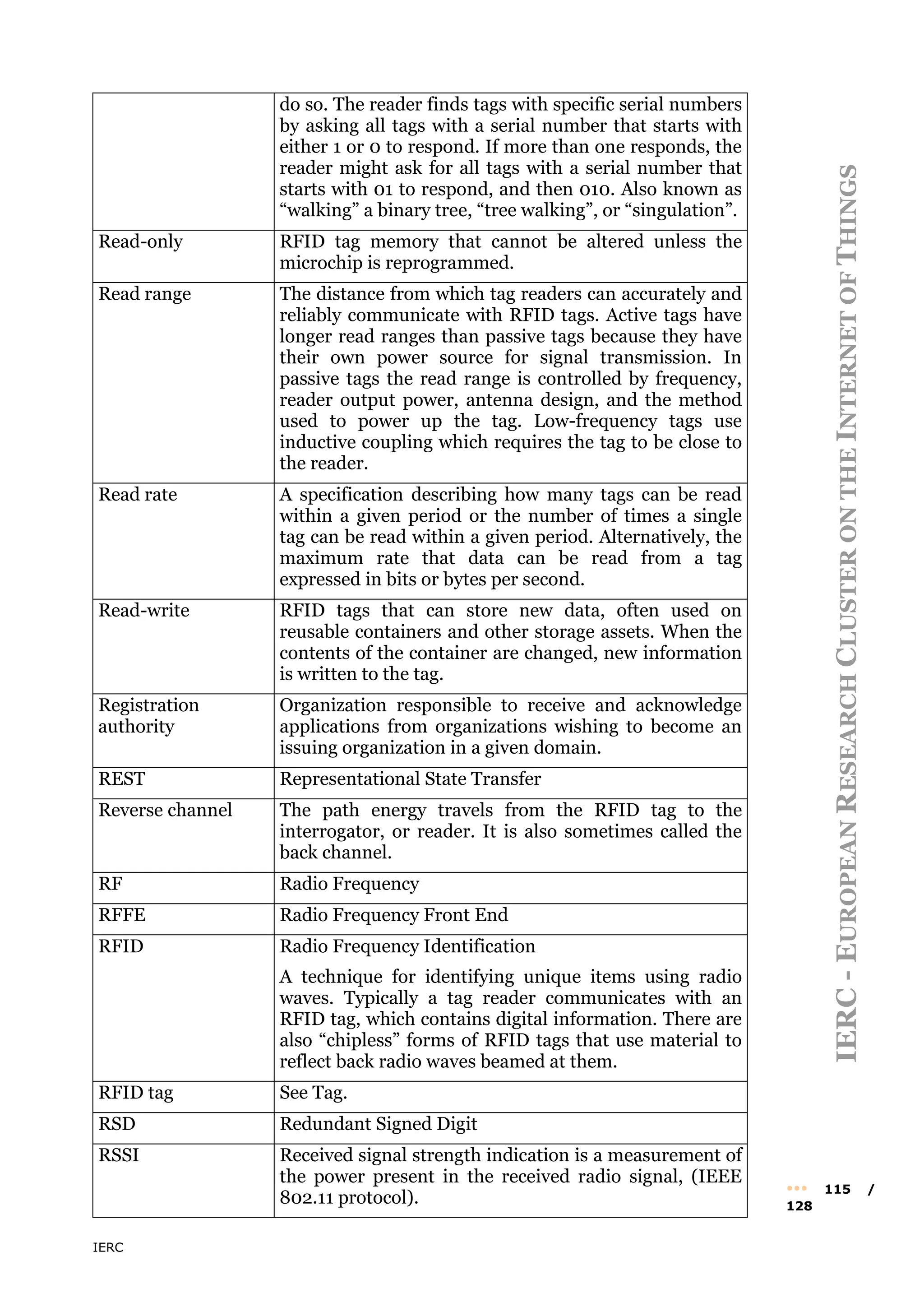
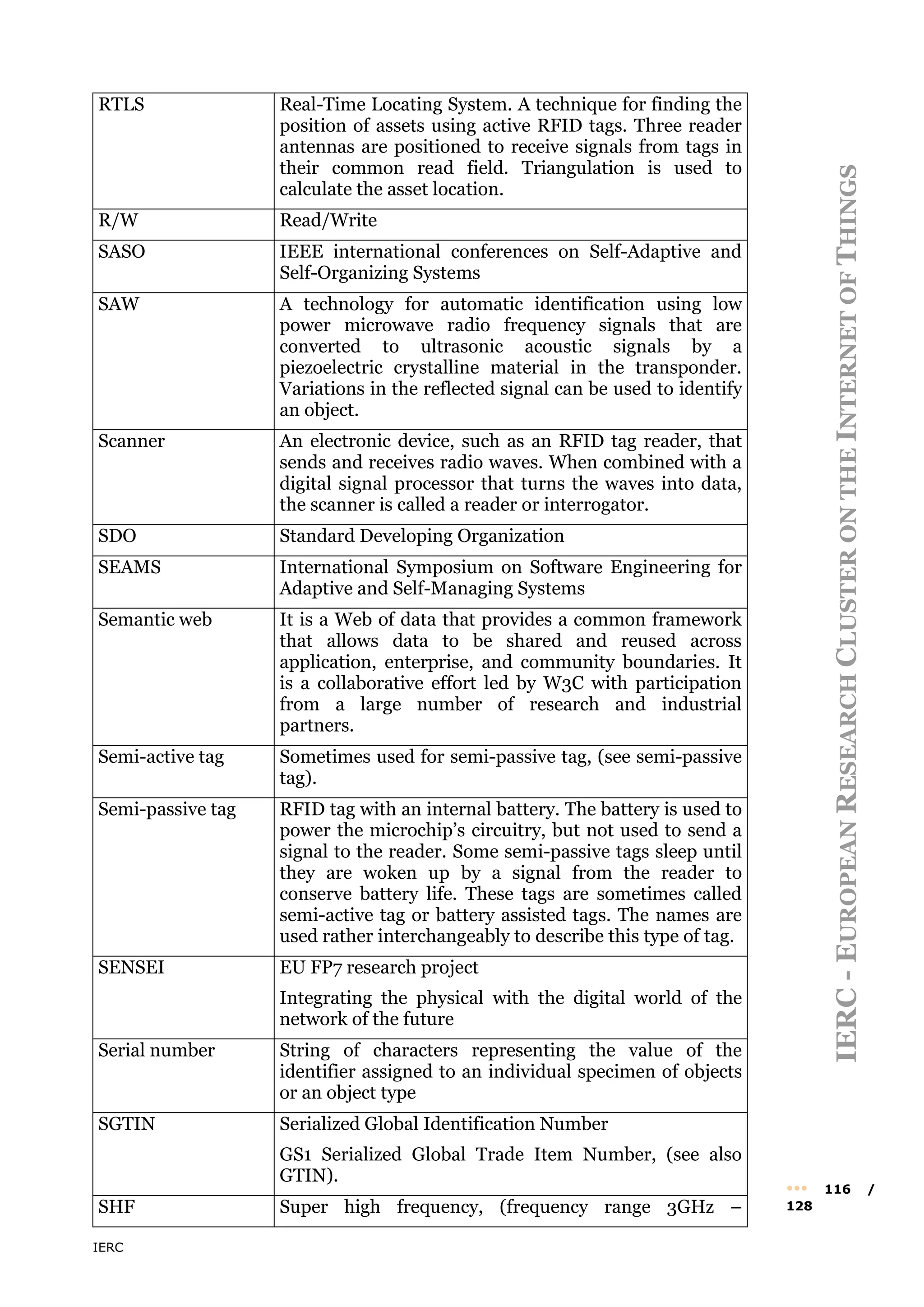
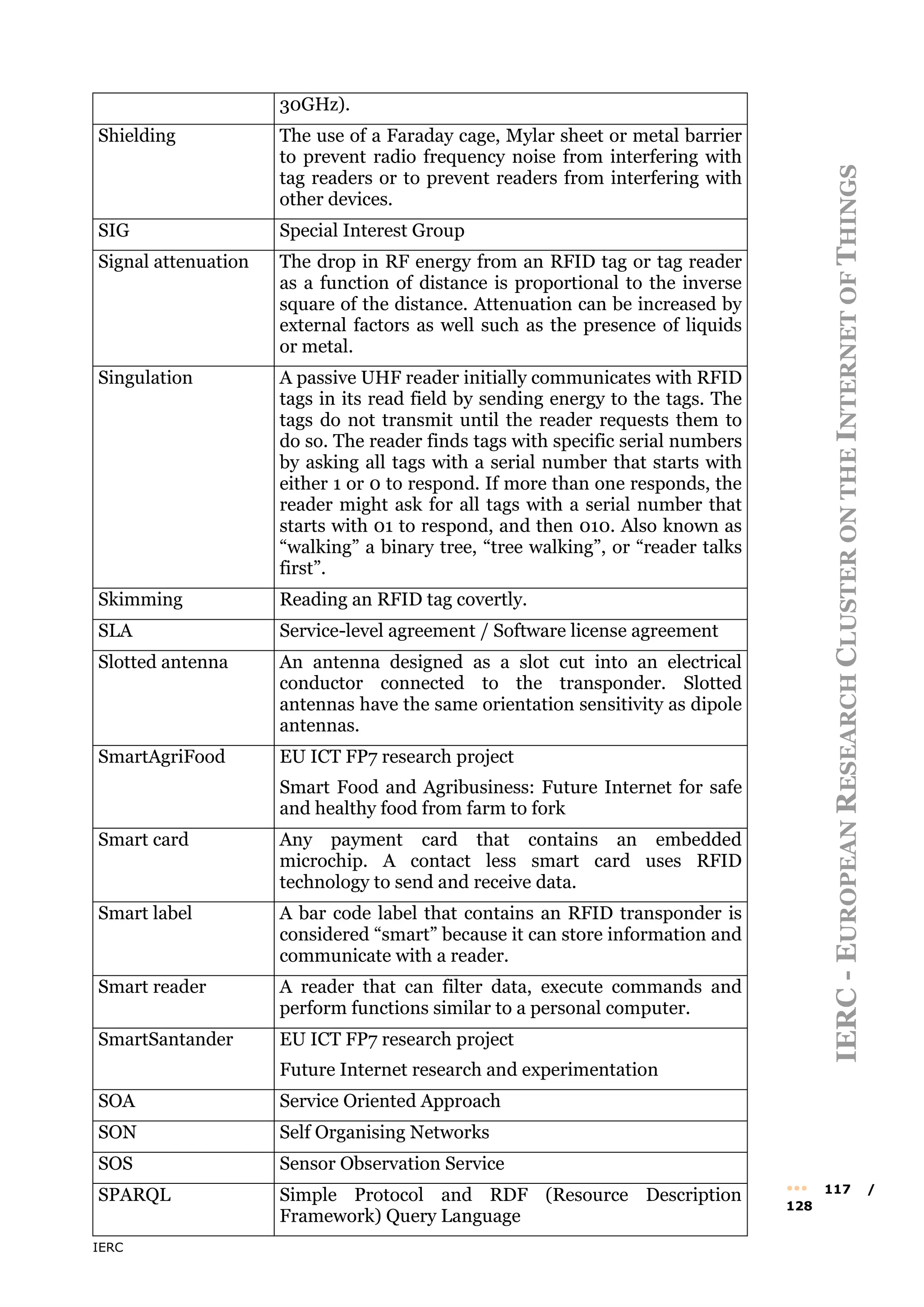
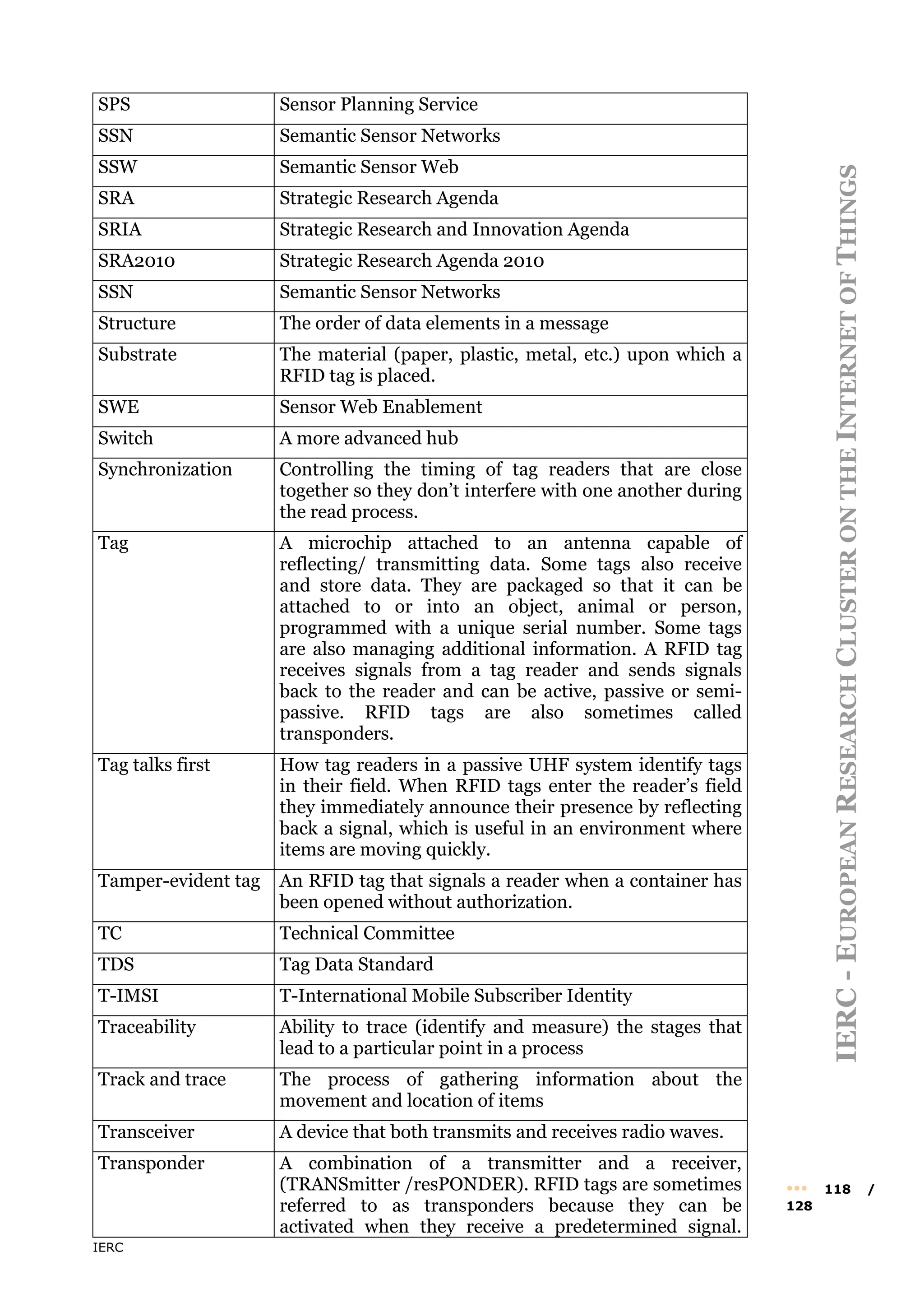
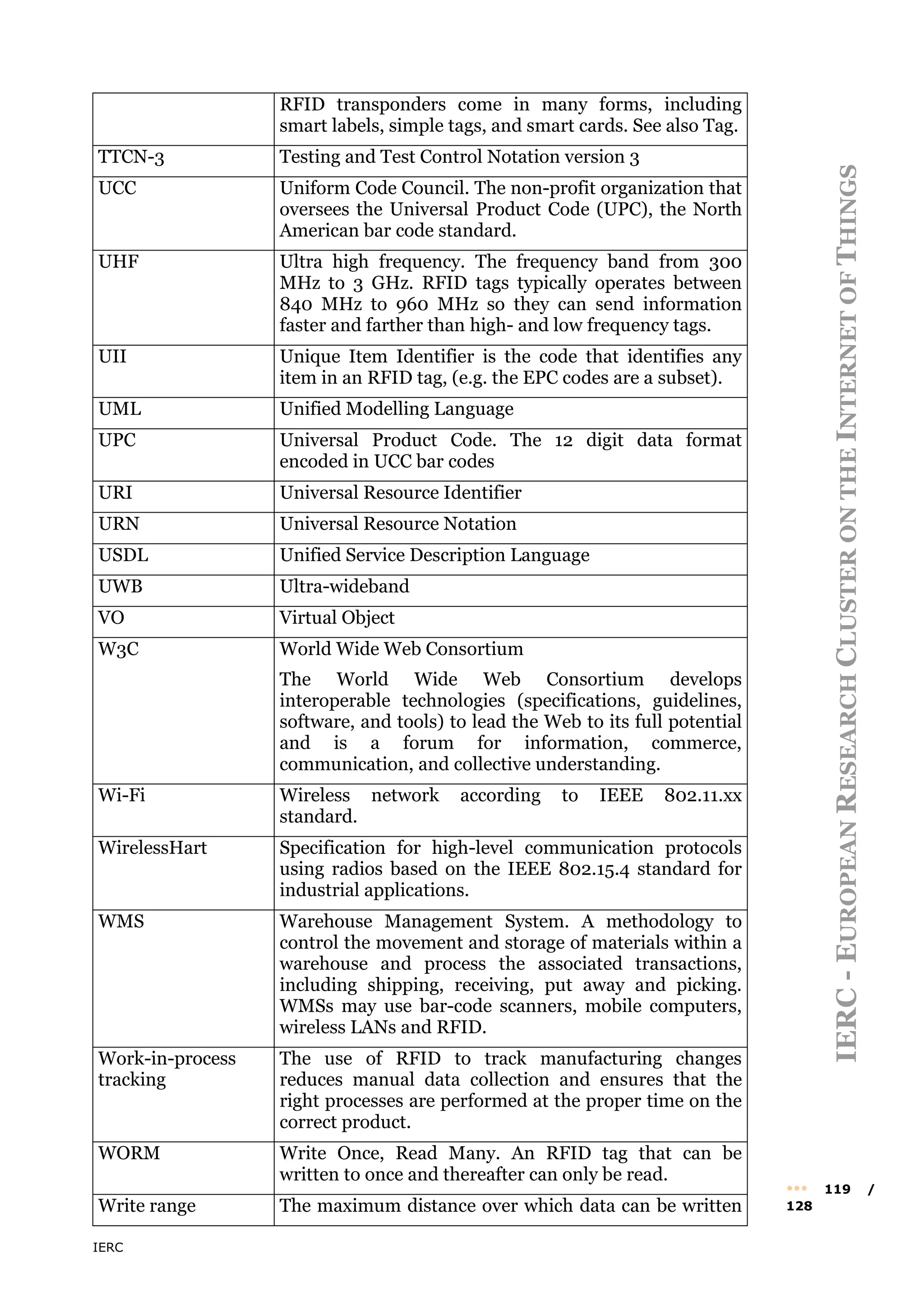
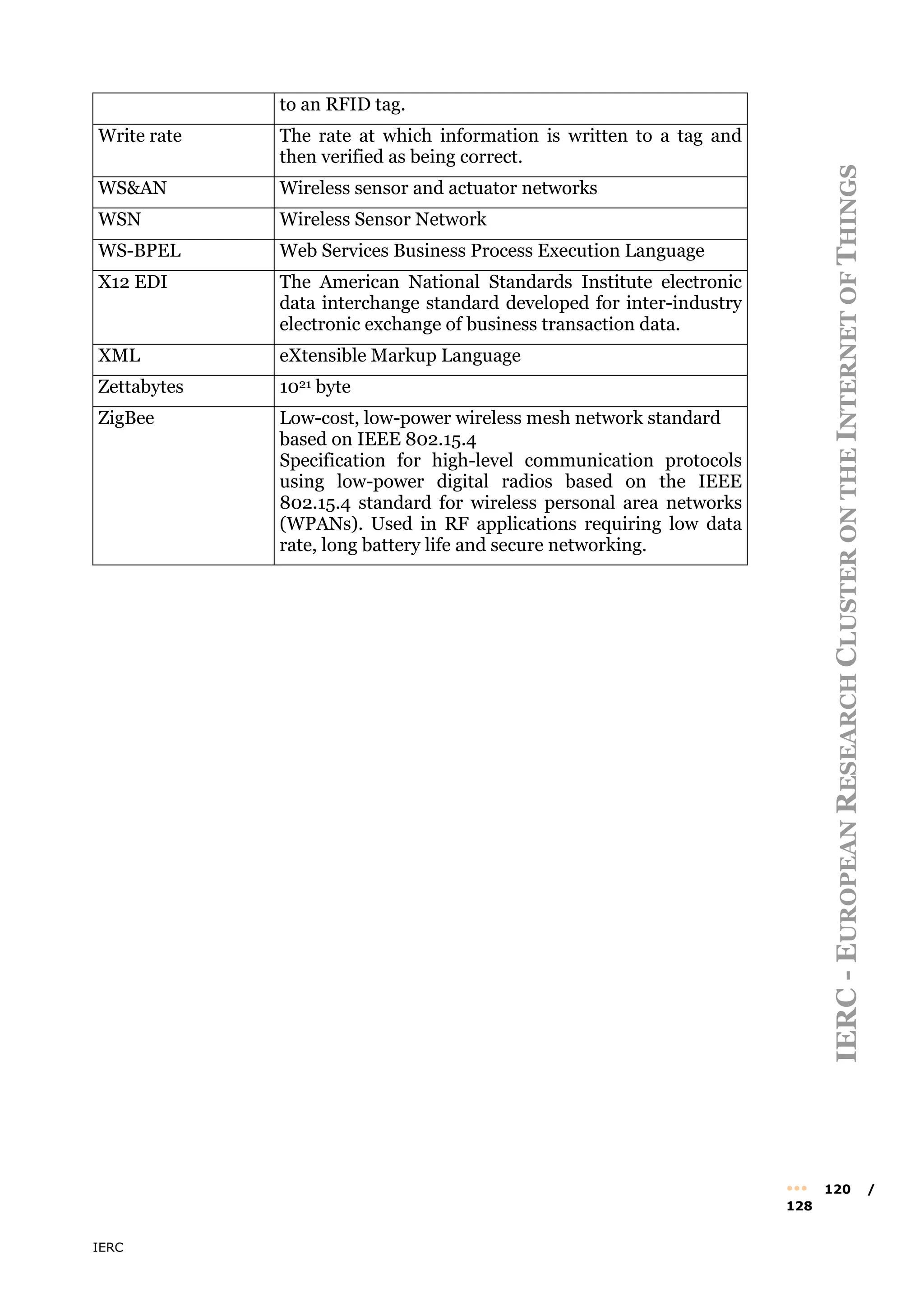
![IERC
IERC
-
E
UROPEAN
R
ESEARCH
C
LUSTER
ON
THE
I
NTERNET
OF
T
HINGS
••• 121 /
128
References
[1] Helen Rebecca Schindler, Jonathan Cave, Neil Robinson, Veronika
Horvath, Petal Jean Hackett, Salil Gunashekar, Maarten Botterman,
Simon Forge, Hans Graux. Europe’s policy options for a dynamic and
trustworthy development of the Internet of Things, RAND Europe.
Prepared for European Commission, DG Communications Networks,
Content and Technology (CONNECT).
[2] EU IoT Task Force. 2012. Final Report of the EU IOT Task Force on IOT
Governance. Brussels, November 14, 2012
[3] Rolf H. Weber, Internet of things – Governance quo vadis?, Computer
Law & Security Review, Volume 29, Issue 4, August 2013, Pages 341-347,
ISSN 0267-3649
[4] R. Roman, J. Zhou, J. Lopez, On the features and challenges of security
and privacy in distributed internet of things, Computer Networks 57 (10)
(2013).
[5] D. Miorandi, S. Sicari, F. D. Pellegrini, I. Chlamtac, Internet of things:
Vision, applications and research challenges, Ad Hoc Networks 10 (7)
(2012) 1497.
[6] Conclusions of the Internet of Things public consultation.
http://ec.europa.eu/digital-agenda/en/news/conclusions-internet-things-
public-consultation. Last accessed 24 October 2013.
[7] ENISA. Recommended cryptographic measures - Securing personal data
http://www.enisa.europa.eu/activities/identity-and-
trust/library/deliverables/recommended-cryptographic-measures-
securing-personal-data. November 2013.
[8] ENISA. Algorithms, Key Sizes and Parameters Report.
http://www.enisa.europa.eu/activities/identity-and-
trust/library/deliverables/algorithms-key-sizes-and-parameters-report.
October 2013.
[9] US White House. BIG DATA: SEIZING OPPORTUNITIES, PRESERVING
VALUES.
http://www.whitehouse.gov/sites/default/files/docs/big_data_privacy_re
port_may_1_2014.pdf. May 2014.
[10] Subharthi Paul, Jianli Pan, and Raj Jain. 2011. Architectures for the future
networks and the next generation Internet: A survey. Comput. Commun.
34, 1 (January 2011), 2-42.
[11] Kiev Gama, Lionel Touseau, Didier Donsez, Combining heterogeneous
service technologies for building an Internet of Things middleware,
Computer Communications, Volume 35, Issue 4, 15 February 2012, Pages
405-417, ISSN 0140-3664.
[12] S. Gusmeroli, S. Piccione, D. Rotondi, A capability-based security
approach to manage access control in the internet of things, Mathematical
and Computer Modelling 58 (5) (2013) 1189.](https://image.slidesharecdn.com/iercpositionpaperiotgovernanceprivacysecurityfinal-250505064116-f6f9566a/75/IERC_Position_Paper_IoT_Governance_Privacy_Security_Final-pdf-121-2048.jpg)
![IERC
IERC
-
E
UROPEAN
R
ESEARCH
C
LUSTER
ON
THE
I
NTERNET
OF
T
HINGS
••• 122 /
128
[13] Mehra, P. 2012. Context-Aware Computing: Beyond Search and Location-
Based Services. IEEE Internet Computing, 16, 2 (March-April, 2012), 12-
16
[14] Trappeniers, L., Roelands, M., Godon, M., Criel, J., and Dobbelaere, P.
2009. Towards Abundant DiY Service Creativity Successfully Leveraging
the Internet-of-Things in the City and at Home. In Proceedings of the 13th
Int. Conf. on Intelligence in Next Generation Networks (Bordeaux, France,
October 26 - 29, 2009). ICIN 2009.
[15] Uckelman, D., Harrison, M., and Michahelles, F. (eds.) 2011. Architecting
the Internet of Things. Springer-Verlag Berlin Heidelberg.
[16] Conti Marco, Sajal K. Das, Chatschik Bisdikian, Mohan Kumar, Lionel M.
Ni, Andrea Passarella, George Roussos, Gerhard Tröster, Gene Tsudik,
Franco Zambonelli. 2011. Looking ahead in pervasive computing:
Challenges and opportunities in the era of cyber–physical convergence,
Pervasive and Mobile Computing, Volume 8, Issue 1, February 2012, Pages
2-21, ISSN 1574-1192, http://dx.doi.org/10.1016/j.pmcj.2011.10.001.
[17] Cockton, Gilbert. 2006. Designing Worth is Worth Designing. NordiCHI,
14-18 Ocyober: 165-174.
[18] Lene Sørensen and Knud Erik Skouby (eds.), “User scenarios 2020 – a
worldwide wireless future”, OUTLOOK - Visions and research directions
for the Wireless World, Wireless World Research Forum, No4, July 2009.
[19] Ramachandran, A., Singh, L., Porter, E. and Nagle, F., ‘Exploring Re-
identification Risks in Public Domains’, Proceedings of the Tenth Annual
International Conference on Privacy, Security and Trust (PST), 2012,
pp.35–42, 2012.
[20] Rikke Bendlin, Ivan Damgård, Claudio Orlandi, and Sarah Zakarias. 2011.
Semi-homomorphic encryption and multiparty computation. In
Proceedings of the 30th Annual international conference on Theory and
applications of cryptographic techniques: advances in cryptology
(EUROCRYPT'11), Kenneth G. Paterson (Ed.). Springer-Verlag, Berlin,
Heidelberg, 169-188.
[21] Kristian Gjøsteen, George Petrides, and Asgeir Steine. Secure and
anonymous network connection in mobile communications. 2012.
[22] Issarny, V., Georgantas, N., Hachem, S., Zarras, A., Vassiliadist, P., Autili,
M., Gerosa, M., and Hamida, A. 2011. Service-oriented middleware for the
Future Internet: state of the art and research directions. Journal of
Internet Services and Applications 79, 1 (2011), 23-45.
DOI=http://dx.doi.org/10.1007/s13174-011-0021-3
[23] Christophe, B., Boussard, M., Lu, M., Pastor, A., and Toubiana, V. 2011.
The web of things vision: Things as a service and interaction patterns. Bell
Labs Technical Journal, 16, 1 (June 2011), 55-61. DOI=
http://dx.doi.org/10.1002/bltj.20485
[24] Yee, K. P. 2003. Secure interaction design and the principle of least
authority. In Proc. of the 21st Int. Conf. on Human Factors in Computing
Systems – Workshop on HumanComputer Interaction and Security
Systems, (Ft. Lauderdale, FL, USA, April 6, 2003). CHI 2003. ACM, New
York, NY, USA](https://image.slidesharecdn.com/iercpositionpaperiotgovernanceprivacysecurityfinal-250505064116-f6f9566a/75/IERC_Position_Paper_IoT_Governance_Privacy_Security_Final-pdf-122-2048.jpg)
![IERC
IERC
-
E
UROPEAN
R
ESEARCH
C
LUSTER
ON
THE
I
NTERNET
OF
T
HINGS
••• 123 /
128
[25] Saltzer, J.H. and Schroeder, M.D. 1975. The protection of information in
computer systems. In Proceedings of the IEEE, 63, 9, (Sept. 1975), 1278-
1308. DOI=http://dx.doi.org/10.1109/PROC.1975.9939
[26] G. Fenu and G. Steri, “Safe, fault tolerant and capture-resilient
environmental parameters survey using WSNs,” in Security and Privacy
in Mobile Information and Communication Systems (First International
ICST Conference, MOBISEC 2009, Turin, Italy, June 2009, Revised
Selected Papers), ser. Lecture Notes of the Institute for Computer
Sciences, Social Informatics and Telecommunications Engineering
(LNICST), A. U. Schmidt, and S. Lian, Eds. Springer Berlin Heidelberg,
2009, vol. 17, pp. 180–189. http://dx.doi.org/10.1007/978-3-642-04434-
2_16
[27] Cave, J. et al., Does It Help or Hinder? Promotion of Innovation on the
Internet and Citizens’ Right to Privacy, final report, European Parliament,
2011
[28] Ion, Mihaela; Danzi, A.; Koshutanski, H.; Telesca, L., "A peer-to-peer
multidimensional trust model for digital ecosystems," Digital Ecosystems
and Technologies, 2008. DEST 2008. 2nd IEEE International Conference
on, vol., no., pp.461, 469, 26-29 Feb. 2008.
[29] Benkler, Y. and Nissenbaum H. 2006. Commons-based Peer Production
and Virtue. The Journal of Political Philosophhy, 14, 4:394-419.
[30] Benkler, Y. 2011. The Penguin and the Leviathan. New York: Random
House.
[31] Copp, David. 2007. The Oxford Handbook of Ethical Theory. Oxford
University Press: Oxford-New York 2007.
[32] Proper, Michel. 2011. La philosophie du droit. PUF:Paris.s
[33] Wiener, Norbert. 1950. The Human Use of Human Beings. Houghton
Mifflin:Boston MA.
[34] Bynum, Terrell Ward and Simon Rogerson. 1996. Special issue of Science
and Engineering Ethics, 2, 2:131-247.
[35] Floridi Luciano and J.W. Sanders. 2002. Mapping the foundationalist
debate in computer ethics. Ethics and Information Technology, 4:1-9.
[36] Van den Hoven Jeroen and John Weckert (eds). 2008. Information
technology and moral philosophy. Cambridge University Press:
Cambridge-New York.
[37] Moor James H. 1985. What Is Computer Ethics. Metaphilosophy, 16, 4:
266–275.
[38] Naess, Are. 1973. The shallow and the deep, long-range ecology
movement. A summary. Inquiry 16:95-100.
[39] Cohen, Julie. 2012. Configuring the Networked Self: Law, Code, and the
Play of Everyday Practice, Yale University Press:New Haven NJ.
[40] Benkler, Yochai and Helen Nissenbaum. 2006. Commons-based Peer
Production and Virtue. The Journal of Political Philosophy 14, 4:394-419.
[41] Benkler, Yochai. 2011. The Penguin and the Leviathan. Crown Business:
New York.](https://image.slidesharecdn.com/iercpositionpaperiotgovernanceprivacysecurityfinal-250505064116-f6f9566a/75/IERC_Position_Paper_IoT_Governance_Privacy_Security_Final-pdf-123-2048.jpg)
![IERC
IERC
-
E
UROPEAN
R
ESEARCH
C
LUSTER
ON
THE
I
NTERNET
OF
T
HINGS
••• 124 /
128
[42] Jasanoff, Sheila (ed). 2011. Reframing Rights. Bio-Constitutionalism in the
Genetic Age. MIT Press: Cambridge MA.
[43] Jonas, Hans. 1984. The Imperative of Responsibility. University of
Chicago Press: Chicago IL (Frankfurt am Mein 1979).
[44] Dupuy, J.P. (2004) ‘Complexity and Uncertainty a Prudential Approach to
Nanotechnology. European Commission. A Preliminary Risk Analysis on
the Basis of a Workshop Organized by the Health and Consumer
Protection Directorate General of the European Commission’, in Brussels
1-2 March 2004.
[45] Von Schomberg, R. (2012) ‘Prospects for Technology Assessment in a
Framework of Responsible Research and Innovation’, in M. Dusseldorp
and R. Beecroft (eds), 26 Technikfolgen abschätzen lehren:
Bildungspotenziale transdisziplinärer Metho-den,Wiesbaden: Springer VS
Verlag, pp. 39-61.
[46] Van den Hoven Jeroen et al. 2013. Fact sheet-Ethics Subgroup IoT -
Version 4.0. Conclusions of the Internet of Things public consultation.
Available at https://ec.europa.eu/digital-agenda/en/news/conclusions-
internet-things-public-consultation
[47] Schindler Helen Rebecca et al. 2013. Europe’s policy options for a dynamic
and trustworthy development of the Internet of Things. SMART
2012/0053, RAND Corp., European Union 2013.
[48] Value Ageing’ project. Incorporating European Fundamental Values Into
ICT for Ageing: A vital political, ethical, technological, and industrial
challenge. Ref. online: www.valueageing.eu
[49] Arendt Hannah. 1998. The Human Condition. University Of Chicago
Press: Chicago IL (1958).
[50] Hildebrandt, Mireille and Antoinette Rouvroy (eds). 2011. The Philosophy
of Law Meets the Philosophy of Technology. Autonomic Computing and
Transformations of Human Agency. Routledge:London.
[51] EDPS (European Data Protection Supervisor). 2010. Opinion on
Promoting Trust in the Information Society by Fostering Data Protection
and Privacy (Opinion on Privacy By Design). OJ C 280, 16.10.2010.
[52] Nissenbaum, Helen. 2011. From Preemption to Circumvention: If
Technology Regulates, Why Do We Need Regulation (and Vice-versa)?
Berkeley Technology Law Journal, 26, 3:1367-1386.
[53] Pagallo, Ugo. 2012. Good Onlife Governance: On Law, Spontaneous
Orders, and Design, Onlife Project, https://ec.europa.eu/digital-
agenda/sites/digital-agenda/files/Contribution_Pagallo.pdf
[54] Snyder, Francis. 1993. Soft law and institutional practice in the European
Community. European University Institute working paper, LAW no. 93/5.
[55] G. Pasolini, D. Dardari, S. Severi and G. Abreu: “The Effect of Channel
Spatial Correlation on Physical Layer Security in Multi-antenna
Scenarios,” Proc. IEEE Fourty-Seventh Asilomar Conference on Signals,
Systems and Computers, (Asilomar 2013), November 3-6, 2013 (Invited).
[56] A. Cavoukian. (2011, January) Privacy by Design: The 7 Foundational
Principles, Revised Version.](https://image.slidesharecdn.com/iercpositionpaperiotgovernanceprivacysecurityfinal-250505064116-f6f9566a/75/IERC_Position_Paper_IoT_Governance_Privacy_Security_Final-pdf-124-2048.jpg)
![IERC
IERC
-
E
UROPEAN
R
ESEARCH
C
LUSTER
ON
THE
I
NTERNET
OF
T
HINGS
••• 125 /
128
www.privacybydesign.ca/content/uploads/2009/08/7foundationalprincip
les.pdf
[57] S. Gusmeroli, S. Piccione, D. Rotondi, “IoT@Work Automation
Middleware System Design and Architecture,” presented at 17 IEEE
International Conference on Emerging Technology and Factory
Automation (ETFA’12), September 2012.
[58] OAUTH Specification http://oauth.net/2/
[59] OpenID 2.0 http://openid.net/specs/openid-authentication-2_0.html
[60] IoT6 D2.2, “Distributed IPv6-based Security, Privacy, Authentication and
QoS”.
[61] A, J. Jara, M. A. Zamora, and A. Skarmeta, “Glowbal IP: an adaptive and
transparent ipv6 integration in the internet of things, Mobile Information
Systems”, 2012.
[62] Jara, A. J., Lopez, P., Fernandez, D., Castillo, J. F., Zamora, M. A.,
Skarmeta, A. F. “Mobile Digcovery: Discovering and Interacting with the
World through the Internet of Things”, Personal and Ubiquitous
Computing, 10.1007/s00779-013-0648-0, Springer-Verlag London,
(2013).
[63] IoT6 D3.1, “Look-up/discovery, context-awareness, and resource/services
directory”.
[64] IoT6 D2.3, “Report on IPv6 based advanced features”.
[65] IoT6 D5.4, “Intelligence distribution tests and evaluation report”.
[66] The HANDLE System. http://www.handle.net
[67] EPC Information Services Standard,
http://www.gs1.org/gsmp/kc/epcglobal/epcis
[68] Neisse, Ricardo, Alexander Pretschner and Valentina Di Giacomo. "A
Trustworthy Usage Control Enforcement Framework," International
Journal of Mobile Computing and Multimedia Communications
(IJMCMC) 5 (2013): 3, doi:10.4018/jmcmc.2013070103.
[69] Neisse, R.; Doerr, J., "Model-based specification and refinement of usage
control policies," Privacy, Security and Trust (PST), 2013 Eleventh Annual
International Conference on , vol., no., pp.169,176, 10-12 July 2013, doi:
10.1109/PST.2013.6596051.
[70] D. Quartel, “Action relations - basic design concepts for behaviour
modelling and refinement,” PhD Thesis University of Twente, 1998.
[71] Lujun Fang and Kristen LeFevre. 2010. Privacy wizards for social
networking sites. In Proceedings of the 19th international conference on
World wide web (WWW '10). ACM, New York, NY, USA.
[72] M. Bagaa et al., “SEDAN: secure and efficient protocol for data
aggregationinwirelesssensornetworks,”inProc.ofIEEELCN. IEEE, 2007,
pp. 1053–1060.
[73] R. Riggio and S. Sicari, “Secure aggregation in hybrid mesh/sensor
networks,” in Ultra Modern Telecommunications & Workshops. IEEE,
October 2009, pp. 1–6.](https://image.slidesharecdn.com/iercpositionpaperiotgovernanceprivacysecurityfinal-250505064116-f6f9566a/75/IERC_Position_Paper_IoT_Governance_Privacy_Security_Final-pdf-125-2048.jpg)
![IERC
IERC
-
E
UROPEAN
R
ESEARCH
C
LUSTER
ON
THE
I
NTERNET
OF
T
HINGS
••• 126 /
128
[74] A. Coen-Porisini and S. Sicari, “SeDAP: Secure data aggregation protocol
in privacy aware wireless sensor networks,” in Proc. of the 2nd Int. Conf.
on Sensor Systems and Software. Springer Verlag, 2010.
[75] E. Mykletun, J. Girao, and D. Westhoff, “Public key based cryp- toschemes
for data concealment in wireless sensor networks,” in Proc. of IEEE
ICC’06. IEEE, September 2006, pp. 2288–2295.
[76] A. Fragkiadakis, I. Askoxylakis, E. Tragos, "Joint compressed-sensing and
matrix-completion for efficient data collection in WSNs", in Proc. of the
IEEE CAMAD 2013, Berlin, Germany, September 2013.
[77] Sarmad Ullah Khan, Claudio Pastrone, Luciano Lavagno, Maurizio A.
Spirito, “An Authentication and Key Establishment Scheme for the IP-
Based Wireless Sensor Networks”, Procedia Computer Science, Volume
10, 2012, Pages 1039-1045.
[78] S. Severi, G. Pasolini, D. Dardari and G. Abreu: “A Secret Key Exchange
Scheme For Near Field Communication,” Proc. IEEE Wireless
Communications and Networking Conference, (WCNC, 2014), April 6-9,
2014.
[79] E. Tragos and V. Angelakis, “Cognitive Radio Inspired M2M
Communications (Invited Paper),” in IEEE Global Wireless Summit 2013.
[80] J. Golbeck, J. Hendler. Accuracy of metrics for inferring trust and
reputation. Proceedings of the 14th International Conference on
Knowledge Engineering and Knowledge Management (2004).
[81] J. Golbeck, J. Hendler. Inferring reputation on the semantic web.
Proceedings of the 13th International World Wide Web Conference
(2004).
[82] FaceBook-Connect API -
http://developers.facebook.com/docs/guides/web/
[83] Liberty Framework http://www.projectliberty.org/specs/ and Kantara
http://kantarainitiative.org/
[84] Windows/Microsoft CardSpace http://msdn.microsoft.com/en-
us/library/aa480189.aspx
[85] ANTS, Gemalto, Oberthur Technologies, and Safran Morpho, Technical
report: Restricted Identification through Access to e-Services with privacy
preserving credentials, France ANTS, December 2011.
[86] Gemalto, Oberthur Technologies, and Safran Morpho, Technical report:
Privacy Protocol Semantic, criteria list and privacy-preserving credentials
format, France ANTS, December 2011.
[87] Jan Camenisch, Simone Fischer-Hübner, Kai Rannenberg (Eds.): Privacy
and Identity Management for Life. Springer 2011 ISBN 978-3-642-20316-
9
[88] Gurgen, Levent; Gunalp, Ozan; Benazzouz, Yazid; Gallissot, Mathieu,
"Self-aware cyber-physical systems and applications in smart buildings
and cities," Design, Automation & Test in Europe Conference & Exhibition
(DATE), 2013 , vol., no., pp.1149,1154, 18-22 March 2013.
[89] R. Dingledine, N. Mathewson, and P. Syverson, “Tor: The second-
generation onion router,” in roceedings of the 13th USENIX Security](https://image.slidesharecdn.com/iercpositionpaperiotgovernanceprivacysecurityfinal-250505064116-f6f9566a/75/IERC_Position_Paper_IoT_Governance_Privacy_Security_Final-pdf-126-2048.jpg)
![IERC
IERC
-
E
UROPEAN
R
ESEARCH
C
LUSTER
ON
THE
I
NTERNET
OF
T
HINGS
••• 127 /
128
Symposium, August 2004. [Online]. Available:
citeseer.ist.psu.edu/dingledine04tor.html
[90] J.P. Timpanaro, I. Chrisment, O. Festor, Monitoring the I2P network.
Research Report RR - 7844, INRIA (December 2011)
[91] Ian Clarke, Theodore W. Hong, Scott G. Miller, Oskar Sandberg, Brandon
Wiley, “Protecting Freedom of Information with Freenet” in IEEE Internet
Computing, 2002.
[92] K. Bennett and C. Grothoff, “gap - Practical Anonymous Networking,” in
Designing Privacy Enhancing Technologies. Springer-Verlag, 2003, pp.
141–160.
[93] R. Rivest, and David L. Chaum. Untraceable electronic mail, return
addresses, and digital pseudonyms. Communications of the ACM, 24:84-
88, 1981.
[94] Paquin, C., & Thompson, G. (2010). U-Prove CTP White Paper. Microsoft
Corporation.
[95] Chaum, D. (1983). Blind signatures for untraceable payments. Advances in
Cryptology - Proceedings of Crypto'82, (pp. 199-203).
[96] Idemix - Camenisch & Van Herreweghen, Design and Implementation of
the Idemix Anonymous Credential System, 2002.
[97] Chaum, Eugene; van Heyst (1991). "Group signatures". Advances in
Cryptology — EUROCRYPT ’91. Lecture Notes in Computer Science 547:
257–265.
[98] Jan Camenisch and Anna Lysyanskaya. Efficient non-transferable
anonymous multi-show credential system with optional anonymity
revocation. In Proc. of Advances in Cryptology - Eurocrypt, 2001.
[99] A. Lee, K. Seamons, M. Winslett and T. Yu, “Automated Trust Negotiation
in Open Systems Secure Data Management in Decentralized Systems”,
Advances in Information Security, 2007, Volume 33, Part III, 217-258,
[100]G. Yajun, W. Yulin, "Establishing Trust Relationship in Mobile Ad-Hoc
Network," Wireless Communications, Networking and Mobile Computing,
2007. WiCom 2007. International Conference on , vol., no., pp.1562-1564,
21-25 Sept. 2007.
[101]Devadas, S; Suh, E.; Paral, S.; Sowell, R.; Ziola, T.; Khandelwal, V.,
"Design and Implementation of PUF-Based "Unclonable" RFID ICs for
Anti-Counterfeiting and Security Applications," RFID, 2008 IEEE
International Conference on , vol., no., pp.58,64, 16-17 April 2008.
[102]Internet of Things–Architecture IoT-A. Deliverable D1.5– Final
architectural reference model for the IoT.
[103]DG CONNECT Trust and Security. https://ec.europa.eu/digital-
agenda/en/telecoms-and-internet/trust-security.
[104]SysSec Red Book is a Roadmap in the area of Systems Security.
http://www.red-book.eu/m/documents/syssec_red_book.pdf.
[105]REGULATION OF THE EUROPEAN PARLIAMENT AND OF THE
COUNCIL on the protection of individuals with regard to the processing of
personal data and on the free movement of such data (General Data
Protection Regulation). COM(2012) 11 final.](https://image.slidesharecdn.com/iercpositionpaperiotgovernanceprivacysecurityfinal-250505064116-f6f9566a/75/IERC_Position_Paper_IoT_Governance_Privacy_Security_Final-pdf-127-2048.jpg)
![IERC
IERC
-
E
UROPEAN
R
ESEARCH
C
LUSTER
ON
THE
I
NTERNET
OF
T
HINGS
••• 128 /
128
[106]ETSI TErms and Definitions Database Interactive (TEDDI).
http://webapp.etsi.org/Teddi/.
[107]Directive 95/46/EC of the European Parliament and of the Council of 24
October 1995 on the protection of individuals with regard to the
processing of personal data and on the free movement of such data.
[108]ITU, ITU Internet Reports 2005: The Internet of Things, Executive
Summary, International Telecommunication Union, 2005.
[109]Van Blarkom, G. W., Borking, J. J., Olk, J. G. E., Handbook of Privacy and
Privacy-Enhancing Technologies: The Case of Intelligent Software Agents,
2003.](https://image.slidesharecdn.com/iercpositionpaperiotgovernanceprivacysecurityfinal-250505064116-f6f9566a/75/IERC_Position_Paper_IoT_Governance_Privacy_Security_Final-pdf-128-2048.jpg)


