PRESENTATION
ON
IEEE 802.11
Prepared By:
Shreejan Acharya
BEX 68114
Slides Includes
Introduction
Physical Layer
Architecture
Frame format
Different Protocols
Media Access Control (MAC)
Introduction
 Created and maintained by IEEE
 Set of media control(MAC) and physical layer
 Used to implement wireless local area
network(WLAN)
 In the frequency band 2.4,3.6,5 and 60 GHz
 Wi-fi refers to the IEEE 802.11 communication for
WLAN
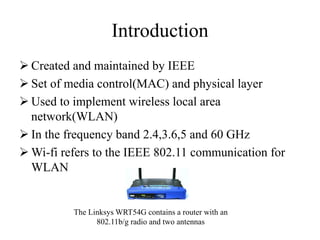
The Linksys WRT54G contains a router with an
802.11b/g radio and two antennas
Introduction cntd.
Adopted in 1997
Family of 802
Origins in a 1985 ruling by the U.S. Federal
Communications commission
Consist of series of half duplex over the air
modulation
Uses same basic protocols
It uses two spread spectrum technology
Frequency Hopping Spread Spectrum (FHSS)
 Direct Sequence Spread Spectrum (DSSS)
802.11 Physical Layer (PHY)
The 802.11 physical layer (PHY) is the interface
between the MAC and the wireless media where
frames are transmitted and received.
 The PHY provides three functions.
 First, the PHY provides an interface to exchange
frames with the upper MAC layer for transmission and
reception of data.
Secondly, the PHY uses signal carrier and spread
spectrum modulation to transmit data frames over
the media.
 Thirdly, the PHY provides a carrier sense indication
back to the MAC to verify activity on the media.
Architectures
Station (STA) Architecture:
 It contains IEEE 802.11
conformant MAC and PHY
interface to the wireless
medium, but does not
provide access to a
distribution system
Access-Point Architecture:
 Device that contains
IEEE802.11 conformant
MAC and PHY interface to
the wireless medium, and
provide access to a
distribution system for
associated stations
 Implemented in infra-
structure products that
connect to wired backbones
General terminologies
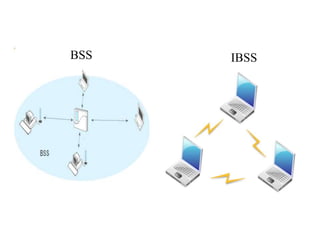
BSS (basic service set):
Group of stations that communicate each other
IBSS(independent basic service set):
It is a BSS without access point
Extended Service Set (ESS):
A set of one or more Basic Service Sets inter
connected by a distribution System (DS)
BSS IBSS
General terminologies cntd
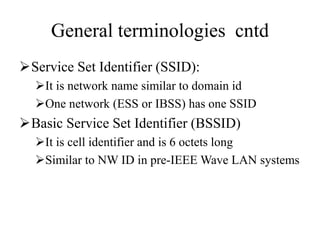
Service Set Identifier (SSID):
It is network name similar to domain id
One network (ESS or IBSS) has one SSID
Basic Service Set Identifier (BSSID)
It is cell identifier and is 6 octets long
Similar to NW ID in pre-IEEE Wave LAN systems
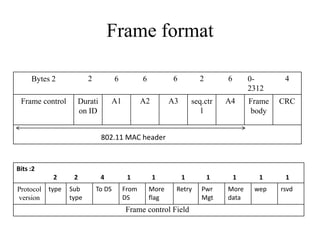
Frame format
Bytes 2 22 6 6
6
66 2 6 0-
2312
4
Frame control Durati
on ID
A1 A2 A3 seq.ctr
l
A4 Frame
body
CRC
802.11 MAC header
Bits :2
2 2 4 1 1 1 1 1 1 1
Protocol
version
type Sub
type
To DS From
DS
More
flag
Retry Pwr
Mgt
More
data
wep rsvd
Frame control Field
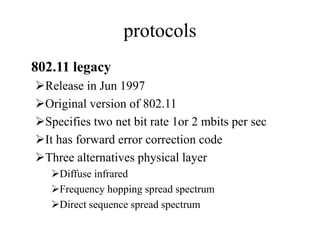
protocols
802.11 legacy
Release in Jun 1997
Original version of 802.11
Specifies two net bit rate 1or 2 mbits per sec
It has forward error correction code
Three alternatives physical layer
Diffuse infrared
Frequency hopping spread spectrum
Direct sequence spread spectrum
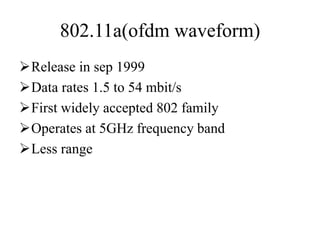
802.11a(ofdm waveform)
Release in sep 1999
Data rates 1.5 to 54 mbit/s
First widely accepted 802 family
Operates at 5GHz frequency band
Less range
802.11b
Release on the market in 2000
Maximum raw data rate of 11mbit/s
High throughput
Low cost
Interference problem
802.11g
Release on june 2003
Operates in the 2.4 GHz band
Uses OFDM based transmission scheme
Operates at the average bit rate of 22 Mbit/s or
maximum 54 Mbit/s
Its hardware are full back compatible with
802.11b hardware
802.11n
Release on October 2009
It is the improvement over previous 802.11
standard
It has MIMO antennas
Operates at the 2.4 GHz or less than 5GHz
bands
Data rates from 54 Mbit/s to 600 Mbit/s
802.11ac
Release in December 2013
It is an amendment to IEEE 802.11
It has wider channels(80 or 160 MHz)
Operates at 5GHz band
It supports multi-user MIMO
Data rates up to 1300 Mbit/s
802.11ad
Release in Dec 2012
It defines new physical layer for 802.11 n/w
Operates in the 60GHz millimeter wave
spectrum
Product implementing this standard are being
brought under the name of wigig brand
Peak transmission rate 7 Gbit/s
Other Protocols
802.11 AH
Estimated to release 2016
Bandwidth 900MHz
802.11 AJ
 Estimated to release 2016
Bandwidth 24/60
802.11 AX
Estimated to release 2019
Bandwidth 2.4/5
802.11 Media Access Control
 The 802.11 MAC layer provides functionality to allow reliable data
delivery for the upper layers over the wireless PHY media.
 The data delivery itself is based on an asynchronous, best-effort,
connectionless delivery of MAC layer data.
 There is no guarantee that the frames will be delivered successfully.
 The 802.11 MAC provides a controlled access method to the shared
wireless media called Carrier-Sense Multiple Access with Collision
Avoidance (CSMA/CA).
 CSMA/CA is similar to the collision detection access method
deployed by 802.3 Ethernet LANs.
802.11 Media Access Control cntd
Another function of the 802.11 MAC is to
protect the data being delivered by providing
security and privacy services.
 Security is provided by the authentication
services and by Wireless Equivalent Privacy
(WEP), which is an encryption service for data
delivered on the WLAN.
Security
For security 802.11 specifies two
Authentication modes:
OSA(Opens Systems Authentication)
• Device that request to access the network is granted
without any security check
Shared Key Authentication
• Device that request to access the network is granted
with security check
• WEP: wired equivalent privacy
ESSID offers casual separation of traffic
THANK YOU

wireless network IEEE 802.11

  • 1.
  • 2.
    Slides Includes Introduction Physical Layer Architecture Frameformat Different Protocols Media Access Control (MAC)
  • 3.
    Introduction  Created andmaintained by IEEE  Set of media control(MAC) and physical layer  Used to implement wireless local area network(WLAN)  In the frequency band 2.4,3.6,5 and 60 GHz  Wi-fi refers to the IEEE 802.11 communication for WLAN The Linksys WRT54G contains a router with an 802.11b/g radio and two antennas
  • 4.
    Introduction cntd. Adopted in1997 Family of 802 Origins in a 1985 ruling by the U.S. Federal Communications commission Consist of series of half duplex over the air modulation Uses same basic protocols It uses two spread spectrum technology Frequency Hopping Spread Spectrum (FHSS)  Direct Sequence Spread Spectrum (DSSS)
  • 5.
    802.11 Physical Layer(PHY) The 802.11 physical layer (PHY) is the interface between the MAC and the wireless media where frames are transmitted and received.  The PHY provides three functions.  First, the PHY provides an interface to exchange frames with the upper MAC layer for transmission and reception of data. Secondly, the PHY uses signal carrier and spread spectrum modulation to transmit data frames over the media.  Thirdly, the PHY provides a carrier sense indication back to the MAC to verify activity on the media.
  • 6.
    Architectures Station (STA) Architecture: It contains IEEE 802.11 conformant MAC and PHY interface to the wireless medium, but does not provide access to a distribution system Access-Point Architecture:  Device that contains IEEE802.11 conformant MAC and PHY interface to the wireless medium, and provide access to a distribution system for associated stations  Implemented in infra- structure products that connect to wired backbones
  • 7.
    General terminologies BSS (basicservice set): Group of stations that communicate each other IBSS(independent basic service set): It is a BSS without access point Extended Service Set (ESS): A set of one or more Basic Service Sets inter connected by a distribution System (DS)
  • 8.
  • 9.
    General terminologies cntd ServiceSet Identifier (SSID): It is network name similar to domain id One network (ESS or IBSS) has one SSID Basic Service Set Identifier (BSSID) It is cell identifier and is 6 octets long Similar to NW ID in pre-IEEE Wave LAN systems
  • 10.
    Frame format Bytes 222 6 6 6 66 2 6 0- 2312 4 Frame control Durati on ID A1 A2 A3 seq.ctr l A4 Frame body CRC 802.11 MAC header Bits :2 2 2 4 1 1 1 1 1 1 1 Protocol version type Sub type To DS From DS More flag Retry Pwr Mgt More data wep rsvd Frame control Field
  • 11.
    protocols 802.11 legacy Release inJun 1997 Original version of 802.11 Specifies two net bit rate 1or 2 mbits per sec It has forward error correction code Three alternatives physical layer Diffuse infrared Frequency hopping spread spectrum Direct sequence spread spectrum
  • 12.
    802.11a(ofdm waveform) Release insep 1999 Data rates 1.5 to 54 mbit/s First widely accepted 802 family Operates at 5GHz frequency band Less range
  • 13.
    802.11b Release on themarket in 2000 Maximum raw data rate of 11mbit/s High throughput Low cost Interference problem
  • 14.
    802.11g Release on june2003 Operates in the 2.4 GHz band Uses OFDM based transmission scheme Operates at the average bit rate of 22 Mbit/s or maximum 54 Mbit/s Its hardware are full back compatible with 802.11b hardware
  • 15.
    802.11n Release on October2009 It is the improvement over previous 802.11 standard It has MIMO antennas Operates at the 2.4 GHz or less than 5GHz bands Data rates from 54 Mbit/s to 600 Mbit/s
  • 16.
    802.11ac Release in December2013 It is an amendment to IEEE 802.11 It has wider channels(80 or 160 MHz) Operates at 5GHz band It supports multi-user MIMO Data rates up to 1300 Mbit/s
  • 17.
    802.11ad Release in Dec2012 It defines new physical layer for 802.11 n/w Operates in the 60GHz millimeter wave spectrum Product implementing this standard are being brought under the name of wigig brand Peak transmission rate 7 Gbit/s
  • 18.
    Other Protocols 802.11 AH Estimatedto release 2016 Bandwidth 900MHz 802.11 AJ  Estimated to release 2016 Bandwidth 24/60 802.11 AX Estimated to release 2019 Bandwidth 2.4/5
  • 19.
    802.11 Media AccessControl  The 802.11 MAC layer provides functionality to allow reliable data delivery for the upper layers over the wireless PHY media.  The data delivery itself is based on an asynchronous, best-effort, connectionless delivery of MAC layer data.  There is no guarantee that the frames will be delivered successfully.  The 802.11 MAC provides a controlled access method to the shared wireless media called Carrier-Sense Multiple Access with Collision Avoidance (CSMA/CA).  CSMA/CA is similar to the collision detection access method deployed by 802.3 Ethernet LANs.
  • 20.
    802.11 Media AccessControl cntd Another function of the 802.11 MAC is to protect the data being delivered by providing security and privacy services.  Security is provided by the authentication services and by Wireless Equivalent Privacy (WEP), which is an encryption service for data delivered on the WLAN.
  • 21.
    Security For security 802.11specifies two Authentication modes: OSA(Opens Systems Authentication) • Device that request to access the network is granted without any security check Shared Key Authentication • Device that request to access the network is granted with security check • WEP: wired equivalent privacy ESSID offers casual separation of traffic
  • 22.