Identification of
Research Gaps
Through
Literature Review
Dr Eric Balan
International Business Researcher
Chief Executive Officer
Asiatech Education Sdn Bhd
Malaysia
Defining Research Gap
Research Gap - a topic or area that has not yet been
explored or is underexplored which limits the ability
of researchers to reach a conclusion for a given
question.
The Gap, could be in the population, sample, location,
method, data, analysis, hypothesis, research question,
variables, conditions, etc.
There are no limits to the gaps
when perspectives are in question.
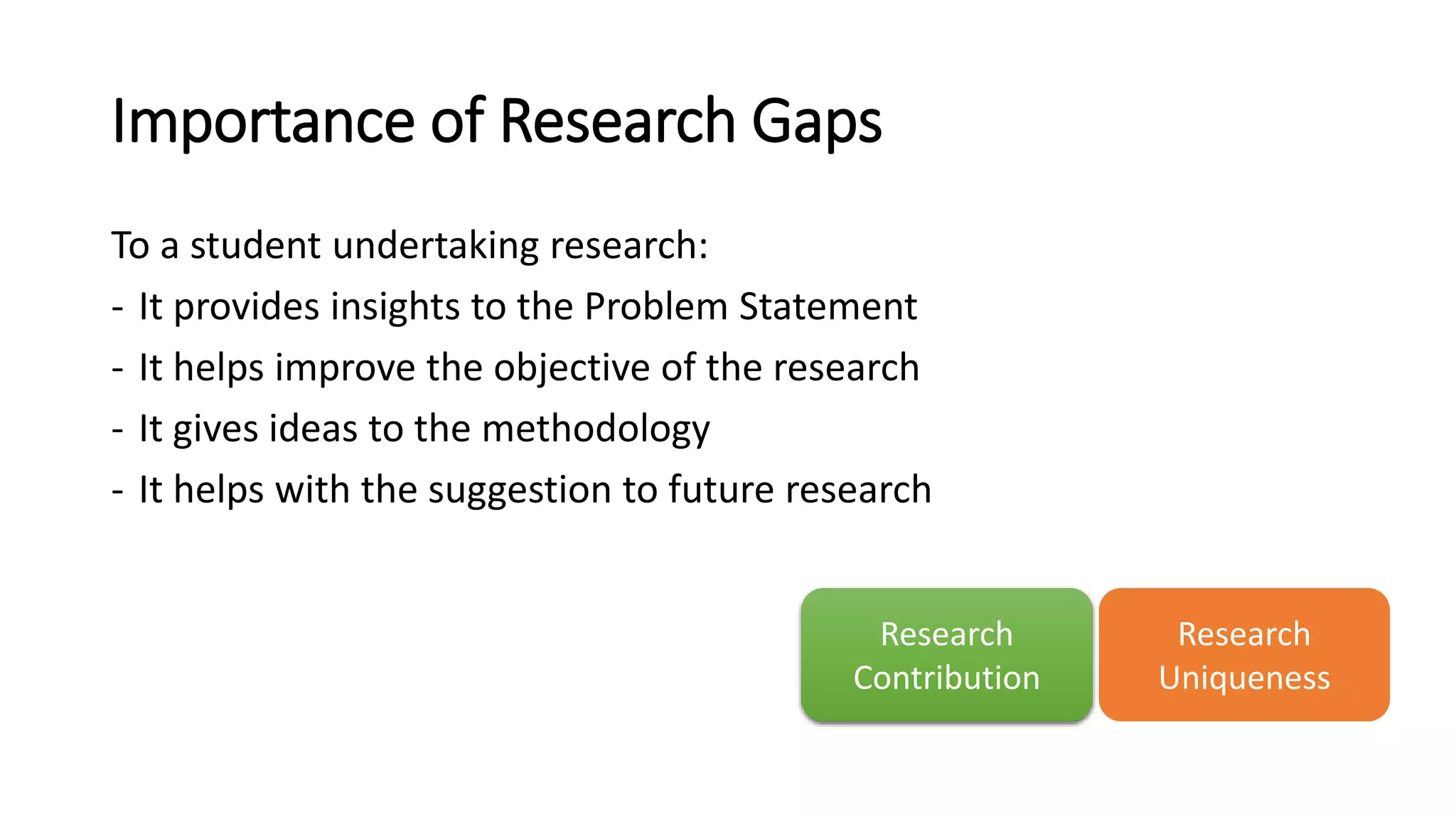
Importance of Research Gaps
To a student undertaking research:
- It provides insights to the Problem Statement
- It helps improve the objective of the research
- It gives ideas to the methodology
- It helps with the suggestion to future research
Research
Contribution
Research
Uniqueness
Common Challenges in
Identifying Research Gaps
1. Effort of dealing with an enormous amount
of information: There could be a lot of unanswered
questions in an area of your interest. So you might get
overwhelmed with the number of research gaps you stumble
upon and feel confused about which one you should focus
on.
2. Difficulty of searching in an organized
manner: Some researchers may find it difficult to organize
the information they have gathered. One can easily lose
ideas if they are not noted properly.
3. Hesitation in questioning established
norms: Some researchers are not confident enough to
challenge the existing knowledge in their field and may
hesitate to question what others have claimed in their work.
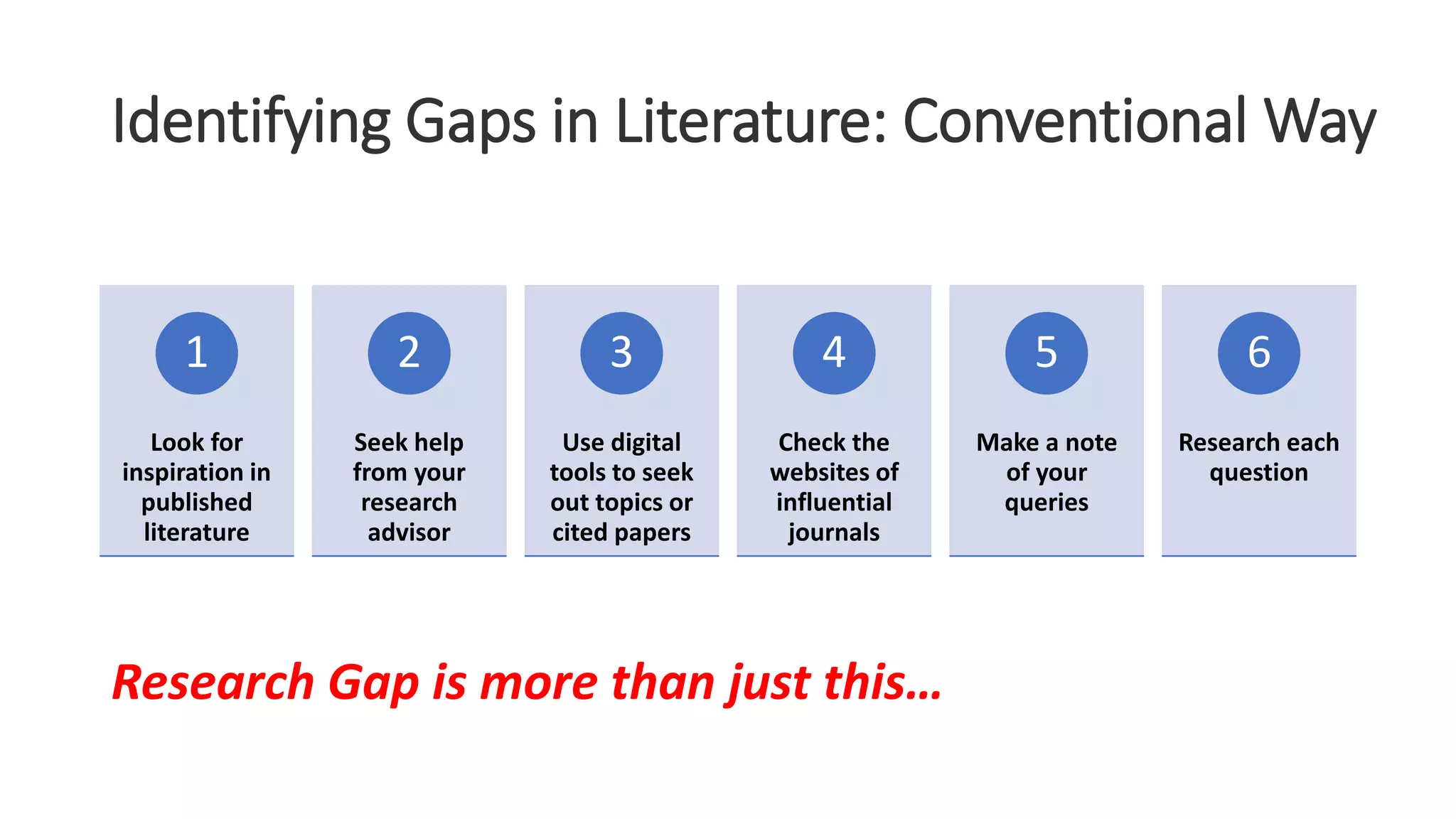
Identifying Gaps in Literature: Conventional Way
Look for
inspiration in
published
literature
1
Seek help
from your
research
advisor
2
Use digital
tools to seek
out topics or
cited papers
3
Check the
websites of
influential
journals
4
Make a note
of your
queries
5
Research each
question
6
Research Gap is more than just this…
Research Gap Analysis
Research Gap is a problem. And because it lacks the backing of
proper and adequate literature, it needs to be explored.
Therefore in the analysis of conducting a research gap, it must:
1. Identity the broad area
2. It requires a research on its own
3. It must have a scientific method to analyse the gap/s
4. It checks on the viability of the gap – thoroughly
5. It is very selective and discriminative to the literature
6. It should have an expected outcome
7. It should be evidence base (and no mere hypotheticals)
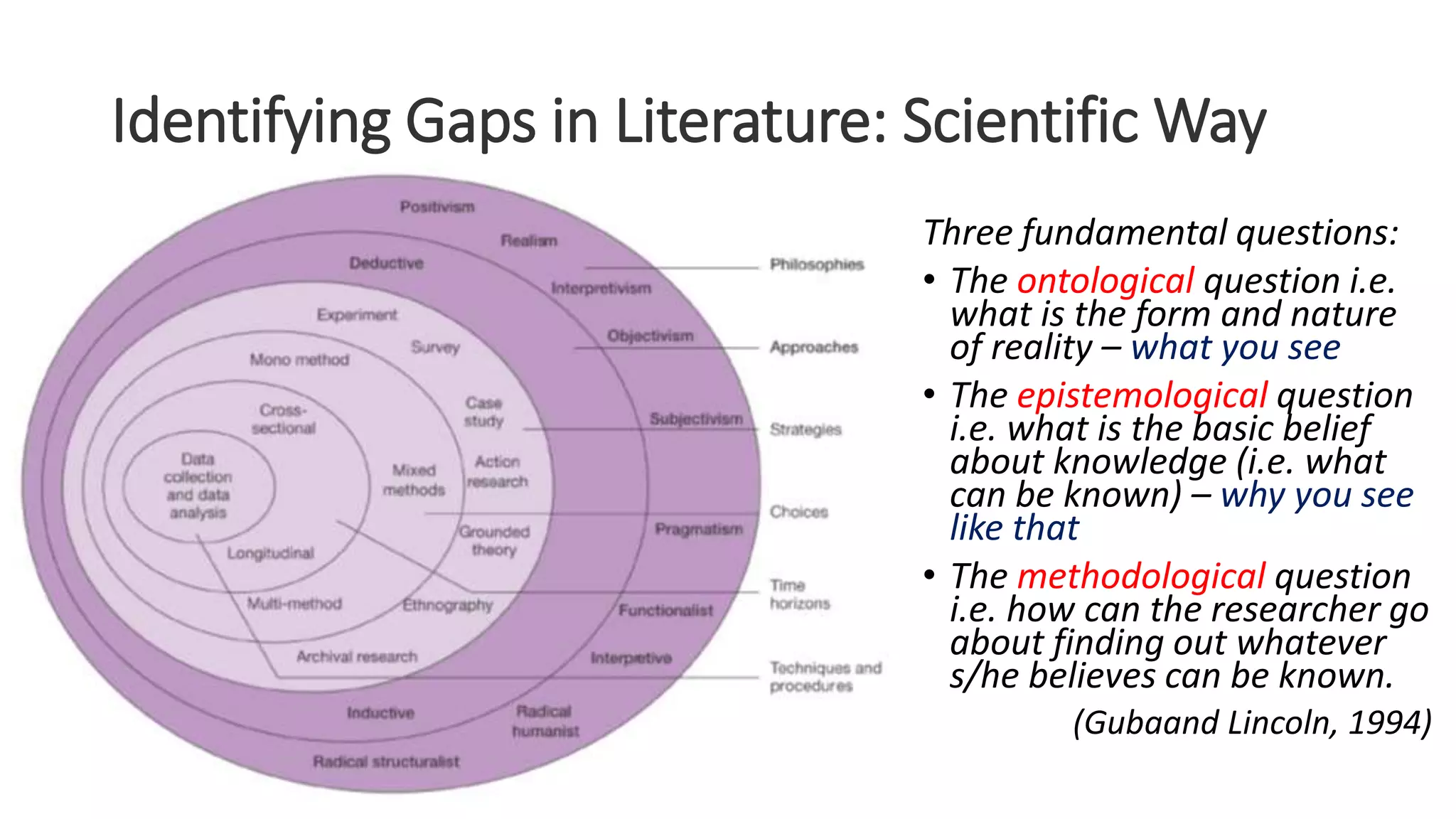
Identifying Gaps in Literature: Scientific Way
Three fundamental questions:
• The ontological question i.e.
what is the form and nature
of reality – what you see
• The epistemological question
i.e. what is the basic belief
about knowledge (i.e. what
can be known) – why you see
like that
• The methodological question
i.e. how can the researcher go
about finding out whatever
s/he believes can be known.
(Gubaand Lincoln, 1994)
Thank You
Dr Eric Balan
International Business Researcher
Chief Executive Officer
Asiatech Education Sdn Bhd
Malaysia

Identification of Research Gaps Through Literature Review.pptx

  • 1.
    Identification of Research Gaps Through LiteratureReview Dr Eric Balan International Business Researcher Chief Executive Officer Asiatech Education Sdn Bhd Malaysia
  • 2.
    Defining Research Gap ResearchGap - a topic or area that has not yet been explored or is underexplored which limits the ability of researchers to reach a conclusion for a given question. The Gap, could be in the population, sample, location, method, data, analysis, hypothesis, research question, variables, conditions, etc. There are no limits to the gaps when perspectives are in question.
  • 3.
    Importance of ResearchGaps To a student undertaking research: - It provides insights to the Problem Statement - It helps improve the objective of the research - It gives ideas to the methodology - It helps with the suggestion to future research Research Contribution Research Uniqueness
  • 4.
    Common Challenges in IdentifyingResearch Gaps 1. Effort of dealing with an enormous amount of information: There could be a lot of unanswered questions in an area of your interest. So you might get overwhelmed with the number of research gaps you stumble upon and feel confused about which one you should focus on. 2. Difficulty of searching in an organized manner: Some researchers may find it difficult to organize the information they have gathered. One can easily lose ideas if they are not noted properly. 3. Hesitation in questioning established norms: Some researchers are not confident enough to challenge the existing knowledge in their field and may hesitate to question what others have claimed in their work.
  • 5.
    Identifying Gaps inLiterature: Conventional Way Look for inspiration in published literature 1 Seek help from your research advisor 2 Use digital tools to seek out topics or cited papers 3 Check the websites of influential journals 4 Make a note of your queries 5 Research each question 6 Research Gap is more than just this…
  • 6.
    Research Gap Analysis ResearchGap is a problem. And because it lacks the backing of proper and adequate literature, it needs to be explored. Therefore in the analysis of conducting a research gap, it must: 1. Identity the broad area 2. It requires a research on its own 3. It must have a scientific method to analyse the gap/s 4. It checks on the viability of the gap – thoroughly 5. It is very selective and discriminative to the literature 6. It should have an expected outcome 7. It should be evidence base (and no mere hypotheticals)
  • 7.
    Identifying Gaps inLiterature: Scientific Way Three fundamental questions: • The ontological question i.e. what is the form and nature of reality – what you see • The epistemological question i.e. what is the basic belief about knowledge (i.e. what can be known) – why you see like that • The methodological question i.e. how can the researcher go about finding out whatever s/he believes can be known. (Gubaand Lincoln, 1994)
  • 8.
    Thank You Dr EricBalan International Business Researcher Chief Executive Officer Asiatech Education Sdn Bhd Malaysia