Ideation &
Design Principles:
Ye Olde Design
Workshoppe
Dan Saffer, Kicker Studio
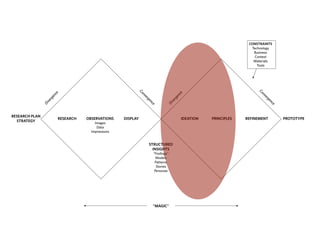
CONSTRAINTS
                                                                                                                       Technology
                                                                                                                        Business
                                                                                                                         Context
                                                                                                                        Materials
                                                                                                                          Tools


                                                             Co


                                                                                                                          Co
                        e


                                                                                         e
                      nc


                                                                                       nc
                                                                nv


                                                                                                                             nv
                        e


                                                                                         e
                                                                  er


                                                                                                                               er
                     rg


                                                                                      rg
                                                                    ge


                                                                                                                                 ge
                  ve


                                                                                   ve
                                                                   nc


                                                                                                                                  nc
                Di


                                                                                 Di
                                                                     e


                                                                                                                                    e
RESEARCH PLAN
                            RESEARCH   OBSERVATIONS    DISPLAY                               IDEATION   PRINCIPLES   REFINEMENT         PROTOTYPE
  STRATEGY                                 Images
                                            Data
                                         Impressions


                                                                   STRUCTURED
                                                                     INSIGHTS
                                                                         "Findings"
                                                                           Models
                                                                          Patterns
                                                                           Stories
                                                                          Personas


                                                                         "MAGIC"
Ideation
Brainstorming rules
•   No bad ideas, no criticism

•   Stay focused: Stray ideas into “parking lot”

•   Don’t spend a lot of time on any one idea

•   Use the whole room

•   No multitasking

•   Start with a warm-up exercise
Brainstorming sprints
•   Fixed time limit

•   Quantity, quantity, quantity

•   Reward quantity, not quality!

•   Breaks (even small ones) between sessions

•   Drawing, dammit. This is design!

•   Focus on pain points and opportunities
Brainstorming
Techniques I
Brainwriting
Each person writes down or sketches the
beginning of an idea silently on a piece
of paper. This could be as simple as a
single word or a shape. After three
minutes, the person passes the paper to
his neighbor, who continues the idea.
This repeats around the circle until it gets
all the way back around to its originator.
Break the rules
Rather than ignore the project’s
constraints, you list them out and
one-by-one proceed to figure out
how to break them.
Force fit
Distill the problem down to two words
that are in opposition, then put those
words together into a phrase. For
example, “intense peace.” Then
ruminate on what exists in the world
that embodies that phrase, then try to
apply it to the project for inspiration.
Nature and art often work well for this.
Poetry
Reduce the problem down to a haiku
or bento poem. Such a small form
makes you figure out what are the most
important parts of the problem.
Brainstorming
Techniques II
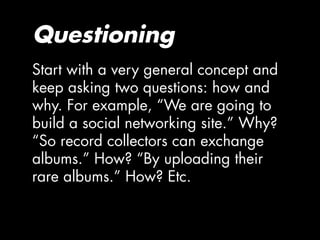
Questioning
Start with a very general concept and
keep asking two questions: how and
why. For example, “We are going to
build a social networking site.” Why?
“So record collectors can exchange
albums.” How? “By uploading their
rare albums.” How? Etc.
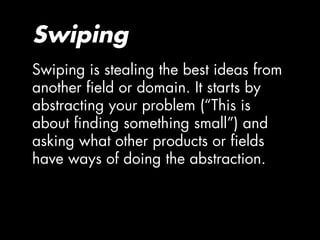
Swiping
Swiping is stealing the best ideas from
another field or domain. It starts by
abstracting your problem (“This is
about finding something small”) and
asking what other products or fields
have ways of doing the abstraction.
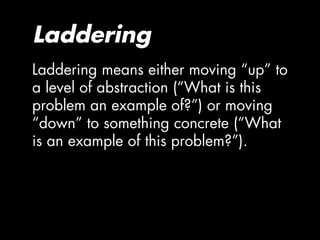
Laddering
Laddering means either moving “up” to
a level of abstraction (“What is this
problem an example of?”) or moving
“down” to something concrete (“What
is an example of this problem?”).
Bizarro World
Pretend you wanted to make the
opposite product or the opposite
outcome. Invert everything: what is
good is bad, what is desirable isn’t, etc.
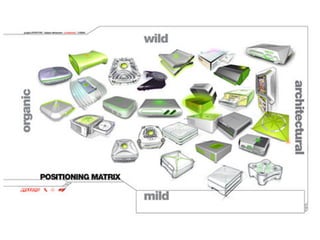
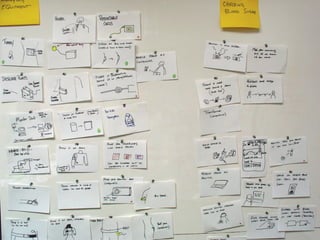
Clustering concepts
•   Cluster similar concepts around activities,
    characteristics, metaphors, etc.

•   Name the clusters

•   Consider collapsing similar concepts or
    stringing together concepts

•   Do an initial sorting of concepts
Design principles
Why design principles
•   Help pick the right concept

•   Help make design decisions

•   Can be longer lasting than product itself

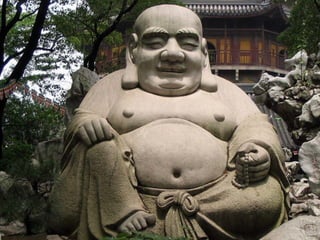
•   Helps find the Buddha Nature of a product
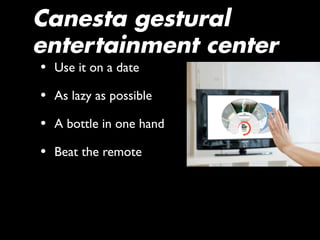
Canesta gestural
entertainment center
• Use it on a date
• As lazy as possible
• A bottle in one hand
• Beat the remote
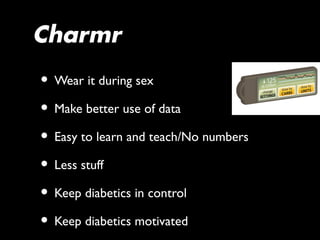
Charmr
• Wear it during sex
• Make better use of data
• Easy to learn and teach/No numbers
• Less stuff
• Keep diabetics in control
• Keep diabetics motivated
Design principles
•   Short

•   Memorable

•   Cross-feature

•   Specific (no “Easy to Use”)

•   Differentiator taken together

•   Non-conflicting
THANKS.


dan@kickerstudio.com

odannyboy on twitter

Ideation and Design Principles Workshop

  • 1.
    Ideation & Design Principles: YeOlde Design Workshoppe Dan Saffer, Kicker Studio
  • 3.
    CONSTRAINTS Technology Business Context Materials Tools Co Co e e nc nc nv nv e e er er rg rg ge ge ve ve nc nc Di Di e e RESEARCH PLAN RESEARCH OBSERVATIONS DISPLAY IDEATION PRINCIPLES REFINEMENT PROTOTYPE STRATEGY Images Data Impressions STRUCTURED INSIGHTS "Findings" Models Patterns Stories Personas "MAGIC"
  • 4.
  • 5.
    Brainstorming rules • No bad ideas, no criticism • Stay focused: Stray ideas into “parking lot” • Don’t spend a lot of time on any one idea • Use the whole room • No multitasking • Start with a warm-up exercise
  • 6.
    Brainstorming sprints • Fixed time limit • Quantity, quantity, quantity • Reward quantity, not quality! • Breaks (even small ones) between sessions • Drawing, dammit. This is design! • Focus on pain points and opportunities
  • 8.
  • 9.
    Brainwriting Each person writesdown or sketches the beginning of an idea silently on a piece of paper. This could be as simple as a single word or a shape. After three minutes, the person passes the paper to his neighbor, who continues the idea. This repeats around the circle until it gets all the way back around to its originator.
  • 10.
    Break the rules Ratherthan ignore the project’s constraints, you list them out and one-by-one proceed to figure out how to break them.
  • 11.
    Force fit Distill theproblem down to two words that are in opposition, then put those words together into a phrase. For example, “intense peace.” Then ruminate on what exists in the world that embodies that phrase, then try to apply it to the project for inspiration. Nature and art often work well for this.
  • 12.
    Poetry Reduce the problemdown to a haiku or bento poem. Such a small form makes you figure out what are the most important parts of the problem.
  • 13.
  • 14.
    Questioning Start with avery general concept and keep asking two questions: how and why. For example, “We are going to build a social networking site.” Why? “So record collectors can exchange albums.” How? “By uploading their rare albums.” How? Etc.
  • 15.
    Swiping Swiping is stealingthe best ideas from another field or domain. It starts by abstracting your problem (“This is about finding something small”) and asking what other products or fields have ways of doing the abstraction.
  • 16.
    Laddering Laddering means eithermoving “up” to a level of abstraction (“What is this problem an example of?”) or moving “down” to something concrete (“What is an example of this problem?”).
  • 17.
    Bizarro World Pretend youwanted to make the opposite product or the opposite outcome. Invert everything: what is good is bad, what is desirable isn’t, etc.
  • 18.
    Clustering concepts • Cluster similar concepts around activities, characteristics, metaphors, etc. • Name the clusters • Consider collapsing similar concepts or stringing together concepts • Do an initial sorting of concepts
  • 21.
  • 22.
    Why design principles • Help pick the right concept • Help make design decisions • Can be longer lasting than product itself • Helps find the Buddha Nature of a product
  • 24.
    Canesta gestural entertainment center •Use it on a date • As lazy as possible • A bottle in one hand • Beat the remote
  • 25.
    Charmr • Wear itduring sex • Make better use of data • Easy to learn and teach/No numbers • Less stuff • Keep diabetics in control • Keep diabetics motivated
  • 26.
    Design principles • Short • Memorable • Cross-feature • Specific (no “Easy to Use”) • Differentiator taken together • Non-conflicting
  • 27.