ICT in Education Communication and information are at the very heart of the educational process, consequently ICT-use in education has a long history. ICT-use in education can be expected to increase dramatically source: New Directions of ICT Use in Education, UNESCO report  http://www.unesco.org/education/educprog/lwf/dl/edict.pdf
ICT in Education significant challenge in preparing students and teachers for “our future ‘knowledge-based’ society”  most teachers are not prepared to use ICT  majority of existing school buildings are not equipped to integrate the new ICT. source: New Directions of ICT Use in Education, UNESCO report  http://www.unesco.org/education/educprog/lwf/dl/edict.pdf
ICT in Education: penetration USA: students/computer:  63:1   (1985)      6:1   (1997)   internet access:  35%   (1994)      72%   (1997) UK  (1998)   : students/computer:  16:1   (primary)  -  9:1   (secondary)   internet access:  43% Slovenia  (1998)  : internet access:  80%   (primary) -   93%   (secondary) source: New Directions of ICT Use in Education, UNESCO report  http://www.unesco.org/education/educprog/lwf/dl/edict.pdf
ICT in Education: trends interactivity  ICT no longer one-way channel for info choice about pace & order of presentation, topics take notes, answer questions, explore communicate with others flexibility of use anytime, anyplace source: New Directions of ICT Use in Education, UNESCO report  http://www.unesco.org/education/educprog/lwf/dl/edict.pdf
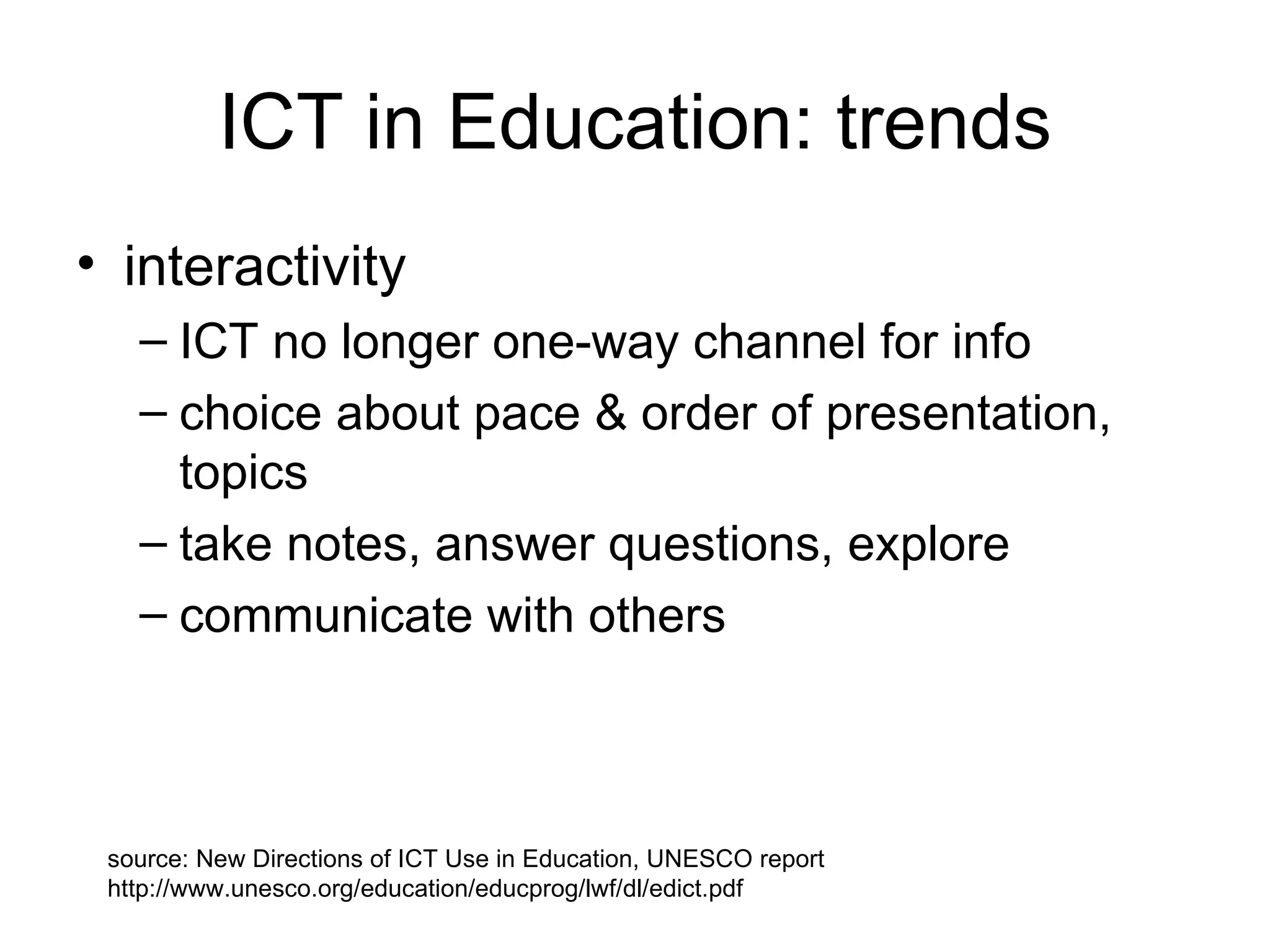
ICT in Education: trends interactivity  ICT no longer one-way channel for info choice about pace & order of presentation, topics take notes, answer questions, explore communicate with others source: New Directions of ICT Use in Education, UNESCO report  http://www.unesco.org/education/educprog/lwf/dl/edict.pdf
ICT in Education: trends flexibility of use anytime, anyplace integration of multiple media CDROM, text, audio, video, simulations, … connectivity worldwide access to people , sources, archives source: New Directions of ICT Use in Education, UNESCO report  http://www.unesco.org/education/educprog/lwf/dl/edict.pdf
ICT in Education: impact Students … learn more in classes with CBI learn in less time with CBI like their classes more with CBI develop more positive attitudes toward computers when they receive help from them in school source: New Directions of ICT Use in Education, UNESCO report  http://www.unesco.org/education/educprog/lwf/dl/edict.pdf

Ict in education

  • 1.
    ICT in EducationCommunication and information are at the very heart of the educational process, consequently ICT-use in education has a long history. ICT-use in education can be expected to increase dramatically source: New Directions of ICT Use in Education, UNESCO report http://www.unesco.org/education/educprog/lwf/dl/edict.pdf
  • 2.
    ICT in Educationsignificant challenge in preparing students and teachers for “our future ‘knowledge-based’ society” most teachers are not prepared to use ICT majority of existing school buildings are not equipped to integrate the new ICT. source: New Directions of ICT Use in Education, UNESCO report http://www.unesco.org/education/educprog/lwf/dl/edict.pdf
  • 3.
    ICT in Education:penetration USA: students/computer: 63:1 (1985)  6:1 (1997) internet access: 35% (1994)  72% (1997) UK (1998) : students/computer: 16:1 (primary) - 9:1 (secondary) internet access: 43% Slovenia (1998) : internet access: 80% (primary) - 93% (secondary) source: New Directions of ICT Use in Education, UNESCO report http://www.unesco.org/education/educprog/lwf/dl/edict.pdf
  • 4.
    ICT in Education:trends interactivity ICT no longer one-way channel for info choice about pace & order of presentation, topics take notes, answer questions, explore communicate with others flexibility of use anytime, anyplace source: New Directions of ICT Use in Education, UNESCO report http://www.unesco.org/education/educprog/lwf/dl/edict.pdf
  • 5.
    ICT in Education:trends interactivity ICT no longer one-way channel for info choice about pace & order of presentation, topics take notes, answer questions, explore communicate with others source: New Directions of ICT Use in Education, UNESCO report http://www.unesco.org/education/educprog/lwf/dl/edict.pdf
  • 6.
    ICT in Education:trends flexibility of use anytime, anyplace integration of multiple media CDROM, text, audio, video, simulations, … connectivity worldwide access to people , sources, archives source: New Directions of ICT Use in Education, UNESCO report http://www.unesco.org/education/educprog/lwf/dl/edict.pdf
  • 7.
    ICT in Education:impact Students … learn more in classes with CBI learn in less time with CBI like their classes more with CBI develop more positive attitudes toward computers when they receive help from them in school source: New Directions of ICT Use in Education, UNESCO report http://www.unesco.org/education/educprog/lwf/dl/edict.pdf