Dr. Faheem Hussain
Assistant Professor, Department of Technology and Society,
College of Engineering and Applied Sciences,
SUNY Korea
faheem.hussain@stonybrook.edu
ICT Entrepreneurship in Developing Countries:
Challenges & Beyond
Agenda
 What is ICT Entrepreneurship?
 Situation Analysis of Developing Countries
 Global ICT usage trends: Disparity and Opportunity
 ICT Entrepreneurship: Billionaires’ Club to BoP Initiatives
 Challenges in ICT Entrepreneurship
 Opportunities: A Collaborative Future
What is ICT Entrepreneurship?
• ICT Entrepreneurship explores newer business
opportunities using the virtue of traditional
entrepreneurship, empowered by digital
technologies
• ICT Entrepreneurs utilize digital tools to
– Ensure better participation of its partners/ stakeholders,
higher level of ROI
– Foster sustainable future financial growth, and
– Expand service access to the unreachable in developing
countries
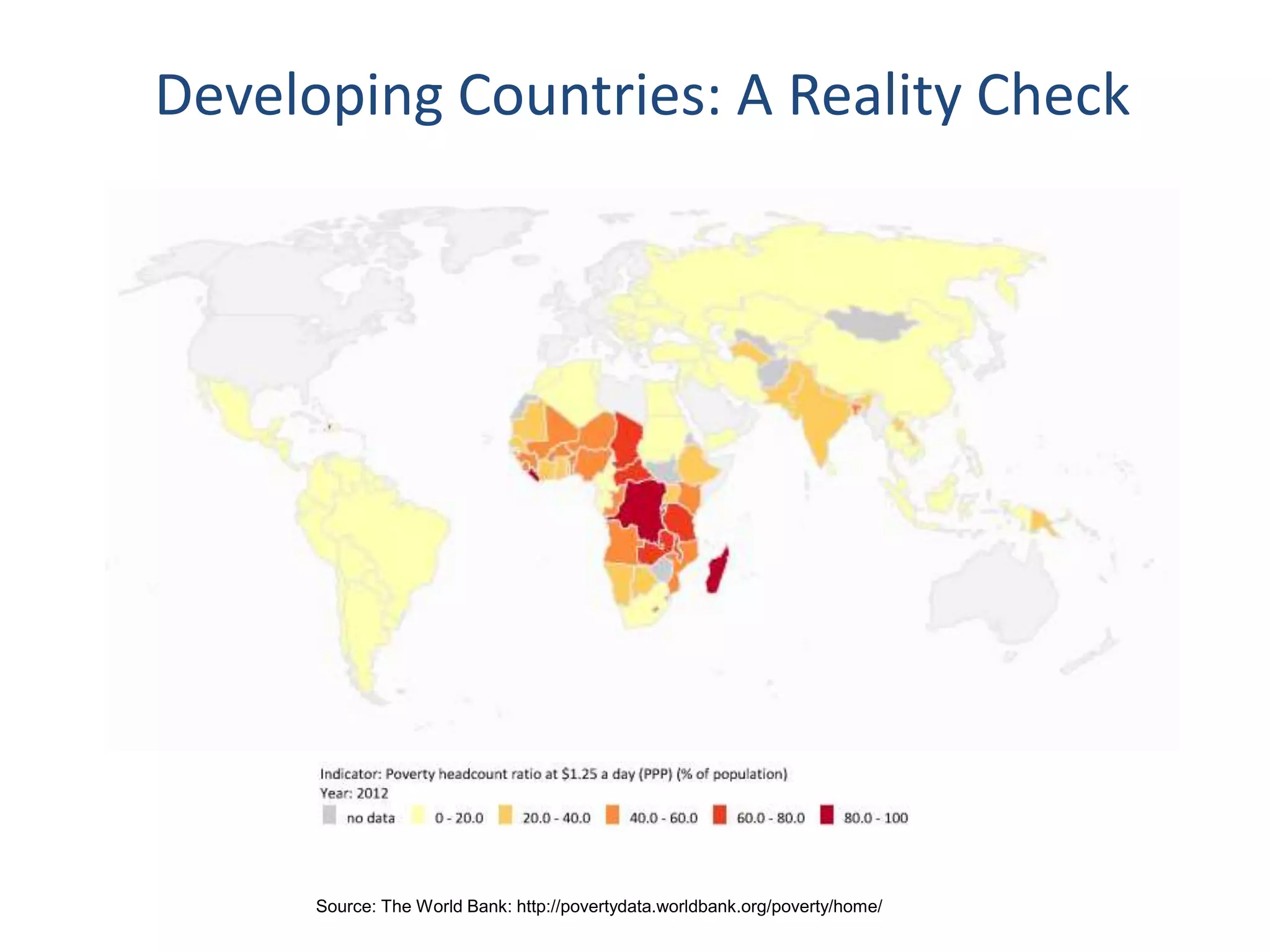
Developing Countries: A Reality Check
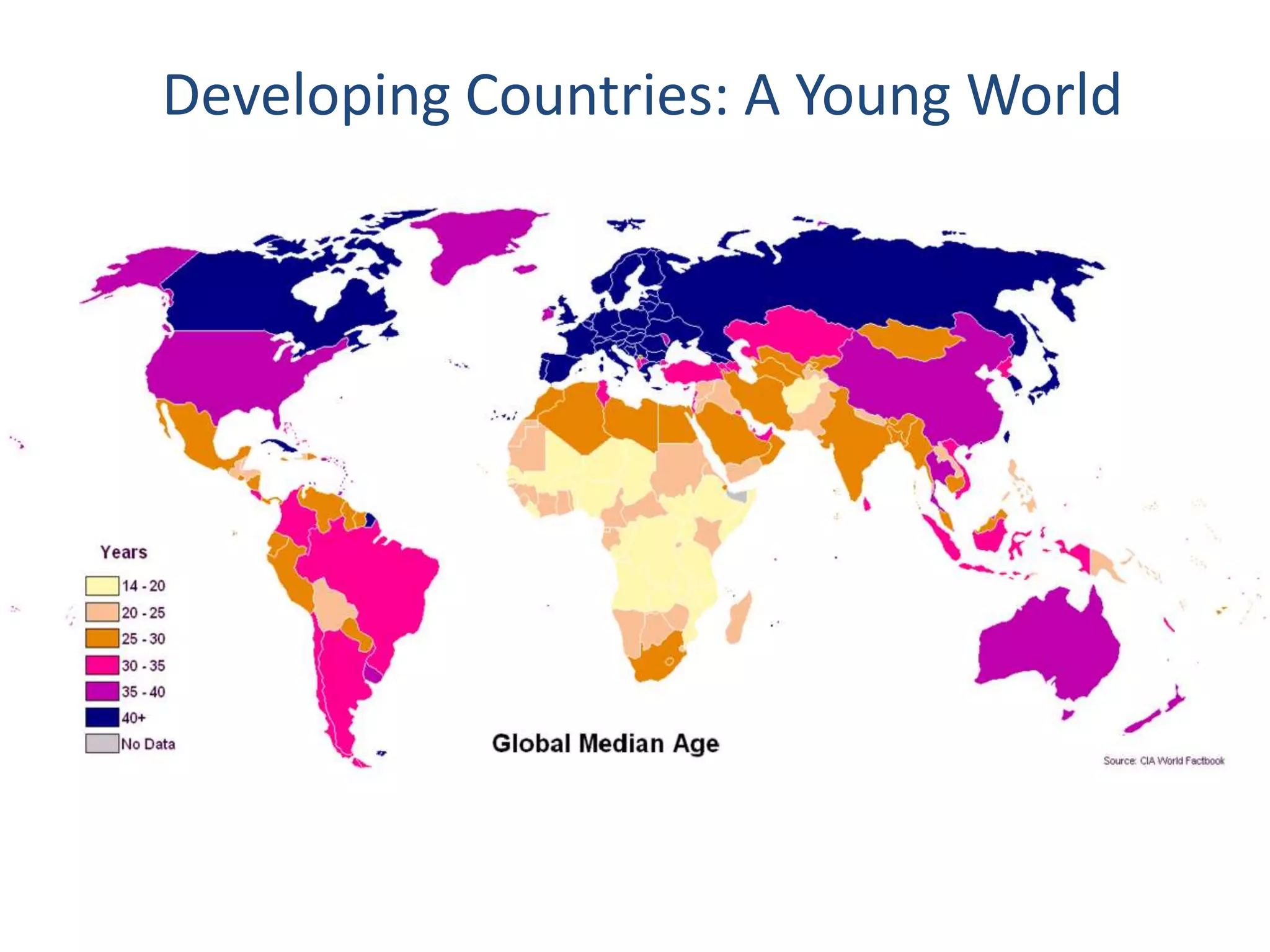
• Global development has been unequal, even though
the trends in human development are generally
positive
• In 2011, just over 1 billion people live on less than
$1.25 a day
• Life expectancy in some of the country is below 40
years
Developing Countries: A Reality Check
Source: The World Bank: http://povertydata.worldbank.org/poverty/home/
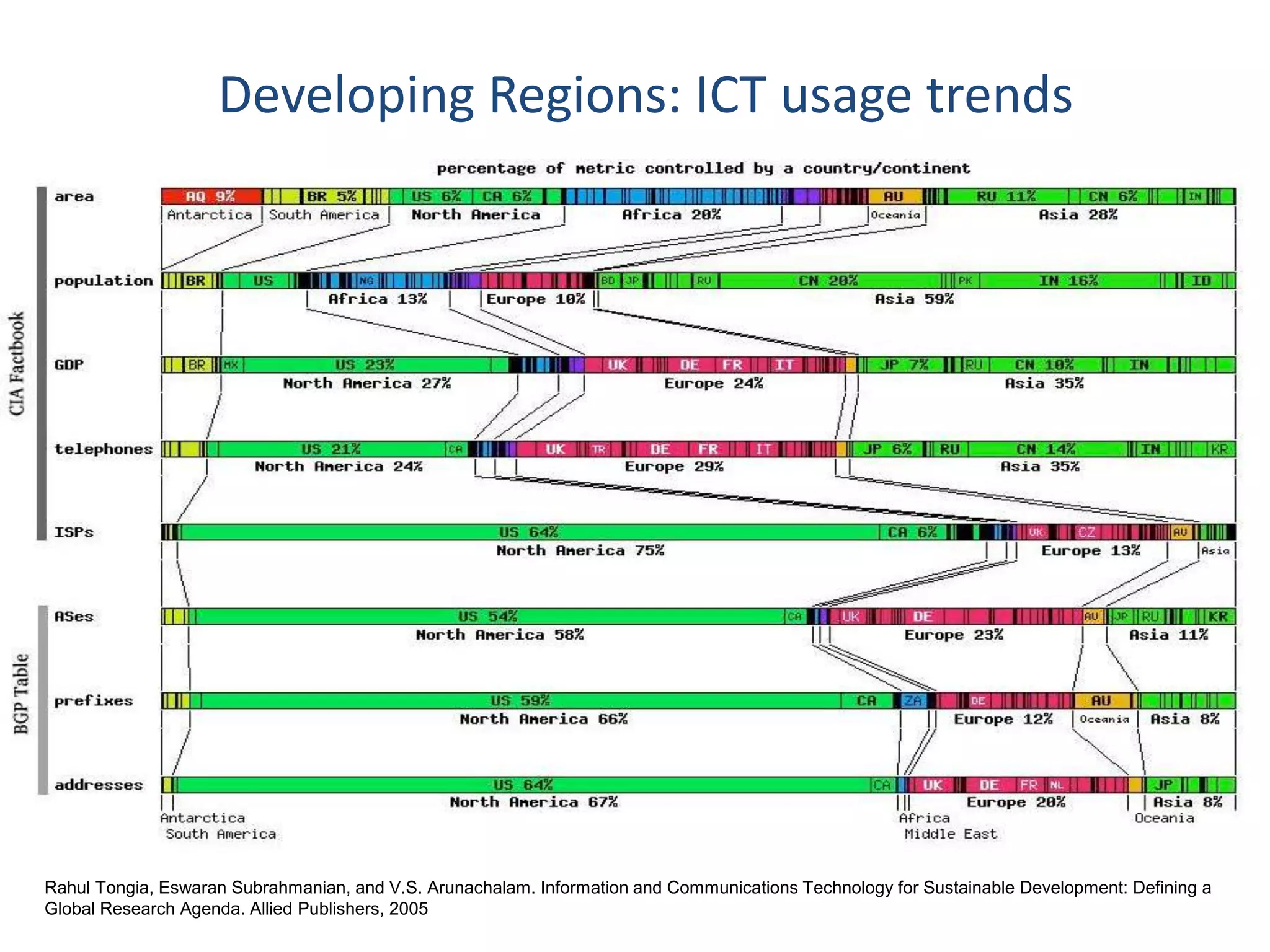
Developing Regions: ICT usage trends
Rahul Tongia, Eswaran Subrahmanian, and V.S. Arunachalam. Information and Communications Technology for Sustainable Development: Defining a
Global Research Agenda. Allied Publishers, 2005
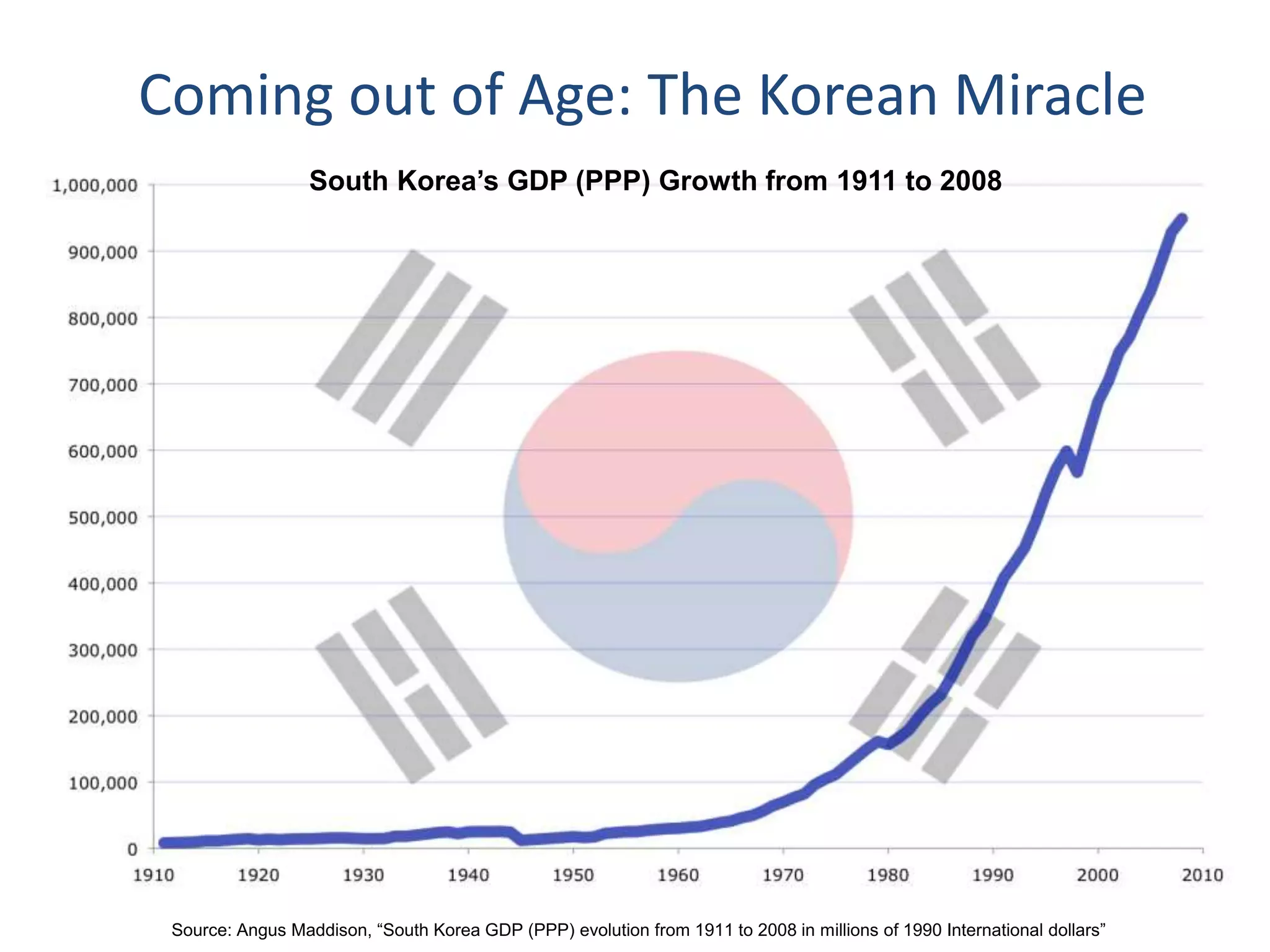
Coming out of Age: The Korean Miracle
Source: Angus Maddison, “South Korea GDP (PPP) evolution from 1911 to 2008 in millions of 1990 International dollars”
South Korea’s GDP (PPP) Growth from 1911 to 2008
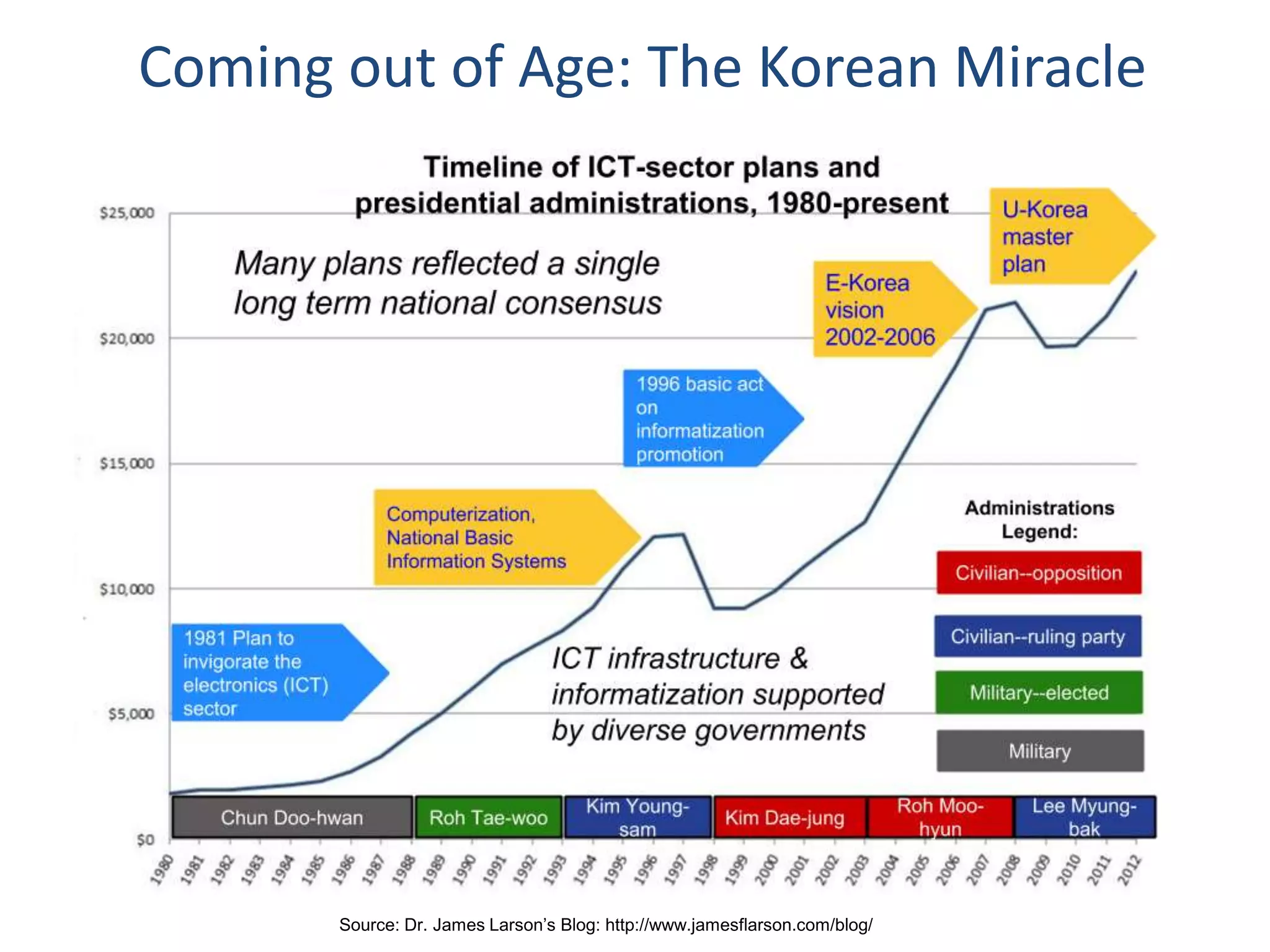
Coming out of Age: The Korean Miracle
Source: Dr. James Larson’s Blog: http://www.jamesflarson.com/blog/
Developing Countries: A Young World
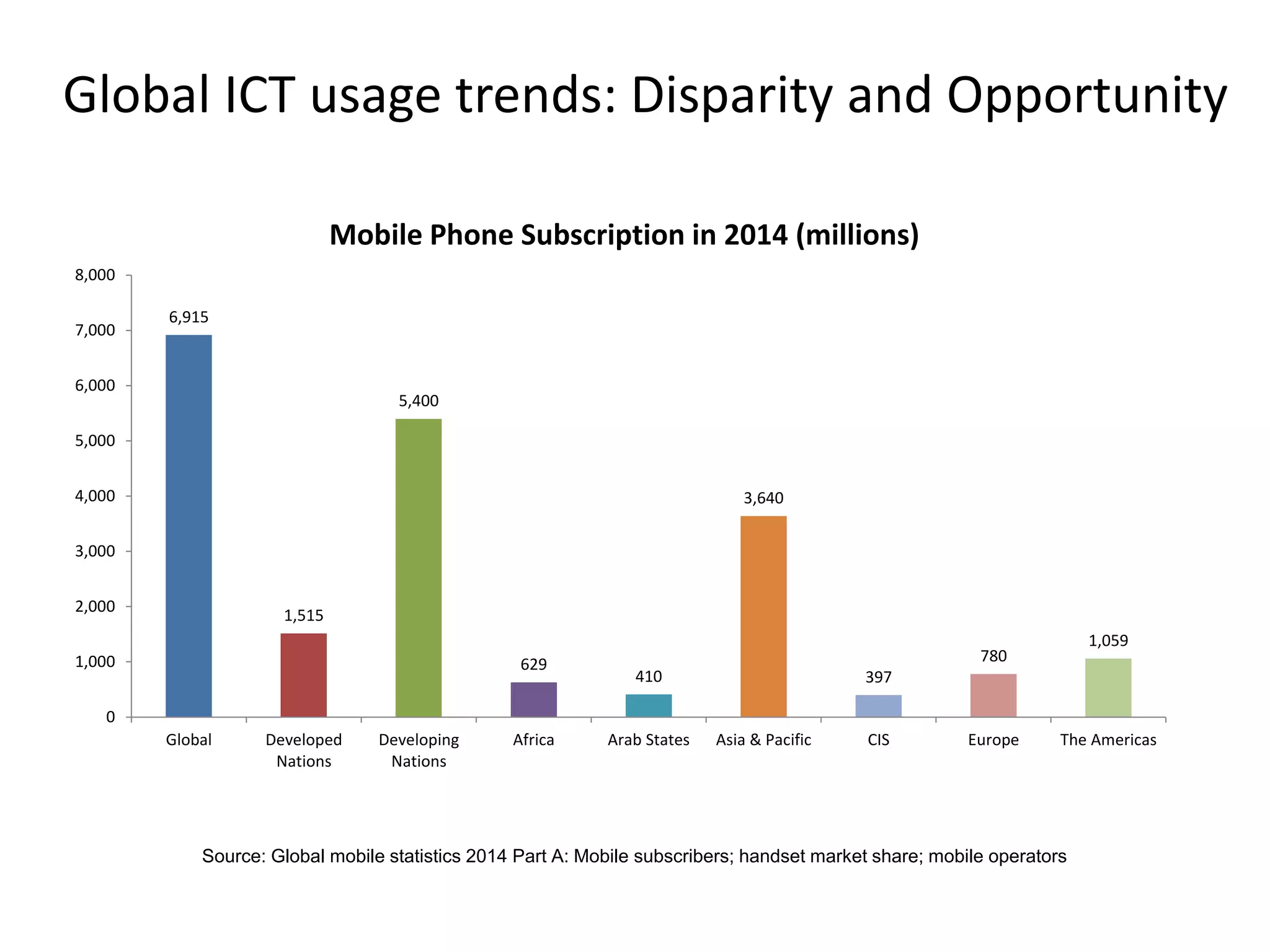
Global ICT usage trends: Disparity and Opportunity
6,915
1,515
5,400
629
410
3,640
397
780
1,059
0
1,000
2,000
3,000
4,000
5,000
6,000
7,000
8,000
Global Developed
Nations
Developing
Nations
Africa Arab States Asia & Pacific CIS Europe The Americas
Mobile Phone Subscription in 2014 (millions)
Source: Global mobile statistics 2014 Part A: Mobile subscribers; handset market share; mobile operators
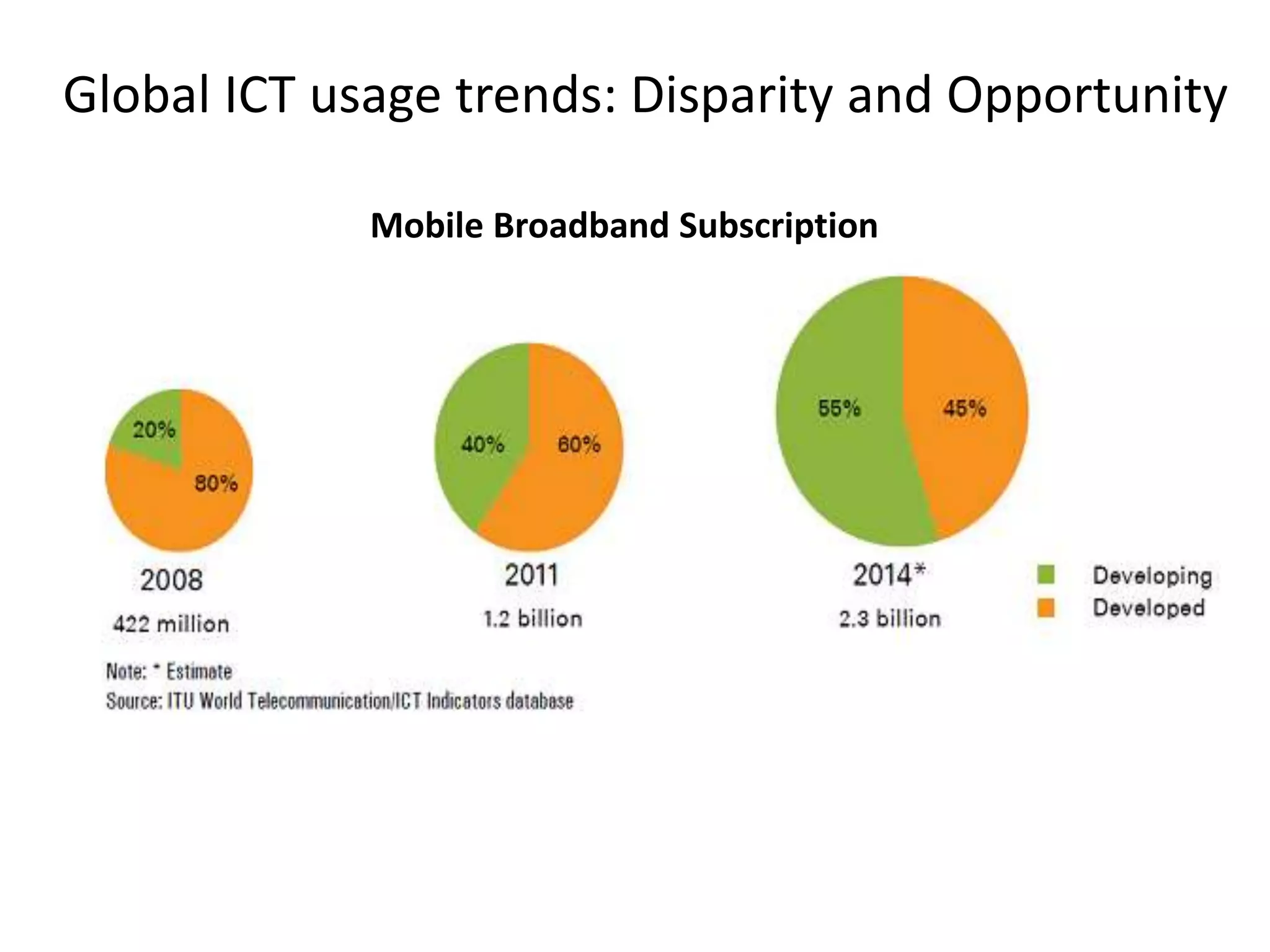
Global ICT usage trends: Disparity and Opportunity
Mobile Broadband Subscription
Stage is set for rapid diffusion of
ICT Entrepreneurship
ICT Entrepreneurship:
Billionaires’ Club to BoP Initiatives
ICT Entrepreneurship:
Billionaires’ Club to BoP Initiatives
Source: ICT Sprin, http://www.ictspring.com/startups/
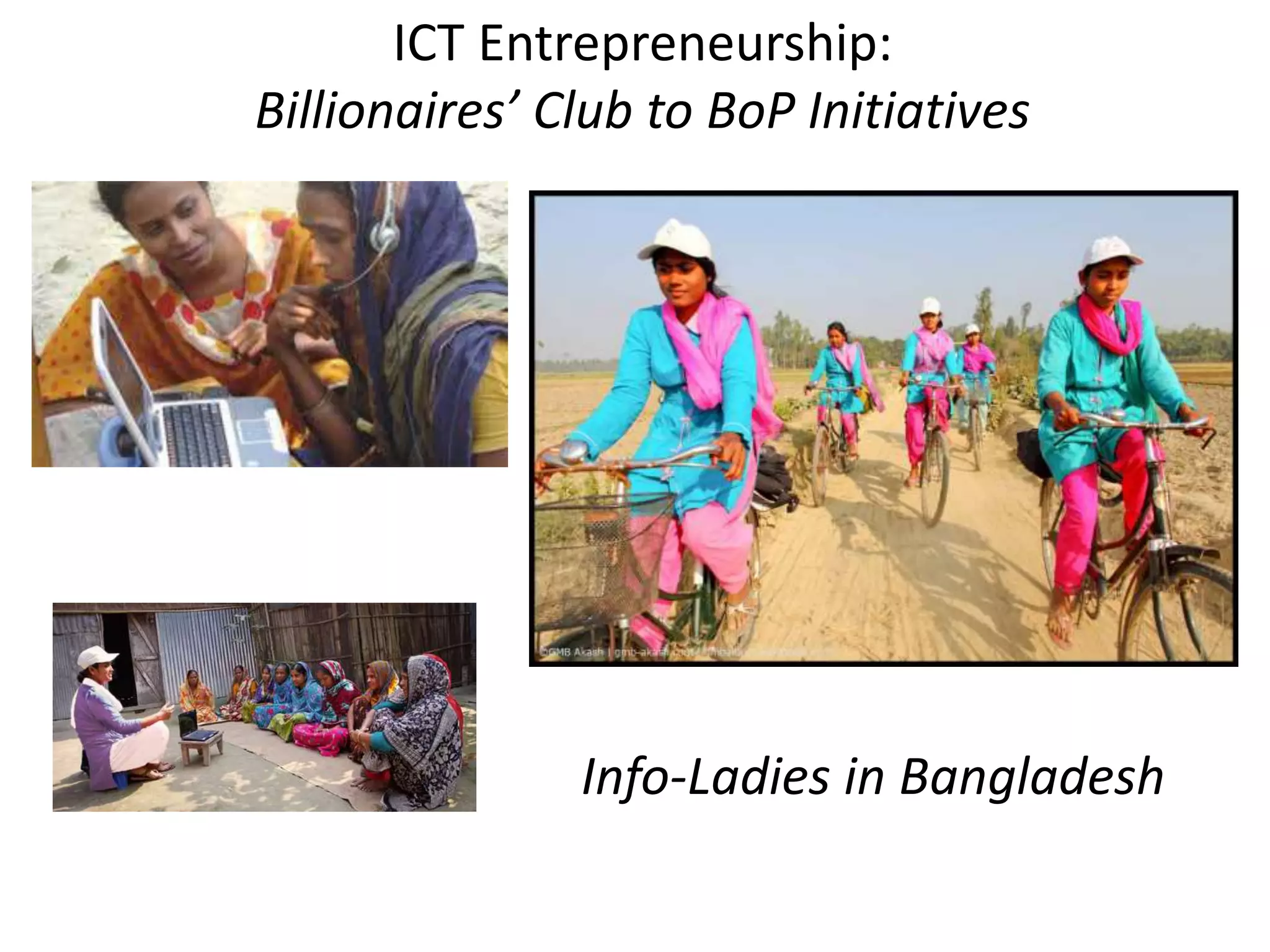
Info-Ladies in Bangladesh
ICT Entrepreneurship:
Billionaires’ Club to BoP Initiatives
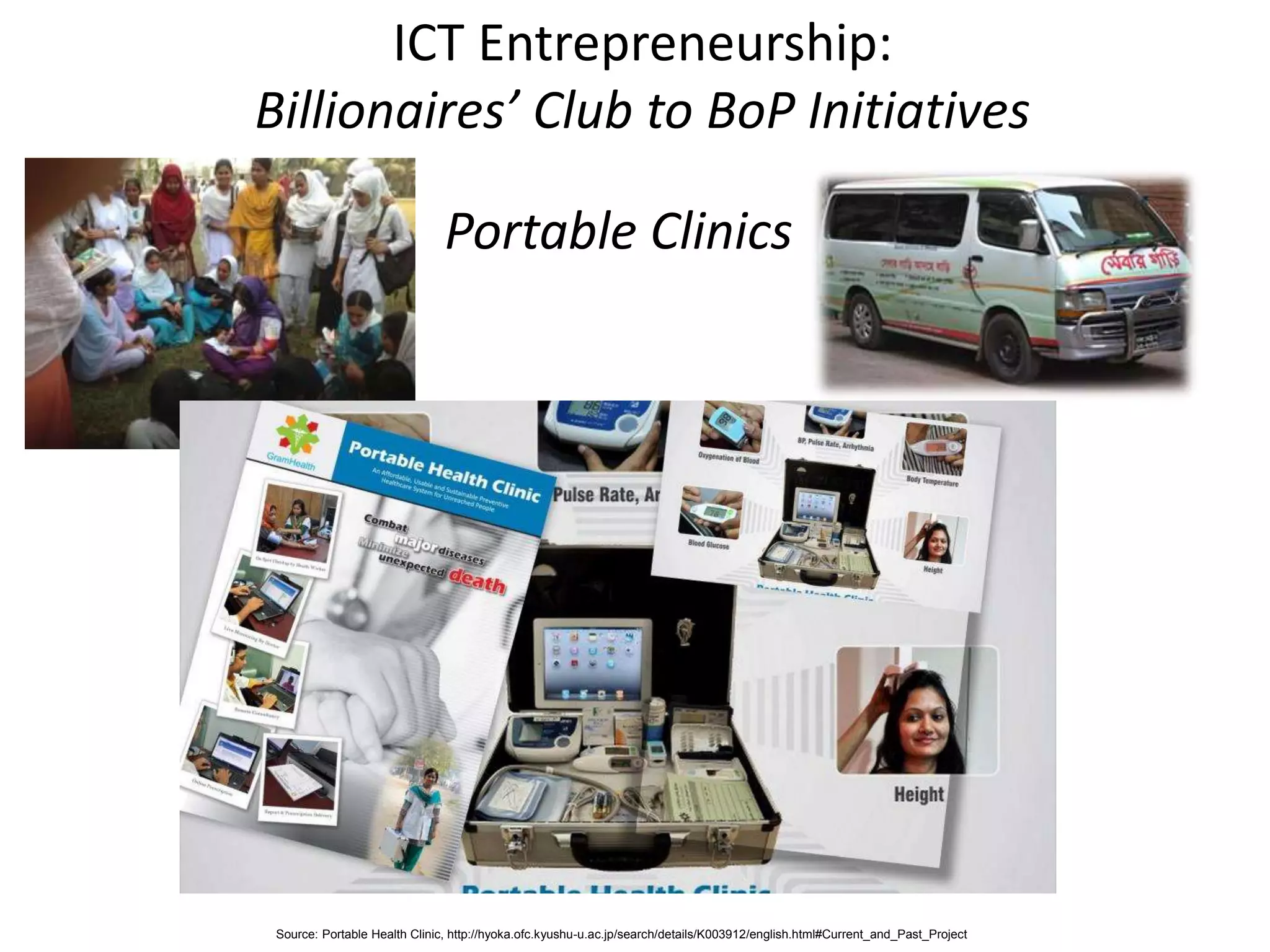
Portable Clinics
ICT Entrepreneurship:
Billionaires’ Club to BoP Initiatives
Source: Portable Health Clinic, http://hyoka.ofc.kyushu-u.ac.jp/search/details/K003912/english.html#Current_and_Past_Project
ICT Entrepreneurship: A Game Changer
• Traditional entrepreneurship as creating business
opportunities, jobs and services for the region
• Start Up culture ensures dynamism in ICT Industry
• Also, ICT enabled, newer trend/social entrepreneurship
where it is directly linked with
• Improving access to services to excluded populations,
• Improving impact and opportunities for them, etc.
• Scope for Collaboration, Innovation, Technology
Diffusion, CHANGE
ICT Entrepreneurship: A Game Changer
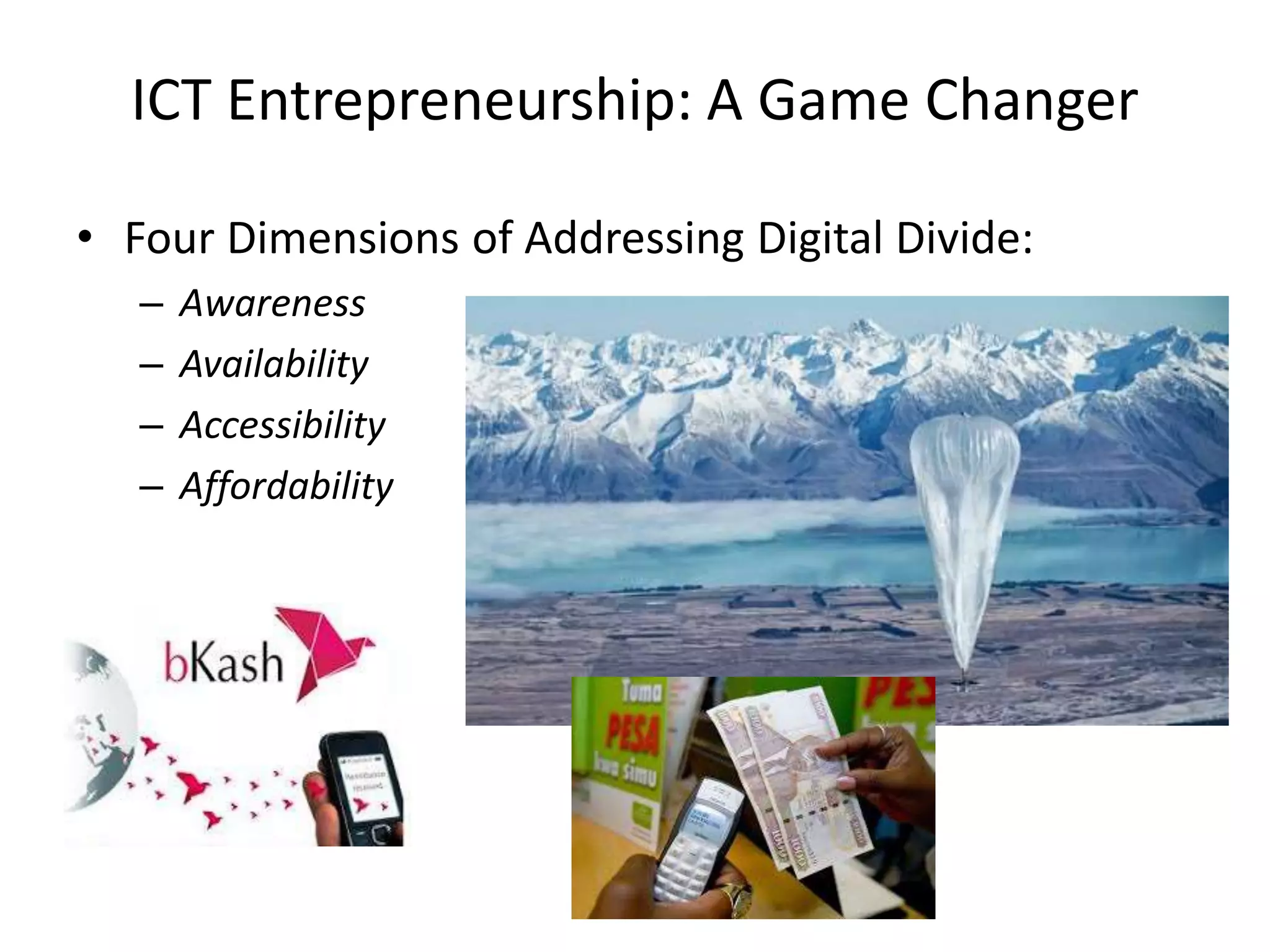
• Four Dimensions of Addressing Digital Divide:
– Awareness
– Availability
– Accessibility
– Affordability
Challenges in ICT Entrepreneurship
• Outdated Government Policies and failure to
recognize and facilitate ICT Entrepreneurship
– Absence of administrative structure to ensure legal
registration and safety net
• Lack of ownership, power play between multiple
ministries/departments
– Absence of/Poor implementation of Intellectual Property
Right addressing the specific needs of ICT Entrepreneurs,
• Fewer new entrants in the marketplace
• Discouraging foreign investors
Challenges in ICT Entrepreneurship
• Outdated Government Policies and failure to
recognize and facilitate ICT Entrepreneurship
– Many Governments failing to recognize their roles as
investor, client, and development partner
– Inefficient Financial Services
• Higher overhead cost, Complex legal issues with foreign currency
transaction,
– In many developing countries, Information based
Products/Services are not qualified to be covered by
insurances, increasing the risk of investment
Challenges in ICT Entrepreneurship
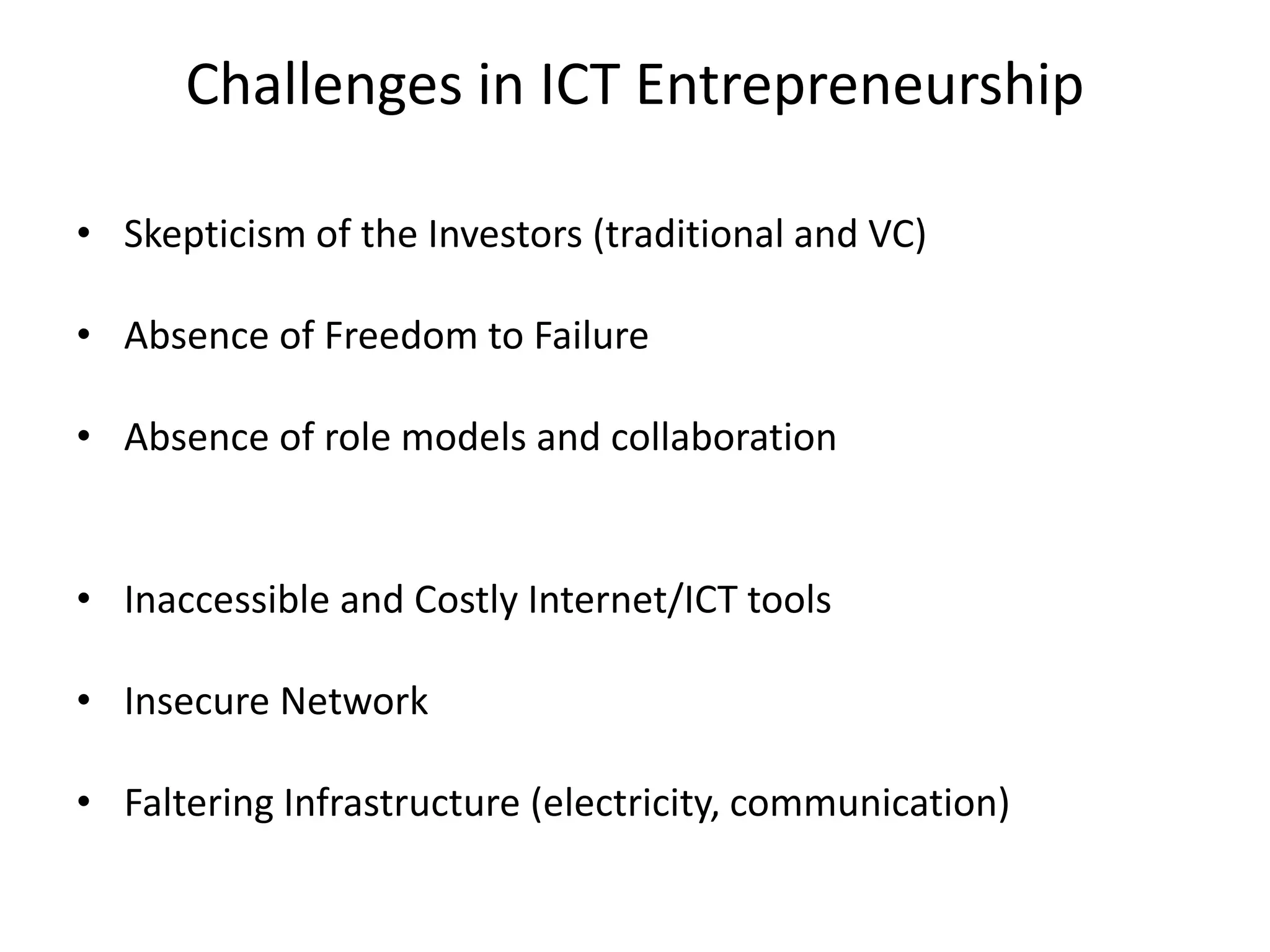
• Skepticism of the Investors (traditional and VC)
• Absence of Freedom to Failure
• Absence of role models and collaboration
• Inaccessible and Costly Internet/ICT tools
• Insecure Network
• Faltering Infrastructure (electricity, communication)
Challenges in ICT Entrepreneurship
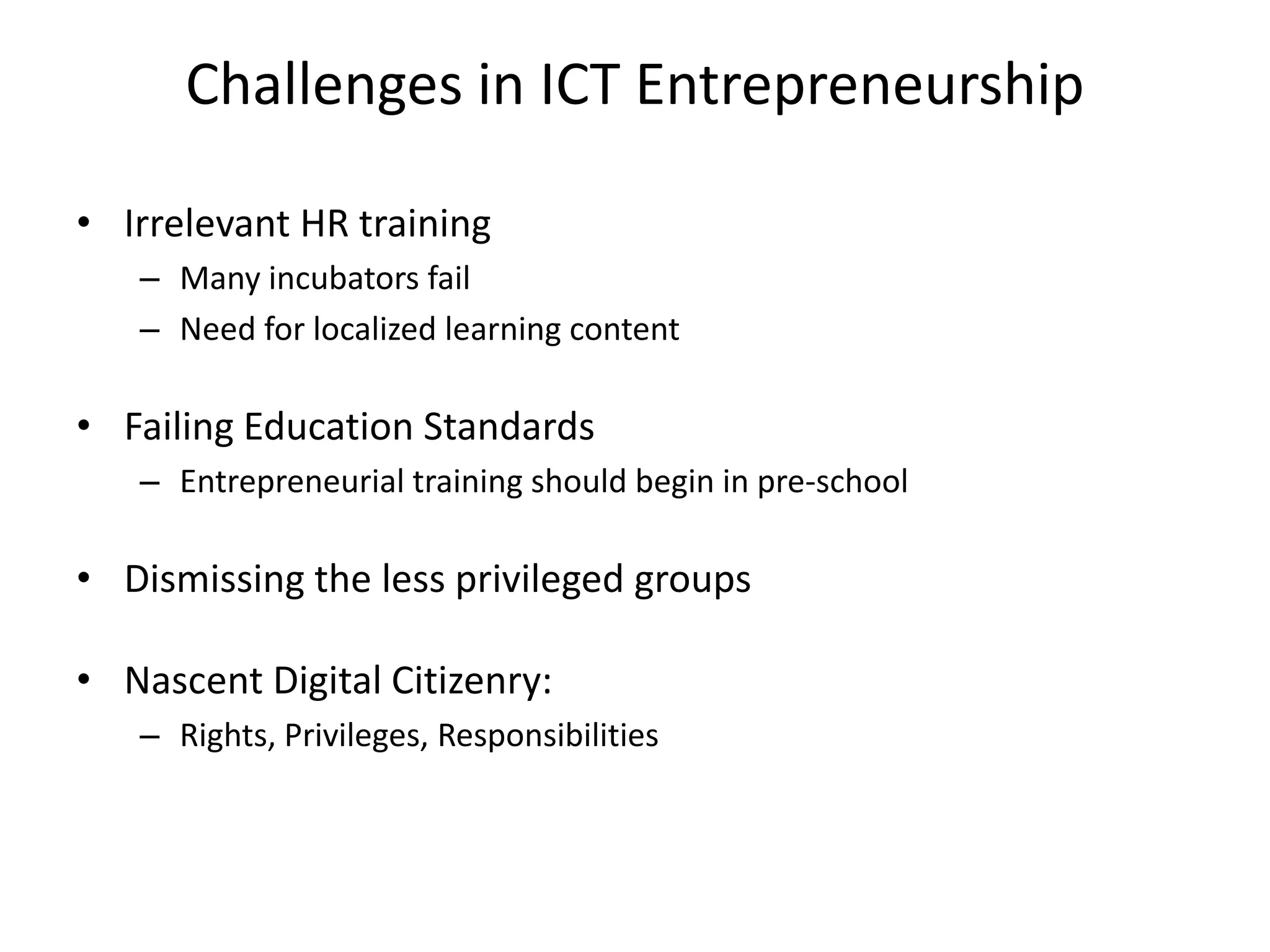
• Irrelevant HR training
– Many incubators fail
– Need for localized learning content
• Failing Education Standards
– Entrepreneurial training should begin in pre-school
• Dismissing the less privileged groups
• Nascent Digital Citizenry:
– Rights, Privileges, Responsibilities
Opportunities: A Collaborative Future
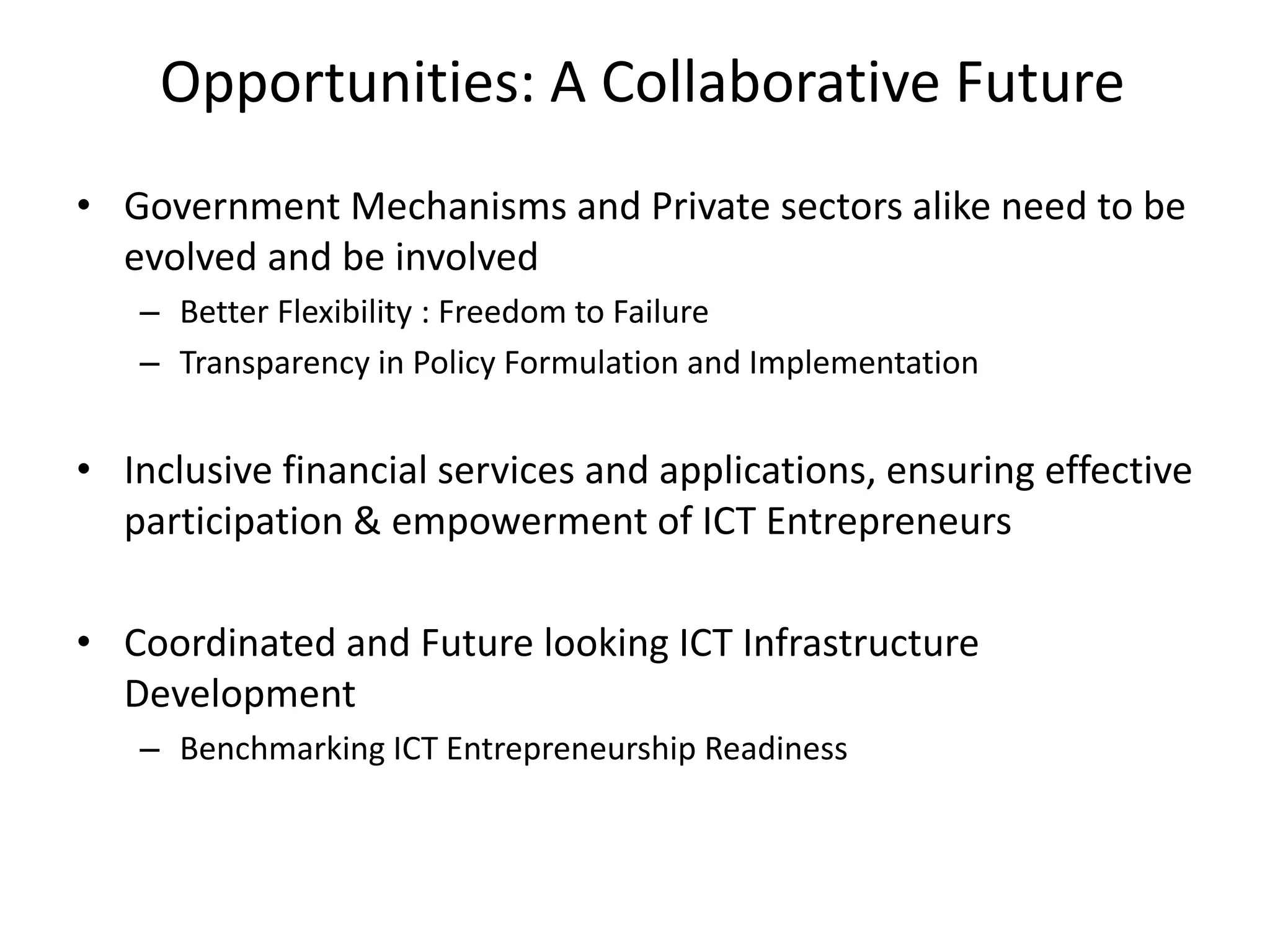
• Government Mechanisms and Private sectors alike need to be
evolved and be involved
– Better Flexibility : Freedom to Failure
– Transparency in Policy Formulation and Implementation
• Inclusive financial services and applications, ensuring effective
participation & empowerment of ICT Entrepreneurs
• Coordinated and Future looking ICT Infrastructure
Development
– Benchmarking ICT Entrepreneurship Readiness
Acknowledgement
• SUNY Korea IT Consilience Creative Program (ITCCP)
Research Fund
• Dr. James Larson, SUNY Korea
• Dr. Christian Girard, Asian University for Women
• Sufi Ibne Abu Bakar, ICT Entrepreneur

ICT Entrepreneurship in Developing Countries: Challenges and Beyond

  • 1.
    Dr. Faheem Hussain AssistantProfessor, Department of Technology and Society, College of Engineering and Applied Sciences, SUNY Korea faheem.hussain@stonybrook.edu ICT Entrepreneurship in Developing Countries: Challenges & Beyond
  • 2.
    Agenda  What isICT Entrepreneurship?  Situation Analysis of Developing Countries  Global ICT usage trends: Disparity and Opportunity  ICT Entrepreneurship: Billionaires’ Club to BoP Initiatives  Challenges in ICT Entrepreneurship  Opportunities: A Collaborative Future
  • 3.
    What is ICTEntrepreneurship? • ICT Entrepreneurship explores newer business opportunities using the virtue of traditional entrepreneurship, empowered by digital technologies • ICT Entrepreneurs utilize digital tools to – Ensure better participation of its partners/ stakeholders, higher level of ROI – Foster sustainable future financial growth, and – Expand service access to the unreachable in developing countries
  • 4.
    Developing Countries: AReality Check • Global development has been unequal, even though the trends in human development are generally positive • In 2011, just over 1 billion people live on less than $1.25 a day • Life expectancy in some of the country is below 40 years
  • 5.
    Developing Countries: AReality Check Source: The World Bank: http://povertydata.worldbank.org/poverty/home/
  • 6.
    Developing Regions: ICTusage trends Rahul Tongia, Eswaran Subrahmanian, and V.S. Arunachalam. Information and Communications Technology for Sustainable Development: Defining a Global Research Agenda. Allied Publishers, 2005
  • 7.
    Coming out ofAge: The Korean Miracle Source: Angus Maddison, “South Korea GDP (PPP) evolution from 1911 to 2008 in millions of 1990 International dollars” South Korea’s GDP (PPP) Growth from 1911 to 2008
  • 8.
    Coming out ofAge: The Korean Miracle Source: Dr. James Larson’s Blog: http://www.jamesflarson.com/blog/
  • 9.
  • 10.
    Global ICT usagetrends: Disparity and Opportunity 6,915 1,515 5,400 629 410 3,640 397 780 1,059 0 1,000 2,000 3,000 4,000 5,000 6,000 7,000 8,000 Global Developed Nations Developing Nations Africa Arab States Asia & Pacific CIS Europe The Americas Mobile Phone Subscription in 2014 (millions) Source: Global mobile statistics 2014 Part A: Mobile subscribers; handset market share; mobile operators
  • 11.
    Global ICT usagetrends: Disparity and Opportunity Mobile Broadband Subscription
  • 12.
    Stage is setfor rapid diffusion of ICT Entrepreneurship
  • 13.
  • 14.
    ICT Entrepreneurship: Billionaires’ Clubto BoP Initiatives Source: ICT Sprin, http://www.ictspring.com/startups/
  • 15.
    Info-Ladies in Bangladesh ICTEntrepreneurship: Billionaires’ Club to BoP Initiatives
  • 16.
    Portable Clinics ICT Entrepreneurship: Billionaires’Club to BoP Initiatives Source: Portable Health Clinic, http://hyoka.ofc.kyushu-u.ac.jp/search/details/K003912/english.html#Current_and_Past_Project
  • 17.
    ICT Entrepreneurship: AGame Changer • Traditional entrepreneurship as creating business opportunities, jobs and services for the region • Start Up culture ensures dynamism in ICT Industry • Also, ICT enabled, newer trend/social entrepreneurship where it is directly linked with • Improving access to services to excluded populations, • Improving impact and opportunities for them, etc. • Scope for Collaboration, Innovation, Technology Diffusion, CHANGE
  • 18.
    ICT Entrepreneurship: AGame Changer • Four Dimensions of Addressing Digital Divide: – Awareness – Availability – Accessibility – Affordability
  • 19.
    Challenges in ICTEntrepreneurship • Outdated Government Policies and failure to recognize and facilitate ICT Entrepreneurship – Absence of administrative structure to ensure legal registration and safety net • Lack of ownership, power play between multiple ministries/departments – Absence of/Poor implementation of Intellectual Property Right addressing the specific needs of ICT Entrepreneurs, • Fewer new entrants in the marketplace • Discouraging foreign investors
  • 20.
    Challenges in ICTEntrepreneurship • Outdated Government Policies and failure to recognize and facilitate ICT Entrepreneurship – Many Governments failing to recognize their roles as investor, client, and development partner – Inefficient Financial Services • Higher overhead cost, Complex legal issues with foreign currency transaction, – In many developing countries, Information based Products/Services are not qualified to be covered by insurances, increasing the risk of investment
  • 21.
    Challenges in ICTEntrepreneurship • Skepticism of the Investors (traditional and VC) • Absence of Freedom to Failure • Absence of role models and collaboration • Inaccessible and Costly Internet/ICT tools • Insecure Network • Faltering Infrastructure (electricity, communication)
  • 22.
    Challenges in ICTEntrepreneurship • Irrelevant HR training – Many incubators fail – Need for localized learning content • Failing Education Standards – Entrepreneurial training should begin in pre-school • Dismissing the less privileged groups • Nascent Digital Citizenry: – Rights, Privileges, Responsibilities
  • 23.
    Opportunities: A CollaborativeFuture • Government Mechanisms and Private sectors alike need to be evolved and be involved – Better Flexibility : Freedom to Failure – Transparency in Policy Formulation and Implementation • Inclusive financial services and applications, ensuring effective participation & empowerment of ICT Entrepreneurs • Coordinated and Future looking ICT Infrastructure Development – Benchmarking ICT Entrepreneurship Readiness
  • 24.
    Acknowledgement • SUNY KoreaIT Consilience Creative Program (ITCCP) Research Fund • Dr. James Larson, SUNY Korea • Dr. Christian Girard, Asian University for Women • Sufi Ibne Abu Bakar, ICT Entrepreneur