ICS Networks
PRESENTED AT OREGON INFRAGARD MEETING
26 JUNE 2018
Who Am I
 Chad Hunter
 Security Analyst at Portland General Electric (all views / opinions / information
presented are my own and do not reflect the opinion of PGE in any way shape
or form)
 Formerly Network Admin on a CIP controlled network at Bonneville Power
Administration (same disclaimer apples)
 GIAC GICSP (Industrial Control Security Professional) and GRID (Response and
Industrial Defense) certified.
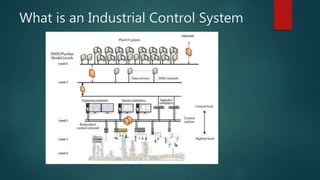
What is an Industrial Control System
 Device or devices that manages, commands, directs, or
regulates the behavior of other devices or systems
 Intersection of Digital / Cyber and the physical world
 Feedback loops
 Sensor reads a value
 Value is forwarded to controller and compared to a set of parameters
 Controller sends command to actuator
 Actuator acts on physical environment
 Repeat
Common ICS Components
 Programmable Logic Controller (PLC) – Computer based, multiple I/O
(feedback loop), logic executed based on state, resistant to physical stress
 Remote Terminal Unit (RTU) – Communication link between control
systems and supervisory systems. Can connect IEDs or PLCs to Supervisory
system or multiple discrete processes to centralized control. RTUs and
PLCs are converging in function
 Intelligent Electronic Device (IED) – devices with limited programming
that have a limited specialized function (protective relay or PMU)
Common ICS Components
 Instrumented Devices – Sensors and Actuators that physically interact
with the plant
 Supervisory Components –
 Human Machine Interface (HMI) – Presents process data to operator. May
be read only or facilitate manual control.
 Historian – stores historical data about process
 Alarms
 Operator / Engineer Workstations – used for changes or maintenance
 Safety Instrumented Systems – monitors and remediates situations that may
impact plant or personnel safety
Types of Control Systems
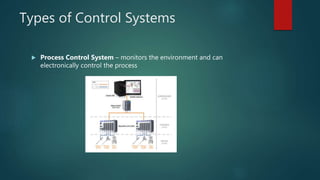
 Process Control System – monitors the environment and can
electronically control the process
Types of Control Systems
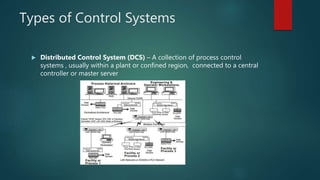
 Distributed Control System (DCS) – A collection of process control
systems , usually within a plant or confined region, connected to a central
controller or master server
Types of Control Systems
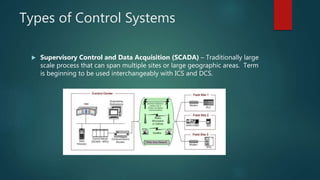
 Supervisory Control and Data Acquisition (SCADA) – Traditionally large
scale process that can span multiple sites or large geographic areas. Term
is beginning to be used interchangeably with ICS and DCS.
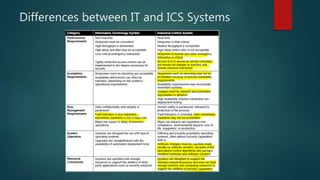
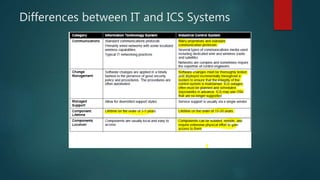
Differences between IT and ICS Systems
Common Threats to ICS Systems
 Insider
 Hacktivist
 Nation State
 Cyber criminal
Nation States are of particular interest in the context of ICS networks.
Compromising an ICS network, especially maintaining persistence is usually
more complicated than compromising an IT network and requires a level of
resources most commonly associated with Nation States.
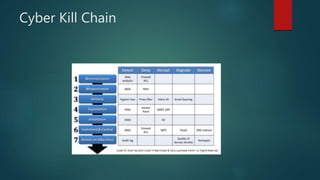
Cyber Kill Chain
ICS Cyber Kill Chain
ICS Specific Threats
 Stuxnet
 Havex
 Blackenergy
 CRASHOVERRIDE
 Triton/Trisis
Stuxnet
 Nation State developer
 Earliest traces 2005 discovered 2010
 Targets Siemens Step7 software
 3 modules
 Worm
 Link file – propagates to other systems
 Rootkit – hides activities
 Used infected USBs to cross airgap
Havex
 Discovered 2015
 Mainly distributed via watering hole attack
 Scans and Targets ports commonly used by Rockwell and Siemens
 Maps ICS networks that use DCOM based OPC
 Mainly used for intelligence gathering but the RAT payload allows
complete control of targeted system
BlackEnergy
 Multiple variants
 BlackEnergy2 – targeted infrastructure in the US
 Modular – dropper can deliver payloads capable of executing files and
updating itself
 BlackEnergy3 – used in 2014 Ukraine attack
 Installs .dlls directly doesn’t need driver component anymore
CRASHOVERRIDE
 Used in 2016 Ukraine attacks
 Specifically targets the electric grid
 Modular
 Backdoor
 can execute various commands including copying files and start stopping services
 Launcher
 Can wipe registry keys, ICS configs and render system unusable
 Payload
 Can extend capabilities
 Specifically designed to destroy and disrupt
TRITON / TRISIS
 Discovered 2017
 Specifically targeted Triconex Safety Instrumented Systems
 Mimics Trilog controller software
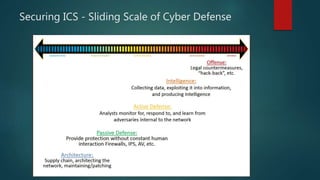
Securing ICS
 DHS – Seven Steps to Effectively Defend Industrial Control Systems
 Prioritized by effectiveness
 1. Whitelisting – because ICS systems are relative static this is easier than on a
traditional IT network
 2. Configuration / Patch Management
 3. Reduce Attack Surface – turn off unneeded ports / services, segment
 4. Defensible Environment – Network segmentation
 5. Authentication
 6. Secure Remote Access
 7. Monitor and Respond – know your normal (baselines) – This is the essence of
active defense
Securing ICS - Sliding Scale of Cyber Defense
References
 SANS ICS 410 ICS/SCADA Security Essentials
 SANS ICS 515 Active Defense and Incident Response for ICS Systems
 NIST SP 800-82 Rev 2 Guide to Industrial Control System Security
 CRASHOVERRIDE: Threat to Electric Grid Operations
https://dragos.com/blog/crashoverride/CrashOverride-01.pdf
 Securing Industrial Control Systems with Tripwire

Ics presentation

  • 1.
    ICS Networks PRESENTED ATOREGON INFRAGARD MEETING 26 JUNE 2018
  • 2.
    Who Am I Chad Hunter  Security Analyst at Portland General Electric (all views / opinions / information presented are my own and do not reflect the opinion of PGE in any way shape or form)  Formerly Network Admin on a CIP controlled network at Bonneville Power Administration (same disclaimer apples)  GIAC GICSP (Industrial Control Security Professional) and GRID (Response and Industrial Defense) certified.
  • 3.
    What is anIndustrial Control System
  • 4.
    What is anIndustrial Control System  Device or devices that manages, commands, directs, or regulates the behavior of other devices or systems  Intersection of Digital / Cyber and the physical world  Feedback loops  Sensor reads a value  Value is forwarded to controller and compared to a set of parameters  Controller sends command to actuator  Actuator acts on physical environment  Repeat
  • 5.
    Common ICS Components Programmable Logic Controller (PLC) – Computer based, multiple I/O (feedback loop), logic executed based on state, resistant to physical stress  Remote Terminal Unit (RTU) – Communication link between control systems and supervisory systems. Can connect IEDs or PLCs to Supervisory system or multiple discrete processes to centralized control. RTUs and PLCs are converging in function  Intelligent Electronic Device (IED) – devices with limited programming that have a limited specialized function (protective relay or PMU)
  • 6.
    Common ICS Components Instrumented Devices – Sensors and Actuators that physically interact with the plant  Supervisory Components –  Human Machine Interface (HMI) – Presents process data to operator. May be read only or facilitate manual control.  Historian – stores historical data about process  Alarms  Operator / Engineer Workstations – used for changes or maintenance  Safety Instrumented Systems – monitors and remediates situations that may impact plant or personnel safety
  • 7.
    Types of ControlSystems  Process Control System – monitors the environment and can electronically control the process
  • 8.
    Types of ControlSystems  Distributed Control System (DCS) – A collection of process control systems , usually within a plant or confined region, connected to a central controller or master server
  • 9.
    Types of ControlSystems  Supervisory Control and Data Acquisition (SCADA) – Traditionally large scale process that can span multiple sites or large geographic areas. Term is beginning to be used interchangeably with ICS and DCS.
  • 10.
    Differences between ITand ICS Systems
  • 11.
    Differences between ITand ICS Systems
  • 12.
    Common Threats toICS Systems  Insider  Hacktivist  Nation State  Cyber criminal Nation States are of particular interest in the context of ICS networks. Compromising an ICS network, especially maintaining persistence is usually more complicated than compromising an IT network and requires a level of resources most commonly associated with Nation States.
  • 13.
  • 14.
  • 15.
    ICS Specific Threats Stuxnet  Havex  Blackenergy  CRASHOVERRIDE  Triton/Trisis
  • 16.
    Stuxnet  Nation Statedeveloper  Earliest traces 2005 discovered 2010  Targets Siemens Step7 software  3 modules  Worm  Link file – propagates to other systems  Rootkit – hides activities  Used infected USBs to cross airgap
  • 17.
    Havex  Discovered 2015 Mainly distributed via watering hole attack  Scans and Targets ports commonly used by Rockwell and Siemens  Maps ICS networks that use DCOM based OPC  Mainly used for intelligence gathering but the RAT payload allows complete control of targeted system
  • 18.
    BlackEnergy  Multiple variants BlackEnergy2 – targeted infrastructure in the US  Modular – dropper can deliver payloads capable of executing files and updating itself  BlackEnergy3 – used in 2014 Ukraine attack  Installs .dlls directly doesn’t need driver component anymore
  • 19.
    CRASHOVERRIDE  Used in2016 Ukraine attacks  Specifically targets the electric grid  Modular  Backdoor  can execute various commands including copying files and start stopping services  Launcher  Can wipe registry keys, ICS configs and render system unusable  Payload  Can extend capabilities  Specifically designed to destroy and disrupt
  • 20.
    TRITON / TRISIS Discovered 2017  Specifically targeted Triconex Safety Instrumented Systems  Mimics Trilog controller software
  • 21.
    Securing ICS  DHS– Seven Steps to Effectively Defend Industrial Control Systems  Prioritized by effectiveness  1. Whitelisting – because ICS systems are relative static this is easier than on a traditional IT network  2. Configuration / Patch Management  3. Reduce Attack Surface – turn off unneeded ports / services, segment  4. Defensible Environment – Network segmentation  5. Authentication  6. Secure Remote Access  7. Monitor and Respond – know your normal (baselines) – This is the essence of active defense
  • 22.
    Securing ICS -Sliding Scale of Cyber Defense
  • 23.
    References  SANS ICS410 ICS/SCADA Security Essentials  SANS ICS 515 Active Defense and Incident Response for ICS Systems  NIST SP 800-82 Rev 2 Guide to Industrial Control System Security  CRASHOVERRIDE: Threat to Electric Grid Operations https://dragos.com/blog/crashoverride/CrashOverride-01.pdf  Securing Industrial Control Systems with Tripwire