Chapter1
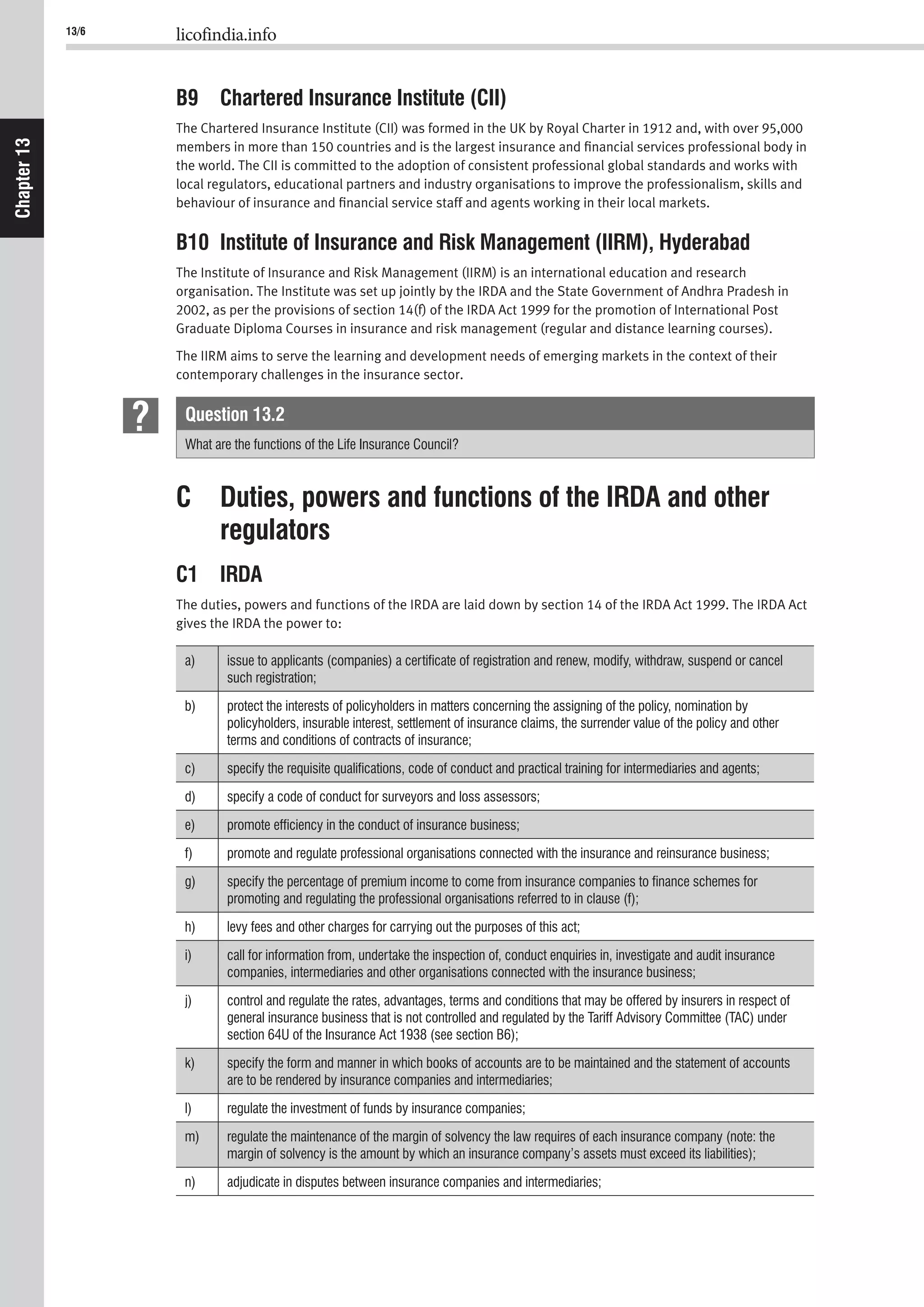
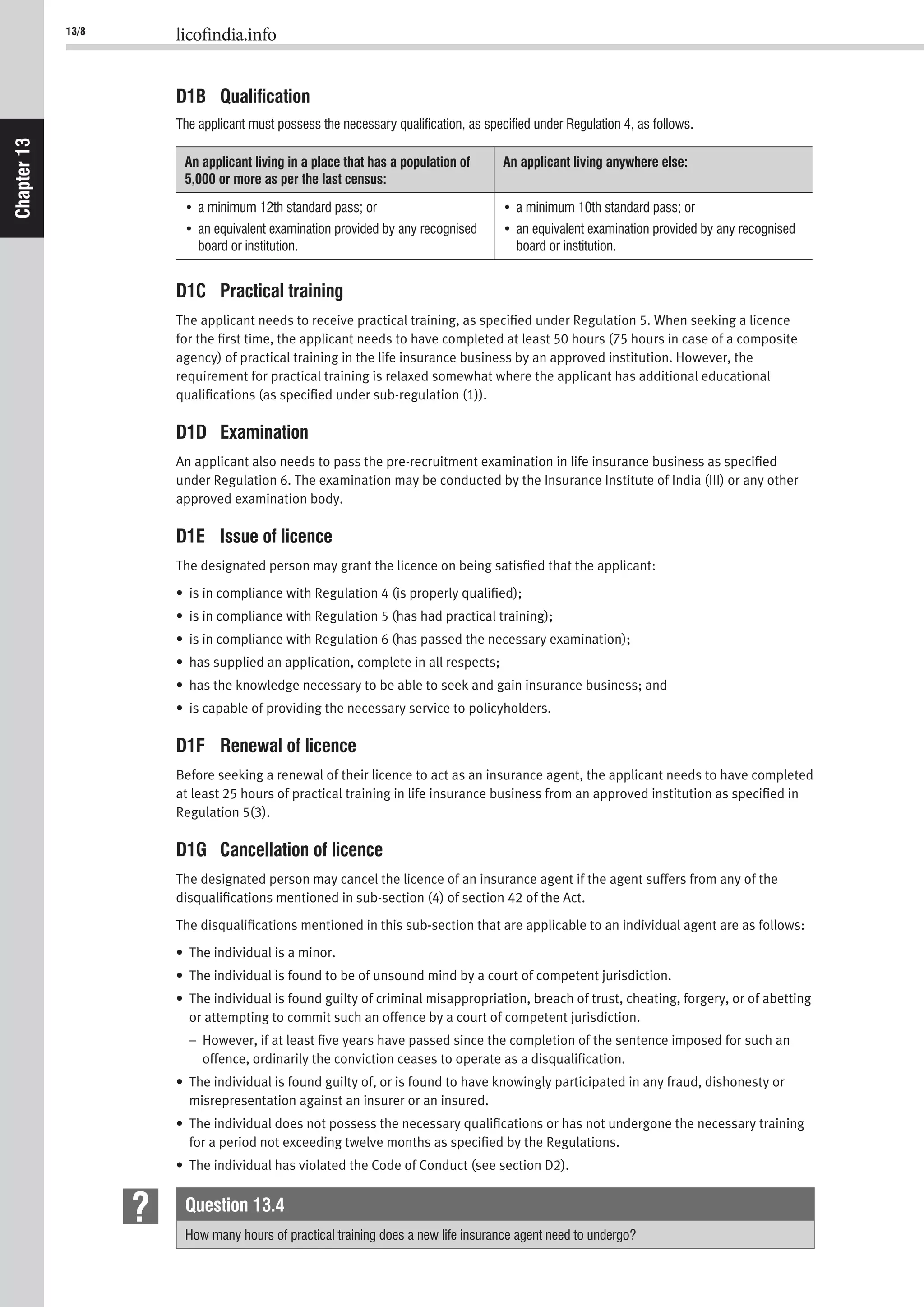
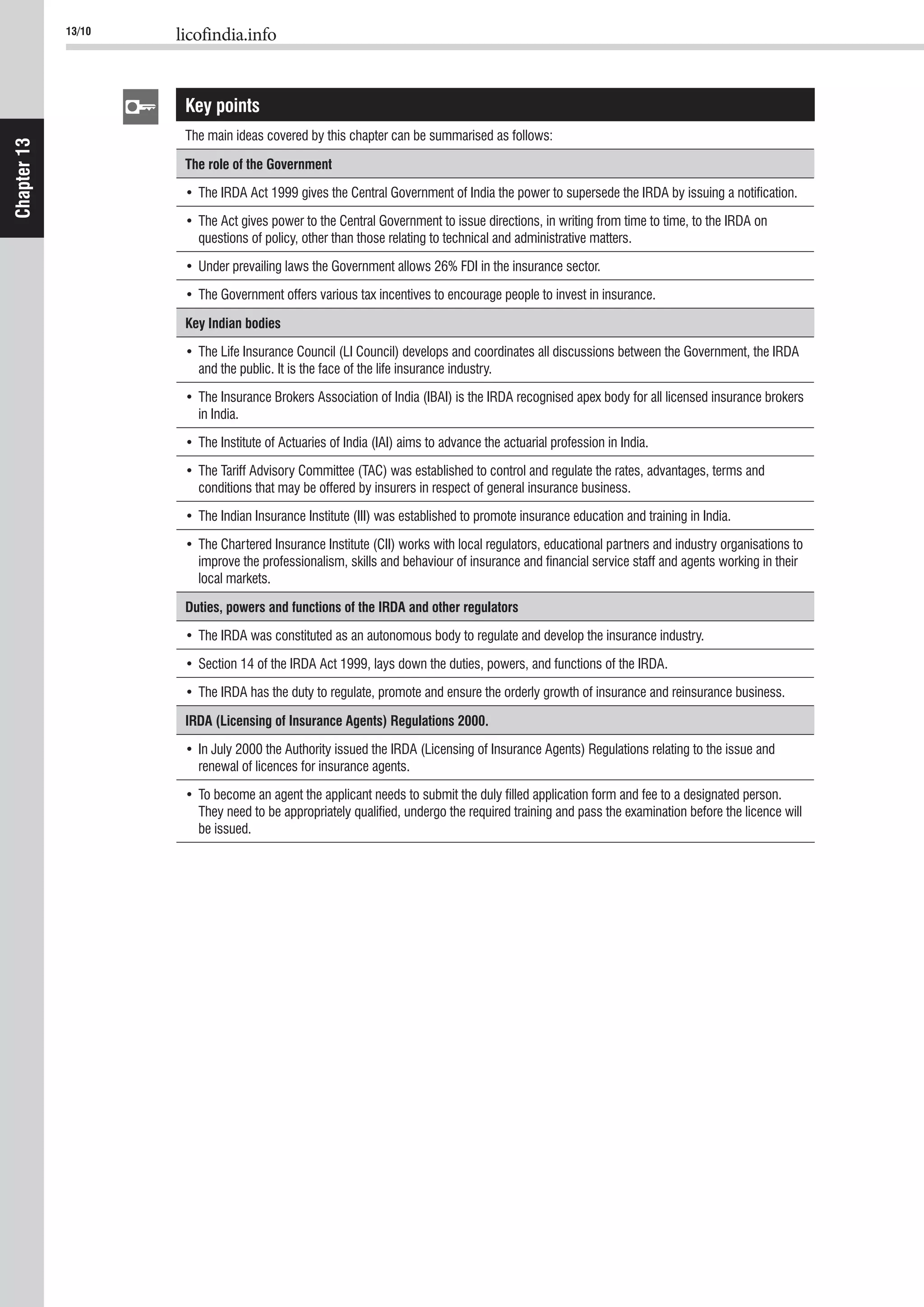
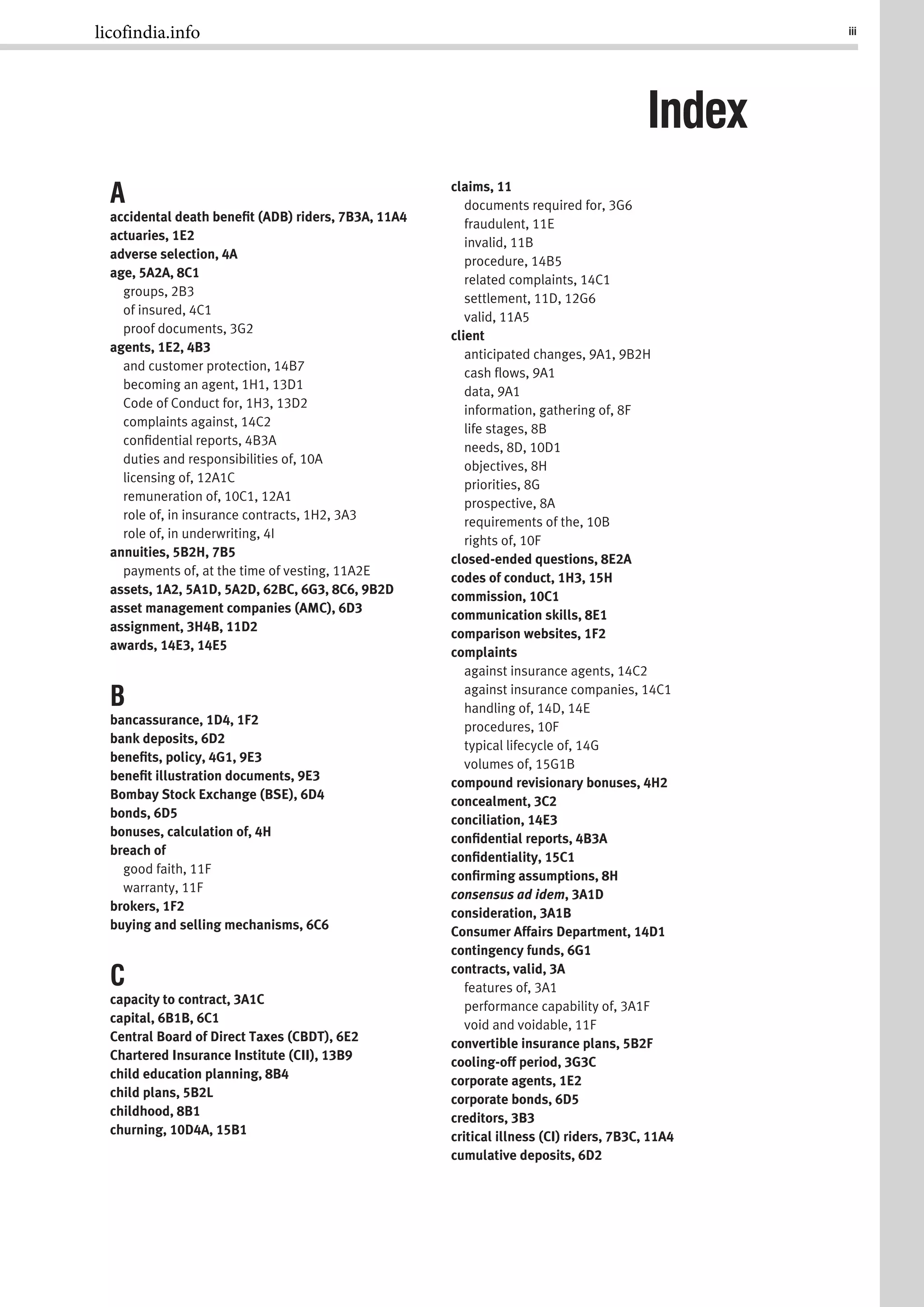
1How the insurance
market operates
Contents Syllabus learning
outcomes
Learning objectives
Introduction
Key terms
A What is insurance? 1.1
B Role of financial services and insurance 1.1
C Benefits of a professional insurance market 1.2
D History of insurance 1.3
E Insurance organisations and roles 1.3, 1.6
F Insurance distribution 1.4
G Insurance products 1.5
H Role and functions of an agent 1.7
Key points
Question answers
Self-test questions
Learning objectives
After studying this chapter, you should be able to:
• explain the need for insurance;
• describe how insurance works;
• explain the role of the financial services sector and within that the role of the insurance sector in building
the country’s economy;
• explain the benefits brought about by a professional insurance market;
• outline the history of insurance in India together with the recent developments in the insurance industry;
• describe the structure of the insurance market, the different types of insurance organisations and the
various roles in the insurance industry;
• explain how insurance products are distributed;
• outline the different types of insurance products available in the market;
• describe the role and functions of an insurance agent.
licofindia.info
1/2 licofindia.info
Chapter1
Introduction
As the first step in helping you to gain the knowledge you need to become a professional and successful life
insurance agent, we are going to first take an overview of life insurance – what it is and why it is needed.
In this chapter we are going to look at the insurance market in India and start to introduce some of the key
concepts and ideas behind life insurance. We will continue this process in the next few chapters to give you
the necessary information to help you to explain the products you will be selling to your clients and sell them
the products that they really need.
In seeing how life insurance works we will need to make reference to the insurance market as a whole –
insurance is available for many other things, not just for human life – but our focus will remain firmly on the
life insurance part of it.
In this first section we will start by discovering what insurance is, what it is for and why people need it.
Key terms
This chapter features explanations of the following terms and concepts:
Insurance Risk transfer Risk retention Reinsurance
Liberalisation Life insurance Non-life insurance Insurance intermediaries
E-sales Bancassurance Insurance broker Direct marketing
Non-direct marketing Underwriters Actuaries Third party
administrators (TPAs)
The Regulator Individual agents Term insurance Endowment insurance
Money-back insurance Unit-linked insurance
plans (ULIP)
Pension plans
Note
You will find the answers to the in-text questions at the end of the chapter.
A What is insurance?
We can define insurance as follows:
Insurance is a contract between the insurance company (insurer) and the policyholder (insured). In return for a
consideration (the premium), the insurance company promises to pay a specified amount to the insured on the
happening of a specific event.
That is all very well. But what does it mean? The first step in being able to answer this question is to
understand why insurance is needed.
Chapter 1 How the insurance market operates 1/3
Chapter1
A1 The need for insurance
Consider the following case study to understand the need for insurance.
Case study
Ajay is 35 years old and works for a multinational corporation (MNC). He has a ten-year-old son, Vijay, whom he
dreams will one day become a doctor. Ajay’s spouse is a housewife, and his parents are retired and dependent on
him. Ajay has a home loan and is making monthly investments for Vijay’s higher studies and marriage and his own
retirement. Ajay wants to ensure that Vijay gets the best of everything and that he himself is not dependent on Vijay
during his retirement in the way that Ajay’s parents are on him. So far everything is going well with Ajay’s plans. But
imagine what will happen in the following scenario.
One day while returning home from the office Ajay has an accident and dies. What will happen? Who will take care of
the family, Vijay’s education and marriage, the home loan etc.? What are the options available to Ajay so that his family
can be taken care of in his absence?
Now put yourself in Ajay’s shoes and imagine you are the family income provider and have to face the above scenario.
What will you do? Relax! Our intention is not to panic or scare you. We are using this case study to try to help you
realise the importance of insurance which is the solution to all the problems Ajay faces should the above scenario
happen. So, let’s look at the scenario again and see how insurance can provide a solution.
Life insurance provides protection to a family on the untimely death of the income provider. If Ajay has adequate life
insurance cover, then should he die, the money received from the life insurance company can help to support his family.
The insurance money will help to take care of the family’s living expenses, Vijay’s education and marriage, and the cost
of the home loan etc.
Now that we have looked at the above scenario, we can see how insurance, in this case life insurance, can
safeguard a person against unexpected events.
Consider this…
As the income provider for your family, what risks are you exposed to? Do you have any financial goals that you would
like to protect?
A2 How does insurance work?
Now that you understand the need for insurance, we can move on to understanding how insurance works
exactly.
Let us continue with our case study of Ajay. The risk of premature death described above is only one of the
risks that Ajay faces. He faces many other risks – that he will need medical care at some point, that his home
may burn down, for instance. Ajay can handle these risks in different ways.
• Risk retention: One, not very wise way, of handling these risks is to retain them, i.e. for Ajay to bear the
risk that he will have to provide for these situations himself, and so do nothing about them. While times
are good and none of these events happen, Ajay need not be worried. But the moment any one of them
does happen, Ajay will be in trouble. So it is definitely not wise for Ajay to retain, or handle, these risks
himself.
• Risk transfer: The other way of handling these risks is to transfer them to someone who can handle
them properly. In simple words, the process of transferring risks from one person who does not have the
capacity to bear them to someone who does have the capacity for them, is known as insurance.
At this point, it may be useful to return to our definition of insurance:
Insurance is a contract between the insurance company (insurer) and the policyholder (insured). In return for a
consideration (the premium), the insurance company promises to pay a specified amount to the insured on the
happening of a specific event.
Insurance, then, is nothing but a risk transfer mechanism wherein the person taking out insurance transfers
their risk to the insurance company in return for a payment (known as the premium). So in Ajay’s case he can
take out insurance, pay the premium and transfer his risks to the insurance company.
Insurance companies collect premiums from people like Ajay – from all those who are exposed to the same
risks – and put the money into a risk pool. Not everyone will experience the happening of an insured event at
the same time, but those who do are compensated from this risk pool.
1/4 licofindia.info
Chapter1
So, from the above explanation we can see that insurance is:
• the process of transferring the risk from the owner (insured person);
• to another party (insurer) who can bear that risk;
• in return for a consideration (premium).
The business of insurance relates to the protection of the economic value of assets. An asset is valuable to
its owner because they expect some benefits from it. The benefit can be in the form of income generated
from the asset (giving a car on rent) or convenience (using the car for their own travel).
Human beings are also assets in the sense that they have the capacity to generate income themselves. Every
human being has a finite life span, and death is certain. But the timing of death is uncertain. If a person
dies unexpectedly early in their working life, then their family will lose the income that person would have
generated in future, had they survived for their entire working life. This is where life insurance acts to fill the
financial gap left behind by the early death of a person. The timing of death is uncertain for everyone, so
potentially every human being needs life insurance from an early age, to protect future income.
Life insurance can protect the family from financial hardship in the event that the untimely death of an
individual leads to a loss of income.
Be aware
Insurance cannot prevent the insured event from happening. It can only provide compensation for the loss that comes
as a result of the insured event happening.
Question 1.1
Which is correct? The act of buying insurance is an act of:
a) risk transfer; or
b) risk retention?
Suggested activity
Speak to your family members or friends who have bought insurance. Ask them the points they considered before
buying the insurance and the reason(s) they bought it.
So now we know, in the simplest of terms, how insurance works. We have seen how it can benefit the
individual by providing protection against the losses that arise from life’s most unhappy events. However,
insurance and the insurance industry also have benefits beyond the individual, and we will look at these in
the following sections.
B Role of financial services and insurance
As an employer, a producer of profit and a provider of funds for investment, the financial services industry
has a huge role to play in the wider economy of the country. Insurance in particular benefits society
economically and socially. Socially, it protects people from financial hardship should a disaster happen, for
example a family that loses its income provider will not have to deprive its children of a higher education.
Economically, it also provides employment. This is not just direct employment in the industry itself, but also,
because companies no longer have to hold funds in reserve in case a disaster happens, they can invest those
funds into their businesses.
The economic role is of particular importance because, according to the Government, a lot of money
needs to be invested into the basic infrastructure of India if it is to continue to grow at its present rate. The
Government’s expenses already amount to more than its income, and so there is a role for private companies
to play in developing this infrastructure and this includes insurance companies. The monies they raise from
premiums can be invested into the development of the basic infrastructure needs of India: needs such as
irrigation, housing, water, drainage and sanitation. In this way, insurance benefits society as a whole, not
just those who hold insurance.
Life insurance is a long-term commitment for the life insured; they will need to keep paying the premium
year after year for a long time. The long-term nature of this relationship means that the insurance industry is
particularly well placed to meet the cost of providing infrastructure projects such as the building of airports,
roads, bridges, ports and power plants etc. – projects that take a long time to develop.
We can see from all of this that a well-developed and evolved insurance sector benefits economic
development and at the same time strengthens the risk-taking ability of the country.
Chapter 1 How the insurance market operates 1/5
Chapter1
Insurance has a role to play at the individual level too. Some of the benefits for the policyholder are shown
below:
Investment option Insurance products are an excellent investment option where the policyholder not only gets
the advantage of insurance cover, but also a return on their investments based on their risk
appetite.
Protection of financial
security
Insurance companies provide compensation in case something happens to the assets or the
individual insured, as per the terms and conditions of the policy. Life insurance protects the
family against the loss of the income provider, helping to provide for the family’s needs and
the children’s education and marriage. Hence the effect of loss is considerably reduced for an
individual.
Tax benefits Insurance offers considerable tax benefits under the Income Tax Act 1961. Premium paid up
to Rs. 1,00,000 qualifies for deduction from taxable income under Section 80C of the Act,
subject to certain terms and conditions. The death benefit or the maturity benefit received
by the nominee or the policyholder is tax-free under Section 10 (10D) of the Act, as per
prevailing laws, before premium paid up to Rs. 1,00,000.
Planning for life
stage needs
Today the insurance products that are being offered by insurance companies are designed
to suit the needs of individuals in different age groups. This allows individuals to invest in
insurance policies to meet their various and changing priorities.
Example
(unit-linked insurance plan) for high returns based on their risk appetite.
marriage, can invest in various child ULIPs or endowment plans based on their risk profile.
Develops the habit
of saving
An individual learns to save a certain amount of money from their income in order to pay their
insurance premium. This encourages the habit of saving among individuals.
Loan against
insurance policy
Individuals can also take out a loan against their insurance policies, subject to the conditions
and privileges of the policy, without affecting any policy benefits.
Releases capital and
management
When the management of a company knows that many of the risks faced by that company
are covered by insurance, they no longer need to set funds aside to cover the impact of
those risks taking place. They are also free to concentrate on developing and growing their
business. This makes the company more effective, which in turn helps to improve the overall
economy of the country.
However, insurance can only make a positive contribution to society if people have confidence that they will
only be sold a policy that meets their needs and that the policy will protect them should an insured event
happen. If people don’t feel this confidence, then they will not buy the insurance and all these benefits will
be lost or reduced. Therefore, the insurance market needs to take a professional approach in all that it does.
C Benefits of a professional insurance market
A professional insurance market is one that is open and honest in its dealings with customers and one that
keeps the interests of its customers at the forefront of all that it does. There are numerous benefits of taking
such a professional approach as we shall see here.
Needs-based selling
A professional market ensures that the customer gets what they are looking for rather than what the
company wishes to sell them. This is called ‘needs-based selling’. A customer who is confident that they
will only be sold a product that meets their needs is more likely to buy and then buy again, and recommend
insurance to others. The insurance industry’s Regulator (the IRDA) has been proactively trying to address
concerns about mis-selling, which is where a customer has been sold a policy that does not meet their needs
in some way. When this happens the public becomes wary and cynical about the value of insurance.
1/6 licofindia.info
Chapter1
Disclosure
Similarly, a professional insurance market is one that is open in its dealings: where there is clear disclosure
of all relevant information. For example, with unit-linked insurance plans (ULIPs) a break up of the premium
(including all the charges) is given in the policy. The Regulator has made it mandatory for companies to
disclose the commissions earned by agents on the product in the benefit illustration document. This practice
makes the customer aware of how much money is going towards life cover, investments and other expenses
– information they need to know.
An insurance market that operates in this professional way will bring many benefits to its customers, itself, society and
the wider economy:
Higher confidence
among policyholders
A professional approach to insurance selling (incorporating needs-based selling and
disclosure) combined with various steps like regulation, a grievance redressal system, the
Ombudsman and the IRDA grievance call centre (see section D4) have greatly helped to build
the public’s confidence in the system. The public can be assured that they are being treated
fairly by the industry and, if they have a legitimate concern, that the Regulator will support
them. Therefore they are more likely to see insurance as a practical way of meeting their
needs.
Increase in insurance
penetration
India has the world’s second largest population and thereby the potential to be the second
biggest insurance market. The addressable market is so vast that there is scope for all
insurers to find new customers rather than competing with each other for the same ones.
This will increase the market penetration of insurance, but will only be true if the public has
confidence that they are safe to address their needs through buying insurance.
Social benefits As insurance spreads to more parts of the Indian community, with more people seeing it as
a safe and valuable option, less people will be thrown into financial hardship as a result of a
family tragedy or other unforeseen event.
Employment
generation
An increase in the penetration of insurance will mean more employment opportunities.
Insurance companies are continuously recruiting new employees and agents to sell their
products. With a dynamic market and new roles emerging, professionals can keep looking for
new opportunities. An insurance market that has a reputation as a professional industry will
attract good quality personnel to a career in insurance, which will also help to promote the
market’s professionalism.
Increase in profits
for the insurance
company
A company that is professional in its approach to selling insurance and is, therefore, trusted
by the public will find that it is able to sell more insurance. This, combined with the spread of
insurance to new customers as confidence in insurance grows, will increase the profitability
of the insurance company.
We can see that these benefits of a professional insurance market will contribute to an increase in the
overall benefits that insurance offers to the wider economy, as discussed in section B. More profitable
companies, more jobs, and less financial hardship at an individual and corporate level will all enhance the
overall economic success of the Indian economy and release more funds for investment in its businesses and
infrastructure.
Now that we have looked at how insurance can benefit not just individuals but society as a whole, let’s pause
for a moment to consider how we came to be where we are today. The insurance market in India has not
always been the way it is today, and we shall look at how it has developed over the years in the next section.
Chapter 1 How the insurance market operates 1/7
Chapter1
D History of insurance
The history of insurance in India is deep-rooted. Since the earliest times insurance has been carried out in
some form or other. Insurance in India has developed over time and has taken ideas from other countries –
England in particular.
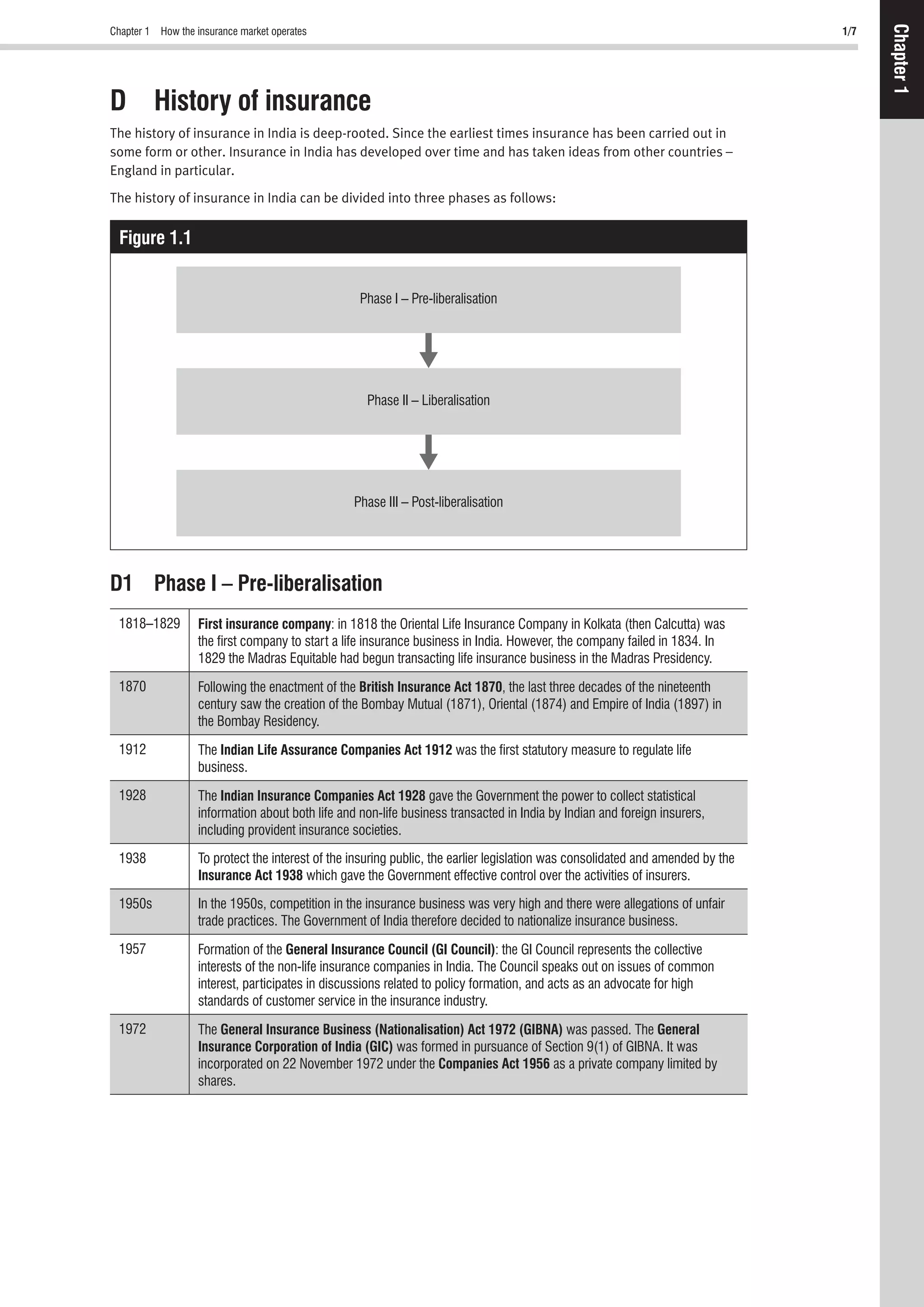
The history of insurance in India can be divided into three phases as follows:
Figure 1.1
Phase I – Pre-liberalisation
Phase II – Liberalisation
Phase III – Post-liberalisation
D1 Phase I – Pre-liberalisation
1818–1829 First insurance company: in 1818 the Oriental Life Insurance Company in Kolkata (then Calcutta) was
the first company to start a life insurance business in India. However, the company failed in 1834. In
1829 the Madras Equitable had begun transacting life insurance business in the Madras Presidency.
1870 Following the enactment of the British Insurance Act 1870, the last three decades of the nineteenth
century saw the creation of the Bombay Mutual (1871), Oriental (1874) and Empire of India (1897) in
the Bombay Residency.
1912 The Indian Life Assurance Companies Act 1912 was the first statutory measure to regulate life
business.
1928 The Indian Insurance Companies Act 1928 gave the Government the power to collect statistical
information about both life and non-life business transacted in India by Indian and foreign insurers,
including provident insurance societies.
1938 To protect the interest of the insuring public, the earlier legislation was consolidated and amended by the
Insurance Act 1938 which gave the Government effective control over the activities of insurers.
1950s In the 1950s, competition in the insurance business was very high and there were allegations of unfair
trade practices. The Government of India therefore decided to nationalize insurance business.
1957 Formation of the General Insurance Council (GI Council): the GI Council represents the collective
interests of the non-life insurance companies in India. The Council speaks out on issues of common
interest, participates in discussions related to policy formation, and acts as an advocate for high
standards of customer service in the insurance industry.
1972 The General Insurance Business (Nationalisation) Act 1972 (GIBNA) was passed. The General
Insurance Corporation of India (GIC) was formed in pursuance of Section 9(1) of GIBNA. It was
incorporated on 22 November 1972 under the Companies Act 1956 as a private company limited by
shares.
1/8 licofindia.info
Chapter1
D2 Phase II – Liberalisation
The start of reform
The international payment crisis of the 1990s forced the Government to re-think its industrial policies and
regulations. The Government only had enough foreign currency reserves to finance a few days of imports.
1993 Malhotra Committee: in 1993 the Government set up a committee under the chairmanship of R N
Malhotra, the former Governor of RBI, to make recommendations for the reform of the insurance sector.
In its report in 1994, the committee recommended, among other things, that the private sector and
foreign companies (but only through a joint venture with an Indian partner) be permitted to enter the
insurance industry.
1999 Formation of the IRDA: following the recommendations of the Malhotra Committee report, the
Insurance Regulatory and Development Authority (IRDA) was constituted as an autonomous body
in 1999 to regulate and develop the insurance industry. The IRDA was incorporated as a statutory
body in April 2000.
D3 Phase III – Post-liberalisation
As we have seen, following the recommendations of the Malhotra Committee, the insurance sector was
opened to private companies. Foreign companies were also allowed to participate in the Indian insurance
market through joint ventures (JVs) with Indian companies. Under current regulations the foreign partner
cannot hold more than a 26% stake in the joint venture.
The key objectives of the IRDA include the promotion of competition with a view to increasing customer
satisfaction through more consumer choice and lower premiums, while ensuring the financial security of
the insurance market. The IRDA has the power to make regulations under section 114A of the Insurance
Act 1938. Since 2000 it has introduced various regulations ranging from the registration of companies for
carrying on insurance business to the protection of policyholders’ interests.
The Insurance Act 1938 and GIBNA were amended which removed the exclusive privilege of GIC and its four
subsidiaries to write general insurance in India. As a result, general insurance business was opened up to the
private sector.
With the General Insurance Business (Nationalisation) Amendment Act 2002, effective from 21 March
2003, GIC ceased to be a holding company of its four subsidiaries. Their ownership was vested with the
Government of India. GIC was notified as a reinsurance company.
Question 1.2
Why did the Government think it necessary to nationalise the life insurance industry in the 1950s?
In appendix 1 we have provided lists of the life and general insurance companies that are active in India at the
present time. Take a look at it now and get a feel for how many companies operate in the different sectors.
Be aware
At the time of writing (January 2011) a proposal to increase the Foreign Direct Investment (FDI) limit in the insurance
sector from the current 26% to 49% is awaiting approval in Parliament.
D4 Recent developments in the insurance industry
By 2010 India was the fifth largest insurance market in the world and it is still growing rapidly.
There has been a lot of change in the decade since the market was opened up to the private sector. In this
section we will look at some of the important developments of the last few years.
Growing importance
of IT
All insurance companies now use information technology (IT) to benefit their business and to
improve convenience for their customers. Today, customers can pay their premiums and check
the status and other details of their policy using the company’s website. Updates relating to the
receipt of premiums or changes to their policy are sent to the customer through mobile SMS.
Bancassurance Many banks have joined with insurance companies to cross-sell insurance products to their
customers. Insurance companies benefit from the wide network and loyal customer base
of banks, and the contribution that bancassurance makes to insurance sales has steadily
grown over the last few years. The banks benefit through being able to provide value-added
products to their customers and from the fee income they receive in return from the insurance
companies. Many banks have started their own life insurance subsidiaries.
Chapter 1 How the insurance market operates 1/9
Chapter1
Online sales Most of the insurance companies have now started selling insurance products online. This
eliminates the need for an intermediary and reduces costs. This saving can be passed to
customers in the form of reduced premiums.
Micro-insurance Micro-insurance guidelines were issued by the IRDA in 2005. Micro-insurance products
provide insurance protection to people in lower income groups, such as self-help group (SHG)
members, farmers, rickshaw pullers and others against the risks that they and their assets are
exposed to. The premiums for these products may be as low as Rs. 15 and are collected on
a weekly basis. The minimum life insurance cover specified by the Regulator for this category
is Rs. 5,000 and the maximum cover that can be provided is Rs. 50,000. People who work in
agriculture and allied activities are exposed to the hazards of nature so they need protection
against risks like monsoon failure, floods etc. This is where micro-insurance can come to their
rescue.
Grievance redressal Whenever any industry is experiencing fast growth there are bound to be concerns, and the
insurance industry is no different. There has been an increase in complaints from customers
about the settlement of their claims and customer service in general. As we saw earlier, the
IRDA has taken steps to protect the interest of the policyholders. It has asked insurance
companies to set up internal customer grievance redressal cells/departments, and an
Insurance Ombudsman has been established.
The latest initiative from the IRDA is the setting up of a call centre which an insured can contact
to seek the resolution of a grievance they have against their insurer. The unhappy customer
can either call a toll-free number (155255) or email complaints@irda.gov.in to register their
complaint.
Question 1.3
What is bancassurance?
We will return to some of these topics in more detail later in this chapter. First, however, we will continue our
overview of the insurance industry in India by looking at the organisations and roles that feature within it.
E Insurance organisations and roles
E1 Types of insurance organisations
Insurance organisations are divided into three main categories, as the following figure shows. We will look
briefly at the various products the different types of insurance organisations offer in section G.
Figure 1.2: Types of insurance organisation
Insurance
Life insurance Non-life insurance Reinsurance
E1A Life insurance companies
Life insurance companies cover risks that relate to human lives. They offer different benefits under different
types of products and cover the risk of early death, as well as the risk of living into old age. Under traditional
plans, like term insurance plans, insurance companies provide death cover. If the insured person dies within
the term of the policy then the nominee/beneficiary is paid a specified amount (also known as the sum
insured). We saw an example of this when we looked at the case of Ajay at the start of this chapter. Under
pension plans, insurance companies offer periodic monthly payments (annuities) to support the insured
during their retirement.
1/10 licofindia.info
Chapter1
E1B Non-life insurance companies
Non-life insurance companies generally cover risks other than those relating to human lives. The exceptions
to this are personal accident and health insurance, which are provided by non-life insurance companies. Any
asset either gives a monetary return (e.g. a house given on rent), or offers convenience (e.g. a car which can
be used to travel from one place to another) can be insured. All assets are exposed to various risks: they
can be damaged or destroyed by fire, earthquake, riot, theft, flooding, cyclones etc. If the asset is damaged
by any of these risks, the owner will be at a disadvantage and they will lose the income or the convenience
the asset provided. Non-life insurance companies offer products that cover these risks and compensate
the owner should the asset be damaged by one of them. It is a product from this type of company that an
individual would buy to protect their assets, for example, their home against fire etc.
E1C Reinsurance companies
We saw in section A2 earlier that insurance is a risk transfer mechanism. Risk is transferred from those
who are unable to bear it to those who can. However, insurance companies can only take on so much risk.
Once that limit is reached, the insurer itself is exposed to the risk of loss. When this happens insurers look
to transfer some of their risks to someone else to shield themselves from overexposure. This is where
reinsurance companies come into use. A reinsurance company is an insurer for the insurance company.
Reinsurance companies take on a certain percentage of the risks on the insurance company’s books, in
return for the payment of a consideration.
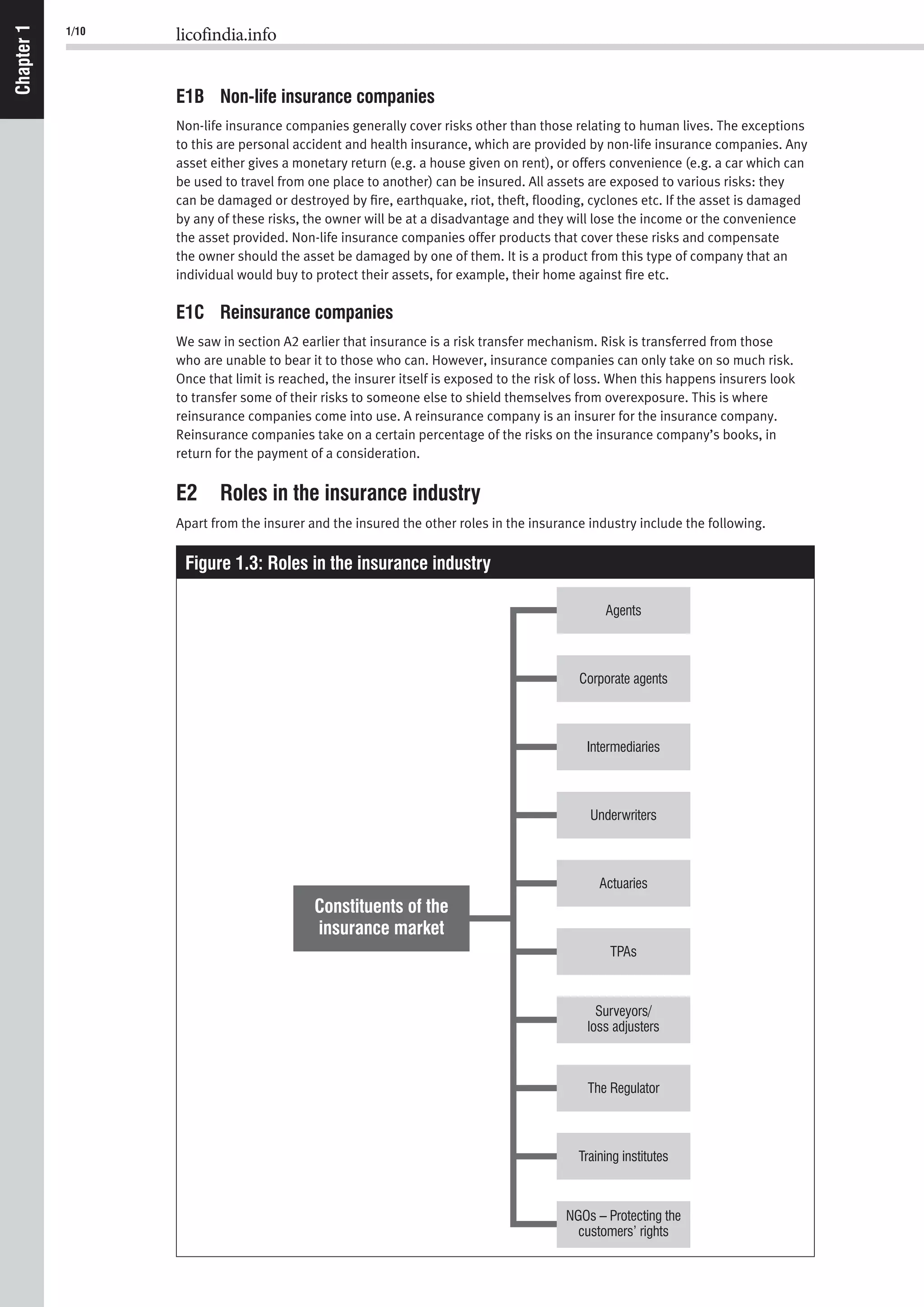
E2 Roles in the insurance industry
Apart from the insurer and the insured the other roles in the insurance industry include the following.
Figure 1.3: Roles in the insurance industry
Constituents of the
insurance market
NGOs – Protecting the
customers’ rights
Training institutes
The Regulator
Surveyors/
loss adjusters
TPAs
Actuaries
Underwriters
Intermediaries
Corporate agents
Agents
Chapter 1 How the insurance market operates 1/11
Chapter1
Agents These contribute the major percentage of insurance sales in India. It is the agent’s primary
responsibility to meet the prospective client, understand their needs, and accordingly
recommend suitable products. We shall discuss the role of agents in more detail in section H.
Corporate agents These include banks and brokers. More details about these are included in section F2.
Intermediaries These can be individuals as well as organisations, like firms, banks and composite brokers.
Intermediaries solicit and procure business from prospective clients for the insurance
company.
Underwriters These decide whether to accept or reject the insurance proposal. If the proposal is to be
accepted, then the underwriter decides at what price it should be accepted.
Actuaries These calculate the standard price of products. They take into account statistical data and the
past claims experience of the company. Apart from pricing individual products, they also do
an overall financial assessment of the insurance company from time to time to make sure that
the company has sufficient reserves to pay for future liabilities.
Third party
administrators (TPAs)
These do the work of building hospital networks. They also help with approvals at the time of
cashless admission to a hospital and with settling the bill with the insurer on discharge.
Loss adjusters/
surveyors
These do the work of assessing and certifying a loss when a claim is made on the insurance
company. They have a major role to play in non-life insurance business.
The Regulator The Regulator has the responsibility of ensuring the smooth running of the insurance sector.
The Insurance Regulatory and Development Authority (IRDA) is the insurance Regulator
in India. The IRDA grants licences to insurance companies and makes sure all insurance
companies are in compliance with the regulations at all times. It also has a responsibility to
protect the interests of the small policyholders against the mighty insurance companies.
Training institutes These have the responsibility of supplying trained manpower to meet the ever growing need
for skilled labour in the insurance industry. The Insurance Institute of India (III), Insurance
Institute of Risk Management (IIRM) and the National Insurance Academy (NIA) are premier
training institutes in the field of insurance.
NGOs – Protecting
the customers’ rights
Non-Governmental Organisations (NGOs) play an important role in spreading awareness
about insurance products and protecting the rights of the customers. The role of NGOs
is more important in the rural areas where they work with Self Help Groups (SHGs) and
insurance companies on deeper penetration of micro-insurance products at the grassroots
level.
You will see that some of these roles in the market are to do with the selling of insurance products – or
insurance distribution as it is known. How do they do this? Let’s take a look in this next section.
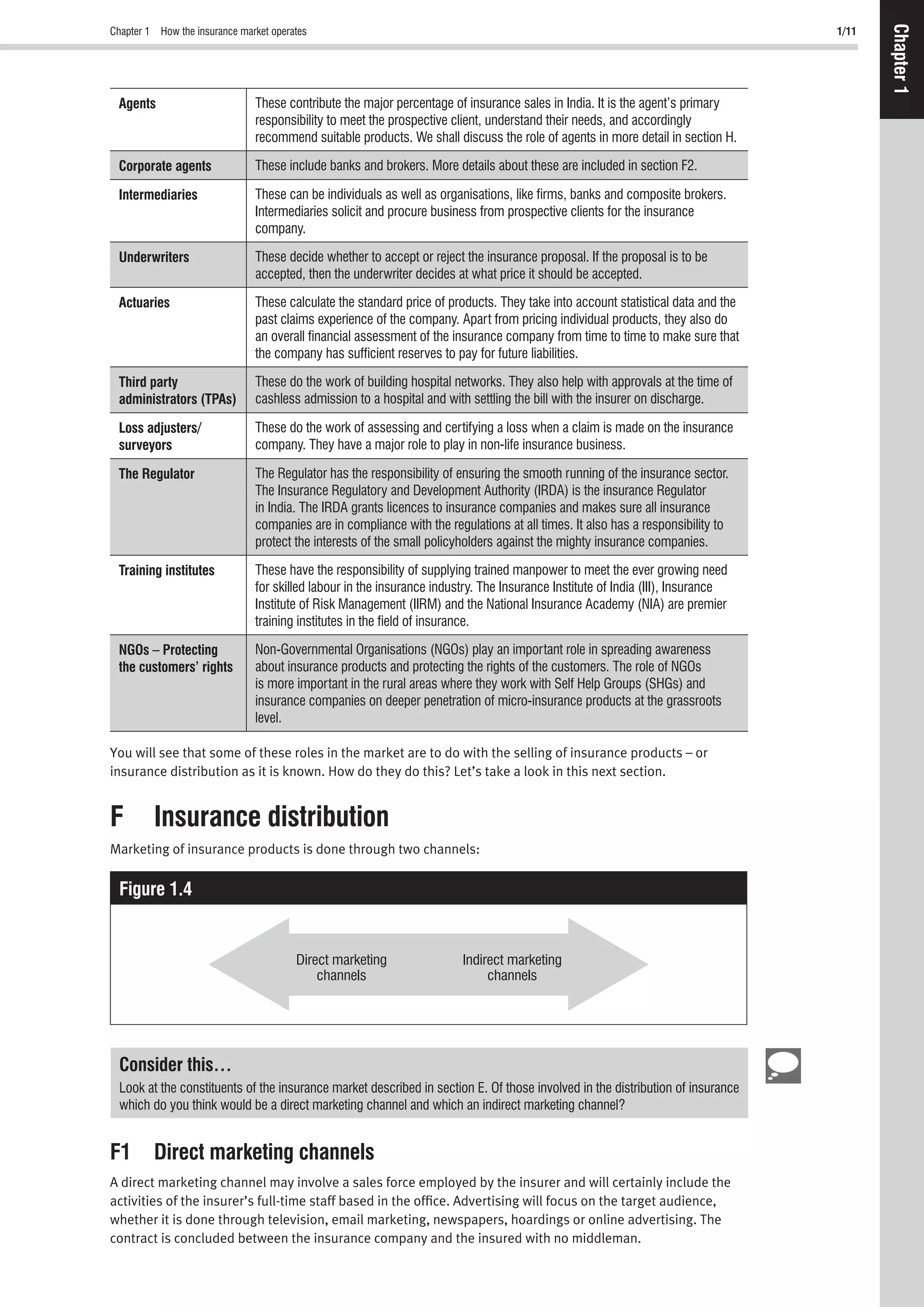
F Insurance distribution
Marketing of insurance products is done through two channels:
Figure 1.4
Direct marketing Indirect marketing
channels channels
Consider this…
Look at the constituents of the insurance market described in section E. Of those involved in the distribution of insurance
which do you think would be a direct marketing channel and which an indirect marketing channel?
F1 Direct marketing channels
A direct marketing channel may involve a sales force employed by the insurer and will certainly include the
activities of the insurer’s full-time staff based in the office. Advertising will focus on the target audience,
whether it is done through television, email marketing, newspapers, hoardings or online advertising. The
contract is concluded between the insurance company and the insured with no middleman.
1/12 licofindia.info
Chapter1
F1A E-sales
E-sales refer to sales of insurance products through the internet. This channel for the sale of insurance
products is relatively new in India, but is fast catching up with more traditional methods. For some time,
insurance companies have been using online payment gateways to collect renewal premiums and their
websites to solicit sales inquiries for their insurance products, but it was only late in 2009 that insurance
companies in India introduced products that are exclusively sold via the internet. Because these online
products are being sold directly to the end customer, with no intermediaries, insurance companies can sell
these products much cheaper, as the intermediary commissions are eliminated.
F2 Indirect marketing channels
Although, as we have seen, online insurance sales are increasing at a fast rate, intermediaries still make a
major contribution to the sale of insurance company products. Intermediaries include the following:
Figure 1.5: Indirect marketing channels
Indirect
marketing
channels
Individual
agents
Bancassurance
Insurance
brokers
Comparison
websites
Direct brokers
Reinsurance
brokers
Composite
brokers
Individual agents These are hired by insurance companies and given the required training. After passing the
prescribed examination and getting their licence, these agents seek and gain insurance
business for the insurer. Agents are not on the payroll of the insurance company but are
paid commission based on the sales they make. Current regulations in India mean that an
individual can act as an insurance agent for only one life insurance company at a time.
Bancassurance As we saw in section D4, insurance companies partner with banks to sell their products
through them. Current regulations in India state that a bank can only act as an insurance
agent for one life insurance company at a time.
Insurance brokers These can sell the products of a number of life insurance companies. They have the
advantage of being able to compare the insurance products of various insurance companies
and then offer a plan that best suits the requirements of the customer. The broker represents
the client: they keep in mind the customer’s requirements rather than favouring any specific
products of any specific insurance company.
Comparison websites These are a recent phenomenon and use the internet to collect together and provide quotes
from various life insurance companies. An individual can input their details and compare
quotes from different companies. They can then choose the one that best suits their needs.
However, these websites are not regulated so the customer would be wise to check with the
insurance company before making a final decision on the purchase.
Consider this…
Which is better – selling insurance by direct marketing or indirect marketing? Why do you think this?
Question 1.4
Why are insurers who sell their products direct to the customer over the internet able to offer much lower premiums?
Chapter 1 How the insurance market operates 1/13
Chapter1
Now that we have established how we are going to sell our insurance products and who is going to do it,
we need some products to sell. What sort of products are available? We will be taking the time to look at
life insurance products later in this study text. For now, we will give a very brief overview of the types of
insurance that are available.
G Insurance products
As we saw in section E1, apart from reinsurance, the insurance market is broadly divided into two categories
– life insurance and non-life insurance. Life insurance covers risks related to human lives. All other risks are
covered under non-life insurance or general insurance.
G1 Non-life insurance market
The non-life insurance market is further divided into sub-categories.
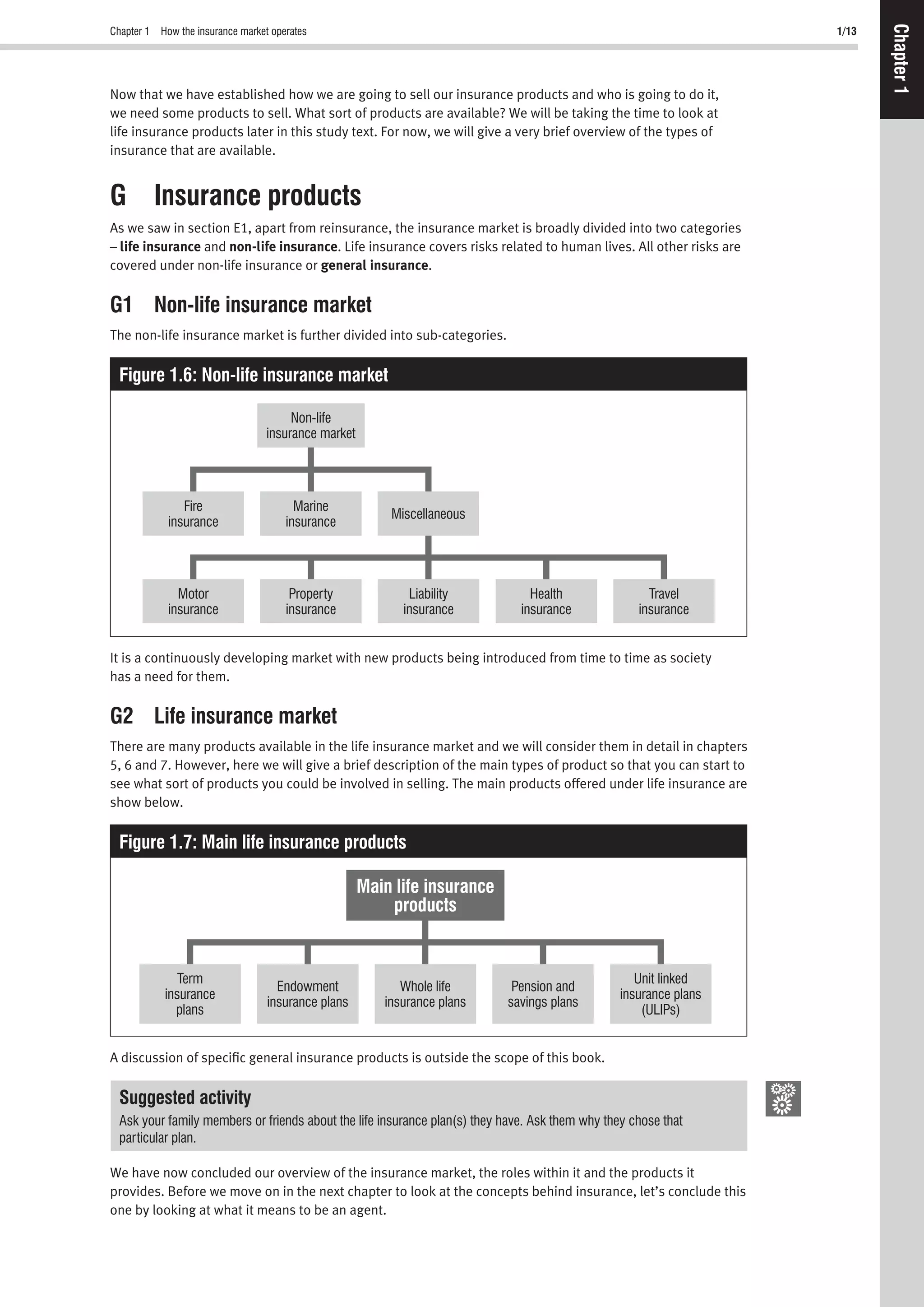
Figure 1.6: Non-life insurance market
Fire
insurance
Non-life
insurance market
Marine
insurance
Miscellaneous
Liability
insurance
Property
insurance
Motor
insurance
Health
insurance
Travel
insurance
It is a continuously developing market with new products being introduced from time to time as society
has a need for them.
G2 Life insurance market
There are many products available in the life insurance market and we will consider them in detail in chapters
5, 6 and 7. However, here we will give a brief description of the main types of product so that you can start to
see what sort of products you could be involved in selling. The main products offered under life insurance are
show below.
Figure 1.7: Main life insurance products
Whole life
insurance plans
Main life insurance
products
Endowment
insurance plans
Term
insurance
plans
Pension and
savings plans
Unit linked
insurance plans
(ULIPs)
A discussion of specific general insurance products is outside the scope of this book.
Suggested activity
Ask your family members or friends about the life insurance plan(s) they have. Ask them why they chose that
particular plan.
We have now concluded our overview of the insurance market, the roles within it and the products it
provides. Before we move on in the next chapter to look at the concepts behind insurance, let’s conclude this
one by looking at what it means to be an agent.
1/14 licofindia.info
Chapter1
H Role and functions of an agent
H1 Becoming an agent
There are a number of steps that you as an individual need to take and a number of criteria that you will need
to fulfil if you wish to become a life insurance agent. The Insurance Act requires that an insurance agent must
have a licence, and the IRDA deals with all issues of licences and other matters relating to agents. There are
regulations which must be complied with at all stages in the process. Full details of these regulations and
requirements will be covered later in the study text. In this introductory chapter we shall just outline the
process of becoming an agent and explain what an agent does.
H2 Role of an agent
As stated in section F2, agents are hired by insurance companies and they act as the main link between the
insurance company and the insured. Their role is to recommend to clients the right products that address
the clients’ needs. At the same time they must act in the interests of the insurance company by using their
unique position of knowing their clients well enough to protect the insurance company from any undue
adverse product selection.
This makes the role of the agent in the entire insurance business very crucial.
Agents facilitate the smooth sale of insurance products by assisting their clients with completing the
paperwork involved, and after the policy is sold the agent should ensure it is serviced properly until maturity
or in the event of a claim. At the time of a claim, the agent should also assist the client to complete the
required formalities to ensure quick settlement.
In India, life insurance agents deal with a range of insurances which are generally considered under the
following headings:
• basic life insurance products, such as term insurance and whole life plans;
• savings products; and
• other financial products, such as health insurances and accidental death plans.
All these products will be looked at in later chapters.
Once licensed and appointed, the agent is an independent professional. At the heart of this is the need for
agents to put the interests of their clients above all else.
H3 Code of Conduct for agents
In supporting agents to carry out their role in a professional manner, every licensed agent must adhere to the
Code of Conduct specified by the IRDA in the Insurance Regulatory and Development Authority (Licensing
of Insurance Agents) Regulations 2000 as per Regulation 8. In the Code of Conduct the IRDA gives details
as to what an agent shall and shall not do. For instance, the agent should disclose all information relating to
the insurance company that they represent and the products they are recommending. They should act in the
best interests of the client while at the same time making sure that there is no adverse selection against the
insurance company (we will discuss adverse selection further in chapter 4).
In addition, the insurance agent needs to take steps to keep the business they have secured for their
company. To do this they need to make every attempt – both orally and in writing – to ensure that the
policyholder pays the premium within the required time.
We will return to the Code of Conduct for agents later.
Chapter 1 How the insurance market operates 1/15
Chapter1
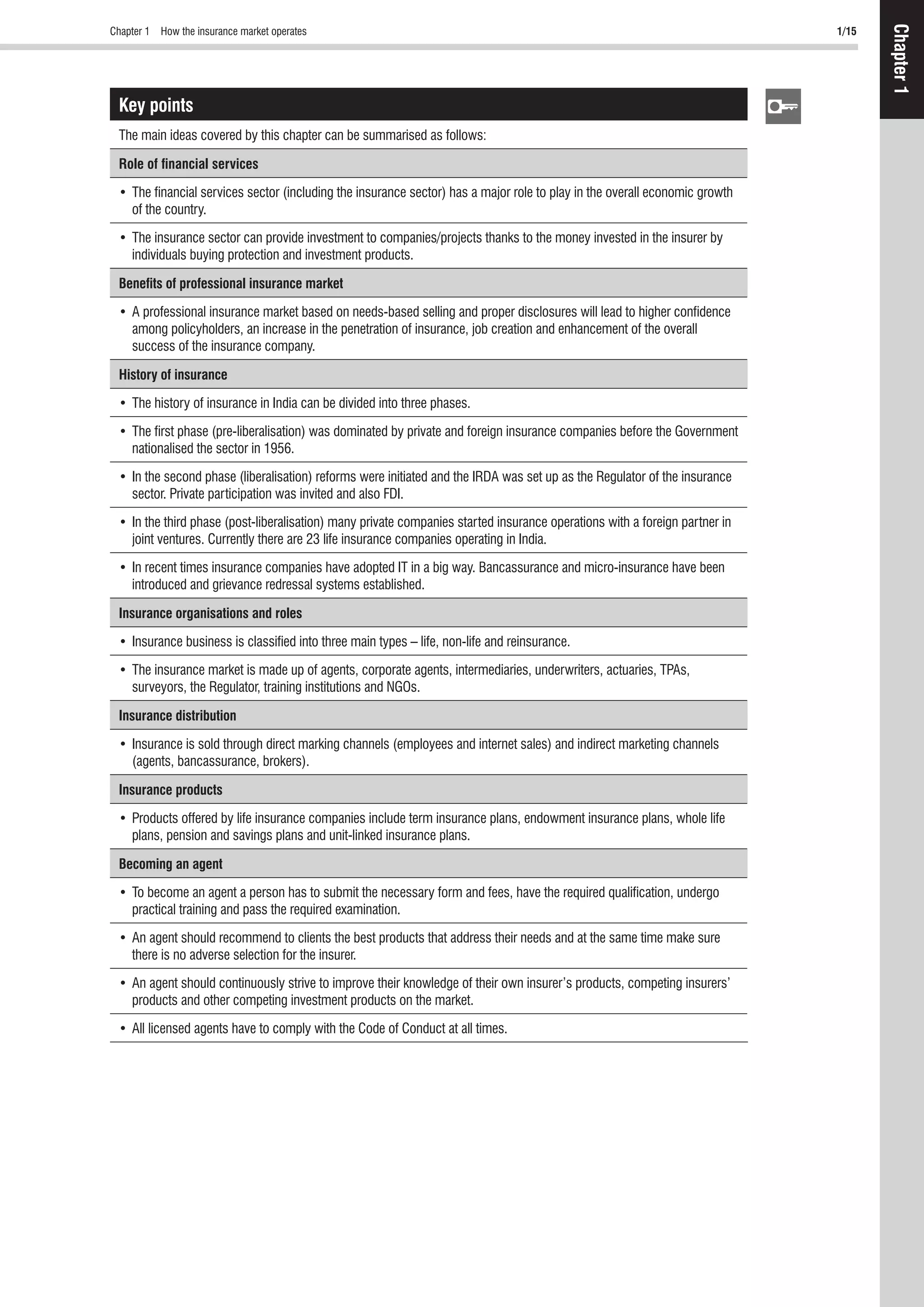
Key points
The main ideas covered by this chapter can be summarised as follows:
Role of financial services
of the country.
individuals buying protection and investment products.
Benefits of professional insurance market
among policyholders, an increase in the penetration of insurance, job creation and enhancement of the overall
success of the insurance company.
History of insurance
nationalised the sector in 1956.
sector. Private participation was invited and also FDI.
joint ventures. Currently there are 23 life insurance companies operating in India.
introduced and grievance redressal systems established.
Insurance organisations and roles
surveyors, the Regulator, training institutions and NGOs.
Insurance distribution
(agents, bancassurance, brokers).
Insurance products
plans, pension and savings plans and unit-linked insurance plans.
Becoming an agent
practical training and pass the required examination.
there is no adverse selection for the insurer.
products and other competing investment products on the market.
1/16 licofindia.info
Chapter1
Question answers
1.1 The answer is a) risk transfer. You are transferring the risk you face to the insurance company to bear for you.
1.2 There was a great deal of competition and allegations of unfair practice.
1.3 Bancassurance is when banks partner with insurance companies to offer insurance products to the bank’s
customers.
1.4 By removing the need for a middleman and so the need to pay any commission, the insurance company can pass
on the savings made to their customers.
Chapter 1 How the insurance market operates 1/17
Chapter1
Self-test questions
1. Why do people need life insurance?
2. What are the benefits of having a professional insurance market?
3. a) What are the three phases of the development of the insurance sector in India?
b) Describe what happened in the most recent phase.
4. List the participants who make up the insurance market.
5. What indirect marketing channels are available to insurance companies?
6. What are the different types of products sold by life insurance companies?
You will find the answers on the next page
1/18 licofindia.info
Chapter1
Self-test question answers
1. People need life insurance to help take care of their obligations should they die prematurely. These include the:
2. The benefits of a professional insurance market that focuses on needs-based selling and disclosure include:
3. a) The history of insurance in India can be divided into 3 phases as follows:
b) In Phase III, following the recommendations of the Malhotra Committee, the insurance sector was opened
up to private companies. Foreign companies were also allowed to participate in the Indian insurance market
through joint ventures (JVs) with Indian companies. Under current regulations the foreign partner cannot hold
more than a 26% stake in the joint venture.
The IRDA has the power to make regulations under Section 114A of the Insurance Act 1938. Since 2000
it has introduced various regulations ranging from the registration of companies for carrying on insurance
business to the protection of policyholders’ interests.
4. The constituents of the insurance market include:
5. The indirect marketing channels include:
brokers; and
6. The different types of products sold by life insurance companies include:
Chapter 1 How the insurance market operates 1/19
Chapter1Chapter1
Appendix 1.1: Insurance companies active in India
(January 2011)
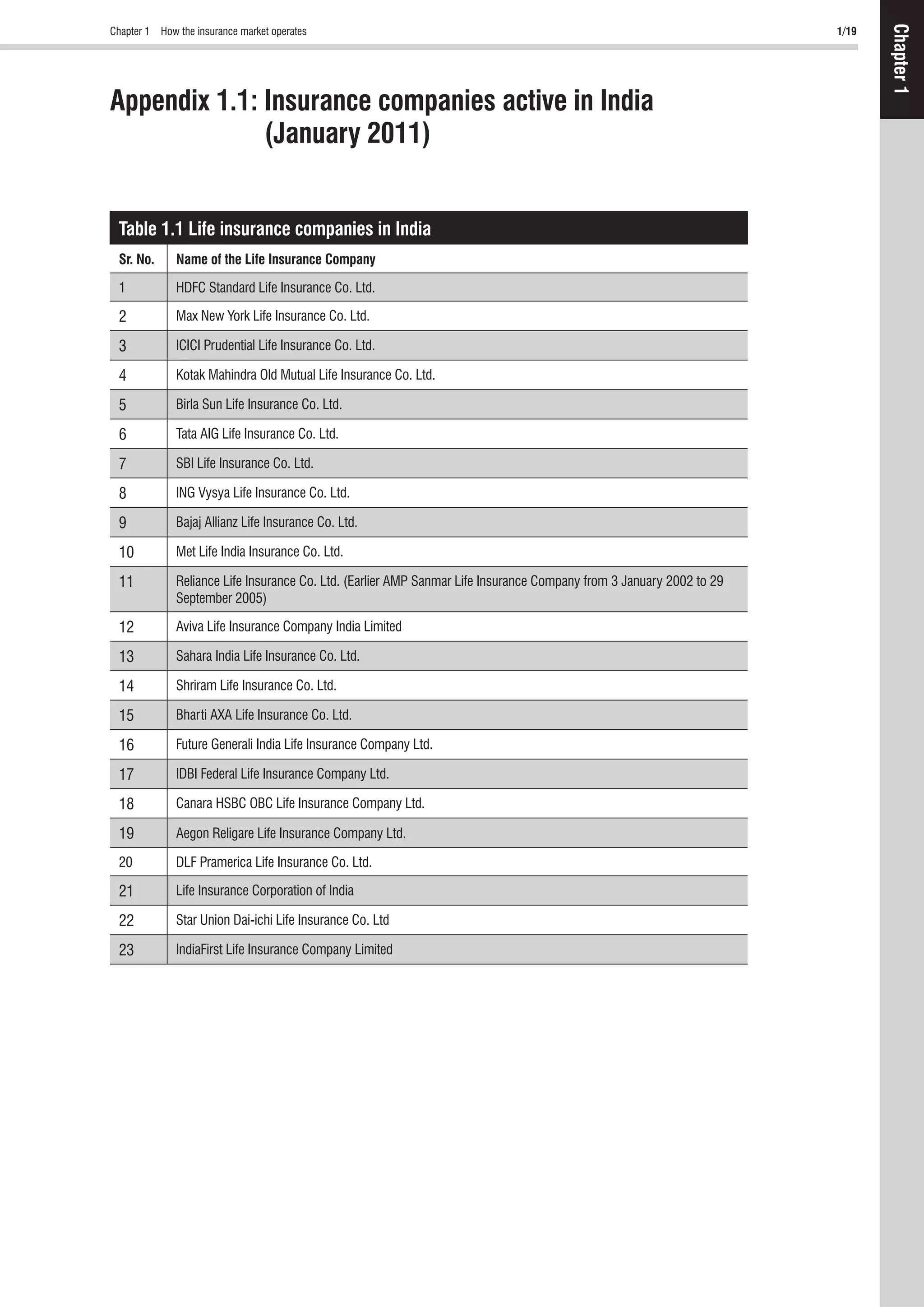
Table 1.1 Life insurance companies in India
Sr. No. Name of the Life Insurance Company
1 HDFC Standard Life Insurance Co. Ltd.
2 Max New York Life Insurance Co. Ltd.
3 ICICI Prudential Life Insurance Co. Ltd.
4 Kotak Mahindra Old Mutual Life Insurance Co. Ltd.
5 Birla Sun Life Insurance Co. Ltd.
6 Tata AIG Life Insurance Co. Ltd.
7 SBI Life Insurance Co. Ltd.
8 ING Vysya Life Insurance Co. Ltd.
9 Bajaj Allianz Life Insurance Co. Ltd.
10 Met Life India Insurance Co. Ltd.
11 Reliance Life Insurance Co. Ltd. (Earlier AMP Sanmar Life Insurance Company from 3 January 2002 to 29
September 2005)
12 Aviva Life Insurance Company India Limited
13 Sahara India Life Insurance Co. Ltd.
14 Shriram Life Insurance Co. Ltd.
15 Bharti AXA Life Insurance Co. Ltd.
16 Future Generali India Life Insurance Company Ltd.
17 IDBI Federal Life Insurance Company Ltd.
18 Canara HSBC OBC Life Insurance Company Ltd.
19 Aegon Religare Life Insurance Company Ltd.
20 DLF Pramerica Life Insurance Co. Ltd.
21 Life Insurance Corporation of India
22 Star Union Dai-ichi Life Insurance Co. Ltd
23 IndiaFirst Life Insurance Company Limited
1/20 licofindia.info
Chapter1Chapter1
Appendix 1.1: Insurance companies active in India
(January 2011)
Table 1.2 General insurance companies in India
Sr. No. Name of the General Insurance Company
1 Bajaj Allianz General Insurance Company Limited
2 IFFCO Tokio General Insurance Company Limited
3 HDFC ERGO General Insurance Company Limited
4 ICICI Lombard General Insurance Company Limited
5 The New India Assurance Company Limited
6 The Oriental Insurance Company Limited
7 Max Bupa Health Insurance Company Limited
8 Royal Sundaram Alliance Insurance Company Limited
9 United India Insurance Company Limited
10 SBI General Insurance Company Limited
11 Tata AIG General Insurance Company Limited
12 Reliance General Insurance Company Limited
13 Cholamandalam MS General Insurance Company Limited
14 National Insurance Company Limited
15 Shriram General Insurance Company Limited
16 Bharti Axa General Insurance Company Limited
17 Future Generali India Insurance Company Limited
18 Agriculture Insurance Company of India
19 Star Health and Allied Insurance Company Limited
20 Apollo Munich Health Insurance Company Limited
21 Universal Sampo General Insurance Company Limited
22 Export Credit and Guarantee Corporation of India Limited
23 Raheja QBE General Insurance Company Limited
24 L&T General Insurance Company Limited
Table 1.3 Reinsurance companies in India
General Insurance Corporation (GIC)
Source: IRDA website
Chapter2Chapter2
2Risk and insurance
Contents Syllabus learning
outcomes
Learning objectives
Introduction
Key terms
A Concept of risk 2.1
B Components of risk 2.2
C Insurable risks 2.3
D Risk transfer 2.4
E Pooling of risks 2.5
Key points
Question answers
Self-test questions
Learning objectives
After studying this chapter, you should be able to:
• explain the concept of risk in terms of insurance;
• explain the main components of risk;
• describe the risks that can be insured;
• describe the importance of insurance as a risk transfer mechanism;
• explain the concept of pooling of risks.
licofindia.info
2/2 licofindia.info
Chapter2Chapter2
Introduction
In chapter 1 we explained that insurance is based on the transfer of risk and we looked briefly at some of the
risks that a person might face.
In this chapter we will look at the nature of risk in more detail and the types of risks that can be insured
against, in addition to explaining a little more about how risks are transferred and pooled. Of course, as a life
insurance agent you are concerned with the risks relating to human life and we shall focus our attention on
these aspects in this chapter. However, we shall also be making reference to some risks that apply to general
insurances as this will help you to gain a good understanding of the concept of risk in its broadest sense.
Key terms
This chapter features explanations of the following terms and concepts:
Risk Components of risk Uncertainty Hazard
Peril Homogeneous risk Accidental risk Insurable risk
Financial risk Pure risk Risk transfer Pooling of risks
A Concept of risk
A1 Definition of risk
The word ‘risk’ can be used in several different contexts. In insurance, risk is applied to certain assets that
can be insured, such as a human life, a house, a car, etc.
There is no single definition of risk because of the different contexts in which it can be used.
Here are some of the definitions of risk:
• Risk is the chance of damage or loss.
• Risk is doubt concerning the outcome of a situation.
• Risk is something or someone considered to be a potential hazard.
Be aware
In life insurance the word ‘risk’ is used to describe the possibility of an unfavourable event occurring, for example
untimely death or an unforeseen disability.
During a lifetime an individual can be exposed to many risks, some of these are:
Figure 2.1
Risks to
human
life
Accidents
Unemployment
Premature
death
Living too long
beyond
retirement
Illness
Insurance cannot prevent the occurrence of these risks, but it can reduce their impact should they occur.
Life insurance mainly deals with two risks – premature death and living too long. The other risks relating to
human life are mostly covered under non-life insurance. However, life insurance companies offer additional
benefits or riders along with life insurance plans to cover the following risks – death or disability due to
accidents, illness and unemployment.
Chapter 2 Risk and insurance 2/3
Chapter2
Example
Rakesh Gupta is a sales executive working for a private company. His job involves frequent travelling to meet
various retailers in his region in order to achieve his monthly and quarterly sales targets. Sometimes he has to travel
continuously for days, without any rest.
Rakesh Gupta is exposed to the following risks, for which he should consider buying insurance:
Premature death – Rakesh’s job profile is quite stressful and involves intense travelling. He is exposed to the risk of
early death which could occur due to an accident or illness caused by stress. A life insurance plan can protect his family
against the risk of Rakesh’s early death.
Accident – Due to the frequent travelling that Rakesh has to do, he is prone to the risk of accidents that can result in
either permanent or temporary disability. A life insurance plan with a disability benefit rider or a separate accidental death
policy can protect his family against the risk of Rakesh becoming disabled.
Illness – Due to the stressful nature of his job, Rakesh is exposed to the risk of suffering from critical illnesses. A life
insurance plan with a critical illness rider, or a health insurance policy, can help meet the hospitalisation expenses should
Rakesh suffer from any critical illness.
Unemployment – If Rakesh has an accident and becomes disabled, he risks losing his job and becoming unemployed.
Living too long – Should none of the above events occur during his working life and Rakesh retires, he may be exposed
to the risk of living too long beyond retirement. He is working for a private company that does not provide a monthly
pension after retirement as part of his employee benefits. Hence he needs to work towards building a retirement fund
during his working life by investing in a retirement pension plan. On retirement he can purchase an annuity plan from a
life insurance company that will pay him regular annuity payments during his retirement years.
Note: Details about various life insurance plans, health insurance plans and riders will be discussed in later chapters.
Be aware
Insurance companies provide cover for only a specified number of risks. These risks are listed in the policy document.
The insurance company will not provide protection for claims arising out of risks other than the specified risks.
Suggested activity
After studying the risks that an individual is exposed to, discuss with your family income provider which risks they are
exposed to due to the nature of their job. If you are the main income provider what risks are you personally exposed to?
A2 Attitude to risk
Each person’s attitude to risk is different. Therefore, we all respond to risks in different ways.
Some people are willing to retain risks and carry them themselves, while others act cautiously and transfer
them to an insurance company.
B Components of risk
The components of risk include:
Figure 2.2
Uncertainty
Peril and
hazard
Level
Uncertainty
hazard
Level
Peril and
hazard
Risk
2/4 licofindia.info
Chapter2
B1 Uncertainty
Life is uncertain and so is our future. If we could know in advance that an event is going to take place we
could plan to prevent it or overcome it, and thereby limit or even remove the risk involved.
As a general principle insurance is only available for risks that are uncertain. This statement raises a
question: we all know that death is certain – but we also know that life insurance is available against death.
So how can this statement be true?
It is true because, although we will all die one day, when we will die is uncertain. It is the uncertainty
about the timing of death that makes death insurable. Once the timing of death becomes certain, when an
individual is suffering from a fatal disease, for example, then an insurance company will not cover the risk.
The following case studies show how this works.
Case studies
1. Rishbah Agrawal is a 40-year-old businessman who leads a healthy lifestyle. Every morning he practices yoga
and abstains from smoking, tobacco and alcohol. There is a family medical history of diabetes and both his parents
suffer from it. But Rishbah Agrawal himself has not been diagnosed with diabetes. Can Rishbah be provided with life
insurance?
The answer is Yes, because Rishbah maintains a healthy lifestyle and he has not been diagnosed with any disease. The
timing of his death is uncertain.
2. Rakesh Sharma has been diagnosed with a brain tumour at a very advanced stage. The doctors know that they
cannot save him and sadly Rakesh’s death is almost certain in the near future. Can Rakesh Sharma be provided life
insurance?
The answer is No, life insurance companies will not take the risk of providing insurance cover for Rakesh as his death in
a very short time span is almost certain.
B2 Level of risk
We know that there is a greater likelihood of some things happening than others and this affects the level of
risk involved.
The level of risk is normally assessed in terms of the:
• probability (or frequency) of a certain event happening, and the
• extent (or severity) of the event if it does happen.
Frequency
The probability that a certain person will die within one year is calculated by actuaries, from the past data
collected, and is made available as mortality tables. This allows insurance companies to determine the
probability of a particular event, such as death, occurring under various circumstances.
The probability of risk to life for individuals will differ on the basis of their age, medical wellbeing, family
medical history, lifestyle, job profile etc.
The mortality rate is the chance of dying at a specified age based on the proportion of deaths among a
specific number of a sample population.
Example
Let’s look at two different groups of 100 people. The first group is aged 30-39. Of these one person dies before the age
of 31. The probability of death in this case is 1% – or a frequency of 1 in 100. The second group is aged 60–69. Of
these 15 die people before the age of 61 (15%). The frequency of death in the second group is therefore greater than in
the first group.
Severity
Insurance companies attempt to determine the amount of claims they would experience if the insured events
were to actually occur based on the likely severity of the losses.
Be aware
Life insurance companies determine the level of risk based on past data (claims experience). If the past data indicates
that individuals within a certain age group (say, 60–70) are more prone to heart attacks, then the level of risk will be
considered to be higher for that age group.
Chapter 2 Risk and insurance 2/5
Chapter2
Case study
On 22 May 2010 Air India Express Flight 812 (Dubai – Mangalore) crashed. 158 passengers were killed. The total
insurance claim for Air India is expected to run into crores of rupees for the plane crash victims.
The nature of airline insurance can be categorised as low frequency but high severity (impact) since the probability of an
air crash is low, but when it does occur, the extent of the loss is very high.
B3 Peril and hazard
This is the final aspect of risk and relates to the cause of losses.
Peril refers to a specific event which might cause a loss. This loss can be loss of life or loss of property.
Natural disasters such as earthquakes, storms, floods etc. are all perils which cause loss of life and damage
to assets.
Perils are the risk being insured against, e.g. the risk that an individual will die during the term of their policy.
A hazard, on the other hand, is a condition that either increases the chance that a peril will happen or may
cause its effect to be worse if it does.
Be aware
A hazard influences the operation of the peril.
Example
If lung cancer is a peril then smoking can be a hazard that may increase the chance that the peril (lung cancer) will
occur.
Case study
On 26 January 2001 one of the worst earthquakes in India’s history hit Gujarat. Thousands of people lost their lives in
this tragic event. Lakhs of people were injured and property worth thousands of crores of rupees was destroyed. The
epicentre of the earthquake was located northeast of Bhuj Town in Western Gujarat.
In this case the earthquake was the peril and the poorly constructed houses and schools which were not earthquake
resistant and easily collapsed were a hazard.
Similarly in the event of a tsunami (such as the one that happened on 26 December 2004) leading to widespread loss of
life and property, the tsunami will be the peril and flimsy houses and buildings constructed near the seashore which are
washed away causing their occupants to drown will be a hazard.
Remember that while insurance cannot prevent the peril from happening, the resulting loss from the occurrence of the
peril can be insured against.
Types of hazard
Hazards can be categorised into one of the following types:
Physical hazards Moral hazards
Refer to the dimensions and physical characteristics of
the risk.
Refer to the habits and activities of the individual that
increase risks. They may also arise from a state of mind,
i.e. the attitude and behaviour of the individual.
Example: a family history of heart disease, high blood
pressure etc. is a physical hazard.
Example: consumption of alcohol, smoking etc.
2/6 licofindia.info
Chapter2
In the case of life insurance, companies take account of hazard by categorising policyholders as high or low
risk individuals based on their risk exposure. This categorisation also extends to the assets owned by the
policyholder if they wish to insure them as well. Some of the hazards that would cause an individual to be
categorised as high risk are:
• Risky job profile: if the job profile of the individual requires them to work in dangerous situations then
the exposure to risk increases. For example, a person working in a chemicals factory, explosives factory,
underground mine etc. will be considered more at risk than someone working in an IT company or a bank.
• Existing medical conditions: if the individual has already been diagnosed with a medical condition such
as high blood pressure or diabetes, they will be considered to be a greater risk than those who are not
suffering from an illness.
• Lifestyle of the individual: if an individual maintains a healthy lifestyle and abstains from smoking
and drinking, the risk reduces. In contrast, an individual who is a heavy smoker or drinker has a higher
exposure to risk.
• Age group of the individual: an older individual seeking insurance will be considered a greater risk than a
younger person.
If the individual is categorised as high risk, insurance companies can either accept or reject the proposal.
High risk proposals can be accepted on other than standard terms such as charging a higher premium,
imposing restrictions on the sum insured, term or a lien etc. We will look at this topic in more detail in
chapter 4.
Think
Identify any three perils that can happen in an individual’s life. What are the hazards that might give rise to these perils?
Question 2.1
Distinguish between perils and hazards.
C Insurable risks
The following types of risk can be insured against:
• financial risks;
• pure risks; and
• particular risks.
C1 Financial risks
The outcomes of risks that can be measured in monetary terms are known as financial risks. Some of the
financial risks for which an individual needs to plan are as follows:
Loss of life – this refers to risk of death of the
income provider of the family with unfulfilled
financial liabilities. home loan, car loan etc. in the event of their death.
Disease/disability – these include medical
expenses and loss of earnings.
due to disease/disability.
Savings accumulation
Retirement – this refers to the risk of
insufficient income following retirement.
Chapter 2 Risk and insurance 2/7
Chapter2
Example
Raghav Mishra is an accountant who works with a local firm. He is married with two children. His wife Kavya is a
housewife. His elderly father, Suhas, also lives with them. Suhas Mishra is a farmer and owns a small piece of farmland.
However, income from the farmland is not sufficient to help him meet his expenses, hence he is reliant on Raghav.
Being the main earning member of the family, Raghav has a considerable responsibility to provide for different
contingencies in the future, such as:
Loss of life – Raghav needs to make sure that his wife, children and father are able to have a steady source of
income in case something happens to him. This income should be sufficient to meet liabilities such as daily living
expenses, children’s school fees, managing his father’s medical expenses etc.
Disease/disability – there is a risk that Raghav may have an accident and become physically disabled so that he
cannot work. To protect against this, he should have sufficient funds for meeting medical expenses and also routine
living expenses.
Savings accumulation – Raghav should make sure that his children’s education is not affected due to a shortage of
funds. He therefore needs to save for his children’s higher education and marriage expenses.
Retirement – Raghav needs to make sure that he receives a steady source of income post-retirement which should
be sufficient to meet his medical and other living expenses.
Question 2.2
What are the main financial risks for which an individual needs to plan?
C2 Pure risks
Pure risks are those risks where there is no possibility of making a profit. In pure risks there can be a loss and
the best possible outcome is one of breaking even.
With a pure risk the possibility of any benefit occurring as a result of the insured event taking place is nil.
This type of risk is associated with those events which are totally out of the control of an individual.
C3 Particular risks
Particular risks are personal or local in their effect. The consequences of these risks occurring affect specific
individuals or local communities.
D Risk transfer
As we saw in chapter 1, the primary function of insurance is to transfer the risk from an individual to an
insurance company. The insurance company which bears the risk is known as the insurer and the individual
who transfers his risk is known as the insured.
Risk transfer provides a sense of financial security to the insured in that if anything happens to them or their
financial assets, the losses would be compensated for by the insurance company as per the policy terms and
conditions. Against this transferred risk, the insured will have to pay a certain amount (consideration) to the
insurer, which is known as the premium.
E Pooling of risks
Pooling of risks is one of the fundamental principles of insurance.
With pooling of risks an insurance company pools the premium collected from several individuals to insure
them against similar risks. The insurance company maintains different sets of pools for different risks.
Example
Separate pools will be maintained by insurance companies for:
2/8 licofindia.info
Chapter2
The premium collected from the individuals is deposited in the pool accounts. When there is a claim to be
settled it is paid out of this pool. The insurance company has to make sure that the premium that is collected
is enough to meet the claim payments. The premium that is charged by the insurance company should also
be sufficient to meet the administrative and other expenses for maintaining the pool. The insurance company
includes a certain percentage of the profit in the premium as well.
Question 2.3
What is pooling of risk in insurance? Can the same pool be used for car insurance and life insurance for
claims payment?
E1 Law of large numbers
Insurance companies apply the ‘law of large numbers’ to determine the cost of total annual claims. Insurance
companies determine the probability that a certain amount of claims will have to be paid by them if a large
number of people are insured for a similar risk.
Example
Out of the 1,000 individuals insured by an insurance company, if the probability of death is 1% then the company will
have to pay claims for 10 people.
An insurance company will set the rates of its premiums according to the number of claims it will expect to
pay over the term of the policy.
Chapter 2 Risk and insurance 2/9
Chapter2
Key points
The main ideas covered by this chapter can be summarised as follows:
Concept of risk
Components of risk
suffered due to the occurrence of that event.
a peril.
Insurable risks
best possible outcome is one of breaking even.
Pooling of risks
2/10 licofindia.info
Chapter2
Question answers
2.1 Peril refers to a specific event which might cause a loss. This loss can be loss of life or loss of property. Natural
disasters such as earthquakes, storms, floods etc. are all perils which cause damage to assets and loss of life.
Perils are the risks being insured against, e.g. the risk that an individual will die during the term of their policy.
A hazard, on the other hand, is a condition that either increases the chance that a peril will happen or may cause its
effect to be worse if it does.
A hazard influences the operation of the peril.
2.2 The main financial risks for which an individual needs to plan are:
1)Loss of life – this refers to the risk of death of the income earner of the family with unfulfilled financial liabilities.
death.
2)Disease/disability – includes medical expenses and loss of earnings.
3)Savings accumulation
4)Retirement – this refers to the risk of insufficient income after retirement.
2.3 In pooling of risk, an insurance company pools the premium collected from several individuals to insure them
against similar risks. The insurance company maintains different sets of pools for different types of risks.
The pool account for life insurance will be maintained separately from the pool account for car insurance.
The pool account for one risk cannot be used to settle the claim for another type of risk.
Chapter 2 Risk and insurance 2/11
Chapter2
Self-test questions
1. List the main components of risk.
2. List the types of risks that can be insured.
You will find the answers on the next page
2/12 licofindia.info
Chapter2
Self-test question answers
1. The main components of risk are:
2. The following types of risks can be insured:
Chapter3:1Chapter3
3Life insurance principles
and practices
Contents
Part 1: Insurance principles
Part 2: Insurance practices
licofindia.info
Chapter3:1Chapter3:1
3Part 1: Insurance principles
Contents Syllabus learning
outcomes
Learning objectives
Introduction
Key terms
A Essentials of a valid contract of insurance 3.1, 3.2
B Insurable interest 3.3
C Utmost good faith 3.4
D Material facts 3.5, 3.6
E Indemnity 3.7
Key points
Question answers
Self-test questions
Learning objectives
After studying this chapter, you should be able to:
• explain the essential features of a valid contract;
• explain the concept of insurable interest and state when insurable interest needs to exist;
• explain the importance of utmost good faith;
• outline the insurer’s and insured’s duty of disclosure;
• explain the importance of material facts;
• describe the facts which need not be disclosed;
• explain the concept of indemnity and its relevance to life insurance.
licofindia.info
3/4 licofindia.info
Chapter3:1Chapter3:1
Introduction
An insurance policy is a legal contract between the insurance company and the insured person and it must
satisfy certain conditions to ensure that it is a valid contract.
In this chapter we will learn what the essential features of a valid contract are, including some unique
principles that apply only to contracts of insurance.
Key terms
This chapter features explanations of the following terms and concepts:
Offer and acceptance Consideration Consensus ad idem Insurable interest
Key person insurance Utmost good faith Duty of disclosure Material facts
Ab initio Indisputability clause Indemnity Capacity to contract
Contract of indemnity Value contracts
A Essentials of a valid contract of insurance
An insurance contract is an agreement, enforceable by law, between the insurance company and the insured
person; the insured person agrees to pay a premium to the insurance company and the insurance company
agrees to pay a sum of money, on the happening of a specified event, to the insured person.
How do both parties enter into this legally binding agreement and what conditions must be satisfied by both
parties to ensure that the contract is a valid one?
To answer these questions, we will first look at the essential features of a valid contract, and then we will
move on to see how an insurance contract differs from other contracts.
A1 Features of a valid contract
The following features are essential if a legal contract is to be valid:
Figure 3.1
Consensus ad idem
(both parties having the
same understanding)
Legality of object or
purpose
Capability of
performance
Capacity to contract
Consideration
Offer and acceptance
Features of a valid
contract
The most important features are offer and acceptance and consideration.
Chapter 3 Part 1: Insurance principles 3/5
Chapter3:1
A1A Offer and acceptance
A contract comes into existence when one party makes an offer which the other party accepts
unconditionally. It is easier to see how unconditional acceptance works by looking at an example. Let’s
consider the following conversation:
Example
ABC insurance company: ‘On the basis of your proposal form we can offer you cover, with a sum insured of
Rs. XXXXX.’
Ganesh, the proposer (the person who wants to take out the insurance): ‘I accept.’
In this example, Ganesh’s acceptance does not alter any of the terms of ABC’s offer and the acceptance is
said to be unconditional. A contract is formed, subject to the other essential elements being present.
Now, consider an alternative response by Ganesh:
Example
ABC insurance company: ‘On the basis of your proposal form we can offer you cover, with a sum insured of
Rs. XXXXX.’
Ganesh, the proposer (the person who wants to take out the insurance): ‘I accept, but I would like to increase the sum
insured to Rs. YYYYY.’
In this case, a contract has not been formed as Ganesh has not unconditionally accepted the offer. Not until
ABC accepts Ganesh’s counter-offer, without further conditions, is a contract formed.
A1B Consideration
A contract must be supported by consideration in order to be valid. Consideration may be described as each
person’s side of the bargain which supports the contract. Consideration in contract law is merely something
of value that is provided and which acts as the inducement to enter into the agreement. The payment of
money is a common form of consideration, although not the only form. In terms of insurance policies, we
refer to the premium as the insured’s consideration.
A1C Capacity to contract
Persons entering into contracts should be competent to do so. An individual is said to be competent to enter
into a contract if they are:
• of the age of majority (age 18);
• of sound mind; and
• not disqualified, by law, from entering into contracts
According to this provision therefore, minors (those under the age of 18) cannot enter into insurance
agreements. In addition, people who are legally considered to be of unsound mind and any person who has
been barred by law cannot enter into an insurance contract. Any contracts entered into by the above people
will be null and void.
A1D Consensus ad idem
In simple terms this means both the parties to the contract must understand and agree upon the same thing,
in the same sense. The proposer should have understood the features of the insurance policy in the same
sense (manner) in which it was explained to them by the agent.
A1E Legality of object or purpose
The objective of both the parties to the contract should be to create a legal relationship. The purpose of the
contract should also be legal.
Example
It is illegal for a husband to insure his wife’s life, and then to kill her and present it as a case of accidental death in
order to benefit from the claim amount that he will receive as the legal beneficiary. Insurance cannot be used for illegal
purposes or to derive monetary benefits from it.
Another example of an illegal act is a person who is heavily in debt, taking out life insurance for a large amount and then
committing suicide so that their family can benefit from the claim money. Claims for death due to suicide in the first year
are excluded by most life insurance companies.
3/6 licofindia.info
Chapter3:1
A1F Capability of performance
The contract must be capable of being performed by both the parties. For example, a person requesting life
insurance for a very high amount should be capable of paying the premium required.
The agreement and its term must be certain and capable of performance and in a form that complies with the
requirements of the laws of the land.
Consider this…
Jigar makes a proposal to an insurance company for life insurance cover of Rs. 75 lakhs with a premium payment of
Rs.12,000. During the medical check-up the company finds out that Jigar is suffering from a disease and considers that
he presents a higher than normal risk. The insurance company therefore tells him that the premium chargeable will be
Rs.15,000 instead of Rs.12,000.
How will you treat the above scenario in terms of offer and acceptance?
Question 3.1
What are the essential features of a valid contract?
A2 The policy document
In order that both the insured person and the insurance company are clear as to the terms that have been
agreed between them, a policy is issued. The policy contains all the details of cover, period of cover,
exceptions, conditions, the premium and other relevant information. The policy is not the contract of
insurance in itself; rather, it is evidence of the contract.
The contract of insurance comes into effect once the insurance company has accepted the insurance
proposal, terms have been agreed and the premium has been paid or agreed to be paid. Thus, the contract
exists irrespective of the existence of an actual policy document. The absence or loss of the policy does not
invalidate the contract, but the policy is useful as proof in the event of a dispute over the terms agreed. We
will examine the structure and contents of the policy in detail in Part 2 of this chapter.
A3 The role of insurance agents in insurance contracts
In the eyes of the law, anyone who acts on behalf of another person is an ‘agent’. If we allow someone to act
for us, we probably have to accept responsibility for whatever is done by them on our behalf within the terms
of the arrangement. This is true in insurance, and whenever there is the involvement of an intermediary, legal
relationships are set up.
We saw in chapter 1 that there are different types of intermediaries involved in the insurance industry
and that the term ‘agent’ is applied to a licensed intermediary hired by an insurance company to sell that
company’s products on its behalf. In doing so the intermediary becomes the legal ‘agent’ and is deemed
to be acting on behalf of the ‘principal’ (in this case, the insurance company). They are authorised by the
principal to bring the principal into a contractual relationship with a third party (in this case the proposer/
person wanting to take out insurance).
Be aware
You will also remember from chapter 1 that certain intermediaries called composite brokers are independant advisers.
Their legal status is complicated because they do some things on behalf of their client and some on behalf of the insurer,
and so they can be deemed to be both the agent of the insured and the agent of the insurer (depending upon the nature
of the function they are performing).
Be aware
Insurance contracts are specialised contracts and are subject to additional principles as well as the essentials of a valid
contract described above.
We will now look at these additional principles in the following section.
Chapter 3 Part 1: Insurance principles 3/7
Chapter3:1
B Insurable interest
Insurable interest is one of the elements necessary to create a valid insurance contract.
B1 What is insurable interest?
The following case study will help you to understand the meaning of insurable interest:
Case study
Ganesh is a 30-year-old man working for a multinational company (MNC). Ganesh’s wife works for a domestic firm
and she is a co-applicant in the loan on their home together with Ganesh. Whilst Ganesh has a well-paid job, as well
as managing the monthly living expenses he has a running home loan and a car loan to take care of. Ganesh has
worked hard to build these assets. So far everything has been going as Ganesh has planned. Imagine, however, the
following scenarios:
Scenario 1: Ganesh meets with an accident and is hospitalised for a month.
Scenario 2: Ganesh’s wife dies unexpectedly.
Let us have a closer look at the above scenarios and the possible solutions.
Scenario 1: Ganesh will not be able to work for at least a month. He will not receive a salary for that time and will also
have to pay his hospital bills which could be very costly. To avoid this situation Ganesh should ensure that he has
adequate health insurance to cover him against unexpected medical emergencies and to cover him against loss of pay if
he is absent from work due to medical reasons.
Scenario 2: Ganesh’s wife, apart from contributing to the family income, also takes care of the family. Following
her unexpected death, Ganesh will face financial difficulties in repaying the home loan and meeting other financial
commitments. To protect against the above scenario Ganesh can take out life insurance on his wife’s life which will pay
out in the event of her unexpected death, thus ensuring that the family’s finances are not put in jeopardy. Ganesh’s wife
can also take out life insurance on Ganesh’s life which would pay out on his unexpected death.
You will see from these scenarios that if either of the events happen, Ganesh and his family’s financial
position will be adversely affected unless he has taken out insurance.
Consider this…
How do these scenarios help us to understand insurable interest?
Insurable interest is said to exist when an individual stands to gain or benefit from the continued existence
or well-being of another individual(s) or property, and at the same time the individual would suffer a financial
loss or inconvenience if there is damage to the other individual(s) or property.
We can see from the case study that Ganesh has insurable interest in his own good health and the life of his
wife because he benefits from the well-being of them, and he would be financially adversely affected should
there be damage to either or both of them.
B2 Relevance of insurable interest
Now that you know the meaning of insurable interest, you must be wondering what is the relevance or
importance of insurable interest in insurance? Insurable interest is a very important principle of insurance. In
order to take out any kind of insurance, an individual has to have insurable interest in the subject matter they
wish to insure. The subject matter is the item or event insured and can be a person’s own life, the life of others
or property. Insurable interest forms the legal basis for deciding whether insurance can be taken out or not.
To summarise: Insurable interest is the legal right of the person to insure the subject matter with which they have a legal
relationship recognised by law.
3/8 licofindia.info
Chapter3:1
B3 Circumstances in which insurable interest exists
Court judgements have established the circumstances in which insurable interest is deemed to exist.
By common law, insurance interest is deemed to exist in the following circumstances:
• Own life: a person has unlimited insurable interest in their own life.
Example
Ganesh can take out life insurance for an amount equal to the present value of his future earnings. Alternatively, he might
assess how much would be needed to take care of all his liabilities in his absence – such as the home loan, car loan,
his family’s living expenses etc.
Another method that can be used to calculate the amount of life insurance needed is to use a multiple of annual income,
say, 15 times annual income or even 20 times annual income.
• Spouse: a husband has insurable interest in the life of his wife and, similarly, a wife has insurable interest
in the life of her husband. Both benefit from the well-being of each other and each would be adversely
affected if something were to happen to the other. So a husband can take out life insurance cover for his
wife and vice versa.
• Children: parents can take insurance for their children when the children are dependants. Children
can also take out insurance for their parents when the parents are dependent upon them. Ganesh can,
therefore, take out life insurance for his children. Similarly Ganesh’s children can take out health insurance
for Ganesh in his old age when he may be dependent on his children.
• Assets: a person has insurable interest in the assets they own because they benefit from their use and
they would be adversely affected if the assets were to be damaged.
Figure 3.2
Insurable
interest
Parents
Self
Assets
Children Spouse
Other circumstances where insurable interest is deemed to exist include:
• Creditor: a creditor has insurable interest in the life of the debtor to the extent they have lent money to the
debtor.
Example
If Ganesh has borrowed Rs.10,000 from Kailash, Kailash will then have insurable interest in the life of Ganesh to the
extent of the loan amount lent, i.e. Rs.10,000.
This is because if something happens to Ganesh then Kailash will not be able to recover his Rs.10,000 and he will
have incurred a loss. So in this case Kailash can take out life insurance on Ganesh’s life for up to the loan amount of
Rs.10,000.
• Surety: a surety has insurable interest in the life of the principal debtor and also in the life of the co-surety
to the extent of the debt.
• Employee – employer: an employee has insurable interest in the life of their employer to the extent of their
monthly salary.
• Employer – employee: employers have insurable interest in the well-being of all their employees to the
extent of the value of their services, for example if an employee falls sick and remains absent from duty for
a long time then it can hamper the delivery of the projects that they are working on.
• Keyman insurance: a company has insurable interest in the lives of certain important people. The company
can take out keyman insurance on the lives of such people.
• Partners: partners in a business have insurable interests in the lives of each other.
Chapter 3 Part 1: Insurance principles 3/9
Chapter3:1
Be aware
In life insurance, insurable interest needs to exist (be proven) at the time of taking out the policy, i.e. at the inception of
the policy. In the event of a claim, insurable interest may or may not exist and is not required to be proved.
In the case of general insurance, insurable interest must exist at the time of inception of the policy and also at the time
of making a claim.
Different rules apply to marine insurance where insurable interest need only exist at the time of the claim.
C Utmost good faith
Utmost good faith must also exist for a contract of insurance to be valid.
C1 Importance of utmost good faith
The following scenario will help you to understand the principle of utmost good faith:
Scenario
Rajesh had taken out a term insurance policy of Rs. 50 lakhs for 20 years.
While returning home from the office one day, Rajesh had a road accident and sadly died.
Rajesh’s wife Komal (as the policy nominee) made a claim with the insurance company. To Komal’s surprise the
insurance company rejected the insurance claim. Komal was obviously very distressed and asked for an explanation
for the rejection of the claim. The insurance company had found out in its investigation that Rajesh had manipulated his
proof of age documents and, in order to benefit from a lower premium, declared his age to be five years younger than
he actually was. Rajesh had deliberately misled the insurance company to obtain the insurance policy at better terms.
Due to this the insurance company declared the policy null and void and rejected the claim made by Rajesh’s wife.
The proposer knows all the facts about themselves and has the moral responsibility to disclose all true
information at the time of completing the insurance proposal form and submitting proper documents.
The age of a person is a vital criterion in deciding the premium pricing of a life insurance policy which is what
Rajesh manipulated.
In many contracts for the purchase of a tangible product, each party can examine the item. Provided that one
party does not mislead the other party and answers questions truthfully, there is no question of the other
party avoiding the contract. In the case of buying a refrigerator, its features can be examined and switched
on to check that it works properly. The rule governing the sale and purchase of goods and services is caveat
emptor, or ‘let the buyer beware’.
But insurance cannot work like this. We can read the policy but the only point at which we will find out how
it works is when a claim is made. There is nothing to touch or see. Equally the insurance company is relying
entirely upon the proposer for much of the information that it will use to decide whether it wants to accept
the risk, and if it does, on what terms.
The above scenario shows that the intentional suppression of a material fact is not permissible. That is why a
different set of rules apply to insurance contracts and a higher duty is required called utmost good faith.
C2 Definition of utmost good faith
We can define ‘utmost good faith’ as:
A positive duty voluntarily to disclose, accurately and fully, all facts material to the risk being proposed, whether
requested or not.
This means that the parties to a contract must volunteer material information before the contract is
concluded. The principle applies equally to both the proposer and the insurer throughout the contract
negotiations, but the law sees the proposer as the main supplier of material facts to the contract. We shall be
explaining what material facts are in section D.
Breach of the duty of utmost good faith
Breaches of the duty of utmost good faith can be categorised as:
• Non-disclosure, or the omission to disclose a material fact, either inadvertently or because the proposer
thought it was immaterial.
For example, Ajay, while applying for life insurance with Company ABC, does not disclose that he had undergone surgery
during his childhood. He feels it is immaterial to disclose this information to the insurance company as the surgery was
done during his childhood, some 15 years ago, and he had completely recovered from the incident a long time ago.
3/10 licofindia.info
Chapter3:1
• Concealment of a material fact.
For example, Ajay consumes alcohol regularly. However, before applying for life insurance he does not consume alcohol
for a month, thinking that by doing so it will not be detected during the medical test and he will get insurance at better
terms.
• Fraudulent misrepresentation or statements made with the intention of deceiving the insurer.
For example, Ajay declares his age to be five years less than he actually is. To support this he forges the proof of age
documents and submits them to the insurance company to get insurance at better terms.
• Innocent misrepresentation or inaccurate statements which are believed to be true.
Question 3.2
List some practical circumstances in which insurable interest is deemed to exist for an individual.
C3 Duty of disclosure
As we have explained, there is a duty to disclose material facts implicit in all insurance negotiations; this is
particularly important at the proposal stage, before the contract comes into existence. The duty of disclosure
is revived at each renewal date.
Insured’s duty of disclosure
It is important that the proposer makes full and complete disclosure of all the material facts relating to the
contract since, in the vast majority of cases, the full circumstances of the subject matter are only known to
the proposer. The insured should also act towards the insurer in good faith throughout the duration of the
insurance contract.
Examples
the insurer’s decision, it must be disclosed at the time of the proposal itself.
premium than normal, then this should be mentioned along with the reason for it, on the proposal form.
Insurer’s duty of disclosure
The insurer also has a duty of disclosure to the insured. In order to fulfil this duty, the insurer must also
behave with utmost good faith.
Examples
as pamphlets, brochures, website etc.
the cover by a certain percentage keeping the premium the same, if there has been no claim made by the insured in
the entire year.
Suggested activity
We have mentioned above some instances where the insurer has a duty of disclosure to the proposer/insured person.
Think about some other instances where there might be a duty of disclosure on the insurer towards the insured.
Or
Search the internet for some cases or examples where the insured has not followed the duty of disclosure and their
claims have been rejected by the insurer on the grounds of non-disclosure. Study the reasons for such a rejection
of claims.
Chapter 3 Part 1: Insurance principles 3/11
Chapter3:1
D Material facts
D1 Importance of material facts
Material facts can be defined as those which:
would influence the judgment of a prudent insurer in fixing the premium or determining whether it will take the risk.
From the above definition we can see that material facts are important because they help the insurance
company’s underwriter to decide two things:
• whether to accept the risk proposal or to reject it; and
• if the proposal is to be accepted, then at what price (premium) it should be accepted.
If the proposer is in any doubt about facts which may be considered material, they should disclose them,
regardless of whether there is a specific question on the proposal form. This is because the proposer alone
is in possession of the full facts and these must be presented to the insurer when the insurer is underwriting
the business.
Any facts which render the risk greater than normal are clearly material, as are those that explain the
exceptional nature of a risk, or suggest some special motive for insurance.
D2 Consequences of non-disclosure
If the insured is in material breach of the duty of disclosure, the insurer may avoid the contract entirely, ab
initio (from the beginning). In other words, no claims are payable. If the non-disclosure is fraudulent (often
termed ‘concealment’) the insurer may keep the premium. The legal rule is that non-disclosure arises and
gives grounds for avoidance by the second party to the contract (the insurer) where a fact is:
• within the knowledge of the first party (the insured);
• not known to the second party (insurer); or
• calculated, if disclosed, to induce the second party to enter the contract at terms they consider to be
better, or not to enter the contract at all.
D3 Indisputability clause (section 45)
As specified in section 45 of the Insurance Act, in the first two years of the policy, if the insurance company
comes to know that some material fact has not been disclosed by the proposer, it can declare the policy to be
null and void. The insurance company can also keep all the premiums paid. This right can be enforced by the
insurance company only during the first two years of the policy. After two years, fraud must be established by
the insurance company if it wishes to make the policy void. This clause is referred to as the ‘indisputability’
clause and applies to life insurance.
D4 Life insurance: duty of disclosure
In the case of life insurance, the duty of disclosure arises at the time of proposal up until the time the risk is
accepted by the insurance company and the policy cover has commenced.
Be aware
In the event that a lapsed policy is revived, the insurance company may ask the insured to disclose all material facts
along with proof of continued good health. More details about policy lapse and revival are discussed in Part 2 of this
chapter.
3/12 licofindia.info
Chapter3:1
Example
Scenario 1: Arjun took out a whole of life policy from an insurance company at the age of 30. At the time of completing
the proposal form Arjun declared all the material facts. Five years later Arjun is diagnosed with diabetes. Even if Arjun
does not disclose this fact to the insurance company it will not affect his policy cover in any way as it happened five
years after the policy cover had started. If Arjun’s policy lapses and he revives the policy then, at the time of reviving it,
the insurance company may ask him to disclose all material facts again.
Scenario 2: At the age of 35 Arjun wants to take out another policy (term insurance) but he is now a diabetic. This time
while making the proposal, in accordance with the principle of utmost good faith, Arjun will have to disclose that he is
suffering from diabetes.
Based on the disclosures made by Arjun, the insurance company will assess his proposal and may decide to accept or
reject the risk. If the company decides to accept the risk it will advise Arjun of the premium it requires.
If Arjun does not disclose that he is suffering from diabetes and the insurance company finds out about this fact
6 months later, it may declare the policy to be null and void and keep all the premiums paid by Arjun to date.
E Indemnity
Indemnity can be defined as:
financial compensation sufficient to place the insured in the same financial position after a loss as they enjoyed
immediately before the loss occurred.
In short, this means that in the event of a loss the insurance company indemnifies (compensates) the insured
for the loss they incur, under the terms and conditions of the policy.
Example
Suresh has taken out an individual health insurance policy with a sum insured of Rs. 2,00,000. Suresh falls ill and has
to be hospitalised, resulting in a hospital bill of Rs. 40,000. So in this case the insurance company will compensate
(indemnify) Suresh with Rs. 40,000.
Insurance cannot be used to make a profit
The principle of indemnity makes sure that the insured is compensated only to the extent to which they have
suffered a loss. Thus the insured cannot profit from insurance.
Example
Rajesh has taken out an individual health insurance policy with a sum insured of Rs. 1,00,000. Rajesh also has health
cover of Rs.1,00,000 from his employer. Rajesh falls ill and has to be hospitalised, resulting in a hospital bill of
Rs. 25,000. So in this case Rajesh cannot make a claim of Rs. 25,000 from both insurers. Rajesh will get a total claim
of only Rs. 25,000. So the principle of indemnity ensures that insurance cannot be used to make a profit.
To summarise: indemnity makes sure that the insured is neither better nor worse off after the claim is settled by the
insurance company. It also makes sure that neither the insured benefits at the cost of the insurer, nor that the insurer
benefits at the cost of the insured.
E1 Indemnity and life insurance
General insurance policies and health insurance policies are contracts of indemnity whereby the insured is
compensated for the loss incurred in line with the principles explained above.
But the same does not apply to life insurance.
Example
If Ajit has taken out an endowment policy of Rs.1,00,000 for 10 years with an annual premium payment of Rs. 10,000
and he dies in the fourth year of the policy, the beneficiary will get the full amount of Rs. 1,00,000 (plus the bonuses
accumulated up to that point), even though Ajit has paid premiums for only four years.
Therefore life insurance contracts are also known as value contracts and the principle of indemnity does not
apply to them. In the case of life insurance, even if a person takes out multiple policies, the insured’s death
will result in all the insurance companies paying the full sums insured.
Chapter 3 Part 1: Insurance principles 3/13
Chapter3:1
So remember that where life insurance is concerned, the concept of sharing claims, as per the principle of
indemnity, does not apply; we can see this in the following example:
Example
Manish has taken out a whole of life policy from insurance company ABC for Rs. 15,00,000 and an endowment policy
for Rs. 10,00,000 from insurance company XYZ. In the event of his death, within the policy term, both insurance
companies will pay Manish’s nominee. So Manish’s nominee will get a total insurance amount of Rs. 25,00,000
(Rs. 15,00,000 + Rs. 10,00,000) from the two insurance companies.
3/14 licofindia.info
Chapter3:1
Key points
The main ideas covered by this chapter can be summarised as follows:
Essential features of a valid contract of insurance
Insurable interest
members or their assets.
to, the other person or asset.
versa, partners in each other’s lives, and companies in the lives of key persons.
Utmost good faith
the risk being proposed, whether requested or not’.
proposal stage, before the contract comes into existence.
utmost good faith.
Material facts
or determining whether it will take the risk’.
Indemnity
of the loss.
Chapter 3 Part 1: Insurance principles 3/15
Chapter3:1
Question answers
3.1 The essential features of a valid contract are:
Consensus ad idem.
3.2 Circumstances in which insurable interest is deemed to exist are those where an individual has:
Self-test questions
1. Define utmost good faith and explain the meaning of it.
2. What is indemnity?
You will find the answers on the next page
3/16 licofindia.info
Chapter3:1
Self-test question answers
1. Utmost good faith can be defined as:
‘a positive duty to voluntarily disclose, accurately and fully, all facts material to the risk being proposed, whether
requested or not’.
This means that the parties to a contract must volunteer material information before the contract is concluded.
The principle applies equally to both the proposer and the insurer throughout the contract negotiations, but the
law sees the proposer as the main supplier of material facts to the contract.
2. Indemnity can be defined as:
‘financial compensation sufficient to place the insured in the same financial position after a loss as they enjoyed
immediately before the loss occurred’.
This means that in the event of a loss the insurance company indemnifies (compensates) the insured for the
loss they incur, under the terms and conditions of the policy.
Chapter3:1Chapter3:2
3Part 2: Insurance practices
Contents Syllabus learning
outcomes
Learning objectives
Introduction
Key terms
F How insurance policies are bought and written 3.9, 3.11, 3.15
G Key documents 3.8, 3.12, 3.13, 3.14,
3.17
H Key insurance terms 3.8, 3.15, 3.16
I Relevance of premium payment and valid cover 3.10
Key points
Question answers
Self-test questions
Learning objectives
After studying this chapter, you should be able to:
• describe the main features of how insurance is bought and written;
• analyse the key documents used in insurance and their importance;
• define the key terms used in insurance;
• discuss the relevance of premium payment to valid cover.
licofindia.info
3/18 licofindia.info
Chapter3:1Chapter3:2
Introduction
In the first part of this chapter we looked at the principles behind all insurance. In this second part we are
going to build on this by looking at how insurance, and life insurance in particular, is bought. We will do this
in two ways.
We will firstly look at the key documents that anyone who has insurance will become familiar with, and
discuss their importance. These documents will be exchanged between the insurance company and the
policyholder during the policy term. Secondly, we will look at some of the important terms used in life
insurance that you will need to be able to explain to your clients.
To put these topics into their proper context we will begin by giving a brief overview of how insurance is
bought and written.
Key terms
This chapter features explanations of the following terms and concepts:
Assignment Cancellation Lapse Premium receipts
Assignor Cooling-off period Nomination Policy document
Assignee Conditional assignment Notices Prospectus
Absolute assignment Exclusions Paid up value Revival
Appointee Endorsements Proposal form Surrender value
F How insurance policies are bought and written
We have already established in earlier chapters why an individual should have insurance, what insurance is
and the principles behind it. So, how does an individual go about buying an insurance policy? Well, first of all
they will need to have heard that insurance is available.
F1 Source of preliminary information
Insurance companies spread awareness of, and generate interest in, their products through mass media
advertisements. As we will see later (section G5C), the IRDA has issued specific guidelines on what
prospectuses and advertisements issued by insurance companies should say. An individual may conclude
from this information that they need insurance and approach the company or one of its agents. We will look
at prospectuses in more detail in section G5C.
Alternatively, an individual may be approached by a life insurance agent who will introduce them to the
products of the life company they represent.
F2 Purpose of buying insurance
Insurance should be bought by a person based on their needs. There are many insurance products available
in the market, and which to buy should be decided after careful consideration. Based on their requirements,
an individual may choose to purchase a whole life insurance policy, an endowment policy, a money-back
policy, a child plan or a retirement plan etc. We shall look at these products in detail in later chapters.
F3 How life insurance is written
Most policies are written on what is known as a single life basis, with only one life insured. Usually, but not
always, the person taking out the policy and the life insured are one and the same person. This is known as
an own life policy. Policies can also be taken out jointly by two insureds – for example a husband and wife
can take out one policy, with both being the policyholder and the life insured. This is known as a joint life
policy.
F4 Proposal form
Advertisements and the prospectus are the means by which insurance companies invite proposals. The
person seeking insurance is called the proposer – they are proposing themselves for life (or indeed any
kind of) insurance. The proposer will complete the proposal form and submit it to the insurance company.
The information in the proposal form is evaluated by underwriters who will then choose to accept or reject
the proposal, or to accept it on modified terms. We will look at what the proposal form looks like and its
importance in section G1.
Chapter 3 Part 2: Insurance practices 3/19
Chapter3:2
F5 Quotations
A quotation is simply that – a quotation as to how much the policy will cost and on what terms. It will often
be held open for a set period, during which the proposer can choose to take the policy or decide that it is not
for them. If the proposer accepts the quotation, then the insurance company is bound to the terms and price
that were offered in it. However, if a material fact relating to the proposer changes during the period of the
quotation, then the insurance company is not bound to it.
F6 Insurance contract
An insurance contract commences from the date on which the insurance company issues the first premium
receipt (see section G3A). The policy document can be sent later (see section G4). If a person dies before the
issue of the policy document, but after the issue of first premium receipt, the insurance company is liable to
pay the death claim.
F7 Renewals
Life insurance policies are long-term policies, running for a set period of often many years. Health insurance
policies on the other hand, issued by non-life companies, are short-term policies that run for only one year.
At the end of the year the policyholder is advised to renew the policy so that they do not lose the benefit of
the protection that the insurance provides, and also because the insurance company will not want to lose the
customer. The insurance company will therefore invite the policyholder to renew their policy. We will look at
renewal in a little more detail later in the chapter.
F8 Summary
Now that we have set the scene by giving an overview of how insurance is bought, we can build on this
knowledge by looking at the documents that are necessary in insurance and at some of the technical terms
used in them. To put all this into a practical context we will follow the case study of Nitish Sharma and his life
insurance agent, Mr Kumar.
Case study
Nitish Sharma has just been appointed to the position of lecturer in a degree college. He is 28 years old and is married
to Sumedha who is a housewife. One day he is approached by an insurance agent, Mr Kumar. During their conversation,
Mr Kumar demonstrates to Nitish his need for life insurance. Nitish says that he has already been thinking about this as
he recently saw a prospectus issued by a life insurance company and so he agrees to purchase an insurance plan.
G Key documents
There are many important documents associated with insurance – we have already been introduced to some
of them in the previous section. These documents provide information on the insured and on the insurance
itself and sometimes provide proof that the insurance exists and, when it comes to making a claim, that a
loss has occurred. We will look at what these documents are in this section.
G1 Proposal form
The first thing that Mr Kumar does on hearing that Nitish has seen the advantages of having life insurance
and is willing to buy a policy, is to give Nitish a proposal form to complete.
Case study
When Nitish looks at the proposal form, he is perplexed at the amount of information that it asks for. He wonders why
he needs to fill in a proposal form when he is already prepared to pay the price to purchase the insurance plan. He also
makes the comment that this is all very well for him, as an educated man, but what if he had been illiterate – could he
still buy an insurance plan?
Let us look at how Mr Kumar would answer Nitish’s questions.
The proposal form or application form is the first document that the proposer needs to fill in and submit to
the insurance company. In our case study Nitish is the proposer. The proposer should fill in the proposal form
themselves in their own handwriting. However, there can be a few exceptions to this, for example where the
proposer is illiterate or does not understand the language used in the form. Care therefore needs to be taken
to ensure that the proposer is fully aware of and is in agreement with the purchase of the insurance plan.
3/20 licofindia.info
Chapter3:2
The proposal form is the main source of the information the underwriter will use to assess the risk the person
presents to the pool. Therefore it is important that the information provided by the proposer is correct. You
should think back to the importance of utmost good faith and the relevance of material facts in the first part
of chapter 3.
The insurance company collects the following information through the proposal form:
proposer such as name, age, occupation and relationship to the life insured (i.e. the reason they need to take out a
G1A Declaration in the proposal form
At the end of the proposal form there is a declaration for the proposer to sign. By signing this declaration
the proposer states that the information they have provided in the form is correct and that they have fully
understood the questions before answering them.
The signing of this declaration is important. By agreeing to this declaration the proposer is recognising that:
• the insurance company can cancel the contract and keep the premiums if it finds out that any of the
information provided is not true; and
• by stating that they have understood the questions, they cannot claim that they were given wrong
information or misled in any way, if a dispute happens in the future.
What about Nitish’s question about illiterate proposers – how can they complete a proposal form and sign
the declaration? If the proposer is illiterate, then an impression of the left thumb is taken and a third party
has to attest the thumb impression. The person (third party) attesting the thumb impression has to declare
that they have fully explained the questions to the proposer, in their language, and that they have correctly
entered the answers after consulting the proposer. In this case the address of the declaring person may also
be taken.
Sometimes the proposer’s language will be different to that of the proposal form. In these cases, where
the proposer completes the proposal form and also signs the declaration in their own language, then
the proposer has to declare, in their own handwriting above their signature, that all the questions were
explained to them and that they answered them only after fully understanding them.
This proposal form and the proposer’s signature of the declaration will form the basis of the insurance
contract and so are very important documents legally. This is why it is so important that the proposer
understands the questions and answers them truthfully.
Example
Rakesh Chawla is an illiterate person. He is 48 years old and only speaks and understands the Hindi language. He has
decided to purchase a life insurance policy, for which he contacts a life insurance agent. The agent provides Rakesh
Chawla with the form which he needs to fill in. The form is in English and Rakesh is not well versed in this language. So
the insurance agent advises him to ask his friend Nilesh Tandon, who is a school teacher and well versed in both Hindi
and English, for help with filling in the form.
Nilesh Tandon agrees to fill in the form on behalf of Rakesh. He explains each question one by one to Rakesh in Hindi
and duly records the answers provided by Rakesh on the form.
Once the form is complete, Rakesh Chawla needs to put his thumb impression on the form, declaring that he has
understood all the questions and given the answers accordingly.
Nilesh Tandon also signs a declaration provided in the form to confirm that the questions in the proposal form have been
explained to the proposer, in a language that he fully understands, and the answers have been recorded accordingly.
Chapter 3 Part 2: Insurance practices 3/21
Chapter3:2
G2 Age proof
Case study
Nitish Sharma completes the proposal form and hands it to Mr Kumar who asks Nitish for his High School Mark Sheet
as proof to certify his age. Nitish says that he will have to look for this – are there any other documents that he can
submit as proof of age – and why does he need to prove his age anyway?
Age is one of the factors that insurance companies use to determine the risk profile of the proposer and thus
the premium amount to be charged. This is why it is important that insurance companies verify the correct
age of the proposer.
Documents that can be accepted as valid age proofs can be classified as standard age proof documents and
non-standard age proof documents. Some of the documents that can be taken as standard age proofs are:
Some of the non-standard age proof documents that can be accepted as a valid age proof are:
panchayat.
Along with proof of their date of birth an individual is required to submit proof of their address, a photograph
and a deposit towards the premium. The insurance company may also ask the individual to submit bank
statements for six months to a year. Apart from cash or cheque, the premium deposit payment can also be
made by credit card, a direct debit from the proposer’s bank account or through online payment gateways,
electronic clearing system (ECS) etc.
In order to curb money laundering in the insurance sector the IRDA, in recent years, has tightened
Anti-Money Laundering (AML)/Combating Financing of Terrorism (CFT) guidelines for insurance companies so
that extreme care must be exercised during the Know Your Customer (KYC) process. To prove their identity in
accordance with the KYC process, the customer needs to submit:
• an age proof;
• an identity proof;
• an address proof; and
• income proof documents (if required by the insurance company, depending on the insurance amount
asked for).
The above documents are to be obtained to establish clearly the identity of the customer and their source of
income for the premium being paid. More details about anti-money laundering will be discussed in chapter 12.
3/22 licofindia.info
Chapter3:2
G3 Premium receipts
Case study
Nitish Sharma submits his valid age proof, address proof and photograph to Mr Kumar. He also gives him a cheque, in
favour of the insurance company, for the premium. He asks Mr Kumar how and when he will hear whether or not his
proposal has been accepted.
Mr Kumar tells Nitish that IRDA regulations state that the insurance company has to tell him of its decision within 15
days. He also tells Nitish that the insurance company will show its acceptance by issuing him with a first premium
receipt and, maybe at the same time or later, the policy document.
In this section we will discuss the two premiums receipts – the first premium receipt and the renewal
premium receipt. We will look at the policy document in the next section G4.
G3A First premium receipt (FPR)
As we have just seen in Mr Kumar’s response to Nitish, the insurance company will inform the proposer that
their proposal has been accepted and that it has received the premium through issuing the first premium
receipt (FPR). The FPR is important as it is the evidence that the insurance contract has begun. The policy
document, which is the evidence of the contract, may be issued some time later.
The first premium receipt contains the following information:
G3B Renewal premium receipt (RPR)
After the issue of the FPR the insurance company will issue subsequent premium receipts when it receives
further premiums from the proposer. These receipts are known as renewal premium receipts (RPRs). The
RPRs act as proof of payment in the event of any disputes related to premium payment, and so are important.
The RPRs should be kept in a safe place along with the FPR and the policy document so that they can be
produced easily when required.
Be aware
The decision to accept or reject a proposal is taken by the underwriter. If the underwriter accepts the proposal with
modified terms and conditions, then the FPR is issued only after the proposer has agreed to the modified terms and
conditions and paid the additional premium (if any). IRDA regulations require that the decision on the proposal has to be
passed to the proposer within 15 days. We will be looking at the role of the underwriter in more detail in the next chapter.
Question 3.3
Which documents can be accepted as valid proof of age?
G3C What is the ‘free look-in period’ or the ‘cooling-off period’?
Case study
Before Mr Kumar sends Nitish Sharma’s proposal, premium and proofs to the insurance company, Nitish has one last
question: ‘What happens if I change my mind after taking out the insurance policy?’
Chapter 3 Part 2: Insurance practices 3/23
Chapter3:2
The issuing of the FPR signifies the conclusion of the contract and is binding on both the parties. However,
IRDA regulations provide the proposer with the option to withdraw from the contract within a period of
15 days from the date of receipt of the policy document if they disagree with the terms and conditions of the
policy. This period is known as the ‘free look-in period’ or ’cooling-off period’. If the proposer withdraws
from the contract, then the insurance company will have to return the premium paid minus some deductions,
such as the cost of covering the risk for the short period during which cover was provided, medical
examination expenses and stamp duty.
We will return to the relevance of premium payment and valid cover in section I at the end of this chapter.
G4 Policy document
Shortly after Nitish Sharma receives the first premium receipt, he receives a copy of the policy document.
What can Nitish expect from this document? What will it look like?
The policy document is the most important document associated with insurance. It is the evidence of the
contract between the insured and the insurance company. It is not the contract itself: if the policy document
is lost by the policyholder, it does not affect the insurance contract. The insurance company will simply issue
a duplicate policy without making any changes to the contract. The policy document has to be signed by a
competent authority and should be stamped according to the Indian Stamp Act.
A standard policy has the following sections:
Heading Preamble
Operative clause Proviso
Schedule Attestation
Terms and conditions/Privileges and conditions Endorsements
The heading of the policy document contains the name and address of the company and its logo.
The preamble of the policy states that the proposal and declaration signed by the proposer form the basis of
the contract.
The operative clause lays down the mutual obligations of the parties regarding:
• the payment of premiums by the insured; and
• the payment of the sum insured by the insurance company on the happening of the insured event, subject
to the production of age proof and title by the claimant.
The proviso of the policy states the general provisions relating to guaranteed surrender value, nomination,
assignment and loans on security of the policy etc.
The schedule gives all the essential particulars of the policy, such as:
Insurers also include a printed copy of the proposal form completed by the policyholder in the policy
document to remove any ambiguity.
The attestation confirms that the insurers have authenticated the policy document by signature. The
attestation can be done by authorised officials of the insurance company.
3/24 licofindia.info
Chapter3:2
The terms and conditions will refer to the:
• days of grace for payment of premium;
• consequences of failing to pay the premium; and
• availability of loans.
It is also in this section that information will be given on how to assign the policy, how to surrender the policy
or make it paid up (we will look at what these mean in section H) and how to make a claim. This section will
also detail any exclusion(s) under the policy.
An exclusion is a statement that a certain risk is not covered by the policy. If the loss is caused by the risk
that is excluded from cover, the sum insured will not be paid by the insurance company. An exclusion may
be one that is common to all life policies (even those issued by another insurance company). An example of
this would be that the policy will not pay out if the life insured commits suicide within one year of purchasing
the insurance policy. Other exclusions may be included in the policy by the underwriter because of the risk
presented by that particular individual. For example, the underwriter may decide to exclude death resulting
from adventure activities like trekking, water rafting or various other water sports etc. which are considered
risky or dangerous by the insurer. We will look at why an underwriter might do this in chapter 4, when we
consider how an underwriter will sometimes accept a poor risk on modified terms.
In order to make certain changes in the terms and conditions of the original life insurance policy,
endorsements can be made on a blank sheet of paper and attached to the original policy document. A life
insurance policy can be easily amended by using an endorsement. The endorsement is then part of the policy.
Policy information statement
The IRDA requires that the policy information statement should be issued with every policy. This policy
information statement should include the following:
• the facility available for method and frequency of premium payment;
• the person or office to be contacted for any enquiry or service relating to the policy;
• the importance of telling the insurance company of any change of address of the policyholder and
nominee;
• what to do in the case of a grievance or complaint; and
• information on the location of the Insurance Ombudsman.
Once the proposal has been accepted by the insurance company and the first premium receipt and policy has
been issued to the proposer, the proposer is covered by the insurance. From this point we no longer refer to
them as proposers – they are now policyholders, i.e. people who hold insurance policies.
Question 3.4
What information is provided in the first premium receipt (FPR)?
G5 Endorsements, notices and prospectus
Case study
As part of his discussions with Mr Kumar, Nitish Sharma asks if he would be allowed to make any changes to the
method and frequency of premium payment etc. in the contract, and if yes, how.
Mr Kumar explains endorsements to Nitish. He also provides an explanation of some other documents, such as notices
and the prospectus that first set Nitish thinking about life insurance.
G5A Endorsements
During the term of the policy the insurance company allows alterations to the original policy, through the
attaching of endorsements. Using endorsements enables the modification of the sum insured, the policy
term, premium payment method and frequency, the nomination and assignment etc.
The endorsement can be made on plain paper and attached to the policy document to indicate modifications
in the policy.
In cases where the policyholder wants to change the nominee, the endorsement can be done on the back of
the policy. Similarly, assignments can also be made on the back of the policy. (More details on nomination
and assignment are discussed later in the chapter in sections H4A and H4B.)
Chapter 3 Part 2: Insurance practices 3/25
Chapter3:2
G5B Notices
During the policy term the insurance company issues notices to the policyholder. These are:
• notices to remind the policyholder about the due date of premium payment;
• bonus notices;
• notices about premium defaults and policy lapsation;
• notices to revive the policy;
• notices about a benefit falling due – survival benefit/maturity benefit etc.; and
• an annual statement with respect to unit-linked policies.
It is important to note that these notices are used only for information and to remind the policyholder about
the premium due date, payment of benefits, status of the policy etc.
G5C Prospectus
We saw in section F1 that the prospectus is used by insurance companies to give information about the
product and generate interest among the public about their products. The IRDA (Protection of Policyholders’
Interests) Regulations, as amended in October 2002, stipulate that the prospectus issued by the insurance
company should explicitly state under each insurance plan:
• the scope of benefits offered;
• the conditions;
• any warranties;
• the terms and conditions;
• the entitlements;
• the exceptions; and
• any right to participate in bonuses.
If the right to participate in bonuses is deferred for some time after the commencement of the policy, then
this should be explicitly stated. There should be a clear statement as to what benefits are guaranteed and
which ones are not. The prospectus should also mention that non-guaranteed benefits in the future may not
be the same as in the past and that they may vary.
G6 Documents required at the time of a claim
When an insured loss happens and it is necessary to make a claim the insurance company will require a
number of documents from the claimant. For example, for life insurance the insurance company will require
proof that the death has actually happened and so will need to see the death certificate. We will look at the
documents required at the time of a claim in chapter 11, when we look at the topic of claims.
Suggested activity
Collect a proposal form of any one insurance company. Analyse the form and prepare a list of the information that is
being asked for.
The key documents associated with insurance will contain many terms that have a particular meaning in
insurance. To understand how an insurance policy works it is necessary to understand what these terms
mean and so we will look at some of the key terms in the next section.
H Key insurance terms
We have already used some of the specialist insurance terms in the previous section and in this section we
will explain these and others. We will divide the key terms into categories to help you understand them.
These categories are:
• terms associated with the continued existence of the policy: terms such as lapse, paid up value and
surrender value. We will also look at revival and renewal in this context;
• terms associated with who receives the policy monies: nomination and assignment; and
• terms associated with borrowing against a policy: loan and foreclosure.
3/26 licofindia.info
Chapter3:2
H1 Lapse, paid up value and surrender value
These three terms describe what can happen should the insured find that they are unable to continue to
make the premium payments. How they will operate for any particular policy will be described in the terms
and conditions of that policy.
Case study
When Nitish Sharma receives the first premium receipt from the insurance company, he is assured that his proposal has
been accepted. He then tells his wife about his investment. Sumedha is apprehensive about Nitish’s decision and asks
him what would happen if he is unable to pay the premium in future. Would he be able to get his invested money back?
Nitish has no idea how to answer her. He visits the agent, Mr Kumar, once again and raises the query with him.
Mr Kumar then explains that if Nitish does not pay the premium his policy will lapse. If this happens Nitish can ask the
insurer to make the policy paid up. He also informs Nitish that he can voluntarily cancel the policy by surrendering it. In
this case the insurance company will pay the surrender value, subject to certain terms and conditions.
Nitish Sharma is confused by the terms (lapse, paid up, surrender value) that Mr Kumar is using and requests Mr Kumar
to explain them in detail. So Mr Kumar starts explaining the policy-related terms to Nitish.
A policyholder has three choices if they cannot afford to continue making the premium payments. These are:
Figure 3.3
Policyholder cannot
continue to make the
premium payments
Stop making payments
and allow the policy
to lapse
Turn the policy into a
paid up policy
Surrender the policy
H1A Lapse
The policyholder is required to pay the regular premiums on the due dates agreed with the insurance
company. Insurance companies do allow some days of grace beyond the due date during which the
policyholder can pay the premium and still be considered timely. However, if they do not pay the premium
within the ‘days of grace’ it is considered to be a default.
In the event of a default in the payment of the premium, the insurance company is entitled to terminate the
contract. This termination is known as a ‘lapse’. No claims can be made on the policy after a lapse, and all
premiums are forfeited.
Be aware
The grace period would normally be one month, but not less than 30 days for yearly, half-yearly or quarterly premium
payments, and 15 days for monthly premium payments. However, some insurers allow 30 days even for monthly
premium payments.
In practice, the Insurance Act does not allow the insurance company to keep all the premiums paid when a
policy lapses. The reason is that every policy acquires a reserve for the following two reasons:
• premiums in the early years of the policy are more than are justified (level premiums); and
• the savings element in the premium.
It would not be fair to the policyholder if they were to forfeit this reserve. The policy conditions provide
various safeguards to policyholders when there is premium default. These provisions are called non-
forfeiture provisions. A policy can be made paid up if sufficient premiums have been paid and there is a
savings element to the policy. Whilst the policyholder usually requests this, by the nature of the contract it
will be made paid up automatically, based on the number of premiums already paid.
Chapter 3 Part 2: Insurance practices 3/27
Chapter3:2
H1B Paid up value
If a policyholder fails to pay a premium on a policy that is capable of having a value (e.g. an endowment or
savings plan) and the policy lapses, then the insurance company is not liable to pay the full sum insured.
Such a lapsed policy can be made a paid up policy. In a paid up policy the sum insured is reduced to an
amount based on the amount of premiums already paid.
The formula for calculating paid up value is:
Figure 3.4
Total
number of
premiums
payable
Sum
insured
Paid up
value
Number
of premiums
paid
Bonus
(if any)÷ × + =
΄Ά · ΅
Insurance companies insist on a minimum amount that must be acquired as a paid up value. If the paid up
value works out to be lower than this minimum amount, this non-forfeiture benefit would not apply and the
policy would lapse. The policyholder may be able to collect the surrender value (which we will discuss in
section H1C).
Normally insurance companies will offer the policyholder the right to convert a normal policy into a paid up
policy if they have already paid premiums for a minimum of three years. After this period, if the policyholder
is unable to pay the remaining premiums then under the paid up option the policy is not cancelled. Instead,
the sum insured is reduced in proportion to the number of premiums paid. If other benefits related to the
sum insured are payable, the benefits will now be related to the reduced sum insured, which is the paid
up value.
What happens to bonuses if a with-profit policy is made paid up?
When calculating the paid up value of a with-profit policy, there is no change in the bonus already vested or
granted. Only the sum insured is reduced in proportion to the premiums paid. The accrued bonus is added
to the reduced sum insured to arrive at the paid up value. However, a paid up policy is not entitled to receive
further bonuses.
Example
Rakesh Singh has a savings policy. The following are the details of the policy:
Policy term 20 years
Date of commencement of policy 4 June 2001
Sum insured Rs. 5,00,000
Premium payment mode Annually
Last premium paid 4 June 2008
Number of premiums paid 8
Total number of premiums due 20
Vested bonus Rs. 50,000
As seen from the data above, Rakesh Singh stopped premium payment after the eighth year. The policy will not be fully
cancelled. Instead the sum insured will be reduced in proportion to the premiums paid.
Paid up value = [(number of premiums paid ÷ total premiums payable) × sum insured] + bonus
= [(8/20) × Rs. 5,00,000] + Rs. 50,000
= Rs. 2,00,000 + Rs. 50,000
= Rs. 2,50,000
The paid up value of the policy will be Rs. 2,50,000
3/28 licofindia.info
Chapter3:2
H1C Surrender value
As we have already mentioned, if the policyholder finds that they can no longer meet the premium payments
they can cancel the policy by surrendering the policy before it becomes a claim or before it reaches maturity,
and have the surrender value paid to them immediately. The policy must be capable of having a value
attached to it, e.g. an endowment or savings plan. Policy surrender is the voluntary termination of the
contract. Insurance companies stipulate a minimum term of three to seven years before a policy can be
surrendered. The ‘surrender value’ or ‘cash value’ is the amount that the insurance company is liable to
pay once a policy is surrendered. The surrender value is usually a percentage of the premiums paid or a
percentage of the paid up value.
The surrender value is calculated based on the amount of premium paid. Hence:
less than if the policy was surrendered after, say, ten years. As the surrender value is dependent upon the premiums
already paid, it will be high for a policy surrendered after ten years as compared to the same policy if surrendered
after five years.
after the same number of years.
surrendered after ten years and the premiums paid each year are the same. The surrender value for policy A will be
higher than for policy B because the premiums in A have been paid for two-thirds of the term, whereas the premiums
for B have only been paid for half the term.
The duration of the policy is the difference between the date of surrender of the policy and date of
commencement of the policy.
Figure 3.5
Date
of surrender of the
policy
Date
of commencement
of the policy
Duration of
the policy –=
The law requires insurance companies to mention in the prospectus or policy document, the minimum
guaranteed surrender value, which may be described as a percentage of the premiums paid. However, the
actual surrender value paid by insurance companies is more than the guaranteed surrender value.
H2 Revival
Case study
Mr Kumar advises Nitish Sharma against cancelling the insurance policy. There are two reasons for this. The foremost
is that as the risk cover is cancelled, Nitish will become highly vulnerable to unfavourable circumstances. Also, if Nitish
purchases a new insurance policy later at a higher age, he will have to pay a higher premium.
Mr Kumar then informs Nitish Sharma that if he is not able to pay the premiums for any reason and the policy lapses,
the insurance company still offers the policyholder a chance to revive the policy on the same terms as the original or
modified terms within a certain period.
When a policy lapses it benefits neither the insurer nor the insured. The insured loses the insurance risk
cover for the full amount and is exposed to possible adverse circumstances should a claim arise. The insurer
also loses. The level premium is based on the assumption that, barring death claims, the policies will run
for the full term. The initial expenses incurred on setting up the policy in the first place are high and the
insurer can recover them only if the policies remain in force. Generally it is people with bad health who are
more likely to keep their policies in force, while some others with good health may lapse or surrender their
policies. This will result in adverse selection. This means the insurer’s liability is likely to be greater than it
assumed that it would be when fixing the cost of insurance.
Chapter 3 Part 2: Insurance practices 3/29
Chapter3:2
Because lapsation affects both parties adversely, insurance companies make it possible for lapsed
policies to be brought back into full force. This process is called ‘revival’. Insurance companies provide the
policyholder with the option of reviving a lapsed policy. Different insurers have different schemes for revival;
all with a view to help policyholders revive lapsed policies on easy terms, including instalment revival and
loan-cum-revival schemes etc.
To revive a policy, the following will normally be necessary:
Figure 3.6
A
fee for
reinstatement or
revival (some
insurers)
Payment of
outstanding
premiums with
interest
Proof of
continued
good health
Requirements
necessary to
revive a policy
Some insurers do not allow a policy revival if it has remained in a lapsed condition for more than five years.
For a policy to be revived the requirement of proof of good health varies according to the duration of the
lapse and also according to the sum insured.
H3 Renewal
We looked briefly at what renewal is in section F7. At the time of maturity of the policy, the insurance
company will send a notice to their policyholder inviting them to renew their policy.
When issuing the notice to renew, the insurance company may take a fresh look at the risk brought to the
pool by that policyholder. Consequently, it may choose to offer renewal on different terms or for a higher
premium. It will also remind the policyholder that they will need to tell the insurance company of any material
fact that has changed since they first took out the policy. The notice will then explain to the policyholder
what they need to do to renew the policy.
It is up to the policyholder to then accept or reject this offer. If they accept the offer, they will follow the
instructions and a new policy will start. If they reject the offer then the cover will cease.
H4 Nomination and assignment
Case study
Nitish Sharma has been researching the features and benefits offered under his insurance policy and has come across
other terms that he does not understand. He contacts the agent Mr Kumar and asks for help.
He asks why Mr Kumar had insisted on nomination when filling in the proposal form. Nitish also asks: ‘what is
assignment and how is it done?’
H4A Nomination
Nomination is where the life insured proposes the name of the person(s) to which the sum insured should be
paid by the insurance company after their death. The life insured can nominate one or more than one person
as nominees. Nominees are entitled for valid discharge and have to hold the money as a trustee on behalf of
those entitled to it. Nomination can be done either at the time the policy is bought or later. A person having
a policy on the life of another cannot make a nomination. Under section 39 of the Insurance Act 1938, the
holder of a policy on their own life may nominate the person or persons to whom the money secured by the
policy shall be paid in the event of their death.
3/30 licofindia.info
Chapter3:2
Be aware
When an assignment is done (see section H4B below) the nomination is no longer valid. The exception is when the
assignment is done in the favour of the insurance company, in consideration for a loan granted against the insurance
policy. The nomination remains valid in this case.
Important features of nomination
Nomination can be changed by making another endorsement in the policy. If there is insufficient space, the
nomination can be done on a plain piece of paper and attached to the policy document with the signature of
the life insured at the edges, where the paper is attached to the policy. Any changes to or cancellation of the
nomination can be done by the life insured during the term of the policy.
With a joint life policy, nomination may not be required, as on the death of one of the lives insured the policy
monies are payable to the surviving life insured. However, nomination can be made jointly by both the lives
insured nominating a person to receive the sum insured, in case both the lives insured die simultaneously.
Nomination only gives the nominee the right to receive the policy monies in the event of the death of the life
insured. A nominee does not have any right to the whole (or part) of the claim.
In cases where the nominee is a minor, the policyholder needs to appoint an appointee. The appointee
needs to sign the policy document to show their consent to acting as an appointee. The appointee loses their
status when the nominee reaches their majority. The life insured can change the appointee at any time. If no
appointee is given and the nominee is a minor, then on the death of the life insured, the death claim is paid
to the legal heirs of the policyholder.
Where more than one nominee is appointed the death claim will be payable to them jointly, or to the survivor
or survivors. No specific share for each nominee can be made. The nomination can also be done in favour
of successive nominees such as: ‘Payable to Rashmi Gupta, failing him to Pallav Gupta, failing him Madhav
Gupta’.
Nominations made after the commencement of the policy have to be intimated to the insurers to be effective.
Should the nominee die after the death of the life insured, but before the payment of the death claim, then
the sum insured would form a part of the estate of the life insured and would be paid to their legal heirs.
Example
Vishal Mehta is a senior HR executive. At the age of 28 he purchased an endowment policy. He had nominated his
two-year-old son Mohit in the policy. There were no details of the appointee mentioned, and Vishal promised the agent
that he would get the signature of an appointee later on. At the age of 35 Vishal dies in a car accident. In the will that
was produced, Vishal had appointed his father as the legal heir.
After Vishal’s death his wife becomes the natural guardian of the child. Can she claim the policy money being the natural
guardian of Mohit?
The answer is No. Natural or appointed guardians of minors are not entitled to the policy monies. If Vishal had appointed
his wife as the appointee, then only she would have been able to receive the policy money, as Mohit the nominee is a
minor.
In this case, the policy money will be given to Vishal’s father, the legal heir as stated in the will.
H4B Assignment
Assignment refers to the transfer of title, rights and interest in an insurance policy to another.
Assignor Assignee
policy is known as the assignor.
should have a complete title in the policy.
transferred is known as the assignee.
Once the policy has been assigned, the assignee has ownership of the policy and does not need the consent
of the assignor in matters relating to the policy. An assignment once made cannot be cancelled or altered in
any form by the assignor. However, the policy can be ‘reassigned’ by the assignee in favour of the assignor.
Be aware
Although the assignee becomes the titleholder of the policy following assignment, they cannot make a nomination in the
policy as the assignee is not the life insured.
Chapter 3 Part 2: Insurance practices 3/31
Chapter3:2
Section 38 of the Insurance Act specifies the legal provisions relating to the assignment of insurance policies.
It states that:
• the assignment can be done by an endorsement on the policy or by a separate deed. When assignment
is made by an endorsement on the policy itself, no stamp duty is necessary. Separate deeds have to be
stamped;
• it must be signed by the assignor or their duly authorized agent;
• the signature must be attested by a witness;
• the assignment becomes effective on execution;
• the insurance company needs to be informed about the assignment along with a notice;
• the insurance company considers the assignment to be effective only when it receives the notice regarding
the assignment; and
• when there is more than one instrument of assignment, the priority of the claims shall be determined by
the order in which the notices are delivered to the insurer.
Types of assignment
There are two kinds of assignment:
Conditional assignment Absolute assignment
assignor on the occurrence of the specified condition. can deal with the policy in any manner they choose.
Example
A conditional assignment can provide for reversion when:
H5 Loans and foreclosure
Case study
In the same conversation with Mr Kumar, Nitish Sharma says to Mr Kumar that he has heard that it is possible to raise a
loan against a life insurance policy. Is this true?
Let us look at how Mr Kumar would answer such a question.
H5A Loans against a policy
The policyholder has the option to raise a loan against their insurance policy if the terms and conditions
provide for such a facility. Loans are not granted for all policies.
The main features of loans against an insurance policy are as follows:
by the insurer. These types of policies will have a savings element to them. A loan cannot be taken against policies in
which a part of the sum insured needs to be repaid (money-back) during the policy term. Term insurance policies do
not acquire any surrender value and hence cannot be used to raise loans.
loan. The assignment in favour of the insurer for getting the loan under the policy does not invalidate an existing
nomination.
also has the option to postpone the repayment until a claim arises.
more than the outstanding loan and interest at any point of time.
Be aware
Banks also provide loans of up to 75% to 90% of the total surrender value of the policy.
3/32 licofindia.info
Chapter3:2
H5B Foreclosure
There are two ways in which an insurance policy can be surrendered:
• surrender by the policyholder; or
• surrender by the insurer (foreclosure).
If the borrower is not paying the interest or interest and principal, the outstanding loan with the interest
thereon will be appropriated (deducted) from the claim payable (on maturity or death).
When a policy is surrendered (cancelled) by an insurer, it is known as foreclosure. The policy will be
foreclosed by the insurer only in the case of lapsed policies. The policy may have been in force at the time the
loan was granted, but subsequently the policy becomes lapsed, and the policyholder is neither paying the
premiums, nor loan interest, nor principal.
There can be two major reasons for foreclosure:
• the borrower has chosen to repay the loan during the policy term and is unable to do so; or
• the debt (loan) has accumulated over the policy term until the claim arises, and the accumulated debt
(loan) has exceeded the surrender value of the policy.
In the case of paid up policies, the surrender value will not grow as fast as the accumulated interest. The
principal and interest could become more than the surrender value at some time. In that case foreclosure
becomes necessary.
The borrower is issued a notice of foreclosure, requesting them to repay the interest arrears on the loan. If
the borrower fails to repay the interest, then the policy is foreclosed, i.e. surrendered to loan. The balance
surrender value (if any) is paid to the policyholder after settling the loan and the outstanding interest. The
policyholder has to submit a discharge voucher for the same amount.
Can a foreclosed policy be reinstated?
The foreclosed policy can be reinstated before the discharge voucher is submitted by the policyholder for
collecting the balance surrender value. To reinstate the policy, the policyholder will have to pay the arrears of
interest and submit a ‘Declaration of good health’.
What happens to the nomination in case of foreclosure?
On foreclosure, the nomination ceases to be operative. If a death claim arises before the payment of the
surrender value, the payment is made to the legal heirs of the deceased insured.
This concludes our consideration of the key terms used in insurance. However, before we finish this chapter,
let us return once more to the topic of the premium. You should have already understood as a result of
studying this chapter that the payment of the premium is of great importance in ensuring that insurance
cover remains in place. This is so important that it is worth looking at in more detail.
I Relevance of premium payment and valid cover
When an insurance policy is purchased, the risk gets transferred from the insured to the insurance company.
In consideration for this transfer of risk, the policyholder has to pay a premium to the insurance company.
If a proposer never pays any premium, the policy will never come into force. This is because, as we saw in
the first part of chapter 3, consideration is needed if a contract is to be valid. If the proposer does not pay
the premium, there is no consideration and so no contract. This is why, as we saw in section G3A, the first
premium receipt is the evidence that the insurance contract has begun.
As soon as the proposal is accepted and the first premium is paid, the insurance company becomes liable
to pay a death claim, subject to the terms and conditions of the policy. However, if the policyholder fails to
make subsequent premium payments, the policy will become lapsed and they will no longer be entitled to
the benefits of the policy should the worst happen. The best they can hope for is the return of some of their
premium. We looked at this situation in section H1A.
You will see from this how important the premium is if a valid insurance contract is to be in place and the
proposer is to receive the protection they sought in buying insurance.
Case study
Nitish Sharma has been worrying about his policy and contacts Mr Kumar one last time with some more questions.
What if, he asks, he is late with a payment because he is ill and then dies before he can make it? What happens if he is
killed while walking back from the post office after posting his premium cheque? Will he still be covered or will Sumedha
lose all the protection he has worked so hard to give her should he die?
Mr Kumar patiently answers Nitish’s questions once more.
Chapter 3 Part 2: Insurance practices 3/33
Chapter3:2
What happens if the insured dies and the premium has not been paid?
As long as the delay in payment falls within the days of grace given by the insurance company, then, the
insurance company is liable to pay the full claim to the nominee or legal beneficiary. The insurance company
will deduct the unpaid premium from the claim amount.
When is the premium deemed to be paid?
The premium is deemed to be paid only when the insurance company receives the funds. If the payment
has been made by cheque, demand draft or money order, then the payment is deemed to be paid when the
amount has been deposited in the insurance company account. However, in practice, the premium is deemed
to be paid when any form of payment is received.
What if the insured dies while the cheque/demand draft/money order is in transit?
If the life insured dies while the cheque/demand draft/money order is in transit, i.e. the cheque/demand
draft/money order has already been issued by the policyholder but the insurance company has not received
it, then the insurance company will seek ‘proof of sending these instruments’. The proof can be provided
for instruments such as ‘demand drafts’ and ‘money orders’. The insurance company in these cases deems
that the premium has been paid on submission of the proof. However, if a cheque was sent in the post, the
insurance company will require evidence of posting.
3/34 licofindia.info
Chapter3:2
Key points
The main ideas covered by this chapter can be summarised as follows:
How insurance policies are bought and written
another.
Key documents
driving licence, voter ID card etc.
received by the company by issuing the first premium receipt (FPR).
policyholder.
company.
Key insurance terms
surrendered.
the insurance company after their death.
assignee.
as foreclosure.
Relevance of premium payment and valid cover
cannot exist and there will be no cover.
Chapter 3 Part 2: Insurance practices 3/35
Chapter3:2
Question answers
3.3 Documents that can be accepted as valid age proofs can be classified as standard age proof documents and non-
standard age proof documents. Some of the documents that can be taken as standard age proofs are:
Apart from the above mentioned standard documents, some of the non-standard age proof documents that can be
accepted as a valid age proof are:
panchayat
3.4 The FPR contains the following information:
Self-test questions
3. What happens if the nominee is a minor and no appointee has been made?
4. What is the ‘free look-in period’ or ‘cooling-off period’?
5. What happens if a policy lapses?
You will find the answers on the next page
3/36 licofindia.info
Chapter3:2
Self-test question answers
3. If the nominee is a minor, an appointee needs to be appointed by the life insured. If no appointee is appointed,
then, if the life insured dies, the death claim is paid to their legal heir(s) and not to the natural or appointed
guardian of the minor.
4. The insurance contract starts with the issue of the FPR. However, IRDA regulations require that the proposer
be given an option to withdraw from the contract within a period 15 days of the issue of the policy. This period
is known as ‘free look-in period’ or ‘cooling-off period’. If the proposer withdraws from the contract, then the
insurance company will have to return the premium paid minus some deductions for the cost of risk for the
short period, medical examination expenses and stamp duty.
5. Once the policy is ‘lapsed’, the policyholder forfeits all the premiums and no claims arise on the policy.
However, insurers do not terminate the contract. They allow the policyholder to revive the policy by offering
them various easy options, such as on payment of the premium arrears and on the provision of a signed
declaration of continued good health.
Chapter4Chapter4
4Insurance underwriting
Contents Syllabus learning
outcomes
Learning objectives
Introduction
Key terms
A The process of insurance underwriting 4.7
B Obtaining the required information 4.1
C Moral and physical hazard 4.2
D Financial, medical and non-medical underwriting 4.3
E Human life value (HLV) 4.3
F Liens 4.8
G Pricing and calculating the premium 4.4 and 4.5
H Calculating bonuses 4.6
I The agent’s role in underwriting 4.1
Key points
Question answers
Self-test questions
Learning objectives
After studying this chapter, you should be able to:
• explain the process of underwriting;
• explain the various sources from where information is collected for underwriting;
• analyse moral and physical hazards;
• explain the difference between financial, medical and non-medical underwriting;
• explain the concept of Human Life Value (HLV) and its role in underwriting;
• describe the process of pricing a policy;
• determine the process of calculating premiums;
• describe the process of calculating bonuses;
• explain the concept of liens;
• describe the role of the agent in underwriting.
licofindia.info
Chapter4 4/2 licofindia.info
Chapter4
Introduction
Underwriting is the name given to the procedure of:
• assessing the risk which people bring to the pool;
• deciding whether or not to accept the risk, or how much to accept;
• determining the terms, conditions and scope of the cover to be offered; and
• calculating a suitable premium.
For life insurance, underwriters are responsible for selecting the individuals the insurance company can insure
from among those submitting proposals, and also the price it can insure them for, based on their risk profile.
As we have seen, the business of insurance is based on the principle of risk sharing. The insurance company
carries the risks of the person insured in accordance with the policy terms and conditions. Hence the
underwriters have to be extra careful in choosing the individuals to be insured from the group of proposers
and in setting a fair price in line with the risk that each individual presents to the pool. An underwriter who
fails to do this can affect the stability of an insurance company’s business.
In this chapter we will look at the information the underwriter must have to be able to assess accurately the
risk presented by a proposer. Their assessment of the risk will influence the premium to be charged, and
later we will look at how pricing is carried out and how the premium is calculated. First, however, we will start
by taking a brief overall look at the process of insurance underwriting.
Key terms
This chapter features explanations of the following terms and concepts:
Underwriter Gross premium Moral hazards Non-medical underwriting
Human life value (HLV) Loading Physical hazards Risk premium
Bonuses Financial underwriting Medical underwriting Liens
Adverse selection Risk groups Level premium Time value of money
A The process of insurance underwriting
An underwriter is responsible for the classification, analysis and selection of the risks presented to them.
Different companies have different guidelines as to how risks are classified and priced. Each company
develops its own criteria and guidelines for the selection of risk, and the underwriter works within these with
the aim of ensuring that the company continues to operate efficiently.
The process of insurance underwriting is as follows:
Figure 4.1
Determine the probability of loss
Accept (or reject) the proposal
Classify and rate into a risk group to calculate the premium
Estimate the potential exposure
Analyse the risk associated
Collect information about the applicant
Issue the insurance policy
Chapter 4 Insurance underwriting 4/3
Chapter4
Be aware
The word ‘risk’ in life insurance is mainly used with reference to the life insured or the insured person.
The first step in insurance underwriting involves reviewing the information about the proposer from all the
possible sources. For life insurance, significant information includes a person’s age, occupation, income,
personal habits, own health and family health history, in addition to the report of the agent on all these aspects.
The underwriter analyses this information and makes a decision on whether to accept or reject the proposal.
This is a specialised process: the insurance underwriter has to examine all the facts available to them and
analyse a proposer’s real intentions for taking insurance. We will look at how this information is collected
and used later in this chapter.
Fraudulent intentions: insurance underwriters have to be careful to determine the intentions of the proposers: not all will
be honest or genuine. The intention of the proposer has to be analysed carefully before deciding on whether to accept
the proposal or not.
The insurance underwriter then examines the information to determine the probability that the company
might have to pay a claim based on the circumstances. In this step, the underwriter determines maximum
possible loss (MPL). MPL refers to the maximum amount of loss that can occur, if a certain event occurs.
The underwriter will then decide whether to accept the risk at ordinary rates, accept the risk with modified or
special terms (e.g charge a higher premium), accept with a lien, postpone or reject the risk as falling outside
those that the company considers acceptable.
The underwriter must also protect the company from adverse selection. This is a term used to describe the
situation where an insurance company accepts too many proposers who bring a higher than average risk to
the pool. The concept of adverse selection is based on the view that people who fear that they are prone to
risk are more likely to want to take out life insurance as opposed to people who feel that they are prone to
low risk. If a company does find itself exposed to adverse selection it may find that it pays out more claims
than anticipated. This obviously has a bad effect on the success of the company.
Example
Rakesh Sharma has recently being diagnosed with diabetes. He is only 38 years old. Rakesh is very keen to get
insurance cover and is willing pay a high premium. Rakesh Sharma’s main intention in taking out an insurance plan is
to transfer the cost of the medical expenses that are likely to occur in the near future to the insurance company. Also, in
case he dies, the claim from the life insurance company should be sufficient for his family to maintain a decent lifestyle.
If people like Rakesh Sharma are selected by the insurance company in large numbers, this could lead to adverse
selection. The potentially huge medical expenses that may arise will have to be borne by the insurance company.
The underwriter may choose to reject Rakesh Sharma’s proposal on the basis that he brings too high a risk to
the pool. However, rejection is not the only solution available to the underwriter. The underwriter can chose to:
• accept the proposal at ordinary rates;
• accept the proposal with extra premium;
• accept the proposal with a lien;
• accept the proposal with modified terms;
• accept the proposal with a specific/modified clause;
• postpone the decision for a certain period; or
• reject the proposal.
Example
Hiten Patel applies for an insurance policy from an insurance company. In his proposal form, he declares that he is
undergoing treatment for a heart-related problem. He also states that he has been operated on for the same problem
before.
The insurance underwriter in this case will have to collect the information about the nature of the illness, treatment
available, operation and recovery procedure. Based on the information, the underwriter will decide about the risk
associated with Hiten. The underwriter may charge him a higher premium or exclude health issues related to his heart
from the cover provided.
4/4 licofindia.info
Chapter4
Be aware
Different insurance companies use different criteria for deciding whether a proposal is acceptable. If an existing disease
is not considered suitable for cover by a certain company, another company might cover it to some extent with the
payment of extra premium.
Once the decision has been taken to accept a risk, the underwriter will classify it into a risk group. Each risk
group has a rating based on company guidelines, with those risks presenting a higher risk being classified in
a high risk group and being charged a higher rate. The risk group is very important as this is used to decide
what premium the proposer will have to pay. The underwriter can change/modify the rating before arriving at
the final premium.
If the premium and terms offered by the underwriter are accepted by the proposer, the policy can now be
issued to the proposer, customised if necessary to take account of the risk presented by that proposer.
Be aware
The regulations issued by the IRDA, require that the decision on the proposal must be conveyed to the proposer within
15 days of receiving the proposal.
Question 4.1
When the underwriter receives a proposal for insurance, what are the various decisions that they can take in respect to
that proposal?
B Obtaining the required information
The underwriter can collect the information about the proposer from several sources. Much of this is
obtainable from the specific documentation that the underwriter requires, for example, the proposal form.
Figure 4.2: Sources of information about the proposer
Information
on the
proposer
Medical
examination
report
Insurance
agent
Proposal
form
Additional
information
questionnaire
Tax consultants/
IT authorities
Chapter 4 Insurance underwriting 4/5
Chapter4
B1 Proposal
The proposal form, filled in and signed by the proposer, is the most important source of preliminary
information to the insurance underwriter. The proposal contains the following information:
Personal information:
address, age, annual income, an estimate of monthly expenditure, occupation, marital
status, any other insurance policies taken out by them etc.
proposer’s name and address also needs to be entered on the form.
Medical information:
present medical condition. Also, information on the proposer’s weight, height and other
specifications, their medical history and that of their family etc. is collected. A doctor’s
report on the medical condition of the proposer can also be taken at this stage, if the
underwriter or the type of policy makes one necessary.
may be asked to provide information on their past illnesses, injuries and surgical
operations, along with information about their doctor.
Agent’s remarks:
give their analysis on the proposer with regard to their lifestyle, habits and hobbies. They
should also mention the proposer’s financial status and any other information that they
think could be useful to the underwriter when ascertaining the risk.
B2 Medical examination report
A complete medical check-up on the proposer can be carried out by the insurance company or by a certified
doctor. This is done to reduce the chances of adverse selection by the company, i.e. the selection of a large
number of unhealthy individuals as against healthy individuals. The examination may be carried out because
the sum insured, or the proposer’s answers to the health questions, mean that the underwriter wants more
information on the risk before agreeing to accept it.
It may be the policy of the insurer to ask for a medical examination report on all proposed risks of a certain
type.
Some insurers classify proposers according to their age. The number of medical examinations requested
for those in the lowest age bracket will be low, steadily increasing until those in the highest age bracket are
required to have a comprehensive medical check-up. We will look at medical and non-medical underwriting
further in section D.
B3 Insurance agent
The insurance agent interacts directly with the proposer and so is in a good position to judge their risk profile.
The agent has the opportunity to assess the answers of the proposer and determine their truthfulness, and the
underwriter can seek the help of the insurance agent regarding the proposer at any time.
B3A Agent’s Confidential Report
An ‘Agent’s Confidential Report’ needs to be prepared by the insurance agent. If the amount of insurance
cover required is standard, then the agent prepares a report based on the proposer’s financial position,
number of dependants, lifestyle, habits and hobbies. If the amount of insurance cover required is larger than
usual, then the agent needs to prepare a more detailed report. The information for this report is collected
through the family, friends and neighbours of the proposer.
Sometimes, these reports are required to be prepared by senior employees of the insurance company (such
as the Unit Manager or the Sales Manager) and can be referred to as a ‘Moral Hazard Report’.
These days there are some specialised inspection agencies that can carry out the inspection for the insurer.
These companies prepare and present a report on the proposer’s employment history, financial position and
creditworthiness.
4/6 licofindia.info
Chapter4
B4 Additional information
The underwriter seeks additional information when the amount of the insurance cover required is larger than
average or the risk profile of the proposer is high.
Where the amount of insurance cover sought by the proposer is relatively high, then additional information
on the proposer’s medical report can be requested. Special reports from senior officials and the insurance
agent on the proposer’s income, occupation, lifestyle, habits etc. will also be required to evaluate the risk
involved in the proposal.
B5 Report from tax authorities
The underwriter can refer to information from the income tax authorities and tax consultants regarding
a proposer’s income tax records, tax deduction report etc. This will enable the underwriter to determine
whether the proposer has any outstanding tax commitments or has defaulted on them in the past.
Suggested activity
Collect a proposal form from any life insurance company. Prepare a list of the details/information that the form asks for.
What kind of information is the proposal form asking for?
C Moral and physical hazard
We looked at hazard in chapter 2, where we saw that it is divided into two types:
• physical hazard; and
• moral hazard.
In this section we will return to this topic to consider in more detail how moral and physical hazard apply to
life and health insurance.
C1 Physical hazard
Physical hazards refer to the physical characteristics of the risk associated with the life insured. We looked
briefly at some of these in chapter 2.
Some of the physical hazards that relate to life insurance are as follows:
Age
The age of an individual is an important hazard when determining the risk associated with the life insured.
The higher the age of the proposer, the higher will be the probability of their natural death.
Occupation
The proposer’s occupation can increase the chance of their death. Certain jobs carry more risk to health, of
death or of injury, than others and would be considered less attractive by the insurance company than less
risky occupations. The hazards of different occupations can be considered on the following criteria:
Environmental:
person, which increases the chances of early death.
Physical conditions:
factory. The chances of illness increases for the proposer.
Risk from accident:
Example
The proposer’s occupation may be classified as hazardous if they work in any of these: coal mines, ferrous
metallurgical industries, chemical industries, explosives factories, or if their work involves: climbing poles, working at
heights, working with high voltage electricity etc.
Chapter 4 Insurance underwriting 4/7
Chapter4
Gender
Some companies charge a differential rate for females based on their profile, background etc.
Residence
The security of a proposer’s home is an important physical hazard. If the neighbourhood where the individual
lives is considered to be an unsafe, violent and dangerous area, then the risk to individual life increases.
Habits
Habits such as drinking, smoking and the use of tobacco are considered to be hazardous to health. They can
increase the risk that a proposer will die early or suffer a serious illness.
Hobbies
If the individual indulges in dangerous hobbies, such as bungee jumping, car racing, mountain climbing, sky
diving, scuba diving etc. then the risk to the individual’s life increases. These kinds of adventurous sports are
less attractive to the insurance company.
Physical characteristics
The physical characteristics of a person are used to determine the health of the proposer. Data regarding
their height, weight, size etc. can determine how healthy the individual is.
Example
Ravi’s height is 153 cm and his weight is nearly 80 kg. This shows that he could be overweight. This increases the
chance of him developing heart disease and other ailments, such as diabetes and high blood pressure.
Medical condition
When carried out, a complete heath check-up of the proposer will check their blood pressure and pulse
to determine their medical fitness. A blood and urine sample is also taken to check if the proposer has
developed certain diseases.
Physical handicap
Physically handicapped persons are also considered to present an increased physical hazard as their
disability may increase their risk of an early death.
Medical history of the family
Certain illnesses, such as diabetes, a tendency to suffer from heart disease and some cancers are hereditary
in nature. If a family member suffers from such an illness, then the chances that the proposer may also suffer
from it increases.
Personal history
The personal history of the individual with respect to their health records, habits, lifestyle, credit history etc.
are also important criteria.
C2 Moral hazard
Moral hazard is more difficult to define than physical hazard because it relates to the conduct, attitude and/
or intentions of the proposer. It is also hard to minimise or correct poor moral hazard.
The following examples illustrate the nature of moral hazard in relation to life insurance:
• reckless or careless attitude to health and personal safety;
• previous history of dishonesty (perhaps criminal activity that is revealed by checking court records); and
• previous claims history if it reveals a history of fraudulent/frequent claims, bankruptcy or other financial
difficulty.
Fraud and moral hazard
Intention to commit fraud is an aspect of moral hazard that life insurance underwriters need to pay particular
attention to.
4/8 licofindia.info
Chapter4
Underwriters will be alert to proposals for life insurance which display certain characteristics which, based
on their knowledge and experience, are possible indicators of fraudulent intentions. The following are some
examples:
• The proposer is requesting insurance for a fairly large amount at a later stage of their lifecycle.
• The insurance is being taken out by an individual with no dependants.
• The insurance policy is insuring a non-earning family member (because the death of a non-earning member
does not affect the livelihood of the dependants).
• When the nominee of the policy is not among the dependants of the insured.
• When the proposer is seeking insurance for an amount which is much higher than their income.
• If the past premium payments of the individual are much higher than they are capable of paying based on
their income.
• When the medical check-up is carried out at a different place from the place of residence.
• If any aspect of the relationship between the agent and proposer causes the underwriter concern.
Underwriters use the information described in section B to help them assess the circumstances presented by
the proposer.
Question 4.2
Can the area where the proposer lives be considered a physical hazard? Give reasons to support your answer.
D Financial, medical and non-medical underwriting
D1 Financial underwriting
Underwriters will pay careful attention to the financial aspects of a proposed risk for reasons other than to
identify any fraudulent intentions. As we shall see, financial underwriting works to cap the amount of life
insurance an individual can get. The amount of life insurance that an individual is eligible for can be arrived
at through the ‘Human Life Value’ (HLV) concept. The HLV concept tries to measure the economic value of a
person in monetary terms. More details on HLV are covered in section E of this chapter.
Financial underwriting is used to make sure that the person who is being insured qualifies for an amount
of insurance that does not exceed their insurable interest. An individual’s personal and family income is
considered for financial underwriting.
If an individual is seeking a sum insured which is way beyond their income, then an underwriter needs to
evaluate whether the amount of insurance cover being asked for exceeds the insurable interest. As we
know from chapter 3 part 1, section B, insurable interest must exist for a life insurance contract to be valid.
Insurable interest means that there is a firm reason behind the amount of life insurance that is being applied
for. The higher the sum insured, the more justification will be required by an underwriter. Typically this
means that the amount of insurance that is available to any proposer is capped at a certain point, over which
they have no real justification for coverage.
Factors analysed under financial underwriting include the individual’s income, age and net worth etc.
Insurance companies offer two kinds of insurance policies: one which requires medical underwriting and one
where no medical underwriting is required.
D2 Medical underwriting
Medical underwriting is where the underwriter actually researches the health and medical history of the
individual in a detailed and accurate way by checking the medical records of the proposer for the past
few years and insisting on a medical check-up. This medical check-up can be either general or more
comprehensive depending upon the age of the proposer, their medical history and the amount of insurance
cover they are asking for.
If the proposer is found to be in perfect health, then they would be considered as low risk by the underwriter.
Be aware
Insurance companies maintain a schedule that determines the degree of medical tests required depending upon the
proposer’s age, medical history and the amount of insurance cover they are requesting.
Chapter 4 Insurance underwriting 4/9
Chapter4
D3 Non-medical underwriting
As the name suggests, under this category no medical examination is required for insurance to be agreed.
The medical assessment of the proposer can be both a time consuming and expensive exercise. Also, in
many cases (mostly with proposers living in rural areas), specialised medical services would not be available
so it can be difficult for a proposer to obtain a medical report from a qualified doctor.
In non-medical underwriting, instead of a medical report the insurance is based on the physical
characteristics of the individual, such as age, height, weight etc. as revealed by the proposal form. The
proposal form is usually more detailed for this kind of insurance.
All proposals are checked by agents, field officers and branch officials. In addition, a high ranking official may
be called upon to submit a special report.
If the proposer is in regular employment, then the leave records of the employee can be assessed for
insurance. If a personal statement or the family history reveals the existence of a medical condition(s), then a
medical examination may be requested.
Non-medical insurance underwriting carries more risk to the insurer as proposers may have a medical
condition that would have been revealed by a medical examination, but which does not come to light in the
proposer’s answers on the proposal form. The chances of adverse selection may be greater with this method
of underwriting and, as a consequence, these policies may be priced at a higher rate.
Safeguards adopted in non-medical business
Because the chances of adverse selection are greater with medical underwriting, insurance companies
practice the following safeguards:
• a restriction on selection (female lives);
• putting limits on the sum insured;
• a restriction on maximum entry age;
• a restriction on the maximum term for which the policy can be issued;
• a restriction on the maximum age at maturity;
• a restriction on the types of insurance plans allowed;
• restrictions on high risk plans;
• limiting cover to certain categories of lives (based on education, social and economic background);
• restricting the class of lives eligible (to individuals employed in reputable organisations, who have
undergone a medical exam at the time of recruitment, for whom leave records are maintained, and they
have completed at least one year of service etc.); and
• requiring a moral hazard report from an officer of the insurer.
Suggested activity
Visit an insurance company and collect a proposal form for medical insurance and non–medical insurance. What sort of
additional information is asked for by the non-medical form compared to the medical form? Prepare a summary report
to help you to understand the difference in the two approaches.
E Human life value (HLV)
The key role of life insurance is to provide protection for the family of the insured, should the insured die
unexpectedly. It does this by paying out the sum insured under the policy, should the worst happen. But how
much should this sum insured be? How much is the insured’s life worth?
E1 What is human life value?
Ask a person how much their life is worth and without a second thought they will say that human life is
priceless and no amount of money can compensate for the value of a human being. But insurance companies
and their agents will differ. To arrive at the amount of insurance cover that a person should take out they
need to assign a monetary value to human life. This is called human life value (HLV). Like real estate,
equities/shares or commodities, a human being is also an asset and has the potential to generate income.
Through human life value (HLV) the insurance company tries to measure the economic value of a person or
how much the person is worth in monetary terms.
4/10 licofindia.info
Chapter4
In life insurance, HLV is used as a yardstick to determine how much life insurance cover a person should
have. The correct cover will ensure that if the person dies today, there will be no economic loss to their
family. Of course, emotional loss cannot be compensated for. The lump sum amount that the person’s family
will get from the insurance company will compensate for the future income of the life insured; the income
they would have earned had they survived.
E2 How much life insurance should one have?
What many people often do not realise is that, in spite of having a number of insurance policies, if the
amount of cover provided by the individual policies is small they can be grossly underinsured. So what then
is the correct amount of life insurance cover that a person should have? We can answer this by looking at the
different ways of arriving at human life value (HLV). The amount of life insurance cover that a person should
have should be equal to their HLV.
E2A Income replacement method
This method takes into consideration the future income earning potential of a person during the remaining
years of their working life, so that in the event of their untimely death their family will not suffer financial loss.
This is a two-step process:
Step 1:
Step 2: human
life value. The life insurance cover that the person should take out should be equal to this HLV figure. In
the event of their untimely death, this method captures the future income potential of the person, which
they would have earned had they survived until retirement.
In summary, this method equates human life value to the present value of future earnings.
Example
Rajesh is a 35-year-old man earning Rs. 4,00,000 per annum. Rajesh’s family consists of his wife (housewife),
4-year-old daughter and his retired parents who are now dependent on him. The net contribution made by Rajesh to the
family is Rs. 25,000 per month (Rs. 3,00,000 per annum) after deducting taxes and personal expenses.
Let’s assume that Rajesh’s salary will increase by 5% every year and his family contribution (Rs. 3,00,000) will also
increase by 5% every year.
Annual income Rs. 4,00,000 per annum
5% p.a.
Net income after taxes and personal expenses Rs. 3,00,000 per annum
Current age 35 years
Remaining working years 25 years
Future value of earning potential Rs. 1,43,18,129
Discount rate (PPF Rate) 8%
Present value of future earnings Rs. 20,90,703
Rajesh’s worth to his family is Rs. 1.43 crore over his remaining working life if he survives until he is 60 years old. But
if something happens to Rajesh today, his family stands to lose this money.
We need to find the value of this Rs. 1.43 crore as at today. So if we take the discount rate as 8% (risk-free PPF rate)
then the value of Rs. 1.43 crore as at today equals Rs. 20,90,703 (Rs. 20.90 lakhs).
This effectively means that a one-time amount of Rs. 20.90 lakhs invested at 8% interest rate for 25 years will yield
Rs. 1.43 crore on maturity.
Therefore the figure of Rs. 20.90 lakhs is Rajesh’s human life value (HLV) and he should take out life insurance
cover of Rs 20.90 lakhs to protect his future income.
Chapter 4 Insurance underwriting 4/11
Chapter4
E2B Simple method
Alternatively, there is a simpler method to calculate HLV than using the income replacement method.
Example
Let’s take the same example of Rajesh again. Let’s assume that the current Bank Fixed Deposit (FD) rates in the market
are 8%. So if someone invests Rs. 37,50,000 (Rs. 37.5 lakhs) in a Bank FD at 8% per annum interest rate, the yearly
interest earned will be Rs. 3,00,000 (3 lakhs).
So Rajesh’s HLV is Rs. 37.5 lakhs and he should take out life insurance of Rs. 37.5 lakhs so that in the event of his
untimely death, his family will receive a payment of Rs. 37.5 lakhs. If they invest this in a Bank FD at 8% interest rate,
it will give them Rs. 3,00,000 yearly income. This Rs. 3 lakhs per annum will substitute Rajesh’s yearly contribution of
Rs. 3 lakhs and take care of the family’s expenses in his absence.
The table below explains the calculation of human life value for Rajesh:
Annual income Rs. 4,00,000 per annum.
Taxes & personal expenses Rs. 8,000 per month
Net monthly contribution to family Rs. 25,000 per month
Net annual contribution to family Rs. 3,00,000 per annum
Bank FD rate 8%
Human life value calculation 3,00,000 / 8%
= 3,00,000 / 0.08
= 37,50,000
Insurance amount required (HLV) Rs. 37,50,000
Rs 37,50,000 invested in Bank FD at 8% interest rate will give annual return of 37,50,000 × 0.08 = Rs. 3 lakhs per
annum.
This method will ensure that the family will continue to receive Rs. 3 lakhs per annum as long as Bank
FD rates stay at 8%. This method assumes that the annual salary will remain constant at Rs. 4,00,000
throughout, and does not take into consideration any expected increases in salary. It also assumes that
Bank FD rates will remain constant at 8% throughout, and does not take into consideration the increase or
decrease in interest rates.
Be aware
Human life value is not a one-time calculation. It is an ongoing process which needs to be revisited from time to time.
As age increases human life value diminishes.
F Liens
There are certain cases where the underwriter will feel that the risk associated with a person might decrease
over time. In such cases, the underwriter can accept the proposal with a lien. As the risk is assumed to
diminish over a period of time, the lien is operable for that period on a diminishing basis. A lien is generally
used as a substitute to charging a high premium for a high risk.
In simple words, if the insurance company categorises the proposer as high risk because their physical
characteristics do not satisfy the standard ones as determined by the insurance company, then it will charge
the proposer a high premium. However, the proposer has an option to request a lien. If the lien is granted,
then for a certain period, if something were to happen to the proposer, the insurance company would be
liable to pay only a restricted amount of the sum insured.
Example
In the case of a diminishing lien of 20% for the next five years, the lien will cease to exist after the completion of the five
years. In other words, from the sixth year onwards the insurance company will pay out the full sum insured in the event
of a claim.
If the insured dies within the lien period, then the insurance company will not have to pay the full sum insured.
4/12 licofindia.info
Chapter4
The guidelines for liens which are normally followed by insurance companies are:
• the lien should diminish by an equal amount over a specific period of time; and
• if the term of the policy is a multiple of three, then the lien operable is one third of the term of the policy.
The conditions under which a lien can be applied differ amongst insurance companies. Generally a company
imposes a lien if it considers the applicant to present an extra risk because their physical characteristics do
not match the standard ones as determined by the company.
The following case study will help to explain the concept of liens:
Case study
Mukesh Gupta is 31 years old and wants to take out a life insurance plan from IGP insurance company. The company in
their initial enquiry finds out that Mukesh is underweight. IGP insurance company categorises Mukesh as falling into the
high risk category. The company agrees to provide insurance to Mukesh, in spite of his risk profile, if he agrees to pay a
higher premium.
Mukesh instead asks for a lien to be imposed, and so IGP life insurance company imposes a decreasing lien of 15% for
three years.
Analysis
1st year: If Mukesh dies within the first year of taking out insurance, then only 85% of the sum insured will be payable
by the insurance company.
2nd year: If Mukesh dies in the second year of taking out insurance, then only 90% of the sum insured will be payable
by the insurance company.
3rd year: If Mukesh dies in the third year of taking out insurance, then only 95% of the sum insured will be payable by
the insurance company.
4th year: No lien is operative. If Mukesh now dies, the insurance company will pay the full sum insured.
G Pricing and calculating the premium
Pricing refers to the calculation of the premium that will be charged on the insurance policy.
The pricing of the insurance policy is an important decision for the insurance company and it will have a
number of prime objectives in mind in this respect.
In addition to being concerned about charging premiums that are sufficient to meet claims, expenses and
produce profits at the desired level, the company will also be keen to ensure that premiums are competitive
so that it does not lose business to other insurance companies.
It will also consider the process of calculating the premium to be charged with the aim of keeping it simple,
easily understood and not needing to be changed too frequently.
For life insurance the premium charged is based on the mortality rate as revealed in the mortality tables
(you will remember that we introduced these in chapter 2, section B2), and we will look at how insurers use
these tables and rates and how the premium to be charged is actually calculated later in this section. First,
however, we will discuss how insurance companies decide what the price of their policies will be.
G1 Pricing elements
Bearing in mind the main objectives of the company, various other factors will affect the price the insurance
company will charge for its cover. These are the pricing elements and we will look at these briefly now. Later
we will see how these relate to how the premium is calculated.
Mortality rates
We have already mentioned that insurers use mortality tables to help calculate the premium. These tables
also contain mortality rates, which in simple words can be defined as the probability that a certain individual
will die before their next birthday. We will look at how mortality tables and rates are used to calculate the
premium in section G2A.
Loading
All companies incur expenses in going about their business and insurance companies are no different. The
premium is the key source of income for an insurance company and so the premium needs to cover the cost
of meeting these expenses. The addition of these expenses to the premium is called loading.
Income from investment of premium
The premiums that are collected by insurance companies for traditional plans are invested as mandated
in the Insurance Act 1938. The profits they earn from their investment can help to cover the insurance
company’s expenses and so can be taken into account when considering the price.
Chapter 4 Insurance underwriting 4/13
Chapter4
Benefits promised
The pricing will depend upon the benefits promised by the company. The larger the benefits offered by the
insurance company, the higher the premium will need to be to cover the cost of providing that benefit.
With-profit policyholders pay a slightly higher premium for the benefit of sharing in the bonuses and are
generally rewarded well by bonus declarations.
Premium plan being taken
The policyholder can pay the premium in a number of ways:
Single premium plan:
policy. The premium amount should be sufficient to meet the administrative and other
expenses during the entire term of the policy.
Level premium plan:
duration of the policy. When pricing this sort of policy the insurance company will need
to allow for the time value of money, in other words it must be sufficient to meet future
claims, future administration and the effects of inflation. Many life insurance policies are
on a level premium basis and we will look at how the level premium is calculated in more
detail in section G2B.
Flexible premium plan:
plan, where the policyholder can pay the premium amount at their convenience. They can
choose whether they wish the premium to remain the same over the term or to change
the amount of premium paid based on affordability. The premium amount can generally
increase by 5% annually, but the exact terms and conditions for flexibility depend upon
the insurance company.
All of these will influence the premium that is finally charged to the policyholder.
Question 4.3
What is a lien in insurance?
G2 Calculating premiums
The process of calculating the premium is as follows:
Figure 4.3
Add the loadings
Arrive at the gross premium to be charged
Deduct the expected interest on investments to calculate the net premium
Based on the risk premium, calculate the level premium
Calculate the risk premium
G2A Calculate the risk premium
The life insurance premiums collected by the insurance company are kept in a single pool, known as the
common fund or life fund. All the future claims on the company are settled using this common fund. Therefore,
the insurance company has to make sure that there is enough in the common fund to meet those claims.
Determining the correct amount for the common fund is a difficult task, as no one can accurately predict
the future. However, as we have seen, using the statistics on death rates from previous years, insurance
companies can now estimate fairly accurately the probability of an individual dying before their next
birthday. This probability – known as the mortality rate – is used to calculate the risk premium.
4/14 licofindia.info
Chapter4
Be aware
A mortality table shows for each age the number of persons living at that age and the number of people dying at that
age. It is based on death statistics collected over the past 100 years or more.
Mortality tables differ among insurance companies.
The mortality rate is the probability that a certain person will die before their next birthday.
Mortality tables are prepared by mathematicians, known as actuaries, who determine the premium to be charged, based
on mortality rates.
The risk premium is calculated using the mortality rates in the mortality table of the respective insurance
company. The formula is:
Figure 4.4
Risk
premium
Mortality
rate
Sum
insured
= ×
The risk premium is the premium that has to be charged just to meet the claims of those who die during
the year.
To see how this works, let’s look at a case study.
Case study
Ajay Gupta, an insurance agent, has sold three life insurance policies.
The first insurance policy has been sold to a 25-year-old single man who has recently started to work for a reputable IT
firm after completing his engineering degree. He has taken a sum insured of Rs. 5,00,000.
The second policy has been sold to a 36-year-old man. He is married and has two children. The individual has been
insured for Rs. 8,00,000.
The third policy has been sold to a 48-year-old businessman who has insured his life for a substantial sum of
Rs. 40,00,000.
The agent, Ajay Gupta, is calculating the premium for the three clients. Let’s see how he goes about doing so:
Client 1: Age = 25 years. Sum insured = Rs. 5,00,000. Mortality rate = 0.0001
Risk premium = Rs. 50.
Client 2: Age = 36 years. Sum insured = Rs. 8,00,000. Mortality rate = 0.00081
Risk premium = Rs. 648.
Client 3: Age = 48 years. Sum insured = Rs. 40,00,000. Mortality rate = 0.00091
Risk premium = Rs. 3,640.
We can see that the premium charged differs with the mortality rate and the sum insured. The larger the sum insured,
the higher the premium. We can also see that the mortality rate increases with the age of the insured person.
G2B Based on the risk premium calculate the level premium
As we saw earlier, with many life insurance policies the insurance company charges the same amount of
premium for the entire policy term: it cannot be changed. Therefore, the premium set will need to take into
consideration the future expenses and claims that the insurance company will have to pay. It will also need
to take into account the effects of inflation, which means that the value of money decreases over time, so the
premium the policyholder pays now will not hold the same value in later years. This means that the cost of
inflation will be borne by the insurance company in the later years of the policy. Consequently, the premium
will need to be set at a higher level than would appear to be appropriate initially. The higher premium
collected in the early years is put into a reserve by the insurance company to meet the cost of future claims
and expenses.
Chapter 4 Insurance underwriting 4/15
Chapter4
Let’s look at the basic concept of level premiums with the help of an example.
(Please note: this is just a sample scenario)
Table 4.1
Claim payment Expenses Segregation of premium
Year 1 Only a minimal claim
amount will be paid.
Administrative expenses
will be high.
Some of the premium amount received will be
reserved for future. The rest will be used for claim
payment and the expenses.
Year 2 The amount paid will be
higher than the 1st year.
Administrative expenses
will high but lower than
Year 1.
Reserve fund will increase, but the amount
deposited will be less compared to Year 1.
– Reserve fund increases.
Year 10 The amount paid will
be high.
Administrative expenses
will be low.
The entire premium collected for that year is used
for the payment of the claims and expenses. No
amount is transferred to the reserve fund from the
premium collected in that year.
Year 15 The amount paid will
be high.
Administrative expenses
will be even lower.
The premium collected for that year is not sufficient
to meet the expenses and claims. Hence an amount
is taken from the reserve fund to meet the deficit.
– Reserve fund decreases.
Year 20 The insured dies.
the claim along with
other administrative
expenses.
The funds from the premium and reserve funds
should be sufficient to pay the claim.
Remember, this table is only provided to give a simple understanding of the concept of level premium. In
actual practice, the calculation of the premium is a much more complex process. The above table contains
the calculation for a single life insurance policy, but insurance companies calculate the premium payment
for a group of policies. The claims are paid from the common fund and the reserve fund is maintained for a
group of polices.
Hence the reserve will be calculated by grouping homogeneous policies, based on the same age group, risk
associated, type of policy taken, policy term etc. The consolidated amount for the reserve fund is determined
and this amount is then divided by the number of policies.
In an ideal scenario the reserve fund will increase in the initial years, break even in later years, and then
begin to diminish in later years until it finally becomes nil. But new proposers go on enrolling and the
premiums and claims keep flowing in and out of the fund.
G2C Calculate the net premium
The premium that is collected by the insurance companies for traditional plans is invested in securities as
mandated in the Insurance Act 1938. The insurance companies earn interest as income from their investments.
This interest earned is also considered for the premium calculation. The actuaries make an estimate of
the amount of interest that the investments are expected to earn. Based on the estimate of these interest
earnings the premium charge can be reduced.
Figure 4.5
Premium
Interest
earnings
Net
premium
– =
4/16 licofindia.info
Chapter4
There are some important points to remember when thinking about how the premium is adjusted for the
interest earned on its investment:
• the premium is invested, until it is required to pay claims;
• for level premiums, the reserve funds are also invested; and
• the interest expected to be earned also depends upon the term of the policy.
Be aware
The actuaries follow a conservative approach for calculating the expected rate of interest on investments. The expected
interest is adjusted with premiums.
G2D Add loadings
A further adjustment is made to the net premium in order to calculate the gross premium (the actual
premium that is paid by the policyholder). This adjustment is to take account of the expenses and profit of
the insurance company. This process is known as loading.
The following items are added in loading:
• administrative expenses, such as the cost of running the building, employees’ salaries, etc.;
• medical expenses incurred for medical underwriting;
• processing fee;
• expenses involved in the renewal of the policy;
• claim settlement expenses;
• profit margin; and
• bonus loading for with-profit policies.
Be aware
Maximum expenses are incurred at the time of inception of the policy. These expenses have to be spread over the entire
term of the policy when determining the premium.
G2E Arrive at gross premium to be charged
The type of policy – whether it is a single premium plan, a level premium plan, flexible premium plan or an
annually renewable plan – will affect the gross premium to be charged. For instance, when calculating the
premium for a single premium plan the insurance company will need to determine how many policyholders
are likely to take up the plan and how many death claims it will expect to have to pay during the policy term.
Similarly, whether the premium is to be paid annually, semi-annually, quarterly or monthly will also need to
be taken into account. Most insurance companies first calculate the premium for annual payment, and then
make a further adjustment for monthly payment. Insurance companies generally collect a ‘frequency loading’
if the premium is not being paid annually.
Example
Let’s assume that an insurance company charges a 5% frequency loading for a monthly premium plan. The annual
gross premium has been calculated as Rs. 25,000. So the monthly gross premium that the policyholder will have to pay
will be:
25,000/12 × 1.05 = Rs. 2,187.50
Be aware
Some insurance companies calculate the gross premium inversely. That is, they first calculate the monthly premium and
then calculate the annual premium. Certain discounts are allowed for annual premiums. The reason for the discounts
is that the higher the frequency of premium payment, the higher the administrative cost for the insurance company. So
discounts are offered by insurance companies to encourage policyholders to choose an annual premium payment plan.
Question 4.4
Briefly define the following terms:
Chapter 4 Insurance underwriting 4/17
Chapter4
H Calculating bonuses
The policyholders who purchase participating insurance policies (with-profit policies) are entitled to
participate in the profits of the insurance company. These profits are distributed to the policyholders in the
form of bonuses. There are four types of bonus given by insurance companies.
• simple revisionary bonus;
• compound revisionary bonus;
• terminal bonus; and
• interim bonus.
H1 Simple revisionary bonus
The insurance company declares this bonus and adds the declared bonus to the sum insured. This is paid out at
the time of the claim or the maturity of the policy, or at any other time as specified by the insurance company.
Example
If ABC insurance company declares a bonus of 5% for every Rs. 1,000 sum insured then the bonus will be Rs. 50. If
Smita Patel has bought a policy for a sum insured of Rs. 1,00,000 then her share of the bonus will be Rs. 5,000. This
amount declared will remain the same until the time it is paid out, unlike a compounded bonus where the amount is
added to the sum insured and the next year’s bonus is calculated on this enhanced amount.
H2 Compound revisionary bonus
Under this method the insurance company computes the annual bonus on a compound interest basis, i.e. the
bonus is added to the sum insured and the next year’s bonus is calculated on the enhanced amount.
Case study
Rahul Khanna owns two participating policies of Rs. 5,00,000 each. Let’s assume that on the first policy he gets a
bonus using the simple revisionary method and on the second policy he gets a bonus using the compound revisionary
method.
The insurance company has declared a bonus of 5% of the sum insured. Rahul has a sum insured of Rs. 5,00,000 so
the bonus will be Rs. 25,000. Hence Rahul’s payable maturity amount will increase to:
In the next year, the insurance company declares a bonus of 3% of the sum insured. This year Rahul’s payable maturity
amount will increase to:
(Rs. 15,000 is 3% of Rs. 5,00,000)
Rs. 5,25,000)
Note: in the above case the bonus in the case of the simple revisionary method will always be calculated on the sum of
Rs. 5,00,000.
In the case of the compound revisionary bonus, in the first year the bonus will be calculated on the sum of Rs. 5,00,000
and this will be added to the Rs. 5,00,000. In subsequent years the bonus will be calculated on the increased sum and
added to the amount it was calculated on.
H3 Terminal bonus
This bonus is given by the insurance company as an incentive to the insured to continue with the company
long-term until the end of the policy. For long-term policies, of say 20, 25 or 30 years, the insurance company
may give a terminal bonus on maturity along with the sum insured and the regular bonuses that are declared
by the company every year. Some companies may declare the terminal bonus every year, but it accrues and
is payable only on the maturity of the policy. This bonus is also known as a ‘persistency bonus’.
4/18 licofindia.info
Chapter4
H4 Interim bonus
A valuation has to be made every year by insurance companies, by law. Policies on which death claims are
made or which mature between the two valuation dates also contribute to the surpluses, although this is
disclosed only in the valuation made after their closure. As these policies have left the insurance company’s
books before the valuation date, they will not participate in the process of valuation. However, insurance
companies pay an ‘interim bonus’ to such policies at the rates as at the last valuation. In India the payment
of interim bonus is made mandatory under section 112 of the Insurance Act 1938.
Suggested activity
Visit the website of any life insurance company. Study the bonuses declared by the company for the past five years.
How is the bonus distributed to the participating policyholders by the company?
I The agent’s role in underwriting
Agents are in direct contact with the proposer and so have an important part to play in the underwriting
process and are considered as ‘primary underwriters’.
• The agent has to ensure that the proposal form submitted is completely filled out by the proposer. They
also have to make sure that the questions have been answered honestly by the proposer as the proposal
form is the basis on which the proposal will be accepted or rejected.
• If the agent is helping to complete the form, they should fill it out honestly and accurately. The answers
provided should not be prejudiced in any case. The answers of the respondents should be recorded as
objectively as possible and any elements of misinformation or incomplete information need to be avoided.
• Being in direct contact with the proposer, the agent is in a good position to assess why the proposer wants
to take out insurance. If they feel that the proposer’s intentions are not genuine, they should mention
that in their report. As the agent conducts a personal discussion with the proposer and their family, the
agent needs to assess the responses they give. If the proposer supplies information that seems to be
contradictory, they need to question them further about it.
• The agent can help the proposer to calculate their human life value (HLV), to determine the amount
of life insurance they should take. Taking life insurance as per the HLV calculation amount provides
income protection to the family and helps it meet its financial liabilities, even after the income provider’s
premature death.
• The agent can speed up the underwriting process by submitting the required documents and the proposal
form in a timely manner. Should an additional medical check-up be required, the agent should help the
proposer make the necessary appointment with the doctor and ensure the doctor’s report is submitted as
quickly as possible.
• If the insurance proposal is accepted, the policy may be sent directly to the insured or given to the agent
for delivery. The agent may still have a role to play even if the proposal is rejected. Although the insurance
company will send a letter to the proposer explaining why their proposal has been rejected, the agent can
get in touch with the proposer personally and explain the reason(s) for the rejection.
Question 4.5
What is the role of the agent when the underwriter rejects the proposal?
Chapter 4 Insurance underwriting 4/19
Chapter4
Key points
The main ideas covered by this chapter can be summarised as follows:
The process of insurance underwriting
if so, on what terms.
Obtaining the required information
medical examination report, agent’s confidential report, additional information and a report from the tax authorities.
Moral and physical hazards
gender, residence, habits, hobbies, physical characteristics, medical condition, physical handicap, medical history of
family, personal history etc.
Financial, medical and non-medical underwriting
used to make sure that the person insured qualifies for an amount of insurance that does not exceed their insurable
interest.
and requires a medical check-up.
agent or a high ranking official may be called upon to submit special reports.
Human life value (HLV)
Liens
proposals with a lien.
Pricing and calculating the premiums
– arrive at the gross premium to be charged.
Calculating bonuses
profits of the insurance company. These profits are distributed to the policyholders in the form of bonuses.
The agent’s role in underwriting
role in the risk selection process is particularly important.
4/20 licofindia.info
Chapter4
Question answers
4.1 The underwriter can take any of the following decisions regarding the proposal:
4.2 Place of residence of a proposer is an important physical hazard.
If the neighbourhood where the individual lives is categorised as unsafe, violent and dangerous, then the risk to
individual life increases.
4.3 Where an underwriter feels that the risk associated with a person might decrease over time, they may accept the
proposal with lien. As the risk is assumed to diminish over a period of time, the lien is operable for that period on
a diminishing basis. If the insured life dies during the period of the lien, the insurance company will only pay a
proportion of the sum insured as described in the lien.
4.4 Loading is where the net premium is adjusted to take account of the expenses and profit of the insurance company
when calculating the gross premium to be paid by the insured.
Frequency loading is an adjustment to the premium to take account of the increased administration costs
associated with paying the premium more frequently than annually.
4.5 If the proposal is rejected the company sends a letter to the proposer giving the reason. The agent can get in touch
with the proposer personally and explain the reason(s) for the rejection.
Chapter 4 Insurance underwriting 4/21
Chapter4
Self-test questions
1. What is an ‘interim bonus’?
2. How does an insurance company take account of the effects of inflation when calculating a ‘level premium’?
You will find the answers on the next page
4/22 licofindia.info
Chapter4
Answers to self-test questions
1. If a policy pays out a death claim or matures between two valuation dates then, although it does not
participate in the next process of valuation, the insurance company will pay out an ‘interim bonus’ based on
the rates set at the previous valuation. Such interim bonuses were made mandatory under section 112 of the
Insurance Act 1938.
2. An insurance company will take account of the effects of inflation when calculating the level premium. It will
then put some of the premium collected in the early years of the plan into a reserve to meet the cost of future
claims and expenses. The policyholder pays the same amount for the entire duration of a level premium plan.
Chapter5Chapter5
5Basic life insurance products
Contents Syllabus learning
outcomes
Learning objectives
Introduction
Key terms
A Protection needs 5.1
B Life insurance products 5.2
C Taxation and inflation 5.3
D Prioritising protection needs 5.4 and 5.5
Key points
Question answers
Self-test questions
Learning objectives
After studying this chapter, you should be able to:
• outline the various protection needs of an individual;
• explain the personal factors affecting protection needs;
• describe the basic elements of a life insurance plan;
• outline the basic life insurance products offered by the insurance industry;
• explain the different types of life insurance plans;
• describe the tax implications of life insurance products;
• explain how inflation has an impact on life insurance products;
• prioritise client needs and apply basic life insurance products to meet those needs.
licofindia.info
5/2 licofindia.info
Chapter5Chapter5
Introduction
As we saw in chapter 1, protection needs arise when unpredictable events occur that can potentially result in
financial disaster for individuals and/or their dependants. We also saw that protection against unpredictable
events is provided by insurances that aim to replace much of the monetary loss produced by the occurrence
of the insured event.
Even if a person knows that they would benefit from some form of insurance protection, they don’t always
have a real understanding of what their individual protection needs really are.
It is the role of agents to help such people to make the right choices.
In this chapter we will learn about the features and uses of various life insurance plans available in the
market and – importantly – which features affect their suitability for a client. In chapters 6 and 7 we shall turn
our attention to the savings needs of individuals and the range of savings products that are available to meet
those needs, and also the other financial products that agents need to understand, such as health insurance.
This understanding will enable you to advise your clients to take out the right type and level of insurance
cover for their individual needs and circumstances.
Key terms
This chapter features explanations of the following terms and concepts:
Protection needs Factors affecting
protection needs
Death cover Survival benefit
Term insurance plan Pure endowment plan Endowment insurance plan Whole life insurance plan
Convertible insurance plan Single life insurance plan Joint life insurance plan Group insurance plan
Micro-insurance plan ULIPs With-profit policy Taxation
Inflation Prioritising needs Child plan Money-back plan
Chapter 5 Basic life insurance products 5/3
Chapter5
A Protection needs
As a life insurance agent you are concerned about the protection needs that arise as a result of a person’s
death or disability.
Before we move on let us take some time to consider the following case study:
Case study: Prashant’s life takes a turn for the worse
Stage I
Prashant is a 35-year-old man who is well-settled in his job. His wife is a homemaker and he has a 7-year-old son,
Nishant. Prashant wants Nishant to become a doctor when he grows up and has been investing Rs. 5,000 every month
in a mutual fund for the past two years for Nishant’s medical course. His parents are retired and are dependent on him.
Prashant has taken out an endowment policy with a cover of Rs. 2,00,000 for 10 years for which he is paying a
premium of Rs. 20,000 every year. For Prashant the Rs. 2,00,000 cover is not important, it’s the income tax benefits
that the policy brings that attracted him.
Prashant moved into a new house last year. Previously he was staying in rented accommodation. Prashant now has a
running home loan of Rs. 40 lakhs along with a car loan of Rs. 7 lakhs. He enjoys an annual vacation with his family
which is paid for on his credit card. Prashant is an shining example of prospering India’s rising middle class. Everything
is falling into place for him and he feels that he couldn’t have asked for any more from life.
Stage II
Despite his happiness, destiny has something else in store for Prashant: life takes an ugly turn which he would never have
imagined. Nishant is very excited because he has been promised a new bicycle for his 8th birthday and cannot wait for
his father to return from an official conference in Mumbai. Little does the young boy know that his father will never return.
Prashant’s flight crashes while he is returning home and he dies in the crash. Neither Nishant’s father nor his bicycle
arrived; the only thing that came was the news of Prashant’s tragic death which dealt a severe blow to his family.
Stage III
This was not the only bad news that Prashant’s family had to deal with. There was more to come. The tears of
Prashant’s family had not even dried when creditors had already started queuing up outside his house. First it was the
credit card recovery agents and then the car loan recovery agents who repossessed the car as Prashant’s family could
not pay the car loan EMI. The final blow came from the bank who asked Prashant’s family to vacate the house as they
were unable to pay the home loan EMI.
Nishant’s educational dreams fell by the wayside as there was no way the family could invest further for his education.
The survival of the family itself was at stake as Prashant was the only wage earner in the family.
The endowment policy of Rs. 2,00,000 could not take care of the family’s needs even for one year. This was the only
insurance cover that Prashant had bought, and was only really for its income tax benefits.
For the moment, just keep this case study in mind as we move on through the rest of this chapter. We will
return to it later in section D to see how different things could have been for Prashant and his family.
A1 General protection needs of an individual
There are various reasons for which a person needs financial protection in the form of insurance. These
needs are as follows:
A1A Income
There is a strong need for an individual to protect the income that they are currently earning and expect to
earn the future. We saw in the above case study how an untimely death combined with no income protection
can lead to a family landing in a financial mess. Term insurance can help to protect the future loss of income.
A1B Medical needs
Medical emergencies strike when they are least expected. We saw in the above case study that Prashant’s
parents are retired and are dependent on him. If ill health strikes in old age, treatment costs can burn a big
hole in the pocket of a family’s income provider. Medical insurance can help protect against unexpected
medical emergencies.
5/4 licofindia.info
Chapter5
A1C Dependants
• Children’s education: these days with so many children wanting to go for the same MBA/engineering/
medical course and a limited number of good institutions offering quality education, the cost of education
is rising at a rapid pace. As a result, parents need to plan well in advance for their child’s education. In the
above case study we saw how the untimely death of a parent can ruin the education plans of their child.
Therefore, there is a need to protect the child’s education fund. A child insurance plan (which we shall
study in more detail in the next chapter) can help to address this issue in the absence of the parent.
• Children’s marriage: parents will do everything it takes to provide the best quality of everything their child
needs. Parents dream that their only daughter’s wedding should be the best in town and should be the
most talked about event for every guest. To fulfil their dream, parents will start investing for their child’s
wedding right from the beginning of the child’s life. But the premature death of a parent can result in the
wedding plan dreams going sour; hence the need for protection. A child insurance plan can help provide
protection against the untimely death of the parent.
A1D Assets and liabilities
Assets such as our house, car or business are very important to us.
In building these assets – due to the huge initial investment involved – we have to apply for loans to finance
them. It is the responsibility of the person who provides the family’s income to make sure these loans are
repaid on time. But if the income provider dies prematurely who will take care of these loans? We saw in the
above case study how Prashant’s family lost their car and house as they were not able to repay the EMIs
in Prashant’s absence. Hence there is a need for protection of these assets (loans) in the absence of the
main provider of income. Home insurance or additional term insurance can provide protection in this case.
Additional term insurance can provide protection against the credit card dues, personal loans, car loan and
any other loans in case of the untimely death of the income provider.
A1E Family’s maintenance
There is a need to protect the family in the absence of the income provider. We saw in the case study that
after Prashant’s death the family’s survival is at stake. If there is only one income provider then the insured
should make sure that they have enough life insurance to take care of their family in the case of an early
death. Here a term insurance plan can provide a lump sum amount to the family, or a pension plan can
provide regular income.
Be aware
Proper financial planning can ensure protection for all the above needs. A proper financial plan can provide the three
benefits of protection, return on investments and tax benefits.
Consider this…
Now that you are aware of the common protection needs of an individual, make a list of your own personal protection
needs. Do you have any other protection needs that are not mentioned above?
A2 Personal factors affecting protection needs
The precise protection needs of any client are influenced by the following personal and financial details:
Figure 5.1
IncomeAge
Assets/
liabilities
Dependents
Individual
protection
needs
Let us have a look at each of these in detail:
Chapter 5 Basic life insurance products 5/5
Chapter5
A2A Age
Age influences the needs of an individual in several ways. When an individual starts earning in their early
twenties they are more concerned with self-protection and the protection of income. Going forward, the
responsibility of an individual increases when they get married, acquire assets like a home and a retirement
fund, and they start to need to take care of their parents. Age also affects the cost of buying protection.
Insurance premiums for a person in the 20-25 year age group are much less than the premiums for a person
in the 30-35 year age group. So it is wise to buy insurance protection as early as possible.
A2B Dependants
When an individual gets married, they will extend their family and have the responsibility of providing for
their spouse and children. At a later stage in life when the individual’s parents retire, they may also become
dependent, thereby increasing the individual’s number of dependants. Hence the greater the number of
dependants, and the greater the need for a higher insurance protection cover.
A2C Income
The income of an individual has a larger role to play in meeting their financial responsibilities, like planning
for their children’s education, children’s marriage, buying a home and building a retirement fund.
When an individual starts earning their income is generally low. At that stage the income cannot take care
of requirements like buying a house and/or a car. Loans bridge this gap. Insurance protection against
these loans is important in the event of anything happening to the family’s main income provider. For
responsibilities such as investing for a child’s education and marriage and their own retirement, the
individual can start with a small amount and increase their investments as their income grows.
A2D Assets and liabilities
Assets and liabilities have a considerable effect on an individual’s protection needs. Assets like a house are
mainly financed through loans. Income protection will enable the repayment of such loans in the event of
long-term disability or the untimely death of the family income provider.
Liabilities, such as loans taken to buy a car or for vacations, can be a burden on the family members in the
event of the income provider’s death. It may force the family to sell other assets or dip into investments to
clear these loans which can be detrimental to the interests of the family.
B Life insurance products
B1 Basic elements of a life insurance plan
Life insurance companies offer various plans covering the risk of dying early and the risk of living too long.
Most insurance plans offered by insurance companies in India have two basic elements:
• Death cover – this amount is paid to the nominee/beneficiary in the event of death of the life insured
during the term of the policy.
• Maturity benefit – this amount is paid on the maturity of the policy if the life insured survives through the
term of the policy. Some policies like money-back policies also make periodic payments to the life insured
during the term of the policy before maturity, known as survival benefits. Money-back policies will be
discussed in detail in section B2M of this chapter.
Be aware
Policies are usually taken out on what is known as a single life basis, with only one life insured. We shall look at policies
that insure more than one person in sections B2G and B2I.
B2 Basic life insurance plans
The main types of life insurance plans offered by the insurance industry are discussed below.
B2A Term insurance plan
This is the most basic plan and simplest form of insurance offered by the life insurance industry. In this plan
the life insurance company promises to pay a specified amount (sum insured) if the insured dies during the
term of the plan. If the life insured survives the entire duration of the plan then they will not be entitled to
anything, meaning that there is no maturity benefit with such policies.
5/6 licofindia.info
Chapter5
So in short, this plan offers only death cover in the event of the death of the life insured during the period of
the plan.
Example
Prashant takes a term insurance plan from insurance company ABC for a sum insured of Rs. 75 lakhs for 30 years. The
policy document specifies that if Prashant dies at any time during the policy term of 30 years, the insurance company
will pay Prashant’s nominee a sum of Rs. 75 lakhs.
However, if Prashant survives for the entire policy term of 30 years then he will not get any maturity or survival benefit.
Key points:
• Term insurance plans offer only death cover.
• They are the simplest form of insurance plans offered by insurance companies.
• Term insurance plans are the cheapest insurance plans available in the market. For a small premium an
individual can take out a big protection cover against their liabilities.
• Tenure: as the name suggests these plans offer protection only for a specified term. Normally the term
starts from 5 years and runs to 10, 15, 20, 25, 30 years or any other term chosen by the insured and agreed
by the insurer.
• Protection against liabilities: to cover larger liabilities like home loans or car loans, term insurance cover
is the best solution.
• Insurance companies, under some term plans, allow the life insured to increase or decrease the death
cover during the term of the plan.
• Minimum and maximum sum insured: for most term plans the insurance company specifies the minimum
and maximum sums insured. For some insurance companies the maximum sum insured is subject to
underwriting.
• Minimum and maximum age: most insurance companies specify the minimum and maximum age at entry
and exit for term plans.
B2B Return of premium (ROP) plan
Some insurance companies also offer variants of term insurance plans in the form of return of premium
plans. If the life insured dies during the term of the plan, the insurance company pays the specified amount
(sum insured) to the nominee/beneficiary. If the life insured survives the entire policy tenure then on
maturity the insurance company returns part of the premium, or the entire premium, to the life insured
according to the terms of the policy.
In another variant of term insurance plans, some companies also pay some interest along with the premium
on the maturity of the plan if the life insured survives until maturity.
Consider this…
If you had to choose between a term insurance plan and a return of premium plan, which one would you choose
and why?
B2C Pure endowment plan
A pure endowment plan is the opposite of a term insurance plan. In this plan the life insurance company
promises to pay the life insured a specified amount (sum insured) only if they survive the term of the plan. If
the life insured dies during the tenure of the plan then they will not be entitled to anything.
So in short, this plan offers only maturity benefit in the event of the life insured surviving the entire tenure of
the plan. There is no death cover.
Example
Prashant takes a pure endowment plan from insurance company ABC for a sum insured of Rs. 75 lakhs for 30 years.
The policy document specifies that if Prashant survives the entire policy term of 30 years, the insurance company will
pay Prashant a sum of Rs. 75 lakhs on the maturity of the policy.
However, if Prashant dies during the policy term of 30 years then he will not get any death cover.
Life is very uncertain. People like Prashant will never be able to decide whether a term insurance plan or a
pure endowment plan is appropriate for their needs as they don’t know how long they will survive or when
they will die.
Chapter 5 Basic life insurance products 5/7
Chapter5
So if Prashant takes a term insurance plan for 30 years and survives for the entire duration of the plan, then
at the end of 30 years he will not receive anything. At the same time, if he takes out a pure endowment plan
for 30 years and then unfortunately dies during its term, then again his nominee/beneficiary will not get
anything.
Situations like the one mentioned above can confuse people about which insurance plan to choose. In order
to resolve the above situation, life insurance companies have combined the features of the above two plans
and offer them as an endowment insurance plan.
B2D Endowment insurance plan
An endowment insurance plan is basically a combination of a term insurance plan and a pure endowment
plan. It offers death cover if the life insured dies during the term of the policy or survival benefit if the life
insured survives until the maturity of the policy.
Example
Prashant takes out an endowment insurance plan from insurance company ABC for a sum insured of Rs. 75 lakhs
for 30 years. The policy document specifies that if Prashant survives the entire policy term of 30 years, the insurance
company will pay him a sum of Rs. 75 lakhs and the accumulated bonus, if any, on the maturity of the policy. However,
if Prashant dies during the policy term of 30 years and before the maturity of the policy, his nominee/beneficiary will get
death cover of Rs. 75 Lakhs and the policy will be closed.
The above plan is a combination of:
So if Prashant dies during the policy tenure, the term insurance plan will pay out, but if he survives the entire policy
tenure of 30 years then the pure endowment plan will pay out.
Beware
Most insurance plans offered by life insurance companies in India are a combination of term insurance and pure
endowment plans.
Consider this…
If you had to choose between a term insurance plan, a pure endowment plan or an endowment insurance plan which
one would you choose and why?
Key points
• Endowment insurance plans pay a specified amount on maturity of the plan if the life insured survives the
entire term of the plan.
• Death cover: these plans also have a death cover element. If the life insured dies before the maturity of the
plan then the death cover benefit is paid to the nominee/beneficiary.
• Savings element: these plans, apart from the death cover, also have a savings element. After deducting
the death cover charges and administration charges from the premium, the remaining amount is invested
by the insurance company on behalf of the life insured. The returns earned are later paid back to the life
insured in the form of bonuses.
• Goal-based investment: these plans can also be bought for accumulating money for specific plans like a
child’s higher education or marriage etc.
• Some insurance companies also allow partial withdrawal or loans against these policies.
• This plan also comes in different variants. Some plans have a higher death cover than the maturity benefit
and vice versa.
• In some plans the maturity benefit is double the death cover. This type of plan is known as a double
endowment insurance plan.
Question 5.1
Explain the basic elements of a life insurance plan.
5/8 licofindia.info
Chapter5
Participating and non-participating policies
Most endowment policies have a savings element included in the premium. This amount is invested by the insurance
company on behalf of the policyholders and earns a profit on it which is again distributed back to the policyholders in
the form of bonuses.
Such plans where the policyholders are entitled to participate in the profits of the insurance company are known as
‘with-profits’ plans or ‘participating’ plans. Most endowment, money-back and whole life plans are participating plans.
More details on money-back and whole life plans are discussed later in this section.
Plans in which the policyholders are not entitled to participate in the profits of the insurance company are known as
‘without-profits’ plans or ‘non-participating’ plans. Pure term insurance plans are an example of without-profit plans.
Suggested activity
If you have access to the internet, visit the websites of five insurance companies and study the features of the various
endowment plans offered by them. Make a comparison chart of the features of endowment plans of the five companies.
Which company do you think is offering the best endowment plan and why?
B2E Whole life insurance plans
• A term insurance plan with an unspecified period is called a whole life plan. Some plans also have a
savings element to them. The insurance company declares bonuses for these plans based on the returns
earned on investments.
• As the name of the plan specifies, this plan covers the individual throughout their entire life.
• On the death of the life insured, the nominee/beneficiary is paid the sum insured along with the bonuses
accumulated up until that point in time.
• During the individual’s lifetime they can make partial withdrawals to meet emergency requirements. An
individual can also take out loans against the policy.
Example
Insurance Company ABC offers a whole life insurance plan offering protection up to the age of 100.
Death cover
Should the death of the life insured occur during the policy tenure, then the sum insured, along with the accumulated
bonuses up to that date, are paid to the nominee/beneficiary.
Survival benefit
If the life insured survives until age 100, then the sum insured, along with the bonuses, is paid to the life insured.
Suggested activity
So far you have studied the features of term plans, endowment plans and whole life plans. List down the scenarios/
situations in which an individual should opt for each of the three plans.
B2F Convertible insurance plans
As the name suggests, this insurance plan can be converted from one type to another. For example, a term
insurance plan can be converted into an endowment plan or a whole life plan or any other plan as allowed by
the insurance company.
A convertible plan is useful when the life insured cannot initially afford to pay a higher premium. They can
therefore start with a term insurance plan with a lower premium and then later convert it into an endowment
plan or a whole life plan with a higher premium. Also, at the time of the plan conversion the life insured is not
required to undergo a medical check-up.
Another advantage of convertible plans is that at the time of conversion there is no further underwriting
decision to be made.
B2G Joint life insurance plans
• Joint life insurance plans offer insurance coverage for two persons under one policy. This plan is ideal for
married couples or partners in a business firm.
• With some joint life insurance plans the death cover (sum insured) is payable on the death of the first
joint policyholder and then again on the death of the surviving policyholder, along with the accumulated
bonuses up to that date, if the death of both the policyholders happens during the tenure of the policy.
Chapter 5 Basic life insurance products 5/9
Chapter5
• If both the joint policyholders survive until maturity or one of the joint policyholders survives until the
maturity of the policy, then the maturity benefit along with the bonuses accumulated until that date is paid.
• For some joint life policies the premiums have to be paid until the selected term or premium payment
ceases on the death of the first joint policyholder.
• In the case of joint life policies each life will be underwritten separately.
Consider this…
After you marry, would you like to have separate insurance policies for your spouse and yourself or you would like to
have a joint life insurance policy? What are the points that you will consider in making a decision about this?
B2H Annuities
An annuity is a series of regular payments from an annuity provider (insurance company) to an individual
(called the annuitant) in return for a lump sum (purchase price) or instalment premiums for a specified
number of years.
According to the manner in which the purchase price is paid, annuities can be either:
• an immediate annuity; or
• a deferred annuity.
An annuity is the reverse of a life insurance policy. In life insurance the insurance company takes on the risk,
but with an annuity the annuitant takes on the risk that they won’t die in a very short space of time after
paying the purchase price.
There are a number of different types of annuity available (such as a joint life, last survivor/life annuity with
return of purchase price/increasing annuity) and we will look at these in detail in chapter 7.
B2I Group insurance plans
• A group insurance policy provides insurance protection to a group of people who are brought together for
a common objective.
• The group of people can be:
– employees of an organisation;
– customers of a bank;
– members of a trade union;
– members of a professional body like an association of accountants; or
– any other group of people who have come together with a commonality of purpose or are linked to each
other for a common objective.
• In a group insurance policy the insurance company issues one master policy covering all the members of
the group. For example, the insurance company will issue a master policy to an employer covering all the
employees of the company. The employer would be known as the ‘master policyholder’.
• The contract of insurance is between the master policyholder and the insurance company. The employees
are not a direct party to the insurance contract.
• Group insurance schemes are also used by the Government as instruments of social welfare to provide
insurance cover to the masses (people who are below the poverty line).
• In July 2005 the insurance industry regulator (IRDA) issued guidelines on group insurance policies.
Example
Insurance Company ABC offers a group life insurance plan that addresses the insurance requirements of the less
affluent.
The company has specific eligibility criteria to identify the persons to be covered under the scheme.
Death cover
In the event of the death of a member, a sum insured of Rs. 30,000 is paid to the nominee/beneficiary. In case of death
due to an accident Rs. 75,000 is paid to the nominee/beneficiary.
5/10 licofindia.info
Chapter5
B2J Micro-insurance plans
• In November 2005 the IRDA issued guidelines for micro-insurance through the IRDA (Micro-insurance)
Regulations 2005. Micro-insurance aims at providing insurance cover to low income groups.
• The IRDA has specified that the life cover provided under micro-insurance products should range from
Rs. 5,000 to Rs. 50,000.
• A life insurer may offer life micro-insurance products as well as general micro-insurance products and vice
versa. (This is only allowed for micro-insurance products, and no other types of general insurance products.)
B2K Unit-linked insurance plans (ULIPs)
Unit-linked policies carry a higher risk than with-profit policies and contain fewer guarantees. However, they
are much more flexible. Unit-linked policies are suited to people prepared to undertake some investment
risk to obtain the benefits of flexibility. Returns are subject to movements in the capital markets where
investments such as equities (shares) are traded (shares will be discussed fully in chapter 6).
Consider this…
If you had to choose between a ULIP and a traditional policy (term/endowment/whole life), which one would you opt
for? What are the points that you would consider in taking a decision on this?
Key points
• Unit-linked insurance plans (ULIPs) offer the benefits of both life insurance and returns on investment.
• In traditional plans the insurance company takes a decision on the investments to be made on behalf of
the insured. However, in a ULIP the insured has a variety of funds to choose from like equity funds, debt
funds, balanced funds and money market funds etc. for their investments.
• ULIPs give the insured the option to participate in the growth of the capital markets.
• On the death of the insured the sum insured or the market value of the investment (fund value), whichever
is higher, is paid.
• On maturity of the plan the fund value is payable.
• Settlement option: instead of taking a lump sum amount, some plans provide the policyholder with the
option to receive the maturity benefit amount as a structured payout (periodic instalments) over a period
of time (say, 5 years or any time up to 5 years) after maturity. This is known as the settlement option. If
the policyholder wishes to take the settlement option they need to inform the insurance company well in
advance.
Question 5.2
List the features of a group insurance plan.
B2L Child plans
• Child insurance plans help parents to save for their children’s future financial needs such as education,
marriage etc.
• Child insurance plans offer the dual benefit of savings along with insurance.
• It is important to note that the child does not have any income of their own. Instead, they are entirely
financially dependent on their parents. The parent pays the premium to the insurance company towards
accumulating money for the child’s future financial needs.
• The child is the beneficiary who is entitled to receive the benefit on the maturity of the policy.
• In these plans, risk on the life of the insured child will begin only when the child reaches a specified age as
stated in the policy. The time gap between the policy start date and the date of commencement of risk is
called the deferment period.
• The date on which the risk will commence at the end of the deferment period is known as the deferred
date. The deferred date will be a policy anniversary.
• There is no insurance cover during the deferment period.
• When the child reaches the age of majority (18 years old) the title of the policy will be automatically passed
on to the insured child. This process is known as vesting. The date on which the policy title passes to the
child is known as the vesting date.
• After vesting the policy becomes a contract between the insurer and the insured person (the child in
this case).
Chapter 5 Basic life insurance products 5/11
Chapter5
• Some child insurance plans come with a built-in ‘waiver of premium’ rider, whereas in the case of other
child insurance plans the parent can opt for the waiver of premium rider for a small additional premium.
In this case if the parent dies during the policy term the insurance company will continue to pay the
premiums on behalf of the parent (until the child reaches the age of majority) and the policy is left intact.
The child receives the benefit at the end of the policy term according to the policy terms and conditions.
More details on riders will be discussed in chapter 7.
• Child insurance plans can be taken out in the form of endowment plans, money-back plans or ULIPs.
B2M Money-back policies
• Money-back policies combine the dual benefits of savings and insurance, and are somewhat similar to
endowment plans in terms of features.
• In an endowment plan, the policyholder receives the maturity benefit at the end of the policy term.
However, in money-back policies ‘partial survival benefits’ are paid to the policyholder during the term of
the policy at specific intervals.
• The policyholder may receive the survival benefits in fixed proportions or variable proportions during the
policy term as per the terms and conditions of the policy.
• The benefits received by the policyholder at specific intervals are tax-free according to prevailing tax laws.
• If the policyholder dies during the policy term, the nominee or beneficiary receives the entire sum insured
along with the accrued bonus (if any) without the deduction of survival benefits that have already been
paid to the insured.
Example
Chetan Mishra has taken out a 20 year money-back policy from ABC insurance company. The sum insured is
Rs. 20,00,000. He chose to take out a money-back policy as he wanted to enjoy a return on his savings while he is
alive. He has nominated his wife Sumedha to be the beneficiary of the policy. Under the money-back policy that he has
taken out he will receive 25% of the survival benefit after 5, 10 and 15 years and the remaining balance of 25% of the
survival benefit will be payable in the 20th year.
However, tragedy strikes the family. Chetan dies in a car accident. Sumedha is a housewife and was financially
dependent on Chetan.
Chetan’s death occurred in the 11th year after he took out the policy. He had already received a percentage of the
survival benefit (Rs. 10,00,000) in the 5th and 10th years.
In this case Sumedha will receive the entire Rs. 20,00,000 as the sum insured, even though a percentage
(Rs. 10,00,000) of the sum insured has already been paid to Chetan in the 5th and 10th years of the policy.
B2N Salary saving schemes (SSS)
• Salary saving schemes (SSS) are intended to cater to the needs of the working classes.
• In these schemes the insurance company has an arrangement with the employer, whereby the employer
deducts the premium from the employee’s salary and passes it on to the insurance company every month.
• As the premium is deducted from their salary before it reaches the employee they do not need to worry
about defaulting on the premium.
• The insurance company also benefits as it receives the consolidated premium from the employer for all the
employees who have enrolled on the scheme.
Consider this…
What benefit do you think this might have for the insurance company?
• The employer makes the deduction for the premium from the employee’s salary based on an authority
letter signed by the employee, which is collected with the proposal form and is sent to the employer by the
insurer, when the policy is accepted.
• A demand list containing the list of employees, their designation along with the amount to be deducted is
sent to the organisation periodically by the insurance company.
• A salary saving scheme is not a specific insurance plan. It is just a convenient arrangement to collect the
premium. It can be used for a term plan, an endowment plan or any other plan as offered by the insurer
under the SSS arrangement.
5/12 licofindia.info
Chapter5
C Taxation and inflation
C1 Tax implications on insurance products
Life insurance products are eligible for income tax benefits under the Income Tax Act 1961. Insurance
products qualify for income tax benefits at the time of investing as well as at the time of maturity.
(a) Investment stage: the premium paid for life insurance plans qualifies for deduction from taxable income
under section 80C of the Income Tax Act. The Act specifies certain conditions for tax benefits to be
granted. The following condition should be fulfilled:
• as per current tax laws the premium paid should be 20%, or less than 20%, of the sum insured; or
• the sum insured should be five times, or more than five times, the premium paid.
Example
Prashant buys an ULIP policy for Rs. 4 lakhs cover. To make use of tax benefits on this policy, the premium paid should
be less than 20% of the insurance cover of Rs. 4 lakhs. So in this case the premium paid should be Rs. 80,000 or less
to gain the tax benefits.
If the premium is more than 20% of the sum insured, i.e. if the premium paid is more than Rs. 80,000 (say,
Rs. 100,000), then the income tax deduction will be restricted to 20% of the premium paid. In this case it will be
restricted to Rs. 80,000.
Now, let’s look at this the other way round:
Prashant wants to invest Rs. 80,000 to obtain a deduction of this amount from his taxable income. So he decides to
purchase a ULIP policy by paying a premium of Rs. 80,000. If he wants to obtain income tax benefits on the entire
amount of Rs. 80,000 then he should make sure that the insurance cover he gets should be at least five times, or more
than five times, the premium paid (Rs. 80,000). So in this case Prashant should make sure the insurance cover is at
least Rs. 4 lakhs or above.
Be aware
The current income tax provisions can be reviewed at any point by the Income Tax Department and are subject to change.
A new Direct Tax Code (DTC) has been drafted by the Ministry of Finance and will be implemented with effect from
1 April 2012 and consequently there will be changes to the existing income tax laws at that time.
Under section 80C the maximum tax deduction that can be gained for premium paid is Rs. 1,00,000 in a
financial year.
(b) Maturity stage: as per current tax laws the maturity benefit amount received by the life insured or
the death cover amount received by the nominee/beneficiary is tax-free under section 10 (10D) of the
Income Tax Act. However, the condition of premium not exceeding 20% of sum insured also applies to
maturity benefits.
Suggested activity
Under section 80C of the Income Tax Act, an individual can benefit from income tax benefits of up to Rs. 1,00,000
by investing in various instruments. Life insurance is one of the investment instruments. Find out about the other
investment instruments and list them.
C2 Inflation
Over a period of time, inflation can have a big impact on the insurance cover that has been taken out. In
simple words, inflation is the rise in the price of goods and services in the economy and means an increase in
the cost of living.
Example
Until a few years ago a litre of petrol used to cost Rs. 40. Today a litre of petrol costs Rs. 60 – that’s a 50% rise in the
price. So until a few years ago a Rs. 100 currency note could buy 2.5 litres of petrol. Today the same Rs. 100 currency
note can buy only 1.67 litres of petrol.
So a Rs. 100 currency note which could buy us a certain amount of goods some years back, buys us a lot less today. If
prices continue to rise in future, the same Rs. 100 currency note will buy even less.
That is the impact of inflation: money loses its value.
Chapter 5 Basic life insurance products 5/13
Chapter5
Inflation has the same impact on insurance cover. Today we have decided that our insurance requirement
is, say, Rs. 50 lakhs and we take out an insurance cover of Rs. 50 lakhs for 30 years. But the same insurance
cover 15–20 years in the future will be worth a lot less because of inflation. Insurance cover requirements
also increase with the increase in inflation. So clients (and their insurance agents) need to review their
insurance cover from time to time keeping in mind the effect of inflation.
There are some insurance plans provided by insurance companies that allow the insured to increase/
decrease insurance cover at fixed/regular intervals.
Example
Some companies allow an increase/decrease in the sum insured by 5–10% every year. In this way with a higher
insurance cover every year, the life insured can protect themselves from inflation.
D Prioritising protection needs
D1 Why is it necessary to prioritise needs?
An individual can have various protection needs in life. Let us take the example of Prashant again and
identify his various protection needs:
Figure 5.2
Prashant's
protection
needs
Protection
for self &
family from
medical/heath
problems
Planning for
Nishant's
marriage
Planning for
Nishant's
education
Protecton
against home &
car loan
Planning
for
retirement
Protection
of his future
income
Does Prashant have enough money to finance all these needs? If not, how does he decide which ones are
most important?
A person who has adequate financial resources at their disposal can provide money for all their protection
needs. But a person who has limited financial resources cannot provide money for all their protection needs
at the same time. This is where the concept of prioritising needs comes into consideration.
5/14 licofindia.info
Chapter5
D2 How to prioritise needs
Let‘s assume that Prashant does not have sufficient resources to buy protection for all his needs. So let’s see
how the insurance agent can help him go about prioritising them. Let ‘s consider them one by one.
Protection of future income:
for all other needs/goals comes from prashant’s income. Therefore Prashant
should prioritise this need and buy protection for it. He can start with a term
insurance plan and later when he has more resources he can opt for savings/
investment plans. The other option can be starting with a convertible term
plan and later converting it into an endowment plan or a whole life plan.
Protection of self and family from
medical/health problems: occur at any time. Prashant could take out a family health insurance plan. In
the case of many salaried individuals, employers provide health insurance for
their employee as well as their family. In these circumstances the person can
postpone buying health insurance for some time if resources are limited.
Planning for Nishant’s education:
can begin with a child insurance plan investing a small amount to start with
and later, when he has adequate resources, he can step up investments for
this goal.
Planning for Nishant’s marriage:
to finance all their protection needs, whereas people who have adequate
financial resources can start investing towards this goal alongside their other
goals.
Protection against home loan and
car loan: the family income provider and if the family is not able to pay the EMIs then
the creditors can repossess the asset and sell it to recover their money.
For the home loan the individual can buy a home loan protection insurance
policy from the bank and for the car loan the individual can enhance the term
insurance cover.
Planning for retirement:
financial resources can start contributing a small amount towards this need
and later step up the investments for this goal as and when they have more
financial resources at their disposal. We shall look at pensions in more detail
in the next two chapters.
A prudent approach towards protection needs will be to:
Figure 5.3
Prioritise them and immediately start with protection for critical and
high priority needs.
Start with smaller investments for medium priority needs and increase
investments later.
Postpone the low priority needs for some time and take them up later
when additional financial resources are available.
Suggested activity
List down your own protection needs. After that prioritise them into critical, high, medium and low priority categories.
Let’s now go back to how ‘Prashant’s life took a turn for the worse’ and see how Prashant should have
prioritised his and his family’s needs to provide them with the correct insurance protection.
Chapter 5 Basic life insurance products 5/15
Chapter5
Case study: Prashant’s life is back on track
While the first half of the case study paints a rosy picture of ‘shining India’, the second half talks about the harsh
reality of life. It highlights how life can surprise you and if you are not prepared it is your family who will bear the
consequences.
We will now analyse how Prashant got his planning wrong and how insurance could have met his needs.
Term insurance: Prashant is the only earning member of the family, so he should have made sure that the income
that he was going to earn during the remainder of his working years was protected. In short, irrespective of whether
Prashant is there or not, his family should not suffer. Insurance cannot fill the emotional gap left behind by the
absence of a person, but it can at least address the financial gap. Prashant should have taken term insurance for
an amount that would have taken into consideration the salary he would have earned until his retirement. Instead
Prashant chose to buy an endowment plan which could not help his family even for a year. Also, Prashant bought
this plan for income tax benefits and not for protection. Had Prashant bought a term insurance plan instead of an
endowment plan, then for the same premium of Rs. 20,000 he would have got a much bigger insurance cover which
would have taken care of the home loan, car loan and some other requirements of his family in his absence.
Child insurance: Prashant did not have adequate insurance protection for himself. At the same time he was investing
in a mutual fund for Nishant’s education. The moment Prashant died the mutual fund investments stopped and with
that Nishant’s education plans were in jeopardy. Prashant should have chosen a child education plan for Nishant’s
education planning. This plan would have ensured that in the event of Prashant’s death, the insurance company
would have continued to pay the premium and Nishant’s education plans would not have been compromised.
Home loan and car loan: When Prashant’s responsibilities increased, he should have stepped up his term insurance
to cover his additional responsibilities. In this scenario adequate insurance would have made sure that in Prashant’s
absence the insurance money could have been used to clear the car and home loans, and Prashant’s family could
then have retained the car and continued living in the same house.
Retirement plans: Instead of an endowment plan, Prashant should have chosen a term plan with an enhanced cover
which would have diverted the remaining money towards a retirement insurance plan.
Summary
In this chapter we have seen how proper planning and having the right life insurance products in place
can protect a person’s family in the event of their death or disability, and that life can be led without worry
should things ‘take a turn for the worse’.
As a professional life insurance agent you:
• need to know the features of the range of life insurance products available;
• should be able to analyse the protection needs of an individual; and
• should be able to identify how life insurance products can best be used to address those needs.
5/16 licofindia.info
Chapter5
Key points
The main ideas covered by this chapter can be summarised as follows:
Protection needs
children’s education; children’s marriage; loans on various assets; and their family’s survival.
Insurance products
the policy.
the plan.
beneficiary with a specified death cover amount in the event of the death of the life insured during the term of the
policy or provides a maturity benefit/survival benefit to the life insured if the life insured survives the entire tenure of
the plan.
investment.
(purchase price) or instalment premiums for a specified number of years.
objective.
capital markets.
intervals.
In these schemes the insurance company has an arrangement with the employer, whereby the employer deducts the
premium from the employee’s salary and passes it on to the insurance company every month.
Taxation and inflation
income up to Rs. 1,00,000 in a financial year.
at least 5 times the premium or more.
insurance company is tax-free.
inflation.
case of loans which reduce over a period of time.
Chapter 5 Basic life insurance products 5/17
Chapter5
Prioritising protection needs
needs at the same time.
resources towards them accordingly.
5/18 licofindia.info
Chapter5
Question answers
5.1 The two basic elements of most life insurance plans are:
Death cover – this amount is paid to the nominee/beneficiary in the event of the death of the life insured during
the term of the policy.
Maturity benefit – this amount is paid on the maturity of the policy if the life insured survives through the term
of the policy. Some policies, such as money-back policies, also make periodic payments to the life insured
during the term of the policy before maturity, known as survival benefits.
5.2 The features of a group insurance plan are as follows:
common objective.
– employees of an organisation,
– customers of a bank,
– members of a trade union,
– members of a professional body such as an association of accountants, or
– any other group of people who have come together with a commonality of purpose or are linked to each other
for a common objective.
of the group. For example, the insurance company will issue a master policy to an employer covering all the
employees of the company. The employer is known as the ‘master policyholder’.
not a direct party to the insurance contract.
insurance cover to the masses (people who are below the poverty line).
Chapter 5 Basic life insurance products 5/19
Chapter5
Self-test questions
1. List the various protection needs of an individual.
2. What are convertible plans? What is their significance?
You will find the answers on the next page
5/20 licofindia.info
Chapter5
Self-test answers
1. The various protection needs of an individual include:
2. Convertible insurance plans can be converted from one type to another. For example, a term insurance plan can
be converted into an endowment plan, a whole life plan or any other plan as allowed by the insurance company.
A convertible plan is useful when the life insured cannot afford to pay a higher premium initially. So they can
start with a term insurance plan with a lower premium and then later convert it into an endowment plan or a
whole life plan with a higher premium. Also, at the time of the plan conversion the life insured is not required to
undergo a medical check-up. Another advantage of convertible plans is that at the time of conversion there is
no further underwriting decision to be made.
Chapter6Chapter6
6Savings products
Contents Syllabus learning
outcomes
Learning objectives
Introduction
Key terms
A The need for savings/investment advice 6.1
B Factors that determine the savings needs of an individual 6.2
C Features and benefits of savings products 6.3, 6.6
D Types of savings products 6.3
E Tax and inflation implications for savings products 6.5, 6.7
F Implication of interest rates on savings products 6.9
G Prioritising savings needs 6.4, 6.8, 6.10
Key points
Question answers
Self-test questions
Learning objectives
After studying this chapter, you should be able to:
• identify the need for professional advice on savings products;
• explain the factors that determine the savings needs of individuals;
• describe the main features and benefits of savings products;
• discuss the key savings products available in the market;
• describe the tax and inflation implications on savings products;
• describe the implication of interest rates on savings products;
• prioritise the savings needs of individuals and apply savings and investment products to meet those needs.
licofindia.info
6/2 licofindia.info
Chapter6Chapter6
Introduction
In the previous chapter we learned about the types of life insurance plans that can meet a client’s protection
needs arising out of death or disability. As we saw in chapter 1, a life insurance agent’s role is not restricted
to advising on and selling just life insurance – you will also be expected to advise your clients on other
financial products, including savings products.
In this chapter we will focus our attention on the range of savings products that are available in the market,
from which we shall move on to look at some other financial products, such as health insurance and
accidental death products in the next chapter.
Historically the word ‘savings’ was used to describe the process of setting aside small amounts of funds on a
regular basis to accumulate capital. The word ‘investment’ has been used mainly to describe the use of lump
sums of capital or surplus income in certain products with an expectation of good returns. These days the
words ‘savings’ and ‘investment’ are being used almost interchangeably.
Be aware
Most people need the help of a savings/investment plan to achieve their financial objectives in life.
There are various savings/investment products that are available in the market for an individual to choose
from: they can choose whether to invest in products by means of a lump sum or by making small periodic
payments. We will look at some of these products and also highlight the important role that professional
advisers have in selecting suitable savings-related products for their clients.
Key terms
This chapter features explanations of the following terms and concepts:
Asset management
company (AMC)
Compounding Gratuity Traditional deposits
Bank deposits Disposable income Lock-in period Savings needs
Bonds Financial planning analysis
process
Investor’s convenience Shares
Child plans Post office savings Mutual funds Speed of transactions
Cumulative deposits Fund managers Interest rates Taxation and tax planning
A The need for savings/investment advice
The savings needs of each and every individual are unique. Most individuals do not make wise decisions
in terms of investments as they will often invest in certain products without fully evaluating the product
features and their own financial needs. These decisions are often taken at random, based on peer influence
or even as a last-minute resort to save on taxes.
In this section we will discuss the two major reasons for which professional advice should be taken by
individuals with regards to their savings and investment needs.
A1 Ignorance about the financial planning process
Individuals are often unable to identify their own savings and investment needs. They concentrate more
on meeting their short-term needs rather than on their long-term requirement for funds. Also, the tendency
to spend rather than save is greater as the immediate appeal of consumer goods is more apparent and
persuasive than the intangible, future benefits of saving.
Professional insurance agents help individuals by taking them through the financial planning process in
which they can identify their present and future financial needs. Some of the long-term goals an individual
may have include saving money for their children’s education and marriage, saving money to purchase a
house, or repaying the existing home loan at an earlier date and planning for their retirement.
A2 Ignorance about the full range of financial products available
The majority of people are not aware of the various savings and investment products that are available in the
market. As a result they are unable to select suitable products which meet their financial needs.
Chapter 6 Savings products 6/3
Chapter6
It is here that the insurance agent can offer assistance by:
• having a good knowledge of the various products that are available;
• matching the products with the individual’s financial needs; and
• evaluating the tax efficient returns of the products, taking into account the tax treatment of the products
and the tax eligibility criteria of the individuals.
In summary, agents should guide the prospective investor using their financial planning skills to offer quality
advice thereby encouraging saving in a purposeful and needs-based manner, and not necessarily just for
maximising returns.
Suggested activity
Visit an IRDA certified life insurance agent of any company of your choice. Conduct a personal interview with them to
understand how they identify the financial needs of their clients, and discuss how the financial planning process works.
B Factors that determine the savings needs of an
individual
In this section we will look at the various general saving needs an individual might have, and some of the
factors that determine their specific savings needs.
B1 General savings needs
Individuals can save for their future by investing in various savings products. Individuals with no existing
capital need to accumulate it by saving from income, and individuals with sufficient capital need to invest it
wisely to preserve its value.
B1A Individuals without capital
The precise savings needs of an individual are unique to them. Many people undertake financial planning in a
rather disorganised way by saving for a particular need or goal and not going through a comprehensive financial
planning process where they identify all their financial needs. As part of the comprehensive financial planning
process some of the common savings needs/financial goals of an individual may include the following:
• Building a contingency/emergency fund to meet unexpected financial difficulties owing to a medical
contingency, temporary job loss etc.
• Planning and investing for children’s higher education.
• Planning and investing for children’s marriages.
• Buying a home or a second home (depending on whether the individual already owns one). And repaying
the home loan as early as possible.
• Planning and investing for other goals like buying a car, annual vacations with the family, planning and
investing for children’s primary education, accumulating initial capital for their own business and donating
money to charity etc.
• Planning and setting up a retirement fund to maintain the same standard of living when regular monthly
income stops, without compromising on anything.
Be aware
It is important to remember that financial planning is not a one-off activity. The investments needed to achieve these
goals need to be reviewed regularly until the goals are achieved.
B1B Individuals with capital
Individuals who have capital will generally have the following savings needs:
• The need to increase their existing wealth as much as possible for future needs. These may include initial
capital for starting a new business, taking a world tour, making donations to charitable causes and so on.
• The need to ensure that a sufficient amount of capital is left behind as an inheritance for their children.
• The need to ensure that there is sufficient income for maintaining a certain lifestyle once they retire.
6/4 licofindia.info
Chapter6
B2 Factors that determine the savings needs of a particular individual
The main factors that determine the precise savings needs of an individual are as follows:
B2A Duration of investment
The duration for which an individual needs to keep the money invested is an important factor that determines
savings needs. The life insurance agent should help individuals to determine the amount they need to save
for their future. Where individuals need to achieve a savings target at the end of specific number of years,
the length of the savings period determines how much must be invested as a lump sum or as a series of
regular contributions.
Be aware
The savings target depends upon the individual’s income, number of dependants, their assets and liabilities, disposable
income, the expected return on investment and the length of time they wish to keep the money invested.
Case study
Gopal, Deepak and Pavandeep are salaried individuals working for a reputable Multinational Company (MNC) and they
all plan to retire at the age of 60.
Gopal is 30 years old and is married with one child. He has set himself a retirement fund target of Rs. 1 crore.
Deepak is 40 years old and is married with two children. He has also set himself a retirement fund target of Rs. 1 crore.
Pavandeep is 50 years old and has also set himself a retirement target of Rs. 1 crore.
Gopal has 30 years to achieve his target, Deepak has 20 years and Pavandeep 10. Assuming the return given by their
investments is 12%, the following table shows the monthly investments that all three men will have to make if they are
to achieve their retirement targets.
Individual name Current
age
Years left
to retire
Retirement fund
target
Annual return
expected
Monthly investment
required
Gopal 30 30 Rs. 1,00,00,000 12% Rs. 3,277
Deepak 40 20 Rs. 1,00,00,000 12% Rs. 10,975
Pavandeep 50 10 Rs. 1,00,00,000 12% Rs. 45,060
As we can see from the above table the more time the individual has to invest, the lower the monthly investment amount
required to reach the target will be. So it is always a good idea to start saving for retirement as early as possible.
Be aware
In the long run the practice of compounding works wonders. In compounding, the returns earned (quarterly, semi-
annually, annually etc.) are reinvested along with the existing investments to earn higher returns.
B2B Amount of disposable income
The amount of the regular investment also depends upon the surplus amount or the disposable income that
the individual has. This in turn will depend on the individual’s income, the number of dependants they have
and their current liabilities. The surplus amount is the spare amount of money left over after an individual
has paid all their monthly liabilities.
Generally, there will be different times in an individual’s life when the amount of disposable income they
have will vary. For example, an individual who is married with young children would have higher liabilities
and their income would be low compared to an individual who is married with older children. As a result of
this the surplus amount available for investment will be low. As the individual moves into the next life cycle
stage, their income will increase which will result in higher savings and also higher investments.
Therefore you can see that a suitable product which provides considerable flexibility to the individual with
respect to their savings needs should be chosen.
Be aware
Remember that nobody should be encouraged to commit more to savings and investment than they can genuinely
afford.
Chapter 6 Savings products 6/5
Chapter6
B2C Existing assets and liabilities
Professional advisers must also consider the individual’s current assets and liabilities as these affect both
the client’s needs and their ability to finance them. Individuals can use their assets as security for borrowing
to meet their financial needs.
Example
A person can use their assets, like property or gold, as security and take a loan against them in order to finance paying
off the outstanding balance on a credit card, paying off personal loans or borrowing money to pay for children’s higher
education.
An individual may accumulate liabilities at various life stages, such as taking out a home loan, car loan,
education loan for children, personal loans and credit card debts, and the professional adviser must take
account of a client’s liabilities as part of their savings and investment advice.
Consider this…
What are the savings needs of your family? Prepare a list of the various needs.
C Features and benefits of savings products
We will now look at the main features and benefits offered by the various savings products and how these
features influence their suitability to meet a particular individual’s needs.
C1 Capital or income growth
Some savings products provide regular income (interest paid by a bank fixed deposit), some provide capital
growth (gold) and others provide a mixture of the two (equity shares). All of these products will be discussed
later in the chapter. Remember that the objective of the individual investor should be matched with the
investment profile of the product.
C2 Guarantees
Some products are available with guaranteed returns, some provide variable returns and others provide a
mixture of guaranteed and variable returns. So products should be chosen based on the risk profile of the
individual client.
Example
Insurance Company ABC has launched a guaranteed return insurance product. For this product the company is
guaranteeing the following additions:
This effectively means that Insurance Company ABC is guaranteeing returns of 6% and 6.5% for a policy of five and ten
years respectively.
C3 ‘Lock-in’ period
Most savings products have a stipulated ‘lock-in’ period during which the funds cannot be withdrawn by the
individual. Therefore the client should carefully determine their needs and the length of time for which their
money will be inaccessible before deciding which product to invest in.
Example
Investments made in a tax savings bank fixed deposit have a lock-in period of five years. So during this period the
investor cannot withdraw their funds from the fixed deposit. Also they cannot take out a loan against this fixed deposit,
which they can normally do in case of other bank deposits.
Investments made in equity-linked savings schemes (tax saving mutual funds) have a lock-in period of three years.
During this period the individual cannot withdraw money from these mutual funds (but they can do in the case of other
mutual funds that do not have a lock-in period).
6/6 licofindia.info
Chapter6
C4 Penalties
Penalties are associated with the premature withdrawal of funds from fixed term contracts. This is an
important consideration which needs to be evaluated before investing in such products.
Example
Ajay has opened a two-year recurring deposit account in a bank in which he makes a monthly deposit of Rs. 1,000.
After seven months Ajay is unable to make any further monthly deposits. In fact he also wants to withdraw the deposits
that he made in the previous seven months and close the account. So in this case the bank will charge a penalty to Ajay
for premature withdrawal of his money and closing the account before the scheduled tenure of two years.
Some mutual funds have a lock-in period of, say, six months or one year. If the customer withdraws their money before
the expiry of the lock-in period, the mutual fund deducts an exit load (a charge for early withdrawal within the lock-in
period) and pays the balance amount.
C5 Risk
All savings products carry a level of risk and these can be rated as low risk, medium risk and high risk. Low
risk products offer lower returns compared to high risk products. Hence the products should be carefully
chosen based on the individual’s circumstances and their risk appetite.
Example
The risk appetite of individuals will vary depending on their circumstances:
appetite, as their responsibilities would be low.
as they have more responsibilities to take care of. Hence the level of risk appetite can be moderate for them.
C6 Buying and selling mechanisms
Buying and selling mechanisms are important in two ways: convenience to the individual investor and the
speed of the transaction.
Example
Savings products can be purchased through various channels such as individual agents, the internet, call centres,
ATMs, and corporate agents like banks and brokers etc. Procedures for purchasing savings products are normally
straightforward provided the individual submits all the documents promptly. The purchase of savings products via the
internet not only provides convenience to the individual investor but also speeds up the transaction.
An individual can buy and sell shares online through a broker’s website. This is convenient for them and also ensures
immediate execution of the transaction. They do not need to visit the broker’s office and they are not required to call up
the broker’s office or the call centre.
Similarly, an individual can take out a bank fixed deposit via the bank’s website or through the bank’s call centre even
while they are on holiday as they will not be required to visit the bank branch. This again ensures convenience to the
customer.
C7 Flexibility
Flexibility refers to the ability to switch between different forms of investment, the payment of variable
contributions, and even to temporarily stop making contributions altogether. These features can easily
increase the attractiveness of the product. Flexible products also allow for the partial withdrawal of funds
without affecting the product in force. Generally, the greater the product flexibility, the more suitable it is.
However, features like allowing a temporary break in contributions and partial withdrawals can result in
lower long-term investment returns.
Example
Unit-linked insurance plans (ULIPs) allow policyholders to switch their investments from one fund (equity) to another
fund (debt). They also allow policyholders to take premium holidays (temporarily stop making contributions) and to
make partial withdrawals.
Chapter 6 Savings products 6/7
Chapter6
Consider this…
Companies rate their investment products according to the risk associated with them. These products are rated as high
risk, medium risk and low risk. Which types of clients should invest in each of the investment product categories as
described above?
D Types of savings products
In this section we will outline the following types of savings products:
Figure 6.1
Life
insurance
Bank
deposits
Mutual
funds
Shares
Savings
products
Bonds
Post office
savings
Gold and
silver
D1 Life insurance
Many life insurance products, along with the primary life cover, come with a savings element. The savings
component of the premium is invested by the insurance company on behalf of the policyholders and the
returns earned are shared among policyholders in the form of bonuses.
In participating plans like endowment plans and whole life plans the insurance company takes the
investment risk. In ULIPs the investment risk is borne by the policyholder.
Besides meeting protection needs, life insurance products are an excellent choice for investors to invest
funds for long-term goals like children’s education and marriage, retirement and others.
D2 Bank deposits
Bank deposits are one of the oldest and most preferred savings products. They are an instrument where
an individual has to invest a lump sum amount with a bank for a fixed tenure at a fixed interest rate. Bank
deposits are commonly known as fixed deposits or term deposits. Bank deposits are considered safer than
many other investment products and they offer decent returns. In a bank deposit the amount, tenure, interest
rate and method of payment of interest are decided at the inception of the deposit.
The investor can choose from three types of deposits:
Traditional deposits With this type of deposit the bank pays the interest on the depositor’s fund on a monthly/
quarterly/half yearly/yearly basis as chosen by the depositor at the time of making the deposit.
Cumulative deposits With this type of deposit the bank pays the principal and the total interest at the end of the term.
In a cumulative deposit the interest is normally compounded on a quarterly basis.
Recurring deposits With this type of deposit the investor deposits a specified amount every month over a chosen
time horizon. These deposits are ideal for people looking to accumulate money for financial
goals like children’s education, marriage, buying a vehicle etc.
The interest rate on these deposits varies with the maturity period. Bank deposits provide returns in the form
of an interest payment. The principal amount deposited with the bank at the time of opening the deposit is
returned back to the depositor on the maturity of the deposit.
D3 Mutual funds
A mutual fund is a fund that brings people with a common objective together. Money collected from these
people is invested on their behalf and the returns are shared back amongst them. Mutual funds are managed
by Asset Management Companies (AMCs). The AMCs invest the money according to the objective of the
scheme in equities, debt instruments, money market etc. The AMCs employ qualified and experienced fund
managers (also referred to as portfolio managers) who are responsible for investing the funds based on the
type of fund (or scheme) that is chosen by the investor.
6/8 licofindia.info
Chapter6
The main advantage of investing in mutual funds is risk diversification. The individual’s funds are spread over
different securities to get optimum returns with minimal risk.
Mutual funds provide two types of income:
• regular income in the form of dividends declared by the mutual fund scheme from time to time; and
• capital appreciation where the mutual fund units are sold at a price higher than the price at which they
were bought.
However, there can also be capital loss in mutual fund investments. If the financial performance of the
companies in which the mutual fund scheme has invested is poor, it will lead to a fall in the share prices of
those companies. This in turn will reduce the value of the investments of the mutual fund investors who have
invested in the units of that scheme. You can see therefore that the performance of a mutual fund scheme is
based on the performance of the securities in which the scheme has invested.
D4 Shares
Equity shares represent ownership of a company. Whenever a company wants to raise money for its growth,
set up a new production unit, acquire another company, acquire technology, working capital etc. the
company may offer shares (ownership in the company) to the public.
Example
Let’s assume a company’s total capital of Rs. 10,00,000 consists of 1,00,000 equity shares of Rs. 10. If the owners
(promoters) of the company want to raise money for the company’s expansion by offering 10,000 shares to the public;
then it is said that the owners are diluting 10% of their ownership in favour of the public. If an individual acquires 100
shares from the total 10,000 shares on offer, they are said to have acquired 0.1% (100 shares out of a total 1,00,000
shares) shareholding (ownership) in the company.
Once the shares are offered to the public, the buying and selling of shares takes places through stock
exchanges. Stock exchanges act as intermediaries and offer a trading platform for the buying and selling
of shares between individuals. However, individuals cannot directly buy or sell shares through the stock
exchanges, they have to place their buy and sell orders through stock brokers (members) of the stock
exchanges. The two main stock exchanges in India are the Bombay Stock Exchange (BSE) and the National
Stock Exchange (NSE).
Individuals who purchase shares have the right to receive a share in the company’s profits in the form of
dividends. The profits are distributed in proportion to the number of shares held by the shareholders.
Equity shares provide three types of income to the investor:
Dividend income The company may share a portion of the profits that have been earned with the shareholders in
the form of a dividend declared from time to time.
Bonus shares When a company accumulates large cash reserves, it capitalises them by issuing bonus
shares (free shares) instead of distributing them as dividends. Bonus shares are issued in
proportion to the existing equity share capital of the company. The issue of bonus shares
is a vote of confidence from the management to its shareholders about the good financial
performance and future prospects of the company.
Capital appreciation When shares are bought at a lower price and sold at a higher price, the difference between the
two prices is known as the profit or capital appreciation.
Be aware
An investor can also incur a capital loss on equity investments. The returns on equity investments depend on the
financial performance of the company. If shares are bought at a higher price and later sold at a lower price due to the
deteriorating financial performance of the company, it will result in a capital loss.
D5 Bonds
Bonds are similar to bank fixed deposits in that they provide regular income to the investor in the form
of interest payments. However, bonds can also be traded between buyers and sellers. Apart from banks,
bonds are also issued by the Government, companies and other institutions to raise money from the public.
In simple terms, a bond is a loan provided to the issuer by the investors. Hence in the case of bonds, the
investors are the lenders who receive interest on their loan. At the end of the tenure the original amount
(principal) is returned back to the lender.
Chapter 6 Savings products 6/9
Chapter6
There are different kinds of bonds in which the investor can invest, these include:
• corporate bonds;
• Government securities (G-secs);
• commercial paper; and
• treasury bills.
D6 Post office savings
Post offices in India offer several savings products such as:
• National savings certificate (NSC).
• Kisan vikas patra (KVP).
• Public provident fund (PPF).
• Post office savings account.
• Recurring deposit account.
• Time deposit account.
• Post office monthly income scheme (POMIS).
• Senior citizens saving scheme (SCSS).
These are all products in which an individual has to invest a lump sum amount for a fixed period of time
(except for recurring deposits where regular investments are made and savings accounts). The investor earns
a fixed interest rate which is specified at the time of investment.
D7 Investment in gold and silver
India is one of the world’s largest importers of gold, and gold and silver are one of the most popular and
oldest savings instruments in India. There are various ways of investing in gold and silver, the most popular
in India being jewellery. Other ways of investing in gold and silver include bars and coins sold by banks
and jewellers. Apart from physical gold, investing in gold in electronic format is also increasing. Gold ETFs
(exchange traded funds) are like mutual funds in which gold units can be traded in electronic format on a
stock exchange, just like shares. In gold ETFs one unit represents one gram or half a gram of gold.
Reasons for investing in gold and silver include:
• good returns;
• portfolio diversification;
• hedge (protection) against inflation; and
• insurance against uncertainties.
Question 6.1
What is a mutual fund?
E Tax and inflation implications for savings products
An individual’s personal tax position will have considerable influence on the choice of suitable savings
products.
E1 Tax implications
The last quarter of the financial year is the busiest time for insurance agents and other financial advisers.
It is during this time of the year that salaried individuals and others are busy tax planning and making
investments in tax saving products to minimise tax deductions from their salaries. In fact it could be said that
many people make investments purely to minimise their tax liabilities.
This is the wrong approach towards savings and investment, as there needs to be a proper financial plan in
place before a particular investment product is chosen. In this section we will look at the tax implications for
savings products.
6/10 licofindia.info
Chapter6
E2 Income Tax Act 1961
This Act came into effect on 1 April 1962 and has undergone several amendments since then. Every major
amendment is effected through a Finance Act (at the time of the union budget presentation) and other
amending acts. Additionally, the Central Board of Direct Taxes (CBDT) issues circulars clarifying the various
provisions related to income tax.
When working on effective tax planning, it is important to understand the exemptions and deductions
provided by the Government. The investor can take advantage of the following tax deductions under various
sections of the Income Tax Act as per prevailing income tax rules.
E2A Section 80C
Under section 80C a deduction from taxable income is allowed for investments made in the following
products:
• Life insurance premium paid for traditional products.
• Unit-linked insurance plans (ULIPs).
• Pension plans.
• Repayment of the principal component of home loan.
• Employee provident funds (EPFs).
• Equity linked saving schemes (ELSs).
• Tuition fees paid for children.
• Five-year tax saving bank deposits.
• Public provident funds (PPFs).
• National savings certificates (NSCs).
• Senior citizen savings schemes (SCSs).
• Stamp duty and registration charges.
• Infrastructure bonds.
• Pension funds.
• Post office time deposit – five years.
Be aware
The above list of the financial products is for the Financial Year 2010/11. The list is revised from time to time. The
amount allowed as deduction from taxable income is also subject to review each year.
In the 2010 union budget, section 80CCF has been introduced which allows deductions from taxable income for
investments up to a specified limit in infrastructure bonds. This deduction is over and above the deduction allowed
under section 80C.
E2B Section 80D
Section 80D allows deductions from taxable income for the premium paid towards health insurance for the
individual, their spouse and children. For premiums paid for health insurance for parents, an additional
deduction is allowed. For premiums paid for senior citizens, a higher deduction from taxable income is
allowed compared to the deduction made for other individuals.
The amount allowed as deduction from taxable income is subject to review from time to time.
E2C Section 80DD
Under this section a deduction from taxable income is allowed for expenditure (up to specified limits)
incurred on medical treatment/training/rehabilitation for a disabled/handicapped dependant. The expenses
can be for the treatment for disability, disease/ailment (as specified under this section) of the individual or
a dependent relative. To take advantage of this deduction a certificate in the prescribed format needs to be
produced by a medical practitioner.
E2D Section 80E
Under section 80E a deduction from taxable income is allowed for the interest paid on an education loan.
Chapter 6 Savings products 6/11
Chapter6
E2E Section 24(b)
Under section 24(b) a deduction from taxable income is allowed on the interest paid (subject to specified
provisions) on a home loan.
Question 6.2
List five financial products for which an individual can claim a tax deduction under section 80C of the Income Tax
Act 1961.
E3 Inflation implications
We looked at the impact of inflation on insurance cover in chapter 5. When considering financial planning
the investor must make sure that the amount required for meeting future expenses is calculated taking into
consideration the impact of inflation on the prices of goods. If inflation is running at 5% and you earn 8% on
your investments in a bank fixed deposit, you would have earned a return of 3% net of inflation.
Of course, in real life the situation is not quite as simple as this. The inflation rate would not be exactly as
predicted. It could be higher or perhaps even lower. It is always a good practice to assume a higher rate of
inflation rather than the actual inflation rate for the past five or ten years when producing future calculations.
The returns on investments may also be subject to taxation. Inflation and taxation together suppress the real
returns which may turn out to be lower than the anticipated returns.
As a result, an investor has to make sure that the returns on their investments should be sufficient to provide
them with enough income after taking into account inflation and tax deductions.
F Implication of interest rates on savings products
Changes in interest rates will affect those offered by savings and investments products and can, therefore,
have an adverse effect on the investment decisions of an investor.
In this section we will look at the effects of changes to interest rates.
F1 Increase in interest rates
In the case of an increase in interest rates, the interest rates on deposits and loans go up. The decision
to increase interest rates is made by the Central Bank of the country (Reserve Bank of India) when it is in
the interests of the country’s economy to encourage savings and to discourage people from borrowing for
unnecessary expenditure, and thereby reducing the demand for credit. The effects of an increase in interest
rates are as follows:
• The demand for lending products from banks and financial institutions suffer as borrowing becomes
expensive for the individuals and they postpone their purchases.
• On the other hand, bank deposits with higher interest rates become more attractive and people choose
them resulting in an increase in savings. There is also an increase in the purchasing of bonds which have
higher interest rates.
• However, a high interest rate scenario is not good for the stock markets. Borrowing becomes costly
for companies which leads to higher interest payments. This can put pressure on the profitability of
companies which can lead to the selling of shares and subsequently lower share prices.
F2 Decrease in interest rates
In the case of a reduction in interest rates, borrowing becomes cheaper and there is an increase in
investments made by companies. This is done to stimulate the economy so that there are more investments
and an increase in the demand for goods and services in the economy. The effects of a decrease in interest
rates are as follows:
• Low interest rates increase the demand for lending products. Investors take out loans for the purchase of
financial assets, which results in increased consumption.
• Investment in other financial products (like equities and real estate) is preferred compared to investment
in bank deposits due to the low interest rates offered.
• Investors who have already locked-in their investments at a higher interest rate in bonds and bank
deposits are at an advantage when interest rates fall.
6/12 licofindia.info
Chapter6
Question 6.3
Briefly discuss the effects of a reduction to interest rates on savings products.
G Prioritising savings needs
The savings needs of each individual are unique, so it is very difficult to standardise the process of
prioritising savings needs. The life insurance agent has an important role to play in helping the individual to
analyse and prioritise their savings needs.
In this final section of this chapter we will discuss some guidelines that serve as a sound basis for prioritising
savings needs.
We start by setting out a list of common savings needs and how, broadly, to prioritise them:
Figure 6.2
The need to have a contingency/emergency fund
The need for insurance
The need to purchase assets such as a house, a car etc.
The need to save for retirement
The need for tax planning
G1 Contingency/emergency fund
The foremost need for an individual is the easy availability of emergency funds. These funds can be required
for a variety of different purposes, such as meeting unexpected medical expenses due to an illness in the
family, temporary job loss, emergency travel, payment of children’s tuition fees etc. The amount in this fund
should be roughly enough to cover three to six months of expenses.
Individuals should invest the emergency fund money in savings products that offer easy liquidity
(investments that can be easily converted into cash without much loss in value). Bank deposits and debt
mutual funds are the preferred products in this case.
G2 Insurance
Insurance offers financial security to an individual and their family in case unexpected situations should
arise. As insurance needs differ among individuals, there is a variety of insurance products which offer
security for these different needs. Some of the needs for which an individual may seek insurance are:
• The need to have sufficient funds to cover the family in case of the unexpected death of the income
provider. This need should be the top priority for any individual. Term insurance should be the preferred
product to address this need. Once an individual has a suitable term insurance plan they can look at
savings products like endowment plans, whole life plans, money-back plans or ULIPs to address their
savings needs.
• The need to have adequate health insurance cover for the entire family to meet any medical emergencies.
Major hospitalisation and treatment expenses paid from the individual’s own pocket can push back the
financial planning of an individual by a few years. Hence this need assumes significant priority and a family
floater health insurance plan can address this need.
• The need to provide sufficient funds for children’s higher education and marriage. A child insurance plan
can address this need. An individual can prioritise this need once the income provider has taken out
adequate term insurance for themselves and health insurance for the entire family. Child insurance plans
come in two varieties. Risk averse investors can choose child endowment plans, whereas investors who
are willing to take the risk can choose child ULIPs and allocate their money to an equity fund.
Chapter 6 Savings products 6/13
Chapter6
• The need to have a regular income or an annuity after retirement. Insurance companies provide retirement
plans to address this need. An individual can invest a lump sum amount, or during their working life they
can make regular contributions towards a retirement plan. This amount is invested by the insurance
company on behalf of the policyholder. Initially an individual can start providing for their retirement needs
with a small amount as they have other high priority needs to take care of. Later, as the individual’s income
increases they can step up investments for their retirement fund. These accumulated funds (retirement
funds) are then used to buy an annuity plan. As we saw in chapter 5, in an annuity plan the insurance
company makes regular periodic payments to the annuitant after retirement as per the terms of the plan.
We will discuss annuities in more detail in the next chapter.
G3 Assets
During their lifetime, individuals will need to purchase various assets; however, some individuals may not
have the funds to make a lump sum down payment. To address this need there are several lending products
that are available in the market which can help individuals with the purchasing of these assets. Examples of
some of these assets are as follows:
• Purchase of a home or property.
• Purchase of a car or two-wheeler.
• Purchase of consumer goods such as a refrigerator, television, laptop etc.
The need to buy a house is a priority for many individuals, but considering the huge investment involved an
individual needs to do lot of planning for this. The individual should first accumulate funds to pay margin
money and the remaining amount can be financed through a home loan. An individual should make sure
that the money paid for the home loan EMIs does not affect their investments for other needs such as having
funds to pay for their children’s education, marriage, and also funds for their own retirement. There has to be
a balance between the money allocated for EMIs and money allocated for meeting other needs. Care should
be taken to ensure that EMIs do not exceed 40% of the monthly take home salary.
Be aware
The bank does not offer the full amount of the property value as a loan. Only a certain percentage, say 75% or 80%,
of the total value of the property may be offered as a loan by the bank. The rest of the amount has to be paid by the
individual. This money is known as down payment, margin money or home owner’s equity.
The need to purchase a car or a two-wheeler can be placed further down the priority list. An individual can
consider this need once they have provided the finances for other, higher priority, needs. Consumer goods can
then be bought from regular monthly cash flows or can be financed through personal loans or credit cards.
G4 Retirement
The next high priority need is securing funds for the future. Individuals should make sure that they have a
sufficient and regular source of income once they retire. This need depends on the lifestyle that an individual
needs to maintain along with the cost of living during their retirement. Both of these factors determine the
amount that needs to be saved so that they can live comfortably once they have retired. We have already
seen in section G2 that this need can be partly addressed by investing in a retirement or pension plan from
an insurance company at an early age. For working professionals retirement needs are partly addressed
through the retirement benefits that their employer provides on retirement, such as a gratuity, employee
provident fund (EPF) and pension, if applicable. Self-employed people don’t have the luxury of employee
benefits as they are responsible for themselves.
In summary then, an individual can address their retirement needs by investing in mutual funds for the long
term along with retirement plans and employee benefits appropriate to their circumstances.
Be aware
A gratuity is an employee benefit that is paid by the employer to the employee in gratitude for the services rendered by
the employee to the company.
To be eligible for a gratuity the employee needs to have completed five years of continuous service. The amount of the
gratuity is calculated based on the employee’s number of years of service. The employer keeps making contributions to
the gratuity on behalf of the employee during their employment by the company and it is paid out when they leave the
company, retire or die.
Gratuity eligibility, calculation, payment and its tax treatment are defined by the Payment of Gratuity Act 1972.
6/14 licofindia.info
Chapter6
G5 Tax planning
We have seen that the various needs of an individual include the need to make provisions for insurance, and
to provide funds for children’s education, children’s marriage, home and retirement. An individual should
make sure that while investing to fulfil these needs they select investment products which make optimum
use of income tax deductions allowed under various sections of the Income Tax Act (as discussed in section
E2 of this chapter).
Be aware
An individual’s investment portfolio should be as tax efficient as possible, but the tax benefits of any savings or
investment product should be considered as an additional benefit rather than the primary benefit.
Therefore, the buying decision should be based on the need and not the tax benefits offered by the product.
Case study
Rakesh Mohan is a software engineer and is married with a two-year-old child. He is the sole income provider in the
family and his wife Radha is a housewife. He has invested in an ULIP product which he purchased in January from
an insurance agent as he wanted to save income tax by gaining the deduction from his taxable income. He pays
Rs. 25,000 annually for the ULIP.
Apart from this he has no other investments. He has earned a good bonus from his company this year and is looking
for some savings products to invest in using this money. He meets his life insurance agent for advice on which savings
products he should invest in. After discussing Rakesh’s income and his current investments, the agent prepares the
following list:
tax benefits. However, the annual amount invested in the ULIP is quite low and this needs to be increased to meet
Rakesh’s future financial needs. Rakesh can keep investing in this ULIP for his retirement.
agent suggests that Rakesh set aside Rs. 1,00,000 as an emergency fund.
health insurance policy for his family.
requirements that may arise in the future.
own house. In order to do this Rakesh should start accumulating money for the margin money payment for a house.
The remaining amount can be financed through a home loan. Purchasing a house through a home loan will not just
provide him with his own house, but it will also provide him with the tax benefits that are available on the home loan
principal payment as well as the interest repayment.
G6 The difference between short, medium and long-term needs
We saw in section G1 that clients should have access to funds in an emergency, and a client’s needs can be
categorised into long-term, medium-term and short-term, based on the time duration within which funds
will be required. Based on these needs, suitable investment products should be selected from the range of
products already discussed.
Short-term needs funds would be required within a period of, say 1-5 years. Short-term needs include saving for
emergencies etc.
Medium-term needs funds would be required within a period of 5-15 years. Medium-term needs include savings
for children’s education, marriage etc.
Long-term needs funds would be required after more than 15 years. Long-term needs include retirement
planning.
Suggested activity
Prepare a list of short-term, medium-term and long-term needs for your family. Once the list is prepared, prioritise them.
The needs that are to be addressed foremost should be placed at the top of the list.
Chapter 6 Savings products 6/15
Chapter6
Summary
You will now have an understanding of both life insurance and savings products and how to go about
identifying and prioritising the individual needs of your clients in relation to these types of product, and how
to apply the right products to meet those needs.
Before we move on to looking at what a professional financial planning process involves in more detail in
chapters 8 and 9, we shall discuss the other financial products that you need to understand in the next
chapter.
6/16 licofindia.info
Chapter6
Key points
The main ideas covered by this chapter can be summarised as follows:
The need for savings/investment advice
financial needs.
minimum risks. Financial planners can match the products based on the individual’s financial needs.
Factors that determine the savings needs of a client
– building an emergency fund;
– planning and investing for children’s education;
– planning and investing for children’s marriages;
– buying a house;
– planning and investing for other goals like buying a car, annual vacations etc.; and
– planning and investing for retirement.
for children, being able to live comfortably once they have retired etc.
Features and benefits of savings products
mixture of the two.
of both.
and based on the risk appetite of the individual.
Different types of saving products
insurance company on behalf of the policyholders and the returns earned are shared with the policyholders in the form
of bonuses.
interest decided at the time of making the deposit.
invested on their behalf and the returns are shared back amongst them.
shares and capital appreciation.
public. Bonds pay regular interest to the investor.
Tax and inflation implications for savings products
various sections of the Income Tax Act as per the prevailing Income Tax rules.
Implication of interest rates on savings products
for goods and services.
Chapter 6 Savings products 6/17
Chapter6
Prioritising savings needs
– to have a contingency/emergency fund;
– for insurance;
– to purchase assets like a house, car etc.;
– to save for retirement; and
– for tax planning.
6/18 licofindia.info
Chapter6
Question answers
6.1 A mutual fund is a fund that brings people with a common objective together. Money collected from these people
is invested on their behalf and the returns are shared back amongst them. There are qualified and experienced fund
managers (also referred to as portfolio managers) at the AMCs who are responsible for investing the funds based
on the type of fund (or scheme) that is chosen by an investor.
The biggest advantage with investment in mutual funds is risk diversification.
Mutual funds provide two types of income:
bought.
6.2 Any five from the following:
6.3 In the case of a reduction to interest rates, borrowing becomes cheaper and there is an increase in investments
made by companies. This is done to stimulate the economy so that there is an increase in investments and an
increase in the demand for goods and services in the economy. The following points should be noted with regards
to lower interest rates:
financial assets which results in increased consumption.
bank deposits, due to the low interest rate offered by deposits and bonds.
are at an advantage if interest rates fall.
Chapter 6 Savings products 6/19
Chapter6
Self-test questions
1. What are the main reasons for investing in gold and silver?
2. Under which section of the Income Tax Act can an individual get a deduction from taxable income for the
premium paid towards a health insurance policy?
a) Section 80C.
b) Section 80D.
d) Section 80F.
3. In which of the following bank deposits does the bank pay the principal and interest to the individual at the end
of the term?
a) Savings deposits.
b) Traditional deposits.
c) Cumulative deposits.
d) None of the above.
You will find the answers on the next page
6/20 licofindia.info
Chapter6
Self-test answers
1. The main reasons for investing in gold and silver include:
2. b) Section 80D.
Under this section an individual paying a premium for medical insurance for themself, their spouse and their
children is eligible for a deduction from taxable income.
3. c) Cumulative deposits.
Chapter7Chapter7
7Other key financial products
Contents Syllabus learning
outcomes
Learning objectives
Introduction
Key terms
A Other financial needs 7.2, 7.4
B Types of products, their features and benefits 7.1, 7.3
C Tax and inflation implications for financial products 7.5
D Prioritising needs and applying financial products to needs 7.6
Key points
Question answers
Self-test questions
Learning objectives
After studying this chapter, you should be able to:
• explain the other financial needs of an individual;
• explain the types of products available and their features and benefits;
• outline the tax implications for financial products;
• describe the inflation implications for financial products;
• prioritise client needs and apply other financial products to meet those needs.
licofindia.info
7/2 licofindia.info
Chapter7Chapter7
Introduction
In the previous two chapters we have learnt about the various needs of an individual relating to life insurance
and savings/investments and the products that address those needs. In this chapter we will cover the other
financial needs an individual might have which are of equal importance as those studied in the previous two
chapters.
Key terms
This chapter features explanations of the following ideas:
Health insurance Insurance riders Pension plan Cashless facility
No-claim bonus Accumulation phase Commutation Individual health insurance
plan
Family floater Daily hospitalisation cash
benefit plan
Accidental death benefit
rider
Critical illness rider
Term rider Waiver of premium rider Life annuity Guaranteed period annuity
Increasing annuity Accumulation phase Prioritising needs
A Other financial needs
Life expectancy in India is now well above the retirement age of 60 years and is constantly improving thanks
to greater access to healthcare and the rising standards of living. The increased likelihood of a long life,
however, also brings challenges.
We have already seen how insurance companies cover the risk of early death through traditional products
(such as term, endowment, money-back, ULIPs etc.). However, pension/retirement products cover the risk
of living too long by providing retired people with the means to pay for their continued living expenses in
the absence of any regular income. We will learn about retirement pension products offered by insurance
companies in this chapter.
Our vulnerability to illness and disease also increases as we grow older, and insurance companies offer
healthcare products to meet the medical expenses that arise in these circumstances. We will learn about the
various healthcare products provided by insurance companies in this chapter.
Before we move on, however, let’s consider the following case study.
Case study
Rajesh is retired and enjoys spending time with his grandson. Unfortunately, a year ago Rajesh had an accident and had
to be hospitalised for his injuries. The small amount of money Rajesh had saved for his retirement had to be spent in
paying the hospital bill and wiped out his only source of income, leaving Rajesh dependant on his son for the remainder
of his life.
So how and where did Rajesh get his financial planning wrong?
The fundamental point is that Rajesh had not opted for any health insurance cover. Had he bought a health insurance
plan, it would have taken care of the hospitalisation expenses. Also, whatever little money Rajesh had saved for his
retirement was invested in bank fixed deposits rather than a pension plan to ensure a regular monthly income.
In this section we will study the features and benefits of various health insurance plans and retirement plans.
A1 Need for health insurance
As we have already discussed, in the last few years healthcare facilities have much improved in India.
However, this has come at a cost, with medical expenses soaring in recent years. Today the cost of a major
operation or the need for a lengthy period of hospital treatment can be very expensive. Coupled with
improved life expectancy and the corresponding vulnerability to illness and disease, the need for health
insurance is now greater than ever before. A health insurance plan pays the individual and their family for
expenses incurred in the event of hospitalisation. It covers doctors’ fees, room rent, medicines and other
related costs as specified in the policy terms and conditions.
Chapter 7 Other key financial products 7/3
Chapter7
Health insurance (also known as medical insurance or mediclaim) is needed for the following reasons:
• Life is very uncertain. A person may not stay healthy and fit throughout their life and so it is prudent to
have health cover at every stage of life.
• The cost of healthcare has risen significantly in the last few years. If a major illness like heart failure,
cancer or diabetes is diagnosed and the funds for treatment cannot be immediately arranged then it may
lead to loss of life. If the family resorts to costly personal loans for treatment and the life of the person
cannot be saved then the family could incur huge debts. Having health insurance cover can help to
overcome this problem.
• The age of a person at the time of taking the health cover is relevant; the higher the age, the higher the
premium will be. As these are annually renewable policies the cost will increase as the person gets older,
regardless of the age of the policyholder when the policy commences. It also depends on the claims
experience.
Be aware
Health insurance policies specify what they do and don’t cover. The policy wordings should be read carefully.
Consider this…
Have any of your family members or friends taken out health insurance? Find out the features and benefits of the health
insurance plan that they have bought.
A2 Need for insurance riders
Riders are additional benefits that can be added to insurance policies. A rider is a condition or a clause that is
added to the base plan by paying extra premium, i.e. additional benefit = additional premium. If the base plan
does not have some feature that an individual is looking for then it can be added through a rider (if available).
One way of explaining the concept of riders is by using the example of ice-cream scoops (flavours); the base
insurance plan chosen by the individual acts as a base cone on which the individual can pick the riders they
would like to add, in the same way you might choose different scoops (flavours) of ice-cream on the same cone.
Most insurers specify in product brochures or product features as to which riders are available with each
product. Riders provide flexibility in the customisation of a plan to suit the needs of an individual, rather than
purchasing multiple insurance plans. See section B3 for more detail on riders.
A3 Need for pension plans
With the steady increase in life expectancy, it is very important for an individual to make savings during their
working years so that they can continue with a similar lifestyle during their retirement, when there will be no
regular monthly income to provide for everyday living expenses.
A retirement plan is essential for anyone wishing to enjoy their post-retirement life in peace and comfort.
During an individual’s working life it is possible to buy a retirement insurance plan to which a small amount
can be contributed on a monthly basis. In this way a lump sum can be accumulated by the time the individual
reaches retirement age, allowing them to buy a pension plan that will provide a monthly income throughout
retirement.
Consider this…
Ask your parents (if retired) or your grandparents about the financial products they invested in during their working lives
for their retirement.
B Types of products, their features and benefits
B1 Types of health plan
There are basically four types of health plan available in the market. Let’s look at each of them in turn:
B1A Individual health insurance plan
As the name specifies this plan covers a single individual and caters for their health requirements.
7/4 licofindia.info
Chapter7
Example
Ajay and Tina are a married couple. Prior to their marriage Ajay had taken out an individual health insurance policy
from Company ABC for a cover of Rs. 1,00,000 which caters for his health requirements. Tina also has taken a
separate individual health insurance policy from Company ABC for a cover of Rs. 1,00,000 which caters for her health
requirements.
B1B Family floater health insurance plan
A family floater plan is different from an individual health plan. In this type of plan family members can be
covered. An individual can cover themself, their spouse, children and parents. The insurance company may
specify the number of people that can be covered. In this type of plan the insurance cover is shared among
the family members covered in no fixed proportions.
Example
Ajay and Tina are a married couple and they buy a family floater health insurance plan with a cover of Rs. 2,00,000.
This cover of Rs. 2,00,000 can be shared by Ajay and Tina in no fixed proportion. Regardless of whether either or both
are hospitalised, the maximum payout would always be Rs. 2,00,000.
B1C Group health insurance plan
This health insurance plan provides cover to a group of people who are brought together for a common
objective. For example, a group can be the employees of a company. Many employers provide health cover
for their employees to protect them against medical emergencies and some extend the group health cover to
the families of the employees.
Example
Ajay is working with a private company. The company provides group health insurance cover to its employees and their
family members. So Ajay can also include his wife Tina in the company health insurance plan.
B1D Daily hospitalisation cash benefit plan
In this type of health plan the insurance company pays the insured a fixed amount on a daily basis in the
event of hospitalisation. The daily amount is fixed at the time of taking out the policy and is paid for the
number of days the insured is hospitalised, irrespective of the actual amount spent on treatment (subject to
the terms and conditions of the policy). The daily amount paid is fixed and may be more or less than the cost
of actual treatment.
The insurance company may pay an additional amount on a daily basis if the insured is admitted to the
Intensive Care Unit (ICU). In the case of critical illness or surgery an additional lump sum amount may be paid
subject to the terms and conditions of the policy. The daily amount paid under this policy can be in addition
to any other medical insurance policy that the insured may have. The policy has a limit on the total number
of days in a year for which the daily hospitalisation cash benefit can be used. This is specified in the policy
terms and conditions.
Example
Please note: The amounts and figures mentioned below are just examples, and the actual amounts in the case of daily
hospitalisation cash benefit plans may vary among insurance companies.
Ajay is working with a private company. The company provides group health insurance cover to its employees and
their family members, so Ajay can also include his wife Tina in his company health insurance plan. However, Ajay feels
the cover given by the company is inadequate so he decides to take out a daily hospitalisation cash benefit plan to
supplement the health cover given by his company.
The daily hospitalisation cash benefit plan which Ajay has chosen promises to pay Rs. 2,000 per day in the event of
hospitalisation. The insurance company also specifies that if Ajay is admitted to ICU then an additional payment of
Rs. 2,000 per day will be made. However, the insurance company also specifies that there will be an annual limit of
Rs. 1,20,000 that will apply for the daily hospitalisation benefit amount, and an annual limit of Rs. 1,20,000 that will
apply for the ICU daily benefit amount. This effectively means that in a year Ajay can claim compensation for 60 days.
The insurance company also specifies that if Ajay suffers from a critical illness then a lump sum payment of Rs. 50,000
will be made.
The above fixed payments will be made by the insurance company irrespective of the actual hospitalisation expenses
incurred by Ajay, and are over and above the claim that Ajay can make under the health plan from his company.
Chapter 7 Other key financial products 7/5
Chapter7
B2 Features and benefits of health plans
Health insurance plans come with various features and benefits. Some of these include:
1.Pricing: the premium for a health insurance plan depends on the individual’s age, fitness, habits and
family medical history. If all other factors remain constant, premiums increase with the age of the
policyholder. So it is always better to take out a health plan as early as possible as the premium paid at
younger ages is not very significant but will increase as the policyholder gets older.
Example
Karan has bought a health insurance policy for a cover of Rs. 3,00,000 by paying an annual premium of Rs. 7,000.
Karan suffers a major heart attack and has to undergo an operation. The hospital bill amounts to Rs. 2,50,000 which is
taken care of by the health insurance company. So in this case the premium of Rs. 7,000 is hardly anything compared
to the benefit that Karan has had by buying the policy.
2.Cashless facility: some health plans offer a cashless facility. In these plans the person covered under the
plan is given a photo identity card. The insured needs to inform their health insurance company at the time
of their admission to a network hospital. This is the group of hospitals that have contracted with a health
insurance company to provide healthcare services. On approval the insured does not pay the hospital
deposit amount or the treatment expenses, rather the invoices are settled directly by the insurance
company as per the terms and conditions specified in the policy.
Be aware
Not all costs will be covered by the insurance company. There may be some expenses that might be excluded from the
cover. These vary from company to company.
In the case of admission to a non-network hospital, the insured has to settle the hospital bill themselves and
is later reimbursed by the insurance company, subject to the submission of required documents and other
terms and conditions of the policy.
3.Medical examinations: most health insurance companies require the proposer to undergo a medical
examination before the policy can be issued and, depending on the age of the proposer, a number of tests
may be carried out. Based on the doctor’s report, the health insurance company decides whether to accept
the proposal and at what price.
4.Pre-existing illnesses: most health insurance policies cover pre-existing illnesses after a specified
time period; commonly referred to as a ‘waiting period’. Some insurance companies may exclude some
pre-existing illnesses altogether and this information is specified in the policy terms and conditions; for
example a pre-existing illness like diabetes may be covered after, say, three or four years. The terms and
conditions relating to treatment of existing illnesses may vary from company to company.
5.No-claim bonus: if there is no claim in a year then, at the time of renewal, the insurance company may
offer a no-claim bonus, i.e. the insurance company will give a discount in the premium due next year.
6.Permanent exclusions: health insurance plans have some permanent exclusions which are specified in the
policy, e.g. misuse of drugs or not following medical advice.
7.Immediate care: treatment is available immediately and at a time convenient to the policyholder. There
will be no waiting for a future appointment whilst the policyholder is suffering from a treatable medical
condition.
8.No need for lump sums from savings or loans: the policyholder does not have to worry about how to
manage when the need for medical payments arise because these will be paid by the insurance company
as a result of the premiums already paid.
7/6 licofindia.info
Chapter7
B3 Riders
As discussed in section A2, riders allow policyholders to customise their insurance cover with additional
benefits. In this section we shall consider some examples of riders.
B3A Accidental death benefit (ADB) rider
In the event of the death of the insured due to an accident, this rider provides for an additional amount over
and above the normal sum insured, as specified at the time of taking the rider. The death should be a result
of an accident by external, violent, unforeseeable and visible means. The payment made under this rider is
subject to terms and conditions specified in the policy.
An ADB rider has a high significance in India considering the increasing number of deaths due to accidents.
The insurance company specifies the products with which this rider can be taken and also specifies the list of
exclusions under which the benefit of the rider will not be payable.
Example
Mahesh wants to take out a term insurance policy for a cover of Rs. 25,00,000 from ABC Insurance Company. He also
wants to opt for an accidental death benefit (ADB) rider.
ABC Insurance Company has specified the following terms and conditions for the ADB rider:
Minimum entry age 15 years
Maximum entry age 55 years
Maximum age at maturity 60 years
Minimum sum insured Rs. 50,000
Maximum sum insured Rs. 10,00,000 or the base sum insured, whichever is lower
Death must occur within 180 days from the date of the accident
Analysis of the above terms and conditions:
Rs. 25,00,000), whichever is lower. So in this case Mahesh can opt for an ADB rider for a maximum sum insured of
Rs. 10,00,000.
accident then the insurance company will not pay the nominee the benefit amount under the ADB rider, although the
base policy amount will be paid. For the benefit amount under this rider to be paid the insured person’s death must
occur within 180 days of the accident.
*
Please note that this is just an example of one insurance company and the terms and conditions for an ADB rider may
vary among insurance companies.
B3B Term rider
This rider can be used to enhance the death cover amount in a policy at a nominal cost. If an individual wants
a savings policy like an endowment policy or money-back policy and at the same time wants to increase the
death cover without buying a separate term insurance policy, then they can opt for this rider. The insurance
company specifies the products with which this rider can be taken and also specifies the list of exclusions
under which the benefit of the rider will not be payable.
Question 7.1
List some of the features and benefits of health plans.
Chapter 7 Other key financial products 7/7
Chapter7
Example
Mahesh wants to take out an endowment plan to accumulate Rs. 25,00,000 for his son’s education in 20 years time.
Mahesh also wants additional term insurance cover of Rs. 10,00,000, but at the same time he does not want a separate
term insurance plan. So in this case Mahesh can opt for an endowment plan with a sum insured of Rs. 25,00,000 as
the base policy and add a term insurance rider with a sum insured of Rs.10,00,000.
The insurance company has specified the following terms and conditions for the term insurance rider:
Minimum entry age 15 years
Maximum entry age 55 years
Maximum age at maturity 60 years
Minimum sum insured Rs. 50,000
Maximum sum insured Equal to the base sum insured
Analysis of the above terms and conditions:
Rs. 25,00,000). So Mahesh can opt for a term rider for a maximum sum insured of Rs. 25,00,000, although his
requirement is only Rs. 10,00,000.
25,00,000 and term rider sum insured of Rs. 10,00,000 as per the policy terms and conditions.
Please note that this is just an example of one insurance company and the terms and conditions for term rider may
vary among insurance companies.
B3C Critical illness (CI) rider
This rider provides payment of a specified amount on the diagnosis of a critical illness (CI). The payment
can be used for any purpose including payment for medical treatment, hospital admissions or assisting with
the loss of income after the diagnosis of a CI. The illness should be covered in the list of CIs specified by the
insurance company for this rider. The list may differ among insurers.
Figure 7.1
Illnesses a
CI rider
may cover:
Cancer
Stroke
Major organ
transplant
Blindness
Coma
Paraplegia
Multiple
sclerosis
Aorta
surgery
Kidney
failure
Heart
attack
Insurers specify the minimum entry age, maximum entry age, maximum maturity age and minimum and
maximum sums insured for the rider. These figures vary among insurers. The insurer may also specify other
terms and conditions pertaining to the rider. The insurance company specifies the products with which this
rider can be taken and also specifies the list of exclusions under which the benefit of the rider will not be
payable.
7/8 licofindia.info
Chapter7
Be aware
Insurance companies normally pay a lump sum amount under this rider when the policyholder is diagnosed with the CI
(payable under the rider) and the rider benefit ceases. Hence subsequent claims under this rider will not be allowed by
the insurance company.
Question 7.2
Name five common CIs covered under a CI rider.
B3D Waiver of premium (WOP) rider
This rider waives future premiums in the event of the disability of the policyholder due to illness or accident
resulting in their inability to work. The insurance company continues paying the premiums on behalf of the
policyholder and the policy continues normally.
This rider is ideal for helping to prevent a policy lapsing due to non-payment of premiums arising from the
disability or death of the policyholder.
In the case of some child plans the WOP rider comes built-in, while for others it is an optional benefit. The
WOP rider ensures that in the event of the death of the premium-paying parent the policy continues normally
and the child’s future does not suffer. In such cases, the premium is waived until the intended benefit, as per
the policy terms, reaches the child.
Insurers specify the minimum entry age, maximum entry age, maximum maturity age and the minimum and
maximum sums insured to which the WOP applies for the rider. These figures vary among insurers. The
insurer may also specify other terms and conditions pertaining to the rider. The insurance company specifies
the products with which this rider can be taken and also specifies the list of exclusions under which the
benefit of the rider will not be payable.
B3E Other riders offered by insurance companies
Some other riders offered by insurance companies include:
Surgical care rider This rider pays the treatment costs for surgery involving the insured’s brain, heart, lungs,
liver etc. subject to the terms and conditions specified at the time of opting for the rider.
Hospital care rider This rider pays the treatment costs in the event of hospitalisation of the policyholder, subject
to the terms and conditions specified at the time of opting for the rider. Under this rider
payment may be made in two ways. An insurance company may pay the actual cost for the
treatment (subject to what is covered in the rider terms) or it may pay a specified amount
on a per day basis for the number of days the policyholder is hospitalised. The insurance
company may also pay an additional amount on a per day basis if the policyholder is
admitted to ICU. The practice among insurance companies varies. This rider is similar to the
individual policies mentioned in section B1.
Guaranteed insurability
rider
This rider gives the insured the right to increase their cover in response to different life
events, such as marriage, child birth, buying a house etc.
B4 Features and benefits of riders
Features and benefits of riders are listed below:
• Additional cover: by adding riders the insured can purchase extra protection. Riders help to enhance the
quality and scope of cover.
• Nominal cost: riders come at a nominal cost compared to buying a new plan. For example if a person
buying an endowment plan wants to enhance the death cover, then instead of buying a separate term
insurance plan they can add a term rider and enhance the cover at a nominal cost.
• Customisation: riders help in customisation of the health plan according to the preference of the customer.
Insurers also find it convenient to have a small number of basic plans with riders as options to help the
client have a number of options to choose from. Each plan can be taken with one or more riders. Five basic
plans and seven riders, effectively provide 35 or more options.
• Flexibility: many riders can be added or removed at the will of the policyholder, thus providing a high
degree of flexibility.
• Tax benefits: premium paid for riders qualifies for deduction from taxable income under relevant sections
of the Income Tax Act.
Chapter 7 Other key financial products 7/9
Chapter7
IRDA regulations for riders
As per the IRDA regulations issued in April 2002 and amended in October 2002:
• the premium on all riders relating to health or critical illnesses, in case of term or group insurance products
shall not exceed 100% of the premium of the base policy;
• the premium on all the other riders put together should not exceed 30% of the premium on the base
policy; and
• the benefits arising under each of the riders shall not exceed the sum insured under the base policy.
By these regulations the IRDA has put a limit on the number of riders that can be offered with any policy. It is
possible that these limits may be amended from time to time.
B5 Annuities
Annuities are often described as the ‘reverse’ of life insurance; under a life insurance contract the insurer
starts paying upon the death of the insured, but under an annuity contract the insurer usually stops paying
upon the death of the annuitant.
Annuities are bought from life insurance companies. They may be purchased by a single lump sum payment
or by a series of regular contributions spread over, possibly, many years. Payment may be made by the
person who is to be the annuitant or another annuity purchaser such as the annuitant’s employer, other
personal benefactor or a pension scheme.
An annuity is a series of regular payments from an annuity provider to an individual, referred to as the
annuitant.
Annuities can be either immediate or deferred annuities:
• Immediate annuities vest (become payable) immediately after they have been purchased with a lump
sum. The annuity payments commence at the end of the month, quarter, half-year or year as per the
features of the policy/option exercised by the policyholder.
• Deferred annuities are paid for in advance. The annuity purchase price may be a lump sum paid at
commencement before the annuity is due to vest (be paid). Alternatively, deferred annuities may be
bought by paying instalments over a series of years before vesting date.
Example
Vesting
company.
annuity will become payable is known as vesting.
returns on it. On Ajay’s retirement the accumulated money will be used to pay a regular annuity to him.
other life insurer of his choice. This option to choose the pension provider is known as the open market option.
options available to him.
In practice there are many variations available. Here are some examples:
B5A Life annuity
As the name suggests, in this type of annuity the annuitant keeps receiving annuity payments from the
insurance company throughout their lifetime. The annuity payments cease on their death.
For example, if Sanjay buys a life annuity plan then he will keep getting regular annuity payments from the
insurance company until he dies.
Be aware
Life annuities (immediate and deferred) are often bought with money that is tied to pension purchase and which cannot
be used for any other purpose (see section B6 below on pension plans for more detail).
7/10 licofindia.info
Chapter7
B5B Guaranteed period annuity
In this type of annuity the annuitant can choose to receive the annuity payment for a minimum fixed
number of years such as 5, 10, 15, and 20 or 25 years regardless of whether the annuitant is still alive. If
the annuitant dies during the selected term, annuity instalments for the remaining part of the selected term
will be paid to the beneficiaries. If the annuitant is still alive after the guaranteed period has elapsed the
payments are continued until his death.
B5C Joint life, last survivor annuity
In this type of annuity there are usually two annuitants, e.g. husband and wife. After the first death,
regardless of who dies first, the remaining spouse continues to receive the same level of annuity payment
throughout their lifetime, i.e. 100% of the level paid whilst they were both alive.
Another variant of this type of annuity is when the annuitant gets annuity payments during their lifetime, and
after the death of their spouse (for example) gets annuity payments at a reduced percentage during their
lifetime, e.g. 25%, 50% or 75% of the original amount of annuity. With this type of annuity the payments are
made at the 100% level as long as the first named annuitant is still alive. If on their death the first named
annuitant’s spouse is still alive, they will receive the reduced percentage, as stated in the policy, until they die.
Example
For example, Sanjay and his wife Sheetal opt for a joint annuity. In this case Sanjay will keep getting regular annuity
payments from the insurance company during his lifetime. On Sanjay’s death, Sheetal will keep getting the reduced
annuity payments during her lifetime. After Sheetal’s death the annuity payments will stop. If Sheetal dies before Sanjay,
then the annuity payments will stop after Sanjay’s death.
B5D Life annuity with return of purchase price
In this type of annuity the annuitant receives regular annuity payments during their lifetime. On their death,
the original purchase price is returned to the nominee/beneficiary. The purchase price refers to the value of
the investment at the end of the accumulation phase (with which the annuity was purchased) or the lump
sum amount paid at the time of purchasing the annuity, depending on the circumstances.
B5E Increasing annuity
With this type of annuity the terms can be similar to any of the above, but the annuity increases every year by
a fixed percentage or in line with an agreed inflation index.
B6 Pension plans
Pension plans are savings and investment plans tied to the provision of pension benefits for individuals and
their dependants. Once contributions are paid into a pension scheme they are locked in the scheme until
retirement or earlier death. They cannot be withdrawn to pay debts or buy a new car for example. Pension
plans may be provided by employers or by private individuals (for their own benefit).
A retirement pension plan is, in effect, a life annuity starting at retirement.
Features and benefits of pension plans
Accumulation phase In a pension plan there are two phases: the accumulation/investment phase and the
regular annuity phase. In the accumulation phase, during their working life the individual
makes regular contributions or a lump sum contribution which is invested by the insurance
company on the client’s behalf.
Regular annuity phase On retirement the individual can use the fund accumulated during the accumulation phase
to buy an annuity plan from the same insurance company or from another insurance
company. Apart from the accumulated fund the individual can also use the money received
as part of retirement benefits such as provident fund money, gratuity, superannuation etc.
or maturity money received from investments like a Public Provident Fund or from other
investments to buy the annuity scheme. During the regular annuity phase the insurance
company invests the lump sum amount on behalf of the individual and starts making
regular/periodic annuity payments to the individual (annuitant).
Commutation Before receiving regular/periodic annuity payments the individual can make a lump sum
withdrawal. This is known as commutation. Insurance companies normally permit the
individual to make withdrawals of up to a third of the accumulated fund. The remaining two
thirds must be used to buy the annuity payments for the individual.
Chapter 7 Other key financial products 7/11
Chapter7
Payment frequency During the accumulation phase the individual can make contributions on a monthly/
quarterly/biannual/annual basis towards the retirement fund. An individual can also make a
single lump sum investment towards the retirement fund. At the time of buying the annuity
the individual can also choose to receive annuity payments monthly/quarterly/biannually/
annually.
Most people choose the monthly annuity mode.
Insurance cover Annuity plans or pension plans do not provide any insurance cover during the regular
annuity phase, and on the death of the annuitant the payments stop unless there is a
guaranteed period. Refer to section B5B for further information.
Tax implications As per the prevailing tax laws, annual investments of up to a specified amount made in
pension plans during the accumulation phase qualify for deduction from taxable income
under the Income Tax Act. A third of the accumulated fund can be withdrawn as a tax-free
lump sum. Regular annuity or pension received by the individual is taxable as per the tax
slab and tax rate applicable to them.
Frequency of payment An individual can pay the insurance company a lump sum amount or choose to make a
series of payments during the accumulation phase.
Traditional/unit-linked During the accumulation phase the individual can choose to invest in a traditional pension
plan or a unit-linked pension plan, based on their risk appetite. A traditional pension plan
invests most of the funds in Government securities, whereas in a unit-linked retirement plan
the individual can choose to invest the funds in an equity fund, a debt fund, a balanced fund
or any other fund from the available options.
Type of pay outs During the regular annuity phase some annuities make fixed payments to the annuitant
while some increase the annuity payments by a certain percentage or amount related to an
inflation index.
As per IRDA norms which came into effect from 1 September 2010, all unit-linked pension plans require
insurers to guarantee minimum 4.5% returns (if all premiums are paid), and no partial withdrawals will be
allowed during the accumulation period.
C Tax and inflation implications for financial products
Be aware
Note that in the Finance Bill 2011 a decision has been taken to implement the new direct tax code (DTC) from 1 April
2012. This may bring in modifications in the existing tax treatment on all life insurance policies, at which time it will be
necessary to be conversant with such changes before being licensed as an agent.
C1 Tax implications for financial products
• Health insurance plans: as per the prevailing tax laws, the premium paid up to a specified limit for health
insurance plans qualifies for deduction from taxable income under the relevant section of the Income Tax
Act. If the individual is a senior citizen (65 years or above) then the deduction allowed is higher than other
individuals. An individual can pay the premium for themself, their spouse, children and parents and make
use of the tax benefits applicable.
• Riders: premium paid for insurance riders qualifies for deduction from taxable income under relevant
sections of the Income Tax Act.
• Pension plan: the premium paid for pension plans (up to specified limits) during the accumulation phase
qualifies for deduction from taxable income under the Income Tax Act. During commutation the individual
can withdraw a lump sum amount of up to a third of the accumulated funds tax free. The regular annuity
received by an individual will be deemed as income and is taxable in the hands of the annuitant as per the
tax slabs and tax rates applicable to them.
C2 Inflation implications for financial products
We have seen in chapters 5 and 6 how inflation can have severe implications for insurance and other
financial products. Similarly inflation has an impact on the costs of healthcare which have risen sharply in the
past few years meaning that the health insurance cover taken out today may not be adequate in a decade’s
time. However, some health insurance plans allow an increase in the health cover and an individual needs
to review their health cover regularly, keeping in mind the effects of inflation. Some health plans and life
insurance plans allow the insured to add the critical illness rider. This comes in very useful if the individual is
diagnosed with some form of CI.
7/12 licofindia.info
Chapter7
Inflation has severe implications for the cost of living. During their retirement years an individual does not
have any other source of income to fall back on, so when choosing a retirement plan clients must take into
consideration that their expenses will go up year after year due to inflation. Some retirement plans increase
the annuity payment every year by a fixed percentage rate or agreed inflation index to allow for the effects of
inflation.
Question 7.3
Explain the meaning of commutation.
D Prioritising needs and applying financial products to
needs
If a family income provider suffers from a major illness and is hospitalised for a number of days it can affect
the family’s financial position in two ways – firstly, the hospital bill may force the family to divert money
reserved for other financial goals, and secondly the income provider’s hospitalisation will result in a loss of
income to the family. In the worst case scenario the family may even have to borrow money in the form of
personal loans to clear the hospital bills. This may leave the family with large debts and no income to repay
them. This is where health insurance plans can come to the rescue in helping the family take care of the
hospital bills, with some health plans also paying the insured a daily amount for loss of income. This is why
health insurance should be a priority for all individuals.
Once the family income provider has taken out personal life insurance they should consider arranging health
insurance for themselves and their entire family. The individual could also add an accidental death benefit
rider and a disability rider to their life insurance plans to enhance the cover, or they can buy a separate
personal accident insurance. When arranging health insurance for their family an individual should consider
buying a family floater plan rather than individual health plans for all the family members. In a family floater
all family members can share the cover in no fixed proportions.
As we have previously stated, many people give more priority to goals like children’s education planning and
children’s marriage planning over retirement planning. A professional life insurance agent should do their
best to encourage their clients to start contributing to a pension plan as soon as possible, even if they start
with a very small amount and gradually increase their contributions over time.
Summary
We have now concluded our study of the range of products that life insurance agents need to know about
and understand. In this chapter we have considered the importance of addressing the needs of old age
as early as possible in order to ensure a comfortable and enjoyable retirement. As a result you will now
understand the role and variety of health plans, riders and annuities available to individuals as they become
more vulnerable to ill health, as well as the financial consequences of illness when there is no longer the
security of a regular income.
Before moving on, take some time to revisit chapter 5, section D and chapter 6 section G to see how the
topics we have covered in this chapter fit into the overall picture of the potential needs of clients, and how
you should aim to use this knowledge and understanding to help them identify the life insurance and savings
products that are suitable for their particular circumstances.
In the next chapter we will stay with the topic of prioritising client needs, placing particular emphasis on how
you might achieve this within the context of your client’s current life stage and the various factors that will
influence the advice you will provide.
Chapter 7 Other key financial products 7/13
Chapter7
Key points
The main ideas covered by this chapter can be summarised as follows:
Other financial needs
medicines, room rent and other medical expenses.
Features and benefits of other key products
contributions, and the annuity phase where the insurance company makes regular payments to the annuitant.
annuity.
Income Tax Act. The regular annuity received by the annuitant is taxable.
number of people benefitting etc.
Different types of financial products
insurance plans, daily hospitalisation cash benefit plans.
due to an accident.
covered under the rider.
with return of the balance of the purchase price, increasing annuity.
Tax and inflation implications for financial products
relevant section of the Income Tax Act.
However, the regular pension received by an individual is taxable.
decade’s time.
Prioritising needs and applying financial products to needs
family member.
they can start with a lower amount and increase contributions over a period of time.
7/14 licofindia.info
Chapter7
Question answers
7.1 Some of the features and benefits of health plans are:
7.2 The list of critical illnesses covered may vary among insurers. Some of the critical illnesses covered under critical
illness rider include:
7.3 Commutation: before receiving regular/periodic annuity payments the individual can make a lump sum withdrawal.
This is known as commutation. Insurance companies normally allow the individual to make withdrawals of up
to a third of the accumulated fund. The remaining two thirds must be used to buy the annuity payments for the
individual.
Chapter 7 Other key financial products 7/15
Chapter7
Self-test questions
1. List some of the annuity plans available in the market.
2. Explain the accidental death benefit rider.
3. Explain the two phases of an annuity plan.
You will find the answers on the next page
7/16 licofindia.info
Chapter7
Self-test question answers
1. Some of the annuity plans available in the market include:
2. In the event of death of the insured due to an accident, this rider provides for an additional amount over and
above the normal sum insured, as specified at the time of taking the rider. The death should be a result of an
accident by external, violent, unforeseeable and visible means. The payment made under this rider is subject to
the terms and conditions specified in the policy.
The ADB rider is important in India considering the increasing number of deaths due to accidents. The
insurance company specifies the products with which this rider can be taken. The insurance company also
specifies the list of exclusions under which the benefit of the rider will not be payable.
3. The two phases of an annuity plan include the accumulation phase and the regular annuity phase.
Accumulation phase
regular annuity phase. In the accumulation phase, during their working life the individual makes regular
contributions or a lump sum contribution which is invested by the insurance company on their behalf.
Regular annuity phase: on retirement the individual can use the fund accumulated during the accumulation
phase to buy an annuity plan from the same insurance company or from another insurance company. Apart
from the accumulated fund the individual can also use the money received as part of retirement benefits such
as provident fund money, gratuity, superannuation etc., or maturity money received from investments like a
Public Provident Fund or from other investments to buy the annuity scheme. During the regular annuity phase
the insurance company invests the lump sum amount on behalf of the individual and starts making regular/
periodic annuity payments to the individual (annuitant).
Chapter8Chapter8
8Identifying client needs
Contents Syllabus learning
outcomes
Learning objectives
Introduction
Key terms
A Who is your client? 8.1
B The typical life stages of a client 8.1
C Factors that affect the life stages 8.2
D Client needs: real and perceived 8.3
E Communication, questioning and listening skills 8.3
F Gathering client information including family information 8.4
G Understanding priorities – a summary 8.3
H Confirming assumptions and agreeing objectives 8.5
Key points
Question answers
Self-test questions
Learning objectives
After studying this chapter, you should be able to:
• identify who your prospective clients are;
• describe the typical life stages of a client;
• describe the factors that affect the life stages of a client and the different client needs by life stages;
• explain the differences between real and perceived needs of a client;
• describe the communication, questioning and listening skills essential for an insurance agent;
• explain the process of prioritising needs;
• discuss the difference between short, medium and long-term needs;
• explain how to confirm assumptions and agree objectives.
licofindia.info
8/2 licofindia.info
Chapter8Chapter8
Introduction
An individual changes roles several times throughout their lifetime and a man can be a responsible son, a
loving husband and a caring father. The series of roles that an individual plays in their lifetime can be seen
through a lifecycle.
Though each client will have their own unique set of needs, life insurance companies and industry analysts
have identified some standard needs based on the different life stages, and in this chapter we will study how
an insurance agent can help in fulfilling these needs.
Key terms
This chapter features explanations of the following ideas:
Assets Lifecycle Prioritisation of needs Communication skills
Listening skills Questioning skills Quantifying needs Long-term needs
Real needs Income Medium-term needs Short-term needs
Liabilities Perceived needs Surplus funds
A Who is your client?
A1 Prospective clients
As we have seen, an insurance agent’s main task is to understand their client’s needs and then recommend
suitable products. Any individual that an insurance agent comes across and who has any financial need is
a prospective client. Prospective clients may have various needs which they themselves may not be aware
of. In such a case it is the duty of the insurance agent to make the prospective client realise their needs and
recommend suitable insurance protection and/or investment products to meet them. As we have established
in the previous three chapters, life insurance companies and other financial institutions offer a range of
products which cater for the different needs of an individual. To remind you, some of the most important of
those needs are as follows:
The need to:
• provide sufficient funds for dependants in case of the premature death of the family income provider;
• build a contingency fund to take care of any emergencies that may arise;
• save funds for the children’s education, marriage etc;
• provide protection for family members against home loan and other debts in the absence of the family
income provider;
• save funds for retirement; and
• address any other requirements that may arise from time to time.
Any individual who has at least one of the above needs is a prospective client for the insurance agent.
A2 Client needs
In this section we will draw together all that has already been said in previous chapters about identifying and
satisfying client needs. We will discuss the overall process and so consolidate your understanding of how
you should go about the process in order to provide a professional service to your clients.
As we have established, it is the responsibility of the insurance agent to determine the legitimate needs of
their clients, prioritise them and then to recommend suitable insurance or savings products. The process
involves the following steps:
Figure 8.1
Identifying needs Quantifying needs Prioritising needs
Chapter 8 Identifying client needs 8/3
Chapter8
1.Identifying needs: an insurance agent needs to collect and analyse the following information:
• details of the client in terms of their financial assets and liabilities;
• marital status;
• future financial goals of the client for themselves and their children;
• number and age of dependants;
• employment status, i.e. their existing grade and scope of promotion within their company;
• income – which includes salary, business income and income from other sources and investments (if any);
• details of health status and heredity medical conditions; and
• existing protection, savings and retirement provision (if any).
2.Quantifying needs: in the financial planning process an insurance agent needs to quantify each of the
needs in monetary-terms and then calculate suitable amounts that an individual needs to save and invest
for the future.
3.Prioritising needs: the amount available for investment is the client’s income less their living and other
expenses, i.e. the monthly surplus available. The client’s needs must be prioritised, as their investment
capacity may be limited and the total amount to be spent may be more than the surplus funds available.
The insurance agent should suggest the best product mix, where limited funds can be allocated to
fulfill the maximum needs of the client. Prioritising these needs helps the client to determine which
investment(s) can be deferred, and so the needs which are given highest priority in the ranking are the
ones for which investment should be made first.
What if the client already has some existing insurance plans?
In this case, the insurance agent needs to find out two things:
Figure 8.2
Whether the existing insurance plan takes adequate care of the
client's needs. If yes, is the amount of the insurance sufficient to
fulfill the client's future financial liabilities? If not, a suitable
product (complimentary to the existing product or the same
product with higher cover) should be recommended.
The agent should analyse the other needs of the client for which
protection is to be considered. If the client has already taken out a
term plan with adequate cover, then the income protection need
is taken care of. But their other needs, such as planning for their
children’s education and marriage and their own retirement
planning etc. might be outstanding. So a suitable product(s)
needs to be suggested to take care of these unfulfilled needs.
If the client is keen to look at investment schemes and has the
appetite to take risk, fully understanding the risks involved in such
products, then a suitable suggestion can be offered by the agent.
8/4 licofindia.info
Chapter8
Example
Narendra is a 32-year-old government employee. He is married to Mamta, who is a housewife. The couple have two
children – a son and a daughter. What could Narendra’s different financial and protection needs be?
1. To provide for his wife and children in case of his premature death.
2. To provide funds to his family to repay the home loan and the car loan taken out by him, in case of his premature
death.
3. To provide medical protection for the entire family including himself.
4. To save for the children’s education and marriage.
5. To save for his retirement.
Narendra has already taken out a term plan with a cover of Rs. 10,00,000. In this case, the insurance agent needs to
analyse and advise on two things:
1. Whether the insurance cover of Rs. 10,00,000 is sufficient to take care of the liabilities and the family’s needs in case
of Narendra’s premature death. If the answer is no, then another term plan to cover the liabilities and family’s needs
that have not been already provided for, should be recommended.
2. Products for Narendra’s other needs such as house purchase, pension plan, child plan etc. But remember the
decision has to be based on the priorities and investment capacity of the client.
Narendra wants to send his children abroad for higher studies. For this he is ready to make substantial financial
sacrifices in his leisure activities for the future benefit of his children. For Narendra his children’s education takes priority
over his other needs. In this case the insurance agent should suggest a suitable child plan into which a major share of
his investments can be directed with the remaining amount being directed towards other needs. Later, as Narendra’s
income increases and he has more money at his disposal, he can increase investments to meet his other needs.
Suggested activity
Prepare a list of your own future financial goals. Estimate the amount that you will need to invest to achieve these goals.
What investments will you make in order to achieve them?
B The typical life stages of a client
The life stages of a client can be divided as follows:
Figure 8.3
Childhood
Young
unmarried
Young married
Young married
with children
Married with
older children
Pre-retirement
Retirement
The life stages listed above are applicable to a person whether they are an employee, self-employed or
business person etc.
Chapter 8 Identifying client needs 8/5
Chapter8
B1 Childhood
Children are very unlikely to have protection needs. Children normally do not have any income of their own
and are almost entirely dependent upon their parents/guardians.
At this stage there are two basic needs for parents/guardians:
• to secure their children’s financial position, if they themselves die prematurely; and
• to provide for their children’s future expenses, such as primary and higher education, marriage and other
living expenses.
Investment towards their children’s future is an important need that every parent will want to give top
priority to. There are two things that an insurance agent has to do:
Figure 8.4
Firstly, pre-determine the regular amount of money that will be
needed to be invested today for the children’s future; and
Secondly, suggest suitable investment products, keeping in mind
the client’s investment capacity (which may be limited).
B2 Young unmarried
This stage of the lifecycle can be divided into two categories:
• Young unmarried with no dependants – in this case, the individual’s protection need is low as there are
no dependants. Instead, the need to invest any surplus income and earn high returns gains priority. So
suitable investment plans such as ULIPs – which allow participation in the growth of capital markets along
with tax benefits – should be recommended. The ability to change these when other priorities arise (for
example marriage and dependants) should be considered. The individual may also look forward to saving
money for their marriage, payment toward purchasing a house, providing health insurance for parents (if
not already taken out or the parents are unable to fund it themselves).
Case study
Young unmarried
Ankur Arora is a 24-year-old civil engineer, who works as an assistant manager with a construction company. He draws
Rs. 18,000 as his net monthly salary. Ankur is a ‘young unmarried’ individual and lives with his parents. His father is an
engineer in a thermal power plant. Being unmarried, Ankur does not have any responsibilities or liabilities. Ankur’s father
advises him to save money for the future and invest in some good investment plans.
Accordingly Ankur meets with an insurance agent who advises him to invest in a unit-linked insurance plan (ULIP)
which will give him exposure to the equity market for long-term capital growth of his investments.
• Young unmarried with dependants – if an individual is one of the income providers for a family (along with
the parents), then the family will be adversely affected if the young person dies prematurely. Hence the
individual needs to protect their income. The individual should be recommended to take out a suitable life
insurance plan and the sum insured should be sufficient to take care of the family’s financial needs after
their death. The remaining money can be invested for long-term wealth accumulation.
B3 Young married
At this life stage the individual gets married. Their financial needs change, as they now start thinking about
purchasing a house, starting a family etc. These individuals can be further categorised into two types:
• Double income family – when both the partners work then financial dependency on one person is reduced.
Such couples are also commonly known as Double Income No Kids (DINK) couples. In the event of one
of the partner’s premature death, the effect on the family’s finances will be considerably lower than
compared to a single income family. An individual term life insurance plan for both partners is suitable
at this stage so that the loss of income due to the death of one partner can be compensated for to some
extent. The couple may also look to invest in products that can offer them high returns and help them with
wealth accumulation for the future. Investment in unit-linked insurance plans (ULIPs) is recommended
for such couples as ULIPs have the potential to deliver high returns through participation in the capital
markets along with insurance protection.
8/6 licofindia.info
Chapter8
• Single income family – if only one partner is earning and the other partner manages the home then
savings are likely to be lower than for the double income family. For such couples the need for income
protection assumes priority over other needs. The income earner should buy a term insurance plan so that
in the event of their premature death, the surviving spouse will receive a sufficient sum from the insurance
company to replace the income provider’s loss of income.
Case study
Young married
Continuing with Ankur’s case study, three years after becoming established with his company, he gets married to
Kavita. She is a teacher in a private school. Ankur and Kavita are now an example of a double income family where both
partners are earning. In the event of the premature death of Ankur, Kavita will not be entirely affected financially as she
will still be earning in her own right.
At this stage, Ankur and Kavita’s main need is to protect their income against premature death, disability resulting
from injury or long-term sickness. If one of them dies, the sum insured along with their own income will support the
surviving partner. The couple should buy individual term life insurance plans and look at investing their remaining
surplus cash in mutual funds or unit-linked insurance plans for long-term capital growth of their money.
B4 Young married with children
At this stage the responsibility of an individual increases when children are born. This stage can be further
classified into two types:
• Double income family – here both the parents are earning, meaning that the effect of the loss of income
due to the premature death of one of the partners will be less. Protection of income is important. A suitable
individual term life insurance plan for both partners should be recommended so that in the event of the
death of one partner an adequate sum is received by the family to replace the loss of income.
As both the partners are earning, the investment capacity of such families will also be higher. Investments
towards their children’s future can be a high priority for these families. A suitable child investment plan
should be recommended after the income protection need has been taken care of. A family floater health
insurance plan covering the couple and their children is advisable at this stage. The couple should also
start making small contributions towards a retirement plan, which can be stepped up later.
• Single income family – for these families, income protection is very important. A suitable-term life
insurance plan should be recommended as the loss of income of the earning member of the family could
lead to serious financial problems. In the event of the earning parent’s death, an adequate sum insured
will help the family to maintain a decent lifestyle, and the children’s education also will not be affected.
Once the income protection need is taken care of, a child investment plan should be given priority. A family
floater health insurance plan covering the couple and children is advisable at this stage.
Case study
Young married with children
Ankur and Kavita are blessed with a daughter after two years of marriage. Kavita leaves her job to take care of the child.
At this stage the family’s income is reduced with Kavita no longer working, and at the same time expenses increase
with the birth of the baby. Hence the income protection needs of the family have greatly increased. It is advisable that
Ankur increases the term insurance cover that he already has. He should also start investing in a child investment plan
to provide for his daughter’s education and marriage expenses. Ankur should also buy a family floater health insurance
plan which covers him, Kavita and their daughter. He should also start making small contributions towards a retirement
plan which can be stepped up later.
Be aware
Child education planning
higher education, work out the amount that will be required at that time.
accumulate the education fund.
insurance plan.
Chapter 8 Identifying client needs 8/7
Chapter8
B5 Married with older children
This is the stage where the financial responsibility of the couple towards their children will be in respect
of their higher education and marriage. The income of the couple is likely to be higher than previously as
they will have gained considerable experience and made progress in their working lives. At this stage the
need to protect children against the premature death of their parents is low compared to previous years as
the parents will have already made significant investments towards the children’s future needs. However,
the couple should review their investments to ensure that there will be sufficient funds to cover the cost of
higher education and the marriages of their children.
The need to focus investments towards their retirement fund also gains importance at this stage and as
the couple has already made significant investments towards their children’s education and marriage, they
can now step up investments towards their retirement fund. As their age increases, the couple will be more
vulnerable to sickness and disease and should therefore also look at enhancing their health cover.
Case study
Married with older children
Ankur is now aged 48 and his son and daughter have grown up. His daughter has enrolled in a medical college as
she wants to become a dentist and his son has enrolled in an engineering course. Ankur’s father has retired and
receives a pension which is enough to support both him and Ankur’s mother. At this stage, Ankur’s risk appetite has
reduced significantly. He has gradually started shifting his investments from high risk ones like equities to low risk
ones like deposits, as there is a need for guaranteed funds for the education and marriages of his children over the next
few years. He is also more focussed towards stepping up investments towards his retirement fund. Ankur has also
enhanced the family floater health cover.
B6 Pre-retirement
This is the stage when the children will have completed their higher education, be married and will have
become financially independant. The income of the individual/couple will still be high as they will be at
the peak of their careers. At this stage the entire focus is shifted towards the retirement fund and health
protection as other needs are mostly taken care of. After retirement, the major area of concern for a couple
would be meeting day to day financial expenses, regular health checkup expenses, hospitalisation and other
medical expenses. The individual will see how the investments already made towards the retirement fund are
faring and will consult with his insurance agent on whether there is a need to make any changes. The couple
should also review the health cover and see if it is adequate.
Case study
Pre-retirement
At this stage Ankur’s children have become independant. Ankur’s daughter has become a dentist and now runs her
own clinic. She recently married an eye surgeon and has settled down. Ankur’s son is working with a leading MNC as a
software engineer. He is also married. Ankur’s parents have died and have left their estate to him.
At this stage Ankur is concentrating on his retirement fund as most of his other needs have passed. Ankur meets his
agent and discusses the performance of his retirement fund so far and whether any changes are required. The agent
advises him to transfer the remaining small portion of his equity portfolio to low risk investments as he cannot afford
to take any risks at this stage that the retirement fund will fall in value just when it is needed to provide an income for
the rest of his life. Ankur also consults his insurance agent to review the family health cover at this stage to see if it is
adequate.
B7 Retirement
This is the stage where the income of an individual/couple is limited to the returns on investments that
they made in the earlier stages of their working life. In the case of salaried employees, their regular monthly
income will have stopped. If the returns from their investments are not sufficient to meet their financial
liabilities little can now be done. The individual can use their accumulated retirement fund and their
employee benefits amount from provident fund, gratuity, leave encashment etc. to buy an annuity plan from
an insurance company. This will provide a regular monthly income to take care of living expenses for the
rest of their lives. This is also the age when individuals are most prone to illness and disease. The individual
should review the health cover for themself and their spouse to see if it is adequate to meet the couple’s
healthcare requirements.
In the case of self-employed professionals and businessmen, there is no defined retirement age. If they and
their insurance agent feel that they have accumulated enough money in their retirement fund to take care
of their expenses for their remaining lifespan then they can retire. With the retirement fund they can buy an
annuity plan from an insurance company which will give them enough regular income to meet their expenses.
8/8 licofindia.info
Chapter8
But if the individual and their insurance agent feel that the retirement fund is insufficient to sustain the
post-retirement years, then the businessman must continue to work and the self-employed professional
continue with his profession until sufficient money is accumulated. The retirement fund proceeds can then
be used to buy an annuity plan from an insurance company for regular annuity payments to meet retirement
expenses. At this stage the individual should also review the health cover for self and spouse to see if it is
adequate to meet their healthcare requirements.
Case study
Retirement
Ankur and Kavita, with the help of their insurance agent, planned and managed their retirement fund well during their
working lives. As a result they are now receiving sufficient monthly income from the annuity plan they bought that more
than takes care of their living expenses during their retirement years. Even after retirement Ankur and Kavita do not have
to make any compromises in their standard of living. They have also consulted their insurance agent regarding their
health cover to make sure it is enough to cover their healthcare requirements. Having led a successful and responsible
working life, both are now enjoying spending time with their grandchildren.
B8 Summary
We have seen that in a typical lifecycle, all clients have two primary needs – protection and investment.
However, remember that there can be changes in these needs over a person’s lifetime. Below is a summary:
Lifecycle stage Client needs
Children Need for parents to:
Young unmarried
etc.
Young married with
children
Married with older
children the income provider.
Pre-retirement
Retirement
Suggested activity
Visit any two couples who are in the following stages of the lifecycle:
Gather information from them and prepare a list of different needs of each couple. Are the needs of the two couples
similar? Consider your findings.
Chapter 8 Identifying client needs 8/9
Chapter8
Question 8.1
What could be the different needs in a typical lifecycle for the following life stages?
C Factors that affect the life stages
Not every client will go through all the life stages discussed in the last section. The presence of several
factors influences these life stages significantly. The main ones are:
Figure 8.5
Divorce, separation
and bereavement
Health issuesEmployment
Martital status and
dependants
Age
Individual’s assets
and liabilities
Individual’s income
and expenditure
C1 Age
The younger the age of an individual, the lower their liabilities will be. As a person grows older they will
complete their higher education and become employed. Their protection needs will increase due to the new
responsibilities they take on such as marriage and a family.
C2 Marital status and dependants
When an individual gets married and starts a family, their responsibilities will increase and they will wish
to provide for their family. They are also likely to be thinking of buying a home, a car and taking annual
vacations etc. These can all result in increased financial liabilities. With all the above responsibilities and
increase in liabilities you can see that protection needs become very important for an individual after
marriage.
C3 Employment
An individual’s employment status can influence their financial planning needs and investment capacity. An
individual can be employed as a:
• public sector employee;
• private sector employee; or
• self-employed.
In addition, a person may have a short professional career (such as a professional sportsman) or they may be
unemployed.
C3A Public sector employee
If an individual works in the public sector, then their need for life insurance, pension plans and other medical
related plans will not be high. The reason for this is that the public sector makes contributions towards
provident funds, pension funds and gratuities under retirement benefit schemes for its employees. Public
sector employers also offer benefits such as life insurance for the individual and health insurance for their
family.
C3B Private sector employee
The need for a pension plan, life insurance, health insurance etc. is greater in the case of private sector
employees. While most private sector employers provide benefits such as a gratuity and provident fund,
many of them do not provide any pension benefits. Some companies provide life insurance for the individual

and health insurance for their family, and some give the option to the employee to contribute towards the
premium. However, other companies do not provide any of these benefits and the employee needs to make
their own arrangements.
8/10 licofindia.info
Chapter8
C3C Self-employed
In case of self-employed individuals two important factors need to be considered:
• self-employed individuals may have fluctuating income; and
• they may be the sole income provider for their families.
The need for life insurance is high amongst the self-employed. Once this need is taken care of then the focus
can be shifted towards other needs such as child investment plans and retirement plans.
C3D People with short careers
Some people have a short earning career span. Film or television actors and actresses, sport persons,
professional artists etc. will typically have a short earning career spanning, say, 5, 10 or 15 years. During
these years when they are at the peak of their performance they will make a substantial amount of money in
the form of professional fees. But once this peak earning phase is behind them, their income falls drastically
or even stops completely.
People in this category need to protect their income from premature death or disability during their peak
earning years, and the income earned during these years needs to be invested in such a manner that it will
provide a regular income for the remainder of their career and in their retirement.
C3E Unemployed
Unemployment can occur at any stage of a person’s life. It can happen to a self-employed individual as well
as to salaried individuals and can occur due to ill health or the economic situation.
If someone becomes unemployed their financial plans can be severely affected as their priority will shift
towards ensuring they can provide basic amenities for their family such as housing and food. In the case of
prolonged unemployment, the individual will not be in a position to meet the regular premium payments for
any policies or investments they have. This may result in policies being lapsed. In such cases the individual
should try to revive the policy at a later stage when they are employed again or they can convert the policy
into a paid-up policy. Surrendering the policy is another option.
So you can see that this is the stage for which an individual needs to plan in advance. They should have
disability insurance and also have built up an emergency fund that will cover their expenses in the short-
term.
C4 Health issues
Health risks tend to increase as an individual gets older and their chances of obtaining life and health
protection will be reduced. There can also be instances where a person may suffer from continued bad
health, irrespective of their age.
If insurance companies accept these risks, they may modify the conditions of acceptance and/or charge a
higher premium.
C5 Individual’s income and expenditure
Every individual’s income and expenditure pattern is different based on their lifestyles and habits.
Expenditure includes all outgoings i.e. amount spent on food, clothing, housing and leisure activities. It also
includes the liabilities of an individual such as repayments of a home loan, car loan etc. For financial planning
purposes it is essential that an individual has surplus income after meeting all of their expenses.
However, if expenditure exceeds income then this will result in debt and the individual’s capacity to make
investments will be nil.
C6 Individual’s assets and liabilities
Assets are what an individual owns and liabilities are what they owe. Assets can be acquired by an individual
through saving, inheritance or business activity. If an individual’s assets are more than their liabilities, they
will have surplus money available for investment. If their liabilities exceed their assets, then they need to
ensure that all due payments are met on time.
Chapter 8 Identifying client needs 8/11
Chapter8
Example
Raghav Mishra is a doctor and runs his own private clinic. His father was also a doctor and used to run a clinic. After
his death, Raghav’s father left his house, clinic, plot of land and bank fixed deposits worth Rs. 10,00,000 to Raghav.
Raghav is fortunate enough to have a substantial income of his own as well as the assets that he has received from his
inheritance. In the case of individuals like Raghav, who have substantial assets and good cash flows from their regular
income, their investment capacity is high and their ability to take risks is also high.
Any assets which are no longer suitable or are earning fewer returns than expected should be reviewed and
cashed-in for investment into other assets. Similarly an individual’s liabilities, such as a home loan or a car
loan, should be covered by adequate life insurance so that in the event of the income earner’s premature
death, the family can pay off the debts and avoid financial troubles with lenders.
C7 Divorce, separation and bereavement
Marital breakups can adversely affect the financial planning for individuals. In the case of divorce or
separation, the financial objectives of individuals will change and also their investment capacity will decrease
(especially if both spouses are working). As a result, existing investments should be reviewed.
In the case of divorce and separation, financial planning for women (housewives) becomes extremely
important as a woman may not have any financial arrangements other than those of her husband. So
protection and retirement needs assume even greater importance.
A widowed woman will become the custodian of her husband’s financial assets and she will have the
responsibility of providing for her dependent children. Her main concern will be to manage the assets and
enhance or preserve their investment value to provide for her dependent children.
D Client needs: real and perceived
It is important to understand that there are differences between real and perceived needs. Real needs are
the actual needs of a client which should take priority over others, whereas perceived needs are imagined or
thought to be important by the client (for example wanting to buy an expensive car when there is adequate
public transport and the client has insufficient savings or income to buy one).
Real needs are determined by the use of financial planning techniques and analysis. Perceived needs can
be understood by analysing an individual’s thoughts and desires. Let’s have a look at some of the problems
faced by agents in advising clients about real and perceived needs:
• As we discussed earlier in this chapter, different financial needs occur at different stages of the lifecycle
of an individual. However, when the time comes for financial planning, an investor might shy away from
actually making investments. A young man might aspire to have Rs. 10,00,000 ten years from now, but for
this he needs to sacrifice some of his leisure activities and save and invest regularly.
• The second problem is that clients often fail to understand the importance of saving for the future and
do not appreciate the benefits that this will bring. They will want to give priority to their present needs as
opposed to their future intangible needs.
• Individuals may not understand their real needs and may fail to prioritise them sensibly. There can be
cases where an individual might choose to invest in child plans first, whereas their priority need would be
to provide financial protection for their family in the event of their premature death, illness or disability.
8/12 licofindia.info
Chapter8
The job of an insurance agent is to help clients in identifying real needs. The process is as follows:
Identification of real needs
can be done by educating them about the concept and importance of insurance.
Identification of current and
future needs needs.
Quantification and
prioritisation of needs and prioritised.
Financial planning review
planning needs have changed over time. If so, then new investments should be
made to suit the changed circumstances.
Example
Real need – I need to save for my retirement.
Quantification of real need – I need to make provision to have a continued monthly income of Rs. 20,000.
Question 8.2
Explain in brief how the following factors influence life stage needs:
i) Health issues.
ii) Income and expenditure.
iii)Assets and liabilities.
E Communication, questioning and listening skills
For an insurance company an insurance agent is very often the first contact point with their prospective
clients. When advising clients the insurance agent must be able to evaluate effectively the information being
provided by them. This can be done by asking focused questions and using good listening skills. Agents may
have to ‘read between the lines’ as clients may be unfamiliar with insurance-terms and jargon and this may
hinder their understanding of their needs.
In this section we will discuss three essential skills that every insurance agent must have – communication
skills, questioning skills and listening skills.
E1 Communication skills
An insurance agent should have good communication skills so that they are able to establish and retain
a client’s interest and involvement in the financial planning process. Effective communication skills are
important right from the start of any meeting with the client and even more so if the client starts to lose
interest in the process at any point.
Good communication skills include:
• a good command of the client’s local language and dialect;
• a friendly approach towards clients and a genuine interest in them. Agents should be able to encourage
clients to speak about their concerns relating to their future and present needs; and
• whenever a client asks a question, or makes a point, the agent should answer the question honestly and
continue to engage the client in a two-way dialogue. This will encourage the client to participate in the
financial planning process.
E2 Questioning skills
An insurance agent needs to ask different questions in order to understand clients’ financial planning needs.
For this an insurance agent needs to have good questioning techniques. These techniques include:
• using different types of questions; and
• the phrasing of the questions.
Chapter 8 Identifying client needs 8/13
Chapter8
E2A Different types of questions
An agent can ask different types of questions to help understand their clients’ needs. Questions can be
classified by structure or by purpose:
1. Classification by structure: in this classification, questions can be of two types: open-ended and closed-
ended. Both types of questions have different objectives and effects and you should make sure that you
can use them correctly.
a) Open-ended questions – this type of question encourages the client to talk freely and highlight
issues which are most important to them.
Example
Some examples of open-ended questions are:
b) Closed-ended questions – these questions are structured so that the client has to provide short
specific answers. The client’s response is restricted to ‘yes’, ‘no’, ‘a specific fact’, or ‘a specific
amount’.
Example
Some examples of closed-ended questions are:
2. Classification by purpose – in this classification, questions can be either open or closed and include
questions that:
• seek information;
• explore and collect additional information;
• check meaning or understanding;
• confirm points already agreed; and/or
• commit the client to action.
Example
Classification based on purpose Open-ended questions Closed-ended questions
Information-seeking questions Tell me about your children. How many children do you have?
Questions for collecting additional
information
What plans do you have for your
children’s future? education for your children?
Questions to check meaning or
understanding
When you say that you want to
provide professional education,
would you like to send them abroad
for further studies?
When you say you want to provide
medical education, do you mean for
them to be a doctor or pharmacist?
Questions to confirm on points
already agreed
Just refresh my memory as to
how concerned you are about your
children’s education.
like to send your children abroad for
higher studies?
Questions for committing the clients
to action about your children’s education?
Can I assume that you wish to
purchase a child plan?
8/14 licofindia.info
Chapter8
E2B Phrasing of questions
The questions listed above are an illustration to help you to understand the different types of questions that
can be asked. In reality, the above questions will not be asked in such an abrupt manner, and instead, they
need to be phrased more pleasantly and personally. For this:
Figure 8.6
Questions
need to be:
linked to earlier
questions asked.
put in simple terms
that a client will easily
understand.
personalised
according to the
client.
E3 Listening skills
Developing good listening skills is also important for an insurance agent so that they can interpret the
client’s answers correctly.
The agent should concentrate on the client’s answers and the other information that is provided. The agent
should record the client’s answers and their body language should also be studied by the agent, as this will
help in determining their level of interest in financial planning.
E4 Handling objections from clients
You should always bear in mind that some prospective clients may be reluctant to purchase a life insurance
policy as they fail to see the importance of life insurance; they may also be uncomfortable in discussing
the timing of their death and what will then happen to their family. An insurance agent must overcome this
situation sensitively before being able to recommend suitable needs-based products to clients.
Once an agent has made their recommendations, some of the common objections that a prospective client
may have are:
1. The product doesn’t meet my need(s).
2. A competitor’s products are offering additional benefits.
3. I don’t have the funds for investment.
As an insurance agent you must be extremely careful in handling such objections. Whenever clients raise
objections, you should make use of open-ended or closed-ended questions to understand the real reason
behind the objections, and try to overcome them. Good communication and listening skills, as well as asking
appropriate questions are tools that can be extremely useful in this case.
Some ways of handling the above objections include:
The product doesn’t meet my need(s)
and provide more information on the product, or else suggest another
product after reviewing the needs of the client again.
A competitor’s products are offering
additional benefits discuss their pros and cons. Then accordingly advise as to why the
particular product is being suggested to them.
I don’t have funds for investment
needs-based investment. Explain the importance of a having an insurance
plan and the consequences of not having one.
Chapter 8 Identifying client needs 8/15
Chapter8
Suggested activity
Suppose that you have an appointment with a client for whom you have to analyse their different needs and prepare
a financial plan. Prepare a list of open-ended questions and closed-ended questions that you will ask to gather the
necessary information.
Question 8.3
Explain the difference between real and perceived needs in brief.
F Gathering client information including family
information
As part of the planning process, the insurance agent needs to gather personal (including family) data,
professional data and information related to the client’s finances using a form called a fact-find.
• The personal details section includes the client’s name, age, address, contact details and marital status.
• The family details section will include the number of members in the family and their details such as their
name, age and occupation.
• The agent may also record the address of the client’s family physician and the addresses of some close
friends of the client etc.
• The agent will then note the professional details of the client such as whether they are employed, self-
employed or run a business. Based on the client’s profession the agent will ask more details about it.
• The agent will then ask about the client’s cash flows and their existing investments.
Note: more details on all the sections of the fact-find will be discussed in the next chapter when we look at
the financial planning process.
G Understanding priorities – a summary
As we have already discussed, an insurance agent should help his clients to understand their real financial
and protection needs. These needs can be prioritised based on several factors:
Lifecycle
unmarried young individual, life insurance cover will gain priority over a pension plan.
Existing insurance
policies
Amount of surplus
funds available needs. A client with substantial funds available for investment might purchase different
products based on their diverse needs. However if the surplus funds are limited, then they
should choose financial products which can provide cover for their basic needs.
Example
If a young married couple with a small child already has adequate life insurance cover, their priority will shift towards a
child insurance plan and a savings or retirement plan.
H Confirming assumptions and agreeing objectives
A needs analysis should be done by an insurance agent after agreeing the client’s objectives. During
the needs analysis any assumptions made should be confirmed with the client. The agent’s professional
expertise will be important at this stage when evaluating the information gathered from the client.
For the needs analysis, an agent must evaluate all financial investments and commitments already made and
the future commitments that will be required in order to fill the remaining gaps.
Similarly the client’s objectives need to be analysed. This is done in order to estimate the amount that will be
required to achieve these objectives. The insurance agent needs to determine if sufficient funds can be put
aside to meet these objectives.
If there is a gap between the amount needed for the future and the amount now available, additional cover
should be suggested to the clients to protect against it.
8/16 licofindia.info
Chapter8
Be aware – the importance of reviewing financial plans
In spite of all the financial planning techniques available, the exact amount of funds needed in the future cannot be
precisely determined. This amount is subject to various assumptions. Insurance agents will derive only an estimated
amount and not the exact amount. Hence the financial plan needs to be reviewed once every 12 months or so to see if
there are any changes in the client’s needs and whether the investments are doing as expected. This is also a good way
for the insurance agent to keep in regular contact with the client to show that he is concerned about the client’s ongoing
financial welfare.
Apart from the amount, the other aspect that the insurance agent needs to be concerned with is the duration
of the policy. The exact duration for which a life insurance policy is needed cannot be pre-determined. Once
again this figure is determined based on certain assumptions.
Example
Rahul Sharma is a 32-year-old civil lawyer. His wife Rekha is a housewife. He has two children aged 1 and 3 years
respectively. Rahul wants to invest in a suitable insurance plan to provide for his children’s education and marriage in
case he dies prematurely.
His major concern is – what should be the duration of the policy? Rahul wants to use the funds for his children’s
education and marriage. But he does not know exactly when his children will get married and will require the funds.
If he takes a policy for 10 years, then he would receive the funds before his children are ready to pursue their higher
education. If he takes a policy for 20 years, then he would receive funds after his children have completed (or almost
completed) their higher studies (children aged between 21 and 23 years) and would be a little early for their marriage.
Therefore Rahul will have to be very prudent in deciding the duration for which he wants to keep the funds invested.
Consider this…
What are the different factors which an insurance agent and client should use to determine the duration of investments?
What would happen if a client is unable to withdraw their investments at the time of need, as funds invested may be
locked-in for a specific period?
Chapter 8 Identifying client needs 8/17
Chapter8
Key points
The main ideas covered by this chapter can be summarised as follows:
Who is your client?
The typical life stages of a client
married with children, married with older children, pre-retirement and retirement.
Factors that affect the life stages
than their liabilities, then they will have surplus money available for investment.
Client needs: real and perceived
Typical client needs by life stages
deleted over time.
Communication, questioning and listening skills
to lose interest in the process.
insurance agent needs to have good questioning techniques.
questions are structured in a manner where the client only has to provide short specific answers.
the client correctly.
Understanding priorities
stages of the client’s lifecycle.
Confirming assumptions and agreeing objectives
the assumptions made should be confirmed with the client.
8/18 licofindia.info
Chapter8
Question answers
8.1 Young married with children
Married with older children
8.2 Health issues
Health risks increase as an individual gets older. Hence their chances of obtaining health and life protection will be
reduced. There can be instances where an individual may suffer from continued bad health, irrespective of their
age. In such cases, if life insurance companies do accept the risk, they might modify the conditions of acceptance
and/or charge a higher premium as well.
Income and expenditure of an individual
Every individual’s income and expenditure pattern is different based on their lifestyle and habits. Expenditure
includes all outgoings, i.e. the amount spent on food, clothing, housing and leisure activities. It also includes the
liabilities of an individual such as repayment of a home loan, car loan etc. For financial planning it is essential that
an individual should have some surplus income after meeting all of their expenses.
If expenditure exceeds income then this will result in debt and no investment capacity.
Assets and liabilities of an individual
Assets are what an individual owns and liabilities are what they owe. Assets can be acquired by an individual
through saving, inheritance or business. If an individual’s assets are more than their liabilities, they will have
surplus money available for investment. If liabilities exceed assets, then the individual needs to ensure that all due
payments are met on time.
Assets which are no longer suitable or are earning fewer returns than expected can be cashed-in for investments
into other assets. Similarly if an individual is in debt for a prolonged time owing to their liabilities, then they need to
have sufficient life insurance cover for themselves and sufficient insurance cover against these liabilities, so that
their debts can be repaid in event of premature death.
8.3 There are differences between real needs and perceived needs. Real needs are the actual needs of an individual
which should gain priority over others. Whereas perceived needs are those imagined or thought to be important by
the client.
Real needs are determined by the use of financial planning techniques and analysis. Perceived needs can be
understood by analysing an individual’s thoughts and desires.
Chapter 8 Identifying client needs 8/19
Chapter8
Self-test questions
1. Explain the difference between open-ended and closed-ended questions.
2. Explain how divorce or separation can affect the life stage of an individual.
3. List the different life stages of a typical lifecycle.
You will find the answers on the next page
8/20 licofindia.info
Chapter8
Self-test questions answers
1.
Closed-ended questions are structured in a manner where the client has to provide short specific answers.
2. Marital breakups can adversely affect the financial planning for individuals. In the case of divorce or separation,
financial objectives of the individuals change and also their investment capacity decreases (especially if both of
the spouses are working). As a result, existing investments need to be reviewed accordingly.
In the case of divorce and separation, financial planning for women who are housewives becomes extremely
important as a woman may not have any financial arrangements other than those of her husband. Protection
needs and retirement needs assume even greater importance.
In the case of a widowed woman, she would become the custodian of her husband’s financial assets. Her main
concern would be to manage these assets and preserve their investment value.
3. The life stages of a client can be divided into following stages:
1. Childhood
5. Married with older children
6. Pre-retirement
7. Retirement
Chapter9Chapter9
9The fact-find and
financial planning
Contents Syllabus learning
outcomes
Learning objectives
Introduction
Key terms
A What is a fact-find? 9.1
B Using a fact-find 9.2, 9.3, 9.4
C Assessment and analysis 9.4
D Applying product features and benefits to a client situation 9.5
E Making recommendations 9.5
Key points
Question answers
Self-test questions
Learning objectives
After studying this chapter, you should be able to:
• describe the fact-finding process;
• outline the objectives of fact-finding;
• use a fact-find;
• discuss the various sections of a fact-find;
• explain how to do the assessment and analysis of data collected during a fact-find;
• explain how to shortlist products for a client;
• describe how to make recommendations to a client;
• explain the use of benefit illustration documents at the time of making recommendations.
licofindia.info
9/2 licofindia.info
Chapter9Chapter9
Introduction
An important part of the financial planning process is fact-finding. In this chapter you will learn how, as an
agent, the fact-finding process will help you to identify the stage your clients have reached in achieving their
financial goals in life. You will also learn how to:
• quantify the amount needed for the client’s various goals;
• establish the provision (if any) already made to achieve those goals;
• determine the amount which still has to be provided;
• provide assistance to help the client to bridge the gap; and
• bring the client back on track in the financial planning process.
After looking at the fact-finding process itself we will discuss how to analyse the information collected and
choose products which most satisfy your client’s needs. We will also look at presenting the recommended
products to your client and completing the final formalities of form-filling and collecting the required
documents.
Key terms
This chapter features explanations of the following ideas:
Fact-finding Cash flows Structured interview Personal details
Family details Employment details Financial details Assets
Liabilities Assessment Analysis Making recommendations
Needs Priorities Benefit illustration Guaranteed benefits
Non-guaranteed benefits Know your customer (KYC)
A What is a fact-find?
Fact-finding is a process that enables the insurance adviser to:
• identify a client’s financial planning needs;
• quantify them; and
• prioritise them based on the resources available for investment.
Completing a fact-find is the first step in the financial planning process. As we saw in chapter 8, a fact-find
shows the current financial position of the person, where they stand today and also any anticipated changes
in the future.
Good fact-finding is the key to successful financial planning. Without good fact-finding, you will have
no means of knowing whether or not the products you recommend are suitable for your client’s needs.
Fact-finding consists of obtaining the answers to a series of questions about your client’s profile, status,
finances and ambitions for the future. Many questions require detailed factual answers; others seek
statements of principle, such as a client’s personal attitudes, feelings and concerns.
Traditionally, fact-finding has been carried out during interviews set up for this purpose and most agents
wishing to provide a professional, personalised service still rely on this approach.
Chapter 9 The fact-find and financial planning 9/3
Chapter9
A1 Objectives of fact-finding
These are as follows:
Identify needs The prime objective of fact-finding is to identify what needs, if any, the client has in the areas
of protection, savings, health insurance etc. Good fact-finding must assemble the information
to enable the adviser to quantify the total amount of each need, the provision that already
exists to meet the need and, therefore, the amount which still has to be provided.
Example
Ram wants to accumulate money for his son’s education. Through the fact-finding process
the insurance agent, Ravi, can help him to identify this need, the date at which the amount will
be required, quantify the amount required, and based on an assumed rate of return, calculate
how much the monthly investment amount required to achieve the goal will be.
If Ram is already investing a certain amount on a monthly basis, then the agent, Ravi, can help
him assess whether he is investing the appropriate amount and in the right financial products.
The agent can help him to identify the shortfall amount (if any) and how to provide for it.
Gathering client data Such precise identification of needs requires knowledge of the personal details of each client,
their dependants, finances and employment status. This process requires details of existing
health and life insurances and any existing pension provision. It also requires an understanding
of the client’s personal aims, desires and objectives for the future. Good fact-finding will reveal
not only practical needs, but also those caused by emotional considerations.
Example
If Ravi has to help Ram achieve his goal of accumulating the desired amount for his son’s
education he will need to know more details from Ram such as the number of earning
members in the family, number of dependants, number of children Ram has(including their
current ages), his current salary and his savings.
Analysing client cash
flows
Another important fact-finding objective is to identify the client’s available contribution to
invest in financial planning products. This information is derived from a detailed analysis of
the client’s income from all sources and of the outgoings on which it is spent. It also requires
a detailed review of the client’s existing capital resources and the liabilities that must be
offset against them. In both cases, a positive balance indicates the likely amount available for
financial planning purposes. Where no surplus exists, little can be done unless the client is
able to reschedule debts or reduce outgoings on other expenditure.
Example
Through the fact-finding process Ravi will analyse Ram’s cash flows. He will consider all
his cash inflows and cash outflows, his current assets and liabilities and arrive at the cash
surplus/deficit. From the surplus available the agent can prepare a plan for Ram to invest for
his son’s education.
Provide for
anticipated changes
Fact-finding also seeks to uncover any anticipated changes to the client’s circumstances
which will affect their current financial position. For example, is the client expecting a pay rise
or an inheritance in the near future; or are they expecting to start a family, to buy a bigger
house or to become unemployed?
Each expected change in financial circumstances will have an effect on the contribution the
client can continue paying in the future. This helps to define the amount to which clients can
afford to commit themselves now.
Example
Ravi will discuss with Ram:
9/4 licofindia.info
Chapter9
B Using a fact-find
The most common form of fact-finding record is a structured questionnaire. It is possible for these
questionnaires to be completed without a formal interview with the client (for example by telephone interview
or by corresponding with the client by post). However, we will consider their use in the interview situation.
B1 Structured interview
Typically, the interview structure moves through the following stages:
Figure 9.1
Making the client feel comfortable and relaxed
Explanation of the fact-finding process
and its purpose
The information gathering session
A discussion of priorities and the client’s
personal concerns
An agreement, in principle, of the main problems
to be addressed by the adviser’s report
The fact-finding interview may take place at the agent’s office or at the client’s home. After the interview
the agent may be required to prepare recommendations within a budget fixed by the client or, alternatively,
there may be no cost constraints on recommendations.
After the interview, the agent will carry out a more comprehensive analysis of the information and, if
necessary, seek any specialist guidance required. In this way the agent establishes the client’s quantified
needs, identifies the appropriate product(s) to meet each need and assesses the costs involved. The agent
uses this information to finalise recommendations to be put to the client at a subsequent meeting.
Question 9.1
What are the objectives of carrying out a fact-find?
B2 Fact-finding forms
A fact-finding form is divided into separate sections covering the client’s details. These sections include:
• personal details;
• family details;
• employment details;
• financial details;
• existing insurance and investments;
• monthly income and expenditure analysis;
• financial planning objectives and considerations; and
• future changes.
Be aware
Where joint financial plans are required for, say, husband and wife or two business partners, the same information will
be required for each person.
Chapter 9 The fact-find and financial planning 9/5
Chapter9
Each section contains a series of questions. However, there are naturally some differences in the way in
which they are used. Some companies also use computerised fact-finding forms where the agent inputs all
the data into the system at the time of the interview or after the interview. The computer system then prints
out the completed fact-find questionnaire, including information such as the client’s priorities, risk profile,
quantified needs, suitable products and cost-benefit analyses to clients on the screen.
In the following sections we will use the example of an insurance agent, Amit, who is advising his client, Kishore.
B2A Personal details
In this section Amit will record Kishore’s personal details – his full name, address, telephone number and
occupation etc. These details are required for the agent’s own business records. Marital status will also be
important as an indicator of family responsibilities and will point towards later questions on dependants.
The client’s date of birth, place of birth and state of health, including smoking habits and/or drinking habits,
will indicate eligibility for insurance policies and the premium rates to be paid.
B2B Family details
In this section Amit will record Kishore’s family details.
The agent will normally ask for the names, ages, state of health and occupation of the client’s:
This information prompts questions on the extent to which clients need to provide protection against their
own disability or death for their dependants’ benefit. Also the information on dependants (such as elderly
parents) will help the agent to advise on their health insurance needs. The cost of hospitalisation of elderly
parents due to any illness will fall on Kishore in the absence of health insurance cover for his parents.
B2C Employment details
In the employment details section Amit will fill in details of Kishore’s job and employer. If the client works
for a business or a self-employed professional, the agent will record details accordingly. The client’s job
profile and workplace play an important role in deciding the insurance premium for a life insurance policy.
An insurance company considers a person working in an IT company as low risk and a person working in an
explosives factory as high risk.
The agent will record all the details of a client’s earnings: basic salary, commission, performance bonus and
any other additional benefits or any other sources of income. The agent will take into account this income
and factor in annual growth in income during the remaining working years, and accordingly arrive at the
income that needs to be protected against disability and death.
In the case of self-employed people, earnings from employment will be replaced by the client’s profits and
the amounts drawn from the business for family expenditure.
Be aware
The agent will take into consideration the employee benefits that the client is entitled to: provident fund, leave
encashment, gratuity, superannuation, pension, life and health insurance provided by the employer and the amount of
cover provided etc.
Be aware
An employee provident fund (EPF) is a fund into which the employee and the employer (on behalf of the employee)
contribute regularly a certain portion of the employee’s salary. The fund is managed by the Employees’ Provident Fund
Organisation (EPFO), a trust or is administered by the employer itself.
The EPFO invests the money collected in the fund on behalf of the members. The EPFO declares an annual return
(annual interest rate payable) on the fund. The fund is governed by the rules and regulations of the Employees’
Provident Funds and Miscellaneous Provisions (EPF & MP) Act 1952. The money together with the interest
accumulated is paid to the employees when they leave the job or retire, or to the nominee on the employee’s death.
9/6 licofindia.info
Chapter9
The retirement benefits that Kishore is entitled to, such as the provident fund, leave encashment and gratuity
will form a part of his retirement fund and after deducting this amount, the resulting gap is the amount for
which Kishore now needs to start investing.
B2D Financial details
In this section Amit will record the details of Kishore’s assets and liabilities. The assets section provides
spaces to show the current value of each asset the client owns and the gross income, if any, it provides.
Income from these assets must be added to income from employment to identify the client’s total income
and tax position.
Assets and liabilities
Assets Liabilities
Main residence Home loan
Other real estate like residential property, commercial
property, plots of land
Credit card payments outstanding, bank overdrafts and
personal loans
Investments in equity shares and mutual funds Vehicle loan, educational loan, business loan
Investments, fixed income securities like bank fixed
deposits, government securities, public provident fund,
post office deposits and other debt instruments
Any other borrowings
Investments in gold, silver and other precious metals
Any other assets
Where the client has significant assets, this may point to a need for investment advice.
Where the client has limited assets, it is necessary to check that they match the client’s needs and the extent
to which they might be available to fund more advantageous financial plans. Where the assets have been
bought personally by the client, the type of investments may well indicate the client’s attitude to risk.
With this information, the agent can see what further savings are necessary to achieve the financial goals of
clients and their families.
The liabilities section lists the amounts of all the client’s debts. For most clients the major liability will be a
home loan which goes on for 15–20 years in most cases. The other liabilities may include outstanding credit
card payments, personal loans and other loans (if any). For all loans, the client should be asked to show what
protection plans, if any, are in place to pay off the outstanding debt in the event of the client’s death, or to
keep up interest payments during long periods of disability or unemployment. Where such cover exists, there
is no need to deduct the liability from the assets when calculating amounts that are yet to be provided for.
Housing situation: The client’s current housing situation will be a major factor in determining their financial
planning needs.
In this section Amit’s discussion with Kishore will include the following areas:
repairs etc.
B2E Existing insurance and investments
In this section Amit will make a note of existing insurance plans and investments that Kishore has made.
Be aware
Existing policies and investments help to reduce the amount of financial provision required to meet the client’s financial
objectives.
Chapter 9 The fact-find and financial planning 9/7
Chapter9
The agent will record the details of all the client’s personal insurances, including life and health insurance,
endowment policies, ULIPs and other forms of saving plans. For each insurance policy, this section requires
the name of the insurer, the policy type, the nature and amount of the benefit, the premiums payable and
the frequency of the payment. It will also ask for details of who pays the premiums, whose life is insured
against disability or death and who are the beneficiaries under the policy. Any expiry or maturity date should
also be noted.
B2F Monthly income and expenditure analysis
The purpose of the insurance agent doing a regular income and expenditure analysis is to identify the funds
the client has available for contribution to financial planning products. An additional purpose is to enable
clients to identify where they can best reduce existing expenditure, if this is necessary or desirable.
This section of the questionnaire will ask the client for total monthly income from all sources and, in the case
of two earning members of the family, their joint incomes. The client will then be asked to list the main items
of expenditure each month. Some of the likely expenses are:
Figure 9.2
Some of the
expenses the list
may include are:
Travel costs by public
transport and/or by
private car
Loan repaymentsTaxes
Food
Any other forms of
expenditure
Utilities, such as
water, gas, electricity
or telephone
Spending on
entertainment, leisure
and holidays
Pension premiums
Monthly rentChildren's education
B2G Financial planning objectives and considerations
In this section Amit will record Kishore’s ambitions and concerns, both personal and for his family. The
financial planning objectives section is one of the most important parts of all fact-finding questionnaires. The
agent will record the client’s specific longer-term plans, either personal and/or family.
The existing provision questions will ask how the client feels about the adequacy of their existing:
• life and health cover;
• disability insurance;
• spread of investments;
• level of regular saving; and
• retirement age and projected retirement fund.
A final question will ask which, if any, of the answers causes the client concern.
9/8 licofindia.info
Chapter9
The other section asks what plans and ambitions the client has for their:
• family;
• children’s education and marriage;
• changing homes in the future;
• career, occupation or business;
• investments and loan finance;
• retirement; and
• estate on death.
A supplementary question asking for any other aspirations will provide information on any unusual ambitions
outside the standard range.
The objectives and considerations section will also provide space to list the client’s financial planning
priorities. Usually, priorities are indicated by a numerical ranking with one as the top priority. In practice,
most people can only assess three or four priorities at a time. An attempt to prioritise a long list of needs is
more likely to confuse than help them.
Be aware
One consideration that helps to determine the right choice of financial products to meet the client’s needs is the client’s
ability to accept risk and withstand investment losses. Sometimes questionnaires provide space for the client’s risk
profile to be supplied in the client’s own words. Increasingly, however, questionnaires offer a forced choice across a
range of risk ratings. Typically, the risk rating range runs from zero to five, where zero represents an inability to take any
risk and five indicates a willingness to take high risks.
This section will also record whether or not the client has written a will, the main provisions of any existing
will, and any plans already made for tax-efficient disposal of the client’s assets on death.
The objectives and considerations section of the questionnaire is not normally completed until the client and
agent have discussed the purpose of objective-setting, the factors affecting the prioritisation of needs, and
the relationship between investment risks and rewards. Only in this way can the client’s answers be based on
a clear distinction between real and perceived needs.
B2H Future changes
Whilst most of the information in a fact-find will be based on the current situation, possible future changes
should not be ignored.
In this section Amit will ask Kishore about the possible future changes. These could include:
expenditure.
C Assessment and analysis
The precise questions asked and the amount of information required varies considerably from one fact-find
questionnaire to another. Equally, not all questions on a questionnaire will be relevant to the circumstances
of every client.
In deciding which questions are relevant to any given client, the agent must keep the objectives of fact-
finding clearly in mind. The purpose of seeking the information is to enable the agent to recommend financial
products that meet the client’s needs, objectives and personal profile.
Chapter 9 The fact-find and financial planning 9/9
Chapter9
For this purpose, Amit needs to be clear about the main categories of financial detail to be collected and summarised
from his client Kishore. These will include:
This information determines how much existing provision there is to meet each major need and what
resources are available to make up for any resulting gaps.
C1 Assessment
The key tasks of the agent include:
• identifying the amount to be provided for the needs of each client in each need area;
• identifying the client’s affordable contribution;
• allocating this contribution to produce the best financial planning package currently available; and
• evaluating and reviewing the performance of the financial plan on a regular basis with the client.
The precise allocation of the available contribution among the different products will depend on the client’s
personal priorities.
C2 Analysis
To be of value the information on fact-finding questionnaires must be properly recorded. The diagnosis
and quantification of needs requires the application of the agent’s professional knowledge to the facts and
opinions recorded on the questionnaire. At its simplest, needs analysis involves identifying whether or not
the client has made sufficient financial provision to meet both predictable and unpredictable needs.
Example
After the fact-find has been completed, some of Kishore’s predictable and unpredictable needs for which analysis is
required by Amit include:
the event of long periods of incapacity through illness, injury or even terminal illness?
unemployment?
hospitalisation?
children’s wedding costs, a new house, a trip round the world, starting his own business and plans for his
retirement?
Many of the answers are on the fact-find form itself. For example, Kishore’s current expenditure is a guide to
the income needed on death, in ill-health and at retirement. A study of the existing insurance policies, assets
and savings plans will show how much, or how little, provision has already been made. However, the fact-find
form cannot tell us everything. Its content needs to be supplemented by knowledge of prices of the items the
client wishes to provide or buy in the future, such as educational costs, house prices or travel costs.
Sometimes the duration of the period for which any life insurance will be required may be difficult to
ascertain. The fact-find will show the ages of the children but not necessarily the period of their dependency.
Typically, the policy needs to be in force until the youngest child is likely to complete their education.
This age varies from one family to another. The ‘objectives and considerations’ section of the fact-find will
indicate the client’s aspirations for their children. It will also indicate whether or not continuing protection is
needed for the surviving spouse after the children have grown up.
9/10 licofindia.info
Chapter9
Question 9.2
List the various sections of a fact-find form.
D Applying product features and benefits to a client
situation
An additional objective of fact-finding is to identify products the client will need in the future and plan review
dates to see when these can be funded. Without a full fact-find there is no way of knowing precisely what
any individual’s needs are. Even an individual who approaches an agent to buy a specific product should be
offered a full fact-find to see if it is the type of product most suited to their specific needs. This is because
perceived needs can be very different from real needs.
D1 Product shortlisting process
The process of analysing information and drafting recommendations for the client should be methodical
and include a series of checks. After reviewing the client’s fact-find questionnaire, the following stages are
necessary:
Figure 9.3
2. Research information
necessary to prepare a
unified financial
recommendation
3. Carry out calculation(s) of
amount(s) yet to be
provided for
1. Set out each identified need
in priority order
5. Prepare quotations,
illustrations and cost benefit
analysis
4. Identify suitable products
and eliminate all but the
most suitable
6. Draft a report and
presentation
Professional conduct and expertise are required at each of these stages. Even the needs analysis has to
identify the client’s genuine and realistic needs from those that are only unattainable dreams. Each genuine
need must have a sufficient value attached to it. If the value is overstated, the client will be paying for
benefits that are not needed; if the value is understated, the benefit emerging will be insufficient to meet the
need when it arises.
Agents may well have to amass and evaluate considerable volumes of information to find the most suitable
solution for each separate need.
Figure 9.4
The agent’s task
will be twofold:
1. To identify suitable products, their
main features and their tax treatment
2. To check on other external sources
available to meet the identified
needs, including employer provision
and benefits from the client’s
existing investments and insurances
Much of this information is readily available. Indeed, the agent may already have the necessary brochures,
charts and tables at hand to supplement the information on the fact-find.
Chapter 9 The fact-find and financial planning 9/11
Chapter9
D2 Product shortlisting for each need
One good method of selecting products for the client is to:
Figure 9.5
List each of the client’s needs.
For each need the agent identifies and records
products that will fulfil the need.
The agent considers all these factors and
eliminates the products one by one until there is
only one left – the product that is most suitable
for the client in one need area.
Some of these products will be more expensive
than others; some may provide additional
benefits that the client does not need; some may
provide insurance for longer than the client needs
cover; and others may have a risk profile that
does not match the client’s risk rating.
This process is repeated for each need area.
In preparing recommendations, agents will need to study quotations and product illustrations for the
benefits their clients require. Where price is an important consideration, they have to locate the lowest
cost product that will satisfy a given need. Only after studying the prices and benefits available is the agent
in a position to select products and allocate the client’s available resources in a balanced way across the
product(s) recommended for each need area. The process is not easy; it requires great attention to detail and
great professional care.
One of the agent’s most difficult problems is what to recommend about the client’s existing investments and
insurances. The agent’s final recommendation must certainly take existing provision into account, whether or
not the client has been well-advised.
E Making recommendations
When all information has been assembled, discussed and analysed, the agent can fulfill the ultimate
objective of fact-finding: to recommend the products or portfolio of products that best meets the client’s
needs for the contribution they can afford to pay now and sustain in the future.
As with fact-finding, good practice in making product recommendations requires a combination of efficient
procedures and high ethical standards. What are the best solutions to the financial planning problems
identified? Which alternative solutions are most cost-effective and tax efficient?
E1 Presenting recommendations to the client
Only when all the diagnostic work has been completed in a professional manner is the agent in a position
to prepare a report for presentation to the client. Good practice principles apply both to the content of the
presentation and to the skill with which it is delivered.
Be aware
Presentation skills are critical in securing acceptance of recommendations. Presentations need to be a two-way
communication in which the client is fully involved by the agent.
Recommendations to clients are usually presented to the client orally at a meeting arranged especially for
this purpose. During the meeting, the agent explains the proposals, shows the client the benefits and costs
involved and, if the client accepts the proposals or revised proposals, helps the client to complete product
application forms. For the agent to do this clearly and professionally, the presentation interview needs a
structure.
9/12 licofindia.info
Chapter9
E2 Recommendations: presentation structure
Once the client and agent have exchanged greetings, the normal structure of a presentation meeting should
be as follows:
• check the client’s commitment to the needs;
• outline the concept behind the detailed recommendations;
• outline the proposals in each need area;
• seek client authority to proceed; and
• complete the product documentation.
Checking the client’s commitment to the needs is a simple but important procedure. It consists of reminding
the client of the needs and priorities agreed, in principle, during fact-finding. The agent runs through each
major need, in order, and asks the client to confirm that they are still areas of concern. Care needs to be
taken to confine each need to a simple statement. Over-elaborate reminders will merely confuse the client,
imply that changes may be necessary, or lead to another fact-finding session.
If, for any reason, the client’s situation or concerns have changed, the agent may have to prepare a new
set of proposals. Where, as usually happens, the agent has correctly interpreted the client’s concerns and
wishes, the agent can proceed with the planned presentation. Before explaining the recommendations in
detail, the agent should explain the concept behind the proposals. This concept should be very closely
linked to the client’s needs and expressed concerns. Each item should be linked so that the client will
subsequently appreciate how each detailed proposal fits into a single, coherent, overall plan.
Example
The concept for a family income provider with extensive protection needs and no existing insurance policies might be to
ensure they keep a roof over their family’s head in the event of their death or ill-health.
Or, for clients with large sums of money to invest, the concept might be to provide them with tax efficient income and
capital growth through a balanced portfolio of guaranteed and risk investments.
It is important to confirm that the client agrees that the concept is the right approach before going into
detail. At each stage of the presentation, the agent should show clearly how the detail fits in with the overall
concept of the proposals. In outlining the recommendation for each need, the agent has a duty to see that
the client understands the key features of the product recommended, why it is recommended and what
limitations the product may have for the client.
Be aware
It is a failure of professionalism if the client is not aware of any restrictions or risks that may limit their right to benefits in
the future or may involve them in an investment loss.
E3 Benefit illustration documents
In some circumstances there will be too much detail for it all to be covered in the main presentation.
However, professional conduct requires that clients should understand the key features of each product
recommended before a sale is completed. Many agents use benefit illustration documents (subject to IRDA
guidelines) to show the client the nature of the product, its benefits and under what circumstances the
benefit will be paid.
The benefit illustration also distinguishes between guaranteed benefits and non-guaranteed benefits. For
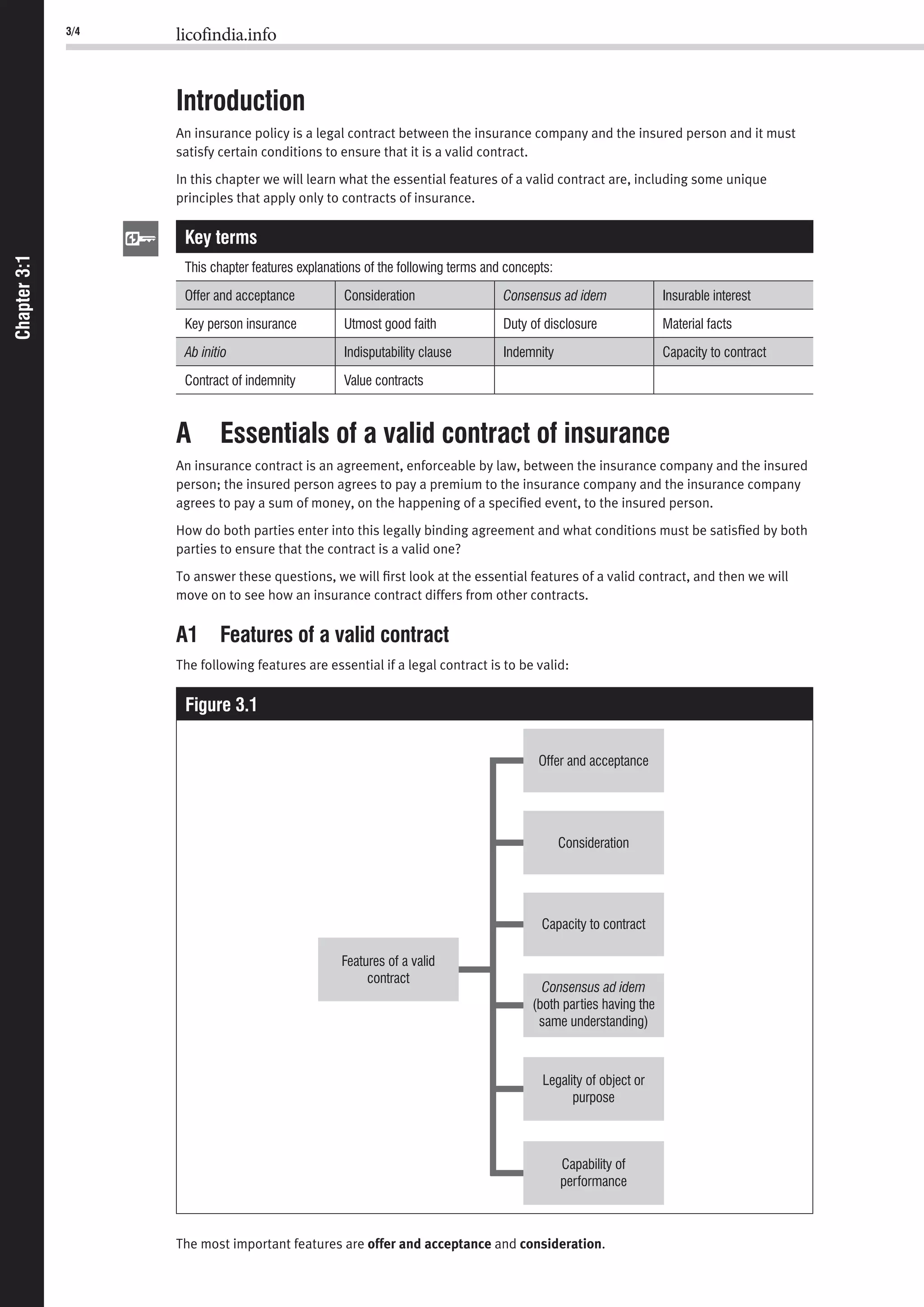
non-guaranteed benefits, the benefit illustration shows the annual growth rate assumed (growth at the rate
of 6% and 10% as per guidelines issued by the Life Insurance Council) for each projection and provides
illustrations of investment values over different periods of time.
It is also usual to show the charges levied by the insurance company and the extent to which these
reduce the investment return to the client during the period of the investment. It enables clients to make
comparisons between one product and another.
E4 Know your customer
At the end of the presentation, the agent will sum up the proposals and seek the client’s authority to proceed
and complete the form filling and know your customer (KYC) formalities.
Chapter 9 The fact-find and financial planning 9/13
Chapter9
Know your customer (KYC)
Along with the completed form, the client needs to submit the premium cheque in the name of the insurance
company and their identification documents as per the Know Your Customer (KYC) procedure. These include:
1.photographs;
2.proof of identity – some common documents accepted are a driving licence, passport, voter ID card, ID
card for defence personnel, PAN card, any identification card issued by a government body etc; and
3.proof of address – some common documents accepted as proof of address are a driving licence, passport,
electricity bill, telephone bill, premium receipt of any insurance company, ration card, bank passbook etc.
The list of documents accepted as proof of identify and address may vary among insurance companies.
9/14 licofindia.info
Chapter9
Key points
The main ideas covered by this chapter can be summarised as follows:
What we need to know and why
changes.
client.
Using a fact-find
Assessment and analysis
unpredictable and predictable needs.
Applying product features and benefits to a client situation.
products that most suit the client’s requirements.
Making recommendations
finding: to recommend the products or portfolio of products that best meets the client’s needs for the contribution
they can afford to pay now and sustain in the future.
report for presentation to the client.
If not the agent should proceed with completing form-filling formalities.
documents.
Chapter 9 The fact-find and financial planning 9/15
Chapter9
Question answers
9.1 The objectives of a fact-find are:
9.2 A fact-find form is divided into separate sections covering the client’s details. These sections include:
Self-test questions
1. Explain the overall product shortlisting process.
2. Explain briefly the structure of a meeting to present and recommend products to a client.
3. According to Life Insurance Council guidelines, in a benefit illustration document what can be shown as the
annual assumed growth rate for investment values?
You will find the answers on the next page
9/16 licofindia.info
Chapter9
Self-test answers
1. The process of analysing information and drafting recommendations to the client should be methodical
and include a series of checks. After reviewing the client’s fact-find questionnaire, the following stages are
necessary:
2. Once client and agent have exchanged greetings, the normal structure of a presentation meeting should be as
follows:
3. For non-guaranteed benefits, the benefit illustration shows the annual growth rate assumed (growth at the
investment values over different periods of time.
Chapter10Chapter10
10Good client practice
Contents Syllabus learning
outcomes
Learning objectives
Introduction
Key terms
A The duties and responsibilities of an insurance agent 10.1
B Requirements of the client 10.1
C Agent remuneration and upfront disclosure methods 10.2
D Recommending suitable policies 10.3, 10.4, 10.5
E The long-term benefits of retaining policies and avoiding short-term cancellations
(persistency)
10.6
F Clients’ rights and complaints procedures 10.7
G Building long-term relationships with clients 10.6
Key points
Question answers
Self-test questions
Learning objectives
After studying this chapter, you should be able to:
• discuss the duties and responsibilities of an agent;
• describe the requirements of clients;
• describe the methods of remuneration for agents;
• explain why it is unethical to advise a client to switch between products or providers, unless it is clearly in
their best interests to do so;
• discuss the need for building long-term relationships with clients.
licofindia.info
10/2 licofindia.info
Chapter10Chapter10
Introduction
Insurance agents are some of the most important intermediaries for selling life insurance products. Agents
have a duty to provide the best available product solutions to their clients based on the clients’ needs and
requirements. They also have a duty towards the insurance company to protect it from adverse selection, as
they are in the best position to judge the risk profile of their own clients.
There is an increasing awareness that insurance agents must behave in a professional way towards their
clients at all times. High standards of professional conduct are in the best interests of the insurance industry
itself as well as in the interest of the public it serves.
The major characteristics of all professions are as follows.
Their members:
These requirements are as essential for insurance industry professionals as they are for doctors, lawyers and
accountants, and the IRDA has laid down the Code of Conduct to ensure that all agents behave in an ethical
manner towards their clients. We will look at the Code in more detail in chapter 15.
In this chapter we will discuss the duties and responsibilities that an insurance agent has towards his clients
and insurance company. We will also discuss the importance of building long-term relationships with clients.
Key terms
A The duties and responsibilities of an insurance agent
Insurance agents are responsible for selling life insurance products to clients, and agents must obtain a
licence from the IRDA. Section 42 of the Insurance Act 1938 defines an insurance agent as:
An insurance agent’s duties and responsibilities include establishing the client’s needs and identifying the
most suitable products to meet those needs. However, the agent’s role does not end there. The agent has to
see the policy through from inception until its maturity and/or from when a claim is made until it is settled.
An insurance agent acts as an intermediary between the insurance company and the client and has the
responsibility of obtaining business for his company. An agent also represents his clients, and therefore he
has to make sure that he does not mislead them in any way and that he always works in their best interests.
The insurance agent is the insurance company’s main contact point with clients, and he has to ensure that he
collects all the necessary information about them that the insurance company will need.
10/3
Chapter10
The main duties and responsibilities of an insurance agent can be summarised as follows:
B Requirements of the client
We have already seen in chapter 8 that the insurance agent must recommend suitable products for the client,
and that before he does this he should have a clear understanding of the client’s needs and requirements.
The process of identifying and analysing the client’s information and suggesting suitable products should be
methodical and involve a series of checks. After the fact-find, the following stages are necessary:
Figure 10.1
Prioritising the needs of the client.
Conducting research to prepare a unified financial recommendation.
Calculating the amounts that need to be provided for or have not yet been provided for.
Indentifying suitable products and eliminating the unsuitable ones.
C Agent remuneration and upfront disclosure methods
In this section we will discuss agent remuneration and disclosure methods as recommended by the IRDA.
C1 Remuneration methods
The remuneration of life insurance agents is governed by IRDA regulations. A life insurance agent receives
his remuneration by way of commission. This commission is a certain percentage of the premium that is
collected by the insurance company. The Insurance Act 1938 stipulates the maximum amount that can be
paid to an insurance agent by way of commission or any other form, the details of which are as follows:
• An insurance agent can receive a maximum of 35% of the first year’s premium, 7.5% of the second and
third year’s renewal premium, and 5% of the subsequent years’ renewal premium. (This does not apply to
immediate or deferred annuities.)
10/4 licofindia.info
Chapter10
• During the first ten years of the insurer’s business, an insurance agent can be paid a maximum of 40% of
the first year’s premium, instead of the stipulated 35%.
• Commission on renewal premiums due to the agent must not exceed 4% in any case. The Insurance Act,
section 44, states the following conditions on agents (whose agency has been terminated) for receiving
commission on the renewal premium:
– the agent should have been working with the insurer for more than five years and policies of not less
than Rs. 50,000 sum insured are in force at least one year before the termination of the agency; or
– the agent should have been working with the insurer for at least ten years and, after ceasing to act as an
agent, are not directly or indirectly soliciting or procuring insurance business for any other person.
In the case of an agent’s death, the commission is payable to his legal heirs.
An insurance company can make payments to its agents within the prescribed limits. Generally, commission
rates for term plans are lower than those for other plans such as whole life plans. Also, polices with shorter
term periods provide less commission compared to policies with longer term periods. Under single premium
plans, annuity and pension plans the commission rates are lower.
C2 Disclosures
An insurance agent must disclose the amount of remuneration and commission he receives as a result of
effecting insurance for a client, on demand.
With effect from 1 July 2010 all insurers have to disclose explicitly in the benefit illustration document, the
commission they pay to their agents for ULIPs. This circular was issued by the IRDA in which it was made
mandatory for the agent to obtain a signed copy of the benefit illustration document together with the
proposal form from the client.
The benefit illustration documents show the details of charges and growth of the fund expected over the
duration of the policy as per the Life Insurance Council’s assumed growth rate of 6% and 10%.
According to the IRDA, disclosure will help in increasing the transparency in the selling of life insurance
products by providing clients with details regarding the exact amount of commission that is being paid to
insurance agents as well as charges applicable on the policy.
Question 10.1
D Recommending suitable policies
Once the insurance agent has identified suitable products for the client’s respective needs, he can
recommend selected policies to them. In this section we will discuss the different issues that may arise on
the recommendation of suitable policies to clients with regard to:
Figure 10.2
checking the client’s commitment to the needs;
outlining the reasons for the recommendation of a particular policy;
acceptance or rejection of the recommnedation; and
churning and product switching.
10/5
Chapter10
D1 Checking the client’s commitment to their needs
Checking the client’s commitment to their needs is an important procedure. This involves reminding the
client of the needs that were agreed during the fact-finding process. The agent should go through each need
and ask the client to confirm that they are still areas of concern.
If the client disagrees with the prioritised needs, the agent will have to revise the financial plan. If the client
agrees with the set of needs, then the agent can go ahead with the recommendation of suitable products and
policies.
D2 Outlining the reasons for the recommendation of a particular policy
Before explaining the recommendation in detail, the agent must explain the reasons for recommending a
certain policy. The reasons should be closely linked to the client’s needs and concerns as expressed during
the fact-find process.
The agent should ensure that the client is able to understand the key features and benefits provided by the
policy. He also needs to present a chart comparing the policy with other available policies so that the client is
able to compare the recommended policy against others.
Client feedback should be taken at each stage of the recommendation. Once a policy has been recommended
and its features and benefits have been explained, the agent should ensure that the client agrees with it.
Where the client is apprehensive or has certain concerns, they must be addressed immediately.
D3 Acceptance or rejection of the recommendation
If the client accepts the recommendation, then the agent should ask the client to fill in the proposal form.
If the client disagrees with the recommendation, the agent must ask further questions to find out the reasons
for the refusal. Recommendations can be rejected for the following reasons:
Figure 10.3
The client does not wish to proceed with financial
planning at the moment and wants to take time to
consider their options before making an investment.
In this case the agent can ask to contact the client at
a future date.
The client is not satisfied with the recommended
products. In this case, the products will have to be
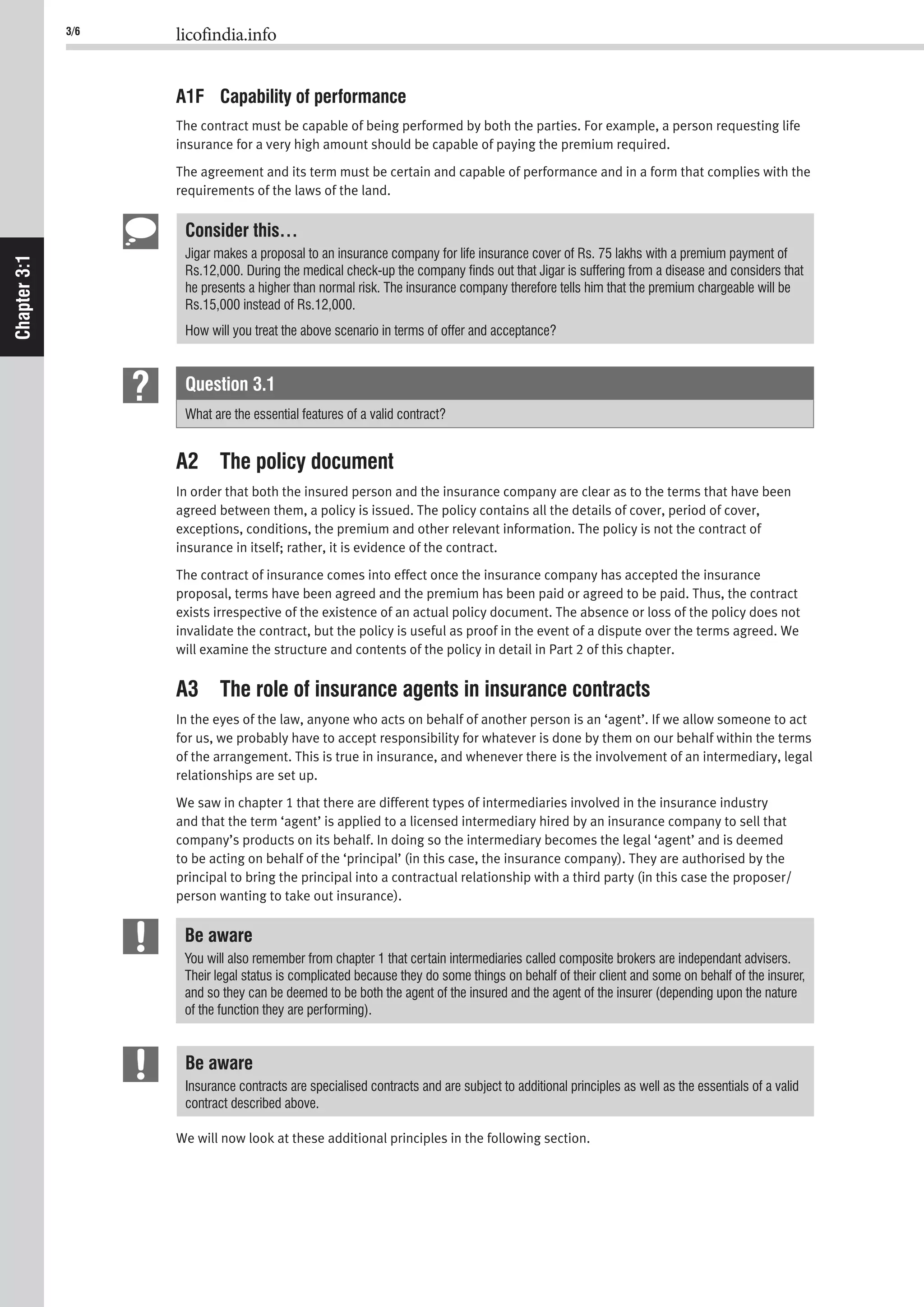
reviewed according to needs of the client.
Good questioning techniques (which we looked at in chapter 8) can help agents in finding out the real
reasons for why a recommendation has been rejected, and may help in resolving the issue thus leading to
the recommendation being accepted. Failing this, the agent must respect the client’s right to decline and
should seek permission to re-approach the client at a future date.
The agent can also ask for some references from the client such as the names and contact details of any
relatives, friends and acquaintances who might be interested in financial planning. These references are
important selling opportunities for the insurance agent.
D3A What should an agent do if a client accepts some but not all of their
recommendations?
There can be cases where the client may tell the agent to ignore a large protection need and instead
invest the money available into a savings plan; or the client may reject advice to invest capital in a low risk
investment product and instruct the agent to buy a high risk investment product that is performing well at
the moment (but that may not do so in the future).
In this case the agent should try to convince the client to follow his recommendation by elaborating on
the reasons as to why that product has been selected. However, if the client still wishes to act against the
agent’s advice, the agent should express his readiness to carry out the client’s instructions, although it
should be made clear that the transaction is not recommended by the agent.
The client’s decision to act differently from the agent’s recommendations may emerge at two different stages:
• during the presentation; or
• during the fact-finding interview;
and the agent needs to address the client’s apprehensions as and when they arise.
10/6 licofindia.info
Chapter10
D4 Churning and product switching
There has been increasing concern in the insurance sector about product switching, though this is now
being brought under control by the proactive efforts of the Regulator (the IRDA) and with the growth of
professionalism among intermediaries.
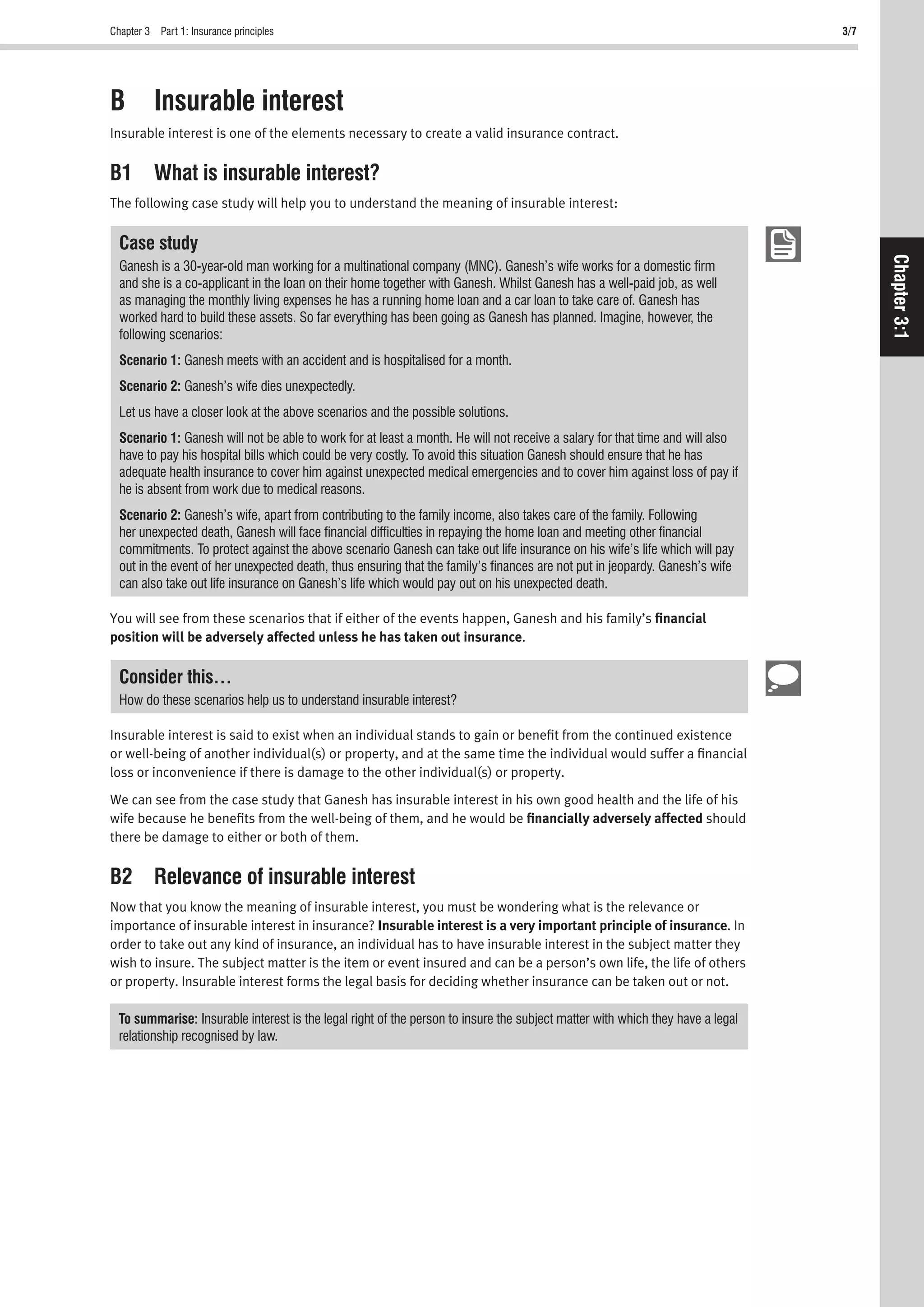
D4A Churning
Repeatedly encouraging clients to switch policies or investments from one to another is known as churning.
Insurance churning is a practice in which agents recommend that clients surrender their existing policy and
use the funds to purchase a new policy, thereby allowing agents to earn a higher commission on the new
policy. It is an unprofessional and unethical practice that results in clients suffering losses in the form of
surrender charges and reduced long-term benefits if their policies are not kept held until maturity.
Case study
D4B When product switching is suitable
There will sometimes be situations where clients have been mis-sold policies that do not match their needs.
There will also be times when clients are holding products that are not good value for money, and others
where clients are facing financial difficulties and may desperately need to reduce expenditure or reschedule
their debts. Unfortunately in these situations clients are often all too willing to cancel existing policies and
they may even volunteer to do so. In such circumstances it may be acceptable, as a last resort, to advise a
client to surrender a product and, possibly, take out a more appropriate one. However, such advice should
only be given where a switch is clearly in the client’s best interest. Even then, no surrender or switch
should ever be recommended until the agent has explained what the client will lose as well as what the client
may gain from the change.
10/7
Chapter10
Case study
10/8 licofindia.info
Chapter10
E The long-term benefit of retaining policies and
avoiding short-term cancellations (persistency)
Persistency refers to the amount of business that insurance companies are successful in retaining without
lapse or surrender of the policy. It can be calculated as follows:
Persistency =
The number of policies remaining in force at the end of the year
The total number of policies in force at the beginning of the year
Agents play an important role in maintaining a high persistency ratio.
A low persistency ratio affects the whole insurance industry adversely:
• for the insurance company it means that a large number of policies have lapsed or have been surrendered,
resulting in a loss of profits and a reduction in the accumulation of reserves;
• for clients it means fewer benefits than originally expected and a loss of insurance cover; and
• for agents it means the loss of renewal commission.
E1 Benefits of persistency
The insurance company, agent and client all benefit by retaining policies and avoiding early surrenders for
the following reasons:
Helps the client in achieving goals
Increased revenues
Reduction in costs
Increased client satisfaction
E2 What are the different factors that can affect persistency?
Figure 10.4
Persistency
Policy servicing
Product design
Role of agents
Change in
client's financial
circumstances
We will discuss each of these factors in turn.
10/9
Chapter10
• Product design
If the client is unsatisfied with the benefits and returns they are getting from their policy then they might
decide to surrender it. Insurance companies must design products based on the real needs of their clients
to avoid policy lapses and surrenders.
• Change in the financial circumstances of the client
There can be a change in financial circumstances of the client due to unemployment, disability or health-
related issues. As a result of this they may not be in a position to pay the premiums on time and so this will
result in a policy lapse.
• Policy servicing
Insurance agents should ensure that they maintain regular contact with clients and remind them when
premium payments are due. In cases where the client is unable to pay the premium on time, then they
should be asked to pay the premium within the grace period. The insurer has to ensure that the benefits
that were promised are actually delivered to the client. If the insurer fails to do so, then the client can
become dissatisfied with the service and can choose to surrender the policy.
• Role of agents
Agents play the most important role in maintaining high persistency. Insurance agents should build a good
rapport with their clients and should place emphasis on recommending products that are the most suitable
for their clients’ needs, and not on the basis of the amount of commission they are likely to receive.
E3 What are the different methods for maintaining high persistency?
The different methods that can be used by an insurance company for maintaining high persistency are as
follows:
Flexibility in premium payment
Constant reminder of due
premium dates
Continuous contact with clients
Policy servicing
Question 10.2
F Clients’ rights and complaints procedures
When a client purchases a life insurance plan, they purchase it with the intention of receiving certain benefits
promised by the insurance company at the time of purchase. Where the client does not receive these benefits
during the tenure of the policy or on maturity and is dissatisfied with the service, or has a query or problem
which has not been addressed, they have the right to raise a grievance/complaint.
This is clearly a very important area for insurance companies and their agents, and we will look at it in detail
in chapter 14 when we discuss the issue of customer protection.
10/10 licofindia.info
Chapter10
Question 10.3
G Building long-term relationships with clients
Insurance companies should aim to build long-term relationships with their clients instead of focusing on
short-term sales. A satisfied client may be the source of other potential clients as they will speak positively
about the agent and the insurance company.
Once recommendations have been made and the relevant transactions carried out, it should not be the end
of the matter for an insurance agent. It is much better to have an ongoing relationship with the client that is
beneficial for both parties. Thus many agents have an ongoing system to review their clients’ financial needs
and financial planning.
Reviews could be irregular but triggered by relevant events, such as tax or legal changes, the introduction of
a new insurance product or a change in a client’s circumstances.
Figure 10.5
change
of job
marriage
moving
house
birth of
a child
A review
may be
triggered
by events
such as:
These changes could lead to recommendations to:
• take out new protection contracts;
• increase existing levels of protection;
• switch investments; or
• alter existing tax saving plans.
Consider this
10/11
Chapter10
Key points
Insurance agent’s duties and responsibilities
Requirements of the client
Agent remuneration and disclosure
Recommending suitable policies
The long-term benefits of retaining policies and avoiding short-term cancellations (persistency)
Clients’ rights and complaints procedures
Building long-term relationships with clients
10/12 licofindia.info
Chapter10
Question answers
Helps the client in achieving goals
Increased revenues
Reduction in costs
Increased client satisfaction
10/13
Chapter10
Self-test questions
You will find the answers on the next page
10/14 licofindia.info
Chapter10
Self-test question answers
Chapter11Chapter11
11Claims
Contents Syllabus learning
outcomes
Learning objectives
Introduction
Key terms
A Requirements for a valid claim 11.1
B Why a claim may be invalid 11.2
C Duties after death and documentary evidence 11.3, 11.4
D Settling claims 11.5
E Fraudulent claims 11.6, 11.7
F Void and voidable contracts 11.8
Key points
Question answers
Self-test questions
Learning objectives
After studying this chapter, you should be able to:
• define a claim;
• identify the different types of claims;
• discuss the requirements of a valid claim;
• recognise invalid claims;
• list the documents required to be submitted to settle a death claim;
• describe early death claims;
• explain the process of settling maturity, survival and death claims;
• recall the IRDA guidelines pertaining to the settlement of claims;
• state the consequences of settling a fraudulent claim;
• distinguish between contracts that are void and voidable;
• explain the indisputability clause in life insurance.
licofindia.info
11/2 licofindia.info
Chapter11Chapter11
Introduction
When making a decision on buying life insurance, clients will take a number of factors into account. These
include the:
• pricing of the product;
• features of the product;
• likely returns that will be offered by the product compared to other insurance and investment products;
• flexibility offered in terms of plan term, premium payments, liquidity etc.;
• tax benefits offered by the product; and
• level of customer service provided by the company.
All these factors play an important role, but one very important aspect, which few people pay attention
to, is how the insurance company handles and settles claims. What good is an insurance product during
the lifetime of a policyholder, if the nominee/beneficiary/assignee is not able to receive the claim from
the insurance company in a reasonable time and with ease? The real test of an insurance company and an
insurance policy comes when the policy becomes a claim. People take out insurance because they worry
about the possibility of misfortune. Ultimately, the ‘value’ of insurance will be judged, by most individuals,
on the way in which their claim is handled.
While the IRDA has laid down broad guidelines for claims settlement, it depends on individual companies
and their claims handling staff how quickly and efficiently they respond to a claim when it arises and how
soon they settle it. The claims settlement ratio (how many claims are settled to every 100 claims arising)
is also one of the benchmarks on which an insurance company is judged. So claims handling and settling
assumes a great deal of significance.
In this chapter you will learn all about claims, their types and their settlement. You will learn about valid and
invalid claims and what you should do when one of your clients’ policies becomes a claim.
Key terms
This chapter features explanations of the following terms and concepts:
Claims Maturity claims Survival benefit payments Death claims
Valid claims Policy not in force Breach of policy condition Fraudulent claims
Claim documents Early death claims Presumption of death Void contracts
Voidable contracts Indisputable contracts Claimant’s statement Rider benefits
Return of premium (ROP) Terminal bonus
A Requirements for a valid claim
Before discussing the requirements for a valid claim let’s look at what a claim is and what the different types
of claims are.
A1 What is a claim?
A claim is a demand that the insurer redeem the promise made in the contract. The insurer then has
to perform its part of the contract, i.e. settle the claim, after satisfying itself that all the conditions and
requirements for the settlement of the claim have been complied with.
We will look at three main types of claim in this section – maturity claims, death claims and rider benefits.
A2 Maturity claims
Some life insurance plans, such as endowment plans and whole life plans, promise to pay the insured a
specific amount at the end of the plan, if they survive for the plan’s entire term. This amount is known as the
maturity benefit amount or the maturity claim amount. The amount payable on maturity is the sum insured
plus any accumulated bonuses, minus any outstanding premiums and interest thereon.
In some cases the premiums paid over the tenure of the plan are returned on maturity. These plans are
termed as ‘return of premium’ (ROP) plans by some insurers.
Chapter 11 Claims 11/3
Chapter11
Example
Ajay has bought a participating endowment plan with a sum insured of Rs. 25 lakhs that will run for 30 years. Under the
terms of this plan, if Ajay survives until the end of the 30 years, and has paid all the premiums, the insurance company
will pay him the maturity benefit amount or maturity claim of Rs. 25 lakhs along with the accumulated bonuses (if any).
On maturity the insurance company may also pay Ajay a one-time terminal bonus in addition to the accumulated
bonuses that are declared year after year. This bonus is paid to encourage policyholders to continue with the policy for
the full term and to pay the premiums regularly on time.
The terminal bonus is also known as the final additional bonus (FAB) or loyalty or persistency bonus. It may be fixed by
some insurance companies at the beginning of the policy, or alternatively it will depend on the financial performance of
the insurance company over the life of the policy. It is paid provided the premiums have been paid for a specified period
(usually at least 15 years).
In the case of ULIPs, the insurance company pays the fund value (or in some cases the fund value and sum
insured) as the maturity claim, at the end of the plan’s term or, in the case of a money-back policy, minus the
survival benefits received during the term of the policy.
A2A Survival benefit payments
For money-back policies the insurance company makes specific payments to the policyholder at specific
times during the term of the policy. These payments are known as survival benefits.
Example
Ajay has bought a money-back policy with a sum insured of Rs. 20 lakhs for 20 years, which promises to pay 25% of
the sum insured every five years as survival benefit. In this case the insurance company will pay Ajay Rs. 5 lakhs at
the end of the 5th, 10th, 15th and 20th years, as a survival benefit. If the policy is a participating policy, the insurance
company will also pay the accumulated bonuses along with the last payment at the end of the 20th year.
Consider this…
How is a survival claim different from a maturity claim? Think of some examples of the types of policies in which the
two claims arise.
A2B Reduced sum insured (paid-up value)
Sometimes during the tenure of a policy the policyholder may face financial problems and may not be
in a position to continue paying the premiums. During such times rather than surrendering the policy,
the policyholder has the option to convert it into a paid-up policy. On the maturity of such policies, the
proportionate reduced sum insured is paid out by the insurance company.
A2C Discounted claims
Discounted claims are those options which are exercised by the policyholder within one year of the maturity
date of the policy.
A2D Commutation of instalments
For annuity plans, before receiving regular/periodic annuity payments, the individual can make a lump sum
withdrawal. This is known as commutation. Insurance companies normally allow the individual to make
withdrawals of up to a third of the accumulated fund. The remaining two thirds must be used to buy the
annuity payments for the individual.
A2E Annuity payments at the time of vesting
In the case of annuities, on vesting, the regular annuity payments start to be made by the insurance company
to the annuitant. The payments may be made to the annuitant on a monthly, quarterly, semi-annual or
annual basis depending on the plan’s terms and conditions.
11/4 licofindia.info
Chapter11
A3 Death claim
A death claim is where the life insurance company pays the sum insured to the nominee/ beneficiary on
the death of the insured during the term of the plan. For whole life policies, the benefit is paid on death,
regardless of when this occurs, i.e. there is no fixed term. If the policy is a participating policy, the insurance
company will also pay the bonuses accumulated until then. If the policyholder had taken out any loans, then
the outstanding amount of the loan, the interest and any outstanding premium and interest thereon will be
deducted before the final amount is paid.
Example
Ajay has bought a term insurance plan with a sum insured of Rs. 25 lakhs for 25 years. He dies in the 13th year of the
policy. In this case the insurance company will pay Ajay’s nominee/beneficiary Rs. 25 lakhs as a death claim.
Be aware
In the case of an ULIP, should the insured die, the insurance company pays the higher of the sum insured or the fund
value (or, in the case of some insurance companies, both the fund value and the sum insured is paid).
There are certain policies where the benefit is not paid on death but on a specified date as chosen by the life
insured when taking out the policy. For example, for a policy where the objective is to provide for a lump sum
amount for a daughter’s marriage or a son’s higher education, the amount is not paid on the death of the life
insured but becomes payable on the date specified, for example:
• when the son/daughter reaches the age of 18 or 21.
This is, of course, as per the terms and conditions of the policy and the option exercised by the proposer.
A4 Rider benefit
A payment under a rider is made by the insurance company on the occurrence of a specified event according
to the rider terms and conditions. For example:
• under an accidental death benefit (ADB) rider, in the event of the death of the insured, the additional sum
insured under this rider is paid;
• under a critical illness (CI) rider in the event of diagnosis of a critical illness, a specified amount is paid
as per the rider terms and conditions. The illness should be covered in the list of CIs specified by the
insurance company (the list may differ among insurers);
• under a ‘hospital care’ rider the insurance company pays the treatment costs in the event of
hospitalisation of the insured, subject to the terms and conditions of the rider.
To refresh your knowledge of riders, refer back to chapter 7, section B3.
A5 Valid claim
Once an insurance company receives notification of a claim it will want to be sure that the claim is valid
before it makes a payment. It will do this by checking the following:
to the policy? These will be investigated by the insurance company as part of its claim settlement process.
Example
The insurance company will investigate whether the policyholder declared their correct age and supported it with
valid age proof documents. If it is an early claim (death happening within 2 to 3 years of buying the policy or revival
of the policy) the insurance company will investigate whether the insured suppressed any material facts (for example
something related to their health or about a pre-existing illness) in order to get insurance on better terms. (If you want to
refresh your knowledge of material facts, we discussed these in chapter 3, part 1.)
Chapter 11 Claims 11/5
Chapter11
This can be the nominee, the legal heir or the assignee etc.
Suggested activity
Find out from your family or friends if any of them has ever made a claim on a life insurance company. Ask them about
Question 11.1
B Why a claim may be invalid
Once an insurance company has completed its investigations it may conclude that it does not need to make a
claim payment because the claim is invalid. There are three main circumstances in which this may arise:
The policy is not in force: If the policy was not in force when
the event occurred, the insurance
company will reject the claim.
Example: Ajay has taken out a term plan for
20 years. He pays the annual premium on
the 1st of April every year. In the 3rd year he
suffers a severe heart attack. Due to financial
problems because of huge hospital bills, Ajay
is not able to pay the premiums on time. His
financial problems continue for a longer time
than expected and he is not able to pay the
premium even during the grace period. At the
same time Ajay’s health deteriorates and he
dies on 15th May.
Ajay’s nominee files a claim with the insurance
company but the company rejects the claim as
the policy was not in force due to premiums
not being paid, even during the grace period.
Excluded conditions apply: If the death is caused by something
excluded from cover under the policy,
the claim will not be met.
Example: Insurance policies exclude death
due to suicide in the first year of the policy,
therefore the death claim for a policyholder who
commits suicide during that first year, will be
rejected by the insurance company.
The claim is fraudulent: If, during its investigations, the
insurance company finds out that
a material fact was deliberately
suppressed by the insured then it will
reject the claim.
Example: If the insurer finds out that the age
declared by the insured at the time of taking
out the policy was wrong or the insured
was suffering from some illness that was
deliberately not disclosed, then the insurer
can reject the claim on the grounds of
misrepresentation.
Suggested activity
Search the internet and find out about some life insurance cases where the insurance company rejected the claim
because it was of the opinion that the claims were invalid due to various reasons. Study those cases.
11/6 licofindia.info
Chapter11
C Duties after death and documentary evidence
Clearly, unless the insurance company knows about the death, it will not pay out the sum insured. Therefore
the first thing that must happen, after the death of the life insured, is for the insurance company to be
advised that the death has taken place. The notification may be sent by the nominee, assignee, relative,
the individual’s employer or the insurance agent. However, notification of the death is not enough – the
insurance company will need proof, not just that the death actually took place, but that the life was insured
by the company. Therefore, the next duty for the claimant is to ensure that the insurance company receives
the following documents:
this so that it can make the payment to the correct person. (See chapter 3, part 2, section H4B to refresh your
knowledge of assignment.)
company.
C1 Early death claims
If the claim occurs within three years from the date of risk, or from its revival, insurance companies normally
classify it as an early death claim. In such cases insurance companies will carry out a detailed investigation.
Additional documents may be called for in order to make certain that material facts were not suppressed at
the time of proposal/revival. These documents include:
the treatment given;
If the life insured had an unnatural death, such as an accident, by suicide or by an unknown cause, the
following will also be looked into:
• Police first information report (FIR);
• panchanama (inquest);
• forensic report;
• post mortem report; and
• Coroner’s report.
Depending on the initial evidence, a special inquiry may be ordered.
Chapter 11 Claims 11/7
Chapter11
Example
Ajay has bought an endowment insurance plan with a cover of Rs. 25,00,000 for a term of 25 years. Let’s see how the
claim will be handled in various scenarios:
a) Ajay dies within the first three years of buying the policy. His death is treated as an early death claim by the life
insurance company. The insurance company carries out a more detailed investigation than usual before settling the
may ask for information from the last doctor who treated Ajay before his death.
b) Ajay pays all the premiums regularly on time and he dies in the 7th year of the policy. The life insurance company
documents along with the completed claim form. The insurance company will settle the claim in a reasonable period
of time without going into a detailed investigation, provided the claim is valid.
c) Ajay is unable to pay the premium in the 5th year of the policy and the policy lapses. He revives the policy in the 6th
year and dies in the 7th year. The treatment of the claim will be different from a normal death claim. Even though
death has happened in the 7th year of the policy, the life insurance company will still treat the claim as an early death
claim as death happened one year after the policy’s revival. The insurance company will carry out a more detailed
investigation than normal before settling the claim as in scenario a).
D Settling claims
In section A we looked at maturity and death claims and in this section we will look at how these are settled
in more detail. Before we do so, however, we will consider the guidelines laid down by the IRDA about how
all claims should be handled, as these provide the framework.
D1 IRDA guidelines for claim settlement
In the introduction to this chapter we stated that the IRDA has laid down guidelines for the settlement of claims.
These are included in the IRDA (Protection of Policyholders’ Interests) Regulations 2002 and are as follows:
Claims procedures in respect of a life insurance policy
in support of a claim.
of additional documents, to the extent possible, shall be raised all at once and not in a piecemeal manner, within a
period of 15 days of the receipt of the claim.
3. A claim under a life policy shall be paid or be disputed giving all the relevant reasons, within 30 days from the date
circumstances of a claim warrant an investigation, it shall initiate and complete such investigation at the earliest, in
any case not later than 6 months from the time of lodging the claim.
4. Subject to the provisions of section 47 of the Act, where a claim is ready for payment but the payment cannot be
made due to any reasons of a proper identification of the payee, the life insurer shall hold the amount for the benefit
of the payee and such an amount shall earn interest at the rate applicable to a savings bank account with a scheduled
bank (effective from 30 days following the submission of all papers and information).
sub-regulation (4), the life insurance company shall pay interest on the claim amount at a rate which is 2% above the
bank rate prevalent at the beginning of the financial year in which the claim is reviewed by it.
Now that we have established the framework within which all claims must be handled, we can go on to
consider the individual types of claim.
11/8 licofindia.info
Chapter11
Question 11.2
D2 Maturity claim
Action on maturity claims is normally initiated by the insurance company itself. It will know from its records
which policies will mature each month and will normally send an advance notification to the person insured.
The insured will then take the steps described in section C. Then, before making the payment, the insurer will
satisfy itself that:
Figure 11.1
The original
policy has
been
handed in
The identity
of the
policyholder
has been
proved
The
discharge
form has
been duly
completed
The correct
age was
admitted and
a supporting
age proof
document
supplied
All the
premiums
have been
paid and are
up to date
There are no
assignments
The insurer is expected to make the payment on the maturity date. Post-dated cheques are usually sent a few
days in advance of the maturity date, provided a signed discharge form has been received.
If the policy is reported lost, then the insurer may settle on the basis of indemnity (see section E). This is
possible because no further obligations remain under the policy.
Assigned policies
Be aware
In the case of an absolute assignment, the claim payment will be made to the assignee.
If the assignment is conditional, reverting to the policyholder on maturity, the insurance company can
make the payment to the policyholder. It will be prudent, however, to first check that the assignee has no
outstanding claims.
Be aware
Settlement option: Some maturity claims (for example in case of ULIPs) may be payable, not on the date of maturity as
chosen by the policyholder, but later and in instalments, not as a lump sum. This is known as the settlement option. The
settle may be taken before the maturity date, the settlement process will continue for a few years after the maturity date.
D3 Survival benefit payments
When it comes to making survival benefit payments, the procedure is similar to the payment of maturity
claims. Action will be initiated by the insurer and post-dated cheques will be sent in advance.
If the policy is reported to be lost, a duplicate policy may be provided on which an endorsement will be made
regarding the settlement of the survival benefits. See also section E below on fraudulent claims.
D4 Death claims
Unlike the first two types of claim, the process here is started by the claimant, who will advise the
insurance company of the death of the life insured. The insurance company will then wait for the relevant
documentation (see section C), check it, and carry out any further investigations that it deems necessary.
Once it is satisfied that the claim is a valid one, it will send the sum insured to the nominee or beneficiary
within a reasonable timeframe, i.e. it will settle the claim.
Question 11.3
According to IRDA guidelines, how long does an insurance company have to complete its investigation of a claim?
Chapter 11 Claims 11/9
Chapter11
E Fraudulent claims
Insurance fraud is a deliberate attempt to use insurance for unjustified financial gain. Insurance fraud
includes bogus claims and the misrepresentation of facts.
Be aware
Loss of policy
Insurance companies take the utmost care when settling maturity claims. Sometimes the original policy is reported as
lost. Caution must be exercised to ensure that there is no attempt to defraud, for example it could have been pledged
elsewhere for a loan. But if the loss of policy is genuine, it is possible to settle the claim on the basis of an indemnity
accompanied, as a precaution, by an advertisement in the newspapers.
The indemnity is in the form of a statement, signed by the claimant, stating that should the original policy come to light
and evidence of ownership by another party is provided, then the claimant will reimburse the insurance company for
any claim payments made to them.
E1 Consequences of fraud
If fraud is not detected and a fraudulent claim is paid, there are direct consequences for the insurer, their
insureds and on the fraudulent claimant, as follows:
Consequences of fraud
from the insurer see the result of this in a fall in their profits. Their claims costs will rise and this will
have an impact on premiums, making them less competitive in the market.
of this sort.
Consequences of fraud for
the insured claims being paid.
those who have made fraudulent claims. You will remember that the insurer tries to
make sure that each insured person brings a fair premium to the pool for the risk
presented. This will be distorted by fraudulent claims.
Consequences of fraud for
the fraudulent claimant claimant has succeeded in receiving monies in respect of a fraudulent claim, there will
be a temptation to continue this practice in future.
E2 Caution points at the time of handling death claims
Death claims are where most fraud occurs, and therefore insurers tend to be more cautious when handling
them. The following are some indications that a death claim may be fraudulent:
• If the notification of death is received from a stranger, there is reason to ask: ‘Why has it not come from a
family member or a relative?’
• Too many enquiries about progress in the settlement of the claim should raise doubts.
• If the notification of death is received three years after the date of death, there is reason to be suspicious.
In such a scenario, investigation in the same way as for an early death claim would be desirable in all
cases, to rule out the possibility of a fraud. If the reasons for the delay in making the claim are not fully
satisfactory, the plea that the claim is ‘time barred’ can be made.
While insurers, as a matter of good faith, should expedite claims settlement, as a trustee of the
policyholder’s premiums and their company’s finances they should always act to prevent fraud. This balance
has to be maintained.
E3 Presumption of death
Proof of death is essential for a claim to be settled. However, sometimes a person is reported missing
without any information about their whereabouts. What happens to the life insurance of such an individual –
can a claim be made or would an insurance company be suspicious that all such claims were fraudulent?
11/10 licofindia.info
Chapter11
Sections 107 and 108 of the Indian Evidence Act 1872 deal with presumption of death; under this Act if an
individual has not been heard of for seven years they are presumed to be dead. This has the following effect
on the actions of the life insurance company:
• If the nominee or heirs claim that the life insured is missing and must be presumed to be dead, insurers
insist on a decree from a competent court.
• However, the insurer may also act on its own, without a decree of the court, if reasonably strong
circumstantial evidence exists to show that the life insured could not have survived a fatal accident or hazard.
• It is necessary that the premiums should be paid until the court decrees presumption of death; although
insurers may, as a concession, waive the premiums during the seven year period. This is at the discretion
of the individual insurance company.
F Void and voidable contracts
One reason why a claim may be rejected by an insurance company is because the original contract of
insurance has been found to be invalid, or void, or has become voidable and the insurance company chooses
to set it aside for some reason. We will describe what these two terms mean, and the difference between
them, in this section.
A contract may not be valid or fully valid in law for a number of reasons. A void contract has no binding effect
on either party because a void contract is no contract at all (the expression is really a contradiction in terms).
Circumstances that will render a policy void include the following:
Mistake If there is a fundamental mistake that goes
to the root of the contract, there has been
no meeting of minds and, therefore, no
valid contract exists.
Example: A life insurance contract entered
into with a drunken person or person
who is not of sound mind at the time of
entering into the contract, will not be valid
as the person is not in a state of mind
to understand the contract’s terms and
conditions.
Illegitimate/unlawful
circumstances
If the insurance has been taken out in
support of some illegitimate (unlawful)
activity, it will be void.
Example: A person taking out life insurance
with the intention of committing suicide
or a husband taking life insurance on his
wife’s life with the intention of killing her
and claiming the money from the insurance
company.
Lack of insurable interest If there is no insurable interest attaching to
a policy, it would be declared null and void.
A voidable contract is binding unless and until one of the parties chooses to set it aside. Insurance contracts
may be voidable on a number of different grounds. Examples are:
• Breach of good faith – misrepresentation or non-disclosure will allow the insurer to treat the policy as void.
• Breach of warranty – this will entitle the insurer to treat the policy as void.
However, in Indian law there is an exception to the insurance company’s right to declare a policy void on the
grounds of misrepresentation or non-disclosure. This is important, so we will consider it now.
F1 Indisputable contracts
As we have just seen, if the proposer has made any untrue or incorrect statements at the time of proposal,
either in the proposal form or in the personal statement, or they have not disclosed some material
information, the policy contract becomes void ab initio. This means that all the benefits under the policy
cease and all monies paid in premiums are forfeited.
Be aware
Ab initio is a Latin term which means ‘from the beginning’. A policy contract which is declared void ab initio means
that the policy was null and void from the beginning and since the contract is not legally enforceable, the insurer is not
Chapter 11 Claims 11/11
Chapter11
However, this penalty is subject to section 45 of the Insurance Act 1938. Under this section, a policy which
has been in force for two years cannot be disputed on the grounds of incorrect or false statements in the
proposal and other documents, unless it is shown to be on a material matter and was fraudulently made.
This provision is meant to protect policyholders from suffering for minor inaccuracies on stated facts.
Section 45
by an insurer on the ground that statement made in the proposal or in any report of a medical officer, or referee, or friend
of the insured, or in any other document leading to the issue of the policy, was inaccurate or false, unless the insurer
shows that such statement was on a material matter or suppressed facts which it was material to disclose and that it
was fraudulently made by the policyholder and that the policyholder knew at the time of making it that the statement was
false or that it suppressed facts which it was material to disclose.
Chapter 11 Claims 11/13
Chapter11
Key points
The main ideas covered by this chapter can be summarised as follows:
Requirements for a valid claim
proposal is on the life of another person, say, key man insurance, partnership insurance etc.) or the assignee if the
policy was assigned absolutely for valuable consideration, at the end/maturity of the plan, if they survive the entire
term of the plan.
during the term of the policy. These payments are known as survival benefits.
the insured during the term of the plan, is known as death claim.
Why a claim may be invalid
– the policy is not in force;
– an exclusion condition applies; or
– the claim is found to be fraudulent.
Duties after loss and documentary advice
documents to settle the claim.
for a normal death claim.
Settling claims
policyholder well in advance.
IRDA (Protection of Policyholders’ Interests)
Regulations 2002.
Fraudulent claims
and the fraudulent claimant.
Void and voidable contracts
– a mistake;
– illegitimate/unlawful circumstances; or
– a lack of insurable interest.
Insurance Act 1938, a policy which has been in force for two years cannot be disputed
on the ground of incorrect or false statements in the proposal and other documents, unless it is shown to be on a
material matter and was fraudulently made.
11/14 licofindia.info
Chapter11
Question answers
11.1 Claims can be of three main types:
insurance company.
11.3 According to IRDA guidelines, an insurance company must complete its investigation of a claim no later than six
months from the time the claim was lodged.
Chapter 11 Claims 11/15
Chapter11
Self-test questions
1.
2.
3.
4.
You will find the answers on the next page
11/16 licofindia.info
Chapter11
Self-test answers
1.
and a death certificate etc.;
2. An insurer may refuse to pay the claim because:
3. Circumstances that will render a policy void include the following:
Mistake – if there is a fundamental mistake that goes to the root of the contract, there has been no meeting
of minds and, therefore, no valid contract exists.
Illegal/unlawful circumstances – if the insurance has been affected in support of some illegal/unlawful
activity, it will be void.
Lack of insurable interest – if there is no insurable interest attaching to a policy, it would be declared null
and void.
4.
insureds and on the fraudulent claimant.
a)Consequences of fraud on the insurer
Individual insurers that do not take seriously the detection and prevention of fraud will see their profits
affected. Their claims costs will rise and this will have an impact on premiums, making them less
competitive in the market. In addition, they will gain a reputation for not carrying out thorough checks when
paying claims, making them vulnerable to more fraudulent claims.
b)Consequences of fraud on the insureds
The premiums will rise for everyone, not just for those making the fraudulent claims, as the insurer’s ability
to ensure that each insured brings a fair premium to the pool will be distorted.
c) Consequences of fraud on the fraudulent claimant
receiving monies in respect of a fraudulent claim, there will be a temptation to continue this practice in future.
Chapter12
12Legislation and client advice
Contents Syllabus learning
outcomes
Learning objectives
Introduction
Key terms
A Insurance Act 1938 12.1, 12.2
B Indian Life Assurance Companies Act 1912 12.1, 12.2
C Life Insurance Corporation Act 1956 12.1, 12.2
D Insurance Regulatory and Development Authority (IRDA) Act 1999 12.1, 12.2
E Prevention of Money Laundering Act (PMLA) 2002 12.1, 12.2
F Married Women’s Property (MWP) Act 1874 12.1, 12.2
G Other key legislation 12.1, 12.2
Key points
Question answers
Self-test questions
Learning objectives
After studying this chapter, you should be able to:
• explain the provisions of key legislation relevant to life insurance agents in providing client advice.
licofindia.info
12/2 licofindia.info
Chapter12
Introduction
At this point in your studies you will have a good understanding of:
• how insurance works;
• the range and detail of the products that you will be advising on and selling;
• how best to provide a professional service to your clients; and
• what happens in the event of a claim.
The final section of the course is concerned with explaining the legal and regulatory measures that exist,
focusing on the impact they have on your role as a life insurance agent in providing client advice.
In this chapter we will consider key legislation, starting with the Insurance Act 1938, and focusing on the
provisions that have an impact on agents.
Key terms
This chapter features explanations of the following terms and concepts:
Remuneration Prohibition of rebates Licensing of
insurance agents
Beneficiary
Solvency Money laundering Financial Intelligence
Unit (FIU)
High and low risk
customers
Trust Trustor Trustee Know your customer (KYC)
A Insurance Act 1938
This is the most important legislation passed in India relating to insurance business and, as stated in chapter 1,
it came into effect from 1 July 1939. The Act consolidates the law relating to the business of insurance and it was
the first piece of legislation to govern all forms of insurance, providing state control over insurance business.
The original 1938 Act was amended in 1950, 1956, 1968, 1972, and also in 1999 and 2002 following the
establishment of the IRDA (see section D). The Act broadly contains provisions relating to the:
• registration of insurers and renewal of registration;
• manner of investment of premium;
• maintenance of insurers’ solvency levels (see ‘Be aware’ below);
• appointment of staff;
• amalgamation and transfer of insurance business;
• assignment or transfer of policies and nominations;
• rural and social sector;
• control over management;
• licensing of agents and their commission;
• prohibition of rebates;
• power of investigation and inspection by the regulatory authority;
• protection of policyholders’ interests; and
• constitution of the Insurance Association and Insurance Councils.
Be aware
In this context, solvency – in simple terms – means whether the insurer has sufficient resources to satisfy the IRDA that
they are able to pay all claims at any point in time.
Until 1999 the Controller of Insurance (a person appointed by the Central Government to exercise all the
powers, discharge the functions and perform the duties of the Authority) was responsible for administration
of the Insurance Act 1938. The Controller was replaced by the IRDA.
Chapter 12 Legislation and client advice 12/3
Chapter12
A1 Provisions with specific relevance to agents
The following sections of the Act are particularly important for agents to understand, as they lay down the
guidelines that must be followed regarding the:
• licensing of agents;
• commission payable to them; and
• prohibition of rebates.
A1A Section 40(1) – Prohibition of payment by way of commission or otherwise for
procuring business.
Section 40(1) of the Insurance Act 1938 prohibits any form of remuneration for soliciting or procuring
insurance business in India to any person other than a licensed insurance agent or an insurance
intermediary.
Section 40(1)
No person shall after the expiry of six months from the commencement of this Act, pay or contract to pay any
remuneration or reward whether by way of commission or otherwise for soliciting or procuring insurance business in
India to any person except an insurance agent or an intermediary or insurance intermediary.
Example
Prashant has appeared for the prescribed pre-recruitment examination in life insurance, but has failed to score the
minimum required mark to pass the examination and therefore is still not certified and still not licensed by the IRDA to
solicit or procure life insurance business. So Prashant cannot be paid for soliciting or procuring insurance business as
he is neither a licensed insurance agent nor an insurance intermediary. In fact, Prashant is not authorised to solicit or
procure any life insurance business for any life insurance company until he is awarded the licence to do so from the
Authority.
Section 40A(1) stipulates the limits on the remuneration or reward by way of commission or otherwise that
can be paid to an insurance agent, the details of which have already been discussed in chapter 10.
Section 40B(1) also prescribes limits for expenses of management of life insurance business. All insurers
have to comply with this and provide statements in the prescribed format, certified by an actuary, within a
given time limit.
A1B Section 41(1) – Prohibition of rebates
Section 41(1) of the Insurance Act 1938 prohibits any insurance agent/intermediary from offering any
commission/premium rebate as an inducement to any person to take out or renew or continue a policy of
insurance. The section also prohibits any person from accepting any such rebates offered for taking out
insurance.
Section 41(1)
No person shall allow or offer to allow, either directly or indirectly, as an inducement to any person to take or renew
or continue an insurance in respect of any kind of risk relating to lives or property in India, any rebate of the whole or
part of the commission payable or any rebate of the premium shown on the policy, nor shall any person taking out
or renewing or continuing a policy accept any rebate, except such rebate as may be allowed in accordance with the
published prospectuses or tables of the insurer.
Example
Santosh is a licensed life insurance agent with ABC Insurance Company. Santosh approaches Karan to buy life
insurance based on his lifecycle needs. Similarly Karan has been approached by agents of other life insurance
companies to consider their products.
In this case, as per section 41 of the Insurance Act 1938, Santosh cannot offer any rebates from the commissions he
will receive from ABC Insurance Company to Karan as an inducement to buy life insurance from him and ignore the
products of other companies.
Similarly Karan cannot ask for any rebates from the agents of any company as an inducement to buy life insurance from
them.
Any person not complying with the provisions of this section shall be punishable with a fine up to Rs. 500.
12/4 licofindia.info
Chapter12
A1C Section 42 – Licensing of insurance agents
Section 42 of the Insurance Act 1938 stipulates the conditions for issuing a licence to a person or company to
act as an insurance agent for soliciting or procuring insurance business. The section covers the following:
Figure 12.1
The fee
payable with
the maximum
limit.
The licence is
valid for three
years, after
which it needs
to be renewed.
The renewal
application and fee
should reach the
IRDA at least 30 days
before the licence
expiry date.
A fee applies for
duplicate licences
issued when the
original has been
lost, damaged or
destroyed.
Any person who
acts as an insurance
agent without holding
a licence shall be
punishable by a fine.
Disqualification.
Undergoing
specific training.
Pass in
specified test.
The qualification
criteria for
becoming an agent.
Section 42:
Licensing of agents
The specific details of the procedure for issuing a licence to agents will be discussed in chapter 13.
A1D Section 44 – Prohibition of cessation of payments of commission
As we saw in chapter 10, under section 44 of the Insurance Act 1938, no insurance agent can be refused
payment of renewal commission due to him on renewal premium, in respect of life insurance business
conducted in India under the agreement. Even after the termination of agency the renewal commission is
payable, except for fraud, provided that:
(a) the insurance agent has served the insurer continually and exclusively in respect of life insurance
business for at least five years, and policies insuring a total sum of not less than Rs. 50,000 effected
through him for the insurer were in force for one year before his ceasing to act as an agent for the
insurer, and that the commission on renewal premiums due to him does not exceed 4%;
or
(b) the agent has served the insurer continually and exclusively for at least ten years and after his ceasing
to act as an agent he does not directly or indirectly solicit or procure insurance business for any other
person.
Be aware
In the event of the death of an agent, any commission payable to him under the above points (a) and (b), is payable to
his heirs for so long as such commission would have been payable had he been alive.
Chapter 12 Legislation and client advice 12/5
Chapter12
B Indian Life Assurance Companies Act 1912
The first statutory measure in India to regulate life insurance business was introduced in 1912 when the
Indian Life Assurance Companies Act was passed. Prior to 1912, there had been no legislation to regulate
insurance business in India.
As we saw in chapter 1, India’s life insurance business in its present form owes its origins to other countries,
in particular England, and the first insurance company established in India was the Oriental Life Insurance
Company in Kolkata in 1818.
However, all the insurance companies established at this time catered to the needs of the European
community and Indians were charged a higher premium than other policyholders. The Indian Life Assurance
Companies Act 1912 stipulated for the first time in India that premium rate tables and periodical valuations
of companies had to be certified by an actuary. However the Act discriminated between foreign and Indian
companies in many areas, putting the Indian companies at a disadvantage.
C Life Insurance Corporation Act 1956
The Life Insurance Corporation Act 1956 was passed on 19 June 1956 and subsequently the Life Insurance
Corporation (LIC) was formed on 1 September 1956.
The Life Insurance Corporation Act 1956 was passed to:
Figure 12.2
Provide for the nationalisation of the
insurance business in India by transferring
all such business to the LIC of India.
Regulate and control the business of
the LIC and other connected matters.
Be aware
The Life Insurance Corporation of India was formed in 1956 with the merger of 245 Indian and foreign insurers in total
(154 Indian, 16 non-Indian and 75 provident societies).
The LIC Act was passed with the objective of nationalising life insurance business in India and also to provide
for the regulation and control of the business of the LIC and for all connected matters.
Section 30 of the Act gave the LIC an exclusive privilege to transact life insurance business in India. In 1999
this exclusive privilege was revoked by way of an amendment to the Act as part of the Government’s policy of
economic reforms.
D Insurance Regulatory and Development Authority
(IRDA) Act 1999
The Insurance Regulatory and Development Authority (IRDA) Act 1999 was passed by Parliament in
December 1999. The Act provided for the establishment of the IRDA as a corporate body:
• to protect the interest of holders of insurance policies;
• to regulate, promote and ensure orderly growth of the insurance industry; and
• for other related matters.
As mentioned in section A, the IRDA Act 1999 led to amendments in the Insurance Act 1938, the Life
Insurance Corporation Act 1956, and also the General Insurance Business (Nationalisation) Act 1972.
12/6 licofindia.info
Chapter12
Question 12.1
List the section 42 provisions related to the licensing of insurance agents.
As we have seen, the IRDA replaced the ‘Controller of Insurance’ in administering the provisions of the
Insurance Act including registration, licensing and laying down regulations for the proper conduct of the
business and the protection of the interests of policyholders.
Be aware
Section 4 of the IRDA Act 1999 specifies the composition of the IRDA. It consists of a Chairperson, not more than five
whole-time members and not more than four part-time members. All the members are appointed by the Government of
India. Section 14 of the Act lays down the duties, powers and functions of the IRDA.
E Prevention of Money Laundering Act (PMLA) 2002
Before we explain the provisions of this important piece of legislation and the impact it has on life insurance
agents, we shall explain what money laundering actually means.
Money laundering is the process of bringing illegal money into the financial system by hiding its illegal
origin so that it appears to be legally acquired. Money laundering is the term used to describe the process of
turning dirty money into clean money. Illegal or ‘dirty’ money is put through a cycle of transactions so that it
comes out ‘washed’ at the other end as ‘legal’ or ‘clean’ money.
There are three common stages of money laundering:
Figure 9.3
Integration: creating the
impression of an apparent
legitimate explanation for
the illegal proceeds
Layering: separating illicit
proceeds from their source
by creating complex layers
of financial transactions
Placement: involves the
physical placing of cash
obtained from illegal
sources
The Prevention of Money Laundering Act (PMLA) 2002 came into effect from 1 July 2005 to control money
laundering activities as well as to combat the financing of terrorism. Guidelines on anti-money laundering (AML)
for insurance companies were issued on 31 March 2006 which require all insurers to establish an anti-money
laundering program. Each company is required to have an AML policy and accordingly file a copy with the IRDA.
Insurance companies offer a variety of products through trained agents and other intermediaries. Hence
these guidelines are of importance to insurance agents to the extent indicated in the guidelines.
Compliance with the PMLA is applicable to all financial institutions regulated by the Reserve Bank of India
(RBI) – the banking regulator, the Securities Exchange Board of India (SEBI) – the capital markets regulator,
and the Insurance Regulatory Development Authority (IRDA) – the insurance regulator and all other financial
intermediaries.
The IRDA made it mandatory for all life insurance companies to follow the AML guidelines from 1 August
2006. The guidelines require every insurer to have an AML program which at a minimum should include:
• internal policies, procedures and controls;
• the appointment of a principal compliance officer;
• recruitment and training of insurance agents/employees on AML measures; and
• internal audit/control.
Chapter 12 Legislation and client advice 12/7
Chapter12
Be aware
You should be aware that the following must be adhered to in respect of the AML guidelines while conducting your
business.
Know your customer (KYC)
Insurers need to determine the true identity of their customers, and agents have a major role to play in this.
Agents should make sure that their clients submit the necessary identity and address proofs. KYC needs to
be carried out at all stages – issue of policy, top-ups and at the time of claim payment.
Information on customers must be collected from all sources including insurance agents, and agents need
to educate their clients on the importance of adhering to KYC requirements. The IRDA has provided an
indicative list of documents that can be obtained from the customer for customer identification, residence
proof and income proof. See chapter 9, section E4 for more details.
Risk profile of the customer
Individuals whose identity and source of funds can be easily identified are categorised as low-risk
customers. However, even in such cases, if the customer profile is inconsistent with the policies/investments
taken out, proper diligence is to be conducted through enquiry and by obtaining all the necessary
documents.
High net worth individuals (HNIs), politically exposed persons (PEPs), Non-Governmental Organisations
(NGOs), Non-resident Indians (NRIs) are all categorised as high-risk customers.
Insurance agents must be very careful while dealing with high-risk customers. Agents need to make sure
proper screening of such people is carried out and that all KYC and AML requirements have been adhered to
while dealing with these clients.
Example
Low-risk customers include:
Other high-risk customers apart from the ones mentioned above include:
Sources of funds
The customer’s source of funds (from which the premium is being paid) and their estimated net worth needs
to be verified and properly documented. Insurance agents must obtain suitable income proofs to establish
the customer’s need for insurance cover. If the customer is paying a single premium, which is of a substantial
amount, insurance agents need to obtain suitable documents to establish the source of funds.
Threshold for payment of premium in cash
To ensure that the premiums are being paid out of a legitimate source of funds, payment of premiums by
cash cannot exceed Rs. 50,000. Premiums of Rs 50,000 and above can be paid only by cheque, demand draft,
credit card or any other banking channels.
Insurance agents therefore need to educate their clients about AML provisions.
Be aware
terminated and details are to be reported to the IRDA for further action.
This can include termination of the business relationship with the agent.
12/8 licofindia.info
Chapter12
F Married Women’s Property (MWP) Act 1874
Section 6 of the Married Women’s Property (MWP) Act 1874 provides that a life insurance policy that has
been taken out by a married man on his own life, for the benefit of his wife and children, shall be deemed to
be a trust and will be outside the control of the life insured, his creditors, court attachments etc.
Be aware
A trust is a legal agreement, which has three parties associated with it – a trustor, a trustee and a beneficiary.
which is entrusted to them as a ‘trust’ by the trustor.
The proposer can appoint:
A trustee must be a major (18 years and above) and their consent to act as a trustee should be taken and added to the
policy as an endorsement. If a trustee is not appointed or not existing, Official Trustees will be appointed by a competent
Government Authority.
The beneficiaries of a life insurance policy affected by the MWP Act can be:
• the wife alone;
• one or more children; or
• the wife and one or more children jointly.
The main features of this Act are listed below:
• The proposer should be a married, divorced or widowed man. Only his wife and children can be
beneficiaries. Children include sons and daughters. In the case of Hindus, adopted sons and daughters are
also included.
• The policy must be on his own life.
• Each policy will remain a separate trust.
• The policy is insured as a trust. Either his wife or child (if over the age of 18) can be appointed as a trustee.
The individual has the choice of revoking the trustee(s) and appointing new ones at any time.
• Two or more trustees can be appointed.
• Insurance under the MWP Act is free from court attachments, tax attachments, and creditors, and even the
life insured does not have any right to deal with the policy.
• When a claim arises, the policy monies will be paid to the trustees according to the policy. The trustees
hold the policy money for the beneficiaries.
• The policy cannot be amended or surrendered.
• It should not have been formed to defraud creditors.
• Nomination and assignment are not allowed.
Mohammedan Law
A non-Mohammedan proposer can specify equal shares or unequal shares for the beneficiaries and
provide that the benefit should go to them jointly or the survivors or survivor of them and can specify the
beneficiaries by class.
In the case of Mohammedan proposers, the beneficiaries have to be named as it is ‘Persona Designata’. The
name of the wife and children as beneficiaries should be stated in the policy and they must be existing at
the time the policy is taken out. In circumstances where there are more than two beneficiaries, the proposer
needs to mention the respective share for each beneficiary.
Question 12.2
What are the key aspects of the AML guidelines that are relevant to an agent?
Chapter 12 Legislation and client advice 12/9
Chapter12
G Other key legislation
We will look at other key pieces of legislation and regulations that have an impact on your role as an
insurance agent in this section.
G1 Redressal of Public Grievance Rules 1998
The Governing Body of Insurance Council (GBIC) was established under the Redressal of Public Grievances
Rules 1998 (RPG rules 1998) to set up and facilitate the Institution of Insurance Ombudsman in India.
Be aware
The GBIC consists of one representative each from all insurance companies. The representative should be either the
Chairman or Managing Director or a Director of the company.
The RPG rules contain provisions regarding:
• the appointment and office term for the Insurance Ombudsman;
• stipulations in respect of staffing and administration of the Ombudsman centre;
• the powers of the Ombudsman; and
• the manner of lodging complaints and disposing of complaints by the Ombudsman either by way of
‘recommendation’ or ‘award’.
We shall return to the role of the Insurance Ombudsman in protecting customers’ interests and how this
impacts on the role of an agent in chapter 14.
G2 Insurance Regulatory and Development Authority (Insurance
Advertisement and Disclosure) Regulations 2000
The IRDA (Insurance Advertisement and Disclosures) Regulations 2000 define ‘insurance advertisement’ as:
any communication directly or indirectly related to a policy and intended to result in the eventual sale or
solicitation of a policy from members of the public. It includes all forms of printed and published materials or any
material using the print and/or electronic medium for public communication.
Unfair or misleading advertisement includes any advertisements that:
• fail to be identified as an insurance product;
• make claims beyond the ability of the policy; or
• describe such benefits that do not match policy provisions.
Advertisement by insurance agents
An advertisement by an insurance agent that affects an insurer must, before it is issued, be prior approved
by the insurer in writing. The insurer needs to ensure that the advertisement is not deceptive or misleading
before granting such approval.
An agent is not required to obtain the prior approval of the insurer before placing an advertisement if the
advertisement:
• has been developed by the insurer itself and is provided to its agents;
• is generic and information is limited to the agent’s name, logo, address and phone number; or
• contains only statements that mention the experience, service and qualifications of the agent and makes
no reference to specific policies, benefits or costs.
G3 Insurance Regulatory and Development Authority (Manner of Receipt
of Premium) Regulations 2002
These Regulations define the manner in which premium can be paid by a policyholder for purchasing an
insurance policy as follows:
• cash;
• any negotiable instrument such as cheques, demand draft, pay orders, bankers cheque drawn on any
scheduled bank in India;
• postal money orders;
• credit or debit card held in the policyholder’s name;
• bank guarantee or cash deposits;
12/10 licofindia.info
Chapter12
• internet;
• E-transfer;
• direct credit, via standing instructions of the proposer or the policyholder or the life insured through bank
transfers; and
• any other method of payment as may be approved by the IRDA from time to time.
The insurer has the option to recover the collection charges of the payment instrument from the proposer.
Be aware
Except where the premium has been paid in cash, the risk will commence only after receipt of the premium by the
insurer.
G4 Insurance Regulatory and Development Authority (Licensing of
Corporate Agents) Regulations 2002
In October 2002 the IRDA issued a notification under the IRDA (Licensing of Corporate Agents) Regulations
2002. The Regulations deal with the issue of licensing and other matters related to corporate agents such as
companies, firms, banks, co-operative societies etc. who are not individuals and can still become agents.
G5 Foreign Exchange Management (Insurance) Regulations 2000
These Regulations, notified by the Reserve Bank of India, prohibit resident Indians from taking out life/
general insurance policies issued by an insurer outside India.
The Foreign Exchange Management (Insurance) (Amendment) Regulations 2002 subsequently added the
following: ‘Provided further that the prohibition against taking a general insurance policy issued by an
insurer outside India shall not apply to a unit located in Special Economic Zone’.
G6 Foreign Exchange Management (Insurance) Regulations 2000 – Life
Insurance Memorandum (LIM)
This sets out exchange control regulations that govern issues relating to the issue of life insurance policies in
Rupees and in foreign currencies to non-residents, collection of premium and settlement of claims and other
related matters.
• Issue of policy and collection of premium – in the case of resident individuals with Indian nationality,
life insurance policies can be issued in foreign currency, provided that the premium is being paid out of
remittances from foreign currency funds held by them abroad, or from their resident foreign currency
accounts with authorised dealers in India.
In the case of non-residents, life insurance policies denominated in foreign currency by insurers, through
their offices, either in India or abroad, provided that the premium is collected in foreign currency from
abroad or out of NRE/FCNR accounts of the insured or their family members held in India.
• Claim settlement – in cases where the claimant is a resident outside India, for rupee life insurance policies,
payment in foreign currency will only be in proportion to the amount of premium paid in foreign currency.
In the case of non-resident beneficiaries, settlement in foreign currency can be made in their NRE/FCNR
account.
• Commission to overseas agents – commission by insurance companies can be paid to their agents who
are permanently resident outside India, notwithstanding that the part of the business booked by them has
been for resident Indians with premiums paid in rupees in India.
G7 Consumer Protection Act (COPA) 1986
• Under this Act, a consumer, as an individual, can approach the various forums prescribed under the Act for
redressal if they are not satisfied with the goods or service provided.
• COPA applies to the insurance industry as well.
• Policyholders have the right to seek redress against unfair trade practices or unsatisfactory service from
insurers and from agents.
• The majority of disputes relating to insurance arise out of repudiation and delays in claims.
Consumer dispute redressal forums are established in each district and for each State. The forum at the
district level will hear complaints up to the value of Rs. 20,00,000, and the forum at the State level will hear
complaints up to the value of Rs. 1,00,00,000. The National Commission will attend to matters beyond the
jurisdiction of the State forums and also appeals against the decisions of a State forum.
Chapter 12 Legislation and client advice 12/11
Chapter12
The following are basic consumer rights:
• Right to Protection against marketing Goods & services.
• Right to Information.
• Right to be Safe.
• Right to Choose.
• Right to be Heard.
• Right to Seek Redressal.
• Right to Consumer Education.
The complaint should be filed within two years from the date on which the cause of action has arisen, unless
otherwise condoned by the competent consumer Forum.
There are various other measures taken by all insurance industry stakeholders, including the IRDA, for the
protection of policyholders. We will look at these measures in more detail in chapter 14.
Chapter 12 Legislation and client advice 12/13
Chapter12
Key points
The main ideas covered by this chapter can be summarised as follows:
to any person other than a licensed insurance agent.
buy insurance. The section also prohibits any person from accepting any such rebates offered for taking insurance.
an insurance agent for soliciting insurance business.
payment of renewal commission due to him in respect of life insurance business conducted in India.
Act 1912.
life insurance business to the LIC.
proper conduct of the business and the protection of interests of policyholders.
business.
own life, for the benefit of his wife and children, shall be deemed to be a trust and will be outside the control of the life
insured, his creditors, court attachments etc.
children jointly.
Other legislation:
1998 (RPG rules 1998) to set up and facilitate the Institution of Insurance Ombudsman in India.
govern issues related to unfair advertisements and advertisements by insurance companies and insurance agents.
manner in which premium can be paid by a policyholder for purchasing an insurance policy.
issue of licences and other matters related to corporate agents who are not individuals and can still become agents.
general insurance policies issued by an insurer outside India.
exchange control regulations that govern issues relating to the issue of life insurance policies in rupees and in foreign
currencies to non-residents, the settlement of claims and other matters.
not satisfied with the goods or services provided to them. Accordingly policyholders have the right to seek redress
against unfair trade practices or unsatisfactory service from insurers and their agents.
12/14 licofindia.info
Chapter12
Question answers
12.1 Section 42 of the Insurance Act 1938 stipulates the conditions for issuing a licence to a person or company to act
as an insurance agent for soliciting or procuring insurance business. It covers the following points:
expiry date of the licence.
The section also lays down the guidelines for registration, regulation of principal agents, chief agents and special
agents.
12.2 The key aspects of the AML guidelines that are relevant to an agent are the need to:
demand draft, credit card or any other banking channels.
Chapter 12 Legislation and client advice 12/15
Chapter12
Self-test questions
1. What are the objectives of the IRDA Act 1999?
2. To whom is the PMLA 2002 applicable?
3. Under the MWP Act 1874 who can be the beneficiaries of a life insurance policy?
You will find the answers on the next page
12/16 licofindia.info
Chapter12
Self-test answers
1. The objectives of the IRDA Act 1999 are:
2. Compliance with the PMLA is applicable to all financial institutions coming under the:
3. For a policy under the MWP Act the beneficiaries can be:
Chapter13Chapter13
13Regulation and client advice
Contents Syllabus learning
outcomes
Learning objectives
Introduction
Key terms
A The role of the Government 13.2
B Key Indian and international insurance bodies 13.3
C Duties, powers and functions of the IRDA and other regulators 13.1
D IRDA (Licensing of Insurance Agents) Regulations 2000 13.1
Key points
Question answers
Self-test questions
Learning objectives
After studying this chapter, you should be able to:
• describe the role played by the Indian Government in promoting the growth of the insurance industry;
• outline the role of various Indian and international insurance bodies in the insurance industry;
• explain the duties, powers and functions of the IRDA as the insurance regulator;
• describe the key features of the IRDA (Licensing of Insurance Agents) Regulations 2000.
licofindia.info
13/2 licofindia.info
Chapter13Chapter13
Introduction
We have discussed the Insurance Regulatory and Development Authority (IRDA) already in the course of
our studies, and in the previous chapter we were reminded about how it was established by the Insurance
Regulatory and Development Authority (IRDA) Act 1999. We know that the IRDA is the insurance regulator in
India and that it was formed with a mission to protect the interests of policyholders and to regulate, promote
and ensure the orderly growth of the insurance industry. In this chapter we will study the duties, functions
and powers conferred upon the IRDA to accomplish this mission. This chapter will also make you aware of
the provisions of the IRDA (Licensing of Insurance Agents) Regulations 2000, which cover the issue and
renewal of licences to insurance agents.
We will start by learning about the role played by the Indian Government and various other key bodies in the
promotion and penetration of insurance in India.
Key terms
This chapter features explanations of the following terms and concepts:
Insurance Regulatory and
Development Authority
(IRDA)
Foreign direct
investment (FDI)
Life Insurance Council
(LI Council)
Institute of Actuaries of
India (IAI)
Insurance Brokers
Association of India (IBAI)
Insurance Institute
of India (III)
Tariff Advisory
Committee (TAC)
De-tarrification
IRDA (Licensing of
Insurance Agents)
Regulations 2000
Cancellation of licence Practical training Issue of licence
Code of conduct Duplicate licence
A The role of Government
As the ultimate source of law, the Government has a key role to play in the regulation of the insurance
industry in India. It has powers to act to ensure that the industry is properly regulated and takes action from
time to time to promote the spread of insurance throughout India.
A1 Power of the Central Government to supersede the IRDA
The IRDA Act 1999 gives the Central Government of India the power to supersede the IRDA by issuing
a notification. The Government may exercise this power if it is of the opinion that the IRDA is unable to
discharge its functions or duties (for reasons beyond the control of the IRDA), or that it has persistently
defaulted on its duties and responsibilities, or where circumstances exist which render action necessary in
the public interest.
A2 Relationship of the Central Government with the IRDA
The IRDA Act specifies the role that the Central Government has in relation to the IRDA. We can sum this up
as follows:
• To issue grants to the IRDA after due appropriation made by Parliament by law, for the IRDA to use for the
purpose of the Act.
• The annual statement of accounts of the IRDA must be audited and certified by the Comptroller and
Auditor-General of India and then forwarded to the Central Government. These account statements will
then be presented before each House of Parliament by the Central Government.
• The Central Government can issue directions to the IRDA on questions of policy, other than those relating
to technical and administrative matters. The Central Government may give these directions in writing from
time to time and the IRDA is bound by them.
• The IRDA should supply returns, statements and other particulars regarding any proposed or existing
programme for the promotion and development of the insurance industry to the Central Government
as required.
• The Central Government has the power to make rules for carrying out the provisions of the Act, and may do
this by issuing a notification.
Chapter 13 Regulation and client advice 13/3
Chapter13
Figure 13.1: Relationship between the IRDA and Central Government
CENTRAL
GOVERNMENT
Rules for carrying out the provisions of the Act
Grants
Directions on questions of policy
Annual statement of accounts
Returns, statements and particulars on
programmes
IRDA
A3 Role of the Government in the growth of the industry
The Central Government introduces various provisions from time to time to promote the growth of the
insurance industry. One of the major provisions that Central Government has made is to allow foreign
investment in the insurance sector. This is known as foreign direct investment (FDI).
A3A Foreign direct investment (FDI)
Prior to 2000 the Life Insurance Corporation (LIC) had the exclusive privilege of transacting life insurance
business in India.
Insurance is a very capital intensive business with long break-even periods and requires a great deal of
expertise. When the Government wanted to open up the insurance industry to private participation, the
prospective participants had neither the technical expertise nor the required capital for insurance business.
Therefore, to facilitate the smooth opening up of the insurance market to private participation, and to ensure
the industry’s orderly growth, the Government allowed 26% foreign direct investment (FDI) in the insurance
sector.
Be aware
Under prevailing FDI laws for insurance at the time of writing, domestic private companies are allowed to form joint
ventures (JVs) with foreign partners, in which the foreign partner can hold a 26% stake.
Since the opening up of the insurance sector to private participation in 2000, the penetration of insurance
has much improved in the country. Customers have benefitted greatly in terms of the availability of
innovative and customised products which cater to their requirements and are offered at competitive
premiums. In order to sustain this growth, the Government proposes to increase the FDI limit in the insurance
sector to 49%. At the time of writing the Bill for this is pending approval in Parliament. Once this is approved,
the foreign partners will be able to increase their ownership to 49% in the joint ventures with the private
domestic players. You are encouraged to keep up to date with developments in this area.
Suggested activity
Make a list of any five private life insurance companies and from the internet or company product brochures find out
about the shareholding pattern of these companies. Find out how much is owned by the domestic partner(s) and how
much by the foreign partner.
A3B Income tax incentives
We have seen in earlier chapters how the Government offers various tax incentives to encourage individuals
to invest in life insurance. This has helped the take-up and spread of life insurance in India.
13/4 licofindia.info
Chapter13
Question 13.1
What can the Central Government do if it is of the opinion that the IRDA is failing to carry out its functions?
B Key Indian and international insurance bodies
In this section we will look at some of the key bodies that play a role in the Indian insurance industry.
B1 Insurance Regulatory and Development Authority (IRDA)
We saw in chapter 1 that in 1999 the Insurance Regulatory and Development Authority (IRDA) was
constituted as an autonomous body to regulate and develop the insurance industry following the
recommendations of the Malhotra Committee report. The key objectives of the IRDA include promoting
competition, so as to enhance customer satisfaction through increased consumer choice and competitive
premiums, while ensuring the financial security of the insurance market. The IRDA has the duty to regulate,
promote and ensure the orderly growth of insurance and reinsurance business in India.
Be aware
The IRDA was incorporated as a statutory body in April 2000.
We will look at the duties, powers and functions of the IRDA later in this chapter.
B2 Life Insurance Council (LI Council)
The Life Insurance Council was constituted under section 64A of the Insurance Act 1938. It functions through
the Executive Committee and several sub-committees, and includes all life insurance companies in India. It
develops and coordinates all discussions on behalf of the industry with the Government, the IRDA and the
public. In short, it is the face of the life insurance industry.
The objective of the Life Insurance Council is to play a significant and complementary role in transforming
India’s life insurance industry into a vibrant, trustworthy and profitable service that helps people in their
journey to prosperity.
The functions of the Life Insurance Council are as follows:
B3 General Insurance Council (GI Council)
The General Insurance Council represents the collective interests of the general (non-life) insurance
companies in India. The Council speaks out on issues of common interest, participates in discussions related
to policy formation, and acts as an advocate for high standards of customer service in the insurance industry.
B4 Insurance Brokers Association of India (IBAI)
The Insurance Brokers Association of India (IBAI) is the IRDA recognised apex body for all licensed insurance
brokers in India. Insurance brokers have been introduced into the Indian market by the IRDA as professionals
who represent and service the interests of insurance buyers. The insurance broker represents the insurance
buyer and not the insurance company, although the broker is remunerated by the insurance company.
Chapter 13 Regulation and client advice 13/5
Chapter13
Be aware
There is no additional cost to the policyholder for placing business through an insurance broker.
B5 Institute of Actuaries of India (IAI)
The Institute of Actuaries of India (IAI) (formally the Actuarial Society of India – ASI) was formed in 1944 and
was registered as a member of the International Actuarial Association in 1979.
Be aware
An actuary is an expert who applies mathematical and statistical methods for assessing the risk associated with
certain events in insurance. For example, in chapter 4 we saw how actuaries prepared the mortality tables used by life
insurance companies. An actuary should be a fellow of the Institute of Actuaries of India (IAI).
The IAI was started with the objectives of:
B6 Tariff Advisory Committee (TAC)
The Tariff Advisory Committee (TAC) was established by section 64U of the Insurance Act 1938 to control
and regulate the rates, advantages, terms and conditions offered by insurers in respect of general insurance
business. Consequently, in the past the pricing of many insurance products was based on rates prescribed by
the TAC. The TAC has been designated by the IRDA as the data repository for the non-life insurance industry.
The IRDA is in the process of implementing, in a phased manner, the de-tariffication of rates; this has been
completed for some classes of non-life insurance but not yet for others.
Be aware
De-tariffication is the process of freeing the pricing of insurance so that insurers can price their products on the basis
of their risk assessment and as driven by the market, rather than having a price imposed upon them.
While the pricing of insurance products is no longer dictated by the TAC, the standard policy wordings framed
by the TAC are still being used by insurers.
B7 Insurance Institute of India (III)
The Insurance Institute of India (III) was formed in 1955 as the Federation of Insurance Institutes, becoming
the III in 1987. Its purpose is to promote insurance education and training in India, and it is closely
associated with all the segments of the insurance industry, including the IRDA and both public and private
sector insurance companies.
The institute conducts examinations at various levels and works with other international insurance bodies in
Canada, the USA and the UK, including the Chartered Insurance Institute (see section B9).
B8 National Insurance Academy (NIA), Pune
The NIA was set up in 1980 by the Government with support from the LI Council, GI Council and the four PSU
general insurers. The main objective of NIA, Pune is to design, implement and operate an insurance training
architecture that will engage the participating executives, faculty and staff in assisted learning, research,
management and communications. It is an apex institution for research, training, education, consultancy,
publication and leadership development in insurance and risk management. The NIA has produced numerous
competent insurance executive practitioners through cognitive development programmes.
13/6 licofindia.info
Chapter13
B9 Chartered Insurance Institute (CII)
The Chartered Insurance Institute (CII) was formed in the UK by Royal Charter in 1912 and, with over 95,000
members in more than 150 countries and is the largest insurance and financial services professional body in
the world. The CII is committed to the adoption of consistent professional global standards and works with
local regulators, educational partners and industry organisations to improve the professionalism, skills and
behaviour of insurance and financial service staff and agents working in their local markets.
B10 Institute of Insurance and Risk Management (IIRM), Hyderabad
The Institute of Insurance and Risk Management (IIRM) is an international education and research
organisation. The Institute was set up jointly by the IRDA and the State Government of Andhra Pradesh in
2002, as per the provisions of section 14(f) of the IRDA Act 1999 for the promotion of International Post
Graduate Diploma Courses in insurance and risk management (regular and distance learning courses).
The IIRM aims to serve the learning and development needs of emerging markets in the context of their
contemporary challenges in the insurance sector.
Question 13.2
What are the functions of the Life Insurance Council?
C Duties, powers and functions of the IRDA and other
regulators
C1 IRDA
The duties, powers and functions of the IRDA are laid down by section 14 of the IRDA Act 1999. The IRDA Act
gives the IRDA the power to:
a) issue to applicants (companies) a certificate of registration and renew, modify, withdraw, suspend or cancel
b) protect the interests of policyholders in matters concerning the assigning of the policy, nomination by
policyholders, insurable interest, settlement of insurance claims, the surrender value of the policy and other
c)
d)
e)
f)
g) specify the percentage of premium income to come from insurance companies to finance schemes for
h)
i) call for information from, undertake the inspection of, conduct enquiries in, investigate and audit insurance
j) control and regulate the rates, advantages, terms and conditions that may be offered by insurers in respect of
general insurance business that is not controlled and regulated by the Tariff Advisory Committee (TAC) under
k) specify the form and manner in which books of accounts are to be maintained and the statement of accounts
l)
m) regulate the maintenance of the margin of solvency the law requires of each insurance company (note: the
n)
Chapter 13 Regulation and client advice 13/7
Chapter13
o)
p) specify the percentage of life insurance business and general insurance business to be undertaken by the
q) exercise such other powers as may be prescribed.
C2 Reserve Bank of India (RBI)
The Reserve Bank of India is the Central Bank of India and was set up on 1 April 1935 in accordance with the
provisions of the Reserve Bank of India Act 1934. The RBI is the regulator, supervisor and monetary authority
of the financial system in India. It provides guidelines for banking operations within which the country’s
banking and financial systems operate. The RBI formulates, implements and monitors the monetary policy of
the country and ensures that price stability is maintained.
C3 Securities and Exchange Board of India (SEBI)
The SEBI was established on 12 April 1992 in accordance with the provision of Securities and Exchange
Board of India Act 1992. The SEBI is the regulator for the securities market in India and protects the interests
of all investors in the securities market. It is also responsible for promoting the development of the securities
market through appropriate measures as required from time to time.
Question 13.3
What are the key objectives of the IRDA?
D IRDA (Licensing of Insurance Agents) Regulations 2000
In July 2000 the IRDA issued the Insurance Regulatory and Development Authority (Licensing of Insurance
Agents) Regulations. This is a key piece of legislation for you to know about as it relates to the issue and
renewal of licences for insurance agents.
D1 Becoming an agent
There are a number of steps that you as an individual need to take, and a number of criteria that you will
need to fulfil, if you wish to become a life insurance agent.
Figure 13.2
Becoming an agent
Application form (Regulation 3) & fee (Regulation 7)
Qualification (Regulation 4)
Practical Training (Regulation 5)
Examination (Regulation 6)
Licensed Agent
D1A Application
Firstly, a person who wishes to obtain a licence to act as an insurance agent must make an application, in the
required format, to a designated person as specified in Regulation 3. The application must be accompanied
by the fee of Rs. 250, payable to the authority as specified in Regulation 7.
13/8 licofindia.info
Chapter13
D1B Qualification
The applicant must possess the necessary qualification, as specified under Regulation 4, as follows.
An applicant living in a place that has a population of
5,000 or more as per the last census:
An applicant living anywhere else:
board or institution. board or institution.
D1C Practical training
The applicant needs to receive practical training, as specified under Regulation 5. When seeking a licence
for the first time, the applicant needs to have completed at least 50 hours (75 hours in case of a composite
agency) of practical training in the life insurance business by an approved institution. However, the
requirement for practical training is relaxed somewhat where the applicant has additional educational
qualifications (as specified under sub-regulation (1)).
D1D Examination
An applicant also needs to pass the pre-recruitment examination in life insurance business as specified
under Regulation 6. The examination may be conducted by the Insurance Institute of India (III) or any other
approved examination body.
D1E Issue of licence
The designated person may grant the licence on being satisfied that the applicant:
• is in compliance with Regulation 4 (is properly qualified);
• is in compliance with Regulation 5 (has had practical training);
• is in compliance with Regulation 6 (has passed the necessary examination);
• has supplied an application, complete in all respects;
• has the knowledge necessary to be able to seek and gain insurance business; and
• is capable of providing the necessary service to policyholders.
D1F Renewal of licence
Before seeking a renewal of their licence to act as an insurance agent, the applicant needs to have completed
at least 25 hours of practical training in life insurance business from an approved institution as specified in
Regulation 5(3).
D1G Cancellation of licence
The designated person may cancel the licence of an insurance agent if the agent suffers from any of the
disqualifications mentioned in sub-section (4) of section 42 of the Act.
The disqualifications mentioned in this sub-section that are applicable to an individual agent are as follows:
• The individual is a minor.
• The individual is found to be of unsound mind by a court of competent jurisdiction.
• The individual is found guilty of criminal misappropriation, breach of trust, cheating, forgery, or of abetting
or attempting to commit such an offence by a court of competent jurisdiction.
– However, if at least five years have passed since the completion of the sentence imposed for such an
offence, ordinarily the conviction ceases to operate as a disqualification.
• The individual is found guilty of, or is found to have knowingly participated in any fraud, dishonesty or
misrepresentation against an insurer or an insured.
• The individual does not possess the necessary qualifications or has not undergone the necessary training
for a period not exceeding twelve months as specified by the Regulations.
• The individual has violated the Code of Conduct (see section D2).
Question 13.4
How many hours of practical training does a new life insurance agent need to undergo?
Chapter 13 Regulation and client advice 13/9
Chapter13
D1H Issue of duplicate licence
The authority may issue a duplicate licence to replace a licence lost, destroyed, or mutilated on payment of a
fee of Rs. 50.
D1I Operating without a licence
An individual who acts as an insurance agent without holding a licence will be fined up to Rs. 500.
D2 Agent Code of Conduct
Along with the licence regulations, the Regulator has also laid down a code of conduct that is to be followed
by every insurance agent. We will discuss the Code of Conduct in Chapter 15.
Question 13.5
What steps do you need to take to become an insurance agent?
13/10 licofindia.info
Chapter13
Key points
The main ideas covered by this chapter can be summarised as follows:
The role of the Government
questions of policy, other than those relating to technical and administrative matters.
Key Indian bodies
and the public. It is the face of the life insurance industry.
in India.
conditions that may be offered by insurers in respect of general insurance business.
improve the professionalism, skills and behaviour of insurance and financial service staff and agents working in their
local markets.
Duties, powers and functions of the IRDA and other regulators
IRDA (Licensing of Insurance Agents) Regulations 2000.
renewal of licences for insurance agents.
They need to be appropriately qualified, undergo the required training and pass the examination before the licence will
be issued.
Chapter 13 Regulation and client advice 13/11
Chapter13
Question answers
13.1 The Central Government has the power to supersede the IRDA if it is of the opinion that the IRDA is failing to carry
out its functions, either through reasons beyond its control or because it has persistently defaulted on its duties and
responsibilities. It can do this by issuing a notification.
13.2 The functions of the Life Insurance Council are as follows:
1. Maintaining high standards of ethics and governance.
2. Creating a positive image of the industry and enhancing consumer confidence.
3. Promoting awareness of the role and benefits of life insurance.
5. Conducting research in life insurance and contributing to the development of the sector.
6. Acting as a forum of interaction with other organisations in the financial services sector.
7. Playing a leading role in insurance education, training and conferences.
8. Providing help and guidance to members when necessary.
9. Acting as a link between the Indian life insurance industry and the global markets.
13.3 The key objectives of the IRDA include promoting of competition so as to enhance customer satisfaction through
increased consumer choice and lower premiums, while ensuring the financial security of the insurance market.
13.4 A new life insurance agent needs to undergo 50 hours of training, though this is relaxed somewhat if they have
additional educational qualifications.
13.5 There are a number of steps and a number of criteria to fulfil if you wish to become a life insurance agent.
1. You need to make an application in the required format to a designated person (Regulation 3), enclosing a fee of
Rs. 250. (Regulation 7).
2. You must possess the necessary qualification: minimum 12th standard pass or equivalent if you live in a place
with a population of 5,000 or more, or a minimum 10th standard pass or equivalent if you live anywhere else
(Regulation 4).
3. You must undergo the 50 hours of practical training (less if you have additional educational qualifications)
(Regulation 5).
4. You must pass the pre-recruitment examination in life insurance business (Regulation 6).
You will be issued with your licence if you have fulfilled all the above and are deemed to have the necessary
knowledge and skill to seek and gain insurance business and provide the necessary service to policyholders.
Self-test questions
1. What is the minimum qualification of an insurance agent?
2. List seven powers and functions of the IRDA.
3. What is the role of Central Government as specified by the IRDA Act 1999?
4. How much is the current FDI allowed in insurance in India?
You will find the answers on the next page
13/12 licofindia.info
Chapter13
Self-test question answers
1. The applicant needs to possess the necessary qualification, as specified under Regulation 4. If the applicant
lives in a place with a population of 5,000 or more (as per the last census), then they need a minimum 12th
standard pass or equivalent examination provided by any recognised Board or Institution. If they live anywhere
else, the minimum requirement is a 10th standard pass or equivalent examination provided by any recognised
Board or Institution.
2. Your answer should contain seven of the following.
The powers and functions of the IRDA are to:
a) issue applicants with a certificate of registration and renew, modify, withdraw, suspend or cancel such
b) protect the interests of policyholders in matters concerning the assigning of the policy, nomination by
policyholders, insurable interest, settlement of insurance claims, the surrender value of the policy and
g) specify the percentage of premium income to come from insurance companies to finance schemes for
i) call for information from, undertake the inspection of, conduct enquiries in, investigate and audit insurance
j) control and regulate the rates, advantages, terms and conditions that may be offered by insurers in respect
of general insurance business that is not controlled and regulated by the Tariff Advisory Committee (TAC)
k) specify the form and manner in which books of accounts are to be maintained and statements of accounts
p) specify the percentage of life insurance business and general insurance business to be undertaken by the
q) exercise such other powers as may be prescribed.
3. The IRDA Act specifies the role of the Central Government which can be summed up as follows:
purpose of the Act.
Auditor-General of India and shall be forwarded annually to the Central Government. These account
statements will then be presented before each House of Parliament by the Central Government.
policy, other than those relating to technical and administrative matters. The Central Government may give
these directions in writing from time to time and the IRDA shall be bound by these directions.
programme for the promotion and development of the insurance industry as required by the Central
Government from time to time.
Act. The Central Government may do so by issuing a notification.
4. The Government currently allows 26% foreign direct investment (FDI) in the insurance sector. Domestic private
companies were allowed to form joint ventures (JVs) with foreign partners in which the foreign partner can
have up to a 26% share.
Chapter14Chapter14
14Customer protection
Contents Syllabus learning
outcomes
Learning objectives
Introduction
Key terms
A The importance of customer protection 14.1
B IRDA (Protection of Policyholders’ Interests) Regulations 2002 14.3
C Typical complaints 14.2
D Handling customer complaints effectively 14.4
E The role of the Insurance Ombudsman 14.3
F Grievance Redressal Cell of the IRDA 14.4
G A typical complaint 14.2,14.3
H Renewal of licence 14.2
Key points
Question answers
Self-test questions
Learning objectives
After studying this chapter, you should be able to:
• recognise the importance of customer protection;
• discuss the IRDA (Protection of Policyholders’ Interests) Regulations issued by the IRDA in 2002;
• outline the matters to be included in a life insurance policy;
• discuss the internal grievance redressal mechanism of insurance companies;
• discuss the role of the Insurance Ombudsman in settling insurance disputes;
• describe the ways in which complaints received by the Ombudsman are handled;
• describe the typical complaints made against insurers and insurance agents;
• discuss the various measures taken by the IRDA to handle customer complaints effectively;
• describe the Grievance Redressal Cell of the IRDA;
• state the circumstances in which the IRDA can renew an agent’s licence.
licofindia.info
14/2 licofindia.info
Chapter14Chapter14
Introduction
As with any business, insurance companies aim to make a profit. However, there is an increasing awareness
within all types of businesses that profits should not be made at the expense of customers’ interests and
that a business has a responsibility to take the interests of all its stakeholders (including its customers) into
consideration when making decisions about how it operates. This includes communicating clearly and in a
manner that will be easily understood by customers.
In the field of financial services, and insurance in particular, the more financially literate a customer is, the
easier it will be to protect their interests. In many parts of India this is not the case and all stakeholders,
including life insurance agents, have a responsibility to ensure that their dealings with customers are as
transparent as possible; providing relevant information as accurately and concisely as possible.
In support of this, various measures have been taken by key industry stakeholders (IRDA, insurers, insurance
councils etc.) on an ongoing basis to provide insurance customers with the best service possible and to
ensure that their interests are protected. We shall discuss the following key measures in this chapter:
• regulations issued by the IRDA for the protection of policyholders’ interests;
• insurers’ internal grievance redress cells;
• the Insurance Ombudsman;
• the role of the Consumer Affairs Department of the IRDA;
• the IRDA’s Grievance Redress Cell; and
• other measures taken to protect the policyholder.
Key terms
This chapter features explanations of the following ideas:
Customer protection Prospectus Proposal for insurance Grievance redressal
procedure
Claim procedure Policyholders’ servicing Insurance Ombudsman Settlement
Award Recommendation Typical complaints Grievance management
system
Grievance Redressal Cell of
the IRDA
Key features document Consumer Affairs
Department
Renewal of licence
A The importance of customer protection
Customer protection in the insurance industry is of great significance for a number of reasons. As mentioned
in the introduction, in some parts of India financial literacy levels are still low compared to many other
countries. As a result, customer protection measures play an important role in safeguarding customers’
interests should they have a problem with an agent or insurance company at any stage; during the selling
process, at renewal or at the point of making a claim, for example.
Be aware
Many people still do not appreciate the importance of having insurance cover and prefer to live with the risk rather than
transferring it to an insurance company. This explains the low penetration of life insurance in India which is still less than
10% of the population. Of these, many do not have the adequate level of protection they should ideally have.
Of those who do have insurance cover, many have complaints about claims settlement, premiums, policy
servicing, policy terms and conditions; a significant proportion of which result in legal disputes. This trend is
detrimental to customers, individual agents and insurers alike, in addition to the overall growth of the insurance
industry. Therefore, it is important for agents and insurance companies to focus on satisfying their customers
and placing their interests at the heart of how they perform their roles and carry out their operations.
Be aware
An informed and satisfied customer is a brand ambassador for the industry. Therefore, it is it is in the interests of all
industry stakeholders to protect the customer.
Chapter 14 Customer protection 14/3
Chapter14
The agent should make sure that he gives all possible product information and makes proper disclosures
to the potential client at the time of fact-finding so that there is no scope for potential future grievances.
However if, after buying a policy, a customer still has a grievance then the agent should guide the customer
in a proper manner through the appropriate channel. The agent, as an intermediary between the customer
and the insurance company, should try to get the issue resolved as quickly as possible. This would add a
personal touch to the process and help considerably in mitigating customer dissatisfaction.
B IRDA (Protection of Policyholders’ Interests)
Regulations 2002
In October 2002 the IRDA, in consultation with the Insurance Advisory Committee, issued the following
Regulations for the protection of policyholders’ interests.
B1 Point of sale
1.A prospectus of any insurance product will clearly state:
• the scope of benefits;
• the extent of insurance cover;
• the exceptions and conditions of the insurance cover in a straightforward manner;
• whether the product is participating (with-profits) or non-participating (without-profits);
• the premium on all the riders relating to health or critical illness, in the case of term or group products,
shall not exceed 100% of the premium of the main policy;
• that the allowable rider or riders on the product will be clearly spelt out with regard to their scope of
benefits, and under no circumstance will the premium relatable to all the other riders put together
exceed 30% of the premium of the main product; and
• the benefits arising under each of the riders shall not exceed the sum insured under the basic product.
2.An insurer or its agent or other intermediary shall provide all material information in respect of a proposed
cover to the potential client to enable them to decide on the most appropriate cover for them.
3.Where the potential client is reliant upon the advice of the insurer or an agent or an insurance
intermediary, such a person must recommend product(s) based on the need(s) of the prospective client.
4.Where, for any reason, the proposal and other connected papers are not completed by the potential
client, a certificate may be incorporated at the end of the proposal form that the contents of the form and
documents have been fully explained to them and that they have fully understood the significance of the
proposed contract.
Be aware
In the process of a sale, the insurer or its agent or any intermediary shall act according to the code of conduct
prescribed by:
member.
14/4 licofindia.info
Chapter14
B2 Proposal for insurance
Figure 14.1
A proposal for grant of cover must be evidenced by a written document. It is the duty of an insurer to provide
the insured with a complimentary copy of the proposal form within 30 days of the acceptance of a proposal.
Forms and documents used in the grant of cover may, depending upon the circumstances of each case,
be made available in languages recognised under the Constitution of India.
Where a proposal form is not used, the insurer will record the information obtained orally or in writing,
confirm it within a period of 15 days thereof with the proposer and incorporate the information in its
cover note or policy. The onus of proof rests with the insurer in respect of any information not recorded,
where the insurer claims that the proposer suppressed any material information or provided misleading
or false information on any matter material to the grant of a cover.
Wherever the benefit of nomination is available to the proposer, the insurer will draw the attention of the
proposer to the terms of the Insurance Act 1938, or the conditions of the policy, and encourage the potential
client to utilise the nomination facility.
Proposals will be processed by the insurer with speed and efficiency and all decisions thereof shall be
communicated in writing within a reasonable period not exceeding 15 days from receipt of proposals by
the insurer.
Be aware
In filling out the proposal form, the potential client is to be guided by the provisions of section 45 (Indisputability Clause)
of the Insurance Act 1938. Any proposal form seeking information for the grant of life cover may prominently state
therein the requirements of section 45 of the Act.
B3 Grievance redressal procedure
Every insurer must have proper procedures in place to address the complaints and grievances of
policyholders efficiently and with speed. This also applies to the information in respect of the Insurance
Ombudsman which will be communicated as necessary to the policyholder along with the policy document.
Be aware
The internal grievance redress mechanism to be followed by every insurer and the role of the Insurance Ombudsman
will be discussed in detail in section E of this chapter.
B4 Matters to be stated in a life insurance policy
1.A life insurance policy will clearly state the following:
• the name of the plan governing the policy, including its terms and conditions;
• whether it is participating in profits or not;
• the basis of participation in profits such as cash bonus, deferred bonus, simple or compound
reversionary bonus;
• the benefits payable and the contingencies upon which these are payable and the other terms and
conditions of the insurance contract;
• the details of the riders attached to the main policy;
• the date of commencement of risk and the date of maturity or date(s) on which the benefits are payable;
• the premiums payable, period of payment or grace period allowed for payment of the premium, the date
of the final instalment of premium, the implications of discontinuing the payment of an instalment(s) of
premium and also the provisions of a guaranteed surrender value;
Chapter 14 Customer protection 14/5
Chapter14
• the age at entry and whether this has been admitted;
• the policy requirements for:
(i) conversion of the policy into a paid-up policy,
(ii) surrender,
(iii) non-forfeiture, and
(iv) revival of lapsed policies;
• contingencies excluded from the scope of the cover, both in respect of the main policy and the riders;
• the provisions for nomination, assignment and loans on security of the policy and a statement that the
rate of interest payable on such loan amount shall be as prescribed by the insurer at the time of taking
the loan;
• any special clauses or conditions, such as first pregnancy clause, suicide clause etc.;
• the address of the insurer to which all communications in respect of the policy shall be sent;
• the documents that are normally required to be submitted by a claimant in support of a claim under the
policy; and
• along with the policy document the insurer should also include information on how to contact the
Insurance Ombudsman. In the event that the policyholder is not satisfied with the insurer in any aspect
and the insurer has not resolved the issue within a reasonable timeframe, the policyholder can approach
the Insurance Ombudsman with their grievance.
Suggested activity
Ask your family members or friends if any of them have bought a life insurance policy. If yes, then compare the policy
with the above mentioned points and see how these points are mentioned in the policy.
2.In accordance with Regulation 6(1) of the above referred Regulations, in forwarding the policy to the
insured, the insurer will inform the policyholder by letter that they have a period of 15 days from the date
of receipt of the policy document to review the terms and conditions of the policy. Where the insured
disagrees with any of the terms or conditions of the policy, they have the option to return the policy stating
the reasons for their objection. The policyholder is entitled to a refund of the premium paid, subject only to
a deduction of a proportionate risk premium for the period on cover, the expenses incurred by the insurer
on medical examination of the proposer and stamp duty charges. This 15 day period is also known as the
free-look period or the cooling off period.
3.In respect of a unit-linked policy, in addition to the deductions under sub-regulation (2) of this Regulation,
the insurer shall also be entitled to repurchase the unit at the price of the units on the date of cancellation.
4.In respect of cover, where premium charged is dependent on age, the insurer will ensure that the client’s
age is admitted as early as possible before the policy document is issued. If their age has not been provided
by the time the policy is issued, the insurer will make efforts to obtain proof of age as soon as possible.
Question 14.1
What details should the prospectus of an insurance product clearly state?
B5 Claims procedure
In the Protection of Policyholders’ Regulations the IRDA has also laid down various procedures to be followed
pertaining to settling life insurance claims. We have already studied these guidelines in chapter 11 where we
discussed claims in detail.
Each insurer will periodically inform the insured of their own responsibilities (with regards to policy terms
and procedures) when lodging a claim throughout the claims process. This is in order for the insurer to
streamline the process and settle the claim promptly.
14/6 licofindia.info
Chapter14
B6 Servicing of policyholders
Figure 14.2
An insurer carrying out
life insurance business
must respond within
10 days of the receipt
of any communication
from its policyholders
in all matters, such as:
issuing an endorsement
under the policy; noting
a change of interest ,
sum assured or perils
insured, financial
interest of a bank and
other interests.
processing
papers and
dispersal of a
loan on security
of policy
providing information
on the current status
of a policy indicating
matters such as
accrued bonus,
surrender value and
entitlement to a loan
noting a new
nomination or
change of
nomination
under a policy
recording
a change
of address
issuing a
duplicate
policy
noting an
assignment
on the policy
non receipt of policy
band; non receipt of
renewal premium receipt,
age admission, alterations
in policy, revival of policy,
foreclosure, payment of
premiums – various
options
providing
guidance on the
procedure for
registering a
claim and early
settlement thereof
Suggested activity
Ask your family or friends if they have ever had to contact their life insurer for any of the above points. If yes, ask them
how the company went about addressing their request and how quick and friendly the company’s service was.
B7 What does this mean for life insurance agents?
Insurance agents are the face of the insurance company to its policyholders and they interact directly with
the policyholders. Therefore, it is the duty of an insurance agent to serve the customer in the best possible
manner, as outlined below:
• Good customer service enables you to promote yourself to your customers as an insurance agent who is
going to work for them.
• Lack of transparency and disclosures would lead the customer to conclude that you do not care about
them and their needs. As a result, they would not give you repeat business or references.
• This would deprive you of ‘word of mouth’ publicity, a reliable form of marketing which will help to make
your career successful.
• There is also a possibility that customers would not want to continue their policies. This, while depriving
you of a continuous income stream, may also impact upon your confidence.
Therefore, as an agent you should always place your customers’ interests above everything else and serve
your customers in the best possible manner.
C Typical complaints
In this section we will look at some of the typical complaints lodged by policyholders. The intention of this
section is to make you aware of these complaints so that as an agent you don’t falter on your commitments
and can help these complaints be avoided.
Chapter 14 Customer protection 14/7
Chapter14
Analysis of complaints indicates that a common complaint associated with agents is that of not disclosing all
facts to the client and, at times, overstating the benefits of a product in their anxiety to close the deal. Not
making extensive enquiries about a potential client and recording incorrect responses on the proposal form
can lead to the rejection of a claim at a later stage which is likely to result in a complaint from the customer.
Another associated concern is the effectiveness of an after-sales service. This is an important feature of the
Indian insurance market and is something that the customer expects. Consequently, agents need to ensure
that they are constantly in touch with their customers, providing them with the much needed confidence that
they are at their service when required.
Some of the typical complaints and issues faced by policyholders are listed below.
C1 Complaints against insurance companies
Some of the most common complaints registered against insurers are:
Claim-related complaints
Policy servicing-related
complaints
Policy lapse-related complaints
causing foreclosure of a policy.
C2 Complaints against agents
Some of the common complaints registered against agents include the following:
Figure 14.3
they have been sold a
product that does not
match their requirements
all the pros and cons of
the product were not
fully explained to them
Common
policyholder
complaints
against agents
include:
the charges were not
fully disclosed to them
the premium paying
tenure is much longer
than they had been told
14/8 licofindia.info
Chapter14
Be aware
As a new agent you should pay careful attention to your client’s needs and requirements to be sure of the policy’s
suitability before you sell it to them. Look back at sections B and D of chapter 10 to remind yourself of how to go about
recommending the correct policy for a client’s needs.
D Handling customer complaints effectively
In this section we will look at some of the initiatives taken by the IRDA to protect the interests of
policyholders and the grievance redressal mechanisms available to the policyholder. As an agent you will
need to understand the obligations set out in the regulations and guidelines and position your behaviour and
conduct appropriately.
Whilst an agent must make their clients aware of their rights and the processes involved in making a
complaint, they are also responsible for alerting their clients to their own obligations. These include making
honest disclosures about their health, habits, personal information, history etc., all of which are crucial for
acceptance of the risk.
The IRDA has established the Consumer Affairs Department to make sure that customer complaints are
handled effectively.
D1 Consumer Affairs Department
Be aware
The objectives of the Consumer Affairs Department are to:
redressing grievances.
Policyholders must be provided with inexpensive and speedy mechanisms for complaints disposal. The
IRDA (Protection of Policyholders Interests) Regulations 2002 require insurance companies to have effective
internal grievance redressal mechanisms in place. The IRDA has also issued Guidelines for Grievance
Redressal, which lay down specific timeframes and turnaround times (TATs) for response, resolution, etc.,
and will further strengthen the redressal systems insurers already have in place.
D2 Integrated Grievance Management System (IGMS)
The effectiveness of the grievance redressal mechanism needs to be monitored by the Regulator. To enable
the creation of a central repository of industry-wide insurance grievance data, the IRDA is on the verge of
implementing the Integrated Grievance Management System (IGMS).
IGMS will create a gateway for policyholders to register complaints with insurance companies first and, if
needs be, to escalate them to the IRDA Grievance Cell. IGMS is a comprehensive solution which not only has
the ability to provide centralised and online access to the policyholder, but also complete access and control
to the IRDA for monitoring market conduct issues of which policyholder grievances are the main indicators.
IGMS will have the ability to classify different complaint types based on pre-defined rules. The system will be
able to assign, store and track unique complaint IDs and notify various stakeholders as required within the
workflow. The system will enable defining of target turn around times (TATs) and measure the actual TATs on
all complaints. The system will set up alerts for pending tasks nearing the planned turn around time and will
therefore automatically trigger activities at the appropriate time through rule-based workflows.
A complaint registered through IGMS will flow simultaneously to the insurer’s system as well as the IRDA
repository. Status update by the insurers would automatically be mirrored in the IRDA system. IGMS will be
able to generate reports on all criteria such as status, nature of complaint and any other parameter that is
defined. Thus, IGMS will provide a standard platform to all insurers to resolve policyholder grievances and
will provide the IRDA with a tool to monitor the effectiveness of insurers’ own grievance redressal systems.
Chapter 14 Customer protection 14/9
Chapter14
D3 Internal grievance redressal cell of the insurer
As per the guidelines provided by the IRDA under the Regulations for Protection of Policyholders’ Interests,
every insurance company will have a grievance redressal system to address the complaints of clients. An
internal grievance redressal system helps to provide a speedy resolution to clients. On 28 July 2010 the IRDA
issued detailed guidelines on the grievance redressal procedures to be adopted by all insurance companies.
Insurers’ grievance redressal systems normally involve the following two-tier system.
D3A Grievance registration mechanism
Customers can register their complaint with the insurance company either by calling up its customer care
department, writing an email to the company’s helpdesk , or by registering a complaint with the officer at a
branch office.
Most insurance companies normally provide the helpline number and grievance redressal contact email
address on their website, proposal forms, product brochures and policy documents. The insurance company
has to acknowledge receipt of the complaint within three working days and has to provide a resolution
in a specified number of days. Turn around time for resolution is normally stated by the company during
registration of the complaint.
D3B Grievance redressal officer
If the customer is dissatisfied with the reply/explanation or solution provided by the customer care cell, or
if the customer care cell fails to resolve the grievance in the specified turn around time the customer can
escalate the complaint to the next level. In such cases the customer can approach the grievance redressal
officer named by the insurance company at the branch location/divisional, regional or zonal area/central or
corporate office to address the complaint. This grievance redressal officer is also called a nodal officer by
some insurance companies.
If the customer is still not satisfied or the grievance redressal officer is unable to provide a resolution, they
can approach the next highest officer in the hierarchy named by the insurance company who may be called
as the appellate authority (or the person responsible for appealing to a higher authority) for redressal of their
complaint.
This hierarchy is company-specific and details of it can be found on the insurance company’s website.
Be aware
The IRDA has stipulated the turn around time for specific grievances such as:
endorsements.
In both the above cases, the insurance company must respond within 10 working days of the complaint being
registered.
Be aware
If the insurance company rejects a complaint, it needs to provide a valid reason for doing so.
Each insurance company must advise the client/claimant, particularly in the case of death claims, that they
can approach the Insurance Ombudsman, by stating the address, contact number, email address etc. of the
Ombudsman, if they are not satisfied with the decision of the insurer.
D4 Other initiatives by the IRDA to protect policyholders
A number of initiatives have been taken by the IRDA recently to protect the interests of policyholders. These
initiatives include:
D4A Key features document
One of the recent initiatives of the IRDA, to ensure that clear information regarding products is given to the
policyholder in a way they can understand, is the proposal to introduce a key features document in simple
language. The test of a key features document is whether or not the target customer for a particular product
understands its main features and is able to take a decision as to whether the product is suitable for them. A key
features document would also ensure disclosure by insurers of other important information such as premium
details, payment modes, various charges, risks involved and what happens in the event of discontinuance etc.
14/10 licofindia.info
Chapter14
D4B Needs analysis or suitability
Needs analysis or suitability is another initiative identified by the IRDA as a step in curbing inaccurate advice
and mis-selling. An exposure draft on the subject has been issued. The Authority is currently working on
putting a system in place to ensure that proposals go through a prospect product matrix before the sale is
actually effected. This is to ensure that mis-selling does not take place.
D4C Guidelines for direct marketing
The guidelines addressing issues relating to distance marketing are proposed to focus on new challenges
of mis-selling that have occurred with the advancement of technology. While the benefits of having new and
faster channels need to be reaped, the gaps created by them also need plugging.
Be aware
The IRDA as a regulator takes various initiatives from time to time to protect the interests of policyholders. However, the
IRDA is not vested with the power of adjudication. It can only facilitate the resolution of grievances by taking them up
with the insurance companies concerned.
E The role of the Insurance Ombudsman
E1 The Insurance Ombudsman’s objective
The Institution of Insurance Ombudsman was created by the Government of India Notification dated 11
November 1998 with the purpose of resolving insured customers’ grievances quickly and to mitigate the
problems involved in redressing these grievances. This Institution is of great importance and relevance for
protecting policyholders’ interests and also in building confidence in the system. The Institution has helped
to generate and sustain confidence amongst both customers and insurers.
The main objective of the Ombudsman’s office is to resolve complaints relating to claims, disputes with
regard to terms of policy or premium paid, and the non-issue of policy documents in a cost-effective,
impartial and efficient manner. With regards to a complaint, if any client is dissatisfied with the action taken
by the insurance company in the mentioned areas, they can approach the Insurance Ombudsman.
E2 Territorial jurisdiction of ombudsmen
The governing body has set up twelve ombudsmen offices across the country. Each ombudsman office has
been allotted a different geographical area as their area of jurisdiction and they may hold sittings at various
places within their area of jurisdiction in order to expedite the disposal of complaints.
Figure 14.4
Kolkata
Chennai
New Delhi
Chandigarh
Guwahati
HyderabadBhopal
Lucknow
Bhubaneswar
Cochin
Mumbai
Ahmedabad
The offices of
the twelve
insurance
ombudsmen
are located at:
Chapter 14 Customer protection 14/11
Chapter14
E3 Functions of the Ombudsman
The Insurance Ombudsman has two types of function to perform:
• conciliation; and
• making awards.
The Insurance Ombudsman is empowered to receive and consider complaints in respect of personal lines of
insurance from any person who has a grievance against an insurer. The nature of the complaint may relate to
any grievance against the insurer. Examples include:
• any partial or total repudiation of claims by the insurance companies;
• any dispute with regard to premium paid or payable in terms of the policy;
• any dispute on the legal construction of the policy wording in the case that such a dispute relates to claims;
• a delay in settlement of claims; and
• non-issue of any insurance document to customers after receipt of premium.
Insurance companies are required to honour the awards passed by the Insurance Ombudsman (which must
be made within three months) within 15 days.
Be aware
The Ombudsman’s powers are restricted to insurance contracts of value not exceeding Rs. 20 lakhs.
E4 Manner of lodging a complaint
The aggrieved person’s complaint must be in writing and addressed to the relevant Insurance Ombudsman in
the jurisdiction under which the office of the insurer falls. The complaint can also be lodged through the legal
heirs of the insured.
Before lodging a complaint:
• the complainant should have made a representation to the insurer named in the complaint and the insurer
has either rejected the complaint, failed to respond within a period of one month, or the customer is
dissatisfied with the insurer’s response; and
• the same subject of complaint should not be pending before any court, consumer forum or arbitrator.
The complaint must be made within one year of the insurer’s response.
E5 Complaints resolution process
The complaints received by the Ombudsman are dealt with in the following manner:
Withdrawal/
settlement complainant and the insurance company through mediation or conciliation. To achieve this, the
Ombudsman may follow such procedures as it considers appropriate. If there is an agreement
between the two parties and the issue is settled, the two parties may go ahead with it and the
case may be withdrawn.
Recommendation
feels to be an appropriate timeframe, then the Ombudsman may make a recommendation to
what is, in his opinion, fair to both the parties.
the complainant and copies will be sent to the complainant and the insurance company
concerned. The recommendation is binding on the complainant if they accept all terms of
the recommendation in full and final settlement of the complaint. If the complainant accepts
the recommendation they will send a communication in writing within 15 days of the date
of receipt acknowledging their acceptance. If the recommendation is accepted by the
complainant, then it will be binding on the insurer and it will have to fulfil its obligation.
14/12 licofindia.info
Chapter14
Award
complainant, then in this case the Ombudsman will grant an award. This award will be granted
within a period of three months from the receipt of the complaint. The award is binding upon
the insurance company (if it is acceptable to the complainant).
venues such as Consumer Forums and Courts of law for redressal of their grievances.
shows that the policyholders are placing their confidence in the Institution of Insurance
Ombudsman.
Non-acceptable/
not maintainable
complaints
is no loss or damage or inconvenience suffered by the complainant may be classified as non-
acceptable or non-maintainable and dismissed by the Ombudsman.
Rs. 20 lakhs.
– if the complainant approaches the Ombudsman directly without first approaching the insurer
and giving the insurer an opportunity to hear their complaint and attempt to resolve their
grievance.
– If the same complaint on the subject is pending before any court, consumer forum or
arbitrator.
– If the complaint is not within the jurisdiction of the Ombudsman.
Be aware
As per the Policyholders’ Protection Regulations, when sending the policyholder’s documentation each insurer must
provide information of how to contact the Insurance Ombudsman pertaining to their region, in the event that they wish to
lodge a complaint against their insurer.
F Grievance Redressal Cell of the IRDA
The IRDA has recently introduced the IRDA Grievance Call Centre (IGCC). The IGCC provides an additional
channel for policyholders to lodge their grievances and also check the status of their complaint over the
phone/email.
Be aware
A complaint can be lodged by calling up the IGCC on the toll-free number 155255 or by sending an email to the IRDA at
complaints@irda.gov.in
The call centre environment will interface with IGMS, once it is implemented (see section D2). The IGCC
has enabled policyholders to have easy access to the Grievance Redressal Cell of the IRDA both through
telephone and email, apart from providing details of the redressal systems of insurance companies whenever
policyholders require them. The call centre fills out grievance registration forms on the basis of the call. The
IGCC also provides a channel for tracking grievances.
The IGCC also educates policyholders about the role of the Insurance Ombudsman.
With a view to going beyond the facilitation of complaints resolution, the IRDA has begun to look into details of
complaints to identify instances of violation/non-compliance of various provisions of the applicable regulations
through enquiries and inspections. Wherever it is required, regulatory action is initiated by the IRDA.
The Institution of Insurance Ombudsman is also being reviewed for possible changes and expansion of
jurisdiction to ensure that grievances that are not resolved by insurers and which are escalated to the
Regulator and/or Ombudsman are resolved conclusively, except where they would fall necessarily within the
ambit of the courts.
Chapter 14 Customer protection 14/13
Chapter14
G A typical complaint
While each complaint is individual, the following diagram illustrates the path a typical complaint might follow
if a claim is disputed by the insurance company, and highlights the role and input that might be expected of
the agent at each stage in supporting their client in the process.
Figure 14.5
Role/input of agent
The insurance agent, Amar, helps Anjali fill the
required claim settlement form and submit it to
the insurance company office along with all the
supporting documents.
Claim submitted
Anjali, mother of Ketan, files a death claim of
Rs.10 lakhs with a life insurance company. In her
claim Anjali mentioned that her son, Ketan, died a
natural death.
Life insurance company
The insurance company completed its internal
investigation and rejected the claim saying that
Ketan’s death claim was not a natural death claim.
Life insurance company’s internal grievance
redressal cell
The grievance cell acknowledged the complaint
but gave the reply that the claim has been rightly
rejected by the company.
Insurance company’s nodal officer
The nodal officer said the insurance company in
its internal investigation established that Ketan
was an alcoholic. He did not disclose this fact to
the insurance company at the time of taking out
the policy, and so the company was right in
rejecting the claim on grounds of suppression of
a material fact.
After advice from her agent, Anjali decides to
approach the Insurance Ombudsman
The Insurance Ombudsman
After consulting the two parties and doing its
own investigation, the Insurance Ombudsman
comes to the conclusion that Ketan had died a
natural death and the insurance company’s
explanation to reject the claim has no grounds.
The Ombudsman tries to promote a settlement
between Anjali and the insurance company
through mediation or conciliation but there is no
agreement or settlement between the two parties.
Outcome
The Ombudsman granted an award directing the
insurance company to pay Anjali Rs.10 lakhs and
settle the claim.
Amar advises Anjali to lodge a complaint with the
internal grievance redressal cell of the insurance
company.
Amar advises Anjali to escalate the complaint to
the nodal officer.
At this stage the insurance agent Amar tells
Anjali that she has three grievance redressal
options:
1. approach the Insurance Ombudsman;
2. approach a District Forum under the
Consumer Protection Act; or
3. approach the IRDA Grievance Redressal Cell.
The agent, Amar, guides her on how to go
about filing her grievance with the Insurance
Ombudsman.
Question 14.2
Make a list of the different ways in which the complaints are handled/resolved by the Insurance Ombudsman.
14/14 licofindia.info
Chapter14
H Renewal of licence
Now that you are nearing the end of this study text, you will have a very good understanding of how you
should go about your dealings with your clients to ensure that their interests are at the forefront of your
mind, and how that will contribute to your success as an agent in the longer term. If clients are satisfied they
will generally renew their policies if they are financially able to do so.
As a final measure to protect customers the IRDA has drawn up guidelines that propose that the licence of
an insurance agent will not be renewed if less than a specified percentage of the policies sold by them are
renewed annually, as this indicates that an agent has not met the needs of his clients effectively and may be
guilty of mis-selling.
In section G of chapter 15 we will return to how the IRDA goes about evaluating, monitoring and disciplining
agents and insurance companies where practices have fallen short of requirements and expectations.
Question 14.3
How can a customer lodge a complaint against their insurer through the IRDA Grievance Redressal Cell?
Summary
It will now be clear to you from what has been discussed in this and earlier chapters that it is the behaviour
and practices of all those engaged in the business of insurance which underpin, shape and define the
industry in which you have chosen to work.
In the final chapter of this course we shall conclude by explaining the role that ethics plays in this process.
Chapter 14 Customer protection 14/15
Chapter14
Key points
The main ideas covered by this chapter can be summarised as follows:
Importance of customer protection
Customer protection in the insurance industry is very important due to low financial literacy levels and because
insurance is still not well understood by the masses in India.
Low customer protection leads to high levels of dissatisfaction which is detrimental to the growth of the entire insurance
industry as a whole.
Transparency in transactions during the entire life of the policy ensures fair treatment to the customers.
IRDA (Protection of Policyholders’ Interests) Regulations 2002
In October 2002 the IRDA, in consultation with the Insurance Advisory Committee, issued the regulations for protection
of policyholders’ interests.
The Regulations clearly specify what the prospectus of an insurance product should state.
The Regulations specify that every insurer shall have in place proper procedures and effective mechanisms to address
the complaints and grievances of policyholders efficiently.
The Regulations specify exactly what should be clearly stated in the policy.
The Regulations lay down the procedures to be followed pertaining to the settlement of life insurance claims.
The Regulations specify the matters in which the insurer has to respond to the policyholder within 10 days of the receipt
of any communication from its policyholders.
Role of the Insurance Ombudsman
The main objective of the Ombudsman’s office is to resolve complaints relating to claims, disputes with regard to terms
of policy or premium paid, and non-issue of policy documents in a cost-effective, impartial and efficient manner.
The governing body has appointed twelve Ombudsmen across the country, allotting them different geographical areas
as their areas of jurisdiction.
The complaints received by the Ombudsman are handled in the following manner: withdrawal/settlement,
recommendation, award, and non-acceptable complaints.
Typical complaints
Typical complaints against insurers include complaints relating to claims, policy servicing, premiums and policy lapse
claims etc.
Typical complaints against insurance advisers are related to inappropriate plans being allotted, wrong term allotted and
charges not being disclosed.
Handling customer complaints effectively
The Consumer Affairs Department of the IRDA oversees the compliance by insurers of the IRDA Regulations for
Protection of Policyholders’ Interests and aims to empower consumers by educating them about grievance redressal
procedures.
To enable the effectiveness of the grievance redressal mechanisms of insurers as well as to create a central repository
of industry-wide insurance grievance data, the IRDA is on the verge of implementing the Integrated Grievance
Management System (IGMS).
An internal grievance redressal system of an insurer involves the following two-tier system: first registering a complaint
with the helpline or the insurer’s office and secondly escalating it to the nodal officer/appellate authority.
Grievance Redressal Cell of IRDA
A complaint can be lodged with the IRDA by calling up the IGCC on the toll free number 155255 or by sending an email
to the IRDA at complaints@irda.gov.in
Renewal of licence
As a final measure to protect customers, the IRDA has drawn up guidelines to increase the persistency ratio of
insurance agents.
The IRDA has proposed that the licence of an insurance agent be cancelled if less than a specified percentage of the
policies sold by the agent are renewed annually.
14/16 licofindia.info
Chapter14
Question answers
14.1. A prospectus of any insurance product should clearly state:
and under no circumstance will the premium relatable to all the other riders put together exceed 30% of the
14.2. The complaints received by the Ombudsman are dealt with in the following manner:
4. non-acceptable/not maintainable.
14.3. A person can lodge a complaint against the insurer with the IRDA Grievance Redressal Cell by calling up the
IGCC on the toll free number 155255, or by sending an email to IRDA at complaints@irda.gov.in.
Chapter 14 Customer protection 14/17
Chapter14
Self-test questions
1. As per the IRDA (Protection of Policyholders’ Interest) Regulations what should all life insurance policies clearly
state?
2. List the cities in which the offices of the Insurance Ombudsman are located.
You will find the answers on the next page
14/18 licofindia.info
Chapter14
Self-test question answers
1. A life insurance policy shall clearly state the following:
c. the basis of participation in profits such as cash bonus, deferred bonus, simple or compound reversionary
d. the benefits payable and the contingencies upon which these are payable and the other terms and
g. the premiums payable, period of payment, grace period allowed for payment of the premium, the date
of the last instalment of premium, the implication of discontinuing the payment of an instalment(s) of
i. the policy requirements for (i) conversion of the policy into a paid-up policy, (ii) surrender (iii) non-
k. the provisions for nomination, assignment, and loans on security of the policy and a statement that the
rate of interest payable on such loan amount shall be as prescribed by the insurer at the time of taking the
n. the documents that are normally required to be submitted by a claimant in support of a claim under the
policy.
Along with the policy document the insurer should also include information on the Insurance Ombudsman.
2. The offices of the twelve Insurance Ombudsmen are located at:
Chapter15Chapter15
15Ethics and code of conduct
Contents Syllabus learning
outcomes
Learning objectives
Introduction
Key terms
A What do we mean by ethics? 15.4
B Typical unethical behaviour 15.5
C The business benefits of ethics 15.4
D Typical ethical behaviour 15.3
E Ethical frameworks including ethical codes 15.1, 15.2
F Underpinning professional responsibilities 15.2
G Evaluation, monitoring and discipline 15.4
H Code of Conduct prescribed by the IRDA 15.1
Key points
Question answers
Self-test questions
Learning objectives
After studying this chapter, you should be able to:
• discuss the meaning of ethics;
• analyse the dangers of unethical behaviour;
• discuss the importance of ethics for individuals and insurers;
• analyse typical ethical behaviour;
• explain the elements of an ethical framework;
• explain the importance of underpinning professional responsibilities;
• discuss the importance of evaluation, monitoring and discipline for ethical practices followed by insurance
companies;
• discuss the Code of Conduct prescribed by the IRDA.
licofindia.info
15/2 licofindia.info
Chapter15Chapter15
Introduction
As we discussed in chapter 10 it is important that insurance agents behave in a professional and ethical
manner towards their clients at all times. But what do we mean by ‘ethics’?
The word ’ethics’ comes from the Greek word ‘ethikos’ which relates to a person’s character. Ethics in
insurance pertain to certain standards or principles that are followed by insurance agents and insurers in the
course of their business, while maintaining the profitability of the business.
In simple terms, sales targets aside, the main concern for an insurance company should be the policyholder’s
needs and requirements and in providing assistance to them and their family at the time of a claims
situation, should the need arise. Unethical practices may result in short-term profits, but in the long run, they
will tarnish the image of the company. A negative image can result in a loss of business – both existing and
new business.
In this chapter we will highlight the importance of following ethical practices in insurance business and we
will also highlight the adverse effects of following unethical practices.
Finally, we will discuss the Code of Conduct that has been prescribed by the IRDA to monitor and discipline
the conduct of insurance agents.
Key terms
This chapter features explanations of the following terms and concepts:
Ethics Churning Discipline Unethical behaviour
Delay in claims settlement Ethical codes Underpinning professional
responsibilities
Overselling of insurance
policies
Positive image Evaluation and monitoring Underselling of insurance
policies
Embedding ethics
A What do we mean by ethics?
Considering the many instances of mis-selling that have been reported in the recent past, one of the biggest
concerns and issues of debate for the insurance industry in India is the need for a high standard of ethical
behaviour when selling insurance.
Ethics can be defined as:
Ethical standards depend upon the actions – whether they are right or wrong – practised by all those involved
in the process of advising on, selling and servicing insurance products. This includes the insurance agents
themselves and the officers and managers of insurance companies.
The ethical standards of an insurance agent will be demonstrated by the actions he takes to achieve his
desired end result, i.e. his sales target. For example, behaving in an ethical manner means not suggesting
products to clients that will help the agent earn a high amount of commission, irrespective of the fact that the
product might not be suitable for the client.
Be aware
agent uses unethical conduct to sell an insurance product to his client then he has failed in his duty to provide his client
Chapter 15 Ethics and code of conduct 15/3
Chapter15
Case study
Sushil decides to modify his presentation and suggest a newly launched product by the insurance company to all his
In his meetings with the clients he highlights only some of the good benefits about the product and hides certain
Is this ethical behaviour on the part of Sushil?
No, it is not – Sushil has resorted to unethical behaviour by focusing on meeting his sales target rather than meeting the
Consider this…
B Typical unethical behaviour
In the past a common statement made about the insurance industry was ‘Life insurance is seldom bought;
rather it is sold to clients’. This statement still holds good today and underlines the importance of insurers
and agents avoiding unethical practices in the course of their dealings with customers.
Some of the common forms of unethical behaviour in the Indian insurance market have been as follows:
• Projecting exorbitant benefits under the plan (for example promising that the amount invested would
double in three to five years).
• Passing off a regular premium payment policy as a single premium payment policy or limited premium
payment policy.
• Not making complete and true disclosures about the product and its features.
• Not obtaining complete information about the prospective client.
• Offering a rebate or inducement in return for purchasing a policy.
• Selling a policy saying that the client does not have to pay premiums for the full term while the actual
features of the product do not substantiate this statement.
B1 Dangers of unethical behaviour
Unethical behaviour such as that outlined above has consequences for the whole insurance industry. In this
section we will discuss the consequences of the following unethical practices:
• The overselling of insurance policies. An overambitious insurance agent can mislead clients and sell them
more insurance cover than they actually require or can afford. The overselling of insurance policies can
result in lapsed policies if the policyholder is not able to pay the premiums.
Example
15/4 licofindia.info
Chapter15
• The underselling of insurance policies. In order to achieve their sales targets, insurance agents may
compromise on the insurance cover and suggest a lower sum insured to clients. This is done because
an insurance policy with a lower cover and hence a lower premium is more attractive to the client and
enables a higher success rate for the agent. Suggesting a high premium amount can sometimes result in
a loss of business for the agent due to the client’s financial limitations. In such cases the consequences of
underinsurance will have to be borne by the family in the event of the premature death of the policyholder,
as the insurance cover would not be enough to meet the family’s financial liabilities.
• Churning. Churning (refer back to chapter 10, section D4A for an explanation) should only be
recommended in very rare cases; however, it is often used for the purposes of mis-selling products
by insurance agents. Some agents recommend certain policies to clients with the advice that they
can surrender the policy after a certain period of time and withdraw their funds. Churning is often
recommended to clients by insurance agents with the purpose of withdrawing invested funds and
reinvesting them in a new insurance plan launched by the company for which they have to meet a certain
sales target.
In this unethical process of churning, the policyholder is the biggest loser. They may incur a loss on their
investments and they may not even recover the original investment amount. The insurance company also
suffers a loss in this case as the policy is closed ahead of its normal tenure.
Be aware
One of the biggest concerns in the insurance industry is the unethical practice followed by some insurance agents in the
• Delay/refusal to make a claim payment during the claim settlement process. If the policy has been sold on
unethical grounds (such as suggesting benefits to the client for which they might not be eligible), this can
result in a delay/refusal in making a claim settlement payment. Due to mis-selling, an individual may not
be able to get the benefits falsely promised by the agent and this can result in both a loss of money to the
individual and also a loss of faith in the insurance company. Unnecessary delay in making a claim payment
during the claim settlement process can also result in negative publicity for the company and should be
avoided. The claim settlement period is a difficult time for families and the insurer should help them in the
best possible way during this time.
It is these types of unethical practice which have resulted in creating a poor public image for insurance
agents and the companies they represent which in turn results in a loss of trust for the whole insurance
industry. As a result of this, a priority of the IRDA has been to encourage the industry to be proactive in
adopting ethical standards with the hope that these unethical practices will no longer take place.
C The business benefits of ethics
If an insurance company follows ethical practices in the selling of its insurance products and in the claim
settlement process, this will help build a good long-term reputation for the company. But the use of
inappropriate practices by a company and its agents to achieve sales targets will tarnish the company’s
image which in turn harms the business of the insurance company and, in the long run, the whole industry.
C1 The importance of ethics for individuals and the insurance company
Ethical standards will help to increase business for the company. Ethical selling of insurance products not
only benefits the company itself but also helps to build a good reputation for the individual insurance agent.
More importantly, if the insurance company and agent have been ethical in selling an insurance policy to an
individual and an appropriate policy has been sold, it will help to save the client from a huge financial burden
should an unfortunate event occur and a claim need to be made.
Chapter 15 Ethics and code of conduct 15/5
Chapter15
The importance of ethics for individual agents and their insurance companies can be summed up as follows:
Positive image If an insurance company adopts a high standard of ethical practice this will help
Goodwill
insurance agents helps in establishing long-term trust with clients who in turn will
Protection by both sides
Insurance selling on ethical grounds also helps the insurance company to
Model for others
Confidentiality
Question 15.1
D Typical ethical behaviour
When advising a client, in order to be sure he is behaving ethically, an agent should always work through the
following steps:
Figure 15.1
Recommend a suitable needs-based insurance policy to the client.
Fully explain the product benefits including the conditions that have to be met for the policy benefits to be
received, as well as any exclusions that may apply.
Recommend an adequate sum insured amount.
Recommend an appropriate method of payment based on the client’s needs.
Explain the terms and conditions as per the client’s needs.
15/6 licofindia.info
Chapter15
Case study
well aware of?
You can see then that it is very important that the insurance agent and the insurance company provide
complete information to the client to help them understand a policy’s features and the various conditions
associated with it. Nothing should be hidden. The fact that a client may be more aware about child plans than
the insurance agent does not change that.
E Ethical frameworks including ethical codes
It is very important to embed an ethical culture within an organisation. This can be done by developing a
coherent framework with the following elements:
• Ethical codes.
• Structures and processes to embed ethics.
E1 Ethical codes
Ethical codes are critical to an insurance company. They are developed to establish accountability among
employees and board members with regards to their conduct. Everyone within an insurance company, from
the CEO to directors to employees, is expected to comply with these ethical codes. The board members and
employees have a duty to avoid situations that could lead to violations of these codes.
Insurance companies can define their own standard ethical code which is unique to their company, or they
can adopt industry-specific codes.
It is important to note that behaving ethically will depend on an individual’s judgment of right and wrong in
a given set of circumstances, but an insurance agent cannot follow a defined checklist for each and every
situation. However, general checklists and codes can be an important means for providing guidance to the
insurer as well as the insurance agent for monitoring and evaluating ethical conduct.
Be aware
Chapter 15 Ethics and code of conduct 15/7
Chapter15
E2 Embedding ethics
Embedding means ensuring that ethics are practised at all levels of a business, coherently and consistently
in all situations. All employees should be aware of the ethical codes followed by their company and should
apply good judgments to ensure that these codes are adhered to. In order to do this, companies need to
be able to demonstrate the values that underpin an ethical code. This may involve staff practising ethical
decision-making in roleplay situations.
Be aware
Insurance companies have a responsibility towards their customers to:
F Underpinning professional responsibilities
The IRDA and the Life Insurance Council have a responsibility to outline the underpinning professional
responsibilities of insurers and insurance agents. In this section we will outline the objectives of the IRDA
and the Life Insurance Council.
F1 Objectives of the IRDA
The main objectives of the IRDA are as follows:
Figure 15.2
To protect the interests of policyholders. The Regulator issued the IRDA (Protection of Policyholders’
Interests) Regulations 2002 for the protection of policyholders’ interest (as discussed in chapter 14).
To regulate, promote and ensure the orderly growth of the insurance industry (as discussed in chapter 13).
To ensure that insurance business is conducted by all stakeholders in the most ethical manner. To ensure this
objective is met, the IRDA has issued a Code of Conduct that must be followed by all insurance agents (we willl
discuss the Code of Conduct in section H of this chapter).
15/8 licofindia.info
Chapter15
F2 Objectives of the Life Insurance Council
The main objective of the Life Insurance Council is to play a significant and complementary role in
transforming India’s life insurance industry into a vibrant, trustworthy and profitable service, helping people
in their journey to prosperity. The other objectives of the Life Insurance Council include the following:
Figure 15.3
To function as an active forum to aid, advise and assist insurers in maintaining high standards of conduct
and service to policyholders.
To interact with the Government and other bodies on policy matters.
To actively participate in spreading insurance awareness in India.
To take steps to develop education and research in insurance.
The Life Insurance Council also has a responsibility to establish, enforce and monitor the highest standards
of ethical responsibility among insurers and their agents.
Suggested activity
you amend it?
G Evaluation, monitoring and discipline
It is not an easy task to monitor and evaluate the ethical practices followed by insurers and insurance agents.
Data can be collected regarding the number of complaints registered against the company’s products and
services such as premium collection, claims settlement etc. which can provide an insight into a company’s
practices.
G1 Evaluation and monitoring
G1A Lapses/cancellations/free look-in period
Lapsed and cancelled policies can be either the result of a client’s inability to pay premiums or a sign of
dissatisfaction with the company’s services. Both of these situations can be as a result of unethical practices
followed by agents in selling policies to meet sales targets. If a policy has lapsed or been cancelled due to
the client’s inability to pay the premium, then this can be an indicator that the financial assets and liabilities
of the client were not assessed properly. This is a failure on the part of the agent which can result in financial
losses to the client as well as to the insurance company itself.
To protect the policyholder against unethical agents, the IRDA allows policyholders a free look-in period of
15 days after receiving the policy. During this period the policyholder can review their decision with respect
to the policy purchased.
Chapter 15 Ethics and code of conduct 15/9
Chapter15
If the policyholder feels that:
• the policy does not meet their requirement; or
• the terms and conditions of the policy are not in accordance with what the agent has told them at the time
of selling the policy; or
• they are dissatisfied with the service of the insurance company; then
they can return the insurance policy within 15 days and ask for a refund of the premium they have paid.
If the policy has lapsed or has been surrendered due to dissatisfaction with the service provided by the
insurance company (for example, lack of effective and timely after-sale service provided by the agent), this
raises doubts about the efficiency of the company in discharging its responsibilities in a timely and efficient
manner.
Therefore, the higher the number of policy lapses, surrenders and returns of policies during the free look-in
period, the higher will be the doubts raised about the ethical practices followed by an insurance company
and its agents.
G1B Complaint volumes
Repeated complaints regarding a certain product or service provided by an insurer are a good indicator that
persistent problems exist. An analysis of the issues raised in the complaints will in turn lead to the insurance
company being able to decide on appropriate action to address the issue(s). If a company is receiving a high
level of complaints across many of its products and services, then this is likely to suggest that there are
serious underlying issues which may well include problems with the ethical standards and the behaviour of
its staff during the sales, premium collection and claims settlement processes.
G1C Analysis of products being offered
Insurance companies and their agents must sell products suitable to their clients’ needs. Therefore products
should be analysed in the context of whether the benefits being offered to clients are actually being
delivered, and if not, then the reasons for why this might be. Based on these reasons, products may need to
be redesigned to meet clients’ needs.
G2 Discipline
Insurance companies may have internal guidelines in place for agents with regards to ethical conduct and the
disciplinary procedures to be followed, in addition to the IRDA Code of Conduct which all agents are expected
to adhere to. They may have an internal process in place where corrective action is taken against any erring
insurance agent. An insurance agent who breaches internal company guidelines or is held for any misconduct
in a manner that can be detrimental for the insurance company can be penalised. Once the insurance
company has analysed the complaint or issue of misconduct by an insurance agent then, if appropriate,
disciplinary action should be taken.
In certain cases further enquiries on the matter and remedial action may be required. In these situations an
insurance company may take following the steps:
Revamping internal systems
and procedures
Disciplinary action against
the offenders suspension or permanent dismissal are some of the disciplinary actions that can be
Question 15.2
H Code of Conduct prescribed by the IRDA
The IRDA (Licensing of Insurance Agents) Regulations, 2000 prescribes a Code of Conduct for insurance
agents. Every person holding a licence shall adhere to the Code of Conduct as mentioned in the regulations.
15/10 licofindia.info
Chapter15
The Code of Conduct is specified below:
any material fact that may adversely affect the underwriting decision of the insurer as regards acceptance of
H1 Non-adherence to the Code of Conduct
Every person holding an insurance agent licence shall adhere to the Code of Conduct as mentioned in the
Regulations. Section 42 (4) (g) of the Insurance Act 1938 states that any violation of the Code of Conduct as
may be specified by the Regulations made by the Authority, may lead to the disqualification of the agent.
Section 42 (4) (c) states that if an agent has been found guilty of criminal misappropriation, criminal breach
of trust, cheating, forgery or an abetment of or attempt to commit any such offence by a court of competent
jurisdiction, then it may lead to disqualification.
Apart from the above causes that may lead to disqualification of the agent by the Authority, if an insurance
company finds any agent guilty of any wrongdoing or misconduct which is detrimental to the interests of
the insurance company or its policyholders, then the company may initiate internal proceedings against the
insurance agent (as discussed earlier in section G2 of this chapter).
Chapter 15 Ethics and code of conduct 15/11
Chapter15
Key points
The main ideas covered by this chapter can be summarised as follows:
What do we mean by ethics?
Ethics can be defined as:
The dangers of unethical behaviour
The business benefits of ethics
Typical ethical behaviours
Typical ethical behaviours include the following:
Ethical frameworks including ethical codes
The underpinning professional responsibilities
Evaluation, monitoring and discipline
IRDA Code of conduct
15/12 licofindia.info
Chapter15
Question answers
Chapter 15 Ethics and code of conduct 15/13
Chapter15
Self-test questions
You will find the answers on the next page
15/14 licofindia.info
Chapter15
Self-test question answers
Statutes
British Insurance Act 1870, 1D
Consumer Protection Act (COPA) 1986, 12G7
Employees’ Provident Funds and Miscellaneous Provisions (EPF & MP) Act 1952, 9B2C
General Insurance Business (Nationalisation) Act 1972 (GIBNA), 1D, 1D3, 12D
Foreign Exchange Management (Insurance) Regulations 2000, 12G5
Foreign Exchange Management (Insurance) Regulations 2000 – Life Insurance Memorandum (LIM), 12G6
Income Tax Act 1961, 1B, 5C1, 6E2
Indian Evidence Act 1872, 11E3
Indian Insurance Companies Act 1928, 1D
Indian Life Assurance Companies Act 1912, 1D, 12B
Indian Stamp Act 1899, 3G4
Insurance Act 1938, 1D, 3D3, 4G1, 4G2C, 10A, 10C1, 11F1, 12A, 13B2, 13B6, 14B2, 15H1
Insurance Regulatory and Development Authority (IRDA) Act 1999, 12D, 13A1, 13A2, 13C
Insurance Regulatory and Development Authority (Insurance Advertisement and Disclosure) Regulations
2000, 12G2
Insurance Regulatory and Development Authority (Licensing of Corporate Agents) Regulations 2002, 12G4
Insurance Regulatory and Development Authority (Licensing of Insurance Agents) Regulations 2000, 1H3,
13D, 15H
Insurance Regulatory and Development Authority (Manner of Receipt of Premium) Regulations 2002, 12G3
Insurance Regulatory and Development Authority (Protection of Policyholders’ Interests)
Regulations 2002, 3G5C, 11D1, 14B, 14D1, 15F1
Life Insurance Corporation Act 1956, 12C
Married Women’s Property (MWP) Act 1874, 12F
Payment of Gratuity Act 1972, 6G4
Prevention of Money Laundering Act (PMLA) 2002, 12E
Redressal of Public Grievance (RPG) Rules 1998, 12G1
Reserve Bank of India Act 1934, 13C2
Securities and Exchange Board of India Act 1992, 13C3
ilicofindia.info
iii
A
accidental death benefit (ADB) riders, 7B3A, 11A4
actuaries, 1E2
adverse selection, 4A
age, 5A2A, 8C1
groups, 2B3
of insured, 4C1
proof documents, 3G2
agents, 1E2, 4B3
and customer protection, 14B7
becoming an agent, 1H1, 13D1
Code of Conduct for, 1H3, 13D2
complaints against, 14C2
confidential reports, 4B3A
duties and responsibilities of, 10A
licensing of, 12A1C
remuneration of, 10C1, 12A1
role of, in insurance contracts, 1H2, 3A3
role of, in underwriting, 4I
annuities, 5B2H, 7B5
payments of, at the time of vesting, 11A2E
assets, 1A2, 5A1D, 5A2D, 62BC, 6G3, 8C6, 9B2D
asset management companies (AMC), 6D3
assignment, 3H4B, 11D2
awards, 14E3, 14E5
B
bancassurance, 1D4, 1F2
bank deposits, 6D2
benefits, policy, 4G1, 9E3
benefit illustration documents, 9E3
Bombay Stock Exchange (BSE), 6D4
bonds, 6D5
bonuses, calculation of, 4H
breach of
good faith, 11F
warranty, 11F
brokers, 1F2
buying and selling mechanisms, 6C6
C
capacity to contract, 3A1C
capital, 6B1B, 6C1
Central Board of Direct Taxes (CBDT), 6E2
Chartered Insurance Institute (CII), 13B9
child education planning, 8B4
child plans, 5B2L
childhood, 8B1
churning, 10D4A, 15B1
claims, 11
documents required for, 3G6
fraudulent, 11E
invalid, 11B
procedure, 14B5
related complaints, 14C1
settlement, 11D, 12G6
valid, 11A5
client
anticipated changes, 9A1, 9B2H
cash flows, 9A1
data, 9A1
information, gathering of, 8F
life stages, 8B
needs, 8D, 10D1
objectives, 8H
priorities, 8G
prospective, 8A
requirements of the, 10B
rights of, 10F
closed-ended questions, 8E2A
codes of conduct, 1H3, 15H
commission, 10C1
communication skills, 8E1
comparison websites, 1F2
complaints
against insurance agents, 14C2
against insurance companies, 14C1
handling of, 14D, 14E
procedures, 10F
typical lifecycle of, 14G
volumes of, 15G1B
compound revisionary bonuses, 4H2
concealment, 3C2
conciliation, 14E3
confidential reports, 4B3A
confidentiality, 15C1
confirming assumptions, 8H
consensus ad idem, 3A1D
consideration, 3A1B
Consumer Affairs Department, 14D1
contingency funds, 6G1
contracts, valid, 3A
features of, 3A1
performance capability of, 3A1F
void and voidable, 11F
convertible insurance plans, 5B2F
cooling-off period, 3G3C
corporate agents, 1E2
corporate bonds, 6D5
creditors, 3B3
critical illness (CI) riders, 7B3C, 11A4
cumulative deposits, 6D2
Index
licofindia.info
iv licofindia.info
D
daily hospitalisation cash benefit plans, 7B1D
days of grace, 3H1A
death claims, 11A3
documentary evidence required in, 11C
early, 11C1
settling of, 11D4
death cover, 5B1
deferred annuities, 7B5
dependants, 5A1C, 5A2B
deposits, bank, 6D2
de-tariffication, 13B6
direct marketing
channels, 1F1
guidelines for, 14D4C
disability, 2C1
disciplinary action, 15G2
disclosure, 1C, 10C2
duty of, 3C3, 3D4
discounted claims, 11A2C
disposable income, 62B2
divorce, separation and bereavement, 8C7
double income families, 8B3, 8B4
E
emergency funds, 6G1
employee provident funds (EPFs), 9B2C
employment, 8C3, 9B2C
endorsements, 3G5A
endowment insurance plans, 1G2, 5B2D
E-sales, 1D4, 1F1A
ethics, 15
ethical frameworks and codes, 15E
evaluation of insurance companies’ practices, 15G
exchange traded funds, 6D7
existing insurance and investments, 9B2E
F
fact-find forms, 8F, 9
assessment and analysis of, 9C
objectives of, 9A1
using, 9B
family
floater health insurance plans, 7B1B
medical history of the insured’s, 4C1
financial
details, 9B2D
planning objectives and considerations, 9B2G
services industry, role of, 1B
underwriting, 4D1
flexibility, 6C7
flexible premium plans, 4G1
foreclosure, 3H5B
foreign direct investment (FDI), 13A3A
fraud, 3C2, 4A, 11E
and moral hazard, 4C2
consequences of, 11E1
indications of, 11E2
free look-in periods, 3G3C
frequency, 2B2
funds, sources of, 11E
G
gender, of insured, 4C1
General Insurance Corporation of India (GIC), 1D1
General Insurance Council (GI Council), 1D1,
13B3
gold, investment in, 6D7
Governing Body of Insurance Council (GBIC), 12G
Government
relationship with the IRDA, 13A1, 13A2
role of the, 13A
securities (G-secs), 6D5
grievances, 1D4
grievance redressal
cell of the IRDA, 14F
officers, 14D3B
procedures, 14B3
systems, 14D
grievance registration mechanism, 14D3A
gross premium, 4G2E
group insurance plans, 5B2I, 7B1C
guaranteed period annuities, 7B5B
guarantees, 6C2
H
habits, of an insured, 4C1
hazards, physical and moral, 2B3, 4C
health insurance, 7A1
inflation implications for products, 7C2
tax implications for products, 7C1
types of plans, 7B1
features and benefits of, 7B2
health issues, 8C4
hobbies, of an insured, 4C1
hospital care riders, 11A4
Human Life Value (HLV), 4D1, 4E, 4I
I
immediate annuities, 7B5
income, 5A1A, 5A2C
and expenditure, 8C5
from investment of premium, 4G1
replacement method, 4E2A
tax incentives, 13A3B
increasing annuity, 7B5E
indemnity, 3E
indisputability clause (section 45), 3D3, 14B2
indisputable contracts, 11F1
individual health insurance plans, 7B1A
individual’s savings needs, 6B
inflation, 5C2, 6E3
implications for financial products, 7C2
innocent misrepresentation, 3C2
Institute of Actuaries in India (IAI), 13B5
Institute of Insurance and Risk Management
(IIRM), 13B10
Insurable
interest, 3B
risks, 2C
licofindia.info v
insurance,
as an investment option, 1B, 6G2
benefits of a professional market, 1C
contracts, 3F6
definition of, 1A
distribution of, 1F
history of, 1D
how it works, 1A2
industry, roles of the, 1E2
key terms, 3H
need for, 1A1
organisations, types of, 1D4
policies, key documents, 3G
products, analysis of, 15G1C
purpose of, 3F2
tax benefits of, 1D
Insurance Brokers Association of India (IBAI),
13B4
Insurance Institute of India (III), 13B7
Insurance Ombudsman, the role and function of,
14E
Insurance Regulatory and Development Authority
(IRDA), 1D2, 1E2, , 12D, 13B1
guidelines for claims’ settlement, 11D1
guidelines for grievance redressal, 14D1
objectives of, 15F1
powers and functions of the, 13C1
relationship with the Government, 13A1, 13A2
IRDA Code of Conduct, 15H
IRDA Grievance Call Centre (IGCC), 14F
Integrated Grievance Management System
(IGMS), 14D2
interest rates, 6F2
interim bonuses, 4H4
intermediaries, 1E2, 3A3
interviews, structured, 9B1
investments, 6A, 6B
commutation of, 11A2D
IT authorities’ report, 4B5
J
job profile of insured, 2B3
joint last survivor annuities, 7B5C
joint life insurance plans, 5B2G
K
key features document, 14D4A
keyman insurance, 3B3
kisan vikas patra (KVP), 6D6
know your customer (KYC), 9E4, 12E
L
lapse, 3H1A
law of large numbers, 2E1
legality of object or purpose, 3A1E
legislation, 12
level premium plans, 4G1, 4G2B
liabilities, 5A1D, 5A2D, 62BC, 8C6, 9B2D
Liberalisation, (Phase II), 1D2
licences, 13D1
renewal of 14H
liens, 4F
life annuities, 7B5A
with return of purchase price, 7B5D
Life Insurance Corporation (LIC), 12C, 13A3A
Life Insurance Council (LI Council), 13B2
objectives of, 15F2
life insurance, 6D1
companies, 1E1A
market, 1G2
plans, 5B
products, 5B
life stages of clients, 8B
factors that affect the, 8C
lifestyle, 2B3
listening skills, 8E3
loadings, 4G1, 4G2D
loans against a policy, 3H5A
lock-in period, 6C3
long-term relationships, benefits of, 10G
loss of life, 2C1
loss of policy, 11E
M
Malhotra Committee, 1D2
marital status, 8C2
married with older children, 8B5
material facts, 3D
maturity benefit, 5B1, 11A2
maturity claims, 11A2
settling of claims, 11D2
maximum possible loss (MPL), 4A
medical
conditions, existing, 2B3, 4C1
examination reports, 4B2
needs, 5A1B
underwriting, 4D2
micro-insurance, 1D4
plans, 5B2J
Mohammedan Law, 12F
money laundering, 12E
money-back plans, 5B2M
monitoring of insurance companies’ practices,
15G
monthly income and expenditure analysis, 9B2F
moral hazards, 2B3, 4C
and fraud, 4C2
moral standards, 15A
mortality rates, 4G1
mutual funds, 6D3
N
National Insurance Academy (NIA), 13B8
national savings certificates (NSCs), 6D6
National Stock Exchange (NSE), 6D4
vi licofindia.info
needs, 8
analysis, 8H, 14D4B
distinction between, 6G6
of clients, 8A2
identification of, 8D, 9A1
prioritisation of, 7D
real and perceived, 8D
needs-based selling, 1C
net premium, 4G2C
nomination, 3H4A
non-direct marketing channels, 1F2
non-disclosure, 3C2
consequences of, 3D2
Non-Governmental Organisations (NGOs), 1E2
non-life insurance
companies, 1E1B
market, 1G1
non-medical underwriting, 4D3
notices, 3G5B
O
objections, handling of, 8E4
occupation, of insured, 4C1
offer and acceptance, 3A1A
open-ended questions, 8E2A
overseas agents, commission to, 12G6
overselling insurance policies, 15B1
P
paid-up value, 3H1B, 11A2B
penalties, 6C4
pension and savings plans, 1G2
pension plans, 7A3, 7B6
inflation implications for, 7C2
tax implications for, 7C1
perils, 2B3
persistency bonuses (see terminal bonuses)
persistency, 10E
personal details, 9B2A
personal history, of insured, 4C1
physical characteristics, of insured, 4C1
physical handicaps, of insured, 4C1
physical hazards, 2B1, 4C, 4C1
policy
documents, 3A2, 3G4
matters to be stated in, 14B4
information statement, 3G4
lapse-related complaints, 14C1
servicing-related complaints, 14C1
policyholders
servicing of, 14B6
pooling, of risks, 2E
post office monthly income schemes (POMISs), 6D6
post office savings accounts, 6D6
Post-liberalisation, (Phase III), 1D3
Pre-liberalisation, (Phase I), 1D1
premium, the, 1A, 4G
calculation of, 4G2,
collection of, 12G6
premium payments
relevance of, 3I
premium plans, 4G1
premium receipts, 3G3
first premium receipt (FPR), 3G3A
renewal premium receipt (RPR), 3G3B
pre-retirement, 8B6
presumption of death, 11E3
pricing elements, 4G1
priorities, 8G
private sector employees, 8C3B
product shortlisting
for each client need, 9D2
product switching, 10D4B
professional responsibilities, 15F
professionalism, 1C
proposal forms, 3F4, 3G1, 4B1, 14B2
the declaration in, 3G1A
prospectus, the, 3G5C
protection
of the customer, 14A
needs, 5A, 5A2, 5D
public provident funds (PPFS), 6D6
public sector employees, 8C3A
pure endowment plans, 5B2C
Q
questions, 8E2
different types of, 8E2A
phrasing of, 8E2B
questioning skills, 8E, 8E2A
quotations, 3F5
R
recommendations, 9E, 10D, 14E5
acceptance or rejection of, 10D3
recurring deposit accounts, 6D2, 6D6
reduced sum insured, 11A2B
refusals, unwarranted, 15B1
reinsurance companies, 1E1C
renewal, 3F7, 3H3
requirements, of the client, 10B
Reserve Bank of India (RBI), 12E, 13C2
residence, of insured, 4C1
retirement, 2C1, 6G4, 8B7
return of premium plans (ROPs), 5B2B, 11A2
reviewing financial plans, importance of, 8H
revival, 3H2
riders, 7A2, 7B3
features and benefits of, 7B4, 11A4
inflation implications for, 7C2
IRDA regulations for, 7B4
tax implications for, 7C1
risk, 2
attitude to, 2A2
components of, 2B
concept of, 2A
definition of, 2A1
diversification, 6D3
groups, 4A
level of, 2B2
of saving and investment products, 6C5
pools, 1A2, 2E
licofindia.info vii
premiums, 4G2A, 4G2B
profiles of customers, 11E
retention, 1A2
transfer, 1A2, 2D
uncertainty, 2B1
risks
financial, 2C1
high, 2B3
particular, 2C3
pooling of, 2E
pure, 2C2
S
salary saving schemes (SSS), 5B2N
savings, 2C1, 6A
needs, 6B
prioritisation of, 6G
savings products
features of, 6C
implications of inflation, 6E3
tax implications for, 6E1
types of, 6D
Securities Exchange Board of India (SEBI), 12E,
13C3
self-employed, 8C3C
senior citizens saving schemes (SCSS), 6D6
settlement options, 11D2, 14E5
shares, 6D4
short careers, individuals with, 8C3D
short-term cancellations, avoidance of, 10E
silver, investment in, 6D7
simple revisionary bonuses, 4H1
single
income families, 8B3, 8B4
life insurance plans, 5B1
premium plans, 4G1
stock exchanges, 6D4
suitability, 14D4B
of policies, 10D
surety, 3B3
surrender value, 3H1C
survival benefit, 5B1, 5B2E, 11A2A
settling of claims, 11D3
T
Tariff Advisory Committee (TAC), 13B6
tax, 5C1, 6E1
consultant’s report, 4B5
implications for financial products, 7C1
planning, 6G5
term
benefit riders, 7B3B
insurance plans, 1G2, 5B2A
terminal bonuses, 4H3
third party administrators (TPAs), 1E2
time deposit accounts, 6D6
traditional deposits, 6D2
Training Institutes, 1E2
treasury bills, 6D5
trusts, 12F
turnaround times (TATs), 14D1
U
underselling insurance policies, 15B1
underwriters, 1E2
underwriting
financial, 4D1
information required for, 4B
medical, 4D2
non-medical, 4D3
process of, 4A
unemployment, 8C3E
unethical behaviour, 15B
dangers of 15B1
unit-linked insurance plans (ULIPs), 1C, 1G2,
5B2K
utmost good faith, 3C
definition of, 3C2
importance of, 3C1
V
valid claims, 11A5
valid cover, relevance of, 3I
voidable claims, 11F
W
waiver of premium (WOP) riders, 7B3D
whole life insurance plans, 1G2, 5B2E
without-profit policies, 5B2D
with-profit policies, 4H, 5B2D
Y
young
unmarried, 8B2
married, 8B3
married with children, 8B4

Ic 33 english

  • 1.
    Chapter1 1How the insurance marketoperates Contents Syllabus learning outcomes Learning objectives Introduction Key terms A What is insurance? 1.1 B Role of financial services and insurance 1.1 C Benefits of a professional insurance market 1.2 D History of insurance 1.3 E Insurance organisations and roles 1.3, 1.6 F Insurance distribution 1.4 G Insurance products 1.5 H Role and functions of an agent 1.7 Key points Question answers Self-test questions Learning objectives After studying this chapter, you should be able to: • explain the need for insurance; • describe how insurance works; • explain the role of the financial services sector and within that the role of the insurance sector in building the country’s economy; • explain the benefits brought about by a professional insurance market; • outline the history of insurance in India together with the recent developments in the insurance industry; • describe the structure of the insurance market, the different types of insurance organisations and the various roles in the insurance industry; • explain how insurance products are distributed; • outline the different types of insurance products available in the market; • describe the role and functions of an insurance agent. licofindia.info
  • 2.
    1/2 licofindia.info Chapter1 Introduction As thefirst step in helping you to gain the knowledge you need to become a professional and successful life insurance agent, we are going to first take an overview of life insurance – what it is and why it is needed. In this chapter we are going to look at the insurance market in India and start to introduce some of the key concepts and ideas behind life insurance. We will continue this process in the next few chapters to give you the necessary information to help you to explain the products you will be selling to your clients and sell them the products that they really need. In seeing how life insurance works we will need to make reference to the insurance market as a whole – insurance is available for many other things, not just for human life – but our focus will remain firmly on the life insurance part of it. In this first section we will start by discovering what insurance is, what it is for and why people need it. Key terms This chapter features explanations of the following terms and concepts: Insurance Risk transfer Risk retention Reinsurance Liberalisation Life insurance Non-life insurance Insurance intermediaries E-sales Bancassurance Insurance broker Direct marketing Non-direct marketing Underwriters Actuaries Third party administrators (TPAs) The Regulator Individual agents Term insurance Endowment insurance Money-back insurance Unit-linked insurance plans (ULIP) Pension plans Note You will find the answers to the in-text questions at the end of the chapter. A What is insurance? We can define insurance as follows: Insurance is a contract between the insurance company (insurer) and the policyholder (insured). In return for a consideration (the premium), the insurance company promises to pay a specified amount to the insured on the happening of a specific event. That is all very well. But what does it mean? The first step in being able to answer this question is to understand why insurance is needed.
  • 3.
    Chapter 1 Howthe insurance market operates 1/3 Chapter1 A1 The need for insurance Consider the following case study to understand the need for insurance. Case study Ajay is 35 years old and works for a multinational corporation (MNC). He has a ten-year-old son, Vijay, whom he dreams will one day become a doctor. Ajay’s spouse is a housewife, and his parents are retired and dependent on him. Ajay has a home loan and is making monthly investments for Vijay’s higher studies and marriage and his own retirement. Ajay wants to ensure that Vijay gets the best of everything and that he himself is not dependent on Vijay during his retirement in the way that Ajay’s parents are on him. So far everything is going well with Ajay’s plans. But imagine what will happen in the following scenario. One day while returning home from the office Ajay has an accident and dies. What will happen? Who will take care of the family, Vijay’s education and marriage, the home loan etc.? What are the options available to Ajay so that his family can be taken care of in his absence? Now put yourself in Ajay’s shoes and imagine you are the family income provider and have to face the above scenario. What will you do? Relax! Our intention is not to panic or scare you. We are using this case study to try to help you realise the importance of insurance which is the solution to all the problems Ajay faces should the above scenario happen. So, let’s look at the scenario again and see how insurance can provide a solution. Life insurance provides protection to a family on the untimely death of the income provider. If Ajay has adequate life insurance cover, then should he die, the money received from the life insurance company can help to support his family. The insurance money will help to take care of the family’s living expenses, Vijay’s education and marriage, and the cost of the home loan etc. Now that we have looked at the above scenario, we can see how insurance, in this case life insurance, can safeguard a person against unexpected events. Consider this… As the income provider for your family, what risks are you exposed to? Do you have any financial goals that you would like to protect? A2 How does insurance work? Now that you understand the need for insurance, we can move on to understanding how insurance works exactly. Let us continue with our case study of Ajay. The risk of premature death described above is only one of the risks that Ajay faces. He faces many other risks – that he will need medical care at some point, that his home may burn down, for instance. Ajay can handle these risks in different ways. • Risk retention: One, not very wise way, of handling these risks is to retain them, i.e. for Ajay to bear the risk that he will have to provide for these situations himself, and so do nothing about them. While times are good and none of these events happen, Ajay need not be worried. But the moment any one of them does happen, Ajay will be in trouble. So it is definitely not wise for Ajay to retain, or handle, these risks himself. • Risk transfer: The other way of handling these risks is to transfer them to someone who can handle them properly. In simple words, the process of transferring risks from one person who does not have the capacity to bear them to someone who does have the capacity for them, is known as insurance. At this point, it may be useful to return to our definition of insurance: Insurance is a contract between the insurance company (insurer) and the policyholder (insured). In return for a consideration (the premium), the insurance company promises to pay a specified amount to the insured on the happening of a specific event. Insurance, then, is nothing but a risk transfer mechanism wherein the person taking out insurance transfers their risk to the insurance company in return for a payment (known as the premium). So in Ajay’s case he can take out insurance, pay the premium and transfer his risks to the insurance company. Insurance companies collect premiums from people like Ajay – from all those who are exposed to the same risks – and put the money into a risk pool. Not everyone will experience the happening of an insured event at the same time, but those who do are compensated from this risk pool.
  • 4.
    1/4 licofindia.info Chapter1 So, fromthe above explanation we can see that insurance is: • the process of transferring the risk from the owner (insured person); • to another party (insurer) who can bear that risk; • in return for a consideration (premium). The business of insurance relates to the protection of the economic value of assets. An asset is valuable to its owner because they expect some benefits from it. The benefit can be in the form of income generated from the asset (giving a car on rent) or convenience (using the car for their own travel). Human beings are also assets in the sense that they have the capacity to generate income themselves. Every human being has a finite life span, and death is certain. But the timing of death is uncertain. If a person dies unexpectedly early in their working life, then their family will lose the income that person would have generated in future, had they survived for their entire working life. This is where life insurance acts to fill the financial gap left behind by the early death of a person. The timing of death is uncertain for everyone, so potentially every human being needs life insurance from an early age, to protect future income. Life insurance can protect the family from financial hardship in the event that the untimely death of an individual leads to a loss of income. Be aware Insurance cannot prevent the insured event from happening. It can only provide compensation for the loss that comes as a result of the insured event happening. Question 1.1 Which is correct? The act of buying insurance is an act of: a) risk transfer; or b) risk retention? Suggested activity Speak to your family members or friends who have bought insurance. Ask them the points they considered before buying the insurance and the reason(s) they bought it. So now we know, in the simplest of terms, how insurance works. We have seen how it can benefit the individual by providing protection against the losses that arise from life’s most unhappy events. However, insurance and the insurance industry also have benefits beyond the individual, and we will look at these in the following sections. B Role of financial services and insurance As an employer, a producer of profit and a provider of funds for investment, the financial services industry has a huge role to play in the wider economy of the country. Insurance in particular benefits society economically and socially. Socially, it protects people from financial hardship should a disaster happen, for example a family that loses its income provider will not have to deprive its children of a higher education. Economically, it also provides employment. This is not just direct employment in the industry itself, but also, because companies no longer have to hold funds in reserve in case a disaster happens, they can invest those funds into their businesses. The economic role is of particular importance because, according to the Government, a lot of money needs to be invested into the basic infrastructure of India if it is to continue to grow at its present rate. The Government’s expenses already amount to more than its income, and so there is a role for private companies to play in developing this infrastructure and this includes insurance companies. The monies they raise from premiums can be invested into the development of the basic infrastructure needs of India: needs such as irrigation, housing, water, drainage and sanitation. In this way, insurance benefits society as a whole, not just those who hold insurance. Life insurance is a long-term commitment for the life insured; they will need to keep paying the premium year after year for a long time. The long-term nature of this relationship means that the insurance industry is particularly well placed to meet the cost of providing infrastructure projects such as the building of airports, roads, bridges, ports and power plants etc. – projects that take a long time to develop. We can see from all of this that a well-developed and evolved insurance sector benefits economic development and at the same time strengthens the risk-taking ability of the country.
  • 5.
    Chapter 1 Howthe insurance market operates 1/5 Chapter1 Insurance has a role to play at the individual level too. Some of the benefits for the policyholder are shown below: Investment option Insurance products are an excellent investment option where the policyholder not only gets the advantage of insurance cover, but also a return on their investments based on their risk appetite. Protection of financial security Insurance companies provide compensation in case something happens to the assets or the individual insured, as per the terms and conditions of the policy. Life insurance protects the family against the loss of the income provider, helping to provide for the family’s needs and the children’s education and marriage. Hence the effect of loss is considerably reduced for an individual. Tax benefits Insurance offers considerable tax benefits under the Income Tax Act 1961. Premium paid up to Rs. 1,00,000 qualifies for deduction from taxable income under Section 80C of the Act, subject to certain terms and conditions. The death benefit or the maturity benefit received by the nominee or the policyholder is tax-free under Section 10 (10D) of the Act, as per prevailing laws, before premium paid up to Rs. 1,00,000. Planning for life stage needs Today the insurance products that are being offered by insurance companies are designed to suit the needs of individuals in different age groups. This allows individuals to invest in insurance policies to meet their various and changing priorities. Example (unit-linked insurance plan) for high returns based on their risk appetite. marriage, can invest in various child ULIPs or endowment plans based on their risk profile. Develops the habit of saving An individual learns to save a certain amount of money from their income in order to pay their insurance premium. This encourages the habit of saving among individuals. Loan against insurance policy Individuals can also take out a loan against their insurance policies, subject to the conditions and privileges of the policy, without affecting any policy benefits. Releases capital and management When the management of a company knows that many of the risks faced by that company are covered by insurance, they no longer need to set funds aside to cover the impact of those risks taking place. They are also free to concentrate on developing and growing their business. This makes the company more effective, which in turn helps to improve the overall economy of the country. However, insurance can only make a positive contribution to society if people have confidence that they will only be sold a policy that meets their needs and that the policy will protect them should an insured event happen. If people don’t feel this confidence, then they will not buy the insurance and all these benefits will be lost or reduced. Therefore, the insurance market needs to take a professional approach in all that it does. C Benefits of a professional insurance market A professional insurance market is one that is open and honest in its dealings with customers and one that keeps the interests of its customers at the forefront of all that it does. There are numerous benefits of taking such a professional approach as we shall see here. Needs-based selling A professional market ensures that the customer gets what they are looking for rather than what the company wishes to sell them. This is called ‘needs-based selling’. A customer who is confident that they will only be sold a product that meets their needs is more likely to buy and then buy again, and recommend insurance to others. The insurance industry’s Regulator (the IRDA) has been proactively trying to address concerns about mis-selling, which is where a customer has been sold a policy that does not meet their needs in some way. When this happens the public becomes wary and cynical about the value of insurance.
  • 6.
    1/6 licofindia.info Chapter1 Disclosure Similarly, aprofessional insurance market is one that is open in its dealings: where there is clear disclosure of all relevant information. For example, with unit-linked insurance plans (ULIPs) a break up of the premium (including all the charges) is given in the policy. The Regulator has made it mandatory for companies to disclose the commissions earned by agents on the product in the benefit illustration document. This practice makes the customer aware of how much money is going towards life cover, investments and other expenses – information they need to know. An insurance market that operates in this professional way will bring many benefits to its customers, itself, society and the wider economy: Higher confidence among policyholders A professional approach to insurance selling (incorporating needs-based selling and disclosure) combined with various steps like regulation, a grievance redressal system, the Ombudsman and the IRDA grievance call centre (see section D4) have greatly helped to build the public’s confidence in the system. The public can be assured that they are being treated fairly by the industry and, if they have a legitimate concern, that the Regulator will support them. Therefore they are more likely to see insurance as a practical way of meeting their needs. Increase in insurance penetration India has the world’s second largest population and thereby the potential to be the second biggest insurance market. The addressable market is so vast that there is scope for all insurers to find new customers rather than competing with each other for the same ones. This will increase the market penetration of insurance, but will only be true if the public has confidence that they are safe to address their needs through buying insurance. Social benefits As insurance spreads to more parts of the Indian community, with more people seeing it as a safe and valuable option, less people will be thrown into financial hardship as a result of a family tragedy or other unforeseen event. Employment generation An increase in the penetration of insurance will mean more employment opportunities. Insurance companies are continuously recruiting new employees and agents to sell their products. With a dynamic market and new roles emerging, professionals can keep looking for new opportunities. An insurance market that has a reputation as a professional industry will attract good quality personnel to a career in insurance, which will also help to promote the market’s professionalism. Increase in profits for the insurance company A company that is professional in its approach to selling insurance and is, therefore, trusted by the public will find that it is able to sell more insurance. This, combined with the spread of insurance to new customers as confidence in insurance grows, will increase the profitability of the insurance company. We can see that these benefits of a professional insurance market will contribute to an increase in the overall benefits that insurance offers to the wider economy, as discussed in section B. More profitable companies, more jobs, and less financial hardship at an individual and corporate level will all enhance the overall economic success of the Indian economy and release more funds for investment in its businesses and infrastructure. Now that we have looked at how insurance can benefit not just individuals but society as a whole, let’s pause for a moment to consider how we came to be where we are today. The insurance market in India has not always been the way it is today, and we shall look at how it has developed over the years in the next section.
  • 7.
    Chapter 1 Howthe insurance market operates 1/7 Chapter1 D History of insurance The history of insurance in India is deep-rooted. Since the earliest times insurance has been carried out in some form or other. Insurance in India has developed over time and has taken ideas from other countries – England in particular. The history of insurance in India can be divided into three phases as follows: Figure 1.1 Phase I – Pre-liberalisation Phase II – Liberalisation Phase III – Post-liberalisation D1 Phase I – Pre-liberalisation 1818–1829 First insurance company: in 1818 the Oriental Life Insurance Company in Kolkata (then Calcutta) was the first company to start a life insurance business in India. However, the company failed in 1834. In 1829 the Madras Equitable had begun transacting life insurance business in the Madras Presidency. 1870 Following the enactment of the British Insurance Act 1870, the last three decades of the nineteenth century saw the creation of the Bombay Mutual (1871), Oriental (1874) and Empire of India (1897) in the Bombay Residency. 1912 The Indian Life Assurance Companies Act 1912 was the first statutory measure to regulate life business. 1928 The Indian Insurance Companies Act 1928 gave the Government the power to collect statistical information about both life and non-life business transacted in India by Indian and foreign insurers, including provident insurance societies. 1938 To protect the interest of the insuring public, the earlier legislation was consolidated and amended by the Insurance Act 1938 which gave the Government effective control over the activities of insurers. 1950s In the 1950s, competition in the insurance business was very high and there were allegations of unfair trade practices. The Government of India therefore decided to nationalize insurance business. 1957 Formation of the General Insurance Council (GI Council): the GI Council represents the collective interests of the non-life insurance companies in India. The Council speaks out on issues of common interest, participates in discussions related to policy formation, and acts as an advocate for high standards of customer service in the insurance industry. 1972 The General Insurance Business (Nationalisation) Act 1972 (GIBNA) was passed. The General Insurance Corporation of India (GIC) was formed in pursuance of Section 9(1) of GIBNA. It was incorporated on 22 November 1972 under the Companies Act 1956 as a private company limited by shares.
  • 8.
    1/8 licofindia.info Chapter1 D2 PhaseII – Liberalisation The start of reform The international payment crisis of the 1990s forced the Government to re-think its industrial policies and regulations. The Government only had enough foreign currency reserves to finance a few days of imports. 1993 Malhotra Committee: in 1993 the Government set up a committee under the chairmanship of R N Malhotra, the former Governor of RBI, to make recommendations for the reform of the insurance sector. In its report in 1994, the committee recommended, among other things, that the private sector and foreign companies (but only through a joint venture with an Indian partner) be permitted to enter the insurance industry. 1999 Formation of the IRDA: following the recommendations of the Malhotra Committee report, the Insurance Regulatory and Development Authority (IRDA) was constituted as an autonomous body in 1999 to regulate and develop the insurance industry. The IRDA was incorporated as a statutory body in April 2000. D3 Phase III – Post-liberalisation As we have seen, following the recommendations of the Malhotra Committee, the insurance sector was opened to private companies. Foreign companies were also allowed to participate in the Indian insurance market through joint ventures (JVs) with Indian companies. Under current regulations the foreign partner cannot hold more than a 26% stake in the joint venture. The key objectives of the IRDA include the promotion of competition with a view to increasing customer satisfaction through more consumer choice and lower premiums, while ensuring the financial security of the insurance market. The IRDA has the power to make regulations under section 114A of the Insurance Act 1938. Since 2000 it has introduced various regulations ranging from the registration of companies for carrying on insurance business to the protection of policyholders’ interests. The Insurance Act 1938 and GIBNA were amended which removed the exclusive privilege of GIC and its four subsidiaries to write general insurance in India. As a result, general insurance business was opened up to the private sector. With the General Insurance Business (Nationalisation) Amendment Act 2002, effective from 21 March 2003, GIC ceased to be a holding company of its four subsidiaries. Their ownership was vested with the Government of India. GIC was notified as a reinsurance company. Question 1.2 Why did the Government think it necessary to nationalise the life insurance industry in the 1950s? In appendix 1 we have provided lists of the life and general insurance companies that are active in India at the present time. Take a look at it now and get a feel for how many companies operate in the different sectors. Be aware At the time of writing (January 2011) a proposal to increase the Foreign Direct Investment (FDI) limit in the insurance sector from the current 26% to 49% is awaiting approval in Parliament. D4 Recent developments in the insurance industry By 2010 India was the fifth largest insurance market in the world and it is still growing rapidly. There has been a lot of change in the decade since the market was opened up to the private sector. In this section we will look at some of the important developments of the last few years. Growing importance of IT All insurance companies now use information technology (IT) to benefit their business and to improve convenience for their customers. Today, customers can pay their premiums and check the status and other details of their policy using the company’s website. Updates relating to the receipt of premiums or changes to their policy are sent to the customer through mobile SMS. Bancassurance Many banks have joined with insurance companies to cross-sell insurance products to their customers. Insurance companies benefit from the wide network and loyal customer base of banks, and the contribution that bancassurance makes to insurance sales has steadily grown over the last few years. The banks benefit through being able to provide value-added products to their customers and from the fee income they receive in return from the insurance companies. Many banks have started their own life insurance subsidiaries.
  • 9.
    Chapter 1 Howthe insurance market operates 1/9 Chapter1 Online sales Most of the insurance companies have now started selling insurance products online. This eliminates the need for an intermediary and reduces costs. This saving can be passed to customers in the form of reduced premiums. Micro-insurance Micro-insurance guidelines were issued by the IRDA in 2005. Micro-insurance products provide insurance protection to people in lower income groups, such as self-help group (SHG) members, farmers, rickshaw pullers and others against the risks that they and their assets are exposed to. The premiums for these products may be as low as Rs. 15 and are collected on a weekly basis. The minimum life insurance cover specified by the Regulator for this category is Rs. 5,000 and the maximum cover that can be provided is Rs. 50,000. People who work in agriculture and allied activities are exposed to the hazards of nature so they need protection against risks like monsoon failure, floods etc. This is where micro-insurance can come to their rescue. Grievance redressal Whenever any industry is experiencing fast growth there are bound to be concerns, and the insurance industry is no different. There has been an increase in complaints from customers about the settlement of their claims and customer service in general. As we saw earlier, the IRDA has taken steps to protect the interest of the policyholders. It has asked insurance companies to set up internal customer grievance redressal cells/departments, and an Insurance Ombudsman has been established. The latest initiative from the IRDA is the setting up of a call centre which an insured can contact to seek the resolution of a grievance they have against their insurer. The unhappy customer can either call a toll-free number (155255) or email complaints@irda.gov.in to register their complaint. Question 1.3 What is bancassurance? We will return to some of these topics in more detail later in this chapter. First, however, we will continue our overview of the insurance industry in India by looking at the organisations and roles that feature within it. E Insurance organisations and roles E1 Types of insurance organisations Insurance organisations are divided into three main categories, as the following figure shows. We will look briefly at the various products the different types of insurance organisations offer in section G. Figure 1.2: Types of insurance organisation Insurance Life insurance Non-life insurance Reinsurance E1A Life insurance companies Life insurance companies cover risks that relate to human lives. They offer different benefits under different types of products and cover the risk of early death, as well as the risk of living into old age. Under traditional plans, like term insurance plans, insurance companies provide death cover. If the insured person dies within the term of the policy then the nominee/beneficiary is paid a specified amount (also known as the sum insured). We saw an example of this when we looked at the case of Ajay at the start of this chapter. Under pension plans, insurance companies offer periodic monthly payments (annuities) to support the insured during their retirement.
  • 10.
    1/10 licofindia.info Chapter1 E1B Non-lifeinsurance companies Non-life insurance companies generally cover risks other than those relating to human lives. The exceptions to this are personal accident and health insurance, which are provided by non-life insurance companies. Any asset either gives a monetary return (e.g. a house given on rent), or offers convenience (e.g. a car which can be used to travel from one place to another) can be insured. All assets are exposed to various risks: they can be damaged or destroyed by fire, earthquake, riot, theft, flooding, cyclones etc. If the asset is damaged by any of these risks, the owner will be at a disadvantage and they will lose the income or the convenience the asset provided. Non-life insurance companies offer products that cover these risks and compensate the owner should the asset be damaged by one of them. It is a product from this type of company that an individual would buy to protect their assets, for example, their home against fire etc. E1C Reinsurance companies We saw in section A2 earlier that insurance is a risk transfer mechanism. Risk is transferred from those who are unable to bear it to those who can. However, insurance companies can only take on so much risk. Once that limit is reached, the insurer itself is exposed to the risk of loss. When this happens insurers look to transfer some of their risks to someone else to shield themselves from overexposure. This is where reinsurance companies come into use. A reinsurance company is an insurer for the insurance company. Reinsurance companies take on a certain percentage of the risks on the insurance company’s books, in return for the payment of a consideration. E2 Roles in the insurance industry Apart from the insurer and the insured the other roles in the insurance industry include the following. Figure 1.3: Roles in the insurance industry Constituents of the insurance market NGOs – Protecting the customers’ rights Training institutes The Regulator Surveyors/ loss adjusters TPAs Actuaries Underwriters Intermediaries Corporate agents Agents
  • 11.
    Chapter 1 Howthe insurance market operates 1/11 Chapter1 Agents These contribute the major percentage of insurance sales in India. It is the agent’s primary responsibility to meet the prospective client, understand their needs, and accordingly recommend suitable products. We shall discuss the role of agents in more detail in section H. Corporate agents These include banks and brokers. More details about these are included in section F2. Intermediaries These can be individuals as well as organisations, like firms, banks and composite brokers. Intermediaries solicit and procure business from prospective clients for the insurance company. Underwriters These decide whether to accept or reject the insurance proposal. If the proposal is to be accepted, then the underwriter decides at what price it should be accepted. Actuaries These calculate the standard price of products. They take into account statistical data and the past claims experience of the company. Apart from pricing individual products, they also do an overall financial assessment of the insurance company from time to time to make sure that the company has sufficient reserves to pay for future liabilities. Third party administrators (TPAs) These do the work of building hospital networks. They also help with approvals at the time of cashless admission to a hospital and with settling the bill with the insurer on discharge. Loss adjusters/ surveyors These do the work of assessing and certifying a loss when a claim is made on the insurance company. They have a major role to play in non-life insurance business. The Regulator The Regulator has the responsibility of ensuring the smooth running of the insurance sector. The Insurance Regulatory and Development Authority (IRDA) is the insurance Regulator in India. The IRDA grants licences to insurance companies and makes sure all insurance companies are in compliance with the regulations at all times. It also has a responsibility to protect the interests of the small policyholders against the mighty insurance companies. Training institutes These have the responsibility of supplying trained manpower to meet the ever growing need for skilled labour in the insurance industry. The Insurance Institute of India (III), Insurance Institute of Risk Management (IIRM) and the National Insurance Academy (NIA) are premier training institutes in the field of insurance. NGOs – Protecting the customers’ rights Non-Governmental Organisations (NGOs) play an important role in spreading awareness about insurance products and protecting the rights of the customers. The role of NGOs is more important in the rural areas where they work with Self Help Groups (SHGs) and insurance companies on deeper penetration of micro-insurance products at the grassroots level. You will see that some of these roles in the market are to do with the selling of insurance products – or insurance distribution as it is known. How do they do this? Let’s take a look in this next section. F Insurance distribution Marketing of insurance products is done through two channels: Figure 1.4 Direct marketing Indirect marketing channels channels Consider this… Look at the constituents of the insurance market described in section E. Of those involved in the distribution of insurance which do you think would be a direct marketing channel and which an indirect marketing channel? F1 Direct marketing channels A direct marketing channel may involve a sales force employed by the insurer and will certainly include the activities of the insurer’s full-time staff based in the office. Advertising will focus on the target audience, whether it is done through television, email marketing, newspapers, hoardings or online advertising. The contract is concluded between the insurance company and the insured with no middleman.
  • 12.
    1/12 licofindia.info Chapter1 F1A E-sales E-salesrefer to sales of insurance products through the internet. This channel for the sale of insurance products is relatively new in India, but is fast catching up with more traditional methods. For some time, insurance companies have been using online payment gateways to collect renewal premiums and their websites to solicit sales inquiries for their insurance products, but it was only late in 2009 that insurance companies in India introduced products that are exclusively sold via the internet. Because these online products are being sold directly to the end customer, with no intermediaries, insurance companies can sell these products much cheaper, as the intermediary commissions are eliminated. F2 Indirect marketing channels Although, as we have seen, online insurance sales are increasing at a fast rate, intermediaries still make a major contribution to the sale of insurance company products. Intermediaries include the following: Figure 1.5: Indirect marketing channels Indirect marketing channels Individual agents Bancassurance Insurance brokers Comparison websites Direct brokers Reinsurance brokers Composite brokers Individual agents These are hired by insurance companies and given the required training. After passing the prescribed examination and getting their licence, these agents seek and gain insurance business for the insurer. Agents are not on the payroll of the insurance company but are paid commission based on the sales they make. Current regulations in India mean that an individual can act as an insurance agent for only one life insurance company at a time. Bancassurance As we saw in section D4, insurance companies partner with banks to sell their products through them. Current regulations in India state that a bank can only act as an insurance agent for one life insurance company at a time. Insurance brokers These can sell the products of a number of life insurance companies. They have the advantage of being able to compare the insurance products of various insurance companies and then offer a plan that best suits the requirements of the customer. The broker represents the client: they keep in mind the customer’s requirements rather than favouring any specific products of any specific insurance company. Comparison websites These are a recent phenomenon and use the internet to collect together and provide quotes from various life insurance companies. An individual can input their details and compare quotes from different companies. They can then choose the one that best suits their needs. However, these websites are not regulated so the customer would be wise to check with the insurance company before making a final decision on the purchase. Consider this… Which is better – selling insurance by direct marketing or indirect marketing? Why do you think this? Question 1.4 Why are insurers who sell their products direct to the customer over the internet able to offer much lower premiums?
  • 13.
    Chapter 1 Howthe insurance market operates 1/13 Chapter1 Now that we have established how we are going to sell our insurance products and who is going to do it, we need some products to sell. What sort of products are available? We will be taking the time to look at life insurance products later in this study text. For now, we will give a very brief overview of the types of insurance that are available. G Insurance products As we saw in section E1, apart from reinsurance, the insurance market is broadly divided into two categories – life insurance and non-life insurance. Life insurance covers risks related to human lives. All other risks are covered under non-life insurance or general insurance. G1 Non-life insurance market The non-life insurance market is further divided into sub-categories. Figure 1.6: Non-life insurance market Fire insurance Non-life insurance market Marine insurance Miscellaneous Liability insurance Property insurance Motor insurance Health insurance Travel insurance It is a continuously developing market with new products being introduced from time to time as society has a need for them. G2 Life insurance market There are many products available in the life insurance market and we will consider them in detail in chapters 5, 6 and 7. However, here we will give a brief description of the main types of product so that you can start to see what sort of products you could be involved in selling. The main products offered under life insurance are show below. Figure 1.7: Main life insurance products Whole life insurance plans Main life insurance products Endowment insurance plans Term insurance plans Pension and savings plans Unit linked insurance plans (ULIPs) A discussion of specific general insurance products is outside the scope of this book. Suggested activity Ask your family members or friends about the life insurance plan(s) they have. Ask them why they chose that particular plan. We have now concluded our overview of the insurance market, the roles within it and the products it provides. Before we move on in the next chapter to look at the concepts behind insurance, let’s conclude this one by looking at what it means to be an agent.
  • 14.
    1/14 licofindia.info Chapter1 H Roleand functions of an agent H1 Becoming an agent There are a number of steps that you as an individual need to take and a number of criteria that you will need to fulfil if you wish to become a life insurance agent. The Insurance Act requires that an insurance agent must have a licence, and the IRDA deals with all issues of licences and other matters relating to agents. There are regulations which must be complied with at all stages in the process. Full details of these regulations and requirements will be covered later in the study text. In this introductory chapter we shall just outline the process of becoming an agent and explain what an agent does. H2 Role of an agent As stated in section F2, agents are hired by insurance companies and they act as the main link between the insurance company and the insured. Their role is to recommend to clients the right products that address the clients’ needs. At the same time they must act in the interests of the insurance company by using their unique position of knowing their clients well enough to protect the insurance company from any undue adverse product selection. This makes the role of the agent in the entire insurance business very crucial. Agents facilitate the smooth sale of insurance products by assisting their clients with completing the paperwork involved, and after the policy is sold the agent should ensure it is serviced properly until maturity or in the event of a claim. At the time of a claim, the agent should also assist the client to complete the required formalities to ensure quick settlement. In India, life insurance agents deal with a range of insurances which are generally considered under the following headings: • basic life insurance products, such as term insurance and whole life plans; • savings products; and • other financial products, such as health insurances and accidental death plans. All these products will be looked at in later chapters. Once licensed and appointed, the agent is an independent professional. At the heart of this is the need for agents to put the interests of their clients above all else. H3 Code of Conduct for agents In supporting agents to carry out their role in a professional manner, every licensed agent must adhere to the Code of Conduct specified by the IRDA in the Insurance Regulatory and Development Authority (Licensing of Insurance Agents) Regulations 2000 as per Regulation 8. In the Code of Conduct the IRDA gives details as to what an agent shall and shall not do. For instance, the agent should disclose all information relating to the insurance company that they represent and the products they are recommending. They should act in the best interests of the client while at the same time making sure that there is no adverse selection against the insurance company (we will discuss adverse selection further in chapter 4). In addition, the insurance agent needs to take steps to keep the business they have secured for their company. To do this they need to make every attempt – both orally and in writing – to ensure that the policyholder pays the premium within the required time. We will return to the Code of Conduct for agents later.
  • 15.
    Chapter 1 Howthe insurance market operates 1/15 Chapter1 Key points The main ideas covered by this chapter can be summarised as follows: Role of financial services of the country. individuals buying protection and investment products. Benefits of professional insurance market among policyholders, an increase in the penetration of insurance, job creation and enhancement of the overall success of the insurance company. History of insurance nationalised the sector in 1956. sector. Private participation was invited and also FDI. joint ventures. Currently there are 23 life insurance companies operating in India. introduced and grievance redressal systems established. Insurance organisations and roles surveyors, the Regulator, training institutions and NGOs. Insurance distribution (agents, bancassurance, brokers). Insurance products plans, pension and savings plans and unit-linked insurance plans. Becoming an agent practical training and pass the required examination. there is no adverse selection for the insurer. products and other competing investment products on the market.
  • 16.
    1/16 licofindia.info Chapter1 Question answers 1.1The answer is a) risk transfer. You are transferring the risk you face to the insurance company to bear for you. 1.2 There was a great deal of competition and allegations of unfair practice. 1.3 Bancassurance is when banks partner with insurance companies to offer insurance products to the bank’s customers. 1.4 By removing the need for a middleman and so the need to pay any commission, the insurance company can pass on the savings made to their customers.
  • 17.
    Chapter 1 Howthe insurance market operates 1/17 Chapter1 Self-test questions 1. Why do people need life insurance? 2. What are the benefits of having a professional insurance market? 3. a) What are the three phases of the development of the insurance sector in India? b) Describe what happened in the most recent phase. 4. List the participants who make up the insurance market. 5. What indirect marketing channels are available to insurance companies? 6. What are the different types of products sold by life insurance companies? You will find the answers on the next page
  • 18.
    1/18 licofindia.info Chapter1 Self-test questionanswers 1. People need life insurance to help take care of their obligations should they die prematurely. These include the: 2. The benefits of a professional insurance market that focuses on needs-based selling and disclosure include: 3. a) The history of insurance in India can be divided into 3 phases as follows: b) In Phase III, following the recommendations of the Malhotra Committee, the insurance sector was opened up to private companies. Foreign companies were also allowed to participate in the Indian insurance market through joint ventures (JVs) with Indian companies. Under current regulations the foreign partner cannot hold more than a 26% stake in the joint venture. The IRDA has the power to make regulations under Section 114A of the Insurance Act 1938. Since 2000 it has introduced various regulations ranging from the registration of companies for carrying on insurance business to the protection of policyholders’ interests. 4. The constituents of the insurance market include: 5. The indirect marketing channels include: brokers; and 6. The different types of products sold by life insurance companies include:
  • 19.
    Chapter 1 Howthe insurance market operates 1/19 Chapter1Chapter1 Appendix 1.1: Insurance companies active in India (January 2011) Table 1.1 Life insurance companies in India Sr. No. Name of the Life Insurance Company 1 HDFC Standard Life Insurance Co. Ltd. 2 Max New York Life Insurance Co. Ltd. 3 ICICI Prudential Life Insurance Co. Ltd. 4 Kotak Mahindra Old Mutual Life Insurance Co. Ltd. 5 Birla Sun Life Insurance Co. Ltd. 6 Tata AIG Life Insurance Co. Ltd. 7 SBI Life Insurance Co. Ltd. 8 ING Vysya Life Insurance Co. Ltd. 9 Bajaj Allianz Life Insurance Co. Ltd. 10 Met Life India Insurance Co. Ltd. 11 Reliance Life Insurance Co. Ltd. (Earlier AMP Sanmar Life Insurance Company from 3 January 2002 to 29 September 2005) 12 Aviva Life Insurance Company India Limited 13 Sahara India Life Insurance Co. Ltd. 14 Shriram Life Insurance Co. Ltd. 15 Bharti AXA Life Insurance Co. Ltd. 16 Future Generali India Life Insurance Company Ltd. 17 IDBI Federal Life Insurance Company Ltd. 18 Canara HSBC OBC Life Insurance Company Ltd. 19 Aegon Religare Life Insurance Company Ltd. 20 DLF Pramerica Life Insurance Co. Ltd. 21 Life Insurance Corporation of India 22 Star Union Dai-ichi Life Insurance Co. Ltd 23 IndiaFirst Life Insurance Company Limited
  • 20.
    1/20 licofindia.info Chapter1Chapter1 Appendix 1.1:Insurance companies active in India (January 2011) Table 1.2 General insurance companies in India Sr. No. Name of the General Insurance Company 1 Bajaj Allianz General Insurance Company Limited 2 IFFCO Tokio General Insurance Company Limited 3 HDFC ERGO General Insurance Company Limited 4 ICICI Lombard General Insurance Company Limited 5 The New India Assurance Company Limited 6 The Oriental Insurance Company Limited 7 Max Bupa Health Insurance Company Limited 8 Royal Sundaram Alliance Insurance Company Limited 9 United India Insurance Company Limited 10 SBI General Insurance Company Limited 11 Tata AIG General Insurance Company Limited 12 Reliance General Insurance Company Limited 13 Cholamandalam MS General Insurance Company Limited 14 National Insurance Company Limited 15 Shriram General Insurance Company Limited 16 Bharti Axa General Insurance Company Limited 17 Future Generali India Insurance Company Limited 18 Agriculture Insurance Company of India 19 Star Health and Allied Insurance Company Limited 20 Apollo Munich Health Insurance Company Limited 21 Universal Sampo General Insurance Company Limited 22 Export Credit and Guarantee Corporation of India Limited 23 Raheja QBE General Insurance Company Limited 24 L&T General Insurance Company Limited Table 1.3 Reinsurance companies in India General Insurance Corporation (GIC) Source: IRDA website
  • 21.
    Chapter2Chapter2 2Risk and insurance ContentsSyllabus learning outcomes Learning objectives Introduction Key terms A Concept of risk 2.1 B Components of risk 2.2 C Insurable risks 2.3 D Risk transfer 2.4 E Pooling of risks 2.5 Key points Question answers Self-test questions Learning objectives After studying this chapter, you should be able to: • explain the concept of risk in terms of insurance; • explain the main components of risk; • describe the risks that can be insured; • describe the importance of insurance as a risk transfer mechanism; • explain the concept of pooling of risks. licofindia.info
  • 22.
    2/2 licofindia.info Chapter2Chapter2 Introduction In chapter1 we explained that insurance is based on the transfer of risk and we looked briefly at some of the risks that a person might face. In this chapter we will look at the nature of risk in more detail and the types of risks that can be insured against, in addition to explaining a little more about how risks are transferred and pooled. Of course, as a life insurance agent you are concerned with the risks relating to human life and we shall focus our attention on these aspects in this chapter. However, we shall also be making reference to some risks that apply to general insurances as this will help you to gain a good understanding of the concept of risk in its broadest sense. Key terms This chapter features explanations of the following terms and concepts: Risk Components of risk Uncertainty Hazard Peril Homogeneous risk Accidental risk Insurable risk Financial risk Pure risk Risk transfer Pooling of risks A Concept of risk A1 Definition of risk The word ‘risk’ can be used in several different contexts. In insurance, risk is applied to certain assets that can be insured, such as a human life, a house, a car, etc. There is no single definition of risk because of the different contexts in which it can be used. Here are some of the definitions of risk: • Risk is the chance of damage or loss. • Risk is doubt concerning the outcome of a situation. • Risk is something or someone considered to be a potential hazard. Be aware In life insurance the word ‘risk’ is used to describe the possibility of an unfavourable event occurring, for example untimely death or an unforeseen disability. During a lifetime an individual can be exposed to many risks, some of these are: Figure 2.1 Risks to human life Accidents Unemployment Premature death Living too long beyond retirement Illness Insurance cannot prevent the occurrence of these risks, but it can reduce their impact should they occur. Life insurance mainly deals with two risks – premature death and living too long. The other risks relating to human life are mostly covered under non-life insurance. However, life insurance companies offer additional benefits or riders along with life insurance plans to cover the following risks – death or disability due to accidents, illness and unemployment.
  • 23.
    Chapter 2 Riskand insurance 2/3 Chapter2 Example Rakesh Gupta is a sales executive working for a private company. His job involves frequent travelling to meet various retailers in his region in order to achieve his monthly and quarterly sales targets. Sometimes he has to travel continuously for days, without any rest. Rakesh Gupta is exposed to the following risks, for which he should consider buying insurance: Premature death – Rakesh’s job profile is quite stressful and involves intense travelling. He is exposed to the risk of early death which could occur due to an accident or illness caused by stress. A life insurance plan can protect his family against the risk of Rakesh’s early death. Accident – Due to the frequent travelling that Rakesh has to do, he is prone to the risk of accidents that can result in either permanent or temporary disability. A life insurance plan with a disability benefit rider or a separate accidental death policy can protect his family against the risk of Rakesh becoming disabled. Illness – Due to the stressful nature of his job, Rakesh is exposed to the risk of suffering from critical illnesses. A life insurance plan with a critical illness rider, or a health insurance policy, can help meet the hospitalisation expenses should Rakesh suffer from any critical illness. Unemployment – If Rakesh has an accident and becomes disabled, he risks losing his job and becoming unemployed. Living too long – Should none of the above events occur during his working life and Rakesh retires, he may be exposed to the risk of living too long beyond retirement. He is working for a private company that does not provide a monthly pension after retirement as part of his employee benefits. Hence he needs to work towards building a retirement fund during his working life by investing in a retirement pension plan. On retirement he can purchase an annuity plan from a life insurance company that will pay him regular annuity payments during his retirement years. Note: Details about various life insurance plans, health insurance plans and riders will be discussed in later chapters. Be aware Insurance companies provide cover for only a specified number of risks. These risks are listed in the policy document. The insurance company will not provide protection for claims arising out of risks other than the specified risks. Suggested activity After studying the risks that an individual is exposed to, discuss with your family income provider which risks they are exposed to due to the nature of their job. If you are the main income provider what risks are you personally exposed to? A2 Attitude to risk Each person’s attitude to risk is different. Therefore, we all respond to risks in different ways. Some people are willing to retain risks and carry them themselves, while others act cautiously and transfer them to an insurance company. B Components of risk The components of risk include: Figure 2.2 Uncertainty Peril and hazard Level Uncertainty hazard Level Peril and hazard Risk
  • 24.
    2/4 licofindia.info Chapter2 B1 Uncertainty Lifeis uncertain and so is our future. If we could know in advance that an event is going to take place we could plan to prevent it or overcome it, and thereby limit or even remove the risk involved. As a general principle insurance is only available for risks that are uncertain. This statement raises a question: we all know that death is certain – but we also know that life insurance is available against death. So how can this statement be true? It is true because, although we will all die one day, when we will die is uncertain. It is the uncertainty about the timing of death that makes death insurable. Once the timing of death becomes certain, when an individual is suffering from a fatal disease, for example, then an insurance company will not cover the risk. The following case studies show how this works. Case studies 1. Rishbah Agrawal is a 40-year-old businessman who leads a healthy lifestyle. Every morning he practices yoga and abstains from smoking, tobacco and alcohol. There is a family medical history of diabetes and both his parents suffer from it. But Rishbah Agrawal himself has not been diagnosed with diabetes. Can Rishbah be provided with life insurance? The answer is Yes, because Rishbah maintains a healthy lifestyle and he has not been diagnosed with any disease. The timing of his death is uncertain. 2. Rakesh Sharma has been diagnosed with a brain tumour at a very advanced stage. The doctors know that they cannot save him and sadly Rakesh’s death is almost certain in the near future. Can Rakesh Sharma be provided life insurance? The answer is No, life insurance companies will not take the risk of providing insurance cover for Rakesh as his death in a very short time span is almost certain. B2 Level of risk We know that there is a greater likelihood of some things happening than others and this affects the level of risk involved. The level of risk is normally assessed in terms of the: • probability (or frequency) of a certain event happening, and the • extent (or severity) of the event if it does happen. Frequency The probability that a certain person will die within one year is calculated by actuaries, from the past data collected, and is made available as mortality tables. This allows insurance companies to determine the probability of a particular event, such as death, occurring under various circumstances. The probability of risk to life for individuals will differ on the basis of their age, medical wellbeing, family medical history, lifestyle, job profile etc. The mortality rate is the chance of dying at a specified age based on the proportion of deaths among a specific number of a sample population. Example Let’s look at two different groups of 100 people. The first group is aged 30-39. Of these one person dies before the age of 31. The probability of death in this case is 1% – or a frequency of 1 in 100. The second group is aged 60–69. Of these 15 die people before the age of 61 (15%). The frequency of death in the second group is therefore greater than in the first group. Severity Insurance companies attempt to determine the amount of claims they would experience if the insured events were to actually occur based on the likely severity of the losses. Be aware Life insurance companies determine the level of risk based on past data (claims experience). If the past data indicates that individuals within a certain age group (say, 60–70) are more prone to heart attacks, then the level of risk will be considered to be higher for that age group.
  • 25.
    Chapter 2 Riskand insurance 2/5 Chapter2 Case study On 22 May 2010 Air India Express Flight 812 (Dubai – Mangalore) crashed. 158 passengers were killed. The total insurance claim for Air India is expected to run into crores of rupees for the plane crash victims. The nature of airline insurance can be categorised as low frequency but high severity (impact) since the probability of an air crash is low, but when it does occur, the extent of the loss is very high. B3 Peril and hazard This is the final aspect of risk and relates to the cause of losses. Peril refers to a specific event which might cause a loss. This loss can be loss of life or loss of property. Natural disasters such as earthquakes, storms, floods etc. are all perils which cause loss of life and damage to assets. Perils are the risk being insured against, e.g. the risk that an individual will die during the term of their policy. A hazard, on the other hand, is a condition that either increases the chance that a peril will happen or may cause its effect to be worse if it does. Be aware A hazard influences the operation of the peril. Example If lung cancer is a peril then smoking can be a hazard that may increase the chance that the peril (lung cancer) will occur. Case study On 26 January 2001 one of the worst earthquakes in India’s history hit Gujarat. Thousands of people lost their lives in this tragic event. Lakhs of people were injured and property worth thousands of crores of rupees was destroyed. The epicentre of the earthquake was located northeast of Bhuj Town in Western Gujarat. In this case the earthquake was the peril and the poorly constructed houses and schools which were not earthquake resistant and easily collapsed were a hazard. Similarly in the event of a tsunami (such as the one that happened on 26 December 2004) leading to widespread loss of life and property, the tsunami will be the peril and flimsy houses and buildings constructed near the seashore which are washed away causing their occupants to drown will be a hazard. Remember that while insurance cannot prevent the peril from happening, the resulting loss from the occurrence of the peril can be insured against. Types of hazard Hazards can be categorised into one of the following types: Physical hazards Moral hazards Refer to the dimensions and physical characteristics of the risk. Refer to the habits and activities of the individual that increase risks. They may also arise from a state of mind, i.e. the attitude and behaviour of the individual. Example: a family history of heart disease, high blood pressure etc. is a physical hazard. Example: consumption of alcohol, smoking etc.
  • 26.
    2/6 licofindia.info Chapter2 In thecase of life insurance, companies take account of hazard by categorising policyholders as high or low risk individuals based on their risk exposure. This categorisation also extends to the assets owned by the policyholder if they wish to insure them as well. Some of the hazards that would cause an individual to be categorised as high risk are: • Risky job profile: if the job profile of the individual requires them to work in dangerous situations then the exposure to risk increases. For example, a person working in a chemicals factory, explosives factory, underground mine etc. will be considered more at risk than someone working in an IT company or a bank. • Existing medical conditions: if the individual has already been diagnosed with a medical condition such as high blood pressure or diabetes, they will be considered to be a greater risk than those who are not suffering from an illness. • Lifestyle of the individual: if an individual maintains a healthy lifestyle and abstains from smoking and drinking, the risk reduces. In contrast, an individual who is a heavy smoker or drinker has a higher exposure to risk. • Age group of the individual: an older individual seeking insurance will be considered a greater risk than a younger person. If the individual is categorised as high risk, insurance companies can either accept or reject the proposal. High risk proposals can be accepted on other than standard terms such as charging a higher premium, imposing restrictions on the sum insured, term or a lien etc. We will look at this topic in more detail in chapter 4. Think Identify any three perils that can happen in an individual’s life. What are the hazards that might give rise to these perils? Question 2.1 Distinguish between perils and hazards. C Insurable risks The following types of risk can be insured against: • financial risks; • pure risks; and • particular risks. C1 Financial risks The outcomes of risks that can be measured in monetary terms are known as financial risks. Some of the financial risks for which an individual needs to plan are as follows: Loss of life – this refers to risk of death of the income provider of the family with unfulfilled financial liabilities. home loan, car loan etc. in the event of their death. Disease/disability – these include medical expenses and loss of earnings. due to disease/disability. Savings accumulation Retirement – this refers to the risk of insufficient income following retirement.
  • 27.
    Chapter 2 Riskand insurance 2/7 Chapter2 Example Raghav Mishra is an accountant who works with a local firm. He is married with two children. His wife Kavya is a housewife. His elderly father, Suhas, also lives with them. Suhas Mishra is a farmer and owns a small piece of farmland. However, income from the farmland is not sufficient to help him meet his expenses, hence he is reliant on Raghav. Being the main earning member of the family, Raghav has a considerable responsibility to provide for different contingencies in the future, such as: Loss of life – Raghav needs to make sure that his wife, children and father are able to have a steady source of income in case something happens to him. This income should be sufficient to meet liabilities such as daily living expenses, children’s school fees, managing his father’s medical expenses etc. Disease/disability – there is a risk that Raghav may have an accident and become physically disabled so that he cannot work. To protect against this, he should have sufficient funds for meeting medical expenses and also routine living expenses. Savings accumulation – Raghav should make sure that his children’s education is not affected due to a shortage of funds. He therefore needs to save for his children’s higher education and marriage expenses. Retirement – Raghav needs to make sure that he receives a steady source of income post-retirement which should be sufficient to meet his medical and other living expenses. Question 2.2 What are the main financial risks for which an individual needs to plan? C2 Pure risks Pure risks are those risks where there is no possibility of making a profit. In pure risks there can be a loss and the best possible outcome is one of breaking even. With a pure risk the possibility of any benefit occurring as a result of the insured event taking place is nil. This type of risk is associated with those events which are totally out of the control of an individual. C3 Particular risks Particular risks are personal or local in their effect. The consequences of these risks occurring affect specific individuals or local communities. D Risk transfer As we saw in chapter 1, the primary function of insurance is to transfer the risk from an individual to an insurance company. The insurance company which bears the risk is known as the insurer and the individual who transfers his risk is known as the insured. Risk transfer provides a sense of financial security to the insured in that if anything happens to them or their financial assets, the losses would be compensated for by the insurance company as per the policy terms and conditions. Against this transferred risk, the insured will have to pay a certain amount (consideration) to the insurer, which is known as the premium. E Pooling of risks Pooling of risks is one of the fundamental principles of insurance. With pooling of risks an insurance company pools the premium collected from several individuals to insure them against similar risks. The insurance company maintains different sets of pools for different risks. Example Separate pools will be maintained by insurance companies for:
  • 28.
    2/8 licofindia.info Chapter2 The premiumcollected from the individuals is deposited in the pool accounts. When there is a claim to be settled it is paid out of this pool. The insurance company has to make sure that the premium that is collected is enough to meet the claim payments. The premium that is charged by the insurance company should also be sufficient to meet the administrative and other expenses for maintaining the pool. The insurance company includes a certain percentage of the profit in the premium as well. Question 2.3 What is pooling of risk in insurance? Can the same pool be used for car insurance and life insurance for claims payment? E1 Law of large numbers Insurance companies apply the ‘law of large numbers’ to determine the cost of total annual claims. Insurance companies determine the probability that a certain amount of claims will have to be paid by them if a large number of people are insured for a similar risk. Example Out of the 1,000 individuals insured by an insurance company, if the probability of death is 1% then the company will have to pay claims for 10 people. An insurance company will set the rates of its premiums according to the number of claims it will expect to pay over the term of the policy.
  • 29.
    Chapter 2 Riskand insurance 2/9 Chapter2 Key points The main ideas covered by this chapter can be summarised as follows: Concept of risk Components of risk suffered due to the occurrence of that event. a peril. Insurable risks best possible outcome is one of breaking even. Pooling of risks
  • 30.
    2/10 licofindia.info Chapter2 Question answers 2.1Peril refers to a specific event which might cause a loss. This loss can be loss of life or loss of property. Natural disasters such as earthquakes, storms, floods etc. are all perils which cause damage to assets and loss of life. Perils are the risks being insured against, e.g. the risk that an individual will die during the term of their policy. A hazard, on the other hand, is a condition that either increases the chance that a peril will happen or may cause its effect to be worse if it does. A hazard influences the operation of the peril. 2.2 The main financial risks for which an individual needs to plan are: 1)Loss of life – this refers to the risk of death of the income earner of the family with unfulfilled financial liabilities. death. 2)Disease/disability – includes medical expenses and loss of earnings. 3)Savings accumulation 4)Retirement – this refers to the risk of insufficient income after retirement. 2.3 In pooling of risk, an insurance company pools the premium collected from several individuals to insure them against similar risks. The insurance company maintains different sets of pools for different types of risks. The pool account for life insurance will be maintained separately from the pool account for car insurance. The pool account for one risk cannot be used to settle the claim for another type of risk.
  • 31.
    Chapter 2 Riskand insurance 2/11 Chapter2 Self-test questions 1. List the main components of risk. 2. List the types of risks that can be insured. You will find the answers on the next page
  • 32.
    2/12 licofindia.info Chapter2 Self-test questionanswers 1. The main components of risk are: 2. The following types of risks can be insured:
  • 33.
    Chapter3:1Chapter3 3Life insurance principles andpractices Contents Part 1: Insurance principles Part 2: Insurance practices licofindia.info
  • 34.
    Chapter3:1Chapter3:1 3Part 1: Insuranceprinciples Contents Syllabus learning outcomes Learning objectives Introduction Key terms A Essentials of a valid contract of insurance 3.1, 3.2 B Insurable interest 3.3 C Utmost good faith 3.4 D Material facts 3.5, 3.6 E Indemnity 3.7 Key points Question answers Self-test questions Learning objectives After studying this chapter, you should be able to: • explain the essential features of a valid contract; • explain the concept of insurable interest and state when insurable interest needs to exist; • explain the importance of utmost good faith; • outline the insurer’s and insured’s duty of disclosure; • explain the importance of material facts; • describe the facts which need not be disclosed; • explain the concept of indemnity and its relevance to life insurance. licofindia.info
  • 35.
    3/4 licofindia.info Chapter3:1Chapter3:1 Introduction An insurancepolicy is a legal contract between the insurance company and the insured person and it must satisfy certain conditions to ensure that it is a valid contract. In this chapter we will learn what the essential features of a valid contract are, including some unique principles that apply only to contracts of insurance. Key terms This chapter features explanations of the following terms and concepts: Offer and acceptance Consideration Consensus ad idem Insurable interest Key person insurance Utmost good faith Duty of disclosure Material facts Ab initio Indisputability clause Indemnity Capacity to contract Contract of indemnity Value contracts A Essentials of a valid contract of insurance An insurance contract is an agreement, enforceable by law, between the insurance company and the insured person; the insured person agrees to pay a premium to the insurance company and the insurance company agrees to pay a sum of money, on the happening of a specified event, to the insured person. How do both parties enter into this legally binding agreement and what conditions must be satisfied by both parties to ensure that the contract is a valid one? To answer these questions, we will first look at the essential features of a valid contract, and then we will move on to see how an insurance contract differs from other contracts. A1 Features of a valid contract The following features are essential if a legal contract is to be valid: Figure 3.1 Consensus ad idem (both parties having the same understanding) Legality of object or purpose Capability of performance Capacity to contract Consideration Offer and acceptance Features of a valid contract The most important features are offer and acceptance and consideration.
  • 36.
    Chapter 3 Part1: Insurance principles 3/5 Chapter3:1 A1A Offer and acceptance A contract comes into existence when one party makes an offer which the other party accepts unconditionally. It is easier to see how unconditional acceptance works by looking at an example. Let’s consider the following conversation: Example ABC insurance company: ‘On the basis of your proposal form we can offer you cover, with a sum insured of Rs. XXXXX.’ Ganesh, the proposer (the person who wants to take out the insurance): ‘I accept.’ In this example, Ganesh’s acceptance does not alter any of the terms of ABC’s offer and the acceptance is said to be unconditional. A contract is formed, subject to the other essential elements being present. Now, consider an alternative response by Ganesh: Example ABC insurance company: ‘On the basis of your proposal form we can offer you cover, with a sum insured of Rs. XXXXX.’ Ganesh, the proposer (the person who wants to take out the insurance): ‘I accept, but I would like to increase the sum insured to Rs. YYYYY.’ In this case, a contract has not been formed as Ganesh has not unconditionally accepted the offer. Not until ABC accepts Ganesh’s counter-offer, without further conditions, is a contract formed. A1B Consideration A contract must be supported by consideration in order to be valid. Consideration may be described as each person’s side of the bargain which supports the contract. Consideration in contract law is merely something of value that is provided and which acts as the inducement to enter into the agreement. The payment of money is a common form of consideration, although not the only form. In terms of insurance policies, we refer to the premium as the insured’s consideration. A1C Capacity to contract Persons entering into contracts should be competent to do so. An individual is said to be competent to enter into a contract if they are: • of the age of majority (age 18); • of sound mind; and • not disqualified, by law, from entering into contracts According to this provision therefore, minors (those under the age of 18) cannot enter into insurance agreements. In addition, people who are legally considered to be of unsound mind and any person who has been barred by law cannot enter into an insurance contract. Any contracts entered into by the above people will be null and void. A1D Consensus ad idem In simple terms this means both the parties to the contract must understand and agree upon the same thing, in the same sense. The proposer should have understood the features of the insurance policy in the same sense (manner) in which it was explained to them by the agent. A1E Legality of object or purpose The objective of both the parties to the contract should be to create a legal relationship. The purpose of the contract should also be legal. Example It is illegal for a husband to insure his wife’s life, and then to kill her and present it as a case of accidental death in order to benefit from the claim amount that he will receive as the legal beneficiary. Insurance cannot be used for illegal purposes or to derive monetary benefits from it. Another example of an illegal act is a person who is heavily in debt, taking out life insurance for a large amount and then committing suicide so that their family can benefit from the claim money. Claims for death due to suicide in the first year are excluded by most life insurance companies.
  • 37.
    3/6 licofindia.info Chapter3:1 A1F Capabilityof performance The contract must be capable of being performed by both the parties. For example, a person requesting life insurance for a very high amount should be capable of paying the premium required. The agreement and its term must be certain and capable of performance and in a form that complies with the requirements of the laws of the land. Consider this… Jigar makes a proposal to an insurance company for life insurance cover of Rs. 75 lakhs with a premium payment of Rs.12,000. During the medical check-up the company finds out that Jigar is suffering from a disease and considers that he presents a higher than normal risk. The insurance company therefore tells him that the premium chargeable will be Rs.15,000 instead of Rs.12,000. How will you treat the above scenario in terms of offer and acceptance? Question 3.1 What are the essential features of a valid contract? A2 The policy document In order that both the insured person and the insurance company are clear as to the terms that have been agreed between them, a policy is issued. The policy contains all the details of cover, period of cover, exceptions, conditions, the premium and other relevant information. The policy is not the contract of insurance in itself; rather, it is evidence of the contract. The contract of insurance comes into effect once the insurance company has accepted the insurance proposal, terms have been agreed and the premium has been paid or agreed to be paid. Thus, the contract exists irrespective of the existence of an actual policy document. The absence or loss of the policy does not invalidate the contract, but the policy is useful as proof in the event of a dispute over the terms agreed. We will examine the structure and contents of the policy in detail in Part 2 of this chapter. A3 The role of insurance agents in insurance contracts In the eyes of the law, anyone who acts on behalf of another person is an ‘agent’. If we allow someone to act for us, we probably have to accept responsibility for whatever is done by them on our behalf within the terms of the arrangement. This is true in insurance, and whenever there is the involvement of an intermediary, legal relationships are set up. We saw in chapter 1 that there are different types of intermediaries involved in the insurance industry and that the term ‘agent’ is applied to a licensed intermediary hired by an insurance company to sell that company’s products on its behalf. In doing so the intermediary becomes the legal ‘agent’ and is deemed to be acting on behalf of the ‘principal’ (in this case, the insurance company). They are authorised by the principal to bring the principal into a contractual relationship with a third party (in this case the proposer/ person wanting to take out insurance). Be aware You will also remember from chapter 1 that certain intermediaries called composite brokers are independant advisers. Their legal status is complicated because they do some things on behalf of their client and some on behalf of the insurer, and so they can be deemed to be both the agent of the insured and the agent of the insurer (depending upon the nature of the function they are performing). Be aware Insurance contracts are specialised contracts and are subject to additional principles as well as the essentials of a valid contract described above. We will now look at these additional principles in the following section.
  • 38.
    Chapter 3 Part1: Insurance principles 3/7 Chapter3:1 B Insurable interest Insurable interest is one of the elements necessary to create a valid insurance contract. B1 What is insurable interest? The following case study will help you to understand the meaning of insurable interest: Case study Ganesh is a 30-year-old man working for a multinational company (MNC). Ganesh’s wife works for a domestic firm and she is a co-applicant in the loan on their home together with Ganesh. Whilst Ganesh has a well-paid job, as well as managing the monthly living expenses he has a running home loan and a car loan to take care of. Ganesh has worked hard to build these assets. So far everything has been going as Ganesh has planned. Imagine, however, the following scenarios: Scenario 1: Ganesh meets with an accident and is hospitalised for a month. Scenario 2: Ganesh’s wife dies unexpectedly. Let us have a closer look at the above scenarios and the possible solutions. Scenario 1: Ganesh will not be able to work for at least a month. He will not receive a salary for that time and will also have to pay his hospital bills which could be very costly. To avoid this situation Ganesh should ensure that he has adequate health insurance to cover him against unexpected medical emergencies and to cover him against loss of pay if he is absent from work due to medical reasons. Scenario 2: Ganesh’s wife, apart from contributing to the family income, also takes care of the family. Following her unexpected death, Ganesh will face financial difficulties in repaying the home loan and meeting other financial commitments. To protect against the above scenario Ganesh can take out life insurance on his wife’s life which will pay out in the event of her unexpected death, thus ensuring that the family’s finances are not put in jeopardy. Ganesh’s wife can also take out life insurance on Ganesh’s life which would pay out on his unexpected death. You will see from these scenarios that if either of the events happen, Ganesh and his family’s financial position will be adversely affected unless he has taken out insurance. Consider this… How do these scenarios help us to understand insurable interest? Insurable interest is said to exist when an individual stands to gain or benefit from the continued existence or well-being of another individual(s) or property, and at the same time the individual would suffer a financial loss or inconvenience if there is damage to the other individual(s) or property. We can see from the case study that Ganesh has insurable interest in his own good health and the life of his wife because he benefits from the well-being of them, and he would be financially adversely affected should there be damage to either or both of them. B2 Relevance of insurable interest Now that you know the meaning of insurable interest, you must be wondering what is the relevance or importance of insurable interest in insurance? Insurable interest is a very important principle of insurance. In order to take out any kind of insurance, an individual has to have insurable interest in the subject matter they wish to insure. The subject matter is the item or event insured and can be a person’s own life, the life of others or property. Insurable interest forms the legal basis for deciding whether insurance can be taken out or not. To summarise: Insurable interest is the legal right of the person to insure the subject matter with which they have a legal relationship recognised by law.
  • 39.
    3/8 licofindia.info Chapter3:1 B3 Circumstancesin which insurable interest exists Court judgements have established the circumstances in which insurable interest is deemed to exist. By common law, insurance interest is deemed to exist in the following circumstances: • Own life: a person has unlimited insurable interest in their own life. Example Ganesh can take out life insurance for an amount equal to the present value of his future earnings. Alternatively, he might assess how much would be needed to take care of all his liabilities in his absence – such as the home loan, car loan, his family’s living expenses etc. Another method that can be used to calculate the amount of life insurance needed is to use a multiple of annual income, say, 15 times annual income or even 20 times annual income. • Spouse: a husband has insurable interest in the life of his wife and, similarly, a wife has insurable interest in the life of her husband. Both benefit from the well-being of each other and each would be adversely affected if something were to happen to the other. So a husband can take out life insurance cover for his wife and vice versa. • Children: parents can take insurance for their children when the children are dependants. Children can also take out insurance for their parents when the parents are dependent upon them. Ganesh can, therefore, take out life insurance for his children. Similarly Ganesh’s children can take out health insurance for Ganesh in his old age when he may be dependent on his children. • Assets: a person has insurable interest in the assets they own because they benefit from their use and they would be adversely affected if the assets were to be damaged. Figure 3.2 Insurable interest Parents Self Assets Children Spouse Other circumstances where insurable interest is deemed to exist include: • Creditor: a creditor has insurable interest in the life of the debtor to the extent they have lent money to the debtor. Example If Ganesh has borrowed Rs.10,000 from Kailash, Kailash will then have insurable interest in the life of Ganesh to the extent of the loan amount lent, i.e. Rs.10,000. This is because if something happens to Ganesh then Kailash will not be able to recover his Rs.10,000 and he will have incurred a loss. So in this case Kailash can take out life insurance on Ganesh’s life for up to the loan amount of Rs.10,000. • Surety: a surety has insurable interest in the life of the principal debtor and also in the life of the co-surety to the extent of the debt. • Employee – employer: an employee has insurable interest in the life of their employer to the extent of their monthly salary. • Employer – employee: employers have insurable interest in the well-being of all their employees to the extent of the value of their services, for example if an employee falls sick and remains absent from duty for a long time then it can hamper the delivery of the projects that they are working on. • Keyman insurance: a company has insurable interest in the lives of certain important people. The company can take out keyman insurance on the lives of such people. • Partners: partners in a business have insurable interests in the lives of each other.
  • 40.
    Chapter 3 Part1: Insurance principles 3/9 Chapter3:1 Be aware In life insurance, insurable interest needs to exist (be proven) at the time of taking out the policy, i.e. at the inception of the policy. In the event of a claim, insurable interest may or may not exist and is not required to be proved. In the case of general insurance, insurable interest must exist at the time of inception of the policy and also at the time of making a claim. Different rules apply to marine insurance where insurable interest need only exist at the time of the claim. C Utmost good faith Utmost good faith must also exist for a contract of insurance to be valid. C1 Importance of utmost good faith The following scenario will help you to understand the principle of utmost good faith: Scenario Rajesh had taken out a term insurance policy of Rs. 50 lakhs for 20 years. While returning home from the office one day, Rajesh had a road accident and sadly died. Rajesh’s wife Komal (as the policy nominee) made a claim with the insurance company. To Komal’s surprise the insurance company rejected the insurance claim. Komal was obviously very distressed and asked for an explanation for the rejection of the claim. The insurance company had found out in its investigation that Rajesh had manipulated his proof of age documents and, in order to benefit from a lower premium, declared his age to be five years younger than he actually was. Rajesh had deliberately misled the insurance company to obtain the insurance policy at better terms. Due to this the insurance company declared the policy null and void and rejected the claim made by Rajesh’s wife. The proposer knows all the facts about themselves and has the moral responsibility to disclose all true information at the time of completing the insurance proposal form and submitting proper documents. The age of a person is a vital criterion in deciding the premium pricing of a life insurance policy which is what Rajesh manipulated. In many contracts for the purchase of a tangible product, each party can examine the item. Provided that one party does not mislead the other party and answers questions truthfully, there is no question of the other party avoiding the contract. In the case of buying a refrigerator, its features can be examined and switched on to check that it works properly. The rule governing the sale and purchase of goods and services is caveat emptor, or ‘let the buyer beware’. But insurance cannot work like this. We can read the policy but the only point at which we will find out how it works is when a claim is made. There is nothing to touch or see. Equally the insurance company is relying entirely upon the proposer for much of the information that it will use to decide whether it wants to accept the risk, and if it does, on what terms. The above scenario shows that the intentional suppression of a material fact is not permissible. That is why a different set of rules apply to insurance contracts and a higher duty is required called utmost good faith. C2 Definition of utmost good faith We can define ‘utmost good faith’ as: A positive duty voluntarily to disclose, accurately and fully, all facts material to the risk being proposed, whether requested or not. This means that the parties to a contract must volunteer material information before the contract is concluded. The principle applies equally to both the proposer and the insurer throughout the contract negotiations, but the law sees the proposer as the main supplier of material facts to the contract. We shall be explaining what material facts are in section D. Breach of the duty of utmost good faith Breaches of the duty of utmost good faith can be categorised as: • Non-disclosure, or the omission to disclose a material fact, either inadvertently or because the proposer thought it was immaterial. For example, Ajay, while applying for life insurance with Company ABC, does not disclose that he had undergone surgery during his childhood. He feels it is immaterial to disclose this information to the insurance company as the surgery was done during his childhood, some 15 years ago, and he had completely recovered from the incident a long time ago.
  • 41.
    3/10 licofindia.info Chapter3:1 • Concealmentof a material fact. For example, Ajay consumes alcohol regularly. However, before applying for life insurance he does not consume alcohol for a month, thinking that by doing so it will not be detected during the medical test and he will get insurance at better terms. • Fraudulent misrepresentation or statements made with the intention of deceiving the insurer. For example, Ajay declares his age to be five years less than he actually is. To support this he forges the proof of age documents and submits them to the insurance company to get insurance at better terms. • Innocent misrepresentation or inaccurate statements which are believed to be true. Question 3.2 List some practical circumstances in which insurable interest is deemed to exist for an individual. C3 Duty of disclosure As we have explained, there is a duty to disclose material facts implicit in all insurance negotiations; this is particularly important at the proposal stage, before the contract comes into existence. The duty of disclosure is revived at each renewal date. Insured’s duty of disclosure It is important that the proposer makes full and complete disclosure of all the material facts relating to the contract since, in the vast majority of cases, the full circumstances of the subject matter are only known to the proposer. The insured should also act towards the insurer in good faith throughout the duration of the insurance contract. Examples the insurer’s decision, it must be disclosed at the time of the proposal itself. premium than normal, then this should be mentioned along with the reason for it, on the proposal form. Insurer’s duty of disclosure The insurer also has a duty of disclosure to the insured. In order to fulfil this duty, the insurer must also behave with utmost good faith. Examples as pamphlets, brochures, website etc. the cover by a certain percentage keeping the premium the same, if there has been no claim made by the insured in the entire year. Suggested activity We have mentioned above some instances where the insurer has a duty of disclosure to the proposer/insured person. Think about some other instances where there might be a duty of disclosure on the insurer towards the insured. Or Search the internet for some cases or examples where the insured has not followed the duty of disclosure and their claims have been rejected by the insurer on the grounds of non-disclosure. Study the reasons for such a rejection of claims.
  • 42.
    Chapter 3 Part1: Insurance principles 3/11 Chapter3:1 D Material facts D1 Importance of material facts Material facts can be defined as those which: would influence the judgment of a prudent insurer in fixing the premium or determining whether it will take the risk. From the above definition we can see that material facts are important because they help the insurance company’s underwriter to decide two things: • whether to accept the risk proposal or to reject it; and • if the proposal is to be accepted, then at what price (premium) it should be accepted. If the proposer is in any doubt about facts which may be considered material, they should disclose them, regardless of whether there is a specific question on the proposal form. This is because the proposer alone is in possession of the full facts and these must be presented to the insurer when the insurer is underwriting the business. Any facts which render the risk greater than normal are clearly material, as are those that explain the exceptional nature of a risk, or suggest some special motive for insurance. D2 Consequences of non-disclosure If the insured is in material breach of the duty of disclosure, the insurer may avoid the contract entirely, ab initio (from the beginning). In other words, no claims are payable. If the non-disclosure is fraudulent (often termed ‘concealment’) the insurer may keep the premium. The legal rule is that non-disclosure arises and gives grounds for avoidance by the second party to the contract (the insurer) where a fact is: • within the knowledge of the first party (the insured); • not known to the second party (insurer); or • calculated, if disclosed, to induce the second party to enter the contract at terms they consider to be better, or not to enter the contract at all. D3 Indisputability clause (section 45) As specified in section 45 of the Insurance Act, in the first two years of the policy, if the insurance company comes to know that some material fact has not been disclosed by the proposer, it can declare the policy to be null and void. The insurance company can also keep all the premiums paid. This right can be enforced by the insurance company only during the first two years of the policy. After two years, fraud must be established by the insurance company if it wishes to make the policy void. This clause is referred to as the ‘indisputability’ clause and applies to life insurance. D4 Life insurance: duty of disclosure In the case of life insurance, the duty of disclosure arises at the time of proposal up until the time the risk is accepted by the insurance company and the policy cover has commenced. Be aware In the event that a lapsed policy is revived, the insurance company may ask the insured to disclose all material facts along with proof of continued good health. More details about policy lapse and revival are discussed in Part 2 of this chapter.
  • 43.
    3/12 licofindia.info Chapter3:1 Example Scenario 1:Arjun took out a whole of life policy from an insurance company at the age of 30. At the time of completing the proposal form Arjun declared all the material facts. Five years later Arjun is diagnosed with diabetes. Even if Arjun does not disclose this fact to the insurance company it will not affect his policy cover in any way as it happened five years after the policy cover had started. If Arjun’s policy lapses and he revives the policy then, at the time of reviving it, the insurance company may ask him to disclose all material facts again. Scenario 2: At the age of 35 Arjun wants to take out another policy (term insurance) but he is now a diabetic. This time while making the proposal, in accordance with the principle of utmost good faith, Arjun will have to disclose that he is suffering from diabetes. Based on the disclosures made by Arjun, the insurance company will assess his proposal and may decide to accept or reject the risk. If the company decides to accept the risk it will advise Arjun of the premium it requires. If Arjun does not disclose that he is suffering from diabetes and the insurance company finds out about this fact 6 months later, it may declare the policy to be null and void and keep all the premiums paid by Arjun to date. E Indemnity Indemnity can be defined as: financial compensation sufficient to place the insured in the same financial position after a loss as they enjoyed immediately before the loss occurred. In short, this means that in the event of a loss the insurance company indemnifies (compensates) the insured for the loss they incur, under the terms and conditions of the policy. Example Suresh has taken out an individual health insurance policy with a sum insured of Rs. 2,00,000. Suresh falls ill and has to be hospitalised, resulting in a hospital bill of Rs. 40,000. So in this case the insurance company will compensate (indemnify) Suresh with Rs. 40,000. Insurance cannot be used to make a profit The principle of indemnity makes sure that the insured is compensated only to the extent to which they have suffered a loss. Thus the insured cannot profit from insurance. Example Rajesh has taken out an individual health insurance policy with a sum insured of Rs. 1,00,000. Rajesh also has health cover of Rs.1,00,000 from his employer. Rajesh falls ill and has to be hospitalised, resulting in a hospital bill of Rs. 25,000. So in this case Rajesh cannot make a claim of Rs. 25,000 from both insurers. Rajesh will get a total claim of only Rs. 25,000. So the principle of indemnity ensures that insurance cannot be used to make a profit. To summarise: indemnity makes sure that the insured is neither better nor worse off after the claim is settled by the insurance company. It also makes sure that neither the insured benefits at the cost of the insurer, nor that the insurer benefits at the cost of the insured. E1 Indemnity and life insurance General insurance policies and health insurance policies are contracts of indemnity whereby the insured is compensated for the loss incurred in line with the principles explained above. But the same does not apply to life insurance. Example If Ajit has taken out an endowment policy of Rs.1,00,000 for 10 years with an annual premium payment of Rs. 10,000 and he dies in the fourth year of the policy, the beneficiary will get the full amount of Rs. 1,00,000 (plus the bonuses accumulated up to that point), even though Ajit has paid premiums for only four years. Therefore life insurance contracts are also known as value contracts and the principle of indemnity does not apply to them. In the case of life insurance, even if a person takes out multiple policies, the insured’s death will result in all the insurance companies paying the full sums insured.
  • 44.
    Chapter 3 Part1: Insurance principles 3/13 Chapter3:1 So remember that where life insurance is concerned, the concept of sharing claims, as per the principle of indemnity, does not apply; we can see this in the following example: Example Manish has taken out a whole of life policy from insurance company ABC for Rs. 15,00,000 and an endowment policy for Rs. 10,00,000 from insurance company XYZ. In the event of his death, within the policy term, both insurance companies will pay Manish’s nominee. So Manish’s nominee will get a total insurance amount of Rs. 25,00,000 (Rs. 15,00,000 + Rs. 10,00,000) from the two insurance companies.
  • 45.
    3/14 licofindia.info Chapter3:1 Key points Themain ideas covered by this chapter can be summarised as follows: Essential features of a valid contract of insurance Insurable interest members or their assets. to, the other person or asset. versa, partners in each other’s lives, and companies in the lives of key persons. Utmost good faith the risk being proposed, whether requested or not’. proposal stage, before the contract comes into existence. utmost good faith. Material facts or determining whether it will take the risk’. Indemnity of the loss.
  • 46.
    Chapter 3 Part1: Insurance principles 3/15 Chapter3:1 Question answers 3.1 The essential features of a valid contract are: Consensus ad idem. 3.2 Circumstances in which insurable interest is deemed to exist are those where an individual has: Self-test questions 1. Define utmost good faith and explain the meaning of it. 2. What is indemnity? You will find the answers on the next page
  • 47.
    3/16 licofindia.info Chapter3:1 Self-test questionanswers 1. Utmost good faith can be defined as: ‘a positive duty to voluntarily disclose, accurately and fully, all facts material to the risk being proposed, whether requested or not’. This means that the parties to a contract must volunteer material information before the contract is concluded. The principle applies equally to both the proposer and the insurer throughout the contract negotiations, but the law sees the proposer as the main supplier of material facts to the contract. 2. Indemnity can be defined as: ‘financial compensation sufficient to place the insured in the same financial position after a loss as they enjoyed immediately before the loss occurred’. This means that in the event of a loss the insurance company indemnifies (compensates) the insured for the loss they incur, under the terms and conditions of the policy.
  • 48.
    Chapter3:1Chapter3:2 3Part 2: Insurancepractices Contents Syllabus learning outcomes Learning objectives Introduction Key terms F How insurance policies are bought and written 3.9, 3.11, 3.15 G Key documents 3.8, 3.12, 3.13, 3.14, 3.17 H Key insurance terms 3.8, 3.15, 3.16 I Relevance of premium payment and valid cover 3.10 Key points Question answers Self-test questions Learning objectives After studying this chapter, you should be able to: • describe the main features of how insurance is bought and written; • analyse the key documents used in insurance and their importance; • define the key terms used in insurance; • discuss the relevance of premium payment to valid cover. licofindia.info
  • 49.
    3/18 licofindia.info Chapter3:1Chapter3:2 Introduction In thefirst part of this chapter we looked at the principles behind all insurance. In this second part we are going to build on this by looking at how insurance, and life insurance in particular, is bought. We will do this in two ways. We will firstly look at the key documents that anyone who has insurance will become familiar with, and discuss their importance. These documents will be exchanged between the insurance company and the policyholder during the policy term. Secondly, we will look at some of the important terms used in life insurance that you will need to be able to explain to your clients. To put these topics into their proper context we will begin by giving a brief overview of how insurance is bought and written. Key terms This chapter features explanations of the following terms and concepts: Assignment Cancellation Lapse Premium receipts Assignor Cooling-off period Nomination Policy document Assignee Conditional assignment Notices Prospectus Absolute assignment Exclusions Paid up value Revival Appointee Endorsements Proposal form Surrender value F How insurance policies are bought and written We have already established in earlier chapters why an individual should have insurance, what insurance is and the principles behind it. So, how does an individual go about buying an insurance policy? Well, first of all they will need to have heard that insurance is available. F1 Source of preliminary information Insurance companies spread awareness of, and generate interest in, their products through mass media advertisements. As we will see later (section G5C), the IRDA has issued specific guidelines on what prospectuses and advertisements issued by insurance companies should say. An individual may conclude from this information that they need insurance and approach the company or one of its agents. We will look at prospectuses in more detail in section G5C. Alternatively, an individual may be approached by a life insurance agent who will introduce them to the products of the life company they represent. F2 Purpose of buying insurance Insurance should be bought by a person based on their needs. There are many insurance products available in the market, and which to buy should be decided after careful consideration. Based on their requirements, an individual may choose to purchase a whole life insurance policy, an endowment policy, a money-back policy, a child plan or a retirement plan etc. We shall look at these products in detail in later chapters. F3 How life insurance is written Most policies are written on what is known as a single life basis, with only one life insured. Usually, but not always, the person taking out the policy and the life insured are one and the same person. This is known as an own life policy. Policies can also be taken out jointly by two insureds – for example a husband and wife can take out one policy, with both being the policyholder and the life insured. This is known as a joint life policy. F4 Proposal form Advertisements and the prospectus are the means by which insurance companies invite proposals. The person seeking insurance is called the proposer – they are proposing themselves for life (or indeed any kind of) insurance. The proposer will complete the proposal form and submit it to the insurance company. The information in the proposal form is evaluated by underwriters who will then choose to accept or reject the proposal, or to accept it on modified terms. We will look at what the proposal form looks like and its importance in section G1.
  • 50.
    Chapter 3 Part2: Insurance practices 3/19 Chapter3:2 F5 Quotations A quotation is simply that – a quotation as to how much the policy will cost and on what terms. It will often be held open for a set period, during which the proposer can choose to take the policy or decide that it is not for them. If the proposer accepts the quotation, then the insurance company is bound to the terms and price that were offered in it. However, if a material fact relating to the proposer changes during the period of the quotation, then the insurance company is not bound to it. F6 Insurance contract An insurance contract commences from the date on which the insurance company issues the first premium receipt (see section G3A). The policy document can be sent later (see section G4). If a person dies before the issue of the policy document, but after the issue of first premium receipt, the insurance company is liable to pay the death claim. F7 Renewals Life insurance policies are long-term policies, running for a set period of often many years. Health insurance policies on the other hand, issued by non-life companies, are short-term policies that run for only one year. At the end of the year the policyholder is advised to renew the policy so that they do not lose the benefit of the protection that the insurance provides, and also because the insurance company will not want to lose the customer. The insurance company will therefore invite the policyholder to renew their policy. We will look at renewal in a little more detail later in the chapter. F8 Summary Now that we have set the scene by giving an overview of how insurance is bought, we can build on this knowledge by looking at the documents that are necessary in insurance and at some of the technical terms used in them. To put all this into a practical context we will follow the case study of Nitish Sharma and his life insurance agent, Mr Kumar. Case study Nitish Sharma has just been appointed to the position of lecturer in a degree college. He is 28 years old and is married to Sumedha who is a housewife. One day he is approached by an insurance agent, Mr Kumar. During their conversation, Mr Kumar demonstrates to Nitish his need for life insurance. Nitish says that he has already been thinking about this as he recently saw a prospectus issued by a life insurance company and so he agrees to purchase an insurance plan. G Key documents There are many important documents associated with insurance – we have already been introduced to some of them in the previous section. These documents provide information on the insured and on the insurance itself and sometimes provide proof that the insurance exists and, when it comes to making a claim, that a loss has occurred. We will look at what these documents are in this section. G1 Proposal form The first thing that Mr Kumar does on hearing that Nitish has seen the advantages of having life insurance and is willing to buy a policy, is to give Nitish a proposal form to complete. Case study When Nitish looks at the proposal form, he is perplexed at the amount of information that it asks for. He wonders why he needs to fill in a proposal form when he is already prepared to pay the price to purchase the insurance plan. He also makes the comment that this is all very well for him, as an educated man, but what if he had been illiterate – could he still buy an insurance plan? Let us look at how Mr Kumar would answer Nitish’s questions. The proposal form or application form is the first document that the proposer needs to fill in and submit to the insurance company. In our case study Nitish is the proposer. The proposer should fill in the proposal form themselves in their own handwriting. However, there can be a few exceptions to this, for example where the proposer is illiterate or does not understand the language used in the form. Care therefore needs to be taken to ensure that the proposer is fully aware of and is in agreement with the purchase of the insurance plan.
  • 51.
    3/20 licofindia.info Chapter3:2 The proposalform is the main source of the information the underwriter will use to assess the risk the person presents to the pool. Therefore it is important that the information provided by the proposer is correct. You should think back to the importance of utmost good faith and the relevance of material facts in the first part of chapter 3. The insurance company collects the following information through the proposal form: proposer such as name, age, occupation and relationship to the life insured (i.e. the reason they need to take out a G1A Declaration in the proposal form At the end of the proposal form there is a declaration for the proposer to sign. By signing this declaration the proposer states that the information they have provided in the form is correct and that they have fully understood the questions before answering them. The signing of this declaration is important. By agreeing to this declaration the proposer is recognising that: • the insurance company can cancel the contract and keep the premiums if it finds out that any of the information provided is not true; and • by stating that they have understood the questions, they cannot claim that they were given wrong information or misled in any way, if a dispute happens in the future. What about Nitish’s question about illiterate proposers – how can they complete a proposal form and sign the declaration? If the proposer is illiterate, then an impression of the left thumb is taken and a third party has to attest the thumb impression. The person (third party) attesting the thumb impression has to declare that they have fully explained the questions to the proposer, in their language, and that they have correctly entered the answers after consulting the proposer. In this case the address of the declaring person may also be taken. Sometimes the proposer’s language will be different to that of the proposal form. In these cases, where the proposer completes the proposal form and also signs the declaration in their own language, then the proposer has to declare, in their own handwriting above their signature, that all the questions were explained to them and that they answered them only after fully understanding them. This proposal form and the proposer’s signature of the declaration will form the basis of the insurance contract and so are very important documents legally. This is why it is so important that the proposer understands the questions and answers them truthfully. Example Rakesh Chawla is an illiterate person. He is 48 years old and only speaks and understands the Hindi language. He has decided to purchase a life insurance policy, for which he contacts a life insurance agent. The agent provides Rakesh Chawla with the form which he needs to fill in. The form is in English and Rakesh is not well versed in this language. So the insurance agent advises him to ask his friend Nilesh Tandon, who is a school teacher and well versed in both Hindi and English, for help with filling in the form. Nilesh Tandon agrees to fill in the form on behalf of Rakesh. He explains each question one by one to Rakesh in Hindi and duly records the answers provided by Rakesh on the form. Once the form is complete, Rakesh Chawla needs to put his thumb impression on the form, declaring that he has understood all the questions and given the answers accordingly. Nilesh Tandon also signs a declaration provided in the form to confirm that the questions in the proposal form have been explained to the proposer, in a language that he fully understands, and the answers have been recorded accordingly.
  • 52.
    Chapter 3 Part2: Insurance practices 3/21 Chapter3:2 G2 Age proof Case study Nitish Sharma completes the proposal form and hands it to Mr Kumar who asks Nitish for his High School Mark Sheet as proof to certify his age. Nitish says that he will have to look for this – are there any other documents that he can submit as proof of age – and why does he need to prove his age anyway? Age is one of the factors that insurance companies use to determine the risk profile of the proposer and thus the premium amount to be charged. This is why it is important that insurance companies verify the correct age of the proposer. Documents that can be accepted as valid age proofs can be classified as standard age proof documents and non-standard age proof documents. Some of the documents that can be taken as standard age proofs are: Some of the non-standard age proof documents that can be accepted as a valid age proof are: panchayat. Along with proof of their date of birth an individual is required to submit proof of their address, a photograph and a deposit towards the premium. The insurance company may also ask the individual to submit bank statements for six months to a year. Apart from cash or cheque, the premium deposit payment can also be made by credit card, a direct debit from the proposer’s bank account or through online payment gateways, electronic clearing system (ECS) etc. In order to curb money laundering in the insurance sector the IRDA, in recent years, has tightened Anti-Money Laundering (AML)/Combating Financing of Terrorism (CFT) guidelines for insurance companies so that extreme care must be exercised during the Know Your Customer (KYC) process. To prove their identity in accordance with the KYC process, the customer needs to submit: • an age proof; • an identity proof; • an address proof; and • income proof documents (if required by the insurance company, depending on the insurance amount asked for). The above documents are to be obtained to establish clearly the identity of the customer and their source of income for the premium being paid. More details about anti-money laundering will be discussed in chapter 12.
  • 53.
    3/22 licofindia.info Chapter3:2 G3 Premiumreceipts Case study Nitish Sharma submits his valid age proof, address proof and photograph to Mr Kumar. He also gives him a cheque, in favour of the insurance company, for the premium. He asks Mr Kumar how and when he will hear whether or not his proposal has been accepted. Mr Kumar tells Nitish that IRDA regulations state that the insurance company has to tell him of its decision within 15 days. He also tells Nitish that the insurance company will show its acceptance by issuing him with a first premium receipt and, maybe at the same time or later, the policy document. In this section we will discuss the two premiums receipts – the first premium receipt and the renewal premium receipt. We will look at the policy document in the next section G4. G3A First premium receipt (FPR) As we have just seen in Mr Kumar’s response to Nitish, the insurance company will inform the proposer that their proposal has been accepted and that it has received the premium through issuing the first premium receipt (FPR). The FPR is important as it is the evidence that the insurance contract has begun. The policy document, which is the evidence of the contract, may be issued some time later. The first premium receipt contains the following information: G3B Renewal premium receipt (RPR) After the issue of the FPR the insurance company will issue subsequent premium receipts when it receives further premiums from the proposer. These receipts are known as renewal premium receipts (RPRs). The RPRs act as proof of payment in the event of any disputes related to premium payment, and so are important. The RPRs should be kept in a safe place along with the FPR and the policy document so that they can be produced easily when required. Be aware The decision to accept or reject a proposal is taken by the underwriter. If the underwriter accepts the proposal with modified terms and conditions, then the FPR is issued only after the proposer has agreed to the modified terms and conditions and paid the additional premium (if any). IRDA regulations require that the decision on the proposal has to be passed to the proposer within 15 days. We will be looking at the role of the underwriter in more detail in the next chapter. Question 3.3 Which documents can be accepted as valid proof of age? G3C What is the ‘free look-in period’ or the ‘cooling-off period’? Case study Before Mr Kumar sends Nitish Sharma’s proposal, premium and proofs to the insurance company, Nitish has one last question: ‘What happens if I change my mind after taking out the insurance policy?’
  • 54.
    Chapter 3 Part2: Insurance practices 3/23 Chapter3:2 The issuing of the FPR signifies the conclusion of the contract and is binding on both the parties. However, IRDA regulations provide the proposer with the option to withdraw from the contract within a period of 15 days from the date of receipt of the policy document if they disagree with the terms and conditions of the policy. This period is known as the ‘free look-in period’ or ’cooling-off period’. If the proposer withdraws from the contract, then the insurance company will have to return the premium paid minus some deductions, such as the cost of covering the risk for the short period during which cover was provided, medical examination expenses and stamp duty. We will return to the relevance of premium payment and valid cover in section I at the end of this chapter. G4 Policy document Shortly after Nitish Sharma receives the first premium receipt, he receives a copy of the policy document. What can Nitish expect from this document? What will it look like? The policy document is the most important document associated with insurance. It is the evidence of the contract between the insured and the insurance company. It is not the contract itself: if the policy document is lost by the policyholder, it does not affect the insurance contract. The insurance company will simply issue a duplicate policy without making any changes to the contract. The policy document has to be signed by a competent authority and should be stamped according to the Indian Stamp Act. A standard policy has the following sections: Heading Preamble Operative clause Proviso Schedule Attestation Terms and conditions/Privileges and conditions Endorsements The heading of the policy document contains the name and address of the company and its logo. The preamble of the policy states that the proposal and declaration signed by the proposer form the basis of the contract. The operative clause lays down the mutual obligations of the parties regarding: • the payment of premiums by the insured; and • the payment of the sum insured by the insurance company on the happening of the insured event, subject to the production of age proof and title by the claimant. The proviso of the policy states the general provisions relating to guaranteed surrender value, nomination, assignment and loans on security of the policy etc. The schedule gives all the essential particulars of the policy, such as: Insurers also include a printed copy of the proposal form completed by the policyholder in the policy document to remove any ambiguity. The attestation confirms that the insurers have authenticated the policy document by signature. The attestation can be done by authorised officials of the insurance company.
  • 55.
    3/24 licofindia.info Chapter3:2 The termsand conditions will refer to the: • days of grace for payment of premium; • consequences of failing to pay the premium; and • availability of loans. It is also in this section that information will be given on how to assign the policy, how to surrender the policy or make it paid up (we will look at what these mean in section H) and how to make a claim. This section will also detail any exclusion(s) under the policy. An exclusion is a statement that a certain risk is not covered by the policy. If the loss is caused by the risk that is excluded from cover, the sum insured will not be paid by the insurance company. An exclusion may be one that is common to all life policies (even those issued by another insurance company). An example of this would be that the policy will not pay out if the life insured commits suicide within one year of purchasing the insurance policy. Other exclusions may be included in the policy by the underwriter because of the risk presented by that particular individual. For example, the underwriter may decide to exclude death resulting from adventure activities like trekking, water rafting or various other water sports etc. which are considered risky or dangerous by the insurer. We will look at why an underwriter might do this in chapter 4, when we consider how an underwriter will sometimes accept a poor risk on modified terms. In order to make certain changes in the terms and conditions of the original life insurance policy, endorsements can be made on a blank sheet of paper and attached to the original policy document. A life insurance policy can be easily amended by using an endorsement. The endorsement is then part of the policy. Policy information statement The IRDA requires that the policy information statement should be issued with every policy. This policy information statement should include the following: • the facility available for method and frequency of premium payment; • the person or office to be contacted for any enquiry or service relating to the policy; • the importance of telling the insurance company of any change of address of the policyholder and nominee; • what to do in the case of a grievance or complaint; and • information on the location of the Insurance Ombudsman. Once the proposal has been accepted by the insurance company and the first premium receipt and policy has been issued to the proposer, the proposer is covered by the insurance. From this point we no longer refer to them as proposers – they are now policyholders, i.e. people who hold insurance policies. Question 3.4 What information is provided in the first premium receipt (FPR)? G5 Endorsements, notices and prospectus Case study As part of his discussions with Mr Kumar, Nitish Sharma asks if he would be allowed to make any changes to the method and frequency of premium payment etc. in the contract, and if yes, how. Mr Kumar explains endorsements to Nitish. He also provides an explanation of some other documents, such as notices and the prospectus that first set Nitish thinking about life insurance. G5A Endorsements During the term of the policy the insurance company allows alterations to the original policy, through the attaching of endorsements. Using endorsements enables the modification of the sum insured, the policy term, premium payment method and frequency, the nomination and assignment etc. The endorsement can be made on plain paper and attached to the policy document to indicate modifications in the policy. In cases where the policyholder wants to change the nominee, the endorsement can be done on the back of the policy. Similarly, assignments can also be made on the back of the policy. (More details on nomination and assignment are discussed later in the chapter in sections H4A and H4B.)
  • 56.
    Chapter 3 Part2: Insurance practices 3/25 Chapter3:2 G5B Notices During the policy term the insurance company issues notices to the policyholder. These are: • notices to remind the policyholder about the due date of premium payment; • bonus notices; • notices about premium defaults and policy lapsation; • notices to revive the policy; • notices about a benefit falling due – survival benefit/maturity benefit etc.; and • an annual statement with respect to unit-linked policies. It is important to note that these notices are used only for information and to remind the policyholder about the premium due date, payment of benefits, status of the policy etc. G5C Prospectus We saw in section F1 that the prospectus is used by insurance companies to give information about the product and generate interest among the public about their products. The IRDA (Protection of Policyholders’ Interests) Regulations, as amended in October 2002, stipulate that the prospectus issued by the insurance company should explicitly state under each insurance plan: • the scope of benefits offered; • the conditions; • any warranties; • the terms and conditions; • the entitlements; • the exceptions; and • any right to participate in bonuses. If the right to participate in bonuses is deferred for some time after the commencement of the policy, then this should be explicitly stated. There should be a clear statement as to what benefits are guaranteed and which ones are not. The prospectus should also mention that non-guaranteed benefits in the future may not be the same as in the past and that they may vary. G6 Documents required at the time of a claim When an insured loss happens and it is necessary to make a claim the insurance company will require a number of documents from the claimant. For example, for life insurance the insurance company will require proof that the death has actually happened and so will need to see the death certificate. We will look at the documents required at the time of a claim in chapter 11, when we look at the topic of claims. Suggested activity Collect a proposal form of any one insurance company. Analyse the form and prepare a list of the information that is being asked for. The key documents associated with insurance will contain many terms that have a particular meaning in insurance. To understand how an insurance policy works it is necessary to understand what these terms mean and so we will look at some of the key terms in the next section. H Key insurance terms We have already used some of the specialist insurance terms in the previous section and in this section we will explain these and others. We will divide the key terms into categories to help you understand them. These categories are: • terms associated with the continued existence of the policy: terms such as lapse, paid up value and surrender value. We will also look at revival and renewal in this context; • terms associated with who receives the policy monies: nomination and assignment; and • terms associated with borrowing against a policy: loan and foreclosure.
  • 57.
    3/26 licofindia.info Chapter3:2 H1 Lapse,paid up value and surrender value These three terms describe what can happen should the insured find that they are unable to continue to make the premium payments. How they will operate for any particular policy will be described in the terms and conditions of that policy. Case study When Nitish Sharma receives the first premium receipt from the insurance company, he is assured that his proposal has been accepted. He then tells his wife about his investment. Sumedha is apprehensive about Nitish’s decision and asks him what would happen if he is unable to pay the premium in future. Would he be able to get his invested money back? Nitish has no idea how to answer her. He visits the agent, Mr Kumar, once again and raises the query with him. Mr Kumar then explains that if Nitish does not pay the premium his policy will lapse. If this happens Nitish can ask the insurer to make the policy paid up. He also informs Nitish that he can voluntarily cancel the policy by surrendering it. In this case the insurance company will pay the surrender value, subject to certain terms and conditions. Nitish Sharma is confused by the terms (lapse, paid up, surrender value) that Mr Kumar is using and requests Mr Kumar to explain them in detail. So Mr Kumar starts explaining the policy-related terms to Nitish. A policyholder has three choices if they cannot afford to continue making the premium payments. These are: Figure 3.3 Policyholder cannot continue to make the premium payments Stop making payments and allow the policy to lapse Turn the policy into a paid up policy Surrender the policy H1A Lapse The policyholder is required to pay the regular premiums on the due dates agreed with the insurance company. Insurance companies do allow some days of grace beyond the due date during which the policyholder can pay the premium and still be considered timely. However, if they do not pay the premium within the ‘days of grace’ it is considered to be a default. In the event of a default in the payment of the premium, the insurance company is entitled to terminate the contract. This termination is known as a ‘lapse’. No claims can be made on the policy after a lapse, and all premiums are forfeited. Be aware The grace period would normally be one month, but not less than 30 days for yearly, half-yearly or quarterly premium payments, and 15 days for monthly premium payments. However, some insurers allow 30 days even for monthly premium payments. In practice, the Insurance Act does not allow the insurance company to keep all the premiums paid when a policy lapses. The reason is that every policy acquires a reserve for the following two reasons: • premiums in the early years of the policy are more than are justified (level premiums); and • the savings element in the premium. It would not be fair to the policyholder if they were to forfeit this reserve. The policy conditions provide various safeguards to policyholders when there is premium default. These provisions are called non- forfeiture provisions. A policy can be made paid up if sufficient premiums have been paid and there is a savings element to the policy. Whilst the policyholder usually requests this, by the nature of the contract it will be made paid up automatically, based on the number of premiums already paid.
  • 58.
    Chapter 3 Part2: Insurance practices 3/27 Chapter3:2 H1B Paid up value If a policyholder fails to pay a premium on a policy that is capable of having a value (e.g. an endowment or savings plan) and the policy lapses, then the insurance company is not liable to pay the full sum insured. Such a lapsed policy can be made a paid up policy. In a paid up policy the sum insured is reduced to an amount based on the amount of premiums already paid. The formula for calculating paid up value is: Figure 3.4 Total number of premiums payable Sum insured Paid up value Number of premiums paid Bonus (if any)÷ × + = ΄Ά · ΅ Insurance companies insist on a minimum amount that must be acquired as a paid up value. If the paid up value works out to be lower than this minimum amount, this non-forfeiture benefit would not apply and the policy would lapse. The policyholder may be able to collect the surrender value (which we will discuss in section H1C). Normally insurance companies will offer the policyholder the right to convert a normal policy into a paid up policy if they have already paid premiums for a minimum of three years. After this period, if the policyholder is unable to pay the remaining premiums then under the paid up option the policy is not cancelled. Instead, the sum insured is reduced in proportion to the number of premiums paid. If other benefits related to the sum insured are payable, the benefits will now be related to the reduced sum insured, which is the paid up value. What happens to bonuses if a with-profit policy is made paid up? When calculating the paid up value of a with-profit policy, there is no change in the bonus already vested or granted. Only the sum insured is reduced in proportion to the premiums paid. The accrued bonus is added to the reduced sum insured to arrive at the paid up value. However, a paid up policy is not entitled to receive further bonuses. Example Rakesh Singh has a savings policy. The following are the details of the policy: Policy term 20 years Date of commencement of policy 4 June 2001 Sum insured Rs. 5,00,000 Premium payment mode Annually Last premium paid 4 June 2008 Number of premiums paid 8 Total number of premiums due 20 Vested bonus Rs. 50,000 As seen from the data above, Rakesh Singh stopped premium payment after the eighth year. The policy will not be fully cancelled. Instead the sum insured will be reduced in proportion to the premiums paid. Paid up value = [(number of premiums paid ÷ total premiums payable) × sum insured] + bonus = [(8/20) × Rs. 5,00,000] + Rs. 50,000 = Rs. 2,00,000 + Rs. 50,000 = Rs. 2,50,000 The paid up value of the policy will be Rs. 2,50,000
  • 59.
    3/28 licofindia.info Chapter3:2 H1C Surrendervalue As we have already mentioned, if the policyholder finds that they can no longer meet the premium payments they can cancel the policy by surrendering the policy before it becomes a claim or before it reaches maturity, and have the surrender value paid to them immediately. The policy must be capable of having a value attached to it, e.g. an endowment or savings plan. Policy surrender is the voluntary termination of the contract. Insurance companies stipulate a minimum term of three to seven years before a policy can be surrendered. The ‘surrender value’ or ‘cash value’ is the amount that the insurance company is liable to pay once a policy is surrendered. The surrender value is usually a percentage of the premiums paid or a percentage of the paid up value. The surrender value is calculated based on the amount of premium paid. Hence: less than if the policy was surrendered after, say, ten years. As the surrender value is dependent upon the premiums already paid, it will be high for a policy surrendered after ten years as compared to the same policy if surrendered after five years. after the same number of years. surrendered after ten years and the premiums paid each year are the same. The surrender value for policy A will be higher than for policy B because the premiums in A have been paid for two-thirds of the term, whereas the premiums for B have only been paid for half the term. The duration of the policy is the difference between the date of surrender of the policy and date of commencement of the policy. Figure 3.5 Date of surrender of the policy Date of commencement of the policy Duration of the policy –= The law requires insurance companies to mention in the prospectus or policy document, the minimum guaranteed surrender value, which may be described as a percentage of the premiums paid. However, the actual surrender value paid by insurance companies is more than the guaranteed surrender value. H2 Revival Case study Mr Kumar advises Nitish Sharma against cancelling the insurance policy. There are two reasons for this. The foremost is that as the risk cover is cancelled, Nitish will become highly vulnerable to unfavourable circumstances. Also, if Nitish purchases a new insurance policy later at a higher age, he will have to pay a higher premium. Mr Kumar then informs Nitish Sharma that if he is not able to pay the premiums for any reason and the policy lapses, the insurance company still offers the policyholder a chance to revive the policy on the same terms as the original or modified terms within a certain period. When a policy lapses it benefits neither the insurer nor the insured. The insured loses the insurance risk cover for the full amount and is exposed to possible adverse circumstances should a claim arise. The insurer also loses. The level premium is based on the assumption that, barring death claims, the policies will run for the full term. The initial expenses incurred on setting up the policy in the first place are high and the insurer can recover them only if the policies remain in force. Generally it is people with bad health who are more likely to keep their policies in force, while some others with good health may lapse or surrender their policies. This will result in adverse selection. This means the insurer’s liability is likely to be greater than it assumed that it would be when fixing the cost of insurance.
  • 60.
    Chapter 3 Part2: Insurance practices 3/29 Chapter3:2 Because lapsation affects both parties adversely, insurance companies make it possible for lapsed policies to be brought back into full force. This process is called ‘revival’. Insurance companies provide the policyholder with the option of reviving a lapsed policy. Different insurers have different schemes for revival; all with a view to help policyholders revive lapsed policies on easy terms, including instalment revival and loan-cum-revival schemes etc. To revive a policy, the following will normally be necessary: Figure 3.6 A fee for reinstatement or revival (some insurers) Payment of outstanding premiums with interest Proof of continued good health Requirements necessary to revive a policy Some insurers do not allow a policy revival if it has remained in a lapsed condition for more than five years. For a policy to be revived the requirement of proof of good health varies according to the duration of the lapse and also according to the sum insured. H3 Renewal We looked briefly at what renewal is in section F7. At the time of maturity of the policy, the insurance company will send a notice to their policyholder inviting them to renew their policy. When issuing the notice to renew, the insurance company may take a fresh look at the risk brought to the pool by that policyholder. Consequently, it may choose to offer renewal on different terms or for a higher premium. It will also remind the policyholder that they will need to tell the insurance company of any material fact that has changed since they first took out the policy. The notice will then explain to the policyholder what they need to do to renew the policy. It is up to the policyholder to then accept or reject this offer. If they accept the offer, they will follow the instructions and a new policy will start. If they reject the offer then the cover will cease. H4 Nomination and assignment Case study Nitish Sharma has been researching the features and benefits offered under his insurance policy and has come across other terms that he does not understand. He contacts the agent Mr Kumar and asks for help. He asks why Mr Kumar had insisted on nomination when filling in the proposal form. Nitish also asks: ‘what is assignment and how is it done?’ H4A Nomination Nomination is where the life insured proposes the name of the person(s) to which the sum insured should be paid by the insurance company after their death. The life insured can nominate one or more than one person as nominees. Nominees are entitled for valid discharge and have to hold the money as a trustee on behalf of those entitled to it. Nomination can be done either at the time the policy is bought or later. A person having a policy on the life of another cannot make a nomination. Under section 39 of the Insurance Act 1938, the holder of a policy on their own life may nominate the person or persons to whom the money secured by the policy shall be paid in the event of their death.
  • 61.
    3/30 licofindia.info Chapter3:2 Be aware Whenan assignment is done (see section H4B below) the nomination is no longer valid. The exception is when the assignment is done in the favour of the insurance company, in consideration for a loan granted against the insurance policy. The nomination remains valid in this case. Important features of nomination Nomination can be changed by making another endorsement in the policy. If there is insufficient space, the nomination can be done on a plain piece of paper and attached to the policy document with the signature of the life insured at the edges, where the paper is attached to the policy. Any changes to or cancellation of the nomination can be done by the life insured during the term of the policy. With a joint life policy, nomination may not be required, as on the death of one of the lives insured the policy monies are payable to the surviving life insured. However, nomination can be made jointly by both the lives insured nominating a person to receive the sum insured, in case both the lives insured die simultaneously. Nomination only gives the nominee the right to receive the policy monies in the event of the death of the life insured. A nominee does not have any right to the whole (or part) of the claim. In cases where the nominee is a minor, the policyholder needs to appoint an appointee. The appointee needs to sign the policy document to show their consent to acting as an appointee. The appointee loses their status when the nominee reaches their majority. The life insured can change the appointee at any time. If no appointee is given and the nominee is a minor, then on the death of the life insured, the death claim is paid to the legal heirs of the policyholder. Where more than one nominee is appointed the death claim will be payable to them jointly, or to the survivor or survivors. No specific share for each nominee can be made. The nomination can also be done in favour of successive nominees such as: ‘Payable to Rashmi Gupta, failing him to Pallav Gupta, failing him Madhav Gupta’. Nominations made after the commencement of the policy have to be intimated to the insurers to be effective. Should the nominee die after the death of the life insured, but before the payment of the death claim, then the sum insured would form a part of the estate of the life insured and would be paid to their legal heirs. Example Vishal Mehta is a senior HR executive. At the age of 28 he purchased an endowment policy. He had nominated his two-year-old son Mohit in the policy. There were no details of the appointee mentioned, and Vishal promised the agent that he would get the signature of an appointee later on. At the age of 35 Vishal dies in a car accident. In the will that was produced, Vishal had appointed his father as the legal heir. After Vishal’s death his wife becomes the natural guardian of the child. Can she claim the policy money being the natural guardian of Mohit? The answer is No. Natural or appointed guardians of minors are not entitled to the policy monies. If Vishal had appointed his wife as the appointee, then only she would have been able to receive the policy money, as Mohit the nominee is a minor. In this case, the policy money will be given to Vishal’s father, the legal heir as stated in the will. H4B Assignment Assignment refers to the transfer of title, rights and interest in an insurance policy to another. Assignor Assignee policy is known as the assignor. should have a complete title in the policy. transferred is known as the assignee. Once the policy has been assigned, the assignee has ownership of the policy and does not need the consent of the assignor in matters relating to the policy. An assignment once made cannot be cancelled or altered in any form by the assignor. However, the policy can be ‘reassigned’ by the assignee in favour of the assignor. Be aware Although the assignee becomes the titleholder of the policy following assignment, they cannot make a nomination in the policy as the assignee is not the life insured.
  • 62.
    Chapter 3 Part2: Insurance practices 3/31 Chapter3:2 Section 38 of the Insurance Act specifies the legal provisions relating to the assignment of insurance policies. It states that: • the assignment can be done by an endorsement on the policy or by a separate deed. When assignment is made by an endorsement on the policy itself, no stamp duty is necessary. Separate deeds have to be stamped; • it must be signed by the assignor or their duly authorized agent; • the signature must be attested by a witness; • the assignment becomes effective on execution; • the insurance company needs to be informed about the assignment along with a notice; • the insurance company considers the assignment to be effective only when it receives the notice regarding the assignment; and • when there is more than one instrument of assignment, the priority of the claims shall be determined by the order in which the notices are delivered to the insurer. Types of assignment There are two kinds of assignment: Conditional assignment Absolute assignment assignor on the occurrence of the specified condition. can deal with the policy in any manner they choose. Example A conditional assignment can provide for reversion when: H5 Loans and foreclosure Case study In the same conversation with Mr Kumar, Nitish Sharma says to Mr Kumar that he has heard that it is possible to raise a loan against a life insurance policy. Is this true? Let us look at how Mr Kumar would answer such a question. H5A Loans against a policy The policyholder has the option to raise a loan against their insurance policy if the terms and conditions provide for such a facility. Loans are not granted for all policies. The main features of loans against an insurance policy are as follows: by the insurer. These types of policies will have a savings element to them. A loan cannot be taken against policies in which a part of the sum insured needs to be repaid (money-back) during the policy term. Term insurance policies do not acquire any surrender value and hence cannot be used to raise loans. loan. The assignment in favour of the insurer for getting the loan under the policy does not invalidate an existing nomination. also has the option to postpone the repayment until a claim arises. more than the outstanding loan and interest at any point of time. Be aware Banks also provide loans of up to 75% to 90% of the total surrender value of the policy.
  • 63.
    3/32 licofindia.info Chapter3:2 H5B Foreclosure Thereare two ways in which an insurance policy can be surrendered: • surrender by the policyholder; or • surrender by the insurer (foreclosure). If the borrower is not paying the interest or interest and principal, the outstanding loan with the interest thereon will be appropriated (deducted) from the claim payable (on maturity or death). When a policy is surrendered (cancelled) by an insurer, it is known as foreclosure. The policy will be foreclosed by the insurer only in the case of lapsed policies. The policy may have been in force at the time the loan was granted, but subsequently the policy becomes lapsed, and the policyholder is neither paying the premiums, nor loan interest, nor principal. There can be two major reasons for foreclosure: • the borrower has chosen to repay the loan during the policy term and is unable to do so; or • the debt (loan) has accumulated over the policy term until the claim arises, and the accumulated debt (loan) has exceeded the surrender value of the policy. In the case of paid up policies, the surrender value will not grow as fast as the accumulated interest. The principal and interest could become more than the surrender value at some time. In that case foreclosure becomes necessary. The borrower is issued a notice of foreclosure, requesting them to repay the interest arrears on the loan. If the borrower fails to repay the interest, then the policy is foreclosed, i.e. surrendered to loan. The balance surrender value (if any) is paid to the policyholder after settling the loan and the outstanding interest. The policyholder has to submit a discharge voucher for the same amount. Can a foreclosed policy be reinstated? The foreclosed policy can be reinstated before the discharge voucher is submitted by the policyholder for collecting the balance surrender value. To reinstate the policy, the policyholder will have to pay the arrears of interest and submit a ‘Declaration of good health’. What happens to the nomination in case of foreclosure? On foreclosure, the nomination ceases to be operative. If a death claim arises before the payment of the surrender value, the payment is made to the legal heirs of the deceased insured. This concludes our consideration of the key terms used in insurance. However, before we finish this chapter, let us return once more to the topic of the premium. You should have already understood as a result of studying this chapter that the payment of the premium is of great importance in ensuring that insurance cover remains in place. This is so important that it is worth looking at in more detail. I Relevance of premium payment and valid cover When an insurance policy is purchased, the risk gets transferred from the insured to the insurance company. In consideration for this transfer of risk, the policyholder has to pay a premium to the insurance company. If a proposer never pays any premium, the policy will never come into force. This is because, as we saw in the first part of chapter 3, consideration is needed if a contract is to be valid. If the proposer does not pay the premium, there is no consideration and so no contract. This is why, as we saw in section G3A, the first premium receipt is the evidence that the insurance contract has begun. As soon as the proposal is accepted and the first premium is paid, the insurance company becomes liable to pay a death claim, subject to the terms and conditions of the policy. However, if the policyholder fails to make subsequent premium payments, the policy will become lapsed and they will no longer be entitled to the benefits of the policy should the worst happen. The best they can hope for is the return of some of their premium. We looked at this situation in section H1A. You will see from this how important the premium is if a valid insurance contract is to be in place and the proposer is to receive the protection they sought in buying insurance. Case study Nitish Sharma has been worrying about his policy and contacts Mr Kumar one last time with some more questions. What if, he asks, he is late with a payment because he is ill and then dies before he can make it? What happens if he is killed while walking back from the post office after posting his premium cheque? Will he still be covered or will Sumedha lose all the protection he has worked so hard to give her should he die? Mr Kumar patiently answers Nitish’s questions once more.
  • 64.
    Chapter 3 Part2: Insurance practices 3/33 Chapter3:2 What happens if the insured dies and the premium has not been paid? As long as the delay in payment falls within the days of grace given by the insurance company, then, the insurance company is liable to pay the full claim to the nominee or legal beneficiary. The insurance company will deduct the unpaid premium from the claim amount. When is the premium deemed to be paid? The premium is deemed to be paid only when the insurance company receives the funds. If the payment has been made by cheque, demand draft or money order, then the payment is deemed to be paid when the amount has been deposited in the insurance company account. However, in practice, the premium is deemed to be paid when any form of payment is received. What if the insured dies while the cheque/demand draft/money order is in transit? If the life insured dies while the cheque/demand draft/money order is in transit, i.e. the cheque/demand draft/money order has already been issued by the policyholder but the insurance company has not received it, then the insurance company will seek ‘proof of sending these instruments’. The proof can be provided for instruments such as ‘demand drafts’ and ‘money orders’. The insurance company in these cases deems that the premium has been paid on submission of the proof. However, if a cheque was sent in the post, the insurance company will require evidence of posting.
  • 65.
    3/34 licofindia.info Chapter3:2 Key points Themain ideas covered by this chapter can be summarised as follows: How insurance policies are bought and written another. Key documents driving licence, voter ID card etc. received by the company by issuing the first premium receipt (FPR). policyholder. company. Key insurance terms surrendered. the insurance company after their death. assignee. as foreclosure. Relevance of premium payment and valid cover cannot exist and there will be no cover.
  • 66.
    Chapter 3 Part2: Insurance practices 3/35 Chapter3:2 Question answers 3.3 Documents that can be accepted as valid age proofs can be classified as standard age proof documents and non- standard age proof documents. Some of the documents that can be taken as standard age proofs are: Apart from the above mentioned standard documents, some of the non-standard age proof documents that can be accepted as a valid age proof are: panchayat 3.4 The FPR contains the following information: Self-test questions 3. What happens if the nominee is a minor and no appointee has been made? 4. What is the ‘free look-in period’ or ‘cooling-off period’? 5. What happens if a policy lapses? You will find the answers on the next page
  • 67.
    3/36 licofindia.info Chapter3:2 Self-test questionanswers 3. If the nominee is a minor, an appointee needs to be appointed by the life insured. If no appointee is appointed, then, if the life insured dies, the death claim is paid to their legal heir(s) and not to the natural or appointed guardian of the minor. 4. The insurance contract starts with the issue of the FPR. However, IRDA regulations require that the proposer be given an option to withdraw from the contract within a period 15 days of the issue of the policy. This period is known as ‘free look-in period’ or ‘cooling-off period’. If the proposer withdraws from the contract, then the insurance company will have to return the premium paid minus some deductions for the cost of risk for the short period, medical examination expenses and stamp duty. 5. Once the policy is ‘lapsed’, the policyholder forfeits all the premiums and no claims arise on the policy. However, insurers do not terminate the contract. They allow the policyholder to revive the policy by offering them various easy options, such as on payment of the premium arrears and on the provision of a signed declaration of continued good health.
  • 68.
    Chapter4Chapter4 4Insurance underwriting Contents Syllabuslearning outcomes Learning objectives Introduction Key terms A The process of insurance underwriting 4.7 B Obtaining the required information 4.1 C Moral and physical hazard 4.2 D Financial, medical and non-medical underwriting 4.3 E Human life value (HLV) 4.3 F Liens 4.8 G Pricing and calculating the premium 4.4 and 4.5 H Calculating bonuses 4.6 I The agent’s role in underwriting 4.1 Key points Question answers Self-test questions Learning objectives After studying this chapter, you should be able to: • explain the process of underwriting; • explain the various sources from where information is collected for underwriting; • analyse moral and physical hazards; • explain the difference between financial, medical and non-medical underwriting; • explain the concept of Human Life Value (HLV) and its role in underwriting; • describe the process of pricing a policy; • determine the process of calculating premiums; • describe the process of calculating bonuses; • explain the concept of liens; • describe the role of the agent in underwriting. licofindia.info
  • 69.
    Chapter4 4/2 licofindia.info Chapter4 Introduction Underwritingis the name given to the procedure of: • assessing the risk which people bring to the pool; • deciding whether or not to accept the risk, or how much to accept; • determining the terms, conditions and scope of the cover to be offered; and • calculating a suitable premium. For life insurance, underwriters are responsible for selecting the individuals the insurance company can insure from among those submitting proposals, and also the price it can insure them for, based on their risk profile. As we have seen, the business of insurance is based on the principle of risk sharing. The insurance company carries the risks of the person insured in accordance with the policy terms and conditions. Hence the underwriters have to be extra careful in choosing the individuals to be insured from the group of proposers and in setting a fair price in line with the risk that each individual presents to the pool. An underwriter who fails to do this can affect the stability of an insurance company’s business. In this chapter we will look at the information the underwriter must have to be able to assess accurately the risk presented by a proposer. Their assessment of the risk will influence the premium to be charged, and later we will look at how pricing is carried out and how the premium is calculated. First, however, we will start by taking a brief overall look at the process of insurance underwriting. Key terms This chapter features explanations of the following terms and concepts: Underwriter Gross premium Moral hazards Non-medical underwriting Human life value (HLV) Loading Physical hazards Risk premium Bonuses Financial underwriting Medical underwriting Liens Adverse selection Risk groups Level premium Time value of money A The process of insurance underwriting An underwriter is responsible for the classification, analysis and selection of the risks presented to them. Different companies have different guidelines as to how risks are classified and priced. Each company develops its own criteria and guidelines for the selection of risk, and the underwriter works within these with the aim of ensuring that the company continues to operate efficiently. The process of insurance underwriting is as follows: Figure 4.1 Determine the probability of loss Accept (or reject) the proposal Classify and rate into a risk group to calculate the premium Estimate the potential exposure Analyse the risk associated Collect information about the applicant Issue the insurance policy
  • 70.
    Chapter 4 Insuranceunderwriting 4/3 Chapter4 Be aware The word ‘risk’ in life insurance is mainly used with reference to the life insured or the insured person. The first step in insurance underwriting involves reviewing the information about the proposer from all the possible sources. For life insurance, significant information includes a person’s age, occupation, income, personal habits, own health and family health history, in addition to the report of the agent on all these aspects. The underwriter analyses this information and makes a decision on whether to accept or reject the proposal. This is a specialised process: the insurance underwriter has to examine all the facts available to them and analyse a proposer’s real intentions for taking insurance. We will look at how this information is collected and used later in this chapter. Fraudulent intentions: insurance underwriters have to be careful to determine the intentions of the proposers: not all will be honest or genuine. The intention of the proposer has to be analysed carefully before deciding on whether to accept the proposal or not. The insurance underwriter then examines the information to determine the probability that the company might have to pay a claim based on the circumstances. In this step, the underwriter determines maximum possible loss (MPL). MPL refers to the maximum amount of loss that can occur, if a certain event occurs. The underwriter will then decide whether to accept the risk at ordinary rates, accept the risk with modified or special terms (e.g charge a higher premium), accept with a lien, postpone or reject the risk as falling outside those that the company considers acceptable. The underwriter must also protect the company from adverse selection. This is a term used to describe the situation where an insurance company accepts too many proposers who bring a higher than average risk to the pool. The concept of adverse selection is based on the view that people who fear that they are prone to risk are more likely to want to take out life insurance as opposed to people who feel that they are prone to low risk. If a company does find itself exposed to adverse selection it may find that it pays out more claims than anticipated. This obviously has a bad effect on the success of the company. Example Rakesh Sharma has recently being diagnosed with diabetes. He is only 38 years old. Rakesh is very keen to get insurance cover and is willing pay a high premium. Rakesh Sharma’s main intention in taking out an insurance plan is to transfer the cost of the medical expenses that are likely to occur in the near future to the insurance company. Also, in case he dies, the claim from the life insurance company should be sufficient for his family to maintain a decent lifestyle. If people like Rakesh Sharma are selected by the insurance company in large numbers, this could lead to adverse selection. The potentially huge medical expenses that may arise will have to be borne by the insurance company. The underwriter may choose to reject Rakesh Sharma’s proposal on the basis that he brings too high a risk to the pool. However, rejection is not the only solution available to the underwriter. The underwriter can chose to: • accept the proposal at ordinary rates; • accept the proposal with extra premium; • accept the proposal with a lien; • accept the proposal with modified terms; • accept the proposal with a specific/modified clause; • postpone the decision for a certain period; or • reject the proposal. Example Hiten Patel applies for an insurance policy from an insurance company. In his proposal form, he declares that he is undergoing treatment for a heart-related problem. He also states that he has been operated on for the same problem before. The insurance underwriter in this case will have to collect the information about the nature of the illness, treatment available, operation and recovery procedure. Based on the information, the underwriter will decide about the risk associated with Hiten. The underwriter may charge him a higher premium or exclude health issues related to his heart from the cover provided.
  • 71.
    4/4 licofindia.info Chapter4 Be aware Differentinsurance companies use different criteria for deciding whether a proposal is acceptable. If an existing disease is not considered suitable for cover by a certain company, another company might cover it to some extent with the payment of extra premium. Once the decision has been taken to accept a risk, the underwriter will classify it into a risk group. Each risk group has a rating based on company guidelines, with those risks presenting a higher risk being classified in a high risk group and being charged a higher rate. The risk group is very important as this is used to decide what premium the proposer will have to pay. The underwriter can change/modify the rating before arriving at the final premium. If the premium and terms offered by the underwriter are accepted by the proposer, the policy can now be issued to the proposer, customised if necessary to take account of the risk presented by that proposer. Be aware The regulations issued by the IRDA, require that the decision on the proposal must be conveyed to the proposer within 15 days of receiving the proposal. Question 4.1 When the underwriter receives a proposal for insurance, what are the various decisions that they can take in respect to that proposal? B Obtaining the required information The underwriter can collect the information about the proposer from several sources. Much of this is obtainable from the specific documentation that the underwriter requires, for example, the proposal form. Figure 4.2: Sources of information about the proposer Information on the proposer Medical examination report Insurance agent Proposal form Additional information questionnaire Tax consultants/ IT authorities
  • 72.
    Chapter 4 Insuranceunderwriting 4/5 Chapter4 B1 Proposal The proposal form, filled in and signed by the proposer, is the most important source of preliminary information to the insurance underwriter. The proposal contains the following information: Personal information: address, age, annual income, an estimate of monthly expenditure, occupation, marital status, any other insurance policies taken out by them etc. proposer’s name and address also needs to be entered on the form. Medical information: present medical condition. Also, information on the proposer’s weight, height and other specifications, their medical history and that of their family etc. is collected. A doctor’s report on the medical condition of the proposer can also be taken at this stage, if the underwriter or the type of policy makes one necessary. may be asked to provide information on their past illnesses, injuries and surgical operations, along with information about their doctor. Agent’s remarks: give their analysis on the proposer with regard to their lifestyle, habits and hobbies. They should also mention the proposer’s financial status and any other information that they think could be useful to the underwriter when ascertaining the risk. B2 Medical examination report A complete medical check-up on the proposer can be carried out by the insurance company or by a certified doctor. This is done to reduce the chances of adverse selection by the company, i.e. the selection of a large number of unhealthy individuals as against healthy individuals. The examination may be carried out because the sum insured, or the proposer’s answers to the health questions, mean that the underwriter wants more information on the risk before agreeing to accept it. It may be the policy of the insurer to ask for a medical examination report on all proposed risks of a certain type. Some insurers classify proposers according to their age. The number of medical examinations requested for those in the lowest age bracket will be low, steadily increasing until those in the highest age bracket are required to have a comprehensive medical check-up. We will look at medical and non-medical underwriting further in section D. B3 Insurance agent The insurance agent interacts directly with the proposer and so is in a good position to judge their risk profile. The agent has the opportunity to assess the answers of the proposer and determine their truthfulness, and the underwriter can seek the help of the insurance agent regarding the proposer at any time. B3A Agent’s Confidential Report An ‘Agent’s Confidential Report’ needs to be prepared by the insurance agent. If the amount of insurance cover required is standard, then the agent prepares a report based on the proposer’s financial position, number of dependants, lifestyle, habits and hobbies. If the amount of insurance cover required is larger than usual, then the agent needs to prepare a more detailed report. The information for this report is collected through the family, friends and neighbours of the proposer. Sometimes, these reports are required to be prepared by senior employees of the insurance company (such as the Unit Manager or the Sales Manager) and can be referred to as a ‘Moral Hazard Report’. These days there are some specialised inspection agencies that can carry out the inspection for the insurer. These companies prepare and present a report on the proposer’s employment history, financial position and creditworthiness.
  • 73.
    4/6 licofindia.info Chapter4 B4 Additionalinformation The underwriter seeks additional information when the amount of the insurance cover required is larger than average or the risk profile of the proposer is high. Where the amount of insurance cover sought by the proposer is relatively high, then additional information on the proposer’s medical report can be requested. Special reports from senior officials and the insurance agent on the proposer’s income, occupation, lifestyle, habits etc. will also be required to evaluate the risk involved in the proposal. B5 Report from tax authorities The underwriter can refer to information from the income tax authorities and tax consultants regarding a proposer’s income tax records, tax deduction report etc. This will enable the underwriter to determine whether the proposer has any outstanding tax commitments or has defaulted on them in the past. Suggested activity Collect a proposal form from any life insurance company. Prepare a list of the details/information that the form asks for. What kind of information is the proposal form asking for? C Moral and physical hazard We looked at hazard in chapter 2, where we saw that it is divided into two types: • physical hazard; and • moral hazard. In this section we will return to this topic to consider in more detail how moral and physical hazard apply to life and health insurance. C1 Physical hazard Physical hazards refer to the physical characteristics of the risk associated with the life insured. We looked briefly at some of these in chapter 2. Some of the physical hazards that relate to life insurance are as follows: Age The age of an individual is an important hazard when determining the risk associated with the life insured. The higher the age of the proposer, the higher will be the probability of their natural death. Occupation The proposer’s occupation can increase the chance of their death. Certain jobs carry more risk to health, of death or of injury, than others and would be considered less attractive by the insurance company than less risky occupations. The hazards of different occupations can be considered on the following criteria: Environmental: person, which increases the chances of early death. Physical conditions: factory. The chances of illness increases for the proposer. Risk from accident: Example The proposer’s occupation may be classified as hazardous if they work in any of these: coal mines, ferrous metallurgical industries, chemical industries, explosives factories, or if their work involves: climbing poles, working at heights, working with high voltage electricity etc.
  • 74.
    Chapter 4 Insuranceunderwriting 4/7 Chapter4 Gender Some companies charge a differential rate for females based on their profile, background etc. Residence The security of a proposer’s home is an important physical hazard. If the neighbourhood where the individual lives is considered to be an unsafe, violent and dangerous area, then the risk to individual life increases. Habits Habits such as drinking, smoking and the use of tobacco are considered to be hazardous to health. They can increase the risk that a proposer will die early or suffer a serious illness. Hobbies If the individual indulges in dangerous hobbies, such as bungee jumping, car racing, mountain climbing, sky diving, scuba diving etc. then the risk to the individual’s life increases. These kinds of adventurous sports are less attractive to the insurance company. Physical characteristics The physical characteristics of a person are used to determine the health of the proposer. Data regarding their height, weight, size etc. can determine how healthy the individual is. Example Ravi’s height is 153 cm and his weight is nearly 80 kg. This shows that he could be overweight. This increases the chance of him developing heart disease and other ailments, such as diabetes and high blood pressure. Medical condition When carried out, a complete heath check-up of the proposer will check their blood pressure and pulse to determine their medical fitness. A blood and urine sample is also taken to check if the proposer has developed certain diseases. Physical handicap Physically handicapped persons are also considered to present an increased physical hazard as their disability may increase their risk of an early death. Medical history of the family Certain illnesses, such as diabetes, a tendency to suffer from heart disease and some cancers are hereditary in nature. If a family member suffers from such an illness, then the chances that the proposer may also suffer from it increases. Personal history The personal history of the individual with respect to their health records, habits, lifestyle, credit history etc. are also important criteria. C2 Moral hazard Moral hazard is more difficult to define than physical hazard because it relates to the conduct, attitude and/ or intentions of the proposer. It is also hard to minimise or correct poor moral hazard. The following examples illustrate the nature of moral hazard in relation to life insurance: • reckless or careless attitude to health and personal safety; • previous history of dishonesty (perhaps criminal activity that is revealed by checking court records); and • previous claims history if it reveals a history of fraudulent/frequent claims, bankruptcy or other financial difficulty. Fraud and moral hazard Intention to commit fraud is an aspect of moral hazard that life insurance underwriters need to pay particular attention to.
  • 75.
    4/8 licofindia.info Chapter4 Underwriters willbe alert to proposals for life insurance which display certain characteristics which, based on their knowledge and experience, are possible indicators of fraudulent intentions. The following are some examples: • The proposer is requesting insurance for a fairly large amount at a later stage of their lifecycle. • The insurance is being taken out by an individual with no dependants. • The insurance policy is insuring a non-earning family member (because the death of a non-earning member does not affect the livelihood of the dependants). • When the nominee of the policy is not among the dependants of the insured. • When the proposer is seeking insurance for an amount which is much higher than their income. • If the past premium payments of the individual are much higher than they are capable of paying based on their income. • When the medical check-up is carried out at a different place from the place of residence. • If any aspect of the relationship between the agent and proposer causes the underwriter concern. Underwriters use the information described in section B to help them assess the circumstances presented by the proposer. Question 4.2 Can the area where the proposer lives be considered a physical hazard? Give reasons to support your answer. D Financial, medical and non-medical underwriting D1 Financial underwriting Underwriters will pay careful attention to the financial aspects of a proposed risk for reasons other than to identify any fraudulent intentions. As we shall see, financial underwriting works to cap the amount of life insurance an individual can get. The amount of life insurance that an individual is eligible for can be arrived at through the ‘Human Life Value’ (HLV) concept. The HLV concept tries to measure the economic value of a person in monetary terms. More details on HLV are covered in section E of this chapter. Financial underwriting is used to make sure that the person who is being insured qualifies for an amount of insurance that does not exceed their insurable interest. An individual’s personal and family income is considered for financial underwriting. If an individual is seeking a sum insured which is way beyond their income, then an underwriter needs to evaluate whether the amount of insurance cover being asked for exceeds the insurable interest. As we know from chapter 3 part 1, section B, insurable interest must exist for a life insurance contract to be valid. Insurable interest means that there is a firm reason behind the amount of life insurance that is being applied for. The higher the sum insured, the more justification will be required by an underwriter. Typically this means that the amount of insurance that is available to any proposer is capped at a certain point, over which they have no real justification for coverage. Factors analysed under financial underwriting include the individual’s income, age and net worth etc. Insurance companies offer two kinds of insurance policies: one which requires medical underwriting and one where no medical underwriting is required. D2 Medical underwriting Medical underwriting is where the underwriter actually researches the health and medical history of the individual in a detailed and accurate way by checking the medical records of the proposer for the past few years and insisting on a medical check-up. This medical check-up can be either general or more comprehensive depending upon the age of the proposer, their medical history and the amount of insurance cover they are asking for. If the proposer is found to be in perfect health, then they would be considered as low risk by the underwriter. Be aware Insurance companies maintain a schedule that determines the degree of medical tests required depending upon the proposer’s age, medical history and the amount of insurance cover they are requesting.
  • 76.
    Chapter 4 Insuranceunderwriting 4/9 Chapter4 D3 Non-medical underwriting As the name suggests, under this category no medical examination is required for insurance to be agreed. The medical assessment of the proposer can be both a time consuming and expensive exercise. Also, in many cases (mostly with proposers living in rural areas), specialised medical services would not be available so it can be difficult for a proposer to obtain a medical report from a qualified doctor. In non-medical underwriting, instead of a medical report the insurance is based on the physical characteristics of the individual, such as age, height, weight etc. as revealed by the proposal form. The proposal form is usually more detailed for this kind of insurance. All proposals are checked by agents, field officers and branch officials. In addition, a high ranking official may be called upon to submit a special report. If the proposer is in regular employment, then the leave records of the employee can be assessed for insurance. If a personal statement or the family history reveals the existence of a medical condition(s), then a medical examination may be requested. Non-medical insurance underwriting carries more risk to the insurer as proposers may have a medical condition that would have been revealed by a medical examination, but which does not come to light in the proposer’s answers on the proposal form. The chances of adverse selection may be greater with this method of underwriting and, as a consequence, these policies may be priced at a higher rate. Safeguards adopted in non-medical business Because the chances of adverse selection are greater with medical underwriting, insurance companies practice the following safeguards: • a restriction on selection (female lives); • putting limits on the sum insured; • a restriction on maximum entry age; • a restriction on the maximum term for which the policy can be issued; • a restriction on the maximum age at maturity; • a restriction on the types of insurance plans allowed; • restrictions on high risk plans; • limiting cover to certain categories of lives (based on education, social and economic background); • restricting the class of lives eligible (to individuals employed in reputable organisations, who have undergone a medical exam at the time of recruitment, for whom leave records are maintained, and they have completed at least one year of service etc.); and • requiring a moral hazard report from an officer of the insurer. Suggested activity Visit an insurance company and collect a proposal form for medical insurance and non–medical insurance. What sort of additional information is asked for by the non-medical form compared to the medical form? Prepare a summary report to help you to understand the difference in the two approaches. E Human life value (HLV) The key role of life insurance is to provide protection for the family of the insured, should the insured die unexpectedly. It does this by paying out the sum insured under the policy, should the worst happen. But how much should this sum insured be? How much is the insured’s life worth? E1 What is human life value? Ask a person how much their life is worth and without a second thought they will say that human life is priceless and no amount of money can compensate for the value of a human being. But insurance companies and their agents will differ. To arrive at the amount of insurance cover that a person should take out they need to assign a monetary value to human life. This is called human life value (HLV). Like real estate, equities/shares or commodities, a human being is also an asset and has the potential to generate income. Through human life value (HLV) the insurance company tries to measure the economic value of a person or how much the person is worth in monetary terms.
  • 77.
    4/10 licofindia.info Chapter4 In lifeinsurance, HLV is used as a yardstick to determine how much life insurance cover a person should have. The correct cover will ensure that if the person dies today, there will be no economic loss to their family. Of course, emotional loss cannot be compensated for. The lump sum amount that the person’s family will get from the insurance company will compensate for the future income of the life insured; the income they would have earned had they survived. E2 How much life insurance should one have? What many people often do not realise is that, in spite of having a number of insurance policies, if the amount of cover provided by the individual policies is small they can be grossly underinsured. So what then is the correct amount of life insurance cover that a person should have? We can answer this by looking at the different ways of arriving at human life value (HLV). The amount of life insurance cover that a person should have should be equal to their HLV. E2A Income replacement method This method takes into consideration the future income earning potential of a person during the remaining years of their working life, so that in the event of their untimely death their family will not suffer financial loss. This is a two-step process: Step 1: Step 2: human life value. The life insurance cover that the person should take out should be equal to this HLV figure. In the event of their untimely death, this method captures the future income potential of the person, which they would have earned had they survived until retirement. In summary, this method equates human life value to the present value of future earnings. Example Rajesh is a 35-year-old man earning Rs. 4,00,000 per annum. Rajesh’s family consists of his wife (housewife), 4-year-old daughter and his retired parents who are now dependent on him. The net contribution made by Rajesh to the family is Rs. 25,000 per month (Rs. 3,00,000 per annum) after deducting taxes and personal expenses. Let’s assume that Rajesh’s salary will increase by 5% every year and his family contribution (Rs. 3,00,000) will also increase by 5% every year. Annual income Rs. 4,00,000 per annum 5% p.a. Net income after taxes and personal expenses Rs. 3,00,000 per annum Current age 35 years Remaining working years 25 years Future value of earning potential Rs. 1,43,18,129 Discount rate (PPF Rate) 8% Present value of future earnings Rs. 20,90,703 Rajesh’s worth to his family is Rs. 1.43 crore over his remaining working life if he survives until he is 60 years old. But if something happens to Rajesh today, his family stands to lose this money. We need to find the value of this Rs. 1.43 crore as at today. So if we take the discount rate as 8% (risk-free PPF rate) then the value of Rs. 1.43 crore as at today equals Rs. 20,90,703 (Rs. 20.90 lakhs). This effectively means that a one-time amount of Rs. 20.90 lakhs invested at 8% interest rate for 25 years will yield Rs. 1.43 crore on maturity. Therefore the figure of Rs. 20.90 lakhs is Rajesh’s human life value (HLV) and he should take out life insurance cover of Rs 20.90 lakhs to protect his future income.
  • 78.
    Chapter 4 Insuranceunderwriting 4/11 Chapter4 E2B Simple method Alternatively, there is a simpler method to calculate HLV than using the income replacement method. Example Let’s take the same example of Rajesh again. Let’s assume that the current Bank Fixed Deposit (FD) rates in the market are 8%. So if someone invests Rs. 37,50,000 (Rs. 37.5 lakhs) in a Bank FD at 8% per annum interest rate, the yearly interest earned will be Rs. 3,00,000 (3 lakhs). So Rajesh’s HLV is Rs. 37.5 lakhs and he should take out life insurance of Rs. 37.5 lakhs so that in the event of his untimely death, his family will receive a payment of Rs. 37.5 lakhs. If they invest this in a Bank FD at 8% interest rate, it will give them Rs. 3,00,000 yearly income. This Rs. 3 lakhs per annum will substitute Rajesh’s yearly contribution of Rs. 3 lakhs and take care of the family’s expenses in his absence. The table below explains the calculation of human life value for Rajesh: Annual income Rs. 4,00,000 per annum. Taxes & personal expenses Rs. 8,000 per month Net monthly contribution to family Rs. 25,000 per month Net annual contribution to family Rs. 3,00,000 per annum Bank FD rate 8% Human life value calculation 3,00,000 / 8% = 3,00,000 / 0.08 = 37,50,000 Insurance amount required (HLV) Rs. 37,50,000 Rs 37,50,000 invested in Bank FD at 8% interest rate will give annual return of 37,50,000 × 0.08 = Rs. 3 lakhs per annum. This method will ensure that the family will continue to receive Rs. 3 lakhs per annum as long as Bank FD rates stay at 8%. This method assumes that the annual salary will remain constant at Rs. 4,00,000 throughout, and does not take into consideration any expected increases in salary. It also assumes that Bank FD rates will remain constant at 8% throughout, and does not take into consideration the increase or decrease in interest rates. Be aware Human life value is not a one-time calculation. It is an ongoing process which needs to be revisited from time to time. As age increases human life value diminishes. F Liens There are certain cases where the underwriter will feel that the risk associated with a person might decrease over time. In such cases, the underwriter can accept the proposal with a lien. As the risk is assumed to diminish over a period of time, the lien is operable for that period on a diminishing basis. A lien is generally used as a substitute to charging a high premium for a high risk. In simple words, if the insurance company categorises the proposer as high risk because their physical characteristics do not satisfy the standard ones as determined by the insurance company, then it will charge the proposer a high premium. However, the proposer has an option to request a lien. If the lien is granted, then for a certain period, if something were to happen to the proposer, the insurance company would be liable to pay only a restricted amount of the sum insured. Example In the case of a diminishing lien of 20% for the next five years, the lien will cease to exist after the completion of the five years. In other words, from the sixth year onwards the insurance company will pay out the full sum insured in the event of a claim. If the insured dies within the lien period, then the insurance company will not have to pay the full sum insured.
  • 79.
    4/12 licofindia.info Chapter4 The guidelinesfor liens which are normally followed by insurance companies are: • the lien should diminish by an equal amount over a specific period of time; and • if the term of the policy is a multiple of three, then the lien operable is one third of the term of the policy. The conditions under which a lien can be applied differ amongst insurance companies. Generally a company imposes a lien if it considers the applicant to present an extra risk because their physical characteristics do not match the standard ones as determined by the company. The following case study will help to explain the concept of liens: Case study Mukesh Gupta is 31 years old and wants to take out a life insurance plan from IGP insurance company. The company in their initial enquiry finds out that Mukesh is underweight. IGP insurance company categorises Mukesh as falling into the high risk category. The company agrees to provide insurance to Mukesh, in spite of his risk profile, if he agrees to pay a higher premium. Mukesh instead asks for a lien to be imposed, and so IGP life insurance company imposes a decreasing lien of 15% for three years. Analysis 1st year: If Mukesh dies within the first year of taking out insurance, then only 85% of the sum insured will be payable by the insurance company. 2nd year: If Mukesh dies in the second year of taking out insurance, then only 90% of the sum insured will be payable by the insurance company. 3rd year: If Mukesh dies in the third year of taking out insurance, then only 95% of the sum insured will be payable by the insurance company. 4th year: No lien is operative. If Mukesh now dies, the insurance company will pay the full sum insured. G Pricing and calculating the premium Pricing refers to the calculation of the premium that will be charged on the insurance policy. The pricing of the insurance policy is an important decision for the insurance company and it will have a number of prime objectives in mind in this respect. In addition to being concerned about charging premiums that are sufficient to meet claims, expenses and produce profits at the desired level, the company will also be keen to ensure that premiums are competitive so that it does not lose business to other insurance companies. It will also consider the process of calculating the premium to be charged with the aim of keeping it simple, easily understood and not needing to be changed too frequently. For life insurance the premium charged is based on the mortality rate as revealed in the mortality tables (you will remember that we introduced these in chapter 2, section B2), and we will look at how insurers use these tables and rates and how the premium to be charged is actually calculated later in this section. First, however, we will discuss how insurance companies decide what the price of their policies will be. G1 Pricing elements Bearing in mind the main objectives of the company, various other factors will affect the price the insurance company will charge for its cover. These are the pricing elements and we will look at these briefly now. Later we will see how these relate to how the premium is calculated. Mortality rates We have already mentioned that insurers use mortality tables to help calculate the premium. These tables also contain mortality rates, which in simple words can be defined as the probability that a certain individual will die before their next birthday. We will look at how mortality tables and rates are used to calculate the premium in section G2A. Loading All companies incur expenses in going about their business and insurance companies are no different. The premium is the key source of income for an insurance company and so the premium needs to cover the cost of meeting these expenses. The addition of these expenses to the premium is called loading. Income from investment of premium The premiums that are collected by insurance companies for traditional plans are invested as mandated in the Insurance Act 1938. The profits they earn from their investment can help to cover the insurance company’s expenses and so can be taken into account when considering the price.
  • 80.
    Chapter 4 Insuranceunderwriting 4/13 Chapter4 Benefits promised The pricing will depend upon the benefits promised by the company. The larger the benefits offered by the insurance company, the higher the premium will need to be to cover the cost of providing that benefit. With-profit policyholders pay a slightly higher premium for the benefit of sharing in the bonuses and are generally rewarded well by bonus declarations. Premium plan being taken The policyholder can pay the premium in a number of ways: Single premium plan: policy. The premium amount should be sufficient to meet the administrative and other expenses during the entire term of the policy. Level premium plan: duration of the policy. When pricing this sort of policy the insurance company will need to allow for the time value of money, in other words it must be sufficient to meet future claims, future administration and the effects of inflation. Many life insurance policies are on a level premium basis and we will look at how the level premium is calculated in more detail in section G2B. Flexible premium plan: plan, where the policyholder can pay the premium amount at their convenience. They can choose whether they wish the premium to remain the same over the term or to change the amount of premium paid based on affordability. The premium amount can generally increase by 5% annually, but the exact terms and conditions for flexibility depend upon the insurance company. All of these will influence the premium that is finally charged to the policyholder. Question 4.3 What is a lien in insurance? G2 Calculating premiums The process of calculating the premium is as follows: Figure 4.3 Add the loadings Arrive at the gross premium to be charged Deduct the expected interest on investments to calculate the net premium Based on the risk premium, calculate the level premium Calculate the risk premium G2A Calculate the risk premium The life insurance premiums collected by the insurance company are kept in a single pool, known as the common fund or life fund. All the future claims on the company are settled using this common fund. Therefore, the insurance company has to make sure that there is enough in the common fund to meet those claims. Determining the correct amount for the common fund is a difficult task, as no one can accurately predict the future. However, as we have seen, using the statistics on death rates from previous years, insurance companies can now estimate fairly accurately the probability of an individual dying before their next birthday. This probability – known as the mortality rate – is used to calculate the risk premium.
  • 81.
    4/14 licofindia.info Chapter4 Be aware Amortality table shows for each age the number of persons living at that age and the number of people dying at that age. It is based on death statistics collected over the past 100 years or more. Mortality tables differ among insurance companies. The mortality rate is the probability that a certain person will die before their next birthday. Mortality tables are prepared by mathematicians, known as actuaries, who determine the premium to be charged, based on mortality rates. The risk premium is calculated using the mortality rates in the mortality table of the respective insurance company. The formula is: Figure 4.4 Risk premium Mortality rate Sum insured = × The risk premium is the premium that has to be charged just to meet the claims of those who die during the year. To see how this works, let’s look at a case study. Case study Ajay Gupta, an insurance agent, has sold three life insurance policies. The first insurance policy has been sold to a 25-year-old single man who has recently started to work for a reputable IT firm after completing his engineering degree. He has taken a sum insured of Rs. 5,00,000. The second policy has been sold to a 36-year-old man. He is married and has two children. The individual has been insured for Rs. 8,00,000. The third policy has been sold to a 48-year-old businessman who has insured his life for a substantial sum of Rs. 40,00,000. The agent, Ajay Gupta, is calculating the premium for the three clients. Let’s see how he goes about doing so: Client 1: Age = 25 years. Sum insured = Rs. 5,00,000. Mortality rate = 0.0001 Risk premium = Rs. 50. Client 2: Age = 36 years. Sum insured = Rs. 8,00,000. Mortality rate = 0.00081 Risk premium = Rs. 648. Client 3: Age = 48 years. Sum insured = Rs. 40,00,000. Mortality rate = 0.00091 Risk premium = Rs. 3,640. We can see that the premium charged differs with the mortality rate and the sum insured. The larger the sum insured, the higher the premium. We can also see that the mortality rate increases with the age of the insured person. G2B Based on the risk premium calculate the level premium As we saw earlier, with many life insurance policies the insurance company charges the same amount of premium for the entire policy term: it cannot be changed. Therefore, the premium set will need to take into consideration the future expenses and claims that the insurance company will have to pay. It will also need to take into account the effects of inflation, which means that the value of money decreases over time, so the premium the policyholder pays now will not hold the same value in later years. This means that the cost of inflation will be borne by the insurance company in the later years of the policy. Consequently, the premium will need to be set at a higher level than would appear to be appropriate initially. The higher premium collected in the early years is put into a reserve by the insurance company to meet the cost of future claims and expenses.
  • 82.
    Chapter 4 Insuranceunderwriting 4/15 Chapter4 Let’s look at the basic concept of level premiums with the help of an example. (Please note: this is just a sample scenario) Table 4.1 Claim payment Expenses Segregation of premium Year 1 Only a minimal claim amount will be paid. Administrative expenses will be high. Some of the premium amount received will be reserved for future. The rest will be used for claim payment and the expenses. Year 2 The amount paid will be higher than the 1st year. Administrative expenses will high but lower than Year 1. Reserve fund will increase, but the amount deposited will be less compared to Year 1. – Reserve fund increases. – Reserve fund increases. – Reserve fund increases. Year 10 The amount paid will be high. Administrative expenses will be low. The entire premium collected for that year is used for the payment of the claims and expenses. No amount is transferred to the reserve fund from the premium collected in that year. Year 15 The amount paid will be high. Administrative expenses will be even lower. The premium collected for that year is not sufficient to meet the expenses and claims. Hence an amount is taken from the reserve fund to meet the deficit. – Reserve fund decreases. – Reserve fund decreases. Year 20 The insured dies. the claim along with other administrative expenses. The funds from the premium and reserve funds should be sufficient to pay the claim. Remember, this table is only provided to give a simple understanding of the concept of level premium. In actual practice, the calculation of the premium is a much more complex process. The above table contains the calculation for a single life insurance policy, but insurance companies calculate the premium payment for a group of policies. The claims are paid from the common fund and the reserve fund is maintained for a group of polices. Hence the reserve will be calculated by grouping homogeneous policies, based on the same age group, risk associated, type of policy taken, policy term etc. The consolidated amount for the reserve fund is determined and this amount is then divided by the number of policies. In an ideal scenario the reserve fund will increase in the initial years, break even in later years, and then begin to diminish in later years until it finally becomes nil. But new proposers go on enrolling and the premiums and claims keep flowing in and out of the fund. G2C Calculate the net premium The premium that is collected by the insurance companies for traditional plans is invested in securities as mandated in the Insurance Act 1938. The insurance companies earn interest as income from their investments. This interest earned is also considered for the premium calculation. The actuaries make an estimate of the amount of interest that the investments are expected to earn. Based on the estimate of these interest earnings the premium charge can be reduced. Figure 4.5 Premium Interest earnings Net premium – =
  • 83.
    4/16 licofindia.info Chapter4 There aresome important points to remember when thinking about how the premium is adjusted for the interest earned on its investment: • the premium is invested, until it is required to pay claims; • for level premiums, the reserve funds are also invested; and • the interest expected to be earned also depends upon the term of the policy. Be aware The actuaries follow a conservative approach for calculating the expected rate of interest on investments. The expected interest is adjusted with premiums. G2D Add loadings A further adjustment is made to the net premium in order to calculate the gross premium (the actual premium that is paid by the policyholder). This adjustment is to take account of the expenses and profit of the insurance company. This process is known as loading. The following items are added in loading: • administrative expenses, such as the cost of running the building, employees’ salaries, etc.; • medical expenses incurred for medical underwriting; • processing fee; • expenses involved in the renewal of the policy; • claim settlement expenses; • profit margin; and • bonus loading for with-profit policies. Be aware Maximum expenses are incurred at the time of inception of the policy. These expenses have to be spread over the entire term of the policy when determining the premium. G2E Arrive at gross premium to be charged The type of policy – whether it is a single premium plan, a level premium plan, flexible premium plan or an annually renewable plan – will affect the gross premium to be charged. For instance, when calculating the premium for a single premium plan the insurance company will need to determine how many policyholders are likely to take up the plan and how many death claims it will expect to have to pay during the policy term. Similarly, whether the premium is to be paid annually, semi-annually, quarterly or monthly will also need to be taken into account. Most insurance companies first calculate the premium for annual payment, and then make a further adjustment for monthly payment. Insurance companies generally collect a ‘frequency loading’ if the premium is not being paid annually. Example Let’s assume that an insurance company charges a 5% frequency loading for a monthly premium plan. The annual gross premium has been calculated as Rs. 25,000. So the monthly gross premium that the policyholder will have to pay will be: 25,000/12 × 1.05 = Rs. 2,187.50 Be aware Some insurance companies calculate the gross premium inversely. That is, they first calculate the monthly premium and then calculate the annual premium. Certain discounts are allowed for annual premiums. The reason for the discounts is that the higher the frequency of premium payment, the higher the administrative cost for the insurance company. So discounts are offered by insurance companies to encourage policyholders to choose an annual premium payment plan. Question 4.4 Briefly define the following terms:
  • 84.
    Chapter 4 Insuranceunderwriting 4/17 Chapter4 H Calculating bonuses The policyholders who purchase participating insurance policies (with-profit policies) are entitled to participate in the profits of the insurance company. These profits are distributed to the policyholders in the form of bonuses. There are four types of bonus given by insurance companies. • simple revisionary bonus; • compound revisionary bonus; • terminal bonus; and • interim bonus. H1 Simple revisionary bonus The insurance company declares this bonus and adds the declared bonus to the sum insured. This is paid out at the time of the claim or the maturity of the policy, or at any other time as specified by the insurance company. Example If ABC insurance company declares a bonus of 5% for every Rs. 1,000 sum insured then the bonus will be Rs. 50. If Smita Patel has bought a policy for a sum insured of Rs. 1,00,000 then her share of the bonus will be Rs. 5,000. This amount declared will remain the same until the time it is paid out, unlike a compounded bonus where the amount is added to the sum insured and the next year’s bonus is calculated on this enhanced amount. H2 Compound revisionary bonus Under this method the insurance company computes the annual bonus on a compound interest basis, i.e. the bonus is added to the sum insured and the next year’s bonus is calculated on the enhanced amount. Case study Rahul Khanna owns two participating policies of Rs. 5,00,000 each. Let’s assume that on the first policy he gets a bonus using the simple revisionary method and on the second policy he gets a bonus using the compound revisionary method. The insurance company has declared a bonus of 5% of the sum insured. Rahul has a sum insured of Rs. 5,00,000 so the bonus will be Rs. 25,000. Hence Rahul’s payable maturity amount will increase to: In the next year, the insurance company declares a bonus of 3% of the sum insured. This year Rahul’s payable maturity amount will increase to: (Rs. 15,000 is 3% of Rs. 5,00,000) Rs. 5,25,000) Note: in the above case the bonus in the case of the simple revisionary method will always be calculated on the sum of Rs. 5,00,000. In the case of the compound revisionary bonus, in the first year the bonus will be calculated on the sum of Rs. 5,00,000 and this will be added to the Rs. 5,00,000. In subsequent years the bonus will be calculated on the increased sum and added to the amount it was calculated on. H3 Terminal bonus This bonus is given by the insurance company as an incentive to the insured to continue with the company long-term until the end of the policy. For long-term policies, of say 20, 25 or 30 years, the insurance company may give a terminal bonus on maturity along with the sum insured and the regular bonuses that are declared by the company every year. Some companies may declare the terminal bonus every year, but it accrues and is payable only on the maturity of the policy. This bonus is also known as a ‘persistency bonus’.
  • 85.
    4/18 licofindia.info Chapter4 H4 Interimbonus A valuation has to be made every year by insurance companies, by law. Policies on which death claims are made or which mature between the two valuation dates also contribute to the surpluses, although this is disclosed only in the valuation made after their closure. As these policies have left the insurance company’s books before the valuation date, they will not participate in the process of valuation. However, insurance companies pay an ‘interim bonus’ to such policies at the rates as at the last valuation. In India the payment of interim bonus is made mandatory under section 112 of the Insurance Act 1938. Suggested activity Visit the website of any life insurance company. Study the bonuses declared by the company for the past five years. How is the bonus distributed to the participating policyholders by the company? I The agent’s role in underwriting Agents are in direct contact with the proposer and so have an important part to play in the underwriting process and are considered as ‘primary underwriters’. • The agent has to ensure that the proposal form submitted is completely filled out by the proposer. They also have to make sure that the questions have been answered honestly by the proposer as the proposal form is the basis on which the proposal will be accepted or rejected. • If the agent is helping to complete the form, they should fill it out honestly and accurately. The answers provided should not be prejudiced in any case. The answers of the respondents should be recorded as objectively as possible and any elements of misinformation or incomplete information need to be avoided. • Being in direct contact with the proposer, the agent is in a good position to assess why the proposer wants to take out insurance. If they feel that the proposer’s intentions are not genuine, they should mention that in their report. As the agent conducts a personal discussion with the proposer and their family, the agent needs to assess the responses they give. If the proposer supplies information that seems to be contradictory, they need to question them further about it. • The agent can help the proposer to calculate their human life value (HLV), to determine the amount of life insurance they should take. Taking life insurance as per the HLV calculation amount provides income protection to the family and helps it meet its financial liabilities, even after the income provider’s premature death. • The agent can speed up the underwriting process by submitting the required documents and the proposal form in a timely manner. Should an additional medical check-up be required, the agent should help the proposer make the necessary appointment with the doctor and ensure the doctor’s report is submitted as quickly as possible. • If the insurance proposal is accepted, the policy may be sent directly to the insured or given to the agent for delivery. The agent may still have a role to play even if the proposal is rejected. Although the insurance company will send a letter to the proposer explaining why their proposal has been rejected, the agent can get in touch with the proposer personally and explain the reason(s) for the rejection. Question 4.5 What is the role of the agent when the underwriter rejects the proposal?
  • 86.
    Chapter 4 Insuranceunderwriting 4/19 Chapter4 Key points The main ideas covered by this chapter can be summarised as follows: The process of insurance underwriting if so, on what terms. Obtaining the required information medical examination report, agent’s confidential report, additional information and a report from the tax authorities. Moral and physical hazards gender, residence, habits, hobbies, physical characteristics, medical condition, physical handicap, medical history of family, personal history etc. Financial, medical and non-medical underwriting used to make sure that the person insured qualifies for an amount of insurance that does not exceed their insurable interest. and requires a medical check-up. agent or a high ranking official may be called upon to submit special reports. Human life value (HLV) Liens proposals with a lien. Pricing and calculating the premiums – arrive at the gross premium to be charged. Calculating bonuses profits of the insurance company. These profits are distributed to the policyholders in the form of bonuses. The agent’s role in underwriting role in the risk selection process is particularly important.
  • 87.
    4/20 licofindia.info Chapter4 Question answers 4.1The underwriter can take any of the following decisions regarding the proposal: 4.2 Place of residence of a proposer is an important physical hazard. If the neighbourhood where the individual lives is categorised as unsafe, violent and dangerous, then the risk to individual life increases. 4.3 Where an underwriter feels that the risk associated with a person might decrease over time, they may accept the proposal with lien. As the risk is assumed to diminish over a period of time, the lien is operable for that period on a diminishing basis. If the insured life dies during the period of the lien, the insurance company will only pay a proportion of the sum insured as described in the lien. 4.4 Loading is where the net premium is adjusted to take account of the expenses and profit of the insurance company when calculating the gross premium to be paid by the insured. Frequency loading is an adjustment to the premium to take account of the increased administration costs associated with paying the premium more frequently than annually. 4.5 If the proposal is rejected the company sends a letter to the proposer giving the reason. The agent can get in touch with the proposer personally and explain the reason(s) for the rejection.
  • 88.
    Chapter 4 Insuranceunderwriting 4/21 Chapter4 Self-test questions 1. What is an ‘interim bonus’? 2. How does an insurance company take account of the effects of inflation when calculating a ‘level premium’? You will find the answers on the next page
  • 89.
    4/22 licofindia.info Chapter4 Answers toself-test questions 1. If a policy pays out a death claim or matures between two valuation dates then, although it does not participate in the next process of valuation, the insurance company will pay out an ‘interim bonus’ based on the rates set at the previous valuation. Such interim bonuses were made mandatory under section 112 of the Insurance Act 1938. 2. An insurance company will take account of the effects of inflation when calculating the level premium. It will then put some of the premium collected in the early years of the plan into a reserve to meet the cost of future claims and expenses. The policyholder pays the same amount for the entire duration of a level premium plan.
  • 90.
    Chapter5Chapter5 5Basic life insuranceproducts Contents Syllabus learning outcomes Learning objectives Introduction Key terms A Protection needs 5.1 B Life insurance products 5.2 C Taxation and inflation 5.3 D Prioritising protection needs 5.4 and 5.5 Key points Question answers Self-test questions Learning objectives After studying this chapter, you should be able to: • outline the various protection needs of an individual; • explain the personal factors affecting protection needs; • describe the basic elements of a life insurance plan; • outline the basic life insurance products offered by the insurance industry; • explain the different types of life insurance plans; • describe the tax implications of life insurance products; • explain how inflation has an impact on life insurance products; • prioritise client needs and apply basic life insurance products to meet those needs. licofindia.info
  • 91.
    5/2 licofindia.info Chapter5Chapter5 Introduction As wesaw in chapter 1, protection needs arise when unpredictable events occur that can potentially result in financial disaster for individuals and/or their dependants. We also saw that protection against unpredictable events is provided by insurances that aim to replace much of the monetary loss produced by the occurrence of the insured event. Even if a person knows that they would benefit from some form of insurance protection, they don’t always have a real understanding of what their individual protection needs really are. It is the role of agents to help such people to make the right choices. In this chapter we will learn about the features and uses of various life insurance plans available in the market and – importantly – which features affect their suitability for a client. In chapters 6 and 7 we shall turn our attention to the savings needs of individuals and the range of savings products that are available to meet those needs, and also the other financial products that agents need to understand, such as health insurance. This understanding will enable you to advise your clients to take out the right type and level of insurance cover for their individual needs and circumstances. Key terms This chapter features explanations of the following terms and concepts: Protection needs Factors affecting protection needs Death cover Survival benefit Term insurance plan Pure endowment plan Endowment insurance plan Whole life insurance plan Convertible insurance plan Single life insurance plan Joint life insurance plan Group insurance plan Micro-insurance plan ULIPs With-profit policy Taxation Inflation Prioritising needs Child plan Money-back plan
  • 92.
    Chapter 5 Basiclife insurance products 5/3 Chapter5 A Protection needs As a life insurance agent you are concerned about the protection needs that arise as a result of a person’s death or disability. Before we move on let us take some time to consider the following case study: Case study: Prashant’s life takes a turn for the worse Stage I Prashant is a 35-year-old man who is well-settled in his job. His wife is a homemaker and he has a 7-year-old son, Nishant. Prashant wants Nishant to become a doctor when he grows up and has been investing Rs. 5,000 every month in a mutual fund for the past two years for Nishant’s medical course. His parents are retired and are dependent on him. Prashant has taken out an endowment policy with a cover of Rs. 2,00,000 for 10 years for which he is paying a premium of Rs. 20,000 every year. For Prashant the Rs. 2,00,000 cover is not important, it’s the income tax benefits that the policy brings that attracted him. Prashant moved into a new house last year. Previously he was staying in rented accommodation. Prashant now has a running home loan of Rs. 40 lakhs along with a car loan of Rs. 7 lakhs. He enjoys an annual vacation with his family which is paid for on his credit card. Prashant is an shining example of prospering India’s rising middle class. Everything is falling into place for him and he feels that he couldn’t have asked for any more from life. Stage II Despite his happiness, destiny has something else in store for Prashant: life takes an ugly turn which he would never have imagined. Nishant is very excited because he has been promised a new bicycle for his 8th birthday and cannot wait for his father to return from an official conference in Mumbai. Little does the young boy know that his father will never return. Prashant’s flight crashes while he is returning home and he dies in the crash. Neither Nishant’s father nor his bicycle arrived; the only thing that came was the news of Prashant’s tragic death which dealt a severe blow to his family. Stage III This was not the only bad news that Prashant’s family had to deal with. There was more to come. The tears of Prashant’s family had not even dried when creditors had already started queuing up outside his house. First it was the credit card recovery agents and then the car loan recovery agents who repossessed the car as Prashant’s family could not pay the car loan EMI. The final blow came from the bank who asked Prashant’s family to vacate the house as they were unable to pay the home loan EMI. Nishant’s educational dreams fell by the wayside as there was no way the family could invest further for his education. The survival of the family itself was at stake as Prashant was the only wage earner in the family. The endowment policy of Rs. 2,00,000 could not take care of the family’s needs even for one year. This was the only insurance cover that Prashant had bought, and was only really for its income tax benefits. For the moment, just keep this case study in mind as we move on through the rest of this chapter. We will return to it later in section D to see how different things could have been for Prashant and his family. A1 General protection needs of an individual There are various reasons for which a person needs financial protection in the form of insurance. These needs are as follows: A1A Income There is a strong need for an individual to protect the income that they are currently earning and expect to earn the future. We saw in the above case study how an untimely death combined with no income protection can lead to a family landing in a financial mess. Term insurance can help to protect the future loss of income. A1B Medical needs Medical emergencies strike when they are least expected. We saw in the above case study that Prashant’s parents are retired and are dependent on him. If ill health strikes in old age, treatment costs can burn a big hole in the pocket of a family’s income provider. Medical insurance can help protect against unexpected medical emergencies.
  • 93.
    5/4 licofindia.info Chapter5 A1C Dependants •Children’s education: these days with so many children wanting to go for the same MBA/engineering/ medical course and a limited number of good institutions offering quality education, the cost of education is rising at a rapid pace. As a result, parents need to plan well in advance for their child’s education. In the above case study we saw how the untimely death of a parent can ruin the education plans of their child. Therefore, there is a need to protect the child’s education fund. A child insurance plan (which we shall study in more detail in the next chapter) can help to address this issue in the absence of the parent. • Children’s marriage: parents will do everything it takes to provide the best quality of everything their child needs. Parents dream that their only daughter’s wedding should be the best in town and should be the most talked about event for every guest. To fulfil their dream, parents will start investing for their child’s wedding right from the beginning of the child’s life. But the premature death of a parent can result in the wedding plan dreams going sour; hence the need for protection. A child insurance plan can help provide protection against the untimely death of the parent. A1D Assets and liabilities Assets such as our house, car or business are very important to us. In building these assets – due to the huge initial investment involved – we have to apply for loans to finance them. It is the responsibility of the person who provides the family’s income to make sure these loans are repaid on time. But if the income provider dies prematurely who will take care of these loans? We saw in the above case study how Prashant’s family lost their car and house as they were not able to repay the EMIs in Prashant’s absence. Hence there is a need for protection of these assets (loans) in the absence of the main provider of income. Home insurance or additional term insurance can provide protection in this case. Additional term insurance can provide protection against the credit card dues, personal loans, car loan and any other loans in case of the untimely death of the income provider. A1E Family’s maintenance There is a need to protect the family in the absence of the income provider. We saw in the case study that after Prashant’s death the family’s survival is at stake. If there is only one income provider then the insured should make sure that they have enough life insurance to take care of their family in the case of an early death. Here a term insurance plan can provide a lump sum amount to the family, or a pension plan can provide regular income. Be aware Proper financial planning can ensure protection for all the above needs. A proper financial plan can provide the three benefits of protection, return on investments and tax benefits. Consider this… Now that you are aware of the common protection needs of an individual, make a list of your own personal protection needs. Do you have any other protection needs that are not mentioned above? A2 Personal factors affecting protection needs The precise protection needs of any client are influenced by the following personal and financial details: Figure 5.1 IncomeAge Assets/ liabilities Dependents Individual protection needs Let us have a look at each of these in detail:
  • 94.
    Chapter 5 Basiclife insurance products 5/5 Chapter5 A2A Age Age influences the needs of an individual in several ways. When an individual starts earning in their early twenties they are more concerned with self-protection and the protection of income. Going forward, the responsibility of an individual increases when they get married, acquire assets like a home and a retirement fund, and they start to need to take care of their parents. Age also affects the cost of buying protection. Insurance premiums for a person in the 20-25 year age group are much less than the premiums for a person in the 30-35 year age group. So it is wise to buy insurance protection as early as possible. A2B Dependants When an individual gets married, they will extend their family and have the responsibility of providing for their spouse and children. At a later stage in life when the individual’s parents retire, they may also become dependent, thereby increasing the individual’s number of dependants. Hence the greater the number of dependants, and the greater the need for a higher insurance protection cover. A2C Income The income of an individual has a larger role to play in meeting their financial responsibilities, like planning for their children’s education, children’s marriage, buying a home and building a retirement fund. When an individual starts earning their income is generally low. At that stage the income cannot take care of requirements like buying a house and/or a car. Loans bridge this gap. Insurance protection against these loans is important in the event of anything happening to the family’s main income provider. For responsibilities such as investing for a child’s education and marriage and their own retirement, the individual can start with a small amount and increase their investments as their income grows. A2D Assets and liabilities Assets and liabilities have a considerable effect on an individual’s protection needs. Assets like a house are mainly financed through loans. Income protection will enable the repayment of such loans in the event of long-term disability or the untimely death of the family income provider. Liabilities, such as loans taken to buy a car or for vacations, can be a burden on the family members in the event of the income provider’s death. It may force the family to sell other assets or dip into investments to clear these loans which can be detrimental to the interests of the family. B Life insurance products B1 Basic elements of a life insurance plan Life insurance companies offer various plans covering the risk of dying early and the risk of living too long. Most insurance plans offered by insurance companies in India have two basic elements: • Death cover – this amount is paid to the nominee/beneficiary in the event of death of the life insured during the term of the policy. • Maturity benefit – this amount is paid on the maturity of the policy if the life insured survives through the term of the policy. Some policies like money-back policies also make periodic payments to the life insured during the term of the policy before maturity, known as survival benefits. Money-back policies will be discussed in detail in section B2M of this chapter. Be aware Policies are usually taken out on what is known as a single life basis, with only one life insured. We shall look at policies that insure more than one person in sections B2G and B2I. B2 Basic life insurance plans The main types of life insurance plans offered by the insurance industry are discussed below. B2A Term insurance plan This is the most basic plan and simplest form of insurance offered by the life insurance industry. In this plan the life insurance company promises to pay a specified amount (sum insured) if the insured dies during the term of the plan. If the life insured survives the entire duration of the plan then they will not be entitled to anything, meaning that there is no maturity benefit with such policies.
  • 95.
    5/6 licofindia.info Chapter5 So inshort, this plan offers only death cover in the event of the death of the life insured during the period of the plan. Example Prashant takes a term insurance plan from insurance company ABC for a sum insured of Rs. 75 lakhs for 30 years. The policy document specifies that if Prashant dies at any time during the policy term of 30 years, the insurance company will pay Prashant’s nominee a sum of Rs. 75 lakhs. However, if Prashant survives for the entire policy term of 30 years then he will not get any maturity or survival benefit. Key points: • Term insurance plans offer only death cover. • They are the simplest form of insurance plans offered by insurance companies. • Term insurance plans are the cheapest insurance plans available in the market. For a small premium an individual can take out a big protection cover against their liabilities. • Tenure: as the name suggests these plans offer protection only for a specified term. Normally the term starts from 5 years and runs to 10, 15, 20, 25, 30 years or any other term chosen by the insured and agreed by the insurer. • Protection against liabilities: to cover larger liabilities like home loans or car loans, term insurance cover is the best solution. • Insurance companies, under some term plans, allow the life insured to increase or decrease the death cover during the term of the plan. • Minimum and maximum sum insured: for most term plans the insurance company specifies the minimum and maximum sums insured. For some insurance companies the maximum sum insured is subject to underwriting. • Minimum and maximum age: most insurance companies specify the minimum and maximum age at entry and exit for term plans. B2B Return of premium (ROP) plan Some insurance companies also offer variants of term insurance plans in the form of return of premium plans. If the life insured dies during the term of the plan, the insurance company pays the specified amount (sum insured) to the nominee/beneficiary. If the life insured survives the entire policy tenure then on maturity the insurance company returns part of the premium, or the entire premium, to the life insured according to the terms of the policy. In another variant of term insurance plans, some companies also pay some interest along with the premium on the maturity of the plan if the life insured survives until maturity. Consider this… If you had to choose between a term insurance plan and a return of premium plan, which one would you choose and why? B2C Pure endowment plan A pure endowment plan is the opposite of a term insurance plan. In this plan the life insurance company promises to pay the life insured a specified amount (sum insured) only if they survive the term of the plan. If the life insured dies during the tenure of the plan then they will not be entitled to anything. So in short, this plan offers only maturity benefit in the event of the life insured surviving the entire tenure of the plan. There is no death cover. Example Prashant takes a pure endowment plan from insurance company ABC for a sum insured of Rs. 75 lakhs for 30 years. The policy document specifies that if Prashant survives the entire policy term of 30 years, the insurance company will pay Prashant a sum of Rs. 75 lakhs on the maturity of the policy. However, if Prashant dies during the policy term of 30 years then he will not get any death cover. Life is very uncertain. People like Prashant will never be able to decide whether a term insurance plan or a pure endowment plan is appropriate for their needs as they don’t know how long they will survive or when they will die.
  • 96.
    Chapter 5 Basiclife insurance products 5/7 Chapter5 So if Prashant takes a term insurance plan for 30 years and survives for the entire duration of the plan, then at the end of 30 years he will not receive anything. At the same time, if he takes out a pure endowment plan for 30 years and then unfortunately dies during its term, then again his nominee/beneficiary will not get anything. Situations like the one mentioned above can confuse people about which insurance plan to choose. In order to resolve the above situation, life insurance companies have combined the features of the above two plans and offer them as an endowment insurance plan. B2D Endowment insurance plan An endowment insurance plan is basically a combination of a term insurance plan and a pure endowment plan. It offers death cover if the life insured dies during the term of the policy or survival benefit if the life insured survives until the maturity of the policy. Example Prashant takes out an endowment insurance plan from insurance company ABC for a sum insured of Rs. 75 lakhs for 30 years. The policy document specifies that if Prashant survives the entire policy term of 30 years, the insurance company will pay him a sum of Rs. 75 lakhs and the accumulated bonus, if any, on the maturity of the policy. However, if Prashant dies during the policy term of 30 years and before the maturity of the policy, his nominee/beneficiary will get death cover of Rs. 75 Lakhs and the policy will be closed. The above plan is a combination of: So if Prashant dies during the policy tenure, the term insurance plan will pay out, but if he survives the entire policy tenure of 30 years then the pure endowment plan will pay out. Beware Most insurance plans offered by life insurance companies in India are a combination of term insurance and pure endowment plans. Consider this… If you had to choose between a term insurance plan, a pure endowment plan or an endowment insurance plan which one would you choose and why? Key points • Endowment insurance plans pay a specified amount on maturity of the plan if the life insured survives the entire term of the plan. • Death cover: these plans also have a death cover element. If the life insured dies before the maturity of the plan then the death cover benefit is paid to the nominee/beneficiary. • Savings element: these plans, apart from the death cover, also have a savings element. After deducting the death cover charges and administration charges from the premium, the remaining amount is invested by the insurance company on behalf of the life insured. The returns earned are later paid back to the life insured in the form of bonuses. • Goal-based investment: these plans can also be bought for accumulating money for specific plans like a child’s higher education or marriage etc. • Some insurance companies also allow partial withdrawal or loans against these policies. • This plan also comes in different variants. Some plans have a higher death cover than the maturity benefit and vice versa. • In some plans the maturity benefit is double the death cover. This type of plan is known as a double endowment insurance plan. Question 5.1 Explain the basic elements of a life insurance plan.
  • 97.
    5/8 licofindia.info Chapter5 Participating andnon-participating policies Most endowment policies have a savings element included in the premium. This amount is invested by the insurance company on behalf of the policyholders and earns a profit on it which is again distributed back to the policyholders in the form of bonuses. Such plans where the policyholders are entitled to participate in the profits of the insurance company are known as ‘with-profits’ plans or ‘participating’ plans. Most endowment, money-back and whole life plans are participating plans. More details on money-back and whole life plans are discussed later in this section. Plans in which the policyholders are not entitled to participate in the profits of the insurance company are known as ‘without-profits’ plans or ‘non-participating’ plans. Pure term insurance plans are an example of without-profit plans. Suggested activity If you have access to the internet, visit the websites of five insurance companies and study the features of the various endowment plans offered by them. Make a comparison chart of the features of endowment plans of the five companies. Which company do you think is offering the best endowment plan and why? B2E Whole life insurance plans • A term insurance plan with an unspecified period is called a whole life plan. Some plans also have a savings element to them. The insurance company declares bonuses for these plans based on the returns earned on investments. • As the name of the plan specifies, this plan covers the individual throughout their entire life. • On the death of the life insured, the nominee/beneficiary is paid the sum insured along with the bonuses accumulated up until that point in time. • During the individual’s lifetime they can make partial withdrawals to meet emergency requirements. An individual can also take out loans against the policy. Example Insurance Company ABC offers a whole life insurance plan offering protection up to the age of 100. Death cover Should the death of the life insured occur during the policy tenure, then the sum insured, along with the accumulated bonuses up to that date, are paid to the nominee/beneficiary. Survival benefit If the life insured survives until age 100, then the sum insured, along with the bonuses, is paid to the life insured. Suggested activity So far you have studied the features of term plans, endowment plans and whole life plans. List down the scenarios/ situations in which an individual should opt for each of the three plans. B2F Convertible insurance plans As the name suggests, this insurance plan can be converted from one type to another. For example, a term insurance plan can be converted into an endowment plan or a whole life plan or any other plan as allowed by the insurance company. A convertible plan is useful when the life insured cannot initially afford to pay a higher premium. They can therefore start with a term insurance plan with a lower premium and then later convert it into an endowment plan or a whole life plan with a higher premium. Also, at the time of the plan conversion the life insured is not required to undergo a medical check-up. Another advantage of convertible plans is that at the time of conversion there is no further underwriting decision to be made. B2G Joint life insurance plans • Joint life insurance plans offer insurance coverage for two persons under one policy. This plan is ideal for married couples or partners in a business firm. • With some joint life insurance plans the death cover (sum insured) is payable on the death of the first joint policyholder and then again on the death of the surviving policyholder, along with the accumulated bonuses up to that date, if the death of both the policyholders happens during the tenure of the policy.
  • 98.
    Chapter 5 Basiclife insurance products 5/9 Chapter5 • If both the joint policyholders survive until maturity or one of the joint policyholders survives until the maturity of the policy, then the maturity benefit along with the bonuses accumulated until that date is paid. • For some joint life policies the premiums have to be paid until the selected term or premium payment ceases on the death of the first joint policyholder. • In the case of joint life policies each life will be underwritten separately. Consider this… After you marry, would you like to have separate insurance policies for your spouse and yourself or you would like to have a joint life insurance policy? What are the points that you will consider in making a decision about this? B2H Annuities An annuity is a series of regular payments from an annuity provider (insurance company) to an individual (called the annuitant) in return for a lump sum (purchase price) or instalment premiums for a specified number of years. According to the manner in which the purchase price is paid, annuities can be either: • an immediate annuity; or • a deferred annuity. An annuity is the reverse of a life insurance policy. In life insurance the insurance company takes on the risk, but with an annuity the annuitant takes on the risk that they won’t die in a very short space of time after paying the purchase price. There are a number of different types of annuity available (such as a joint life, last survivor/life annuity with return of purchase price/increasing annuity) and we will look at these in detail in chapter 7. B2I Group insurance plans • A group insurance policy provides insurance protection to a group of people who are brought together for a common objective. • The group of people can be: – employees of an organisation; – customers of a bank; – members of a trade union; – members of a professional body like an association of accountants; or – any other group of people who have come together with a commonality of purpose or are linked to each other for a common objective. • In a group insurance policy the insurance company issues one master policy covering all the members of the group. For example, the insurance company will issue a master policy to an employer covering all the employees of the company. The employer would be known as the ‘master policyholder’. • The contract of insurance is between the master policyholder and the insurance company. The employees are not a direct party to the insurance contract. • Group insurance schemes are also used by the Government as instruments of social welfare to provide insurance cover to the masses (people who are below the poverty line). • In July 2005 the insurance industry regulator (IRDA) issued guidelines on group insurance policies. Example Insurance Company ABC offers a group life insurance plan that addresses the insurance requirements of the less affluent. The company has specific eligibility criteria to identify the persons to be covered under the scheme. Death cover In the event of the death of a member, a sum insured of Rs. 30,000 is paid to the nominee/beneficiary. In case of death due to an accident Rs. 75,000 is paid to the nominee/beneficiary.
  • 99.
    5/10 licofindia.info Chapter5 B2J Micro-insuranceplans • In November 2005 the IRDA issued guidelines for micro-insurance through the IRDA (Micro-insurance) Regulations 2005. Micro-insurance aims at providing insurance cover to low income groups. • The IRDA has specified that the life cover provided under micro-insurance products should range from Rs. 5,000 to Rs. 50,000. • A life insurer may offer life micro-insurance products as well as general micro-insurance products and vice versa. (This is only allowed for micro-insurance products, and no other types of general insurance products.) B2K Unit-linked insurance plans (ULIPs) Unit-linked policies carry a higher risk than with-profit policies and contain fewer guarantees. However, they are much more flexible. Unit-linked policies are suited to people prepared to undertake some investment risk to obtain the benefits of flexibility. Returns are subject to movements in the capital markets where investments such as equities (shares) are traded (shares will be discussed fully in chapter 6). Consider this… If you had to choose between a ULIP and a traditional policy (term/endowment/whole life), which one would you opt for? What are the points that you would consider in taking a decision on this? Key points • Unit-linked insurance plans (ULIPs) offer the benefits of both life insurance and returns on investment. • In traditional plans the insurance company takes a decision on the investments to be made on behalf of the insured. However, in a ULIP the insured has a variety of funds to choose from like equity funds, debt funds, balanced funds and money market funds etc. for their investments. • ULIPs give the insured the option to participate in the growth of the capital markets. • On the death of the insured the sum insured or the market value of the investment (fund value), whichever is higher, is paid. • On maturity of the plan the fund value is payable. • Settlement option: instead of taking a lump sum amount, some plans provide the policyholder with the option to receive the maturity benefit amount as a structured payout (periodic instalments) over a period of time (say, 5 years or any time up to 5 years) after maturity. This is known as the settlement option. If the policyholder wishes to take the settlement option they need to inform the insurance company well in advance. Question 5.2 List the features of a group insurance plan. B2L Child plans • Child insurance plans help parents to save for their children’s future financial needs such as education, marriage etc. • Child insurance plans offer the dual benefit of savings along with insurance. • It is important to note that the child does not have any income of their own. Instead, they are entirely financially dependent on their parents. The parent pays the premium to the insurance company towards accumulating money for the child’s future financial needs. • The child is the beneficiary who is entitled to receive the benefit on the maturity of the policy. • In these plans, risk on the life of the insured child will begin only when the child reaches a specified age as stated in the policy. The time gap between the policy start date and the date of commencement of risk is called the deferment period. • The date on which the risk will commence at the end of the deferment period is known as the deferred date. The deferred date will be a policy anniversary. • There is no insurance cover during the deferment period. • When the child reaches the age of majority (18 years old) the title of the policy will be automatically passed on to the insured child. This process is known as vesting. The date on which the policy title passes to the child is known as the vesting date. • After vesting the policy becomes a contract between the insurer and the insured person (the child in this case).
  • 100.
    Chapter 5 Basiclife insurance products 5/11 Chapter5 • Some child insurance plans come with a built-in ‘waiver of premium’ rider, whereas in the case of other child insurance plans the parent can opt for the waiver of premium rider for a small additional premium. In this case if the parent dies during the policy term the insurance company will continue to pay the premiums on behalf of the parent (until the child reaches the age of majority) and the policy is left intact. The child receives the benefit at the end of the policy term according to the policy terms and conditions. More details on riders will be discussed in chapter 7. • Child insurance plans can be taken out in the form of endowment plans, money-back plans or ULIPs. B2M Money-back policies • Money-back policies combine the dual benefits of savings and insurance, and are somewhat similar to endowment plans in terms of features. • In an endowment plan, the policyholder receives the maturity benefit at the end of the policy term. However, in money-back policies ‘partial survival benefits’ are paid to the policyholder during the term of the policy at specific intervals. • The policyholder may receive the survival benefits in fixed proportions or variable proportions during the policy term as per the terms and conditions of the policy. • The benefits received by the policyholder at specific intervals are tax-free according to prevailing tax laws. • If the policyholder dies during the policy term, the nominee or beneficiary receives the entire sum insured along with the accrued bonus (if any) without the deduction of survival benefits that have already been paid to the insured. Example Chetan Mishra has taken out a 20 year money-back policy from ABC insurance company. The sum insured is Rs. 20,00,000. He chose to take out a money-back policy as he wanted to enjoy a return on his savings while he is alive. He has nominated his wife Sumedha to be the beneficiary of the policy. Under the money-back policy that he has taken out he will receive 25% of the survival benefit after 5, 10 and 15 years and the remaining balance of 25% of the survival benefit will be payable in the 20th year. However, tragedy strikes the family. Chetan dies in a car accident. Sumedha is a housewife and was financially dependent on Chetan. Chetan’s death occurred in the 11th year after he took out the policy. He had already received a percentage of the survival benefit (Rs. 10,00,000) in the 5th and 10th years. In this case Sumedha will receive the entire Rs. 20,00,000 as the sum insured, even though a percentage (Rs. 10,00,000) of the sum insured has already been paid to Chetan in the 5th and 10th years of the policy. B2N Salary saving schemes (SSS) • Salary saving schemes (SSS) are intended to cater to the needs of the working classes. • In these schemes the insurance company has an arrangement with the employer, whereby the employer deducts the premium from the employee’s salary and passes it on to the insurance company every month. • As the premium is deducted from their salary before it reaches the employee they do not need to worry about defaulting on the premium. • The insurance company also benefits as it receives the consolidated premium from the employer for all the employees who have enrolled on the scheme. Consider this… What benefit do you think this might have for the insurance company? • The employer makes the deduction for the premium from the employee’s salary based on an authority letter signed by the employee, which is collected with the proposal form and is sent to the employer by the insurer, when the policy is accepted. • A demand list containing the list of employees, their designation along with the amount to be deducted is sent to the organisation periodically by the insurance company. • A salary saving scheme is not a specific insurance plan. It is just a convenient arrangement to collect the premium. It can be used for a term plan, an endowment plan or any other plan as offered by the insurer under the SSS arrangement.
  • 101.
    5/12 licofindia.info Chapter5 C Taxationand inflation C1 Tax implications on insurance products Life insurance products are eligible for income tax benefits under the Income Tax Act 1961. Insurance products qualify for income tax benefits at the time of investing as well as at the time of maturity. (a) Investment stage: the premium paid for life insurance plans qualifies for deduction from taxable income under section 80C of the Income Tax Act. The Act specifies certain conditions for tax benefits to be granted. The following condition should be fulfilled: • as per current tax laws the premium paid should be 20%, or less than 20%, of the sum insured; or • the sum insured should be five times, or more than five times, the premium paid. Example Prashant buys an ULIP policy for Rs. 4 lakhs cover. To make use of tax benefits on this policy, the premium paid should be less than 20% of the insurance cover of Rs. 4 lakhs. So in this case the premium paid should be Rs. 80,000 or less to gain the tax benefits. If the premium is more than 20% of the sum insured, i.e. if the premium paid is more than Rs. 80,000 (say, Rs. 100,000), then the income tax deduction will be restricted to 20% of the premium paid. In this case it will be restricted to Rs. 80,000. Now, let’s look at this the other way round: Prashant wants to invest Rs. 80,000 to obtain a deduction of this amount from his taxable income. So he decides to purchase a ULIP policy by paying a premium of Rs. 80,000. If he wants to obtain income tax benefits on the entire amount of Rs. 80,000 then he should make sure that the insurance cover he gets should be at least five times, or more than five times, the premium paid (Rs. 80,000). So in this case Prashant should make sure the insurance cover is at least Rs. 4 lakhs or above. Be aware The current income tax provisions can be reviewed at any point by the Income Tax Department and are subject to change. A new Direct Tax Code (DTC) has been drafted by the Ministry of Finance and will be implemented with effect from 1 April 2012 and consequently there will be changes to the existing income tax laws at that time. Under section 80C the maximum tax deduction that can be gained for premium paid is Rs. 1,00,000 in a financial year. (b) Maturity stage: as per current tax laws the maturity benefit amount received by the life insured or the death cover amount received by the nominee/beneficiary is tax-free under section 10 (10D) of the Income Tax Act. However, the condition of premium not exceeding 20% of sum insured also applies to maturity benefits. Suggested activity Under section 80C of the Income Tax Act, an individual can benefit from income tax benefits of up to Rs. 1,00,000 by investing in various instruments. Life insurance is one of the investment instruments. Find out about the other investment instruments and list them. C2 Inflation Over a period of time, inflation can have a big impact on the insurance cover that has been taken out. In simple words, inflation is the rise in the price of goods and services in the economy and means an increase in the cost of living. Example Until a few years ago a litre of petrol used to cost Rs. 40. Today a litre of petrol costs Rs. 60 – that’s a 50% rise in the price. So until a few years ago a Rs. 100 currency note could buy 2.5 litres of petrol. Today the same Rs. 100 currency note can buy only 1.67 litres of petrol. So a Rs. 100 currency note which could buy us a certain amount of goods some years back, buys us a lot less today. If prices continue to rise in future, the same Rs. 100 currency note will buy even less. That is the impact of inflation: money loses its value.
  • 102.
    Chapter 5 Basiclife insurance products 5/13 Chapter5 Inflation has the same impact on insurance cover. Today we have decided that our insurance requirement is, say, Rs. 50 lakhs and we take out an insurance cover of Rs. 50 lakhs for 30 years. But the same insurance cover 15–20 years in the future will be worth a lot less because of inflation. Insurance cover requirements also increase with the increase in inflation. So clients (and their insurance agents) need to review their insurance cover from time to time keeping in mind the effect of inflation. There are some insurance plans provided by insurance companies that allow the insured to increase/ decrease insurance cover at fixed/regular intervals. Example Some companies allow an increase/decrease in the sum insured by 5–10% every year. In this way with a higher insurance cover every year, the life insured can protect themselves from inflation. D Prioritising protection needs D1 Why is it necessary to prioritise needs? An individual can have various protection needs in life. Let us take the example of Prashant again and identify his various protection needs: Figure 5.2 Prashant's protection needs Protection for self & family from medical/heath problems Planning for Nishant's marriage Planning for Nishant's education Protecton against home & car loan Planning for retirement Protection of his future income Does Prashant have enough money to finance all these needs? If not, how does he decide which ones are most important? A person who has adequate financial resources at their disposal can provide money for all their protection needs. But a person who has limited financial resources cannot provide money for all their protection needs at the same time. This is where the concept of prioritising needs comes into consideration.
  • 103.
    5/14 licofindia.info Chapter5 D2 Howto prioritise needs Let‘s assume that Prashant does not have sufficient resources to buy protection for all his needs. So let’s see how the insurance agent can help him go about prioritising them. Let ‘s consider them one by one. Protection of future income: for all other needs/goals comes from prashant’s income. Therefore Prashant should prioritise this need and buy protection for it. He can start with a term insurance plan and later when he has more resources he can opt for savings/ investment plans. The other option can be starting with a convertible term plan and later converting it into an endowment plan or a whole life plan. Protection of self and family from medical/health problems: occur at any time. Prashant could take out a family health insurance plan. In the case of many salaried individuals, employers provide health insurance for their employee as well as their family. In these circumstances the person can postpone buying health insurance for some time if resources are limited. Planning for Nishant’s education: can begin with a child insurance plan investing a small amount to start with and later, when he has adequate resources, he can step up investments for this goal. Planning for Nishant’s marriage: to finance all their protection needs, whereas people who have adequate financial resources can start investing towards this goal alongside their other goals. Protection against home loan and car loan: the family income provider and if the family is not able to pay the EMIs then the creditors can repossess the asset and sell it to recover their money. For the home loan the individual can buy a home loan protection insurance policy from the bank and for the car loan the individual can enhance the term insurance cover. Planning for retirement: financial resources can start contributing a small amount towards this need and later step up the investments for this goal as and when they have more financial resources at their disposal. We shall look at pensions in more detail in the next two chapters. A prudent approach towards protection needs will be to: Figure 5.3 Prioritise them and immediately start with protection for critical and high priority needs. Start with smaller investments for medium priority needs and increase investments later. Postpone the low priority needs for some time and take them up later when additional financial resources are available. Suggested activity List down your own protection needs. After that prioritise them into critical, high, medium and low priority categories. Let’s now go back to how ‘Prashant’s life took a turn for the worse’ and see how Prashant should have prioritised his and his family’s needs to provide them with the correct insurance protection.
  • 104.
    Chapter 5 Basiclife insurance products 5/15 Chapter5 Case study: Prashant’s life is back on track While the first half of the case study paints a rosy picture of ‘shining India’, the second half talks about the harsh reality of life. It highlights how life can surprise you and if you are not prepared it is your family who will bear the consequences. We will now analyse how Prashant got his planning wrong and how insurance could have met his needs. Term insurance: Prashant is the only earning member of the family, so he should have made sure that the income that he was going to earn during the remainder of his working years was protected. In short, irrespective of whether Prashant is there or not, his family should not suffer. Insurance cannot fill the emotional gap left behind by the absence of a person, but it can at least address the financial gap. Prashant should have taken term insurance for an amount that would have taken into consideration the salary he would have earned until his retirement. Instead Prashant chose to buy an endowment plan which could not help his family even for a year. Also, Prashant bought this plan for income tax benefits and not for protection. Had Prashant bought a term insurance plan instead of an endowment plan, then for the same premium of Rs. 20,000 he would have got a much bigger insurance cover which would have taken care of the home loan, car loan and some other requirements of his family in his absence. Child insurance: Prashant did not have adequate insurance protection for himself. At the same time he was investing in a mutual fund for Nishant’s education. The moment Prashant died the mutual fund investments stopped and with that Nishant’s education plans were in jeopardy. Prashant should have chosen a child education plan for Nishant’s education planning. This plan would have ensured that in the event of Prashant’s death, the insurance company would have continued to pay the premium and Nishant’s education plans would not have been compromised. Home loan and car loan: When Prashant’s responsibilities increased, he should have stepped up his term insurance to cover his additional responsibilities. In this scenario adequate insurance would have made sure that in Prashant’s absence the insurance money could have been used to clear the car and home loans, and Prashant’s family could then have retained the car and continued living in the same house. Retirement plans: Instead of an endowment plan, Prashant should have chosen a term plan with an enhanced cover which would have diverted the remaining money towards a retirement insurance plan. Summary In this chapter we have seen how proper planning and having the right life insurance products in place can protect a person’s family in the event of their death or disability, and that life can be led without worry should things ‘take a turn for the worse’. As a professional life insurance agent you: • need to know the features of the range of life insurance products available; • should be able to analyse the protection needs of an individual; and • should be able to identify how life insurance products can best be used to address those needs.
  • 105.
    5/16 licofindia.info Chapter5 Key points Themain ideas covered by this chapter can be summarised as follows: Protection needs children’s education; children’s marriage; loans on various assets; and their family’s survival. Insurance products the policy. the plan. beneficiary with a specified death cover amount in the event of the death of the life insured during the term of the policy or provides a maturity benefit/survival benefit to the life insured if the life insured survives the entire tenure of the plan. investment. (purchase price) or instalment premiums for a specified number of years. objective. capital markets. intervals. In these schemes the insurance company has an arrangement with the employer, whereby the employer deducts the premium from the employee’s salary and passes it on to the insurance company every month. Taxation and inflation income up to Rs. 1,00,000 in a financial year. at least 5 times the premium or more. insurance company is tax-free. inflation. case of loans which reduce over a period of time.
  • 106.
    Chapter 5 Basiclife insurance products 5/17 Chapter5 Prioritising protection needs needs at the same time. resources towards them accordingly.
  • 107.
    5/18 licofindia.info Chapter5 Question answers 5.1The two basic elements of most life insurance plans are: Death cover – this amount is paid to the nominee/beneficiary in the event of the death of the life insured during the term of the policy. Maturity benefit – this amount is paid on the maturity of the policy if the life insured survives through the term of the policy. Some policies, such as money-back policies, also make periodic payments to the life insured during the term of the policy before maturity, known as survival benefits. 5.2 The features of a group insurance plan are as follows: common objective. – employees of an organisation, – customers of a bank, – members of a trade union, – members of a professional body such as an association of accountants, or – any other group of people who have come together with a commonality of purpose or are linked to each other for a common objective. of the group. For example, the insurance company will issue a master policy to an employer covering all the employees of the company. The employer is known as the ‘master policyholder’. not a direct party to the insurance contract. insurance cover to the masses (people who are below the poverty line).
  • 108.
    Chapter 5 Basiclife insurance products 5/19 Chapter5 Self-test questions 1. List the various protection needs of an individual. 2. What are convertible plans? What is their significance? You will find the answers on the next page
  • 109.
    5/20 licofindia.info Chapter5 Self-test answers 1.The various protection needs of an individual include: 2. Convertible insurance plans can be converted from one type to another. For example, a term insurance plan can be converted into an endowment plan, a whole life plan or any other plan as allowed by the insurance company. A convertible plan is useful when the life insured cannot afford to pay a higher premium initially. So they can start with a term insurance plan with a lower premium and then later convert it into an endowment plan or a whole life plan with a higher premium. Also, at the time of the plan conversion the life insured is not required to undergo a medical check-up. Another advantage of convertible plans is that at the time of conversion there is no further underwriting decision to be made.
  • 110.
    Chapter6Chapter6 6Savings products Contents Syllabuslearning outcomes Learning objectives Introduction Key terms A The need for savings/investment advice 6.1 B Factors that determine the savings needs of an individual 6.2 C Features and benefits of savings products 6.3, 6.6 D Types of savings products 6.3 E Tax and inflation implications for savings products 6.5, 6.7 F Implication of interest rates on savings products 6.9 G Prioritising savings needs 6.4, 6.8, 6.10 Key points Question answers Self-test questions Learning objectives After studying this chapter, you should be able to: • identify the need for professional advice on savings products; • explain the factors that determine the savings needs of individuals; • describe the main features and benefits of savings products; • discuss the key savings products available in the market; • describe the tax and inflation implications on savings products; • describe the implication of interest rates on savings products; • prioritise the savings needs of individuals and apply savings and investment products to meet those needs. licofindia.info
  • 111.
    6/2 licofindia.info Chapter6Chapter6 Introduction In theprevious chapter we learned about the types of life insurance plans that can meet a client’s protection needs arising out of death or disability. As we saw in chapter 1, a life insurance agent’s role is not restricted to advising on and selling just life insurance – you will also be expected to advise your clients on other financial products, including savings products. In this chapter we will focus our attention on the range of savings products that are available in the market, from which we shall move on to look at some other financial products, such as health insurance and accidental death products in the next chapter. Historically the word ‘savings’ was used to describe the process of setting aside small amounts of funds on a regular basis to accumulate capital. The word ‘investment’ has been used mainly to describe the use of lump sums of capital or surplus income in certain products with an expectation of good returns. These days the words ‘savings’ and ‘investment’ are being used almost interchangeably. Be aware Most people need the help of a savings/investment plan to achieve their financial objectives in life. There are various savings/investment products that are available in the market for an individual to choose from: they can choose whether to invest in products by means of a lump sum or by making small periodic payments. We will look at some of these products and also highlight the important role that professional advisers have in selecting suitable savings-related products for their clients. Key terms This chapter features explanations of the following terms and concepts: Asset management company (AMC) Compounding Gratuity Traditional deposits Bank deposits Disposable income Lock-in period Savings needs Bonds Financial planning analysis process Investor’s convenience Shares Child plans Post office savings Mutual funds Speed of transactions Cumulative deposits Fund managers Interest rates Taxation and tax planning A The need for savings/investment advice The savings needs of each and every individual are unique. Most individuals do not make wise decisions in terms of investments as they will often invest in certain products without fully evaluating the product features and their own financial needs. These decisions are often taken at random, based on peer influence or even as a last-minute resort to save on taxes. In this section we will discuss the two major reasons for which professional advice should be taken by individuals with regards to their savings and investment needs. A1 Ignorance about the financial planning process Individuals are often unable to identify their own savings and investment needs. They concentrate more on meeting their short-term needs rather than on their long-term requirement for funds. Also, the tendency to spend rather than save is greater as the immediate appeal of consumer goods is more apparent and persuasive than the intangible, future benefits of saving. Professional insurance agents help individuals by taking them through the financial planning process in which they can identify their present and future financial needs. Some of the long-term goals an individual may have include saving money for their children’s education and marriage, saving money to purchase a house, or repaying the existing home loan at an earlier date and planning for their retirement. A2 Ignorance about the full range of financial products available The majority of people are not aware of the various savings and investment products that are available in the market. As a result they are unable to select suitable products which meet their financial needs.
  • 112.
    Chapter 6 Savingsproducts 6/3 Chapter6 It is here that the insurance agent can offer assistance by: • having a good knowledge of the various products that are available; • matching the products with the individual’s financial needs; and • evaluating the tax efficient returns of the products, taking into account the tax treatment of the products and the tax eligibility criteria of the individuals. In summary, agents should guide the prospective investor using their financial planning skills to offer quality advice thereby encouraging saving in a purposeful and needs-based manner, and not necessarily just for maximising returns. Suggested activity Visit an IRDA certified life insurance agent of any company of your choice. Conduct a personal interview with them to understand how they identify the financial needs of their clients, and discuss how the financial planning process works. B Factors that determine the savings needs of an individual In this section we will look at the various general saving needs an individual might have, and some of the factors that determine their specific savings needs. B1 General savings needs Individuals can save for their future by investing in various savings products. Individuals with no existing capital need to accumulate it by saving from income, and individuals with sufficient capital need to invest it wisely to preserve its value. B1A Individuals without capital The precise savings needs of an individual are unique to them. Many people undertake financial planning in a rather disorganised way by saving for a particular need or goal and not going through a comprehensive financial planning process where they identify all their financial needs. As part of the comprehensive financial planning process some of the common savings needs/financial goals of an individual may include the following: • Building a contingency/emergency fund to meet unexpected financial difficulties owing to a medical contingency, temporary job loss etc. • Planning and investing for children’s higher education. • Planning and investing for children’s marriages. • Buying a home or a second home (depending on whether the individual already owns one). And repaying the home loan as early as possible. • Planning and investing for other goals like buying a car, annual vacations with the family, planning and investing for children’s primary education, accumulating initial capital for their own business and donating money to charity etc. • Planning and setting up a retirement fund to maintain the same standard of living when regular monthly income stops, without compromising on anything. Be aware It is important to remember that financial planning is not a one-off activity. The investments needed to achieve these goals need to be reviewed regularly until the goals are achieved. B1B Individuals with capital Individuals who have capital will generally have the following savings needs: • The need to increase their existing wealth as much as possible for future needs. These may include initial capital for starting a new business, taking a world tour, making donations to charitable causes and so on. • The need to ensure that a sufficient amount of capital is left behind as an inheritance for their children. • The need to ensure that there is sufficient income for maintaining a certain lifestyle once they retire.
  • 113.
    6/4 licofindia.info Chapter6 B2 Factorsthat determine the savings needs of a particular individual The main factors that determine the precise savings needs of an individual are as follows: B2A Duration of investment The duration for which an individual needs to keep the money invested is an important factor that determines savings needs. The life insurance agent should help individuals to determine the amount they need to save for their future. Where individuals need to achieve a savings target at the end of specific number of years, the length of the savings period determines how much must be invested as a lump sum or as a series of regular contributions. Be aware The savings target depends upon the individual’s income, number of dependants, their assets and liabilities, disposable income, the expected return on investment and the length of time they wish to keep the money invested. Case study Gopal, Deepak and Pavandeep are salaried individuals working for a reputable Multinational Company (MNC) and they all plan to retire at the age of 60. Gopal is 30 years old and is married with one child. He has set himself a retirement fund target of Rs. 1 crore. Deepak is 40 years old and is married with two children. He has also set himself a retirement fund target of Rs. 1 crore. Pavandeep is 50 years old and has also set himself a retirement target of Rs. 1 crore. Gopal has 30 years to achieve his target, Deepak has 20 years and Pavandeep 10. Assuming the return given by their investments is 12%, the following table shows the monthly investments that all three men will have to make if they are to achieve their retirement targets. Individual name Current age Years left to retire Retirement fund target Annual return expected Monthly investment required Gopal 30 30 Rs. 1,00,00,000 12% Rs. 3,277 Deepak 40 20 Rs. 1,00,00,000 12% Rs. 10,975 Pavandeep 50 10 Rs. 1,00,00,000 12% Rs. 45,060 As we can see from the above table the more time the individual has to invest, the lower the monthly investment amount required to reach the target will be. So it is always a good idea to start saving for retirement as early as possible. Be aware In the long run the practice of compounding works wonders. In compounding, the returns earned (quarterly, semi- annually, annually etc.) are reinvested along with the existing investments to earn higher returns. B2B Amount of disposable income The amount of the regular investment also depends upon the surplus amount or the disposable income that the individual has. This in turn will depend on the individual’s income, the number of dependants they have and their current liabilities. The surplus amount is the spare amount of money left over after an individual has paid all their monthly liabilities. Generally, there will be different times in an individual’s life when the amount of disposable income they have will vary. For example, an individual who is married with young children would have higher liabilities and their income would be low compared to an individual who is married with older children. As a result of this the surplus amount available for investment will be low. As the individual moves into the next life cycle stage, their income will increase which will result in higher savings and also higher investments. Therefore you can see that a suitable product which provides considerable flexibility to the individual with respect to their savings needs should be chosen. Be aware Remember that nobody should be encouraged to commit more to savings and investment than they can genuinely afford.
  • 114.
    Chapter 6 Savingsproducts 6/5 Chapter6 B2C Existing assets and liabilities Professional advisers must also consider the individual’s current assets and liabilities as these affect both the client’s needs and their ability to finance them. Individuals can use their assets as security for borrowing to meet their financial needs. Example A person can use their assets, like property or gold, as security and take a loan against them in order to finance paying off the outstanding balance on a credit card, paying off personal loans or borrowing money to pay for children’s higher education. An individual may accumulate liabilities at various life stages, such as taking out a home loan, car loan, education loan for children, personal loans and credit card debts, and the professional adviser must take account of a client’s liabilities as part of their savings and investment advice. Consider this… What are the savings needs of your family? Prepare a list of the various needs. C Features and benefits of savings products We will now look at the main features and benefits offered by the various savings products and how these features influence their suitability to meet a particular individual’s needs. C1 Capital or income growth Some savings products provide regular income (interest paid by a bank fixed deposit), some provide capital growth (gold) and others provide a mixture of the two (equity shares). All of these products will be discussed later in the chapter. Remember that the objective of the individual investor should be matched with the investment profile of the product. C2 Guarantees Some products are available with guaranteed returns, some provide variable returns and others provide a mixture of guaranteed and variable returns. So products should be chosen based on the risk profile of the individual client. Example Insurance Company ABC has launched a guaranteed return insurance product. For this product the company is guaranteeing the following additions: This effectively means that Insurance Company ABC is guaranteeing returns of 6% and 6.5% for a policy of five and ten years respectively. C3 ‘Lock-in’ period Most savings products have a stipulated ‘lock-in’ period during which the funds cannot be withdrawn by the individual. Therefore the client should carefully determine their needs and the length of time for which their money will be inaccessible before deciding which product to invest in. Example Investments made in a tax savings bank fixed deposit have a lock-in period of five years. So during this period the investor cannot withdraw their funds from the fixed deposit. Also they cannot take out a loan against this fixed deposit, which they can normally do in case of other bank deposits. Investments made in equity-linked savings schemes (tax saving mutual funds) have a lock-in period of three years. During this period the individual cannot withdraw money from these mutual funds (but they can do in the case of other mutual funds that do not have a lock-in period).
  • 115.
    6/6 licofindia.info Chapter6 C4 Penalties Penaltiesare associated with the premature withdrawal of funds from fixed term contracts. This is an important consideration which needs to be evaluated before investing in such products. Example Ajay has opened a two-year recurring deposit account in a bank in which he makes a monthly deposit of Rs. 1,000. After seven months Ajay is unable to make any further monthly deposits. In fact he also wants to withdraw the deposits that he made in the previous seven months and close the account. So in this case the bank will charge a penalty to Ajay for premature withdrawal of his money and closing the account before the scheduled tenure of two years. Some mutual funds have a lock-in period of, say, six months or one year. If the customer withdraws their money before the expiry of the lock-in period, the mutual fund deducts an exit load (a charge for early withdrawal within the lock-in period) and pays the balance amount. C5 Risk All savings products carry a level of risk and these can be rated as low risk, medium risk and high risk. Low risk products offer lower returns compared to high risk products. Hence the products should be carefully chosen based on the individual’s circumstances and their risk appetite. Example The risk appetite of individuals will vary depending on their circumstances: appetite, as their responsibilities would be low. as they have more responsibilities to take care of. Hence the level of risk appetite can be moderate for them. C6 Buying and selling mechanisms Buying and selling mechanisms are important in two ways: convenience to the individual investor and the speed of the transaction. Example Savings products can be purchased through various channels such as individual agents, the internet, call centres, ATMs, and corporate agents like banks and brokers etc. Procedures for purchasing savings products are normally straightforward provided the individual submits all the documents promptly. The purchase of savings products via the internet not only provides convenience to the individual investor but also speeds up the transaction. An individual can buy and sell shares online through a broker’s website. This is convenient for them and also ensures immediate execution of the transaction. They do not need to visit the broker’s office and they are not required to call up the broker’s office or the call centre. Similarly, an individual can take out a bank fixed deposit via the bank’s website or through the bank’s call centre even while they are on holiday as they will not be required to visit the bank branch. This again ensures convenience to the customer. C7 Flexibility Flexibility refers to the ability to switch between different forms of investment, the payment of variable contributions, and even to temporarily stop making contributions altogether. These features can easily increase the attractiveness of the product. Flexible products also allow for the partial withdrawal of funds without affecting the product in force. Generally, the greater the product flexibility, the more suitable it is. However, features like allowing a temporary break in contributions and partial withdrawals can result in lower long-term investment returns. Example Unit-linked insurance plans (ULIPs) allow policyholders to switch their investments from one fund (equity) to another fund (debt). They also allow policyholders to take premium holidays (temporarily stop making contributions) and to make partial withdrawals.
  • 116.
    Chapter 6 Savingsproducts 6/7 Chapter6 Consider this… Companies rate their investment products according to the risk associated with them. These products are rated as high risk, medium risk and low risk. Which types of clients should invest in each of the investment product categories as described above? D Types of savings products In this section we will outline the following types of savings products: Figure 6.1 Life insurance Bank deposits Mutual funds Shares Savings products Bonds Post office savings Gold and silver D1 Life insurance Many life insurance products, along with the primary life cover, come with a savings element. The savings component of the premium is invested by the insurance company on behalf of the policyholders and the returns earned are shared among policyholders in the form of bonuses. In participating plans like endowment plans and whole life plans the insurance company takes the investment risk. In ULIPs the investment risk is borne by the policyholder. Besides meeting protection needs, life insurance products are an excellent choice for investors to invest funds for long-term goals like children’s education and marriage, retirement and others. D2 Bank deposits Bank deposits are one of the oldest and most preferred savings products. They are an instrument where an individual has to invest a lump sum amount with a bank for a fixed tenure at a fixed interest rate. Bank deposits are commonly known as fixed deposits or term deposits. Bank deposits are considered safer than many other investment products and they offer decent returns. In a bank deposit the amount, tenure, interest rate and method of payment of interest are decided at the inception of the deposit. The investor can choose from three types of deposits: Traditional deposits With this type of deposit the bank pays the interest on the depositor’s fund on a monthly/ quarterly/half yearly/yearly basis as chosen by the depositor at the time of making the deposit. Cumulative deposits With this type of deposit the bank pays the principal and the total interest at the end of the term. In a cumulative deposit the interest is normally compounded on a quarterly basis. Recurring deposits With this type of deposit the investor deposits a specified amount every month over a chosen time horizon. These deposits are ideal for people looking to accumulate money for financial goals like children’s education, marriage, buying a vehicle etc. The interest rate on these deposits varies with the maturity period. Bank deposits provide returns in the form of an interest payment. The principal amount deposited with the bank at the time of opening the deposit is returned back to the depositor on the maturity of the deposit. D3 Mutual funds A mutual fund is a fund that brings people with a common objective together. Money collected from these people is invested on their behalf and the returns are shared back amongst them. Mutual funds are managed by Asset Management Companies (AMCs). The AMCs invest the money according to the objective of the scheme in equities, debt instruments, money market etc. The AMCs employ qualified and experienced fund managers (also referred to as portfolio managers) who are responsible for investing the funds based on the type of fund (or scheme) that is chosen by the investor.
  • 117.
    6/8 licofindia.info Chapter6 The mainadvantage of investing in mutual funds is risk diversification. The individual’s funds are spread over different securities to get optimum returns with minimal risk. Mutual funds provide two types of income: • regular income in the form of dividends declared by the mutual fund scheme from time to time; and • capital appreciation where the mutual fund units are sold at a price higher than the price at which they were bought. However, there can also be capital loss in mutual fund investments. If the financial performance of the companies in which the mutual fund scheme has invested is poor, it will lead to a fall in the share prices of those companies. This in turn will reduce the value of the investments of the mutual fund investors who have invested in the units of that scheme. You can see therefore that the performance of a mutual fund scheme is based on the performance of the securities in which the scheme has invested. D4 Shares Equity shares represent ownership of a company. Whenever a company wants to raise money for its growth, set up a new production unit, acquire another company, acquire technology, working capital etc. the company may offer shares (ownership in the company) to the public. Example Let’s assume a company’s total capital of Rs. 10,00,000 consists of 1,00,000 equity shares of Rs. 10. If the owners (promoters) of the company want to raise money for the company’s expansion by offering 10,000 shares to the public; then it is said that the owners are diluting 10% of their ownership in favour of the public. If an individual acquires 100 shares from the total 10,000 shares on offer, they are said to have acquired 0.1% (100 shares out of a total 1,00,000 shares) shareholding (ownership) in the company. Once the shares are offered to the public, the buying and selling of shares takes places through stock exchanges. Stock exchanges act as intermediaries and offer a trading platform for the buying and selling of shares between individuals. However, individuals cannot directly buy or sell shares through the stock exchanges, they have to place their buy and sell orders through stock brokers (members) of the stock exchanges. The two main stock exchanges in India are the Bombay Stock Exchange (BSE) and the National Stock Exchange (NSE). Individuals who purchase shares have the right to receive a share in the company’s profits in the form of dividends. The profits are distributed in proportion to the number of shares held by the shareholders. Equity shares provide three types of income to the investor: Dividend income The company may share a portion of the profits that have been earned with the shareholders in the form of a dividend declared from time to time. Bonus shares When a company accumulates large cash reserves, it capitalises them by issuing bonus shares (free shares) instead of distributing them as dividends. Bonus shares are issued in proportion to the existing equity share capital of the company. The issue of bonus shares is a vote of confidence from the management to its shareholders about the good financial performance and future prospects of the company. Capital appreciation When shares are bought at a lower price and sold at a higher price, the difference between the two prices is known as the profit or capital appreciation. Be aware An investor can also incur a capital loss on equity investments. The returns on equity investments depend on the financial performance of the company. If shares are bought at a higher price and later sold at a lower price due to the deteriorating financial performance of the company, it will result in a capital loss. D5 Bonds Bonds are similar to bank fixed deposits in that they provide regular income to the investor in the form of interest payments. However, bonds can also be traded between buyers and sellers. Apart from banks, bonds are also issued by the Government, companies and other institutions to raise money from the public. In simple terms, a bond is a loan provided to the issuer by the investors. Hence in the case of bonds, the investors are the lenders who receive interest on their loan. At the end of the tenure the original amount (principal) is returned back to the lender.
  • 118.
    Chapter 6 Savingsproducts 6/9 Chapter6 There are different kinds of bonds in which the investor can invest, these include: • corporate bonds; • Government securities (G-secs); • commercial paper; and • treasury bills. D6 Post office savings Post offices in India offer several savings products such as: • National savings certificate (NSC). • Kisan vikas patra (KVP). • Public provident fund (PPF). • Post office savings account. • Recurring deposit account. • Time deposit account. • Post office monthly income scheme (POMIS). • Senior citizens saving scheme (SCSS). These are all products in which an individual has to invest a lump sum amount for a fixed period of time (except for recurring deposits where regular investments are made and savings accounts). The investor earns a fixed interest rate which is specified at the time of investment. D7 Investment in gold and silver India is one of the world’s largest importers of gold, and gold and silver are one of the most popular and oldest savings instruments in India. There are various ways of investing in gold and silver, the most popular in India being jewellery. Other ways of investing in gold and silver include bars and coins sold by banks and jewellers. Apart from physical gold, investing in gold in electronic format is also increasing. Gold ETFs (exchange traded funds) are like mutual funds in which gold units can be traded in electronic format on a stock exchange, just like shares. In gold ETFs one unit represents one gram or half a gram of gold. Reasons for investing in gold and silver include: • good returns; • portfolio diversification; • hedge (protection) against inflation; and • insurance against uncertainties. Question 6.1 What is a mutual fund? E Tax and inflation implications for savings products An individual’s personal tax position will have considerable influence on the choice of suitable savings products. E1 Tax implications The last quarter of the financial year is the busiest time for insurance agents and other financial advisers. It is during this time of the year that salaried individuals and others are busy tax planning and making investments in tax saving products to minimise tax deductions from their salaries. In fact it could be said that many people make investments purely to minimise their tax liabilities. This is the wrong approach towards savings and investment, as there needs to be a proper financial plan in place before a particular investment product is chosen. In this section we will look at the tax implications for savings products.
  • 119.
    6/10 licofindia.info Chapter6 E2 IncomeTax Act 1961 This Act came into effect on 1 April 1962 and has undergone several amendments since then. Every major amendment is effected through a Finance Act (at the time of the union budget presentation) and other amending acts. Additionally, the Central Board of Direct Taxes (CBDT) issues circulars clarifying the various provisions related to income tax. When working on effective tax planning, it is important to understand the exemptions and deductions provided by the Government. The investor can take advantage of the following tax deductions under various sections of the Income Tax Act as per prevailing income tax rules. E2A Section 80C Under section 80C a deduction from taxable income is allowed for investments made in the following products: • Life insurance premium paid for traditional products. • Unit-linked insurance plans (ULIPs). • Pension plans. • Repayment of the principal component of home loan. • Employee provident funds (EPFs). • Equity linked saving schemes (ELSs). • Tuition fees paid for children. • Five-year tax saving bank deposits. • Public provident funds (PPFs). • National savings certificates (NSCs). • Senior citizen savings schemes (SCSs). • Stamp duty and registration charges. • Infrastructure bonds. • Pension funds. • Post office time deposit – five years. Be aware The above list of the financial products is for the Financial Year 2010/11. The list is revised from time to time. The amount allowed as deduction from taxable income is also subject to review each year. In the 2010 union budget, section 80CCF has been introduced which allows deductions from taxable income for investments up to a specified limit in infrastructure bonds. This deduction is over and above the deduction allowed under section 80C. E2B Section 80D Section 80D allows deductions from taxable income for the premium paid towards health insurance for the individual, their spouse and children. For premiums paid for health insurance for parents, an additional deduction is allowed. For premiums paid for senior citizens, a higher deduction from taxable income is allowed compared to the deduction made for other individuals. The amount allowed as deduction from taxable income is subject to review from time to time. E2C Section 80DD Under this section a deduction from taxable income is allowed for expenditure (up to specified limits) incurred on medical treatment/training/rehabilitation for a disabled/handicapped dependant. The expenses can be for the treatment for disability, disease/ailment (as specified under this section) of the individual or a dependent relative. To take advantage of this deduction a certificate in the prescribed format needs to be produced by a medical practitioner. E2D Section 80E Under section 80E a deduction from taxable income is allowed for the interest paid on an education loan.
  • 120.
    Chapter 6 Savingsproducts 6/11 Chapter6 E2E Section 24(b) Under section 24(b) a deduction from taxable income is allowed on the interest paid (subject to specified provisions) on a home loan. Question 6.2 List five financial products for which an individual can claim a tax deduction under section 80C of the Income Tax Act 1961. E3 Inflation implications We looked at the impact of inflation on insurance cover in chapter 5. When considering financial planning the investor must make sure that the amount required for meeting future expenses is calculated taking into consideration the impact of inflation on the prices of goods. If inflation is running at 5% and you earn 8% on your investments in a bank fixed deposit, you would have earned a return of 3% net of inflation. Of course, in real life the situation is not quite as simple as this. The inflation rate would not be exactly as predicted. It could be higher or perhaps even lower. It is always a good practice to assume a higher rate of inflation rather than the actual inflation rate for the past five or ten years when producing future calculations. The returns on investments may also be subject to taxation. Inflation and taxation together suppress the real returns which may turn out to be lower than the anticipated returns. As a result, an investor has to make sure that the returns on their investments should be sufficient to provide them with enough income after taking into account inflation and tax deductions. F Implication of interest rates on savings products Changes in interest rates will affect those offered by savings and investments products and can, therefore, have an adverse effect on the investment decisions of an investor. In this section we will look at the effects of changes to interest rates. F1 Increase in interest rates In the case of an increase in interest rates, the interest rates on deposits and loans go up. The decision to increase interest rates is made by the Central Bank of the country (Reserve Bank of India) when it is in the interests of the country’s economy to encourage savings and to discourage people from borrowing for unnecessary expenditure, and thereby reducing the demand for credit. The effects of an increase in interest rates are as follows: • The demand for lending products from banks and financial institutions suffer as borrowing becomes expensive for the individuals and they postpone their purchases. • On the other hand, bank deposits with higher interest rates become more attractive and people choose them resulting in an increase in savings. There is also an increase in the purchasing of bonds which have higher interest rates. • However, a high interest rate scenario is not good for the stock markets. Borrowing becomes costly for companies which leads to higher interest payments. This can put pressure on the profitability of companies which can lead to the selling of shares and subsequently lower share prices. F2 Decrease in interest rates In the case of a reduction in interest rates, borrowing becomes cheaper and there is an increase in investments made by companies. This is done to stimulate the economy so that there are more investments and an increase in the demand for goods and services in the economy. The effects of a decrease in interest rates are as follows: • Low interest rates increase the demand for lending products. Investors take out loans for the purchase of financial assets, which results in increased consumption. • Investment in other financial products (like equities and real estate) is preferred compared to investment in bank deposits due to the low interest rates offered. • Investors who have already locked-in their investments at a higher interest rate in bonds and bank deposits are at an advantage when interest rates fall.
  • 121.
    6/12 licofindia.info Chapter6 Question 6.3 Brieflydiscuss the effects of a reduction to interest rates on savings products. G Prioritising savings needs The savings needs of each individual are unique, so it is very difficult to standardise the process of prioritising savings needs. The life insurance agent has an important role to play in helping the individual to analyse and prioritise their savings needs. In this final section of this chapter we will discuss some guidelines that serve as a sound basis for prioritising savings needs. We start by setting out a list of common savings needs and how, broadly, to prioritise them: Figure 6.2 The need to have a contingency/emergency fund The need for insurance The need to purchase assets such as a house, a car etc. The need to save for retirement The need for tax planning G1 Contingency/emergency fund The foremost need for an individual is the easy availability of emergency funds. These funds can be required for a variety of different purposes, such as meeting unexpected medical expenses due to an illness in the family, temporary job loss, emergency travel, payment of children’s tuition fees etc. The amount in this fund should be roughly enough to cover three to six months of expenses. Individuals should invest the emergency fund money in savings products that offer easy liquidity (investments that can be easily converted into cash without much loss in value). Bank deposits and debt mutual funds are the preferred products in this case. G2 Insurance Insurance offers financial security to an individual and their family in case unexpected situations should arise. As insurance needs differ among individuals, there is a variety of insurance products which offer security for these different needs. Some of the needs for which an individual may seek insurance are: • The need to have sufficient funds to cover the family in case of the unexpected death of the income provider. This need should be the top priority for any individual. Term insurance should be the preferred product to address this need. Once an individual has a suitable term insurance plan they can look at savings products like endowment plans, whole life plans, money-back plans or ULIPs to address their savings needs. • The need to have adequate health insurance cover for the entire family to meet any medical emergencies. Major hospitalisation and treatment expenses paid from the individual’s own pocket can push back the financial planning of an individual by a few years. Hence this need assumes significant priority and a family floater health insurance plan can address this need. • The need to provide sufficient funds for children’s higher education and marriage. A child insurance plan can address this need. An individual can prioritise this need once the income provider has taken out adequate term insurance for themselves and health insurance for the entire family. Child insurance plans come in two varieties. Risk averse investors can choose child endowment plans, whereas investors who are willing to take the risk can choose child ULIPs and allocate their money to an equity fund.
  • 122.
    Chapter 6 Savingsproducts 6/13 Chapter6 • The need to have a regular income or an annuity after retirement. Insurance companies provide retirement plans to address this need. An individual can invest a lump sum amount, or during their working life they can make regular contributions towards a retirement plan. This amount is invested by the insurance company on behalf of the policyholder. Initially an individual can start providing for their retirement needs with a small amount as they have other high priority needs to take care of. Later, as the individual’s income increases they can step up investments for their retirement fund. These accumulated funds (retirement funds) are then used to buy an annuity plan. As we saw in chapter 5, in an annuity plan the insurance company makes regular periodic payments to the annuitant after retirement as per the terms of the plan. We will discuss annuities in more detail in the next chapter. G3 Assets During their lifetime, individuals will need to purchase various assets; however, some individuals may not have the funds to make a lump sum down payment. To address this need there are several lending products that are available in the market which can help individuals with the purchasing of these assets. Examples of some of these assets are as follows: • Purchase of a home or property. • Purchase of a car or two-wheeler. • Purchase of consumer goods such as a refrigerator, television, laptop etc. The need to buy a house is a priority for many individuals, but considering the huge investment involved an individual needs to do lot of planning for this. The individual should first accumulate funds to pay margin money and the remaining amount can be financed through a home loan. An individual should make sure that the money paid for the home loan EMIs does not affect their investments for other needs such as having funds to pay for their children’s education, marriage, and also funds for their own retirement. There has to be a balance between the money allocated for EMIs and money allocated for meeting other needs. Care should be taken to ensure that EMIs do not exceed 40% of the monthly take home salary. Be aware The bank does not offer the full amount of the property value as a loan. Only a certain percentage, say 75% or 80%, of the total value of the property may be offered as a loan by the bank. The rest of the amount has to be paid by the individual. This money is known as down payment, margin money or home owner’s equity. The need to purchase a car or a two-wheeler can be placed further down the priority list. An individual can consider this need once they have provided the finances for other, higher priority, needs. Consumer goods can then be bought from regular monthly cash flows or can be financed through personal loans or credit cards. G4 Retirement The next high priority need is securing funds for the future. Individuals should make sure that they have a sufficient and regular source of income once they retire. This need depends on the lifestyle that an individual needs to maintain along with the cost of living during their retirement. Both of these factors determine the amount that needs to be saved so that they can live comfortably once they have retired. We have already seen in section G2 that this need can be partly addressed by investing in a retirement or pension plan from an insurance company at an early age. For working professionals retirement needs are partly addressed through the retirement benefits that their employer provides on retirement, such as a gratuity, employee provident fund (EPF) and pension, if applicable. Self-employed people don’t have the luxury of employee benefits as they are responsible for themselves. In summary then, an individual can address their retirement needs by investing in mutual funds for the long term along with retirement plans and employee benefits appropriate to their circumstances. Be aware A gratuity is an employee benefit that is paid by the employer to the employee in gratitude for the services rendered by the employee to the company. To be eligible for a gratuity the employee needs to have completed five years of continuous service. The amount of the gratuity is calculated based on the employee’s number of years of service. The employer keeps making contributions to the gratuity on behalf of the employee during their employment by the company and it is paid out when they leave the company, retire or die. Gratuity eligibility, calculation, payment and its tax treatment are defined by the Payment of Gratuity Act 1972.
  • 123.
    6/14 licofindia.info Chapter6 G5 Taxplanning We have seen that the various needs of an individual include the need to make provisions for insurance, and to provide funds for children’s education, children’s marriage, home and retirement. An individual should make sure that while investing to fulfil these needs they select investment products which make optimum use of income tax deductions allowed under various sections of the Income Tax Act (as discussed in section E2 of this chapter). Be aware An individual’s investment portfolio should be as tax efficient as possible, but the tax benefits of any savings or investment product should be considered as an additional benefit rather than the primary benefit. Therefore, the buying decision should be based on the need and not the tax benefits offered by the product. Case study Rakesh Mohan is a software engineer and is married with a two-year-old child. He is the sole income provider in the family and his wife Radha is a housewife. He has invested in an ULIP product which he purchased in January from an insurance agent as he wanted to save income tax by gaining the deduction from his taxable income. He pays Rs. 25,000 annually for the ULIP. Apart from this he has no other investments. He has earned a good bonus from his company this year and is looking for some savings products to invest in using this money. He meets his life insurance agent for advice on which savings products he should invest in. After discussing Rakesh’s income and his current investments, the agent prepares the following list: tax benefits. However, the annual amount invested in the ULIP is quite low and this needs to be increased to meet Rakesh’s future financial needs. Rakesh can keep investing in this ULIP for his retirement. agent suggests that Rakesh set aside Rs. 1,00,000 as an emergency fund. health insurance policy for his family. requirements that may arise in the future. own house. In order to do this Rakesh should start accumulating money for the margin money payment for a house. The remaining amount can be financed through a home loan. Purchasing a house through a home loan will not just provide him with his own house, but it will also provide him with the tax benefits that are available on the home loan principal payment as well as the interest repayment. G6 The difference between short, medium and long-term needs We saw in section G1 that clients should have access to funds in an emergency, and a client’s needs can be categorised into long-term, medium-term and short-term, based on the time duration within which funds will be required. Based on these needs, suitable investment products should be selected from the range of products already discussed. Short-term needs funds would be required within a period of, say 1-5 years. Short-term needs include saving for emergencies etc. Medium-term needs funds would be required within a period of 5-15 years. Medium-term needs include savings for children’s education, marriage etc. Long-term needs funds would be required after more than 15 years. Long-term needs include retirement planning. Suggested activity Prepare a list of short-term, medium-term and long-term needs for your family. Once the list is prepared, prioritise them. The needs that are to be addressed foremost should be placed at the top of the list.
  • 124.
    Chapter 6 Savingsproducts 6/15 Chapter6 Summary You will now have an understanding of both life insurance and savings products and how to go about identifying and prioritising the individual needs of your clients in relation to these types of product, and how to apply the right products to meet those needs. Before we move on to looking at what a professional financial planning process involves in more detail in chapters 8 and 9, we shall discuss the other financial products that you need to understand in the next chapter.
  • 125.
    6/16 licofindia.info Chapter6 Key points Themain ideas covered by this chapter can be summarised as follows: The need for savings/investment advice financial needs. minimum risks. Financial planners can match the products based on the individual’s financial needs. Factors that determine the savings needs of a client – building an emergency fund; – planning and investing for children’s education; – planning and investing for children’s marriages; – buying a house; – planning and investing for other goals like buying a car, annual vacations etc.; and – planning and investing for retirement. for children, being able to live comfortably once they have retired etc. Features and benefits of savings products mixture of the two. of both. and based on the risk appetite of the individual. Different types of saving products insurance company on behalf of the policyholders and the returns earned are shared with the policyholders in the form of bonuses. interest decided at the time of making the deposit. invested on their behalf and the returns are shared back amongst them. shares and capital appreciation. public. Bonds pay regular interest to the investor. Tax and inflation implications for savings products various sections of the Income Tax Act as per the prevailing Income Tax rules. Implication of interest rates on savings products for goods and services.
  • 126.
    Chapter 6 Savingsproducts 6/17 Chapter6 Prioritising savings needs – to have a contingency/emergency fund; – for insurance; – to purchase assets like a house, car etc.; – to save for retirement; and – for tax planning.
  • 127.
    6/18 licofindia.info Chapter6 Question answers 6.1A mutual fund is a fund that brings people with a common objective together. Money collected from these people is invested on their behalf and the returns are shared back amongst them. There are qualified and experienced fund managers (also referred to as portfolio managers) at the AMCs who are responsible for investing the funds based on the type of fund (or scheme) that is chosen by an investor. The biggest advantage with investment in mutual funds is risk diversification. Mutual funds provide two types of income: bought. 6.2 Any five from the following: 6.3 In the case of a reduction to interest rates, borrowing becomes cheaper and there is an increase in investments made by companies. This is done to stimulate the economy so that there is an increase in investments and an increase in the demand for goods and services in the economy. The following points should be noted with regards to lower interest rates: financial assets which results in increased consumption. bank deposits, due to the low interest rate offered by deposits and bonds. are at an advantage if interest rates fall.
  • 128.
    Chapter 6 Savingsproducts 6/19 Chapter6 Self-test questions 1. What are the main reasons for investing in gold and silver? 2. Under which section of the Income Tax Act can an individual get a deduction from taxable income for the premium paid towards a health insurance policy? a) Section 80C. b) Section 80D. d) Section 80F. 3. In which of the following bank deposits does the bank pay the principal and interest to the individual at the end of the term? a) Savings deposits. b) Traditional deposits. c) Cumulative deposits. d) None of the above. You will find the answers on the next page
  • 129.
    6/20 licofindia.info Chapter6 Self-test answers 1.The main reasons for investing in gold and silver include: 2. b) Section 80D. Under this section an individual paying a premium for medical insurance for themself, their spouse and their children is eligible for a deduction from taxable income. 3. c) Cumulative deposits.
  • 130.
    Chapter7Chapter7 7Other key financialproducts Contents Syllabus learning outcomes Learning objectives Introduction Key terms A Other financial needs 7.2, 7.4 B Types of products, their features and benefits 7.1, 7.3 C Tax and inflation implications for financial products 7.5 D Prioritising needs and applying financial products to needs 7.6 Key points Question answers Self-test questions Learning objectives After studying this chapter, you should be able to: • explain the other financial needs of an individual; • explain the types of products available and their features and benefits; • outline the tax implications for financial products; • describe the inflation implications for financial products; • prioritise client needs and apply other financial products to meet those needs. licofindia.info
  • 131.
    7/2 licofindia.info Chapter7Chapter7 Introduction In theprevious two chapters we have learnt about the various needs of an individual relating to life insurance and savings/investments and the products that address those needs. In this chapter we will cover the other financial needs an individual might have which are of equal importance as those studied in the previous two chapters. Key terms This chapter features explanations of the following ideas: Health insurance Insurance riders Pension plan Cashless facility No-claim bonus Accumulation phase Commutation Individual health insurance plan Family floater Daily hospitalisation cash benefit plan Accidental death benefit rider Critical illness rider Term rider Waiver of premium rider Life annuity Guaranteed period annuity Increasing annuity Accumulation phase Prioritising needs A Other financial needs Life expectancy in India is now well above the retirement age of 60 years and is constantly improving thanks to greater access to healthcare and the rising standards of living. The increased likelihood of a long life, however, also brings challenges. We have already seen how insurance companies cover the risk of early death through traditional products (such as term, endowment, money-back, ULIPs etc.). However, pension/retirement products cover the risk of living too long by providing retired people with the means to pay for their continued living expenses in the absence of any regular income. We will learn about retirement pension products offered by insurance companies in this chapter. Our vulnerability to illness and disease also increases as we grow older, and insurance companies offer healthcare products to meet the medical expenses that arise in these circumstances. We will learn about the various healthcare products provided by insurance companies in this chapter. Before we move on, however, let’s consider the following case study. Case study Rajesh is retired and enjoys spending time with his grandson. Unfortunately, a year ago Rajesh had an accident and had to be hospitalised for his injuries. The small amount of money Rajesh had saved for his retirement had to be spent in paying the hospital bill and wiped out his only source of income, leaving Rajesh dependant on his son for the remainder of his life. So how and where did Rajesh get his financial planning wrong? The fundamental point is that Rajesh had not opted for any health insurance cover. Had he bought a health insurance plan, it would have taken care of the hospitalisation expenses. Also, whatever little money Rajesh had saved for his retirement was invested in bank fixed deposits rather than a pension plan to ensure a regular monthly income. In this section we will study the features and benefits of various health insurance plans and retirement plans. A1 Need for health insurance As we have already discussed, in the last few years healthcare facilities have much improved in India. However, this has come at a cost, with medical expenses soaring in recent years. Today the cost of a major operation or the need for a lengthy period of hospital treatment can be very expensive. Coupled with improved life expectancy and the corresponding vulnerability to illness and disease, the need for health insurance is now greater than ever before. A health insurance plan pays the individual and their family for expenses incurred in the event of hospitalisation. It covers doctors’ fees, room rent, medicines and other related costs as specified in the policy terms and conditions.
  • 132.
    Chapter 7 Otherkey financial products 7/3 Chapter7 Health insurance (also known as medical insurance or mediclaim) is needed for the following reasons: • Life is very uncertain. A person may not stay healthy and fit throughout their life and so it is prudent to have health cover at every stage of life. • The cost of healthcare has risen significantly in the last few years. If a major illness like heart failure, cancer or diabetes is diagnosed and the funds for treatment cannot be immediately arranged then it may lead to loss of life. If the family resorts to costly personal loans for treatment and the life of the person cannot be saved then the family could incur huge debts. Having health insurance cover can help to overcome this problem. • The age of a person at the time of taking the health cover is relevant; the higher the age, the higher the premium will be. As these are annually renewable policies the cost will increase as the person gets older, regardless of the age of the policyholder when the policy commences. It also depends on the claims experience. Be aware Health insurance policies specify what they do and don’t cover. The policy wordings should be read carefully. Consider this… Have any of your family members or friends taken out health insurance? Find out the features and benefits of the health insurance plan that they have bought. A2 Need for insurance riders Riders are additional benefits that can be added to insurance policies. A rider is a condition or a clause that is added to the base plan by paying extra premium, i.e. additional benefit = additional premium. If the base plan does not have some feature that an individual is looking for then it can be added through a rider (if available). One way of explaining the concept of riders is by using the example of ice-cream scoops (flavours); the base insurance plan chosen by the individual acts as a base cone on which the individual can pick the riders they would like to add, in the same way you might choose different scoops (flavours) of ice-cream on the same cone. Most insurers specify in product brochures or product features as to which riders are available with each product. Riders provide flexibility in the customisation of a plan to suit the needs of an individual, rather than purchasing multiple insurance plans. See section B3 for more detail on riders. A3 Need for pension plans With the steady increase in life expectancy, it is very important for an individual to make savings during their working years so that they can continue with a similar lifestyle during their retirement, when there will be no regular monthly income to provide for everyday living expenses. A retirement plan is essential for anyone wishing to enjoy their post-retirement life in peace and comfort. During an individual’s working life it is possible to buy a retirement insurance plan to which a small amount can be contributed on a monthly basis. In this way a lump sum can be accumulated by the time the individual reaches retirement age, allowing them to buy a pension plan that will provide a monthly income throughout retirement. Consider this… Ask your parents (if retired) or your grandparents about the financial products they invested in during their working lives for their retirement. B Types of products, their features and benefits B1 Types of health plan There are basically four types of health plan available in the market. Let’s look at each of them in turn: B1A Individual health insurance plan As the name specifies this plan covers a single individual and caters for their health requirements.
  • 133.
    7/4 licofindia.info Chapter7 Example Ajay andTina are a married couple. Prior to their marriage Ajay had taken out an individual health insurance policy from Company ABC for a cover of Rs. 1,00,000 which caters for his health requirements. Tina also has taken a separate individual health insurance policy from Company ABC for a cover of Rs. 1,00,000 which caters for her health requirements. B1B Family floater health insurance plan A family floater plan is different from an individual health plan. In this type of plan family members can be covered. An individual can cover themself, their spouse, children and parents. The insurance company may specify the number of people that can be covered. In this type of plan the insurance cover is shared among the family members covered in no fixed proportions. Example Ajay and Tina are a married couple and they buy a family floater health insurance plan with a cover of Rs. 2,00,000. This cover of Rs. 2,00,000 can be shared by Ajay and Tina in no fixed proportion. Regardless of whether either or both are hospitalised, the maximum payout would always be Rs. 2,00,000. B1C Group health insurance plan This health insurance plan provides cover to a group of people who are brought together for a common objective. For example, a group can be the employees of a company. Many employers provide health cover for their employees to protect them against medical emergencies and some extend the group health cover to the families of the employees. Example Ajay is working with a private company. The company provides group health insurance cover to its employees and their family members. So Ajay can also include his wife Tina in the company health insurance plan. B1D Daily hospitalisation cash benefit plan In this type of health plan the insurance company pays the insured a fixed amount on a daily basis in the event of hospitalisation. The daily amount is fixed at the time of taking out the policy and is paid for the number of days the insured is hospitalised, irrespective of the actual amount spent on treatment (subject to the terms and conditions of the policy). The daily amount paid is fixed and may be more or less than the cost of actual treatment. The insurance company may pay an additional amount on a daily basis if the insured is admitted to the Intensive Care Unit (ICU). In the case of critical illness or surgery an additional lump sum amount may be paid subject to the terms and conditions of the policy. The daily amount paid under this policy can be in addition to any other medical insurance policy that the insured may have. The policy has a limit on the total number of days in a year for which the daily hospitalisation cash benefit can be used. This is specified in the policy terms and conditions. Example Please note: The amounts and figures mentioned below are just examples, and the actual amounts in the case of daily hospitalisation cash benefit plans may vary among insurance companies. Ajay is working with a private company. The company provides group health insurance cover to its employees and their family members, so Ajay can also include his wife Tina in his company health insurance plan. However, Ajay feels the cover given by the company is inadequate so he decides to take out a daily hospitalisation cash benefit plan to supplement the health cover given by his company. The daily hospitalisation cash benefit plan which Ajay has chosen promises to pay Rs. 2,000 per day in the event of hospitalisation. The insurance company also specifies that if Ajay is admitted to ICU then an additional payment of Rs. 2,000 per day will be made. However, the insurance company also specifies that there will be an annual limit of Rs. 1,20,000 that will apply for the daily hospitalisation benefit amount, and an annual limit of Rs. 1,20,000 that will apply for the ICU daily benefit amount. This effectively means that in a year Ajay can claim compensation for 60 days. The insurance company also specifies that if Ajay suffers from a critical illness then a lump sum payment of Rs. 50,000 will be made. The above fixed payments will be made by the insurance company irrespective of the actual hospitalisation expenses incurred by Ajay, and are over and above the claim that Ajay can make under the health plan from his company.
  • 134.
    Chapter 7 Otherkey financial products 7/5 Chapter7 B2 Features and benefits of health plans Health insurance plans come with various features and benefits. Some of these include: 1.Pricing: the premium for a health insurance plan depends on the individual’s age, fitness, habits and family medical history. If all other factors remain constant, premiums increase with the age of the policyholder. So it is always better to take out a health plan as early as possible as the premium paid at younger ages is not very significant but will increase as the policyholder gets older. Example Karan has bought a health insurance policy for a cover of Rs. 3,00,000 by paying an annual premium of Rs. 7,000. Karan suffers a major heart attack and has to undergo an operation. The hospital bill amounts to Rs. 2,50,000 which is taken care of by the health insurance company. So in this case the premium of Rs. 7,000 is hardly anything compared to the benefit that Karan has had by buying the policy. 2.Cashless facility: some health plans offer a cashless facility. In these plans the person covered under the plan is given a photo identity card. The insured needs to inform their health insurance company at the time of their admission to a network hospital. This is the group of hospitals that have contracted with a health insurance company to provide healthcare services. On approval the insured does not pay the hospital deposit amount or the treatment expenses, rather the invoices are settled directly by the insurance company as per the terms and conditions specified in the policy. Be aware Not all costs will be covered by the insurance company. There may be some expenses that might be excluded from the cover. These vary from company to company. In the case of admission to a non-network hospital, the insured has to settle the hospital bill themselves and is later reimbursed by the insurance company, subject to the submission of required documents and other terms and conditions of the policy. 3.Medical examinations: most health insurance companies require the proposer to undergo a medical examination before the policy can be issued and, depending on the age of the proposer, a number of tests may be carried out. Based on the doctor’s report, the health insurance company decides whether to accept the proposal and at what price. 4.Pre-existing illnesses: most health insurance policies cover pre-existing illnesses after a specified time period; commonly referred to as a ‘waiting period’. Some insurance companies may exclude some pre-existing illnesses altogether and this information is specified in the policy terms and conditions; for example a pre-existing illness like diabetes may be covered after, say, three or four years. The terms and conditions relating to treatment of existing illnesses may vary from company to company. 5.No-claim bonus: if there is no claim in a year then, at the time of renewal, the insurance company may offer a no-claim bonus, i.e. the insurance company will give a discount in the premium due next year. 6.Permanent exclusions: health insurance plans have some permanent exclusions which are specified in the policy, e.g. misuse of drugs or not following medical advice. 7.Immediate care: treatment is available immediately and at a time convenient to the policyholder. There will be no waiting for a future appointment whilst the policyholder is suffering from a treatable medical condition. 8.No need for lump sums from savings or loans: the policyholder does not have to worry about how to manage when the need for medical payments arise because these will be paid by the insurance company as a result of the premiums already paid.
  • 135.
    7/6 licofindia.info Chapter7 B3 Riders Asdiscussed in section A2, riders allow policyholders to customise their insurance cover with additional benefits. In this section we shall consider some examples of riders. B3A Accidental death benefit (ADB) rider In the event of the death of the insured due to an accident, this rider provides for an additional amount over and above the normal sum insured, as specified at the time of taking the rider. The death should be a result of an accident by external, violent, unforeseeable and visible means. The payment made under this rider is subject to terms and conditions specified in the policy. An ADB rider has a high significance in India considering the increasing number of deaths due to accidents. The insurance company specifies the products with which this rider can be taken and also specifies the list of exclusions under which the benefit of the rider will not be payable. Example Mahesh wants to take out a term insurance policy for a cover of Rs. 25,00,000 from ABC Insurance Company. He also wants to opt for an accidental death benefit (ADB) rider. ABC Insurance Company has specified the following terms and conditions for the ADB rider: Minimum entry age 15 years Maximum entry age 55 years Maximum age at maturity 60 years Minimum sum insured Rs. 50,000 Maximum sum insured Rs. 10,00,000 or the base sum insured, whichever is lower Death must occur within 180 days from the date of the accident Analysis of the above terms and conditions: Rs. 25,00,000), whichever is lower. So in this case Mahesh can opt for an ADB rider for a maximum sum insured of Rs. 10,00,000. accident then the insurance company will not pay the nominee the benefit amount under the ADB rider, although the base policy amount will be paid. For the benefit amount under this rider to be paid the insured person’s death must occur within 180 days of the accident. * Please note that this is just an example of one insurance company and the terms and conditions for an ADB rider may vary among insurance companies. B3B Term rider This rider can be used to enhance the death cover amount in a policy at a nominal cost. If an individual wants a savings policy like an endowment policy or money-back policy and at the same time wants to increase the death cover without buying a separate term insurance policy, then they can opt for this rider. The insurance company specifies the products with which this rider can be taken and also specifies the list of exclusions under which the benefit of the rider will not be payable. Question 7.1 List some of the features and benefits of health plans.
  • 136.
    Chapter 7 Otherkey financial products 7/7 Chapter7 Example Mahesh wants to take out an endowment plan to accumulate Rs. 25,00,000 for his son’s education in 20 years time. Mahesh also wants additional term insurance cover of Rs. 10,00,000, but at the same time he does not want a separate term insurance plan. So in this case Mahesh can opt for an endowment plan with a sum insured of Rs. 25,00,000 as the base policy and add a term insurance rider with a sum insured of Rs.10,00,000. The insurance company has specified the following terms and conditions for the term insurance rider: Minimum entry age 15 years Maximum entry age 55 years Maximum age at maturity 60 years Minimum sum insured Rs. 50,000 Maximum sum insured Equal to the base sum insured Analysis of the above terms and conditions: Rs. 25,00,000). So Mahesh can opt for a term rider for a maximum sum insured of Rs. 25,00,000, although his requirement is only Rs. 10,00,000. 25,00,000 and term rider sum insured of Rs. 10,00,000 as per the policy terms and conditions. Please note that this is just an example of one insurance company and the terms and conditions for term rider may vary among insurance companies. B3C Critical illness (CI) rider This rider provides payment of a specified amount on the diagnosis of a critical illness (CI). The payment can be used for any purpose including payment for medical treatment, hospital admissions or assisting with the loss of income after the diagnosis of a CI. The illness should be covered in the list of CIs specified by the insurance company for this rider. The list may differ among insurers. Figure 7.1 Illnesses a CI rider may cover: Cancer Stroke Major organ transplant Blindness Coma Paraplegia Multiple sclerosis Aorta surgery Kidney failure Heart attack Insurers specify the minimum entry age, maximum entry age, maximum maturity age and minimum and maximum sums insured for the rider. These figures vary among insurers. The insurer may also specify other terms and conditions pertaining to the rider. The insurance company specifies the products with which this rider can be taken and also specifies the list of exclusions under which the benefit of the rider will not be payable.
  • 137.
    7/8 licofindia.info Chapter7 Be aware Insurancecompanies normally pay a lump sum amount under this rider when the policyholder is diagnosed with the CI (payable under the rider) and the rider benefit ceases. Hence subsequent claims under this rider will not be allowed by the insurance company. Question 7.2 Name five common CIs covered under a CI rider. B3D Waiver of premium (WOP) rider This rider waives future premiums in the event of the disability of the policyholder due to illness or accident resulting in their inability to work. The insurance company continues paying the premiums on behalf of the policyholder and the policy continues normally. This rider is ideal for helping to prevent a policy lapsing due to non-payment of premiums arising from the disability or death of the policyholder. In the case of some child plans the WOP rider comes built-in, while for others it is an optional benefit. The WOP rider ensures that in the event of the death of the premium-paying parent the policy continues normally and the child’s future does not suffer. In such cases, the premium is waived until the intended benefit, as per the policy terms, reaches the child. Insurers specify the minimum entry age, maximum entry age, maximum maturity age and the minimum and maximum sums insured to which the WOP applies for the rider. These figures vary among insurers. The insurer may also specify other terms and conditions pertaining to the rider. The insurance company specifies the products with which this rider can be taken and also specifies the list of exclusions under which the benefit of the rider will not be payable. B3E Other riders offered by insurance companies Some other riders offered by insurance companies include: Surgical care rider This rider pays the treatment costs for surgery involving the insured’s brain, heart, lungs, liver etc. subject to the terms and conditions specified at the time of opting for the rider. Hospital care rider This rider pays the treatment costs in the event of hospitalisation of the policyholder, subject to the terms and conditions specified at the time of opting for the rider. Under this rider payment may be made in two ways. An insurance company may pay the actual cost for the treatment (subject to what is covered in the rider terms) or it may pay a specified amount on a per day basis for the number of days the policyholder is hospitalised. The insurance company may also pay an additional amount on a per day basis if the policyholder is admitted to ICU. The practice among insurance companies varies. This rider is similar to the individual policies mentioned in section B1. Guaranteed insurability rider This rider gives the insured the right to increase their cover in response to different life events, such as marriage, child birth, buying a house etc. B4 Features and benefits of riders Features and benefits of riders are listed below: • Additional cover: by adding riders the insured can purchase extra protection. Riders help to enhance the quality and scope of cover. • Nominal cost: riders come at a nominal cost compared to buying a new plan. For example if a person buying an endowment plan wants to enhance the death cover, then instead of buying a separate term insurance plan they can add a term rider and enhance the cover at a nominal cost. • Customisation: riders help in customisation of the health plan according to the preference of the customer. Insurers also find it convenient to have a small number of basic plans with riders as options to help the client have a number of options to choose from. Each plan can be taken with one or more riders. Five basic plans and seven riders, effectively provide 35 or more options. • Flexibility: many riders can be added or removed at the will of the policyholder, thus providing a high degree of flexibility. • Tax benefits: premium paid for riders qualifies for deduction from taxable income under relevant sections of the Income Tax Act.
  • 138.
    Chapter 7 Otherkey financial products 7/9 Chapter7 IRDA regulations for riders As per the IRDA regulations issued in April 2002 and amended in October 2002: • the premium on all riders relating to health or critical illnesses, in case of term or group insurance products shall not exceed 100% of the premium of the base policy; • the premium on all the other riders put together should not exceed 30% of the premium on the base policy; and • the benefits arising under each of the riders shall not exceed the sum insured under the base policy. By these regulations the IRDA has put a limit on the number of riders that can be offered with any policy. It is possible that these limits may be amended from time to time. B5 Annuities Annuities are often described as the ‘reverse’ of life insurance; under a life insurance contract the insurer starts paying upon the death of the insured, but under an annuity contract the insurer usually stops paying upon the death of the annuitant. Annuities are bought from life insurance companies. They may be purchased by a single lump sum payment or by a series of regular contributions spread over, possibly, many years. Payment may be made by the person who is to be the annuitant or another annuity purchaser such as the annuitant’s employer, other personal benefactor or a pension scheme. An annuity is a series of regular payments from an annuity provider to an individual, referred to as the annuitant. Annuities can be either immediate or deferred annuities: • Immediate annuities vest (become payable) immediately after they have been purchased with a lump sum. The annuity payments commence at the end of the month, quarter, half-year or year as per the features of the policy/option exercised by the policyholder. • Deferred annuities are paid for in advance. The annuity purchase price may be a lump sum paid at commencement before the annuity is due to vest (be paid). Alternatively, deferred annuities may be bought by paying instalments over a series of years before vesting date. Example Vesting company. annuity will become payable is known as vesting. returns on it. On Ajay’s retirement the accumulated money will be used to pay a regular annuity to him. other life insurer of his choice. This option to choose the pension provider is known as the open market option. options available to him. In practice there are many variations available. Here are some examples: B5A Life annuity As the name suggests, in this type of annuity the annuitant keeps receiving annuity payments from the insurance company throughout their lifetime. The annuity payments cease on their death. For example, if Sanjay buys a life annuity plan then he will keep getting regular annuity payments from the insurance company until he dies. Be aware Life annuities (immediate and deferred) are often bought with money that is tied to pension purchase and which cannot be used for any other purpose (see section B6 below on pension plans for more detail).
  • 139.
    7/10 licofindia.info Chapter7 B5B Guaranteedperiod annuity In this type of annuity the annuitant can choose to receive the annuity payment for a minimum fixed number of years such as 5, 10, 15, and 20 or 25 years regardless of whether the annuitant is still alive. If the annuitant dies during the selected term, annuity instalments for the remaining part of the selected term will be paid to the beneficiaries. If the annuitant is still alive after the guaranteed period has elapsed the payments are continued until his death. B5C Joint life, last survivor annuity In this type of annuity there are usually two annuitants, e.g. husband and wife. After the first death, regardless of who dies first, the remaining spouse continues to receive the same level of annuity payment throughout their lifetime, i.e. 100% of the level paid whilst they were both alive. Another variant of this type of annuity is when the annuitant gets annuity payments during their lifetime, and after the death of their spouse (for example) gets annuity payments at a reduced percentage during their lifetime, e.g. 25%, 50% or 75% of the original amount of annuity. With this type of annuity the payments are made at the 100% level as long as the first named annuitant is still alive. If on their death the first named annuitant’s spouse is still alive, they will receive the reduced percentage, as stated in the policy, until they die. Example For example, Sanjay and his wife Sheetal opt for a joint annuity. In this case Sanjay will keep getting regular annuity payments from the insurance company during his lifetime. On Sanjay’s death, Sheetal will keep getting the reduced annuity payments during her lifetime. After Sheetal’s death the annuity payments will stop. If Sheetal dies before Sanjay, then the annuity payments will stop after Sanjay’s death. B5D Life annuity with return of purchase price In this type of annuity the annuitant receives regular annuity payments during their lifetime. On their death, the original purchase price is returned to the nominee/beneficiary. The purchase price refers to the value of the investment at the end of the accumulation phase (with which the annuity was purchased) or the lump sum amount paid at the time of purchasing the annuity, depending on the circumstances. B5E Increasing annuity With this type of annuity the terms can be similar to any of the above, but the annuity increases every year by a fixed percentage or in line with an agreed inflation index. B6 Pension plans Pension plans are savings and investment plans tied to the provision of pension benefits for individuals and their dependants. Once contributions are paid into a pension scheme they are locked in the scheme until retirement or earlier death. They cannot be withdrawn to pay debts or buy a new car for example. Pension plans may be provided by employers or by private individuals (for their own benefit). A retirement pension plan is, in effect, a life annuity starting at retirement. Features and benefits of pension plans Accumulation phase In a pension plan there are two phases: the accumulation/investment phase and the regular annuity phase. In the accumulation phase, during their working life the individual makes regular contributions or a lump sum contribution which is invested by the insurance company on the client’s behalf. Regular annuity phase On retirement the individual can use the fund accumulated during the accumulation phase to buy an annuity plan from the same insurance company or from another insurance company. Apart from the accumulated fund the individual can also use the money received as part of retirement benefits such as provident fund money, gratuity, superannuation etc. or maturity money received from investments like a Public Provident Fund or from other investments to buy the annuity scheme. During the regular annuity phase the insurance company invests the lump sum amount on behalf of the individual and starts making regular/periodic annuity payments to the individual (annuitant). Commutation Before receiving regular/periodic annuity payments the individual can make a lump sum withdrawal. This is known as commutation. Insurance companies normally permit the individual to make withdrawals of up to a third of the accumulated fund. The remaining two thirds must be used to buy the annuity payments for the individual.
  • 140.
    Chapter 7 Otherkey financial products 7/11 Chapter7 Payment frequency During the accumulation phase the individual can make contributions on a monthly/ quarterly/biannual/annual basis towards the retirement fund. An individual can also make a single lump sum investment towards the retirement fund. At the time of buying the annuity the individual can also choose to receive annuity payments monthly/quarterly/biannually/ annually. Most people choose the monthly annuity mode. Insurance cover Annuity plans or pension plans do not provide any insurance cover during the regular annuity phase, and on the death of the annuitant the payments stop unless there is a guaranteed period. Refer to section B5B for further information. Tax implications As per the prevailing tax laws, annual investments of up to a specified amount made in pension plans during the accumulation phase qualify for deduction from taxable income under the Income Tax Act. A third of the accumulated fund can be withdrawn as a tax-free lump sum. Regular annuity or pension received by the individual is taxable as per the tax slab and tax rate applicable to them. Frequency of payment An individual can pay the insurance company a lump sum amount or choose to make a series of payments during the accumulation phase. Traditional/unit-linked During the accumulation phase the individual can choose to invest in a traditional pension plan or a unit-linked pension plan, based on their risk appetite. A traditional pension plan invests most of the funds in Government securities, whereas in a unit-linked retirement plan the individual can choose to invest the funds in an equity fund, a debt fund, a balanced fund or any other fund from the available options. Type of pay outs During the regular annuity phase some annuities make fixed payments to the annuitant while some increase the annuity payments by a certain percentage or amount related to an inflation index. As per IRDA norms which came into effect from 1 September 2010, all unit-linked pension plans require insurers to guarantee minimum 4.5% returns (if all premiums are paid), and no partial withdrawals will be allowed during the accumulation period. C Tax and inflation implications for financial products Be aware Note that in the Finance Bill 2011 a decision has been taken to implement the new direct tax code (DTC) from 1 April 2012. This may bring in modifications in the existing tax treatment on all life insurance policies, at which time it will be necessary to be conversant with such changes before being licensed as an agent. C1 Tax implications for financial products • Health insurance plans: as per the prevailing tax laws, the premium paid up to a specified limit for health insurance plans qualifies for deduction from taxable income under the relevant section of the Income Tax Act. If the individual is a senior citizen (65 years or above) then the deduction allowed is higher than other individuals. An individual can pay the premium for themself, their spouse, children and parents and make use of the tax benefits applicable. • Riders: premium paid for insurance riders qualifies for deduction from taxable income under relevant sections of the Income Tax Act. • Pension plan: the premium paid for pension plans (up to specified limits) during the accumulation phase qualifies for deduction from taxable income under the Income Tax Act. During commutation the individual can withdraw a lump sum amount of up to a third of the accumulated funds tax free. The regular annuity received by an individual will be deemed as income and is taxable in the hands of the annuitant as per the tax slabs and tax rates applicable to them. C2 Inflation implications for financial products We have seen in chapters 5 and 6 how inflation can have severe implications for insurance and other financial products. Similarly inflation has an impact on the costs of healthcare which have risen sharply in the past few years meaning that the health insurance cover taken out today may not be adequate in a decade’s time. However, some health insurance plans allow an increase in the health cover and an individual needs to review their health cover regularly, keeping in mind the effects of inflation. Some health plans and life insurance plans allow the insured to add the critical illness rider. This comes in very useful if the individual is diagnosed with some form of CI.
  • 141.
    7/12 licofindia.info Chapter7 Inflation hassevere implications for the cost of living. During their retirement years an individual does not have any other source of income to fall back on, so when choosing a retirement plan clients must take into consideration that their expenses will go up year after year due to inflation. Some retirement plans increase the annuity payment every year by a fixed percentage rate or agreed inflation index to allow for the effects of inflation. Question 7.3 Explain the meaning of commutation. D Prioritising needs and applying financial products to needs If a family income provider suffers from a major illness and is hospitalised for a number of days it can affect the family’s financial position in two ways – firstly, the hospital bill may force the family to divert money reserved for other financial goals, and secondly the income provider’s hospitalisation will result in a loss of income to the family. In the worst case scenario the family may even have to borrow money in the form of personal loans to clear the hospital bills. This may leave the family with large debts and no income to repay them. This is where health insurance plans can come to the rescue in helping the family take care of the hospital bills, with some health plans also paying the insured a daily amount for loss of income. This is why health insurance should be a priority for all individuals. Once the family income provider has taken out personal life insurance they should consider arranging health insurance for themselves and their entire family. The individual could also add an accidental death benefit rider and a disability rider to their life insurance plans to enhance the cover, or they can buy a separate personal accident insurance. When arranging health insurance for their family an individual should consider buying a family floater plan rather than individual health plans for all the family members. In a family floater all family members can share the cover in no fixed proportions. As we have previously stated, many people give more priority to goals like children’s education planning and children’s marriage planning over retirement planning. A professional life insurance agent should do their best to encourage their clients to start contributing to a pension plan as soon as possible, even if they start with a very small amount and gradually increase their contributions over time. Summary We have now concluded our study of the range of products that life insurance agents need to know about and understand. In this chapter we have considered the importance of addressing the needs of old age as early as possible in order to ensure a comfortable and enjoyable retirement. As a result you will now understand the role and variety of health plans, riders and annuities available to individuals as they become more vulnerable to ill health, as well as the financial consequences of illness when there is no longer the security of a regular income. Before moving on, take some time to revisit chapter 5, section D and chapter 6 section G to see how the topics we have covered in this chapter fit into the overall picture of the potential needs of clients, and how you should aim to use this knowledge and understanding to help them identify the life insurance and savings products that are suitable for their particular circumstances. In the next chapter we will stay with the topic of prioritising client needs, placing particular emphasis on how you might achieve this within the context of your client’s current life stage and the various factors that will influence the advice you will provide.
  • 142.
    Chapter 7 Otherkey financial products 7/13 Chapter7 Key points The main ideas covered by this chapter can be summarised as follows: Other financial needs medicines, room rent and other medical expenses. Features and benefits of other key products contributions, and the annuity phase where the insurance company makes regular payments to the annuitant. annuity. Income Tax Act. The regular annuity received by the annuitant is taxable. number of people benefitting etc. Different types of financial products insurance plans, daily hospitalisation cash benefit plans. due to an accident. covered under the rider. with return of the balance of the purchase price, increasing annuity. Tax and inflation implications for financial products relevant section of the Income Tax Act. However, the regular pension received by an individual is taxable. decade’s time. Prioritising needs and applying financial products to needs family member. they can start with a lower amount and increase contributions over a period of time.
  • 143.
    7/14 licofindia.info Chapter7 Question answers 7.1Some of the features and benefits of health plans are: 7.2 The list of critical illnesses covered may vary among insurers. Some of the critical illnesses covered under critical illness rider include: 7.3 Commutation: before receiving regular/periodic annuity payments the individual can make a lump sum withdrawal. This is known as commutation. Insurance companies normally allow the individual to make withdrawals of up to a third of the accumulated fund. The remaining two thirds must be used to buy the annuity payments for the individual.
  • 144.
    Chapter 7 Otherkey financial products 7/15 Chapter7 Self-test questions 1. List some of the annuity plans available in the market. 2. Explain the accidental death benefit rider. 3. Explain the two phases of an annuity plan. You will find the answers on the next page
  • 145.
    7/16 licofindia.info Chapter7 Self-test questionanswers 1. Some of the annuity plans available in the market include: 2. In the event of death of the insured due to an accident, this rider provides for an additional amount over and above the normal sum insured, as specified at the time of taking the rider. The death should be a result of an accident by external, violent, unforeseeable and visible means. The payment made under this rider is subject to the terms and conditions specified in the policy. The ADB rider is important in India considering the increasing number of deaths due to accidents. The insurance company specifies the products with which this rider can be taken. The insurance company also specifies the list of exclusions under which the benefit of the rider will not be payable. 3. The two phases of an annuity plan include the accumulation phase and the regular annuity phase. Accumulation phase regular annuity phase. In the accumulation phase, during their working life the individual makes regular contributions or a lump sum contribution which is invested by the insurance company on their behalf. Regular annuity phase: on retirement the individual can use the fund accumulated during the accumulation phase to buy an annuity plan from the same insurance company or from another insurance company. Apart from the accumulated fund the individual can also use the money received as part of retirement benefits such as provident fund money, gratuity, superannuation etc., or maturity money received from investments like a Public Provident Fund or from other investments to buy the annuity scheme. During the regular annuity phase the insurance company invests the lump sum amount on behalf of the individual and starts making regular/ periodic annuity payments to the individual (annuitant).
  • 146.
    Chapter8Chapter8 8Identifying client needs ContentsSyllabus learning outcomes Learning objectives Introduction Key terms A Who is your client? 8.1 B The typical life stages of a client 8.1 C Factors that affect the life stages 8.2 D Client needs: real and perceived 8.3 E Communication, questioning and listening skills 8.3 F Gathering client information including family information 8.4 G Understanding priorities – a summary 8.3 H Confirming assumptions and agreeing objectives 8.5 Key points Question answers Self-test questions Learning objectives After studying this chapter, you should be able to: • identify who your prospective clients are; • describe the typical life stages of a client; • describe the factors that affect the life stages of a client and the different client needs by life stages; • explain the differences between real and perceived needs of a client; • describe the communication, questioning and listening skills essential for an insurance agent; • explain the process of prioritising needs; • discuss the difference between short, medium and long-term needs; • explain how to confirm assumptions and agree objectives. licofindia.info
  • 147.
    8/2 licofindia.info Chapter8Chapter8 Introduction An individualchanges roles several times throughout their lifetime and a man can be a responsible son, a loving husband and a caring father. The series of roles that an individual plays in their lifetime can be seen through a lifecycle. Though each client will have their own unique set of needs, life insurance companies and industry analysts have identified some standard needs based on the different life stages, and in this chapter we will study how an insurance agent can help in fulfilling these needs. Key terms This chapter features explanations of the following ideas: Assets Lifecycle Prioritisation of needs Communication skills Listening skills Questioning skills Quantifying needs Long-term needs Real needs Income Medium-term needs Short-term needs Liabilities Perceived needs Surplus funds A Who is your client? A1 Prospective clients As we have seen, an insurance agent’s main task is to understand their client’s needs and then recommend suitable products. Any individual that an insurance agent comes across and who has any financial need is a prospective client. Prospective clients may have various needs which they themselves may not be aware of. In such a case it is the duty of the insurance agent to make the prospective client realise their needs and recommend suitable insurance protection and/or investment products to meet them. As we have established in the previous three chapters, life insurance companies and other financial institutions offer a range of products which cater for the different needs of an individual. To remind you, some of the most important of those needs are as follows: The need to: • provide sufficient funds for dependants in case of the premature death of the family income provider; • build a contingency fund to take care of any emergencies that may arise; • save funds for the children’s education, marriage etc; • provide protection for family members against home loan and other debts in the absence of the family income provider; • save funds for retirement; and • address any other requirements that may arise from time to time. Any individual who has at least one of the above needs is a prospective client for the insurance agent. A2 Client needs In this section we will draw together all that has already been said in previous chapters about identifying and satisfying client needs. We will discuss the overall process and so consolidate your understanding of how you should go about the process in order to provide a professional service to your clients. As we have established, it is the responsibility of the insurance agent to determine the legitimate needs of their clients, prioritise them and then to recommend suitable insurance or savings products. The process involves the following steps: Figure 8.1 Identifying needs Quantifying needs Prioritising needs
  • 148.
    Chapter 8 Identifyingclient needs 8/3 Chapter8 1.Identifying needs: an insurance agent needs to collect and analyse the following information: • details of the client in terms of their financial assets and liabilities; • marital status; • future financial goals of the client for themselves and their children; • number and age of dependants; • employment status, i.e. their existing grade and scope of promotion within their company; • income – which includes salary, business income and income from other sources and investments (if any); • details of health status and heredity medical conditions; and • existing protection, savings and retirement provision (if any). 2.Quantifying needs: in the financial planning process an insurance agent needs to quantify each of the needs in monetary-terms and then calculate suitable amounts that an individual needs to save and invest for the future. 3.Prioritising needs: the amount available for investment is the client’s income less their living and other expenses, i.e. the monthly surplus available. The client’s needs must be prioritised, as their investment capacity may be limited and the total amount to be spent may be more than the surplus funds available. The insurance agent should suggest the best product mix, where limited funds can be allocated to fulfill the maximum needs of the client. Prioritising these needs helps the client to determine which investment(s) can be deferred, and so the needs which are given highest priority in the ranking are the ones for which investment should be made first. What if the client already has some existing insurance plans? In this case, the insurance agent needs to find out two things: Figure 8.2 Whether the existing insurance plan takes adequate care of the client's needs. If yes, is the amount of the insurance sufficient to fulfill the client's future financial liabilities? If not, a suitable product (complimentary to the existing product or the same product with higher cover) should be recommended. The agent should analyse the other needs of the client for which protection is to be considered. If the client has already taken out a term plan with adequate cover, then the income protection need is taken care of. But their other needs, such as planning for their children’s education and marriage and their own retirement planning etc. might be outstanding. So a suitable product(s) needs to be suggested to take care of these unfulfilled needs. If the client is keen to look at investment schemes and has the appetite to take risk, fully understanding the risks involved in such products, then a suitable suggestion can be offered by the agent.
  • 149.
    8/4 licofindia.info Chapter8 Example Narendra isa 32-year-old government employee. He is married to Mamta, who is a housewife. The couple have two children – a son and a daughter. What could Narendra’s different financial and protection needs be? 1. To provide for his wife and children in case of his premature death. 2. To provide funds to his family to repay the home loan and the car loan taken out by him, in case of his premature death. 3. To provide medical protection for the entire family including himself. 4. To save for the children’s education and marriage. 5. To save for his retirement. Narendra has already taken out a term plan with a cover of Rs. 10,00,000. In this case, the insurance agent needs to analyse and advise on two things: 1. Whether the insurance cover of Rs. 10,00,000 is sufficient to take care of the liabilities and the family’s needs in case of Narendra’s premature death. If the answer is no, then another term plan to cover the liabilities and family’s needs that have not been already provided for, should be recommended. 2. Products for Narendra’s other needs such as house purchase, pension plan, child plan etc. But remember the decision has to be based on the priorities and investment capacity of the client. Narendra wants to send his children abroad for higher studies. For this he is ready to make substantial financial sacrifices in his leisure activities for the future benefit of his children. For Narendra his children’s education takes priority over his other needs. In this case the insurance agent should suggest a suitable child plan into which a major share of his investments can be directed with the remaining amount being directed towards other needs. Later, as Narendra’s income increases and he has more money at his disposal, he can increase investments to meet his other needs. Suggested activity Prepare a list of your own future financial goals. Estimate the amount that you will need to invest to achieve these goals. What investments will you make in order to achieve them? B The typical life stages of a client The life stages of a client can be divided as follows: Figure 8.3 Childhood Young unmarried Young married Young married with children Married with older children Pre-retirement Retirement The life stages listed above are applicable to a person whether they are an employee, self-employed or business person etc.
  • 150.
    Chapter 8 Identifyingclient needs 8/5 Chapter8 B1 Childhood Children are very unlikely to have protection needs. Children normally do not have any income of their own and are almost entirely dependent upon their parents/guardians. At this stage there are two basic needs for parents/guardians: • to secure their children’s financial position, if they themselves die prematurely; and • to provide for their children’s future expenses, such as primary and higher education, marriage and other living expenses. Investment towards their children’s future is an important need that every parent will want to give top priority to. There are two things that an insurance agent has to do: Figure 8.4 Firstly, pre-determine the regular amount of money that will be needed to be invested today for the children’s future; and Secondly, suggest suitable investment products, keeping in mind the client’s investment capacity (which may be limited). B2 Young unmarried This stage of the lifecycle can be divided into two categories: • Young unmarried with no dependants – in this case, the individual’s protection need is low as there are no dependants. Instead, the need to invest any surplus income and earn high returns gains priority. So suitable investment plans such as ULIPs – which allow participation in the growth of capital markets along with tax benefits – should be recommended. The ability to change these when other priorities arise (for example marriage and dependants) should be considered. The individual may also look forward to saving money for their marriage, payment toward purchasing a house, providing health insurance for parents (if not already taken out or the parents are unable to fund it themselves). Case study Young unmarried Ankur Arora is a 24-year-old civil engineer, who works as an assistant manager with a construction company. He draws Rs. 18,000 as his net monthly salary. Ankur is a ‘young unmarried’ individual and lives with his parents. His father is an engineer in a thermal power plant. Being unmarried, Ankur does not have any responsibilities or liabilities. Ankur’s father advises him to save money for the future and invest in some good investment plans. Accordingly Ankur meets with an insurance agent who advises him to invest in a unit-linked insurance plan (ULIP) which will give him exposure to the equity market for long-term capital growth of his investments. • Young unmarried with dependants – if an individual is one of the income providers for a family (along with the parents), then the family will be adversely affected if the young person dies prematurely. Hence the individual needs to protect their income. The individual should be recommended to take out a suitable life insurance plan and the sum insured should be sufficient to take care of the family’s financial needs after their death. The remaining money can be invested for long-term wealth accumulation. B3 Young married At this life stage the individual gets married. Their financial needs change, as they now start thinking about purchasing a house, starting a family etc. These individuals can be further categorised into two types: • Double income family – when both the partners work then financial dependency on one person is reduced. Such couples are also commonly known as Double Income No Kids (DINK) couples. In the event of one of the partner’s premature death, the effect on the family’s finances will be considerably lower than compared to a single income family. An individual term life insurance plan for both partners is suitable at this stage so that the loss of income due to the death of one partner can be compensated for to some extent. The couple may also look to invest in products that can offer them high returns and help them with wealth accumulation for the future. Investment in unit-linked insurance plans (ULIPs) is recommended for such couples as ULIPs have the potential to deliver high returns through participation in the capital markets along with insurance protection.
  • 151.
    8/6 licofindia.info Chapter8 • Singleincome family – if only one partner is earning and the other partner manages the home then savings are likely to be lower than for the double income family. For such couples the need for income protection assumes priority over other needs. The income earner should buy a term insurance plan so that in the event of their premature death, the surviving spouse will receive a sufficient sum from the insurance company to replace the income provider’s loss of income. Case study Young married Continuing with Ankur’s case study, three years after becoming established with his company, he gets married to Kavita. She is a teacher in a private school. Ankur and Kavita are now an example of a double income family where both partners are earning. In the event of the premature death of Ankur, Kavita will not be entirely affected financially as she will still be earning in her own right. At this stage, Ankur and Kavita’s main need is to protect their income against premature death, disability resulting from injury or long-term sickness. If one of them dies, the sum insured along with their own income will support the surviving partner. The couple should buy individual term life insurance plans and look at investing their remaining surplus cash in mutual funds or unit-linked insurance plans for long-term capital growth of their money. B4 Young married with children At this stage the responsibility of an individual increases when children are born. This stage can be further classified into two types: • Double income family – here both the parents are earning, meaning that the effect of the loss of income due to the premature death of one of the partners will be less. Protection of income is important. A suitable individual term life insurance plan for both partners should be recommended so that in the event of the death of one partner an adequate sum is received by the family to replace the loss of income. As both the partners are earning, the investment capacity of such families will also be higher. Investments towards their children’s future can be a high priority for these families. A suitable child investment plan should be recommended after the income protection need has been taken care of. A family floater health insurance plan covering the couple and their children is advisable at this stage. The couple should also start making small contributions towards a retirement plan, which can be stepped up later. • Single income family – for these families, income protection is very important. A suitable-term life insurance plan should be recommended as the loss of income of the earning member of the family could lead to serious financial problems. In the event of the earning parent’s death, an adequate sum insured will help the family to maintain a decent lifestyle, and the children’s education also will not be affected. Once the income protection need is taken care of, a child investment plan should be given priority. A family floater health insurance plan covering the couple and children is advisable at this stage. Case study Young married with children Ankur and Kavita are blessed with a daughter after two years of marriage. Kavita leaves her job to take care of the child. At this stage the family’s income is reduced with Kavita no longer working, and at the same time expenses increase with the birth of the baby. Hence the income protection needs of the family have greatly increased. It is advisable that Ankur increases the term insurance cover that he already has. He should also start investing in a child investment plan to provide for his daughter’s education and marriage expenses. Ankur should also buy a family floater health insurance plan which covers him, Kavita and their daughter. He should also start making small contributions towards a retirement plan which can be stepped up later. Be aware Child education planning higher education, work out the amount that will be required at that time. accumulate the education fund. insurance plan.
  • 152.
    Chapter 8 Identifyingclient needs 8/7 Chapter8 B5 Married with older children This is the stage where the financial responsibility of the couple towards their children will be in respect of their higher education and marriage. The income of the couple is likely to be higher than previously as they will have gained considerable experience and made progress in their working lives. At this stage the need to protect children against the premature death of their parents is low compared to previous years as the parents will have already made significant investments towards the children’s future needs. However, the couple should review their investments to ensure that there will be sufficient funds to cover the cost of higher education and the marriages of their children. The need to focus investments towards their retirement fund also gains importance at this stage and as the couple has already made significant investments towards their children’s education and marriage, they can now step up investments towards their retirement fund. As their age increases, the couple will be more vulnerable to sickness and disease and should therefore also look at enhancing their health cover. Case study Married with older children Ankur is now aged 48 and his son and daughter have grown up. His daughter has enrolled in a medical college as she wants to become a dentist and his son has enrolled in an engineering course. Ankur’s father has retired and receives a pension which is enough to support both him and Ankur’s mother. At this stage, Ankur’s risk appetite has reduced significantly. He has gradually started shifting his investments from high risk ones like equities to low risk ones like deposits, as there is a need for guaranteed funds for the education and marriages of his children over the next few years. He is also more focussed towards stepping up investments towards his retirement fund. Ankur has also enhanced the family floater health cover. B6 Pre-retirement This is the stage when the children will have completed their higher education, be married and will have become financially independant. The income of the individual/couple will still be high as they will be at the peak of their careers. At this stage the entire focus is shifted towards the retirement fund and health protection as other needs are mostly taken care of. After retirement, the major area of concern for a couple would be meeting day to day financial expenses, regular health checkup expenses, hospitalisation and other medical expenses. The individual will see how the investments already made towards the retirement fund are faring and will consult with his insurance agent on whether there is a need to make any changes. The couple should also review the health cover and see if it is adequate. Case study Pre-retirement At this stage Ankur’s children have become independant. Ankur’s daughter has become a dentist and now runs her own clinic. She recently married an eye surgeon and has settled down. Ankur’s son is working with a leading MNC as a software engineer. He is also married. Ankur’s parents have died and have left their estate to him. At this stage Ankur is concentrating on his retirement fund as most of his other needs have passed. Ankur meets his agent and discusses the performance of his retirement fund so far and whether any changes are required. The agent advises him to transfer the remaining small portion of his equity portfolio to low risk investments as he cannot afford to take any risks at this stage that the retirement fund will fall in value just when it is needed to provide an income for the rest of his life. Ankur also consults his insurance agent to review the family health cover at this stage to see if it is adequate. B7 Retirement This is the stage where the income of an individual/couple is limited to the returns on investments that they made in the earlier stages of their working life. In the case of salaried employees, their regular monthly income will have stopped. If the returns from their investments are not sufficient to meet their financial liabilities little can now be done. The individual can use their accumulated retirement fund and their employee benefits amount from provident fund, gratuity, leave encashment etc. to buy an annuity plan from an insurance company. This will provide a regular monthly income to take care of living expenses for the rest of their lives. This is also the age when individuals are most prone to illness and disease. The individual should review the health cover for themself and their spouse to see if it is adequate to meet the couple’s healthcare requirements. In the case of self-employed professionals and businessmen, there is no defined retirement age. If they and their insurance agent feel that they have accumulated enough money in their retirement fund to take care of their expenses for their remaining lifespan then they can retire. With the retirement fund they can buy an annuity plan from an insurance company which will give them enough regular income to meet their expenses.
  • 153.
    8/8 licofindia.info Chapter8 But ifthe individual and their insurance agent feel that the retirement fund is insufficient to sustain the post-retirement years, then the businessman must continue to work and the self-employed professional continue with his profession until sufficient money is accumulated. The retirement fund proceeds can then be used to buy an annuity plan from an insurance company for regular annuity payments to meet retirement expenses. At this stage the individual should also review the health cover for self and spouse to see if it is adequate to meet their healthcare requirements. Case study Retirement Ankur and Kavita, with the help of their insurance agent, planned and managed their retirement fund well during their working lives. As a result they are now receiving sufficient monthly income from the annuity plan they bought that more than takes care of their living expenses during their retirement years. Even after retirement Ankur and Kavita do not have to make any compromises in their standard of living. They have also consulted their insurance agent regarding their health cover to make sure it is enough to cover their healthcare requirements. Having led a successful and responsible working life, both are now enjoying spending time with their grandchildren. B8 Summary We have seen that in a typical lifecycle, all clients have two primary needs – protection and investment. However, remember that there can be changes in these needs over a person’s lifetime. Below is a summary: Lifecycle stage Client needs Children Need for parents to: Young unmarried etc. Young married with children Married with older children the income provider. Pre-retirement Retirement Suggested activity Visit any two couples who are in the following stages of the lifecycle: Gather information from them and prepare a list of different needs of each couple. Are the needs of the two couples similar? Consider your findings.
  • 154.
    Chapter 8 Identifyingclient needs 8/9 Chapter8 Question 8.1 What could be the different needs in a typical lifecycle for the following life stages? C Factors that affect the life stages Not every client will go through all the life stages discussed in the last section. The presence of several factors influences these life stages significantly. The main ones are: Figure 8.5 Divorce, separation and bereavement Health issuesEmployment Martital status and dependants Age Individual’s assets and liabilities Individual’s income and expenditure C1 Age The younger the age of an individual, the lower their liabilities will be. As a person grows older they will complete their higher education and become employed. Their protection needs will increase due to the new responsibilities they take on such as marriage and a family. C2 Marital status and dependants When an individual gets married and starts a family, their responsibilities will increase and they will wish to provide for their family. They are also likely to be thinking of buying a home, a car and taking annual vacations etc. These can all result in increased financial liabilities. With all the above responsibilities and increase in liabilities you can see that protection needs become very important for an individual after marriage. C3 Employment An individual’s employment status can influence their financial planning needs and investment capacity. An individual can be employed as a: • public sector employee; • private sector employee; or • self-employed. In addition, a person may have a short professional career (such as a professional sportsman) or they may be unemployed. C3A Public sector employee If an individual works in the public sector, then their need for life insurance, pension plans and other medical related plans will not be high. The reason for this is that the public sector makes contributions towards provident funds, pension funds and gratuities under retirement benefit schemes for its employees. Public sector employers also offer benefits such as life insurance for the individual and health insurance for their family. C3B Private sector employee The need for a pension plan, life insurance, health insurance etc. is greater in the case of private sector employees. While most private sector employers provide benefits such as a gratuity and provident fund, many of them do not provide any pension benefits. Some companies provide life insurance for the individual and health insurance for their family, and some give the option to the employee to contribute towards the premium. However, other companies do not provide any of these benefits and the employee needs to make their own arrangements.
  • 155.
    8/10 licofindia.info Chapter8 C3C Self-employed Incase of self-employed individuals two important factors need to be considered: • self-employed individuals may have fluctuating income; and • they may be the sole income provider for their families. The need for life insurance is high amongst the self-employed. Once this need is taken care of then the focus can be shifted towards other needs such as child investment plans and retirement plans. C3D People with short careers Some people have a short earning career span. Film or television actors and actresses, sport persons, professional artists etc. will typically have a short earning career spanning, say, 5, 10 or 15 years. During these years when they are at the peak of their performance they will make a substantial amount of money in the form of professional fees. But once this peak earning phase is behind them, their income falls drastically or even stops completely. People in this category need to protect their income from premature death or disability during their peak earning years, and the income earned during these years needs to be invested in such a manner that it will provide a regular income for the remainder of their career and in their retirement. C3E Unemployed Unemployment can occur at any stage of a person’s life. It can happen to a self-employed individual as well as to salaried individuals and can occur due to ill health or the economic situation. If someone becomes unemployed their financial plans can be severely affected as their priority will shift towards ensuring they can provide basic amenities for their family such as housing and food. In the case of prolonged unemployment, the individual will not be in a position to meet the regular premium payments for any policies or investments they have. This may result in policies being lapsed. In such cases the individual should try to revive the policy at a later stage when they are employed again or they can convert the policy into a paid-up policy. Surrendering the policy is another option. So you can see that this is the stage for which an individual needs to plan in advance. They should have disability insurance and also have built up an emergency fund that will cover their expenses in the short- term. C4 Health issues Health risks tend to increase as an individual gets older and their chances of obtaining life and health protection will be reduced. There can also be instances where a person may suffer from continued bad health, irrespective of their age. If insurance companies accept these risks, they may modify the conditions of acceptance and/or charge a higher premium. C5 Individual’s income and expenditure Every individual’s income and expenditure pattern is different based on their lifestyles and habits. Expenditure includes all outgoings i.e. amount spent on food, clothing, housing and leisure activities. It also includes the liabilities of an individual such as repayments of a home loan, car loan etc. For financial planning purposes it is essential that an individual has surplus income after meeting all of their expenses. However, if expenditure exceeds income then this will result in debt and the individual’s capacity to make investments will be nil. C6 Individual’s assets and liabilities Assets are what an individual owns and liabilities are what they owe. Assets can be acquired by an individual through saving, inheritance or business activity. If an individual’s assets are more than their liabilities, they will have surplus money available for investment. If their liabilities exceed their assets, then they need to ensure that all due payments are met on time.
  • 156.
    Chapter 8 Identifyingclient needs 8/11 Chapter8 Example Raghav Mishra is a doctor and runs his own private clinic. His father was also a doctor and used to run a clinic. After his death, Raghav’s father left his house, clinic, plot of land and bank fixed deposits worth Rs. 10,00,000 to Raghav. Raghav is fortunate enough to have a substantial income of his own as well as the assets that he has received from his inheritance. In the case of individuals like Raghav, who have substantial assets and good cash flows from their regular income, their investment capacity is high and their ability to take risks is also high. Any assets which are no longer suitable or are earning fewer returns than expected should be reviewed and cashed-in for investment into other assets. Similarly an individual’s liabilities, such as a home loan or a car loan, should be covered by adequate life insurance so that in the event of the income earner’s premature death, the family can pay off the debts and avoid financial troubles with lenders. C7 Divorce, separation and bereavement Marital breakups can adversely affect the financial planning for individuals. In the case of divorce or separation, the financial objectives of individuals will change and also their investment capacity will decrease (especially if both spouses are working). As a result, existing investments should be reviewed. In the case of divorce and separation, financial planning for women (housewives) becomes extremely important as a woman may not have any financial arrangements other than those of her husband. So protection and retirement needs assume even greater importance. A widowed woman will become the custodian of her husband’s financial assets and she will have the responsibility of providing for her dependent children. Her main concern will be to manage the assets and enhance or preserve their investment value to provide for her dependent children. D Client needs: real and perceived It is important to understand that there are differences between real and perceived needs. Real needs are the actual needs of a client which should take priority over others, whereas perceived needs are imagined or thought to be important by the client (for example wanting to buy an expensive car when there is adequate public transport and the client has insufficient savings or income to buy one). Real needs are determined by the use of financial planning techniques and analysis. Perceived needs can be understood by analysing an individual’s thoughts and desires. Let’s have a look at some of the problems faced by agents in advising clients about real and perceived needs: • As we discussed earlier in this chapter, different financial needs occur at different stages of the lifecycle of an individual. However, when the time comes for financial planning, an investor might shy away from actually making investments. A young man might aspire to have Rs. 10,00,000 ten years from now, but for this he needs to sacrifice some of his leisure activities and save and invest regularly. • The second problem is that clients often fail to understand the importance of saving for the future and do not appreciate the benefits that this will bring. They will want to give priority to their present needs as opposed to their future intangible needs. • Individuals may not understand their real needs and may fail to prioritise them sensibly. There can be cases where an individual might choose to invest in child plans first, whereas their priority need would be to provide financial protection for their family in the event of their premature death, illness or disability.
  • 157.
    8/12 licofindia.info Chapter8 The jobof an insurance agent is to help clients in identifying real needs. The process is as follows: Identification of real needs can be done by educating them about the concept and importance of insurance. Identification of current and future needs needs. Quantification and prioritisation of needs and prioritised. Financial planning review planning needs have changed over time. If so, then new investments should be made to suit the changed circumstances. Example Real need – I need to save for my retirement. Quantification of real need – I need to make provision to have a continued monthly income of Rs. 20,000. Question 8.2 Explain in brief how the following factors influence life stage needs: i) Health issues. ii) Income and expenditure. iii)Assets and liabilities. E Communication, questioning and listening skills For an insurance company an insurance agent is very often the first contact point with their prospective clients. When advising clients the insurance agent must be able to evaluate effectively the information being provided by them. This can be done by asking focused questions and using good listening skills. Agents may have to ‘read between the lines’ as clients may be unfamiliar with insurance-terms and jargon and this may hinder their understanding of their needs. In this section we will discuss three essential skills that every insurance agent must have – communication skills, questioning skills and listening skills. E1 Communication skills An insurance agent should have good communication skills so that they are able to establish and retain a client’s interest and involvement in the financial planning process. Effective communication skills are important right from the start of any meeting with the client and even more so if the client starts to lose interest in the process at any point. Good communication skills include: • a good command of the client’s local language and dialect; • a friendly approach towards clients and a genuine interest in them. Agents should be able to encourage clients to speak about their concerns relating to their future and present needs; and • whenever a client asks a question, or makes a point, the agent should answer the question honestly and continue to engage the client in a two-way dialogue. This will encourage the client to participate in the financial planning process. E2 Questioning skills An insurance agent needs to ask different questions in order to understand clients’ financial planning needs. For this an insurance agent needs to have good questioning techniques. These techniques include: • using different types of questions; and • the phrasing of the questions.
  • 158.
    Chapter 8 Identifyingclient needs 8/13 Chapter8 E2A Different types of questions An agent can ask different types of questions to help understand their clients’ needs. Questions can be classified by structure or by purpose: 1. Classification by structure: in this classification, questions can be of two types: open-ended and closed- ended. Both types of questions have different objectives and effects and you should make sure that you can use them correctly. a) Open-ended questions – this type of question encourages the client to talk freely and highlight issues which are most important to them. Example Some examples of open-ended questions are: b) Closed-ended questions – these questions are structured so that the client has to provide short specific answers. The client’s response is restricted to ‘yes’, ‘no’, ‘a specific fact’, or ‘a specific amount’. Example Some examples of closed-ended questions are: 2. Classification by purpose – in this classification, questions can be either open or closed and include questions that: • seek information; • explore and collect additional information; • check meaning or understanding; • confirm points already agreed; and/or • commit the client to action. Example Classification based on purpose Open-ended questions Closed-ended questions Information-seeking questions Tell me about your children. How many children do you have? Questions for collecting additional information What plans do you have for your children’s future? education for your children? Questions to check meaning or understanding When you say that you want to provide professional education, would you like to send them abroad for further studies? When you say you want to provide medical education, do you mean for them to be a doctor or pharmacist? Questions to confirm on points already agreed Just refresh my memory as to how concerned you are about your children’s education. like to send your children abroad for higher studies? Questions for committing the clients to action about your children’s education? Can I assume that you wish to purchase a child plan?
  • 159.
    8/14 licofindia.info Chapter8 E2B Phrasingof questions The questions listed above are an illustration to help you to understand the different types of questions that can be asked. In reality, the above questions will not be asked in such an abrupt manner, and instead, they need to be phrased more pleasantly and personally. For this: Figure 8.6 Questions need to be: linked to earlier questions asked. put in simple terms that a client will easily understand. personalised according to the client. E3 Listening skills Developing good listening skills is also important for an insurance agent so that they can interpret the client’s answers correctly. The agent should concentrate on the client’s answers and the other information that is provided. The agent should record the client’s answers and their body language should also be studied by the agent, as this will help in determining their level of interest in financial planning. E4 Handling objections from clients You should always bear in mind that some prospective clients may be reluctant to purchase a life insurance policy as they fail to see the importance of life insurance; they may also be uncomfortable in discussing the timing of their death and what will then happen to their family. An insurance agent must overcome this situation sensitively before being able to recommend suitable needs-based products to clients. Once an agent has made their recommendations, some of the common objections that a prospective client may have are: 1. The product doesn’t meet my need(s). 2. A competitor’s products are offering additional benefits. 3. I don’t have the funds for investment. As an insurance agent you must be extremely careful in handling such objections. Whenever clients raise objections, you should make use of open-ended or closed-ended questions to understand the real reason behind the objections, and try to overcome them. Good communication and listening skills, as well as asking appropriate questions are tools that can be extremely useful in this case. Some ways of handling the above objections include: The product doesn’t meet my need(s) and provide more information on the product, or else suggest another product after reviewing the needs of the client again. A competitor’s products are offering additional benefits discuss their pros and cons. Then accordingly advise as to why the particular product is being suggested to them. I don’t have funds for investment needs-based investment. Explain the importance of a having an insurance plan and the consequences of not having one.
  • 160.
    Chapter 8 Identifyingclient needs 8/15 Chapter8 Suggested activity Suppose that you have an appointment with a client for whom you have to analyse their different needs and prepare a financial plan. Prepare a list of open-ended questions and closed-ended questions that you will ask to gather the necessary information. Question 8.3 Explain the difference between real and perceived needs in brief. F Gathering client information including family information As part of the planning process, the insurance agent needs to gather personal (including family) data, professional data and information related to the client’s finances using a form called a fact-find. • The personal details section includes the client’s name, age, address, contact details and marital status. • The family details section will include the number of members in the family and their details such as their name, age and occupation. • The agent may also record the address of the client’s family physician and the addresses of some close friends of the client etc. • The agent will then note the professional details of the client such as whether they are employed, self- employed or run a business. Based on the client’s profession the agent will ask more details about it. • The agent will then ask about the client’s cash flows and their existing investments. Note: more details on all the sections of the fact-find will be discussed in the next chapter when we look at the financial planning process. G Understanding priorities – a summary As we have already discussed, an insurance agent should help his clients to understand their real financial and protection needs. These needs can be prioritised based on several factors: Lifecycle unmarried young individual, life insurance cover will gain priority over a pension plan. Existing insurance policies Amount of surplus funds available needs. A client with substantial funds available for investment might purchase different products based on their diverse needs. However if the surplus funds are limited, then they should choose financial products which can provide cover for their basic needs. Example If a young married couple with a small child already has adequate life insurance cover, their priority will shift towards a child insurance plan and a savings or retirement plan. H Confirming assumptions and agreeing objectives A needs analysis should be done by an insurance agent after agreeing the client’s objectives. During the needs analysis any assumptions made should be confirmed with the client. The agent’s professional expertise will be important at this stage when evaluating the information gathered from the client. For the needs analysis, an agent must evaluate all financial investments and commitments already made and the future commitments that will be required in order to fill the remaining gaps. Similarly the client’s objectives need to be analysed. This is done in order to estimate the amount that will be required to achieve these objectives. The insurance agent needs to determine if sufficient funds can be put aside to meet these objectives. If there is a gap between the amount needed for the future and the amount now available, additional cover should be suggested to the clients to protect against it.
  • 161.
    8/16 licofindia.info Chapter8 Be aware– the importance of reviewing financial plans In spite of all the financial planning techniques available, the exact amount of funds needed in the future cannot be precisely determined. This amount is subject to various assumptions. Insurance agents will derive only an estimated amount and not the exact amount. Hence the financial plan needs to be reviewed once every 12 months or so to see if there are any changes in the client’s needs and whether the investments are doing as expected. This is also a good way for the insurance agent to keep in regular contact with the client to show that he is concerned about the client’s ongoing financial welfare. Apart from the amount, the other aspect that the insurance agent needs to be concerned with is the duration of the policy. The exact duration for which a life insurance policy is needed cannot be pre-determined. Once again this figure is determined based on certain assumptions. Example Rahul Sharma is a 32-year-old civil lawyer. His wife Rekha is a housewife. He has two children aged 1 and 3 years respectively. Rahul wants to invest in a suitable insurance plan to provide for his children’s education and marriage in case he dies prematurely. His major concern is – what should be the duration of the policy? Rahul wants to use the funds for his children’s education and marriage. But he does not know exactly when his children will get married and will require the funds. If he takes a policy for 10 years, then he would receive the funds before his children are ready to pursue their higher education. If he takes a policy for 20 years, then he would receive funds after his children have completed (or almost completed) their higher studies (children aged between 21 and 23 years) and would be a little early for their marriage. Therefore Rahul will have to be very prudent in deciding the duration for which he wants to keep the funds invested. Consider this… What are the different factors which an insurance agent and client should use to determine the duration of investments? What would happen if a client is unable to withdraw their investments at the time of need, as funds invested may be locked-in for a specific period?
  • 162.
    Chapter 8 Identifyingclient needs 8/17 Chapter8 Key points The main ideas covered by this chapter can be summarised as follows: Who is your client? The typical life stages of a client married with children, married with older children, pre-retirement and retirement. Factors that affect the life stages than their liabilities, then they will have surplus money available for investment. Client needs: real and perceived Typical client needs by life stages deleted over time. Communication, questioning and listening skills to lose interest in the process. insurance agent needs to have good questioning techniques. questions are structured in a manner where the client only has to provide short specific answers. the client correctly. Understanding priorities stages of the client’s lifecycle. Confirming assumptions and agreeing objectives the assumptions made should be confirmed with the client.
  • 163.
    8/18 licofindia.info Chapter8 Question answers 8.1Young married with children Married with older children 8.2 Health issues Health risks increase as an individual gets older. Hence their chances of obtaining health and life protection will be reduced. There can be instances where an individual may suffer from continued bad health, irrespective of their age. In such cases, if life insurance companies do accept the risk, they might modify the conditions of acceptance and/or charge a higher premium as well. Income and expenditure of an individual Every individual’s income and expenditure pattern is different based on their lifestyle and habits. Expenditure includes all outgoings, i.e. the amount spent on food, clothing, housing and leisure activities. It also includes the liabilities of an individual such as repayment of a home loan, car loan etc. For financial planning it is essential that an individual should have some surplus income after meeting all of their expenses. If expenditure exceeds income then this will result in debt and no investment capacity. Assets and liabilities of an individual Assets are what an individual owns and liabilities are what they owe. Assets can be acquired by an individual through saving, inheritance or business. If an individual’s assets are more than their liabilities, they will have surplus money available for investment. If liabilities exceed assets, then the individual needs to ensure that all due payments are met on time. Assets which are no longer suitable or are earning fewer returns than expected can be cashed-in for investments into other assets. Similarly if an individual is in debt for a prolonged time owing to their liabilities, then they need to have sufficient life insurance cover for themselves and sufficient insurance cover against these liabilities, so that their debts can be repaid in event of premature death. 8.3 There are differences between real needs and perceived needs. Real needs are the actual needs of an individual which should gain priority over others. Whereas perceived needs are those imagined or thought to be important by the client. Real needs are determined by the use of financial planning techniques and analysis. Perceived needs can be understood by analysing an individual’s thoughts and desires.
  • 164.
    Chapter 8 Identifyingclient needs 8/19 Chapter8 Self-test questions 1. Explain the difference between open-ended and closed-ended questions. 2. Explain how divorce or separation can affect the life stage of an individual. 3. List the different life stages of a typical lifecycle. You will find the answers on the next page
  • 165.
    8/20 licofindia.info Chapter8 Self-test questionsanswers 1. Closed-ended questions are structured in a manner where the client has to provide short specific answers. 2. Marital breakups can adversely affect the financial planning for individuals. In the case of divorce or separation, financial objectives of the individuals change and also their investment capacity decreases (especially if both of the spouses are working). As a result, existing investments need to be reviewed accordingly. In the case of divorce and separation, financial planning for women who are housewives becomes extremely important as a woman may not have any financial arrangements other than those of her husband. Protection needs and retirement needs assume even greater importance. In the case of a widowed woman, she would become the custodian of her husband’s financial assets. Her main concern would be to manage these assets and preserve their investment value. 3. The life stages of a client can be divided into following stages: 1. Childhood 5. Married with older children 6. Pre-retirement 7. Retirement
  • 166.
    Chapter9Chapter9 9The fact-find and financialplanning Contents Syllabus learning outcomes Learning objectives Introduction Key terms A What is a fact-find? 9.1 B Using a fact-find 9.2, 9.3, 9.4 C Assessment and analysis 9.4 D Applying product features and benefits to a client situation 9.5 E Making recommendations 9.5 Key points Question answers Self-test questions Learning objectives After studying this chapter, you should be able to: • describe the fact-finding process; • outline the objectives of fact-finding; • use a fact-find; • discuss the various sections of a fact-find; • explain how to do the assessment and analysis of data collected during a fact-find; • explain how to shortlist products for a client; • describe how to make recommendations to a client; • explain the use of benefit illustration documents at the time of making recommendations. licofindia.info
  • 167.
    9/2 licofindia.info Chapter9Chapter9 Introduction An importantpart of the financial planning process is fact-finding. In this chapter you will learn how, as an agent, the fact-finding process will help you to identify the stage your clients have reached in achieving their financial goals in life. You will also learn how to: • quantify the amount needed for the client’s various goals; • establish the provision (if any) already made to achieve those goals; • determine the amount which still has to be provided; • provide assistance to help the client to bridge the gap; and • bring the client back on track in the financial planning process. After looking at the fact-finding process itself we will discuss how to analyse the information collected and choose products which most satisfy your client’s needs. We will also look at presenting the recommended products to your client and completing the final formalities of form-filling and collecting the required documents. Key terms This chapter features explanations of the following ideas: Fact-finding Cash flows Structured interview Personal details Family details Employment details Financial details Assets Liabilities Assessment Analysis Making recommendations Needs Priorities Benefit illustration Guaranteed benefits Non-guaranteed benefits Know your customer (KYC) A What is a fact-find? Fact-finding is a process that enables the insurance adviser to: • identify a client’s financial planning needs; • quantify them; and • prioritise them based on the resources available for investment. Completing a fact-find is the first step in the financial planning process. As we saw in chapter 8, a fact-find shows the current financial position of the person, where they stand today and also any anticipated changes in the future. Good fact-finding is the key to successful financial planning. Without good fact-finding, you will have no means of knowing whether or not the products you recommend are suitable for your client’s needs. Fact-finding consists of obtaining the answers to a series of questions about your client’s profile, status, finances and ambitions for the future. Many questions require detailed factual answers; others seek statements of principle, such as a client’s personal attitudes, feelings and concerns. Traditionally, fact-finding has been carried out during interviews set up for this purpose and most agents wishing to provide a professional, personalised service still rely on this approach.
  • 168.
    Chapter 9 Thefact-find and financial planning 9/3 Chapter9 A1 Objectives of fact-finding These are as follows: Identify needs The prime objective of fact-finding is to identify what needs, if any, the client has in the areas of protection, savings, health insurance etc. Good fact-finding must assemble the information to enable the adviser to quantify the total amount of each need, the provision that already exists to meet the need and, therefore, the amount which still has to be provided. Example Ram wants to accumulate money for his son’s education. Through the fact-finding process the insurance agent, Ravi, can help him to identify this need, the date at which the amount will be required, quantify the amount required, and based on an assumed rate of return, calculate how much the monthly investment amount required to achieve the goal will be. If Ram is already investing a certain amount on a monthly basis, then the agent, Ravi, can help him assess whether he is investing the appropriate amount and in the right financial products. The agent can help him to identify the shortfall amount (if any) and how to provide for it. Gathering client data Such precise identification of needs requires knowledge of the personal details of each client, their dependants, finances and employment status. This process requires details of existing health and life insurances and any existing pension provision. It also requires an understanding of the client’s personal aims, desires and objectives for the future. Good fact-finding will reveal not only practical needs, but also those caused by emotional considerations. Example If Ravi has to help Ram achieve his goal of accumulating the desired amount for his son’s education he will need to know more details from Ram such as the number of earning members in the family, number of dependants, number of children Ram has(including their current ages), his current salary and his savings. Analysing client cash flows Another important fact-finding objective is to identify the client’s available contribution to invest in financial planning products. This information is derived from a detailed analysis of the client’s income from all sources and of the outgoings on which it is spent. It also requires a detailed review of the client’s existing capital resources and the liabilities that must be offset against them. In both cases, a positive balance indicates the likely amount available for financial planning purposes. Where no surplus exists, little can be done unless the client is able to reschedule debts or reduce outgoings on other expenditure. Example Through the fact-finding process Ravi will analyse Ram’s cash flows. He will consider all his cash inflows and cash outflows, his current assets and liabilities and arrive at the cash surplus/deficit. From the surplus available the agent can prepare a plan for Ram to invest for his son’s education. Provide for anticipated changes Fact-finding also seeks to uncover any anticipated changes to the client’s circumstances which will affect their current financial position. For example, is the client expecting a pay rise or an inheritance in the near future; or are they expecting to start a family, to buy a bigger house or to become unemployed? Each expected change in financial circumstances will have an effect on the contribution the client can continue paying in the future. This helps to define the amount to which clients can afford to commit themselves now. Example Ravi will discuss with Ram:
  • 169.
    9/4 licofindia.info Chapter9 B Usinga fact-find The most common form of fact-finding record is a structured questionnaire. It is possible for these questionnaires to be completed without a formal interview with the client (for example by telephone interview or by corresponding with the client by post). However, we will consider their use in the interview situation. B1 Structured interview Typically, the interview structure moves through the following stages: Figure 9.1 Making the client feel comfortable and relaxed Explanation of the fact-finding process and its purpose The information gathering session A discussion of priorities and the client’s personal concerns An agreement, in principle, of the main problems to be addressed by the adviser’s report The fact-finding interview may take place at the agent’s office or at the client’s home. After the interview the agent may be required to prepare recommendations within a budget fixed by the client or, alternatively, there may be no cost constraints on recommendations. After the interview, the agent will carry out a more comprehensive analysis of the information and, if necessary, seek any specialist guidance required. In this way the agent establishes the client’s quantified needs, identifies the appropriate product(s) to meet each need and assesses the costs involved. The agent uses this information to finalise recommendations to be put to the client at a subsequent meeting. Question 9.1 What are the objectives of carrying out a fact-find? B2 Fact-finding forms A fact-finding form is divided into separate sections covering the client’s details. These sections include: • personal details; • family details; • employment details; • financial details; • existing insurance and investments; • monthly income and expenditure analysis; • financial planning objectives and considerations; and • future changes. Be aware Where joint financial plans are required for, say, husband and wife or two business partners, the same information will be required for each person.
  • 170.
    Chapter 9 Thefact-find and financial planning 9/5 Chapter9 Each section contains a series of questions. However, there are naturally some differences in the way in which they are used. Some companies also use computerised fact-finding forms where the agent inputs all the data into the system at the time of the interview or after the interview. The computer system then prints out the completed fact-find questionnaire, including information such as the client’s priorities, risk profile, quantified needs, suitable products and cost-benefit analyses to clients on the screen. In the following sections we will use the example of an insurance agent, Amit, who is advising his client, Kishore. B2A Personal details In this section Amit will record Kishore’s personal details – his full name, address, telephone number and occupation etc. These details are required for the agent’s own business records. Marital status will also be important as an indicator of family responsibilities and will point towards later questions on dependants. The client’s date of birth, place of birth and state of health, including smoking habits and/or drinking habits, will indicate eligibility for insurance policies and the premium rates to be paid. B2B Family details In this section Amit will record Kishore’s family details. The agent will normally ask for the names, ages, state of health and occupation of the client’s: This information prompts questions on the extent to which clients need to provide protection against their own disability or death for their dependants’ benefit. Also the information on dependants (such as elderly parents) will help the agent to advise on their health insurance needs. The cost of hospitalisation of elderly parents due to any illness will fall on Kishore in the absence of health insurance cover for his parents. B2C Employment details In the employment details section Amit will fill in details of Kishore’s job and employer. If the client works for a business or a self-employed professional, the agent will record details accordingly. The client’s job profile and workplace play an important role in deciding the insurance premium for a life insurance policy. An insurance company considers a person working in an IT company as low risk and a person working in an explosives factory as high risk. The agent will record all the details of a client’s earnings: basic salary, commission, performance bonus and any other additional benefits or any other sources of income. The agent will take into account this income and factor in annual growth in income during the remaining working years, and accordingly arrive at the income that needs to be protected against disability and death. In the case of self-employed people, earnings from employment will be replaced by the client’s profits and the amounts drawn from the business for family expenditure. Be aware The agent will take into consideration the employee benefits that the client is entitled to: provident fund, leave encashment, gratuity, superannuation, pension, life and health insurance provided by the employer and the amount of cover provided etc. Be aware An employee provident fund (EPF) is a fund into which the employee and the employer (on behalf of the employee) contribute regularly a certain portion of the employee’s salary. The fund is managed by the Employees’ Provident Fund Organisation (EPFO), a trust or is administered by the employer itself. The EPFO invests the money collected in the fund on behalf of the members. The EPFO declares an annual return (annual interest rate payable) on the fund. The fund is governed by the rules and regulations of the Employees’ Provident Funds and Miscellaneous Provisions (EPF & MP) Act 1952. The money together with the interest accumulated is paid to the employees when they leave the job or retire, or to the nominee on the employee’s death.
  • 171.
    9/6 licofindia.info Chapter9 The retirementbenefits that Kishore is entitled to, such as the provident fund, leave encashment and gratuity will form a part of his retirement fund and after deducting this amount, the resulting gap is the amount for which Kishore now needs to start investing. B2D Financial details In this section Amit will record the details of Kishore’s assets and liabilities. The assets section provides spaces to show the current value of each asset the client owns and the gross income, if any, it provides. Income from these assets must be added to income from employment to identify the client’s total income and tax position. Assets and liabilities Assets Liabilities Main residence Home loan Other real estate like residential property, commercial property, plots of land Credit card payments outstanding, bank overdrafts and personal loans Investments in equity shares and mutual funds Vehicle loan, educational loan, business loan Investments, fixed income securities like bank fixed deposits, government securities, public provident fund, post office deposits and other debt instruments Any other borrowings Investments in gold, silver and other precious metals Any other assets Where the client has significant assets, this may point to a need for investment advice. Where the client has limited assets, it is necessary to check that they match the client’s needs and the extent to which they might be available to fund more advantageous financial plans. Where the assets have been bought personally by the client, the type of investments may well indicate the client’s attitude to risk. With this information, the agent can see what further savings are necessary to achieve the financial goals of clients and their families. The liabilities section lists the amounts of all the client’s debts. For most clients the major liability will be a home loan which goes on for 15–20 years in most cases. The other liabilities may include outstanding credit card payments, personal loans and other loans (if any). For all loans, the client should be asked to show what protection plans, if any, are in place to pay off the outstanding debt in the event of the client’s death, or to keep up interest payments during long periods of disability or unemployment. Where such cover exists, there is no need to deduct the liability from the assets when calculating amounts that are yet to be provided for. Housing situation: The client’s current housing situation will be a major factor in determining their financial planning needs. In this section Amit’s discussion with Kishore will include the following areas: repairs etc. B2E Existing insurance and investments In this section Amit will make a note of existing insurance plans and investments that Kishore has made. Be aware Existing policies and investments help to reduce the amount of financial provision required to meet the client’s financial objectives.
  • 172.
    Chapter 9 Thefact-find and financial planning 9/7 Chapter9 The agent will record the details of all the client’s personal insurances, including life and health insurance, endowment policies, ULIPs and other forms of saving plans. For each insurance policy, this section requires the name of the insurer, the policy type, the nature and amount of the benefit, the premiums payable and the frequency of the payment. It will also ask for details of who pays the premiums, whose life is insured against disability or death and who are the beneficiaries under the policy. Any expiry or maturity date should also be noted. B2F Monthly income and expenditure analysis The purpose of the insurance agent doing a regular income and expenditure analysis is to identify the funds the client has available for contribution to financial planning products. An additional purpose is to enable clients to identify where they can best reduce existing expenditure, if this is necessary or desirable. This section of the questionnaire will ask the client for total monthly income from all sources and, in the case of two earning members of the family, their joint incomes. The client will then be asked to list the main items of expenditure each month. Some of the likely expenses are: Figure 9.2 Some of the expenses the list may include are: Travel costs by public transport and/or by private car Loan repaymentsTaxes Food Any other forms of expenditure Utilities, such as water, gas, electricity or telephone Spending on entertainment, leisure and holidays Pension premiums Monthly rentChildren's education B2G Financial planning objectives and considerations In this section Amit will record Kishore’s ambitions and concerns, both personal and for his family. The financial planning objectives section is one of the most important parts of all fact-finding questionnaires. The agent will record the client’s specific longer-term plans, either personal and/or family. The existing provision questions will ask how the client feels about the adequacy of their existing: • life and health cover; • disability insurance; • spread of investments; • level of regular saving; and • retirement age and projected retirement fund. A final question will ask which, if any, of the answers causes the client concern.
  • 173.
    9/8 licofindia.info Chapter9 The othersection asks what plans and ambitions the client has for their: • family; • children’s education and marriage; • changing homes in the future; • career, occupation or business; • investments and loan finance; • retirement; and • estate on death. A supplementary question asking for any other aspirations will provide information on any unusual ambitions outside the standard range. The objectives and considerations section will also provide space to list the client’s financial planning priorities. Usually, priorities are indicated by a numerical ranking with one as the top priority. In practice, most people can only assess three or four priorities at a time. An attempt to prioritise a long list of needs is more likely to confuse than help them. Be aware One consideration that helps to determine the right choice of financial products to meet the client’s needs is the client’s ability to accept risk and withstand investment losses. Sometimes questionnaires provide space for the client’s risk profile to be supplied in the client’s own words. Increasingly, however, questionnaires offer a forced choice across a range of risk ratings. Typically, the risk rating range runs from zero to five, where zero represents an inability to take any risk and five indicates a willingness to take high risks. This section will also record whether or not the client has written a will, the main provisions of any existing will, and any plans already made for tax-efficient disposal of the client’s assets on death. The objectives and considerations section of the questionnaire is not normally completed until the client and agent have discussed the purpose of objective-setting, the factors affecting the prioritisation of needs, and the relationship between investment risks and rewards. Only in this way can the client’s answers be based on a clear distinction between real and perceived needs. B2H Future changes Whilst most of the information in a fact-find will be based on the current situation, possible future changes should not be ignored. In this section Amit will ask Kishore about the possible future changes. These could include: expenditure. C Assessment and analysis The precise questions asked and the amount of information required varies considerably from one fact-find questionnaire to another. Equally, not all questions on a questionnaire will be relevant to the circumstances of every client. In deciding which questions are relevant to any given client, the agent must keep the objectives of fact- finding clearly in mind. The purpose of seeking the information is to enable the agent to recommend financial products that meet the client’s needs, objectives and personal profile.
  • 174.
    Chapter 9 Thefact-find and financial planning 9/9 Chapter9 For this purpose, Amit needs to be clear about the main categories of financial detail to be collected and summarised from his client Kishore. These will include: This information determines how much existing provision there is to meet each major need and what resources are available to make up for any resulting gaps. C1 Assessment The key tasks of the agent include: • identifying the amount to be provided for the needs of each client in each need area; • identifying the client’s affordable contribution; • allocating this contribution to produce the best financial planning package currently available; and • evaluating and reviewing the performance of the financial plan on a regular basis with the client. The precise allocation of the available contribution among the different products will depend on the client’s personal priorities. C2 Analysis To be of value the information on fact-finding questionnaires must be properly recorded. The diagnosis and quantification of needs requires the application of the agent’s professional knowledge to the facts and opinions recorded on the questionnaire. At its simplest, needs analysis involves identifying whether or not the client has made sufficient financial provision to meet both predictable and unpredictable needs. Example After the fact-find has been completed, some of Kishore’s predictable and unpredictable needs for which analysis is required by Amit include: the event of long periods of incapacity through illness, injury or even terminal illness? unemployment? hospitalisation? children’s wedding costs, a new house, a trip round the world, starting his own business and plans for his retirement? Many of the answers are on the fact-find form itself. For example, Kishore’s current expenditure is a guide to the income needed on death, in ill-health and at retirement. A study of the existing insurance policies, assets and savings plans will show how much, or how little, provision has already been made. However, the fact-find form cannot tell us everything. Its content needs to be supplemented by knowledge of prices of the items the client wishes to provide or buy in the future, such as educational costs, house prices or travel costs. Sometimes the duration of the period for which any life insurance will be required may be difficult to ascertain. The fact-find will show the ages of the children but not necessarily the period of their dependency. Typically, the policy needs to be in force until the youngest child is likely to complete their education. This age varies from one family to another. The ‘objectives and considerations’ section of the fact-find will indicate the client’s aspirations for their children. It will also indicate whether or not continuing protection is needed for the surviving spouse after the children have grown up.
  • 175.
    9/10 licofindia.info Chapter9 Question 9.2 Listthe various sections of a fact-find form. D Applying product features and benefits to a client situation An additional objective of fact-finding is to identify products the client will need in the future and plan review dates to see when these can be funded. Without a full fact-find there is no way of knowing precisely what any individual’s needs are. Even an individual who approaches an agent to buy a specific product should be offered a full fact-find to see if it is the type of product most suited to their specific needs. This is because perceived needs can be very different from real needs. D1 Product shortlisting process The process of analysing information and drafting recommendations for the client should be methodical and include a series of checks. After reviewing the client’s fact-find questionnaire, the following stages are necessary: Figure 9.3 2. Research information necessary to prepare a unified financial recommendation 3. Carry out calculation(s) of amount(s) yet to be provided for 1. Set out each identified need in priority order 5. Prepare quotations, illustrations and cost benefit analysis 4. Identify suitable products and eliminate all but the most suitable 6. Draft a report and presentation Professional conduct and expertise are required at each of these stages. Even the needs analysis has to identify the client’s genuine and realistic needs from those that are only unattainable dreams. Each genuine need must have a sufficient value attached to it. If the value is overstated, the client will be paying for benefits that are not needed; if the value is understated, the benefit emerging will be insufficient to meet the need when it arises. Agents may well have to amass and evaluate considerable volumes of information to find the most suitable solution for each separate need. Figure 9.4 The agent’s task will be twofold: 1. To identify suitable products, their main features and their tax treatment 2. To check on other external sources available to meet the identified needs, including employer provision and benefits from the client’s existing investments and insurances Much of this information is readily available. Indeed, the agent may already have the necessary brochures, charts and tables at hand to supplement the information on the fact-find.
  • 176.
    Chapter 9 Thefact-find and financial planning 9/11 Chapter9 D2 Product shortlisting for each need One good method of selecting products for the client is to: Figure 9.5 List each of the client’s needs. For each need the agent identifies and records products that will fulfil the need. The agent considers all these factors and eliminates the products one by one until there is only one left – the product that is most suitable for the client in one need area. Some of these products will be more expensive than others; some may provide additional benefits that the client does not need; some may provide insurance for longer than the client needs cover; and others may have a risk profile that does not match the client’s risk rating. This process is repeated for each need area. In preparing recommendations, agents will need to study quotations and product illustrations for the benefits their clients require. Where price is an important consideration, they have to locate the lowest cost product that will satisfy a given need. Only after studying the prices and benefits available is the agent in a position to select products and allocate the client’s available resources in a balanced way across the product(s) recommended for each need area. The process is not easy; it requires great attention to detail and great professional care. One of the agent’s most difficult problems is what to recommend about the client’s existing investments and insurances. The agent’s final recommendation must certainly take existing provision into account, whether or not the client has been well-advised. E Making recommendations When all information has been assembled, discussed and analysed, the agent can fulfill the ultimate objective of fact-finding: to recommend the products or portfolio of products that best meets the client’s needs for the contribution they can afford to pay now and sustain in the future. As with fact-finding, good practice in making product recommendations requires a combination of efficient procedures and high ethical standards. What are the best solutions to the financial planning problems identified? Which alternative solutions are most cost-effective and tax efficient? E1 Presenting recommendations to the client Only when all the diagnostic work has been completed in a professional manner is the agent in a position to prepare a report for presentation to the client. Good practice principles apply both to the content of the presentation and to the skill with which it is delivered. Be aware Presentation skills are critical in securing acceptance of recommendations. Presentations need to be a two-way communication in which the client is fully involved by the agent. Recommendations to clients are usually presented to the client orally at a meeting arranged especially for this purpose. During the meeting, the agent explains the proposals, shows the client the benefits and costs involved and, if the client accepts the proposals or revised proposals, helps the client to complete product application forms. For the agent to do this clearly and professionally, the presentation interview needs a structure.
  • 177.
    9/12 licofindia.info Chapter9 E2 Recommendations:presentation structure Once the client and agent have exchanged greetings, the normal structure of a presentation meeting should be as follows: • check the client’s commitment to the needs; • outline the concept behind the detailed recommendations; • outline the proposals in each need area; • seek client authority to proceed; and • complete the product documentation. Checking the client’s commitment to the needs is a simple but important procedure. It consists of reminding the client of the needs and priorities agreed, in principle, during fact-finding. The agent runs through each major need, in order, and asks the client to confirm that they are still areas of concern. Care needs to be taken to confine each need to a simple statement. Over-elaborate reminders will merely confuse the client, imply that changes may be necessary, or lead to another fact-finding session. If, for any reason, the client’s situation or concerns have changed, the agent may have to prepare a new set of proposals. Where, as usually happens, the agent has correctly interpreted the client’s concerns and wishes, the agent can proceed with the planned presentation. Before explaining the recommendations in detail, the agent should explain the concept behind the proposals. This concept should be very closely linked to the client’s needs and expressed concerns. Each item should be linked so that the client will subsequently appreciate how each detailed proposal fits into a single, coherent, overall plan. Example The concept for a family income provider with extensive protection needs and no existing insurance policies might be to ensure they keep a roof over their family’s head in the event of their death or ill-health. Or, for clients with large sums of money to invest, the concept might be to provide them with tax efficient income and capital growth through a balanced portfolio of guaranteed and risk investments. It is important to confirm that the client agrees that the concept is the right approach before going into detail. At each stage of the presentation, the agent should show clearly how the detail fits in with the overall concept of the proposals. In outlining the recommendation for each need, the agent has a duty to see that the client understands the key features of the product recommended, why it is recommended and what limitations the product may have for the client. Be aware It is a failure of professionalism if the client is not aware of any restrictions or risks that may limit their right to benefits in the future or may involve them in an investment loss. E3 Benefit illustration documents In some circumstances there will be too much detail for it all to be covered in the main presentation. However, professional conduct requires that clients should understand the key features of each product recommended before a sale is completed. Many agents use benefit illustration documents (subject to IRDA guidelines) to show the client the nature of the product, its benefits and under what circumstances the benefit will be paid. The benefit illustration also distinguishes between guaranteed benefits and non-guaranteed benefits. For non-guaranteed benefits, the benefit illustration shows the annual growth rate assumed (growth at the rate of 6% and 10% as per guidelines issued by the Life Insurance Council) for each projection and provides illustrations of investment values over different periods of time. It is also usual to show the charges levied by the insurance company and the extent to which these reduce the investment return to the client during the period of the investment. It enables clients to make comparisons between one product and another. E4 Know your customer At the end of the presentation, the agent will sum up the proposals and seek the client’s authority to proceed and complete the form filling and know your customer (KYC) formalities.
  • 178.
    Chapter 9 Thefact-find and financial planning 9/13 Chapter9 Know your customer (KYC) Along with the completed form, the client needs to submit the premium cheque in the name of the insurance company and their identification documents as per the Know Your Customer (KYC) procedure. These include: 1.photographs; 2.proof of identity – some common documents accepted are a driving licence, passport, voter ID card, ID card for defence personnel, PAN card, any identification card issued by a government body etc; and 3.proof of address – some common documents accepted as proof of address are a driving licence, passport, electricity bill, telephone bill, premium receipt of any insurance company, ration card, bank passbook etc. The list of documents accepted as proof of identify and address may vary among insurance companies.
  • 179.
    9/14 licofindia.info Chapter9 Key points Themain ideas covered by this chapter can be summarised as follows: What we need to know and why changes. client. Using a fact-find Assessment and analysis unpredictable and predictable needs. Applying product features and benefits to a client situation. products that most suit the client’s requirements. Making recommendations finding: to recommend the products or portfolio of products that best meets the client’s needs for the contribution they can afford to pay now and sustain in the future. report for presentation to the client. If not the agent should proceed with completing form-filling formalities. documents.
  • 180.
    Chapter 9 Thefact-find and financial planning 9/15 Chapter9 Question answers 9.1 The objectives of a fact-find are: 9.2 A fact-find form is divided into separate sections covering the client’s details. These sections include: Self-test questions 1. Explain the overall product shortlisting process. 2. Explain briefly the structure of a meeting to present and recommend products to a client. 3. According to Life Insurance Council guidelines, in a benefit illustration document what can be shown as the annual assumed growth rate for investment values? You will find the answers on the next page
  • 181.
    9/16 licofindia.info Chapter9 Self-test answers 1.The process of analysing information and drafting recommendations to the client should be methodical and include a series of checks. After reviewing the client’s fact-find questionnaire, the following stages are necessary: 2. Once client and agent have exchanged greetings, the normal structure of a presentation meeting should be as follows: 3. For non-guaranteed benefits, the benefit illustration shows the annual growth rate assumed (growth at the investment values over different periods of time.
  • 182.
    Chapter10Chapter10 10Good client practice ContentsSyllabus learning outcomes Learning objectives Introduction Key terms A The duties and responsibilities of an insurance agent 10.1 B Requirements of the client 10.1 C Agent remuneration and upfront disclosure methods 10.2 D Recommending suitable policies 10.3, 10.4, 10.5 E The long-term benefits of retaining policies and avoiding short-term cancellations (persistency) 10.6 F Clients’ rights and complaints procedures 10.7 G Building long-term relationships with clients 10.6 Key points Question answers Self-test questions Learning objectives After studying this chapter, you should be able to: • discuss the duties and responsibilities of an agent; • describe the requirements of clients; • describe the methods of remuneration for agents; • explain why it is unethical to advise a client to switch between products or providers, unless it is clearly in their best interests to do so; • discuss the need for building long-term relationships with clients. licofindia.info
  • 183.
    10/2 licofindia.info Chapter10Chapter10 Introduction Insurance agentsare some of the most important intermediaries for selling life insurance products. Agents have a duty to provide the best available product solutions to their clients based on the clients’ needs and requirements. They also have a duty towards the insurance company to protect it from adverse selection, as they are in the best position to judge the risk profile of their own clients. There is an increasing awareness that insurance agents must behave in a professional way towards their clients at all times. High standards of professional conduct are in the best interests of the insurance industry itself as well as in the interest of the public it serves. The major characteristics of all professions are as follows. Their members: These requirements are as essential for insurance industry professionals as they are for doctors, lawyers and accountants, and the IRDA has laid down the Code of Conduct to ensure that all agents behave in an ethical manner towards their clients. We will look at the Code in more detail in chapter 15. In this chapter we will discuss the duties and responsibilities that an insurance agent has towards his clients and insurance company. We will also discuss the importance of building long-term relationships with clients. Key terms A The duties and responsibilities of an insurance agent Insurance agents are responsible for selling life insurance products to clients, and agents must obtain a licence from the IRDA. Section 42 of the Insurance Act 1938 defines an insurance agent as: An insurance agent’s duties and responsibilities include establishing the client’s needs and identifying the most suitable products to meet those needs. However, the agent’s role does not end there. The agent has to see the policy through from inception until its maturity and/or from when a claim is made until it is settled. An insurance agent acts as an intermediary between the insurance company and the client and has the responsibility of obtaining business for his company. An agent also represents his clients, and therefore he has to make sure that he does not mislead them in any way and that he always works in their best interests. The insurance agent is the insurance company’s main contact point with clients, and he has to ensure that he collects all the necessary information about them that the insurance company will need.
  • 184.
    10/3 Chapter10 The main dutiesand responsibilities of an insurance agent can be summarised as follows: B Requirements of the client We have already seen in chapter 8 that the insurance agent must recommend suitable products for the client, and that before he does this he should have a clear understanding of the client’s needs and requirements. The process of identifying and analysing the client’s information and suggesting suitable products should be methodical and involve a series of checks. After the fact-find, the following stages are necessary: Figure 10.1 Prioritising the needs of the client. Conducting research to prepare a unified financial recommendation. Calculating the amounts that need to be provided for or have not yet been provided for. Indentifying suitable products and eliminating the unsuitable ones. C Agent remuneration and upfront disclosure methods In this section we will discuss agent remuneration and disclosure methods as recommended by the IRDA. C1 Remuneration methods The remuneration of life insurance agents is governed by IRDA regulations. A life insurance agent receives his remuneration by way of commission. This commission is a certain percentage of the premium that is collected by the insurance company. The Insurance Act 1938 stipulates the maximum amount that can be paid to an insurance agent by way of commission or any other form, the details of which are as follows: • An insurance agent can receive a maximum of 35% of the first year’s premium, 7.5% of the second and third year’s renewal premium, and 5% of the subsequent years’ renewal premium. (This does not apply to immediate or deferred annuities.)
  • 185.
    10/4 licofindia.info Chapter10 • Duringthe first ten years of the insurer’s business, an insurance agent can be paid a maximum of 40% of the first year’s premium, instead of the stipulated 35%. • Commission on renewal premiums due to the agent must not exceed 4% in any case. The Insurance Act, section 44, states the following conditions on agents (whose agency has been terminated) for receiving commission on the renewal premium: – the agent should have been working with the insurer for more than five years and policies of not less than Rs. 50,000 sum insured are in force at least one year before the termination of the agency; or – the agent should have been working with the insurer for at least ten years and, after ceasing to act as an agent, are not directly or indirectly soliciting or procuring insurance business for any other person. In the case of an agent’s death, the commission is payable to his legal heirs. An insurance company can make payments to its agents within the prescribed limits. Generally, commission rates for term plans are lower than those for other plans such as whole life plans. Also, polices with shorter term periods provide less commission compared to policies with longer term periods. Under single premium plans, annuity and pension plans the commission rates are lower. C2 Disclosures An insurance agent must disclose the amount of remuneration and commission he receives as a result of effecting insurance for a client, on demand. With effect from 1 July 2010 all insurers have to disclose explicitly in the benefit illustration document, the commission they pay to their agents for ULIPs. This circular was issued by the IRDA in which it was made mandatory for the agent to obtain a signed copy of the benefit illustration document together with the proposal form from the client. The benefit illustration documents show the details of charges and growth of the fund expected over the duration of the policy as per the Life Insurance Council’s assumed growth rate of 6% and 10%. According to the IRDA, disclosure will help in increasing the transparency in the selling of life insurance products by providing clients with details regarding the exact amount of commission that is being paid to insurance agents as well as charges applicable on the policy. Question 10.1 D Recommending suitable policies Once the insurance agent has identified suitable products for the client’s respective needs, he can recommend selected policies to them. In this section we will discuss the different issues that may arise on the recommendation of suitable policies to clients with regard to: Figure 10.2 checking the client’s commitment to the needs; outlining the reasons for the recommendation of a particular policy; acceptance or rejection of the recommnedation; and churning and product switching.
  • 186.
    10/5 Chapter10 D1 Checking theclient’s commitment to their needs Checking the client’s commitment to their needs is an important procedure. This involves reminding the client of the needs that were agreed during the fact-finding process. The agent should go through each need and ask the client to confirm that they are still areas of concern. If the client disagrees with the prioritised needs, the agent will have to revise the financial plan. If the client agrees with the set of needs, then the agent can go ahead with the recommendation of suitable products and policies. D2 Outlining the reasons for the recommendation of a particular policy Before explaining the recommendation in detail, the agent must explain the reasons for recommending a certain policy. The reasons should be closely linked to the client’s needs and concerns as expressed during the fact-find process. The agent should ensure that the client is able to understand the key features and benefits provided by the policy. He also needs to present a chart comparing the policy with other available policies so that the client is able to compare the recommended policy against others. Client feedback should be taken at each stage of the recommendation. Once a policy has been recommended and its features and benefits have been explained, the agent should ensure that the client agrees with it. Where the client is apprehensive or has certain concerns, they must be addressed immediately. D3 Acceptance or rejection of the recommendation If the client accepts the recommendation, then the agent should ask the client to fill in the proposal form. If the client disagrees with the recommendation, the agent must ask further questions to find out the reasons for the refusal. Recommendations can be rejected for the following reasons: Figure 10.3 The client does not wish to proceed with financial planning at the moment and wants to take time to consider their options before making an investment. In this case the agent can ask to contact the client at a future date. The client is not satisfied with the recommended products. In this case, the products will have to be reviewed according to needs of the client. Good questioning techniques (which we looked at in chapter 8) can help agents in finding out the real reasons for why a recommendation has been rejected, and may help in resolving the issue thus leading to the recommendation being accepted. Failing this, the agent must respect the client’s right to decline and should seek permission to re-approach the client at a future date. The agent can also ask for some references from the client such as the names and contact details of any relatives, friends and acquaintances who might be interested in financial planning. These references are important selling opportunities for the insurance agent. D3A What should an agent do if a client accepts some but not all of their recommendations? There can be cases where the client may tell the agent to ignore a large protection need and instead invest the money available into a savings plan; or the client may reject advice to invest capital in a low risk investment product and instruct the agent to buy a high risk investment product that is performing well at the moment (but that may not do so in the future). In this case the agent should try to convince the client to follow his recommendation by elaborating on the reasons as to why that product has been selected. However, if the client still wishes to act against the agent’s advice, the agent should express his readiness to carry out the client’s instructions, although it should be made clear that the transaction is not recommended by the agent. The client’s decision to act differently from the agent’s recommendations may emerge at two different stages: • during the presentation; or • during the fact-finding interview; and the agent needs to address the client’s apprehensions as and when they arise.
  • 187.
    10/6 licofindia.info Chapter10 D4 Churningand product switching There has been increasing concern in the insurance sector about product switching, though this is now being brought under control by the proactive efforts of the Regulator (the IRDA) and with the growth of professionalism among intermediaries. D4A Churning Repeatedly encouraging clients to switch policies or investments from one to another is known as churning. Insurance churning is a practice in which agents recommend that clients surrender their existing policy and use the funds to purchase a new policy, thereby allowing agents to earn a higher commission on the new policy. It is an unprofessional and unethical practice that results in clients suffering losses in the form of surrender charges and reduced long-term benefits if their policies are not kept held until maturity. Case study D4B When product switching is suitable There will sometimes be situations where clients have been mis-sold policies that do not match their needs. There will also be times when clients are holding products that are not good value for money, and others where clients are facing financial difficulties and may desperately need to reduce expenditure or reschedule their debts. Unfortunately in these situations clients are often all too willing to cancel existing policies and they may even volunteer to do so. In such circumstances it may be acceptable, as a last resort, to advise a client to surrender a product and, possibly, take out a more appropriate one. However, such advice should only be given where a switch is clearly in the client’s best interest. Even then, no surrender or switch should ever be recommended until the agent has explained what the client will lose as well as what the client may gain from the change.
  • 188.
  • 189.
    10/8 licofindia.info Chapter10 E Thelong-term benefit of retaining policies and avoiding short-term cancellations (persistency) Persistency refers to the amount of business that insurance companies are successful in retaining without lapse or surrender of the policy. It can be calculated as follows: Persistency = The number of policies remaining in force at the end of the year The total number of policies in force at the beginning of the year Agents play an important role in maintaining a high persistency ratio. A low persistency ratio affects the whole insurance industry adversely: • for the insurance company it means that a large number of policies have lapsed or have been surrendered, resulting in a loss of profits and a reduction in the accumulation of reserves; • for clients it means fewer benefits than originally expected and a loss of insurance cover; and • for agents it means the loss of renewal commission. E1 Benefits of persistency The insurance company, agent and client all benefit by retaining policies and avoiding early surrenders for the following reasons: Helps the client in achieving goals Increased revenues Reduction in costs Increased client satisfaction E2 What are the different factors that can affect persistency? Figure 10.4 Persistency Policy servicing Product design Role of agents Change in client's financial circumstances We will discuss each of these factors in turn.
  • 190.
    10/9 Chapter10 • Product design Ifthe client is unsatisfied with the benefits and returns they are getting from their policy then they might decide to surrender it. Insurance companies must design products based on the real needs of their clients to avoid policy lapses and surrenders. • Change in the financial circumstances of the client There can be a change in financial circumstances of the client due to unemployment, disability or health- related issues. As a result of this they may not be in a position to pay the premiums on time and so this will result in a policy lapse. • Policy servicing Insurance agents should ensure that they maintain regular contact with clients and remind them when premium payments are due. In cases where the client is unable to pay the premium on time, then they should be asked to pay the premium within the grace period. The insurer has to ensure that the benefits that were promised are actually delivered to the client. If the insurer fails to do so, then the client can become dissatisfied with the service and can choose to surrender the policy. • Role of agents Agents play the most important role in maintaining high persistency. Insurance agents should build a good rapport with their clients and should place emphasis on recommending products that are the most suitable for their clients’ needs, and not on the basis of the amount of commission they are likely to receive. E3 What are the different methods for maintaining high persistency? The different methods that can be used by an insurance company for maintaining high persistency are as follows: Flexibility in premium payment Constant reminder of due premium dates Continuous contact with clients Policy servicing Question 10.2 F Clients’ rights and complaints procedures When a client purchases a life insurance plan, they purchase it with the intention of receiving certain benefits promised by the insurance company at the time of purchase. Where the client does not receive these benefits during the tenure of the policy or on maturity and is dissatisfied with the service, or has a query or problem which has not been addressed, they have the right to raise a grievance/complaint. This is clearly a very important area for insurance companies and their agents, and we will look at it in detail in chapter 14 when we discuss the issue of customer protection.
  • 191.
    10/10 licofindia.info Chapter10 Question 10.3 GBuilding long-term relationships with clients Insurance companies should aim to build long-term relationships with their clients instead of focusing on short-term sales. A satisfied client may be the source of other potential clients as they will speak positively about the agent and the insurance company. Once recommendations have been made and the relevant transactions carried out, it should not be the end of the matter for an insurance agent. It is much better to have an ongoing relationship with the client that is beneficial for both parties. Thus many agents have an ongoing system to review their clients’ financial needs and financial planning. Reviews could be irregular but triggered by relevant events, such as tax or legal changes, the introduction of a new insurance product or a change in a client’s circumstances. Figure 10.5 change of job marriage moving house birth of a child A review may be triggered by events such as: These changes could lead to recommendations to: • take out new protection contracts; • increase existing levels of protection; • switch investments; or • alter existing tax saving plans. Consider this
  • 192.
    10/11 Chapter10 Key points Insurance agent’sduties and responsibilities Requirements of the client Agent remuneration and disclosure Recommending suitable policies The long-term benefits of retaining policies and avoiding short-term cancellations (persistency) Clients’ rights and complaints procedures Building long-term relationships with clients
  • 193.
    10/12 licofindia.info Chapter10 Question answers Helpsthe client in achieving goals Increased revenues Reduction in costs Increased client satisfaction
  • 194.
    10/13 Chapter10 Self-test questions You willfind the answers on the next page
  • 195.
  • 196.
    Chapter11Chapter11 11Claims Contents Syllabus learning outcomes Learningobjectives Introduction Key terms A Requirements for a valid claim 11.1 B Why a claim may be invalid 11.2 C Duties after death and documentary evidence 11.3, 11.4 D Settling claims 11.5 E Fraudulent claims 11.6, 11.7 F Void and voidable contracts 11.8 Key points Question answers Self-test questions Learning objectives After studying this chapter, you should be able to: • define a claim; • identify the different types of claims; • discuss the requirements of a valid claim; • recognise invalid claims; • list the documents required to be submitted to settle a death claim; • describe early death claims; • explain the process of settling maturity, survival and death claims; • recall the IRDA guidelines pertaining to the settlement of claims; • state the consequences of settling a fraudulent claim; • distinguish between contracts that are void and voidable; • explain the indisputability clause in life insurance. licofindia.info
  • 197.
    11/2 licofindia.info Chapter11Chapter11 Introduction When makinga decision on buying life insurance, clients will take a number of factors into account. These include the: • pricing of the product; • features of the product; • likely returns that will be offered by the product compared to other insurance and investment products; • flexibility offered in terms of plan term, premium payments, liquidity etc.; • tax benefits offered by the product; and • level of customer service provided by the company. All these factors play an important role, but one very important aspect, which few people pay attention to, is how the insurance company handles and settles claims. What good is an insurance product during the lifetime of a policyholder, if the nominee/beneficiary/assignee is not able to receive the claim from the insurance company in a reasonable time and with ease? The real test of an insurance company and an insurance policy comes when the policy becomes a claim. People take out insurance because they worry about the possibility of misfortune. Ultimately, the ‘value’ of insurance will be judged, by most individuals, on the way in which their claim is handled. While the IRDA has laid down broad guidelines for claims settlement, it depends on individual companies and their claims handling staff how quickly and efficiently they respond to a claim when it arises and how soon they settle it. The claims settlement ratio (how many claims are settled to every 100 claims arising) is also one of the benchmarks on which an insurance company is judged. So claims handling and settling assumes a great deal of significance. In this chapter you will learn all about claims, their types and their settlement. You will learn about valid and invalid claims and what you should do when one of your clients’ policies becomes a claim. Key terms This chapter features explanations of the following terms and concepts: Claims Maturity claims Survival benefit payments Death claims Valid claims Policy not in force Breach of policy condition Fraudulent claims Claim documents Early death claims Presumption of death Void contracts Voidable contracts Indisputable contracts Claimant’s statement Rider benefits Return of premium (ROP) Terminal bonus A Requirements for a valid claim Before discussing the requirements for a valid claim let’s look at what a claim is and what the different types of claims are. A1 What is a claim? A claim is a demand that the insurer redeem the promise made in the contract. The insurer then has to perform its part of the contract, i.e. settle the claim, after satisfying itself that all the conditions and requirements for the settlement of the claim have been complied with. We will look at three main types of claim in this section – maturity claims, death claims and rider benefits. A2 Maturity claims Some life insurance plans, such as endowment plans and whole life plans, promise to pay the insured a specific amount at the end of the plan, if they survive for the plan’s entire term. This amount is known as the maturity benefit amount or the maturity claim amount. The amount payable on maturity is the sum insured plus any accumulated bonuses, minus any outstanding premiums and interest thereon. In some cases the premiums paid over the tenure of the plan are returned on maturity. These plans are termed as ‘return of premium’ (ROP) plans by some insurers.
  • 198.
    Chapter 11 Claims11/3 Chapter11 Example Ajay has bought a participating endowment plan with a sum insured of Rs. 25 lakhs that will run for 30 years. Under the terms of this plan, if Ajay survives until the end of the 30 years, and has paid all the premiums, the insurance company will pay him the maturity benefit amount or maturity claim of Rs. 25 lakhs along with the accumulated bonuses (if any). On maturity the insurance company may also pay Ajay a one-time terminal bonus in addition to the accumulated bonuses that are declared year after year. This bonus is paid to encourage policyholders to continue with the policy for the full term and to pay the premiums regularly on time. The terminal bonus is also known as the final additional bonus (FAB) or loyalty or persistency bonus. It may be fixed by some insurance companies at the beginning of the policy, or alternatively it will depend on the financial performance of the insurance company over the life of the policy. It is paid provided the premiums have been paid for a specified period (usually at least 15 years). In the case of ULIPs, the insurance company pays the fund value (or in some cases the fund value and sum insured) as the maturity claim, at the end of the plan’s term or, in the case of a money-back policy, minus the survival benefits received during the term of the policy. A2A Survival benefit payments For money-back policies the insurance company makes specific payments to the policyholder at specific times during the term of the policy. These payments are known as survival benefits. Example Ajay has bought a money-back policy with a sum insured of Rs. 20 lakhs for 20 years, which promises to pay 25% of the sum insured every five years as survival benefit. In this case the insurance company will pay Ajay Rs. 5 lakhs at the end of the 5th, 10th, 15th and 20th years, as a survival benefit. If the policy is a participating policy, the insurance company will also pay the accumulated bonuses along with the last payment at the end of the 20th year. Consider this… How is a survival claim different from a maturity claim? Think of some examples of the types of policies in which the two claims arise. A2B Reduced sum insured (paid-up value) Sometimes during the tenure of a policy the policyholder may face financial problems and may not be in a position to continue paying the premiums. During such times rather than surrendering the policy, the policyholder has the option to convert it into a paid-up policy. On the maturity of such policies, the proportionate reduced sum insured is paid out by the insurance company. A2C Discounted claims Discounted claims are those options which are exercised by the policyholder within one year of the maturity date of the policy. A2D Commutation of instalments For annuity plans, before receiving regular/periodic annuity payments, the individual can make a lump sum withdrawal. This is known as commutation. Insurance companies normally allow the individual to make withdrawals of up to a third of the accumulated fund. The remaining two thirds must be used to buy the annuity payments for the individual. A2E Annuity payments at the time of vesting In the case of annuities, on vesting, the regular annuity payments start to be made by the insurance company to the annuitant. The payments may be made to the annuitant on a monthly, quarterly, semi-annual or annual basis depending on the plan’s terms and conditions.
  • 199.
    11/4 licofindia.info Chapter11 A3 Deathclaim A death claim is where the life insurance company pays the sum insured to the nominee/ beneficiary on the death of the insured during the term of the plan. For whole life policies, the benefit is paid on death, regardless of when this occurs, i.e. there is no fixed term. If the policy is a participating policy, the insurance company will also pay the bonuses accumulated until then. If the policyholder had taken out any loans, then the outstanding amount of the loan, the interest and any outstanding premium and interest thereon will be deducted before the final amount is paid. Example Ajay has bought a term insurance plan with a sum insured of Rs. 25 lakhs for 25 years. He dies in the 13th year of the policy. In this case the insurance company will pay Ajay’s nominee/beneficiary Rs. 25 lakhs as a death claim. Be aware In the case of an ULIP, should the insured die, the insurance company pays the higher of the sum insured or the fund value (or, in the case of some insurance companies, both the fund value and the sum insured is paid). There are certain policies where the benefit is not paid on death but on a specified date as chosen by the life insured when taking out the policy. For example, for a policy where the objective is to provide for a lump sum amount for a daughter’s marriage or a son’s higher education, the amount is not paid on the death of the life insured but becomes payable on the date specified, for example: • when the son/daughter reaches the age of 18 or 21. This is, of course, as per the terms and conditions of the policy and the option exercised by the proposer. A4 Rider benefit A payment under a rider is made by the insurance company on the occurrence of a specified event according to the rider terms and conditions. For example: • under an accidental death benefit (ADB) rider, in the event of the death of the insured, the additional sum insured under this rider is paid; • under a critical illness (CI) rider in the event of diagnosis of a critical illness, a specified amount is paid as per the rider terms and conditions. The illness should be covered in the list of CIs specified by the insurance company (the list may differ among insurers); • under a ‘hospital care’ rider the insurance company pays the treatment costs in the event of hospitalisation of the insured, subject to the terms and conditions of the rider. To refresh your knowledge of riders, refer back to chapter 7, section B3. A5 Valid claim Once an insurance company receives notification of a claim it will want to be sure that the claim is valid before it makes a payment. It will do this by checking the following: to the policy? These will be investigated by the insurance company as part of its claim settlement process. Example The insurance company will investigate whether the policyholder declared their correct age and supported it with valid age proof documents. If it is an early claim (death happening within 2 to 3 years of buying the policy or revival of the policy) the insurance company will investigate whether the insured suppressed any material facts (for example something related to their health or about a pre-existing illness) in order to get insurance on better terms. (If you want to refresh your knowledge of material facts, we discussed these in chapter 3, part 1.)
  • 200.
    Chapter 11 Claims11/5 Chapter11 This can be the nominee, the legal heir or the assignee etc. Suggested activity Find out from your family or friends if any of them has ever made a claim on a life insurance company. Ask them about Question 11.1 B Why a claim may be invalid Once an insurance company has completed its investigations it may conclude that it does not need to make a claim payment because the claim is invalid. There are three main circumstances in which this may arise: The policy is not in force: If the policy was not in force when the event occurred, the insurance company will reject the claim. Example: Ajay has taken out a term plan for 20 years. He pays the annual premium on the 1st of April every year. In the 3rd year he suffers a severe heart attack. Due to financial problems because of huge hospital bills, Ajay is not able to pay the premiums on time. His financial problems continue for a longer time than expected and he is not able to pay the premium even during the grace period. At the same time Ajay’s health deteriorates and he dies on 15th May. Ajay’s nominee files a claim with the insurance company but the company rejects the claim as the policy was not in force due to premiums not being paid, even during the grace period. Excluded conditions apply: If the death is caused by something excluded from cover under the policy, the claim will not be met. Example: Insurance policies exclude death due to suicide in the first year of the policy, therefore the death claim for a policyholder who commits suicide during that first year, will be rejected by the insurance company. The claim is fraudulent: If, during its investigations, the insurance company finds out that a material fact was deliberately suppressed by the insured then it will reject the claim. Example: If the insurer finds out that the age declared by the insured at the time of taking out the policy was wrong or the insured was suffering from some illness that was deliberately not disclosed, then the insurer can reject the claim on the grounds of misrepresentation. Suggested activity Search the internet and find out about some life insurance cases where the insurance company rejected the claim because it was of the opinion that the claims were invalid due to various reasons. Study those cases.
  • 201.
    11/6 licofindia.info Chapter11 C Dutiesafter death and documentary evidence Clearly, unless the insurance company knows about the death, it will not pay out the sum insured. Therefore the first thing that must happen, after the death of the life insured, is for the insurance company to be advised that the death has taken place. The notification may be sent by the nominee, assignee, relative, the individual’s employer or the insurance agent. However, notification of the death is not enough – the insurance company will need proof, not just that the death actually took place, but that the life was insured by the company. Therefore, the next duty for the claimant is to ensure that the insurance company receives the following documents: this so that it can make the payment to the correct person. (See chapter 3, part 2, section H4B to refresh your knowledge of assignment.) company. C1 Early death claims If the claim occurs within three years from the date of risk, or from its revival, insurance companies normally classify it as an early death claim. In such cases insurance companies will carry out a detailed investigation. Additional documents may be called for in order to make certain that material facts were not suppressed at the time of proposal/revival. These documents include: the treatment given; If the life insured had an unnatural death, such as an accident, by suicide or by an unknown cause, the following will also be looked into: • Police first information report (FIR); • panchanama (inquest); • forensic report; • post mortem report; and • Coroner’s report. Depending on the initial evidence, a special inquiry may be ordered.
  • 202.
    Chapter 11 Claims11/7 Chapter11 Example Ajay has bought an endowment insurance plan with a cover of Rs. 25,00,000 for a term of 25 years. Let’s see how the claim will be handled in various scenarios: a) Ajay dies within the first three years of buying the policy. His death is treated as an early death claim by the life insurance company. The insurance company carries out a more detailed investigation than usual before settling the may ask for information from the last doctor who treated Ajay before his death. b) Ajay pays all the premiums regularly on time and he dies in the 7th year of the policy. The life insurance company documents along with the completed claim form. The insurance company will settle the claim in a reasonable period of time without going into a detailed investigation, provided the claim is valid. c) Ajay is unable to pay the premium in the 5th year of the policy and the policy lapses. He revives the policy in the 6th year and dies in the 7th year. The treatment of the claim will be different from a normal death claim. Even though death has happened in the 7th year of the policy, the life insurance company will still treat the claim as an early death claim as death happened one year after the policy’s revival. The insurance company will carry out a more detailed investigation than normal before settling the claim as in scenario a). D Settling claims In section A we looked at maturity and death claims and in this section we will look at how these are settled in more detail. Before we do so, however, we will consider the guidelines laid down by the IRDA about how all claims should be handled, as these provide the framework. D1 IRDA guidelines for claim settlement In the introduction to this chapter we stated that the IRDA has laid down guidelines for the settlement of claims. These are included in the IRDA (Protection of Policyholders’ Interests) Regulations 2002 and are as follows: Claims procedures in respect of a life insurance policy in support of a claim. of additional documents, to the extent possible, shall be raised all at once and not in a piecemeal manner, within a period of 15 days of the receipt of the claim. 3. A claim under a life policy shall be paid or be disputed giving all the relevant reasons, within 30 days from the date circumstances of a claim warrant an investigation, it shall initiate and complete such investigation at the earliest, in any case not later than 6 months from the time of lodging the claim. 4. Subject to the provisions of section 47 of the Act, where a claim is ready for payment but the payment cannot be made due to any reasons of a proper identification of the payee, the life insurer shall hold the amount for the benefit of the payee and such an amount shall earn interest at the rate applicable to a savings bank account with a scheduled bank (effective from 30 days following the submission of all papers and information). sub-regulation (4), the life insurance company shall pay interest on the claim amount at a rate which is 2% above the bank rate prevalent at the beginning of the financial year in which the claim is reviewed by it. Now that we have established the framework within which all claims must be handled, we can go on to consider the individual types of claim.
  • 203.
    11/8 licofindia.info Chapter11 Question 11.2 D2Maturity claim Action on maturity claims is normally initiated by the insurance company itself. It will know from its records which policies will mature each month and will normally send an advance notification to the person insured. The insured will then take the steps described in section C. Then, before making the payment, the insurer will satisfy itself that: Figure 11.1 The original policy has been handed in The identity of the policyholder has been proved The discharge form has been duly completed The correct age was admitted and a supporting age proof document supplied All the premiums have been paid and are up to date There are no assignments The insurer is expected to make the payment on the maturity date. Post-dated cheques are usually sent a few days in advance of the maturity date, provided a signed discharge form has been received. If the policy is reported lost, then the insurer may settle on the basis of indemnity (see section E). This is possible because no further obligations remain under the policy. Assigned policies Be aware In the case of an absolute assignment, the claim payment will be made to the assignee. If the assignment is conditional, reverting to the policyholder on maturity, the insurance company can make the payment to the policyholder. It will be prudent, however, to first check that the assignee has no outstanding claims. Be aware Settlement option: Some maturity claims (for example in case of ULIPs) may be payable, not on the date of maturity as chosen by the policyholder, but later and in instalments, not as a lump sum. This is known as the settlement option. The settle may be taken before the maturity date, the settlement process will continue for a few years after the maturity date. D3 Survival benefit payments When it comes to making survival benefit payments, the procedure is similar to the payment of maturity claims. Action will be initiated by the insurer and post-dated cheques will be sent in advance. If the policy is reported to be lost, a duplicate policy may be provided on which an endorsement will be made regarding the settlement of the survival benefits. See also section E below on fraudulent claims. D4 Death claims Unlike the first two types of claim, the process here is started by the claimant, who will advise the insurance company of the death of the life insured. The insurance company will then wait for the relevant documentation (see section C), check it, and carry out any further investigations that it deems necessary. Once it is satisfied that the claim is a valid one, it will send the sum insured to the nominee or beneficiary within a reasonable timeframe, i.e. it will settle the claim. Question 11.3 According to IRDA guidelines, how long does an insurance company have to complete its investigation of a claim?
  • 204.
    Chapter 11 Claims11/9 Chapter11 E Fraudulent claims Insurance fraud is a deliberate attempt to use insurance for unjustified financial gain. Insurance fraud includes bogus claims and the misrepresentation of facts. Be aware Loss of policy Insurance companies take the utmost care when settling maturity claims. Sometimes the original policy is reported as lost. Caution must be exercised to ensure that there is no attempt to defraud, for example it could have been pledged elsewhere for a loan. But if the loss of policy is genuine, it is possible to settle the claim on the basis of an indemnity accompanied, as a precaution, by an advertisement in the newspapers. The indemnity is in the form of a statement, signed by the claimant, stating that should the original policy come to light and evidence of ownership by another party is provided, then the claimant will reimburse the insurance company for any claim payments made to them. E1 Consequences of fraud If fraud is not detected and a fraudulent claim is paid, there are direct consequences for the insurer, their insureds and on the fraudulent claimant, as follows: Consequences of fraud from the insurer see the result of this in a fall in their profits. Their claims costs will rise and this will have an impact on premiums, making them less competitive in the market. of this sort. Consequences of fraud for the insured claims being paid. those who have made fraudulent claims. You will remember that the insurer tries to make sure that each insured person brings a fair premium to the pool for the risk presented. This will be distorted by fraudulent claims. Consequences of fraud for the fraudulent claimant claimant has succeeded in receiving monies in respect of a fraudulent claim, there will be a temptation to continue this practice in future. E2 Caution points at the time of handling death claims Death claims are where most fraud occurs, and therefore insurers tend to be more cautious when handling them. The following are some indications that a death claim may be fraudulent: • If the notification of death is received from a stranger, there is reason to ask: ‘Why has it not come from a family member or a relative?’ • Too many enquiries about progress in the settlement of the claim should raise doubts. • If the notification of death is received three years after the date of death, there is reason to be suspicious. In such a scenario, investigation in the same way as for an early death claim would be desirable in all cases, to rule out the possibility of a fraud. If the reasons for the delay in making the claim are not fully satisfactory, the plea that the claim is ‘time barred’ can be made. While insurers, as a matter of good faith, should expedite claims settlement, as a trustee of the policyholder’s premiums and their company’s finances they should always act to prevent fraud. This balance has to be maintained. E3 Presumption of death Proof of death is essential for a claim to be settled. However, sometimes a person is reported missing without any information about their whereabouts. What happens to the life insurance of such an individual – can a claim be made or would an insurance company be suspicious that all such claims were fraudulent?
  • 205.
    11/10 licofindia.info Chapter11 Sections 107and 108 of the Indian Evidence Act 1872 deal with presumption of death; under this Act if an individual has not been heard of for seven years they are presumed to be dead. This has the following effect on the actions of the life insurance company: • If the nominee or heirs claim that the life insured is missing and must be presumed to be dead, insurers insist on a decree from a competent court. • However, the insurer may also act on its own, without a decree of the court, if reasonably strong circumstantial evidence exists to show that the life insured could not have survived a fatal accident or hazard. • It is necessary that the premiums should be paid until the court decrees presumption of death; although insurers may, as a concession, waive the premiums during the seven year period. This is at the discretion of the individual insurance company. F Void and voidable contracts One reason why a claim may be rejected by an insurance company is because the original contract of insurance has been found to be invalid, or void, or has become voidable and the insurance company chooses to set it aside for some reason. We will describe what these two terms mean, and the difference between them, in this section. A contract may not be valid or fully valid in law for a number of reasons. A void contract has no binding effect on either party because a void contract is no contract at all (the expression is really a contradiction in terms). Circumstances that will render a policy void include the following: Mistake If there is a fundamental mistake that goes to the root of the contract, there has been no meeting of minds and, therefore, no valid contract exists. Example: A life insurance contract entered into with a drunken person or person who is not of sound mind at the time of entering into the contract, will not be valid as the person is not in a state of mind to understand the contract’s terms and conditions. Illegitimate/unlawful circumstances If the insurance has been taken out in support of some illegitimate (unlawful) activity, it will be void. Example: A person taking out life insurance with the intention of committing suicide or a husband taking life insurance on his wife’s life with the intention of killing her and claiming the money from the insurance company. Lack of insurable interest If there is no insurable interest attaching to a policy, it would be declared null and void. A voidable contract is binding unless and until one of the parties chooses to set it aside. Insurance contracts may be voidable on a number of different grounds. Examples are: • Breach of good faith – misrepresentation or non-disclosure will allow the insurer to treat the policy as void. • Breach of warranty – this will entitle the insurer to treat the policy as void. However, in Indian law there is an exception to the insurance company’s right to declare a policy void on the grounds of misrepresentation or non-disclosure. This is important, so we will consider it now. F1 Indisputable contracts As we have just seen, if the proposer has made any untrue or incorrect statements at the time of proposal, either in the proposal form or in the personal statement, or they have not disclosed some material information, the policy contract becomes void ab initio. This means that all the benefits under the policy cease and all monies paid in premiums are forfeited. Be aware Ab initio is a Latin term which means ‘from the beginning’. A policy contract which is declared void ab initio means that the policy was null and void from the beginning and since the contract is not legally enforceable, the insurer is not
  • 206.
    Chapter 11 Claims11/11 Chapter11 However, this penalty is subject to section 45 of the Insurance Act 1938. Under this section, a policy which has been in force for two years cannot be disputed on the grounds of incorrect or false statements in the proposal and other documents, unless it is shown to be on a material matter and was fraudulently made. This provision is meant to protect policyholders from suffering for minor inaccuracies on stated facts. Section 45 by an insurer on the ground that statement made in the proposal or in any report of a medical officer, or referee, or friend of the insured, or in any other document leading to the issue of the policy, was inaccurate or false, unless the insurer shows that such statement was on a material matter or suppressed facts which it was material to disclose and that it was fraudulently made by the policyholder and that the policyholder knew at the time of making it that the statement was false or that it suppressed facts which it was material to disclose.
  • 207.
    Chapter 11 Claims11/13 Chapter11 Key points The main ideas covered by this chapter can be summarised as follows: Requirements for a valid claim proposal is on the life of another person, say, key man insurance, partnership insurance etc.) or the assignee if the policy was assigned absolutely for valuable consideration, at the end/maturity of the plan, if they survive the entire term of the plan. during the term of the policy. These payments are known as survival benefits. the insured during the term of the plan, is known as death claim. Why a claim may be invalid – the policy is not in force; – an exclusion condition applies; or – the claim is found to be fraudulent. Duties after loss and documentary advice documents to settle the claim. for a normal death claim. Settling claims policyholder well in advance. IRDA (Protection of Policyholders’ Interests) Regulations 2002. Fraudulent claims and the fraudulent claimant. Void and voidable contracts – a mistake; – illegitimate/unlawful circumstances; or – a lack of insurable interest. Insurance Act 1938, a policy which has been in force for two years cannot be disputed on the ground of incorrect or false statements in the proposal and other documents, unless it is shown to be on a material matter and was fraudulently made.
  • 208.
    11/14 licofindia.info Chapter11 Question answers 11.1Claims can be of three main types: insurance company. 11.3 According to IRDA guidelines, an insurance company must complete its investigation of a claim no later than six months from the time the claim was lodged.
  • 209.
    Chapter 11 Claims11/15 Chapter11 Self-test questions 1. 2. 3. 4. You will find the answers on the next page
  • 210.
    11/16 licofindia.info Chapter11 Self-test answers 1. anda death certificate etc.; 2. An insurer may refuse to pay the claim because: 3. Circumstances that will render a policy void include the following: Mistake – if there is a fundamental mistake that goes to the root of the contract, there has been no meeting of minds and, therefore, no valid contract exists. Illegal/unlawful circumstances – if the insurance has been affected in support of some illegal/unlawful activity, it will be void. Lack of insurable interest – if there is no insurable interest attaching to a policy, it would be declared null and void. 4. insureds and on the fraudulent claimant. a)Consequences of fraud on the insurer Individual insurers that do not take seriously the detection and prevention of fraud will see their profits affected. Their claims costs will rise and this will have an impact on premiums, making them less competitive in the market. In addition, they will gain a reputation for not carrying out thorough checks when paying claims, making them vulnerable to more fraudulent claims. b)Consequences of fraud on the insureds The premiums will rise for everyone, not just for those making the fraudulent claims, as the insurer’s ability to ensure that each insured brings a fair premium to the pool will be distorted. c) Consequences of fraud on the fraudulent claimant receiving monies in respect of a fraudulent claim, there will be a temptation to continue this practice in future.
  • 211.
    Chapter12 12Legislation and clientadvice Contents Syllabus learning outcomes Learning objectives Introduction Key terms A Insurance Act 1938 12.1, 12.2 B Indian Life Assurance Companies Act 1912 12.1, 12.2 C Life Insurance Corporation Act 1956 12.1, 12.2 D Insurance Regulatory and Development Authority (IRDA) Act 1999 12.1, 12.2 E Prevention of Money Laundering Act (PMLA) 2002 12.1, 12.2 F Married Women’s Property (MWP) Act 1874 12.1, 12.2 G Other key legislation 12.1, 12.2 Key points Question answers Self-test questions Learning objectives After studying this chapter, you should be able to: • explain the provisions of key legislation relevant to life insurance agents in providing client advice. licofindia.info
  • 212.
    12/2 licofindia.info Chapter12 Introduction At thispoint in your studies you will have a good understanding of: • how insurance works; • the range and detail of the products that you will be advising on and selling; • how best to provide a professional service to your clients; and • what happens in the event of a claim. The final section of the course is concerned with explaining the legal and regulatory measures that exist, focusing on the impact they have on your role as a life insurance agent in providing client advice. In this chapter we will consider key legislation, starting with the Insurance Act 1938, and focusing on the provisions that have an impact on agents. Key terms This chapter features explanations of the following terms and concepts: Remuneration Prohibition of rebates Licensing of insurance agents Beneficiary Solvency Money laundering Financial Intelligence Unit (FIU) High and low risk customers Trust Trustor Trustee Know your customer (KYC) A Insurance Act 1938 This is the most important legislation passed in India relating to insurance business and, as stated in chapter 1, it came into effect from 1 July 1939. The Act consolidates the law relating to the business of insurance and it was the first piece of legislation to govern all forms of insurance, providing state control over insurance business. The original 1938 Act was amended in 1950, 1956, 1968, 1972, and also in 1999 and 2002 following the establishment of the IRDA (see section D). The Act broadly contains provisions relating to the: • registration of insurers and renewal of registration; • manner of investment of premium; • maintenance of insurers’ solvency levels (see ‘Be aware’ below); • appointment of staff; • amalgamation and transfer of insurance business; • assignment or transfer of policies and nominations; • rural and social sector; • control over management; • licensing of agents and their commission; • prohibition of rebates; • power of investigation and inspection by the regulatory authority; • protection of policyholders’ interests; and • constitution of the Insurance Association and Insurance Councils. Be aware In this context, solvency – in simple terms – means whether the insurer has sufficient resources to satisfy the IRDA that they are able to pay all claims at any point in time. Until 1999 the Controller of Insurance (a person appointed by the Central Government to exercise all the powers, discharge the functions and perform the duties of the Authority) was responsible for administration of the Insurance Act 1938. The Controller was replaced by the IRDA.
  • 213.
    Chapter 12 Legislationand client advice 12/3 Chapter12 A1 Provisions with specific relevance to agents The following sections of the Act are particularly important for agents to understand, as they lay down the guidelines that must be followed regarding the: • licensing of agents; • commission payable to them; and • prohibition of rebates. A1A Section 40(1) – Prohibition of payment by way of commission or otherwise for procuring business. Section 40(1) of the Insurance Act 1938 prohibits any form of remuneration for soliciting or procuring insurance business in India to any person other than a licensed insurance agent or an insurance intermediary. Section 40(1) No person shall after the expiry of six months from the commencement of this Act, pay or contract to pay any remuneration or reward whether by way of commission or otherwise for soliciting or procuring insurance business in India to any person except an insurance agent or an intermediary or insurance intermediary. Example Prashant has appeared for the prescribed pre-recruitment examination in life insurance, but has failed to score the minimum required mark to pass the examination and therefore is still not certified and still not licensed by the IRDA to solicit or procure life insurance business. So Prashant cannot be paid for soliciting or procuring insurance business as he is neither a licensed insurance agent nor an insurance intermediary. In fact, Prashant is not authorised to solicit or procure any life insurance business for any life insurance company until he is awarded the licence to do so from the Authority. Section 40A(1) stipulates the limits on the remuneration or reward by way of commission or otherwise that can be paid to an insurance agent, the details of which have already been discussed in chapter 10. Section 40B(1) also prescribes limits for expenses of management of life insurance business. All insurers have to comply with this and provide statements in the prescribed format, certified by an actuary, within a given time limit. A1B Section 41(1) – Prohibition of rebates Section 41(1) of the Insurance Act 1938 prohibits any insurance agent/intermediary from offering any commission/premium rebate as an inducement to any person to take out or renew or continue a policy of insurance. The section also prohibits any person from accepting any such rebates offered for taking out insurance. Section 41(1) No person shall allow or offer to allow, either directly or indirectly, as an inducement to any person to take or renew or continue an insurance in respect of any kind of risk relating to lives or property in India, any rebate of the whole or part of the commission payable or any rebate of the premium shown on the policy, nor shall any person taking out or renewing or continuing a policy accept any rebate, except such rebate as may be allowed in accordance with the published prospectuses or tables of the insurer. Example Santosh is a licensed life insurance agent with ABC Insurance Company. Santosh approaches Karan to buy life insurance based on his lifecycle needs. Similarly Karan has been approached by agents of other life insurance companies to consider their products. In this case, as per section 41 of the Insurance Act 1938, Santosh cannot offer any rebates from the commissions he will receive from ABC Insurance Company to Karan as an inducement to buy life insurance from him and ignore the products of other companies. Similarly Karan cannot ask for any rebates from the agents of any company as an inducement to buy life insurance from them. Any person not complying with the provisions of this section shall be punishable with a fine up to Rs. 500.
  • 214.
    12/4 licofindia.info Chapter12 A1C Section42 – Licensing of insurance agents Section 42 of the Insurance Act 1938 stipulates the conditions for issuing a licence to a person or company to act as an insurance agent for soliciting or procuring insurance business. The section covers the following: Figure 12.1 The fee payable with the maximum limit. The licence is valid for three years, after which it needs to be renewed. The renewal application and fee should reach the IRDA at least 30 days before the licence expiry date. A fee applies for duplicate licences issued when the original has been lost, damaged or destroyed. Any person who acts as an insurance agent without holding a licence shall be punishable by a fine. Disqualification. Undergoing specific training. Pass in specified test. The qualification criteria for becoming an agent. Section 42: Licensing of agents The specific details of the procedure for issuing a licence to agents will be discussed in chapter 13. A1D Section 44 – Prohibition of cessation of payments of commission As we saw in chapter 10, under section 44 of the Insurance Act 1938, no insurance agent can be refused payment of renewal commission due to him on renewal premium, in respect of life insurance business conducted in India under the agreement. Even after the termination of agency the renewal commission is payable, except for fraud, provided that: (a) the insurance agent has served the insurer continually and exclusively in respect of life insurance business for at least five years, and policies insuring a total sum of not less than Rs. 50,000 effected through him for the insurer were in force for one year before his ceasing to act as an agent for the insurer, and that the commission on renewal premiums due to him does not exceed 4%; or (b) the agent has served the insurer continually and exclusively for at least ten years and after his ceasing to act as an agent he does not directly or indirectly solicit or procure insurance business for any other person. Be aware In the event of the death of an agent, any commission payable to him under the above points (a) and (b), is payable to his heirs for so long as such commission would have been payable had he been alive.
  • 215.
    Chapter 12 Legislationand client advice 12/5 Chapter12 B Indian Life Assurance Companies Act 1912 The first statutory measure in India to regulate life insurance business was introduced in 1912 when the Indian Life Assurance Companies Act was passed. Prior to 1912, there had been no legislation to regulate insurance business in India. As we saw in chapter 1, India’s life insurance business in its present form owes its origins to other countries, in particular England, and the first insurance company established in India was the Oriental Life Insurance Company in Kolkata in 1818. However, all the insurance companies established at this time catered to the needs of the European community and Indians were charged a higher premium than other policyholders. The Indian Life Assurance Companies Act 1912 stipulated for the first time in India that premium rate tables and periodical valuations of companies had to be certified by an actuary. However the Act discriminated between foreign and Indian companies in many areas, putting the Indian companies at a disadvantage. C Life Insurance Corporation Act 1956 The Life Insurance Corporation Act 1956 was passed on 19 June 1956 and subsequently the Life Insurance Corporation (LIC) was formed on 1 September 1956. The Life Insurance Corporation Act 1956 was passed to: Figure 12.2 Provide for the nationalisation of the insurance business in India by transferring all such business to the LIC of India. Regulate and control the business of the LIC and other connected matters. Be aware The Life Insurance Corporation of India was formed in 1956 with the merger of 245 Indian and foreign insurers in total (154 Indian, 16 non-Indian and 75 provident societies). The LIC Act was passed with the objective of nationalising life insurance business in India and also to provide for the regulation and control of the business of the LIC and for all connected matters. Section 30 of the Act gave the LIC an exclusive privilege to transact life insurance business in India. In 1999 this exclusive privilege was revoked by way of an amendment to the Act as part of the Government’s policy of economic reforms. D Insurance Regulatory and Development Authority (IRDA) Act 1999 The Insurance Regulatory and Development Authority (IRDA) Act 1999 was passed by Parliament in December 1999. The Act provided for the establishment of the IRDA as a corporate body: • to protect the interest of holders of insurance policies; • to regulate, promote and ensure orderly growth of the insurance industry; and • for other related matters. As mentioned in section A, the IRDA Act 1999 led to amendments in the Insurance Act 1938, the Life Insurance Corporation Act 1956, and also the General Insurance Business (Nationalisation) Act 1972.
  • 216.
    12/6 licofindia.info Chapter12 Question 12.1 Listthe section 42 provisions related to the licensing of insurance agents. As we have seen, the IRDA replaced the ‘Controller of Insurance’ in administering the provisions of the Insurance Act including registration, licensing and laying down regulations for the proper conduct of the business and the protection of the interests of policyholders. Be aware Section 4 of the IRDA Act 1999 specifies the composition of the IRDA. It consists of a Chairperson, not more than five whole-time members and not more than four part-time members. All the members are appointed by the Government of India. Section 14 of the Act lays down the duties, powers and functions of the IRDA. E Prevention of Money Laundering Act (PMLA) 2002 Before we explain the provisions of this important piece of legislation and the impact it has on life insurance agents, we shall explain what money laundering actually means. Money laundering is the process of bringing illegal money into the financial system by hiding its illegal origin so that it appears to be legally acquired. Money laundering is the term used to describe the process of turning dirty money into clean money. Illegal or ‘dirty’ money is put through a cycle of transactions so that it comes out ‘washed’ at the other end as ‘legal’ or ‘clean’ money. There are three common stages of money laundering: Figure 9.3 Integration: creating the impression of an apparent legitimate explanation for the illegal proceeds Layering: separating illicit proceeds from their source by creating complex layers of financial transactions Placement: involves the physical placing of cash obtained from illegal sources The Prevention of Money Laundering Act (PMLA) 2002 came into effect from 1 July 2005 to control money laundering activities as well as to combat the financing of terrorism. Guidelines on anti-money laundering (AML) for insurance companies were issued on 31 March 2006 which require all insurers to establish an anti-money laundering program. Each company is required to have an AML policy and accordingly file a copy with the IRDA. Insurance companies offer a variety of products through trained agents and other intermediaries. Hence these guidelines are of importance to insurance agents to the extent indicated in the guidelines. Compliance with the PMLA is applicable to all financial institutions regulated by the Reserve Bank of India (RBI) – the banking regulator, the Securities Exchange Board of India (SEBI) – the capital markets regulator, and the Insurance Regulatory Development Authority (IRDA) – the insurance regulator and all other financial intermediaries. The IRDA made it mandatory for all life insurance companies to follow the AML guidelines from 1 August 2006. The guidelines require every insurer to have an AML program which at a minimum should include: • internal policies, procedures and controls; • the appointment of a principal compliance officer; • recruitment and training of insurance agents/employees on AML measures; and • internal audit/control.
  • 217.
    Chapter 12 Legislationand client advice 12/7 Chapter12 Be aware You should be aware that the following must be adhered to in respect of the AML guidelines while conducting your business. Know your customer (KYC) Insurers need to determine the true identity of their customers, and agents have a major role to play in this. Agents should make sure that their clients submit the necessary identity and address proofs. KYC needs to be carried out at all stages – issue of policy, top-ups and at the time of claim payment. Information on customers must be collected from all sources including insurance agents, and agents need to educate their clients on the importance of adhering to KYC requirements. The IRDA has provided an indicative list of documents that can be obtained from the customer for customer identification, residence proof and income proof. See chapter 9, section E4 for more details. Risk profile of the customer Individuals whose identity and source of funds can be easily identified are categorised as low-risk customers. However, even in such cases, if the customer profile is inconsistent with the policies/investments taken out, proper diligence is to be conducted through enquiry and by obtaining all the necessary documents. High net worth individuals (HNIs), politically exposed persons (PEPs), Non-Governmental Organisations (NGOs), Non-resident Indians (NRIs) are all categorised as high-risk customers. Insurance agents must be very careful while dealing with high-risk customers. Agents need to make sure proper screening of such people is carried out and that all KYC and AML requirements have been adhered to while dealing with these clients. Example Low-risk customers include: Other high-risk customers apart from the ones mentioned above include: Sources of funds The customer’s source of funds (from which the premium is being paid) and their estimated net worth needs to be verified and properly documented. Insurance agents must obtain suitable income proofs to establish the customer’s need for insurance cover. If the customer is paying a single premium, which is of a substantial amount, insurance agents need to obtain suitable documents to establish the source of funds. Threshold for payment of premium in cash To ensure that the premiums are being paid out of a legitimate source of funds, payment of premiums by cash cannot exceed Rs. 50,000. Premiums of Rs 50,000 and above can be paid only by cheque, demand draft, credit card or any other banking channels. Insurance agents therefore need to educate their clients about AML provisions. Be aware terminated and details are to be reported to the IRDA for further action. This can include termination of the business relationship with the agent.
  • 218.
    12/8 licofindia.info Chapter12 F MarriedWomen’s Property (MWP) Act 1874 Section 6 of the Married Women’s Property (MWP) Act 1874 provides that a life insurance policy that has been taken out by a married man on his own life, for the benefit of his wife and children, shall be deemed to be a trust and will be outside the control of the life insured, his creditors, court attachments etc. Be aware A trust is a legal agreement, which has three parties associated with it – a trustor, a trustee and a beneficiary. which is entrusted to them as a ‘trust’ by the trustor. The proposer can appoint: A trustee must be a major (18 years and above) and their consent to act as a trustee should be taken and added to the policy as an endorsement. If a trustee is not appointed or not existing, Official Trustees will be appointed by a competent Government Authority. The beneficiaries of a life insurance policy affected by the MWP Act can be: • the wife alone; • one or more children; or • the wife and one or more children jointly. The main features of this Act are listed below: • The proposer should be a married, divorced or widowed man. Only his wife and children can be beneficiaries. Children include sons and daughters. In the case of Hindus, adopted sons and daughters are also included. • The policy must be on his own life. • Each policy will remain a separate trust. • The policy is insured as a trust. Either his wife or child (if over the age of 18) can be appointed as a trustee. The individual has the choice of revoking the trustee(s) and appointing new ones at any time. • Two or more trustees can be appointed. • Insurance under the MWP Act is free from court attachments, tax attachments, and creditors, and even the life insured does not have any right to deal with the policy. • When a claim arises, the policy monies will be paid to the trustees according to the policy. The trustees hold the policy money for the beneficiaries. • The policy cannot be amended or surrendered. • It should not have been formed to defraud creditors. • Nomination and assignment are not allowed. Mohammedan Law A non-Mohammedan proposer can specify equal shares or unequal shares for the beneficiaries and provide that the benefit should go to them jointly or the survivors or survivor of them and can specify the beneficiaries by class. In the case of Mohammedan proposers, the beneficiaries have to be named as it is ‘Persona Designata’. The name of the wife and children as beneficiaries should be stated in the policy and they must be existing at the time the policy is taken out. In circumstances where there are more than two beneficiaries, the proposer needs to mention the respective share for each beneficiary. Question 12.2 What are the key aspects of the AML guidelines that are relevant to an agent?
  • 219.
    Chapter 12 Legislationand client advice 12/9 Chapter12 G Other key legislation We will look at other key pieces of legislation and regulations that have an impact on your role as an insurance agent in this section. G1 Redressal of Public Grievance Rules 1998 The Governing Body of Insurance Council (GBIC) was established under the Redressal of Public Grievances Rules 1998 (RPG rules 1998) to set up and facilitate the Institution of Insurance Ombudsman in India. Be aware The GBIC consists of one representative each from all insurance companies. The representative should be either the Chairman or Managing Director or a Director of the company. The RPG rules contain provisions regarding: • the appointment and office term for the Insurance Ombudsman; • stipulations in respect of staffing and administration of the Ombudsman centre; • the powers of the Ombudsman; and • the manner of lodging complaints and disposing of complaints by the Ombudsman either by way of ‘recommendation’ or ‘award’. We shall return to the role of the Insurance Ombudsman in protecting customers’ interests and how this impacts on the role of an agent in chapter 14. G2 Insurance Regulatory and Development Authority (Insurance Advertisement and Disclosure) Regulations 2000 The IRDA (Insurance Advertisement and Disclosures) Regulations 2000 define ‘insurance advertisement’ as: any communication directly or indirectly related to a policy and intended to result in the eventual sale or solicitation of a policy from members of the public. It includes all forms of printed and published materials or any material using the print and/or electronic medium for public communication. Unfair or misleading advertisement includes any advertisements that: • fail to be identified as an insurance product; • make claims beyond the ability of the policy; or • describe such benefits that do not match policy provisions. Advertisement by insurance agents An advertisement by an insurance agent that affects an insurer must, before it is issued, be prior approved by the insurer in writing. The insurer needs to ensure that the advertisement is not deceptive or misleading before granting such approval. An agent is not required to obtain the prior approval of the insurer before placing an advertisement if the advertisement: • has been developed by the insurer itself and is provided to its agents; • is generic and information is limited to the agent’s name, logo, address and phone number; or • contains only statements that mention the experience, service and qualifications of the agent and makes no reference to specific policies, benefits or costs. G3 Insurance Regulatory and Development Authority (Manner of Receipt of Premium) Regulations 2002 These Regulations define the manner in which premium can be paid by a policyholder for purchasing an insurance policy as follows: • cash; • any negotiable instrument such as cheques, demand draft, pay orders, bankers cheque drawn on any scheduled bank in India; • postal money orders; • credit or debit card held in the policyholder’s name; • bank guarantee or cash deposits;
  • 220.
    12/10 licofindia.info Chapter12 • internet; •E-transfer; • direct credit, via standing instructions of the proposer or the policyholder or the life insured through bank transfers; and • any other method of payment as may be approved by the IRDA from time to time. The insurer has the option to recover the collection charges of the payment instrument from the proposer. Be aware Except where the premium has been paid in cash, the risk will commence only after receipt of the premium by the insurer. G4 Insurance Regulatory and Development Authority (Licensing of Corporate Agents) Regulations 2002 In October 2002 the IRDA issued a notification under the IRDA (Licensing of Corporate Agents) Regulations 2002. The Regulations deal with the issue of licensing and other matters related to corporate agents such as companies, firms, banks, co-operative societies etc. who are not individuals and can still become agents. G5 Foreign Exchange Management (Insurance) Regulations 2000 These Regulations, notified by the Reserve Bank of India, prohibit resident Indians from taking out life/ general insurance policies issued by an insurer outside India. The Foreign Exchange Management (Insurance) (Amendment) Regulations 2002 subsequently added the following: ‘Provided further that the prohibition against taking a general insurance policy issued by an insurer outside India shall not apply to a unit located in Special Economic Zone’. G6 Foreign Exchange Management (Insurance) Regulations 2000 – Life Insurance Memorandum (LIM) This sets out exchange control regulations that govern issues relating to the issue of life insurance policies in Rupees and in foreign currencies to non-residents, collection of premium and settlement of claims and other related matters. • Issue of policy and collection of premium – in the case of resident individuals with Indian nationality, life insurance policies can be issued in foreign currency, provided that the premium is being paid out of remittances from foreign currency funds held by them abroad, or from their resident foreign currency accounts with authorised dealers in India. In the case of non-residents, life insurance policies denominated in foreign currency by insurers, through their offices, either in India or abroad, provided that the premium is collected in foreign currency from abroad or out of NRE/FCNR accounts of the insured or their family members held in India. • Claim settlement – in cases where the claimant is a resident outside India, for rupee life insurance policies, payment in foreign currency will only be in proportion to the amount of premium paid in foreign currency. In the case of non-resident beneficiaries, settlement in foreign currency can be made in their NRE/FCNR account. • Commission to overseas agents – commission by insurance companies can be paid to their agents who are permanently resident outside India, notwithstanding that the part of the business booked by them has been for resident Indians with premiums paid in rupees in India. G7 Consumer Protection Act (COPA) 1986 • Under this Act, a consumer, as an individual, can approach the various forums prescribed under the Act for redressal if they are not satisfied with the goods or service provided. • COPA applies to the insurance industry as well. • Policyholders have the right to seek redress against unfair trade practices or unsatisfactory service from insurers and from agents. • The majority of disputes relating to insurance arise out of repudiation and delays in claims. Consumer dispute redressal forums are established in each district and for each State. The forum at the district level will hear complaints up to the value of Rs. 20,00,000, and the forum at the State level will hear complaints up to the value of Rs. 1,00,00,000. The National Commission will attend to matters beyond the jurisdiction of the State forums and also appeals against the decisions of a State forum.
  • 221.
    Chapter 12 Legislationand client advice 12/11 Chapter12 The following are basic consumer rights: • Right to Protection against marketing Goods & services. • Right to Information. • Right to be Safe. • Right to Choose. • Right to be Heard. • Right to Seek Redressal. • Right to Consumer Education. The complaint should be filed within two years from the date on which the cause of action has arisen, unless otherwise condoned by the competent consumer Forum. There are various other measures taken by all insurance industry stakeholders, including the IRDA, for the protection of policyholders. We will look at these measures in more detail in chapter 14.
  • 222.
    Chapter 12 Legislationand client advice 12/13 Chapter12 Key points The main ideas covered by this chapter can be summarised as follows: to any person other than a licensed insurance agent. buy insurance. The section also prohibits any person from accepting any such rebates offered for taking insurance. an insurance agent for soliciting insurance business. payment of renewal commission due to him in respect of life insurance business conducted in India. Act 1912. life insurance business to the LIC. proper conduct of the business and the protection of interests of policyholders. business. own life, for the benefit of his wife and children, shall be deemed to be a trust and will be outside the control of the life insured, his creditors, court attachments etc. children jointly. Other legislation: 1998 (RPG rules 1998) to set up and facilitate the Institution of Insurance Ombudsman in India. govern issues related to unfair advertisements and advertisements by insurance companies and insurance agents. manner in which premium can be paid by a policyholder for purchasing an insurance policy. issue of licences and other matters related to corporate agents who are not individuals and can still become agents. general insurance policies issued by an insurer outside India. exchange control regulations that govern issues relating to the issue of life insurance policies in rupees and in foreign currencies to non-residents, the settlement of claims and other matters. not satisfied with the goods or services provided to them. Accordingly policyholders have the right to seek redress against unfair trade practices or unsatisfactory service from insurers and their agents.
  • 223.
    12/14 licofindia.info Chapter12 Question answers 12.1Section 42 of the Insurance Act 1938 stipulates the conditions for issuing a licence to a person or company to act as an insurance agent for soliciting or procuring insurance business. It covers the following points: expiry date of the licence. The section also lays down the guidelines for registration, regulation of principal agents, chief agents and special agents. 12.2 The key aspects of the AML guidelines that are relevant to an agent are the need to: demand draft, credit card or any other banking channels.
  • 224.
    Chapter 12 Legislationand client advice 12/15 Chapter12 Self-test questions 1. What are the objectives of the IRDA Act 1999? 2. To whom is the PMLA 2002 applicable? 3. Under the MWP Act 1874 who can be the beneficiaries of a life insurance policy? You will find the answers on the next page
  • 225.
    12/16 licofindia.info Chapter12 Self-test answers 1.The objectives of the IRDA Act 1999 are: 2. Compliance with the PMLA is applicable to all financial institutions coming under the: 3. For a policy under the MWP Act the beneficiaries can be:
  • 226.
    Chapter13Chapter13 13Regulation and clientadvice Contents Syllabus learning outcomes Learning objectives Introduction Key terms A The role of the Government 13.2 B Key Indian and international insurance bodies 13.3 C Duties, powers and functions of the IRDA and other regulators 13.1 D IRDA (Licensing of Insurance Agents) Regulations 2000 13.1 Key points Question answers Self-test questions Learning objectives After studying this chapter, you should be able to: • describe the role played by the Indian Government in promoting the growth of the insurance industry; • outline the role of various Indian and international insurance bodies in the insurance industry; • explain the duties, powers and functions of the IRDA as the insurance regulator; • describe the key features of the IRDA (Licensing of Insurance Agents) Regulations 2000. licofindia.info
  • 227.
    13/2 licofindia.info Chapter13Chapter13 Introduction We havediscussed the Insurance Regulatory and Development Authority (IRDA) already in the course of our studies, and in the previous chapter we were reminded about how it was established by the Insurance Regulatory and Development Authority (IRDA) Act 1999. We know that the IRDA is the insurance regulator in India and that it was formed with a mission to protect the interests of policyholders and to regulate, promote and ensure the orderly growth of the insurance industry. In this chapter we will study the duties, functions and powers conferred upon the IRDA to accomplish this mission. This chapter will also make you aware of the provisions of the IRDA (Licensing of Insurance Agents) Regulations 2000, which cover the issue and renewal of licences to insurance agents. We will start by learning about the role played by the Indian Government and various other key bodies in the promotion and penetration of insurance in India. Key terms This chapter features explanations of the following terms and concepts: Insurance Regulatory and Development Authority (IRDA) Foreign direct investment (FDI) Life Insurance Council (LI Council) Institute of Actuaries of India (IAI) Insurance Brokers Association of India (IBAI) Insurance Institute of India (III) Tariff Advisory Committee (TAC) De-tarrification IRDA (Licensing of Insurance Agents) Regulations 2000 Cancellation of licence Practical training Issue of licence Code of conduct Duplicate licence A The role of Government As the ultimate source of law, the Government has a key role to play in the regulation of the insurance industry in India. It has powers to act to ensure that the industry is properly regulated and takes action from time to time to promote the spread of insurance throughout India. A1 Power of the Central Government to supersede the IRDA The IRDA Act 1999 gives the Central Government of India the power to supersede the IRDA by issuing a notification. The Government may exercise this power if it is of the opinion that the IRDA is unable to discharge its functions or duties (for reasons beyond the control of the IRDA), or that it has persistently defaulted on its duties and responsibilities, or where circumstances exist which render action necessary in the public interest. A2 Relationship of the Central Government with the IRDA The IRDA Act specifies the role that the Central Government has in relation to the IRDA. We can sum this up as follows: • To issue grants to the IRDA after due appropriation made by Parliament by law, for the IRDA to use for the purpose of the Act. • The annual statement of accounts of the IRDA must be audited and certified by the Comptroller and Auditor-General of India and then forwarded to the Central Government. These account statements will then be presented before each House of Parliament by the Central Government. • The Central Government can issue directions to the IRDA on questions of policy, other than those relating to technical and administrative matters. The Central Government may give these directions in writing from time to time and the IRDA is bound by them. • The IRDA should supply returns, statements and other particulars regarding any proposed or existing programme for the promotion and development of the insurance industry to the Central Government as required. • The Central Government has the power to make rules for carrying out the provisions of the Act, and may do this by issuing a notification.
  • 228.
    Chapter 13 Regulationand client advice 13/3 Chapter13 Figure 13.1: Relationship between the IRDA and Central Government CENTRAL GOVERNMENT Rules for carrying out the provisions of the Act Grants Directions on questions of policy Annual statement of accounts Returns, statements and particulars on programmes IRDA A3 Role of the Government in the growth of the industry The Central Government introduces various provisions from time to time to promote the growth of the insurance industry. One of the major provisions that Central Government has made is to allow foreign investment in the insurance sector. This is known as foreign direct investment (FDI). A3A Foreign direct investment (FDI) Prior to 2000 the Life Insurance Corporation (LIC) had the exclusive privilege of transacting life insurance business in India. Insurance is a very capital intensive business with long break-even periods and requires a great deal of expertise. When the Government wanted to open up the insurance industry to private participation, the prospective participants had neither the technical expertise nor the required capital for insurance business. Therefore, to facilitate the smooth opening up of the insurance market to private participation, and to ensure the industry’s orderly growth, the Government allowed 26% foreign direct investment (FDI) in the insurance sector. Be aware Under prevailing FDI laws for insurance at the time of writing, domestic private companies are allowed to form joint ventures (JVs) with foreign partners, in which the foreign partner can hold a 26% stake. Since the opening up of the insurance sector to private participation in 2000, the penetration of insurance has much improved in the country. Customers have benefitted greatly in terms of the availability of innovative and customised products which cater to their requirements and are offered at competitive premiums. In order to sustain this growth, the Government proposes to increase the FDI limit in the insurance sector to 49%. At the time of writing the Bill for this is pending approval in Parliament. Once this is approved, the foreign partners will be able to increase their ownership to 49% in the joint ventures with the private domestic players. You are encouraged to keep up to date with developments in this area. Suggested activity Make a list of any five private life insurance companies and from the internet or company product brochures find out about the shareholding pattern of these companies. Find out how much is owned by the domestic partner(s) and how much by the foreign partner. A3B Income tax incentives We have seen in earlier chapters how the Government offers various tax incentives to encourage individuals to invest in life insurance. This has helped the take-up and spread of life insurance in India.
  • 229.
    13/4 licofindia.info Chapter13 Question 13.1 Whatcan the Central Government do if it is of the opinion that the IRDA is failing to carry out its functions? B Key Indian and international insurance bodies In this section we will look at some of the key bodies that play a role in the Indian insurance industry. B1 Insurance Regulatory and Development Authority (IRDA) We saw in chapter 1 that in 1999 the Insurance Regulatory and Development Authority (IRDA) was constituted as an autonomous body to regulate and develop the insurance industry following the recommendations of the Malhotra Committee report. The key objectives of the IRDA include promoting competition, so as to enhance customer satisfaction through increased consumer choice and competitive premiums, while ensuring the financial security of the insurance market. The IRDA has the duty to regulate, promote and ensure the orderly growth of insurance and reinsurance business in India. Be aware The IRDA was incorporated as a statutory body in April 2000. We will look at the duties, powers and functions of the IRDA later in this chapter. B2 Life Insurance Council (LI Council) The Life Insurance Council was constituted under section 64A of the Insurance Act 1938. It functions through the Executive Committee and several sub-committees, and includes all life insurance companies in India. It develops and coordinates all discussions on behalf of the industry with the Government, the IRDA and the public. In short, it is the face of the life insurance industry. The objective of the Life Insurance Council is to play a significant and complementary role in transforming India’s life insurance industry into a vibrant, trustworthy and profitable service that helps people in their journey to prosperity. The functions of the Life Insurance Council are as follows: B3 General Insurance Council (GI Council) The General Insurance Council represents the collective interests of the general (non-life) insurance companies in India. The Council speaks out on issues of common interest, participates in discussions related to policy formation, and acts as an advocate for high standards of customer service in the insurance industry. B4 Insurance Brokers Association of India (IBAI) The Insurance Brokers Association of India (IBAI) is the IRDA recognised apex body for all licensed insurance brokers in India. Insurance brokers have been introduced into the Indian market by the IRDA as professionals who represent and service the interests of insurance buyers. The insurance broker represents the insurance buyer and not the insurance company, although the broker is remunerated by the insurance company.
  • 230.
    Chapter 13 Regulationand client advice 13/5 Chapter13 Be aware There is no additional cost to the policyholder for placing business through an insurance broker. B5 Institute of Actuaries of India (IAI) The Institute of Actuaries of India (IAI) (formally the Actuarial Society of India – ASI) was formed in 1944 and was registered as a member of the International Actuarial Association in 1979. Be aware An actuary is an expert who applies mathematical and statistical methods for assessing the risk associated with certain events in insurance. For example, in chapter 4 we saw how actuaries prepared the mortality tables used by life insurance companies. An actuary should be a fellow of the Institute of Actuaries of India (IAI). The IAI was started with the objectives of: B6 Tariff Advisory Committee (TAC) The Tariff Advisory Committee (TAC) was established by section 64U of the Insurance Act 1938 to control and regulate the rates, advantages, terms and conditions offered by insurers in respect of general insurance business. Consequently, in the past the pricing of many insurance products was based on rates prescribed by the TAC. The TAC has been designated by the IRDA as the data repository for the non-life insurance industry. The IRDA is in the process of implementing, in a phased manner, the de-tariffication of rates; this has been completed for some classes of non-life insurance but not yet for others. Be aware De-tariffication is the process of freeing the pricing of insurance so that insurers can price their products on the basis of their risk assessment and as driven by the market, rather than having a price imposed upon them. While the pricing of insurance products is no longer dictated by the TAC, the standard policy wordings framed by the TAC are still being used by insurers. B7 Insurance Institute of India (III) The Insurance Institute of India (III) was formed in 1955 as the Federation of Insurance Institutes, becoming the III in 1987. Its purpose is to promote insurance education and training in India, and it is closely associated with all the segments of the insurance industry, including the IRDA and both public and private sector insurance companies. The institute conducts examinations at various levels and works with other international insurance bodies in Canada, the USA and the UK, including the Chartered Insurance Institute (see section B9). B8 National Insurance Academy (NIA), Pune The NIA was set up in 1980 by the Government with support from the LI Council, GI Council and the four PSU general insurers. The main objective of NIA, Pune is to design, implement and operate an insurance training architecture that will engage the participating executives, faculty and staff in assisted learning, research, management and communications. It is an apex institution for research, training, education, consultancy, publication and leadership development in insurance and risk management. The NIA has produced numerous competent insurance executive practitioners through cognitive development programmes.
  • 231.
    13/6 licofindia.info Chapter13 B9 CharteredInsurance Institute (CII) The Chartered Insurance Institute (CII) was formed in the UK by Royal Charter in 1912 and, with over 95,000 members in more than 150 countries and is the largest insurance and financial services professional body in the world. The CII is committed to the adoption of consistent professional global standards and works with local regulators, educational partners and industry organisations to improve the professionalism, skills and behaviour of insurance and financial service staff and agents working in their local markets. B10 Institute of Insurance and Risk Management (IIRM), Hyderabad The Institute of Insurance and Risk Management (IIRM) is an international education and research organisation. The Institute was set up jointly by the IRDA and the State Government of Andhra Pradesh in 2002, as per the provisions of section 14(f) of the IRDA Act 1999 for the promotion of International Post Graduate Diploma Courses in insurance and risk management (regular and distance learning courses). The IIRM aims to serve the learning and development needs of emerging markets in the context of their contemporary challenges in the insurance sector. Question 13.2 What are the functions of the Life Insurance Council? C Duties, powers and functions of the IRDA and other regulators C1 IRDA The duties, powers and functions of the IRDA are laid down by section 14 of the IRDA Act 1999. The IRDA Act gives the IRDA the power to: a) issue to applicants (companies) a certificate of registration and renew, modify, withdraw, suspend or cancel b) protect the interests of policyholders in matters concerning the assigning of the policy, nomination by policyholders, insurable interest, settlement of insurance claims, the surrender value of the policy and other c) d) e) f) g) specify the percentage of premium income to come from insurance companies to finance schemes for h) i) call for information from, undertake the inspection of, conduct enquiries in, investigate and audit insurance j) control and regulate the rates, advantages, terms and conditions that may be offered by insurers in respect of general insurance business that is not controlled and regulated by the Tariff Advisory Committee (TAC) under k) specify the form and manner in which books of accounts are to be maintained and the statement of accounts l) m) regulate the maintenance of the margin of solvency the law requires of each insurance company (note: the n)
  • 232.
    Chapter 13 Regulationand client advice 13/7 Chapter13 o) p) specify the percentage of life insurance business and general insurance business to be undertaken by the q) exercise such other powers as may be prescribed. C2 Reserve Bank of India (RBI) The Reserve Bank of India is the Central Bank of India and was set up on 1 April 1935 in accordance with the provisions of the Reserve Bank of India Act 1934. The RBI is the regulator, supervisor and monetary authority of the financial system in India. It provides guidelines for banking operations within which the country’s banking and financial systems operate. The RBI formulates, implements and monitors the monetary policy of the country and ensures that price stability is maintained. C3 Securities and Exchange Board of India (SEBI) The SEBI was established on 12 April 1992 in accordance with the provision of Securities and Exchange Board of India Act 1992. The SEBI is the regulator for the securities market in India and protects the interests of all investors in the securities market. It is also responsible for promoting the development of the securities market through appropriate measures as required from time to time. Question 13.3 What are the key objectives of the IRDA? D IRDA (Licensing of Insurance Agents) Regulations 2000 In July 2000 the IRDA issued the Insurance Regulatory and Development Authority (Licensing of Insurance Agents) Regulations. This is a key piece of legislation for you to know about as it relates to the issue and renewal of licences for insurance agents. D1 Becoming an agent There are a number of steps that you as an individual need to take, and a number of criteria that you will need to fulfil, if you wish to become a life insurance agent. Figure 13.2 Becoming an agent Application form (Regulation 3) & fee (Regulation 7) Qualification (Regulation 4) Practical Training (Regulation 5) Examination (Regulation 6) Licensed Agent D1A Application Firstly, a person who wishes to obtain a licence to act as an insurance agent must make an application, in the required format, to a designated person as specified in Regulation 3. The application must be accompanied by the fee of Rs. 250, payable to the authority as specified in Regulation 7.
  • 233.
    13/8 licofindia.info Chapter13 D1B Qualification Theapplicant must possess the necessary qualification, as specified under Regulation 4, as follows. An applicant living in a place that has a population of 5,000 or more as per the last census: An applicant living anywhere else: board or institution. board or institution. D1C Practical training The applicant needs to receive practical training, as specified under Regulation 5. When seeking a licence for the first time, the applicant needs to have completed at least 50 hours (75 hours in case of a composite agency) of practical training in the life insurance business by an approved institution. However, the requirement for practical training is relaxed somewhat where the applicant has additional educational qualifications (as specified under sub-regulation (1)). D1D Examination An applicant also needs to pass the pre-recruitment examination in life insurance business as specified under Regulation 6. The examination may be conducted by the Insurance Institute of India (III) or any other approved examination body. D1E Issue of licence The designated person may grant the licence on being satisfied that the applicant: • is in compliance with Regulation 4 (is properly qualified); • is in compliance with Regulation 5 (has had practical training); • is in compliance with Regulation 6 (has passed the necessary examination); • has supplied an application, complete in all respects; • has the knowledge necessary to be able to seek and gain insurance business; and • is capable of providing the necessary service to policyholders. D1F Renewal of licence Before seeking a renewal of their licence to act as an insurance agent, the applicant needs to have completed at least 25 hours of practical training in life insurance business from an approved institution as specified in Regulation 5(3). D1G Cancellation of licence The designated person may cancel the licence of an insurance agent if the agent suffers from any of the disqualifications mentioned in sub-section (4) of section 42 of the Act. The disqualifications mentioned in this sub-section that are applicable to an individual agent are as follows: • The individual is a minor. • The individual is found to be of unsound mind by a court of competent jurisdiction. • The individual is found guilty of criminal misappropriation, breach of trust, cheating, forgery, or of abetting or attempting to commit such an offence by a court of competent jurisdiction. – However, if at least five years have passed since the completion of the sentence imposed for such an offence, ordinarily the conviction ceases to operate as a disqualification. • The individual is found guilty of, or is found to have knowingly participated in any fraud, dishonesty or misrepresentation against an insurer or an insured. • The individual does not possess the necessary qualifications or has not undergone the necessary training for a period not exceeding twelve months as specified by the Regulations. • The individual has violated the Code of Conduct (see section D2). Question 13.4 How many hours of practical training does a new life insurance agent need to undergo?
  • 234.
    Chapter 13 Regulationand client advice 13/9 Chapter13 D1H Issue of duplicate licence The authority may issue a duplicate licence to replace a licence lost, destroyed, or mutilated on payment of a fee of Rs. 50. D1I Operating without a licence An individual who acts as an insurance agent without holding a licence will be fined up to Rs. 500. D2 Agent Code of Conduct Along with the licence regulations, the Regulator has also laid down a code of conduct that is to be followed by every insurance agent. We will discuss the Code of Conduct in Chapter 15. Question 13.5 What steps do you need to take to become an insurance agent?
  • 235.
    13/10 licofindia.info Chapter13 Key points Themain ideas covered by this chapter can be summarised as follows: The role of the Government questions of policy, other than those relating to technical and administrative matters. Key Indian bodies and the public. It is the face of the life insurance industry. in India. conditions that may be offered by insurers in respect of general insurance business. improve the professionalism, skills and behaviour of insurance and financial service staff and agents working in their local markets. Duties, powers and functions of the IRDA and other regulators IRDA (Licensing of Insurance Agents) Regulations 2000. renewal of licences for insurance agents. They need to be appropriately qualified, undergo the required training and pass the examination before the licence will be issued.
  • 236.
    Chapter 13 Regulationand client advice 13/11 Chapter13 Question answers 13.1 The Central Government has the power to supersede the IRDA if it is of the opinion that the IRDA is failing to carry out its functions, either through reasons beyond its control or because it has persistently defaulted on its duties and responsibilities. It can do this by issuing a notification. 13.2 The functions of the Life Insurance Council are as follows: 1. Maintaining high standards of ethics and governance. 2. Creating a positive image of the industry and enhancing consumer confidence. 3. Promoting awareness of the role and benefits of life insurance. 5. Conducting research in life insurance and contributing to the development of the sector. 6. Acting as a forum of interaction with other organisations in the financial services sector. 7. Playing a leading role in insurance education, training and conferences. 8. Providing help and guidance to members when necessary. 9. Acting as a link between the Indian life insurance industry and the global markets. 13.3 The key objectives of the IRDA include promoting of competition so as to enhance customer satisfaction through increased consumer choice and lower premiums, while ensuring the financial security of the insurance market. 13.4 A new life insurance agent needs to undergo 50 hours of training, though this is relaxed somewhat if they have additional educational qualifications. 13.5 There are a number of steps and a number of criteria to fulfil if you wish to become a life insurance agent. 1. You need to make an application in the required format to a designated person (Regulation 3), enclosing a fee of Rs. 250. (Regulation 7). 2. You must possess the necessary qualification: minimum 12th standard pass or equivalent if you live in a place with a population of 5,000 or more, or a minimum 10th standard pass or equivalent if you live anywhere else (Regulation 4). 3. You must undergo the 50 hours of practical training (less if you have additional educational qualifications) (Regulation 5). 4. You must pass the pre-recruitment examination in life insurance business (Regulation 6). You will be issued with your licence if you have fulfilled all the above and are deemed to have the necessary knowledge and skill to seek and gain insurance business and provide the necessary service to policyholders. Self-test questions 1. What is the minimum qualification of an insurance agent? 2. List seven powers and functions of the IRDA. 3. What is the role of Central Government as specified by the IRDA Act 1999? 4. How much is the current FDI allowed in insurance in India? You will find the answers on the next page
  • 237.
    13/12 licofindia.info Chapter13 Self-test questionanswers 1. The applicant needs to possess the necessary qualification, as specified under Regulation 4. If the applicant lives in a place with a population of 5,000 or more (as per the last census), then they need a minimum 12th standard pass or equivalent examination provided by any recognised Board or Institution. If they live anywhere else, the minimum requirement is a 10th standard pass or equivalent examination provided by any recognised Board or Institution. 2. Your answer should contain seven of the following. The powers and functions of the IRDA are to: a) issue applicants with a certificate of registration and renew, modify, withdraw, suspend or cancel such b) protect the interests of policyholders in matters concerning the assigning of the policy, nomination by policyholders, insurable interest, settlement of insurance claims, the surrender value of the policy and g) specify the percentage of premium income to come from insurance companies to finance schemes for i) call for information from, undertake the inspection of, conduct enquiries in, investigate and audit insurance j) control and regulate the rates, advantages, terms and conditions that may be offered by insurers in respect of general insurance business that is not controlled and regulated by the Tariff Advisory Committee (TAC) k) specify the form and manner in which books of accounts are to be maintained and statements of accounts p) specify the percentage of life insurance business and general insurance business to be undertaken by the q) exercise such other powers as may be prescribed. 3. The IRDA Act specifies the role of the Central Government which can be summed up as follows: purpose of the Act. Auditor-General of India and shall be forwarded annually to the Central Government. These account statements will then be presented before each House of Parliament by the Central Government. policy, other than those relating to technical and administrative matters. The Central Government may give these directions in writing from time to time and the IRDA shall be bound by these directions. programme for the promotion and development of the insurance industry as required by the Central Government from time to time. Act. The Central Government may do so by issuing a notification. 4. The Government currently allows 26% foreign direct investment (FDI) in the insurance sector. Domestic private companies were allowed to form joint ventures (JVs) with foreign partners in which the foreign partner can have up to a 26% share.
  • 238.
    Chapter14Chapter14 14Customer protection Contents Syllabuslearning outcomes Learning objectives Introduction Key terms A The importance of customer protection 14.1 B IRDA (Protection of Policyholders’ Interests) Regulations 2002 14.3 C Typical complaints 14.2 D Handling customer complaints effectively 14.4 E The role of the Insurance Ombudsman 14.3 F Grievance Redressal Cell of the IRDA 14.4 G A typical complaint 14.2,14.3 H Renewal of licence 14.2 Key points Question answers Self-test questions Learning objectives After studying this chapter, you should be able to: • recognise the importance of customer protection; • discuss the IRDA (Protection of Policyholders’ Interests) Regulations issued by the IRDA in 2002; • outline the matters to be included in a life insurance policy; • discuss the internal grievance redressal mechanism of insurance companies; • discuss the role of the Insurance Ombudsman in settling insurance disputes; • describe the ways in which complaints received by the Ombudsman are handled; • describe the typical complaints made against insurers and insurance agents; • discuss the various measures taken by the IRDA to handle customer complaints effectively; • describe the Grievance Redressal Cell of the IRDA; • state the circumstances in which the IRDA can renew an agent’s licence. licofindia.info
  • 239.
    14/2 licofindia.info Chapter14Chapter14 Introduction As withany business, insurance companies aim to make a profit. However, there is an increasing awareness within all types of businesses that profits should not be made at the expense of customers’ interests and that a business has a responsibility to take the interests of all its stakeholders (including its customers) into consideration when making decisions about how it operates. This includes communicating clearly and in a manner that will be easily understood by customers. In the field of financial services, and insurance in particular, the more financially literate a customer is, the easier it will be to protect their interests. In many parts of India this is not the case and all stakeholders, including life insurance agents, have a responsibility to ensure that their dealings with customers are as transparent as possible; providing relevant information as accurately and concisely as possible. In support of this, various measures have been taken by key industry stakeholders (IRDA, insurers, insurance councils etc.) on an ongoing basis to provide insurance customers with the best service possible and to ensure that their interests are protected. We shall discuss the following key measures in this chapter: • regulations issued by the IRDA for the protection of policyholders’ interests; • insurers’ internal grievance redress cells; • the Insurance Ombudsman; • the role of the Consumer Affairs Department of the IRDA; • the IRDA’s Grievance Redress Cell; and • other measures taken to protect the policyholder. Key terms This chapter features explanations of the following ideas: Customer protection Prospectus Proposal for insurance Grievance redressal procedure Claim procedure Policyholders’ servicing Insurance Ombudsman Settlement Award Recommendation Typical complaints Grievance management system Grievance Redressal Cell of the IRDA Key features document Consumer Affairs Department Renewal of licence A The importance of customer protection Customer protection in the insurance industry is of great significance for a number of reasons. As mentioned in the introduction, in some parts of India financial literacy levels are still low compared to many other countries. As a result, customer protection measures play an important role in safeguarding customers’ interests should they have a problem with an agent or insurance company at any stage; during the selling process, at renewal or at the point of making a claim, for example. Be aware Many people still do not appreciate the importance of having insurance cover and prefer to live with the risk rather than transferring it to an insurance company. This explains the low penetration of life insurance in India which is still less than 10% of the population. Of these, many do not have the adequate level of protection they should ideally have. Of those who do have insurance cover, many have complaints about claims settlement, premiums, policy servicing, policy terms and conditions; a significant proportion of which result in legal disputes. This trend is detrimental to customers, individual agents and insurers alike, in addition to the overall growth of the insurance industry. Therefore, it is important for agents and insurance companies to focus on satisfying their customers and placing their interests at the heart of how they perform their roles and carry out their operations. Be aware An informed and satisfied customer is a brand ambassador for the industry. Therefore, it is it is in the interests of all industry stakeholders to protect the customer.
  • 240.
    Chapter 14 Customerprotection 14/3 Chapter14 The agent should make sure that he gives all possible product information and makes proper disclosures to the potential client at the time of fact-finding so that there is no scope for potential future grievances. However if, after buying a policy, a customer still has a grievance then the agent should guide the customer in a proper manner through the appropriate channel. The agent, as an intermediary between the customer and the insurance company, should try to get the issue resolved as quickly as possible. This would add a personal touch to the process and help considerably in mitigating customer dissatisfaction. B IRDA (Protection of Policyholders’ Interests) Regulations 2002 In October 2002 the IRDA, in consultation with the Insurance Advisory Committee, issued the following Regulations for the protection of policyholders’ interests. B1 Point of sale 1.A prospectus of any insurance product will clearly state: • the scope of benefits; • the extent of insurance cover; • the exceptions and conditions of the insurance cover in a straightforward manner; • whether the product is participating (with-profits) or non-participating (without-profits); • the premium on all the riders relating to health or critical illness, in the case of term or group products, shall not exceed 100% of the premium of the main policy; • that the allowable rider or riders on the product will be clearly spelt out with regard to their scope of benefits, and under no circumstance will the premium relatable to all the other riders put together exceed 30% of the premium of the main product; and • the benefits arising under each of the riders shall not exceed the sum insured under the basic product. 2.An insurer or its agent or other intermediary shall provide all material information in respect of a proposed cover to the potential client to enable them to decide on the most appropriate cover for them. 3.Where the potential client is reliant upon the advice of the insurer or an agent or an insurance intermediary, such a person must recommend product(s) based on the need(s) of the prospective client. 4.Where, for any reason, the proposal and other connected papers are not completed by the potential client, a certificate may be incorporated at the end of the proposal form that the contents of the form and documents have been fully explained to them and that they have fully understood the significance of the proposed contract. Be aware In the process of a sale, the insurer or its agent or any intermediary shall act according to the code of conduct prescribed by: member.
  • 241.
    14/4 licofindia.info Chapter14 B2 Proposalfor insurance Figure 14.1 A proposal for grant of cover must be evidenced by a written document. It is the duty of an insurer to provide the insured with a complimentary copy of the proposal form within 30 days of the acceptance of a proposal. Forms and documents used in the grant of cover may, depending upon the circumstances of each case, be made available in languages recognised under the Constitution of India. Where a proposal form is not used, the insurer will record the information obtained orally or in writing, confirm it within a period of 15 days thereof with the proposer and incorporate the information in its cover note or policy. The onus of proof rests with the insurer in respect of any information not recorded, where the insurer claims that the proposer suppressed any material information or provided misleading or false information on any matter material to the grant of a cover. Wherever the benefit of nomination is available to the proposer, the insurer will draw the attention of the proposer to the terms of the Insurance Act 1938, or the conditions of the policy, and encourage the potential client to utilise the nomination facility. Proposals will be processed by the insurer with speed and efficiency and all decisions thereof shall be communicated in writing within a reasonable period not exceeding 15 days from receipt of proposals by the insurer. Be aware In filling out the proposal form, the potential client is to be guided by the provisions of section 45 (Indisputability Clause) of the Insurance Act 1938. Any proposal form seeking information for the grant of life cover may prominently state therein the requirements of section 45 of the Act. B3 Grievance redressal procedure Every insurer must have proper procedures in place to address the complaints and grievances of policyholders efficiently and with speed. This also applies to the information in respect of the Insurance Ombudsman which will be communicated as necessary to the policyholder along with the policy document. Be aware The internal grievance redress mechanism to be followed by every insurer and the role of the Insurance Ombudsman will be discussed in detail in section E of this chapter. B4 Matters to be stated in a life insurance policy 1.A life insurance policy will clearly state the following: • the name of the plan governing the policy, including its terms and conditions; • whether it is participating in profits or not; • the basis of participation in profits such as cash bonus, deferred bonus, simple or compound reversionary bonus; • the benefits payable and the contingencies upon which these are payable and the other terms and conditions of the insurance contract; • the details of the riders attached to the main policy; • the date of commencement of risk and the date of maturity or date(s) on which the benefits are payable; • the premiums payable, period of payment or grace period allowed for payment of the premium, the date of the final instalment of premium, the implications of discontinuing the payment of an instalment(s) of premium and also the provisions of a guaranteed surrender value;
  • 242.
    Chapter 14 Customerprotection 14/5 Chapter14 • the age at entry and whether this has been admitted; • the policy requirements for: (i) conversion of the policy into a paid-up policy, (ii) surrender, (iii) non-forfeiture, and (iv) revival of lapsed policies; • contingencies excluded from the scope of the cover, both in respect of the main policy and the riders; • the provisions for nomination, assignment and loans on security of the policy and a statement that the rate of interest payable on such loan amount shall be as prescribed by the insurer at the time of taking the loan; • any special clauses or conditions, such as first pregnancy clause, suicide clause etc.; • the address of the insurer to which all communications in respect of the policy shall be sent; • the documents that are normally required to be submitted by a claimant in support of a claim under the policy; and • along with the policy document the insurer should also include information on how to contact the Insurance Ombudsman. In the event that the policyholder is not satisfied with the insurer in any aspect and the insurer has not resolved the issue within a reasonable timeframe, the policyholder can approach the Insurance Ombudsman with their grievance. Suggested activity Ask your family members or friends if any of them have bought a life insurance policy. If yes, then compare the policy with the above mentioned points and see how these points are mentioned in the policy. 2.In accordance with Regulation 6(1) of the above referred Regulations, in forwarding the policy to the insured, the insurer will inform the policyholder by letter that they have a period of 15 days from the date of receipt of the policy document to review the terms and conditions of the policy. Where the insured disagrees with any of the terms or conditions of the policy, they have the option to return the policy stating the reasons for their objection. The policyholder is entitled to a refund of the premium paid, subject only to a deduction of a proportionate risk premium for the period on cover, the expenses incurred by the insurer on medical examination of the proposer and stamp duty charges. This 15 day period is also known as the free-look period or the cooling off period. 3.In respect of a unit-linked policy, in addition to the deductions under sub-regulation (2) of this Regulation, the insurer shall also be entitled to repurchase the unit at the price of the units on the date of cancellation. 4.In respect of cover, where premium charged is dependent on age, the insurer will ensure that the client’s age is admitted as early as possible before the policy document is issued. If their age has not been provided by the time the policy is issued, the insurer will make efforts to obtain proof of age as soon as possible. Question 14.1 What details should the prospectus of an insurance product clearly state? B5 Claims procedure In the Protection of Policyholders’ Regulations the IRDA has also laid down various procedures to be followed pertaining to settling life insurance claims. We have already studied these guidelines in chapter 11 where we discussed claims in detail. Each insurer will periodically inform the insured of their own responsibilities (with regards to policy terms and procedures) when lodging a claim throughout the claims process. This is in order for the insurer to streamline the process and settle the claim promptly.
  • 243.
    14/6 licofindia.info Chapter14 B6 Servicingof policyholders Figure 14.2 An insurer carrying out life insurance business must respond within 10 days of the receipt of any communication from its policyholders in all matters, such as: issuing an endorsement under the policy; noting a change of interest , sum assured or perils insured, financial interest of a bank and other interests. processing papers and dispersal of a loan on security of policy providing information on the current status of a policy indicating matters such as accrued bonus, surrender value and entitlement to a loan noting a new nomination or change of nomination under a policy recording a change of address issuing a duplicate policy noting an assignment on the policy non receipt of policy band; non receipt of renewal premium receipt, age admission, alterations in policy, revival of policy, foreclosure, payment of premiums – various options providing guidance on the procedure for registering a claim and early settlement thereof Suggested activity Ask your family or friends if they have ever had to contact their life insurer for any of the above points. If yes, ask them how the company went about addressing their request and how quick and friendly the company’s service was. B7 What does this mean for life insurance agents? Insurance agents are the face of the insurance company to its policyholders and they interact directly with the policyholders. Therefore, it is the duty of an insurance agent to serve the customer in the best possible manner, as outlined below: • Good customer service enables you to promote yourself to your customers as an insurance agent who is going to work for them. • Lack of transparency and disclosures would lead the customer to conclude that you do not care about them and their needs. As a result, they would not give you repeat business or references. • This would deprive you of ‘word of mouth’ publicity, a reliable form of marketing which will help to make your career successful. • There is also a possibility that customers would not want to continue their policies. This, while depriving you of a continuous income stream, may also impact upon your confidence. Therefore, as an agent you should always place your customers’ interests above everything else and serve your customers in the best possible manner. C Typical complaints In this section we will look at some of the typical complaints lodged by policyholders. The intention of this section is to make you aware of these complaints so that as an agent you don’t falter on your commitments and can help these complaints be avoided.
  • 244.
    Chapter 14 Customerprotection 14/7 Chapter14 Analysis of complaints indicates that a common complaint associated with agents is that of not disclosing all facts to the client and, at times, overstating the benefits of a product in their anxiety to close the deal. Not making extensive enquiries about a potential client and recording incorrect responses on the proposal form can lead to the rejection of a claim at a later stage which is likely to result in a complaint from the customer. Another associated concern is the effectiveness of an after-sales service. This is an important feature of the Indian insurance market and is something that the customer expects. Consequently, agents need to ensure that they are constantly in touch with their customers, providing them with the much needed confidence that they are at their service when required. Some of the typical complaints and issues faced by policyholders are listed below. C1 Complaints against insurance companies Some of the most common complaints registered against insurers are: Claim-related complaints Policy servicing-related complaints Policy lapse-related complaints causing foreclosure of a policy. C2 Complaints against agents Some of the common complaints registered against agents include the following: Figure 14.3 they have been sold a product that does not match their requirements all the pros and cons of the product were not fully explained to them Common policyholder complaints against agents include: the charges were not fully disclosed to them the premium paying tenure is much longer than they had been told
  • 245.
    14/8 licofindia.info Chapter14 Be aware Asa new agent you should pay careful attention to your client’s needs and requirements to be sure of the policy’s suitability before you sell it to them. Look back at sections B and D of chapter 10 to remind yourself of how to go about recommending the correct policy for a client’s needs. D Handling customer complaints effectively In this section we will look at some of the initiatives taken by the IRDA to protect the interests of policyholders and the grievance redressal mechanisms available to the policyholder. As an agent you will need to understand the obligations set out in the regulations and guidelines and position your behaviour and conduct appropriately. Whilst an agent must make their clients aware of their rights and the processes involved in making a complaint, they are also responsible for alerting their clients to their own obligations. These include making honest disclosures about their health, habits, personal information, history etc., all of which are crucial for acceptance of the risk. The IRDA has established the Consumer Affairs Department to make sure that customer complaints are handled effectively. D1 Consumer Affairs Department Be aware The objectives of the Consumer Affairs Department are to: redressing grievances. Policyholders must be provided with inexpensive and speedy mechanisms for complaints disposal. The IRDA (Protection of Policyholders Interests) Regulations 2002 require insurance companies to have effective internal grievance redressal mechanisms in place. The IRDA has also issued Guidelines for Grievance Redressal, which lay down specific timeframes and turnaround times (TATs) for response, resolution, etc., and will further strengthen the redressal systems insurers already have in place. D2 Integrated Grievance Management System (IGMS) The effectiveness of the grievance redressal mechanism needs to be monitored by the Regulator. To enable the creation of a central repository of industry-wide insurance grievance data, the IRDA is on the verge of implementing the Integrated Grievance Management System (IGMS). IGMS will create a gateway for policyholders to register complaints with insurance companies first and, if needs be, to escalate them to the IRDA Grievance Cell. IGMS is a comprehensive solution which not only has the ability to provide centralised and online access to the policyholder, but also complete access and control to the IRDA for monitoring market conduct issues of which policyholder grievances are the main indicators. IGMS will have the ability to classify different complaint types based on pre-defined rules. The system will be able to assign, store and track unique complaint IDs and notify various stakeholders as required within the workflow. The system will enable defining of target turn around times (TATs) and measure the actual TATs on all complaints. The system will set up alerts for pending tasks nearing the planned turn around time and will therefore automatically trigger activities at the appropriate time through rule-based workflows. A complaint registered through IGMS will flow simultaneously to the insurer’s system as well as the IRDA repository. Status update by the insurers would automatically be mirrored in the IRDA system. IGMS will be able to generate reports on all criteria such as status, nature of complaint and any other parameter that is defined. Thus, IGMS will provide a standard platform to all insurers to resolve policyholder grievances and will provide the IRDA with a tool to monitor the effectiveness of insurers’ own grievance redressal systems.
  • 246.
    Chapter 14 Customerprotection 14/9 Chapter14 D3 Internal grievance redressal cell of the insurer As per the guidelines provided by the IRDA under the Regulations for Protection of Policyholders’ Interests, every insurance company will have a grievance redressal system to address the complaints of clients. An internal grievance redressal system helps to provide a speedy resolution to clients. On 28 July 2010 the IRDA issued detailed guidelines on the grievance redressal procedures to be adopted by all insurance companies. Insurers’ grievance redressal systems normally involve the following two-tier system. D3A Grievance registration mechanism Customers can register their complaint with the insurance company either by calling up its customer care department, writing an email to the company’s helpdesk , or by registering a complaint with the officer at a branch office. Most insurance companies normally provide the helpline number and grievance redressal contact email address on their website, proposal forms, product brochures and policy documents. The insurance company has to acknowledge receipt of the complaint within three working days and has to provide a resolution in a specified number of days. Turn around time for resolution is normally stated by the company during registration of the complaint. D3B Grievance redressal officer If the customer is dissatisfied with the reply/explanation or solution provided by the customer care cell, or if the customer care cell fails to resolve the grievance in the specified turn around time the customer can escalate the complaint to the next level. In such cases the customer can approach the grievance redressal officer named by the insurance company at the branch location/divisional, regional or zonal area/central or corporate office to address the complaint. This grievance redressal officer is also called a nodal officer by some insurance companies. If the customer is still not satisfied or the grievance redressal officer is unable to provide a resolution, they can approach the next highest officer in the hierarchy named by the insurance company who may be called as the appellate authority (or the person responsible for appealing to a higher authority) for redressal of their complaint. This hierarchy is company-specific and details of it can be found on the insurance company’s website. Be aware The IRDA has stipulated the turn around time for specific grievances such as: endorsements. In both the above cases, the insurance company must respond within 10 working days of the complaint being registered. Be aware If the insurance company rejects a complaint, it needs to provide a valid reason for doing so. Each insurance company must advise the client/claimant, particularly in the case of death claims, that they can approach the Insurance Ombudsman, by stating the address, contact number, email address etc. of the Ombudsman, if they are not satisfied with the decision of the insurer. D4 Other initiatives by the IRDA to protect policyholders A number of initiatives have been taken by the IRDA recently to protect the interests of policyholders. These initiatives include: D4A Key features document One of the recent initiatives of the IRDA, to ensure that clear information regarding products is given to the policyholder in a way they can understand, is the proposal to introduce a key features document in simple language. The test of a key features document is whether or not the target customer for a particular product understands its main features and is able to take a decision as to whether the product is suitable for them. A key features document would also ensure disclosure by insurers of other important information such as premium details, payment modes, various charges, risks involved and what happens in the event of discontinuance etc.
  • 247.
    14/10 licofindia.info Chapter14 D4B Needsanalysis or suitability Needs analysis or suitability is another initiative identified by the IRDA as a step in curbing inaccurate advice and mis-selling. An exposure draft on the subject has been issued. The Authority is currently working on putting a system in place to ensure that proposals go through a prospect product matrix before the sale is actually effected. This is to ensure that mis-selling does not take place. D4C Guidelines for direct marketing The guidelines addressing issues relating to distance marketing are proposed to focus on new challenges of mis-selling that have occurred with the advancement of technology. While the benefits of having new and faster channels need to be reaped, the gaps created by them also need plugging. Be aware The IRDA as a regulator takes various initiatives from time to time to protect the interests of policyholders. However, the IRDA is not vested with the power of adjudication. It can only facilitate the resolution of grievances by taking them up with the insurance companies concerned. E The role of the Insurance Ombudsman E1 The Insurance Ombudsman’s objective The Institution of Insurance Ombudsman was created by the Government of India Notification dated 11 November 1998 with the purpose of resolving insured customers’ grievances quickly and to mitigate the problems involved in redressing these grievances. This Institution is of great importance and relevance for protecting policyholders’ interests and also in building confidence in the system. The Institution has helped to generate and sustain confidence amongst both customers and insurers. The main objective of the Ombudsman’s office is to resolve complaints relating to claims, disputes with regard to terms of policy or premium paid, and the non-issue of policy documents in a cost-effective, impartial and efficient manner. With regards to a complaint, if any client is dissatisfied with the action taken by the insurance company in the mentioned areas, they can approach the Insurance Ombudsman. E2 Territorial jurisdiction of ombudsmen The governing body has set up twelve ombudsmen offices across the country. Each ombudsman office has been allotted a different geographical area as their area of jurisdiction and they may hold sittings at various places within their area of jurisdiction in order to expedite the disposal of complaints. Figure 14.4 Kolkata Chennai New Delhi Chandigarh Guwahati HyderabadBhopal Lucknow Bhubaneswar Cochin Mumbai Ahmedabad The offices of the twelve insurance ombudsmen are located at:
  • 248.
    Chapter 14 Customerprotection 14/11 Chapter14 E3 Functions of the Ombudsman The Insurance Ombudsman has two types of function to perform: • conciliation; and • making awards. The Insurance Ombudsman is empowered to receive and consider complaints in respect of personal lines of insurance from any person who has a grievance against an insurer. The nature of the complaint may relate to any grievance against the insurer. Examples include: • any partial or total repudiation of claims by the insurance companies; • any dispute with regard to premium paid or payable in terms of the policy; • any dispute on the legal construction of the policy wording in the case that such a dispute relates to claims; • a delay in settlement of claims; and • non-issue of any insurance document to customers after receipt of premium. Insurance companies are required to honour the awards passed by the Insurance Ombudsman (which must be made within three months) within 15 days. Be aware The Ombudsman’s powers are restricted to insurance contracts of value not exceeding Rs. 20 lakhs. E4 Manner of lodging a complaint The aggrieved person’s complaint must be in writing and addressed to the relevant Insurance Ombudsman in the jurisdiction under which the office of the insurer falls. The complaint can also be lodged through the legal heirs of the insured. Before lodging a complaint: • the complainant should have made a representation to the insurer named in the complaint and the insurer has either rejected the complaint, failed to respond within a period of one month, or the customer is dissatisfied with the insurer’s response; and • the same subject of complaint should not be pending before any court, consumer forum or arbitrator. The complaint must be made within one year of the insurer’s response. E5 Complaints resolution process The complaints received by the Ombudsman are dealt with in the following manner: Withdrawal/ settlement complainant and the insurance company through mediation or conciliation. To achieve this, the Ombudsman may follow such procedures as it considers appropriate. If there is an agreement between the two parties and the issue is settled, the two parties may go ahead with it and the case may be withdrawn. Recommendation feels to be an appropriate timeframe, then the Ombudsman may make a recommendation to what is, in his opinion, fair to both the parties. the complainant and copies will be sent to the complainant and the insurance company concerned. The recommendation is binding on the complainant if they accept all terms of the recommendation in full and final settlement of the complaint. If the complainant accepts the recommendation they will send a communication in writing within 15 days of the date of receipt acknowledging their acceptance. If the recommendation is accepted by the complainant, then it will be binding on the insurer and it will have to fulfil its obligation.
  • 249.
    14/12 licofindia.info Chapter14 Award complainant, thenin this case the Ombudsman will grant an award. This award will be granted within a period of three months from the receipt of the complaint. The award is binding upon the insurance company (if it is acceptable to the complainant). venues such as Consumer Forums and Courts of law for redressal of their grievances. shows that the policyholders are placing their confidence in the Institution of Insurance Ombudsman. Non-acceptable/ not maintainable complaints is no loss or damage or inconvenience suffered by the complainant may be classified as non- acceptable or non-maintainable and dismissed by the Ombudsman. Rs. 20 lakhs. – if the complainant approaches the Ombudsman directly without first approaching the insurer and giving the insurer an opportunity to hear their complaint and attempt to resolve their grievance. – If the same complaint on the subject is pending before any court, consumer forum or arbitrator. – If the complaint is not within the jurisdiction of the Ombudsman. Be aware As per the Policyholders’ Protection Regulations, when sending the policyholder’s documentation each insurer must provide information of how to contact the Insurance Ombudsman pertaining to their region, in the event that they wish to lodge a complaint against their insurer. F Grievance Redressal Cell of the IRDA The IRDA has recently introduced the IRDA Grievance Call Centre (IGCC). The IGCC provides an additional channel for policyholders to lodge their grievances and also check the status of their complaint over the phone/email. Be aware A complaint can be lodged by calling up the IGCC on the toll-free number 155255 or by sending an email to the IRDA at complaints@irda.gov.in The call centre environment will interface with IGMS, once it is implemented (see section D2). The IGCC has enabled policyholders to have easy access to the Grievance Redressal Cell of the IRDA both through telephone and email, apart from providing details of the redressal systems of insurance companies whenever policyholders require them. The call centre fills out grievance registration forms on the basis of the call. The IGCC also provides a channel for tracking grievances. The IGCC also educates policyholders about the role of the Insurance Ombudsman. With a view to going beyond the facilitation of complaints resolution, the IRDA has begun to look into details of complaints to identify instances of violation/non-compliance of various provisions of the applicable regulations through enquiries and inspections. Wherever it is required, regulatory action is initiated by the IRDA. The Institution of Insurance Ombudsman is also being reviewed for possible changes and expansion of jurisdiction to ensure that grievances that are not resolved by insurers and which are escalated to the Regulator and/or Ombudsman are resolved conclusively, except where they would fall necessarily within the ambit of the courts.
  • 250.
    Chapter 14 Customerprotection 14/13 Chapter14 G A typical complaint While each complaint is individual, the following diagram illustrates the path a typical complaint might follow if a claim is disputed by the insurance company, and highlights the role and input that might be expected of the agent at each stage in supporting their client in the process. Figure 14.5 Role/input of agent The insurance agent, Amar, helps Anjali fill the required claim settlement form and submit it to the insurance company office along with all the supporting documents. Claim submitted Anjali, mother of Ketan, files a death claim of Rs.10 lakhs with a life insurance company. In her claim Anjali mentioned that her son, Ketan, died a natural death. Life insurance company The insurance company completed its internal investigation and rejected the claim saying that Ketan’s death claim was not a natural death claim. Life insurance company’s internal grievance redressal cell The grievance cell acknowledged the complaint but gave the reply that the claim has been rightly rejected by the company. Insurance company’s nodal officer The nodal officer said the insurance company in its internal investigation established that Ketan was an alcoholic. He did not disclose this fact to the insurance company at the time of taking out the policy, and so the company was right in rejecting the claim on grounds of suppression of a material fact. After advice from her agent, Anjali decides to approach the Insurance Ombudsman The Insurance Ombudsman After consulting the two parties and doing its own investigation, the Insurance Ombudsman comes to the conclusion that Ketan had died a natural death and the insurance company’s explanation to reject the claim has no grounds. The Ombudsman tries to promote a settlement between Anjali and the insurance company through mediation or conciliation but there is no agreement or settlement between the two parties. Outcome The Ombudsman granted an award directing the insurance company to pay Anjali Rs.10 lakhs and settle the claim. Amar advises Anjali to lodge a complaint with the internal grievance redressal cell of the insurance company. Amar advises Anjali to escalate the complaint to the nodal officer. At this stage the insurance agent Amar tells Anjali that she has three grievance redressal options: 1. approach the Insurance Ombudsman; 2. approach a District Forum under the Consumer Protection Act; or 3. approach the IRDA Grievance Redressal Cell. The agent, Amar, guides her on how to go about filing her grievance with the Insurance Ombudsman. Question 14.2 Make a list of the different ways in which the complaints are handled/resolved by the Insurance Ombudsman.
  • 251.
    14/14 licofindia.info Chapter14 H Renewalof licence Now that you are nearing the end of this study text, you will have a very good understanding of how you should go about your dealings with your clients to ensure that their interests are at the forefront of your mind, and how that will contribute to your success as an agent in the longer term. If clients are satisfied they will generally renew their policies if they are financially able to do so. As a final measure to protect customers the IRDA has drawn up guidelines that propose that the licence of an insurance agent will not be renewed if less than a specified percentage of the policies sold by them are renewed annually, as this indicates that an agent has not met the needs of his clients effectively and may be guilty of mis-selling. In section G of chapter 15 we will return to how the IRDA goes about evaluating, monitoring and disciplining agents and insurance companies where practices have fallen short of requirements and expectations. Question 14.3 How can a customer lodge a complaint against their insurer through the IRDA Grievance Redressal Cell? Summary It will now be clear to you from what has been discussed in this and earlier chapters that it is the behaviour and practices of all those engaged in the business of insurance which underpin, shape and define the industry in which you have chosen to work. In the final chapter of this course we shall conclude by explaining the role that ethics plays in this process.
  • 252.
    Chapter 14 Customerprotection 14/15 Chapter14 Key points The main ideas covered by this chapter can be summarised as follows: Importance of customer protection Customer protection in the insurance industry is very important due to low financial literacy levels and because insurance is still not well understood by the masses in India. Low customer protection leads to high levels of dissatisfaction which is detrimental to the growth of the entire insurance industry as a whole. Transparency in transactions during the entire life of the policy ensures fair treatment to the customers. IRDA (Protection of Policyholders’ Interests) Regulations 2002 In October 2002 the IRDA, in consultation with the Insurance Advisory Committee, issued the regulations for protection of policyholders’ interests. The Regulations clearly specify what the prospectus of an insurance product should state. The Regulations specify that every insurer shall have in place proper procedures and effective mechanisms to address the complaints and grievances of policyholders efficiently. The Regulations specify exactly what should be clearly stated in the policy. The Regulations lay down the procedures to be followed pertaining to the settlement of life insurance claims. The Regulations specify the matters in which the insurer has to respond to the policyholder within 10 days of the receipt of any communication from its policyholders. Role of the Insurance Ombudsman The main objective of the Ombudsman’s office is to resolve complaints relating to claims, disputes with regard to terms of policy or premium paid, and non-issue of policy documents in a cost-effective, impartial and efficient manner. The governing body has appointed twelve Ombudsmen across the country, allotting them different geographical areas as their areas of jurisdiction. The complaints received by the Ombudsman are handled in the following manner: withdrawal/settlement, recommendation, award, and non-acceptable complaints. Typical complaints Typical complaints against insurers include complaints relating to claims, policy servicing, premiums and policy lapse claims etc. Typical complaints against insurance advisers are related to inappropriate plans being allotted, wrong term allotted and charges not being disclosed. Handling customer complaints effectively The Consumer Affairs Department of the IRDA oversees the compliance by insurers of the IRDA Regulations for Protection of Policyholders’ Interests and aims to empower consumers by educating them about grievance redressal procedures. To enable the effectiveness of the grievance redressal mechanisms of insurers as well as to create a central repository of industry-wide insurance grievance data, the IRDA is on the verge of implementing the Integrated Grievance Management System (IGMS). An internal grievance redressal system of an insurer involves the following two-tier system: first registering a complaint with the helpline or the insurer’s office and secondly escalating it to the nodal officer/appellate authority. Grievance Redressal Cell of IRDA A complaint can be lodged with the IRDA by calling up the IGCC on the toll free number 155255 or by sending an email to the IRDA at complaints@irda.gov.in Renewal of licence As a final measure to protect customers, the IRDA has drawn up guidelines to increase the persistency ratio of insurance agents. The IRDA has proposed that the licence of an insurance agent be cancelled if less than a specified percentage of the policies sold by the agent are renewed annually.
  • 253.
    14/16 licofindia.info Chapter14 Question answers 14.1.A prospectus of any insurance product should clearly state: and under no circumstance will the premium relatable to all the other riders put together exceed 30% of the 14.2. The complaints received by the Ombudsman are dealt with in the following manner: 4. non-acceptable/not maintainable. 14.3. A person can lodge a complaint against the insurer with the IRDA Grievance Redressal Cell by calling up the IGCC on the toll free number 155255, or by sending an email to IRDA at complaints@irda.gov.in.
  • 254.
    Chapter 14 Customerprotection 14/17 Chapter14 Self-test questions 1. As per the IRDA (Protection of Policyholders’ Interest) Regulations what should all life insurance policies clearly state? 2. List the cities in which the offices of the Insurance Ombudsman are located. You will find the answers on the next page
  • 255.
    14/18 licofindia.info Chapter14 Self-test questionanswers 1. A life insurance policy shall clearly state the following: c. the basis of participation in profits such as cash bonus, deferred bonus, simple or compound reversionary d. the benefits payable and the contingencies upon which these are payable and the other terms and g. the premiums payable, period of payment, grace period allowed for payment of the premium, the date of the last instalment of premium, the implication of discontinuing the payment of an instalment(s) of i. the policy requirements for (i) conversion of the policy into a paid-up policy, (ii) surrender (iii) non- k. the provisions for nomination, assignment, and loans on security of the policy and a statement that the rate of interest payable on such loan amount shall be as prescribed by the insurer at the time of taking the n. the documents that are normally required to be submitted by a claimant in support of a claim under the policy. Along with the policy document the insurer should also include information on the Insurance Ombudsman. 2. The offices of the twelve Insurance Ombudsmen are located at:
  • 256.
    Chapter15Chapter15 15Ethics and codeof conduct Contents Syllabus learning outcomes Learning objectives Introduction Key terms A What do we mean by ethics? 15.4 B Typical unethical behaviour 15.5 C The business benefits of ethics 15.4 D Typical ethical behaviour 15.3 E Ethical frameworks including ethical codes 15.1, 15.2 F Underpinning professional responsibilities 15.2 G Evaluation, monitoring and discipline 15.4 H Code of Conduct prescribed by the IRDA 15.1 Key points Question answers Self-test questions Learning objectives After studying this chapter, you should be able to: • discuss the meaning of ethics; • analyse the dangers of unethical behaviour; • discuss the importance of ethics for individuals and insurers; • analyse typical ethical behaviour; • explain the elements of an ethical framework; • explain the importance of underpinning professional responsibilities; • discuss the importance of evaluation, monitoring and discipline for ethical practices followed by insurance companies; • discuss the Code of Conduct prescribed by the IRDA. licofindia.info
  • 257.
    15/2 licofindia.info Chapter15Chapter15 Introduction As wediscussed in chapter 10 it is important that insurance agents behave in a professional and ethical manner towards their clients at all times. But what do we mean by ‘ethics’? The word ’ethics’ comes from the Greek word ‘ethikos’ which relates to a person’s character. Ethics in insurance pertain to certain standards or principles that are followed by insurance agents and insurers in the course of their business, while maintaining the profitability of the business. In simple terms, sales targets aside, the main concern for an insurance company should be the policyholder’s needs and requirements and in providing assistance to them and their family at the time of a claims situation, should the need arise. Unethical practices may result in short-term profits, but in the long run, they will tarnish the image of the company. A negative image can result in a loss of business – both existing and new business. In this chapter we will highlight the importance of following ethical practices in insurance business and we will also highlight the adverse effects of following unethical practices. Finally, we will discuss the Code of Conduct that has been prescribed by the IRDA to monitor and discipline the conduct of insurance agents. Key terms This chapter features explanations of the following terms and concepts: Ethics Churning Discipline Unethical behaviour Delay in claims settlement Ethical codes Underpinning professional responsibilities Overselling of insurance policies Positive image Evaluation and monitoring Underselling of insurance policies Embedding ethics A What do we mean by ethics? Considering the many instances of mis-selling that have been reported in the recent past, one of the biggest concerns and issues of debate for the insurance industry in India is the need for a high standard of ethical behaviour when selling insurance. Ethics can be defined as: Ethical standards depend upon the actions – whether they are right or wrong – practised by all those involved in the process of advising on, selling and servicing insurance products. This includes the insurance agents themselves and the officers and managers of insurance companies. The ethical standards of an insurance agent will be demonstrated by the actions he takes to achieve his desired end result, i.e. his sales target. For example, behaving in an ethical manner means not suggesting products to clients that will help the agent earn a high amount of commission, irrespective of the fact that the product might not be suitable for the client. Be aware agent uses unethical conduct to sell an insurance product to his client then he has failed in his duty to provide his client
  • 258.
    Chapter 15 Ethicsand code of conduct 15/3 Chapter15 Case study Sushil decides to modify his presentation and suggest a newly launched product by the insurance company to all his In his meetings with the clients he highlights only some of the good benefits about the product and hides certain Is this ethical behaviour on the part of Sushil? No, it is not – Sushil has resorted to unethical behaviour by focusing on meeting his sales target rather than meeting the Consider this… B Typical unethical behaviour In the past a common statement made about the insurance industry was ‘Life insurance is seldom bought; rather it is sold to clients’. This statement still holds good today and underlines the importance of insurers and agents avoiding unethical practices in the course of their dealings with customers. Some of the common forms of unethical behaviour in the Indian insurance market have been as follows: • Projecting exorbitant benefits under the plan (for example promising that the amount invested would double in three to five years). • Passing off a regular premium payment policy as a single premium payment policy or limited premium payment policy. • Not making complete and true disclosures about the product and its features. • Not obtaining complete information about the prospective client. • Offering a rebate or inducement in return for purchasing a policy. • Selling a policy saying that the client does not have to pay premiums for the full term while the actual features of the product do not substantiate this statement. B1 Dangers of unethical behaviour Unethical behaviour such as that outlined above has consequences for the whole insurance industry. In this section we will discuss the consequences of the following unethical practices: • The overselling of insurance policies. An overambitious insurance agent can mislead clients and sell them more insurance cover than they actually require or can afford. The overselling of insurance policies can result in lapsed policies if the policyholder is not able to pay the premiums. Example
  • 259.
    15/4 licofindia.info Chapter15 • Theunderselling of insurance policies. In order to achieve their sales targets, insurance agents may compromise on the insurance cover and suggest a lower sum insured to clients. This is done because an insurance policy with a lower cover and hence a lower premium is more attractive to the client and enables a higher success rate for the agent. Suggesting a high premium amount can sometimes result in a loss of business for the agent due to the client’s financial limitations. In such cases the consequences of underinsurance will have to be borne by the family in the event of the premature death of the policyholder, as the insurance cover would not be enough to meet the family’s financial liabilities. • Churning. Churning (refer back to chapter 10, section D4A for an explanation) should only be recommended in very rare cases; however, it is often used for the purposes of mis-selling products by insurance agents. Some agents recommend certain policies to clients with the advice that they can surrender the policy after a certain period of time and withdraw their funds. Churning is often recommended to clients by insurance agents with the purpose of withdrawing invested funds and reinvesting them in a new insurance plan launched by the company for which they have to meet a certain sales target. In this unethical process of churning, the policyholder is the biggest loser. They may incur a loss on their investments and they may not even recover the original investment amount. The insurance company also suffers a loss in this case as the policy is closed ahead of its normal tenure. Be aware One of the biggest concerns in the insurance industry is the unethical practice followed by some insurance agents in the • Delay/refusal to make a claim payment during the claim settlement process. If the policy has been sold on unethical grounds (such as suggesting benefits to the client for which they might not be eligible), this can result in a delay/refusal in making a claim settlement payment. Due to mis-selling, an individual may not be able to get the benefits falsely promised by the agent and this can result in both a loss of money to the individual and also a loss of faith in the insurance company. Unnecessary delay in making a claim payment during the claim settlement process can also result in negative publicity for the company and should be avoided. The claim settlement period is a difficult time for families and the insurer should help them in the best possible way during this time. It is these types of unethical practice which have resulted in creating a poor public image for insurance agents and the companies they represent which in turn results in a loss of trust for the whole insurance industry. As a result of this, a priority of the IRDA has been to encourage the industry to be proactive in adopting ethical standards with the hope that these unethical practices will no longer take place. C The business benefits of ethics If an insurance company follows ethical practices in the selling of its insurance products and in the claim settlement process, this will help build a good long-term reputation for the company. But the use of inappropriate practices by a company and its agents to achieve sales targets will tarnish the company’s image which in turn harms the business of the insurance company and, in the long run, the whole industry. C1 The importance of ethics for individuals and the insurance company Ethical standards will help to increase business for the company. Ethical selling of insurance products not only benefits the company itself but also helps to build a good reputation for the individual insurance agent. More importantly, if the insurance company and agent have been ethical in selling an insurance policy to an individual and an appropriate policy has been sold, it will help to save the client from a huge financial burden should an unfortunate event occur and a claim need to be made.
  • 260.
    Chapter 15 Ethicsand code of conduct 15/5 Chapter15 The importance of ethics for individual agents and their insurance companies can be summed up as follows: Positive image If an insurance company adopts a high standard of ethical practice this will help Goodwill insurance agents helps in establishing long-term trust with clients who in turn will Protection by both sides Insurance selling on ethical grounds also helps the insurance company to Model for others Confidentiality Question 15.1 D Typical ethical behaviour When advising a client, in order to be sure he is behaving ethically, an agent should always work through the following steps: Figure 15.1 Recommend a suitable needs-based insurance policy to the client. Fully explain the product benefits including the conditions that have to be met for the policy benefits to be received, as well as any exclusions that may apply. Recommend an adequate sum insured amount. Recommend an appropriate method of payment based on the client’s needs. Explain the terms and conditions as per the client’s needs.
  • 261.
    15/6 licofindia.info Chapter15 Case study wellaware of? You can see then that it is very important that the insurance agent and the insurance company provide complete information to the client to help them understand a policy’s features and the various conditions associated with it. Nothing should be hidden. The fact that a client may be more aware about child plans than the insurance agent does not change that. E Ethical frameworks including ethical codes It is very important to embed an ethical culture within an organisation. This can be done by developing a coherent framework with the following elements: • Ethical codes. • Structures and processes to embed ethics. E1 Ethical codes Ethical codes are critical to an insurance company. They are developed to establish accountability among employees and board members with regards to their conduct. Everyone within an insurance company, from the CEO to directors to employees, is expected to comply with these ethical codes. The board members and employees have a duty to avoid situations that could lead to violations of these codes. Insurance companies can define their own standard ethical code which is unique to their company, or they can adopt industry-specific codes. It is important to note that behaving ethically will depend on an individual’s judgment of right and wrong in a given set of circumstances, but an insurance agent cannot follow a defined checklist for each and every situation. However, general checklists and codes can be an important means for providing guidance to the insurer as well as the insurance agent for monitoring and evaluating ethical conduct. Be aware
  • 262.
    Chapter 15 Ethicsand code of conduct 15/7 Chapter15 E2 Embedding ethics Embedding means ensuring that ethics are practised at all levels of a business, coherently and consistently in all situations. All employees should be aware of the ethical codes followed by their company and should apply good judgments to ensure that these codes are adhered to. In order to do this, companies need to be able to demonstrate the values that underpin an ethical code. This may involve staff practising ethical decision-making in roleplay situations. Be aware Insurance companies have a responsibility towards their customers to: F Underpinning professional responsibilities The IRDA and the Life Insurance Council have a responsibility to outline the underpinning professional responsibilities of insurers and insurance agents. In this section we will outline the objectives of the IRDA and the Life Insurance Council. F1 Objectives of the IRDA The main objectives of the IRDA are as follows: Figure 15.2 To protect the interests of policyholders. The Regulator issued the IRDA (Protection of Policyholders’ Interests) Regulations 2002 for the protection of policyholders’ interest (as discussed in chapter 14). To regulate, promote and ensure the orderly growth of the insurance industry (as discussed in chapter 13). To ensure that insurance business is conducted by all stakeholders in the most ethical manner. To ensure this objective is met, the IRDA has issued a Code of Conduct that must be followed by all insurance agents (we willl discuss the Code of Conduct in section H of this chapter).
  • 263.
    15/8 licofindia.info Chapter15 F2 Objectivesof the Life Insurance Council The main objective of the Life Insurance Council is to play a significant and complementary role in transforming India’s life insurance industry into a vibrant, trustworthy and profitable service, helping people in their journey to prosperity. The other objectives of the Life Insurance Council include the following: Figure 15.3 To function as an active forum to aid, advise and assist insurers in maintaining high standards of conduct and service to policyholders. To interact with the Government and other bodies on policy matters. To actively participate in spreading insurance awareness in India. To take steps to develop education and research in insurance. The Life Insurance Council also has a responsibility to establish, enforce and monitor the highest standards of ethical responsibility among insurers and their agents. Suggested activity you amend it? G Evaluation, monitoring and discipline It is not an easy task to monitor and evaluate the ethical practices followed by insurers and insurance agents. Data can be collected regarding the number of complaints registered against the company’s products and services such as premium collection, claims settlement etc. which can provide an insight into a company’s practices. G1 Evaluation and monitoring G1A Lapses/cancellations/free look-in period Lapsed and cancelled policies can be either the result of a client’s inability to pay premiums or a sign of dissatisfaction with the company’s services. Both of these situations can be as a result of unethical practices followed by agents in selling policies to meet sales targets. If a policy has lapsed or been cancelled due to the client’s inability to pay the premium, then this can be an indicator that the financial assets and liabilities of the client were not assessed properly. This is a failure on the part of the agent which can result in financial losses to the client as well as to the insurance company itself. To protect the policyholder against unethical agents, the IRDA allows policyholders a free look-in period of 15 days after receiving the policy. During this period the policyholder can review their decision with respect to the policy purchased.
  • 264.
    Chapter 15 Ethicsand code of conduct 15/9 Chapter15 If the policyholder feels that: • the policy does not meet their requirement; or • the terms and conditions of the policy are not in accordance with what the agent has told them at the time of selling the policy; or • they are dissatisfied with the service of the insurance company; then they can return the insurance policy within 15 days and ask for a refund of the premium they have paid. If the policy has lapsed or has been surrendered due to dissatisfaction with the service provided by the insurance company (for example, lack of effective and timely after-sale service provided by the agent), this raises doubts about the efficiency of the company in discharging its responsibilities in a timely and efficient manner. Therefore, the higher the number of policy lapses, surrenders and returns of policies during the free look-in period, the higher will be the doubts raised about the ethical practices followed by an insurance company and its agents. G1B Complaint volumes Repeated complaints regarding a certain product or service provided by an insurer are a good indicator that persistent problems exist. An analysis of the issues raised in the complaints will in turn lead to the insurance company being able to decide on appropriate action to address the issue(s). If a company is receiving a high level of complaints across many of its products and services, then this is likely to suggest that there are serious underlying issues which may well include problems with the ethical standards and the behaviour of its staff during the sales, premium collection and claims settlement processes. G1C Analysis of products being offered Insurance companies and their agents must sell products suitable to their clients’ needs. Therefore products should be analysed in the context of whether the benefits being offered to clients are actually being delivered, and if not, then the reasons for why this might be. Based on these reasons, products may need to be redesigned to meet clients’ needs. G2 Discipline Insurance companies may have internal guidelines in place for agents with regards to ethical conduct and the disciplinary procedures to be followed, in addition to the IRDA Code of Conduct which all agents are expected to adhere to. They may have an internal process in place where corrective action is taken against any erring insurance agent. An insurance agent who breaches internal company guidelines or is held for any misconduct in a manner that can be detrimental for the insurance company can be penalised. Once the insurance company has analysed the complaint or issue of misconduct by an insurance agent then, if appropriate, disciplinary action should be taken. In certain cases further enquiries on the matter and remedial action may be required. In these situations an insurance company may take following the steps: Revamping internal systems and procedures Disciplinary action against the offenders suspension or permanent dismissal are some of the disciplinary actions that can be Question 15.2 H Code of Conduct prescribed by the IRDA The IRDA (Licensing of Insurance Agents) Regulations, 2000 prescribes a Code of Conduct for insurance agents. Every person holding a licence shall adhere to the Code of Conduct as mentioned in the regulations.
  • 265.
    15/10 licofindia.info Chapter15 The Codeof Conduct is specified below: any material fact that may adversely affect the underwriting decision of the insurer as regards acceptance of H1 Non-adherence to the Code of Conduct Every person holding an insurance agent licence shall adhere to the Code of Conduct as mentioned in the Regulations. Section 42 (4) (g) of the Insurance Act 1938 states that any violation of the Code of Conduct as may be specified by the Regulations made by the Authority, may lead to the disqualification of the agent. Section 42 (4) (c) states that if an agent has been found guilty of criminal misappropriation, criminal breach of trust, cheating, forgery or an abetment of or attempt to commit any such offence by a court of competent jurisdiction, then it may lead to disqualification. Apart from the above causes that may lead to disqualification of the agent by the Authority, if an insurance company finds any agent guilty of any wrongdoing or misconduct which is detrimental to the interests of the insurance company or its policyholders, then the company may initiate internal proceedings against the insurance agent (as discussed earlier in section G2 of this chapter).
  • 266.
    Chapter 15 Ethicsand code of conduct 15/11 Chapter15 Key points The main ideas covered by this chapter can be summarised as follows: What do we mean by ethics? Ethics can be defined as: The dangers of unethical behaviour The business benefits of ethics Typical ethical behaviours Typical ethical behaviours include the following: Ethical frameworks including ethical codes The underpinning professional responsibilities Evaluation, monitoring and discipline IRDA Code of conduct
  • 267.
  • 268.
    Chapter 15 Ethicsand code of conduct 15/13 Chapter15 Self-test questions You will find the answers on the next page
  • 269.
  • 270.
    Statutes British Insurance Act1870, 1D Consumer Protection Act (COPA) 1986, 12G7 Employees’ Provident Funds and Miscellaneous Provisions (EPF & MP) Act 1952, 9B2C General Insurance Business (Nationalisation) Act 1972 (GIBNA), 1D, 1D3, 12D Foreign Exchange Management (Insurance) Regulations 2000, 12G5 Foreign Exchange Management (Insurance) Regulations 2000 – Life Insurance Memorandum (LIM), 12G6 Income Tax Act 1961, 1B, 5C1, 6E2 Indian Evidence Act 1872, 11E3 Indian Insurance Companies Act 1928, 1D Indian Life Assurance Companies Act 1912, 1D, 12B Indian Stamp Act 1899, 3G4 Insurance Act 1938, 1D, 3D3, 4G1, 4G2C, 10A, 10C1, 11F1, 12A, 13B2, 13B6, 14B2, 15H1 Insurance Regulatory and Development Authority (IRDA) Act 1999, 12D, 13A1, 13A2, 13C Insurance Regulatory and Development Authority (Insurance Advertisement and Disclosure) Regulations 2000, 12G2 Insurance Regulatory and Development Authority (Licensing of Corporate Agents) Regulations 2002, 12G4 Insurance Regulatory and Development Authority (Licensing of Insurance Agents) Regulations 2000, 1H3, 13D, 15H Insurance Regulatory and Development Authority (Manner of Receipt of Premium) Regulations 2002, 12G3 Insurance Regulatory and Development Authority (Protection of Policyholders’ Interests) Regulations 2002, 3G5C, 11D1, 14B, 14D1, 15F1 Life Insurance Corporation Act 1956, 12C Married Women’s Property (MWP) Act 1874, 12F Payment of Gratuity Act 1972, 6G4 Prevention of Money Laundering Act (PMLA) 2002, 12E Redressal of Public Grievance (RPG) Rules 1998, 12G1 Reserve Bank of India Act 1934, 13C2 Securities and Exchange Board of India Act 1992, 13C3 ilicofindia.info
  • 271.
    iii A accidental death benefit(ADB) riders, 7B3A, 11A4 actuaries, 1E2 adverse selection, 4A age, 5A2A, 8C1 groups, 2B3 of insured, 4C1 proof documents, 3G2 agents, 1E2, 4B3 and customer protection, 14B7 becoming an agent, 1H1, 13D1 Code of Conduct for, 1H3, 13D2 complaints against, 14C2 confidential reports, 4B3A duties and responsibilities of, 10A licensing of, 12A1C remuneration of, 10C1, 12A1 role of, in insurance contracts, 1H2, 3A3 role of, in underwriting, 4I annuities, 5B2H, 7B5 payments of, at the time of vesting, 11A2E assets, 1A2, 5A1D, 5A2D, 62BC, 6G3, 8C6, 9B2D asset management companies (AMC), 6D3 assignment, 3H4B, 11D2 awards, 14E3, 14E5 B bancassurance, 1D4, 1F2 bank deposits, 6D2 benefits, policy, 4G1, 9E3 benefit illustration documents, 9E3 Bombay Stock Exchange (BSE), 6D4 bonds, 6D5 bonuses, calculation of, 4H breach of good faith, 11F warranty, 11F brokers, 1F2 buying and selling mechanisms, 6C6 C capacity to contract, 3A1C capital, 6B1B, 6C1 Central Board of Direct Taxes (CBDT), 6E2 Chartered Insurance Institute (CII), 13B9 child education planning, 8B4 child plans, 5B2L childhood, 8B1 churning, 10D4A, 15B1 claims, 11 documents required for, 3G6 fraudulent, 11E invalid, 11B procedure, 14B5 related complaints, 14C1 settlement, 11D, 12G6 valid, 11A5 client anticipated changes, 9A1, 9B2H cash flows, 9A1 data, 9A1 information, gathering of, 8F life stages, 8B needs, 8D, 10D1 objectives, 8H priorities, 8G prospective, 8A requirements of the, 10B rights of, 10F closed-ended questions, 8E2A codes of conduct, 1H3, 15H commission, 10C1 communication skills, 8E1 comparison websites, 1F2 complaints against insurance agents, 14C2 against insurance companies, 14C1 handling of, 14D, 14E procedures, 10F typical lifecycle of, 14G volumes of, 15G1B compound revisionary bonuses, 4H2 concealment, 3C2 conciliation, 14E3 confidential reports, 4B3A confidentiality, 15C1 confirming assumptions, 8H consensus ad idem, 3A1D consideration, 3A1B Consumer Affairs Department, 14D1 contingency funds, 6G1 contracts, valid, 3A features of, 3A1 performance capability of, 3A1F void and voidable, 11F convertible insurance plans, 5B2F cooling-off period, 3G3C corporate agents, 1E2 corporate bonds, 6D5 creditors, 3B3 critical illness (CI) riders, 7B3C, 11A4 cumulative deposits, 6D2 Index licofindia.info
  • 272.
    iv licofindia.info D daily hospitalisationcash benefit plans, 7B1D days of grace, 3H1A death claims, 11A3 documentary evidence required in, 11C early, 11C1 settling of, 11D4 death cover, 5B1 deferred annuities, 7B5 dependants, 5A1C, 5A2B deposits, bank, 6D2 de-tariffication, 13B6 direct marketing channels, 1F1 guidelines for, 14D4C disability, 2C1 disciplinary action, 15G2 disclosure, 1C, 10C2 duty of, 3C3, 3D4 discounted claims, 11A2C disposable income, 62B2 divorce, separation and bereavement, 8C7 double income families, 8B3, 8B4 E emergency funds, 6G1 employee provident funds (EPFs), 9B2C employment, 8C3, 9B2C endorsements, 3G5A endowment insurance plans, 1G2, 5B2D E-sales, 1D4, 1F1A ethics, 15 ethical frameworks and codes, 15E evaluation of insurance companies’ practices, 15G exchange traded funds, 6D7 existing insurance and investments, 9B2E F fact-find forms, 8F, 9 assessment and analysis of, 9C objectives of, 9A1 using, 9B family floater health insurance plans, 7B1B medical history of the insured’s, 4C1 financial details, 9B2D planning objectives and considerations, 9B2G services industry, role of, 1B underwriting, 4D1 flexibility, 6C7 flexible premium plans, 4G1 foreclosure, 3H5B foreign direct investment (FDI), 13A3A fraud, 3C2, 4A, 11E and moral hazard, 4C2 consequences of, 11E1 indications of, 11E2 free look-in periods, 3G3C frequency, 2B2 funds, sources of, 11E G gender, of insured, 4C1 General Insurance Corporation of India (GIC), 1D1 General Insurance Council (GI Council), 1D1, 13B3 gold, investment in, 6D7 Governing Body of Insurance Council (GBIC), 12G Government relationship with the IRDA, 13A1, 13A2 role of the, 13A securities (G-secs), 6D5 grievances, 1D4 grievance redressal cell of the IRDA, 14F officers, 14D3B procedures, 14B3 systems, 14D grievance registration mechanism, 14D3A gross premium, 4G2E group insurance plans, 5B2I, 7B1C guaranteed period annuities, 7B5B guarantees, 6C2 H habits, of an insured, 4C1 hazards, physical and moral, 2B3, 4C health insurance, 7A1 inflation implications for products, 7C2 tax implications for products, 7C1 types of plans, 7B1 features and benefits of, 7B2 health issues, 8C4 hobbies, of an insured, 4C1 hospital care riders, 11A4 Human Life Value (HLV), 4D1, 4E, 4I I immediate annuities, 7B5 income, 5A1A, 5A2C and expenditure, 8C5 from investment of premium, 4G1 replacement method, 4E2A tax incentives, 13A3B increasing annuity, 7B5E indemnity, 3E indisputability clause (section 45), 3D3, 14B2 indisputable contracts, 11F1 individual health insurance plans, 7B1A individual’s savings needs, 6B inflation, 5C2, 6E3 implications for financial products, 7C2 innocent misrepresentation, 3C2 Institute of Actuaries in India (IAI), 13B5 Institute of Insurance and Risk Management (IIRM), 13B10 Insurable interest, 3B risks, 2C
  • 273.
    licofindia.info v insurance, as aninvestment option, 1B, 6G2 benefits of a professional market, 1C contracts, 3F6 definition of, 1A distribution of, 1F history of, 1D how it works, 1A2 industry, roles of the, 1E2 key terms, 3H need for, 1A1 organisations, types of, 1D4 policies, key documents, 3G products, analysis of, 15G1C purpose of, 3F2 tax benefits of, 1D Insurance Brokers Association of India (IBAI), 13B4 Insurance Institute of India (III), 13B7 Insurance Ombudsman, the role and function of, 14E Insurance Regulatory and Development Authority (IRDA), 1D2, 1E2, , 12D, 13B1 guidelines for claims’ settlement, 11D1 guidelines for grievance redressal, 14D1 objectives of, 15F1 powers and functions of the, 13C1 relationship with the Government, 13A1, 13A2 IRDA Code of Conduct, 15H IRDA Grievance Call Centre (IGCC), 14F Integrated Grievance Management System (IGMS), 14D2 interest rates, 6F2 interim bonuses, 4H4 intermediaries, 1E2, 3A3 interviews, structured, 9B1 investments, 6A, 6B commutation of, 11A2D IT authorities’ report, 4B5 J job profile of insured, 2B3 joint last survivor annuities, 7B5C joint life insurance plans, 5B2G K key features document, 14D4A keyman insurance, 3B3 kisan vikas patra (KVP), 6D6 know your customer (KYC), 9E4, 12E L lapse, 3H1A law of large numbers, 2E1 legality of object or purpose, 3A1E legislation, 12 level premium plans, 4G1, 4G2B liabilities, 5A1D, 5A2D, 62BC, 8C6, 9B2D Liberalisation, (Phase II), 1D2 licences, 13D1 renewal of 14H liens, 4F life annuities, 7B5A with return of purchase price, 7B5D Life Insurance Corporation (LIC), 12C, 13A3A Life Insurance Council (LI Council), 13B2 objectives of, 15F2 life insurance, 6D1 companies, 1E1A market, 1G2 plans, 5B products, 5B life stages of clients, 8B factors that affect the, 8C lifestyle, 2B3 listening skills, 8E3 loadings, 4G1, 4G2D loans against a policy, 3H5A lock-in period, 6C3 long-term relationships, benefits of, 10G loss of life, 2C1 loss of policy, 11E M Malhotra Committee, 1D2 marital status, 8C2 married with older children, 8B5 material facts, 3D maturity benefit, 5B1, 11A2 maturity claims, 11A2 settling of claims, 11D2 maximum possible loss (MPL), 4A medical conditions, existing, 2B3, 4C1 examination reports, 4B2 needs, 5A1B underwriting, 4D2 micro-insurance, 1D4 plans, 5B2J Mohammedan Law, 12F money laundering, 12E money-back plans, 5B2M monitoring of insurance companies’ practices, 15G monthly income and expenditure analysis, 9B2F moral hazards, 2B3, 4C and fraud, 4C2 moral standards, 15A mortality rates, 4G1 mutual funds, 6D3 N National Insurance Academy (NIA), 13B8 national savings certificates (NSCs), 6D6 National Stock Exchange (NSE), 6D4
  • 274.
    vi licofindia.info needs, 8 analysis,8H, 14D4B distinction between, 6G6 of clients, 8A2 identification of, 8D, 9A1 prioritisation of, 7D real and perceived, 8D needs-based selling, 1C net premium, 4G2C nomination, 3H4A non-direct marketing channels, 1F2 non-disclosure, 3C2 consequences of, 3D2 Non-Governmental Organisations (NGOs), 1E2 non-life insurance companies, 1E1B market, 1G1 non-medical underwriting, 4D3 notices, 3G5B O objections, handling of, 8E4 occupation, of insured, 4C1 offer and acceptance, 3A1A open-ended questions, 8E2A overseas agents, commission to, 12G6 overselling insurance policies, 15B1 P paid-up value, 3H1B, 11A2B penalties, 6C4 pension and savings plans, 1G2 pension plans, 7A3, 7B6 inflation implications for, 7C2 tax implications for, 7C1 perils, 2B3 persistency bonuses (see terminal bonuses) persistency, 10E personal details, 9B2A personal history, of insured, 4C1 physical characteristics, of insured, 4C1 physical handicaps, of insured, 4C1 physical hazards, 2B1, 4C, 4C1 policy documents, 3A2, 3G4 matters to be stated in, 14B4 information statement, 3G4 lapse-related complaints, 14C1 servicing-related complaints, 14C1 policyholders servicing of, 14B6 pooling, of risks, 2E post office monthly income schemes (POMISs), 6D6 post office savings accounts, 6D6 Post-liberalisation, (Phase III), 1D3 Pre-liberalisation, (Phase I), 1D1 premium, the, 1A, 4G calculation of, 4G2, collection of, 12G6 premium payments relevance of, 3I premium plans, 4G1 premium receipts, 3G3 first premium receipt (FPR), 3G3A renewal premium receipt (RPR), 3G3B pre-retirement, 8B6 presumption of death, 11E3 pricing elements, 4G1 priorities, 8G private sector employees, 8C3B product shortlisting for each client need, 9D2 product switching, 10D4B professional responsibilities, 15F professionalism, 1C proposal forms, 3F4, 3G1, 4B1, 14B2 the declaration in, 3G1A prospectus, the, 3G5C protection of the customer, 14A needs, 5A, 5A2, 5D public provident funds (PPFS), 6D6 public sector employees, 8C3A pure endowment plans, 5B2C Q questions, 8E2 different types of, 8E2A phrasing of, 8E2B questioning skills, 8E, 8E2A quotations, 3F5 R recommendations, 9E, 10D, 14E5 acceptance or rejection of, 10D3 recurring deposit accounts, 6D2, 6D6 reduced sum insured, 11A2B refusals, unwarranted, 15B1 reinsurance companies, 1E1C renewal, 3F7, 3H3 requirements, of the client, 10B Reserve Bank of India (RBI), 12E, 13C2 residence, of insured, 4C1 retirement, 2C1, 6G4, 8B7 return of premium plans (ROPs), 5B2B, 11A2 reviewing financial plans, importance of, 8H revival, 3H2 riders, 7A2, 7B3 features and benefits of, 7B4, 11A4 inflation implications for, 7C2 IRDA regulations for, 7B4 tax implications for, 7C1 risk, 2 attitude to, 2A2 components of, 2B concept of, 2A definition of, 2A1 diversification, 6D3 groups, 4A level of, 2B2 of saving and investment products, 6C5 pools, 1A2, 2E
  • 275.
    licofindia.info vii premiums, 4G2A,4G2B profiles of customers, 11E retention, 1A2 transfer, 1A2, 2D uncertainty, 2B1 risks financial, 2C1 high, 2B3 particular, 2C3 pooling of, 2E pure, 2C2 S salary saving schemes (SSS), 5B2N savings, 2C1, 6A needs, 6B prioritisation of, 6G savings products features of, 6C implications of inflation, 6E3 tax implications for, 6E1 types of, 6D Securities Exchange Board of India (SEBI), 12E, 13C3 self-employed, 8C3C senior citizens saving schemes (SCSS), 6D6 settlement options, 11D2, 14E5 shares, 6D4 short careers, individuals with, 8C3D short-term cancellations, avoidance of, 10E silver, investment in, 6D7 simple revisionary bonuses, 4H1 single income families, 8B3, 8B4 life insurance plans, 5B1 premium plans, 4G1 stock exchanges, 6D4 suitability, 14D4B of policies, 10D surety, 3B3 surrender value, 3H1C survival benefit, 5B1, 5B2E, 11A2A settling of claims, 11D3 T Tariff Advisory Committee (TAC), 13B6 tax, 5C1, 6E1 consultant’s report, 4B5 implications for financial products, 7C1 planning, 6G5 term benefit riders, 7B3B insurance plans, 1G2, 5B2A terminal bonuses, 4H3 third party administrators (TPAs), 1E2 time deposit accounts, 6D6 traditional deposits, 6D2 Training Institutes, 1E2 treasury bills, 6D5 trusts, 12F turnaround times (TATs), 14D1 U underselling insurance policies, 15B1 underwriters, 1E2 underwriting financial, 4D1 information required for, 4B medical, 4D2 non-medical, 4D3 process of, 4A unemployment, 8C3E unethical behaviour, 15B dangers of 15B1 unit-linked insurance plans (ULIPs), 1C, 1G2, 5B2K utmost good faith, 3C definition of, 3C2 importance of, 3C1 V valid claims, 11A5 valid cover, relevance of, 3I voidable claims, 11F W waiver of premium (WOP) riders, 7B3D whole life insurance plans, 1G2, 5B2E without-profit policies, 5B2D with-profit policies, 4H, 5B2D Y young unmarried, 8B2 married, 8B3 married with children, 8B4