I.C. Engines
Introduction
• An internal combustion engine is a heat engine
which converts the heat energy to mechanical
work.
Heat
energ
y
MecHanica
l work
CLASSIFICATION
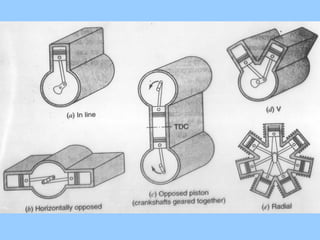
( According to arrengement of cylinder)
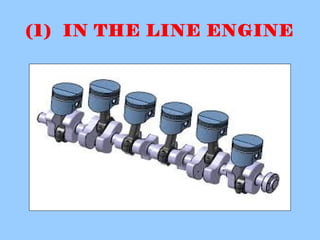
(1) In the line engine
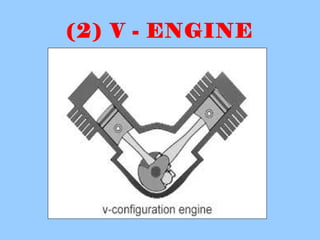
(2) V-engine
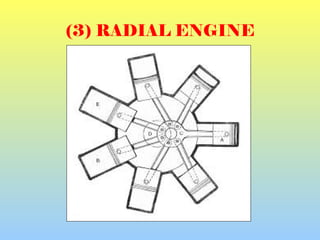
(3) Radial engine
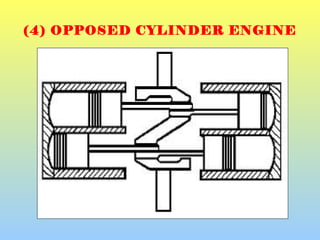
(4) Opposed cylinder engine
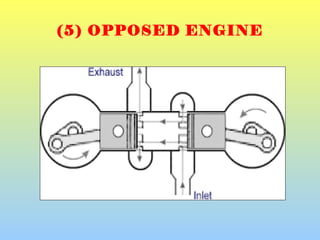
(5) Opposed piston engine
(1) IN THE LINE ENGINE
(2) V - ENGINE
(3) RADIAL ENGINE
(4) OPPOSED CYLINDER ENGINE
(5) OPPOSED ENGINE
Classification
( According to method of ignition )
• Spark ignition.
e.g. Petrol engine
• Compression ignition.
e.g. Diesel engine
Classification
(According to the cycle of combustion)
• Otto cycle.
• Diesel cycle.
• Duel combustion.
Classification
(According to method of cooling)
• Air cooled engine.
• Water cooled engine.
Classification
(According to the number of cylinders)
• Single cylinder.
• Multi cylinder.
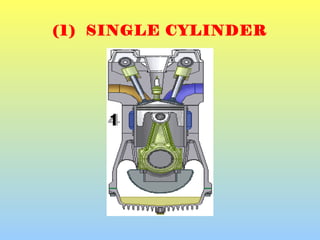
(1) SINGLE CYLINDER
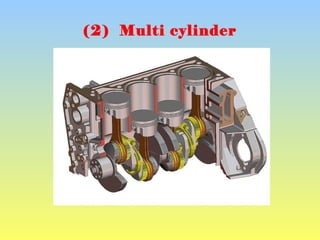
(2) Multi cylinder
ENGINE DETAILS
The various
important parts
of
an I.C. engines
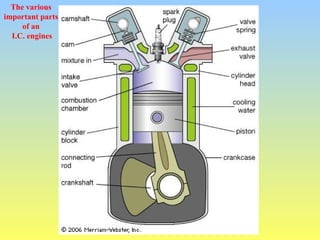
The various
important parts
of an
I.C. engines
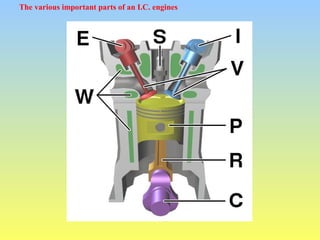
The various important parts of an I.C. engines
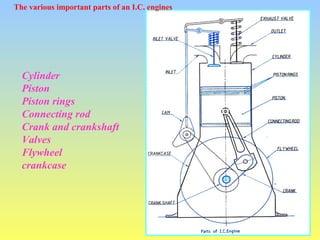
Cylinder
Piston
Piston rings
Connecting rod
Crank and crankshaft
Valves
Flywheel
crankcase
The various important parts of an I.C. engines
(1) Cylinder
› Part of the engine where fuel is
burnt and power is developed.
› Inside diameter is called as bore.
› Sleeve is fitted tightly in the
cylinder to prevent wearing of
block.
(2) Piston
› Close fitting hollow – cylinder plunger
moving to and fro in the cylinder.
› Function – Power developed by the
combustion of fuel is transmitted by
piston to the crank-shaft through the
connecting rod.
(3) Piston rings
 Metallic rings inserted into groves
provided at top end of the piston.
 Function – it maintains a gas-tight
joint between the piston and the
cylinder.
(4) Connecting rod
› Link that connects the piston and crankshaft
by means of pin joint.
› Function – It converts the rectilinear
motion of the piston into rotary motion of
crankshaft.
(5) Crank and crankshaft
 Crank is a lever that connects
crankshaft and piston rod.
(6) Valves
 These are devices which control the flow of
intake and exhaust gases.
There are two types of Valves
(1) Inlet valve
(2) Exhaust valve
There two types of Valves
(1) Inlet valve
(2) Exhaust valve
(7) Fly wheel
Mounted on crankshaft to maintain
uniform rotation of crankshaft.
(8) Crankcase
 Enclosure for crankshaft and sump for
lubricating oil.
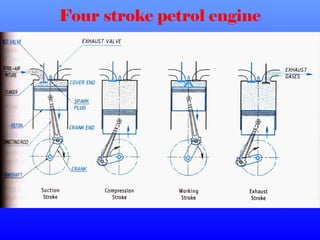
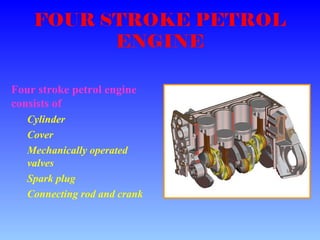
FOUR STROKE PETROL
ENGINE
Four stroke petrol engine
consists of
Cylinder
Cover
Mechanically operated
valves
Spark plug
Connecting rod and crank
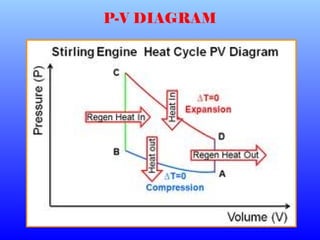
P-V DIAGRAM
Four stroke petrol engine
• Suction stroke
• Compression stroke
• Power stroke
• Exhaust stroke
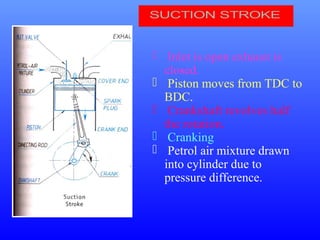
 Inlet is open exhaust is
closed.
 Piston moves from TDC to
BDC.
 Crankshaft revolves half
the rotation.
 Cranking
 Petrol air mixture drawn
into cylinder due to
pressure difference.
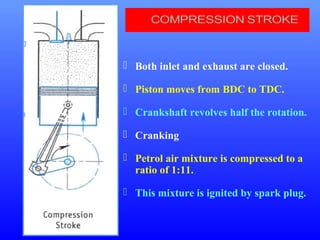
 Both inlet and exhaust are closed.
 Piston moves from BDC to TDC.
 Crankshaft revolves half the rotation.
 Cranking
 Petrol air mixture is compressed to a
ratio of 1:11.
 This mixture is ignited by spark plug.
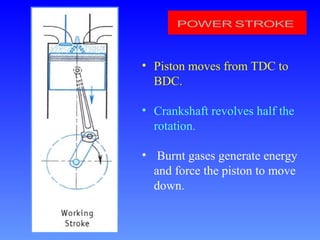
• Piston moves from TDC to
BDC.
• Crankshaft revolves half the
rotation.
• Burnt gases generate energy
and force the piston to move
down.
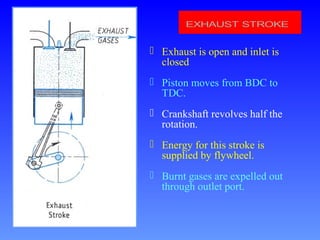
 Exhaust is open and inlet is
closed
 Piston moves from BDC to
TDC.
 Crankshaft revolves half the
rotation.
 Energy for this stroke is
supplied by flywheel.
 Burnt gases are expelled out
through outlet port.
Four stroke petrol engine
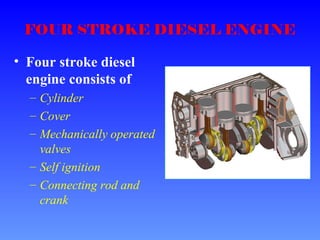
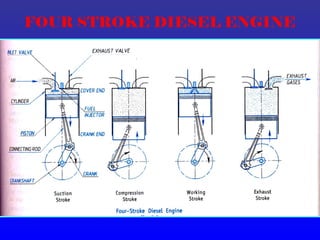
FOUR STROKE DIESEL ENGINE
• Four stroke diesel
engine consists of
– Cylinder
– Cover
– Mechanically operated
valves
– Self ignition
– Connecting rod and
crank
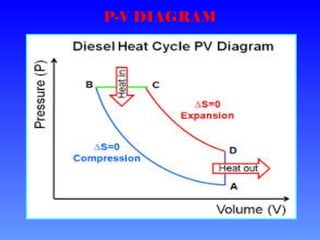
P-V DIAGRAM
Four stroke diesel engine
• Suction stroke
• Compression stroke
• Power stroke
• Exhaust stroke
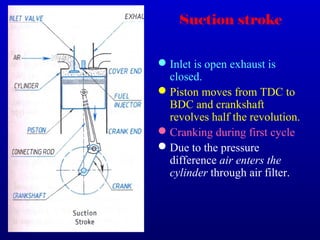
Suction stroke
Inlet is open exhaust is
closed.
Piston moves from TDC to
BDC and crankshaft
revolves half the revolution.
Cranking during first cycle.
Due to the pressure
difference air enters the
cylinder through air filter.
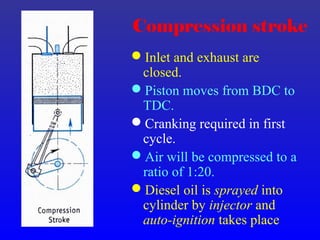
Compression stroke
Inlet and exhaust are
closed.
Piston moves from BDC to
TDC.
Cranking required in first
cycle.
Air will be compressed to a
ratio of 1:20.
Diesel oil is sprayed into
cylinder by injector and
auto-ignition takes place
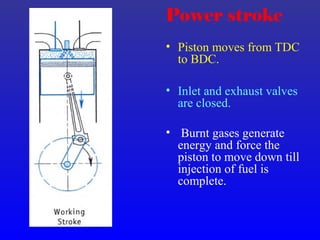
Power stroke
• Piston moves from TDC
to BDC.
• Inlet and exhaust valves
are closed.
• Burnt gases generate
energy and force the
piston to move down till
injection of fuel is
complete.
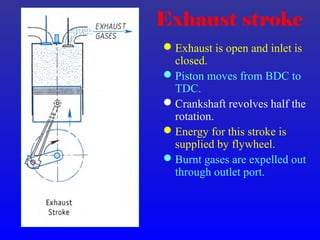
Exhaust stroke
Exhaust is open and inlet is
closed.
Piston moves from BDC to
TDC.
Crankshaft revolves half the
rotation.
Energy for this stroke is
supplied by flywheel.
Burnt gases are expelled out
through outlet port.
FOUR STROKE DIESEL ENGINE
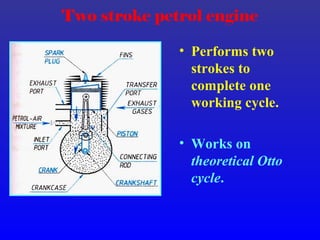
Two stroke petrol engine
• Performs two
strokes to
complete one
working cycle.
• Works on
theoretical Otto
cycle.
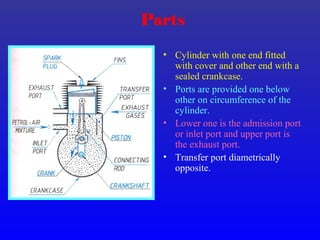
Parts
• Cylinder with one end fitted
with cover and other end with a
sealed crankcase.
• Ports are provided one below
other on circumference of the
cylinder.
• Lower one is the admission port
or inlet port and upper port is
the exhaust port.
• Transfer port diametrically
opposite.
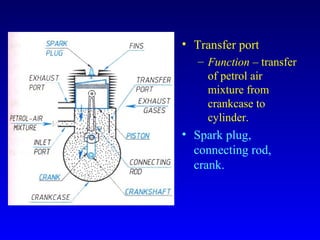
• Transfer port
– Function – transfer
of petrol air
mixture from
crankcase to
cylinder.
• Spark plug,
connecting rod,
crank.
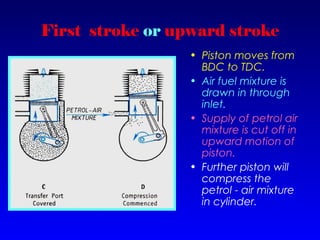
First stroke or upward stroke
• Piston moves from
BDC to TDC.
• Air fuel mixture is
drawn in through
inlet.
• Supply of petrol air
mixture is cut off in
upward motion of
piston.
• Further piston will
compress the
petrol - air mixture
in cylinder.
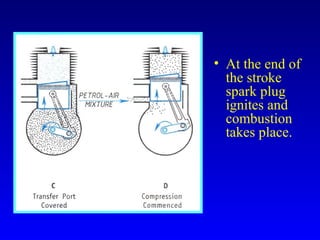
• At the end of
the stroke
spark plug
ignites and
combustion
takes place.
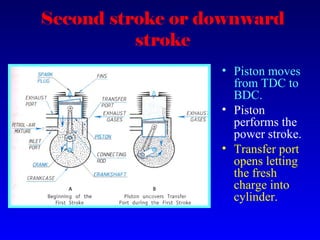
Second stroke or downward
stroke
• Piston moves
from TDC to
BDC.
• Piston
performs the
power stroke.
• Transfer port
opens letting
the fresh
charge into
cylinder.
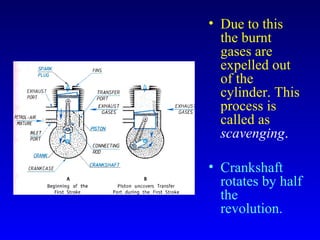
• Due to this
the burnt
gases are
expelled out
of the
cylinder. This
process is
called as
scavenging.
• Crankshaft
rotates by half
the
revolution.
TWO STROKE DIESEL
ENGINE
• Up stroke
• Down stroke
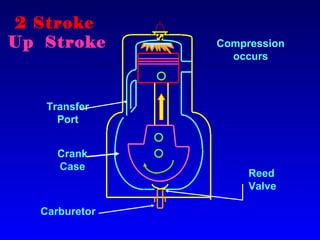
Reed
Valve
Transfer
Port
Carburetor
2 Stroke
Up Stroke Compression
occurs
Crank
Case
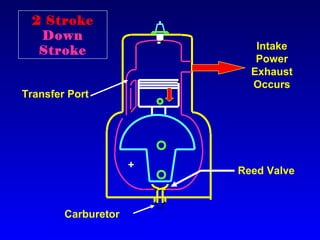
Intake
Power
Exhaust
Occurs
Transfer Port
Reed Valve
2 Stroke
Down
Stroke
Carburetor
+
I c engines

I c engines

  • 3.
  • 4.
    Introduction • An internalcombustion engine is a heat engine which converts the heat energy to mechanical work. Heat energ y MecHanica l work
  • 6.
    CLASSIFICATION ( According toarrengement of cylinder) (1) In the line engine (2) V-engine (3) Radial engine (4) Opposed cylinder engine (5) Opposed piston engine
  • 7.
    (1) IN THELINE ENGINE
  • 8.
    (2) V -ENGINE
  • 9.
  • 10.
  • 11.
  • 13.
    Classification ( According tomethod of ignition ) • Spark ignition. e.g. Petrol engine • Compression ignition. e.g. Diesel engine
  • 14.
    Classification (According to thecycle of combustion) • Otto cycle. • Diesel cycle. • Duel combustion.
  • 15.
    Classification (According to methodof cooling) • Air cooled engine. • Water cooled engine.
  • 16.
    Classification (According to thenumber of cylinders) • Single cylinder. • Multi cylinder.
  • 17.
  • 18.
  • 19.
    ENGINE DETAILS The various importantparts of an I.C. engines
  • 20.
  • 21.
    The various importantparts of an I.C. engines
  • 22.
    Cylinder Piston Piston rings Connecting rod Crankand crankshaft Valves Flywheel crankcase The various important parts of an I.C. engines
  • 23.
    (1) Cylinder › Partof the engine where fuel is burnt and power is developed. › Inside diameter is called as bore. › Sleeve is fitted tightly in the cylinder to prevent wearing of block.
  • 24.
    (2) Piston › Closefitting hollow – cylinder plunger moving to and fro in the cylinder. › Function – Power developed by the combustion of fuel is transmitted by piston to the crank-shaft through the connecting rod.
  • 25.
    (3) Piston rings Metallic rings inserted into groves provided at top end of the piston.  Function – it maintains a gas-tight joint between the piston and the cylinder.
  • 26.
    (4) Connecting rod ›Link that connects the piston and crankshaft by means of pin joint. › Function – It converts the rectilinear motion of the piston into rotary motion of crankshaft.
  • 27.
    (5) Crank andcrankshaft  Crank is a lever that connects crankshaft and piston rod.
  • 28.
    (6) Valves  Theseare devices which control the flow of intake and exhaust gases. There are two types of Valves (1) Inlet valve (2) Exhaust valve
  • 29.
    There two typesof Valves (1) Inlet valve (2) Exhaust valve
  • 30.
    (7) Fly wheel Mountedon crankshaft to maintain uniform rotation of crankshaft.
  • 31.
    (8) Crankcase  Enclosurefor crankshaft and sump for lubricating oil.
  • 32.
    FOUR STROKE PETROL ENGINE Fourstroke petrol engine consists of Cylinder Cover Mechanically operated valves Spark plug Connecting rod and crank
  • 33.
  • 34.
    Four stroke petrolengine • Suction stroke • Compression stroke • Power stroke • Exhaust stroke
  • 35.
     Inlet isopen exhaust is closed.  Piston moves from TDC to BDC.  Crankshaft revolves half the rotation.  Cranking  Petrol air mixture drawn into cylinder due to pressure difference.
  • 36.
     Both inletand exhaust are closed.  Piston moves from BDC to TDC.  Crankshaft revolves half the rotation.  Cranking  Petrol air mixture is compressed to a ratio of 1:11.  This mixture is ignited by spark plug.
  • 37.
    • Piston movesfrom TDC to BDC. • Crankshaft revolves half the rotation. • Burnt gases generate energy and force the piston to move down.
  • 38.
     Exhaust isopen and inlet is closed  Piston moves from BDC to TDC.  Crankshaft revolves half the rotation.  Energy for this stroke is supplied by flywheel.  Burnt gases are expelled out through outlet port.
  • 39.
  • 40.
    FOUR STROKE DIESELENGINE • Four stroke diesel engine consists of – Cylinder – Cover – Mechanically operated valves – Self ignition – Connecting rod and crank
  • 41.
  • 42.
    Four stroke dieselengine • Suction stroke • Compression stroke • Power stroke • Exhaust stroke
  • 43.
    Suction stroke Inlet isopen exhaust is closed. Piston moves from TDC to BDC and crankshaft revolves half the revolution. Cranking during first cycle. Due to the pressure difference air enters the cylinder through air filter.
  • 44.
    Compression stroke Inlet andexhaust are closed. Piston moves from BDC to TDC. Cranking required in first cycle. Air will be compressed to a ratio of 1:20. Diesel oil is sprayed into cylinder by injector and auto-ignition takes place
  • 45.
    Power stroke • Pistonmoves from TDC to BDC. • Inlet and exhaust valves are closed. • Burnt gases generate energy and force the piston to move down till injection of fuel is complete.
  • 46.
    Exhaust stroke Exhaust isopen and inlet is closed. Piston moves from BDC to TDC. Crankshaft revolves half the rotation. Energy for this stroke is supplied by flywheel. Burnt gases are expelled out through outlet port.
  • 47.
  • 48.
    Two stroke petrolengine • Performs two strokes to complete one working cycle. • Works on theoretical Otto cycle.
  • 49.
    Parts • Cylinder withone end fitted with cover and other end with a sealed crankcase. • Ports are provided one below other on circumference of the cylinder. • Lower one is the admission port or inlet port and upper port is the exhaust port. • Transfer port diametrically opposite.
  • 50.
    • Transfer port –Function – transfer of petrol air mixture from crankcase to cylinder. • Spark plug, connecting rod, crank.
  • 51.
    First stroke orupward stroke • Piston moves from BDC to TDC. • Air fuel mixture is drawn in through inlet. • Supply of petrol air mixture is cut off in upward motion of piston. • Further piston will compress the petrol - air mixture in cylinder.
  • 52.
    • At theend of the stroke spark plug ignites and combustion takes place.
  • 53.
    Second stroke ordownward stroke • Piston moves from TDC to BDC. • Piston performs the power stroke. • Transfer port opens letting the fresh charge into cylinder.
  • 54.
    • Due tothis the burnt gases are expelled out of the cylinder. This process is called as scavenging. • Crankshaft rotates by half the revolution.
  • 55.
    TWO STROKE DIESEL ENGINE •Up stroke • Down stroke
  • 56.
  • 57.