HYPO-THYROIDISM
RUBAB ZAHRA
24011714-019
Outlines
 Introduction
 Definition
 Cretinism and myxedema
 Types
 Etiology
 Pathophysiology
 Clinical menifestations
 Dignostic Evaluation
 Medical Management
 Nursing Dignosis
 Complications
Introduction
 Hypothyroidism is a common disorder in which the
thyroid gland can not produce enough hormones to
meet the body’s demand.
 As a result, your metabolism slows down. This can cause
unintentional weight gain and make you feel exhausted
all the time.
 In general, hypothyroidism is very treatable. Most
people can manage the condition with medication and
regular follow-up visits with their endocrinologist.
 Left untreated over long periods of time, hypothyroidism
can become life-threatening.
Thyroid gland
 The thyroid gland is a butterfly-shaped gland located in
the lower front of the neck, and is normally controlled
by a gland in the brain known as the pituitary.
 When the pituitary releases thyroid stimulating
hormone (TSH), the thyroid secretes two kinds of
hormones – tri-iodo-thyronine (T3) and thyroxine (T4) –
into the blood stream.
 The thyroid hormones help the body work properly by
controlling the rate of metabolism and functions of
many organ systems.
Anatomy
Thyroid hormones
Mental growth and maturation
Physical growth and maturation
Sensitivity to adrenergic system
Basal Metabolic Rate
Definition
 This is a condition that arises from inadequate
amount of thyroid hormone in the blood stream.
Cretinism:
- When thyroid deficiency is present at the birth,
the condition is known as cretinism.
Myxodema:
- The accumulation of muco-polysaccharides in
sub-cutanous and other intestinal tissues leads to
thyroid insufficiency.
Difference between Cretinism and Myxoedema
CRETINISM MYXOEDEMA
Hypothyroidim in childrens Hypothyroidim in adults
Characterized by stunted growth Characterised by edematous appearence
Congenital absence of thyroid gland
Lack of iodine in diet
Diease of thyroid gland
Iodine deficiency
Deficiency of TSH
Hashimotos thyroiditis
Stunted growth
Guttural breathing
Swelling of Face
Bagginess under eyes
Anemia
Fatigue
Atherosclerosis
TYPES
Primary
Secondary
Tertiary
Primary hypothyroidism
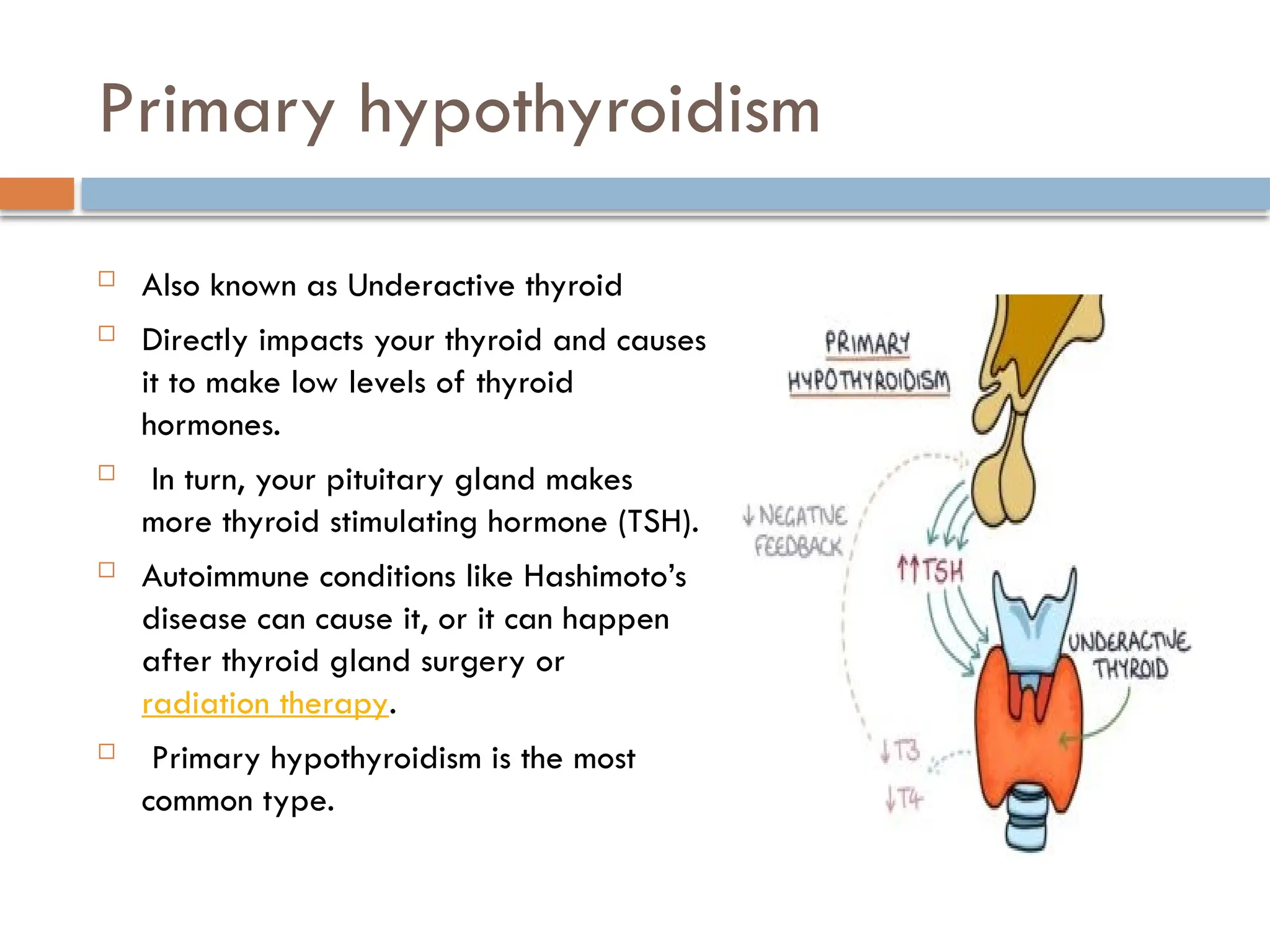
 Also known as Underactive thyroid
 Directly impacts your thyroid and causes
it to make low levels of thyroid
hormones.
 In turn, your pituitary gland makes
more thyroid stimulating hormone (TSH).
 Autoimmune conditions like Hashimoto’s
disease can cause it, or it can happen
after thyroid gland surgery or
radiation therapy.
 Primary hypothyroidism is the most
common type.
Secondary Hypothyroidism
 occurs when you have an
underactive pituitary
gland (a pea-sized
gland at the base of
your brain). This rare
type of hypothyroidism
prevents your pituitary
gland from sending TSH
to your thyroid gland.
Tertiary hypothyroidism and subclinical hypothroidism
 happens when your
hypothalamus (a structure
in your brain that keeps
your body in a stable
state called homeostasis)
doesn’t make enough
thyrotropin-releasing
hormone (TRH). As a
result, your pituitary
gland can’t make enough
TSH.
 also known as mild
thyroid failure, happens
when you have slightly
elevated TSH levels, but
all other thyroid
hormone levels are
within a typical range.
Subclinical
hypothyroidism usually
goes away on its own in
about three months.
How common is hypothyroidism
 Hypothyroidism can affect anyone. It’s most common
among people assigned female at birth
(AFAB) over age 60, particularly after menopause.
What causes hypothyroidism
Hashimoto’s disease is the most common cause of hypothyroidism. It’s
an autoimmune disease, so it happens when your immune system attacks
your thyroid.
Other hypothyroidism causes include:
 Certain medications, including lithium, thalidomide and amiodarone.
 Conditions present at birth, like being born with no thyroid gland or
a thyroid gland that doesn’t work properly.
 Iodine deficiency (when you don’t have enough iodine in your body).
 Pituitary gland disorders, including noncancerous tumors.
 Thyroiditis (inflammation of the thyroid that can happen after a viral
illness or pregnancy)
 Thyroidectomy
Pathophysiology
Thyroid gland needs Iodine to secrete thyroid hormone
Production of thyroid depends upon the TSH, Iodine intake and
also protein intake
Enlargement of thyroid gland results goitre form increased
secretion of pituitary gland
TSH stimulates the thyroid to secreate more level of T4
Cont….
In the blood, T4 levels are low, the thyroid gland will
be more large and compress then neck and also the
chest
Causing in respiratory manifestation.
Pathogenesis of hypothyroidism
 Pathogenesis of hypothyroidism through accumulation of
glycosaminoglycan is a key mecahnisn in certain type of
hypothyroidism
 GAGs are complex cabohydrates that play important
role in tissue structure and fuction
 In hypothyroidism, GAGs accumulate in thyroid gland
and interfere with thyroid hormone synthesis
 This lead to tissue swelling , inflammation and damage
especially in skin heart muscles and striated muscles
Clinical manifestation of hypo-thyroidsm
Symptoms and signs vary in relation to the magnitude
of the thyroid hormone deficiency, and the acuteness
with which the deficiency develops.
 Less prominent clinically and better tolerated when
gradual loss of thyroid function (as in most cases of
primary hypothyroidism)
 Symptoms develop acutely after thyroidectomy or
abrupt withdrawal of exogenous thyroid hormone
Signs and symptom of hypothyroidim
Clinical Manifestation
 Early Symptoms:
 Extreme fatigue
 Hair loss
 Brittle nails
 Dry skin
 Numbness and tingling of the fingers
 Voice may become husky
 Menorrhea
 Loss of libido
Cont….
 Severe:
 Abnormal temperature and pulse rate
 Gain weight
 Skin thickening
 Hair thins and fall out
 Constipation
 Deafness
Cont….
 Advanced:
 Personality and cognitive change
 Inadequate Ventilation
 Pleural Effusion
 Pericardial effusion
 Respiratory muscle weakness
 Sleep Apnea.
Diagnostic Evaluation
 History collection
 Physical examination
 To check Low T3 and T4 level
 Elevated TSH levels in primary hypothyroidism
 Elevation of serum cholestrol
 ABG analysis
 Electro Cardiogram
Medical Management
 T4 levothyroxine, T3 Liothyroxine, T3 & T4 thyro-
globulin liotrix, are used to treat hypothyroidism
and suppress non toxic goitre.
 Sodium levo-thyroxine is administered parentally to
restore T4 level.
 Replacement therapy is used to myxedema
disappear and normal metabolic activity.
 Fluids are administered cautionsly because of the
danger of water intoxification.
Nursing Diagnosis
 Ineffective breathing pattern r/t depressed
ventilation.
 Activity intolerance r/t fatigue and depressed
cognitive process.
 Constipation r/t depressed gastro intestinal
function.
 Knowledge deficit r/t therapeutic regimen for life
and thyroid replacement therapy.
Complication
 Coma
 Hypoventilation
 Hyponatremia
 Hypothermia
 Cerebral hypoxia
References
 https://
my.clevelandclinic.org/health/diseases/12120-hyp
othyroidism

hypothyroidism, underactive thyroid, hyp

  • 1.
  • 2.
    Outlines  Introduction  Definition Cretinism and myxedema  Types  Etiology  Pathophysiology  Clinical menifestations  Dignostic Evaluation  Medical Management  Nursing Dignosis  Complications
  • 3.
    Introduction  Hypothyroidism isa common disorder in which the thyroid gland can not produce enough hormones to meet the body’s demand.  As a result, your metabolism slows down. This can cause unintentional weight gain and make you feel exhausted all the time.  In general, hypothyroidism is very treatable. Most people can manage the condition with medication and regular follow-up visits with their endocrinologist.  Left untreated over long periods of time, hypothyroidism can become life-threatening.
  • 4.
    Thyroid gland  Thethyroid gland is a butterfly-shaped gland located in the lower front of the neck, and is normally controlled by a gland in the brain known as the pituitary.  When the pituitary releases thyroid stimulating hormone (TSH), the thyroid secretes two kinds of hormones – tri-iodo-thyronine (T3) and thyroxine (T4) – into the blood stream.  The thyroid hormones help the body work properly by controlling the rate of metabolism and functions of many organ systems.
  • 6.
  • 7.
    Thyroid hormones Mental growthand maturation Physical growth and maturation Sensitivity to adrenergic system Basal Metabolic Rate
  • 8.
    Definition  This isa condition that arises from inadequate amount of thyroid hormone in the blood stream. Cretinism: - When thyroid deficiency is present at the birth, the condition is known as cretinism. Myxodema: - The accumulation of muco-polysaccharides in sub-cutanous and other intestinal tissues leads to thyroid insufficiency.
  • 9.
    Difference between Cretinismand Myxoedema CRETINISM MYXOEDEMA Hypothyroidim in childrens Hypothyroidim in adults Characterized by stunted growth Characterised by edematous appearence Congenital absence of thyroid gland Lack of iodine in diet Diease of thyroid gland Iodine deficiency Deficiency of TSH Hashimotos thyroiditis Stunted growth Guttural breathing Swelling of Face Bagginess under eyes Anemia Fatigue Atherosclerosis
  • 11.
  • 12.
    Primary hypothyroidism  Alsoknown as Underactive thyroid  Directly impacts your thyroid and causes it to make low levels of thyroid hormones.  In turn, your pituitary gland makes more thyroid stimulating hormone (TSH).  Autoimmune conditions like Hashimoto’s disease can cause it, or it can happen after thyroid gland surgery or radiation therapy.  Primary hypothyroidism is the most common type.
  • 13.
    Secondary Hypothyroidism  occurswhen you have an underactive pituitary gland (a pea-sized gland at the base of your brain). This rare type of hypothyroidism prevents your pituitary gland from sending TSH to your thyroid gland.
  • 14.
    Tertiary hypothyroidism andsubclinical hypothroidism  happens when your hypothalamus (a structure in your brain that keeps your body in a stable state called homeostasis) doesn’t make enough thyrotropin-releasing hormone (TRH). As a result, your pituitary gland can’t make enough TSH.  also known as mild thyroid failure, happens when you have slightly elevated TSH levels, but all other thyroid hormone levels are within a typical range. Subclinical hypothyroidism usually goes away on its own in about three months.
  • 15.
    How common ishypothyroidism  Hypothyroidism can affect anyone. It’s most common among people assigned female at birth (AFAB) over age 60, particularly after menopause.
  • 16.
    What causes hypothyroidism Hashimoto’sdisease is the most common cause of hypothyroidism. It’s an autoimmune disease, so it happens when your immune system attacks your thyroid. Other hypothyroidism causes include:  Certain medications, including lithium, thalidomide and amiodarone.  Conditions present at birth, like being born with no thyroid gland or a thyroid gland that doesn’t work properly.  Iodine deficiency (when you don’t have enough iodine in your body).  Pituitary gland disorders, including noncancerous tumors.  Thyroiditis (inflammation of the thyroid that can happen after a viral illness or pregnancy)  Thyroidectomy
  • 17.
    Pathophysiology Thyroid gland needsIodine to secrete thyroid hormone Production of thyroid depends upon the TSH, Iodine intake and also protein intake Enlargement of thyroid gland results goitre form increased secretion of pituitary gland TSH stimulates the thyroid to secreate more level of T4
  • 18.
    Cont…. In the blood,T4 levels are low, the thyroid gland will be more large and compress then neck and also the chest Causing in respiratory manifestation.
  • 20.
    Pathogenesis of hypothyroidism Pathogenesis of hypothyroidism through accumulation of glycosaminoglycan is a key mecahnisn in certain type of hypothyroidism  GAGs are complex cabohydrates that play important role in tissue structure and fuction  In hypothyroidism, GAGs accumulate in thyroid gland and interfere with thyroid hormone synthesis  This lead to tissue swelling , inflammation and damage especially in skin heart muscles and striated muscles
  • 21.
    Clinical manifestation ofhypo-thyroidsm Symptoms and signs vary in relation to the magnitude of the thyroid hormone deficiency, and the acuteness with which the deficiency develops.  Less prominent clinically and better tolerated when gradual loss of thyroid function (as in most cases of primary hypothyroidism)  Symptoms develop acutely after thyroidectomy or abrupt withdrawal of exogenous thyroid hormone
  • 22.
    Signs and symptomof hypothyroidim
  • 23.
    Clinical Manifestation  EarlySymptoms:  Extreme fatigue  Hair loss  Brittle nails  Dry skin  Numbness and tingling of the fingers  Voice may become husky  Menorrhea  Loss of libido
  • 24.
    Cont….  Severe:  Abnormaltemperature and pulse rate  Gain weight  Skin thickening  Hair thins and fall out  Constipation  Deafness
  • 25.
    Cont….  Advanced:  Personalityand cognitive change  Inadequate Ventilation  Pleural Effusion  Pericardial effusion  Respiratory muscle weakness  Sleep Apnea.
  • 26.
    Diagnostic Evaluation  Historycollection  Physical examination  To check Low T3 and T4 level  Elevated TSH levels in primary hypothyroidism  Elevation of serum cholestrol  ABG analysis  Electro Cardiogram
  • 27.
    Medical Management  T4levothyroxine, T3 Liothyroxine, T3 & T4 thyro- globulin liotrix, are used to treat hypothyroidism and suppress non toxic goitre.  Sodium levo-thyroxine is administered parentally to restore T4 level.  Replacement therapy is used to myxedema disappear and normal metabolic activity.  Fluids are administered cautionsly because of the danger of water intoxification.
  • 28.
    Nursing Diagnosis  Ineffectivebreathing pattern r/t depressed ventilation.  Activity intolerance r/t fatigue and depressed cognitive process.  Constipation r/t depressed gastro intestinal function.  Knowledge deficit r/t therapeutic regimen for life and thyroid replacement therapy.
  • 29.
    Complication  Coma  Hypoventilation Hyponatremia  Hypothermia  Cerebral hypoxia
  • 30.