Hypothyroidism and Hyperthyroidism in the Elderly Chien Yung-Chang , MD .
 
Free T4 Reference range 0.7-1.8 ng/Dl . Converted to triiodothyronine (T3) . The thyroid gland is the sole source of T4 . Free T4 measures the nonprotein-bound circulating T4 .
Total T4 Normal range 50-120 ng/mL , 5-12 mcg/dL . Measurement of total T4 is not particularly helpful . Only 0.03% of T4 circulates in the unbound state . There is no clinical indication for performing total thyroid hormone measurement .
TSH Normal 0.4-5.5 mIU/L . Serum TSH will be decreased to<0.1 mIU/L in most hyperthyroid patients . The findings of a low serum T4 and low TSH mandate a search for pituitary disease .
T3 T3 is  more biologically active . Binding proteins :  thyroid-binding globulin , transthyretin and albumin . T3 thyrotoxicoisis :  approximately 5% of clinically hyperthyroid patients with a normal free T4 level .
Functional examinations Measure the uptake of iodine into the thyroid gland . The iodine isotopes : used to identify nodular thyroid disease , to determine if these nodules are hot ( functioning ) or cold ( hypofunctioning ) , to determine the cause for the hyperthyroid state ( Graves’ disease vs thyroiditis ) and to determine a dose of radioiodine for treatment .
Erythrocyte sedimentation rate To confirm the diagnosis of subacute ( viral ) thyroiditis in patients with tenderness on thyroid palpation .
The Role of the History in Diagnosing Hypothyroidism  Previous thyroid ablation . Elevated thyroid autoantibodies . Thyroid surgery . Medicatins containing lithium or iodine . The most common cause of hypothyroidism is autoimmune or Hashimoto’s thyroiditis .
Signs and Symptoms of Hypothyroidism Less active than usual with loss of interest in things previously enjoyed . Lethargy  , and decreased mobility . Fatigue  . Dry skin .
Sings and Symptoms of Hypothyroidism (continued ) Apathy and psychomotor retardation . Weakness , arthralgia , myalgia , coarsening of the voice , constipation , edema , weight gain , cold intolerance  . Alveolar hypoventilation => CO2 retention and coma .
The Physical Examination in Hypothyroidism  Hypotension or diastolic hypertension . Low body temperature and bradycardia . Facial features that are puffy and coarse . The skin : dry and cold . Carotenemia : An orange or yellow tint without scleral icterus .
The Physical Examination in Hypothyroidism ( continued ) Brittle nails and hair , pallor , induration and thickening of skin , periorbital edema , macroglossia , and myxedema . Mental status change . Delayed relaxation time of deep tendon reflex . Pleural , peritoneal and pericardial effusion . Delirium and psychosis .
The Heart in the Hypothyroid State Decreased stroke volume , bradycardia , and decreased cardiac output . Diastolic hypertension . Sinus bradycardia and a prolonged PR and QT intervals . Low voltage , heart block , T-wave flattening or inversion , Torsades de pointes , and sudden death .
The Heart in the Hypothyroid State ( continued ) Echocardiogram may be useful to show regional wall abnormalities . It also will diagnose a pericardial effusion . Pericardial tamponade is rare .
Laboratory Diagnosis of Hypothyroidism Levels of  TSH :  high . The levels of  free T4 : decreased . Vitamin B 12 deficiency => macrocytic anemia . Erythropoietin levels also are low => fall in hematocrit . Hyponatremia with low serum osmolality .
Laboratory Diagnosis of Hypothyroidism ( continued ) Hypoglycemia . Cardiac enzymes may be elevated . Without AMI , the troponin I level remains normal . Adrenal hypofunction .
Laboratory Diagnosis of Hypothyroidism ( continued ) Elevation of thyroid microsomal antibodies is => chronic autoimmune ( Hashimoto’s ) thyroiditis . Thyroid antibodies may be associated with : Grave’s disease , vitiligo , myasthenia gravis , Addison’s disease , pernicious anemia , and other autoimmune diseases .
The Diagnosis of Myxedema Coma Abnormal TSH and free T4 values : confirm the diagnosis .( in the presence of nonpitting edema , hypoventilation , hypothermia and stupor ) Hyponatremia , hypoglycemia , and associated infection  : confirmatory .
Precipitating Events for Myxedema Coma Surgery , severe infection , and trauma . Sedatives , narcotics , and tranquilizers . Missed doses of T4 .
Clinical Features of Myxedema Coma Alteration in mental status , presence of a precipitating factor , hypothermia , and increased serum CK levels . Pale and edematous . Respiratory symptoms . Ascites , pericardial effusion and pleural effusion .
Clinical Features of Myxedema Coma ( continued ) Distant heart sounds , bradycardia , high serum cholesterol levels and low voltage on the EKG . Dyspnea on exertion , fatigue , and edema . Distended abdomen , paralytic ileus , and fecal impaction . Myxedema megacolon : pseudomembranous colitis and intestinal ischemia .
Clinical Features of Myxedema Coma ( continued ) Disturbance in consciousness : ranging from delirium to stupor and coma . Hallucination ( myxedema madness ) , cerebellar signs and somnolence . Muscle relaxation times of the deep tendon reflexes : delayed markedly . Hyponatremia => seizure and depressed level of consciousness .
Laboratory Database of Myxedema Coma Serum TSH and free T4 levels , blood glucose , electrolytes , and arterial blood gas . Serum cortisol . Chest films , urinalysis , and blood cultures . CK , and SGOT . Serum electrolytes ,creatinine , BUN ,and glucose should be monitored .
Treatment of Myxedema Coma Thyroid hormone replacement : the definitive treatment . Intravenous therapy : preferred . Give steroids when starting thyroid replacement => avoid precipitating adrenal crisis . Passive rewarming and maintenance of appropriate hydration status .
Factors Associated with poor come  Advantaged age . Body temperature lower than 93*F . Hypothermia persisting more than three days . Bradycardia less than 44 beats/minute . Hypotension , MI ,and sepsis .
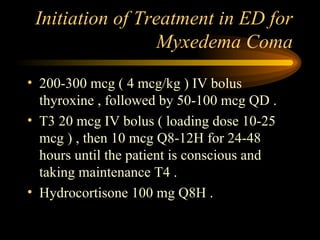
Initiation of Treatment in ED for Myxedema Coma 200-300 mcg ( 4 mcg/kg ) IV bolus thyroxine , followed by 50-100 mcg QD . T3 20 mcg IV bolus ( loading dose 10-25 mcg ) , then 10 mcg Q8-12H for 24-48 hours until the patient is conscious and taking maintenance T4 . Hydrocortisone 100 mg Q8H .
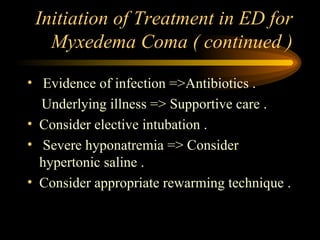
Initiation of Treatment in ED for Myxedema Coma ( continued ) Evidence of infection =>Antibiotics . Underlying illness => Supportive care . Consider elective intubation . Severe hyponatremia => Consider hypertonic saline . Consider appropriate rewarming technique .
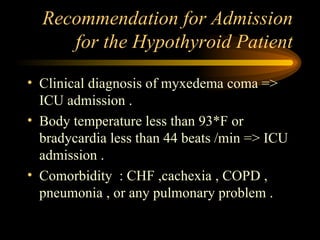
Recommendation for Admission for the Hypothyroid Patient Clinical diagnosis of myxedema coma => ICU admission .  Body temperature less than 93*F or bradycardia less than 44 beats /min => ICU admission . Comorbidity  : CHF ,cachexia , COPD , pneumonia , or any pulmonary problem .
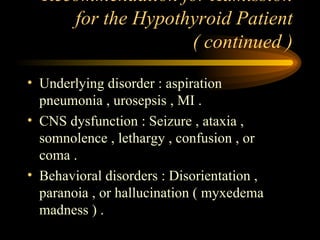
Recommendation for Admission for the Hypothyroid Patient ( continued ) Underlying disorder : aspiration pneumonia , urosepsis , MI . CNS dysfunction : Seizure , ataxia , somnolence , lethargy , confusion , or coma . Behavioral disorders : Disorientation , paranoia , or hallucination ( myxedema madness ) .
Recommendation for Admission for the Hypothyroid Patient ( continued ) Hypoglycemia : suggesting hypopituitarism or adrenal insufficiency . Hyponatremia less than 128 mEq/L . Social factors that jeopardize patient safety .
Symptoms and Signs of Thyrotoxicosis weight loss ( the most common ) , palpitation , weakness , dizziness and syncope . Alteration in mental status . Heat intolerance . Nervous or restlessness .
Symptoms and Signs of Thyrotoxicosis ( continued ) Tracheal compression => SOB, hoarseness , wheezing and stridor .( Pemberton’s sign ) Thyromegaly => wheezing , hoarseness , stridor , or dysphagia . Myopathy : the proximal muscle groups of the shoulder and pelvic girdles .
Symptoms and Signs of Thyrotoxicosis ( continued ) Memory loss , confusion and short attention span . Chorea , delirium , convulsion , stroke , cerebral venous thrombosis , and coma . Some psychiatric conditions => may be mistaken for thyrotoxicosis .
Physical Findings in the Hyperthyroid State Flushed skin.Hyperhidrosis of the palms and soles . Alopecia . Fine and brittle hair . Fever and tachycardia .  Lid lag , chemosis , exophthalmosis , vasodilation of the conjunctiva , edema of the lids , and compromised visual acuity . Myxedema of the pretibial areas , feet , and toes .
Physical Findings in the Hyperthyroid State ( continued ) Diffuse enlargement , bruit ,  nodules , and tenderness. Abdominal pain or secretary diarrhea .  Muscle weakness , hyperactive reflexes , and tremor .Alteration in mental status . Dementia and severe psychomotor retardation . ( Apathetic hyperthyroidism )
The Heart in Thyrotoxicosis Diminished diastolic BP . Palpitation .Decreased exercise tolerance . Dyspnea on exertion .Elevated systolic BP . Sinus tachycardia . Atrial fibrillation . Anigina pectoris .  EKG : shortening of the PR interval , ST change , or atrial fibrillation .
Laboratory Testing in Thyrotoxicosis Suppressed TSH levels and increased serum free T4 estimates : clinically evident thyrotoxicosis ( 95% ) . Radioactive iodine uptake => incereased . ESR => elevated markedly . Serum thyroglobulin => increased .
Thyroid Storm A life-threatening crisis  . Estimated mortality : 20-30% . the result of thyroid surgery . Caused more often by antecedent Grave’s disease .
Precipitants  of Thyroid Storm Surgery . Radioiodine therapy . Iodinated contrast dyes . Thyroid hormone ingestion . Diabetic Ketoacidosis . Cerebrovascular accident . Pulmonary embolism and CHF .
Pathophysiology of Thyroid Storm 1) An acute decrease in thyroxine-binding globulin => high levels of free hormone . 2) Thyroid hormone increases the density of beta-adrenergic receptors & alters responsiveness to catecholamines at a postreceptor level .
Diagnosis of Thyroid Storm Largely a clinical diagnosis . CNS disturbances occur in 90% of patients . Atrial arrhythmia and ventricular tachyarrhythmia may complicate high output CHF . Many of the stigmata of the hyperthyroid state may be present .
Laboratory Diagnosis of Thyroid Storm A combination of low TSH and elevated free T4 => makes the diagnosis . If TSH is lower than normal and free T4 is normal => free T3 testing is recommended . ED measurement of thyroglobulin or thyroid antibodies : No indication .
Treatment of Thyroid Storm Block hormone synthesis with either : a) Propylthiouracil 100-600 mg loading  PO or NG , 200-250 mg q4h for total daily dose of 1200-1500 mg ; or b) methimazole 20 mg PO ( 10-40 mg range ) q 4h .
Treatment of Thyroid Storm ( continued ) Inhibit hormone release : Iodides –Potassium iodide ( SSKI ) 5 drops PO Q6-8H , or Lugol’s solution 7-8 drops ( 1 mL PO Q6H ) or Ipodate 1-3 g daily ( as 1 g Q8H for 24 hours , then 500 mg Q12H ) . If severe iodide allergy , lithium carbonate 300 mg Q6H .
Treatment of Thyroid Storm ( continued ) Glucocorticoids : Hydrocortisone ( 300 mg IV , then 100 mg IV q8h ) ; dexamethasone ( 2 mg Q6H ) . Adrenergic blockade : Propranolol ( 0.5-3 mg IV over 15 minutes slow IV , then 60-80 mg PO Q4H ) ; Esmolol ( 0.25-0.5 mcg/kg loading , infusion of 0.05-0.1 mcg/kg/min ) .
Adjunctive Therapy for Thyroid Storm  Treat fever aggressively with acetaminophen . IV fluid containing 10% dextrose are recommended . Administer vitamin supplements , including thiamine . Treat CHF with conventional methods .
Adjunctive Therapy for Thyroid Storm ( continued ) Identify the precipitating event , including infection . Consider plasmapheresis , hemodialysis or peritoneal dialysis for removal of metabolically active hormone .
Admission Criteria for the Hyperthyroid Elderly Patient Impending or clinical thyroid storm . Clinical hyperthyroidism and : a) CNS effects , including agitation , chorea , delirium , psychosis , seizure , or coma ; b) GI effects such as frank diarrhea , vomiting , jaundice , dehydration , or abdominal pain ;
Admission Criteria for the Hyperthyroid Elderly Patient ( continued ) c) Cardiovascular dysfunction , including CHF , sinus tachycardia unresponsive to oral beta blocade in the ED , new onset atrial fibrillation , or angina pectoris ; d) Persistent fever > 100.4*F after rest , without source or without easily treatable source ; e) Syncopal episode ;
Admission Criteria for the Hyperthyroid Elderly Patient ( continued ) f) History of recent radioiodinevtherapy ; or g) Thyrotoxic periodic paralysis ( address hypokalemia ) . Underlying precipitating cause  .

Hypothyroidism and Hyperthyroidism

  • 1.
    Hypothyroidism and Hyperthyroidismin the Elderly Chien Yung-Chang , MD .
  • 2.
  • 3.
    Free T4 Referencerange 0.7-1.8 ng/Dl . Converted to triiodothyronine (T3) . The thyroid gland is the sole source of T4 . Free T4 measures the nonprotein-bound circulating T4 .
  • 4.
    Total T4 Normalrange 50-120 ng/mL , 5-12 mcg/dL . Measurement of total T4 is not particularly helpful . Only 0.03% of T4 circulates in the unbound state . There is no clinical indication for performing total thyroid hormone measurement .
  • 5.
    TSH Normal 0.4-5.5mIU/L . Serum TSH will be decreased to<0.1 mIU/L in most hyperthyroid patients . The findings of a low serum T4 and low TSH mandate a search for pituitary disease .
  • 6.
    T3 T3 is more biologically active . Binding proteins : thyroid-binding globulin , transthyretin and albumin . T3 thyrotoxicoisis : approximately 5% of clinically hyperthyroid patients with a normal free T4 level .
  • 7.
    Functional examinations Measurethe uptake of iodine into the thyroid gland . The iodine isotopes : used to identify nodular thyroid disease , to determine if these nodules are hot ( functioning ) or cold ( hypofunctioning ) , to determine the cause for the hyperthyroid state ( Graves’ disease vs thyroiditis ) and to determine a dose of radioiodine for treatment .
  • 8.
    Erythrocyte sedimentation rateTo confirm the diagnosis of subacute ( viral ) thyroiditis in patients with tenderness on thyroid palpation .
  • 9.
    The Role ofthe History in Diagnosing Hypothyroidism Previous thyroid ablation . Elevated thyroid autoantibodies . Thyroid surgery . Medicatins containing lithium or iodine . The most common cause of hypothyroidism is autoimmune or Hashimoto’s thyroiditis .
  • 10.
    Signs and Symptomsof Hypothyroidism Less active than usual with loss of interest in things previously enjoyed . Lethargy , and decreased mobility . Fatigue . Dry skin .
  • 11.
    Sings and Symptomsof Hypothyroidism (continued ) Apathy and psychomotor retardation . Weakness , arthralgia , myalgia , coarsening of the voice , constipation , edema , weight gain , cold intolerance . Alveolar hypoventilation => CO2 retention and coma .
  • 12.
    The Physical Examinationin Hypothyroidism Hypotension or diastolic hypertension . Low body temperature and bradycardia . Facial features that are puffy and coarse . The skin : dry and cold . Carotenemia : An orange or yellow tint without scleral icterus .
  • 13.
    The Physical Examinationin Hypothyroidism ( continued ) Brittle nails and hair , pallor , induration and thickening of skin , periorbital edema , macroglossia , and myxedema . Mental status change . Delayed relaxation time of deep tendon reflex . Pleural , peritoneal and pericardial effusion . Delirium and psychosis .
  • 14.
    The Heart inthe Hypothyroid State Decreased stroke volume , bradycardia , and decreased cardiac output . Diastolic hypertension . Sinus bradycardia and a prolonged PR and QT intervals . Low voltage , heart block , T-wave flattening or inversion , Torsades de pointes , and sudden death .
  • 15.
    The Heart inthe Hypothyroid State ( continued ) Echocardiogram may be useful to show regional wall abnormalities . It also will diagnose a pericardial effusion . Pericardial tamponade is rare .
  • 16.
    Laboratory Diagnosis ofHypothyroidism Levels of TSH : high . The levels of free T4 : decreased . Vitamin B 12 deficiency => macrocytic anemia . Erythropoietin levels also are low => fall in hematocrit . Hyponatremia with low serum osmolality .
  • 17.
    Laboratory Diagnosis ofHypothyroidism ( continued ) Hypoglycemia . Cardiac enzymes may be elevated . Without AMI , the troponin I level remains normal . Adrenal hypofunction .
  • 18.
    Laboratory Diagnosis ofHypothyroidism ( continued ) Elevation of thyroid microsomal antibodies is => chronic autoimmune ( Hashimoto’s ) thyroiditis . Thyroid antibodies may be associated with : Grave’s disease , vitiligo , myasthenia gravis , Addison’s disease , pernicious anemia , and other autoimmune diseases .
  • 19.
    The Diagnosis ofMyxedema Coma Abnormal TSH and free T4 values : confirm the diagnosis .( in the presence of nonpitting edema , hypoventilation , hypothermia and stupor ) Hyponatremia , hypoglycemia , and associated infection : confirmatory .
  • 20.
    Precipitating Events forMyxedema Coma Surgery , severe infection , and trauma . Sedatives , narcotics , and tranquilizers . Missed doses of T4 .
  • 21.
    Clinical Features ofMyxedema Coma Alteration in mental status , presence of a precipitating factor , hypothermia , and increased serum CK levels . Pale and edematous . Respiratory symptoms . Ascites , pericardial effusion and pleural effusion .
  • 22.
    Clinical Features ofMyxedema Coma ( continued ) Distant heart sounds , bradycardia , high serum cholesterol levels and low voltage on the EKG . Dyspnea on exertion , fatigue , and edema . Distended abdomen , paralytic ileus , and fecal impaction . Myxedema megacolon : pseudomembranous colitis and intestinal ischemia .
  • 23.
    Clinical Features ofMyxedema Coma ( continued ) Disturbance in consciousness : ranging from delirium to stupor and coma . Hallucination ( myxedema madness ) , cerebellar signs and somnolence . Muscle relaxation times of the deep tendon reflexes : delayed markedly . Hyponatremia => seizure and depressed level of consciousness .
  • 24.
    Laboratory Database ofMyxedema Coma Serum TSH and free T4 levels , blood glucose , electrolytes , and arterial blood gas . Serum cortisol . Chest films , urinalysis , and blood cultures . CK , and SGOT . Serum electrolytes ,creatinine , BUN ,and glucose should be monitored .
  • 25.
    Treatment of MyxedemaComa Thyroid hormone replacement : the definitive treatment . Intravenous therapy : preferred . Give steroids when starting thyroid replacement => avoid precipitating adrenal crisis . Passive rewarming and maintenance of appropriate hydration status .
  • 26.
    Factors Associated withpoor come Advantaged age . Body temperature lower than 93*F . Hypothermia persisting more than three days . Bradycardia less than 44 beats/minute . Hypotension , MI ,and sepsis .
  • 27.
    Initiation of Treatmentin ED for Myxedema Coma 200-300 mcg ( 4 mcg/kg ) IV bolus thyroxine , followed by 50-100 mcg QD . T3 20 mcg IV bolus ( loading dose 10-25 mcg ) , then 10 mcg Q8-12H for 24-48 hours until the patient is conscious and taking maintenance T4 . Hydrocortisone 100 mg Q8H .
  • 28.
    Initiation of Treatmentin ED for Myxedema Coma ( continued ) Evidence of infection =>Antibiotics . Underlying illness => Supportive care . Consider elective intubation . Severe hyponatremia => Consider hypertonic saline . Consider appropriate rewarming technique .
  • 29.
    Recommendation for Admissionfor the Hypothyroid Patient Clinical diagnosis of myxedema coma => ICU admission . Body temperature less than 93*F or bradycardia less than 44 beats /min => ICU admission . Comorbidity : CHF ,cachexia , COPD , pneumonia , or any pulmonary problem .
  • 30.
    Recommendation for Admissionfor the Hypothyroid Patient ( continued ) Underlying disorder : aspiration pneumonia , urosepsis , MI . CNS dysfunction : Seizure , ataxia , somnolence , lethargy , confusion , or coma . Behavioral disorders : Disorientation , paranoia , or hallucination ( myxedema madness ) .
  • 31.
    Recommendation for Admissionfor the Hypothyroid Patient ( continued ) Hypoglycemia : suggesting hypopituitarism or adrenal insufficiency . Hyponatremia less than 128 mEq/L . Social factors that jeopardize patient safety .
  • 32.
    Symptoms and Signsof Thyrotoxicosis weight loss ( the most common ) , palpitation , weakness , dizziness and syncope . Alteration in mental status . Heat intolerance . Nervous or restlessness .
  • 33.
    Symptoms and Signsof Thyrotoxicosis ( continued ) Tracheal compression => SOB, hoarseness , wheezing and stridor .( Pemberton’s sign ) Thyromegaly => wheezing , hoarseness , stridor , or dysphagia . Myopathy : the proximal muscle groups of the shoulder and pelvic girdles .
  • 34.
    Symptoms and Signsof Thyrotoxicosis ( continued ) Memory loss , confusion and short attention span . Chorea , delirium , convulsion , stroke , cerebral venous thrombosis , and coma . Some psychiatric conditions => may be mistaken for thyrotoxicosis .
  • 35.
    Physical Findings inthe Hyperthyroid State Flushed skin.Hyperhidrosis of the palms and soles . Alopecia . Fine and brittle hair . Fever and tachycardia . Lid lag , chemosis , exophthalmosis , vasodilation of the conjunctiva , edema of the lids , and compromised visual acuity . Myxedema of the pretibial areas , feet , and toes .
  • 36.
    Physical Findings inthe Hyperthyroid State ( continued ) Diffuse enlargement , bruit , nodules , and tenderness. Abdominal pain or secretary diarrhea . Muscle weakness , hyperactive reflexes , and tremor .Alteration in mental status . Dementia and severe psychomotor retardation . ( Apathetic hyperthyroidism )
  • 37.
    The Heart inThyrotoxicosis Diminished diastolic BP . Palpitation .Decreased exercise tolerance . Dyspnea on exertion .Elevated systolic BP . Sinus tachycardia . Atrial fibrillation . Anigina pectoris . EKG : shortening of the PR interval , ST change , or atrial fibrillation .
  • 38.
    Laboratory Testing inThyrotoxicosis Suppressed TSH levels and increased serum free T4 estimates : clinically evident thyrotoxicosis ( 95% ) . Radioactive iodine uptake => incereased . ESR => elevated markedly . Serum thyroglobulin => increased .
  • 39.
    Thyroid Storm Alife-threatening crisis . Estimated mortality : 20-30% . the result of thyroid surgery . Caused more often by antecedent Grave’s disease .
  • 40.
    Precipitants ofThyroid Storm Surgery . Radioiodine therapy . Iodinated contrast dyes . Thyroid hormone ingestion . Diabetic Ketoacidosis . Cerebrovascular accident . Pulmonary embolism and CHF .
  • 41.
    Pathophysiology of ThyroidStorm 1) An acute decrease in thyroxine-binding globulin => high levels of free hormone . 2) Thyroid hormone increases the density of beta-adrenergic receptors & alters responsiveness to catecholamines at a postreceptor level .
  • 42.
    Diagnosis of ThyroidStorm Largely a clinical diagnosis . CNS disturbances occur in 90% of patients . Atrial arrhythmia and ventricular tachyarrhythmia may complicate high output CHF . Many of the stigmata of the hyperthyroid state may be present .
  • 43.
    Laboratory Diagnosis ofThyroid Storm A combination of low TSH and elevated free T4 => makes the diagnosis . If TSH is lower than normal and free T4 is normal => free T3 testing is recommended . ED measurement of thyroglobulin or thyroid antibodies : No indication .
  • 44.
    Treatment of ThyroidStorm Block hormone synthesis with either : a) Propylthiouracil 100-600 mg loading PO or NG , 200-250 mg q4h for total daily dose of 1200-1500 mg ; or b) methimazole 20 mg PO ( 10-40 mg range ) q 4h .
  • 45.
    Treatment of ThyroidStorm ( continued ) Inhibit hormone release : Iodides –Potassium iodide ( SSKI ) 5 drops PO Q6-8H , or Lugol’s solution 7-8 drops ( 1 mL PO Q6H ) or Ipodate 1-3 g daily ( as 1 g Q8H for 24 hours , then 500 mg Q12H ) . If severe iodide allergy , lithium carbonate 300 mg Q6H .
  • 46.
    Treatment of ThyroidStorm ( continued ) Glucocorticoids : Hydrocortisone ( 300 mg IV , then 100 mg IV q8h ) ; dexamethasone ( 2 mg Q6H ) . Adrenergic blockade : Propranolol ( 0.5-3 mg IV over 15 minutes slow IV , then 60-80 mg PO Q4H ) ; Esmolol ( 0.25-0.5 mcg/kg loading , infusion of 0.05-0.1 mcg/kg/min ) .
  • 47.
    Adjunctive Therapy forThyroid Storm Treat fever aggressively with acetaminophen . IV fluid containing 10% dextrose are recommended . Administer vitamin supplements , including thiamine . Treat CHF with conventional methods .
  • 48.
    Adjunctive Therapy forThyroid Storm ( continued ) Identify the precipitating event , including infection . Consider plasmapheresis , hemodialysis or peritoneal dialysis for removal of metabolically active hormone .
  • 49.
    Admission Criteria forthe Hyperthyroid Elderly Patient Impending or clinical thyroid storm . Clinical hyperthyroidism and : a) CNS effects , including agitation , chorea , delirium , psychosis , seizure , or coma ; b) GI effects such as frank diarrhea , vomiting , jaundice , dehydration , or abdominal pain ;
  • 50.
    Admission Criteria forthe Hyperthyroid Elderly Patient ( continued ) c) Cardiovascular dysfunction , including CHF , sinus tachycardia unresponsive to oral beta blocade in the ED , new onset atrial fibrillation , or angina pectoris ; d) Persistent fever > 100.4*F after rest , without source or without easily treatable source ; e) Syncopal episode ;
  • 51.
    Admission Criteria forthe Hyperthyroid Elderly Patient ( continued ) f) History of recent radioiodinevtherapy ; or g) Thyrotoxic periodic paralysis ( address hypokalemia ) . Underlying precipitating cause .