In the Name of God, Most Gracious, Most Merciful
DIABETIC EMERGENCIES
- HYPOGLYCEMIA
- HYPERGLYCEMIC HYPEROSMOLAR
STATE

                    Dr. Mohammed Sadiq Azam
                           Dr. D. Sudeepta Rao

             II yr. Postgraduates: MD (Gen Med)
             Deccan College of Medical Sciences
HYPOGLYCEMIA
HYPOGLYCEMIA - OUTLINE
• Definition
• Glucose Homeostasis
• Clinical Features
• Mechanisms
• Diagnosis
   – Clinical Classification
• Hypoglycemia in DM
   – Impact & Frequency
   – Risk factors
   – Hypoglycemia asso. autonomic failure
HYPOGLYCEMIA - OUTLINE

• Drugs asso. with hypoglycemia

• Hyperinsulinemic hypoglycemia – D/D

• Endogenous hyperinsulinemia – D/D, and, a word on
  insulinoma

• Hypoglycemia in Infancy & Childhood

• Diagnostic approach to an adult with hypoglycemia

• Management – Emergency management & prevention
DEFINITION
“Glucose levels <55mg/dl (<3.0mmol/l) with symptoms
  that are relieved promptly after the glucose level is
  raised document hypoglycemia.”
• Hypoglycemia is most convincingly documented by,
  Whipple’s triad, i.e:
   – Symptoms consistent with hypoglycemia
   – Low plasma glucose concentration (measured with a
     precise method)
   – Relief of symptoms when plasma glucose concentration is
     increased.
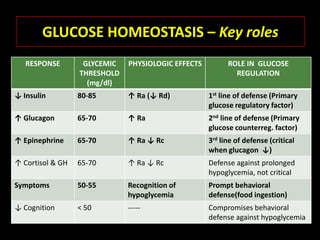
GLUCOSE HOMEOSTASIS – Key roles
   RESPONSE        GLYCEMIC   PHYSIOLOGIC EFFECTS         ROLE IN GLUCOSE
                  THRESHOLD                                 REGULATION
                    (mg/dl)
↓ Insulin         80-85       ↑ Ra (↓ Rd)           1st line of defense (Primary
                                                    glucose regulatory factor)
↑ Glucagon        65-70       ↑ Ra                  2nd line of defense (Primary
                                                    glucose counterreg. factor)
↑ Epinephrine     65-70       ↑ Ra ↓ Rc             3rd line of defense (critical
                                                    when glucagon ↓)
↑ Cortisol & GH   65-70       ↑ Ra ↓ Rc             Defense against prolonged
                                                    hypoglycemia, not critical
Symptoms          50-55       Recognition of        Prompt behavioral
                              hypoglycemia          defense(food ingestion)
↓ Cognition       < 50        -----                 Compromises behavioral
                                                    defense against hypoglycemia
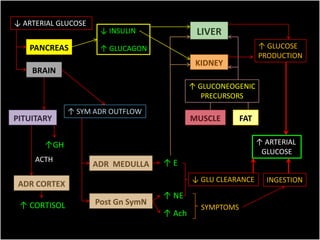
↓ ARTERIAL GLUCOSE
                      ↓ INSULIN              LIVER
   PANCREAS           ↑ GLUCAGON                               ↑ GLUCOSE
                                                               PRODUCTION
                                             KIDNEY
    BRAIN
                                            ↑ GLUCONEOGENIC
                                               PRECURSORS
              ↑ SYM ADR OUTFLOW
PITUITARY                                   MUSCLE       FAT

       ↑GH                                                     ↑ ARTERIAL
                                                                GLUCOSE
     ACTH                           ↑E
                     ADR MEDULLA
                                            ↓ GLU CLEARANCE      INGESTION
 ADR CORTEX
                                    ↑ NE
 ↑ CORTISOL          Post Gn SymN
                                              SYMPTOMS
                                    ↑ Ach
CLINICAL FEATURES - Symptoms
• Neurogenic symptoms:
   – Sweaty
   – Hungry
   – Tingly
   – Shaky (Tremulous)
   – Poundy (Palpitations)
   – Nervy (Anxious/Nervous)
• These symptoms are the result of the perception of
  physiologic changes caused by the ANS discharge (Adr & Chol)
  triggered by hypoglycemia.
CLINICAL FEATURES - Symptoms
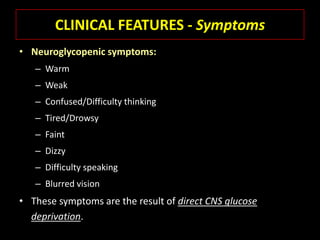
• Neuroglycopenic symptoms:
   – Warm
   – Weak
   – Confused/Difficulty thinking
   – Tired/Drowsy
   – Faint
   – Dizzy
   – Difficulty speaking
   – Blurred vision
• These symptoms are the result of direct CNS glucose
  deprivation.
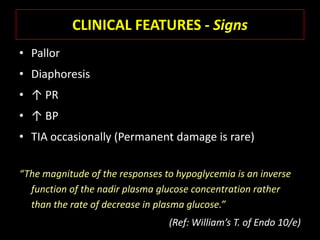
CLINICAL FEATURES - Signs
• Pallor
• Diaphoresis
• ↑ PR
• ↑ BP
• TIA occasionally (Permanent damage is rare)

“The magnitude of the responses to hypoglycemia is an inverse
  function of the nadir plasma glucose concentration rather
  than the rate of decrease in plasma glucose.”
                                 (Ref: William’s T. of Endo 10/e)
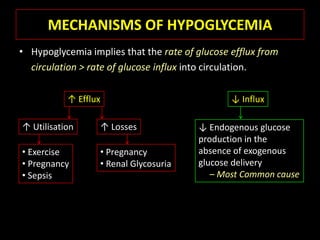
MECHANISMS OF HYPOGLYCEMIA
• Hypoglycemia implies that the rate of glucose efflux from
  circulation > rate of glucose influx into circulation.

           ↑ Efflux                             ↓ Influx

↑ Utilisation     ↑ Losses              ↓ Endogenous glucose
                                        production in the
• Exercise        • Pregnancy           absence of exogenous
• Pregnancy       • Renal Glycosuria    glucose delivery
• Sepsis                                   – Most Common cause
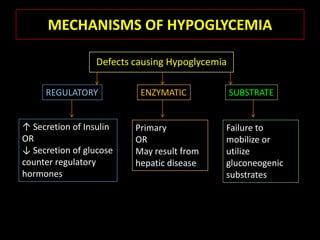
MECHANISMS OF HYPOGLYCEMIA

                 Defects causing Hypoglycemia

     REGULATORY           ENZYMATIC             SUBSTRATE


↑ Secretion of Insulin   Primary            Failure to
OR                       OR                 mobilize or
↓ Secretion of glucose   May result from    utilize
counter regulatory       hepatic disease    gluconeogenic
hormones                                    substrates
DIAGNOSIS
1. Whipple’s triad
2. Venous plasma glucose after an overnight fast:
     • > 70mg/dl (>3.9 mmol/) : Normal
     • 50 - 70 mg/dl (2.8-3.9 mmol/l) : s/o Hypoglycemia
     • < 50 mg/dl (<2.8 mmol/l) : => Postabsorptive hypoglycemia
3. Postprandial (=Reactive) hypoglycemia:
    –     Diagnosis requires documentation of Whipple’s triad
          after a mixed meal (low venous plasma concentration
          post oral glucose load is not sufficient for diagnosis).

(Ref: William’s T. of Endo 10/e, Harrison’s Principles of Int Med 17/e, 339:2308)
CLINICAL CLASSIFICATION
1. Postabsorptive (=Fasting) Hypoglycemia
2. Postprandial (=Reactive) Hypoglycemia
Significance:
   –   Reproducible hypoglycemia in the postabsorptive state,
       implies the presence of disease and requires diagnostic
       explanation and treatment.
   –   It may become apparent during the latter part of any
       interdigestive period (NOT necessarily in the fasting state) esp.
       post-exercise.
   –   Postprandial (=reactive) hypoglycemia does not usually imply a
       serious underlying disorder.
CLINICAL CLASSIFICATION
I) POSTABSORPTIVE (=FASTING) HYPOGLYCEMIA:
1. DRUGS:
  –   Esp. Insulin, SU, alcohol
  –   Pentamidine, quinine
  –   Rarely salicylates, sulphonamides
  –   Others
2. CRITICAL ILLNESSES:
  –   Hepatic failure
  –   Cardiac failure
  –   Renal failure
  –   Sepsis
  –   Inanition                              contd…
CLINICAL CLASSIFICATION
I) POSTABSORPTIVE (=FASTING) HYPOGLYCEMIA:
3. HORMONAL DEFICIENCIES:
  –   Cortisol or GH or both
  –   Glucagon or Epinephrine
4. NON β CELL TUMORS
5. ENDOGENOUS HYPERINSULINISM
  –   Pancreatic β cell disorders
  –   β cell secretagogue (eg: SU)
  –   Autoimmune hypoglycemia (IA, IRA, ? βcell Ab)
  –   ? Ectopic insulin secretion
6. HYPOGLYCEMIA OF INFANCY & CHILDHOOD
CLINICAL CLASSIFICATION
II) POSTPRANDIAL (=REACTIVE) HYPOGLYCEMIA:
1. Congenital deficiencies of enzymes of carbohydrate
   metabolism:
  – Heriditary Fructose intolerance
  – Galactosemia
2. Alimentary Glycosuria:
  – Post gastrectomy
3. Idiopathic (=Functional) postprandial hypoglycemia
HYPOGLYCEMIA IN DM
IMPACT & FREQUENCY:
•   Limiting factor in the glycemic management of DM
1. Causes recurrent morbidity in MOST cases of T1DM and
   MANY with T2DM and is sometimes fatal.
2. Precludes maintenance of euglycemia over a lifetime of
   diabetes and thus full realization of the benefits of glycemic
   control.
3. Causes a vicious cycle of recurrent hypoglycemia by
   producing hypoglycemia associated autonomic failure – the
   clinical syndromes of defective glucose counterregulation
   and of hypoglycemia unawareness.
HYPOGLYCEMIA IN DM – The Burden
•   T1DM-
    –   Fact of life
    –   Average of 2 episodes of symptomatic hypoglycemia per week and at
        least one episode of sever, at least temporarily disabling
        hypoglycemia each year.
    –   Estimated 2-4% of people with T1DM die due to hypoglycemia.
•   T2DM-
    –   Less frequent than T1DM.
    –   Metformin, TZDs, AGIs, GLP-1 analogues, DDP-4 inhibitors should not
        cause hypoglycemia, however the risk increases when combined with
        insulin/SU.
    –   As insulin resistance increases and patients require insulin the risk of
        hypoglycemia in T2DM approaches that in T1DM.
RISK FACTORS – THE PREMISE

“The conventional risk factors for hypoglycemia in diabetes
are based on the premise that relative or absolute insulin
excess is the sole determinant of risk.”
             - Harrison’s Principles of Int Med 17/e, 339:2306


“Iatrogenic hypoglycemia in T1DM is the result of the
interplay of therapeutic insulin excess and compromised
glucose counterregulation.”
                                    -William’s T. of Endo 10/e
CONVENTIONAL RISK FACTORS
•   Absolute/Relative Insulin Excess occurs when:
    –   Insulin (or secretogogue) doses are excessive, ill-timed or of the
        wrong type
    –   The influx of exogenous glucose is reduced (e.g., overnight fast or
        following missed meals/snacks)
    –   Insulin-independent glucose utilization is increased (e.g., exercise)
    –   Sensitivity to insulin is increased (e.g., improved glycemic control, in
        the middle of the night, late of the exercise, or with increased fitness
        or weight loss)
    –   Endogenous glucose production is reduced (e.g., alcohol ingestion)
    –   Insulin clearance is reduced (e.g., renal failure)
COMPROMISED GLUCOSE COUNTERREGULATION

•   Absolute insulin deficiency (C-peptide negativity):
    – β cell destruction: No decrease insulin in response to fall
      in glucose
    – Unknown: No increase glucagon in response to fall in
      glucose
•   H/O severe hypoglycemia/aggressive treatment per se:
    – Lower glucose goals, low HbA1c
    – Attenuated autonomic activation & symptoms in response
      to fall in glucose.
HYPOGLYCEMIA ASSOCIATED
           AUTONOMIC FAILURE

• Defective glucose counterregulation
• Hypoglycemia unawareness


  – Defective glucose counterregulation compromises
    physiologic defense, and hypoglycemia unawareness
    compromises behavioral defense.
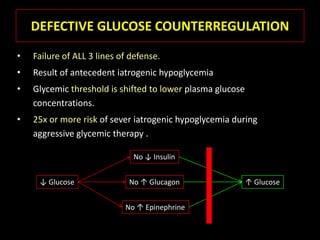
DEFECTIVE GLUCOSE COUNTERREGULATION

•   Failure of ALL 3 lines of defense.
•   Result of antecedent iatrogenic hypoglycemia
•   Glycemic threshold is shifted to lower plasma glucose
    concentrations.
•   25x or more risk of sever iatrogenic hypoglycemia during
    aggressive glycemic therapy .

                              No ↓ Insulin


     ↓ Glucose               No ↑ Glucagon                  ↑ Glucose


                            No ↑ Epinephrine
HYPOGLYCEMIA UNAWARENESS
•   Caused by the attenuated sympathoadrenal response (largely
    the ↓ sympathetic neural response) to hypoglycemia.

•   Characterised by the loss of warning adrenergic & cholinergic
    symptoms that previously allowed the patient to recognise
    developing hypoglycemia ad therefore abort the episode by
    ingesting carbohydrates.

•   6x increased risk of severe iatrogenic hypoglycemia during
    aggressive treatment .
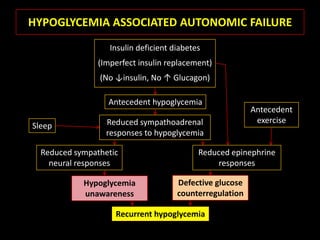
HYPOGLYCEMIA ASSOCIATED AUTONOMIC FAILURE
                   Insulin deficient diabetes
                (Imperfect insulin replacement)
                (No ↓insulin, No ↑ Glucagon)

                  Antecedent hypoglycemia
                                                          Antecedent
                  Reduced sympathoadrenal                  exercise
Sleep
                  responses to hypoglycemia

  Reduced sympathetic                       Reduced epinephrine
    neural responses                             responses

            Hypoglycemia              Defective glucose
            unawareness               counterregulation

                    Recurrent hypoglycemia
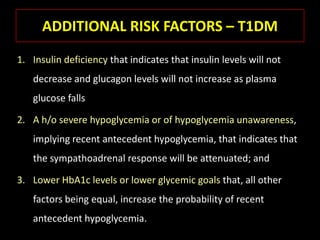
ADDITIONAL RISK FACTORS – T1DM
1. Insulin deficiency that indicates that insulin levels will not
   decrease and glucagon levels will not increase as plasma
   glucose falls

2. A h/o severe hypoglycemia or of hypoglycemia unawareness,
   implying recent antecedent hypoglycemia, that indicates that
   the sympathoadrenal response will be attenuated; and

3. Lower HbA1c levels or lower glycemic goals that, all other
   factors being equal, increase the probability of recent
   antecedent hypoglycemia.
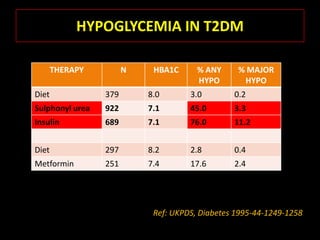
HYPOGLYCEMIA IN T2DM

       THERAPY         N    HBA1C      % ANY     % MAJOR
                                       HYPO       HYPO
Diet             379       8.0       3.0        0.2
Sulphonyl urea   922       7.1       45.0       3.3
Insulin          689       7.1       76.0       11.2


Diet             297       8.2       2.8        0.4
Metformin        251       7.4       17.6       2.4


                            Ref: UKPDS, Diabetes 1995-44-1249-1258
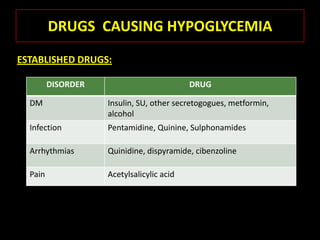
DRUGS CAUSING HYPOGLYCEMIA
ESTABLISHED DRUGS:

         DISORDER                          DRUG

  DM                Insulin, SU, other secretogogues, metformin,
                    alcohol
  Infection         Pentamidine, Quinine, Sulphonamides

  Arrhythmias       Quinidine, dispyramide, cibenzoline

  Pain              Acetylsalicylic acid
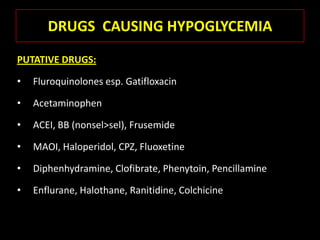
DRUGS CAUSING HYPOGLYCEMIA
PUTATIVE DRUGS:

•   Fluroquinolones esp. Gatifloxacin

•   Acetaminophen

•   ACEI, BB (nonsel>sel), Frusemide

•   MAOI, Haloperidol, CPZ, Fluoxetine

•   Diphenhydramine, Clofibrate, Phenytoin, Pencillamine

•   Enflurane, Halothane, Ranitidine, Colchicine
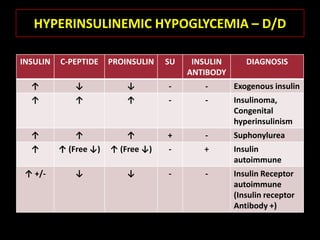
HYPERINSULINEMIC HYPOGLYCEMIA – D/D

INSULIN   C-PEPTIDE    PROINSULIN   SU    INSULIN      DIAGNOSIS
                                         ANTIBODY
  ↑           ↓            ↓        -       -       Exogenous insulin
  ↑           ↑            ↑        -       -       Insulinoma,
                                                    Congenital
                                                    hyperinsulinism
  ↑           ↑            ↑        +       -       Suphonylurea
  ↑       ↑ (Free ↓)   ↑ (Free ↓)   -       +       Insulin
                                                    autoimmune
 ↑ +/-        ↓            ↓        -       -       Insulin Receptor
                                                    autoimmune
                                                    (Insulin receptor
                                                    Antibody +)
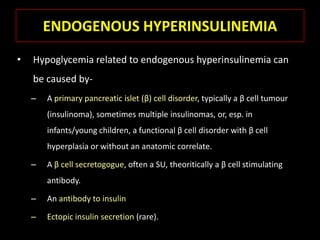
ENDOGENOUS HYPERINSULINEMIA
•   Hypoglycemia related to endogenous hyperinsulinemia can
    be caused by-
    –   A primary pancreatic islet (β) cell disorder, typically a β cell tumour
        (insulinoma), sometimes multiple insulinomas, or, esp. in
        infants/young children, a functional β cell disorder with β cell
        hyperplasia or without an anatomic correlate.

    –   A β cell secretogogue, often a SU, theoritically a β cell stimulating
        antibody.

    –   An antibody to insulin

    –   Ectopic insulin secretion (rare).
ENDOGENOUS HYPERINSULINEMIA
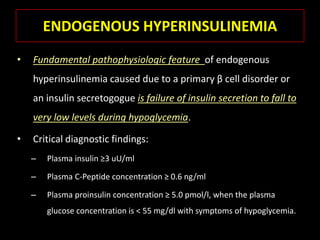
•   Fundamental pathophysiologic feature of endogenous
    hyperinsulinemia caused due to a primary β cell disorder or
    an insulin secretogogue is failure of insulin secretion to fall to
    very low levels during hypoglycemia.

•   Critical diagnostic findings:
    –   Plasma insulin ≥3 uU/ml

    –   Plasma C-Peptide concentration ≥ 0.6 ng/ml

    –   Plasma proinsulin concentration ≥ 5.0 pmol/l, when the plasma
        glucose concentration is < 55 mg/dl with symptoms of hypoglycemia.
INSULINOMA
•   Uncommon, 1/250,000; > 90% benign, treatable cause of
    potentially fatal hypoglycemia.

•   Median age of presentation – 50 yrs (sporadic cases), third
    decade in MEN 1.

•   Symptoms:
    –   Various combinations of diplopia, blurred vision, sweating,
        palpitations or weakness: 85%

    –   Confusion or abnormal behaviour: 80%

    –   Unconsciousness or amnesia: 53%

    –   Grand mal seizures: 12%
HYPOGLYCEMIA IN INFANCY/CHILDHOOD

1. Transient Intolerance of fasting:
   –    Preterm/ SGA infants.

   –    Hypopitutrism, adrenal hypoplasia, congenital adrenal hyperplasia

   –    Ketotic hypoglycemia of childhood.

2. Hyperinsulinism:
   –    IDM

   –    Maternal drugs (SU,B2, adr. Agonist)

   –    Congenital hyperinsulinism, insulinoma

   –    Misc – Rh incompatibility, Beckwith Wiedemann syndrome, exchange
        transfusion.
HYPOGLYCEMIA IN INFANCY/CHILDHOOD

3. Enzyme defects:
  – CARBOHYDRATE METABOLISM :

     •   Glycogen storage disease Types I / II/ VI

     •   Glycogen synthase deficiency

     •   Fructose 1,6 bis phosphatase deficiency

     •   Fructose 1-phosphate – aldolase deficiency

     •   Gal 1-phosphate – uridyl transferase deficiency
HYPOGLYCEMIA IN INFANCY/CHILDHOOD
3. Enzyme defects:

  – PROTEIN METABOLISM :
     •   Branched chain α ketoacid dehydrogenase complex deficiency

  – FAT METABOLISM :
     •   FA oxidation defects induding deficiencies in the carnitine
         cycle

     •   β – oxidation spiral defects

     •   ETC defects

     •   Ketogenesis sequence defects
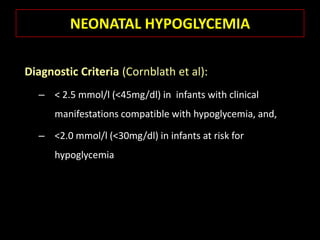
NEONATAL HYPOGLYCEMIA

Diagnostic Criteria (Cornblath et al):
  – < 2.5 mmol/l (<45mg/dl) in infants with clinical
      manifestations compatible with hypoglycemia, and,

  – <2.0 mmol/l (<30mg/dl) in infants at risk for
      hypoglycemia
DIAGNOSTIC APPROACH
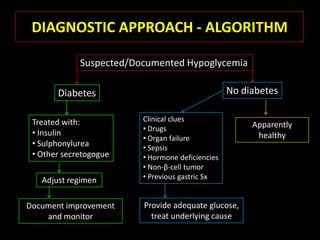
DIAGNOSTIC APPROACH - ALGORITHM

             Suspected/Documented Hypoglycemia

       Diabetes                                   No diabetes

 Treated with:           Clinical clues
                         • Drugs                       Apparently
 • Insulin                                              healthy
                         • Organ failure
 • Sulphonylurea         • Sepsis
 • Other secretogogue    • Hormone deficiencies
                         • Non-β-cell tumor
   Adjust regimen        • Previous gastric Sx


Document improvement     Provide adequate glucose,
    and monitor            treat underlying cause
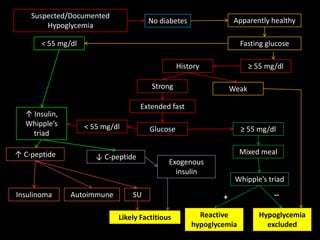
Suspected/Documented
                                       No diabetes                Apparently healthy
        Hypoglycemia

       < 55 mg/dl                                                   Fasting glucose

                                                 History                ≥ 55 mg/dl

                                        Strong                   Weak

                                     Extended fast
  ↑ Insulin,
  Whipple’s         < 55 mg/dl         Glucose                      ≥ 55 mg/dl
    triad

↑ C-peptide                                                         Mixed meal
                       ↓ C-peptide
                                             Exogenous
                                               insulin
                                                                  Whipple’s triad
Insulinoma     Autoimmune        SU                          +                 --

                             Likely Factitious         Reactive            Hypoglycemia
                                                     hypoglycemia            excluded
TREATMENT
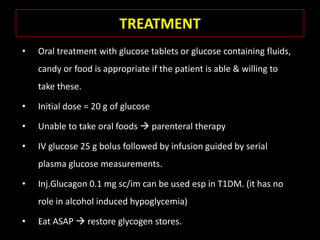
•   Oral treatment with glucose tablets or glucose containing fluids,
    candy or food is appropriate if the patient is able & willing to
    take these.

•   Initial dose = 20 g of glucose

•   Unable to take oral foods  parenteral therapy

•   IV glucose 25 g bolus followed by infusion guided by serial
    plasma glucose measurements.

•   Inj.Glucagon 0.1 mg sc/im can be used esp in T1DM. (it has no
    role in alcohol induced hypoglycemia)

•   Eat ASAP  restore glycogen stores.
PREVENTION

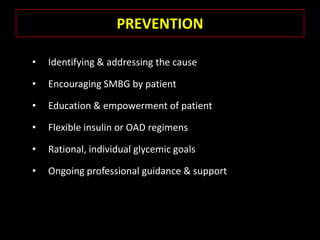
•   Identifying & addressing the cause

•   Encouraging SMBG by patient

•   Education & empowerment of patient

•   Flexible insulin or OAD regimens

•   Rational, individual glycemic goals

•   Ongoing professional guidance & support
HYPERGLYCEMIC HYPEROSMOLAR STATE

Hypoglycaemia

  • 1.
    In the Nameof God, Most Gracious, Most Merciful
  • 2.
    DIABETIC EMERGENCIES - HYPOGLYCEMIA -HYPERGLYCEMIC HYPEROSMOLAR STATE Dr. Mohammed Sadiq Azam Dr. D. Sudeepta Rao II yr. Postgraduates: MD (Gen Med) Deccan College of Medical Sciences
  • 3.
  • 4.
    HYPOGLYCEMIA - OUTLINE •Definition • Glucose Homeostasis • Clinical Features • Mechanisms • Diagnosis – Clinical Classification • Hypoglycemia in DM – Impact & Frequency – Risk factors – Hypoglycemia asso. autonomic failure
  • 5.
    HYPOGLYCEMIA - OUTLINE •Drugs asso. with hypoglycemia • Hyperinsulinemic hypoglycemia – D/D • Endogenous hyperinsulinemia – D/D, and, a word on insulinoma • Hypoglycemia in Infancy & Childhood • Diagnostic approach to an adult with hypoglycemia • Management – Emergency management & prevention
  • 6.
    DEFINITION “Glucose levels <55mg/dl(<3.0mmol/l) with symptoms that are relieved promptly after the glucose level is raised document hypoglycemia.” • Hypoglycemia is most convincingly documented by, Whipple’s triad, i.e: – Symptoms consistent with hypoglycemia – Low plasma glucose concentration (measured with a precise method) – Relief of symptoms when plasma glucose concentration is increased.
  • 7.
    GLUCOSE HOMEOSTASIS –Key roles RESPONSE GLYCEMIC PHYSIOLOGIC EFFECTS ROLE IN GLUCOSE THRESHOLD REGULATION (mg/dl) ↓ Insulin 80-85 ↑ Ra (↓ Rd) 1st line of defense (Primary glucose regulatory factor) ↑ Glucagon 65-70 ↑ Ra 2nd line of defense (Primary glucose counterreg. factor) ↑ Epinephrine 65-70 ↑ Ra ↓ Rc 3rd line of defense (critical when glucagon ↓) ↑ Cortisol & GH 65-70 ↑ Ra ↓ Rc Defense against prolonged hypoglycemia, not critical Symptoms 50-55 Recognition of Prompt behavioral hypoglycemia defense(food ingestion) ↓ Cognition < 50 ----- Compromises behavioral defense against hypoglycemia
  • 8.
    ↓ ARTERIAL GLUCOSE ↓ INSULIN LIVER PANCREAS ↑ GLUCAGON ↑ GLUCOSE PRODUCTION KIDNEY BRAIN ↑ GLUCONEOGENIC PRECURSORS ↑ SYM ADR OUTFLOW PITUITARY MUSCLE FAT ↑GH ↑ ARTERIAL GLUCOSE ACTH ↑E ADR MEDULLA ↓ GLU CLEARANCE INGESTION ADR CORTEX ↑ NE ↑ CORTISOL Post Gn SymN SYMPTOMS ↑ Ach
  • 9.
    CLINICAL FEATURES -Symptoms • Neurogenic symptoms: – Sweaty – Hungry – Tingly – Shaky (Tremulous) – Poundy (Palpitations) – Nervy (Anxious/Nervous) • These symptoms are the result of the perception of physiologic changes caused by the ANS discharge (Adr & Chol) triggered by hypoglycemia.
  • 10.
    CLINICAL FEATURES -Symptoms • Neuroglycopenic symptoms: – Warm – Weak – Confused/Difficulty thinking – Tired/Drowsy – Faint – Dizzy – Difficulty speaking – Blurred vision • These symptoms are the result of direct CNS glucose deprivation.
  • 11.
    CLINICAL FEATURES -Signs • Pallor • Diaphoresis • ↑ PR • ↑ BP • TIA occasionally (Permanent damage is rare) “The magnitude of the responses to hypoglycemia is an inverse function of the nadir plasma glucose concentration rather than the rate of decrease in plasma glucose.” (Ref: William’s T. of Endo 10/e)
  • 12.
    MECHANISMS OF HYPOGLYCEMIA •Hypoglycemia implies that the rate of glucose efflux from circulation > rate of glucose influx into circulation. ↑ Efflux ↓ Influx ↑ Utilisation ↑ Losses ↓ Endogenous glucose production in the • Exercise • Pregnancy absence of exogenous • Pregnancy • Renal Glycosuria glucose delivery • Sepsis – Most Common cause
  • 13.
    MECHANISMS OF HYPOGLYCEMIA Defects causing Hypoglycemia REGULATORY ENZYMATIC SUBSTRATE ↑ Secretion of Insulin Primary Failure to OR OR mobilize or ↓ Secretion of glucose May result from utilize counter regulatory hepatic disease gluconeogenic hormones substrates
  • 14.
    DIAGNOSIS 1. Whipple’s triad 2.Venous plasma glucose after an overnight fast: • > 70mg/dl (>3.9 mmol/) : Normal • 50 - 70 mg/dl (2.8-3.9 mmol/l) : s/o Hypoglycemia • < 50 mg/dl (<2.8 mmol/l) : => Postabsorptive hypoglycemia 3. Postprandial (=Reactive) hypoglycemia: – Diagnosis requires documentation of Whipple’s triad after a mixed meal (low venous plasma concentration post oral glucose load is not sufficient for diagnosis). (Ref: William’s T. of Endo 10/e, Harrison’s Principles of Int Med 17/e, 339:2308)
  • 15.
    CLINICAL CLASSIFICATION 1. Postabsorptive(=Fasting) Hypoglycemia 2. Postprandial (=Reactive) Hypoglycemia Significance: – Reproducible hypoglycemia in the postabsorptive state, implies the presence of disease and requires diagnostic explanation and treatment. – It may become apparent during the latter part of any interdigestive period (NOT necessarily in the fasting state) esp. post-exercise. – Postprandial (=reactive) hypoglycemia does not usually imply a serious underlying disorder.
  • 16.
    CLINICAL CLASSIFICATION I) POSTABSORPTIVE(=FASTING) HYPOGLYCEMIA: 1. DRUGS: – Esp. Insulin, SU, alcohol – Pentamidine, quinine – Rarely salicylates, sulphonamides – Others 2. CRITICAL ILLNESSES: – Hepatic failure – Cardiac failure – Renal failure – Sepsis – Inanition contd…
  • 17.
    CLINICAL CLASSIFICATION I) POSTABSORPTIVE(=FASTING) HYPOGLYCEMIA: 3. HORMONAL DEFICIENCIES: – Cortisol or GH or both – Glucagon or Epinephrine 4. NON β CELL TUMORS 5. ENDOGENOUS HYPERINSULINISM – Pancreatic β cell disorders – β cell secretagogue (eg: SU) – Autoimmune hypoglycemia (IA, IRA, ? βcell Ab) – ? Ectopic insulin secretion 6. HYPOGLYCEMIA OF INFANCY & CHILDHOOD
  • 18.
    CLINICAL CLASSIFICATION II) POSTPRANDIAL(=REACTIVE) HYPOGLYCEMIA: 1. Congenital deficiencies of enzymes of carbohydrate metabolism: – Heriditary Fructose intolerance – Galactosemia 2. Alimentary Glycosuria: – Post gastrectomy 3. Idiopathic (=Functional) postprandial hypoglycemia
  • 19.
    HYPOGLYCEMIA IN DM IMPACT& FREQUENCY: • Limiting factor in the glycemic management of DM 1. Causes recurrent morbidity in MOST cases of T1DM and MANY with T2DM and is sometimes fatal. 2. Precludes maintenance of euglycemia over a lifetime of diabetes and thus full realization of the benefits of glycemic control. 3. Causes a vicious cycle of recurrent hypoglycemia by producing hypoglycemia associated autonomic failure – the clinical syndromes of defective glucose counterregulation and of hypoglycemia unawareness.
  • 20.
    HYPOGLYCEMIA IN DM– The Burden • T1DM- – Fact of life – Average of 2 episodes of symptomatic hypoglycemia per week and at least one episode of sever, at least temporarily disabling hypoglycemia each year. – Estimated 2-4% of people with T1DM die due to hypoglycemia. • T2DM- – Less frequent than T1DM. – Metformin, TZDs, AGIs, GLP-1 analogues, DDP-4 inhibitors should not cause hypoglycemia, however the risk increases when combined with insulin/SU. – As insulin resistance increases and patients require insulin the risk of hypoglycemia in T2DM approaches that in T1DM.
  • 21.
    RISK FACTORS –THE PREMISE “The conventional risk factors for hypoglycemia in diabetes are based on the premise that relative or absolute insulin excess is the sole determinant of risk.” - Harrison’s Principles of Int Med 17/e, 339:2306 “Iatrogenic hypoglycemia in T1DM is the result of the interplay of therapeutic insulin excess and compromised glucose counterregulation.” -William’s T. of Endo 10/e
  • 22.
    CONVENTIONAL RISK FACTORS • Absolute/Relative Insulin Excess occurs when: – Insulin (or secretogogue) doses are excessive, ill-timed or of the wrong type – The influx of exogenous glucose is reduced (e.g., overnight fast or following missed meals/snacks) – Insulin-independent glucose utilization is increased (e.g., exercise) – Sensitivity to insulin is increased (e.g., improved glycemic control, in the middle of the night, late of the exercise, or with increased fitness or weight loss) – Endogenous glucose production is reduced (e.g., alcohol ingestion) – Insulin clearance is reduced (e.g., renal failure)
  • 23.
    COMPROMISED GLUCOSE COUNTERREGULATION • Absolute insulin deficiency (C-peptide negativity): – β cell destruction: No decrease insulin in response to fall in glucose – Unknown: No increase glucagon in response to fall in glucose • H/O severe hypoglycemia/aggressive treatment per se: – Lower glucose goals, low HbA1c – Attenuated autonomic activation & symptoms in response to fall in glucose.
  • 24.
    HYPOGLYCEMIA ASSOCIATED AUTONOMIC FAILURE • Defective glucose counterregulation • Hypoglycemia unawareness – Defective glucose counterregulation compromises physiologic defense, and hypoglycemia unawareness compromises behavioral defense.
  • 25.
    DEFECTIVE GLUCOSE COUNTERREGULATION • Failure of ALL 3 lines of defense. • Result of antecedent iatrogenic hypoglycemia • Glycemic threshold is shifted to lower plasma glucose concentrations. • 25x or more risk of sever iatrogenic hypoglycemia during aggressive glycemic therapy . No ↓ Insulin ↓ Glucose No ↑ Glucagon ↑ Glucose No ↑ Epinephrine
  • 26.
    HYPOGLYCEMIA UNAWARENESS • Caused by the attenuated sympathoadrenal response (largely the ↓ sympathetic neural response) to hypoglycemia. • Characterised by the loss of warning adrenergic & cholinergic symptoms that previously allowed the patient to recognise developing hypoglycemia ad therefore abort the episode by ingesting carbohydrates. • 6x increased risk of severe iatrogenic hypoglycemia during aggressive treatment .
  • 27.
    HYPOGLYCEMIA ASSOCIATED AUTONOMICFAILURE Insulin deficient diabetes (Imperfect insulin replacement) (No ↓insulin, No ↑ Glucagon) Antecedent hypoglycemia Antecedent Reduced sympathoadrenal exercise Sleep responses to hypoglycemia Reduced sympathetic Reduced epinephrine neural responses responses Hypoglycemia Defective glucose unawareness counterregulation Recurrent hypoglycemia
  • 28.
    ADDITIONAL RISK FACTORS– T1DM 1. Insulin deficiency that indicates that insulin levels will not decrease and glucagon levels will not increase as plasma glucose falls 2. A h/o severe hypoglycemia or of hypoglycemia unawareness, implying recent antecedent hypoglycemia, that indicates that the sympathoadrenal response will be attenuated; and 3. Lower HbA1c levels or lower glycemic goals that, all other factors being equal, increase the probability of recent antecedent hypoglycemia.
  • 29.
    HYPOGLYCEMIA IN T2DM THERAPY N HBA1C % ANY % MAJOR HYPO HYPO Diet 379 8.0 3.0 0.2 Sulphonyl urea 922 7.1 45.0 3.3 Insulin 689 7.1 76.0 11.2 Diet 297 8.2 2.8 0.4 Metformin 251 7.4 17.6 2.4 Ref: UKPDS, Diabetes 1995-44-1249-1258
  • 30.
    DRUGS CAUSING HYPOGLYCEMIA ESTABLISHEDDRUGS: DISORDER DRUG DM Insulin, SU, other secretogogues, metformin, alcohol Infection Pentamidine, Quinine, Sulphonamides Arrhythmias Quinidine, dispyramide, cibenzoline Pain Acetylsalicylic acid
  • 31.
    DRUGS CAUSING HYPOGLYCEMIA PUTATIVEDRUGS: • Fluroquinolones esp. Gatifloxacin • Acetaminophen • ACEI, BB (nonsel>sel), Frusemide • MAOI, Haloperidol, CPZ, Fluoxetine • Diphenhydramine, Clofibrate, Phenytoin, Pencillamine • Enflurane, Halothane, Ranitidine, Colchicine
  • 32.
    HYPERINSULINEMIC HYPOGLYCEMIA –D/D INSULIN C-PEPTIDE PROINSULIN SU INSULIN DIAGNOSIS ANTIBODY ↑ ↓ ↓ - - Exogenous insulin ↑ ↑ ↑ - - Insulinoma, Congenital hyperinsulinism ↑ ↑ ↑ + - Suphonylurea ↑ ↑ (Free ↓) ↑ (Free ↓) - + Insulin autoimmune ↑ +/- ↓ ↓ - - Insulin Receptor autoimmune (Insulin receptor Antibody +)
  • 33.
    ENDOGENOUS HYPERINSULINEMIA • Hypoglycemia related to endogenous hyperinsulinemia can be caused by- – A primary pancreatic islet (β) cell disorder, typically a β cell tumour (insulinoma), sometimes multiple insulinomas, or, esp. in infants/young children, a functional β cell disorder with β cell hyperplasia or without an anatomic correlate. – A β cell secretogogue, often a SU, theoritically a β cell stimulating antibody. – An antibody to insulin – Ectopic insulin secretion (rare).
  • 34.
    ENDOGENOUS HYPERINSULINEMIA • Fundamental pathophysiologic feature of endogenous hyperinsulinemia caused due to a primary β cell disorder or an insulin secretogogue is failure of insulin secretion to fall to very low levels during hypoglycemia. • Critical diagnostic findings: – Plasma insulin ≥3 uU/ml – Plasma C-Peptide concentration ≥ 0.6 ng/ml – Plasma proinsulin concentration ≥ 5.0 pmol/l, when the plasma glucose concentration is < 55 mg/dl with symptoms of hypoglycemia.
  • 35.
    INSULINOMA • Uncommon, 1/250,000; > 90% benign, treatable cause of potentially fatal hypoglycemia. • Median age of presentation – 50 yrs (sporadic cases), third decade in MEN 1. • Symptoms: – Various combinations of diplopia, blurred vision, sweating, palpitations or weakness: 85% – Confusion or abnormal behaviour: 80% – Unconsciousness or amnesia: 53% – Grand mal seizures: 12%
  • 36.
    HYPOGLYCEMIA IN INFANCY/CHILDHOOD 1.Transient Intolerance of fasting: – Preterm/ SGA infants. – Hypopitutrism, adrenal hypoplasia, congenital adrenal hyperplasia – Ketotic hypoglycemia of childhood. 2. Hyperinsulinism: – IDM – Maternal drugs (SU,B2, adr. Agonist) – Congenital hyperinsulinism, insulinoma – Misc – Rh incompatibility, Beckwith Wiedemann syndrome, exchange transfusion.
  • 37.
    HYPOGLYCEMIA IN INFANCY/CHILDHOOD 3.Enzyme defects: – CARBOHYDRATE METABOLISM : • Glycogen storage disease Types I / II/ VI • Glycogen synthase deficiency • Fructose 1,6 bis phosphatase deficiency • Fructose 1-phosphate – aldolase deficiency • Gal 1-phosphate – uridyl transferase deficiency
  • 38.
    HYPOGLYCEMIA IN INFANCY/CHILDHOOD 3.Enzyme defects: – PROTEIN METABOLISM : • Branched chain α ketoacid dehydrogenase complex deficiency – FAT METABOLISM : • FA oxidation defects induding deficiencies in the carnitine cycle • β – oxidation spiral defects • ETC defects • Ketogenesis sequence defects
  • 39.
    NEONATAL HYPOGLYCEMIA Diagnostic Criteria(Cornblath et al): – < 2.5 mmol/l (<45mg/dl) in infants with clinical manifestations compatible with hypoglycemia, and, – <2.0 mmol/l (<30mg/dl) in infants at risk for hypoglycemia
  • 40.
  • 41.
    DIAGNOSTIC APPROACH -ALGORITHM Suspected/Documented Hypoglycemia Diabetes No diabetes Treated with: Clinical clues • Drugs Apparently • Insulin healthy • Organ failure • Sulphonylurea • Sepsis • Other secretogogue • Hormone deficiencies • Non-β-cell tumor Adjust regimen • Previous gastric Sx Document improvement Provide adequate glucose, and monitor treat underlying cause
  • 42.
    Suspected/Documented No diabetes Apparently healthy Hypoglycemia < 55 mg/dl Fasting glucose History ≥ 55 mg/dl Strong Weak Extended fast ↑ Insulin, Whipple’s < 55 mg/dl Glucose ≥ 55 mg/dl triad ↑ C-peptide Mixed meal ↓ C-peptide Exogenous insulin Whipple’s triad Insulinoma Autoimmune SU + -- Likely Factitious Reactive Hypoglycemia hypoglycemia excluded
  • 43.
    TREATMENT • Oral treatment with glucose tablets or glucose containing fluids, candy or food is appropriate if the patient is able & willing to take these. • Initial dose = 20 g of glucose • Unable to take oral foods  parenteral therapy • IV glucose 25 g bolus followed by infusion guided by serial plasma glucose measurements. • Inj.Glucagon 0.1 mg sc/im can be used esp in T1DM. (it has no role in alcohol induced hypoglycemia) • Eat ASAP  restore glycogen stores.
  • 44.
    PREVENTION • Identifying & addressing the cause • Encouraging SMBG by patient • Education & empowerment of patient • Flexible insulin or OAD regimens • Rational, individual glycemic goals • Ongoing professional guidance & support
  • 45.