HYPERTHYROIDISM
INTRODUCTION
 Hyperthyroidism, also known as Thyrotoxicosis, is the clinical
syndrome that results from elevated concentrations of free thyroid
hormone in the plasma, associated with clinical evidence of
hypermetabolism.
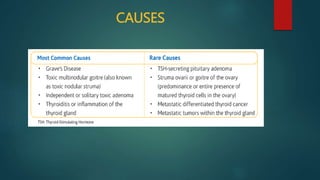
CAUSES
GRAVE’S DISEASE (GD)
 GD is overall the most common cause of Hyperthyroidism. GD is
caused by a generalized over activity of the entire thyroid gland
(Hyperthyroidism).
 GD is an autoimmune disorder in which Thyroid Receptor
Antibodies (TRAbs) stimulate the TSH receptor, increasing thyroid
hormone production.
Prevalance
 Women are more frequently affected by Grave’s Disease than men
by a 5:1 ratio. TRAbs are present in 70-100% of Grave’s Disease (85-
100% for activating antibodies and 75-96% for blocking antibodies).
 The prevalence of hyperthyroidism has been studied in several
studies in India.
 In an epidemiological study from Cochin, Subclinical and Overt
Hyperthyroidism were present in 1.6% and 1.3% of subjects
participating in a community survey.
 In a hospital-based study of women from Pondicherry, Subclinical
and Overt Hyperthyroidism were present in 0.6% and 1.2% of
subjects.
Pathogenesis
 The Hyperthyroidism of Grave’s Disease is caused by Thyroid
stimulating immunoglobulin that are synthesised in the thyroid
gland as well as in bone marrow and lymphnodes. A combination of
environmental and genetic factors, including polymorphism in HLA-
DR, CTLA-4, CD25, PTPN22 & TSH-R contribute to Grave’s Disease
susceptibility. Cytokines appear to play a major role in thyroid-
associated opthalmopathy.
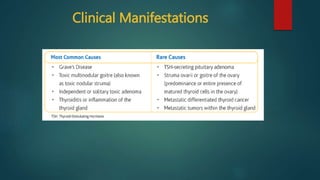
Clinical Manifestations
Laboratory Evaluations
 In Grave’s Disease, the TSH level is suppressed & total and unbound
thyroid hormone levels are increased. In 2-5 % of patients, only T3
is increased (T3 toxicosis).
 Measurement of Thyroid receptor antibodies is the most reliable
diagnostic method if the diagnosis is unclear clinically.
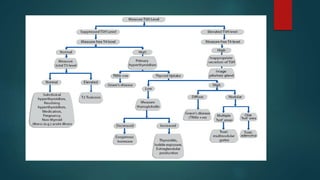
A SCHEME FOR EVALUATING SUSPECTED
HYPERTHYROIDISM
HYPERTHYROIDISM IN PREGNANCY
 Graves’ disease is the most common cause of autoimmune
hyperthyroidism in pregnancy, occurring in 0.1%–1% (0.4% clinical and
0.6% subclinical) of all pregnancies. More frequent than Graves’
disease as the cause of thyrotoxicosis is the syndrome of gestational
hyperthyroidism defined as ‘‘transient hyperthyroidism, limited to the
first half of pregnancy characterized by elevated FT4 and suppressed
or undetectable serum TSH, in the absence of serum markers of
thyroid autoimmunity’’ . It is diagnosed in about 1%–3% of
pregnancies, depending on the geographic area and is secondary to
elevated hCG levels. Determination of TSH receptor antibody (TRAb)
is indicated for differentiating gestational hyperthyroidism from
Grave’s hyperthyroidism in pregnancy.
Fetal risks for women with active
Graves’ hyperthyroidism are
 1) fetal hyperthyroidism
 2) neonatal hyperthyroidism
 3) fetal hypothyroidism
 4) neonatal hypothyroidism
 5) central hypothyroidism
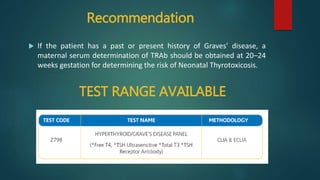
Recommendation
 If the patient has a past or present history of Graves’ disease, a
maternal serum determination of TRAb should be obtained at 20–24
weeks gestation for determining the risk of Neonatal Thyrotoxicosis.
TEST RANGE AVAILABLE
CLINICAL REFERENCE
 Harrison’s Principles of internal Medicine, 18th Edition
 Guidelines of the American Thyroid Association for the Diagnosis and
Management of Thyroid disease during Pregnancy & Postpartum,
2011
 Tietz Textbook of Clinical Biochemistry, Fifth Edition
For more information about Health Disease visit
https://www.lalpathlabs.com/
 HYPOTHYROIDISM
Hyperthyroidism

Hyperthyroidism

  • 1.
  • 2.
    INTRODUCTION  Hyperthyroidism, alsoknown as Thyrotoxicosis, is the clinical syndrome that results from elevated concentrations of free thyroid hormone in the plasma, associated with clinical evidence of hypermetabolism.
  • 3.
  • 4.
    GRAVE’S DISEASE (GD) GD is overall the most common cause of Hyperthyroidism. GD is caused by a generalized over activity of the entire thyroid gland (Hyperthyroidism).  GD is an autoimmune disorder in which Thyroid Receptor Antibodies (TRAbs) stimulate the TSH receptor, increasing thyroid hormone production.
  • 5.
    Prevalance  Women aremore frequently affected by Grave’s Disease than men by a 5:1 ratio. TRAbs are present in 70-100% of Grave’s Disease (85- 100% for activating antibodies and 75-96% for blocking antibodies).  The prevalence of hyperthyroidism has been studied in several studies in India.  In an epidemiological study from Cochin, Subclinical and Overt Hyperthyroidism were present in 1.6% and 1.3% of subjects participating in a community survey.  In a hospital-based study of women from Pondicherry, Subclinical and Overt Hyperthyroidism were present in 0.6% and 1.2% of subjects.
  • 6.
    Pathogenesis  The Hyperthyroidismof Grave’s Disease is caused by Thyroid stimulating immunoglobulin that are synthesised in the thyroid gland as well as in bone marrow and lymphnodes. A combination of environmental and genetic factors, including polymorphism in HLA- DR, CTLA-4, CD25, PTPN22 & TSH-R contribute to Grave’s Disease susceptibility. Cytokines appear to play a major role in thyroid- associated opthalmopathy.
  • 7.
  • 8.
    Laboratory Evaluations  InGrave’s Disease, the TSH level is suppressed & total and unbound thyroid hormone levels are increased. In 2-5 % of patients, only T3 is increased (T3 toxicosis).  Measurement of Thyroid receptor antibodies is the most reliable diagnostic method if the diagnosis is unclear clinically.
  • 9.
    A SCHEME FOREVALUATING SUSPECTED HYPERTHYROIDISM
  • 11.
    HYPERTHYROIDISM IN PREGNANCY Graves’ disease is the most common cause of autoimmune hyperthyroidism in pregnancy, occurring in 0.1%–1% (0.4% clinical and 0.6% subclinical) of all pregnancies. More frequent than Graves’ disease as the cause of thyrotoxicosis is the syndrome of gestational hyperthyroidism defined as ‘‘transient hyperthyroidism, limited to the first half of pregnancy characterized by elevated FT4 and suppressed or undetectable serum TSH, in the absence of serum markers of thyroid autoimmunity’’ . It is diagnosed in about 1%–3% of pregnancies, depending on the geographic area and is secondary to elevated hCG levels. Determination of TSH receptor antibody (TRAb) is indicated for differentiating gestational hyperthyroidism from Grave’s hyperthyroidism in pregnancy.
  • 12.
    Fetal risks forwomen with active Graves’ hyperthyroidism are  1) fetal hyperthyroidism  2) neonatal hyperthyroidism  3) fetal hypothyroidism  4) neonatal hypothyroidism  5) central hypothyroidism
  • 13.
    Recommendation  If thepatient has a past or present history of Graves’ disease, a maternal serum determination of TRAb should be obtained at 20–24 weeks gestation for determining the risk of Neonatal Thyrotoxicosis. TEST RANGE AVAILABLE
  • 14.
    CLINICAL REFERENCE  Harrison’sPrinciples of internal Medicine, 18th Edition  Guidelines of the American Thyroid Association for the Diagnosis and Management of Thyroid disease during Pregnancy & Postpartum, 2011  Tietz Textbook of Clinical Biochemistry, Fifth Edition For more information about Health Disease visit https://www.lalpathlabs.com/  HYPOTHYROIDISM