HYPERSENSITIVITY
REACTION(TYPE I and TYPE II)
BY: JEGANATHAN C
DEPARTMENT OF BIOMEDICAL SCIENCE
E.Mail : jeganathanbms@gmail.com
Cell.no: 9626307988
INTRODUCTION
• Hypersensitivity (also called hypersensitivity
reaction or intolerance) is a set of undesirable
reactions produced by the normal immune
system, including allergies and autoimmunity.
• Inflammatory response can have deleterious
effects ,resulting in significant tissue damage
or even death. this appropriate immune
response is termed hypersensitivity or allergy.
• Hypersensitivity reaction may develop in the
course of either humoral or cell mediated
responses
TYPES
• IgE mediated (type I) hypersensitivity
• Antibody-mediated cytoxic (type II)
hypersensitivity
• Immune complex –mediated (type III)
hypersensitivity
• Delayed- type hypersensitivity (DTH)
IgE mediated hypersensitivity
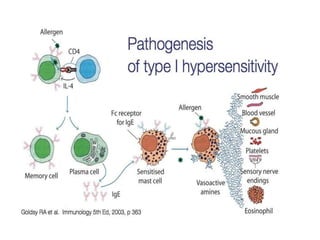
• Type 1 reaction also called as immediate
hypersensitivity reaction
• It is induced by certain types of antigen ,referred
to as allergens
• The allergen induces a humoral antibody
response
• IgE binds with high affinity to Fc receptors on the
surface of tissue mast and basophils
• Such IgE- coated mast cells and basophils are
sensitized
Continuous………
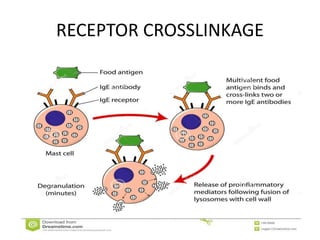
• A later exposure to the same allergen cross-
links the membrane- bound IgE on sensitized
mast cells and basophils, causing
degranulation of these cells
• The pharmacologically active mediators
released from the granules act on the
surrounding tissues
COMMON ALLERGEN ASSOCIATED
WITH TYPE 1 REACTION
• Proteins-foreign serum , vaccines
• Plant pollens-rye grass ,ragweed, timothy
grass,birch trees
• Drugs- penicillin, sulfonamides, local
anesthetics,salicylates
• Foods-nuts, seafood,eggs,peas,beans,milk
• Insect products-bee venom, wasp venom,ant
venom,cockroach calyx,dust mites
• Mold spores , animal hair and dander
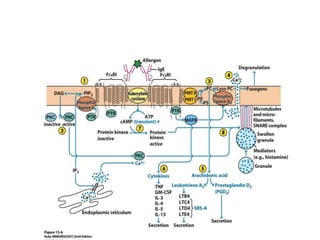
MECHANISM OF ACTION
• Receptor cross linkage
• Intracellular events leading to mast-cell
degranulation
RECEPTOR CROSSLINKAGE
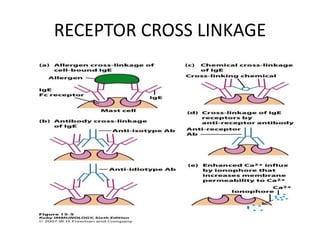
RECEPTOR CROSS LINKAGE
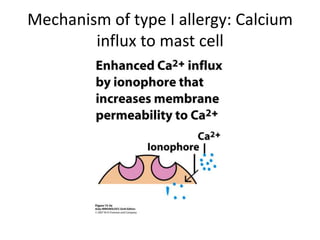
Mechanism of type I allergy: Calcium
influx to mast cell
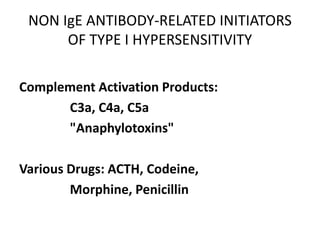
NON IgE ANTIBODY-RELATED INITIATORS
OF TYPE I HYPERSENSITIVITY
Complement Activation Products:
C3a, C4a, C5a
"Anaphylotoxins"
Various Drugs: ACTH, Codeine,
Morphine, Penicillin
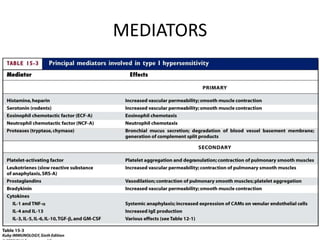
MEDIATORS
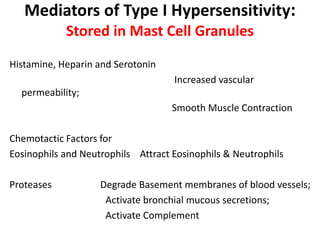
Mediators of Type I Hypersensitivity:
Stored in Mast Cell Granules
Histamine, Heparin and Serotonin
Increased vascular
permeability;
Smooth Muscle Contraction
Chemotactic Factors for
Eosinophils and Neutrophils Attract Eosinophils & Neutrophils
Proteases Degrade Basement membranes of blood vessels;
Activate bronchial mucous secretions;
Activate Complement
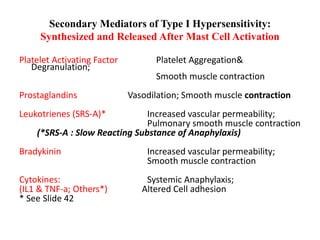
Secondary Mediators of Type I Hypersensitivity:
Synthesized and Released After Mast Cell Activation
Platelet Activating Factor Platelet Aggregation&
Degranulation;
Smooth muscle contraction
Prostaglandins Vasodilation; Smooth muscle contraction
Leukotrienes (SRS-A)* Increased vascular permeability;
Pulmonary smooth muscle contraction
(*SRS-A : Slow Reacting Substance of Anaphylaxis)
Bradykinin Increased vascular permeability;
Smooth muscle contraction
Cytokines: Systemic Anaphylaxis;
(IL1 & TNF-a; Others*) Altered Cell adhesion
* See Slide 42
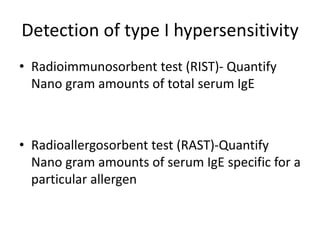
Detection of type I hypersensitivity
• Radioimmunosorbent test (RIST)- Quantify
Nano gram amounts of total serum IgE
• Radioallergosorbent test (RAST)-Quantify
Nano gram amounts of serum IgE specific for a
particular allergen
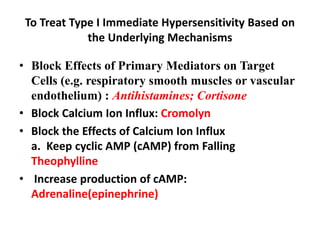
To Treat Type I Immediate Hypersensitivity Based on
the Underlying Mechanisms
• Block Effects of Primary Mediators on Target
Cells (e.g. respiratory smooth muscles or vascular
endothelium) : Antihistamines; Cortisone
• Block Calcium Ion Influx: Cromolyn
• Block the Effects of Calcium Ion Influx
a. Keep cyclic AMP (cAMP) from Falling
Theophylline
• Increase production of cAMP:
Adrenaline(epinephrine)
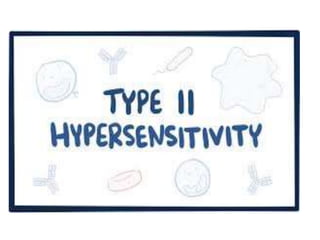
ANTIBODY – MEDIATED CYTOTOXIC
HYPERSENSITIVITY
• Type II hypersensitivity reaction involve
antibody- mediated destruction of cells
• This type is best exemplified by blood –
transfusion reactions, in which host antibodies
react with foreign antigens on the
incompatible transfused blood cells and
mediate destruction of these cells
Type II Hypersensitivity
• Results when Ig or IgM bind to cell surface
Ag’s
– Activating Complement
– Binding Fc receptors on Tc cells promoting ADCC
• Both processes result in lysis of the Ab-coated
cell
• Clinical examples of Type II responses include:
– Certain autoimmune diseases where Ab’s produced
vs membrane Ag’s
• Grave’s Disease – Ab’s produced vs thyroid hormone
receptor
• Myasthenia Gravis – Ab’s produced vs acetylcholine
receptors
• Autoimmune hemolytic anemia – Ab’s produced vs RBC
membrane Ag’s
– Hemolytic Disease of the Newborn
– Hyperacute graft rejection
• Blood Transfusion
• Graft rejection
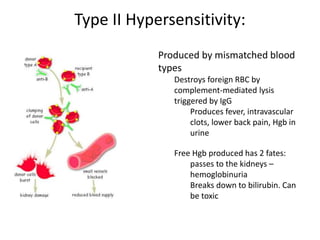
Type II Hypersensitivity:
Produced by mismatched blood
types
Destroys foreign RBC by
complement-mediated lysis
triggered by IgG
Produces fever, intravascular
clots, lower back pain, Hgb in
urine
Free Hgb produced has 2 fates:
passes to the kidneys –
hemoglobinuria
Breaks down to bilirubin. Can
be toxic
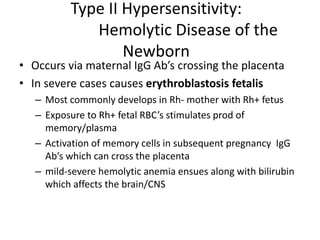
Type II Hypersensitivity:
Hemolytic Disease of the
Newborn
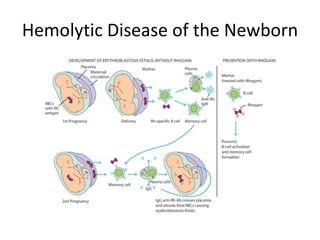
• Occurs via maternal IgG Ab’s crossing the placenta
• In severe cases causes erythroblastosis fetalis
– Most commonly develops in Rh- mother with Rh+ fetus
– Exposure to Rh+ fetal RBC’s stimulates prod of
memory/plasma
– Activation of memory cells in subsequent pregnancy IgG
Ab’s which can cross the placenta
– mild-severe hemolytic anemia ensues along with bilirubin
which affects the brain/CNS
• Treatment centers on anti-Rh antibodies (Rhogam)
• Mothers can be tested for anti-Rh antibodies to
check for a rise in titer
• Isolated fetal RBC’s can be checked for anti-Rh IgG w/
Coombs test
Hemolytic Disease of the Newborn
Drug-induced hemolytic anemia
• Drugs such as aspirin and antibiotics can bind
to the surfaces of RBC’s
• These interactions act similar to hapten-
carrier conj.
• Such complexes can trigger Ab-mediated cell
lysis by complement activation
REFERRENCE
• Kuby immunology- chapter 16th fourth edition
,pp 397- 415
Hyper sensitivity reaction type I and type II

Hyper sensitivity reaction type I and type II

  • 1.
    HYPERSENSITIVITY REACTION(TYPE I andTYPE II) BY: JEGANATHAN C DEPARTMENT OF BIOMEDICAL SCIENCE E.Mail : jeganathanbms@gmail.com Cell.no: 9626307988
  • 2.
    INTRODUCTION • Hypersensitivity (alsocalled hypersensitivity reaction or intolerance) is a set of undesirable reactions produced by the normal immune system, including allergies and autoimmunity. • Inflammatory response can have deleterious effects ,resulting in significant tissue damage or even death. this appropriate immune response is termed hypersensitivity or allergy.
  • 3.
    • Hypersensitivity reactionmay develop in the course of either humoral or cell mediated responses
  • 4.
    TYPES • IgE mediated(type I) hypersensitivity • Antibody-mediated cytoxic (type II) hypersensitivity • Immune complex –mediated (type III) hypersensitivity • Delayed- type hypersensitivity (DTH)
  • 5.
    IgE mediated hypersensitivity •Type 1 reaction also called as immediate hypersensitivity reaction • It is induced by certain types of antigen ,referred to as allergens • The allergen induces a humoral antibody response • IgE binds with high affinity to Fc receptors on the surface of tissue mast and basophils • Such IgE- coated mast cells and basophils are sensitized
  • 6.
    Continuous……… • A laterexposure to the same allergen cross- links the membrane- bound IgE on sensitized mast cells and basophils, causing degranulation of these cells • The pharmacologically active mediators released from the granules act on the surrounding tissues
  • 8.
    COMMON ALLERGEN ASSOCIATED WITHTYPE 1 REACTION • Proteins-foreign serum , vaccines • Plant pollens-rye grass ,ragweed, timothy grass,birch trees • Drugs- penicillin, sulfonamides, local anesthetics,salicylates • Foods-nuts, seafood,eggs,peas,beans,milk • Insect products-bee venom, wasp venom,ant venom,cockroach calyx,dust mites • Mold spores , animal hair and dander
  • 9.
    MECHANISM OF ACTION •Receptor cross linkage • Intracellular events leading to mast-cell degranulation
  • 10.
  • 11.
  • 12.
    Mechanism of typeI allergy: Calcium influx to mast cell
  • 14.
    NON IgE ANTIBODY-RELATEDINITIATORS OF TYPE I HYPERSENSITIVITY Complement Activation Products: C3a, C4a, C5a "Anaphylotoxins" Various Drugs: ACTH, Codeine, Morphine, Penicillin
  • 15.
  • 16.
    Mediators of TypeI Hypersensitivity: Stored in Mast Cell Granules Histamine, Heparin and Serotonin Increased vascular permeability; Smooth Muscle Contraction Chemotactic Factors for Eosinophils and Neutrophils Attract Eosinophils & Neutrophils Proteases Degrade Basement membranes of blood vessels; Activate bronchial mucous secretions; Activate Complement
  • 17.
    Secondary Mediators ofType I Hypersensitivity: Synthesized and Released After Mast Cell Activation Platelet Activating Factor Platelet Aggregation& Degranulation; Smooth muscle contraction Prostaglandins Vasodilation; Smooth muscle contraction Leukotrienes (SRS-A)* Increased vascular permeability; Pulmonary smooth muscle contraction (*SRS-A : Slow Reacting Substance of Anaphylaxis) Bradykinin Increased vascular permeability; Smooth muscle contraction Cytokines: Systemic Anaphylaxis; (IL1 & TNF-a; Others*) Altered Cell adhesion * See Slide 42
  • 18.
    Detection of typeI hypersensitivity • Radioimmunosorbent test (RIST)- Quantify Nano gram amounts of total serum IgE • Radioallergosorbent test (RAST)-Quantify Nano gram amounts of serum IgE specific for a particular allergen
  • 19.
    To Treat TypeI Immediate Hypersensitivity Based on the Underlying Mechanisms • Block Effects of Primary Mediators on Target Cells (e.g. respiratory smooth muscles or vascular endothelium) : Antihistamines; Cortisone • Block Calcium Ion Influx: Cromolyn • Block the Effects of Calcium Ion Influx a. Keep cyclic AMP (cAMP) from Falling Theophylline • Increase production of cAMP: Adrenaline(epinephrine)
  • 21.
    ANTIBODY – MEDIATEDCYTOTOXIC HYPERSENSITIVITY • Type II hypersensitivity reaction involve antibody- mediated destruction of cells • This type is best exemplified by blood – transfusion reactions, in which host antibodies react with foreign antigens on the incompatible transfused blood cells and mediate destruction of these cells
  • 22.
    Type II Hypersensitivity •Results when Ig or IgM bind to cell surface Ag’s – Activating Complement – Binding Fc receptors on Tc cells promoting ADCC • Both processes result in lysis of the Ab-coated cell
  • 23.
    • Clinical examplesof Type II responses include: – Certain autoimmune diseases where Ab’s produced vs membrane Ag’s • Grave’s Disease – Ab’s produced vs thyroid hormone receptor • Myasthenia Gravis – Ab’s produced vs acetylcholine receptors • Autoimmune hemolytic anemia – Ab’s produced vs RBC membrane Ag’s – Hemolytic Disease of the Newborn – Hyperacute graft rejection • Blood Transfusion • Graft rejection
  • 24.
    Type II Hypersensitivity: Producedby mismatched blood types Destroys foreign RBC by complement-mediated lysis triggered by IgG Produces fever, intravascular clots, lower back pain, Hgb in urine Free Hgb produced has 2 fates: passes to the kidneys – hemoglobinuria Breaks down to bilirubin. Can be toxic
  • 25.
    Type II Hypersensitivity: HemolyticDisease of the Newborn • Occurs via maternal IgG Ab’s crossing the placenta • In severe cases causes erythroblastosis fetalis – Most commonly develops in Rh- mother with Rh+ fetus – Exposure to Rh+ fetal RBC’s stimulates prod of memory/plasma – Activation of memory cells in subsequent pregnancy IgG Ab’s which can cross the placenta – mild-severe hemolytic anemia ensues along with bilirubin which affects the brain/CNS
  • 26.
    • Treatment centerson anti-Rh antibodies (Rhogam) • Mothers can be tested for anti-Rh antibodies to check for a rise in titer • Isolated fetal RBC’s can be checked for anti-Rh IgG w/ Coombs test
  • 27.
  • 28.
    Drug-induced hemolytic anemia •Drugs such as aspirin and antibiotics can bind to the surfaces of RBC’s • These interactions act similar to hapten- carrier conj. • Such complexes can trigger Ab-mediated cell lysis by complement activation
  • 29.
    REFERRENCE • Kuby immunology-chapter 16th fourth edition ,pp 397- 415