Hydrogen Bonding
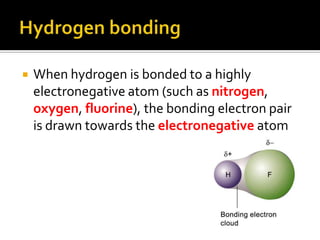
Hydrogen bondingWhen hydrogen is bonded to a highly electronegative atom (such as nitrogen, oxygen, fluorine), the bonding electron pair is drawn towards the electronegative atom
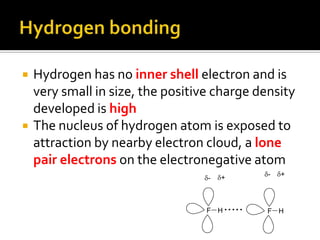
Hydrogen bondingHydrogen has no inner shell electron and is very small in size, the positive charge density developed is highThe nucleus of hydrogen atom is exposed to attraction by nearby electron cloud, a lone pair electrons on the electronegative atom
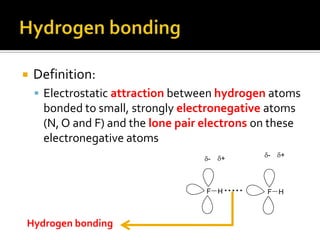
Hydrogen bondingDefinition:Electrostatic attraction between hydrogen atoms bonded to small, strongly electronegative atoms (N, O and F) and the lone pair electrons on these electronegative atomsHydrogen bonding
Hydrogen BondingEssential requirements for formation of hydrogen bond:A hydrogen atom must be directly bonded to a highly electronegative atom (e.g. F, O and N)Anunbonded pair of electrons (lone pair electrons) is presented on the electronegative atom
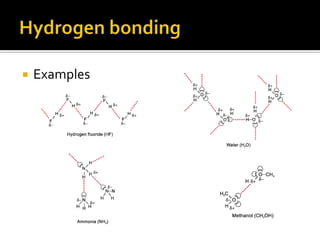
Hydrogen bondingExamples
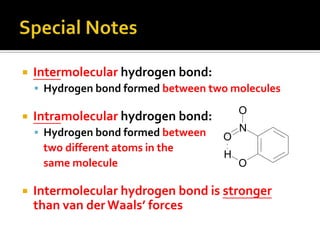
Special NotesIntermolecular hydrogen bond:
Hydrogen bond formed between two molecules
Intramolecularhydrogen bond:
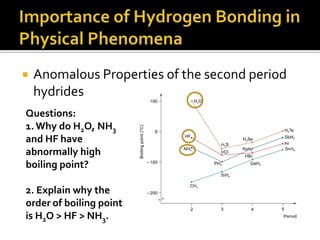
Hydrogen bond formed between     two different atoms in the     same moleculeIntermolecular hydrogen bond is stronger than van der Waals’ forcesImportance of Hydrogen Bonding in Physical PhenomenaAnomalous Properties of the second period hydridesQuestions:1. Why do H2O, NH3 and HF have abnormally high boiling point?2. Explain why the order of boiling point is H2O > HF > NH3.
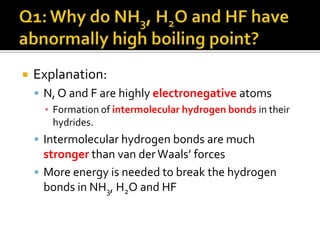
Q1: Why do NH3, H2O and HF have abnormally high boiling point?Explanation:N, O and F are highly electronegative atomsFormation of intermolecular hydrogen bonds in their hydrides.Intermolecular hydrogen bonds are much stronger than van der Waals’ forcesMore energy is needed to break the hydrogen bonds in NH3, H2O and HF
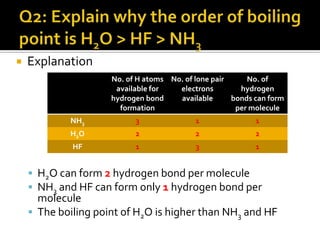
Q2: Explain why the order of boiling point is H2O > HF > NH3Explanation
H2O can form 2 hydrogen bond per molecule
NH3 and HF can form only 1 hydrogen bond per molecule
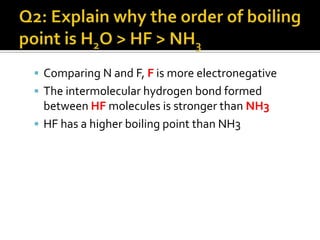
The boiling point of H2O is higher than NH3 and HFQ2: Explain why the order of boiling point is H2O > HF > NH3Comparing N and F, F is more electronegativeThe intermolecular hydrogen bond formed between HF molecules is stronger than NH3HF has a higher boiling point than NH3
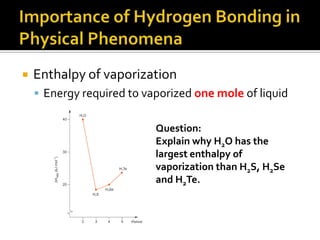
Importance of Hydrogen Bonding in Physical PhenomenaEnthalpy of vaporizationEnergy required to vaporized one mole of liquidQuestion:Explain why H2O has the largest enthalpy of vaporization than H2S, H2Se and H2Te.
Explanation:
In H2O, there are intermolecular hydrogen bonds between molecules
However, in H2S, H2Se and H2Te, the interaction between molecules is dipole-dipole interactions
The strength of hydrogen bond is stronger than dipole-dipole interactions
To break the hydrogen bonds, more energy is required
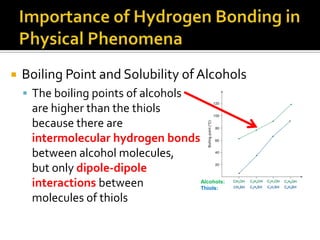
H2O has the largest enthalpy change of vaporizationImportance of Hydrogen Bonding in Physical Phenomena Boiling Point and Solubility of AlcoholsThe boiling points of alcohols 	are higher than the thiols because there are intermolecular hydrogen bonds between alcohol molecules, but only dipole-dipole interactions between molecules of thiols Alcohols:Thiols:
Alcohols of low molecular masses are soluble in water because they can form intermolecular hydrogen bonds with water molecules
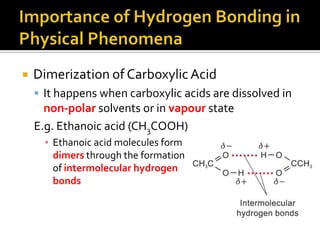
Importance of Hydrogen Bonding in Physical PhenomenaDimerization of Carboxylic AcidIt happens when carboxylic acids are dissolved in non-polar solvents or in vapour stateE.g. Ethanoic acid (CH3COOH)Ethanoic acid molecules formdimers through the formationof intermolecular hydrogenbonds
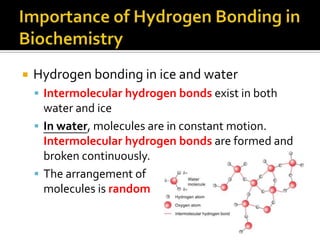
Importance of Hydrogen Bonding in Biochemistry Hydrogen bonding in ice and waterIntermolecular hydrogen bonds exist in both water and ice In water, molecules are in constant motion. Intermolecular hydrogen bondsare formed and broken continuously. The arrangement ofmolecules is random
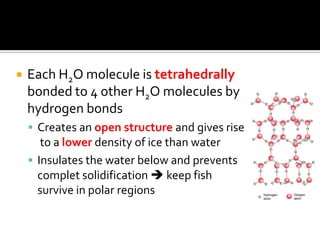
In ice, the molecular motion is restricted. The molecules are arranged in a way to form the maximum number of hydrogen bonds

Hydrogen Bonding Powerpoint

  • 1.
  • 2.
    Hydrogen bondingWhen hydrogenis bonded to a highly electronegative atom (such as nitrogen, oxygen, fluorine), the bonding electron pair is drawn towards the electronegative atom
  • 3.
    Hydrogen bondingHydrogen hasno inner shell electron and is very small in size, the positive charge density developed is highThe nucleus of hydrogen atom is exposed to attraction by nearby electron cloud, a lone pair electrons on the electronegative atom
  • 4.
    Hydrogen bondingDefinition:Electrostatic attractionbetween hydrogen atoms bonded to small, strongly electronegative atoms (N, O and F) and the lone pair electrons on these electronegative atomsHydrogen bonding
  • 5.
    Hydrogen BondingEssential requirementsfor formation of hydrogen bond:A hydrogen atom must be directly bonded to a highly electronegative atom (e.g. F, O and N)Anunbonded pair of electrons (lone pair electrons) is presented on the electronegative atom
  • 6.
  • 7.
  • 8.
    Hydrogen bond formedbetween two molecules
  • 9.
  • 10.
    Hydrogen bond formedbetween two different atoms in the same moleculeIntermolecular hydrogen bond is stronger than van der Waals’ forcesImportance of Hydrogen Bonding in Physical PhenomenaAnomalous Properties of the second period hydridesQuestions:1. Why do H2O, NH3 and HF have abnormally high boiling point?2. Explain why the order of boiling point is H2O > HF > NH3.
  • 11.
    Q1: Why doNH3, H2O and HF have abnormally high boiling point?Explanation:N, O and F are highly electronegative atomsFormation of intermolecular hydrogen bonds in their hydrides.Intermolecular hydrogen bonds are much stronger than van der Waals’ forcesMore energy is needed to break the hydrogen bonds in NH3, H2O and HF
  • 12.
    Q2: Explain whythe order of boiling point is H2O > HF > NH3Explanation
  • 13.
    H2O can form2 hydrogen bond per molecule
  • 14.
    NH3 and HFcan form only 1 hydrogen bond per molecule
  • 15.
    The boiling pointof H2O is higher than NH3 and HFQ2: Explain why the order of boiling point is H2O > HF > NH3Comparing N and F, F is more electronegativeThe intermolecular hydrogen bond formed between HF molecules is stronger than NH3HF has a higher boiling point than NH3
  • 16.
    Importance of HydrogenBonding in Physical PhenomenaEnthalpy of vaporizationEnergy required to vaporized one mole of liquidQuestion:Explain why H2O has the largest enthalpy of vaporization than H2S, H2Se and H2Te.
  • 17.
  • 18.
    In H2O, thereare intermolecular hydrogen bonds between molecules
  • 19.
    However, in H2S,H2Se and H2Te, the interaction between molecules is dipole-dipole interactions
  • 20.
    The strength ofhydrogen bond is stronger than dipole-dipole interactions
  • 21.
    To break thehydrogen bonds, more energy is required
  • 22.
    H2O has thelargest enthalpy change of vaporizationImportance of Hydrogen Bonding in Physical Phenomena Boiling Point and Solubility of AlcoholsThe boiling points of alcohols are higher than the thiols because there are intermolecular hydrogen bonds between alcohol molecules, but only dipole-dipole interactions between molecules of thiols Alcohols:Thiols:
  • 23.
    Alcohols of lowmolecular masses are soluble in water because they can form intermolecular hydrogen bonds with water molecules
  • 24.
    Importance of HydrogenBonding in Physical PhenomenaDimerization of Carboxylic AcidIt happens when carboxylic acids are dissolved in non-polar solvents or in vapour stateE.g. Ethanoic acid (CH3COOH)Ethanoic acid molecules formdimers through the formationof intermolecular hydrogenbonds
  • 25.
    Importance of HydrogenBonding in Biochemistry Hydrogen bonding in ice and waterIntermolecular hydrogen bonds exist in both water and ice In water, molecules are in constant motion. Intermolecular hydrogen bondsare formed and broken continuously. The arrangement ofmolecules is random
  • 26.
    In ice, themolecular motion is restricted. The molecules are arranged in a way to form the maximum number of hydrogen bonds