

March, 2013
Society for Information Technology & Teacher
Education (SITE) International Conference, New
Orleans, LA USA
The HyFlex Course Design: A Case
Study of an Educational Technology
Course
Mariam Abdelmalak
mmariam@nmsu.edu
The HyFlex Course Design: A Case
Study of an Educational Technology
Course
Mariam Abdelmalak
mmariam@nmsu.edu
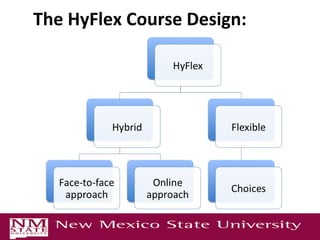
The HyFlex Course Design:
Theoretical Framework:
• A learner-centered framework
• Flexible learning & Flexible delivery
A Learner-centered Framework:
• Considering student needs, interests, and goals
(McCombs, 2000; Ongeri, 2011; Dewey, 1938).
• Students’ control over their learning (Weimer,
2002; Cleveland-Innes & Emes, 2005; Yilmaz,
2009).
• Flexible learning: Interactive learning
environments to anyone, anyplace,
anytime by utilizing the attributes and
resources of the Internet and digital
technologies (Khan, 2007; Casey & Wilson,
2005; Singh, 2003).
• Flexible delivery: Focuses on options
regarding: the what, where, and when
learning occurs (Yusuf, 2009; Hill, 2006).
Flexible Learning & Flexible Delivery:
The Purpose of the Study:
• The purpose of this study was to answer the following
questions:
1) What does the design of an educational technology
course that follows the HyFlex design look like?
2) Why does an instructor choose to implement the HyFlex
design in his/her course?
Method:
• Qualitative Case Study.
• Data Gathering Methods:
 Observation: a graduate educational technology
course for one semester.
 Interview: the instructor & 6 graduate students.
 Analysis: coding, themes
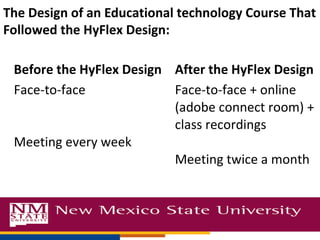
The Design of an Educational technology Course That
Followed the HyFlex Design:
Before the HyFlex Design After the HyFlex Design
Face-to-face
Meeting every week
Face-to-face + online
(adobe connect room) +
class recordings
Meeting twice a month
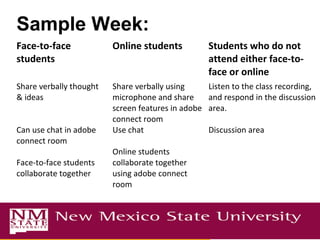
Sample Week:
Face-to-face
students
Online students Students who do not
attend either face-to-
face or online
Share verbally thought
& ideas
Can use chat in adobe
connect room
Face-to-face students
collaborate together
Share verbally using
microphone and share
screen features in adobe
connect room
Use chat
Online students
collaborate together
using adobe connect
room
Listen to the class recording,
and respond in the discussion
area.
Discussion area
Why Choose the HyFlex Design?
• Meeting students’ needs
I want to support my students in being successful in
their journey whatever their journey is, and I do not
want them to be discouraged and drop out, I want
them to succeed. My role is to support every single
student to succeed. So in order for that to happen, in
order for students to succeed, you have to address
their individual needs.
Why Choose the HyFlex Design?
• Tailor learning experiences to students’
circumstances and schedules:
I think it is important to have options regarding the
delivery of the course. Face-to-face meetings should
be always optional because they are dealing with
peoples’ schedules and schedules are interest
conflict. Interest conflict can be an issue. Sometimes
students cannot attend class because of illness and
some people have children, so we should have other
options for these situations.
Why Choose the HyFlex Design?
• Learner involvement and engagement :
It goes to learner involvement and engagement and
kind of keeping them interested and invested
because they made the decision. So when you make
the decision for something, you are usually more
invested than someone makes the decision for you.
Why Choose the HyFlex Design?
• Giving students some control over their
learning :
When someone gets the role of power over like a
parent, a teacher and the system, it sometimes feels
little overwhelming, like I have to do what other say.
The fact that they have power over, or they think
they have some power over their learning, by having
choices, it makes their involvement and their
engagement that much more. And every
engagement and investment you can get from your
students is one more step to help them be successful.
Why Choose the HyFlex Design?
• Showing the power of technology:
I always tell my students: to be face-to-face is a
priority, but if you cannot, we do have means for you
to join us. The fact that we have digital technologies,
we have the Internet access, it gives us far more
capacity and ability to get things done effectively and
efficiently. So showing that to the students in my
mind is important for them in their learning process
as educators and as learners.
• She is very accommodating to her students need. She
recognizes that in order to meet students’ needs,
accommodations need to be met in more ways than
just learning accommodations. It is also a physical
space, physical presence accommodation. I
appreciate that very much.
• She understands life happens. It is a recognition to
the fact that she is working with people who have life
outside academia, people who have jobs and kids
and family and what else can happen. That she
recognizes we are adult that we are running things
that can break our schedules and cannot make the
face to face, so the recording and the online option
are there in case something happens.
Students’ Comments:
Students’ Comments:
• She accommodates to my needs of time by allowing
me to attend online, otherwise I will not be able to
take this course.
• The instructor openness to meet students’ needs
helped me to engage and participate in the class.
Conclusion:
• Adult learners need flexible learning so they can balance
study, work, family and other commitments.
• The HyFlex course design acknowledges that learners
have different needs and preferences concerning
participation in the instructional environment and
activities.
• The HyFlex course design encourages students to study
when and where they are able to so.
• Educators of adult learners are actively encouraged to
find effective and flexible delivery models to provide all
students with more convenient access to quality learning
experiences than is possible with traditional on campus
offerings alone.
References:
• Beatty, B. (2006, October). Designing the HyFlex world - Hybrid, flexible courses for all students. Paper
presented at the 2006 Association for Educational Communication and Technology International
Conference, Dallas, TX.
• Beatty, B. (2007). Hybrid classes with flexible participation options – If you build it, how will they come?
Paper presented at the 2007 Association for Educational Communications and Technology Annual
Convention (October), Anaheim, CA. retrieved October 7, 2012, from
http://itec.sfsu.edu/hyflex/beatty_hyflex_participation_aect_2007.pdf
• Beatty, B. (2008). Using the "HyFlex" course and design process. 2008 Sloan-C Effective Practice Award.
Retrieved October 7, 2012, from http://sloanconsortium.org/effective_practices/using-quothyflexquot-
course-and-design-process
• Beatty, B. (2010). Hybrid courses with flexible participation- The HyFlex design. Retrieved Sep. 24, 2012,
from http://itec.sfsu.edu/hyflex/hyflex_course_design_theory_2.2.pdf
• Beatty, B. (2012). HyFlex course design: The advantages of letting students choose the blend. 9th
Annual
Sloan Consortium Blended Learning Conference & Workshop. Retrieved October 7, 2012, from
http://sloanconsortium.org/conference/2012/blended/hyflex-course-design-advantages-letting-students-
choose-blend
• Casey, J., & Wilson, P. (2005). A practical guide to providing flexible learning in further and higher
education. Retrieved October 7, 2012, from http://www.enhancementthemes.ac.uk/docs/publications/a-
practical-guide-to-providing-flexible-learning-in-further-and-higher-education.pdf
• De George-Walker, L., & Keeffe, M. (2010). Self-determined blended learning: A case study of blended
learning design. Higher Education Research & Development, 29(1). Retrieved October 7, 2012, from
http://eprints.usq.edu.au/8603/2/De_George-Walker_Keeffe_HERD_v29n1_AV.pdf
• Dowling, C., Godfrez, J., & Gyles, N. (2003, December). Do hybrid flexible delivery teaching methods
References:
• Hill, J. (2006). Flexible learning environments: Leveraging the affordances of flexible delivery and flexible
learning. Innovative High Education, 31, 187–197.
• Khan, B. (2007). Flexible learning in an open and distributed environment. In B. Khan (Ed.) Flexible learning
in an information society (pp. 1-17). USA: Information science Publishing.
• King, B. (1996). Life, learning and flexible delivery. Journal of Distance Learning, 2(1), 3-13.
• MacDonald, J. (2006). Blended learning and online tutoring: A good practice guide, Aldershot, UK: Gower
Publishing Co.
• Singh, H. (2003). Building Effective Blended Learning Programs. Educational Technology, 43 (6), 51-54.
• Stake, R. (1998). Case Studies. In N. Denzin & Y. Lincoln (Eds). Strategies of qualitative inquiry (pp. 86-109).
London: Sage Publications.
• Tao, J., Fore, C., & Forbes, W. (2011). Seven best face-to-face teaching practices in a blended learning
environment. Journal of Applied Learning Technology, 1(3), 20-29.
• Ugur, B., Akkoyunlu, B., & Kurbanoglu, S. (2011). Students’ opinions on blended learning and its
implementation in terms of their learning styles. Education and Information Technologies, 16(1), 5-23.
• Yusuf, J. (2009). Flexible delivery issues: The case of the university of the South Pacific. Retrieved October
15, 2012, from http://www.itdl.org/Journal/Jun_09/article05.htm
Q & A
Thank You

The HyFlex Course Design: A Case Study of an Educational Technology Course

  • 1.
    March, 2013 Society forInformation Technology & Teacher Education (SITE) International Conference, New Orleans, LA USA
  • 2.
    The HyFlex CourseDesign: A Case Study of an Educational Technology Course Mariam Abdelmalak mmariam@nmsu.edu
  • 3.
    The HyFlex CourseDesign: A Case Study of an Educational Technology Course Mariam Abdelmalak mmariam@nmsu.edu
  • 4.
  • 5.
    Theoretical Framework: • Alearner-centered framework • Flexible learning & Flexible delivery
  • 6.
    A Learner-centered Framework: •Considering student needs, interests, and goals (McCombs, 2000; Ongeri, 2011; Dewey, 1938). • Students’ control over their learning (Weimer, 2002; Cleveland-Innes & Emes, 2005; Yilmaz, 2009).
  • 7.
    • Flexible learning:Interactive learning environments to anyone, anyplace, anytime by utilizing the attributes and resources of the Internet and digital technologies (Khan, 2007; Casey & Wilson, 2005; Singh, 2003). • Flexible delivery: Focuses on options regarding: the what, where, and when learning occurs (Yusuf, 2009; Hill, 2006). Flexible Learning & Flexible Delivery:
  • 8.
    The Purpose ofthe Study: • The purpose of this study was to answer the following questions: 1) What does the design of an educational technology course that follows the HyFlex design look like? 2) Why does an instructor choose to implement the HyFlex design in his/her course?
  • 9.
    Method: • Qualitative CaseStudy. • Data Gathering Methods:  Observation: a graduate educational technology course for one semester.  Interview: the instructor & 6 graduate students.  Analysis: coding, themes
  • 10.
    The Design ofan Educational technology Course That Followed the HyFlex Design: Before the HyFlex Design After the HyFlex Design Face-to-face Meeting every week Face-to-face + online (adobe connect room) + class recordings Meeting twice a month
  • 11.
    Sample Week: Face-to-face students Online studentsStudents who do not attend either face-to- face or online Share verbally thought & ideas Can use chat in adobe connect room Face-to-face students collaborate together Share verbally using microphone and share screen features in adobe connect room Use chat Online students collaborate together using adobe connect room Listen to the class recording, and respond in the discussion area. Discussion area
  • 14.
    Why Choose theHyFlex Design? • Meeting students’ needs I want to support my students in being successful in their journey whatever their journey is, and I do not want them to be discouraged and drop out, I want them to succeed. My role is to support every single student to succeed. So in order for that to happen, in order for students to succeed, you have to address their individual needs.
  • 15.
    Why Choose theHyFlex Design? • Tailor learning experiences to students’ circumstances and schedules: I think it is important to have options regarding the delivery of the course. Face-to-face meetings should be always optional because they are dealing with peoples’ schedules and schedules are interest conflict. Interest conflict can be an issue. Sometimes students cannot attend class because of illness and some people have children, so we should have other options for these situations.
  • 16.
    Why Choose theHyFlex Design? • Learner involvement and engagement : It goes to learner involvement and engagement and kind of keeping them interested and invested because they made the decision. So when you make the decision for something, you are usually more invested than someone makes the decision for you.
  • 17.
    Why Choose theHyFlex Design? • Giving students some control over their learning : When someone gets the role of power over like a parent, a teacher and the system, it sometimes feels little overwhelming, like I have to do what other say. The fact that they have power over, or they think they have some power over their learning, by having choices, it makes their involvement and their engagement that much more. And every engagement and investment you can get from your students is one more step to help them be successful.
  • 18.
    Why Choose theHyFlex Design? • Showing the power of technology: I always tell my students: to be face-to-face is a priority, but if you cannot, we do have means for you to join us. The fact that we have digital technologies, we have the Internet access, it gives us far more capacity and ability to get things done effectively and efficiently. So showing that to the students in my mind is important for them in their learning process as educators and as learners.
  • 19.
    • She isvery accommodating to her students need. She recognizes that in order to meet students’ needs, accommodations need to be met in more ways than just learning accommodations. It is also a physical space, physical presence accommodation. I appreciate that very much. • She understands life happens. It is a recognition to the fact that she is working with people who have life outside academia, people who have jobs and kids and family and what else can happen. That she recognizes we are adult that we are running things that can break our schedules and cannot make the face to face, so the recording and the online option are there in case something happens. Students’ Comments:
  • 20.
    Students’ Comments: • Sheaccommodates to my needs of time by allowing me to attend online, otherwise I will not be able to take this course. • The instructor openness to meet students’ needs helped me to engage and participate in the class.
  • 21.
    Conclusion: • Adult learnersneed flexible learning so they can balance study, work, family and other commitments. • The HyFlex course design acknowledges that learners have different needs and preferences concerning participation in the instructional environment and activities. • The HyFlex course design encourages students to study when and where they are able to so. • Educators of adult learners are actively encouraged to find effective and flexible delivery models to provide all students with more convenient access to quality learning experiences than is possible with traditional on campus offerings alone.
  • 22.
    References: • Beatty, B.(2006, October). Designing the HyFlex world - Hybrid, flexible courses for all students. Paper presented at the 2006 Association for Educational Communication and Technology International Conference, Dallas, TX. • Beatty, B. (2007). Hybrid classes with flexible participation options – If you build it, how will they come? Paper presented at the 2007 Association for Educational Communications and Technology Annual Convention (October), Anaheim, CA. retrieved October 7, 2012, from http://itec.sfsu.edu/hyflex/beatty_hyflex_participation_aect_2007.pdf • Beatty, B. (2008). Using the "HyFlex" course and design process. 2008 Sloan-C Effective Practice Award. Retrieved October 7, 2012, from http://sloanconsortium.org/effective_practices/using-quothyflexquot- course-and-design-process • Beatty, B. (2010). Hybrid courses with flexible participation- The HyFlex design. Retrieved Sep. 24, 2012, from http://itec.sfsu.edu/hyflex/hyflex_course_design_theory_2.2.pdf • Beatty, B. (2012). HyFlex course design: The advantages of letting students choose the blend. 9th Annual Sloan Consortium Blended Learning Conference & Workshop. Retrieved October 7, 2012, from http://sloanconsortium.org/conference/2012/blended/hyflex-course-design-advantages-letting-students- choose-blend • Casey, J., & Wilson, P. (2005). A practical guide to providing flexible learning in further and higher education. Retrieved October 7, 2012, from http://www.enhancementthemes.ac.uk/docs/publications/a- practical-guide-to-providing-flexible-learning-in-further-and-higher-education.pdf • De George-Walker, L., & Keeffe, M. (2010). Self-determined blended learning: A case study of blended learning design. Higher Education Research & Development, 29(1). Retrieved October 7, 2012, from http://eprints.usq.edu.au/8603/2/De_George-Walker_Keeffe_HERD_v29n1_AV.pdf • Dowling, C., Godfrez, J., & Gyles, N. (2003, December). Do hybrid flexible delivery teaching methods
  • 23.
    References: • Hill, J.(2006). Flexible learning environments: Leveraging the affordances of flexible delivery and flexible learning. Innovative High Education, 31, 187–197. • Khan, B. (2007). Flexible learning in an open and distributed environment. In B. Khan (Ed.) Flexible learning in an information society (pp. 1-17). USA: Information science Publishing. • King, B. (1996). Life, learning and flexible delivery. Journal of Distance Learning, 2(1), 3-13. • MacDonald, J. (2006). Blended learning and online tutoring: A good practice guide, Aldershot, UK: Gower Publishing Co. • Singh, H. (2003). Building Effective Blended Learning Programs. Educational Technology, 43 (6), 51-54. • Stake, R. (1998). Case Studies. In N. Denzin & Y. Lincoln (Eds). Strategies of qualitative inquiry (pp. 86-109). London: Sage Publications. • Tao, J., Fore, C., & Forbes, W. (2011). Seven best face-to-face teaching practices in a blended learning environment. Journal of Applied Learning Technology, 1(3), 20-29. • Ugur, B., Akkoyunlu, B., & Kurbanoglu, S. (2011). Students’ opinions on blended learning and its implementation in terms of their learning styles. Education and Information Technologies, 16(1), 5-23. • Yusuf, J. (2009). Flexible delivery issues: The case of the university of the South Pacific. Retrieved October 15, 2012, from http://www.itdl.org/Journal/Jun_09/article05.htm
  • 24.