The Global Diversity of Taro:
Ethnobotany, Conservation and Use
Colocasia esculenta (taro)
Dryland taro
systems
Wetland taro
systems
Wetland taro
systems
Taro is culturally and
spiritually important….
Taro is economically important….
…but for millions
worldwide taro is a
staple food
Custodians: Taro has been
conserved and managed
by farmers for thousands of
years
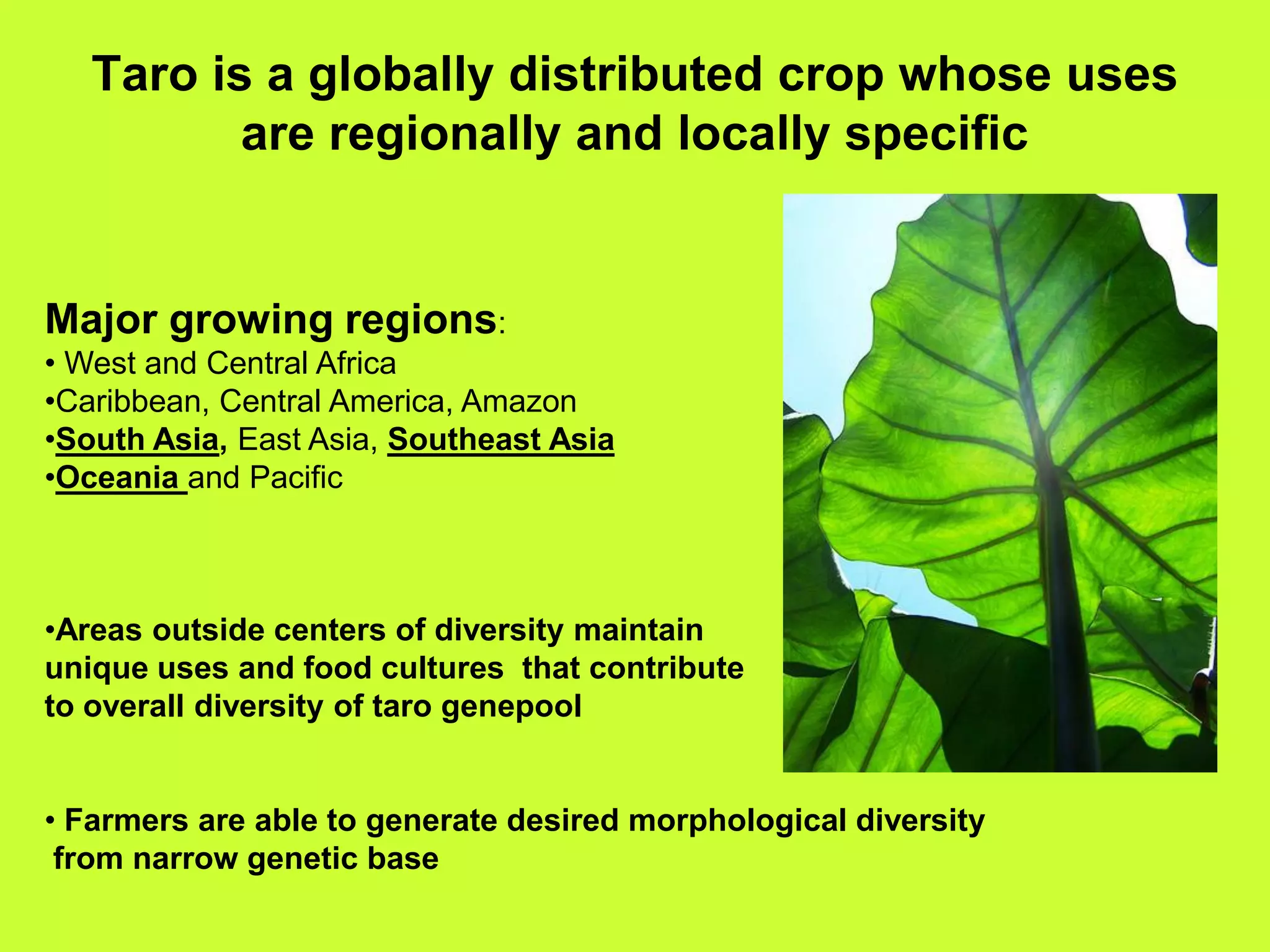
Taro is a globally distributed crop whose uses
are regionally and locally specific
Major growing regions:
• West and Central Africa
•Caribbean, Central America, Amazon
•South Asia, East Asia, Southeast Asia
•Oceania and Pacific
•Areas outside centers of diversity maintain
unique uses and food cultures that contribute
to overall diversity of taro genepool
• Farmers are able to generate desired morphological diversity
from narrow genetic base
Diversity in corm shape of some preferred and widely grown
local taro cultivars in Yunnan
Why research and support
farmers’ management of
taro?
Taro has been managed by farmers and rural communities
and largely neglected by the international research
community – it continues to be!
Taro provides a model for in situ conservation of
vegetatively propagated species where farmer selection and
“domestication”, evolution is a continuous process.
Conservation of taro genetic diversity in situ can focus on
food cultures and farming systems where taro is used in all
its states , wild, naturalised, and under low input or high
input cultivation.
Things do go wrong? How scientists can support farmers’
management of taro in times of crisis and facilitate access to
the global taro gene pool
Why research and support farmers’
management of taro?
Arrival & Impact of TLB
Taro leaf blight (TLB), caused by Phytophthora colocasiae, first
described from Java in 1900. Moved into Pacific region
between 1920s-1940s. Most recent and devastating
introduction to the Samoas in 1990s.
Taro improvement and utilisation
Bioversity working with partners developed a complementary
conservation strategy to safeguard and maintain taro genetic
diversity but despite this two important challenges still remain:
• Devastating problem of taro leaf blight disease as a constraint
in the field still remained. How could the resistance of the crop
to this disease be improved?
• How could improved, resistant taro germplasm, and other taro
accessions (core collection), be safely moved internationally
between countries to deal with new TLB outbreaks – Africa,
Caribbean?
Taro breeding
• Bioversity working with partners established two taro breeding
programmes in Samoa and Papua New Guinea (PNG).
• Breeding strategy based on horizontal and durable resistance,
recurrent selection, population breeding
• To date, 5 disease resistant taro varieties have been released in
PNG
• Numerous lines of disease resistant taro lines have been
evaluated by farmers in Samoa as part of a participatory
plant breeding (PPB) programme and disseminated
Breeding activities – seedlings to nursery
(6 to 7 mths from pollination to seedling distribution)
Taro Improvement Programme (TIP)
Formation of
University
Breeders
Clubs
Selected progeny from cycle-3
recommended variety for export (MAFF/farmers)
Variety:
Samoa 3
Village road side
taro market
Corm yield:
1 to 2 kg
Selected progeny from cycle-5
export variety recommended by MAFF/farmers
Variety:
Samoa 2
Corm yield:
1 to 3 kg
Cleaning taro for
NZ market - 2010
Parental lines:
Pacific x Malaysian
Progeny from cycle-6 (2010 selection)
on-farm, farmer’s choice: good quality for export
Clone #:
C6-095B
Parental lines:
Pacific x Malaysian line
Corm shape &
color
export quality
Eating quality:
excellent
Yellow flesh
Corm weight:
1 to 4kg
Selected progeny from cycle-7
Clone # C7-BC1 - 203
Yield from a
13 months old
plant
Corm weight:
7 kg
Eating quality:
very good
Flesh color:
yellow
Parental line:
Pacific x Malaysian
Ongoing taro research, INEA …..
Ongoing taro research, Mapping Edible Aroids…..
Acknowledgements
TaroGen and TANSAO Networks
University of the South Pacific (USP)
Secretariat of the South Pacific (SPC)
International Network for Edible Aroids (INEA)
Pablo Eyzaguirre, Bioversity International
Peter Matthews, National Museum of Ethnology, Japan
Karin Vaneker, Mapping Edible Aroids initiative

Global diversity of taro: conservation and use

  • 1.
    The Global Diversityof Taro: Ethnobotany, Conservation and Use
  • 2.
  • 3.
  • 4.
  • 6.
  • 8.
    Taro is culturallyand spiritually important….
  • 9.
    Taro is economicallyimportant….
  • 10.
    …but for millions worldwidetaro is a staple food
  • 15.
    Custodians: Taro hasbeen conserved and managed by farmers for thousands of years
  • 16.
    Taro is aglobally distributed crop whose uses are regionally and locally specific Major growing regions: • West and Central Africa •Caribbean, Central America, Amazon •South Asia, East Asia, Southeast Asia •Oceania and Pacific •Areas outside centers of diversity maintain unique uses and food cultures that contribute to overall diversity of taro genepool • Farmers are able to generate desired morphological diversity from narrow genetic base
  • 17.
    Diversity in cormshape of some preferred and widely grown local taro cultivars in Yunnan
  • 19.
    Why research andsupport farmers’ management of taro?
  • 20.
    Taro has beenmanaged by farmers and rural communities and largely neglected by the international research community – it continues to be! Taro provides a model for in situ conservation of vegetatively propagated species where farmer selection and “domestication”, evolution is a continuous process. Conservation of taro genetic diversity in situ can focus on food cultures and farming systems where taro is used in all its states , wild, naturalised, and under low input or high input cultivation. Things do go wrong? How scientists can support farmers’ management of taro in times of crisis and facilitate access to the global taro gene pool Why research and support farmers’ management of taro?
  • 21.
    Arrival & Impactof TLB Taro leaf blight (TLB), caused by Phytophthora colocasiae, first described from Java in 1900. Moved into Pacific region between 1920s-1940s. Most recent and devastating introduction to the Samoas in 1990s.
  • 23.
    Taro improvement andutilisation Bioversity working with partners developed a complementary conservation strategy to safeguard and maintain taro genetic diversity but despite this two important challenges still remain: • Devastating problem of taro leaf blight disease as a constraint in the field still remained. How could the resistance of the crop to this disease be improved? • How could improved, resistant taro germplasm, and other taro accessions (core collection), be safely moved internationally between countries to deal with new TLB outbreaks – Africa, Caribbean?
  • 24.
    Taro breeding • Bioversityworking with partners established two taro breeding programmes in Samoa and Papua New Guinea (PNG). • Breeding strategy based on horizontal and durable resistance, recurrent selection, population breeding • To date, 5 disease resistant taro varieties have been released in PNG • Numerous lines of disease resistant taro lines have been evaluated by farmers in Samoa as part of a participatory plant breeding (PPB) programme and disseminated
  • 26.
    Breeding activities –seedlings to nursery (6 to 7 mths from pollination to seedling distribution)
  • 27.
  • 28.
  • 29.
    Selected progeny fromcycle-3 recommended variety for export (MAFF/farmers) Variety: Samoa 3 Village road side taro market Corm yield: 1 to 2 kg
  • 30.
    Selected progeny fromcycle-5 export variety recommended by MAFF/farmers Variety: Samoa 2 Corm yield: 1 to 3 kg Cleaning taro for NZ market - 2010 Parental lines: Pacific x Malaysian
  • 31.
    Progeny from cycle-6(2010 selection) on-farm, farmer’s choice: good quality for export Clone #: C6-095B Parental lines: Pacific x Malaysian line Corm shape & color export quality Eating quality: excellent Yellow flesh Corm weight: 1 to 4kg
  • 32.
    Selected progeny fromcycle-7 Clone # C7-BC1 - 203 Yield from a 13 months old plant Corm weight: 7 kg Eating quality: very good Flesh color: yellow Parental line: Pacific x Malaysian
  • 33.
  • 34.
    Ongoing taro research,Mapping Edible Aroids…..
  • 36.
    Acknowledgements TaroGen and TANSAONetworks University of the South Pacific (USP) Secretariat of the South Pacific (SPC) International Network for Edible Aroids (INEA) Pablo Eyzaguirre, Bioversity International Peter Matthews, National Museum of Ethnology, Japan Karin Vaneker, Mapping Edible Aroids initiative