Mr.R.R.Patil
Dr.Shivajirao Kadam College of Pharmacy,
Kasabe Digraj, Sangli
 The human skin is the outer covering of the
body.
 In humans, it is the largest organ of the
integumentary system. The skin has up to
seven layers of ectodermal tissue and guards
the underlying muscles, bones, ligaments and
internal organs.
 There are two general types of skin, hairy and
glabrous skin (hairless).
 Because it interfaces with the environment, skin plays
an important immunity role in protecting the body
against pathogens and excessive water loss.
 Its other functions are insulation, temperature
regulation, sensation, synthesis of vitamin D, and the
protection of vitamin B folates.
 Severely damaged skin will try to heal by forming scar
tissue.
 In humans, skin pigmentation varies among
populations, and skin type can range from dry to oily.
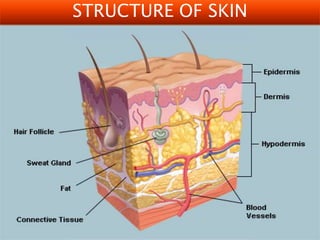
STRUCTURE OF SKIN
 Skin is composed of three primary layers: the
epidermis, the dermis and the hypodermis.
EPIDERMIS
 Epidermis is the outermost layer of the skin.
 It forms the waterproof, protective wrap over the
body's surface which also serves as a barrier to
infection.
 The epidermis contains no blood vessels, and
cells in the deepest layers are nourished almost
exclusively by diffused oxygen from the
surrounding air.
 The main type of cells which make up the
epidermis are keratinocytes, melanocytes,
Langerhans cells and Markel's cells. The
epidermis helps the skin to regulate body
temperature.
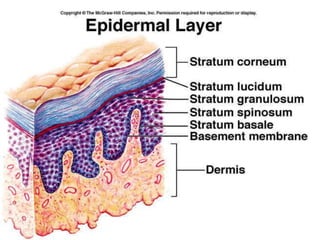
 Epidermis is divided into the following 5 sub
layers
 Stratum corneum
 Stratum lucidum
 Stratum granulosum
 Stratum spinosum
 Stratum basale
 The stratum corneum is the outermost layer of
the epidermis.
 It consisting of dead cells (corneocytes).
 The stratum corneum is the rate limiting barrier
that restricts the inward & outward movement of
chemical substances.
 These corneocytes are embedded in a lipid
matrix composed of ceramides, cholesterol, and
fatty acids.
 The stratum corneum functions to form a barrier
to protect underlying tissue from infection,
dehydration, chemicals and mechanical stress.
 stratum corneum contain a dense network of
keratin, a protein that helps keep the skin
hydrated by preventing water evaporation.
 These cells can also absorb water, further aiding
in hydration.
 This layer is responsible for the "spring back" or
stretchy properties of skin.
 The stratum corneum exhibit regional difference
in thickness over the body.
 In the over most of the body it is about 10µm
thick.
 When dry, increasing to about 40µm to 50µm.
 It is thick on the palm of the hand & soles of the
feet in an adult.
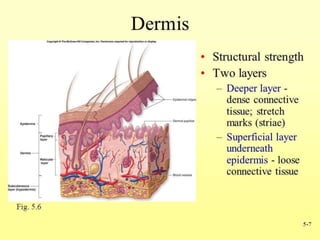
 The dermis is the layer of skin beneath the
epidermis that consists of epithelial tissue and
cushions the body from stress and strain.
 The dermis is tightly connected to the epidermis
by a basement membrane.
 It also harbors many nerve endings that provide
the sense of touch and heat.
 It contains the hair follicles, sweat glands,
sebaceous glands, apocrine glands, lymphatic
vessels and blood vessels.
 The blood vessels in the dermis provide
nourishment and waste removal from its own
cells as well as from the Stratum basale of the
epidermis.
 The dermis is structurally divided into two
areas: a superficial area adjacent to the
epidermis, called the papillary region, and a
deep thicker area known as the reticular
region.
Absorption of substances through the skin depends
on a number of factors:
 Concentration
 Molecular Weight of the molecule
 Duration of contact
 Solubility of medication
 Physical condition of the skin
 Part of the body exposed including the amount of
hair on the skin.
 small amounts of chemicals may enter the body
rapidly through the glands or hair follicles, they
are primarily absorbed through the epidermis.
 The stratum corneum is the outermost layer of
the epidermis and the rate-limiting barrier in
absorption of an agent.
 Once a substance passes through stratum
corneum, then its no significant further
hindrance to penetration of the remaining
epidermal layer & corium.
 The stratum corneum is primarily composed
of lipophilic cholesterol, cholesterol esters
and ceramides (fatty acids).
 Thus lipid-soluble chemicals make it through
the layer and into the circulation faster,
however nearly all molecules penetrate it to
some minimal degree.
 Also, penetration depending upon effective
blood flow, interstitial fluid movement.
For bioavailability there are two factors are most
important
1. Choice of vehicle (Base).
2. Maximizing movement (partitioning) of drug
from vehicle to stratum corneum.
 Greases & oils are the most occlusive vehicles
those induce the greatest hydration through
sweat & accumulation at the skin-vehicle
interface.
 Vehicle such as, humectants, they have high
affinity for water.
 Such vehicle dehydrate the stratum corneum &
decrease the penetration.
 Powders increases the rate of evaporation of
water.
 paraffin bases suppress transepidermal water
diffusion.
 Skin secretions are more readily miscible with
emulsion bases than with greasy bases.
 This miscible drugs is more rapidly release to
the skin.
 So, that type of the bases required small amount
of medicament required.
 The medicament is favored vehicles which have
low soluble.
 On that reason, they loosely combine with
vehicle.
 Therefore, the rate of release from such drug-
vehicle combination is fast.
 Surface active agents appears to increase
permeability of the skin to water by altering the
physical state of water in the skin.
 Anionics surfactant have good ability to
penetration than cationics & non-ionics.
 Soaps of different fatty acids have greater
penetration for salts of fatty acids having a
carbon length of 10 or less.
 Drugs with molecular weight of 100 to 800 &
adequate lipid & aqueous solubility can
permeate skin.
 The ideal molecular weight of drug for
transdermal drug delivery is to be 400 or less.
 Generally, longer the medicated application is
permitted to remain contact with the skin, the
greater is the total drug absorption.
Human skin

Human skin

  • 1.
    Mr.R.R.Patil Dr.Shivajirao Kadam Collegeof Pharmacy, Kasabe Digraj, Sangli
  • 2.
     The humanskin is the outer covering of the body.  In humans, it is the largest organ of the integumentary system. The skin has up to seven layers of ectodermal tissue and guards the underlying muscles, bones, ligaments and internal organs.
  • 3.
     There aretwo general types of skin, hairy and glabrous skin (hairless).  Because it interfaces with the environment, skin plays an important immunity role in protecting the body against pathogens and excessive water loss.  Its other functions are insulation, temperature regulation, sensation, synthesis of vitamin D, and the protection of vitamin B folates.  Severely damaged skin will try to heal by forming scar tissue.  In humans, skin pigmentation varies among populations, and skin type can range from dry to oily.
  • 4.
  • 5.
     Skin iscomposed of three primary layers: the epidermis, the dermis and the hypodermis. EPIDERMIS  Epidermis is the outermost layer of the skin.  It forms the waterproof, protective wrap over the body's surface which also serves as a barrier to infection.  The epidermis contains no blood vessels, and cells in the deepest layers are nourished almost exclusively by diffused oxygen from the surrounding air.
  • 6.
     The maintype of cells which make up the epidermis are keratinocytes, melanocytes, Langerhans cells and Markel's cells. The epidermis helps the skin to regulate body temperature.  Epidermis is divided into the following 5 sub layers  Stratum corneum  Stratum lucidum  Stratum granulosum  Stratum spinosum  Stratum basale
  • 8.
     The stratumcorneum is the outermost layer of the epidermis.  It consisting of dead cells (corneocytes).  The stratum corneum is the rate limiting barrier that restricts the inward & outward movement of chemical substances.  These corneocytes are embedded in a lipid matrix composed of ceramides, cholesterol, and fatty acids.
  • 9.
     The stratumcorneum functions to form a barrier to protect underlying tissue from infection, dehydration, chemicals and mechanical stress.  stratum corneum contain a dense network of keratin, a protein that helps keep the skin hydrated by preventing water evaporation.  These cells can also absorb water, further aiding in hydration.  This layer is responsible for the "spring back" or stretchy properties of skin.
  • 10.
     The stratumcorneum exhibit regional difference in thickness over the body.  In the over most of the body it is about 10µm thick.  When dry, increasing to about 40µm to 50µm.  It is thick on the palm of the hand & soles of the feet in an adult.
  • 11.
     The dermisis the layer of skin beneath the epidermis that consists of epithelial tissue and cushions the body from stress and strain.  The dermis is tightly connected to the epidermis by a basement membrane.  It also harbors many nerve endings that provide the sense of touch and heat.
  • 12.
     It containsthe hair follicles, sweat glands, sebaceous glands, apocrine glands, lymphatic vessels and blood vessels.  The blood vessels in the dermis provide nourishment and waste removal from its own cells as well as from the Stratum basale of the epidermis.  The dermis is structurally divided into two areas: a superficial area adjacent to the epidermis, called the papillary region, and a deep thicker area known as the reticular region.
  • 14.
    Absorption of substancesthrough the skin depends on a number of factors:  Concentration  Molecular Weight of the molecule  Duration of contact  Solubility of medication  Physical condition of the skin  Part of the body exposed including the amount of hair on the skin.
  • 15.
     small amountsof chemicals may enter the body rapidly through the glands or hair follicles, they are primarily absorbed through the epidermis.  The stratum corneum is the outermost layer of the epidermis and the rate-limiting barrier in absorption of an agent.  Once a substance passes through stratum corneum, then its no significant further hindrance to penetration of the remaining epidermal layer & corium.
  • 16.
     The stratumcorneum is primarily composed of lipophilic cholesterol, cholesterol esters and ceramides (fatty acids).  Thus lipid-soluble chemicals make it through the layer and into the circulation faster, however nearly all molecules penetrate it to some minimal degree.  Also, penetration depending upon effective blood flow, interstitial fluid movement.
  • 17.
    For bioavailability thereare two factors are most important 1. Choice of vehicle (Base). 2. Maximizing movement (partitioning) of drug from vehicle to stratum corneum.
  • 18.
     Greases &oils are the most occlusive vehicles those induce the greatest hydration through sweat & accumulation at the skin-vehicle interface.  Vehicle such as, humectants, they have high affinity for water.  Such vehicle dehydrate the stratum corneum & decrease the penetration.
  • 19.
     Powders increasesthe rate of evaporation of water.  paraffin bases suppress transepidermal water diffusion.  Skin secretions are more readily miscible with emulsion bases than with greasy bases.  This miscible drugs is more rapidly release to the skin.  So, that type of the bases required small amount of medicament required.
  • 20.
     The medicamentis favored vehicles which have low soluble.  On that reason, they loosely combine with vehicle.  Therefore, the rate of release from such drug- vehicle combination is fast.
  • 21.
     Surface activeagents appears to increase permeability of the skin to water by altering the physical state of water in the skin.  Anionics surfactant have good ability to penetration than cationics & non-ionics.  Soaps of different fatty acids have greater penetration for salts of fatty acids having a carbon length of 10 or less.
  • 22.
     Drugs withmolecular weight of 100 to 800 & adequate lipid & aqueous solubility can permeate skin.  The ideal molecular weight of drug for transdermal drug delivery is to be 400 or less.  Generally, longer the medicated application is permitted to remain contact with the skin, the greater is the total drug absorption.