Human Resource Management
Chapter 1
Management of Human Capital
in Organizations
• Human Capital
– The collective value of the capabilities, knowledge,
skills, life experiences, and motivation of an
organizational workforce.
– Also known as intellectual capital.

• Core Competency
– A unique capability that creates high value and
differentiates an organization from its competition.
– HR competencies: a source of competitive advantage.
Human Resource Management
• Meaning
– The policies and practices involved in carrying out the
“people” or human resource aspects of a management
position, including recruiting, screening, training,
rewarding, and appraising.
– The design of formal systems in an organization to ensure
effective and efficient use of human talent to accomplish
organizational goals.
– The policies, practices, and systems that influence
employees’ behavior, attitudes, and performance.

3
• Meaning
– The policies, practices, and systems that influence
employees’ behavior, attitudes, and performance.
– HRM is viewed as a means of moving people along to
achieve
organisational
goals
through
staffing,
performance, change management and administrative
objectives.
• HR creates value by engaging in activities that produce the
employee behaviors that the company needs to achieve its
strategic goals.
Goals of HRM
• Attract, retain, and motivate employees
• Direct employee efforts toward goals of
organization
• Assist in the development of the strategic
direction of the organization
• Provide the organization a source of
competitive advantage
• Help ensure legal compliance
5
HR Activities
•
•
•
•
•
•
•

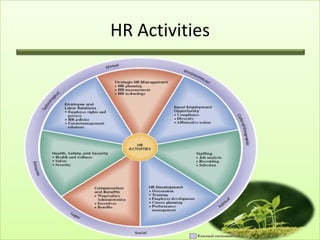
Strategic HR Management
Equal Employment Opportunity
Staffing
HR Development
Compensation and Benefits
Health, Safety, and Security
Employee and Labor Relations
HR Activities
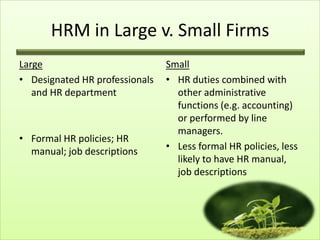
HRM in Large v. Small Firms
Large
• Designated HR professionals
and HR department

• Formal HR policies; HR
manual; job descriptions

Small
• HR duties combined with
other administrative
functions (e.g. accounting)
or performed by line
managers.
• Less formal HR policies, less
likely to have HR manual,
job descriptions

8
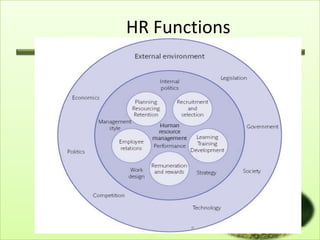
HR Functions

9
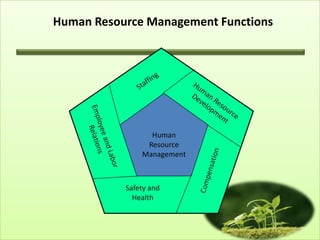
Human Resource Management Functions

Human
Resource
1
Management

Safety and
Health

10
i. Staffing
• Staffing
– Process through which an organization ensures it always
has the proper number of employees with appropriate
skills in right jobs at right time to achieve organizational
objectives
• Job analysis
– Systematic process of determining skills, duties, and
knowledge required for performing jobs in an organization
• Human resource planning
– Systematic process of matching the internal and external
supply of people with job openings anticipated in the
organization over a specified period of time .

11
Staffing (Cont.)
• Recruitment
– Process of attracting individuals on a timely basis, in
sufficient numbers, and with appropriate qualifications,
to apply for jobs with an organization

• Selection
– Process of choosing from a group of applicants the
individual best suited for a particular position and the
organization

12
ii. Human Resource Development
• Training
• Development
• Career Planning
• Career Development
• Organizational Development
• Performance Management
• Performance Appraisal

13
Human Resource Development (Cont.)
• Training

– Designed to provide learners with knowledge and
skills needed for their present jobs

• Development

– Involves learning that goes beyond today's job; it has
more long-term focus

• Career planning

– Ongoing process whereby individual sets career goals
and identifies means to achieve them

• Career development

– Formal approach used by organization to ensure that
people with proper qualifications and experiences are
available when needed
14
• Organization development
– Planned process of improving organization by
developing its structures, systems, and processes to
improve effectiveness and achieving desired goals

• Performance management
– Goal-oriented process directed toward ensuring
organizational processes are in place to maximize
productivity of employees, teams, and ultimately,
the organization

• Performance appraisal
– Formal system of review and evaluation of individual
or team task performance
15
iii. Compensation
• Compensation
– All rewards that individuals receive as a result of their
employment
• Direct Financial Compensation
– Pay that person receives in form of wages, salaries, bonuses,
and commissions.

• Indirect Financial Compensation (Benefits)
– All financial rewards not included in direct compensation such
as paid vacations, sick leave, holidays, and medical insurance.

• Nonfinancial Compensation
– Satisfaction that person receives from job itself or from
psychological and/or physical environment in which person
works.
16
iv. Safety and Health
• Employees who work in a safe environment and
enjoy good health are more likely to be productive
and yield long-term benefits to organization.
• Safety
– Involves protecting employees from injuries caused by
work-related accidents

• Health
– Refers to employees' freedom from illness and their
general physical and mental well being

17
v. Employee and Labor Relations
• Business is required by law to recognize a union and
bargain with it in good faith if the firm’s employees
want the union to represent them
• Human resource activity is often referred to as
industrial relations
• Most firms today would rather have a union-free
environment

18
HR Management Challenges
• Globalization of Business
– Outsourcing and increased competition

• Economic and Technological Changes
– Occupational shifts from manufacturing and
agriculture
to
service
industries
and
telecommunications
– Pressures of global competition causing firms to adapt
by lowering costs and increasing productivity

• Technological Shifts and the Internet
– Growth of information technology
Copyright © 2005 Thomson
Business & Professional
Publishing. All rights reserved.

1–19
HR Management Challenges
• Workforce Availability and Quality Concerns
– Inadequate supply of workers with needed skills for
“knowledge jobs”
– Education of workers in basic skills

• Growth in Contingent Workforce
– Increases in temporary workers, independent
contractors, leased employees, and part-timers
caused by:
• Need for flexibility in staffing levels
• Increased difficulty in firing regular employees.
• Reduced legal liability from contract employees
HR Management Challenges
• Workforce Demographics and Diversity
– Increasing Racial/Ethnic Diversity
– More Women in the Workforce
• Single-parent households
• Dual-career couples
• Domestic partners
• Working mothers and family/childcare

– Significantly Aging Workforce
• Age discrimination
HR Management Challenges
• Organizational Cost Pressures and Restructuring
– Mergers and Acquisitions
– “Right-sizing”—eliminating of layers of management,
closing facilities, merging with other organizations,
and outplacing workers
• Intended results are flatter organizations, increases in
productivity, quality, service and lower costs.
• Costs are “survivor mentality”, loss of employee loyalty, and
turnover of valuable employees.

– HR managers must work toward ensuring cultural
compatibility in mergers.
HR Management Roles
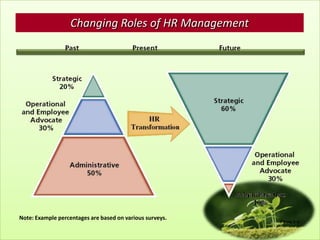
• Administrative Role
– Clerical and administrative support operations
(e.g., payroll and benefits work)
• Technology is transforming how HR services are
delivered.
• Outsourcing HR services to reduce HR staffing costs

• Operational and Employee Advocate Role
– “Champion” for employee concerns
• Employee crisis management
• Responding to employee complaints
Changing Roles of HR Management

Note: Example percentages are based on various surveys.

Figure 1–5
Strategic Role for HR
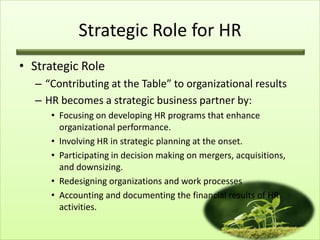
• Strategic Role
– “Contributing at the Table” to organizational results
– HR becomes a strategic business partner by:
• Focusing on developing HR programs that enhance
organizational performance.
• Involving HR in strategic planning at the onset.
• Participating in decision making on mergers, acquisitions,
and downsizing.
• Redesigning organizations and work processes
• Accounting and documenting the financial results of HR
activities.
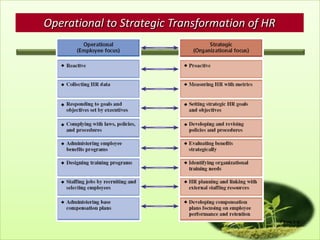
Operational to Strategic Transformation of HR

Figure 1–6
New Approaches to HR Management
• Collaborative HR
– The process of HR professionals from several
different organizations working jointly to address
shared business problems.
• Firms benefit from the expertise of other firms, without
having the time and expense of developing some of
their own HR practices.
HR Technology
• Human Resource Management System (HRMS)
– An integrated system providing information used by
HR management in decision making.
– Purposes (Benefits) of HRMS
• Administrative and operational efficiency in compiling HR
data
• Availability of data for effective HR strategic planning

– Uses of HRMS
• Automation of payroll and benefit activities
• EEO/affirmative action tracking
• HR Workflow: increased access to HR information
– Employee self-service reduces HR costs.

Human resource amnagement

  • 1.
  • 2.
    Management of HumanCapital in Organizations • Human Capital – The collective value of the capabilities, knowledge, skills, life experiences, and motivation of an organizational workforce. – Also known as intellectual capital. • Core Competency – A unique capability that creates high value and differentiates an organization from its competition. – HR competencies: a source of competitive advantage.
  • 3.
    Human Resource Management •Meaning – The policies and practices involved in carrying out the “people” or human resource aspects of a management position, including recruiting, screening, training, rewarding, and appraising. – The design of formal systems in an organization to ensure effective and efficient use of human talent to accomplish organizational goals. – The policies, practices, and systems that influence employees’ behavior, attitudes, and performance. 3
  • 4.
    • Meaning – Thepolicies, practices, and systems that influence employees’ behavior, attitudes, and performance. – HRM is viewed as a means of moving people along to achieve organisational goals through staffing, performance, change management and administrative objectives. • HR creates value by engaging in activities that produce the employee behaviors that the company needs to achieve its strategic goals.
  • 5.
    Goals of HRM •Attract, retain, and motivate employees • Direct employee efforts toward goals of organization • Assist in the development of the strategic direction of the organization • Provide the organization a source of competitive advantage • Help ensure legal compliance 5
  • 6.
    HR Activities • • • • • • • Strategic HRManagement Equal Employment Opportunity Staffing HR Development Compensation and Benefits Health, Safety, and Security Employee and Labor Relations
  • 7.
  • 8.
    HRM in Largev. Small Firms Large • Designated HR professionals and HR department • Formal HR policies; HR manual; job descriptions Small • HR duties combined with other administrative functions (e.g. accounting) or performed by line managers. • Less formal HR policies, less likely to have HR manual, job descriptions 8
  • 9.
  • 10.
    Human Resource ManagementFunctions Human Resource 1 Management Safety and Health 10
  • 11.
    i. Staffing • Staffing –Process through which an organization ensures it always has the proper number of employees with appropriate skills in right jobs at right time to achieve organizational objectives • Job analysis – Systematic process of determining skills, duties, and knowledge required for performing jobs in an organization • Human resource planning – Systematic process of matching the internal and external supply of people with job openings anticipated in the organization over a specified period of time . 11
  • 12.
    Staffing (Cont.) • Recruitment –Process of attracting individuals on a timely basis, in sufficient numbers, and with appropriate qualifications, to apply for jobs with an organization • Selection – Process of choosing from a group of applicants the individual best suited for a particular position and the organization 12
  • 13.
    ii. Human ResourceDevelopment • Training • Development • Career Planning • Career Development • Organizational Development • Performance Management • Performance Appraisal 13
  • 14.
    Human Resource Development(Cont.) • Training – Designed to provide learners with knowledge and skills needed for their present jobs • Development – Involves learning that goes beyond today's job; it has more long-term focus • Career planning – Ongoing process whereby individual sets career goals and identifies means to achieve them • Career development – Formal approach used by organization to ensure that people with proper qualifications and experiences are available when needed 14
  • 15.
    • Organization development –Planned process of improving organization by developing its structures, systems, and processes to improve effectiveness and achieving desired goals • Performance management – Goal-oriented process directed toward ensuring organizational processes are in place to maximize productivity of employees, teams, and ultimately, the organization • Performance appraisal – Formal system of review and evaluation of individual or team task performance 15
  • 16.
    iii. Compensation • Compensation –All rewards that individuals receive as a result of their employment • Direct Financial Compensation – Pay that person receives in form of wages, salaries, bonuses, and commissions. • Indirect Financial Compensation (Benefits) – All financial rewards not included in direct compensation such as paid vacations, sick leave, holidays, and medical insurance. • Nonfinancial Compensation – Satisfaction that person receives from job itself or from psychological and/or physical environment in which person works. 16
  • 17.
    iv. Safety andHealth • Employees who work in a safe environment and enjoy good health are more likely to be productive and yield long-term benefits to organization. • Safety – Involves protecting employees from injuries caused by work-related accidents • Health – Refers to employees' freedom from illness and their general physical and mental well being 17
  • 18.
    v. Employee andLabor Relations • Business is required by law to recognize a union and bargain with it in good faith if the firm’s employees want the union to represent them • Human resource activity is often referred to as industrial relations • Most firms today would rather have a union-free environment 18
  • 19.
    HR Management Challenges •Globalization of Business – Outsourcing and increased competition • Economic and Technological Changes – Occupational shifts from manufacturing and agriculture to service industries and telecommunications – Pressures of global competition causing firms to adapt by lowering costs and increasing productivity • Technological Shifts and the Internet – Growth of information technology Copyright © 2005 Thomson Business & Professional Publishing. All rights reserved. 1–19
  • 20.
    HR Management Challenges •Workforce Availability and Quality Concerns – Inadequate supply of workers with needed skills for “knowledge jobs” – Education of workers in basic skills • Growth in Contingent Workforce – Increases in temporary workers, independent contractors, leased employees, and part-timers caused by: • Need for flexibility in staffing levels • Increased difficulty in firing regular employees. • Reduced legal liability from contract employees
  • 21.
    HR Management Challenges •Workforce Demographics and Diversity – Increasing Racial/Ethnic Diversity – More Women in the Workforce • Single-parent households • Dual-career couples • Domestic partners • Working mothers and family/childcare – Significantly Aging Workforce • Age discrimination
  • 22.
    HR Management Challenges •Organizational Cost Pressures and Restructuring – Mergers and Acquisitions – “Right-sizing”—eliminating of layers of management, closing facilities, merging with other organizations, and outplacing workers • Intended results are flatter organizations, increases in productivity, quality, service and lower costs. • Costs are “survivor mentality”, loss of employee loyalty, and turnover of valuable employees. – HR managers must work toward ensuring cultural compatibility in mergers.
  • 23.
    HR Management Roles •Administrative Role – Clerical and administrative support operations (e.g., payroll and benefits work) • Technology is transforming how HR services are delivered. • Outsourcing HR services to reduce HR staffing costs • Operational and Employee Advocate Role – “Champion” for employee concerns • Employee crisis management • Responding to employee complaints
  • 24.
    Changing Roles ofHR Management Note: Example percentages are based on various surveys. Figure 1–5
  • 25.
    Strategic Role forHR • Strategic Role – “Contributing at the Table” to organizational results – HR becomes a strategic business partner by: • Focusing on developing HR programs that enhance organizational performance. • Involving HR in strategic planning at the onset. • Participating in decision making on mergers, acquisitions, and downsizing. • Redesigning organizations and work processes • Accounting and documenting the financial results of HR activities.
  • 26.
    Operational to StrategicTransformation of HR Figure 1–6
  • 27.
    New Approaches toHR Management • Collaborative HR – The process of HR professionals from several different organizations working jointly to address shared business problems. • Firms benefit from the expertise of other firms, without having the time and expense of developing some of their own HR practices.
  • 28.
    HR Technology • HumanResource Management System (HRMS) – An integrated system providing information used by HR management in decision making. – Purposes (Benefits) of HRMS • Administrative and operational efficiency in compiling HR data • Availability of data for effective HR strategic planning – Uses of HRMS • Automation of payroll and benefit activities • EEO/affirmative action tracking • HR Workflow: increased access to HR information – Employee self-service reduces HR costs.