Human Genetics Concepts and Applications 9th Edition Lewis Test Bank
Human Genetics Concepts and Applications 9th Edition Lewis Test Bank
Human Genetics Concepts and Applications 9th Edition Lewis Test Bank
Human Genetics Concepts and Applications 9th Edition Lewis Test Bank
Human Genetics Concepts and Applications 9th Edition Lewis Test Bank
1.
Human Genetics Conceptsand Applications 9th
Edition Lewis Test Bank download
https://testbankfan.com/product/human-genetics-concepts-and-
applications-9th-edition-lewis-test-bank/
Explore and download more test bank or solution manual
at testbankfan.com
2.
We believe theseproducts will be a great fit for you. Click
the link to download now, or visit testbankfan.com
to discover even more!
Human Genetics Concepts and Applications 12th Edition
Lewis Test Bank
https://testbankfan.com/product/human-genetics-concepts-and-
applications-12th-edition-lewis-test-bank/
Human Genetics Concepts and Applications 11th Edition
Ricki Lewis Test Bank
https://testbankfan.com/product/human-genetics-concepts-and-
applications-11th-edition-ricki-lewis-test-bank/
Human Genetics Concepts and Applications 11th Edition
Ricki Lewis Solutions Manual
https://testbankfan.com/product/human-genetics-concepts-and-
applications-11th-edition-ricki-lewis-solutions-manual/
Data Analytics for Accounting 1st Edition Richardson
Solutions Manual
https://testbankfan.com/product/data-analytics-for-accounting-1st-
edition-richardson-solutions-manual/
3.
International Economics 6thEdition James Gerber Test Bank
https://testbankfan.com/product/international-economics-6th-edition-
james-gerber-test-bank/
Human Resource Management 10th Edition Torrington Test
Bank
https://testbankfan.com/product/human-resource-management-10th-
edition-torrington-test-bank/
Principles of Macroeconomics 8th Edition Mankiw Test Bank
https://testbankfan.com/product/principles-of-macroeconomics-8th-
edition-mankiw-test-bank/
Economics Canada in the Global Environment Canadian 8th
Edition Parkin Solutions Manual
https://testbankfan.com/product/economics-canada-in-the-global-
environment-canadian-8th-edition-parkin-solutions-manual/
Corporate Financial Accounting 12th Edition Warren Test
Bank
https://testbankfan.com/product/corporate-financial-accounting-12th-
edition-warren-test-bank/
4.
Prescotts Microbiology 10thEdition Willey Test Bank
https://testbankfan.com/product/prescotts-microbiology-10th-edition-
willey-test-bank/
5.
Chapter 08 -Genetics of Behavior
8-1
Chapter 08
Genetics of Behavior
Multiple Choice Questions
1. Which choice accurately conveys the complexity of neural connections in the human
brain?
A. about 100 billion neurons each contact 1,000 to 10,000 other neurons
B. a million or so neurons each contact up to 100,000 other neurons
C. 10 million or so neurons each contact up to 10,000 other neurons
D. a billion or so neurons each contact up to a million other neurons
E. a million or so neurons each contact up to 10 million other neurons
Difficulty: Remember/Understand
Section: 08.01
Topic: Genetics
2. Genes can affect behavior by encoding proteins that
A. form connective tissue.
B. function as neurotransmitter transporters, neurotransmitter receptors, and enzymes that
control the synthesis of neurotransmitters and myelin.
C. aggregate to form synapses.
D. are neurotransmitters or neuroregulators.
E. alter synaptic connections when a person thinks a certain way.
Difficulty: Remember/Understand
Section: 08.01
Topic: Genetics
6.
Chapter 08 -Genetics of Behavior
8-2
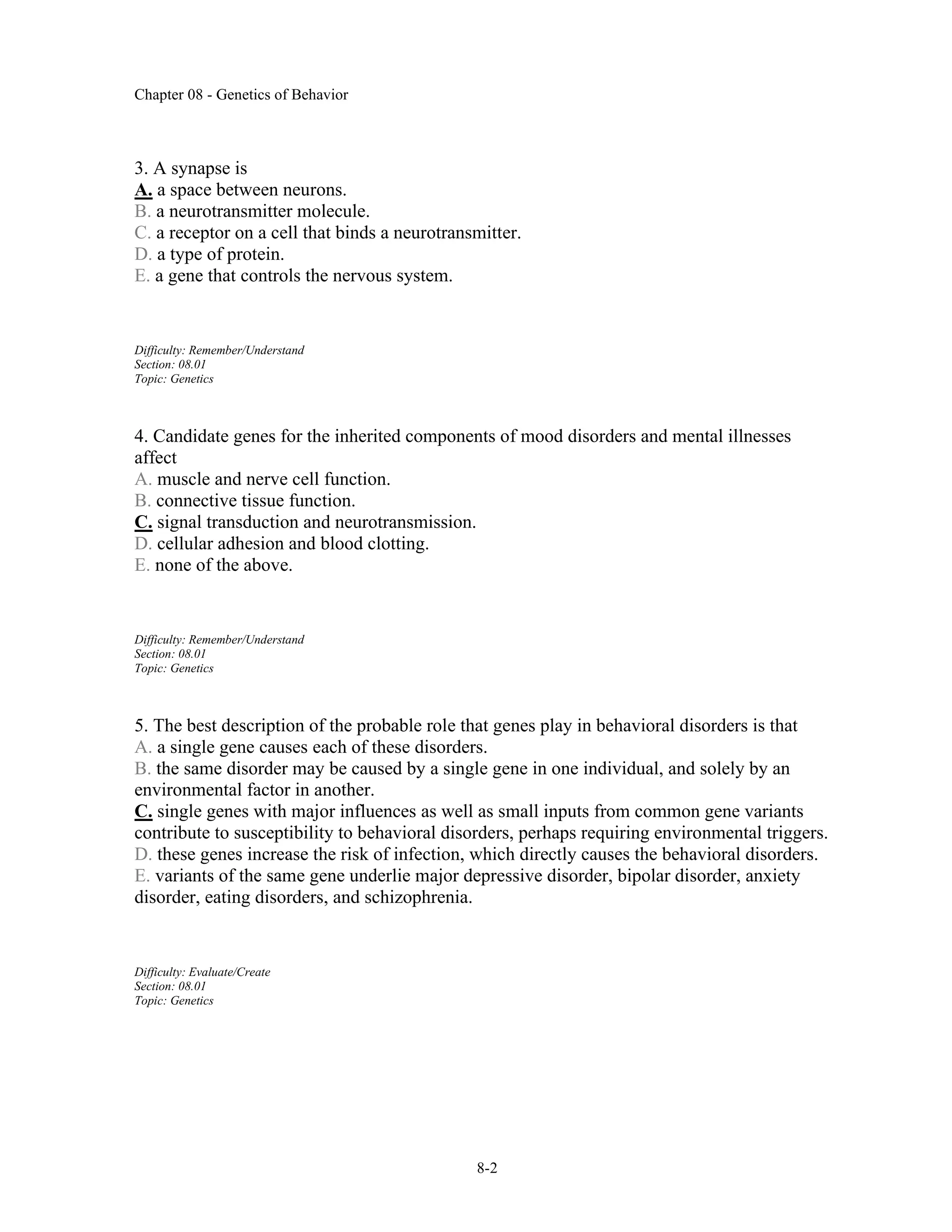
3. A synapse is
A. a space between neurons.
B. a neurotransmitter molecule.
C. a receptor on a cell that binds a neurotransmitter.
D. a type of protein.
E. a gene that controls the nervous system.
Difficulty: Remember/Understand
Section: 08.01
Topic: Genetics
4. Candidate genes for the inherited components of mood disorders and mental illnesses
affect
A. muscle and nerve cell function.
B. connective tissue function.
C. signal transduction and neurotransmission.
D. cellular adhesion and blood clotting.
E. none of the above.
Difficulty: Remember/Understand
Section: 08.01
Topic: Genetics
5. The best description of the probable role that genes play in behavioral disorders is that
A. a single gene causes each of these disorders.
B. the same disorder may be caused by a single gene in one individual, and solely by an
environmental factor in another.
C. single genes with major influences as well as small inputs from common gene variants
contribute to susceptibility to behavioral disorders, perhaps requiring environmental triggers.
D. these genes increase the risk of infection, which directly causes the behavioral disorders.
E. variants of the same gene underlie major depressive disorder, bipolar disorder, anxiety
disorder, eating disorders, and schizophrenia.
Difficulty: Evaluate/Create
Section: 08.01
Topic: Genetics
7.
Chapter 08 -Genetics of Behavior
8-3
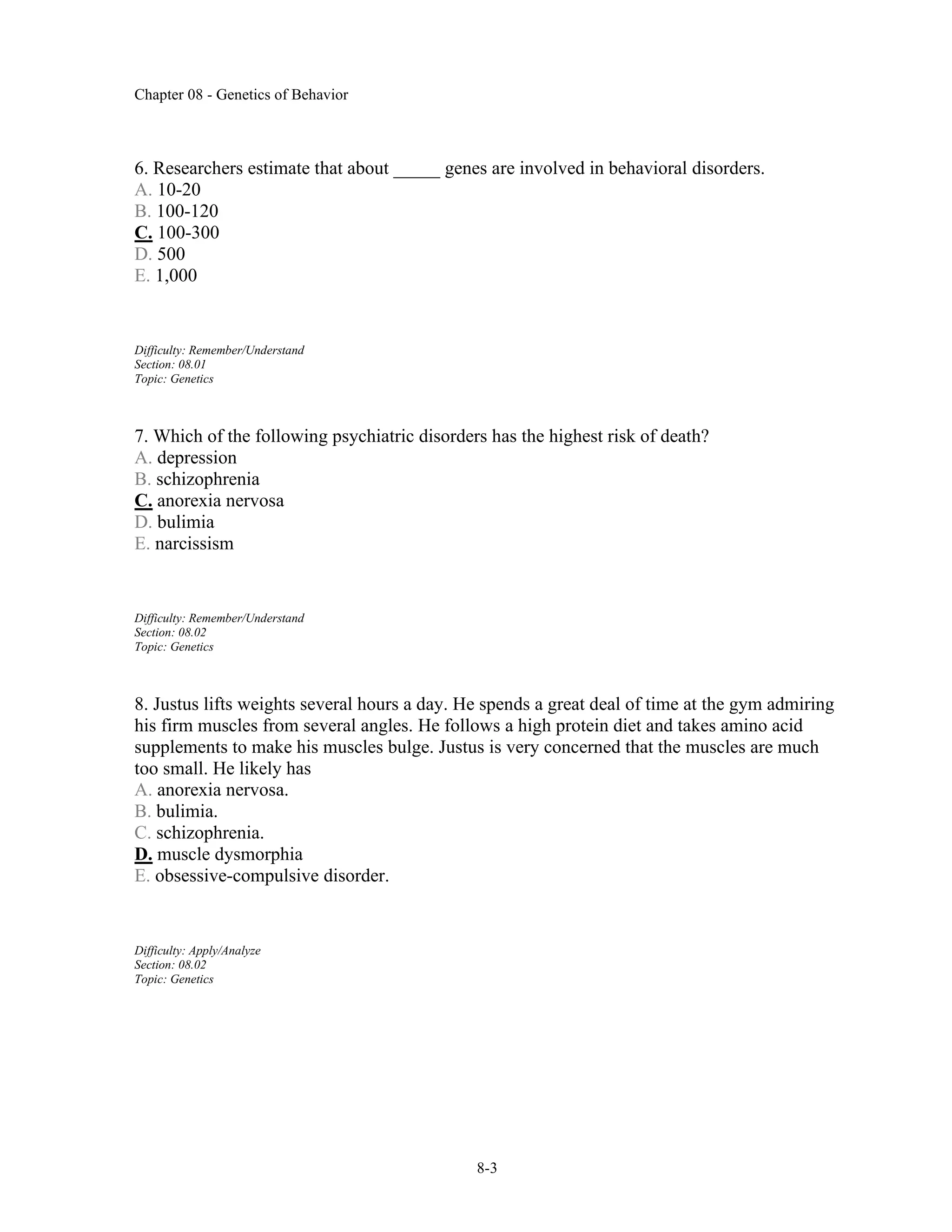
6. Researchers estimate that about _____ genes are involved in behavioral disorders.
A. 10-20
B. 100-120
C. 100-300
D. 500
E. 1,000
Difficulty: Remember/Understand
Section: 08.01
Topic: Genetics
7. Which of the following psychiatric disorders has the highest risk of death?
A. depression
B. schizophrenia
C. anorexia nervosa
D. bulimia
E. narcissism
Difficulty: Remember/Understand
Section: 08.02
Topic: Genetics
8. Justus lifts weights several hours a day. He spends a great deal of time at the gym admiring
his firm muscles from several angles. He follows a high protein diet and takes amino acid
supplements to make his muscles bulge. Justus is very concerned that the muscles are much
too small. He likely has
A. anorexia nervosa.
B. bulimia.
C. schizophrenia.
D. muscle dysmorphia
E. obsessive-compulsive disorder.
Difficulty: Apply/Analyze
Section: 08.02
Topic: Genetics
8.
Chapter 08 -Genetics of Behavior
8-4
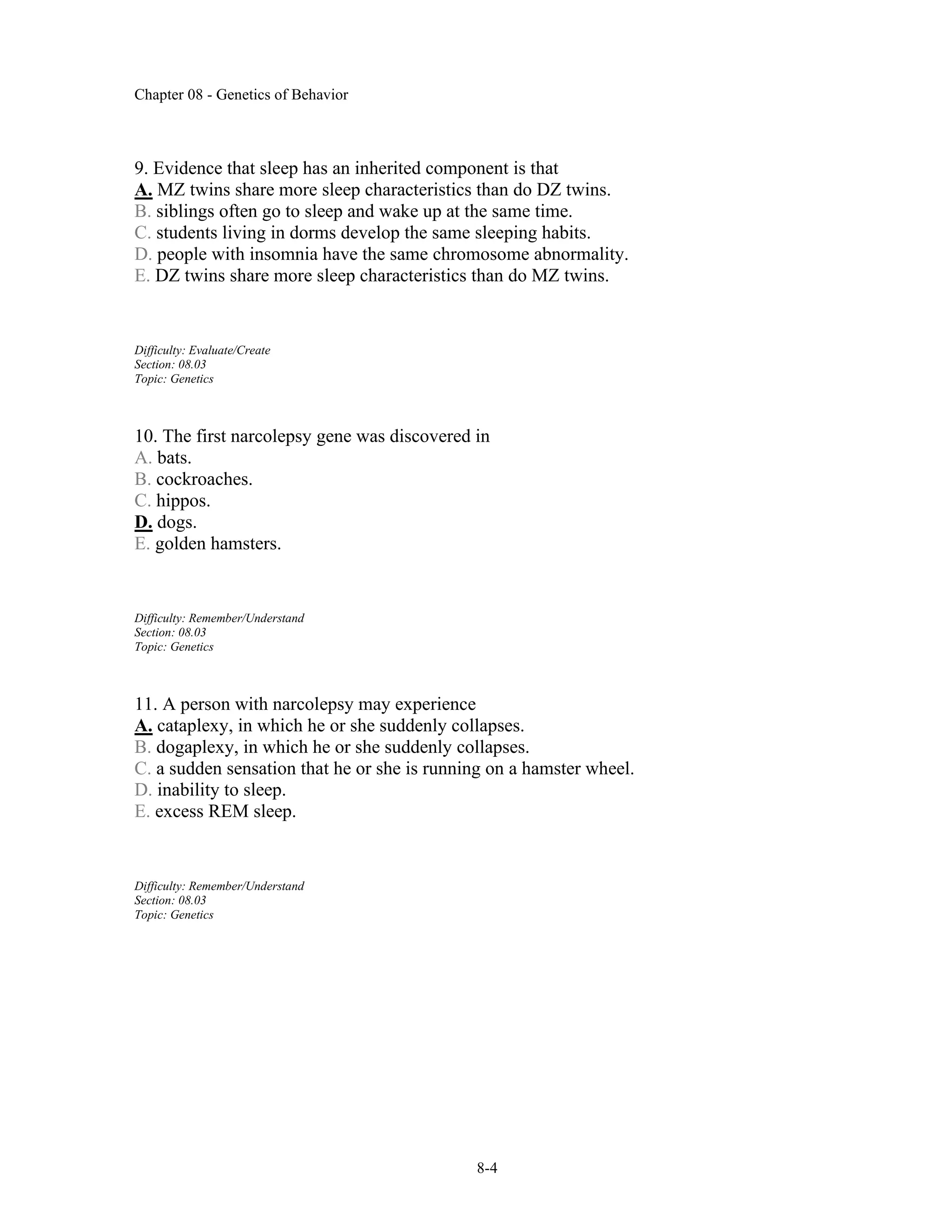
9. Evidence that sleep has an inherited component is that
A. MZ twins share more sleep characteristics than do DZ twins.
B. siblings often go to sleep and wake up at the same time.
C. students living in dorms develop the same sleeping habits.
D. people with insomnia have the same chromosome abnormality.
E. DZ twins share more sleep characteristics than do MZ twins.
Difficulty: Evaluate/Create
Section: 08.03
Topic: Genetics
10. The first narcolepsy gene was discovered in
A. bats.
B. cockroaches.
C. hippos.
D. dogs.
E. golden hamsters.
Difficulty: Remember/Understand
Section: 08.03
Topic: Genetics
11. A person with narcolepsy may experience
A. cataplexy, in which he or she suddenly collapses.
B. dogaplexy, in which he or she suddenly collapses.
C. a sudden sensation that he or she is running on a hamster wheel.
D. inability to sleep.
E. excess REM sleep.
Difficulty: Remember/Understand
Section: 08.03
Topic: Genetics
9.
Chapter 08 -Genetics of Behavior
8-5
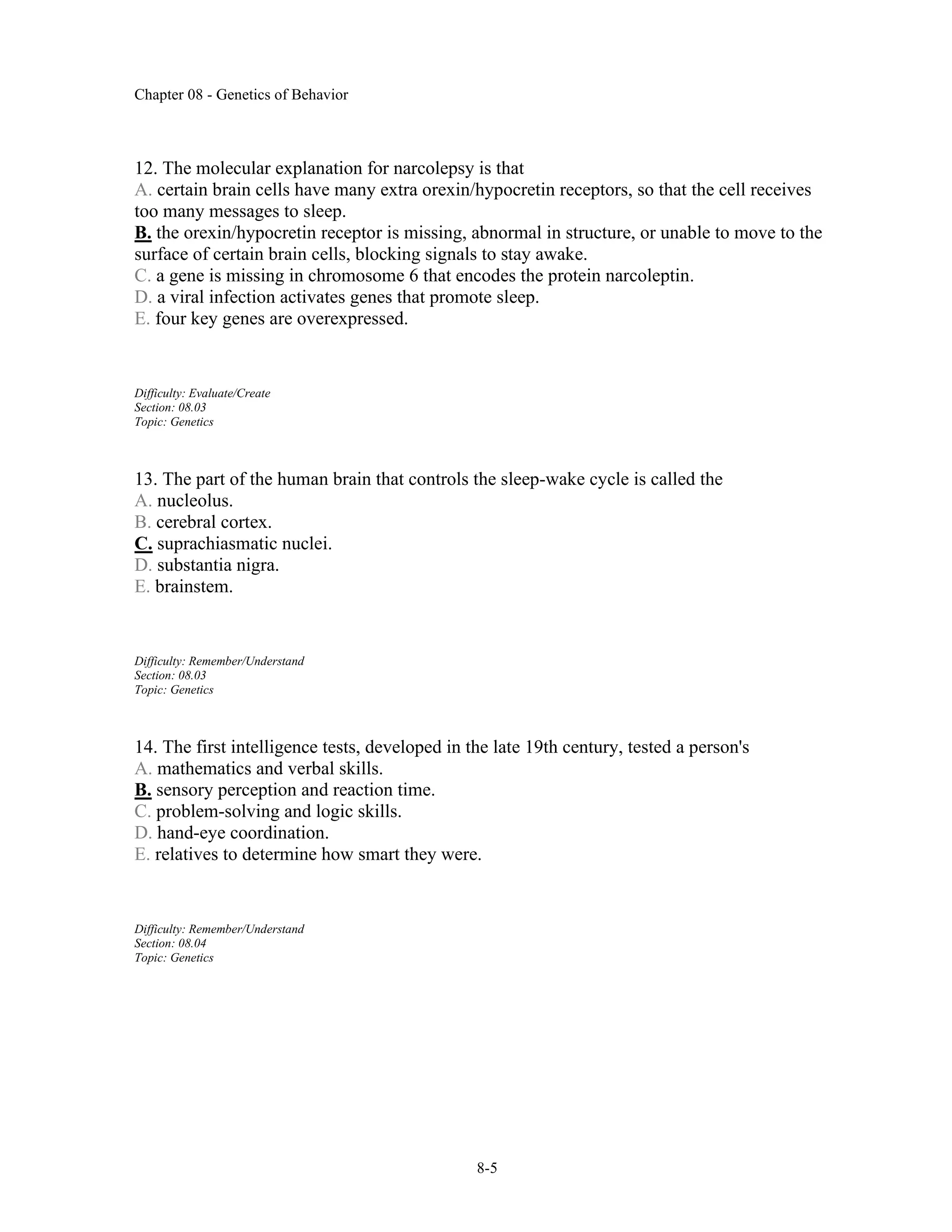
12. The molecular explanation for narcolepsy is that
A. certain brain cells have many extra orexin/hypocretin receptors, so that the cell receives
too many messages to sleep.
B. the orexin/hypocretin receptor is missing, abnormal in structure, or unable to move to the
surface of certain brain cells, blocking signals to stay awake.
C. a gene is missing in chromosome 6 that encodes the protein narcoleptin.
D. a viral infection activates genes that promote sleep.
E. four key genes are overexpressed.
Difficulty: Evaluate/Create
Section: 08.03
Topic: Genetics
13. The part of the human brain that controls the sleep-wake cycle is called the
A. nucleolus.
B. cerebral cortex.
C. suprachiasmatic nuclei.
D. substantia nigra.
E. brainstem.
Difficulty: Remember/Understand
Section: 08.03
Topic: Genetics
14. The first intelligence tests, developed in the late 19th century, tested a person's
A. mathematics and verbal skills.
B. sensory perception and reaction time.
C. problem-solving and logic skills.
D. hand-eye coordination.
E. relatives to determine how smart they were.
Difficulty: Remember/Understand
Section: 08.04
Topic: Genetics
10.
Chapter 08 -Genetics of Behavior
8-6
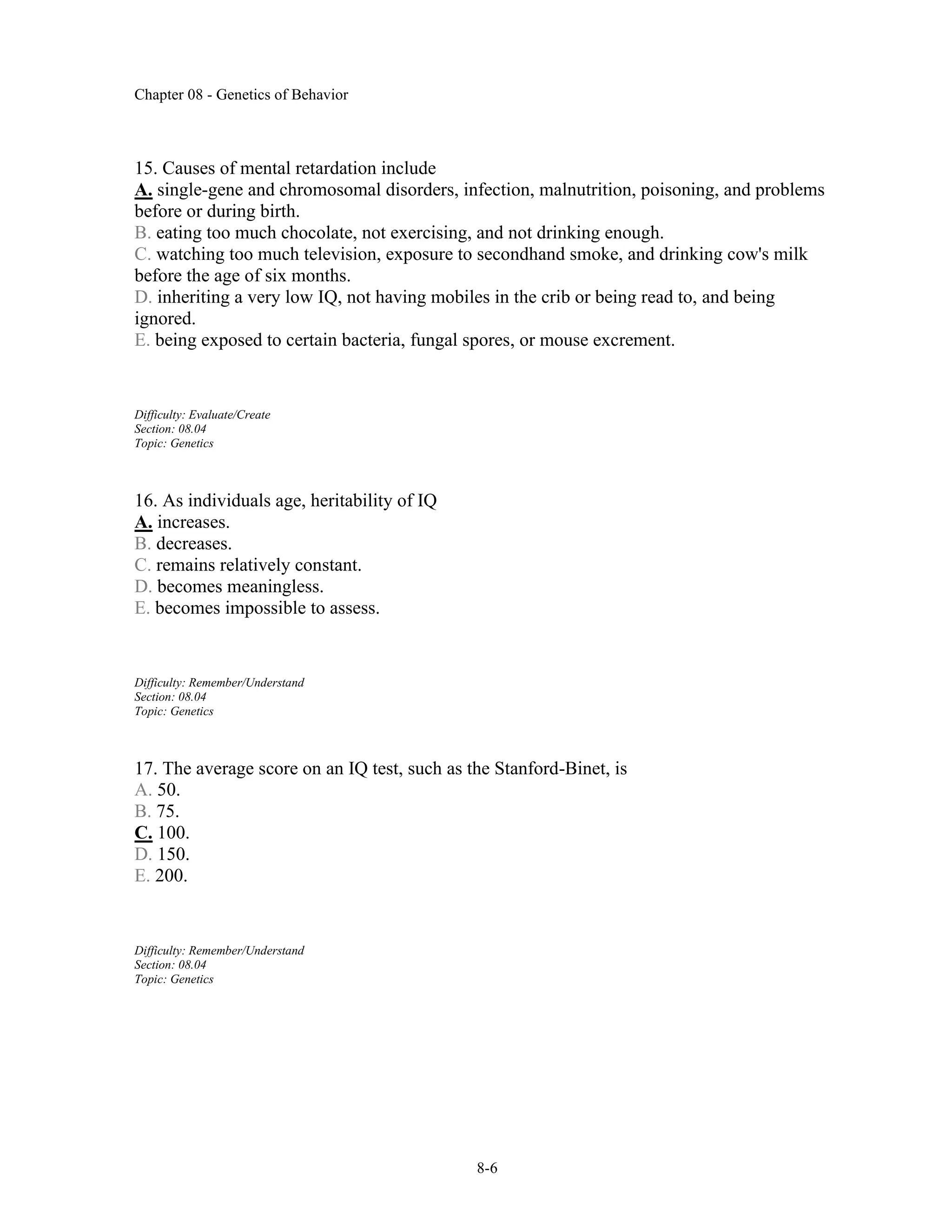
15. Causes of mental retardation include
A. single-gene and chromosomal disorders, infection, malnutrition, poisoning, and problems
before or during birth.
B. eating too much chocolate, not exercising, and not drinking enough.
C. watching too much television, exposure to secondhand smoke, and drinking cow's milk
before the age of six months.
D. inheriting a very low IQ, not having mobiles in the crib or being read to, and being
ignored.
E. being exposed to certain bacteria, fungal spores, or mouse excrement.
Difficulty: Evaluate/Create
Section: 08.04
Topic: Genetics
16. As individuals age, heritability of IQ
A. increases.
B. decreases.
C. remains relatively constant.
D. becomes meaningless.
E. becomes impossible to assess.
Difficulty: Remember/Understand
Section: 08.04
Topic: Genetics
17. The average score on an IQ test, such as the Stanford-Binet, is
A. 50.
B. 75.
C. 100.
D. 150.
E. 200.
Difficulty: Remember/Understand
Section: 08.04
Topic: Genetics
11.
Chapter 08 -Genetics of Behavior
8-7
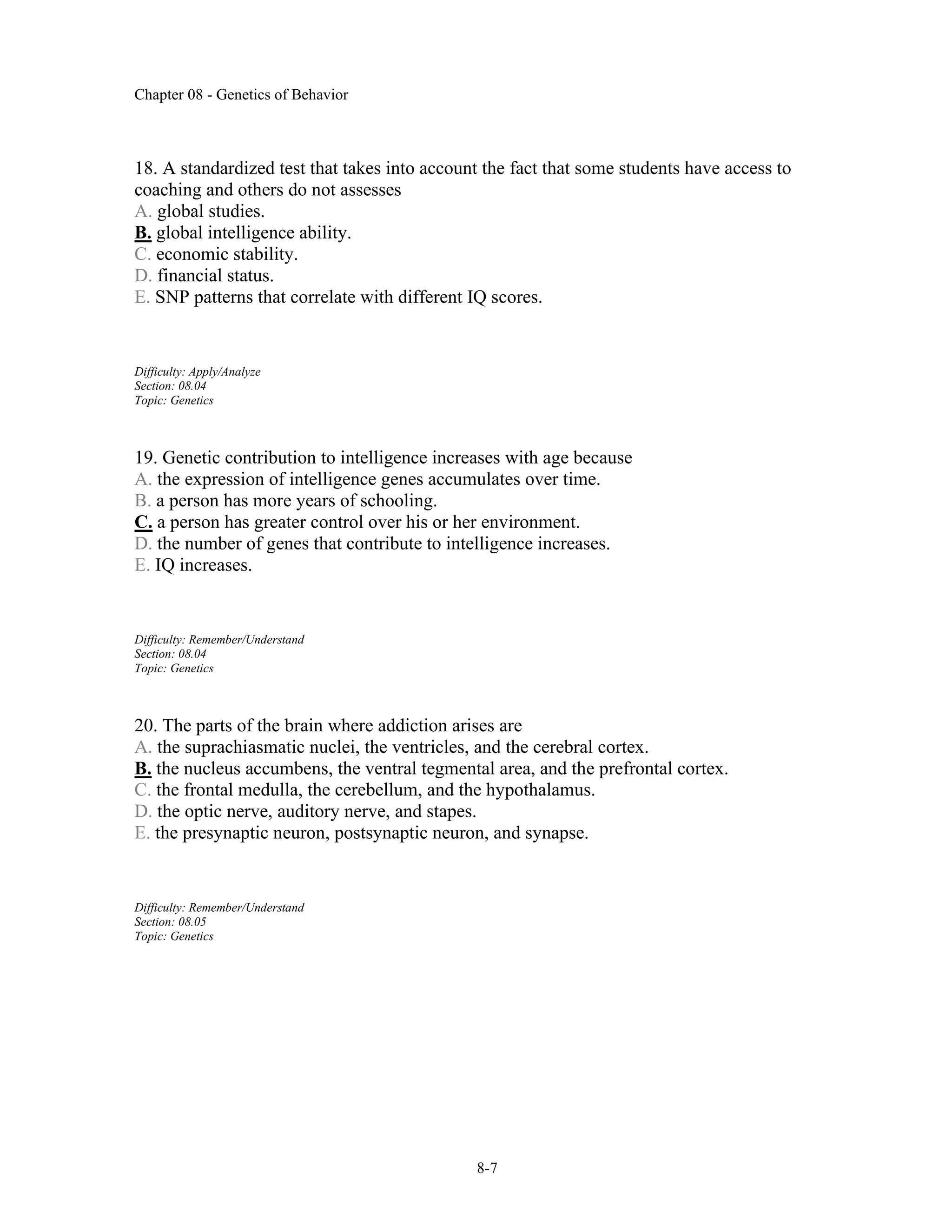
18. A standardized test that takes into account the fact that some students have access to
coaching and others do not assesses
A. global studies.
B. global intelligence ability.
C. economic stability.
D. financial status.
E. SNP patterns that correlate with different IQ scores.
Difficulty: Apply/Analyze
Section: 08.04
Topic: Genetics
19. Genetic contribution to intelligence increases with age because
A. the expression of intelligence genes accumulates over time.
B. a person has more years of schooling.
C. a person has greater control over his or her environment.
D. the number of genes that contribute to intelligence increases.
E. IQ increases.
Difficulty: Remember/Understand
Section: 08.04
Topic: Genetics
20. The parts of the brain where addiction arises are
A. the suprachiasmatic nuclei, the ventricles, and the cerebral cortex.
B. the nucleus accumbens, the ventral tegmental area, and the prefrontal cortex.
C. the frontal medulla, the cerebellum, and the hypothalamus.
D. the optic nerve, auditory nerve, and stapes.
E. the presynaptic neuron, postsynaptic neuron, and synapse.
Difficulty: Remember/Understand
Section: 08.05
Topic: Genetics
12.
Chapter 08 -Genetics of Behavior
8-8
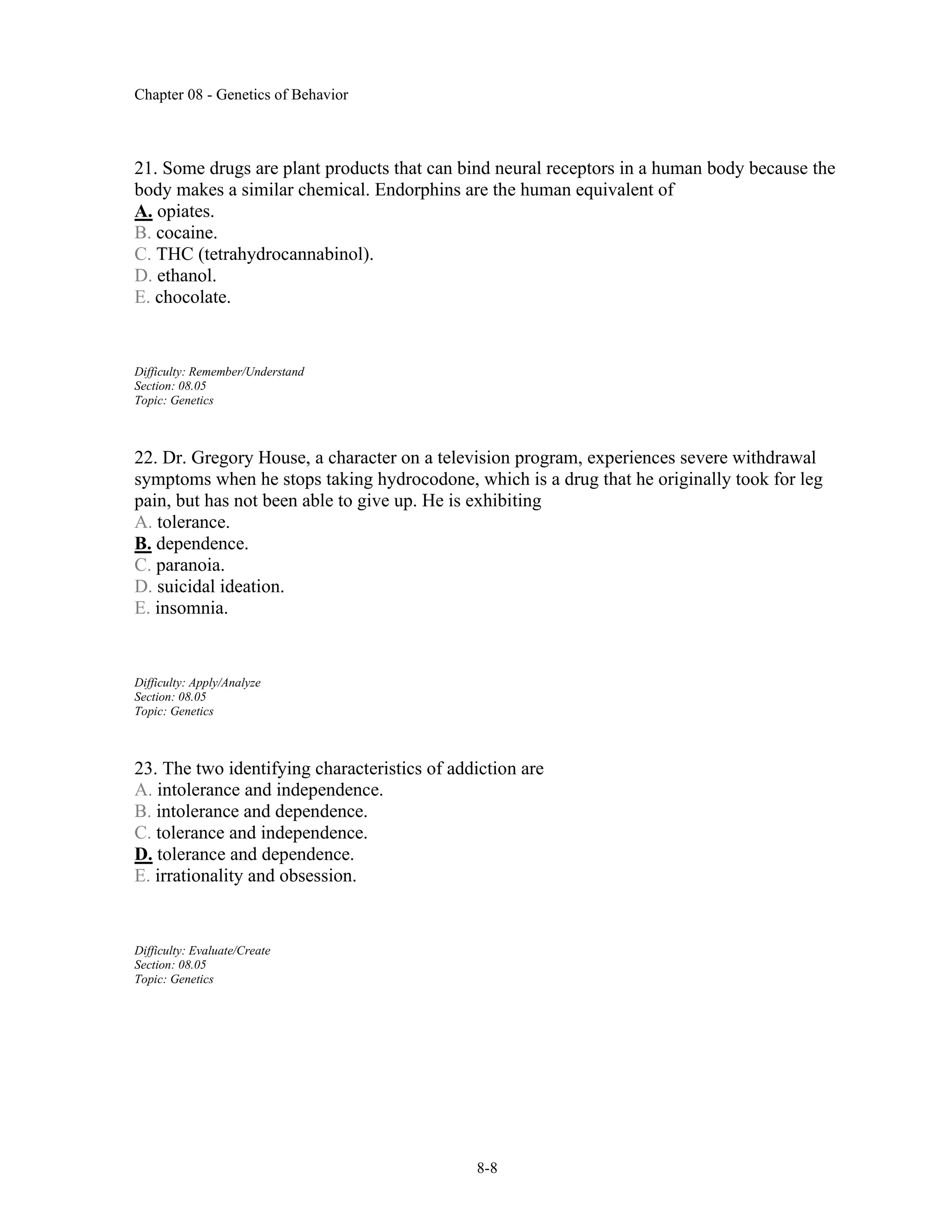
21. Some drugs are plant products that can bind neural receptors in a human body because the
body makes a similar chemical. Endorphins are the human equivalent of
A. opiates.
B. cocaine.
C. THC (tetrahydrocannabinol).
D. ethanol.
E. chocolate.
Difficulty: Remember/Understand
Section: 08.05
Topic: Genetics
22. Dr. Gregory House, a character on a television program, experiences severe withdrawal
symptoms when he stops taking hydrocodone, which is a drug that he originally took for leg
pain, but has not been able to give up. He is exhibiting
A. tolerance.
B. dependence.
C. paranoia.
D. suicidal ideation.
E. insomnia.
Difficulty: Apply/Analyze
Section: 08.05
Topic: Genetics
23. The two identifying characteristics of addiction are
A. intolerance and independence.
B. intolerance and dependence.
C. tolerance and independence.
D. tolerance and dependence.
E. irrationality and obsession.
Difficulty: Evaluate/Create
Section: 08.05
Topic: Genetics
13.
Chapter 08 -Genetics of Behavior
8-9
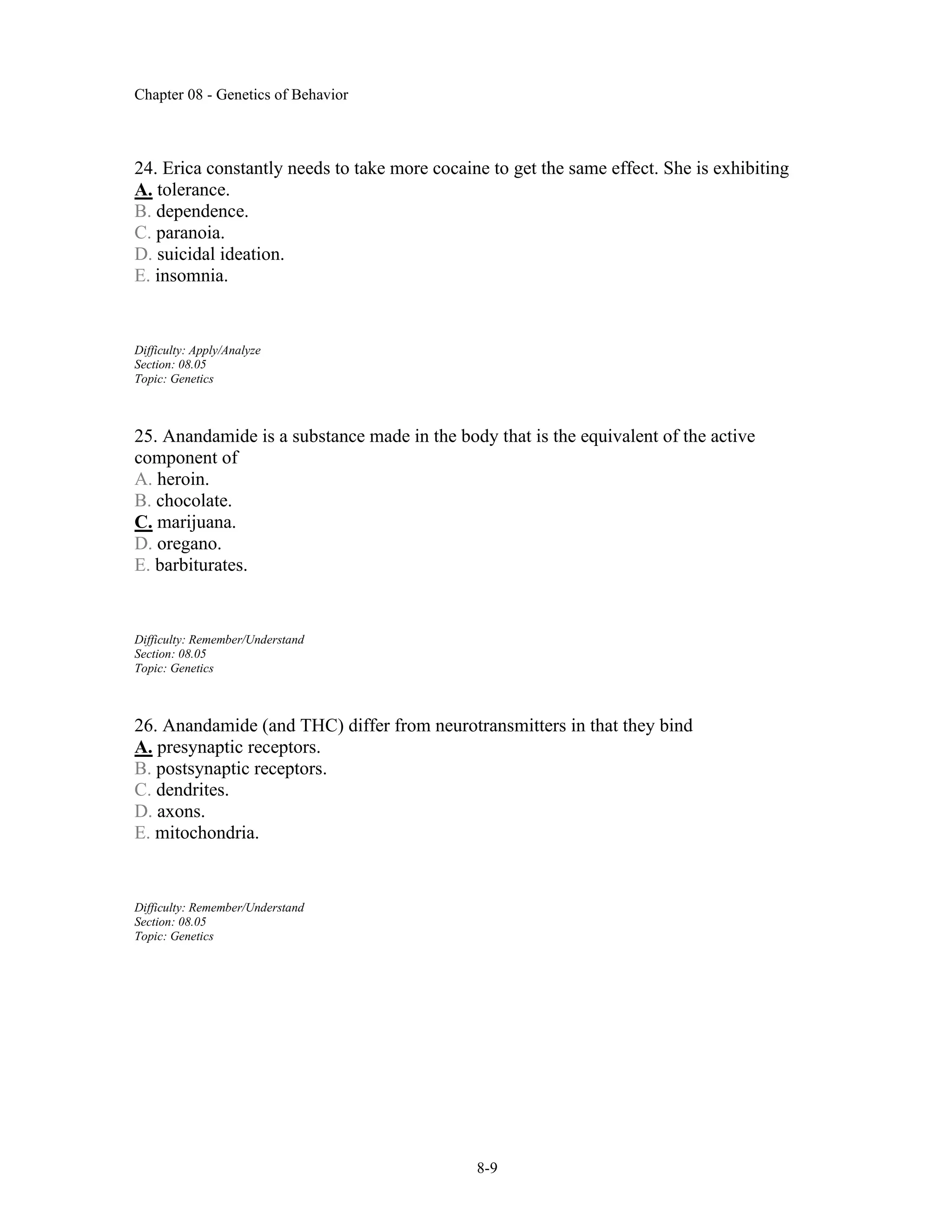
24. Erica constantly needs to take more cocaine to get the same effect. She is exhibiting
A. tolerance.
B. dependence.
C. paranoia.
D. suicidal ideation.
E. insomnia.
Difficulty: Apply/Analyze
Section: 08.05
Topic: Genetics
25. Anandamide is a substance made in the body that is the equivalent of the active
component of
A. heroin.
B. chocolate.
C. marijuana.
D. oregano.
E. barbiturates.
Difficulty: Remember/Understand
Section: 08.05
Topic: Genetics
26. Anandamide (and THC) differ from neurotransmitters in that they bind
A. presynaptic receptors.
B. postsynaptic receptors.
C. dendrites.
D. axons.
E. mitochondria.
Difficulty: Remember/Understand
Section: 08.05
Topic: Genetics
14.
Chapter 08 -Genetics of Behavior
8-10
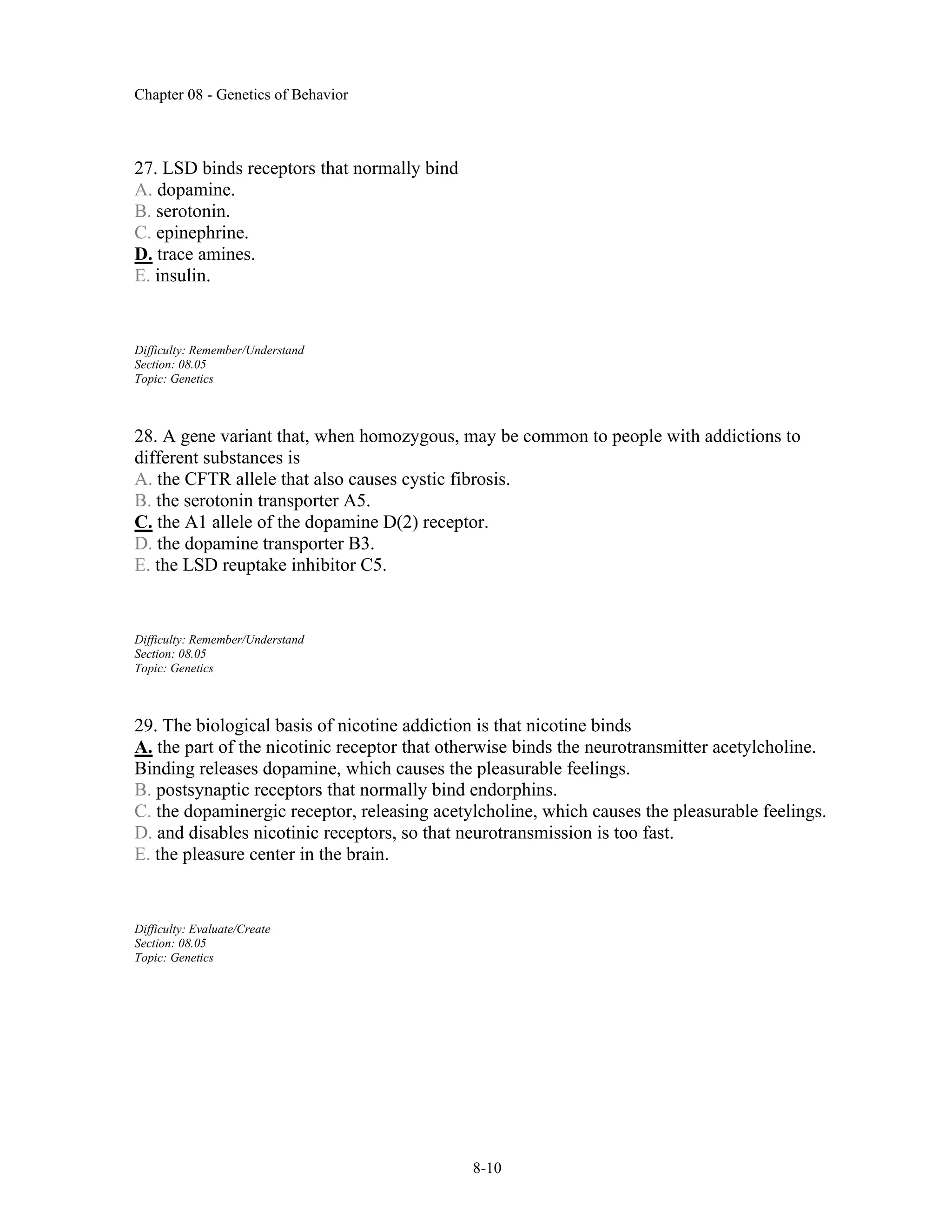
27. LSD binds receptors that normally bind
A. dopamine.
B. serotonin.
C. epinephrine.
D. trace amines.
E. insulin.
Difficulty: Remember/Understand
Section: 08.05
Topic: Genetics
28. A gene variant that, when homozygous, may be common to people with addictions to
different substances is
A. the CFTR allele that also causes cystic fibrosis.
B. the serotonin transporter A5.
C. the A1 allele of the dopamine D(2) receptor.
D. the dopamine transporter B3.
E. the LSD reuptake inhibitor C5.
Difficulty: Remember/Understand
Section: 08.05
Topic: Genetics
29. The biological basis of nicotine addiction is that nicotine binds
A. the part of the nicotinic receptor that otherwise binds the neurotransmitter acetylcholine.
Binding releases dopamine, which causes the pleasurable feelings.
B. postsynaptic receptors that normally bind endorphins.
C. the dopaminergic receptor, releasing acetylcholine, which causes the pleasurable feelings.
D. and disables nicotinic receptors, so that neurotransmission is too fast.
E. the pleasure center in the brain.
Difficulty: Evaluate/Create
Section: 08.05
Topic: Genetics
Chapter 08 -Genetics of Behavior
8-11
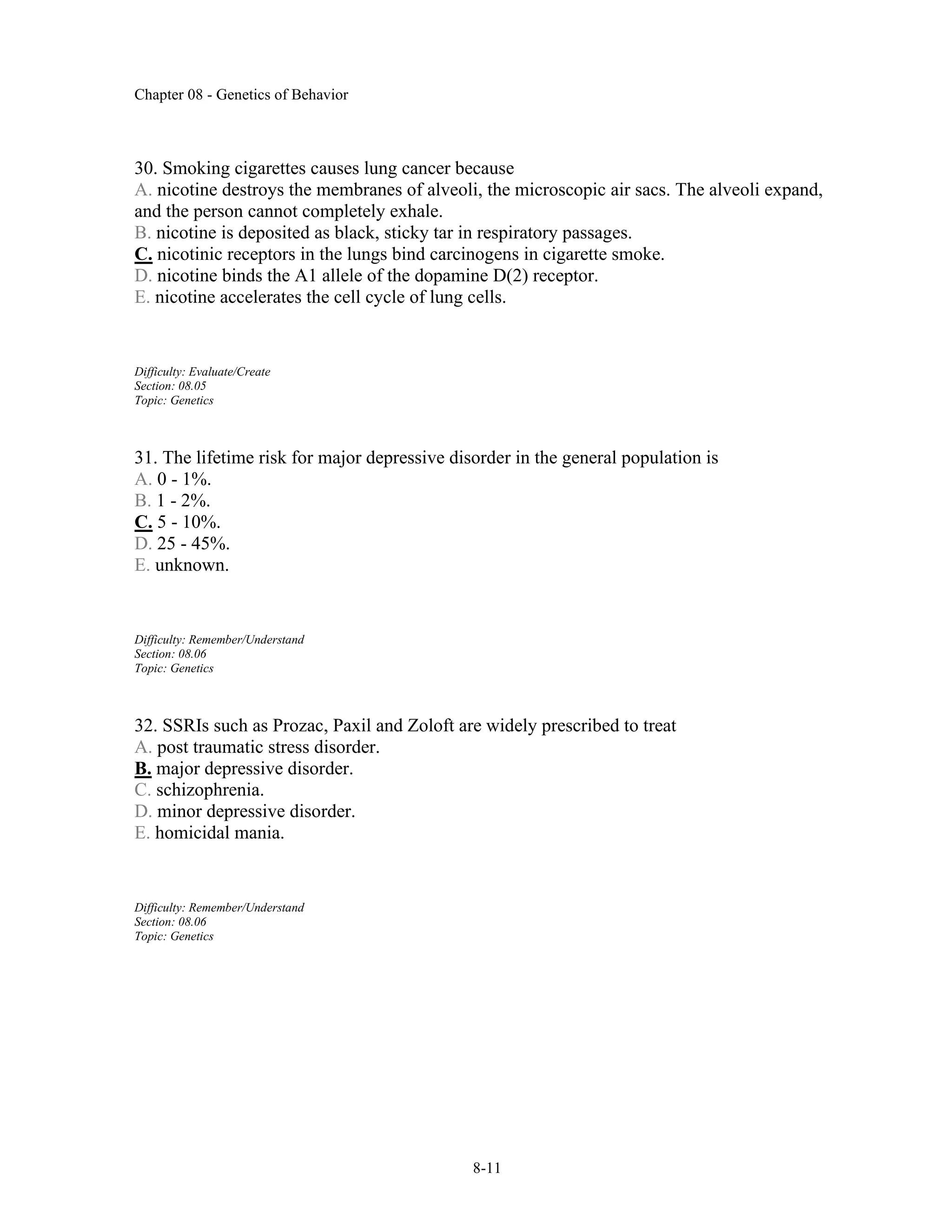
30. Smoking cigarettes causes lung cancer because
A. nicotine destroys the membranes of alveoli, the microscopic air sacs. The alveoli expand,
and the person cannot completely exhale.
B. nicotine is deposited as black, sticky tar in respiratory passages.
C. nicotinic receptors in the lungs bind carcinogens in cigarette smoke.
D. nicotine binds the A1 allele of the dopamine D(2) receptor.
E. nicotine accelerates the cell cycle of lung cells.
Difficulty: Evaluate/Create
Section: 08.05
Topic: Genetics
31. The lifetime risk for major depressive disorder in the general population is
A. 0 - 1%.
B. 1 - 2%.
C. 5 - 10%.
D. 25 - 45%.
E. unknown.
Difficulty: Remember/Understand
Section: 08.06
Topic: Genetics
32. SSRIs such as Prozac, Paxil and Zoloft are widely prescribed to treat
A. post traumatic stress disorder.
B. major depressive disorder.
C. schizophrenia.
D. minor depressive disorder.
E. homicidal mania.
Difficulty: Remember/Understand
Section: 08.06
Topic: Genetics
17.
Chapter 08 -Genetics of Behavior
8-12
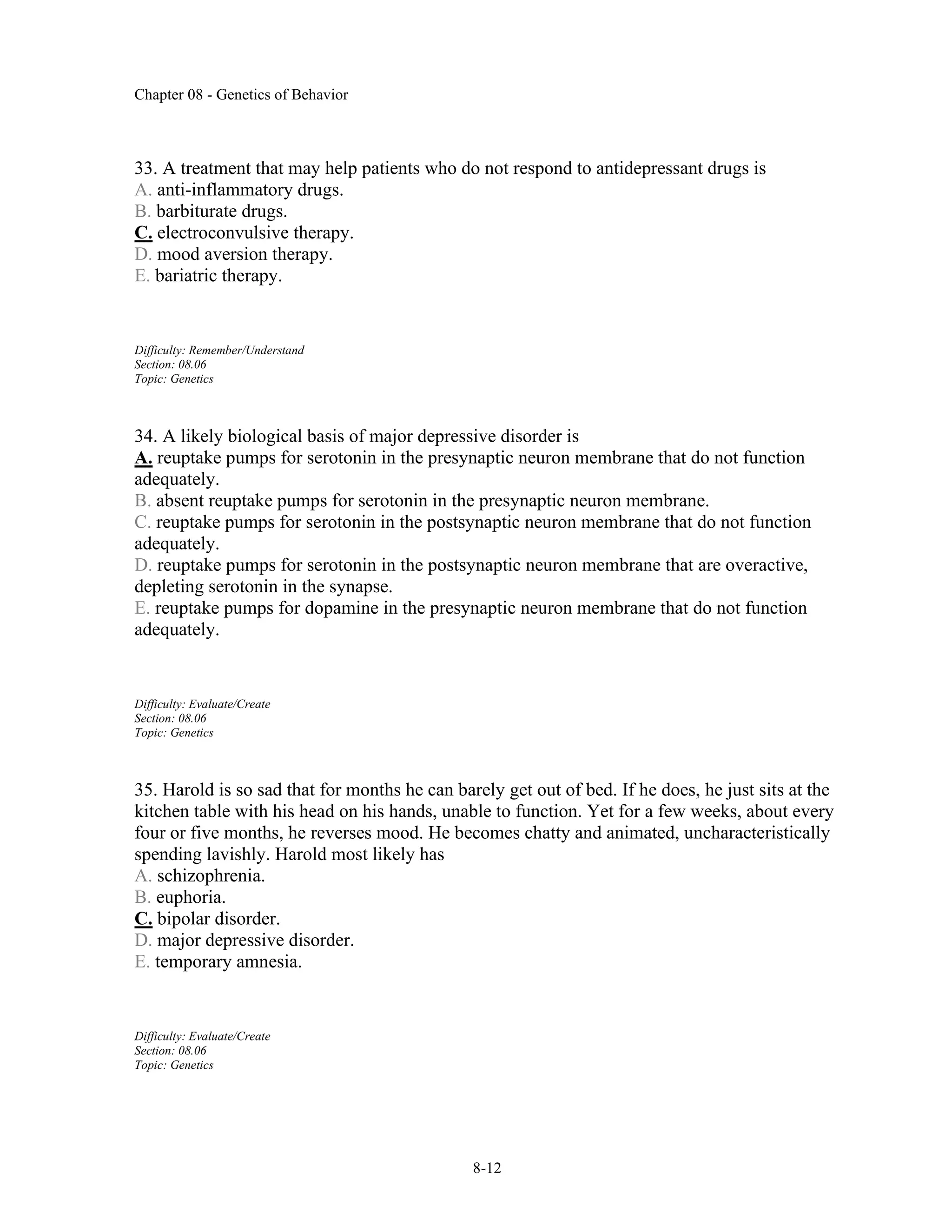
33. A treatment that may help patients who do not respond to antidepressant drugs is
A. anti-inflammatory drugs.
B. barbiturate drugs.
C. electroconvulsive therapy.
D. mood aversion therapy.
E. bariatric therapy.
Difficulty: Remember/Understand
Section: 08.06
Topic: Genetics
34. A likely biological basis of major depressive disorder is
A. reuptake pumps for serotonin in the presynaptic neuron membrane that do not function
adequately.
B. absent reuptake pumps for serotonin in the presynaptic neuron membrane.
C. reuptake pumps for serotonin in the postsynaptic neuron membrane that do not function
adequately.
D. reuptake pumps for serotonin in the postsynaptic neuron membrane that are overactive,
depleting serotonin in the synapse.
E. reuptake pumps for dopamine in the presynaptic neuron membrane that do not function
adequately.
Difficulty: Evaluate/Create
Section: 08.06
Topic: Genetics
35. Harold is so sad that for months he can barely get out of bed. If he does, he just sits at the
kitchen table with his head on his hands, unable to function. Yet for a few weeks, about every
four or five months, he reverses mood. He becomes chatty and animated, uncharacteristically
spending lavishly. Harold most likely has
A. schizophrenia.
B. euphoria.
C. bipolar disorder.
D. major depressive disorder.
E. temporary amnesia.
Difficulty: Evaluate/Create
Section: 08.06
Topic: Genetics
18.
Chapter 08 -Genetics of Behavior
8-13
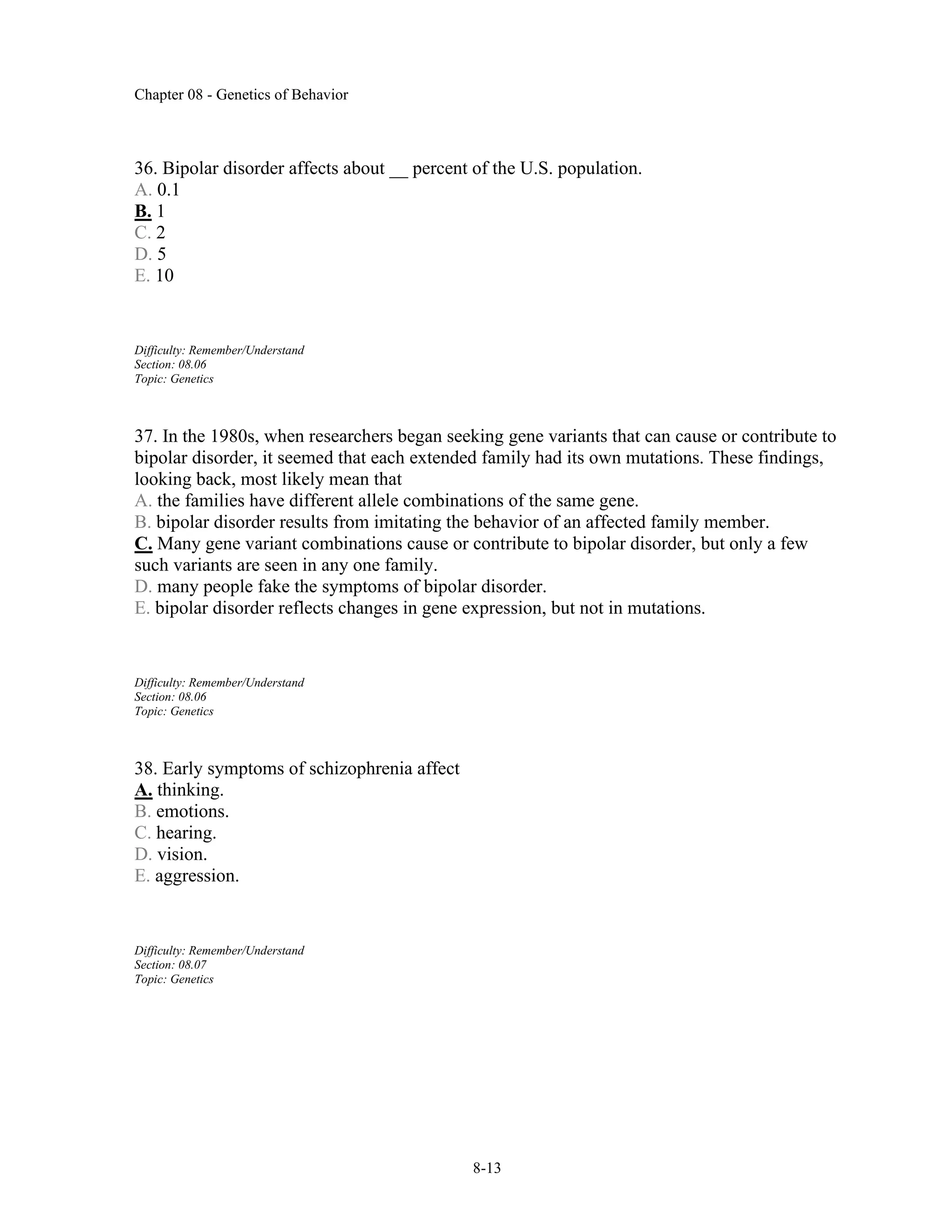
36. Bipolar disorder affects about __ percent of the U.S. population.
A. 0.1
B. 1
C. 2
D. 5
E. 10
Difficulty: Remember/Understand
Section: 08.06
Topic: Genetics
37. In the 1980s, when researchers began seeking gene variants that can cause or contribute to
bipolar disorder, it seemed that each extended family had its own mutations. These findings,
looking back, most likely mean that
A. the families have different allele combinations of the same gene.
B. bipolar disorder results from imitating the behavior of an affected family member.
C. Many gene variant combinations cause or contribute to bipolar disorder, but only a few
such variants are seen in any one family.
D. many people fake the symptoms of bipolar disorder.
E. bipolar disorder reflects changes in gene expression, but not in mutations.
Difficulty: Remember/Understand
Section: 08.06
Topic: Genetics
38. Early symptoms of schizophrenia affect
A. thinking.
B. emotions.
C. hearing.
D. vision.
E. aggression.
Difficulty: Remember/Understand
Section: 08.07
Topic: Genetics
19.
Chapter 08 -Genetics of Behavior
8-14
39. Schizophrenia affects about ____ percent of the population.
A. 0.1
B. 1.0
C. 5.0
D. 10.0
E. 50.0
Difficulty: Remember/Understand
Section: 08.07
Topic: Genetics
40. Age of onset for schizophrenia is
A. prenatal.
B. birth.
C. early childhood.
D. early adulthood.
E. at one's 50th birthday party.
Difficulty: Remember/Understand
Section: 08.07
Topic: Genetics
41. Schizophrenia means "split _____".
A. ends
B. mind
C. personality
D. milk
E. emotions
Difficulty: Remember/Understand
Section: 08.07
Topic: Genetics
20.
Chapter 08 -Genetics of Behavior
8-15
42. Schizophrenia differs from dementia in that it
A. affects primarily males.
B. is a single-gene disorder.
C. is treatable with insulin.
D. is episodic rather than degenerative.
E. is degenerative rather than episodic.
Difficulty: Evaluate/Create
Section: 08.07
Topic: Genetics
43. Environmental factors that might cause or contribute to schizophrenia include
A. infection by smallpox virus.
B. maternal malnutrition.
C. excess oxygen to a fetus.
D. maternal use of anti-depressants.
E. trauma during pregnancy.
Difficulty: Remember/Understand
Section: 08.07
Topic: Genetics
44. Viruses that may cause of contribute to development of schizophrenia are
A. measles, mumps, and rubella.
B. hepatitis A, B, and C viruses.
C. influenza virus, Borna virus, and herpes virus.
D. HIV.
E. schizoviruses and parvoviruses.
Difficulty: Remember/Understand
Section: 08.07
Topic: Genetics
seemed almost impregnable,therefore the right, as the weakest point, was chosen for attack. The
mounted infantry made for the stronghold, and Smith-Dorrien, with part of his brigade, followed in
support—all the troops pushing their way towards the objective under the ferocious fire of the foe.
The Boers, seeing the designs of the British, made valiant efforts to retain the hill, and continual
reinforcements came to their aid, rendering the task of our advancing troops more and more
dangerous. At this time, the fight growing momentarily warmer, and the struggle for possession of
the vantage point more and more intense, Captain Towse (Gordon Highlanders) with twelve of his
men and a few of Kitchener’s Horse managed to gain the top, but in so doing suddenly found
himself and his diminutive band removed from support. At this critical juncture a party of some 150
Boers approached, intending also to seize the plateau occupied by the small band of Scotsmen, and
came within 100 yards of the Highlanders without either observing them or being observed by
them. But, no sooner were the Dutchmen aware of the existence of the British, and of their small
number and their apparent helplessness, than they promptly called on them to surrender.
“Surrender?” cried Captain Towse in a voice of thunder, and instantly ordered his men to open fire!
The blood of Scotland was up. The command was quickly obeyed, and the lion-hearted little band
not only fired, but led by their splendid officer charged fiercely with the bayonet straight into the
thick mass of Dutchmen. A moment of uproar, of amazement, and then—flying heels. The valorous
Highlanders had succeeded, despite their inferior numbers, in driving off the hostile horde and
taking possession of the plateau! But, unfortunately, the magnificent daring of the commanding
officer had cost him almost more than life. A shot across the eyes shattered them, blinding him,
and thus depriving her Majesty’s Service of one of its noblest ornaments.
But the great work was accomplished—and the summit of the hill was gained and kept. The
Dutchmen elsewhere, in vast masses, were fighting hard with guns and pom-poms, and at close of
day had assumed so threatening an attitude that General French was telegraphed for, and the
troops were ordered to sleep on the ground they had gained, and prepare to renew the attack at
dawn. General French arrived from Thabanchu the same night, and next morning (the 1st of May)
hostilities were resumed.
Again the enemy, led by Botha, fought doggedly, even brilliantly, but the troops, after some warm
fighting, succeeded in routing him and forcing a passage to the north. In the operations General
Hamilton was assisted by Broadwood’s brigade of cavalry and the 8th Hussars under Colonel
Clowes, whose gallantry helped to harass the enemy’s rear and forced them eventually to evacuate
their position. Bruce Hamilton’s brigade of infantry also did excellent work. The final stroke to the
enemy’s rout was effected by the Gordons and Canadians, and two companies of the Shropshire
Light Infantry. These came within 200 yards of the foe, and with a ringing cheer launched
themselves boldly at the Dutchmen’s front—so boldly, so dashingly indeed, that at the sheer hint of
the coming collision the Boers had scampered. Promptly the 8th Hussars charged into the flying
fugitives, and forty prisoners were “bagged.” Guns were then galloped on the evacuated position
and shells were sent after the dispersing hordes.
The enemy lost twelve killed and forty wounded. Among the former was a German officer and two
Frenchmen, and among the latter a Russian who commanded the Foreign Legion. The British
wounded were Captain Lord Kensington, Household Cavalry; Major H. Alexander, 10th Hussars;
Captain A. Hart, 1st East Surrey Regiment; Captain Buckle, 2nd Royal West Kent. Captain Cheyne,
Kitchener’s Horse, was missing.
23.
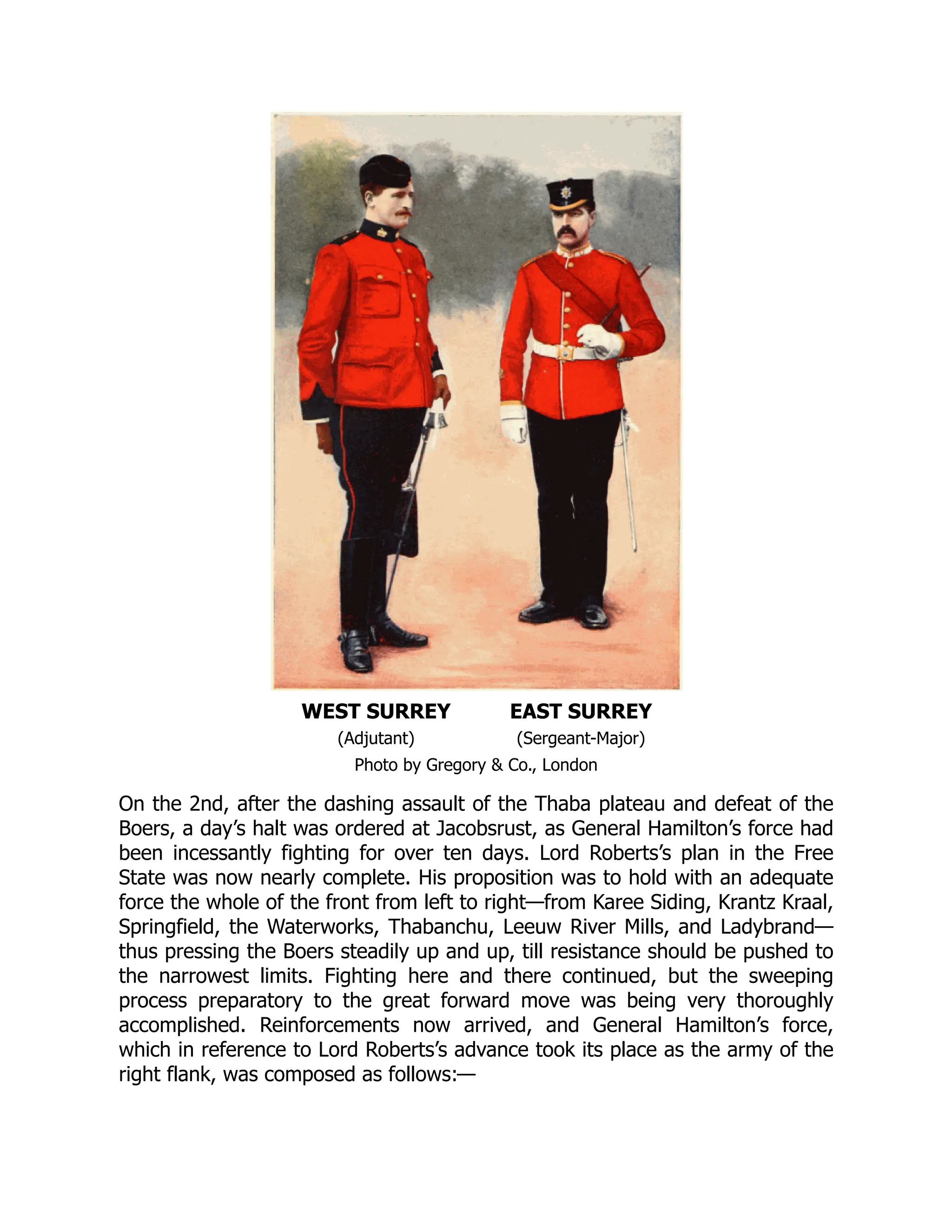
WEST SURREY EASTSURREY
(Adjutant) (Sergeant-Major)
Photo by Gregory & Co., London
On the 2nd, after the dashing assault of the Thaba plateau and defeat of the
Boers, a day’s halt was ordered at Jacobsrust, as General Hamilton’s force had
been incessantly fighting for over ten days. Lord Roberts’s plan in the Free
State was now nearly complete. His proposition was to hold with an adequate
force the whole of the front from left to right—from Karee Siding, Krantz Kraal,
Springfield, the Waterworks, Thabanchu, Leeuw River Mills, and Ladybrand—
thus pressing the Boers steadily up and up, till resistance should be pushed to
the narrowest limits. Fighting here and there continued, but the sweeping
process preparatory to the great forward move was being very thoroughly
accomplished. Reinforcements now arrived, and General Hamilton’s force,
which in reference to Lord Roberts’s advance took its place as the army of the
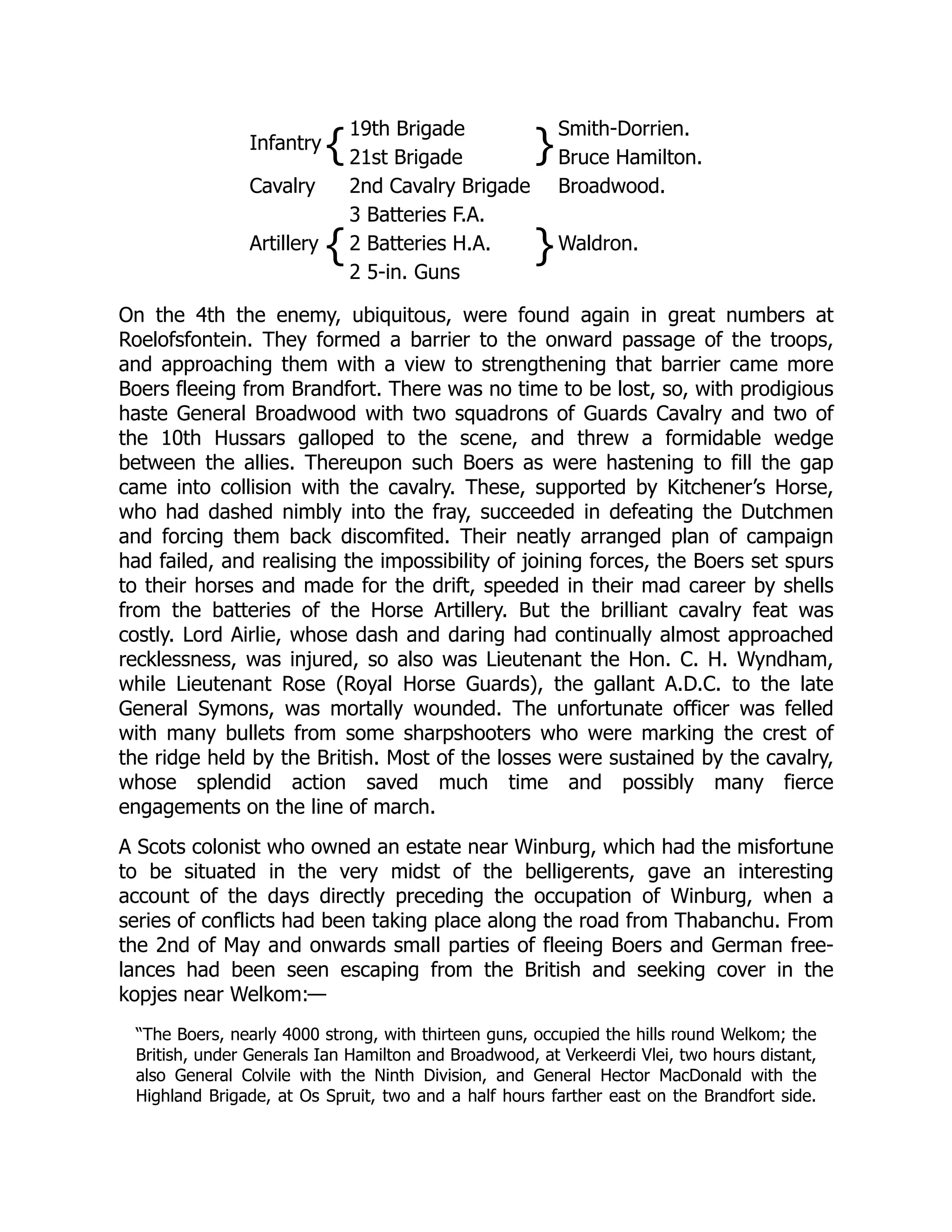
right flank, was composed as follows:—
24.
Infantry {
19th Brigade
}
Smith-Dorrien.
21stBrigade Bruce Hamilton.
Cavalry 2nd Cavalry Brigade Broadwood.
Artillery {
3 Batteries F.A.
}Waldron.
2 Batteries H.A.
2 5-in. Guns
On the 4th the enemy, ubiquitous, were found again in great numbers at
Roelofsfontein. They formed a barrier to the onward passage of the troops,
and approaching them with a view to strengthening that barrier came more
Boers fleeing from Brandfort. There was no time to be lost, so, with prodigious
haste General Broadwood with two squadrons of Guards Cavalry and two of
the 10th Hussars galloped to the scene, and threw a formidable wedge
between the allies. Thereupon such Boers as were hastening to fill the gap
came into collision with the cavalry. These, supported by Kitchener’s Horse,
who had dashed nimbly into the fray, succeeded in defeating the Dutchmen
and forcing them back discomfited. Their neatly arranged plan of campaign
had failed, and realising the impossibility of joining forces, the Boers set spurs
to their horses and made for the drift, speeded in their mad career by shells
from the batteries of the Horse Artillery. But the brilliant cavalry feat was
costly. Lord Airlie, whose dash and daring had continually almost approached
recklessness, was injured, so also was Lieutenant the Hon. C. H. Wyndham,
while Lieutenant Rose (Royal Horse Guards), the gallant A.D.C. to the late
General Symons, was mortally wounded. The unfortunate officer was felled
with many bullets from some sharpshooters who were marking the crest of
the ridge held by the British. Most of the losses were sustained by the cavalry,
whose splendid action saved much time and possibly many fierce
engagements on the line of march.
A Scots colonist who owned an estate near Winburg, which had the misfortune
to be situated in the very midst of the belligerents, gave an interesting
account of the days directly preceding the occupation of Winburg, when a
series of conflicts had been taking place along the road from Thabanchu. From
the 2nd of May and onwards small parties of fleeing Boers and German free-
lances had been seen escaping from the British and seeking cover in the
kopjes near Welkom:—
“The Boers, nearly 4000 strong, with thirteen guns, occupied the hills round Welkom; the
British, under Generals Ian Hamilton and Broadwood, at Verkeerdi Vlei, two hours distant,
also General Colvile with the Ninth Division, and General Hector MacDonald with the
Highland Brigade, at Os Spruit, two and a half hours farther east on the Brandfort side.
25.
Cannon firing startedat 7 a.m., and continued for two or three hours, Naval guns,
Armstrongs, Howitzers, Maxim-Nordenfeldts, &c. &c., all booming together. We heard the
rifle-firing quite distinctly. About ten o’clock the Boers began to give way, and arrived
here, about 1000 of them, with six cannon. We supplied them with water and milk, &c.,
and thanked God to hear them say they did not intend making a stand. Across the river
they moved through the drift very swiftly—guns, waggons, transport, men, horses—all in
fairly good order. Just as they got through, the Boers up on the Brandfort direction began
to give way, and shells from the British cannon burst repeatedly among them. This went
on for about one hour, when a grand stampede set in, and the flight and confusion and
bursting shells was a sight never to be forgotten. In the flight the drift got jammed up.
One cannon upset in the drift and blocked the traffic. Then they tore up here past the
house, and got through at the top drift. How they all got through is still a mystery to me.
Suddenly a shell from the large naval gun burst down at the mill. It made a terrific
explosion, and shook both house and store. The British had meantime worked round, and
got some cannon up to my camp (the Kaffirs’ huts), and began shelling the flying Boers,
as my camp commands the road for miles. The cannon-firing was simply awful, and
nearly deafened the lot of us; even things inside the house shook.”
By-and-by when the fire slackened, to the delight of the British party, some
500 of the 17th Lancers were seen approaching, their scouts in advance.
Quickly they were assured that they were riding into the arms of friends. The
Scotsman mounted to the roof of his house, and there, with the white pinafore
of one of his bairns in hand, he waved a frantic welcome. The signal was
returned, and joy and relief almost overcame him. Then followed some
pleasant experiences, for the Colonist played the host to a distinguished
multitude. He said:—
“On the arrival of the Lancers we supplied them with water and tea, but they pushed on,
and the officer in charge asked me to go with him to General Broadwood. This I did, and
after satisfying him as to the roads, &c., he thanked me and asked me for the use of the
house for General Hamilton and staff, which I said I would give. As I returned to the
house on foot a wounded officer rode up to me. This was Colonel the Earl of Airlie, in
command of the 17th (12th?) Lancers, wounded in elbow. He stayed with us until next
day, and a finer and more homely man I have never met. Notwithstanding his wound, he
insisted on helping to put Tommy to bed, and, although the house was soon full of lords,
generals, &c., and the staffs of two divisions, he helped Florrie (the host’s wife) in every
way he could. Lady Airlie is in Bloemfontein, and he returned thither. He gave us his
Kirriemuir Castle address, and insists on us coming to see him. About sundown the
General and staff arrived, among them Major Count Gleichen, Smith-Dorrien, Duke of
Marlborough, and a lot of others. Winston Churchill also was with them. The scene that
night at Welkom will never be forgotten by us. Fourteen thousand men bivouacked on the
farm, camp fires for miles around. About seven o’clock the Highland Brigade arrived in the
distance, pipes playing. It is quite dark here at 6 p.m., so you can picture to yourself the
scene. With the arrival of MacDonald’s Highlanders the total army on Welkom was
between 19,000 and 20,000 men. The house here was in great brilliancy. The Union Jack
was planted in front, and officers were arriving every few minutes with despatches. A
26.
telegraph line islaid by the troops as they move on, so we had a direct wire from the
house here to Bloemfontein.”
Delightful was it to the Scotsman to find himself specially introduced to
General Hector MacDonald, and see the braw company of Highlanders march
past his house. But their appearance was far from spruce, indeed the whole
army was begrimed with dust and wear and tear, honourable filth on their
bronzed and sweating faces, for which a Walt Whitman—had such been there
—would have felt impelled to hug them. The sad part was the death of
Captain Ernest Rose (Royal Horse Guards) who had been wounded in the
previous fighting. The Colonist, writing of the affair narrated: “When the news
was brought to the General and staff at nine o’clock at night that Rose had
died of his wounds they were all fearfully cut up. He was buried at midnight,
just at the back of the house here on the other side of road, about 100 yards
from where I now sit. The General asked me to promise him to have the grave
built in and to look after it, as it would be a fearful blow to the officer’s father,
Lord Rose. He had only two sons, and the other one died of fever last month
in Bloemfontein.” He went on to say: “The great bulk of the troops had gone
forward, only MacDonald and the Highland Brigade remained behind, and they
were encamped over at the station, so there are still about 5000 men in town.
I found Major Count Gleichen, who had stayed the night at Welkom, was
provost marshal, and Lieutenant Rymand, intelligence officer.”
At dawn on the 6th the march to Winburg was continued, and the troops
prepared themselves again to meet with stout resistance from the hordes
which had been pressed across the drift. But when the main army neared the
outskirts of the place they were nowhere to be seen. The fact was that the 7th
Mounted Infantry and the Hampshires had done a smart piece of work, “off
their own bat” as it were, and forced the congregating Federals to think better
of any plan of resistance to the entry into Winburg which they had made. The
little affair was concisely described by an officer who took part in it:—
“The officer commanding the Mounted Infantry Corps ordered the 7th Battalion Mounted
Infantry (which was leading the advance on the right) to race with the enemy for the
occupation of the big hill, about 3000 feet high, overlooking Winburg, which lies between
the approaches to the town from the south and from the east, both of which it entirely
commands. The Boers were approaching this hill from the north and the east, and had
they succeeded in occupying it, we should have had great difficulty in driving them off it
and capturing Winburg. But the Mounted Infantry got there before them. As soon as they
received the order to try and occupy it, the 7th Battalion Mounted Infantry (having
extricated themselves from the deep ravines near the river) raced for the hill, the
Hampshire squadron making for the point overlooking Winburg, the Borderers and
Lincolns supporting them on the right. When half-way up the hill they jumped off their
horses and scrambled to the top, and, meeting with no opposition, made their way across
27.
the open summitto the rocky edge overlooking Winburg. There a wonderful sight met
their view. The whole Boer force, about 5000 or 6000 strong, and several miles in length,
was seen trekking slowly past Winburg in a northerly direction. The road they were
moving by passed within about 2000 yards of this point of the hill, so the Hampshires
(who were at first only twelve strong, the remainder having been delayed crossing the
ravines) opened fire for all they were worth to make the enemy think that the hill was
strongly occupied. This considerably hastened the enemy’s movements, and the rear-
guard commandos which had yet to pass near the hill thought better of it, and went
round another way behind some high hills out of shot.”
At noon a staff officer under a flag of truce summoned the Mayor of the town
to surrender, promising to protect private property and pay for such foodstuffs
as might be required. Thereupon was enacted a curious drama. While the
magnates were putting their heads together and discussing the position, Botha
and some five hundred of his mercenaries came on the scene. The
commandant bounced that he would not surrender without fighting, and
accused Captain Balfour (who had offered to let such Free Staters as should
surrender their arms return to their farms) of attempting to suborn his
burghers. Botha frantically insisted on the arrest of the staff officer, the staff
officer as furiously flourished his flag of truce. The Boers pointed their rifles,
the women screamed, the townsfolk gabbled, and general turmoil prevailed.
In the end the citizens whose property, so to speak, lay in the palm of the
British hand, preferred the Mayor’s discretion to Botha’s valour, and that
warrior, swelling with indignation, and followed by his equally bombastic
“braves,” shook the dust of the town off their shoes and galloped to the north.
At night General Hamilton reached the town, where he was joined by General
Colville’s Division, which was marching from Waterval towards Heilbron, and
was thereupon directed to follow the leading column at a distance of ten
miles.
28.
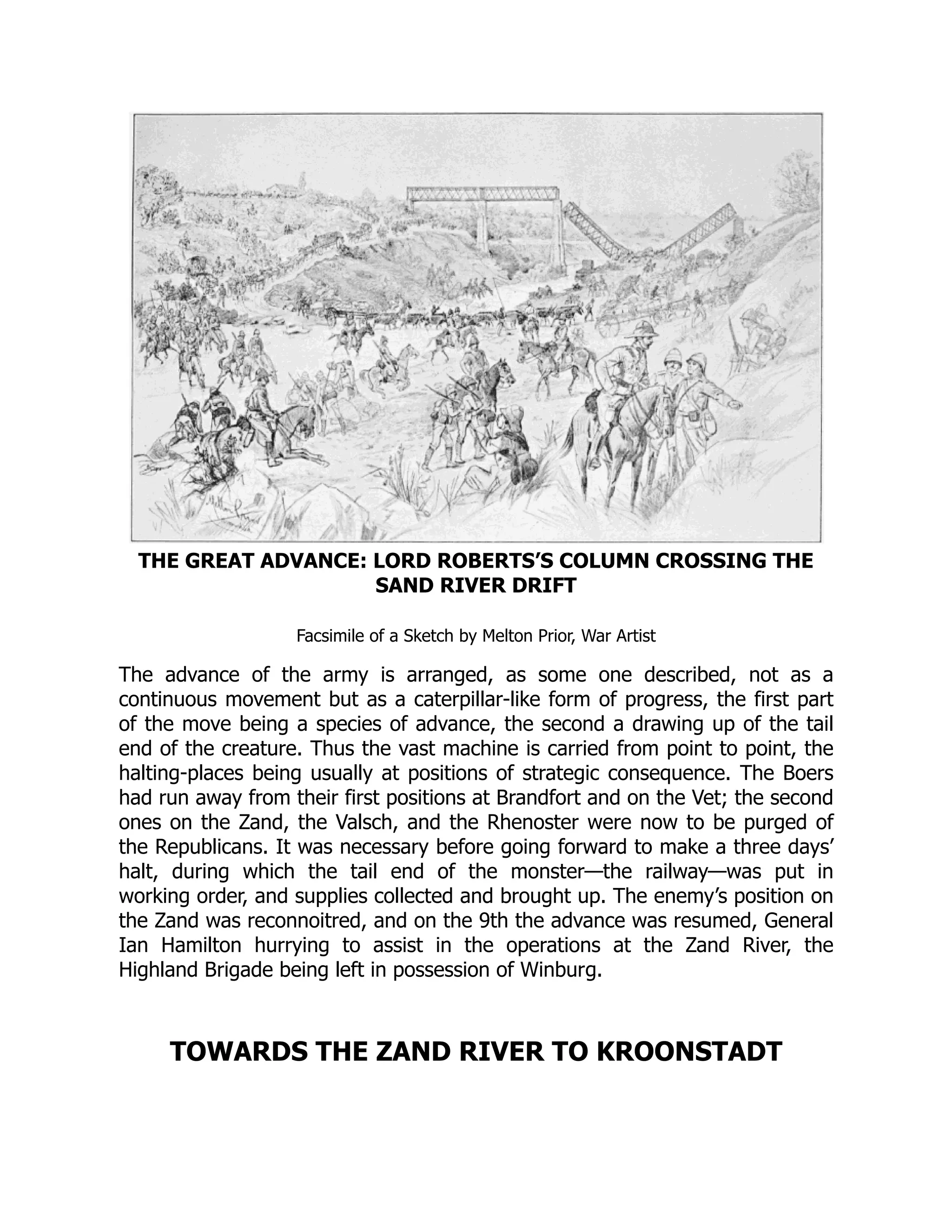
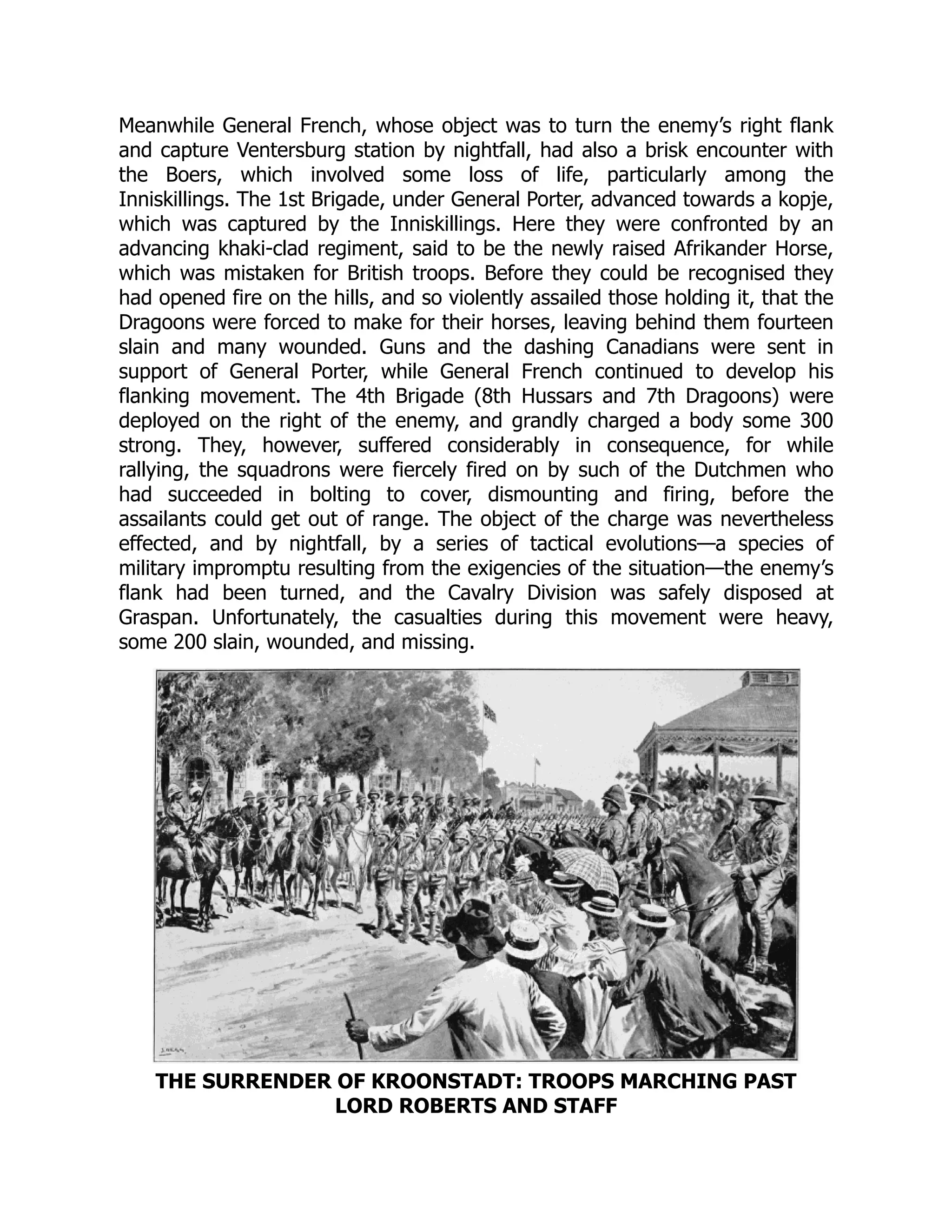
THE GREAT ADVANCE:LORD ROBERTS’S COLUMN CROSSING THE
SAND RIVER DRIFT
Facsimile of a Sketch by Melton Prior, War Artist
The advance of the army is arranged, as some one described, not as a
continuous movement but as a caterpillar-like form of progress, the first part
of the move being a species of advance, the second a drawing up of the tail
end of the creature. Thus the vast machine is carried from point to point, the
halting-places being usually at positions of strategic consequence. The Boers
had run away from their first positions at Brandfort and on the Vet; the second
ones on the Zand, the Valsch, and the Rhenoster were now to be purged of
the Republicans. It was necessary before going forward to make a three days’
halt, during which the tail end of the monster—the railway—was put in
working order, and supplies collected and brought up. The enemy’s position on
the Zand was reconnoitred, and on the 9th the advance was resumed, General
Ian Hamilton hurrying to assist in the operations at the Zand River, the
Highland Brigade being left in possession of Winburg.
TOWARDS THE ZAND RIVER TO KROONSTADT
29.
By the 9thof May, as we know, General Pole-Carew’s and General Tucker’s
Divisions and General Ian Hamilton’s Column (moving from Winburg), with
Naval and Royal Garrison Artillery guns, and four brigades of cavalry, had
concentrated at Welgelegen. The enemy, pushed back on all sides, now held
the opposite bank of the Zand River in force; but nevertheless it was decided
that the army would cross, and cross it did. The crossing was accomplished on
the 10th, the enemy being routed from all his strong positions. According to
the correspondent of the Times, the scheme for the general advance had been
planned as follows: “A concentration of the line of advance was to take place
at Kroonstadt. General Ian Hamilton, after leaving a brigade at Winburg, was
to advance on the right flank with his Mounted Infantry, Broadwood’s Cavalry
Brigade, and the 19th Brigade, via Ventersburg. The main advance with Lord
Roberts was to be made by the Eleventh Division, supported by Gordon’s
Cavalry Brigade, the connection between the railway and right flank being kept
by General Tucker’s Division. The left was entrusted to General French with
the 1st and 4th Cavalry Brigades and General Hutton’s Brigade of Mounted
Infantry. As the left in all probability would find it necessary to act
independently, the Mounted Infantry belonging to General Tucker became
attached to the main column for screening purposes.”
The enemy, some 6000 strong with 15 guns, was found to be posted on a
series of hills running diagonally against the east side of the Zand, but after
some vigorous shelling by General Tucker they evacuated their main position
by the river, blew up various culverts that lay in front of the British force, and
prepared to make a vigorous stand against the Mounted Infantry advancing in
the centre. These, having debouched on the plain on the north of the river
were promptly assailed by guns from the hills to the right, but they still
pushed on towards the west of the railway, while a battery of Horse Artillery
tackled the region whence came the hostile shells. The scene of the fight was
dotted with farmhouses and native kraals, and here numerous parties of
skirmishers were knowingly concealed. The 8th Mounted Infantry Corps,
dismounting, advanced in extended order across the nullah-riven plain under a
heavy shell fire, while the British guns barked merrily and wrought devastation
among the Boer guns, which were hastily scurried away, pursued now by the
4th Mounted Infantry, who, full of excitement, galloped off to capture the
retiring treasures, and in so doing ran almost into the arms of some 500
Boers. These, rushing from ambush, forced them back on their supports. But
the fire from a well-directed Maxim, and from Lumsden’s Horse, who had
captured a hill and stuck to it amid a hurricane of Boer missiles, served to rout
the Dutchmen and send them after their guns and convoy, which
unfortunately, by this time, had been got safely away.
30.
Of General IanHamilton’s part in the proceedings on the right an eye-witness
contributed to the Morning Post an interesting account:—
“At daybreak on May 9 Ian Hamilton’s column left their bivouac at Klipfontein and
marched north to Boemplatz Farm without resistance. About mid-day the Mounted
Infantry, who were a mile or two ahead of the column, on topping the ridges overlooking
Zand River, came under fire of the enemy concealed in the dongas near the river, and on
the hills beyond, and in the kopjes on our right. They remained there all the afternoon,
peppering and being peppered in return. The veldt here was alive with buck and
hartebeest, and they were so tame that herds of them grazed between the Mounted
Infantry screen and the main body. This was too much for some officers of the C.I.V., and
they left their bivouac near the main body, about a mile in the rear, and let drive at the
buck.
“Meanwhile the Hampshire Squadron of Mounted Infantry, which were playing hide and
seek with their brother Boers, began to wonder how it was that bullets were coming from
their rear as well as from their front. When they discovered that these bullets from the
rear were intended for buck, they sent down a message, the language of which was
hardly parliamentary, to the would-be buck slayers, and threatened to send a volley at the
buck themselves. More Boer commandos were seen to be arriving from the east towards
dusk, so there seemed to be every prospect of a warm time the next day, especially on
the right flank. Up till now Ian Hamilton’s column had been working quite independently,
and had marched north from Thabanchu as a flying column, but this afternoon we were
acquainted with the presence of another force on our left by seeing Lord Roberts’s balloon
in the air about eight miles away. That Lord Roberts met with but slight resistance may be
accounted for by the fact that Ian Hamilton’s column away on his right was always a few
miles ahead of him, and threatened the enemy’s flank. Lord Roberts’s force had been
marching north along the line of railway, and now the two columns were converging with
a view to reaching Kroonstadt together.
“Those on outpost duty that night heard the rumbling of waggons for many hours in the
vicinity of the enemy. Evidently their transport was being moved out of harm’s way. The
night was bitterly cold, and many of those on outpost duty had nothing but greatcoats to
keep them warm, some of the waggons not having yet arrived. At daybreak our ‘Long
Toms’ made excellent practice at what looked like a Boer laager on the slope of the hill
across the river to the north. At about 7 p.m. the battle commenced in earnest, and the
crack of our rifles, the double crack of the enemy’s, the barking of Maxims, the ‘pom-pom’
of the Vickers-Maxims, and the boom of the ‘Long Toms’ were heard all along the line.
Our front must have been ten or fifteen miles along the Zand River, because Roberts’s
column was now a few miles to our left, and French’s Cavalry Division was on Roberts’s
left; but for reasons mentioned above the Boers showed a bold front to Ian Hamilton’s
column only. The enemy kept up a steady fire from the positions they had occupied
during the night, some Boers in the dongas having advanced to within a short distance of
our firing line.
“As the day wore on, reinforcements appeared to arrive for the enemy, and they made a
determined effort to turn our right. Here they were opposed by Kitchener’s Horse, who
were hard pressed, and had to be hurriedly reinforced by the New Zealanders. On the
extreme right the enemy now became very bold, and report says that the sergeant-major
of Kitchener’s Horse made a bull’s-eye on a Boer’s head at only fifteen yards’ distance. All
31.
this time wehad kept the enemy at bay without the aid of a single gun, though they had
been firing at us with common shell and shrapnel, but to our great joy in the afternoon
four field-guns came to our assistance, and proceeded to deluge the kopjes and dongas
with shrapnel. Brother Boer now finding matters getting rather unpleasant slunk out of
the dongas and off the kopjes in groups of ten and twenty in an easterly direction, and
now the enemy having been pressed back all along the line, the 7th Mounted Infantry,
Kitchener’s Horse, and the New Zealanders were left as a rear-guard, and the main body
moved on five or six miles. At dark we followed them, and crossed the Zand River
unmolested, and bivouacked on the other side of the drift on the position which had been
all day occupied by the Boers. It was reported that the following day the bodies of fifty or
sixty of the enemy were found in the Zand River dongas, and many more on the kopjes
on the right, so the losses were not all on our side.”
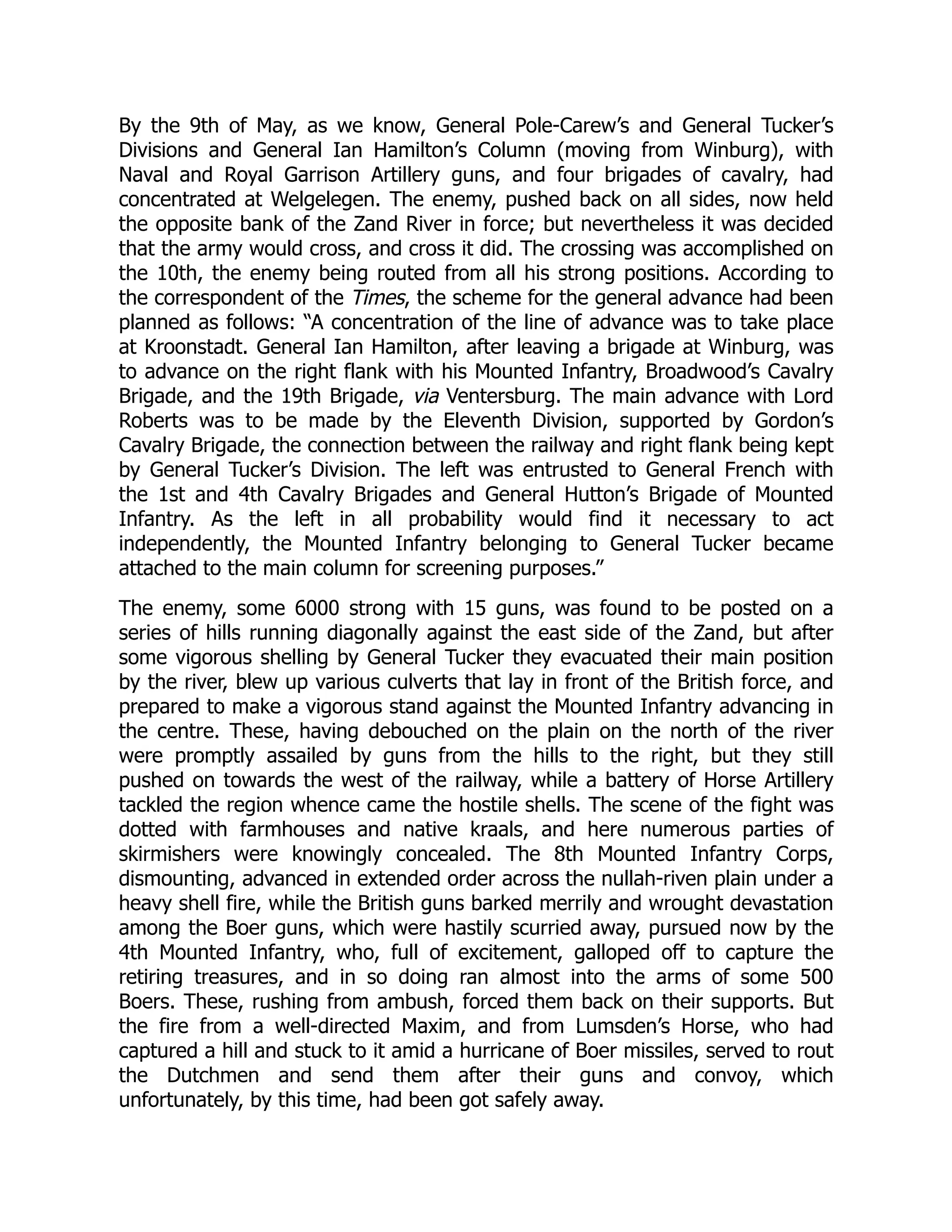
French’s
Cavalry
on
horizon.
Boers
Blowing
up
Railway
Bridge.
Boers
Retreating
with
Convoy
and Guns.
Lord
Kitchener.
Lord
Roberts.
Shelling
the
Boers’
Rear-
guard.
Lord Roberts and his Staff Watching the Boers’ Retreat from Zand River;
General French in Pursuit on the Extreme Left. (Facsimile of a Sketch by
Melton Prior, War Artist.)
The following casualties occurred in General Ian Hamilton’s column during the
day’s fight: Second Lieutenant R. E. Paget, 1st Royal Sussex Regiment,
wounded; Captain Leonard Head, East Lancashire Regiment, dangerously
wounded (since dead).
32.
Meanwhile General French,whose object was to turn the enemy’s right flank
and capture Ventersburg station by nightfall, had also a brisk encounter with
the Boers, which involved some loss of life, particularly among the
Inniskillings. The 1st Brigade, under General Porter, advanced towards a kopje,
which was captured by the Inniskillings. Here they were confronted by an
advancing khaki-clad regiment, said to be the newly raised Afrikander Horse,
which was mistaken for British troops. Before they could be recognised they
had opened fire on the hills, and so violently assailed those holding it, that the
Dragoons were forced to make for their horses, leaving behind them fourteen
slain and many wounded. Guns and the dashing Canadians were sent in
support of General Porter, while General French continued to develop his
flanking movement. The 4th Brigade (8th Hussars and 7th Dragoons) were
deployed on the right of the enemy, and grandly charged a body some 300
strong. They, however, suffered considerably in consequence, for while
rallying, the squadrons were fiercely fired on by such of the Dutchmen who
had succeeded in bolting to cover, dismounting and firing, before the
assailants could get out of range. The object of the charge was nevertheless
effected, and by nightfall, by a series of tactical evolutions—a species of
military impromptu resulting from the exigencies of the situation—the enemy’s
flank had been turned, and the Cavalry Division was safely disposed at
Graspan. Unfortunately, the casualties during this movement were heavy,
some 200 slain, wounded, and missing.
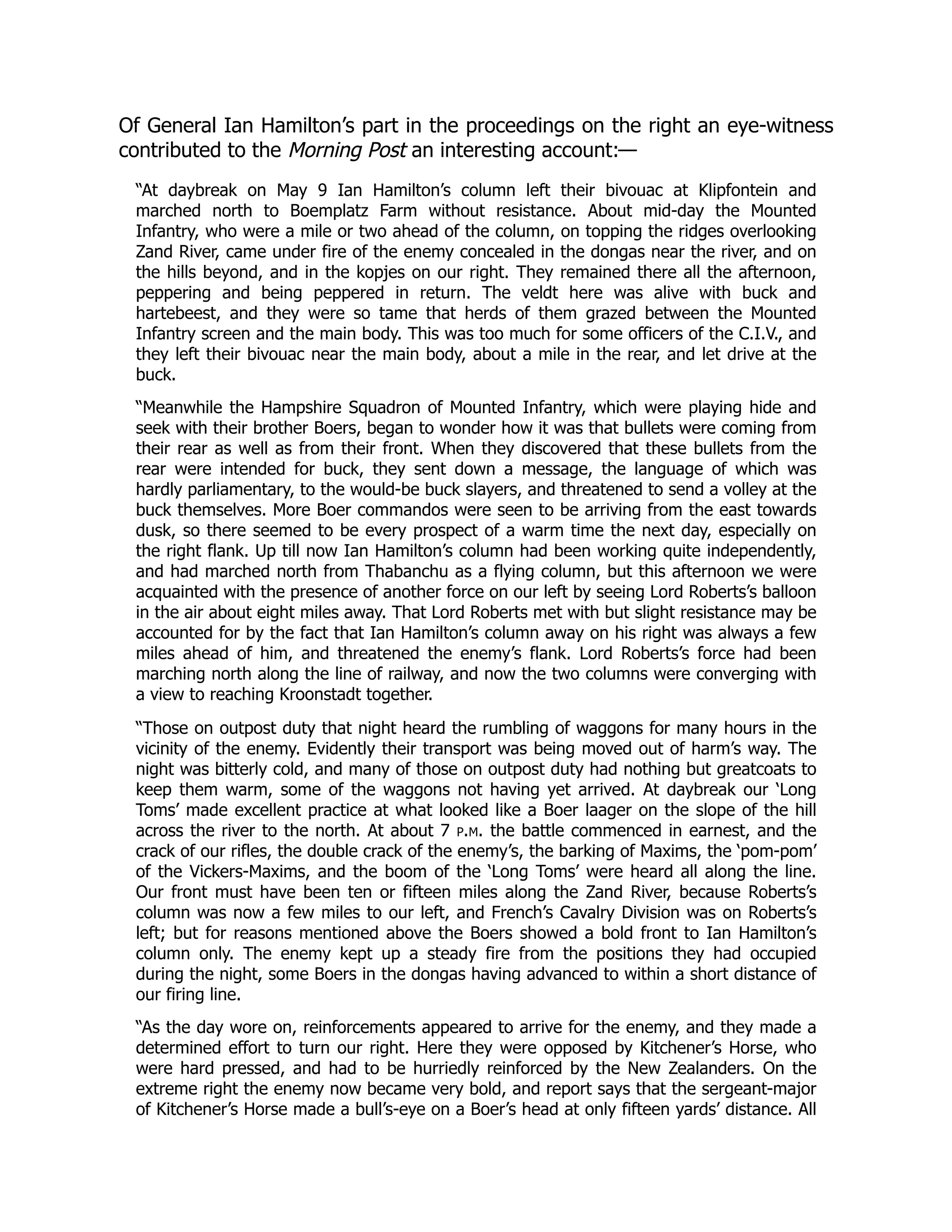
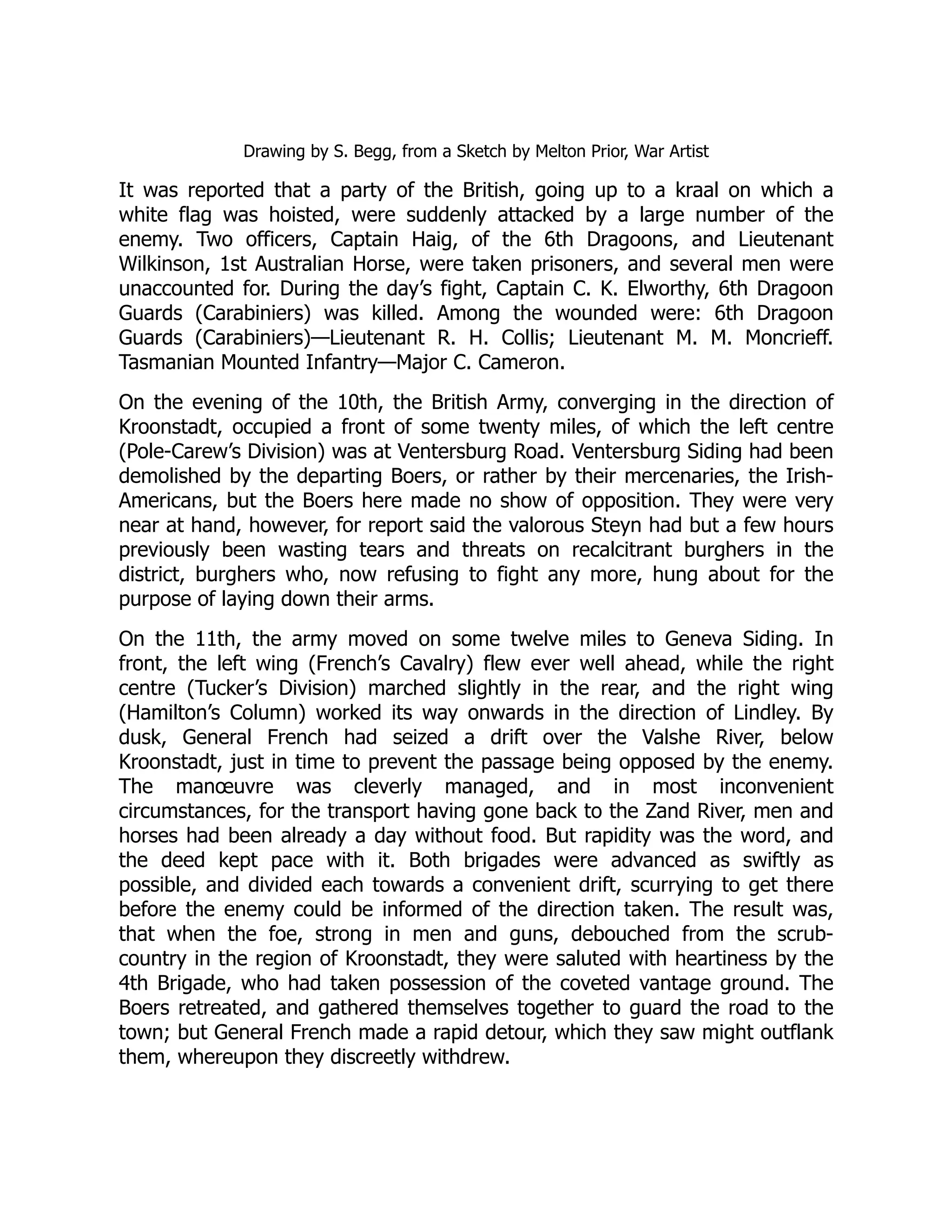
THE SURRENDER OF KROONSTADT: TROOPS MARCHING PAST
LORD ROBERTS AND STAFF
33.
Drawing by S.Begg, from a Sketch by Melton Prior, War Artist
It was reported that a party of the British, going up to a kraal on which a
white flag was hoisted, were suddenly attacked by a large number of the
enemy. Two officers, Captain Haig, of the 6th Dragoons, and Lieutenant
Wilkinson, 1st Australian Horse, were taken prisoners, and several men were
unaccounted for. During the day’s fight, Captain C. K. Elworthy, 6th Dragoon
Guards (Carabiniers) was killed. Among the wounded were: 6th Dragoon
Guards (Carabiniers)—Lieutenant R. H. Collis; Lieutenant M. M. Moncrieff.
Tasmanian Mounted Infantry—Major C. Cameron.
On the evening of the 10th, the British Army, converging in the direction of
Kroonstadt, occupied a front of some twenty miles, of which the left centre
(Pole-Carew’s Division) was at Ventersburg Road. Ventersburg Siding had been
demolished by the departing Boers, or rather by their mercenaries, the Irish-
Americans, but the Boers here made no show of opposition. They were very
near at hand, however, for report said the valorous Steyn had but a few hours
previously been wasting tears and threats on recalcitrant burghers in the
district, burghers who, now refusing to fight any more, hung about for the
purpose of laying down their arms.
On the 11th, the army moved on some twelve miles to Geneva Siding. In
front, the left wing (French’s Cavalry) flew ever well ahead, while the right
centre (Tucker’s Division) marched slightly in the rear, and the right wing
(Hamilton’s Column) worked its way onwards in the direction of Lindley. By
dusk, General French had seized a drift over the Valshe River, below
Kroonstadt, just in time to prevent the passage being opposed by the enemy.
The manœuvre was cleverly managed, and in most inconvenient
circumstances, for the transport having gone back to the Zand River, men and
horses had been already a day without food. But rapidity was the word, and
the deed kept pace with it. Both brigades were advanced as swiftly as
possible, and divided each towards a convenient drift, scurrying to get there
before the enemy could be informed of the direction taken. The result was,
that when the foe, strong in men and guns, debouched from the scrub-
country in the region of Kroonstadt, they were saluted with heartiness by the
4th Brigade, who had taken possession of the coveted vantage ground. The
Boers retreated, and gathered themselves together to guard the road to the
town; but General French made a rapid detour, which they saw might outflank
them, whereupon they discreetly withdrew.
34.
At night agallant effort was made by that indefatigable officer, Major Hunter
Weston, R.E., to cut the railway communications in rear of the enemy.
Escorted by a squadron of cavalry, and accompanied by Burnham the
American scout and eight smart sappers, he proceeded as usual, under cover
of darkness, towards the line. Here, however, he came in touch with the
Boers, and his troopers charged the Dutch patrol and captured them. Then
leaving his escort, he, the scout and sappers, after much hiding in the
moonlight and groping in nullahs, reached the line through the enemy’s
convoy and launched the explosive into the midst of the Dutchmen, causing
considerable panic among them. He, however, was defeated in his main
object, though the hairbreadth escapes and deeds of cool-headed pluck
accomplished during the small hours of the night make a long tale, both
exciting and soul-stirring.
On Saturday the advance was resumed. The town of Boschrand, some eight
miles below Kroonstadt, was found deserted, the Boers before the ubiquitous
French having sped as an arrow from the bow. The Dutchmen had taken care
to put a good deal of country between them and the British, for, after
reconnaissance towards Kroonstadt had been made, it was found that though
they had been seen the night before encamped from Kroonstadt to Honing
Spruit they had melted away, and had evidently decided that they would make
no further stand till the British arrived within the confines of the Transvaal.
President Steyn had already taken himself off to Lindley, and Commandant
Botha had departed with his Transvaal burghers to prepare for a big fight on
the Vaal.
The entry of Lord Roberts into Kroonstadt was a fine spectacle, all the men,
despite their hard, 128-mile march being in splendid condition, and wearing on
their faces the air of honest satisfaction at work accomplished—pride in
themselves and in their admired Chief. The procession was headed by Lord
Roberts’s bodyguards, who were all of them Colonials. Following them came
the staff and foreign attachés, then trooped in the North Somerset Company
of the Imperial Yeomanry, a stalwart and bronzed host; after which marched
General Pole-Carew’s Division, consisting of the Guards, the 18th Brigade, the
Naval Brigade, the 83rd, 84th, and 85th Batteries, two 5-inch guns manned by
Royal Artillerymen, and the 12th Company of Royal Engineers. The sight was a
most imposing one, and the vision of troops apparently innumerable streaming
through the streets highly impressed the Boers, who many of them had
entered on the war with the highest confidence in their military prowess and
the inferiority of the British as a fighting race.
35.
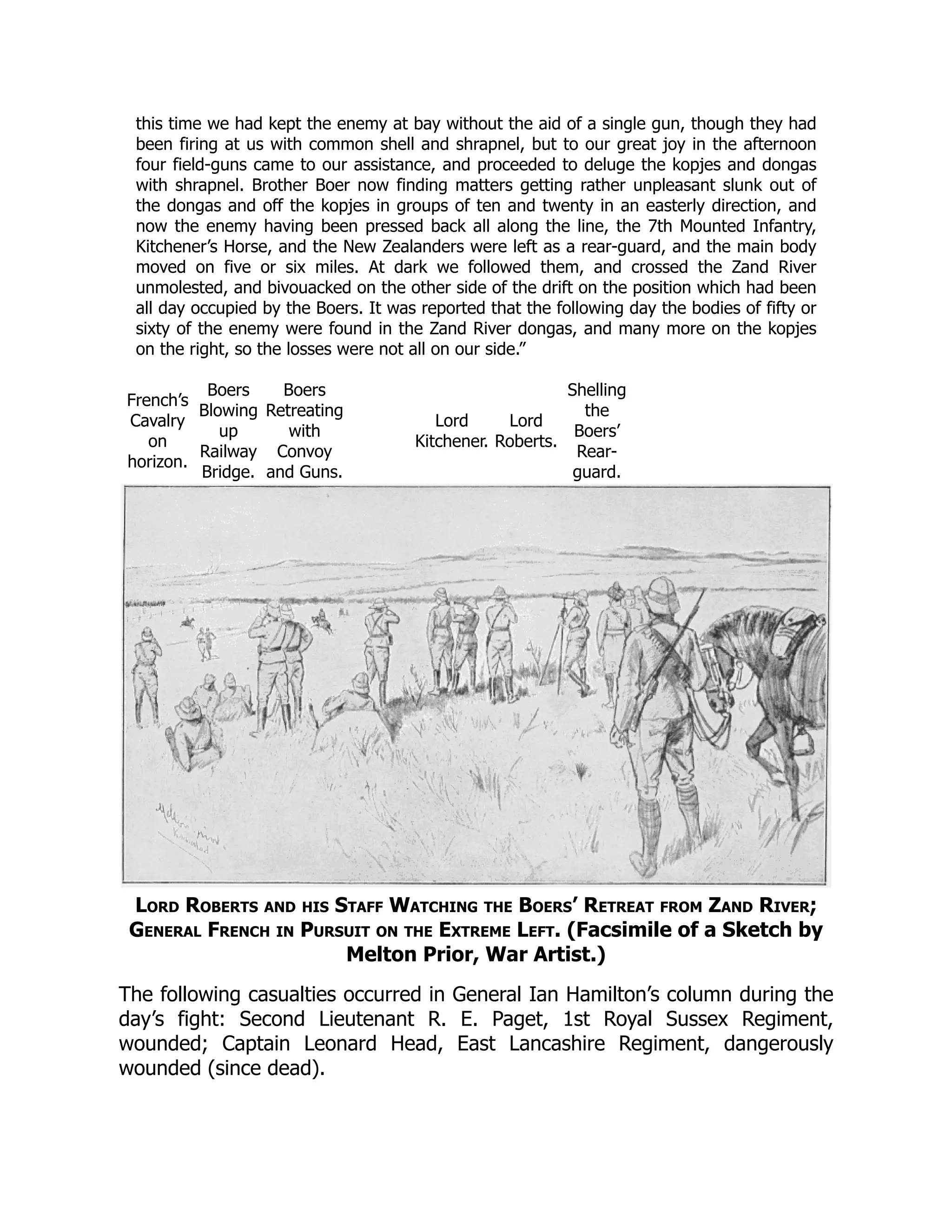
Kroonstadt on theValsch River.
Mr. Steyn, it was said, before his departure the previous night had used in
vain, persuasions, threats, and even violence to the burghers in the effort to
rally them. An enterprising photographer went so far as to take a portrait of
the late President in act of kicking and cuffing his followers—“to put valour
into them,” so it was explained. They, however, turned their backs on the
smiter, and many of them surrendered to Lord Roberts. Mr. Steyn had
announced that in future Lindley, situated between Kroonstadt and Bethlehem,
would become the seat of the Free State Government, and thither fled,
knowing in his heart that the days of the Free State were numbered. The
Transvaalers, disgusted with the “Orange” men, had refused any longer to
fight in the Free State, and took themselves off to the Vaal River; while, on the
other hand, the Free Staters, furious with the Transvaalers, charged them with
having made them into a “cat’s-paw” and then left them in the lurch. The
valiant Federals were, in fact, at loggerheads, and many surrendered, being
only too thankful to part company with their quondam allies.
The troops halted at Kroonstadt for ten days to recuperate, and while they
enjoyed their well-earned rest, stirring events took place elsewhere.
FOOTNOTES:
[4] See map at front.
36.
CHAPTER V
MAFEKING
There wasan immense amount of undiscovered genius in Mafeking till Colonel
Baden-Powell brought it to the front. The art of making ball-cartridges out of
blank, and the manufacture of gunpowder, cannon, shells, fuses, postage
stamps, bank notes, and a strategetic railway, served to occupy and amuse
those whose days were an unending round of monotony. The Colonel’s
vigilance, that in other times had earned for him the Matabele title of “’Mpeesi,
the wolf that never sleeps,” communicated itself to all, and it was to this
general spirit of alertness that the success of the garrison’s sturdy defence was
due. But on their hearts despond was setting its seal; young faces were
becoming lined with anxiety, and even those whose dramatic powers enabled
them to feign merriment were conscious that the effort was becoming even
more pathetic than resignation to their fate.
37.
MAFEKING: “THE WOLFTHAT NEVER SLEEPS”
Drawing by W. Hatherell, R.I., from materials supplied by Major F. D.
Baillie, Correspondent of the Morning Post
Young Eloff, who had gallantly volunteered to subdue Mafeking or die in the
attempt, beguiled the interval in preparing for his feat of chivalry by indulging
in a mild form of jocosity. He informed Colonel Baden-Powell that he had
heard of his Sabbath concerts, tournaments, and cricket matches, and would
be glad, as it was dull outside, to come in and participate in them. The Colonel
replied in the same vein—begged to postpone a return match till the present
one was finished, and suggested as they were now 200 not out, and Snyman
and Cronje had been unsuccessful, a further change of bowling might be
advantageous! In reality the young Boer was racking his brains with plans for
38.
the future, gettinginformation regarding the forts and defences, and deciding
when the time came for assault to do the thing with a flash and a flourish!
And his ambition was not entirely groundless, for things were coming to a
sorry pass, and the tension grew daily more severe. It was necessary to be
eternally pushing out trenches and capturing forts in order to secure grazing
and breathing space, but this action had the result of so extending the lines,
that the problem of how to protect ten miles of perimeter against some 2000
Boers, with only 700 men, became harder than ever to grapple with.
Fortunately there was still an inner line, but even this was difficult to guard,
now that the gallant seven hundred were reduced in stamina by long privation
and immediate famine.
A great deal of irritation was caused by pilfering and house-breaking that went
on. As the men were in the trenches and the women in the women’s laagers,
all the ill-conditioned vagabonds, the human sauria that had trailed from the
Rand and Bulawayo, at the hint of loot “made hay” while there was no police
at liberty to cope with them. Every hand in Mafeking had been required, and
the police had been forced to become soldiers, defenders of the state and not
of private property. And well they had done their work! For over six months
some 2000 to 3000 Boers had found fodder here for their eight guns, including
a 9-pounder. They had been kept stationary, and thus prevented from
combining with the Tuli column, or invading Rhodesia, or joining forces with
any of the aggressive commandos in the south. And this wonderful arrest had
been accomplished by men who at the beginning of hostilities were practically
unarmed and unfortified. It was no marvel, therefore, that President Kruger
and his advisers, who had started their fell work with such confidence, now
began to wag their heads in acridity and dismay. The overweening
bumptiousness of the several commandants who, full of buoyant and bellicose
aspirations, had attempted the subjugation of Mafeking, had been their
undoing. These had become the laughing-stock even of their own people.
Commandant Cronje early in the war had been so convinced of his ability to
capture Mafeking that he had caused a proclamation to be printed annexing
the district to the South African Republic. But he had found it a disastrous
place, and had left it with some loss of prestige, as had many others who had
attempted “to do the trick” and failed. Until this date the Boers had expended
considerably over 100 tons of ammunition, lost over 1000 men killed and
wounded, and had four guns disabled, yet nothing was accomplished.
Commandant Eloff was then specially deputed by Kruger to pulverise “B.P.”,
and came to his work in high spirits accompanied by a man—a deserter—who,
39.
having served asa trooper in the Protectorate Regiment, was well acquainted
with the plans of the fortifications and the military customs of the place. Of
course, it was the object of the youthful commandant to make an attack as
speedily as possible, for rumours of approaching relief threatened to put an
end to his machinations and spoil his ambitious scheme. He knew that a relief
column had reached and was advancing from Setlagoli, and that what had to
be done must be done now or never. Still he had a notion that after passing
Kraaipan any journey for troops would be arid, waterless, and discomforting,
and believed that the column might be cut off before it could offer serious
opposition to his plans.
Commandant Snyman, on his side, was as depressed as his colleague was
jaunty. He was scarcely flattered to find a youngster determining to solve a
problem which for a considerable time had defeated him, and therefore at the
onset, in regard to the momentous plans for attack, the two commandants
were scarcely at one. The rift widened as affairs developed. Indeed, in letters
which subsequently passed between the pair, it was discovered that Eloff, to
use his own words, “had been preparing to trip him up for years.” This
Snyman must evidently have known, and determined to show—as he did when
the opportunity offered—that “two could play at that game.” At this time,
however, though the trail of the green and yellow monster might have been
seen winding about the Boer laagers, there was no suspicion that when
combined action against the common enemy—the British—would be needed
the older commandant would fail the younger one.
Curiously enough, though at the instance of the Boers the Sunday truce had
been agreed upon, they were the first to break through the compact. On the
6th of May, while the usual auction sales were taking place, and the ladies
were cautiously doing their weekly shopping, an affair of some moment since
prices ruled high, the rattle of musketry betrayed that something was wrong.
It was then discovered that the Boers had fired on the horse guard, killing
Trooper Franch, and wounding three horses, and causing a stampede of the
herd towards their own lines. Fortunately the ever-wary B. P. kept a machine
gun in the valley, and a sharp engagement took place, but nevertheless the
Boers succeeded in capturing some of the all too precious cattle. The affair
was soon over and the terrified ladies continued their shopping, but the
incident was sufficient to demonstrate that soon, if the Boers should fail to
succeed by fair means, they would have recourse to foul.
At last, on the 12th of May, came the great, the long-looked-for assault. It was
not yet dawn, the stars were still blinking pallidly, when an ominous crackling
awoke the town. It came from the east, where rosy tints of the sunrise were
40.
beginning to showthemselves. At once every one was astir. The alarm bugle
blared out, bells sounded, forms all sketchily attired, some still in pyjamas,
rushed to their posts.
Though the bullets came from the east, whizzing and phutting into the
market-square, Colonel Baden-Powell, with his natural astuteness, declared
that the real attack would come not from there but from the west, the corner
where stood the stadt of the Baralongs. All got their horses ready, armed
themselves with whatever came to hand, and fled precipitately out into the
nipping air of the morning. For an hour this brisk fusillade continued, then at
about 5.30 there was a lull. The sun now was slowly beginning to rise,
reddening the east with vivid blushes. But the colonel’s eyes were fixed on the
west, and there sure enough was what at first seemed a reflection of the
sunrise—a tremendous flaming mirage surmounted by dense volumes of
smoke, and accompanied by a weird stentorian crackling commingled with
yells discordant, and despairing lamentations from the direction of the native
village. There was no doubt about it, the stadt was ablaze! whether by
accident or design none at that moment could decide. Away went the guns,
after them the Bechuanaland Rifles, rushing to the fray; and then on the
morning breeze came a strange sound—cheers—but not British cheers—cheers
that sent a thrill of horror through all who anxiously awaited the upshot of the
encounter. It was scarcely to be credited, but it was the truth! The enemy had
arrived! They were already in the fort that was held by Colonel Hore and his
staff! They were not 500 yards off! At this time, though the bullets from the
east fell less thickly, those from the west began to pour in, and through this
cross fire the besieged rushed to their several destinations. Women,
distracted, fled hither and thither; men shot and shouted and gave orders.
Columns of smoke and cascades of sparks told the tale of conflagration, and
natives scared, babbling, panic-stricken, tore through the streets.
There was just cause for alarm. The evil hour had come. The Boers had
reached the orderly-room which stood outside the Kaffirs’ stadt. The clerk,
finding himself surrounded, hurriedly telephoned to the Colonel, “The Boers
are all in among us.” Such news it was almost impossible to credit, and the
Colonel put his ear to the telephone. Then the sound of Dutch voices
convinced him of the horrible truth. The next thing was a message saying that
the Boers had taken Colonel Hore and his force prisoners, and that the British
were powerless to help them. Telephonic communication was immediately
destroyed with wire-pliers, but a state of consternation prevailed. It was
perfectly true that Colonel Hore was powerless, as with his small force of
twenty-three all told it was impossible to guard the many outbuildings that
41.
surrounded him againstsuch overwhelming numbers, particularly as at first in
the dusk it had been impossible to distinguish whether the advancing men
were foes or friends.
All—young and old, men and even women—were madly rushing to the front,
all eager to check the Boers in their wild rush forward. The prisoners in the jail
were let loose and armed to join in the common duty, small boys seized
weapons, shovels or pokers for want of anything better, and invited
themselves to help to turn the invaders out. A singular cheeriness prevailed;
the sniff of battle exhilarated, intoxicated them; they swore to protect
Mafeking or die in the attempt!
Meanwhile the dashing Eloff, who so long had boasted that he would bring
Mafeking to her knees, had at last achieved something of a success. The fort
was seized. He and his band of 700 men had advanced up the Molopo, burnt
the stadt as a signal to his allies, and thus made an entry. The storming party
was composed mostly of foreigners, and numbered some 300 all told. Many of
them were Frenchmen, who, when they emerged from Hidden Hollow and
rushed on Colonel Hore’s fort, were heard to be shouting “Fashoda! Fashoda!”
while such Boers as could speak English were sent in front to roar “Hip, hip,
hurrah! Relieved at last!” so as to deceive the besieged with the idea that the
relief column was arriving. Behind were 500 burghers, with Snyman, in
support; but when they heard the firing they discreetly waited to see the
result, and through their discretion Eloff eventually lost what he had gained.
The Baralongs, whose stadt was burning, and who themselves were burning
for revenge, had permitted some 300 of the party to seize the outlying forts,
and then, with an astuteness peculiar to them, decided they would get
between the Dutchmen and their supports, and “kraal them up like cattle.” But
this was not done in a moment.
To return. When the storming party had reached the fort, they broke up into
three. One hundred and fifty of them attacked the fort and seized it, together
with the Colonel and twenty-three men of the Protectorate Regiment, who,
mistaking them in the dusk of the early dawn for friends, had not fired. When
they found out their mistake, it was too late.
Regarding Colonel Hore’s lamentable position and his surrender, the
correspondent of the Times, who had the ill luck as a man and the good luck
as a journalist to get taken prisoner, said: “Commandant Eloff demanded the
unconditional surrender of the twenty-three men who were established at the
fort, an order which, had Colonel Hore refused, implied that every man with
him would be shot. The exigencies of the situation had thus suddenly thrown
42.
upon the shouldersof this very gallant officer an almost overwhelming
responsibility. It was impossible to withdraw to the town. Such a movement
would have meant retirement over 700 yards of open, level ground without a
particle of cover, and with a force of 300 of the enemy immediately in the rear.
For a moment Colonel Hore had considered, but realising that escape was
impossible, that indeed the Boers were all round him, he ordered the
surrender, accepting the responsibility of such an act in the hope of saving the
lives of the men who were with him. But the situation imperatively demanded
this action in consequence of events over which he had no control. It was,
perhaps, a moment as pathetic and great as any in his career, which,
honourable and distinguished as it has been, has brought to him some six
medals. The surrender was effected at 5.25 a.m., and the news of such a
catastrophe did not tend to relieve the gravity of the situation. With the Boers
in the fort and in occupation of the stadt, it was necessary so to arrange our
operations that any junction between the stadt and the fort would be
impossible. At the same time we were compelled to prevent those Boers who
were in the stadt from cutting their way through to the main body of the
enemy. The situation was indeed complex, and throughout the remainder of
the day the skirmishing in the stadt and the repulse of the feints of the
enemy’s main body, delivered in different directions against the outposts, were
altogether apart from the siege which we were conducting within our own
investment. From the town very heavy rifle fire was directed upon the fort,
which the Boers in that quarter returned with spirit and determination. But the
position in the stadt had become acute, since behind our outposts and our
inner chain of forts, which are situated upon its exterior border, were a
rollicking, roving band of 400 Boers, who for the time being were indulging in
pillage and destruction wherever it was possible.”
43.
Welcome to ourwebsite – the perfect destination for book lovers and
knowledge seekers. We believe that every book holds a new world,
offering opportunities for learning, discovery, and personal growth.
That’s why we are dedicated to bringing you a diverse collection of
books, ranging from classic literature and specialized publications to
self-development guides and children's books.
More than just a book-buying platform, we strive to be a bridge
connecting you with timeless cultural and intellectual values. With an
elegant, user-friendly interface and a smart search system, you can
quickly find the books that best suit your interests. Additionally,
our special promotions and home delivery services help you save time
and fully enjoy the joy of reading.
Join us on a journey of knowledge exploration, passion nurturing, and
personal growth every day!
testbankfan.com






![Kroonstadt on the Valsch River.
Mr. Steyn, it was said, before his departure the previous night had used in
vain, persuasions, threats, and even violence to the burghers in the effort to
rally them. An enterprising photographer went so far as to take a portrait of
the late President in act of kicking and cuffing his followers—“to put valour
into them,” so it was explained. They, however, turned their backs on the
smiter, and many of them surrendered to Lord Roberts. Mr. Steyn had
announced that in future Lindley, situated between Kroonstadt and Bethlehem,
would become the seat of the Free State Government, and thither fled,
knowing in his heart that the days of the Free State were numbered. The
Transvaalers, disgusted with the “Orange” men, had refused any longer to
fight in the Free State, and took themselves off to the Vaal River; while, on the
other hand, the Free Staters, furious with the Transvaalers, charged them with
having made them into a “cat’s-paw” and then left them in the lurch. The
valiant Federals were, in fact, at loggerheads, and many surrendered, being
only too thankful to part company with their quondam allies.
The troops halted at Kroonstadt for ten days to recuperate, and while they
enjoyed their well-earned rest, stirring events took place elsewhere.
FOOTNOTES:
[4] See map at front.](https://image.slidesharecdn.com/2792-250409153545-207a1376/75/Human-Genetics-Concepts-and-Applications-9th-Edition-Lewis-Test-Bank-35-2048.jpg)