Huckleberry Finn

    Off the raft
Mob mentality
• What happens between Colonel Sherburn and
  Boggs?
• Here Twain satirizes mob mentality. How?
• The villagers fail to speak up for what’s right.
  How is this scene also a commentary on the
  South’s attitude toward African Americans?
High and low
• The Shakespearean performance is a mixture
  of high and low culture. How?
• In the end the Shakespearean revival doesn’t
  draw a lot of theatergoers. The King and Duke
  come up with a solution that appeals to the
  baser interests of the men. What do they do?
  Why is this ironic?
Royal Nonesuch
• What is the Royal Nonesuch performance?
• This is section of the novel is Twain’s satire on
  entertainment.
  – The entertainers and the villagers are satirized.
    How?
  – What, then, is Twain’s critique of entertainment?
The Wilks orphans
• This scam represents a significant moment in
  Huck’s maturity. Why?
Eternal damnation
• When Huck decides not to tell Miss Watson
  about Jim he acts against the laws of society
  and religion. Through his decision, Twain
  articulates an important theme of individual
  responsibility. What is his point?
Huck Finn, hero?
• Hero status               • Not yet
  – Character growth          – Final section of the novel
  – Individual conscience     – Huck plays second fiddle
  – Moral clarity               to Tom
                              – “No’m. Killed a [black
                                man].” Huck’s response
                                to Aunt Sally’s question
                                about the blown
                                cylinder-head on the
                                steamboat.
Civilized, again

 The Phelps’ farm
Hemingway
• American novelist Ernest Hemingway was
  influenced by Mark Twain, but nonetheless
  calls the ending of Huck Finn “cheating.”
• What does he mean by this?
• Do you agree?
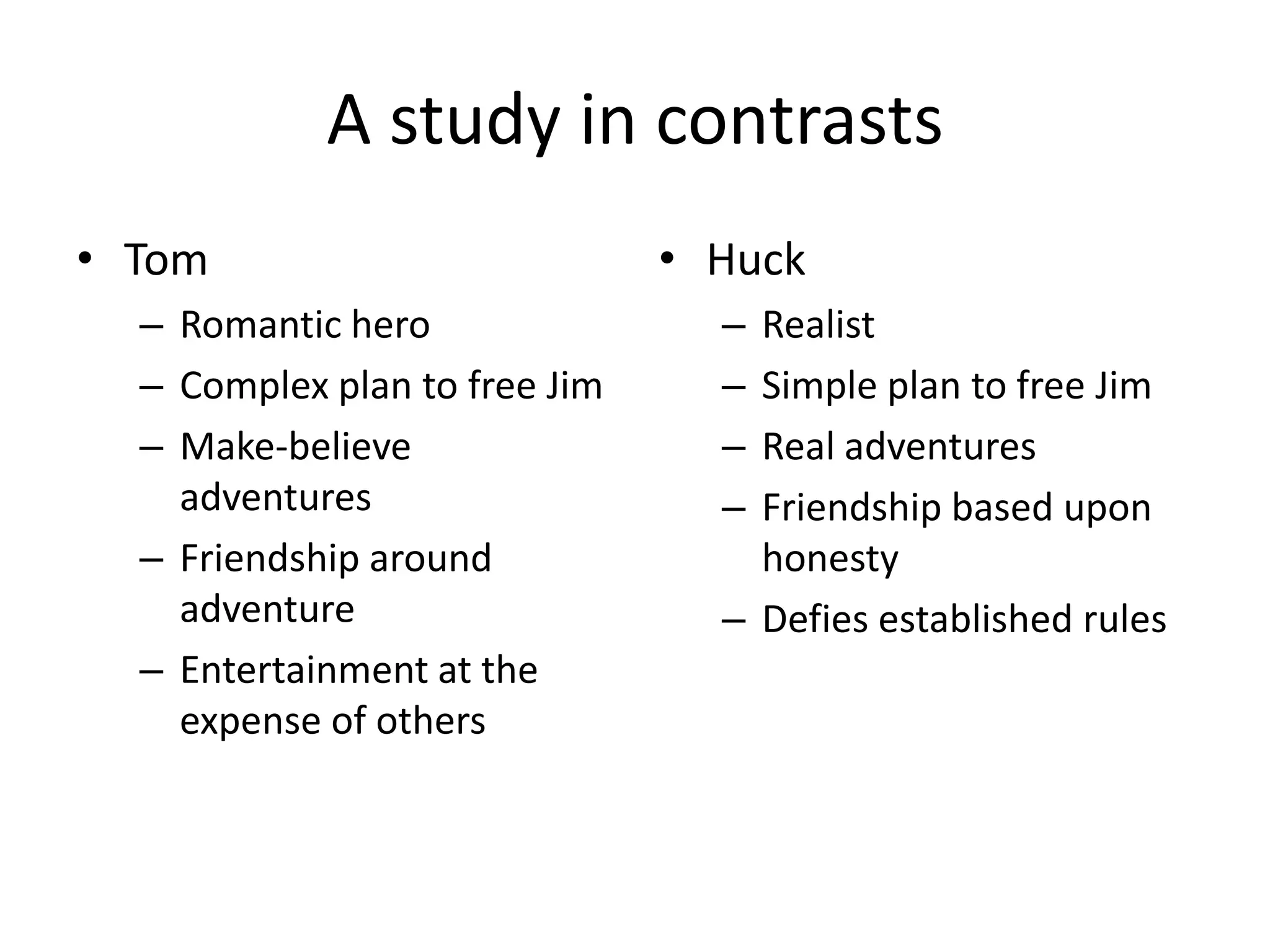
A study in contrasts
• Tom                          • Huck
  – Romantic hero                – Realist
  – Complex plan to free Jim     – Simple plan to free Jim
  – Make-believe                 – Real adventures
    adventures                   – Friendship based upon
  – Friendship around              honesty
    adventure                    – Defies established rules
  – Entertainment at the
    expense of others
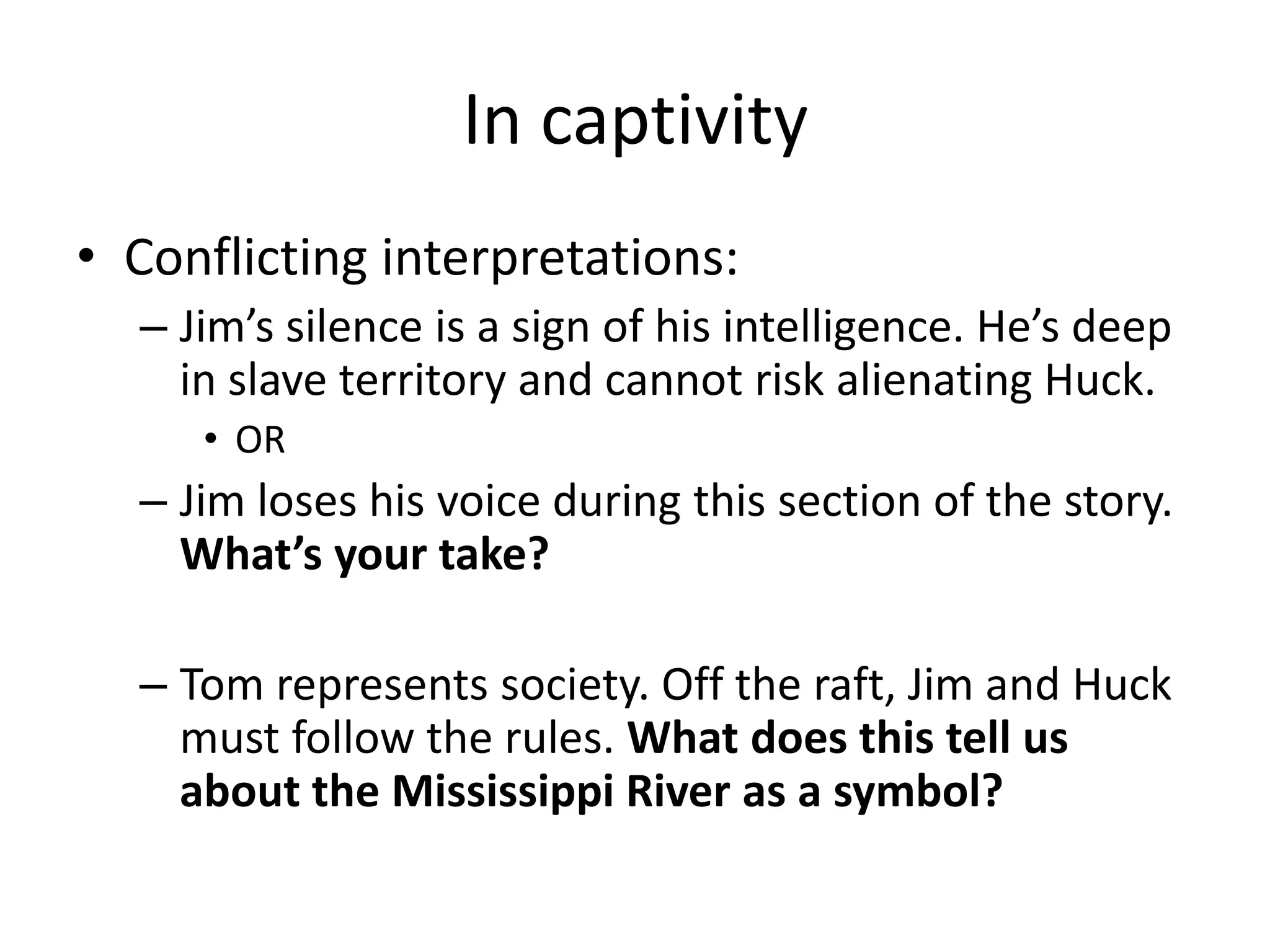
In captivity
• Conflicting interpretations:
  – Jim’s silence is a sign of his intelligence. He’s deep
    in slave territory and cannot risk alienating Huck.
     • OR
  – Jim loses his voice during this section of the story.
    What’s your take?

  – Tom represents society. Off the raft, Jim and Huck
    must follow the rules. What does this tell us
    about the Mississippi River as a symbol?
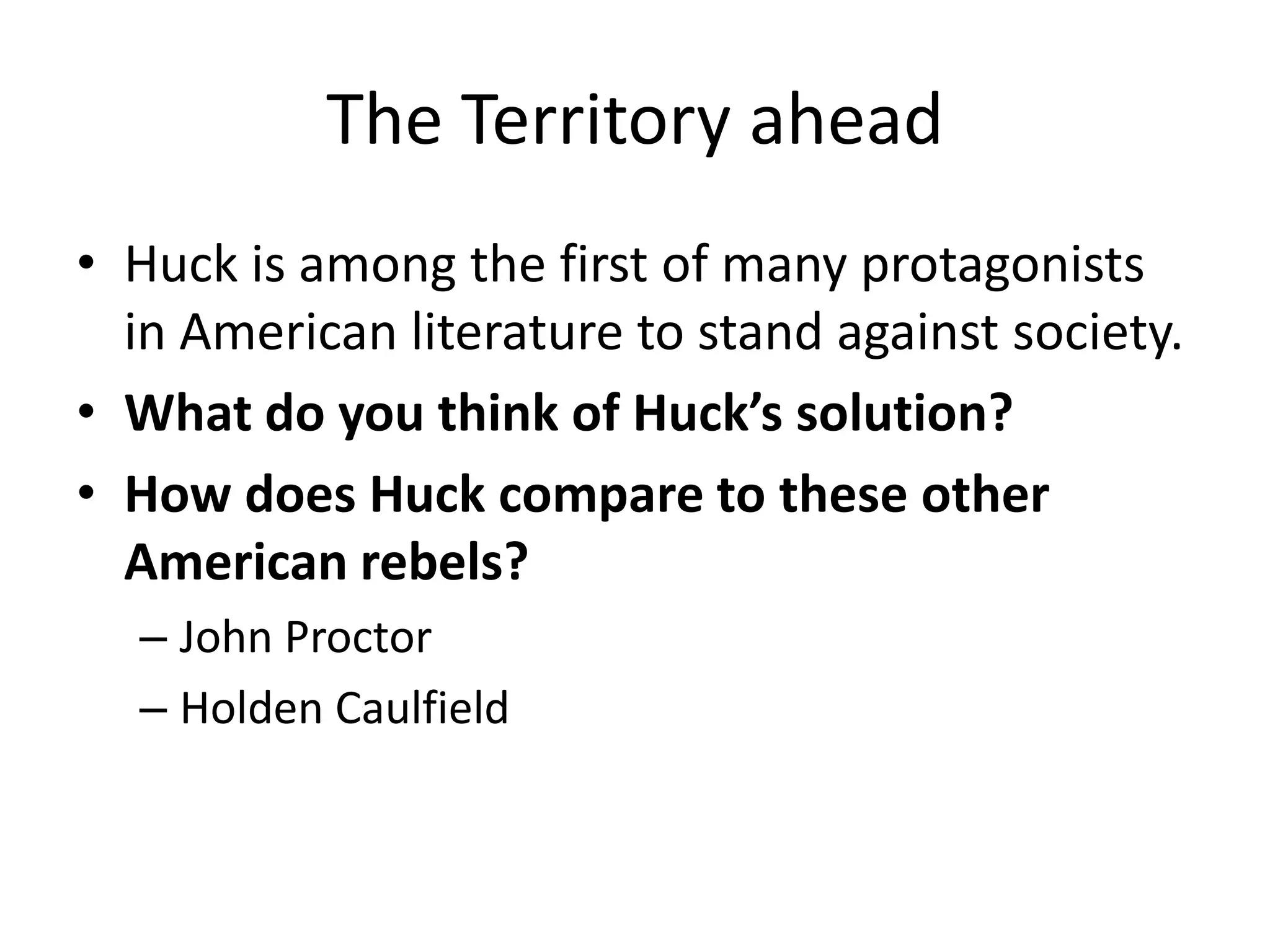
The Territory ahead
• Huck is among the first of many protagonists
  in American literature to stand against society.
• What do you think of Huck’s solution?
• How does Huck compare to these other
  American rebels?
  – John Proctor
  – Holden Caulfield
Bibliography
• Twain, Mark, and Alfred Kazin. The Adventures
  of Huckleberry Finn. New York: Bantam, 1981.
  Print.
• Wasowski, Richard. Twain's Adventures of
  Huckleberry Finn. New York, NY: Hungry
  Minds, 2001. Print.

Huckleberry Finn: The second half

  • 1.
    Huckleberry Finn Off the raft
  • 2.
    Mob mentality • Whathappens between Colonel Sherburn and Boggs? • Here Twain satirizes mob mentality. How? • The villagers fail to speak up for what’s right. How is this scene also a commentary on the South’s attitude toward African Americans?
  • 3.
    High and low •The Shakespearean performance is a mixture of high and low culture. How? • In the end the Shakespearean revival doesn’t draw a lot of theatergoers. The King and Duke come up with a solution that appeals to the baser interests of the men. What do they do? Why is this ironic?
  • 4.
    Royal Nonesuch • Whatis the Royal Nonesuch performance? • This is section of the novel is Twain’s satire on entertainment. – The entertainers and the villagers are satirized. How? – What, then, is Twain’s critique of entertainment?
  • 5.
    The Wilks orphans •This scam represents a significant moment in Huck’s maturity. Why?
  • 6.
    Eternal damnation • WhenHuck decides not to tell Miss Watson about Jim he acts against the laws of society and religion. Through his decision, Twain articulates an important theme of individual responsibility. What is his point?
  • 7.
    Huck Finn, hero? •Hero status • Not yet – Character growth – Final section of the novel – Individual conscience – Huck plays second fiddle – Moral clarity to Tom – “No’m. Killed a [black man].” Huck’s response to Aunt Sally’s question about the blown cylinder-head on the steamboat.
  • 8.
    Civilized, again ThePhelps’ farm
  • 9.
    Hemingway • American novelistErnest Hemingway was influenced by Mark Twain, but nonetheless calls the ending of Huck Finn “cheating.” • What does he mean by this? • Do you agree?
  • 10.
    A study incontrasts • Tom • Huck – Romantic hero – Realist – Complex plan to free Jim – Simple plan to free Jim – Make-believe – Real adventures adventures – Friendship based upon – Friendship around honesty adventure – Defies established rules – Entertainment at the expense of others
  • 11.
    In captivity • Conflictinginterpretations: – Jim’s silence is a sign of his intelligence. He’s deep in slave territory and cannot risk alienating Huck. • OR – Jim loses his voice during this section of the story. What’s your take? – Tom represents society. Off the raft, Jim and Huck must follow the rules. What does this tell us about the Mississippi River as a symbol?
  • 12.
    The Territory ahead •Huck is among the first of many protagonists in American literature to stand against society. • What do you think of Huck’s solution? • How does Huck compare to these other American rebels? – John Proctor – Holden Caulfield
  • 13.
    Bibliography • Twain, Mark,and Alfred Kazin. The Adventures of Huckleberry Finn. New York: Bantam, 1981. Print. • Wasowski, Richard. Twain's Adventures of Huckleberry Finn. New York, NY: Hungry Minds, 2001. Print.