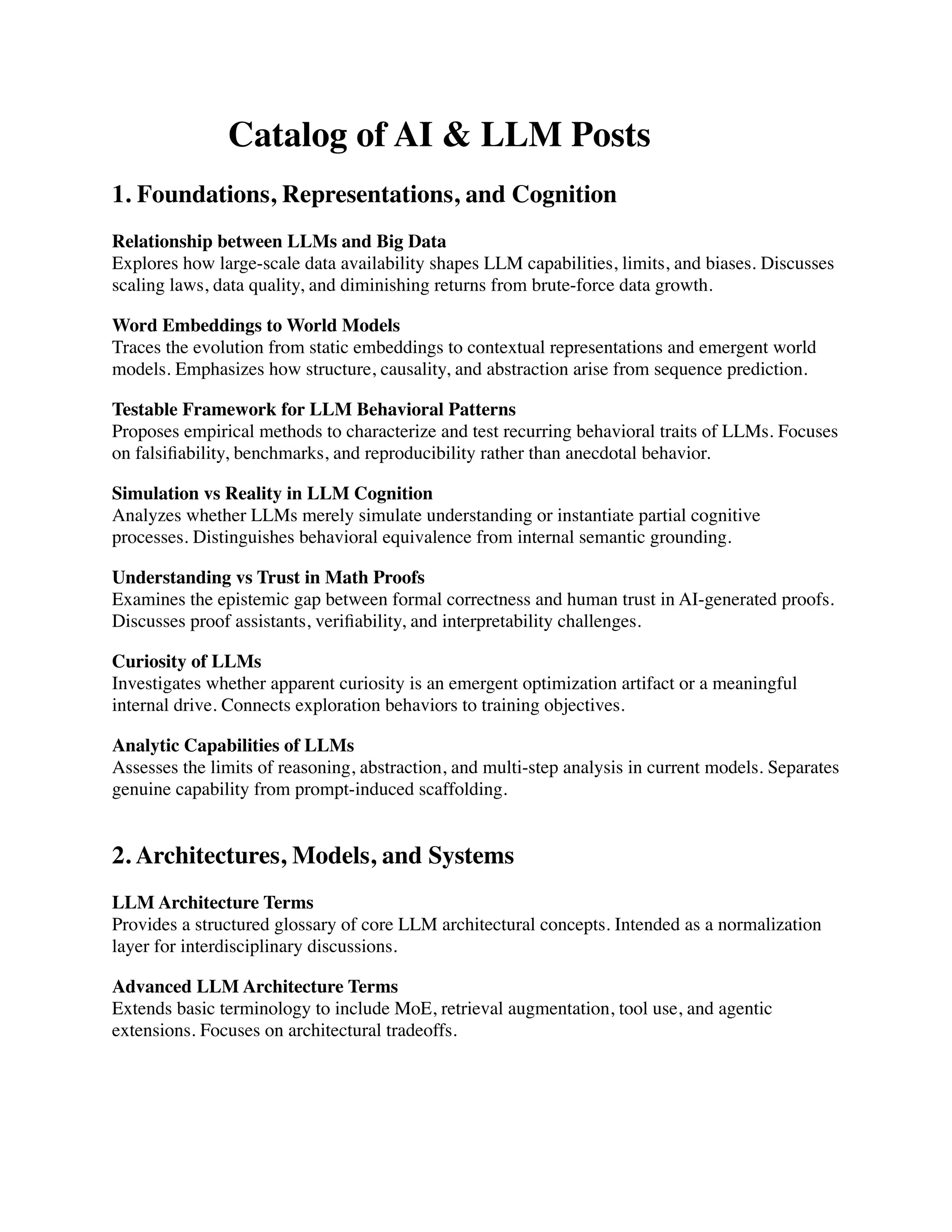
Catalog of AI& LLM Posts
1. Foundations, Representations, and Cognition
Relationship between LLMs and Big Data
Explores how large-scale data availability shapes LLM capabilities, limits, and biases. Discusses
scaling laws, data quality, and diminishing returns from brute-force data growth.
Word Embeddings to World Models
Traces the evolution from static embeddings to contextual representations and emergent world
models. Emphasizes how structure, causality, and abstraction arise from sequence prediction.
Testable Framework for LLM Behavioral Patterns
Proposes empirical methods to characterize and test recurring behavioral traits of LLMs. Focuses
on falsi
fi
ability, benchmarks, and reproducibility rather than anecdotal behavior.
Simulation vs Reality in LLM Cognition
Analyzes whether LLMs merely simulate understanding or instantiate partial cognitive
processes. Distinguishes behavioral equivalence from internal semantic grounding.
Understanding vs Trust in Math Proofs
Examines the epistemic gap between formal correctness and human trust in AI-generated proofs.
Discusses proof assistants, veri
fi
ability, and interpretability challenges.
Curiosity of LLMs
Investigates whether apparent curiosity is an emergent optimization artifact or a meaningful
internal drive. Connects exploration behaviors to training objectives.
Analytic Capabilities of LLMs
Assesses the limits of reasoning, abstraction, and multi-step analysis in current models. Separates
genuine capability from prompt-induced scaffolding.
2. Architectures, Models, and Systems
LLM Architecture Terms
Provides a structured glossary of core LLM architectural concepts. Intended as a normalization
layer for interdisciplinary discussions.
Advanced LLM Architecture Terms
Extends basic terminology to include MoE, retrieval augmentation, tool use, and agentic
extensions. Focuses on architectural tradeoffs.
2.
Beyond Transformers
Surveys post-transformerarchitectures and hybrid approaches. Evaluates claims of architectural
necessity versus scaling suf
fi
ciency.
Gen AI: Next Steps beyond Transformers
Explores candidate directions such as world models, recurrence, modularity, and neurosymbolic
integration.
Small Language Models for Edge and IoT
Discusses constraints and design strategies for deploying LLMs on resource-limited devices.
Emphasizes distillation, sparsity, and task specialization.
Enterprise MoE using World Model Distillation
Presents a practical architecture for enterprise-scale MoE systems grounded in distilled world
models. Focuses on ef
fi
ciency and controllability.
Model Context Protocol
Introduces a standardized approach to managing and structuring model context. Addresses
context over
fl
ow, composability, and tool integration.
AI Accelerators
Overviews hardware accelerators for AI workloads. Focuses on architectural implications rather
than vendor-speci
fi
c marketing.
3. Agentic and Autonomous AI
Survey of Agentic AI Architectures
Systematically reviews agent frameworks, memory, planning, and tool use. Identi
fi
es common
failure modes and open research gaps.
Agentic AI Foundation (AAIF)
Proposes a foundational architecture for agentic systems with safety and governance hooks.
Emphasizes composability and auditability.
Conversation between Two LLMs
Analyzes emergent behaviors when LLMs interact directly. Highlights coordination, divergence,
and instability risks.
Runtime Guardrails for AI
Examines dynamic, runtime-based safety mechanisms. Contrasts static alignment with adaptive
oversight.
Preventing LLM Bloviation
Addresses verbosity, hallucination, and rhetorical overreach. Proposes structural and evaluative
countermeasures.
3.
4. Safety, Risk,and Governance
AI Risk Categories and Governance
Presents a taxonomy of AI risks mapped to governance responses. Separates speculative,
systemic, and near-term harms.
Simpli
fi
ed AI Risk Categories
A distilled version of AI risk classi
fi
cation aimed at policymakers and non-specialists.
AI Safety Landscape
Surveys technical, institutional, and geopolitical safety approaches. Emphasizes tradeoffs
between innovation and control.
Comparison Analysis of Safety Approaches: LangChain and Alternatives
Critically compares safety and control mechanisms in popular agent frameworks. Focuses on
practical enforceability.
Regulating AI – AI’s Recommendations
Explores regulatory proposals generated or analyzed by AI systems themselves. Evaluates
circularity and legitimacy concerns.
AI Bubble and Bloodbath
Assesses economic overexuberance in AI markets. Draws parallels to prior technology cycles.
5. Society, Education, and Human–AI Interaction
Evaluating Students in the LLM Era
Discusses assessment integrity and pedagogy in the presence of ubiquitous AI tools. Proposes
alternative evaluation models.
Bridge between Society and AI
Explores sociotechnical alignment between AI systems and societal values. Focuses on
institutional mediation.
Future Human–AI Collaboration
Outlines plausible collaboration models rather than replacement narratives. Emphasizes
augmentation and division of labor.
Personal AI Assistants
Examines architecture, privacy, and agency issues in personal AI systems. Distinguishes
assistants from autonomous agents.
4.
ChatGPT, Consciousness, andHuman Psychology
Analyzes psychological responses to conversational AI. Avoids claims of machine consciousness
while addressing user perception.
Chatbot Romances / Humanistic Robots 2026
Explores emotional attachment, anthropomorphism, and ethical boundaries in human–AI
relationships.
Safe AI Companions
Proposes design constraints for emotionally engaging AI systems. Focuses on dependency and
manipulation risks.
6. Strategy, Policy, and Geopolitics
AGI Technology, Architecture, and China
Analyzes strategic differences in AGI development approaches. Separates technical reality from
geopolitical rhetoric.
Industrial AI Architecture: US vs China (Technical)
Compares infrastructure, data pipelines, and deployment models. Emphasizes systemic rather
than model-level differences.
Industrial AI Strategy: US vs China (Policy)
Examines regulatory, industrial, and national strategy contrasts. Highlights feedback loops
between policy and architecture.
AI Initiatives Comparison
Provides a comparative overview of major AI initiatives across regions or institutions.
Responding to AI Society Divide
Addresses inequality ampli
fi
ed by AI adoption. Discusses access, literacy, and institutional
responses.
7. Interpretability, Meta-Science, and Research Process
Interpretability of LLM Outputs
Surveys interpretability methods and their limitations. Distinguishes mechanistic insight from
post-hoc explanation.
Improving LLM Responses
Focuses on evaluation, feedback loops, and prompt-independent quality improvements.
5.
Generating Incremental ResearchPapers
Explores AI-assisted scienti
fi
c writing work
fl
ows. Emphasizes incremental contribution and
attribution integrity.
Update: Generating Incremental Research Papers
Re
fi
nes prior methods based on observed failure modes and misuse.
Overview Survey of Gen AI Applications
High-level mapping of generative AI use cases across sectors. Intended as orientation rather than
depth.
8. Consciousness and Advanced Speculation
Pathways to Consciousness
Reviews theoretical routes to machine consciousness without asserting imminence.
LLM Consciousness
Critically evaluates claims of consciousness in LLMs. Emphasizes category errors and empirical
gaps.
AGI+ Transition between AGI and ASI
Speculative analysis of post-AGI capability transitions. Explicitly
fl
ags uncertainty.
AI Self-Replication
Discusses self-replication risks and constraints. Focuses on system-level dependencies.
Platonic AI Representations
Examines the hypothesis that independently trained models converge on shared abstract
representations. Connects to interpretability and universality claims.
9. Classical and Hybrid AI
Neurosymbolic AI Overview
Surveys hybrid approaches combining neural learning with symbolic reasoning.
Classical Machine Learning
Provides a grounding overview of pre-deep-learning methods and their continued relevance.
Generative AI and Social Media
Analyzes the impact of generative models on content ecosystems and incentives.
6.
10. Meta /Organizational
Preface to the Postings
Sets intellectual framing and scope for the collection.
Overview Podcast
Audio-oriented synthesis of key themes across the presentations.
Atlas of Modern AI
A conceptual map situating modern AI sub
fi
elds and trajectories.



![Conviction LP Letter - Dec 2023 [Redacted]](https://cdn.slidesharecdn.com/ss_thumbnails/convictionlpletter-dec2023sentredacted-250215033237-61bacefc-thumbnail.jpg?width=640&height=640&fit=bounds)


