HTML
AN INTRODUCTION
TO WEB PAGE
PROGRAMMING
INTRODUCTION TO HTML
• With HTML you can create your own Web site.
• HTML stands for Hyper Text Markup Language.
• HTML is derived from a language SGML (Standard
Graphics Markup Language).
• The future of HTML is XML (eXtended Markup
Language).
• HTML is not a programming language, it is a Markup
Language.
• A markup language is a set of markup tags.
• HTML uses markup tags to describe web pages.
• HTML is not case sensitive language.
• HTML documents contain HTML tags and plain text.
HTML Elements and Tags
• A tag is always enclosed in angle bracket
<>like <HTML>
• HTML tags normally come in pairs like
<HTML> and </HTML> i.e.
Start tag = <HTML>
End tag =</HTML>
• Start and end tags are also called opening
tags and closing tags
What the following term mean:
Web server: a system on the internet containing one or
more web site
Web site: a collection of one or more web pages
Web pages: single disk file with a single file name
Home pages: first page in website
Think about the followings before working your
Web pages.
Think about the sort of information(content) you want to
put on the Web.
Set the goals for the Web site.
Organize your content into main topics.
Come up with a general structure for pages and topics.
HOW TO START
• Write html code in notepad.
• Save the file with (.Html)/(.Htm) extension.
• View the page in any web browser viz. INTERNET
EXPLORER, NETSCAPE NAVIGATOR etc.
• The purpose of a web browser (like internet explorer or
firefox) is to read html documents and display them as web
pages.
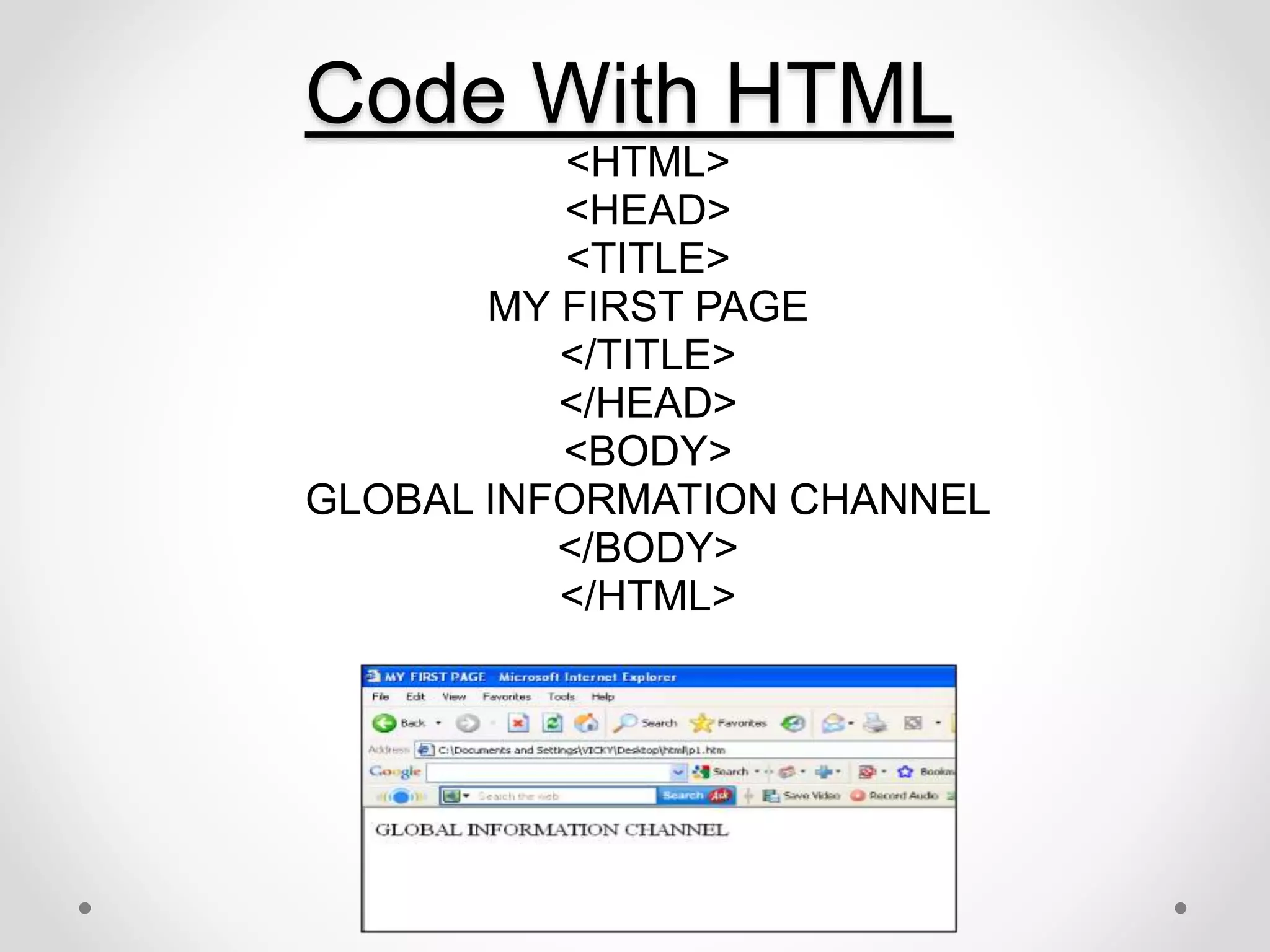
Code With HTML
<HTML>
<HEAD>
<TITLE>
MY FIRST PAGE
</TITLE>
</HEAD>
<BODY>
GLOBAL INFORMATION CHANNEL
</BODY>
</HTML>
Tags used in HTML.
• <HTML> - Describe HTML web page that is to be viewed by
a web browser.
• <HEAD> - This defines the header section of the page.
• <TITLE> - This shows a caption in the title bar of the page.
• <BODY> - This tag show contents of the web page will be
displayed.
Types of HTML Tags
There are two different types of tags:->
Container Element:->
Container Tags contains start tag & end tag i.e.
<HTML>… </HTML>
Empty Element:->
Empty Tags contains start tag i.e.
<BR>
Text Formatting Tags
Heading Element:->
• There are six heading elements (<H1>,<H2>,<H3>,<H4>,
<H5>,<H6>).
• All the six heading elements are container tag and requires
a closing tag.
• <h1> will print the largest heading
• <h6> will print the smallest heading
Heading Tag Code
<html>
<head><title>heading</title></head>
<body>
<h1> GLOBAL INFO CHANNEL</h1>
<h2> GLOBAL INFO CHANNEL</h2>
<h3> GLOBAL INFO CHANNEL</h3>
<h4> GLOBAL INFO CHANNEL</h4>
<h5> GLOBAL INFO CHANNEL</h5>
<h6> GLOBAL INFO CHANNEL</h6>
</body>
</html>
Result of Heading Code
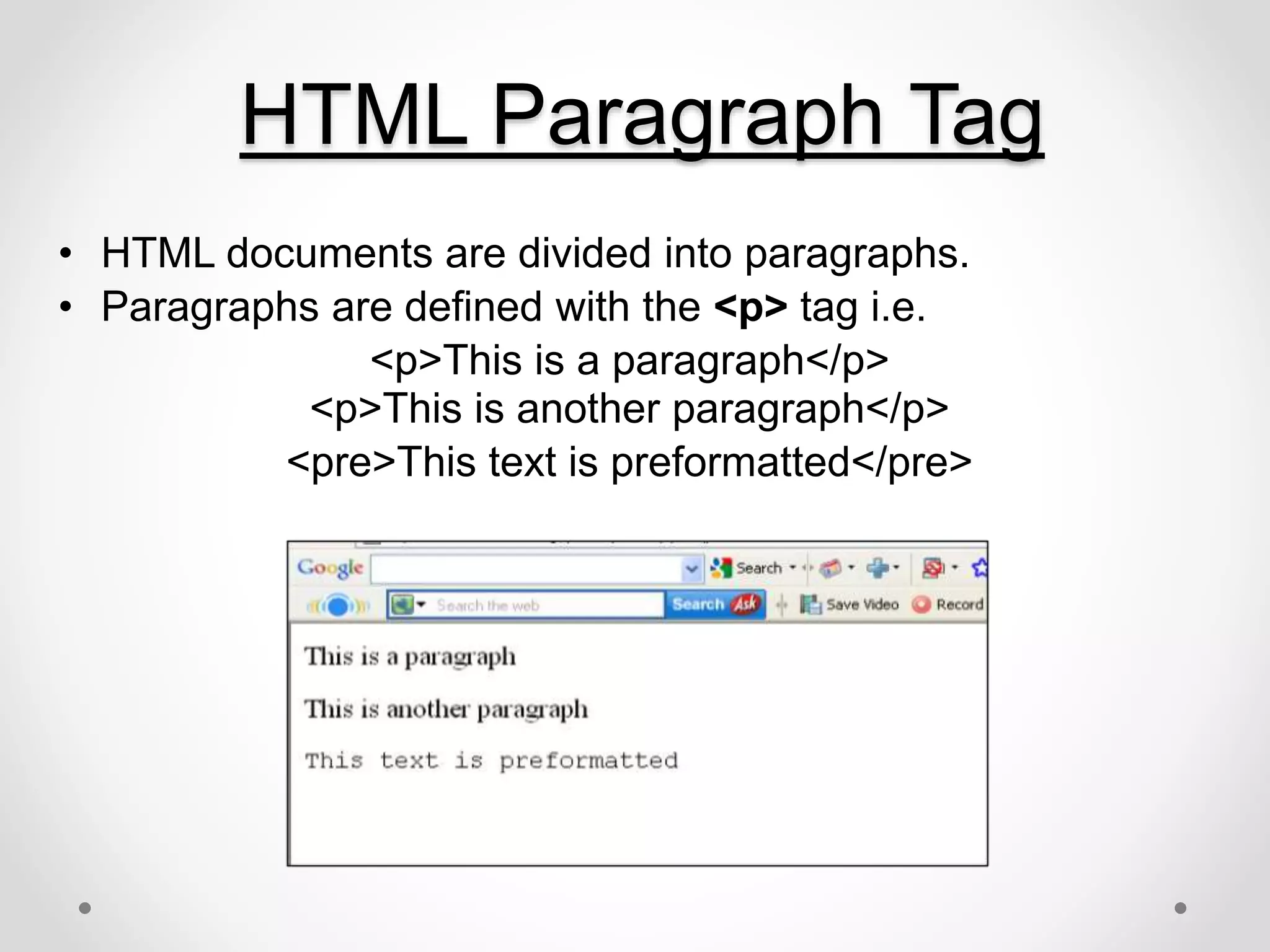
HTML Paragraph Tag
• HTML documents are divided into paragraphs.
• Paragraphs are defined with the <p> tag i.e.
<p>This is a paragraph</p>
<p>This is another paragraph</p>
<pre>This text is preformatted</pre>
Line Break & Horizontal Line Tag
• if you want a line break or a new line without starting a new
paragraph Use the <br> tag.
• Defines a horizontal line use <hr>tag.
• <br> <hr> element are empty HTML element i.e. Global
Information Channel<hr>
Global Information <br> Channel
Text Formatting Tags
<b>
<big>
<em>
<i>
<small>
<strong>
<sub>
<super>
<ins>
<del>
<tt>
<u>
<strike>
Defines bold text
Defines big text
Defines emphasized text
Defines italic text
Defines small text
Defines strong text
Defines subscripted text
Defines superscripted text
Defines inserted text
Defines deleted text
Defines teletype text
Defines underline text
Defines strike text
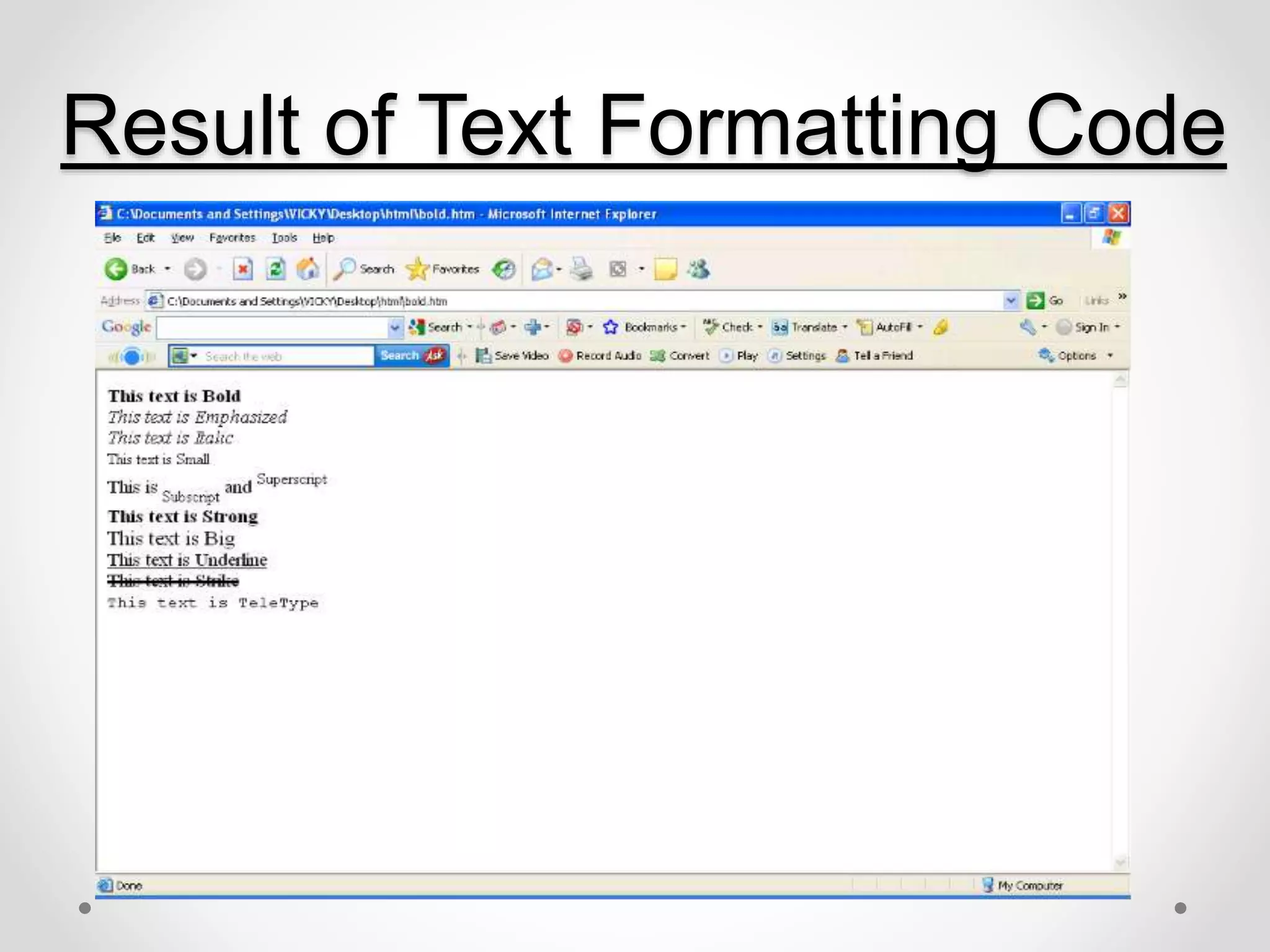
Text Formatting Code
<html>
<head></head>
<body>
<b>This text is Bold</b>
<br><em>This text is Emphasized</em>
<br><i>This text is Italic</i>
<br><small>This text is Small</small>
<br>This is<sub> Subscript</sub> and <sup>Superscript</sup>
<br><strong>This text is Strong</strong>
<br><big>This text is Big</big>
<br><u>This text is Underline</u>
<br><strike>This text is Strike</strike>
<br><tt>This text is Teletype</tt>
</body>
</html>
Result of Text Formatting Code
Font Tag
• This element is used to format the size, typeface and
color of the enclosed text.
• The commonly used fonts for web pages are Arial, Comic
Sans MS , Lucida Sans Unicode, Arial Black, Courier New,
Times New Roman, Arial Narrow, Impact, Verdana.
• The size attribute in font tag takes values from 1 to 7.
Font Tag Code
<html>
<head><title> fonts</title></head>
<body>
<br><font color=“green" size="7" face="Arial"> GLOBAL INFORMATION CHANNEL
</font>
<br><font color=“green" size="6" face="Comic Sans MS "> GLOBAL INFORMATION
CHANNEL </font>
<br><font color=“green" size="5" face="Lucida Sans Unicode"> GLOBAL
INFORMATION CHANNEL </font>
<br><font color=“green" size="4" face="Courier New"> GLOBAL INFORMATION
CHANNEL </font>
<br><font color=“green" size="3" face="Times New Roman"> GLOBAL
INFORMATION CHANNEL </font>
<br><font color=“green" size="2" face="Arial Black"> GLOBAL INFORMATION
CHANNEL </font>
<br><font color=“green" size="1" face="Impact"> GLOBAL INFORMATION
CHANNEL </font>
</body>
</html>
Result of Font Code
Background & Text Color Tag
• The attribute bgcolor is used for changing the back ground
color of the page.
<body bgcolor=“Green” >
• Text is use to change the color of the enclosed text.
<body text=“White”>
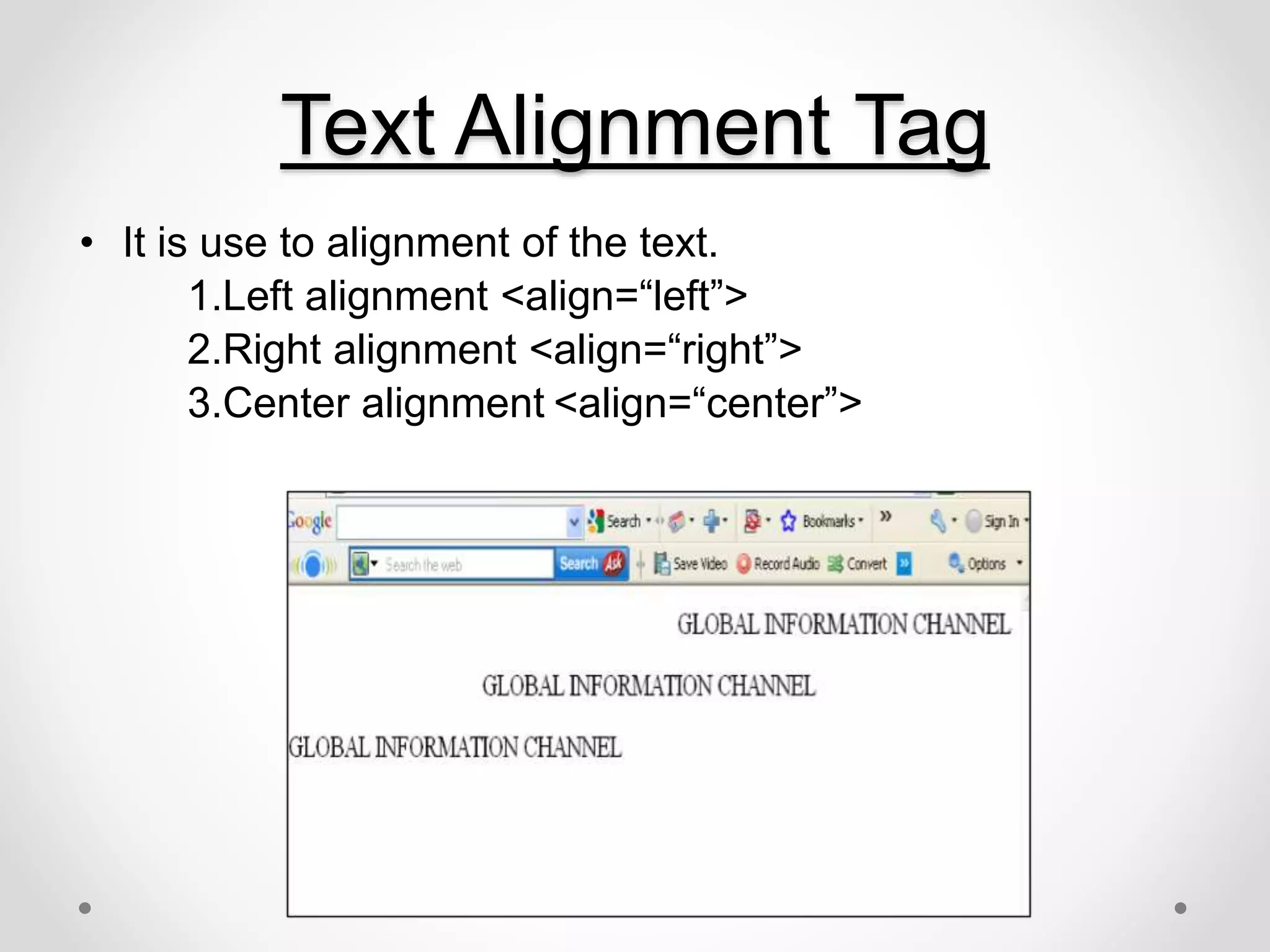
Text Alignment Tag
• It is use to alignment of the text.
1.Left alignment <align=“left”>
2.Right alignment <align=“right”>
3.Center alignment <align=“center”>
Hyperlink Tag
• A hyperlink is a reference (an address) to a resource on the
web.
• Hyperlinks can point to any resource on the web: an HTML
page, an image, a sound file, a movie, etc.
• The HTML anchor element <a>, is used to define both
hyperlinks and anchors.
<a href="url">Link text</a>
• The href attribute defines the link address.
<a href="http://www.globalinfochannel/">Visit
globalinfochannel!</a>
Result of Hyperlink Code
Image Tag
• To display an image on a page, you need to use the src
attribute.
• src stands for "source". The value of the src attribute is the
URL of the image you want to display on your page.
• It is a empty tag.
<IMG SRC ="url">
<IMG SRC="picture.gif“>
<IMG SRC="picture.gif“ HEIGHT="30" WIDTH="50">
Image attributes - <img> tag
<img>
<Src>
<Alt>
<Width>
<Height>
<Border>
<Hspace>
<Vspace>
<Align>
<background>
Defines an image
display an image on a page,Src stands
for "source".
Define "alternate text" for an image
Defines the width of the image
Defines the height of the image
Defines border of the image
Horizontal space of the image
Vertical space of the image
Align an image within the text
Add a background image to an HTML
page
<html><body>
<p><img
src="file:///C:/WINDOWS/Zapotec.bmp"
align="left" width="48" height="48"> </p>
<p><img src
="file:///C:/WINDOWS/Zapotec.bmp"
align="right" width="48" height="48"></p>
</body></html>
<HTML>
<<body
background="file:///C:/WINDOWS/Soap%20Bub
bles.bmp" text="white">
<br><br><br>
<h2> Background Image!</h2>
</BODY></HTML>
Code & Result of the Image
• A form is an area that can contain form elements.
• Form elements are elements that allow the user to enter
information in a form. like text fields, textarea fields, drop-
down menus, radio buttons and checkboxes etc
• A form is defined with the <form> tag.
• The syntax:-
<form>
.
input elements
.
</form>
HTML Form
<form>
<input>
<text>
<textarea>
<password>
<label>
<option>
<select>
<button>
<value>
<checkbox>
<dropdown box>
Form Tags
Defines a form for user input
used to create an input field
Creates a single line text entry field
Defines a text-area (a multi-line text input control)
Creates a single line text entry field. And the
characters entered are shown as asterisks (*)
Defines a label to a control
Creates a Radio Button.
Defines a selectable list (a drop-down box)
Defines a push button
attribute of the option element.
select or unselect a checkbox
A drop-down box is a selectable list
<html><body><form>
<h1>Create a Internet Mail Account</h1>
<p>First Name <input type="text" name="T1" size="30"></p>
<p>Last Name <input type="text" name="T2" size="30"></p>
<p>Desired Login Name <input type="text" name="T3" size="20">
@mail.com</p>
<p>Password <input type="password" name="T4" size="20"></p>
<input type="radio" checked="checked" name="sex" value="male" /> Male</br>
<input type="radio" name="sex" value="female" /> Female
<p>Birthday <input type="text" name="T6" size="05">
<select size="1" name="D2">
<option>-Select One-</option>
<option>January</option>
<option>February</option>
<option>March</option> </select>
<input type="text" name="T7" size="10"></p>
TypeYourself<textarea rows="4" name="S1" cols="20"></textarea>
<br><input type="submit" value="Accept" name="B1"> <input type="reset“ value="Cancel"
name="B2"></br> </form></body></html>
Code of the HTML Form
Result of the Form Code
<HTML>
<THANK YOU>
<HTML>

Html cia

  • 1.
  • 2.
    INTRODUCTION TO HTML •With HTML you can create your own Web site. • HTML stands for Hyper Text Markup Language. • HTML is derived from a language SGML (Standard Graphics Markup Language). • The future of HTML is XML (eXtended Markup Language). • HTML is not a programming language, it is a Markup Language. • A markup language is a set of markup tags. • HTML uses markup tags to describe web pages. • HTML is not case sensitive language. • HTML documents contain HTML tags and plain text.
  • 3.
    HTML Elements andTags • A tag is always enclosed in angle bracket <>like <HTML> • HTML tags normally come in pairs like <HTML> and </HTML> i.e. Start tag = <HTML> End tag =</HTML> • Start and end tags are also called opening tags and closing tags
  • 4.
    What the followingterm mean: Web server: a system on the internet containing one or more web site Web site: a collection of one or more web pages Web pages: single disk file with a single file name Home pages: first page in website Think about the followings before working your Web pages. Think about the sort of information(content) you want to put on the Web. Set the goals for the Web site. Organize your content into main topics. Come up with a general structure for pages and topics.
  • 5.
    HOW TO START •Write html code in notepad. • Save the file with (.Html)/(.Htm) extension. • View the page in any web browser viz. INTERNET EXPLORER, NETSCAPE NAVIGATOR etc. • The purpose of a web browser (like internet explorer or firefox) is to read html documents and display them as web pages.
  • 6.
    Code With HTML <HTML> <HEAD> <TITLE> MYFIRST PAGE </TITLE> </HEAD> <BODY> GLOBAL INFORMATION CHANNEL </BODY> </HTML>
  • 7.
    Tags used inHTML. • <HTML> - Describe HTML web page that is to be viewed by a web browser. • <HEAD> - This defines the header section of the page. • <TITLE> - This shows a caption in the title bar of the page. • <BODY> - This tag show contents of the web page will be displayed.
  • 8.
    Types of HTMLTags There are two different types of tags:-> Container Element:-> Container Tags contains start tag & end tag i.e. <HTML>… </HTML> Empty Element:-> Empty Tags contains start tag i.e. <BR>
  • 9.
    Text Formatting Tags HeadingElement:-> • There are six heading elements (<H1>,<H2>,<H3>,<H4>, <H5>,<H6>). • All the six heading elements are container tag and requires a closing tag. • <h1> will print the largest heading • <h6> will print the smallest heading
  • 10.
    Heading Tag Code <html> <head><title>heading</title></head> <body> <h1>GLOBAL INFO CHANNEL</h1> <h2> GLOBAL INFO CHANNEL</h2> <h3> GLOBAL INFO CHANNEL</h3> <h4> GLOBAL INFO CHANNEL</h4> <h5> GLOBAL INFO CHANNEL</h5> <h6> GLOBAL INFO CHANNEL</h6> </body> </html>
  • 11.
  • 12.
    HTML Paragraph Tag •HTML documents are divided into paragraphs. • Paragraphs are defined with the <p> tag i.e. <p>This is a paragraph</p> <p>This is another paragraph</p> <pre>This text is preformatted</pre>
  • 13.
    Line Break &Horizontal Line Tag • if you want a line break or a new line without starting a new paragraph Use the <br> tag. • Defines a horizontal line use <hr>tag. • <br> <hr> element are empty HTML element i.e. Global Information Channel<hr> Global Information <br> Channel
  • 14.
    Text Formatting Tags <b> <big> <em> <i> <small> <strong> <sub> <super> <ins> <del> <tt> <u> <strike> Definesbold text Defines big text Defines emphasized text Defines italic text Defines small text Defines strong text Defines subscripted text Defines superscripted text Defines inserted text Defines deleted text Defines teletype text Defines underline text Defines strike text
  • 15.
    Text Formatting Code <html> <head></head> <body> <b>Thistext is Bold</b> <br><em>This text is Emphasized</em> <br><i>This text is Italic</i> <br><small>This text is Small</small> <br>This is<sub> Subscript</sub> and <sup>Superscript</sup> <br><strong>This text is Strong</strong> <br><big>This text is Big</big> <br><u>This text is Underline</u> <br><strike>This text is Strike</strike> <br><tt>This text is Teletype</tt> </body> </html>
  • 16.
    Result of TextFormatting Code
  • 17.
    Font Tag • Thiselement is used to format the size, typeface and color of the enclosed text. • The commonly used fonts for web pages are Arial, Comic Sans MS , Lucida Sans Unicode, Arial Black, Courier New, Times New Roman, Arial Narrow, Impact, Verdana. • The size attribute in font tag takes values from 1 to 7.
  • 18.
    Font Tag Code <html> <head><title>fonts</title></head> <body> <br><font color=“green" size="7" face="Arial"> GLOBAL INFORMATION CHANNEL </font> <br><font color=“green" size="6" face="Comic Sans MS "> GLOBAL INFORMATION CHANNEL </font> <br><font color=“green" size="5" face="Lucida Sans Unicode"> GLOBAL INFORMATION CHANNEL </font> <br><font color=“green" size="4" face="Courier New"> GLOBAL INFORMATION CHANNEL </font> <br><font color=“green" size="3" face="Times New Roman"> GLOBAL INFORMATION CHANNEL </font> <br><font color=“green" size="2" face="Arial Black"> GLOBAL INFORMATION CHANNEL </font> <br><font color=“green" size="1" face="Impact"> GLOBAL INFORMATION CHANNEL </font> </body> </html>
  • 19.
  • 20.
    Background & TextColor Tag • The attribute bgcolor is used for changing the back ground color of the page. <body bgcolor=“Green” > • Text is use to change the color of the enclosed text. <body text=“White”>
  • 21.
    Text Alignment Tag •It is use to alignment of the text. 1.Left alignment <align=“left”> 2.Right alignment <align=“right”> 3.Center alignment <align=“center”>
  • 22.
    Hyperlink Tag • Ahyperlink is a reference (an address) to a resource on the web. • Hyperlinks can point to any resource on the web: an HTML page, an image, a sound file, a movie, etc. • The HTML anchor element <a>, is used to define both hyperlinks and anchors. <a href="url">Link text</a> • The href attribute defines the link address. <a href="http://www.globalinfochannel/">Visit globalinfochannel!</a>
  • 23.
  • 24.
    Image Tag • Todisplay an image on a page, you need to use the src attribute. • src stands for "source". The value of the src attribute is the URL of the image you want to display on your page. • It is a empty tag. <IMG SRC ="url"> <IMG SRC="picture.gif“> <IMG SRC="picture.gif“ HEIGHT="30" WIDTH="50">
  • 25.
    Image attributes -<img> tag <img> <Src> <Alt> <Width> <Height> <Border> <Hspace> <Vspace> <Align> <background> Defines an image display an image on a page,Src stands for "source". Define "alternate text" for an image Defines the width of the image Defines the height of the image Defines border of the image Horizontal space of the image Vertical space of the image Align an image within the text Add a background image to an HTML page
  • 26.
    <html><body> <p><img src="file:///C:/WINDOWS/Zapotec.bmp" align="left" width="48" height="48"></p> <p><img src ="file:///C:/WINDOWS/Zapotec.bmp" align="right" width="48" height="48"></p> </body></html> <HTML> <<body background="file:///C:/WINDOWS/Soap%20Bub bles.bmp" text="white"> <br><br><br> <h2> Background Image!</h2> </BODY></HTML> Code & Result of the Image
  • 27.
    • A formis an area that can contain form elements. • Form elements are elements that allow the user to enter information in a form. like text fields, textarea fields, drop- down menus, radio buttons and checkboxes etc • A form is defined with the <form> tag. • The syntax:- <form> . input elements . </form> HTML Form
  • 28.
    <form> <input> <text> <textarea> <password> <label> <option> <select> <button> <value> <checkbox> <dropdown box> Form Tags Definesa form for user input used to create an input field Creates a single line text entry field Defines a text-area (a multi-line text input control) Creates a single line text entry field. And the characters entered are shown as asterisks (*) Defines a label to a control Creates a Radio Button. Defines a selectable list (a drop-down box) Defines a push button attribute of the option element. select or unselect a checkbox A drop-down box is a selectable list
  • 29.
    <html><body><form> <h1>Create a InternetMail Account</h1> <p>First Name <input type="text" name="T1" size="30"></p> <p>Last Name <input type="text" name="T2" size="30"></p> <p>Desired Login Name <input type="text" name="T3" size="20"> @mail.com</p> <p>Password <input type="password" name="T4" size="20"></p> <input type="radio" checked="checked" name="sex" value="male" /> Male</br> <input type="radio" name="sex" value="female" /> Female <p>Birthday <input type="text" name="T6" size="05"> <select size="1" name="D2"> <option>-Select One-</option> <option>January</option> <option>February</option> <option>March</option> </select> <input type="text" name="T7" size="10"></p> TypeYourself<textarea rows="4" name="S1" cols="20"></textarea> <br><input type="submit" value="Accept" name="B1"> <input type="reset“ value="Cancel" name="B2"></br> </form></body></html> Code of the HTML Form
  • 30.
    Result of theForm Code
  • 31.