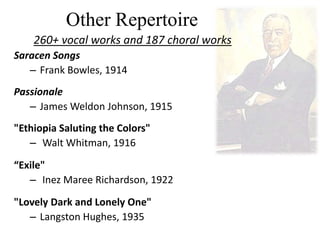
(1866-1949)
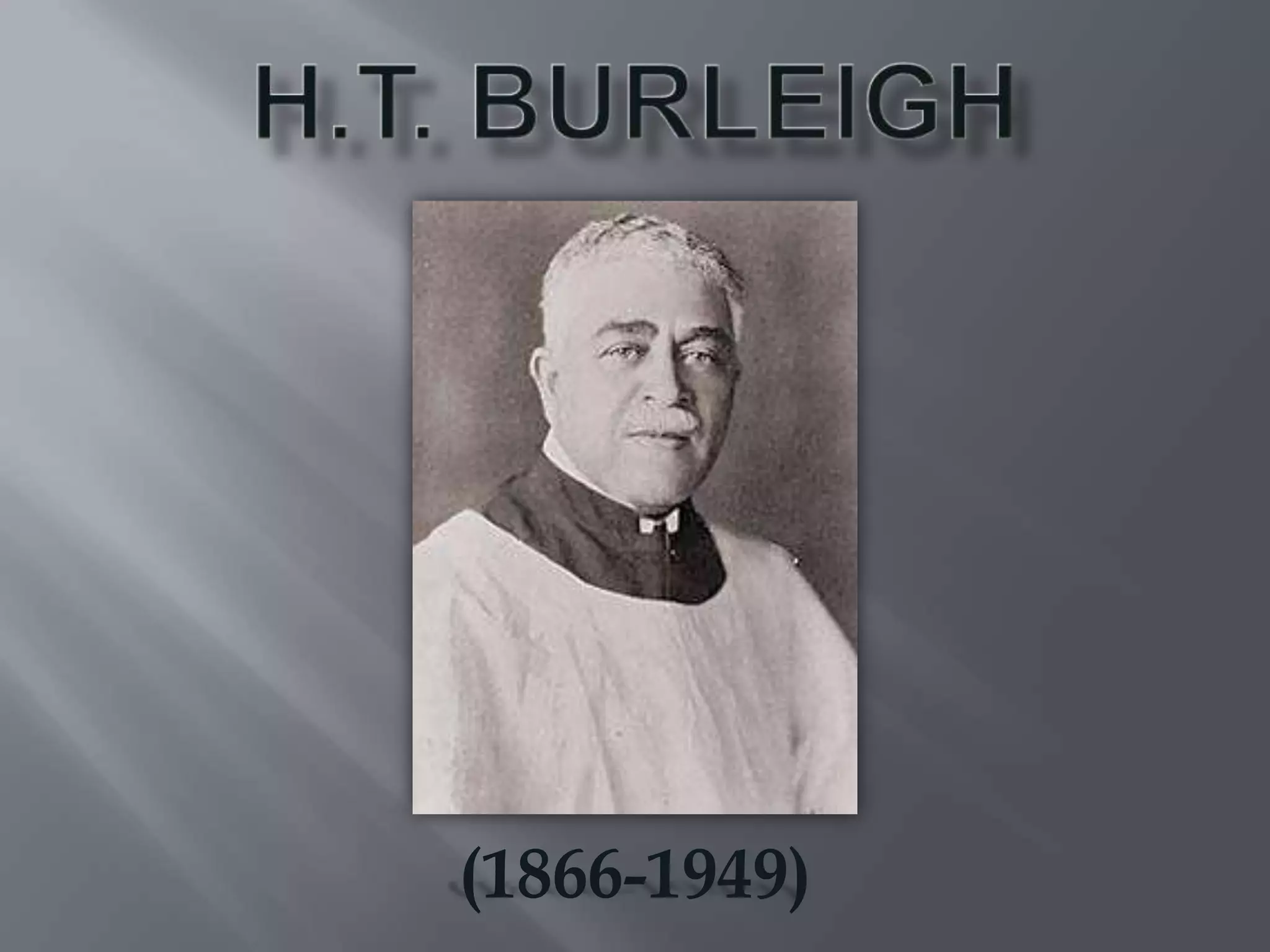
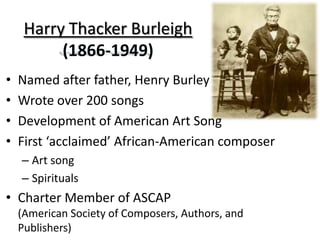
Harry Thacker Burleigh
(1866-1949)
• Named after father, Henry Burley
• Wrote over 200 songs
• Development of American Art Song
• First ‘acclaimed’ African-American composer
– Art song
– Spirituals
• Charter Member of ASCAP
(American Society of Composers, Authors, and
Publishers)
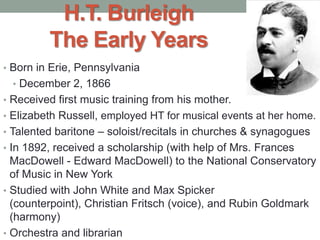
H.T. Burleigh
The Early Years
• Born in Erie, Pennsylvania
• December 2, 1866
• Received first music training from his mother.
• Elizabeth Russell, employed HT for musical events at her home.
• Talented baritone – soloist/recitals in churches & synagogues
• In 1892, received a scholarship (with help of Mrs. Frances
MacDowell - Edward MacDowell) to the National Conservatory
of Music in New York
• Studied with John White and Max Spicker
(counterpoint), Christian Fritsch (voice), and Rubin Goldmark
(harmony)
• Orchestra and librarian
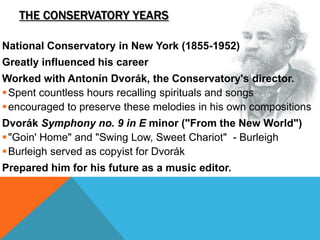
THE CONSERVATORY YEARS
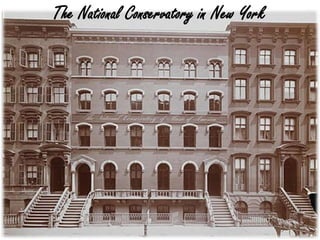
National Conservatory in New York (1855-1952)
Greatly influenced his career
Worked with Antonín Dvorák, the Conservatory's director.
Spent countless hours recalling spirituals and songs
encouraged to preserve these melodies in his own compositions
Dvorák Symphony no. 9 in E minor ("From the New World")
"Goin' Home" and "Swing Low, Sweet Chariot" - Burleigh
Burleigh served as copyist for Dvorák
Prepared him for his future as a music editor.
. . . inspiration for truly national music might be
derived from the Negro melodies or Indian chants. I
was led to take this view partly by the fact that the
so-called plantation songs are indeed the most
striking and appealing melodies that have yet been
found on this side of the water, but largely by the
observation that this seems to be recognized, though
often unconsciously, by most Americans. . . . The
most potent as well as most beautiful among
them, according to my estimation, are certain of the
so-called plantation melodies and slave songs, all of
which are distinguished by unusual and subtle
harmonies, the like of which I have found in no other
songs but those of old Scotland and Ireland.
• Founded by Jeanette Thurber
- One of the first patrons of Classical Music
- Paris Conservatory
• Philanthropists, including , Andrew Carnegie
• Victor Herbert and Anton Dvorak
NY Time Obituary
“But it was Mrs. Thurber who established a
precedent in this field which never will be
forgotten, as one of the works which made her life
and her vision and invincible spirit so valuable to
the musical advancement of America.”
The National Conservatory in New York
In 1894
• Auditioned soloist at St. George's Episcopal Church of NY
• Congregation objected because Burleigh was black
• He was given the position.
He held the appointment over fifty years
Missing only one performance during his tenure at S.GEC
Won the hearts and respect of the church community
• Next several years were productive
• 1898 - he married poet Louise Alston
• 1899 - Alston, their son was born
• G. Schirmer published his first three songs.
• 1900 - First African-American soloist at Temple Emanu-El
• 1911 - Editor for G. Ricordi
• Publication of several of his compositions
• "Ethiopia Saluting the Colors" (1915)
• Collection entitled Jubilee Songs of the USA (1916)
• Arrangement of "Deep River" (1917)
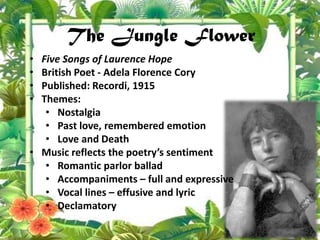
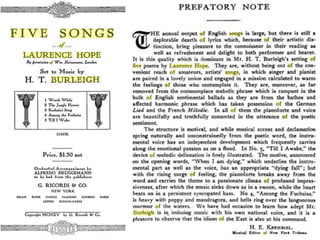
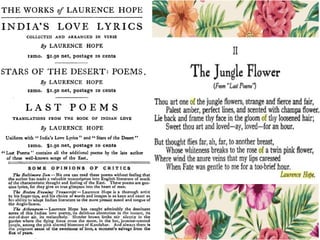
The Jungle Flower
• Five Songs of Laurence Hope
• British Poet - Adela Florence Cory
• Published: Recordi, 1915
• Themes:
• Nostalgia
• Past love, remembered emotion
• Love and Death
• Music reflects the poetry’s sentiment
• Romantic parlor ballad
• Accompaniments – full and expressive
• Vocal lines – effusive and lyric
• Declamatory
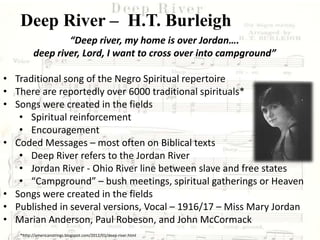
Deep River – H.T. Burleigh
“Deep river, my home is over Jordan….
deep river, Lord, I want to cross over into campground”
• Traditional song of the Negro Spiritual repertoire
• There are reportedly over 6000 traditional spirituals*
• Songs were created in the fields
• Spiritual reinforcement
• Encouragement
• Coded Messages – most often on Biblical texts
• Deep River refers to the Jordan River
• Jordan River - Ohio River line between slave and free states
• “Campground” – bush meetings, spiritual gatherings or Heaven
• Songs were created in the fields
• Published in several versions, Vocal – 1916/17 – Miss Mary Jordan
• Marian Anderson, Paul Robeson, and John McCormack
*http://americanstrings.blogspot.com/2012/01/deep-river.html
Other Repertoire
260+ vocal works and 187 choral works
Saracen Songs
– Frank Bowles, 1914
Passionale
– James Weldon Johnson, 1915
"Ethiopia Saluting the Colors"
– Walt Whitman, 1916
“Exile"
– Inez Maree Richardson, 1922
"Lovely Dark and Lonely One"
– Langston Hughes, 1935
Burleigh’s Last Years and Legacy
 Entered a nursing home in 1946
 Died, September 12, 1949 – age 82
 Over 2,000 mourners attended the funeral
Successfully established the Negro spiritual
Also, composed serious art song
At 75, first African-American on the ASCAP Board of Dir.
Spingarn Achievement Medal (NAACP)
Atlanta University (M.A., 1918)
Howard University (D.M.A., 1920)
Liturgical Calendar: Episcopal Feast Day - September 11
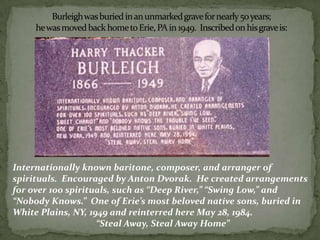
Internationally known baritone, composer, and arranger of
spirituals. Encouraged by Anton Dvorak. He created arrangements
for over 100 spirituals, such as “Deep River,” “Swing Low,” and
“Nobody Knows.” One of Erie’s most beloved native sons, buried in
White Plains, NY, 1949 and reinterred here May 28, 1984.
“Steal Away, Steal Away Home”

Ht burleigh

  • 1.
  • 2.
    Harry Thacker Burleigh (1866-1949) •Named after father, Henry Burley • Wrote over 200 songs • Development of American Art Song • First ‘acclaimed’ African-American composer – Art song – Spirituals • Charter Member of ASCAP (American Society of Composers, Authors, and Publishers)
  • 3.
    H.T. Burleigh The EarlyYears • Born in Erie, Pennsylvania • December 2, 1866 • Received first music training from his mother. • Elizabeth Russell, employed HT for musical events at her home. • Talented baritone – soloist/recitals in churches & synagogues • In 1892, received a scholarship (with help of Mrs. Frances MacDowell - Edward MacDowell) to the National Conservatory of Music in New York • Studied with John White and Max Spicker (counterpoint), Christian Fritsch (voice), and Rubin Goldmark (harmony) • Orchestra and librarian
  • 4.
    THE CONSERVATORY YEARS NationalConservatory in New York (1855-1952) Greatly influenced his career Worked with Antonín Dvorák, the Conservatory's director. Spent countless hours recalling spirituals and songs encouraged to preserve these melodies in his own compositions Dvorák Symphony no. 9 in E minor ("From the New World") "Goin' Home" and "Swing Low, Sweet Chariot" - Burleigh Burleigh served as copyist for Dvorák Prepared him for his future as a music editor.
  • 5.
    . . .inspiration for truly national music might be derived from the Negro melodies or Indian chants. I was led to take this view partly by the fact that the so-called plantation songs are indeed the most striking and appealing melodies that have yet been found on this side of the water, but largely by the observation that this seems to be recognized, though often unconsciously, by most Americans. . . . The most potent as well as most beautiful among them, according to my estimation, are certain of the so-called plantation melodies and slave songs, all of which are distinguished by unusual and subtle harmonies, the like of which I have found in no other songs but those of old Scotland and Ireland.
  • 6.
    • Founded byJeanette Thurber - One of the first patrons of Classical Music - Paris Conservatory • Philanthropists, including , Andrew Carnegie • Victor Herbert and Anton Dvorak NY Time Obituary “But it was Mrs. Thurber who established a precedent in this field which never will be forgotten, as one of the works which made her life and her vision and invincible spirit so valuable to the musical advancement of America.” The National Conservatory in New York
  • 7.
    In 1894 • Auditionedsoloist at St. George's Episcopal Church of NY • Congregation objected because Burleigh was black • He was given the position. He held the appointment over fifty years Missing only one performance during his tenure at S.GEC Won the hearts and respect of the church community
  • 8.
    • Next severalyears were productive • 1898 - he married poet Louise Alston • 1899 - Alston, their son was born • G. Schirmer published his first three songs. • 1900 - First African-American soloist at Temple Emanu-El • 1911 - Editor for G. Ricordi • Publication of several of his compositions • "Ethiopia Saluting the Colors" (1915) • Collection entitled Jubilee Songs of the USA (1916) • Arrangement of "Deep River" (1917)
  • 9.
    The Jungle Flower •Five Songs of Laurence Hope • British Poet - Adela Florence Cory • Published: Recordi, 1915 • Themes: • Nostalgia • Past love, remembered emotion • Love and Death • Music reflects the poetry’s sentiment • Romantic parlor ballad • Accompaniments – full and expressive • Vocal lines – effusive and lyric • Declamatory
  • 12.
    Deep River –H.T. Burleigh “Deep river, my home is over Jordan…. deep river, Lord, I want to cross over into campground” • Traditional song of the Negro Spiritual repertoire • There are reportedly over 6000 traditional spirituals* • Songs were created in the fields • Spiritual reinforcement • Encouragement • Coded Messages – most often on Biblical texts • Deep River refers to the Jordan River • Jordan River - Ohio River line between slave and free states • “Campground” – bush meetings, spiritual gatherings or Heaven • Songs were created in the fields • Published in several versions, Vocal – 1916/17 – Miss Mary Jordan • Marian Anderson, Paul Robeson, and John McCormack *http://americanstrings.blogspot.com/2012/01/deep-river.html
  • 13.
    Other Repertoire 260+ vocalworks and 187 choral works Saracen Songs – Frank Bowles, 1914 Passionale – James Weldon Johnson, 1915 "Ethiopia Saluting the Colors" – Walt Whitman, 1916 “Exile" – Inez Maree Richardson, 1922 "Lovely Dark and Lonely One" – Langston Hughes, 1935
  • 14.
    Burleigh’s Last Yearsand Legacy  Entered a nursing home in 1946  Died, September 12, 1949 – age 82  Over 2,000 mourners attended the funeral Successfully established the Negro spiritual Also, composed serious art song At 75, first African-American on the ASCAP Board of Dir. Spingarn Achievement Medal (NAACP) Atlanta University (M.A., 1918) Howard University (D.M.A., 1920) Liturgical Calendar: Episcopal Feast Day - September 11
  • 15.
    Internationally known baritone,composer, and arranger of spirituals. Encouraged by Anton Dvorak. He created arrangements for over 100 spirituals, such as “Deep River,” “Swing Low,” and “Nobody Knows.” One of Erie’s most beloved native sons, buried in White Plains, NY, 1949 and reinterred here May 28, 1984. “Steal Away, Steal Away Home”