Maternal perception in infancyMaternal perception in infancy
andand
the quality of boys’ relationships withthe quality of boys’ relationships with
mothers and teachers in 1st grademothers and teachers in 1st grade
Mark A. Biernbaum, PhD
California State University, Sacramento
Daniel Shaw, PhD
University of Pittsburgh
The Pitt Moth er & Child Projec t
A lon gitu di nal s tudy of ch ild dev e lo pm e nt
® B egunin BBBB by DrsB D na iel Bhaw andJoanVon rd a atthe
Universit oy fB ittsburgh
o TheNBB Hhas sinceprovided continuous fundingthrough
BBBB
o B verBBB families r recuited from B BB program sit se h va e
now participatedin lab na d oh meassessments w henthe
targetchildw as BBB B BB BBBB BB BBB B BB BB BB B an BBBd
B r mi aryHoalB
Toid ne tifythef tacorsassociatedw ti hob th
vulnerab li ti yand resiline ce ni the developm ne t
of taB r siB childrenB
Cur r ent Analysis
o …thestory oft shi an lays s…i
o Butcom me easureB
B ianta andBte ni bergBs Btud ne t Teac rheRelationshipB cale(B TRB BB which
w as alsoa ptda ed or mof thers(BdultB lhid Rel ta onsi hipB c laeB B B RBBB
o B easureofrel ta onsi hip qualtiy withB B THmothers na dteachersBB
thepr mi ary relatonsi hpi s ni aB yearoldc lhiBds two pr mi ary
environmentsB
o H py othes siB gen re ta ni gNB Th py ot sheisB confirm ni g
Resear Quch set oni B B
B ouldB identifyagroupofboys whoha pod or
r le taionsw ti hbot mh othersand teachersB na d
ocnvers leyB agroup ofboys whoha xd ecellent
r le taionsw ti hbot mh othersand teachers?
Cr e a tion o f Su bs ca le s
o TheBTRB BBBR B is BBBa tiemB liB ret scalemeasure
Reliability scalinganalyses producedtw osubscalesB
B onflictB BB itemsB BlphasB BBB (teachersBB BBB (moth resB
De la ni wg ti th his child drains m ny e regy
Thsi chlidfe les B am unfa ri
B ositiveB B itemsB BlphasB BBB (teachersBB BBB (moth resB
B upf setB th si chlidseeB s com of rtfrom me
De la ni g w tih this childmaB es me fe le good about oh w B
han ldethings
B orrelationsB
B TRB B B onflict B TRB B B ositive B B RB B B ositive
B B RBBB on lf itc BBBB ** B BBB B * B BBB B **
B B RBBB ositive BBBB BBBB
B TRB B B ositive B BBB B **
Ide ntif icat ion o f Gro ups
o Tabulateds ocres onB onflict na Bd ositvi esu sb cales
of rteacherand mother
o BummedB onfl ticand Bos tiivescores rfom mothers
an td eachersB th ne tooBtheiraverageB
o Divided boththeB onflict na Bd osit viesu sb cale
distributions ntoi B qe ualB siz ped arts (each
ocnt naiingBBB o tf hse orc esBB
Gr o up St a tus a nd Vulne ra bility/ Resilie nc y
Conflict Gr o up
Hig h Con flict
Lo w Pos it ive
n = 34
Mo st At-R isk Mo st Vul ne r a ble
Middl e Grou p
n = 64
Positive Gr o up
Lo w Co nflict
Hig h Posi tive
n = 36
Lea st At-R isk Mo st Re silie nt
Succ e ss of Grou ping Proc ed ur e s
Exam inatio n of Gro up De m og ra ph ics
Vari able Sample Confli ct Middle Positive
n = 311 n = 34 n = 64 n = 36
Mean (SD) Mean (SD) Mean (SD) Mean (SD)
Educ ation 12.7 (1 .8) 12 .3 (2 .8) 12 .6 (1 .3) 13.1 (1.4)
Occu pation 1.3 (1.9) 1.7 (2.1) 1.1 (1.7) 1.3 (2.0)
Age 25.1 (9 .8) 25 .0 (8 .8) 26 .0 (9 .6) 24.0 (11 .1)
Rac e 52% 56 % 59 % 70%
Inc om e 1100 (600 ) 10 00 (700 ) 10 00 (500 ) 1300 (600 )
Re se a rch Qu es tion 2
Co ul d I us e d at a co lle ct ed in infanc y (1 8 an d 2 4
m onth s) to pr e di ct th e q ua lity o f a bo y's r e la tion shi p
wi th his mo ther an d te a che r in 1st
gra de ?
o Larg ne umb re o vf ra ia lb es availableincluding:
: : : aternal sel :freportmeasures
: : : bserver: codedratings ofmaternal nad child behavior
in th leab at:: m onths:
: : : bserver: codedratings ofmaternal nad child behavior
in thehomeat:: months:
: : : bserver: codedratings ofthe oh mean nd eighborhood:
o : xaminedthecorrelations betweenall:: an :::md onth
varialb es and boththemoth re:sandteacher:s ratin sg on
boththe:on lfictan :od sitivesubscales
o : varialb es emergedthats oh we sd ignificantcorrelations
Daily Par entin g Stress
Parent Daily Hassles (PDH) at bo th 18- a nd 24- m onth s. The total
scor e (fr e que ncy of has sle by int e nsity ) wa s u se d h er e . Score s
fr om the two a sse ssm e nt s wer e ave ra ge d.
o Dail py arentin sg tress prove td obe ma orepotentpredictor
ofthequalityo pf arent: childintera tc ionthanw reema:or
life veents:
o : arenting hassles havebeen show n tobepotentpred ticors of
laterchildbe vha oi rpro lbems:
o : aternal nadpatern la reports ofparenting hassles vhaebeen
stron lg y associatedwithteacherreports o pf roblematic
classroombeh va ior:
Externa lizing Behavior
Child Behavior Checklist Ages 2-3 (C BCL) at 24 m o nt hs. The
Exte rnal izing b ro ad ban d sco re wa s use d h er e .
o Research has indicatedthatext renalizingpro lbems
identifiedearly: oftenpersist:
o :hildreneventually dia ng osedw ith dsri uptive behavior
pro lb ems ra eo tfen frist refrre edbase od nextern laizing
s mpy toms intheclassroom:
o :n largesurveys o nfonclinicparents: parents report
toddler rir tiating behaviors to bethemostdifficultaspect
ofparentin :g
Mater nal Dep r ession
Bec k Depre ssion Inventor y (BDI) a t bo th 18- a nd 24- m on ths.
Sco r es wer e a ve ra ge d
o Depressedadults show: low re rat se of behavior: low re
lev les ofspeech: less d rie tcgaze ni ni teraction: slow er
respons vi eness: greaterhostilityand rri itab li ti :y and
appearsadder:
o :nt rea tcions with ouy ngchildren:w henexaggerated
vocal nademotional toneandtolre na ceof r some va resive
behavior is requ ried: has been show n tobevery difficult
fordepresse md others:
o Depressedmoth res haveshow nmorer::e ectingbehavior
tow ards th reichli rd enand lses satsifa tc ionwith: na d
confidencein: the ri roleas aparent:
Mater nal Socia l Supp or t
Mater nal Soc ial Suppo rt Index (MS SI) a t bo th 18- a nd 24-
m o nth. Sco r e s wer e sum m e d a nd av er a g e d.
o Lowerscores ondepression na dgeneral distress are
associtaedwithhigh re levelso sf ocial support:
o : ocial supporthas been show n tomoderatetheimpactof
stress anddepressiononparenting:
o : other:s sel :freportedsocial supporthas beenshow nto
beasi ng ificant predictoro tf hequ la ti oy finteractions
w iththeir infantas wellas their attitudes tow ards
p ra enting:
o Highersocil sa upportis associatedw ti loh w erlevels of
H: : axis an :Nd : a tc vi ti uy dringtas: s inthelaband ni
communit sy tetings:
Tempe ra me nt
Infant Char act eri stic s Questionnair e (ICQ) a t bo th 18- a nd
24- m on ths. Sco r es wer e a ve r a g e d; th e difficul ty subsca le
wa s use d.
o Research has s oh w nastrongpred tic vi re leatoi nship
b tew eenteach re- ratedtemp reament andschool
achievement- graderetention- na dteach res- view s ofa
student-s "teachablitiy"-
o -n particular-temp reament measures of activ ti l vy eel-
t sa - persist ne -ceanddistracta lb ity ra emoststrongly
r leatedtoachi veementmeasures- including grades and
standardizet set- as wellas appropriateclassroom
behavior-
o -arents ofchildrenw ith"difficult" temp re ma ents report
morestress na dshow low re l veelso pf ra ne t la functoi ning-
Gr o up Me a ns o n Pr ed ict o r Va r ia ble s
Sa m ple Co nfl ict Middl e Po sitive
n = 311 n = 34 n = 64 n = 36
Mea n( SD) Mea n( SD) Mea n( SD) Mea n( SD)
BDI 8.8 (5.9 ) 11 .0 (5.0 ) 8.7 (6.6 ) 6.9 (4.6 )
MSSI 24 .1 (4.7 ) 23 .6 (4.0 ) 23 .9 (4.8 ) 24 .9 (5.0 )
PDH 86 .9 (15.7 ) 98 .8 (14.2 ) 85 .7 (15.2 ) 78 .8 (11.3 )
ICQ 34 .9 (7.4 ) 40 .2 (7.8 ) 33 .3 (5.9 ) 33 .0 (7.3 )
CBCL 53 .9 (9.2 ) 58 .3 (10.3 ) 53 .9 (8.3 ) 49 .9 (8.2 )
Testing of Group Differ en c es
o - -N -V - usin -g st
gradegroups to uf rther reud cethe
numb re o vf ra ia lb es inthemod le- - ultivariatetest
highl syignificant-
Univariatetestresults
- easure F df p eta- squared
- - - - (-ocial- upport- - --- - --- - ----
--Q (temperament- -- --- - <---- ----
- D (H daily hassles- -- --- - <---- ----
-- -L (-xtern laizin -g - --- - <---- ----
- D- (depression- - --- - ---- ----
Pr ed ict ion o f 1st
Gr ade Gr oups
o Logist rice rg essiontopredi tc groupmembership ofr the
- on lfictan -d ositivegroups- Thefin la solutionw as hi lghy
significna t
LogisticRegress oi n Results
-- - -- of r- xp (ß-
ß(- -- -- - ald df - ig - xp(- - Low High
- DH - ---- (--- - - ---- - --- - - -- --- - --- -- ---
- -D - --- (---- - --- - ----- - --- --- - ---
-- Q ---- (---- - ---- - ----- - --- --- - ---
-- - L ---- (---- ---- - ----- - --- --- - ---
-lassificationT labe
- bserved - redicted
- ositive - onflict - ercent- orrect
- ositive -- - -- -- -
- on lf itc - -- -- -- -
--- eeerrrccceeennnttt--- ooorrrrrreeeccctttlllyyy --- lllaaassssssiiifffiiieeedddbbbyyy --- ooodddeeelll--- --- --- ------ ---
Pr el im inar y Con clu sio ns
® - aternal pre ceptionof dail py arenting hassles ininfancy
w as ra obustpredictoroflater rleationshipquality as
reportedb my oth res andteachers in -st
grade-
® - h wy as t -heDHsosuccessful?
-tis amultifacetedmeasure- li- ley tappingseveral
constructs- including-
- - d sitress tolreance
- - frequenc oy fparentin sg tressors
- - p ra entingefficacy
- - diffi ucltchildbehaviors
® - th re measures diddifferentitaeth -e on lfictan -d os tiive
Hroups- Duringinfanc-y mothersofboys w how ouldl ta re
be in th -e on lfictgroupreportedth ta they-
- - feltsi ng ificna tl my oredepressed
- - p re ceivedtheir toddlers sa temp ream ne t lla y difficult
- - p re ceivedtheir toddlers sa si ng ificantlymore
externalizing
Limitatio ns
® -llquestionnairemeasures-- lef-report- - bservation la
measures consid reedmor re obust- less "biased"-
® - ulti oclline ra ity in predictor vra ia lbes
- - Factor an la ysis
- - -tem an la ysis
® -nform na tbias in theoutocmemeasure- -arto of utcome
scoreis determined mby other-andall ofpredi tcor
scores aredeterminedbymother-
Behav ior al Observ ation Mea sur es
Corre lations with ou tc om es
Variable ACRS- P ACRS- C STRS- P STRS- C POS CON
Nonc om - .068 .052 .009 .026 - .029 .022
Forceful .043 .062 .058 .034 .101 .043
Permissive - .022 .039 - .123 .073 - .138 .038
Rejecting - .059 .119 .114 .023 .072 .076
Prel im inar y Pe rc ep tion Fra me wor k
Mat e rnal
Pe rcept ion
Mat e rnal
Beha vio r
Chil d's
Phe nom e nolog ical
Re al ity
Pe rce ption o f:
He rs e lf
He r life
He r worl d
He r ch ild
Chil d's
de ve lo ping
se lf-p e rcet ion
Chil d's be ha vior
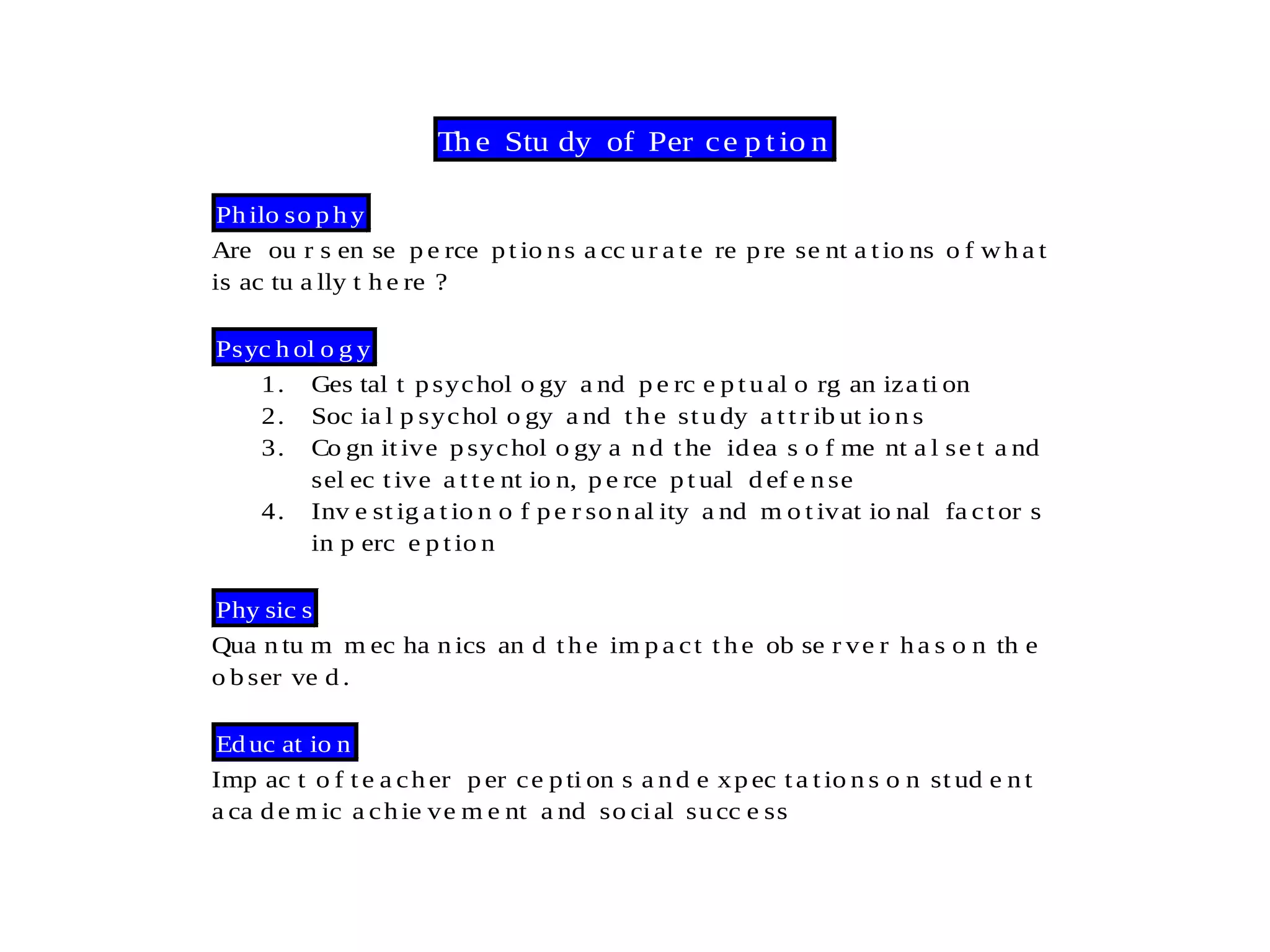
Th e Stu dy of Per ce p t io n
Philo so p h y
Are ou r s en se p e rce pt io ns a cc u r a t e re p re se nt a t io ns o f wh a t
is ac tu a lly t h e re ?
Psyc h ol o g y
1. Ges tal t psychol o gy a nd p e rc e p t u al o rg an iza ti on
2. Soc ia l p sychol o gy a nd t h e st u dy a t t r ib ut io n s
3. Co gn it ive p sychol o gy a n d t he idea s o f me nt a l se t a nd
sel ec t ive a t t e nt io n, p e rce p t ual d ef e n se
4. Inv e st ig a t io n o f pe r so n al ity a nd m o t ivat io nal fa ct or s
in p erc e p t io n
Phy sic s
Qua n tu m m ec ha n ics an d t h e im p a ct t h e ob se r ve r h a s o n th e
o b ser ve d .
Ed uc at io n
Imp ac t o f t e a ch er p er ce pti on s a n d e xp ec t a t io n s o n st ud e n t
a ca d e m ic a ch ie ve m e nt a nd so cial succ e ss
Wha t is th e im pa ct o f be ing pe r cei ve d?
® Childrendo notcomeintothew orldwithsel Cfconcepts
® Cn generalCtheir experienti la w orlds aresm lla
® Cn generalCtheir interpersonal worlds containvery f we
in lfu ne tila a uld ts
® The importantpeopleinchildrenCs lives form a
nexus ofperceptoi ns withinw hichchildren grow C
® Thep receptions thatothers olh dofthem havestrong
in lfu ne ceonthesel Cfperceptoi nschildrend veelop
C el CfreportC withtis "Cn of rm na tbias"C is vti la to
understand ni tg h pe henomenologicalw orlds ofchildren
Int e rv e nt ions = Cha ng ing Pe rc e ption s
® C ostm ne t la illnseses involvedistortioninsel Cf
p re ceptionC Treatmentinvolves changingt oh se
d sitorte pd receptionsC
® C ss sitingstudents w hoarestruggling acamd iclla y
involves lateringan often negativeacademicsel Cf
p re ceptionC
® C reventionprograms liC eHeadCt ra tattempttochange
negativematern l pa re ceptions ofthemselves na dth rei
children
® CublicC erviceC nnouncements often focus onchanging
pu lb icperception

HSPOSTbw.PPT

  • 1.
    Maternal perception ininfancyMaternal perception in infancy andand the quality of boys’ relationships withthe quality of boys’ relationships with mothers and teachers in 1st grademothers and teachers in 1st grade Mark A. Biernbaum, PhD California State University, Sacramento Daniel Shaw, PhD University of Pittsburgh
  • 2.
    The Pitt Mother & Child Projec t A lon gitu di nal s tudy of ch ild dev e lo pm e nt ® B egunin BBBB by DrsB D na iel Bhaw andJoanVon rd a atthe Universit oy fB ittsburgh o TheNBB Hhas sinceprovided continuous fundingthrough BBBB o B verBBB families r recuited from B BB program sit se h va e now participatedin lab na d oh meassessments w henthe targetchildw as BBB B BB BBBB BB BBB B BB BB BB B an BBBd B r mi aryHoalB Toid ne tifythef tacorsassociatedw ti hob th vulnerab li ti yand resiline ce ni the developm ne t of taB r siB childrenB
  • 3.
    Cur r entAnalysis o …thestory oft shi an lays s…i o Butcom me easureB B ianta andBte ni bergBs Btud ne t Teac rheRelationshipB cale(B TRB BB which w as alsoa ptda ed or mof thers(BdultB lhid Rel ta onsi hipB c laeB B B RBBB o B easureofrel ta onsi hip qualtiy withB B THmothers na dteachersBB thepr mi ary relatonsi hpi s ni aB yearoldc lhiBds two pr mi ary environmentsB o H py othes siB gen re ta ni gNB Th py ot sheisB confirm ni g Resear Quch set oni B B B ouldB identifyagroupofboys whoha pod or r le taionsw ti hbot mh othersand teachersB na d ocnvers leyB agroup ofboys whoha xd ecellent r le taionsw ti hbot mh othersand teachers?
  • 4.
    Cr e ation o f Su bs ca le s o TheBTRB BBBR B is BBBa tiemB liB ret scalemeasure Reliability scalinganalyses producedtw osubscalesB B onflictB BB itemsB BlphasB BBB (teachersBB BBB (moth resB De la ni wg ti th his child drains m ny e regy Thsi chlidfe les B am unfa ri B ositiveB B itemsB BlphasB BBB (teachersBB BBB (moth resB B upf setB th si chlidseeB s com of rtfrom me De la ni g w tih this childmaB es me fe le good about oh w B han ldethings B orrelationsB B TRB B B onflict B TRB B B ositive B B RB B B ositive B B RBBB on lf itc BBBB ** B BBB B * B BBB B ** B B RBBB ositive BBBB BBBB B TRB B B ositive B BBB B **
  • 5.
    Ide ntif ication o f Gro ups o Tabulateds ocres onB onflict na Bd ositvi esu sb cales of rteacherand mother o BummedB onfl ticand Bos tiivescores rfom mothers an td eachersB th ne tooBtheiraverageB o Divided boththeB onflict na Bd osit viesu sb cale distributions ntoi B qe ualB siz ped arts (each ocnt naiingBBB o tf hse orc esBB
  • 6.
    Gr o upSt a tus a nd Vulne ra bility/ Resilie nc y Conflict Gr o up Hig h Con flict Lo w Pos it ive n = 34 Mo st At-R isk Mo st Vul ne r a ble Middl e Grou p n = 64 Positive Gr o up Lo w Co nflict Hig h Posi tive n = 36 Lea st At-R isk Mo st Re silie nt
  • 7.
    Succ e ssof Grou ping Proc ed ur e s Exam inatio n of Gro up De m og ra ph ics Vari able Sample Confli ct Middle Positive n = 311 n = 34 n = 64 n = 36 Mean (SD) Mean (SD) Mean (SD) Mean (SD) Educ ation 12.7 (1 .8) 12 .3 (2 .8) 12 .6 (1 .3) 13.1 (1.4) Occu pation 1.3 (1.9) 1.7 (2.1) 1.1 (1.7) 1.3 (2.0) Age 25.1 (9 .8) 25 .0 (8 .8) 26 .0 (9 .6) 24.0 (11 .1) Rac e 52% 56 % 59 % 70% Inc om e 1100 (600 ) 10 00 (700 ) 10 00 (500 ) 1300 (600 )
  • 8.
    Re se arch Qu es tion 2 Co ul d I us e d at a co lle ct ed in infanc y (1 8 an d 2 4 m onth s) to pr e di ct th e q ua lity o f a bo y's r e la tion shi p wi th his mo ther an d te a che r in 1st gra de ? o Larg ne umb re o vf ra ia lb es availableincluding: : : : aternal sel :freportmeasures : : : bserver: codedratings ofmaternal nad child behavior in th leab at:: m onths: : : : bserver: codedratings ofmaternal nad child behavior in thehomeat:: months: : : : bserver: codedratings ofthe oh mean nd eighborhood: o : xaminedthecorrelations betweenall:: an :::md onth varialb es and boththemoth re:sandteacher:s ratin sg on boththe:on lfictan :od sitivesubscales o : varialb es emergedthats oh we sd ignificantcorrelations
  • 9.
    Daily Par enting Stress Parent Daily Hassles (PDH) at bo th 18- a nd 24- m onth s. The total scor e (fr e que ncy of has sle by int e nsity ) wa s u se d h er e . Score s fr om the two a sse ssm e nt s wer e ave ra ge d. o Dail py arentin sg tress prove td obe ma orepotentpredictor ofthequalityo pf arent: childintera tc ionthanw reema:or life veents: o : arenting hassles havebeen show n tobepotentpred ticors of laterchildbe vha oi rpro lbems: o : aternal nadpatern la reports ofparenting hassles vhaebeen stron lg y associatedwithteacherreports o pf roblematic classroombeh va ior:
  • 10.
    Externa lizing Behavior ChildBehavior Checklist Ages 2-3 (C BCL) at 24 m o nt hs. The Exte rnal izing b ro ad ban d sco re wa s use d h er e . o Research has indicatedthatext renalizingpro lbems identifiedearly: oftenpersist: o :hildreneventually dia ng osedw ith dsri uptive behavior pro lb ems ra eo tfen frist refrre edbase od nextern laizing s mpy toms intheclassroom: o :n largesurveys o nfonclinicparents: parents report toddler rir tiating behaviors to bethemostdifficultaspect ofparentin :g
  • 11.
    Mater nal Depr ession Bec k Depre ssion Inventor y (BDI) a t bo th 18- a nd 24- m on ths. Sco r es wer e a ve ra ge d o Depressedadults show: low re rat se of behavior: low re lev les ofspeech: less d rie tcgaze ni ni teraction: slow er respons vi eness: greaterhostilityand rri itab li ti :y and appearsadder: o :nt rea tcions with ouy ngchildren:w henexaggerated vocal nademotional toneandtolre na ceof r some va resive behavior is requ ried: has been show n tobevery difficult fordepresse md others: o Depressedmoth res haveshow nmorer::e ectingbehavior tow ards th reichli rd enand lses satsifa tc ionwith: na d confidencein: the ri roleas aparent:
  • 12.
    Mater nal Social Supp or t Mater nal Soc ial Suppo rt Index (MS SI) a t bo th 18- a nd 24- m o nth. Sco r e s wer e sum m e d a nd av er a g e d. o Lowerscores ondepression na dgeneral distress are associtaedwithhigh re levelso sf ocial support: o : ocial supporthas been show n tomoderatetheimpactof stress anddepressiononparenting: o : other:s sel :freportedsocial supporthas beenshow nto beasi ng ificant predictoro tf hequ la ti oy finteractions w iththeir infantas wellas their attitudes tow ards p ra enting: o Highersocil sa upportis associatedw ti loh w erlevels of H: : axis an :Nd : a tc vi ti uy dringtas: s inthelaband ni communit sy tetings:
  • 13.
    Tempe ra ment Infant Char act eri stic s Questionnair e (ICQ) a t bo th 18- a nd 24- m on ths. Sco r es wer e a ve r a g e d; th e difficul ty subsca le wa s use d. o Research has s oh w nastrongpred tic vi re leatoi nship b tew eenteach re- ratedtemp reament andschool achievement- graderetention- na dteach res- view s ofa student-s "teachablitiy"- o -n particular-temp reament measures of activ ti l vy eel- t sa - persist ne -ceanddistracta lb ity ra emoststrongly r leatedtoachi veementmeasures- including grades and standardizet set- as wellas appropriateclassroom behavior- o -arents ofchildrenw ith"difficult" temp re ma ents report morestress na dshow low re l veelso pf ra ne t la functoi ning-
  • 14.
    Gr o upMe a ns o n Pr ed ict o r Va r ia ble s Sa m ple Co nfl ict Middl e Po sitive n = 311 n = 34 n = 64 n = 36 Mea n( SD) Mea n( SD) Mea n( SD) Mea n( SD) BDI 8.8 (5.9 ) 11 .0 (5.0 ) 8.7 (6.6 ) 6.9 (4.6 ) MSSI 24 .1 (4.7 ) 23 .6 (4.0 ) 23 .9 (4.8 ) 24 .9 (5.0 ) PDH 86 .9 (15.7 ) 98 .8 (14.2 ) 85 .7 (15.2 ) 78 .8 (11.3 ) ICQ 34 .9 (7.4 ) 40 .2 (7.8 ) 33 .3 (5.9 ) 33 .0 (7.3 ) CBCL 53 .9 (9.2 ) 58 .3 (10.3 ) 53 .9 (8.3 ) 49 .9 (8.2 )
  • 15.
    Testing of GroupDiffer en c es o - -N -V - usin -g st gradegroups to uf rther reud cethe numb re o vf ra ia lb es inthemod le- - ultivariatetest highl syignificant- Univariatetestresults - easure F df p eta- squared - - - - (-ocial- upport- - --- - --- - ---- --Q (temperament- -- --- - <---- ---- - D (H daily hassles- -- --- - <---- ---- -- -L (-xtern laizin -g - --- - <---- ---- - D- (depression- - --- - ---- ----
  • 16.
    Pr ed iction o f 1st Gr ade Gr oups o Logist rice rg essiontopredi tc groupmembership ofr the - on lfictan -d ositivegroups- Thefin la solutionw as hi lghy significna t LogisticRegress oi n Results -- - -- of r- xp (ß- ß(- -- -- - ald df - ig - xp(- - Low High - DH - ---- (--- - - ---- - --- - - -- --- - --- -- --- - -D - --- (---- - --- - ----- - --- --- - --- -- Q ---- (---- - ---- - ----- - --- --- - --- -- - L ---- (---- ---- - ----- - --- --- - --- -lassificationT labe - bserved - redicted - ositive - onflict - ercent- orrect - ositive -- - -- -- - - on lf itc - -- -- -- - --- eeerrrccceeennnttt--- ooorrrrrreeeccctttlllyyy --- lllaaassssssiiifffiiieeedddbbbyyy --- ooodddeeelll--- --- --- ------ ---
  • 17.
    Pr el iminar y Con clu sio ns ® - aternal pre ceptionof dail py arenting hassles ininfancy w as ra obustpredictoroflater rleationshipquality as reportedb my oth res andteachers in -st grade- ® - h wy as t -heDHsosuccessful? -tis amultifacetedmeasure- li- ley tappingseveral constructs- including- - - d sitress tolreance - - frequenc oy fparentin sg tressors - - p ra entingefficacy - - diffi ucltchildbehaviors ® - th re measures diddifferentitaeth -e on lfictan -d os tiive Hroups- Duringinfanc-y mothersofboys w how ouldl ta re be in th -e on lfictgroupreportedth ta they- - - feltsi ng ificna tl my oredepressed - - p re ceivedtheir toddlers sa temp ream ne t lla y difficult - - p re ceivedtheir toddlers sa si ng ificantlymore externalizing
  • 18.
    Limitatio ns ® -llquestionnairemeasures--lef-report- - bservation la measures consid reedmor re obust- less "biased"- ® - ulti oclline ra ity in predictor vra ia lbes - - Factor an la ysis - - -tem an la ysis ® -nform na tbias in theoutocmemeasure- -arto of utcome scoreis determined mby other-andall ofpredi tcor scores aredeterminedbymother-
  • 19.
    Behav ior alObserv ation Mea sur es Corre lations with ou tc om es Variable ACRS- P ACRS- C STRS- P STRS- C POS CON Nonc om - .068 .052 .009 .026 - .029 .022 Forceful .043 .062 .058 .034 .101 .043 Permissive - .022 .039 - .123 .073 - .138 .038 Rejecting - .059 .119 .114 .023 .072 .076
  • 20.
    Prel im inary Pe rc ep tion Fra me wor k Mat e rnal Pe rcept ion Mat e rnal Beha vio r Chil d's Phe nom e nolog ical Re al ity Pe rce ption o f: He rs e lf He r life He r worl d He r ch ild Chil d's de ve lo ping se lf-p e rcet ion Chil d's be ha vior
  • 21.
    Th e Study of Per ce p t io n Philo so p h y Are ou r s en se p e rce pt io ns a cc u r a t e re p re se nt a t io ns o f wh a t is ac tu a lly t h e re ? Psyc h ol o g y 1. Ges tal t psychol o gy a nd p e rc e p t u al o rg an iza ti on 2. Soc ia l p sychol o gy a nd t h e st u dy a t t r ib ut io n s 3. Co gn it ive p sychol o gy a n d t he idea s o f me nt a l se t a nd sel ec t ive a t t e nt io n, p e rce p t ual d ef e n se 4. Inv e st ig a t io n o f pe r so n al ity a nd m o t ivat io nal fa ct or s in p erc e p t io n Phy sic s Qua n tu m m ec ha n ics an d t h e im p a ct t h e ob se r ve r h a s o n th e o b ser ve d . Ed uc at io n Imp ac t o f t e a ch er p er ce pti on s a n d e xp ec t a t io n s o n st ud e n t a ca d e m ic a ch ie ve m e nt a nd so cial succ e ss
  • 22.
    Wha t isth e im pa ct o f be ing pe r cei ve d? ® Childrendo notcomeintothew orldwithsel Cfconcepts ® Cn generalCtheir experienti la w orlds aresm lla ® Cn generalCtheir interpersonal worlds containvery f we in lfu ne tila a uld ts ® The importantpeopleinchildrenCs lives form a nexus ofperceptoi ns withinw hichchildren grow C ® Thep receptions thatothers olh dofthem havestrong in lfu ne ceonthesel Cfperceptoi nschildrend veelop C el CfreportC withtis "Cn of rm na tbias"C is vti la to understand ni tg h pe henomenologicalw orlds ofchildren
  • 23.
    Int e rve nt ions = Cha ng ing Pe rc e ption s ® C ostm ne t la illnseses involvedistortioninsel Cf p re ceptionC Treatmentinvolves changingt oh se d sitorte pd receptionsC ® C ss sitingstudents w hoarestruggling acamd iclla y involves lateringan often negativeacademicsel Cf p re ceptionC ® C reventionprograms liC eHeadCt ra tattempttochange negativematern l pa re ceptions ofthemselves na dth rei children ® CublicC erviceC nnouncements often focus onchanging pu lb icperception