Safety Induction
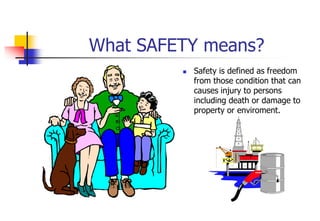
What SAFETY means?
 Safety is defined as freedom
from those condition that can
causes injury to persons
including death or damage to
property or enviroment.
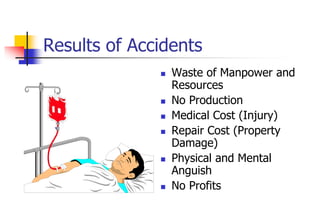
Results of Accidents
 Waste of Manpower and
Resources
 No Production
 Medical Cost (Injury)
 Repair Cost (Property
Damage)
 Physical and Mental
Anguish
 No Profits
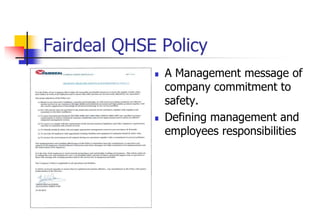
Fairdeal QHSE Policy
 A Management message of
company commitment to
safety.
 Defining management and
employees responsibilities
Safety Philosophy
 All accidents can be prevented.
 The company is committed to preventing accidents.
 Management is responsible for providing a safe work
place.
 Line Supervision is accountable for the actions of their
subordinates.
 Employees are responsible for preventing injuries to
themselves and their co-workers.
 Working safely is a condition of employment.
 All operations must be perform safely.
 Training is essential to a successful safety program.
 Prevention of accidents is good business.
Management Responsibilities
 To provide proper tools, equipment and personal protection
requirements.
 To provide effective employee training with the aim of
achieving a safe and healthy work environment.
 To ensure effective implementation of the Health, Safety and
Environment Management System.
 To monitor overall HSE performance and take actions as
necessary.
Line Supervision HSE
Responsibilities
 To know, understand and comply with
the various company QHSE Policies &
Procedures.
 To ensure safety is given equal
opportunity to production, quality and
moral. Make time for safety each day.
 To match employees skills with tasks
assigned.
 To ensure each task is planned, and
employees receive proper job
instruction.
 To listen to any employees concerns,
immediately correct any potential
hazards reported.
Line Supervision HSE
Responsibilities
 To ensure each employee attends,
learns and applies subject material from
Toolbox Safety Meeting.
 To ensure all employees are issued with
Personal Protective Equipment (PPE),
care for it, and use it correctly.
 To ensure areas are maintained in a
clean and orderly manner.
 To take immediate corrective action
when unsafe acts occur.
 To apply the disciplinary action as
required.
 To always set a good example for all
employees to follow.
Employees HSE Responsibilities
 To know, understand comply with
the various company QHSE
Policies and Procedures.
 You must immediately correct any
potential hazard, if you cannot for
any reason, then report it to your
supervisor.
 Wear correctly the required level
of PPE for the job in progress.
 Work in a courteous manner, do
not endanger your safety or your
fellow workers safety.
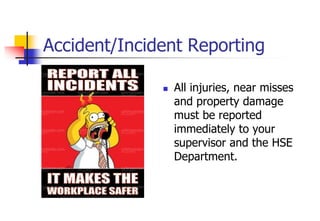
Accident/Incident Reporting
 All injuries, near misses
and property damage
must be reported
immediately to your
supervisor and the HSE
Department.
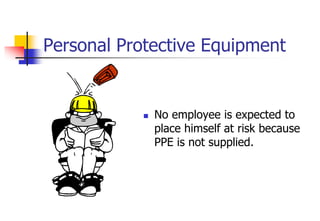
Personal Protective Equipment
 No employee is expected to
place himself at risk because
PPE is not supplied.
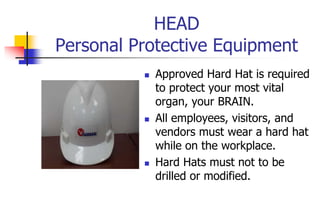
HEAD
Personal Protective Equipment
 Approved Hard Hat is required
to protect your most vital
organ, your BRAIN.
 All employees, visitors, and
vendors must wear a hard hat
while on the workplace.
 Hard Hats must not to be
drilled or modified.
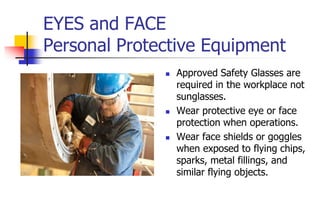
EYES and FACE
Personal Protective Equipment
 Approved Safety Glasses are
required in the workplace not
sunglasses.
 Wear protective eye or face
protection when operations.
 Wear face shields or goggles
when exposed to flying chips,
sparks, metal fillings, and
similar flying objects.
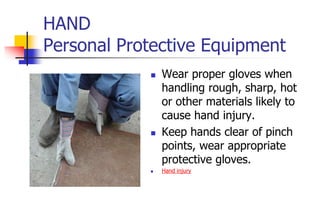
HAND
Personal Protective Equipment
 Wear proper gloves when
handling rough, sharp, hot
or other materials likely to
cause hand injury.
 Keep hands clear of pinch
points, wear appropriate
protective gloves.
 Hand injury
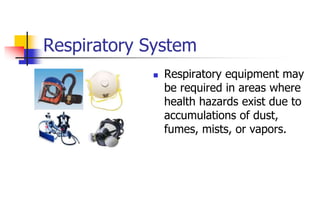
Respiratory System
 Respiratory equipment may
be required in areas where
health hazards exist due to
accumulations of dust,
fumes, mists, or vapors.
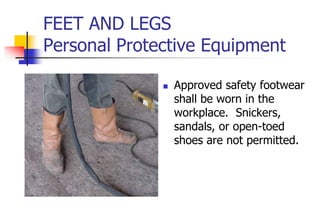
FEET AND LEGS
Personal Protective Equipment
 Approved safety footwear
shall be worn in the
workplace. Snickers,
sandals, or open-toed
shoes are not permitted.
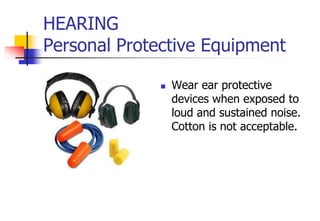
HEARING
Personal Protective Equipment
 Wear ear protective
devices when exposed to
loud and sustained noise.
Cotton is not acceptable.
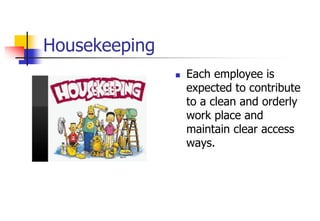
Housekeeping
 Each employee is
expected to contribute
to a clean and orderly
work place and
maintain clear access
ways.
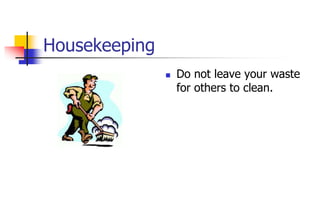
Housekeeping
 Do not leave your waste
for others to clean.
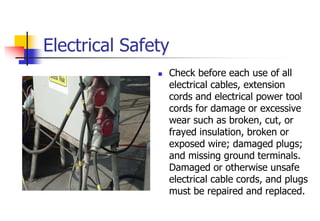
Electrical Safety
 Check before each use of all
electrical cables, extension
cords and electrical power tool
cords for damage or excessive
wear such as broken, cut, or
frayed insulation, broken or
exposed wire; damaged plugs;
and missing ground terminals.
Damaged or otherwise unsafe
electrical cable cords, and plugs
must be repaired and replaced.
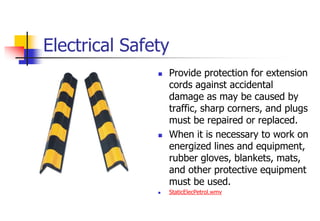
Electrical Safety
 Provide protection for extension
cords against accidental
damage as may be caused by
traffic, sharp corners, and plugs
must be repaired or replaced.
 When it is necessary to work on
energized lines and equipment,
rubber gloves, blankets, mats,
and other protective equipment
must be used.
 StaticElecPetrol.wmv
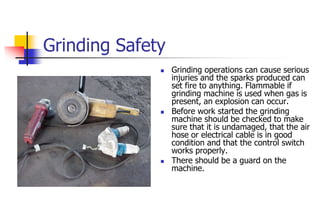
Grinding Safety
 Grinding operations can cause serious
injuries and the sparks produced can
set fire to anything. Flammable if
grinding machine is used when gas is
present, an explosion can occur.
 Before work started the grinding
machine should be checked to make
sure that it is undamaged, that the air
hose or electrical cable is in good
condition and that the control switch
works properly.
 There should be a guard on the
machine.
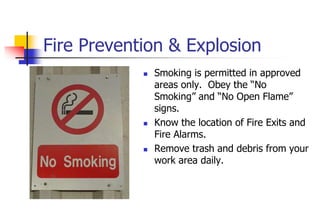
Fire Prevention & Explosion
 Smoking is permitted in approved
areas only. Obey the “No
Smoking” and “No Open Flame”
signs.
 Know the location of Fire Exits and
Fire Alarms.
 Remove trash and debris from your
work area daily.
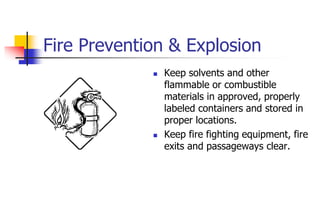
Fire Prevention & Explosion
 Keep solvents and other
flammable or combustible
materials in approved, properly
labeled containers and stored in
proper locations.
 Keep fire fighting equipment, fire
exits and passageways clear.
Fire Prevention & Explosion
 Do not use flammable liquids
or solvents such as carbon
tetrachloride, benzene or
paint thinner for cleaning
purposes.
 Shut off engines of vehicles
and other equipment before
adding fuel.
 Report all fire hazards to
your supervisor immediately.
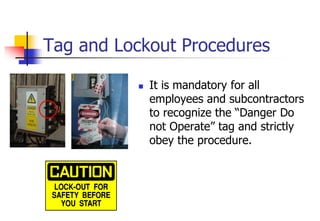
Tag and Lockout Procedures
 It is mandatory for all
employees and subcontractors
to recognize the “Danger Do
not Operate” tag and strictly
obey the procedure.
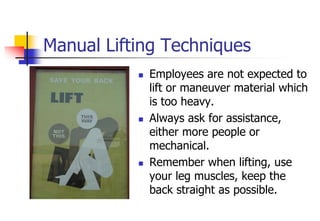
Manual Lifting Techniques
 Employees are not expected to
lift or maneuver material which
is too heavy.
 Always ask for assistance,
either more people or
mechanical.
 Remember when lifting, use
your leg muscles, keep the
back straight as possible.
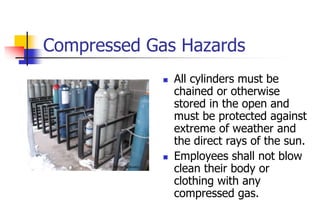
Compressed Gas Hazards
 All cylinders must be
chained or otherwise
stored in the open and
must be protected against
extreme of weather and
the direct rays of the sun.
 Employees shall not blow
clean their body or
clothing with any
compressed gas.
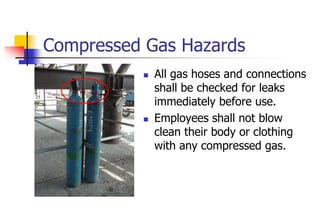
Compressed Gas Hazards
 All gas hoses and connections
shall be checked for leaks
immediately before use.
 Employees shall not blow
clean their body or clothing
with any compressed gas.
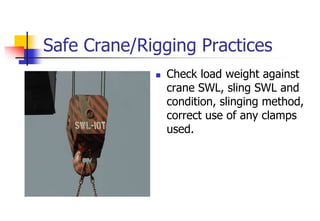
Safe Crane/Rigging Practices
 Check load weight against
crane SWL, sling SWL and
condition, slinging method,
correct use of any clamps
used.
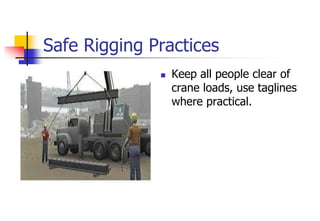
Safe Rigging Practices
 Keep all people clear of
crane loads, use taglines
where practical.
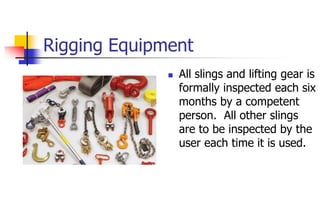
Rigging Equipment
 All slings and lifting gear is
formally inspected each six
months by a competent
person. All other slings
are to be inspected by the
user each time it is used.
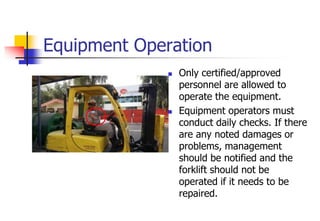
Equipment Operation
 Only certified/approved
personnel are allowed to
operate the equipment.
 Equipment operators must
conduct daily checks. If there
are any noted damages or
problems, management
should be notified and the
forklift should not be
operated if it needs to be
repaired.
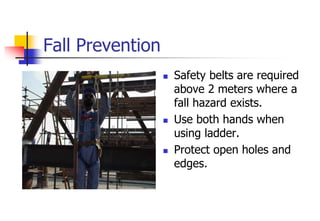
Fall Prevention
 Safety belts are required
above 2 meters where a
fall hazard exists.
 Use both hands when
using ladder.
 Protect open holes and
edges.
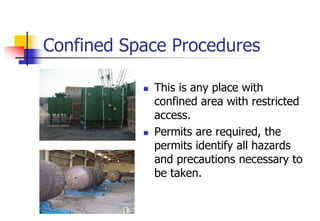
Confined Space Procedures
 This is any place with
confined area with restricted
access.
 Permits are required, the
permits identify all hazards
and precautions necessary to
be taken.
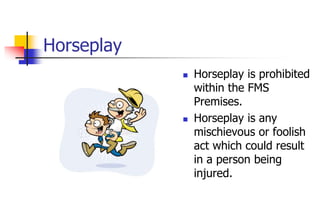
Horseplay
 Horseplay is prohibited
within the FMS
Premises.
 Horseplay is any
mischievous or foolish
act which could result
in a person being
injured.
Illegal Drugs, Weapons,
Gambling and Alcohol
 These are prohibited in the
FMS Premises.
 Employees taking prescribed
drugs must advise their
supervisor if their ability to
perform normal work is
affected.
Disciplinary Action
 Employees who repeatedly fail
to comply with company rules
and regulations will be
subjected to disciplinary
action.
 Generally, offenders receive
verbal and written warnings.
Time off work without pay may
result.
 Serious safety offenses can
result in immediate
termination.
Questions?
THANK YOU

HSE-INDUCTION-TRAINING.ppt

  • 1.
  • 5.
    What SAFETY means? Safety is defined as freedom from those condition that can causes injury to persons including death or damage to property or enviroment.
  • 6.
    Results of Accidents Waste of Manpower and Resources  No Production  Medical Cost (Injury)  Repair Cost (Property Damage)  Physical and Mental Anguish  No Profits
  • 7.
    Fairdeal QHSE Policy A Management message of company commitment to safety.  Defining management and employees responsibilities
  • 8.
    Safety Philosophy  Allaccidents can be prevented.  The company is committed to preventing accidents.  Management is responsible for providing a safe work place.  Line Supervision is accountable for the actions of their subordinates.  Employees are responsible for preventing injuries to themselves and their co-workers.  Working safely is a condition of employment.  All operations must be perform safely.  Training is essential to a successful safety program.  Prevention of accidents is good business.
  • 9.
    Management Responsibilities  Toprovide proper tools, equipment and personal protection requirements.  To provide effective employee training with the aim of achieving a safe and healthy work environment.  To ensure effective implementation of the Health, Safety and Environment Management System.  To monitor overall HSE performance and take actions as necessary.
  • 10.
    Line Supervision HSE Responsibilities To know, understand and comply with the various company QHSE Policies & Procedures.  To ensure safety is given equal opportunity to production, quality and moral. Make time for safety each day.  To match employees skills with tasks assigned.  To ensure each task is planned, and employees receive proper job instruction.  To listen to any employees concerns, immediately correct any potential hazards reported.
  • 11.
    Line Supervision HSE Responsibilities To ensure each employee attends, learns and applies subject material from Toolbox Safety Meeting.  To ensure all employees are issued with Personal Protective Equipment (PPE), care for it, and use it correctly.  To ensure areas are maintained in a clean and orderly manner.  To take immediate corrective action when unsafe acts occur.  To apply the disciplinary action as required.  To always set a good example for all employees to follow.
  • 12.
    Employees HSE Responsibilities To know, understand comply with the various company QHSE Policies and Procedures.  You must immediately correct any potential hazard, if you cannot for any reason, then report it to your supervisor.  Wear correctly the required level of PPE for the job in progress.  Work in a courteous manner, do not endanger your safety or your fellow workers safety.
  • 13.
    Accident/Incident Reporting  Allinjuries, near misses and property damage must be reported immediately to your supervisor and the HSE Department.
  • 14.
    Personal Protective Equipment No employee is expected to place himself at risk because PPE is not supplied.
  • 15.
    HEAD Personal Protective Equipment Approved Hard Hat is required to protect your most vital organ, your BRAIN.  All employees, visitors, and vendors must wear a hard hat while on the workplace.  Hard Hats must not to be drilled or modified.
  • 16.
    EYES and FACE PersonalProtective Equipment  Approved Safety Glasses are required in the workplace not sunglasses.  Wear protective eye or face protection when operations.  Wear face shields or goggles when exposed to flying chips, sparks, metal fillings, and similar flying objects.
  • 17.
    HAND Personal Protective Equipment Wear proper gloves when handling rough, sharp, hot or other materials likely to cause hand injury.  Keep hands clear of pinch points, wear appropriate protective gloves.  Hand injury
  • 18.
    Respiratory System  Respiratoryequipment may be required in areas where health hazards exist due to accumulations of dust, fumes, mists, or vapors.
  • 19.
    FEET AND LEGS PersonalProtective Equipment  Approved safety footwear shall be worn in the workplace. Snickers, sandals, or open-toed shoes are not permitted.
  • 20.
    HEARING Personal Protective Equipment Wear ear protective devices when exposed to loud and sustained noise. Cotton is not acceptable.
  • 21.
    Housekeeping  Each employeeis expected to contribute to a clean and orderly work place and maintain clear access ways.
  • 22.
    Housekeeping  Do notleave your waste for others to clean.
  • 23.
    Electrical Safety  Checkbefore each use of all electrical cables, extension cords and electrical power tool cords for damage or excessive wear such as broken, cut, or frayed insulation, broken or exposed wire; damaged plugs; and missing ground terminals. Damaged or otherwise unsafe electrical cable cords, and plugs must be repaired and replaced.
  • 24.
    Electrical Safety  Provideprotection for extension cords against accidental damage as may be caused by traffic, sharp corners, and plugs must be repaired or replaced.  When it is necessary to work on energized lines and equipment, rubber gloves, blankets, mats, and other protective equipment must be used.  StaticElecPetrol.wmv
  • 25.
    Grinding Safety  Grindingoperations can cause serious injuries and the sparks produced can set fire to anything. Flammable if grinding machine is used when gas is present, an explosion can occur.  Before work started the grinding machine should be checked to make sure that it is undamaged, that the air hose or electrical cable is in good condition and that the control switch works properly.  There should be a guard on the machine.
  • 26.
    Fire Prevention &Explosion  Smoking is permitted in approved areas only. Obey the “No Smoking” and “No Open Flame” signs.  Know the location of Fire Exits and Fire Alarms.  Remove trash and debris from your work area daily.
  • 27.
    Fire Prevention &Explosion  Keep solvents and other flammable or combustible materials in approved, properly labeled containers and stored in proper locations.  Keep fire fighting equipment, fire exits and passageways clear.
  • 28.
    Fire Prevention &Explosion  Do not use flammable liquids or solvents such as carbon tetrachloride, benzene or paint thinner for cleaning purposes.  Shut off engines of vehicles and other equipment before adding fuel.  Report all fire hazards to your supervisor immediately.
  • 29.
    Tag and LockoutProcedures  It is mandatory for all employees and subcontractors to recognize the “Danger Do not Operate” tag and strictly obey the procedure.
  • 30.
    Manual Lifting Techniques Employees are not expected to lift or maneuver material which is too heavy.  Always ask for assistance, either more people or mechanical.  Remember when lifting, use your leg muscles, keep the back straight as possible.
  • 31.
    Compressed Gas Hazards All cylinders must be chained or otherwise stored in the open and must be protected against extreme of weather and the direct rays of the sun.  Employees shall not blow clean their body or clothing with any compressed gas.
  • 32.
    Compressed Gas Hazards All gas hoses and connections shall be checked for leaks immediately before use.  Employees shall not blow clean their body or clothing with any compressed gas.
  • 33.
    Safe Crane/Rigging Practices Check load weight against crane SWL, sling SWL and condition, slinging method, correct use of any clamps used.
  • 34.
    Safe Rigging Practices Keep all people clear of crane loads, use taglines where practical.
  • 35.
    Rigging Equipment  Allslings and lifting gear is formally inspected each six months by a competent person. All other slings are to be inspected by the user each time it is used.
  • 36.
    Equipment Operation  Onlycertified/approved personnel are allowed to operate the equipment.  Equipment operators must conduct daily checks. If there are any noted damages or problems, management should be notified and the forklift should not be operated if it needs to be repaired.
  • 37.
    Fall Prevention  Safetybelts are required above 2 meters where a fall hazard exists.  Use both hands when using ladder.  Protect open holes and edges.
  • 38.
    Confined Space Procedures This is any place with confined area with restricted access.  Permits are required, the permits identify all hazards and precautions necessary to be taken.
  • 39.
    Horseplay  Horseplay isprohibited within the FMS Premises.  Horseplay is any mischievous or foolish act which could result in a person being injured.
  • 40.
    Illegal Drugs, Weapons, Gamblingand Alcohol  These are prohibited in the FMS Premises.  Employees taking prescribed drugs must advise their supervisor if their ability to perform normal work is affected.
  • 41.
    Disciplinary Action  Employeeswho repeatedly fail to comply with company rules and regulations will be subjected to disciplinary action.  Generally, offenders receive verbal and written warnings. Time off work without pay may result.  Serious safety offenses can result in immediate termination.
  • 42.