Investigating HR's Role in
Business Risk Management
• Exploring how Human Resources contributes to identifying,
preventing, and mitigating organizational risks
• Prepared for academic/organizational insights
Introduction
• Risk management is not only financial or operational—it is also
people-driven
• HR plays a strategic role in preventing human capital risks
• Objective: Examine HR's contribution to anticipating, controlling,
and responding to business risks
Understanding Business
Risk
• Types of business risks:
• - Strategic (poor planning, market changes)
• - Operational (process failures, supply chain issues)
• - Financial (cash flow, fraud)
• - Compliance (laws, regulations, ethical breaches)
• - Human Capital (talent loss, misconduct, low morale)
• HR is most directly involved in human capital & compliance risks
HR as a Risk Manager
• Recruitment & background checks reduce hiring risks
• Policies ensure legal & regulatory compliance
• Performance management prevents productivity risks
• Training programs mitigate skills & safety gaps
• Employee engagement reduces attrition risk
HR in Compliance & Legal Risk
 Ensures adherence to labor laws, contracts, and workplace safety
 Prevents costly lawsuits through clear policies & grievance handling
 Monitors equal opportunity, anti-harassment, and diversity
standards
 Protects organizational reputation by promoting ethical conduct
HR in Operational Risk Management
• Workforce planning ensures business continuity
• Succession planning reduces disruption from leadership gaps
• Crisis management training (pandemics, strikes, disasters)
• Collaborates with operations to maintain resilience
HR in Cultural & Ethical Risk
• Builds a culture of trust and transparency
• Promotes ethical decision-making through training
• Early detection of toxic behaviors or misconduct
• Strengthens corporate reputation by aligning employees with
values
HR & Talent Risk
• Identifies and retains critical talent
• Mitigates knowledge loss through documentation & cross-training
• Implements reward systems to lower turnover risk
• Manages remote/hybrid work challenges effectively
Case Example / Best Practices
• Example: During COVID-19, proactive HR teams managed remote work policies, mental health programs, and
safety compliance
• Best Practices:
• - Regular risk audits of HR processes
• - Employee surveys to detect emerging issues
• - HR's participation in enterprise risk committees
Conclusion
• HR is a strategic partner in risk management
• Protects the organization from compliance, talent, ethical, and
operational risks
• Strong HR practices = stronger resilience and sustainability
• Future focus: integrate HR analytics & AI for predictive risk
management
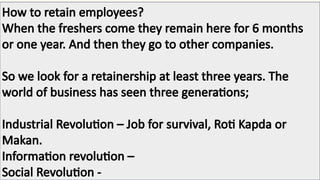
How to retain employees?
When the freshers come they remain here for 6 months
or one year. And then they go to other companies.
So we look for a retainership at least three years. The
world of business has seen three generations;
Industrial Revolution – Job for survival, Roti Kapda or
Makan.
Information revolution –
Social Revolution -

HRRiskManagementPresentationpptxaaa.pptx

  • 1.
    Investigating HR's Rolein Business Risk Management • Exploring how Human Resources contributes to identifying, preventing, and mitigating organizational risks • Prepared for academic/organizational insights
  • 2.
    Introduction • Risk managementis not only financial or operational—it is also people-driven • HR plays a strategic role in preventing human capital risks • Objective: Examine HR's contribution to anticipating, controlling, and responding to business risks
  • 3.
    Understanding Business Risk • Typesof business risks: • - Strategic (poor planning, market changes) • - Operational (process failures, supply chain issues) • - Financial (cash flow, fraud) • - Compliance (laws, regulations, ethical breaches) • - Human Capital (talent loss, misconduct, low morale) • HR is most directly involved in human capital & compliance risks
  • 4.
    HR as aRisk Manager • Recruitment & background checks reduce hiring risks • Policies ensure legal & regulatory compliance • Performance management prevents productivity risks • Training programs mitigate skills & safety gaps • Employee engagement reduces attrition risk
  • 5.
    HR in Compliance& Legal Risk  Ensures adherence to labor laws, contracts, and workplace safety  Prevents costly lawsuits through clear policies & grievance handling  Monitors equal opportunity, anti-harassment, and diversity standards  Protects organizational reputation by promoting ethical conduct
  • 6.
    HR in OperationalRisk Management • Workforce planning ensures business continuity • Succession planning reduces disruption from leadership gaps • Crisis management training (pandemics, strikes, disasters) • Collaborates with operations to maintain resilience
  • 7.
    HR in Cultural& Ethical Risk • Builds a culture of trust and transparency • Promotes ethical decision-making through training • Early detection of toxic behaviors or misconduct • Strengthens corporate reputation by aligning employees with values
  • 8.
    HR & TalentRisk • Identifies and retains critical talent • Mitigates knowledge loss through documentation & cross-training • Implements reward systems to lower turnover risk • Manages remote/hybrid work challenges effectively
  • 9.
    Case Example /Best Practices • Example: During COVID-19, proactive HR teams managed remote work policies, mental health programs, and safety compliance • Best Practices: • - Regular risk audits of HR processes • - Employee surveys to detect emerging issues • - HR's participation in enterprise risk committees
  • 10.
    Conclusion • HR isa strategic partner in risk management • Protects the organization from compliance, talent, ethical, and operational risks • Strong HR practices = stronger resilience and sustainability • Future focus: integrate HR analytics & AI for predictive risk management
  • 11.
    How to retainemployees? When the freshers come they remain here for 6 months or one year. And then they go to other companies. So we look for a retainership at least three years. The world of business has seen three generations; Industrial Revolution – Job for survival, Roti Kapda or Makan. Information revolution – Social Revolution -