Perspectives of Compensation
Society
◦Considers pay as a measure of justice
◦ Job benefits- Reflection of justice in society
Stockholders
◦ Using stock to pay employees creates a
sense of ownership
◦ Linking executive pay to company
performance increases stockholders' returns
1-8
9.
Perspectives of Compensation
Managers
◦Major expense
◦ Can be used to:
◦ Influence employee behaviors
◦ Improve organizational performance
Employees
◦ Major source of financial security
◦ Entitlement for being an employee of the company
◦ Reward for a job well done
1-9
Incentive and SortingEffects of Pay on Employers’ Behaviors
Pay affects motivational intensity, direction, and persistence
◦ Incentive effect: Degree to which pay influences individual and aggregate motivation
◦ Sorting effect: Effect that pay can have on the composition of the workforce
◦ How an organization pays, can result in sorting effects
1-11
12.
What is Compensation?
Allforms of financial returns and tangible services and benefits employees receive as part of an
employment relationship
1-12
13.
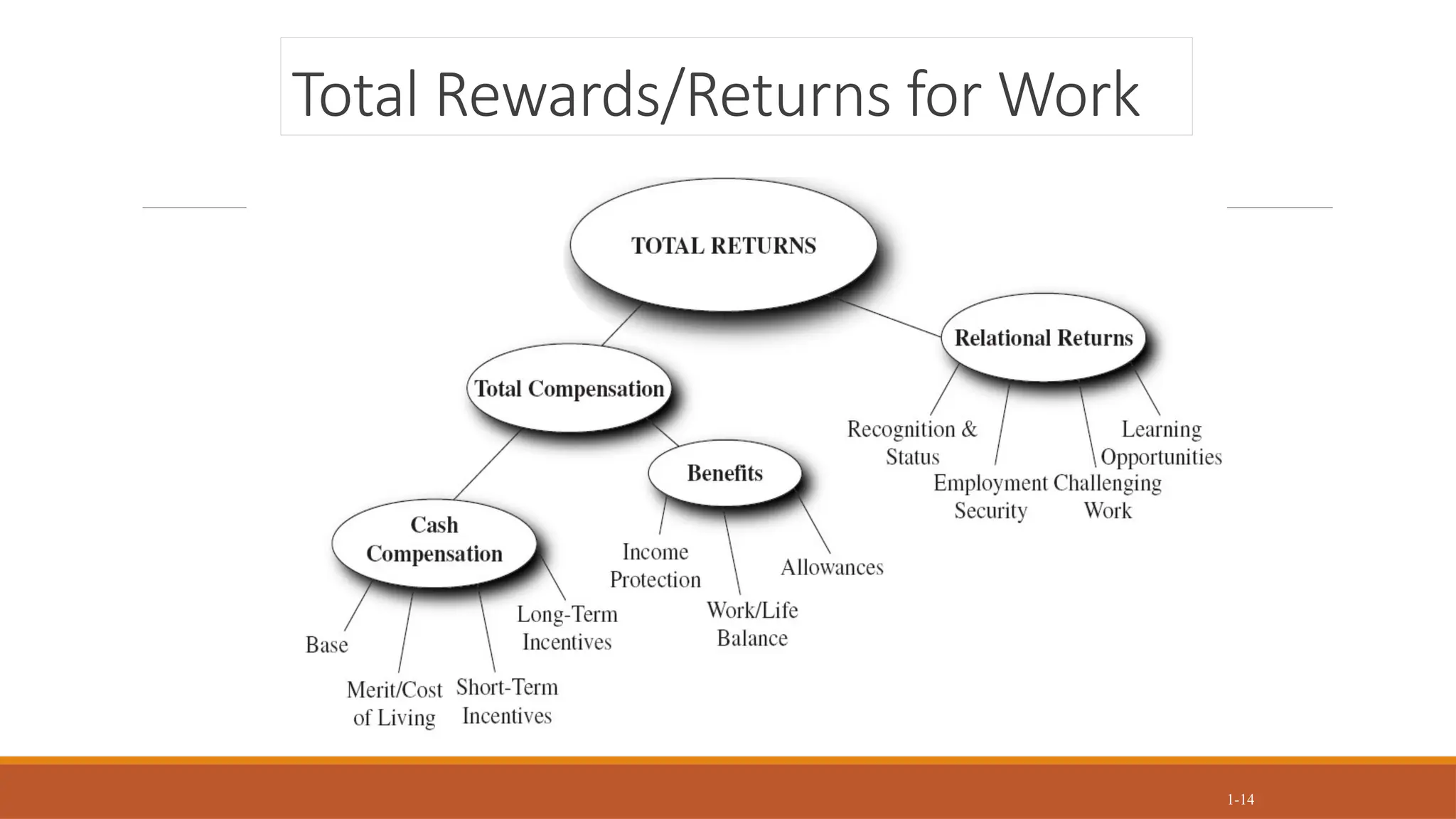
Forms of Pay
Totalcompensation
◦ Pay received directly as cash and indirectly as benefits
Relational returns
◦ Are psychological
1-13
What is employeerelations?
Employee relations refer to the efforts an organization takes to manage relationships between
employers and employees.
Purpose: Build trust, fairness, and motivation in the workplace.
•Employee Relations vs. Industrial Relations
•Focus: Individual vs. Collective Workplace Relations
"Employee Relations" focuses on managing individual
employee relationships within a company, while "Industrial
Relations" encompasses the broader relationship between
employers, employees (including their unions), and the
government, often dealing with collective bargaining and labor
disputes, particularly in unionized workplaces;
20.
Key Components ofEmployee Relations
Communication & Engagement – Open dialogue
improves motivation.
Conflict Resolution – Handling disputes
professionally and fairly.
Performance & Discipline – Balancing productivity
and workplace harmony.
Employee Well-being & Motivation – Creating a
positive work culture.
Legal & Ethical Considerations – Following labor
laws and company policies.
Outcome of GoodEmployee Relations
Effective employee relations lead to:
✅ Higher job satisfaction & engagement
✅ Lower turnover & conflict
✅ Improved performance & workplace culture
✅ Stronger legal & ethical compliance
Ethical vs. Legal Decision-Making in Employee Relations
23.
Outcome of GoodEmployee Relations
For Employers:
•Boost loyalty and retention: Happy employees stick around. With positive
relations, you’ll see reduced turnover, saving time and money on
recruitment and training.
•Unlock higher engagement: Engaged employees take initiative, spark new
ideas, and push boundaries to achieve more. Effective employee relations
foster a culture of ownership and enthusiasm, driving success.
•Reduce workplace conflict and drama: Let’s face it, conflict management
saps energy and resources. A robust employee relations framework equips
you to proactively address concerns and resolve issues early, minimising
costly disruptions.
•Attract top talent: A reputation for positive employee relations is a
magnet for talented individuals. In today’s competitive market, it’s a crucial
advantage that sets you apart.
•Enhance brand image: Happy employees become brand ambassadors,
spreading positive word-of-mouth and boosting your company’s reputation.
24.
Outcome of GoodEmployee Relations
For Employees:
Feel valued and respected: When your employer shows they care about you and your
work, you feel like you belong and want to do your best.
Experience job satisfaction: Positive employee relationships create a safe, supportive,
and collaborative work environment, making work more enjoyable and fulfilling.
Enjoy better work-life balance: Good employee relations mean less stress, more
flexibility, and a happier you, both at work and home.
Have a voice and growth opportunities: Open communication and feedback channels
empower employees, leading to better decision-making and increased learning and
development opportunities.
Feel secure and protected: Transparent rules and fair conflict resolution create a safe
and respectful workplace, building trust and security
25.
Common Legal issues(Labour Act 2074)
Internship
Contractual Employment
Appointment Letter
Disciplinary Actions
Health & Safety
Minimum Wage
Resignation
Layoffs
Model Bylaws