THE 1950s:
“Conservatism, Complacency, and
         Contentment”

            OR
   “Anxiety, Alienation, and
      Social Unrest” ??

     Ms. Stacey M. Hoye
   Caprock HS Amarillo, TX
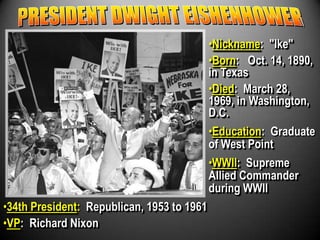
•Nickname: "Ike"
                                            •Born: Oct. 14, 1890,
                                            in Texas
                                            •Died: March 28,
                                            1969, in Washington,
                                            D.C.
                                            •Education: Graduate
                                            of West Point
                                            •WWII: Supreme
                                            Allied Commander
                                            during WWII
•34th President: Republican, 1953 to 1961
•VP: Richard Nixon
Baby Boomers
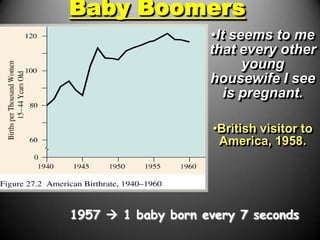
                    •It seems to me
                    that every other
                          young
                    housewife I see
                       is pregnant.

                     •British visitor to
                      America, 1958.


1957  1 baby born every 7 seconds
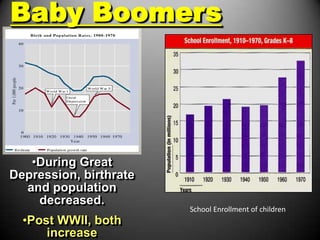
Baby Boomers


   •During Great
Depression, birthrate
  and population
    decreased.
                        School Enrollment of children
  •Post WWII, both
      increase
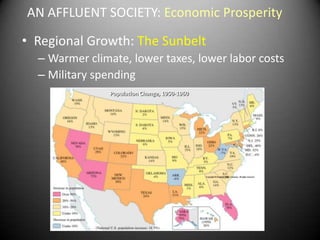
AN AFFLUENT SOCIETY: Economic Prosperity
• Regional Growth: The Sunbelt
  – Warmer climate, lower taxes, lower labor costs
  – Military spending
                Population Change, 1950-1960
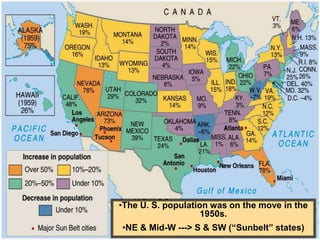
The Culture of the Car


      •The U. S. population was on the move in the
                          1950s.
      •NE & Mid-W ---> S & SW (“Sunbelt” states)
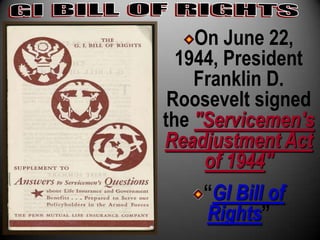
On June 22,
  1944, President
    Franklin D.
 Roosevelt signed
the "Servicemen's
Readjustment Act
     of 1944"
     “GI Bill of
     Rights”
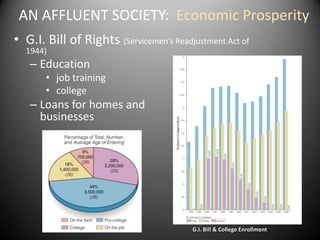
AN AFFLUENT SOCIETY: Economic Prosperity
• G.I. Bill of Rights (Servicemen’s Readjustment Act of
  1944)
   – Education
       • job training
       • college
   – Loans for homes and
     businesses


                                         G.I. Bill & College Enrollment
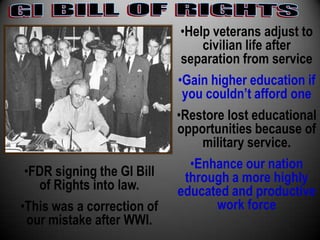
•Help veterans adjust to
                                 civilian life after
                             separation from service
                            •Gain higher education if
                             you couldn’t afford one
                            •Restore lost educational
                            opportunities because of
                                 military service.
                               •Enhance our nation
 •FDR signing the GI Bill     through a more highly
    of Rights into law.     educated and productive
•This was a correction of           work force
  our mistake after WWI.
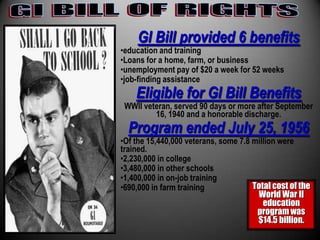
GI Bill provided 6 benefits
•education and training
•Loans for a home, farm, or business
•unemployment pay of $20 a week for 52 weeks
•job-finding assistance
    Eligible for GI Bill Benefits
 WWII veteran, served 90 days or more after September
         16, 1940 and a honorable discharge.
  Program ended July 25, 1956
•Of the 15,440,000 veterans, some 7.8 million were
trained.
•2,230,000 in college
•3,480,000 in other schools
•1,400,000 in on-job training
•690,000 in farm training             Total cost of the
                                       World War II
                                         education
                                       program was
                                       $14.5 billion.
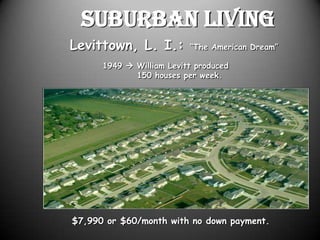
Suburban Living
Levittown, L. I.:         “The American Dream”

      1949  William Levitt produced
             150 houses per week.


$7,990 or $60/month with no down payment.
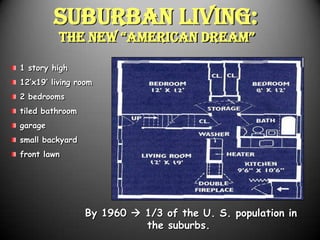
Suburban Living:
          The New “AmericAN DreAm”

1 story high
12’x19’ living room
2 bedrooms
tiled bathroom
garage
small backyard
front lawn


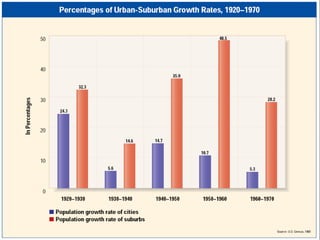
                 By 1960  1/3 of the U. S. population in
                           the suburbs.
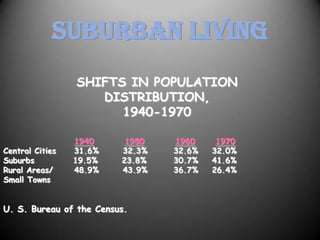
Suburban Living
                 SHIFTS IN POPULATION
                    DISTRIBUTION,
                       1940-1970

                 1940     1950   1960     1970
Central Cities   31.6%   32.3%   32.6%   32.0%
Suburbs          19.5%   23.8%   30.7%   41.6%
Rural Areas/     48.9%   43.9%   36.7%   26.4%
Small Towns


U. S. Bureau of the Census.
Suburban Living

SHIFTS IN POPULATION DISTRIBUTION,
             1940-1970

                 1940     1950   1960    1970
Central Cities   31.6%   32.3%   32.6%   32.0%
Suburbs          19.5%   23.8%   30.7%   41.6%
Rural Areas/     48.9%   43.9%   36.7%   26.4%
Small Towns

  U. S. Bureau of the Census.
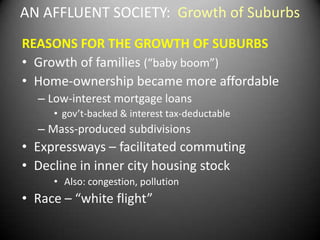
AN AFFLUENT SOCIETY: Growth of Suburbs
REASONS FOR THE GROWTH OF SUBURBS
• Growth of families (“baby boom”)
• Home-ownership became more affordable
  – Low-interest mortgage loans
     • gov’t-backed & interest tax-deductable
  – Mass-produced subdivisions
• Expressways – facilitated commuting
• Decline in inner city housing stock
     • Also: congestion, pollution
• Race – “white flight”
Suburban Living
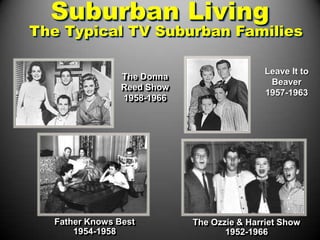
The Typical TV Suburban Families

                                            Leave It to
                The Donna
                                             Beaver
                Reed Show
                                            1957-1963
                1958-1966


  Father Knows Best         The Ozzie & Harriet Show
      1954-1958                    1952-1966
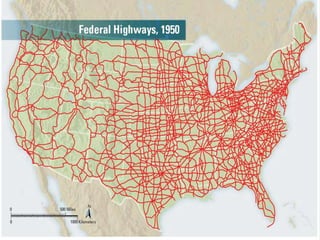
Highway Act of 1956
42,000 miles of interstate highways linking major
cities
Improve national defense
Good for jobs, trucking
Bad for the poor, public transportation
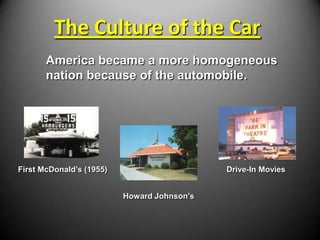
The Culture of the Car
       America became a more homogeneous
       nation because of the automobile.


First McDonald’s (1955)                      Drive-In Movies


                          Howard Johnson’s
The Culture of the Car
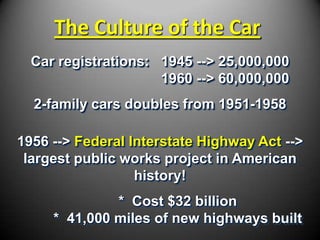
  Car registrations: 1945 --> 25,000,000
                     1960 --> 60,000,000
  2-family cars doubles from 1951-1958

1956 --> Federal Interstate Highway Act -->
 largest public works project in American
                  history!
              * Cost $32 billion
     * 41,000 miles of new highways built
The Culture of the Car

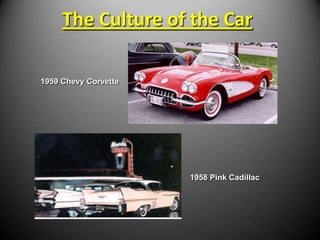
1959 Chevy Corvette


                      1958 Pink Cadillac
The Culture of the Car
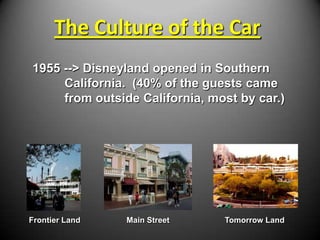
1955 --> Disneyland opened in Southern
     California. (40% of the guests came
     from outside California, most by car.)


Frontier Land   Main Street     Tomorrow Land
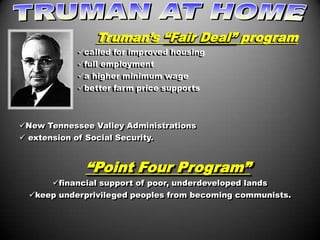
Truman’s “Fair Deal” program
             called for improved housing
             full employment
             a higher minimum wage
             better farm price supports


New Tennessee Valley Administrations
 extension of Social Security.


               “Point Four Program”
       financial support of poor, underdeveloped lands
  keep underprivileged peoples from becoming communists.
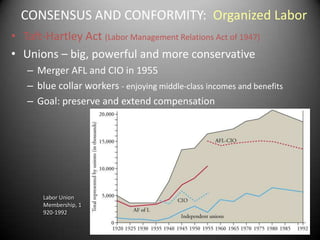
CONSENSUS AND CONFORMITY: Organized Labor
• Taft-Hartley Act (Labor Management Relations Act of 1947)
• Unions – big, powerful and more conservative
   – Merger AFL and CIO in 1955
   – blue collar workers - enjoying middle-class incomes and benefits
   – Goal: preserve and extend compensation


       Labor Union
       Membership, 1
       920-1992
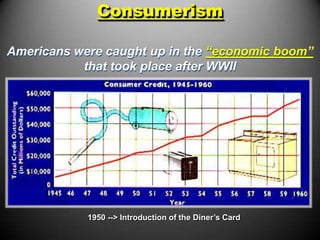
Consumerism

Americans were caught up in the “economic boom”
           that took place after WWII


            1950 --> Introduction of the Diner’s Card
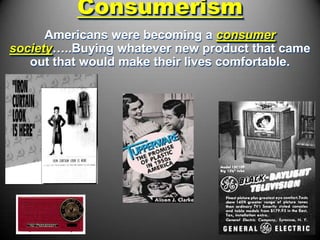
Consumerism
      Americans were becoming a consumer
society…..Buying whatever new product that came
   out that would make their lives comfortable.
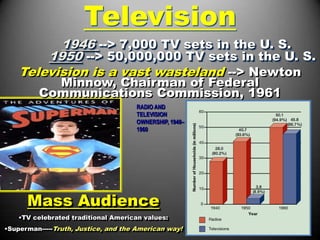
Television
          1946 --> 7,000 TV sets in the U. S.
        1950 --> 50,000,000 TV sets in the U. S.
    Television is a vast wasteland --> Newton
           Minnow, Chairman of Federal
         Communications Commission, 1961
                                     RADIO AND
                                     TELEVISION
                                     OWNERSHIP, 1940–
                                     1960


      Mass Audience
    •TV celebrated traditional American values:
•Superman-----Truth, Justice, and the American way!
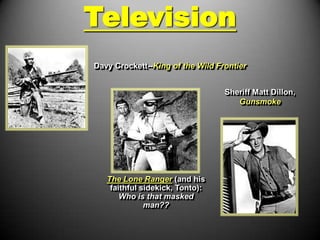
Television
Davy Crockett--King of the Wild Frontier


                                  Sheriff Matt Dillon,
                                     Gunsmoke


   The Lone Ranger (and his
    faithful sidekick, Tonto):
       Who is that masked
              man??
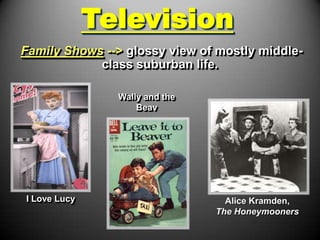
Television
Family Shows --> glossy view of mostly middle-
            class suburban life.

                Wally and the
                    Beav


I Love Lucy                       Alice Kramden,
                                The Honeymooners
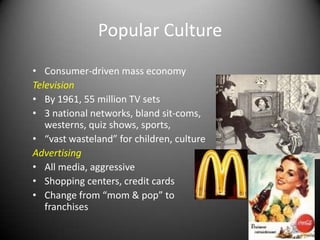
Popular Culture
• Consumer-driven mass economy
Television
• By 1961, 55 million TV sets
• 3 national networks, bland sit-coms,
   westerns, quiz shows, sports,
• “vast wasteland” for children, culture
Advertising
• All media, aggressive
• Shopping centers, credit cards
• Change from “mom & pop” to
   franchises
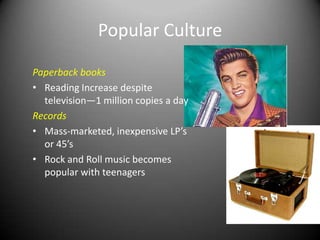
Popular Culture

Paperback books
• Reading Increase despite
  television—1 million copies a day
Records
• Mass-marketed, inexpensive LP’s
  or 45’s
• Rock and Roll music becomes
  popular with teenagers
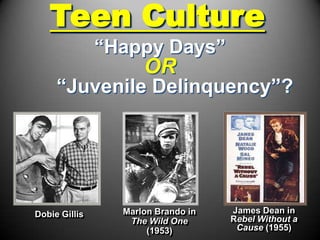
Teen Culture
               “Happy Days”
                     OR
     “Juvenile Delinquency”?


Dobie Gillis     Marlon Brando in   James Dean in
                  The Wild One      Rebel Without a
                      (1953)         Cause (1955)
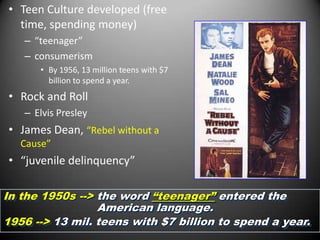
• Teen Culture developed (free
  time, spending money)
   – “teenager”
   – consumerism
      • By 1956, 13 million teens with $7
        billion to spend a year.
• Rock and Roll
   – Elvis Presley
• James Dean, “Rebel without a
   Cause”
• “juvenile delinquency”

In the 1950s --> the word “teenager” entered the
                 American language.
1956 --> 13 mil. teens with $7 billion to spend a year.
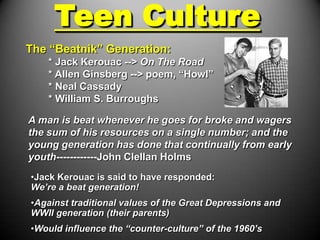
Teen Culture
The “Beatnik” Generation:
    * Jack Kerouac --> On The Road
    * Allen Ginsberg --> poem, “Howl”
    * Neal Cassady
    * William S. Burroughs

A man is beat whenever he goes for broke and wagers
the sum of his resources on a single number; and the
young generation has done that continually from early
youth------------John Clellan Holms
•Jack Kerouac is said to have responded:
We’re a beat generation!
•Against traditional values of the Great Depressions and
WWII generation (their parents)
•Would influence the “counter-culture” of the 1960’s
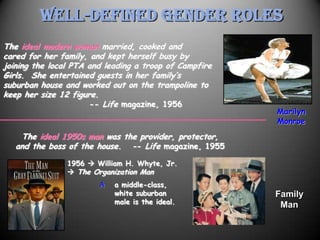
Well-Defined Gender Roles
The ideal modern woman married, cooked and
cared for her family, and kept herself busy by
joining the local PTA and leading a troop of Campfire
Girls. She entertained guests in her family’s
suburban house and worked out on the trampoline to
keep her size 12 figure.
                       -- Life magazine, 1956
                                                        Marilyn
                                                        Monroe
    The ideal 1950s man was the provider, protector,
   and the boss of the house. -- Life magazine, 1955

                1956  William H. Whyte, Jr.
                 The Organization Man
                        A   a middle-class,
                            white suburban              Family
                            male is the ideal.           Man
Religious Revival
CONSENSUS AND CONFORMITY: Religion
  • Organized religion expanded dramatically
    after WW2
    – church/synagogue memberships reached highest
      level in US history
       • 1940  64,000,000; 1960  114,000,000
    – thousands of new churches and synagogues built
      in suburbs
  • Why??
    – more a means of socialization and belonging
      than evidence of interest in doctrine?
       • atmosphere of tolerance
    – stage of life?
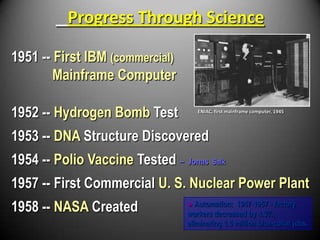
Progress Through Science

1951 -- First IBM (commercial)
        Mainframe Computer

1952 -- Hydrogen Bomb Test           ENIAC, first mainframe computer, 1945


1953 -- DNA Structure Discovered
1954 -- Polio Vaccine Tested – Jonas Salk
1957 -- First Commercial U. S. Nuclear Power Plant
1958 -- NASA Created               Automation: 1947-1957 - factory
                                 workers decreased by 4.3%,
                                 eliminating 1.5 million blue-collar jobs.

Hoye 1950s ap version 2012

  • 1.
    THE 1950s: “Conservatism, Complacency,and Contentment” OR “Anxiety, Alienation, and Social Unrest” ?? Ms. Stacey M. Hoye Caprock HS Amarillo, TX
  • 2.
    •Nickname: "Ike" •Born: Oct. 14, 1890, in Texas •Died: March 28, 1969, in Washington, D.C. •Education: Graduate of West Point •WWII: Supreme Allied Commander during WWII •34th President: Republican, 1953 to 1961 •VP: Richard Nixon
  • 3.
    Baby Boomers •It seems to me that every other young housewife I see is pregnant. •British visitor to America, 1958. 1957  1 baby born every 7 seconds
  • 4.
    Baby Boomers •During Great Depression, birthrate and population decreased. School Enrollment of children •Post WWII, both increase
  • 5.
    AN AFFLUENT SOCIETY:Economic Prosperity • Regional Growth: The Sunbelt – Warmer climate, lower taxes, lower labor costs – Military spending Population Change, 1950-1960
  • 6.
    The Culture ofthe Car •The U. S. population was on the move in the 1950s. •NE & Mid-W ---> S & SW (“Sunbelt” states)
  • 7.
    On June 22, 1944, President Franklin D. Roosevelt signed the "Servicemen's Readjustment Act of 1944" “GI Bill of Rights”
  • 8.
    AN AFFLUENT SOCIETY:Economic Prosperity • G.I. Bill of Rights (Servicemen’s Readjustment Act of 1944) – Education • job training • college – Loans for homes and businesses G.I. Bill & College Enrollment
  • 9.
    •Help veterans adjustto civilian life after separation from service •Gain higher education if you couldn’t afford one •Restore lost educational opportunities because of military service. •Enhance our nation •FDR signing the GI Bill through a more highly of Rights into law. educated and productive •This was a correction of work force our mistake after WWI.
  • 10.
    GI Bill provided6 benefits •education and training •Loans for a home, farm, or business •unemployment pay of $20 a week for 52 weeks •job-finding assistance Eligible for GI Bill Benefits WWII veteran, served 90 days or more after September 16, 1940 and a honorable discharge. Program ended July 25, 1956 •Of the 15,440,000 veterans, some 7.8 million were trained. •2,230,000 in college •3,480,000 in other schools •1,400,000 in on-job training •690,000 in farm training Total cost of the World War II education program was $14.5 billion.
  • 11.
    Suburban Living Levittown, L.I.: “The American Dream” 1949  William Levitt produced 150 houses per week. $7,990 or $60/month with no down payment.
  • 12.
    Suburban Living: The New “AmericAN DreAm” 1 story high 12’x19’ living room 2 bedrooms tiled bathroom garage small backyard front lawn By 1960  1/3 of the U. S. population in the suburbs.
  • 13.
    Suburban Living SHIFTS IN POPULATION DISTRIBUTION, 1940-1970 1940 1950 1960 1970 Central Cities 31.6% 32.3% 32.6% 32.0% Suburbs 19.5% 23.8% 30.7% 41.6% Rural Areas/ 48.9% 43.9% 36.7% 26.4% Small Towns U. S. Bureau of the Census.
  • 14.
    Suburban Living SHIFTS INPOPULATION DISTRIBUTION, 1940-1970 1940 1950 1960 1970 Central Cities 31.6% 32.3% 32.6% 32.0% Suburbs 19.5% 23.8% 30.7% 41.6% Rural Areas/ 48.9% 43.9% 36.7% 26.4% Small Towns U. S. Bureau of the Census.
  • 15.
    AN AFFLUENT SOCIETY:Growth of Suburbs REASONS FOR THE GROWTH OF SUBURBS • Growth of families (“baby boom”) • Home-ownership became more affordable – Low-interest mortgage loans • gov’t-backed & interest tax-deductable – Mass-produced subdivisions • Expressways – facilitated commuting • Decline in inner city housing stock • Also: congestion, pollution • Race – “white flight”
  • 16.
    Suburban Living The TypicalTV Suburban Families Leave It to The Donna Beaver Reed Show 1957-1963 1958-1966 Father Knows Best The Ozzie & Harriet Show 1954-1958 1952-1966
  • 17.
    Highway Act of1956 42,000 miles of interstate highways linking major cities Improve national defense Good for jobs, trucking Bad for the poor, public transportation
  • 19.
    The Culture ofthe Car America became a more homogeneous nation because of the automobile. First McDonald’s (1955) Drive-In Movies Howard Johnson’s
  • 20.
    The Culture ofthe Car Car registrations: 1945 --> 25,000,000 1960 --> 60,000,000 2-family cars doubles from 1951-1958 1956 --> Federal Interstate Highway Act --> largest public works project in American history! * Cost $32 billion * 41,000 miles of new highways built
  • 21.
    The Culture ofthe Car 1959 Chevy Corvette 1958 Pink Cadillac
  • 22.
    The Culture ofthe Car 1955 --> Disneyland opened in Southern California. (40% of the guests came from outside California, most by car.) Frontier Land Main Street Tomorrow Land
  • 23.
    Truman’s “Fair Deal”program called for improved housing full employment a higher minimum wage better farm price supports New Tennessee Valley Administrations  extension of Social Security. “Point Four Program” financial support of poor, underdeveloped lands keep underprivileged peoples from becoming communists.
  • 24.
    CONSENSUS AND CONFORMITY:Organized Labor • Taft-Hartley Act (Labor Management Relations Act of 1947) • Unions – big, powerful and more conservative – Merger AFL and CIO in 1955 – blue collar workers - enjoying middle-class incomes and benefits – Goal: preserve and extend compensation Labor Union Membership, 1 920-1992
  • 25.
    Consumerism Americans were caughtup in the “economic boom” that took place after WWII 1950 --> Introduction of the Diner’s Card
  • 26.
    Consumerism Americans were becoming a consumer society…..Buying whatever new product that came out that would make their lives comfortable.
  • 27.
    Television 1946 --> 7,000 TV sets in the U. S. 1950 --> 50,000,000 TV sets in the U. S. Television is a vast wasteland --> Newton Minnow, Chairman of Federal Communications Commission, 1961 RADIO AND TELEVISION OWNERSHIP, 1940– 1960 Mass Audience •TV celebrated traditional American values: •Superman-----Truth, Justice, and the American way!
  • 28.
    Television Davy Crockett--King ofthe Wild Frontier Sheriff Matt Dillon, Gunsmoke The Lone Ranger (and his faithful sidekick, Tonto): Who is that masked man??
  • 29.
    Television Family Shows -->glossy view of mostly middle- class suburban life. Wally and the Beav I Love Lucy Alice Kramden, The Honeymooners
  • 30.
    Popular Culture • Consumer-drivenmass economy Television • By 1961, 55 million TV sets • 3 national networks, bland sit-coms, westerns, quiz shows, sports, • “vast wasteland” for children, culture Advertising • All media, aggressive • Shopping centers, credit cards • Change from “mom & pop” to franchises
  • 31.
    Popular Culture Paperback books •Reading Increase despite television—1 million copies a day Records • Mass-marketed, inexpensive LP’s or 45’s • Rock and Roll music becomes popular with teenagers
  • 32.
    Teen Culture “Happy Days” OR “Juvenile Delinquency”? Dobie Gillis Marlon Brando in James Dean in The Wild One Rebel Without a (1953) Cause (1955)
  • 33.
    • Teen Culturedeveloped (free time, spending money) – “teenager” – consumerism • By 1956, 13 million teens with $7 billion to spend a year. • Rock and Roll – Elvis Presley • James Dean, “Rebel without a Cause” • “juvenile delinquency” In the 1950s --> the word “teenager” entered the American language. 1956 --> 13 mil. teens with $7 billion to spend a year.
  • 34.
    Teen Culture The “Beatnik”Generation: * Jack Kerouac --> On The Road * Allen Ginsberg --> poem, “Howl” * Neal Cassady * William S. Burroughs A man is beat whenever he goes for broke and wagers the sum of his resources on a single number; and the young generation has done that continually from early youth------------John Clellan Holms •Jack Kerouac is said to have responded: We’re a beat generation! •Against traditional values of the Great Depressions and WWII generation (their parents) •Would influence the “counter-culture” of the 1960’s
  • 35.
    Well-Defined Gender Roles Theideal modern woman married, cooked and cared for her family, and kept herself busy by joining the local PTA and leading a troop of Campfire Girls. She entertained guests in her family’s suburban house and worked out on the trampoline to keep her size 12 figure. -- Life magazine, 1956 Marilyn Monroe The ideal 1950s man was the provider, protector, and the boss of the house. -- Life magazine, 1955 1956  William H. Whyte, Jr.  The Organization Man A a middle-class, white suburban Family male is the ideal. Man
  • 36.
    Religious Revival CONSENSUS ANDCONFORMITY: Religion • Organized religion expanded dramatically after WW2 – church/synagogue memberships reached highest level in US history • 1940  64,000,000; 1960  114,000,000 – thousands of new churches and synagogues built in suburbs • Why?? – more a means of socialization and belonging than evidence of interest in doctrine? • atmosphere of tolerance – stage of life?
  • 37.
    Progress Through Science 1951-- First IBM (commercial) Mainframe Computer 1952 -- Hydrogen Bomb Test ENIAC, first mainframe computer, 1945 1953 -- DNA Structure Discovered 1954 -- Polio Vaccine Tested – Jonas Salk 1957 -- First Commercial U. S. Nuclear Power Plant 1958 -- NASA Created  Automation: 1947-1957 - factory workers decreased by 4.3%, eliminating 1.5 million blue-collar jobs.