A REPORT
INTERNSHIP TRAINING AT ASIAN PHARMACEUTICALS PVT.LTD
(IN PARTIAL FULFILLMENT OF THE REQUIREMENT FOR THE AWARD OF BACHELOR DEGREE IN PHARMACEUTICAL
SCIENCE)
SUBMITTED TO:
ASIAN PHARMACEUTICALS PVT.LTD
Omsatiya -01, Rupandehi, Nepal
Submitted by:
Mr. Min Prasad Subedi
B. Pharmacy(3rd Years)
MVM College of Pharmacy
Rajiv Gandhi University, Banglore,India
Submission date: 24th July 2024
CONTENT
Abstract…… … … … . … … … … … … … … … … … … ….. … … … … … …3
Acknowledgement… … … … … … … … … … … … … … … … … … …………4
Abbreviation … … … … … … … … … … … … … … … … … … … …..…..… . 5
Chapter - I
Introduction … … … … … … … … … ……… … … ……….… … ….……...… 6-7
Background … … … … … … … … … … … … … … … … … …….………..… 6-7
Objectives … … … … … … … … …… … … … … … … … … ………..……..…8
1.2.1 General objectives … … … … … … … … …… … … … … … … ……… …8
1.2.1 Specific objectives … … … … … … … … … … … … … … … … …………8
Chapter - II
Production Department … … … … … … … … … ……… … … …. … … ….…9-18
Dispensing Booth … … … … … … … … … ……… … … … … …….. ……..… 11
Granulation… … … … … … … … … ……… … … … … … … ………..……… 12
Compression … … … … … ……… … … … … … … … … ……………..………12
Coating … … … … … ……… … … … … … … … … ……………………..……13
Capsule filling area … … … … … ……… … … … … … … … … …….….….…14
Semi solid preparations section … … … … … ……… … … … … … … ….….…14
Liquid manufacturing section … … … … … ……… … … … … … … …..…..… 15
Primary packaging area … … … … … ……… … … … … … … … … ….….…..15
Secondary packaging area … … … … … ……… … … … … … ……… …..……17
Raw materials (RM) store … … … … … ……… … … … … … … … … .………18
Packaging materials (PM) store … … … … … ……… … … … … … … ….… …18
Engineering Department … … … … … ……… … … … … … … … ….. ….…18-21
HVAC system … … … … … ……… … … … … … … … … ……….….…..……18
AHU … … … … … ……… … … … … … … … … ……………………...….…..19
RO plant … … … … … ……… … … … … … … … … …………………..…..…20
ETP plant … … … … … ……… … … … … … … … … ……………….….….…21
R&D Department … … … … … ……… … … … … … … … … ………………..22
Quality control (QC)department … … … … … ……… … … … … … … ……… 23
Microbiology department … … … … … ……… … … … … … … … … ……..…24
Quality assurance (QA) department … … … … … ……… … … … … .… ..… 25-27
IPQA department … … … … … ……… … … … … … … … … …………………26
Conclusion … … … … … ……… … … … … … … … ….………………..………27
ABSTRACT
This internship was done as the part of the requirement in fulfilment of the degree of Of Pharmacy
program. It was a great decency to be a member of Asian Pharmaceutical Pvt. Ltd,
Rupandehi ,Nepal, as a intern.. During this training, I was exposed to Different departments namely
Production, Quality Control, Quality Assurance, Research and Development, Maintenance, Store, and
Packaging. This in-plant internship helped us to co-relate our theoretical knowledge into a practice
field. I was able to gain practical knowledge on manufacturing of different drugs and dosage forms,
Operation of different equipment, packaging of products, quality control testing of raw Materials,
intermediate and finished products, packaging materials. I also got to know that Quality is assured
through monitoring, controlling, documentation, implementation of the GMP Guidelines and various
other activities which are performed for achievement of quality Products. I got an opportunity to
know about handling and storage of raw and packaging materials as well as storage of finished
products. Moreover, I was aware of the importance of documentation for the continuation of safe
Manufacturing of different medications. On the top of all, this training helped me a lot to make me
feel the need of pharmacists in the pharmaceutical industry. Thus, this training has indeed been
very fruitful to achieve our goals to be competent pharmacists and to uplift the profession. Lastly,
this training provided a chance to be familiar with ASIAN family, which I am very grateful for.
ACKNOWLEDGEMENT
I would like to express my sincere gratitude for this valuable opportunity to undergo pharmaceutical
training at Asian pharmaceuticals Pvt.Ltd. This experience will undoubtedly enrich my knowledge
and skills in the pharmaceutical field, and I am eager to contribute positively to the team. Thank you
for your confidence in my abilities, and I look forward to a productive and educational training
period.
I would like to express my special thanks and gratitude to Mr. Hutananda Khanal (Chairman &
Managing Director), Mrs. Sabhyata khanal Basyal (Technical Director) for providing me this
opportunity to be part of this prestigious organisation.
I would I will also like to thank Mr. Bishnu Prasad koirala (QA /Regulatory Affairs Executive),Mr.
Sudhir karna (Production Manager), Mr. Deependra Sharma ( Senior Analytical Head Division), Mr.
Bishnu Prasad Aryal (Head Production and Formulation Development), Mr. Brijesh khanal
(Officer ,Microbiology),Mr. Devi Prasad Khanal (Supervisor, RM store), Mr. Madhav Prasad Nepal
( Senior Officer,QC), Mr. Samul Thapa (Production,Officer), Mr. Hem Bahadur Kunwar
(IPQA,Supervisor), Mr. Prakash Pun ( QC,officer ) for providing the opportunity to gain in-depth
knowledge across department sections and processes.
I am equally indebted to all pharmacists, staffs, and operators of QA, production, IPQA, microbiology,
R&D and packaging departments who were directly or indirectly involved to help me explore with
instruments, equipments and much more in this training and help me to gain better understanding
during training.
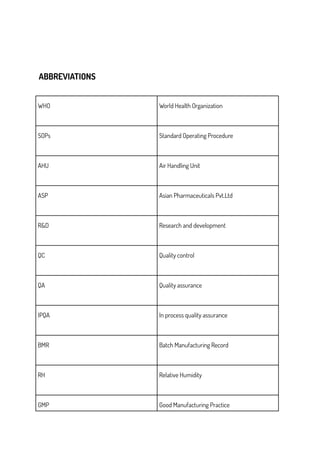
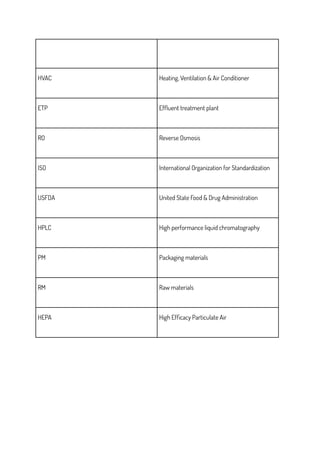
ABBREVIATIONS
WHO World Health Organization
SOPs Standard Operating Procedure
AHU Air Handling Unit
ASP Asian Pharmaceuticals Pvt.Ltd
R&D Research and development
QC Quality control
QA Quality assurance
IPQA In process quality assurance
BMR Batch Manufacturing Record
RH Relative Humidity
GMP Good Manufacturing Practice
HVAC Heating, Ventilation & Air Conditioner
ETP Effluent treatment plant
RO Reverse Osmosis
ISO International Organization for Standardization
USFDA United State Food & Drug Administration
HPLC High performance liquid chromatography
PM Packaging materials
RM Raw materials
HEPA High Efficacy Particulate Air
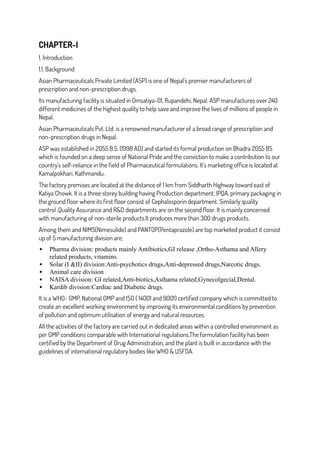
CHAPTER-I
1. Introduction
1.1. Background
Asian Pharmaceuticals Private Limited (ASP) is one of Nepal’s premier manufacturers of
prescription and non-prescription drugs.
Its manufacturing facility is situated in Omsatiya-01, Rupandehi, Nepal. ASP manufactures over 240
different medicines of the highest quality to help save and improve the lives of millions of people in
Nepal.
Asian Pharmaceuticals Pvt. Ltd. is a renowned manufacturer of a broad range of prescription and
non-prescription drugs in Nepal.
ASP was established in 2055 B.S. (1998 AD) and started its formal production on Bhadra 2055 BS
which is founded on a deep sense of National Pride and the conviction to make a contribution to our
country's self-reliance in the field of Pharmaceutical formulations. It's marketing office is located at
Kamalpokhari, Kathmandu.
The factory premises are located at the distance of 1 km from Siddharth Highway toward east of
Katiya Chowk. It is a three storey building having Production department, IPQA, primary packaging in
the ground floor where its first floor consist of Cephalosporin department. Similarly quality
control ,Quality Assurance and R&D departments are on the second floor. It is mainly concerned
with manufacturing of non-sterile products.It produces more than 300 drugs products.
Among them and NIMS(Nimesulide) and PANTOP(Pentaprazole) are top marketed product it consist
up of 5 manufacturing division are;
 Pharma division: products mainly Antibiotics,GI release ,Ortho-Asthama and Allery
related products, vitamins.
 Solar (I &II) division:Anti-psychotics drugs,Anti-depressed drugs,Narcotic drugs.
 Animal care division
 NAISA division: GI related,Anti-biotics,Asthama related,Gynecolgecial,Dental.
 Kardib division:Cardiac and Diabetic drugs.
It is a WHO- GMP, National GMP and ISO ( 14001 and 9001) certified company which is committed to
create an excellent working environment by improving its environmental conditions by prevention
of pollution and optimum utilisation of energy and natural resources.
All the activities of the factory are carried out in dedicated areas within a controlled environment as
per GMP conditions comparable with International regulations.The formulation facility has been
certified by the Department of Drug Administration, and the plant is built in accordance with the
guidelines of international regulatory bodies like WHO & USFDA.
Manufacturing Facility
The factory premises consist of 250411.5 sq ft in area (2.3264 Hectare), which comprises the Pharma
Manufacturing plant, constructed in 16230.85 sq ft, Cephalosporin in 5996.25 sq.ft, all within a self
contained facility.
Veterinary is housed in 2557.75 sq.ft with a separate air handling facility.
Raw materials are stored in 2600 sq ft. and a scrap yard in 1500 sq ft. AHU, chilling units, and the
whole maintenance area occupy 9194.74 sq.ft of the total circumference.
Quality Control, Microbiology, R&D, and Quality Assurance, are located within the second floor area
of 11663.04 sq.ft.
Management shift
Every department has their own head supervisor and it has three different shifts;
 7am -3 pm
 8:30am -4:30 pm
 11am -7 pm
According to the provided schedule(7am -3pm) for my internship program I was assigned to
observe the following departments;
Production department
●
 Granulation
 Compression
 Coating
 Packaging
 Capsule filling
 Liquid manufacturing and filling department
 Semi-solid manufacturing and filling department
Raw materials (RM) department
●
Raw materials store
○
Dispensing booth
○
 Packaging materials (PM) department
Primary PM
○
Secondary PM
○
 IPQA department
 Quality Control (QC) department
Microbiology laboratory
○
 R&D department
 Engineering/maintenance department
 Quality Assurance (QA) department
 Finished Product( FP) department
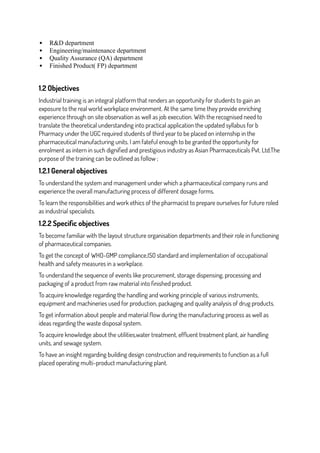
1.2 Objectives
Industrial training is an integral platform that renders an opportunity for students to gain an
exposure to the real world workplace environment. At the same time they provide enriching
experience through on site observation as well as job execution. With the recognised need to
translate the theoretical understanding into practical application the updated syllabus for b
Pharmacy under the UGC required students of third year to be placed on internship in the
pharmaceutical manufacturing units. I am fateful enough to be granted the opportunity for
enrolment as intern in such dignified and prestigious industry as Asian Pharmaceuticals Pvt. Ltd.The
purpose of the training can be outlined as follow ;
1.2.1 General objectives
To understand the system and management under which a pharmaceutical company runs and
experience the overall manufacturing process of different dosage forms.
To learn the responsibilities and work ethics of the pharmacist to prepare ourselves for future roled
as industrial specialists.
1.2.2 Specific objectives
To become familiar with the layout structure organisation departments and their role in functioning
of pharmaceutical companies.
To get the concept of WHO-GMP compliance,ISO standard and implementation of occupational
health and safety measures in a workplace.
To understand the sequence of events like procurement, storage dispensing, processing and
packaging of a product from raw material into finished product.
To acquire knowledge regarding the handling and working principle of various instruments,
equipment and machineries used for production, packaging and quality analysis of drug products.
To get information about people and material flow during the manufacturing process as well as
ideas regarding the waste disposal system.
To acquire knowledge about the utilities,water treatment, effluent treatment plant, air handling
units, and sewage system.
To have an insight regarding building design construction and requirements to function as a full
placed operating multi-product manufacturing plant.
CHAPTER-II
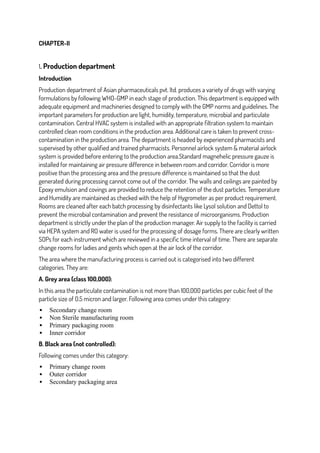
1. Production department
Introduction
Production department of Asian pharmaceuticals pvt. ltd. produces a variety of drugs with varying
formulations by following WHO-GMP in each stage of production. This department is equipped with
adequate equipment and machineries designed to comply with the GMP norms and guidelines. The
important parameters for production are light, humidity, temperature, microbial and particulate
contamination. Central HVAC system is installed with an appropriate filtration system to maintain
controlled clean room conditions in the production area. Additional care is taken to prevent cross-
contamination in the production area. The department is headed by experienced pharmacists and
supervised by other qualified and trained pharmacists. Personnel airlock system & material airlock
system is provided before entering to the production area.Standard magnehelic pressure gauze is
installed for maintaining air pressure difference in between room and corridor. Corridor is more
positive than the processing area and the pressure difference is maintained so that the dust
generated during processing cannot come out of the corridor. The walls and ceilings are painted by
Epoxy emulsion and covings are provided to reduce the retention of the dust particles. Temperature
and Humidity are maintained as checked with the help of Hygrometer as per product requirement.
Rooms are cleaned after each batch processing by disinfectants like Lysol solution and Dettol to
prevent the microbial contamination and prevent the resistance of microorganisms. Production
department is strictly under the plan of the production manager. Air supply to the facility is carried
via HEPA system and RO water is used for the processing of dosage forms. There are clearly written
SOPs for each instrument which are reviewed in a specific time interval of time. There are separate
change rooms for ladies and gents which open at the air lock of the corridor.
The area where the manufacturing process is carried out is categorised into two different
categories. They are:
A. Grey area (class 100,000):
In this area the particulate contamination is not more than 100,000 particles per cubic feet of the
particle size of 0.5 micron and larger. Following area comes under this category:
 Secondary change room
 Non Sterile manufacturing room
 Primary packaging room
 Inner corridor
B. Black area (not controlled):
Following comes under this category:
 Primary change room
 Outer corridor
 Secondary packaging area
A cleanroom is a highly designed controlled environments that a low level of particulates such as
dust,airborne microbes,aerosol particles,and chemical vapors typically used in manufacturing or
scientific research area.To be exacts,a cleanroom has a controlled level of contamination that is
specified by the number of particles per cubic meter at a specified particle size.The ambient air
outside in an environment contains 35,000,000 particles per cubic meter,0.5 micro-meter and
larger in diameter,corresponding to an ISO 9 cleanroom which is at the lowest level of cleanroom
standard whereas,environment conditions that must be designed to maintain pharmaceutical
sterility,activites conducted in such areas include manipulation of sterile materials prior to and
during filling and closing operations corresponding to an ISO 5 cleanroom which is at the highest
level of cleanroom standard.
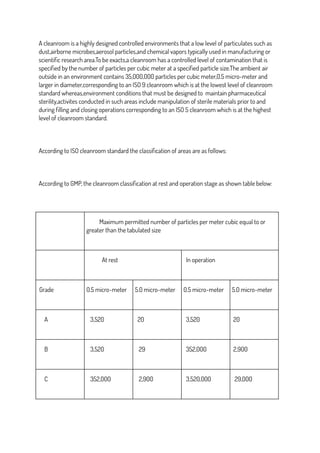
According to ISO cleanroom standard the classification of areas are as follows:
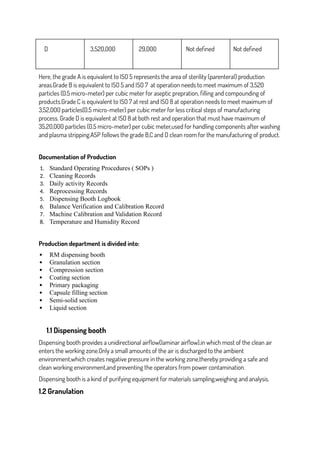
According to GMP, the cleanroom classification at rest and operation stage as shown table below:
Maximum permitted number of particles per meter cubic equal to or
greater than the tabulated size
At rest In operation
Grade 0.5 micro-meter 5.0 micro-meter 0.5 micro-meter 5.0 micro-meter
A 3,520 20 3,520 20
B 3,520 29 352,000 2,900
C 352,000 2,900 3,520,000 29,000
D 3,520,000 29,000 Not defined Not defined
Here, the grade A is equivalent to ISO 5 represents the area of sterility (parenteral) production
areas.Grade B is equivalent to ISO 5 and ISO 7 at operation needs to meet maximum of 3,520
particles (0.5 micro-meter) per cubic meter for aseptic prepration, filling and compounding of
products.Grade C is equivalent to ISO 7 at rest and ISO 8 at operation needs to meet maximum of
3,52,000 particles(0.5 micro-meter) per cubic meter for less critical steps of manufacturing
process. Grade D is equivalent at ISO 8 at both rest and operation that must have maximum of
35,20,000 particles (0.5 micro-meter) per cubic meter,used for handling components after washing
and plasma stripping.ASP follows the grade B,C and D clean room for the manufacturing of product.
Documentation of Production
1. Standard Operating Procedures ( SOPs )
2. Cleaning Records
3. Daily activity Records
4. Reprocessing Records
5. Dispensing Booth Logbook
6. Balance Verification and Calibration Record
7. Machine Calibration and Validation Record
8. Temperature and Humidity Record
Production department is divided into:
 RM dispensing booth
 Granulation section
 Compression section
 Coating section
 Primary packaging
 Capsule filling section
 Semi-solid section
 Liquid section
1.1 Dispensing booth
Dispensing booth provides a unidirectional airflow(laminar airflow),in which most of the clean air
enters the working zone.Only a small amounts of the air is discharged to the ambient
environment,which creates negative pressure in the working zone,thereby providing a safe and
clean working environment,and preventing the operators from power contamination.
Dispensing booth is a kind of purifying equipment for materials sampling,weighing and analysis.
1.2 Granulation
Granulation is the process in which the primary powdered particles are made to adhere to form
larger, multiparticulate entities called granules.
Methods of granulation
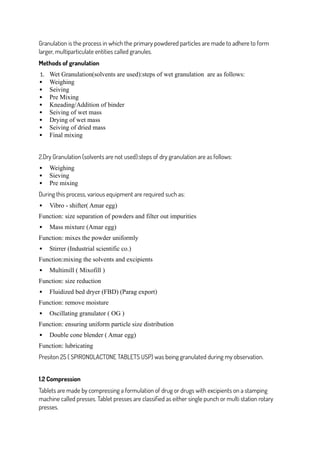
1. Wet Granulation(solvents are used):steps of wet granulation are as follows:
 Weighing
 Seiving
 Pre Mixing
 Kneading/Addition of binder
 Seiving of wet mass
 Drying of wet mass
 Seiving of dried mass
 Final mixing
2.Dry Granulation (solvents are not used):steps of dry granulation are as follows:
 Weighing
 Sieving
 Pre mixing
During this process, various equipment are required such as:
 Vibro - shifter( Amar egg)
Function: size separation of powders and filter out impurities
 Mass mixture (Amar egg)
Function: mixes the powder uniformly
 Stirrer (Industrial scientific co.)
Function:mixing the solvents and excipients
 Multimill ( Mixofill )
Function: size reduction
 Fluidized bed dryer (FBD) (Parag export)
Function: remove moisture
 Oscillating granulator ( OG )
Function: ensuring uniform particle size distribution
 Double cone blender ( Amar egg)
Function: lubricating
Presiton 25 ( SPIRONOLACTONE TABLETS USP) was being granulated during my observation.
1.2 Compression
Tablets are made by compressing a formulation of drug or drugs with excipients on a stamping
machine called presses. Tablet presses are classified as either single punch or multi station rotary
presses.
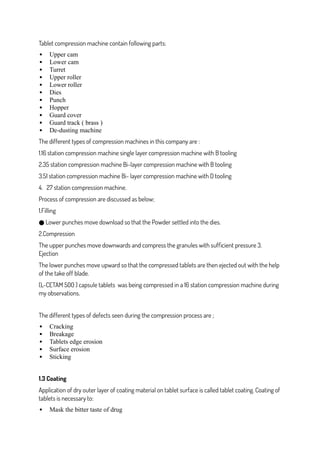
Tablet compression machine contain following parts:
 Upper cam
 Lower cam
 Turret
 Upper roller
 Lower roller
 Dies
 Punch
 Hopper
 Guard cover
 Guard track ( brass )
 De-dusting machine
The different types of compression machines in this company are :
1.16 station compression machine single layer compression machine with B tooling
2.35 station compression machine Bi-layer compression machine with B tooling
3.51 station compression machine Bi- layer compression machine with D tooling
4. 27 station compression machine.
Process of compression are discussed as below;
1.Filling
Lower punches move download so that the Powder settled into the dies.
●
2.Compression
The upper punches move downwards and compress the granules with sufficient pressure 3.
Ejection
The lower punches move upward so that the compressed tablets are then ejected out with the help
of the take off blade.
(L-CETAM 500 ) capsule tablets was being compressed in a 16 station compression machine during
my observations.
The different types of defects seen during the compression process are ;
 Cracking
 Breakage
 Tablets edge erosion
 Surface erosion
 Sticking
1.3 Coating
Application of dry outer layer of coating material on tablet surface is called tablet coating. Coating of
tablets is necessary to:
 Mask the bitter taste of drug
 Prevent the drug from external environment and gastric juice.
 Prevent the stomach from the irritating action of drugs.
 Obtain the longer action of the drug.
 Make the tablet attractive in appearance.
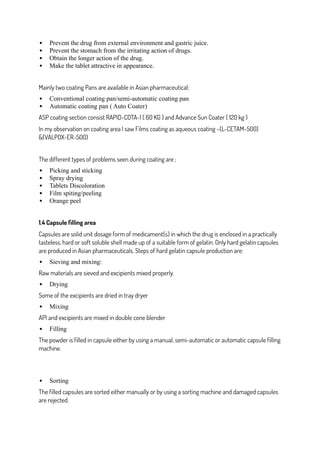
Mainly two coating Pans are available in Asian pharmaceutical;
 Conventional coating pan/semi-automatic coating pan
 Automatic coating pan ( Auto Coater)
ASP coating section consist RAPID-COTA-1 ( 60 KG ) and Advance Sun Coater ( 120 kg )
In my observation on coating area I saw Films coating as aqueous coating –(L-CETAM-500)
&(VALPOX-ER-500)
The different types of problems seen during coating are ;
 Picking and sticking
 Spray drying
 Tablets Discoloration
 Film spiting/peeling
 Orange peel
1.4 Capsule filling area
Capsules are solid unit dosage form of medicament(s) in which the drug is enclosed in a practically
tasteless, hard or soft soluble shell made up of a suitable form of gelatin. Only hard gelatin capsules
are produced in Asian pharmaceuticals. Steps of hard gelatin capsule production are:
 Sieving and mixing:
Raw materials are sieved and excipients mixed properly.
 Drying
Some of the excipients are dried in tray dryer
 Mixing
API and excipients are mixed in double cone blender
 Filling
The powder is filled in capsule either by using a manual, semi-automatic or automatic capsule filling
machine.
 Sorting
The filled capsules are sorted either manually or by using a sorting machine and damaged capsules
are rejected.
 Polishing
The capsules are polished in Capsule Polishing Machine
The different equipments used in capsule section are mentioned as below;
1. Automatic capsule feeling machine 10 station
2. Capsule sorter and elevator for automatic capsule filling
3. Capsule polishing machine
1.5 Semi solid preparation section
Semi-solids are produced in external sections that are applied topically for local or systemic effect
based on their use and site of application. These are prepared by mixing oil phase and water phase
dissolving soluble agents in respective phases. Equipment used during the manufacturing of
semisolid dosage forms are:
 Oil and aqueous base heating vessel
 Planetary mixer
 Jacketed vessel
 Tube filling, sealing, coding machine
Mainly in ASP Delta -gel 10 gram( metronidazole, chlorhexidine, lignocaine & menthol gel) was being
already prepared and filled during my observations. I knew its processing by the operaters by saw
machine.
1.6 Liquid preparations and filling section
The Water used for the preparation of liquid formulation is DM water. Liquid section has Following
rooms for efficient production:
 Manufacturing room
 Mixing room
 Filling/sealing room
 Packaging room
Equipments observed in liquid manufacturing section are:
 Manufacturing Tank(2000l,500l &300l)
 Jacketed tank
 Colloid mill
 Transferring pump
 Turbo stirrer
 Shifter
 Filter Press
Equipments used in liquid filling sections are ;
 Turntable
 Volumetric liquid filling machine
 Screw capping machine
 Inspection belt
 Induction sealing machine
 Dosing cap placement and pressing machine
 Labelling and packaging
Zuben( benzydaminemouthwashBP)wasbeingmanufacturedandfilledduringmy observations.
1.7 Primary Packaging Area
Primary packing area which falls under grey area is the final step carried out in grey area and there
are different rooms with different types of machines at Asian pharmaceutical pvt.ltd.
 Blister packing machine
 Alu -Alu blister packing machine
 Strip packing machine
 Sachet packing machine
Methods and materials of primary packaging are:
I.For solid oral dosage forms (tablets and capsules)
 Strip Packaging: Al-Foil
 Blister Packaging: Al-Foil, PVC, PVDC
 Alu-Alu Packaging: Al-Foil
1. For liquid dosage forms: Amber bottle or clear colourless bottles
2. For dry syrup: High Density Polyethylene (HDPE) bottles
3. For Ointments: Camitube
1.7.1 Strip packaging :
In this, two thin foils of aluminium are used for packing the tablets and capsules. one of the Foils is
printed in which the batch no., mfg. Date, exp. Date and price are printed whereas others are plain.
Equipment used for strip packaging; Strip machine
Its different parts are mentioned as below:
1. Hopper
2. Vibrator
3. Feeder
4. Chute
5. Stereo for printing
6. Sealing roller
7. Cutter station
8. Conveyor belt
Etapram 10 ( Escitalopram oxalate Tablets. IP) was being packaged during my observations
1.7.2 Blister packaging:
In blister packing, the product is enclosed between the pocket of thermoplastic resin and the
backing material made up of printed aluminium foil.
Equipment used for the blister packaging is ; Blister packaging machine
Its different parts are mentioned as below;
 Hopper
 Chute
 formation roller
 Feeder
 Printer
 Sealing roller
 cutter station
 conveyor belt
Pheno -60( Phenobarbitone tablets IP) was being blister packed during my observations.
1.7.3 Alu-Alu packaging
Alu-alu packaging means that both the base and the lid of the packaging are made of aluminium
foil. This types of packaging is often used to protect the drug from environmental factors and
contamination.
Equipment used:Alu-Alu packaging machine
Its parts are mentioned as below;
 Hopper
 Formation roller
 Feeder
 Sealing
 Printer
 Cutter
 Conveyor
Valprox- ER 250 ( Divalproex Sodium Extended release tablets USP) was being packed during my
observations.
1.8 Secondary Packaging Area
After the drugs are packed into the primary packaging they are sent to the black area for secondary
packaging. Before this, visual inspections are done for broken tablets, unfilled packs (strips, blisters),
and printing mistakes. During passing through the conveyor belt integrity of packing, batch coding
and visible defects are observed and if found they are rejected. During secondary packaging strips
and blisters are packed in cartoons and they are packed in corrugated shippers.
Following materials are used for secondary packaging:
 Printed cartoons ( Duplex Box)
 Catch covers
 FBC ( Fiberboard Cartoons)
2. Raw material(RM) store
The dispensing pattern for raw materials is FEFO (First Expiry First Out). Raw Materials are stored in
the main building which comprises of following stores:
1. Raw material quarantine room
2. Raw material store (Bulky material store above 500 kg)
3. Raw material store (Main Raw material store 50-100kg)
4. Raw material store (Liquids Store eg: PEG, glycerol, IPA)
Narcotics like lorazepam,clonazepam,chlordiazepoxide and alprazolam are stored in a locker and
stock record is strictly maintained while thermos-labile materials are stored in cool place.
3. Packaging Materials (PM) store
The dispensing pattern for PM is FIFO (First In First Out). A separate building is used to store a large
amount of packaging material. Materials are segregated alphabetically to prevent mix-up and for
easy availability.
The Packing Materials stored are:
 PVC Films
 Bottles
 PVDC Films
 Aluminium Films
 Packaging Labels
 Duplex Box, corrugated box/ Fibre Box Carbon (FBC) Store
 Tubes
 Gelatin Capsules: Maintain 25±5 degree Centigrade/RH: 55±10 %
4 . Engineering department
Introduction
To ensure seamless production and a safe environment, the engineering department at Asian
pharmaceuticals pvt. Ltd. is in charge of routine maintenance of the equipment, services, and
sanitation. The routine management of the air handling unit, water treatment facility, generation of
energy during load shedding by generator, power supply, gas supply, compressed air supply, etc. is
the main responsibility of this department. Maintenance department carries out the repairing of
electrical wirings, pipelines, machineries etc.
The utilities included in this section are as follows:
1. Heating, Ventilation, Air Conditioning System (HVAC)
2. Air Handling Unit
3. RO plant
4.Power Supply/ Diesel Generator
5.Effluent Water Treatment Plant
4.1 Heating, Ventilation, Air Conditioning System (HVAC)
HVAC systems are essential in a pharmaceutical industry to maintain constant temperature,
pressure, and humidity to ensure the manufacturing of quality products. A well-designed HVAC
system prevents product contamination as well as cross contamination and ensures operator
comfort. Asian pharmaceuticals pvt. Ltd. is equipped with an HVAC system to maintain temperature,
relative humidity, particle count, pressure difference (15±6 pascal positive pressure with respect to
the corridor) in different sections such as production and packaging.
4.2 Air Handling Unit (AHU)
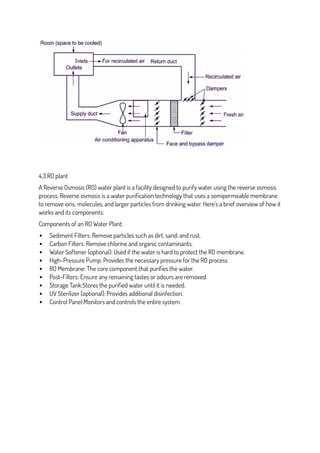
Air Handling Unit (AHU) are considered the lungs of HVAC units, which are essential to ensure
laminar unidirectional flow of fresh air. The different sections of AHU are:
a.Filter Section: Four types of filters are present
 Pre-filter
 Bag Filter
 HEPA/supply filter
 Riser/return filter
b.CoilSection/Conditioningunit:Itisresponsibleformaintainingtemperature (25±2°C) and relative
humidity (20-60% RH).
c.Blower Section: This section sends air to supply duct according to the required CFM (Cubic
feet/min). The air change per hour in the operating room has been maintained to be at least 20/
hour depending upon the volume of room, products, and personnel involved as per WHO GMP
guidelines.
Special arrangements:
 The ducts of AHU are coated with 10mm thick insulator to prevent loss of energy in their
path.
 The curvy path are designed for steady flow of air.
 Damper is placed into HEPA filters to control air flow rate.
 Coil section and conditioning unit maintains temperature and relative humidity.
 Blower section sends air to the duct according to required CFM (Cubic feet/min).
4.3 RO plant
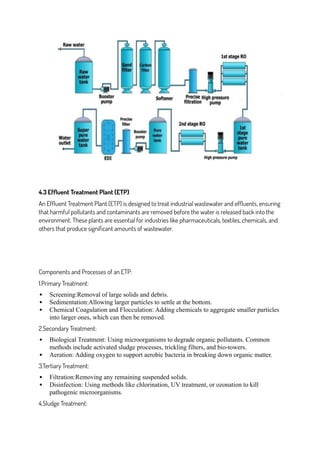
A Reverse Osmosis (RO) water plant is a facility designed to purify water using the reverse osmosis
process. Reverse osmosis is a water purification technology that uses a semipermeable membrane
to remove ions, molecules, and larger particles from drinking water. Here’s a brief overview of how it
works and its components:
Components of an RO Water Plant:
 Sediment Filters: Remove particles such as dirt, sand, and rust.
 Carbon Filters: Remove chlorine and organic contaminants.
 Water Softener (optional): Used if the water is hard to protect the RO membrane.
 High-Pressure Pump: Provides the necessary pressure for the RO process.
 RO Membrane: The core component that purifies the water.
 Post-Filters: Ensure any remaining tastes or odours are removed.
 Storage Tank:Stores the purified water until it is needed.
 UV Sterilizer (optional): Provides additional disinfection.
 Control Panel:Monitors and controls the entire system.
4.3 Effluent Treatment Plant (ETP)
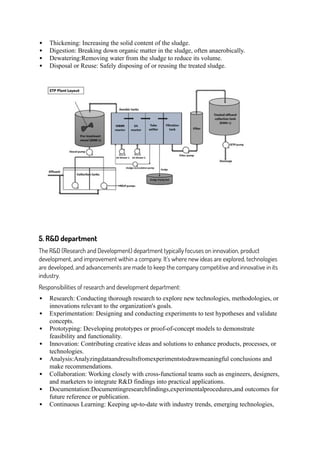
An Effluent Treatment Plant (ETP) is designed to treat industrial wastewater and effluents, ensuring
that harmful pollutants and contaminants are removed before the water is released back into the
environment. These plants are essential for industries like pharmaceuticals, textiles, chemicals, and
others that produce significant amounts of wastewater.
Components and Processes of an ETP:
1.Primary Treatment:
 Screening:Removal of large solids and debris.
 Sedimentation:Allowing larger particles to settle at the bottom.
 Chemical Coagulation and Flocculation: Adding chemicals to aggregate smaller particles
into larger ones, which can then be removed.
2.Secondary Treatment:
 Biological Treatment: Using microorganisms to degrade organic pollutants. Common
methods include activated sludge processes, trickling filters, and bio-towers.
 Aeration: Adding oxygen to support aerobic bacteria in breaking down organic matter.
3.Tertiary Treatment:
 Filtration:Removing any remaining suspended solids.
 Disinfection: Using methods like chlorination, UV treatment, or ozonation to kill
pathogenic microorganisms.
4.Sludge Treatment:
 Thickening: Increasing the solid content of the sludge.
 Digestion: Breaking down organic matter in the sludge, often anaerobically.
 Dewatering:Removing water from the sludge to reduce its volume.
 Disposal or Reuse: Safely disposing of or reusing the treated sludge.
5. R&D department
The R&D (Research and Development) department typically focuses on innovation, product
development, and improvement within a company. It’s where new ideas are explored, technologies
are developed, and advancements are made to keep the company competitive and innovative in its
industry.
Responsibilities of research and development department:
 Research: Conducting thorough research to explore new technologies, methodologies, or
innovations relevant to the organization's goals.
 Experimentation: Designing and conducting experiments to test hypotheses and validate
concepts.
 Prototyping: Developing prototypes or proof-of-concept models to demonstrate
feasibility and functionality.
 Innovation: Contributing creative ideas and solutions to enhance products, processes, or
technologies.
 Analysis:Analyzingdataandresultsfromexperimentstodrawmeaningful conclusions and
make recommendations.
 Collaboration: Working closely with cross-functional teams such as engineers, designers,
and marketers to integrate R&D findings into practical applications.
 Documentation:Documentingresearchfindings,experimentalprocedures,and outcomes for
future reference or publication.
 Continuous Learning: Keeping up-to-date with industry trends, emerging technologies,
and best practices through continuous learning and professional development.
 Problem-solving: Addressing technical challenges and proposing solutions through
critical thinking and innovative approaches.
 Project Management: Managing R&D projects from conception through to completion,
ensuring timelines, budgets, and deliverables are met.
The research and development(R&D)department of Asian Pharmaceuticals Pvt.Ltd.consist up of;
 Fluidized bed dryer
 Granulators
 Multi-mill
 Tray dryer
 Bulk density apparatus
 Moisture analyser
 Compression machine
 Capsule Filling machine
 Blister packaging machine
 Liquid Semi solid manufacturing room
 Lab accessory room
 Coating area
 Raw materials store room
6. Quality Control (QC) department
The Quality Control (QC) department plays a vital role in maintaining the high standards of Good
Manufacturing Practice (GMP) within the pharmaceutical industry. Its main focus is on ensuring that
all products meet the necessary quality criteria before they are approved for use. Within the QC
department, various essential activities are conducted. These include evaluating the suitability of
incoming components, containers, closures, labelling, and in-process materials, as well as the final
finished products. The manufacturing process itself is closely monitored to ensure it adheres to the
required specifications and limits. The QC department is responsible for determining whether each
batch of products meets the necessary quality standards and can be safely released for use. To
achieve this, it must have adequate facilities, well-trained personnel, and approved procedures for
sampling, inspecting, and testing starting materials, packaging materials, intermediate products,
bulk products, and the finished goods.
The functions of QC departments are:
 Raw material analysis
 Intermediate product analysis
 Finished product analysis
 Packaging material analysis
 Real time and accelerated time stability
 Re-evaluation of products returned from the market
 In process sample analysis
 Calibration and standardization of laboratory equipment
 Microbiological assay
 Daily water analysis
 Instrumentation
 Dissolution Test Apparatus
 Disintegration Apparatus
 Ultrasonic Bath ( Sonicator )
 pH Meter
 Magnetic Stirrer
 Vacuum and Compressor Pump
 UV-19001 Spectrophotometer
 Karl Fischer (Automatic Potentiometric) Titrator
 Polarimeter
 Bulk Density Apparatus
 Flame Photometer
 Vacuum Oven
 Digital Hot air Oven
 HPLC
 Other HPLC with UV, RI detectors
 Digital Balance
 Digital Hardness Tester
 Roche Friabilator
 Desiccator
 Fuming hood
Raw material: Excipient(maize starch) was is processing of quality control check in my visit
API (Sodium Valpraoate) was is processing of QC check in my visit.
Packaging material test (Printed cartoon-WORMAR-1500, NEOVIT) was is processing of quality
control check in my visit.
7. Microbiology department
The Microbiology Department in a pharmaceutical industry plays a crucial role in ensuring the
safety, efficacy, and quality of pharmaceutical products. This department is responsible for
monitoring and controlling microbial contamination in the manufacturing environment, raw
materials, and final products.
Key Responsibilities of the Microbiology Department:
 Environmental Monitoring
 Water Testing
 Raw Material Testing
 Sterility Testing
 In-Process and Finished Product Testing
 Microbiology Room consists up of ;
 Autoclave
 Trinocular Microscope
 LAF (Laminar Airflow) cabinet
 Incubator
 Refrigerator
• Cleaning Area
➢ Safety Shower Station
Chemical Store Area
Library and Documentation Area
8 . Quality Assurance (QA)
Introduction
The QA department is responsible for monitoring the overall quality; the ultimate aim being
provided standard quality of drugs to the people by monitoring, developing, implementing, and
improving the quality of the product according to WHO GMP guidelines and DDA regulations.
Principles of QA can be summarised as follows:
It is a wide-ranging concept covering all the matters that individually or collectively influence the
quality of product.
It is the totality of the arrangements made with the objective of ensuring that pharmaceutical
products are of quality required for their intended use.
QA incorporates GMP and also product design and development. The activities of QA Department
are :
 BMR, Master formula and SOPs preparation
 Specification of bulk and intermediate product
 Auditing and self-inspection
 Supply of raw material
 Stability studies
 Documentation and records
 Line Clearance of Production equipment
 Orientation and training to staffs
 Qualification, validation, and calibration
 Record deviation and change control
 Investigation/diagnosis of processing problem and corrective action
 Customer complaint and product recall handling
 Describing managerial responsibilities
 Sampling of bulk & intermediate product
Skills and Qualifications:
 Analytical Skills: Ability to analyze data and identify trends or issues affecting quality.
 Attention to Detail: Thoroughness in testing, inspection, and documentation.
 Communication Skills: Clear communication to report findings and collaborate across
teams.
 Problem-Solving Abilities: Capability to troubleshoot issues and implement effective
solutions.
 Technical Competence: Understanding of quality assurance methodologies, tools, and
standards
QA professionals are integral to maintaining product integrity, customer satisfaction, and regulatory
compliance within organizations. Their diligence ensures that products and services consistently
meet high standards of quality and reliability.
8.1 Inprocess quality control ( IPQA) department
In the pharmaceutical industry, In-Process Quality Assurance (IPQA) is crucial for ensuring that
products meet predefined quality standards during manufacturing. IPQA involves monitoring and
verifying various stages of production to detect and correct issues in real time, rather than relying
solely on end-product testing.
Here are some key aspects of IPQA:
1. Real-Time Monitoring: Continuous assessment of critical process parameters (CPPs) and
critical quality attributes (CQAs) to ensure they remain within specified limits.
2. Sampling and Testing: Regular sampling and testing of materials and products at different
stages of production to identify deviations early.
3. Documentation: Detailed record-keeping of all processes, tests, and inspections to ensure
traceability and compliance with regulatory requirements.
4. Deviation Management: Immediate investigation and resolution of any deviations from
standard procedures or specifications to prevent defective products.
The list of equipments that are used in the IPQA department are listed as below:
 Digital friability test apparatus
 Electronic balance
 Automatic hardness tester
 Tablet disintegration test apparatus
 Magnetic stirrer
 Ph metre
 Electronic moisture analyser
 Bulk density Apparatus
 Digital automatic leak test apparatus
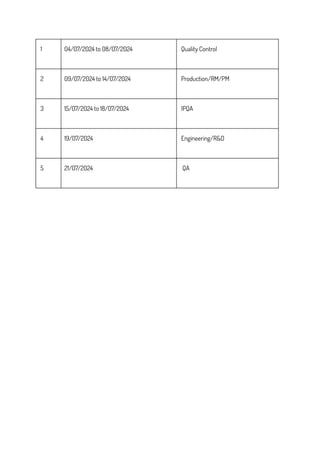
THE TRAINING SCHEDULE IS SET AS FOLLOWS :
SN DATE DEPARTMENTS
1 04/07/2024 to 08/07/2024 Quality Control
2 09/07/2024 to 14/07/2024 Production/RM/PM
3 15/07/2024 to 18/07/2024 IPQA
4 19/07/2024 Engineering/R&D
5 21/07/2024 QA
9. Conclusion
During my internship at Asian pharmaceuticals pvt. ltd., I had the privilege of immersing myself in
the dynamic world of pharmaceutical research and development. From day one, I was involved in a
variety of projects that allowed me to apply classroom knowledge to real-world scenarios. I gained
hands-on experience in conducting experiments, which included preparing formulations,
conducting assays, and analysing results under the guidance of experienced researchers.
I was responsible for running tests to assess the stability and efficacy of the formulation, which
required meticulous attention to detail and adherence to strict protocols. Through this process, I
learned the importance of collaboration and effective communication within a multidisciplinary
team.
Moreover, my internship at Asian pharmaceuticals pvt. provided me with insights into regulatory
affairs and quality control processes. I gained an understanding of the rigorous standards and
guidelines that govern the pharmaceutical industry, ensuring the safety and efficacy of new drug
products. This experience was instrumental in shaping my understanding of the broader
implications of pharmaceutical research and development beyond the laboratory.
Overall, my time at Asian pharmaceuticals pvt. ltd.,was not only educational but also personally
enriching. It reaffirmed my passion for scientific inquiry and innovation in healthcare. I am grateful
for the mentorship I received from seasoned professionals who generously shared their knowledge
and expertise. The skills and experiences gained during my internship have equipped me with a
solid foundation to pursue a career in pharmaceuticals with confidence and enthusiasm.
Thank you once again for this remarkable opportunity and for the continuous efforts in shaping the
future of the pharmaceutical industry.
Thank you!
Sincerely,
Name-Min Prasad subedi
Email address-minprasadsu85@gmail.com

How to write Industrial report for pharmacy students

  • 1.
    A REPORT INTERNSHIP TRAININGAT ASIAN PHARMACEUTICALS PVT.LTD (IN PARTIAL FULFILLMENT OF THE REQUIREMENT FOR THE AWARD OF BACHELOR DEGREE IN PHARMACEUTICAL SCIENCE) SUBMITTED TO: ASIAN PHARMACEUTICALS PVT.LTD Omsatiya -01, Rupandehi, Nepal Submitted by: Mr. Min Prasad Subedi B. Pharmacy(3rd Years) MVM College of Pharmacy Rajiv Gandhi University, Banglore,India
  • 2.
    Submission date: 24thJuly 2024 CONTENT Abstract…… … … … . … … … … … … … … … … … … ….. … … … … … …3 Acknowledgement… … … … … … … … … … … … … … … … … … …………4 Abbreviation … … … … … … … … … … … … … … … … … … … …..…..… . 5 Chapter - I Introduction … … … … … … … … … ……… … … ……….… … ….……...… 6-7 Background … … … … … … … … … … … … … … … … … …….………..… 6-7 Objectives … … … … … … … … …… … … … … … … … … ………..……..…8 1.2.1 General objectives … … … … … … … … …… … … … … … … ……… …8 1.2.1 Specific objectives … … … … … … … … … … … … … … … … …………8 Chapter - II Production Department … … … … … … … … … ……… … … …. … … ….…9-18 Dispensing Booth … … … … … … … … … ……… … … … … …….. ……..… 11 Granulation… … … … … … … … … ……… … … … … … … ………..……… 12 Compression … … … … … ……… … … … … … … … … ……………..………12 Coating … … … … … ……… … … … … … … … … ……………………..……13 Capsule filling area … … … … … ……… … … … … … … … … …….….….…14 Semi solid preparations section … … … … … ……… … … … … … … ….….…14 Liquid manufacturing section … … … … … ……… … … … … … … …..…..… 15 Primary packaging area … … … … … ……… … … … … … … … … ….….…..15 Secondary packaging area … … … … … ……… … … … … … ……… …..……17 Raw materials (RM) store … … … … … ……… … … … … … … … … .………18 Packaging materials (PM) store … … … … … ……… … … … … … … ….… …18 Engineering Department … … … … … ……… … … … … … … … ….. ….…18-21 HVAC system … … … … … ……… … … … … … … … … ……….….…..……18 AHU … … … … … ……… … … … … … … … … ……………………...….…..19
  • 3.
    RO plant …… … … … ……… … … … … … … … … …………………..…..…20 ETP plant … … … … … ……… … … … … … … … … ……………….….….…21 R&D Department … … … … … ……… … … … … … … … … ………………..22 Quality control (QC)department … … … … … ……… … … … … … … ……… 23 Microbiology department … … … … … ……… … … … … … … … … ……..…24 Quality assurance (QA) department … … … … … ……… … … … … .… ..… 25-27 IPQA department … … … … … ……… … … … … … … … … …………………26 Conclusion … … … … … ……… … … … … … … … ….………………..………27 ABSTRACT This internship was done as the part of the requirement in fulfilment of the degree of Of Pharmacy program. It was a great decency to be a member of Asian Pharmaceutical Pvt. Ltd, Rupandehi ,Nepal, as a intern.. During this training, I was exposed to Different departments namely Production, Quality Control, Quality Assurance, Research and Development, Maintenance, Store, and Packaging. This in-plant internship helped us to co-relate our theoretical knowledge into a practice field. I was able to gain practical knowledge on manufacturing of different drugs and dosage forms, Operation of different equipment, packaging of products, quality control testing of raw Materials, intermediate and finished products, packaging materials. I also got to know that Quality is assured through monitoring, controlling, documentation, implementation of the GMP Guidelines and various other activities which are performed for achievement of quality Products. I got an opportunity to know about handling and storage of raw and packaging materials as well as storage of finished products. Moreover, I was aware of the importance of documentation for the continuation of safe Manufacturing of different medications. On the top of all, this training helped me a lot to make me feel the need of pharmacists in the pharmaceutical industry. Thus, this training has indeed been very fruitful to achieve our goals to be competent pharmacists and to uplift the profession. Lastly, this training provided a chance to be familiar with ASIAN family, which I am very grateful for.
  • 4.
    ACKNOWLEDGEMENT I would liketo express my sincere gratitude for this valuable opportunity to undergo pharmaceutical training at Asian pharmaceuticals Pvt.Ltd. This experience will undoubtedly enrich my knowledge and skills in the pharmaceutical field, and I am eager to contribute positively to the team. Thank you for your confidence in my abilities, and I look forward to a productive and educational training period. I would like to express my special thanks and gratitude to Mr. Hutananda Khanal (Chairman & Managing Director), Mrs. Sabhyata khanal Basyal (Technical Director) for providing me this opportunity to be part of this prestigious organisation. I would I will also like to thank Mr. Bishnu Prasad koirala (QA /Regulatory Affairs Executive),Mr. Sudhir karna (Production Manager), Mr. Deependra Sharma ( Senior Analytical Head Division), Mr. Bishnu Prasad Aryal (Head Production and Formulation Development), Mr. Brijesh khanal (Officer ,Microbiology),Mr. Devi Prasad Khanal (Supervisor, RM store), Mr. Madhav Prasad Nepal ( Senior Officer,QC), Mr. Samul Thapa (Production,Officer), Mr. Hem Bahadur Kunwar (IPQA,Supervisor), Mr. Prakash Pun ( QC,officer ) for providing the opportunity to gain in-depth knowledge across department sections and processes. I am equally indebted to all pharmacists, staffs, and operators of QA, production, IPQA, microbiology, R&D and packaging departments who were directly or indirectly involved to help me explore with instruments, equipments and much more in this training and help me to gain better understanding during training.
  • 5.
    ABBREVIATIONS WHO World HealthOrganization SOPs Standard Operating Procedure AHU Air Handling Unit ASP Asian Pharmaceuticals Pvt.Ltd R&D Research and development QC Quality control QA Quality assurance IPQA In process quality assurance BMR Batch Manufacturing Record RH Relative Humidity GMP Good Manufacturing Practice
  • 6.
    HVAC Heating, Ventilation& Air Conditioner ETP Effluent treatment plant RO Reverse Osmosis ISO International Organization for Standardization USFDA United State Food & Drug Administration HPLC High performance liquid chromatography PM Packaging materials RM Raw materials HEPA High Efficacy Particulate Air
  • 7.
    CHAPTER-I 1. Introduction 1.1. Background AsianPharmaceuticals Private Limited (ASP) is one of Nepal’s premier manufacturers of prescription and non-prescription drugs. Its manufacturing facility is situated in Omsatiya-01, Rupandehi, Nepal. ASP manufactures over 240 different medicines of the highest quality to help save and improve the lives of millions of people in Nepal. Asian Pharmaceuticals Pvt. Ltd. is a renowned manufacturer of a broad range of prescription and non-prescription drugs in Nepal. ASP was established in 2055 B.S. (1998 AD) and started its formal production on Bhadra 2055 BS which is founded on a deep sense of National Pride and the conviction to make a contribution to our country's self-reliance in the field of Pharmaceutical formulations. It's marketing office is located at Kamalpokhari, Kathmandu. The factory premises are located at the distance of 1 km from Siddharth Highway toward east of Katiya Chowk. It is a three storey building having Production department, IPQA, primary packaging in the ground floor where its first floor consist of Cephalosporin department. Similarly quality control ,Quality Assurance and R&D departments are on the second floor. It is mainly concerned with manufacturing of non-sterile products.It produces more than 300 drugs products. Among them and NIMS(Nimesulide) and PANTOP(Pentaprazole) are top marketed product it consist up of 5 manufacturing division are;  Pharma division: products mainly Antibiotics,GI release ,Ortho-Asthama and Allery related products, vitamins.  Solar (I &II) division:Anti-psychotics drugs,Anti-depressed drugs,Narcotic drugs.  Animal care division  NAISA division: GI related,Anti-biotics,Asthama related,Gynecolgecial,Dental.  Kardib division:Cardiac and Diabetic drugs. It is a WHO- GMP, National GMP and ISO ( 14001 and 9001) certified company which is committed to create an excellent working environment by improving its environmental conditions by prevention of pollution and optimum utilisation of energy and natural resources. All the activities of the factory are carried out in dedicated areas within a controlled environment as per GMP conditions comparable with International regulations.The formulation facility has been certified by the Department of Drug Administration, and the plant is built in accordance with the guidelines of international regulatory bodies like WHO & USFDA.
  • 8.
    Manufacturing Facility The factorypremises consist of 250411.5 sq ft in area (2.3264 Hectare), which comprises the Pharma Manufacturing plant, constructed in 16230.85 sq ft, Cephalosporin in 5996.25 sq.ft, all within a self contained facility. Veterinary is housed in 2557.75 sq.ft with a separate air handling facility. Raw materials are stored in 2600 sq ft. and a scrap yard in 1500 sq ft. AHU, chilling units, and the whole maintenance area occupy 9194.74 sq.ft of the total circumference. Quality Control, Microbiology, R&D, and Quality Assurance, are located within the second floor area of 11663.04 sq.ft. Management shift Every department has their own head supervisor and it has three different shifts;  7am -3 pm  8:30am -4:30 pm  11am -7 pm According to the provided schedule(7am -3pm) for my internship program I was assigned to observe the following departments; Production department ●  Granulation  Compression  Coating  Packaging  Capsule filling  Liquid manufacturing and filling department  Semi-solid manufacturing and filling department Raw materials (RM) department ● Raw materials store ○ Dispensing booth ○  Packaging materials (PM) department Primary PM ○ Secondary PM ○  IPQA department  Quality Control (QC) department Microbiology laboratory ○
  • 9.
     R&D department Engineering/maintenance department  Quality Assurance (QA) department  Finished Product( FP) department 1.2 Objectives Industrial training is an integral platform that renders an opportunity for students to gain an exposure to the real world workplace environment. At the same time they provide enriching experience through on site observation as well as job execution. With the recognised need to translate the theoretical understanding into practical application the updated syllabus for b Pharmacy under the UGC required students of third year to be placed on internship in the pharmaceutical manufacturing units. I am fateful enough to be granted the opportunity for enrolment as intern in such dignified and prestigious industry as Asian Pharmaceuticals Pvt. Ltd.The purpose of the training can be outlined as follow ; 1.2.1 General objectives To understand the system and management under which a pharmaceutical company runs and experience the overall manufacturing process of different dosage forms. To learn the responsibilities and work ethics of the pharmacist to prepare ourselves for future roled as industrial specialists. 1.2.2 Specific objectives To become familiar with the layout structure organisation departments and their role in functioning of pharmaceutical companies. To get the concept of WHO-GMP compliance,ISO standard and implementation of occupational health and safety measures in a workplace. To understand the sequence of events like procurement, storage dispensing, processing and packaging of a product from raw material into finished product. To acquire knowledge regarding the handling and working principle of various instruments, equipment and machineries used for production, packaging and quality analysis of drug products. To get information about people and material flow during the manufacturing process as well as ideas regarding the waste disposal system. To acquire knowledge about the utilities,water treatment, effluent treatment plant, air handling units, and sewage system. To have an insight regarding building design construction and requirements to function as a full placed operating multi-product manufacturing plant.
  • 10.
    CHAPTER-II 1. Production department Introduction Productiondepartment of Asian pharmaceuticals pvt. ltd. produces a variety of drugs with varying formulations by following WHO-GMP in each stage of production. This department is equipped with adequate equipment and machineries designed to comply with the GMP norms and guidelines. The important parameters for production are light, humidity, temperature, microbial and particulate contamination. Central HVAC system is installed with an appropriate filtration system to maintain controlled clean room conditions in the production area. Additional care is taken to prevent cross- contamination in the production area. The department is headed by experienced pharmacists and supervised by other qualified and trained pharmacists. Personnel airlock system & material airlock system is provided before entering to the production area.Standard magnehelic pressure gauze is installed for maintaining air pressure difference in between room and corridor. Corridor is more positive than the processing area and the pressure difference is maintained so that the dust generated during processing cannot come out of the corridor. The walls and ceilings are painted by Epoxy emulsion and covings are provided to reduce the retention of the dust particles. Temperature and Humidity are maintained as checked with the help of Hygrometer as per product requirement. Rooms are cleaned after each batch processing by disinfectants like Lysol solution and Dettol to prevent the microbial contamination and prevent the resistance of microorganisms. Production department is strictly under the plan of the production manager. Air supply to the facility is carried via HEPA system and RO water is used for the processing of dosage forms. There are clearly written SOPs for each instrument which are reviewed in a specific time interval of time. There are separate change rooms for ladies and gents which open at the air lock of the corridor. The area where the manufacturing process is carried out is categorised into two different categories. They are: A. Grey area (class 100,000): In this area the particulate contamination is not more than 100,000 particles per cubic feet of the particle size of 0.5 micron and larger. Following area comes under this category:  Secondary change room  Non Sterile manufacturing room  Primary packaging room  Inner corridor B. Black area (not controlled): Following comes under this category:  Primary change room  Outer corridor  Secondary packaging area
  • 11.
    A cleanroom isa highly designed controlled environments that a low level of particulates such as dust,airborne microbes,aerosol particles,and chemical vapors typically used in manufacturing or scientific research area.To be exacts,a cleanroom has a controlled level of contamination that is specified by the number of particles per cubic meter at a specified particle size.The ambient air outside in an environment contains 35,000,000 particles per cubic meter,0.5 micro-meter and larger in diameter,corresponding to an ISO 9 cleanroom which is at the lowest level of cleanroom standard whereas,environment conditions that must be designed to maintain pharmaceutical sterility,activites conducted in such areas include manipulation of sterile materials prior to and during filling and closing operations corresponding to an ISO 5 cleanroom which is at the highest level of cleanroom standard. According to ISO cleanroom standard the classification of areas are as follows: According to GMP, the cleanroom classification at rest and operation stage as shown table below: Maximum permitted number of particles per meter cubic equal to or greater than the tabulated size At rest In operation Grade 0.5 micro-meter 5.0 micro-meter 0.5 micro-meter 5.0 micro-meter A 3,520 20 3,520 20 B 3,520 29 352,000 2,900 C 352,000 2,900 3,520,000 29,000
  • 12.
    D 3,520,000 29,000Not defined Not defined Here, the grade A is equivalent to ISO 5 represents the area of sterility (parenteral) production areas.Grade B is equivalent to ISO 5 and ISO 7 at operation needs to meet maximum of 3,520 particles (0.5 micro-meter) per cubic meter for aseptic prepration, filling and compounding of products.Grade C is equivalent to ISO 7 at rest and ISO 8 at operation needs to meet maximum of 3,52,000 particles(0.5 micro-meter) per cubic meter for less critical steps of manufacturing process. Grade D is equivalent at ISO 8 at both rest and operation that must have maximum of 35,20,000 particles (0.5 micro-meter) per cubic meter,used for handling components after washing and plasma stripping.ASP follows the grade B,C and D clean room for the manufacturing of product. Documentation of Production 1. Standard Operating Procedures ( SOPs ) 2. Cleaning Records 3. Daily activity Records 4. Reprocessing Records 5. Dispensing Booth Logbook 6. Balance Verification and Calibration Record 7. Machine Calibration and Validation Record 8. Temperature and Humidity Record Production department is divided into:  RM dispensing booth  Granulation section  Compression section  Coating section  Primary packaging  Capsule filling section  Semi-solid section  Liquid section 1.1 Dispensing booth Dispensing booth provides a unidirectional airflow(laminar airflow),in which most of the clean air enters the working zone.Only a small amounts of the air is discharged to the ambient environment,which creates negative pressure in the working zone,thereby providing a safe and clean working environment,and preventing the operators from power contamination. Dispensing booth is a kind of purifying equipment for materials sampling,weighing and analysis. 1.2 Granulation
  • 13.
    Granulation is theprocess in which the primary powdered particles are made to adhere to form larger, multiparticulate entities called granules. Methods of granulation 1. Wet Granulation(solvents are used):steps of wet granulation are as follows:  Weighing  Seiving  Pre Mixing  Kneading/Addition of binder  Seiving of wet mass  Drying of wet mass  Seiving of dried mass  Final mixing 2.Dry Granulation (solvents are not used):steps of dry granulation are as follows:  Weighing  Sieving  Pre mixing During this process, various equipment are required such as:  Vibro - shifter( Amar egg) Function: size separation of powders and filter out impurities  Mass mixture (Amar egg) Function: mixes the powder uniformly  Stirrer (Industrial scientific co.) Function:mixing the solvents and excipients  Multimill ( Mixofill ) Function: size reduction  Fluidized bed dryer (FBD) (Parag export) Function: remove moisture  Oscillating granulator ( OG ) Function: ensuring uniform particle size distribution  Double cone blender ( Amar egg) Function: lubricating Presiton 25 ( SPIRONOLACTONE TABLETS USP) was being granulated during my observation. 1.2 Compression Tablets are made by compressing a formulation of drug or drugs with excipients on a stamping machine called presses. Tablet presses are classified as either single punch or multi station rotary presses.
  • 14.
    Tablet compression machinecontain following parts:  Upper cam  Lower cam  Turret  Upper roller  Lower roller  Dies  Punch  Hopper  Guard cover  Guard track ( brass )  De-dusting machine The different types of compression machines in this company are : 1.16 station compression machine single layer compression machine with B tooling 2.35 station compression machine Bi-layer compression machine with B tooling 3.51 station compression machine Bi- layer compression machine with D tooling 4. 27 station compression machine. Process of compression are discussed as below; 1.Filling Lower punches move download so that the Powder settled into the dies. ● 2.Compression The upper punches move downwards and compress the granules with sufficient pressure 3. Ejection The lower punches move upward so that the compressed tablets are then ejected out with the help of the take off blade. (L-CETAM 500 ) capsule tablets was being compressed in a 16 station compression machine during my observations. The different types of defects seen during the compression process are ;  Cracking  Breakage  Tablets edge erosion  Surface erosion  Sticking 1.3 Coating Application of dry outer layer of coating material on tablet surface is called tablet coating. Coating of tablets is necessary to:  Mask the bitter taste of drug
  • 15.
     Prevent thedrug from external environment and gastric juice.  Prevent the stomach from the irritating action of drugs.  Obtain the longer action of the drug.  Make the tablet attractive in appearance. Mainly two coating Pans are available in Asian pharmaceutical;  Conventional coating pan/semi-automatic coating pan  Automatic coating pan ( Auto Coater) ASP coating section consist RAPID-COTA-1 ( 60 KG ) and Advance Sun Coater ( 120 kg ) In my observation on coating area I saw Films coating as aqueous coating –(L-CETAM-500) &(VALPOX-ER-500) The different types of problems seen during coating are ;  Picking and sticking  Spray drying  Tablets Discoloration  Film spiting/peeling  Orange peel 1.4 Capsule filling area Capsules are solid unit dosage form of medicament(s) in which the drug is enclosed in a practically tasteless, hard or soft soluble shell made up of a suitable form of gelatin. Only hard gelatin capsules are produced in Asian pharmaceuticals. Steps of hard gelatin capsule production are:  Sieving and mixing: Raw materials are sieved and excipients mixed properly.  Drying Some of the excipients are dried in tray dryer  Mixing API and excipients are mixed in double cone blender  Filling The powder is filled in capsule either by using a manual, semi-automatic or automatic capsule filling machine.  Sorting The filled capsules are sorted either manually or by using a sorting machine and damaged capsules are rejected.
  • 16.
     Polishing The capsulesare polished in Capsule Polishing Machine The different equipments used in capsule section are mentioned as below; 1. Automatic capsule feeling machine 10 station 2. Capsule sorter and elevator for automatic capsule filling 3. Capsule polishing machine 1.5 Semi solid preparation section Semi-solids are produced in external sections that are applied topically for local or systemic effect based on their use and site of application. These are prepared by mixing oil phase and water phase dissolving soluble agents in respective phases. Equipment used during the manufacturing of semisolid dosage forms are:  Oil and aqueous base heating vessel  Planetary mixer  Jacketed vessel  Tube filling, sealing, coding machine Mainly in ASP Delta -gel 10 gram( metronidazole, chlorhexidine, lignocaine & menthol gel) was being already prepared and filled during my observations. I knew its processing by the operaters by saw machine. 1.6 Liquid preparations and filling section The Water used for the preparation of liquid formulation is DM water. Liquid section has Following rooms for efficient production:  Manufacturing room  Mixing room  Filling/sealing room  Packaging room Equipments observed in liquid manufacturing section are:  Manufacturing Tank(2000l,500l &300l)  Jacketed tank  Colloid mill  Transferring pump  Turbo stirrer  Shifter  Filter Press Equipments used in liquid filling sections are ;  Turntable
  • 17.
     Volumetric liquidfilling machine  Screw capping machine  Inspection belt  Induction sealing machine  Dosing cap placement and pressing machine  Labelling and packaging Zuben( benzydaminemouthwashBP)wasbeingmanufacturedandfilledduringmy observations. 1.7 Primary Packaging Area Primary packing area which falls under grey area is the final step carried out in grey area and there are different rooms with different types of machines at Asian pharmaceutical pvt.ltd.  Blister packing machine  Alu -Alu blister packing machine  Strip packing machine  Sachet packing machine Methods and materials of primary packaging are: I.For solid oral dosage forms (tablets and capsules)  Strip Packaging: Al-Foil  Blister Packaging: Al-Foil, PVC, PVDC  Alu-Alu Packaging: Al-Foil 1. For liquid dosage forms: Amber bottle or clear colourless bottles 2. For dry syrup: High Density Polyethylene (HDPE) bottles 3. For Ointments: Camitube 1.7.1 Strip packaging : In this, two thin foils of aluminium are used for packing the tablets and capsules. one of the Foils is printed in which the batch no., mfg. Date, exp. Date and price are printed whereas others are plain. Equipment used for strip packaging; Strip machine Its different parts are mentioned as below: 1. Hopper 2. Vibrator 3. Feeder 4. Chute 5. Stereo for printing 6. Sealing roller 7. Cutter station 8. Conveyor belt Etapram 10 ( Escitalopram oxalate Tablets. IP) was being packaged during my observations 1.7.2 Blister packaging: In blister packing, the product is enclosed between the pocket of thermoplastic resin and the
  • 18.
    backing material madeup of printed aluminium foil. Equipment used for the blister packaging is ; Blister packaging machine Its different parts are mentioned as below;  Hopper  Chute  formation roller  Feeder  Printer  Sealing roller  cutter station  conveyor belt Pheno -60( Phenobarbitone tablets IP) was being blister packed during my observations. 1.7.3 Alu-Alu packaging Alu-alu packaging means that both the base and the lid of the packaging are made of aluminium foil. This types of packaging is often used to protect the drug from environmental factors and contamination. Equipment used:Alu-Alu packaging machine Its parts are mentioned as below;  Hopper  Formation roller  Feeder  Sealing  Printer  Cutter  Conveyor Valprox- ER 250 ( Divalproex Sodium Extended release tablets USP) was being packed during my observations. 1.8 Secondary Packaging Area After the drugs are packed into the primary packaging they are sent to the black area for secondary packaging. Before this, visual inspections are done for broken tablets, unfilled packs (strips, blisters), and printing mistakes. During passing through the conveyor belt integrity of packing, batch coding and visible defects are observed and if found they are rejected. During secondary packaging strips and blisters are packed in cartoons and they are packed in corrugated shippers. Following materials are used for secondary packaging:  Printed cartoons ( Duplex Box)  Catch covers  FBC ( Fiberboard Cartoons)
  • 19.
    2. Raw material(RM)store The dispensing pattern for raw materials is FEFO (First Expiry First Out). Raw Materials are stored in the main building which comprises of following stores: 1. Raw material quarantine room 2. Raw material store (Bulky material store above 500 kg) 3. Raw material store (Main Raw material store 50-100kg) 4. Raw material store (Liquids Store eg: PEG, glycerol, IPA) Narcotics like lorazepam,clonazepam,chlordiazepoxide and alprazolam are stored in a locker and stock record is strictly maintained while thermos-labile materials are stored in cool place. 3. Packaging Materials (PM) store The dispensing pattern for PM is FIFO (First In First Out). A separate building is used to store a large amount of packaging material. Materials are segregated alphabetically to prevent mix-up and for easy availability. The Packing Materials stored are:  PVC Films  Bottles  PVDC Films  Aluminium Films  Packaging Labels  Duplex Box, corrugated box/ Fibre Box Carbon (FBC) Store  Tubes  Gelatin Capsules: Maintain 25±5 degree Centigrade/RH: 55±10 % 4 . Engineering department Introduction To ensure seamless production and a safe environment, the engineering department at Asian pharmaceuticals pvt. Ltd. is in charge of routine maintenance of the equipment, services, and sanitation. The routine management of the air handling unit, water treatment facility, generation of energy during load shedding by generator, power supply, gas supply, compressed air supply, etc. is the main responsibility of this department. Maintenance department carries out the repairing of electrical wirings, pipelines, machineries etc. The utilities included in this section are as follows: 1. Heating, Ventilation, Air Conditioning System (HVAC) 2. Air Handling Unit 3. RO plant 4.Power Supply/ Diesel Generator
  • 20.
    5.Effluent Water TreatmentPlant 4.1 Heating, Ventilation, Air Conditioning System (HVAC) HVAC systems are essential in a pharmaceutical industry to maintain constant temperature, pressure, and humidity to ensure the manufacturing of quality products. A well-designed HVAC system prevents product contamination as well as cross contamination and ensures operator comfort. Asian pharmaceuticals pvt. Ltd. is equipped with an HVAC system to maintain temperature, relative humidity, particle count, pressure difference (15±6 pascal positive pressure with respect to the corridor) in different sections such as production and packaging. 4.2 Air Handling Unit (AHU) Air Handling Unit (AHU) are considered the lungs of HVAC units, which are essential to ensure laminar unidirectional flow of fresh air. The different sections of AHU are: a.Filter Section: Four types of filters are present  Pre-filter  Bag Filter  HEPA/supply filter  Riser/return filter b.CoilSection/Conditioningunit:Itisresponsibleformaintainingtemperature (25±2°C) and relative humidity (20-60% RH). c.Blower Section: This section sends air to supply duct according to the required CFM (Cubic feet/min). The air change per hour in the operating room has been maintained to be at least 20/ hour depending upon the volume of room, products, and personnel involved as per WHO GMP guidelines. Special arrangements:  The ducts of AHU are coated with 10mm thick insulator to prevent loss of energy in their path.  The curvy path are designed for steady flow of air.  Damper is placed into HEPA filters to control air flow rate.  Coil section and conditioning unit maintains temperature and relative humidity.  Blower section sends air to the duct according to required CFM (Cubic feet/min).
  • 21.
    4.3 RO plant AReverse Osmosis (RO) water plant is a facility designed to purify water using the reverse osmosis process. Reverse osmosis is a water purification technology that uses a semipermeable membrane to remove ions, molecules, and larger particles from drinking water. Here’s a brief overview of how it works and its components: Components of an RO Water Plant:  Sediment Filters: Remove particles such as dirt, sand, and rust.  Carbon Filters: Remove chlorine and organic contaminants.  Water Softener (optional): Used if the water is hard to protect the RO membrane.  High-Pressure Pump: Provides the necessary pressure for the RO process.  RO Membrane: The core component that purifies the water.  Post-Filters: Ensure any remaining tastes or odours are removed.  Storage Tank:Stores the purified water until it is needed.  UV Sterilizer (optional): Provides additional disinfection.  Control Panel:Monitors and controls the entire system.
  • 22.
    4.3 Effluent TreatmentPlant (ETP) An Effluent Treatment Plant (ETP) is designed to treat industrial wastewater and effluents, ensuring that harmful pollutants and contaminants are removed before the water is released back into the environment. These plants are essential for industries like pharmaceuticals, textiles, chemicals, and others that produce significant amounts of wastewater. Components and Processes of an ETP: 1.Primary Treatment:  Screening:Removal of large solids and debris.  Sedimentation:Allowing larger particles to settle at the bottom.  Chemical Coagulation and Flocculation: Adding chemicals to aggregate smaller particles into larger ones, which can then be removed. 2.Secondary Treatment:  Biological Treatment: Using microorganisms to degrade organic pollutants. Common methods include activated sludge processes, trickling filters, and bio-towers.  Aeration: Adding oxygen to support aerobic bacteria in breaking down organic matter. 3.Tertiary Treatment:  Filtration:Removing any remaining suspended solids.  Disinfection: Using methods like chlorination, UV treatment, or ozonation to kill pathogenic microorganisms. 4.Sludge Treatment:
  • 23.
     Thickening: Increasingthe solid content of the sludge.  Digestion: Breaking down organic matter in the sludge, often anaerobically.  Dewatering:Removing water from the sludge to reduce its volume.  Disposal or Reuse: Safely disposing of or reusing the treated sludge. 5. R&D department The R&D (Research and Development) department typically focuses on innovation, product development, and improvement within a company. It’s where new ideas are explored, technologies are developed, and advancements are made to keep the company competitive and innovative in its industry. Responsibilities of research and development department:  Research: Conducting thorough research to explore new technologies, methodologies, or innovations relevant to the organization's goals.  Experimentation: Designing and conducting experiments to test hypotheses and validate concepts.  Prototyping: Developing prototypes or proof-of-concept models to demonstrate feasibility and functionality.  Innovation: Contributing creative ideas and solutions to enhance products, processes, or technologies.  Analysis:Analyzingdataandresultsfromexperimentstodrawmeaningful conclusions and make recommendations.  Collaboration: Working closely with cross-functional teams such as engineers, designers, and marketers to integrate R&D findings into practical applications.  Documentation:Documentingresearchfindings,experimentalprocedures,and outcomes for future reference or publication.  Continuous Learning: Keeping up-to-date with industry trends, emerging technologies,
  • 24.
    and best practicesthrough continuous learning and professional development.  Problem-solving: Addressing technical challenges and proposing solutions through critical thinking and innovative approaches.  Project Management: Managing R&D projects from conception through to completion, ensuring timelines, budgets, and deliverables are met. The research and development(R&D)department of Asian Pharmaceuticals Pvt.Ltd.consist up of;  Fluidized bed dryer  Granulators  Multi-mill  Tray dryer  Bulk density apparatus  Moisture analyser  Compression machine  Capsule Filling machine  Blister packaging machine  Liquid Semi solid manufacturing room  Lab accessory room  Coating area  Raw materials store room 6. Quality Control (QC) department The Quality Control (QC) department plays a vital role in maintaining the high standards of Good Manufacturing Practice (GMP) within the pharmaceutical industry. Its main focus is on ensuring that all products meet the necessary quality criteria before they are approved for use. Within the QC department, various essential activities are conducted. These include evaluating the suitability of incoming components, containers, closures, labelling, and in-process materials, as well as the final finished products. The manufacturing process itself is closely monitored to ensure it adheres to the required specifications and limits. The QC department is responsible for determining whether each batch of products meets the necessary quality standards and can be safely released for use. To achieve this, it must have adequate facilities, well-trained personnel, and approved procedures for sampling, inspecting, and testing starting materials, packaging materials, intermediate products, bulk products, and the finished goods. The functions of QC departments are:  Raw material analysis  Intermediate product analysis  Finished product analysis  Packaging material analysis  Real time and accelerated time stability  Re-evaluation of products returned from the market  In process sample analysis
  • 25.
     Calibration andstandardization of laboratory equipment  Microbiological assay  Daily water analysis  Instrumentation  Dissolution Test Apparatus  Disintegration Apparatus  Ultrasonic Bath ( Sonicator )  pH Meter  Magnetic Stirrer  Vacuum and Compressor Pump  UV-19001 Spectrophotometer  Karl Fischer (Automatic Potentiometric) Titrator  Polarimeter  Bulk Density Apparatus  Flame Photometer  Vacuum Oven  Digital Hot air Oven  HPLC  Other HPLC with UV, RI detectors  Digital Balance  Digital Hardness Tester  Roche Friabilator  Desiccator  Fuming hood Raw material: Excipient(maize starch) was is processing of quality control check in my visit API (Sodium Valpraoate) was is processing of QC check in my visit. Packaging material test (Printed cartoon-WORMAR-1500, NEOVIT) was is processing of quality control check in my visit. 7. Microbiology department The Microbiology Department in a pharmaceutical industry plays a crucial role in ensuring the safety, efficacy, and quality of pharmaceutical products. This department is responsible for monitoring and controlling microbial contamination in the manufacturing environment, raw materials, and final products. Key Responsibilities of the Microbiology Department:  Environmental Monitoring  Water Testing  Raw Material Testing  Sterility Testing  In-Process and Finished Product Testing  Microbiology Room consists up of ;  Autoclave  Trinocular Microscope
  • 26.
     LAF (LaminarAirflow) cabinet  Incubator  Refrigerator • Cleaning Area ➢ Safety Shower Station Chemical Store Area Library and Documentation Area 8 . Quality Assurance (QA) Introduction The QA department is responsible for monitoring the overall quality; the ultimate aim being provided standard quality of drugs to the people by monitoring, developing, implementing, and improving the quality of the product according to WHO GMP guidelines and DDA regulations. Principles of QA can be summarised as follows: It is a wide-ranging concept covering all the matters that individually or collectively influence the quality of product. It is the totality of the arrangements made with the objective of ensuring that pharmaceutical products are of quality required for their intended use. QA incorporates GMP and also product design and development. The activities of QA Department are :  BMR, Master formula and SOPs preparation  Specification of bulk and intermediate product  Auditing and self-inspection  Supply of raw material  Stability studies  Documentation and records  Line Clearance of Production equipment  Orientation and training to staffs  Qualification, validation, and calibration  Record deviation and change control  Investigation/diagnosis of processing problem and corrective action  Customer complaint and product recall handling  Describing managerial responsibilities  Sampling of bulk & intermediate product Skills and Qualifications:  Analytical Skills: Ability to analyze data and identify trends or issues affecting quality.  Attention to Detail: Thoroughness in testing, inspection, and documentation.  Communication Skills: Clear communication to report findings and collaborate across teams.
  • 27.
     Problem-Solving Abilities:Capability to troubleshoot issues and implement effective solutions.  Technical Competence: Understanding of quality assurance methodologies, tools, and standards QA professionals are integral to maintaining product integrity, customer satisfaction, and regulatory compliance within organizations. Their diligence ensures that products and services consistently meet high standards of quality and reliability. 8.1 Inprocess quality control ( IPQA) department In the pharmaceutical industry, In-Process Quality Assurance (IPQA) is crucial for ensuring that products meet predefined quality standards during manufacturing. IPQA involves monitoring and verifying various stages of production to detect and correct issues in real time, rather than relying solely on end-product testing. Here are some key aspects of IPQA: 1. Real-Time Monitoring: Continuous assessment of critical process parameters (CPPs) and critical quality attributes (CQAs) to ensure they remain within specified limits. 2. Sampling and Testing: Regular sampling and testing of materials and products at different stages of production to identify deviations early. 3. Documentation: Detailed record-keeping of all processes, tests, and inspections to ensure traceability and compliance with regulatory requirements. 4. Deviation Management: Immediate investigation and resolution of any deviations from standard procedures or specifications to prevent defective products. The list of equipments that are used in the IPQA department are listed as below:  Digital friability test apparatus  Electronic balance  Automatic hardness tester  Tablet disintegration test apparatus  Magnetic stirrer  Ph metre  Electronic moisture analyser  Bulk density Apparatus  Digital automatic leak test apparatus THE TRAINING SCHEDULE IS SET AS FOLLOWS : SN DATE DEPARTMENTS
  • 28.
    1 04/07/2024 to08/07/2024 Quality Control 2 09/07/2024 to 14/07/2024 Production/RM/PM 3 15/07/2024 to 18/07/2024 IPQA 4 19/07/2024 Engineering/R&D 5 21/07/2024 QA
  • 29.
    9. Conclusion During myinternship at Asian pharmaceuticals pvt. ltd., I had the privilege of immersing myself in the dynamic world of pharmaceutical research and development. From day one, I was involved in a variety of projects that allowed me to apply classroom knowledge to real-world scenarios. I gained hands-on experience in conducting experiments, which included preparing formulations, conducting assays, and analysing results under the guidance of experienced researchers. I was responsible for running tests to assess the stability and efficacy of the formulation, which required meticulous attention to detail and adherence to strict protocols. Through this process, I learned the importance of collaboration and effective communication within a multidisciplinary team. Moreover, my internship at Asian pharmaceuticals pvt. provided me with insights into regulatory affairs and quality control processes. I gained an understanding of the rigorous standards and guidelines that govern the pharmaceutical industry, ensuring the safety and efficacy of new drug products. This experience was instrumental in shaping my understanding of the broader implications of pharmaceutical research and development beyond the laboratory. Overall, my time at Asian pharmaceuticals pvt. ltd.,was not only educational but also personally enriching. It reaffirmed my passion for scientific inquiry and innovation in healthcare. I am grateful for the mentorship I received from seasoned professionals who generously shared their knowledge and expertise. The skills and experiences gained during my internship have equipped me with a solid foundation to pursue a career in pharmaceuticals with confidence and enthusiasm. Thank you once again for this remarkable opportunity and for the continuous efforts in shaping the future of the pharmaceutical industry. Thank you! Sincerely, Name-Min Prasad subedi Email address-minprasadsu85@gmail.com