How Much Does It Cost to Build an eCommerce Website in 2025
eCommerce websites are the most valuable industry all over the world. That’s why everyone wants to start their business in 2025. But do you know how much it costs to build an eCommerce website in 2025?
Pixlogix info@pixlogix.com www.pixlogix.com
Recentstudies estimate that the global e-commerce industry will hit $6.3 trillion in value. This is one of the
main reasons to set up a digital store. But the cost of developing an e-commerce website in 2025 is defined by
multiple components. These include business type, platform type, design, and workflow features.
Understanding the e-commerce website cost breakdown for 2025 is essential for resource allocation.
Additionally, these data help businesses calculate ROI and make informed decisions. In this blog, let’s explore
the factors that act as a driving force behind e-commerce website pricing structures. Plus, we’ll share some
valuable insights about the average cost ranges, helping you make smarter decisions.
3.
Pixlogix info@pixlogix.com www.pixlogix.com
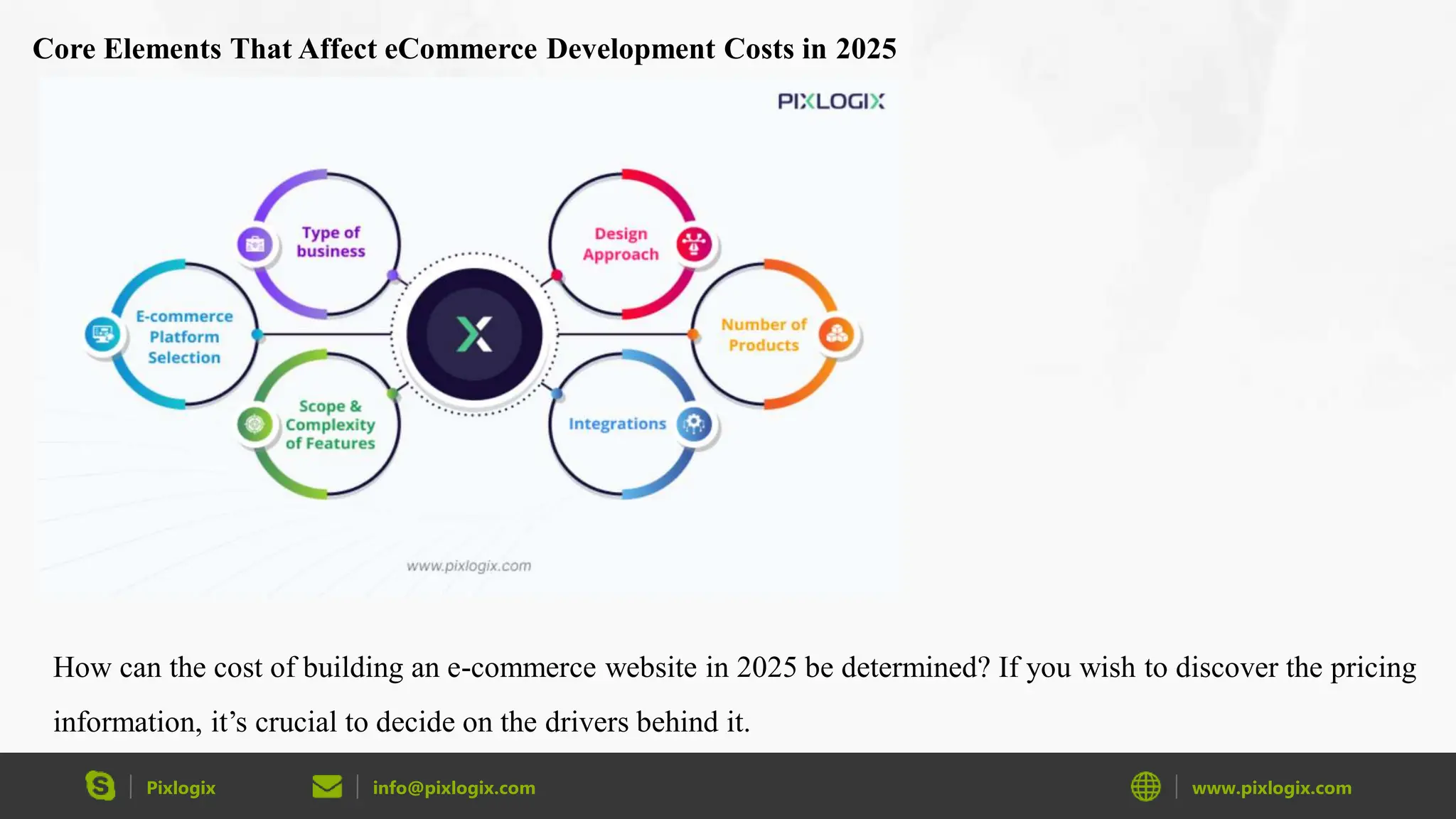
CoreElements That Affect eCommerce Development Costs in 2025
How can the cost of building an e-commerce website in 2025 be determined? If you wish to discover the pricing
information, it’s crucial to decide on the drivers behind it.
4.
Pixlogix info@pixlogix.com www.pixlogix.com
Let’ssee them one by one:
1. Type of Business: Startup, SME, or Enterprise
Your business size has a huge impact on the project scope.
Startup: They need simple MVPs and online stores with core features.
SMEs: They often rely on multiple catalogues. This includes payment gateways, user dashboards, and basic
automation.
Enterprises: They need high-end features. They require advanced analytics and need scalable, secure, and custom
platforms with unique features.
Example: For startups, the cost of custom e-commerce website development ranges from $5,000 – $15,000. On
the other hand, top-level enterprises might spend $25,000 to fulfil their whole requirements.
5.
Pixlogix info@pixlogix.com www.pixlogix.com
2.E-commerce Platform Selection
A professional e-commerce website development company will assist you in determining the ideal platform based
on your company’s requirements, expenditure, and expansion objectives.
Shopify: They have subscription-based platforms that are ideal for startup.
WooCommerce: Choose WooCommerce if you’re planning to establish content-heavy stores. It provides open-
source, cost-effective solutions.
Magento: For medium to large stores, Magento is the best platform, as it can be personalized.
Custom-built Platforms: It is highly recommended for large business models seeking tailored features and
workflows.
Each e-commerce platform has a different pricing model that includes licensing, plugin charges, and hosting.
6.
Pixlogix info@pixlogix.com www.pixlogix.com
3.Scope & Complexity of Features
Development time and e-commerce website cost vary based on its specific features. When the defined
functionalities are complex, they require a high investment. Common cost-influencing features include:
• Advanced product filters
• Multi-vendor capabilities
• Real-time synchronization
• AI-driven recommendations
• Custom checkout and payment workflows
• Subscription management
Basic e-commerce websites built with ready-made themes typically start from $5,000. However, if you aim to
develop custom websites that integrate AI features, the cost will be high.
7.
Pixlogix info@pixlogix.com www.pixlogix.com
4.Design Approach: Template vs Custom UI/UX
UI/UX design plays a crucial role in defining your brand identity.
Template Designs: more affordable but offer limited customization. Building an e-commerce website with this
design generally ranges from $5,000 to $8,000.
Custom UI/UX Design: Their high level of personalization requires a high investment.
Modern e-commerce website design often involves mobile-first, visually appealing features. They require a high
level of performance optimization, which needs more finance.
8.
Pixlogix info@pixlogix.com www.pixlogix.com
5.Number of Pages
The cost of creating an e-commerce site depends on the number of products you intend to list. As demand
increases, expenses climb as well.
• A small e-commerce site can have 10-15 products, ideal for startups.
• Medium-sized stores like to list 100-500 products with high-end features.
• Large-scale businesses deal with over 1000+ products. They may require bulk uploads and a scalable back-end
system.
As product listings grow, design complexity and optimization efforts increase.
9.
Pixlogix info@pixlogix.com www.pixlogix.com
6.Integrations: CRM, ERP, Shipping APIs, and AI Features
An advanced level of integrations may streamline operations but increase the complexity of the project. When
your website has more intricacies, the cost of building them will rise accordingly.
• ERP integration–for inventory and finance.
• CRM tools–like Zoho, Salesforce, are used for managing customers.
• Shipping APIs–from providers like Shiprocket or Delivery.
• AI tools–for personalization, fraud detection, or predictive analytics.
The e-commerce website development cost in 2025 also includes for each third-party add-on integration adds up
to $1,000 to $10,000, depending on the add-on price and customization required.
10.
Pixlogix info@pixlogix.com www.pixlogix.com
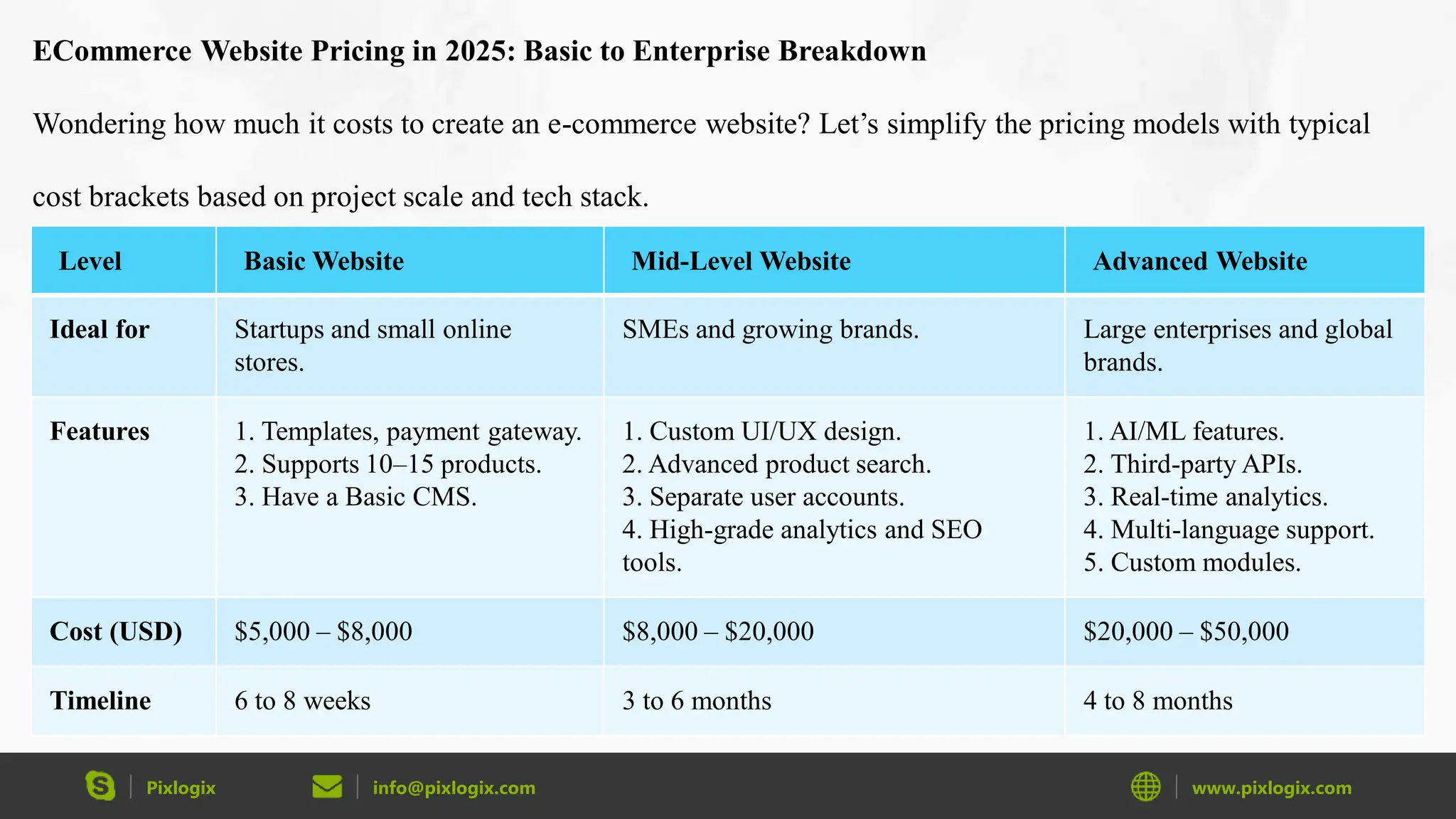
ECommerceWebsite Pricing in 2025: Basic to Enterprise Breakdown
Wondering how much it costs to create an e-commerce website? Let’s simplify the pricing models with typical
cost brackets based on project scale and tech stack.
Level Basic Website Mid-Level Website Advanced Website
Ideal for Startups and small online
stores.
SMEs and growing brands. Large enterprises and global
brands.
Features 1. Templates, payment gateway.
2. Supports 10–15 products.
3. Have a Basic CMS.
1. Custom UI/UX design.
2. Advanced product search.
3. Separate user accounts.
4. High-grade analytics and SEO
tools.
1. AI/ML features.
2. Third-party APIs.
3. Real-time analytics.
4. Multi-language support.
5. Custom modules.
Cost (USD) $5,000 – $8,000 $8,000 – $20,000 $20,000 – $50,000
Timeline 6 to 8 weeks 3 to 6 months 4 to 8 months
11.
Pixlogix info@pixlogix.com www.pixlogix.com
Severalfactors impact the cost of e-commerce website design. This includes third-party integration, design
complexity, number of categories, and many other factors.
Conclusion
Curious about the cost of developing an e-commerce site? Estimating the cost of building an e-commerce website is
a strategic step for any brand. But several key factors are fuelling up the ecommerce website pricing structures.
Some of them are business needs, technology stack, design preferences, and integration requirements.
Simple Shopify stores are highly preferred by startup, as they need less investment. While custom e-commerce
websites are increasing at a rapid pace due to their complex functionalities.
12.
Pixlogix info@pixlogix.com www.pixlogix.com
Overall,it’s essential to plan your budgets strategically based on unique requirements. If you’re hiring a
professional e-commerce website development company in India, then you’ll get a chance to achieve long-term
results.
Struggling to find the cost of developing an e-commerce website in 2025? Then partner with Pixlogix. We provide
high-grade e-commerce development services, helping you calculate the cost of setting up an online store. Reach
out to us today to uplift your business strategy.





![Vibe Coding vs. Spec-Driven Development [Free Meetup]](https://cdn.slidesharecdn.com/ss_thumbnails/vibecodingvsspecdrivendevelopment-251209105622-43f455e7-thumbnail.jpg?width=640&height=640&fit=bounds)


