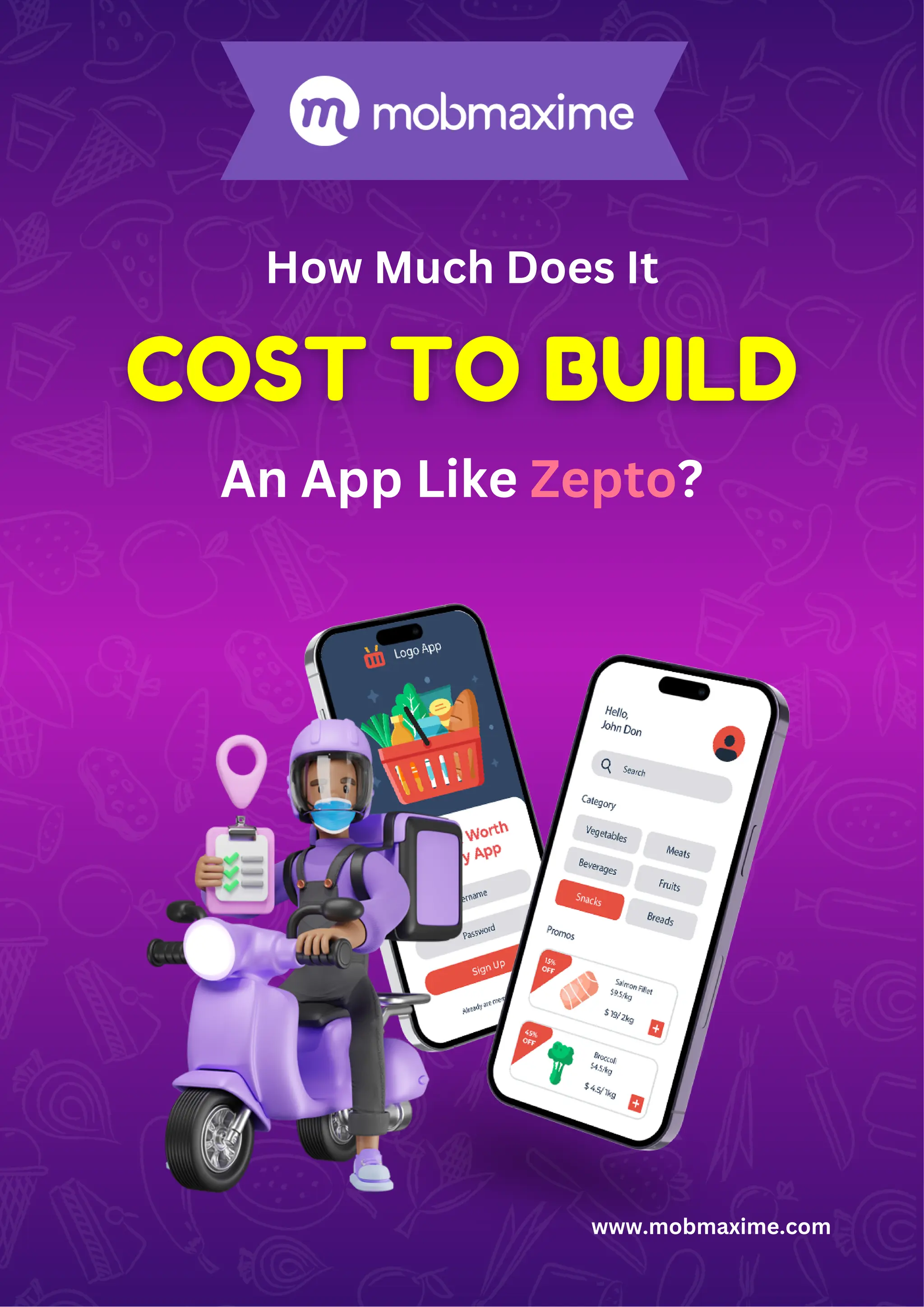
How Much Does It
An App Like Zepto?
www.mobmaxime.com
With grocery delivery applications, you are venturing
into an industry where magnates like Amazon, Instacart,
and Walmart, among others, are already making great
strides. But that doesn’t mean there’s no scope for a
new player to enter the market.
The online grocery market size is expected to cross
$3396 billion by 2033 at a CAGR of 24.6%. Compare this
with the current market size of 2023, which stands at
$377 billion. This means there will be almost 100%
growth in the next decade in this industry. So, all you
have to do is build the best grocery delivery app, and
your brand’s name can also be up there with the top
companies.
One of the questions we often get from our clients is
the cost to build an app like Zepto. Zepto is an online
grocery delivery application that has made headlines in
India. In eight funding rounds, Zepto has raised over
$1.3 billion. So, with this said, let me take you through a
Zepto-like grocery delivery app development cost
guide.
The Functioning of an Online Grocery
Delivery Application
To build a grocery delivery application, we first need to
discuss how to execute the online orders. In other
words, you must decide how you wish to operate the
model.
Operator-Based Delivery Model
A third-party vendor builds the application for online
grocery delivery along with a technology platform to
administer and manage everything from a single place.
This vendor partners with local grocery stores and lists
all the items on the customer’s application.
This way the vendor doesn’t have to invest in inventory
and easily makes the existing local stores, dark stores,
and supermarkets their infrastructure. The
differentiation this vendor provides is the delivery
network. This means the vendor builds a fleet of
drivers, or they can even partner with existing courier
networks, but the former option is preferred.
Company-Based Model
The second popular model will have you invest in
building a supermarket or a dark store and operate your
own fleet of drivers or partner with an existing fleet.
The key requirement here is curating your own
inventory of products, like Amazon Fresh, Walmart, etc.
Here you will have control over the entire supply chain,
can set your prices, and optimize the network as you
deem fit. Even though this model allows for a greater
integration of additional services, you will need a
significantly large upfront investment.
Since our topic for today’s discussion is the cost of
building an app like Zepto, which is an operator-based
delivery service, we will focus on the first of the two
models.
Key Factors Influencing the Cost of Online
Grocery Delivery Application
The cost to build any application, not just a grocery
delivery app, depends on several factors, including;
Application features the development complexity:
You cannot ignore the core features like product
catalog, shopping cart, checkout, etc., no matter
how complex they are to develop. This means the
cost of the application can increase based on the
level of these features.
Smart features or advanced technology-enabled
functionalities can also increase the cost.
Integrating AI and ML-like technologies into the
application will certainly make it better, but it will
also increase the cost. So, if you are thinking about
adding personal recommendations, real-time
The platform you use for application development:
If you come to us for grocery delivery app
development services, one of the many questions
we will want to know is the platform on which you
wish to launch. Will it be for Android, iOS, or both
(cross-platform)?
Application Design and User Experience
Expectations: Here again complexity plays its role as
a complex design takes more work and time, hence
higher costs. In addition to design complexity,
unique branding requirements, and gamified design
elements also play a role here.
Your or the Developer’s Choice of Tech Stack: The
programming languages, frameworks, and additional
tools can also affect the development time and
cost. In addition to this, the complexity of the
interaction between the frontend and backend
infrastructure can also influence costs.
Team Size, Type, and Location: Costs can vary with
the type of team you choose for the development
project. There are two options here, one is that you
hire an in-house team, where you have to hire
designers, developers, and all other professionals to
work under your roof.
Then, you have the option of outsourcing the work
Development Time and Team’s Expertise: Generally
experienced developers will charge more for the
same amount of work as a junior developer. But the
cost you pay to a senior developer is to reduce the
development time and their expertise to help you
build the best possible application in one go.
Then there are ongoing costs which will include regular
updates, application monitoring, and security patches,
among others.
Cost Breakdown of an Online Grocery
Delivery Application
Taking the discussion forward from the previous
section, here I’ll talk about the aspects of the best
grocery delivery app and the costs associated with it.
Frontend Development
Frontend development begins with UI/UX designing,
where designers create intuitive interfaces that are not
only appealing but also functional and interactive. An
to an on-demand grocery app development
company like Mobmaxime. Let me make this clear
here that outsourcing is a better option in terms of
cost savings, experience, time savings, and industry
talent.
important reason behind Zepto’s success is its
implementation of strategic UI/UX design principles.
Senior Product Designer at Zepto has a passion for
creating intuitive and user-friendly designs. He has
been working on improving Zepto’s last-mile delivery
experience, which has proven instrumental in the app’s
success.
Zepto has focused on incorporating modern designs,
and from what I have observed, they have followed the
industry’s best practices with some innovative designs.
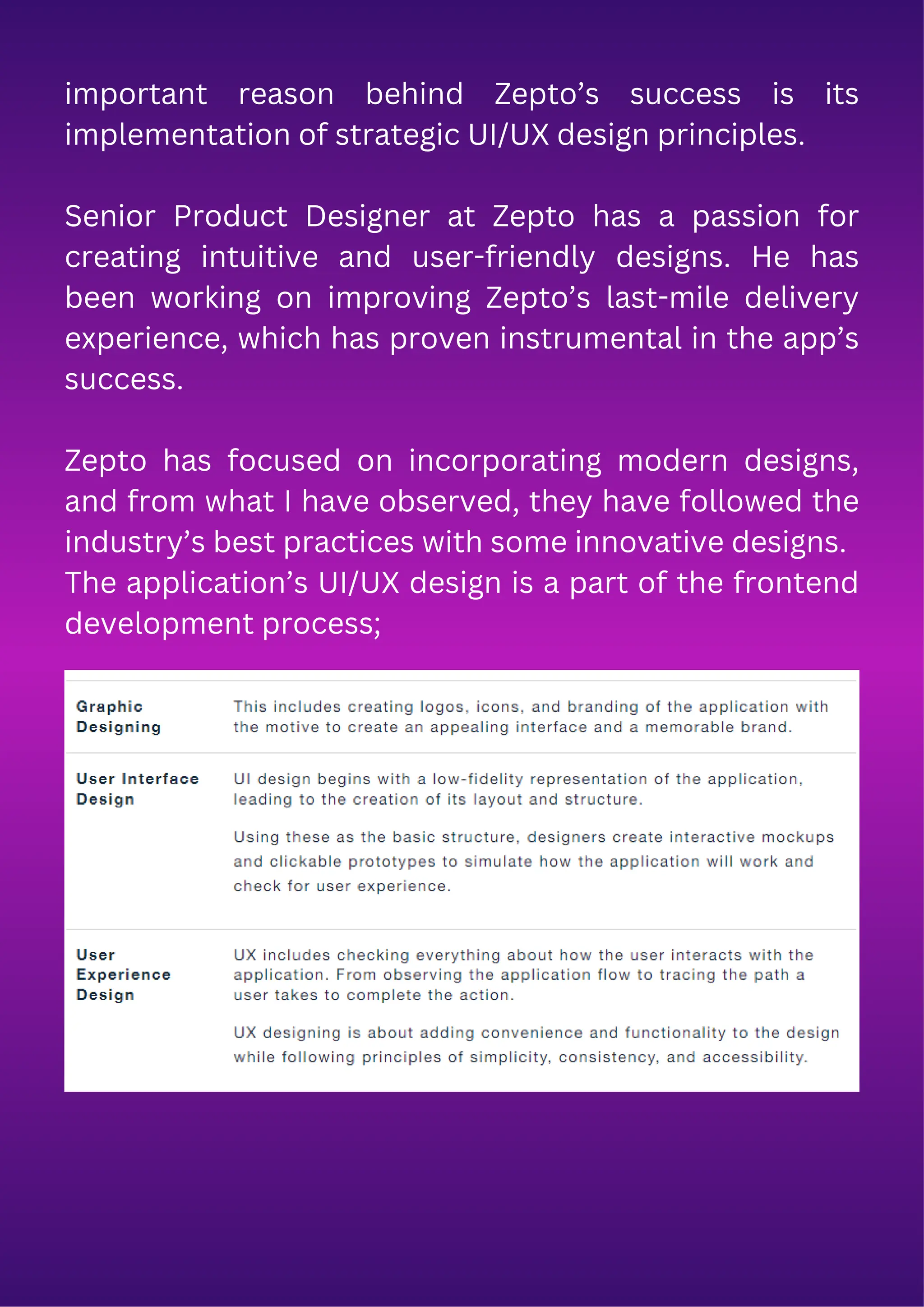
The application’s UI/UX design is a part of the frontend
development process;
Furthermore, front-end development costs and time
can vary according to the tools used. Some popular
design tools are Figma, Sketch, and Adobe XD. On the
other hand, there’s the choice between development
frameworks like React, Angular, and Vue.JS, among
others.
It all comes down to your or the design and
development team’s choice of tools and how
comfortable they are in integrating other tools for the
work. Both of these aspects will vary in the time
required and cost.
Backend Development
Backend or server-side logic development of an online
delivery application is one of the most complex
aspects. This part handles the business logic and
defines how the application will perform when
processing orders, communicating with customers,
giving instructions to delivery partners, and so on.
The backend of a delivery application has to take into
account for three segments;
Customer Portal
Delivery agent portal
Local store portal
The customer portal is where customers place their
orders. For instance, Zepto customers have access to a
different portal where they find all the products
available with the local partner stores. They can place
orders, make payments, track their deliveries, and
interact with the customer care team.
Then there’s the delivery agent portal accessible by the
drivers who will pick up the order from the store and
deliver it to the right address. The delivery agents app is
geolocation enabled, which means the order delivery
request is sent to the person nearest to the pickup and
delivery address. The delivery agents will find
information like orders they have completed, earnings,
customer support, etc.
An important part of backend development is API
integration. APIs make it easier to add payment
gateways, delivery features, and much more. We can
customize the APIs even further to help improve the
app’s functionality.
For backend development as well, popular tools like
NodeJs, Python, Django, Flask, and Ruby on Rails can
also determine the cost and time of building the
application. For instance, working with Flask is relatively
cheaper, but it’s not recommended to use for highly
complex applications.
These nuanced details are considered by the best
grocery delivery app development company to build
the application.
Cross-Platform Development
Cross-platform app development takes a different
route, as you have to write the codebase only once.
This code is rendered for multiple platforms using
platform-specific compilers. Some of the most popular
frameworks we use for Zepto clone app development
services are React Native, Flutter, and Xamarin, among
others.
The codebase you write will include business logic, UI
components, and APIs for additional services. Even
though you have to write the code once and have the
same code logic across, there may be some platform-
specific components you need to work on. This includes
the platform’s native modules, including camera, GPS,
and push notifications.
This development model is faster and more cost-
efficient, no doubt about that. However, issues might
arise with UI components and user experience. In any
app, you will find that UI/UX elements are better in a
native application development system.
The second concern is performance. Cross-platform
applications cannot match the performance of native
applications. However, this does not mean that cross-
platform applications lag or have glitches. They can still
run seamlessly but with the right development
approach.
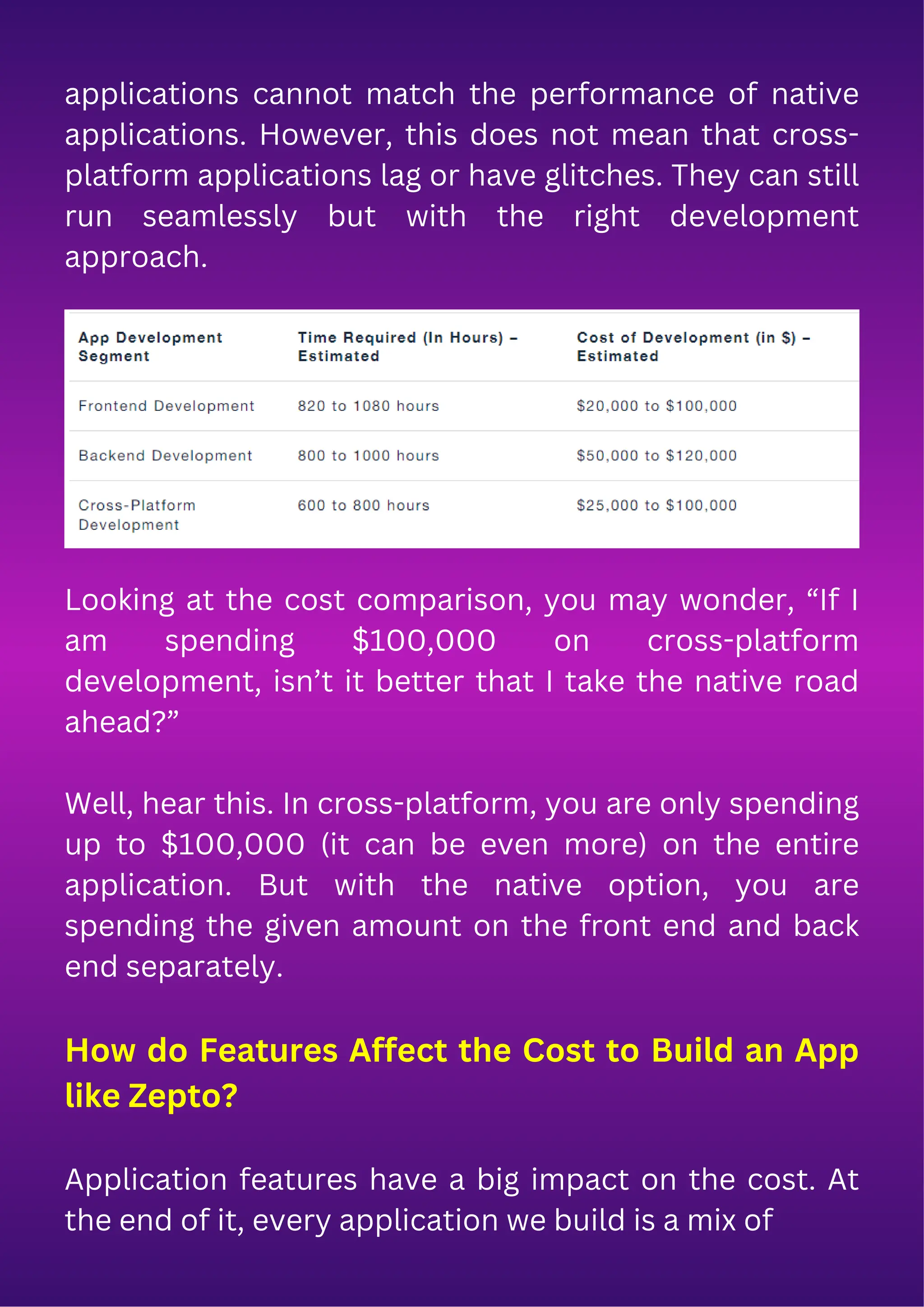
Looking at the cost comparison, you may wonder, “If I
am spending $100,000 on cross-platform
development, isn’t it better that I take the native road
ahead?”
Well, hear this. In cross-platform, you are only spending
up to $100,000 (it can be even more) on the entire
application. But with the native option, you are
spending the given amount on the front end and back
end separately.
How do Features Affect the Cost to Build an App
like Zepto?
Application features have a big impact on the cost. At
the end of it, every application we build is a mix of
different features and functionality. Apart from design,
everything we build in an app, like login sequence,
security system, payment gateways, etc., are all its
features.
The process we implement to add these features along
with the UX design elements that go with them can vary
the development costs. Moreover, the level of features,
like if you want your application to have some AI-based
smart features, the costs will certainly increase there as
well.
To help you understand it better, here are the standard
and advanced features you can add to an online
grocery delivery application.
An operator-based grocery delivery application has
three components and each of them is connected. Here
are the basic and advanced features for all three.
Customer Application
User Registration and Login: Allow your
customers to create an account and speed it up
with social sign-in. Further, let them add the
basic details like name, phone number, address,
etc.
Product Browsing and Search: Let the
customers browse products available to buy
through the application.
Smart Feature Addition: Use artificial
intelligence and machine learning to detect
buying behavior and patterns. This will let the
app provide personalized recommendations to
the customers.
Shopping Cart: Allows customers to add and
remove products from the cart and share
information like total cart value, discounts
available, delivery charges, etc.
Checkout Process: With multiple payment
options, the customers can make payments
through the application. They must also be
allowed to choose from different delivery
options according to customer preferences.
Track Orders: Integrate maps in the customer
application, which is connected to the delivery
agent’s portal. This will allow customers to track
the orders and also find the order ETA.
Push Notifications: The customers will receive
in-app push notifications and send real-time
updates on orders, delivery time, delays, etc.
This is to ensure that customers are always
informed.
Customer Support: Provide multiple channels
for your customers to make contact. Take note
of all customer issues and fix them so that other
customers don’t face the same.
Grocery Store Application
Partner Onboarding and Management: Allow
partners to easily create their profile and
integrate their platform with different available
integrations.
Inventory Management: Allow partners to
maintain their inventory by updating the
number of items and synchronizing the data
between administration and customer portal.
Predictive Inventory Management: AI can
predict demand levels according to the
collective order history of the area they are
operating from. Using this information, they can
update their inventory as required to prevent
understocking and overstocking.
Order Processing: Make it easier for partners to
process all orders efficiently to ensure it is
picked up and delivered on time.
Real-time Analytics: As an advanced feature, the
partners should get information on orders,
customer preferences, experience, driver
behavior, etc. This information is crucial for
partners to measure their efforts and make
changes to ensure their customers are always
happy.
POS Integration: Grocery partners must have
Point-of-Sale integration for seamless orders
and payment processing.
Dynamic Pricing: Dynamic pricing adjusts the
level of products according to the demand and
inventory levels.
Signup and Profile Creation: The delivery
company must allow delivery agents to sign up
and create their profiles while sharing verifiable
details.
Route Optimization: The application must use
GPS, traffic data, and geolocation to update the
route to ensure quick and hassle-free delivery.
Order Pickup and Delivery: Allow drivers to
select the orders they want to deliver
Surge Pricing: Depending on the demand of the
delivery agents, which in turn is influenced by
the number of orders per driver in an area, you
Delivery Partner Application
can implement surge pricing. This is when the
delivery price increases dynamically according
to demand.
Interact with Customer: The delivery driver’s
portal should have the customer’s contact
details but not their actual number. Following in
the footsteps of other similar services, the
drivers must call another number, through
which the call is routed to the customer’s
number.
Based on this information, the cost to integrate the
basic features of a grocery delivery application can be
up to $15,000. However, if you want to include the
above-listed and more advanced features, the costs
can rise to $50,000.
Well, there you have it, a detailed guide on the cost of
building an app like Zepto. Even though we know the
application type and features, the final cost can never
be shared without first understanding your
requirements.
Even if you want to build a Zepto clone, costs can vary
according to the type of team you choose, the team’s
location, and the amount of time you can wait for the
application.
This is because a team sitting in the USA will cost you
more than a team working from India, China, etc. At the
same time, if you choose to have an in-house team as
against the norm to outsource the work, the cost with
the former option will be higher.
To Sum It Up
Zepto is an online grocery delivery application that
partners with local stores but has established its
delivery network. Even with existing players in the
market, Zepto has achieved tremendous success
because they were able to tap into the potential of this
market.
If you also want to build an application like Zepto, come
to us. Mobmaxime is the best grocery delivery app
development company. Bringing our experience and
expertise to the table we will help you create a better
than Zepto online grocery delivery application.
We are available for a meeting right now. All you have to
do is get in touch.
www.mobmaxime.com

How much does it cost to build an app like Zepto?

  • 1.
    How Much DoesIt An App Like Zepto? www.mobmaxime.com
  • 2.
    With grocery deliveryapplications, you are venturing into an industry where magnates like Amazon, Instacart, and Walmart, among others, are already making great strides. But that doesn’t mean there’s no scope for a new player to enter the market. The online grocery market size is expected to cross $3396 billion by 2033 at a CAGR of 24.6%. Compare this with the current market size of 2023, which stands at $377 billion. This means there will be almost 100% growth in the next decade in this industry. So, all you have to do is build the best grocery delivery app, and your brand’s name can also be up there with the top companies. One of the questions we often get from our clients is the cost to build an app like Zepto. Zepto is an online grocery delivery application that has made headlines in India. In eight funding rounds, Zepto has raised over $1.3 billion. So, with this said, let me take you through a Zepto-like grocery delivery app development cost guide. The Functioning of an Online Grocery Delivery Application To build a grocery delivery application, we first need to discuss how to execute the online orders. In other
  • 3.
    words, you mustdecide how you wish to operate the model. Operator-Based Delivery Model A third-party vendor builds the application for online grocery delivery along with a technology platform to administer and manage everything from a single place. This vendor partners with local grocery stores and lists all the items on the customer’s application. This way the vendor doesn’t have to invest in inventory and easily makes the existing local stores, dark stores, and supermarkets their infrastructure. The differentiation this vendor provides is the delivery network. This means the vendor builds a fleet of drivers, or they can even partner with existing courier networks, but the former option is preferred. Company-Based Model The second popular model will have you invest in building a supermarket or a dark store and operate your own fleet of drivers or partner with an existing fleet. The key requirement here is curating your own inventory of products, like Amazon Fresh, Walmart, etc. Here you will have control over the entire supply chain, can set your prices, and optimize the network as you
  • 4.
    deem fit. Eventhough this model allows for a greater integration of additional services, you will need a significantly large upfront investment. Since our topic for today’s discussion is the cost of building an app like Zepto, which is an operator-based delivery service, we will focus on the first of the two models. Key Factors Influencing the Cost of Online Grocery Delivery Application The cost to build any application, not just a grocery delivery app, depends on several factors, including; Application features the development complexity: You cannot ignore the core features like product catalog, shopping cart, checkout, etc., no matter how complex they are to develop. This means the cost of the application can increase based on the level of these features. Smart features or advanced technology-enabled functionalities can also increase the cost. Integrating AI and ML-like technologies into the application will certainly make it better, but it will also increase the cost. So, if you are thinking about adding personal recommendations, real-time
  • 5.
    The platform youuse for application development: If you come to us for grocery delivery app development services, one of the many questions we will want to know is the platform on which you wish to launch. Will it be for Android, iOS, or both (cross-platform)? Application Design and User Experience Expectations: Here again complexity plays its role as a complex design takes more work and time, hence higher costs. In addition to design complexity, unique branding requirements, and gamified design elements also play a role here. Your or the Developer’s Choice of Tech Stack: The programming languages, frameworks, and additional tools can also affect the development time and cost. In addition to this, the complexity of the interaction between the frontend and backend infrastructure can also influence costs. Team Size, Type, and Location: Costs can vary with the type of team you choose for the development project. There are two options here, one is that you hire an in-house team, where you have to hire designers, developers, and all other professionals to work under your roof. Then, you have the option of outsourcing the work
  • 6.
    Development Time andTeam’s Expertise: Generally experienced developers will charge more for the same amount of work as a junior developer. But the cost you pay to a senior developer is to reduce the development time and their expertise to help you build the best possible application in one go. Then there are ongoing costs which will include regular updates, application monitoring, and security patches, among others. Cost Breakdown of an Online Grocery Delivery Application Taking the discussion forward from the previous section, here I’ll talk about the aspects of the best grocery delivery app and the costs associated with it. Frontend Development Frontend development begins with UI/UX designing, where designers create intuitive interfaces that are not only appealing but also functional and interactive. An to an on-demand grocery app development company like Mobmaxime. Let me make this clear here that outsourcing is a better option in terms of cost savings, experience, time savings, and industry talent.
  • 7.
    important reason behindZepto’s success is its implementation of strategic UI/UX design principles. Senior Product Designer at Zepto has a passion for creating intuitive and user-friendly designs. He has been working on improving Zepto’s last-mile delivery experience, which has proven instrumental in the app’s success. Zepto has focused on incorporating modern designs, and from what I have observed, they have followed the industry’s best practices with some innovative designs. The application’s UI/UX design is a part of the frontend development process;
  • 8.
    Furthermore, front-end developmentcosts and time can vary according to the tools used. Some popular design tools are Figma, Sketch, and Adobe XD. On the other hand, there’s the choice between development frameworks like React, Angular, and Vue.JS, among others. It all comes down to your or the design and development team’s choice of tools and how comfortable they are in integrating other tools for the work. Both of these aspects will vary in the time required and cost. Backend Development Backend or server-side logic development of an online delivery application is one of the most complex aspects. This part handles the business logic and defines how the application will perform when processing orders, communicating with customers, giving instructions to delivery partners, and so on. The backend of a delivery application has to take into account for three segments; Customer Portal Delivery agent portal Local store portal
  • 9.
    The customer portalis where customers place their orders. For instance, Zepto customers have access to a different portal where they find all the products available with the local partner stores. They can place orders, make payments, track their deliveries, and interact with the customer care team. Then there’s the delivery agent portal accessible by the drivers who will pick up the order from the store and deliver it to the right address. The delivery agents app is geolocation enabled, which means the order delivery request is sent to the person nearest to the pickup and delivery address. The delivery agents will find information like orders they have completed, earnings, customer support, etc. An important part of backend development is API integration. APIs make it easier to add payment gateways, delivery features, and much more. We can customize the APIs even further to help improve the app’s functionality. For backend development as well, popular tools like NodeJs, Python, Django, Flask, and Ruby on Rails can also determine the cost and time of building the application. For instance, working with Flask is relatively cheaper, but it’s not recommended to use for highly complex applications.
  • 10.
    These nuanced detailsare considered by the best grocery delivery app development company to build the application. Cross-Platform Development Cross-platform app development takes a different route, as you have to write the codebase only once. This code is rendered for multiple platforms using platform-specific compilers. Some of the most popular frameworks we use for Zepto clone app development services are React Native, Flutter, and Xamarin, among others. The codebase you write will include business logic, UI components, and APIs for additional services. Even though you have to write the code once and have the same code logic across, there may be some platform- specific components you need to work on. This includes the platform’s native modules, including camera, GPS, and push notifications. This development model is faster and more cost- efficient, no doubt about that. However, issues might arise with UI components and user experience. In any app, you will find that UI/UX elements are better in a native application development system. The second concern is performance. Cross-platform
  • 11.
    applications cannot matchthe performance of native applications. However, this does not mean that cross- platform applications lag or have glitches. They can still run seamlessly but with the right development approach. Looking at the cost comparison, you may wonder, “If I am spending $100,000 on cross-platform development, isn’t it better that I take the native road ahead?” Well, hear this. In cross-platform, you are only spending up to $100,000 (it can be even more) on the entire application. But with the native option, you are spending the given amount on the front end and back end separately. How do Features Affect the Cost to Build an App like Zepto? Application features have a big impact on the cost. At the end of it, every application we build is a mix of
  • 12.
    different features andfunctionality. Apart from design, everything we build in an app, like login sequence, security system, payment gateways, etc., are all its features. The process we implement to add these features along with the UX design elements that go with them can vary the development costs. Moreover, the level of features, like if you want your application to have some AI-based smart features, the costs will certainly increase there as well. To help you understand it better, here are the standard and advanced features you can add to an online grocery delivery application. An operator-based grocery delivery application has three components and each of them is connected. Here are the basic and advanced features for all three. Customer Application User Registration and Login: Allow your customers to create an account and speed it up with social sign-in. Further, let them add the basic details like name, phone number, address, etc. Product Browsing and Search: Let the customers browse products available to buy
  • 13.
    through the application. SmartFeature Addition: Use artificial intelligence and machine learning to detect buying behavior and patterns. This will let the app provide personalized recommendations to the customers. Shopping Cart: Allows customers to add and remove products from the cart and share information like total cart value, discounts available, delivery charges, etc. Checkout Process: With multiple payment options, the customers can make payments through the application. They must also be allowed to choose from different delivery options according to customer preferences. Track Orders: Integrate maps in the customer application, which is connected to the delivery agent’s portal. This will allow customers to track the orders and also find the order ETA. Push Notifications: The customers will receive in-app push notifications and send real-time updates on orders, delivery time, delays, etc. This is to ensure that customers are always informed.
  • 14.
    Customer Support: Providemultiple channels for your customers to make contact. Take note of all customer issues and fix them so that other customers don’t face the same. Grocery Store Application Partner Onboarding and Management: Allow partners to easily create their profile and integrate their platform with different available integrations. Inventory Management: Allow partners to maintain their inventory by updating the number of items and synchronizing the data between administration and customer portal. Predictive Inventory Management: AI can predict demand levels according to the collective order history of the area they are operating from. Using this information, they can update their inventory as required to prevent understocking and overstocking. Order Processing: Make it easier for partners to process all orders efficiently to ensure it is picked up and delivered on time. Real-time Analytics: As an advanced feature, the partners should get information on orders,
  • 15.
    customer preferences, experience,driver behavior, etc. This information is crucial for partners to measure their efforts and make changes to ensure their customers are always happy. POS Integration: Grocery partners must have Point-of-Sale integration for seamless orders and payment processing. Dynamic Pricing: Dynamic pricing adjusts the level of products according to the demand and inventory levels. Signup and Profile Creation: The delivery company must allow delivery agents to sign up and create their profiles while sharing verifiable details. Route Optimization: The application must use GPS, traffic data, and geolocation to update the route to ensure quick and hassle-free delivery. Order Pickup and Delivery: Allow drivers to select the orders they want to deliver Surge Pricing: Depending on the demand of the delivery agents, which in turn is influenced by the number of orders per driver in an area, you Delivery Partner Application
  • 16.
    can implement surgepricing. This is when the delivery price increases dynamically according to demand. Interact with Customer: The delivery driver’s portal should have the customer’s contact details but not their actual number. Following in the footsteps of other similar services, the drivers must call another number, through which the call is routed to the customer’s number. Based on this information, the cost to integrate the basic features of a grocery delivery application can be up to $15,000. However, if you want to include the above-listed and more advanced features, the costs can rise to $50,000. Well, there you have it, a detailed guide on the cost of building an app like Zepto. Even though we know the application type and features, the final cost can never be shared without first understanding your requirements. Even if you want to build a Zepto clone, costs can vary according to the type of team you choose, the team’s location, and the amount of time you can wait for the application.
  • 17.
    This is becausea team sitting in the USA will cost you more than a team working from India, China, etc. At the same time, if you choose to have an in-house team as against the norm to outsource the work, the cost with the former option will be higher. To Sum It Up Zepto is an online grocery delivery application that partners with local stores but has established its delivery network. Even with existing players in the market, Zepto has achieved tremendous success because they were able to tap into the potential of this market. If you also want to build an application like Zepto, come to us. Mobmaxime is the best grocery delivery app development company. Bringing our experience and expertise to the table we will help you create a better than Zepto online grocery delivery application. We are available for a meeting right now. All you have to do is get in touch. www.mobmaxime.com