listening
deeply
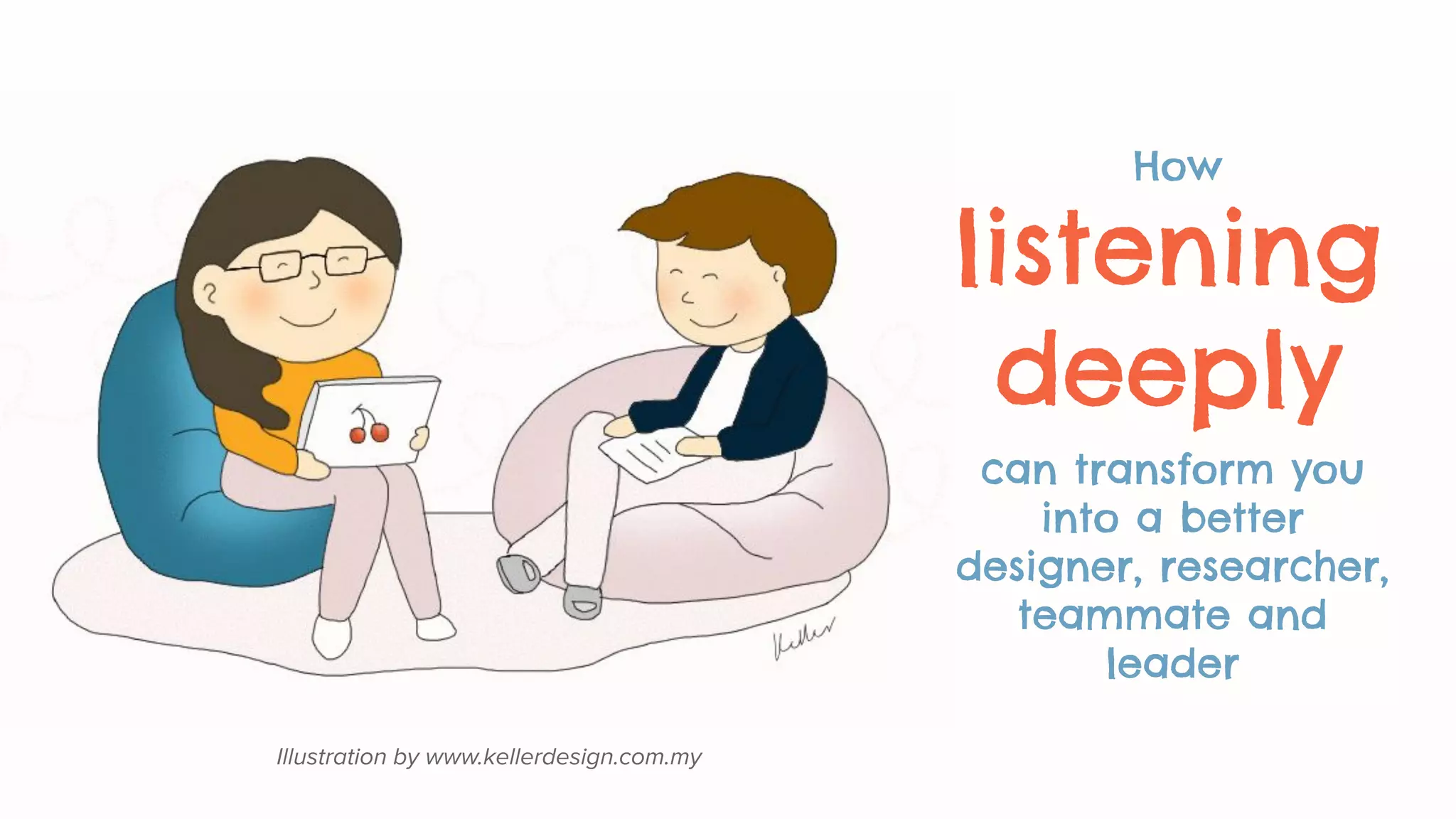
Illustration by www.kellerdesign.com.my
How
can transform you
into a better
designer, researcher,
teammate and
leader
Hello,
I’m
Pei Ling
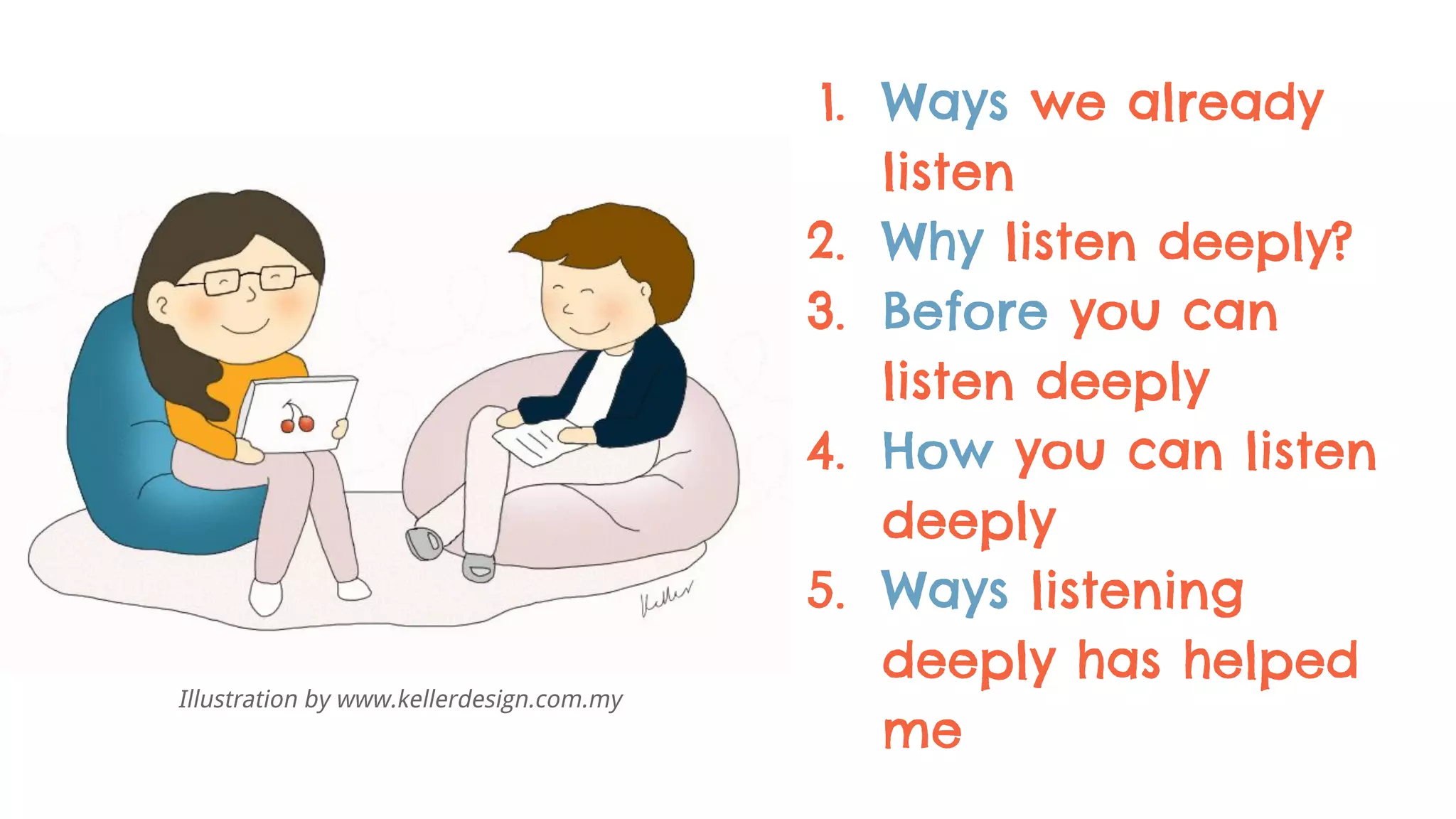
Illustration by www.kellerdesign.com.my
Photo by Luke Ellis-Craven on Unsplash
When was the last time you felt heard?
1. Ways we already
listen
2. Why listen deeply?
3. Before you can
listen deeply
4. How you can listen
deeply
5. Ways listening
deeply has helped
me
Illustration by www.kellerdesign.com.my
The ways we
already listen
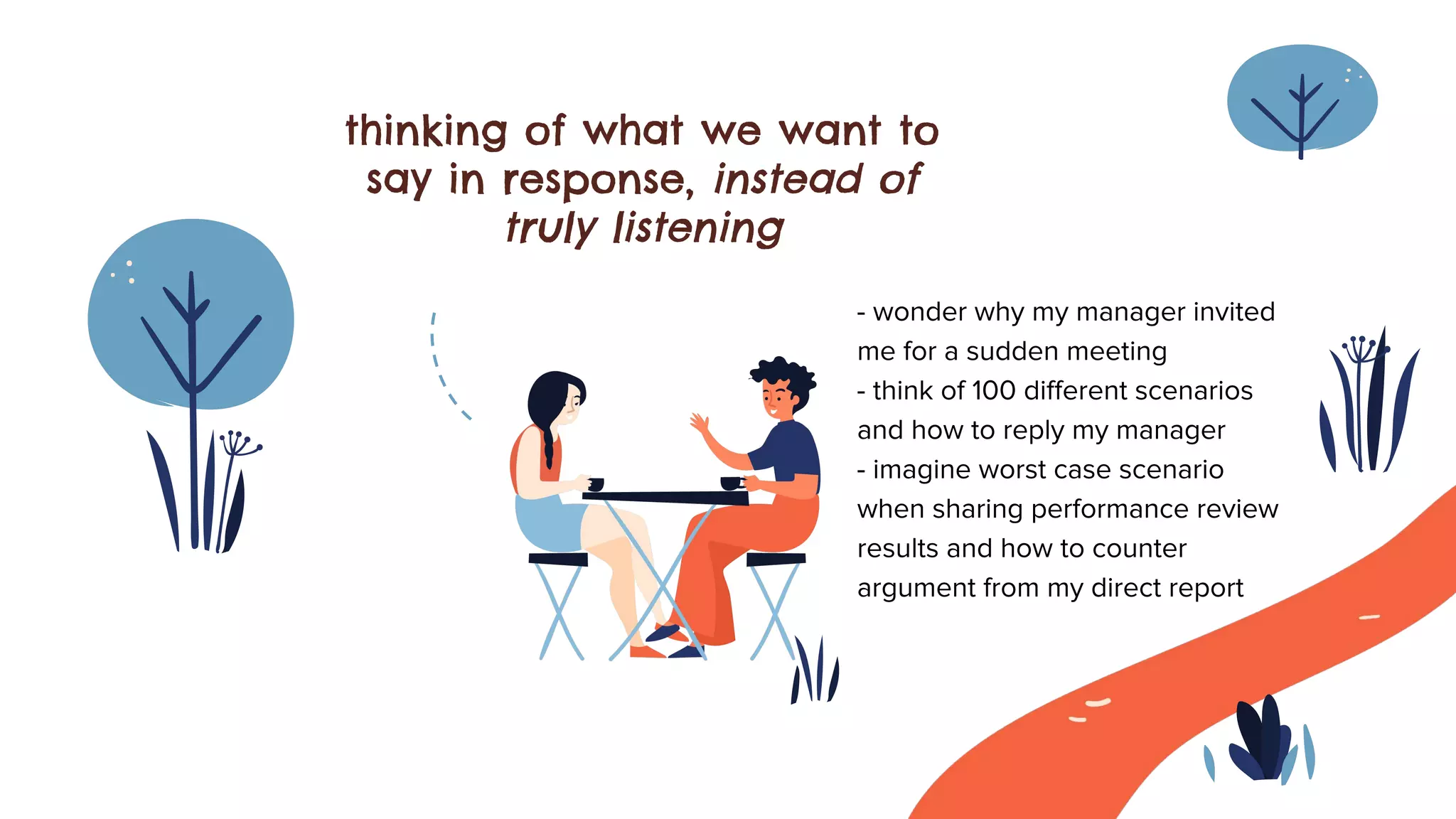
thinking of what we want to
say in response, instead of
truly listening
- wonder why my manager invited
me for a sudden meeting
- think of 100 different scenarios
and how to reply my manager
- imagine worst case scenario
when sharing performance review
results and how to counter
argument from my direct report
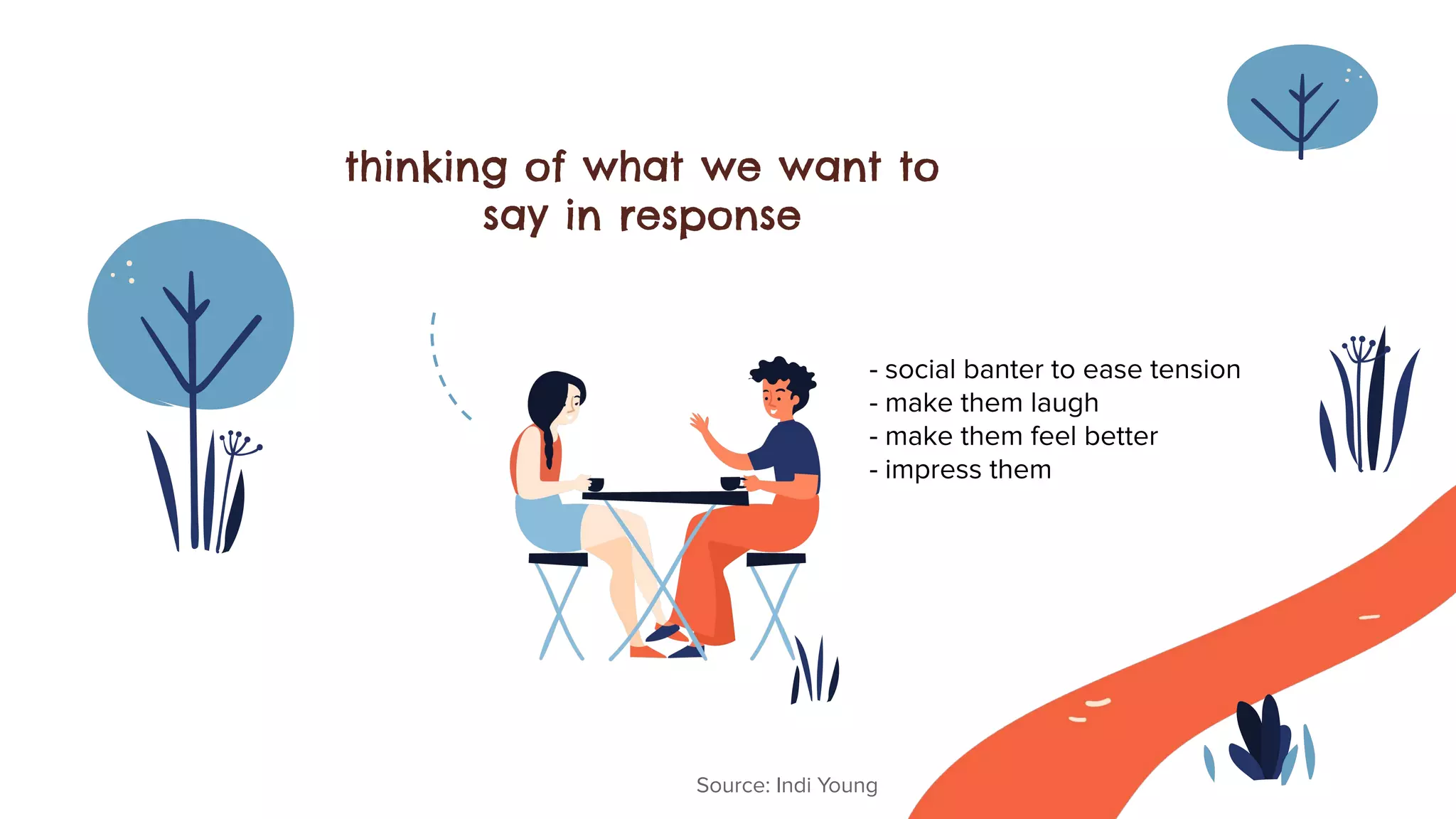
thinking of what we want to
say in response
- social banter to ease tension
- make them laugh
- make them feel better
- impress them
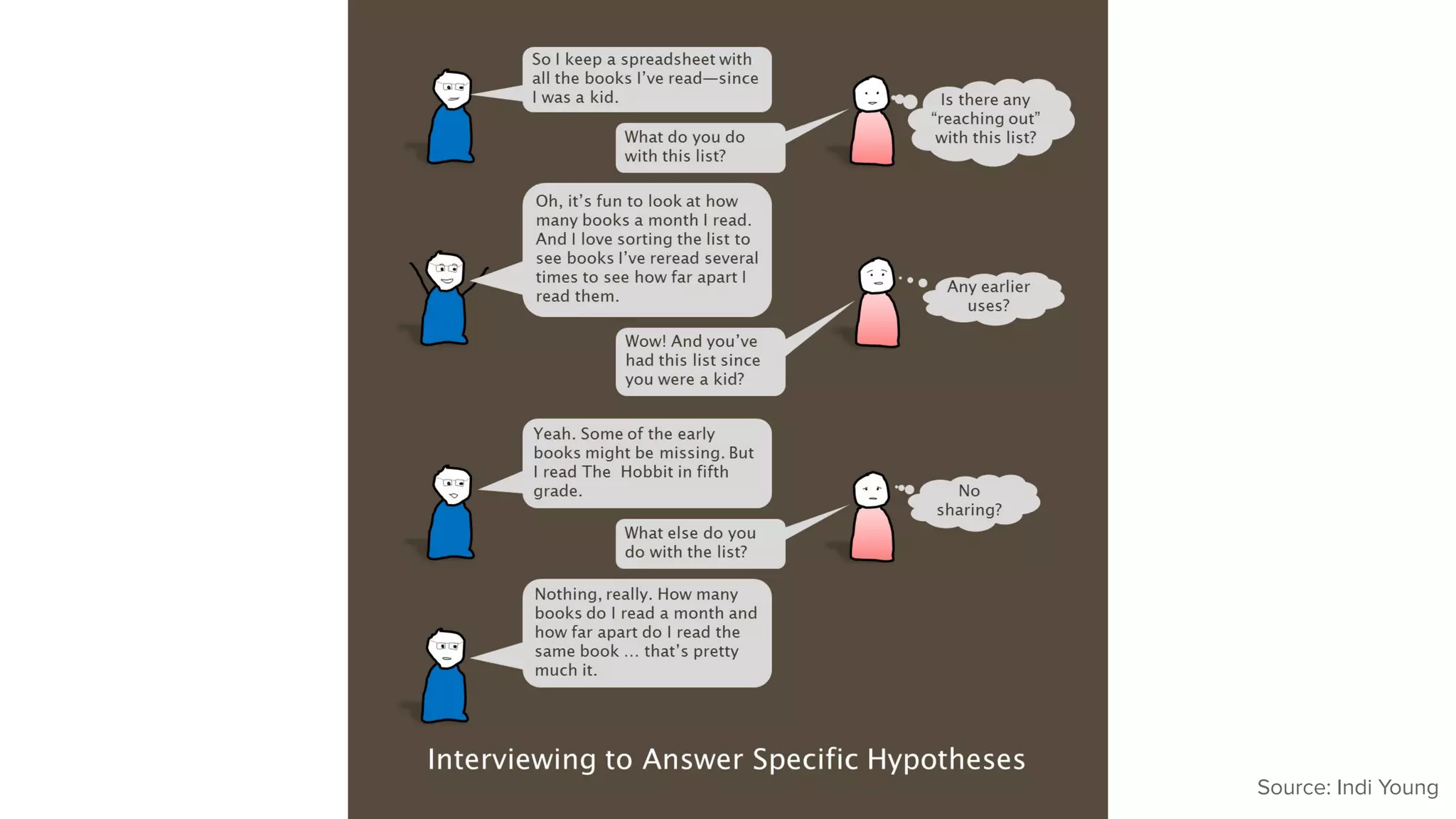
Source: Indi Young
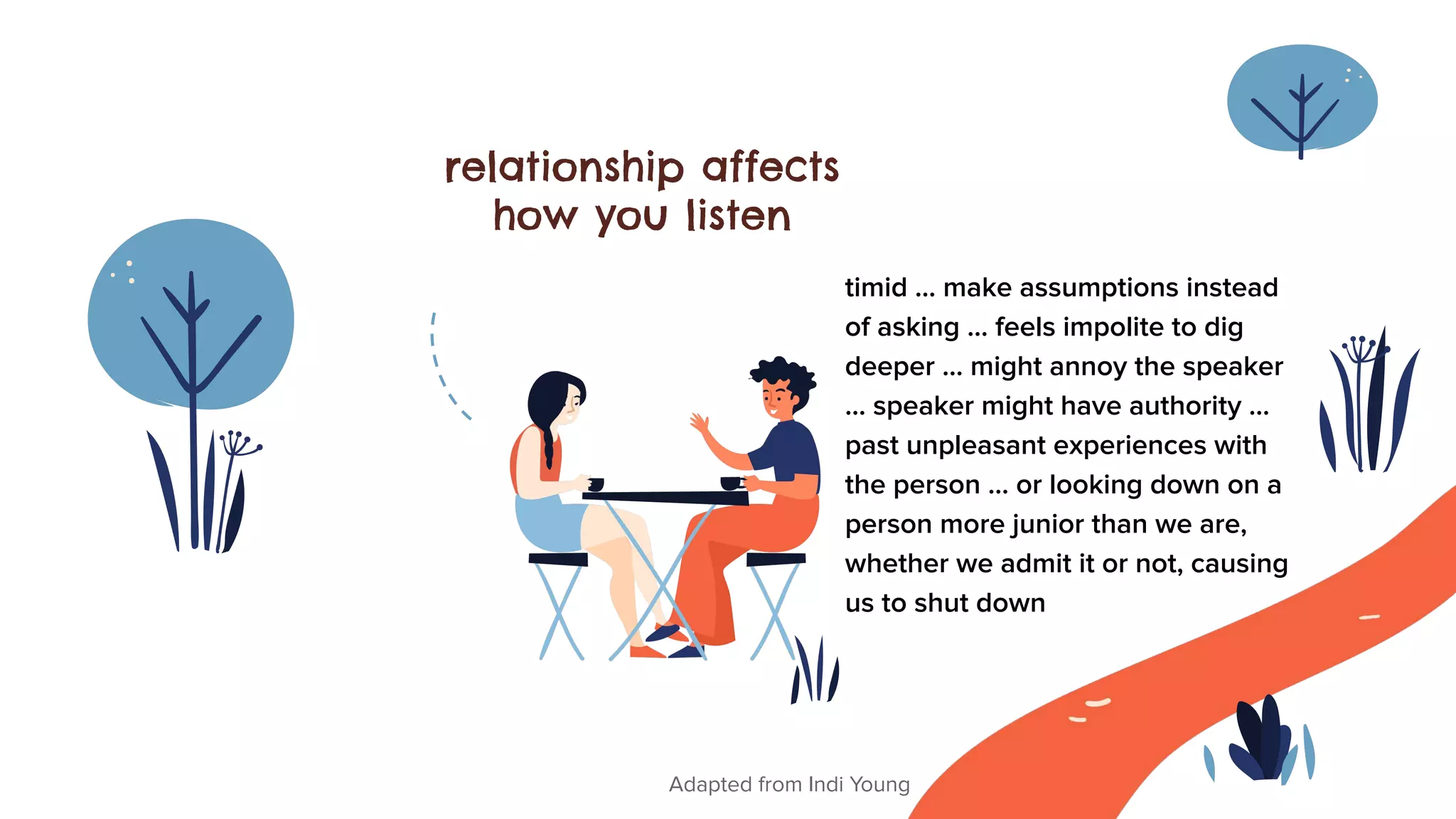
relationship affects
how you listen
Adapted from Indi Young
timid ... make assumptions instead
of asking ... feels impolite to dig
deeper ... might annoy the speaker
... speaker might have authority …
past unpleasant experiences with
the person … or looking down on a
person more junior than we are,
whether we admit it or not, causing
us to shut down
Why listen
deeply?
so that we can develop empathy
empathy is so powerful.
it creates a connection.
it moves conversations.
it can cause action.
it lasts beyond the conversation.
it builds relationship.
The cost of not
listening deeply
● we fill ourselves with assumptions and are led by them
● leaders breed an unconducive environment for trust to
grow
● teams don’t have a safe space to be open
● team motivation and morale are affected, impacting
work quality
● business performance and innovation can be highly
impacted by lack of employee engagement
… and more!
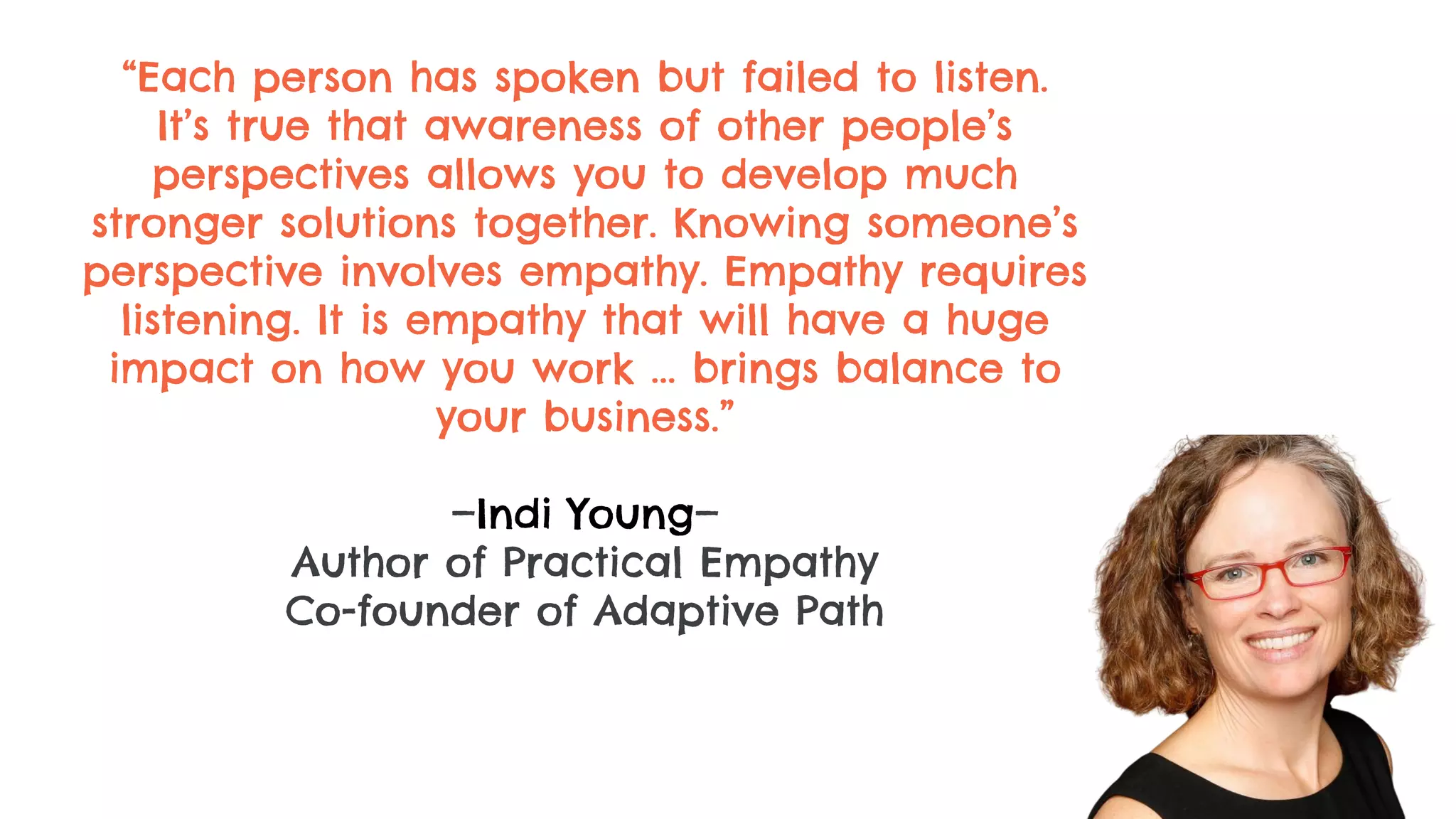
“Each person has spoken but failed to listen.
It’s true that awareness of other people’s
perspectives allows you to develop much
stronger solutions together. Knowing someone’s
perspective involves empathy. Empathy requires
listening. It is empathy that will have a huge
impact on how you work ... brings balance to
your business.”
—Indi Young—
Author of Practical Empathy
Co-founder of Adaptive Path
What is
empathy?
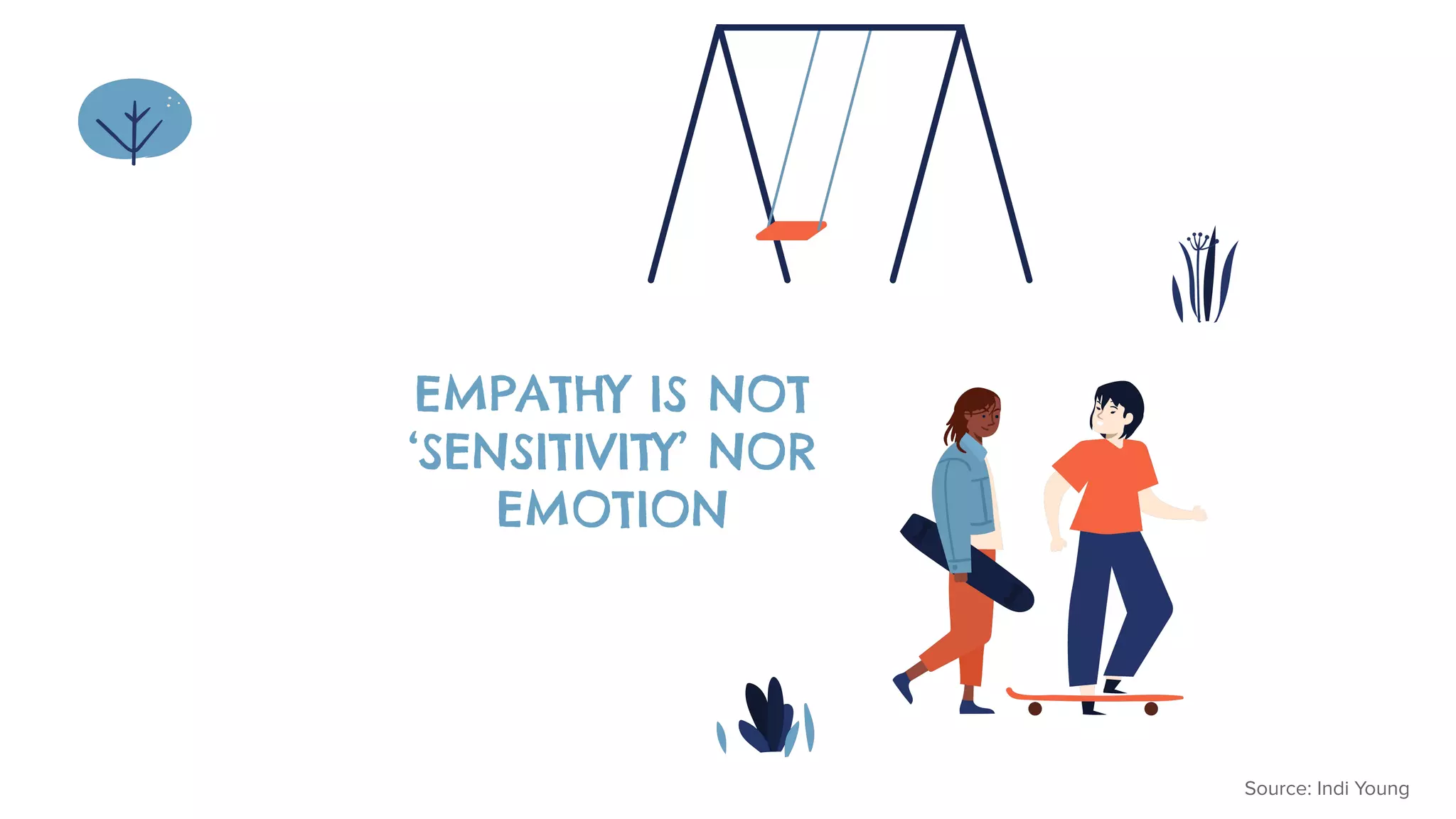
EMPATHY IS NOT
‘SENSITIVITY’ NOR
EMOTION
Source: Indi Young
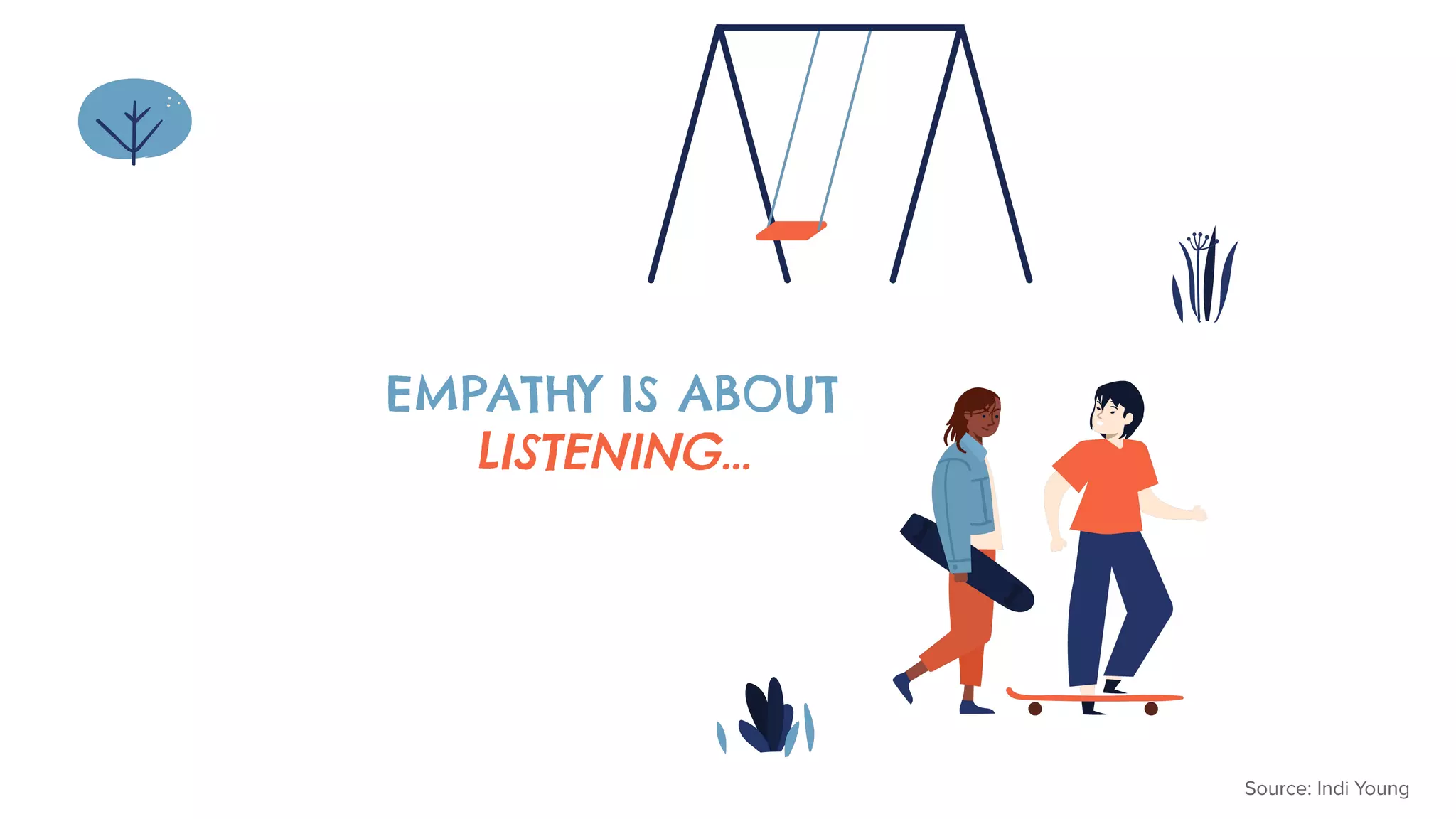
EMPATHY IS ABOUT
LISTENING...
Source: Indi Young
Before you can
listen deeply
here’s where you decide if you want to listen deeply
it’s not going to be perfect on your first try.
you don’t give up easily. it’s a habit you need to form.
put aside your idea of what is right for the person, not
because you are wrong, but because this attitude
hinders you from listening deeply without cognition.
stop talking about yourself. it’s about the other person.
you listen so that you can understand.
How you can
listen deeply
For UX or Design
Researchers
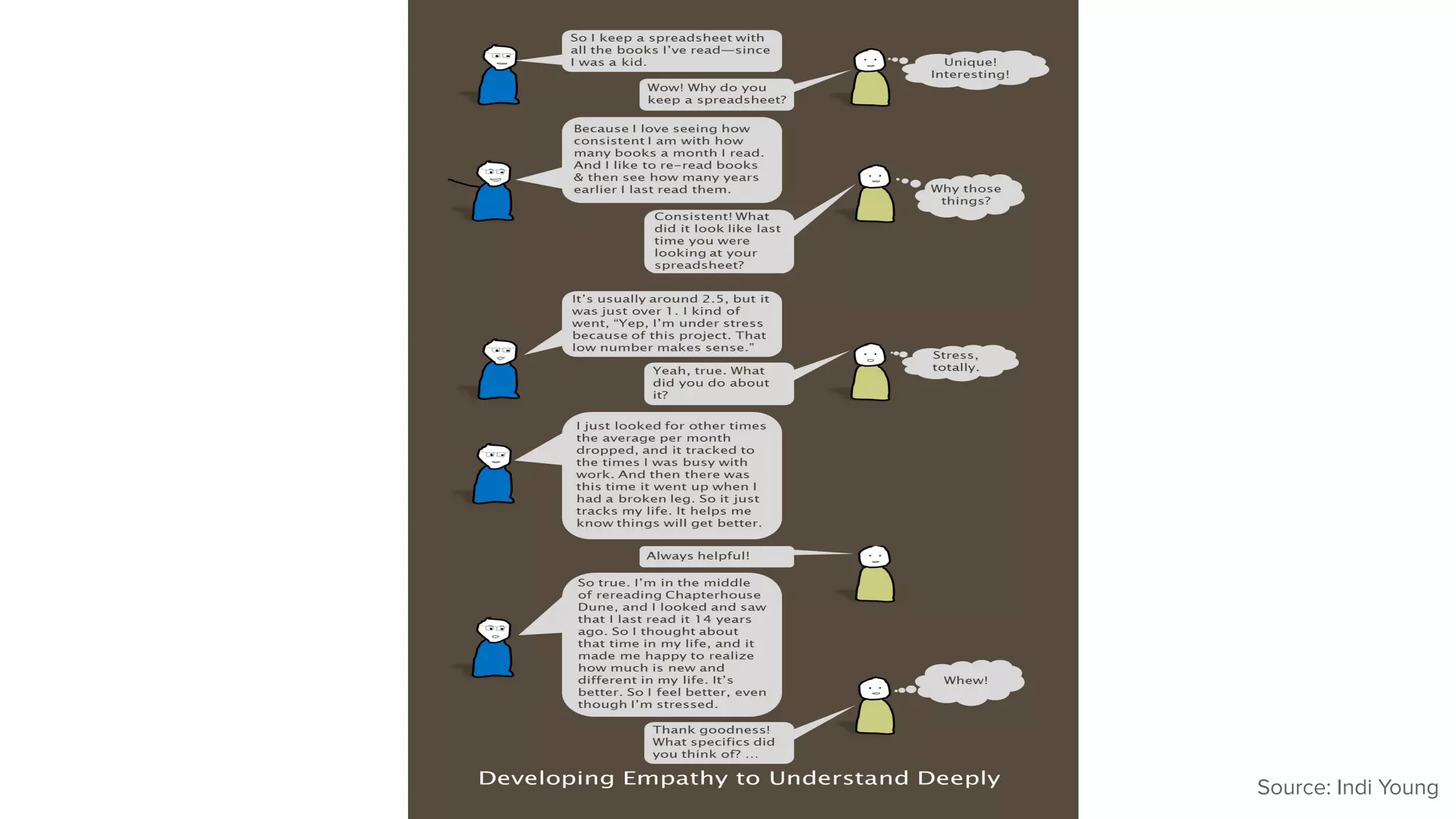
Source: Indi Young
Source: Indi Young
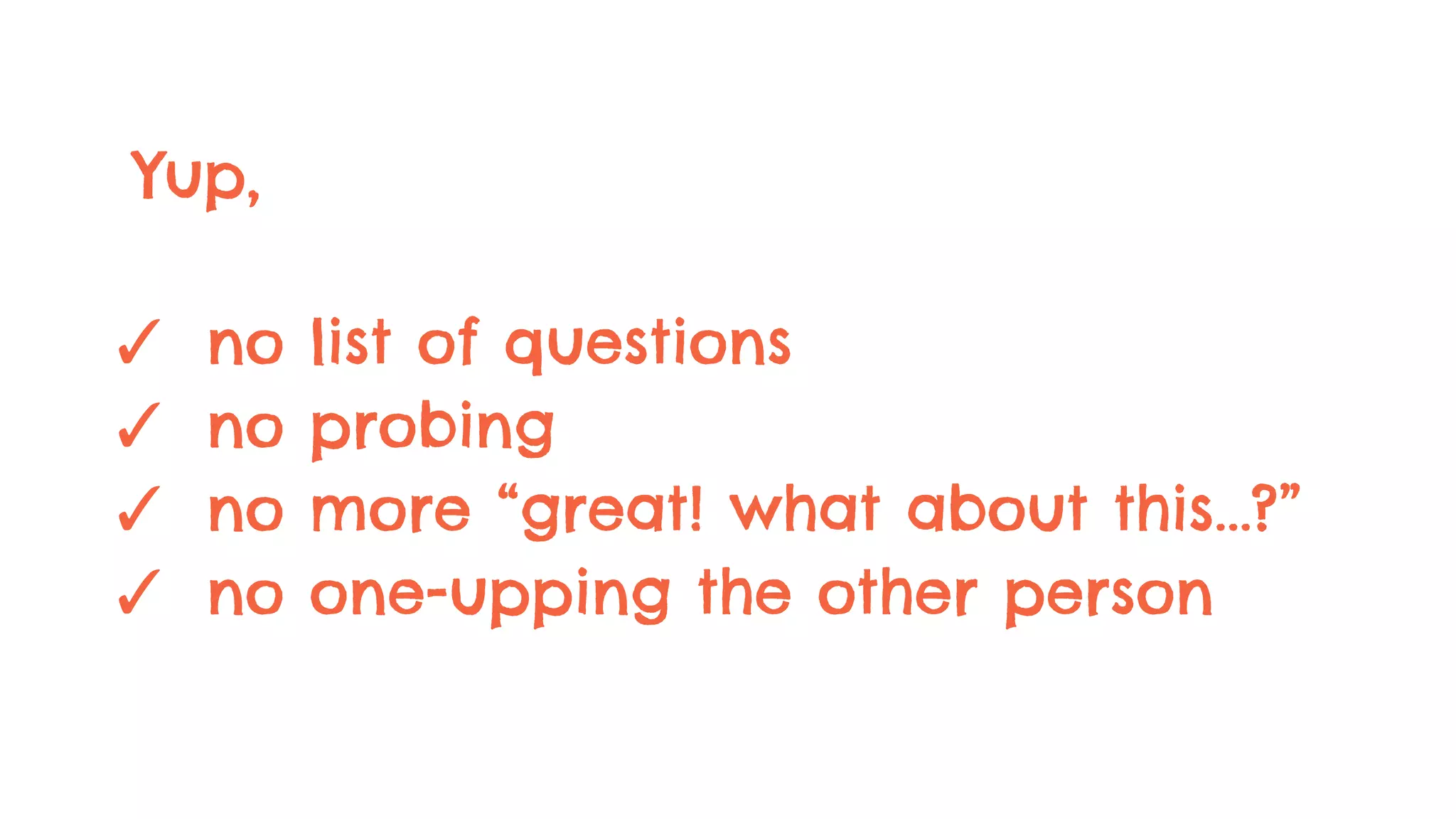
Yup,
✓ no list of questions
✓ no probing
✓ no more “great! what about this...?”
✓ no one-upping the other person
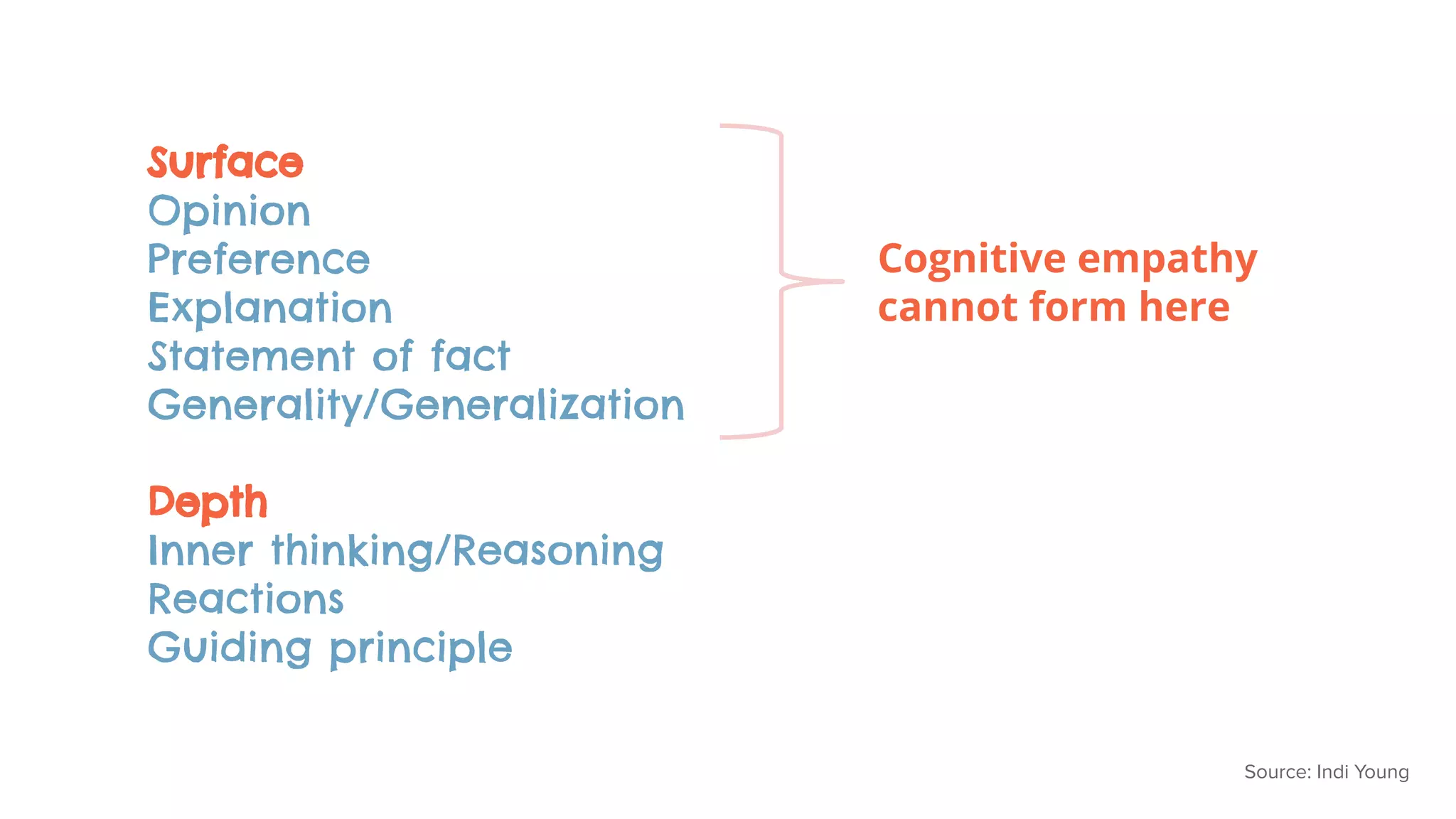
three things to listen for
Source: Indi Young
Surface
Opinion
Preference
Explanation
Statement of fact
Generality/Generalization
Depth
Inner thinking/Reasoning
Reactions
Guiding principle
Cognitive empathy
cannot form here
Source: Indi Young
inner thinking, reasoning - thought process,
why’s and wherefores, decision-making and
indecision
reaction - emotions, feelings that causes an
action, decision, or thought process
guiding principle - rule, philosophy, or
foundational instructions for making decisions
Source: Indi Young
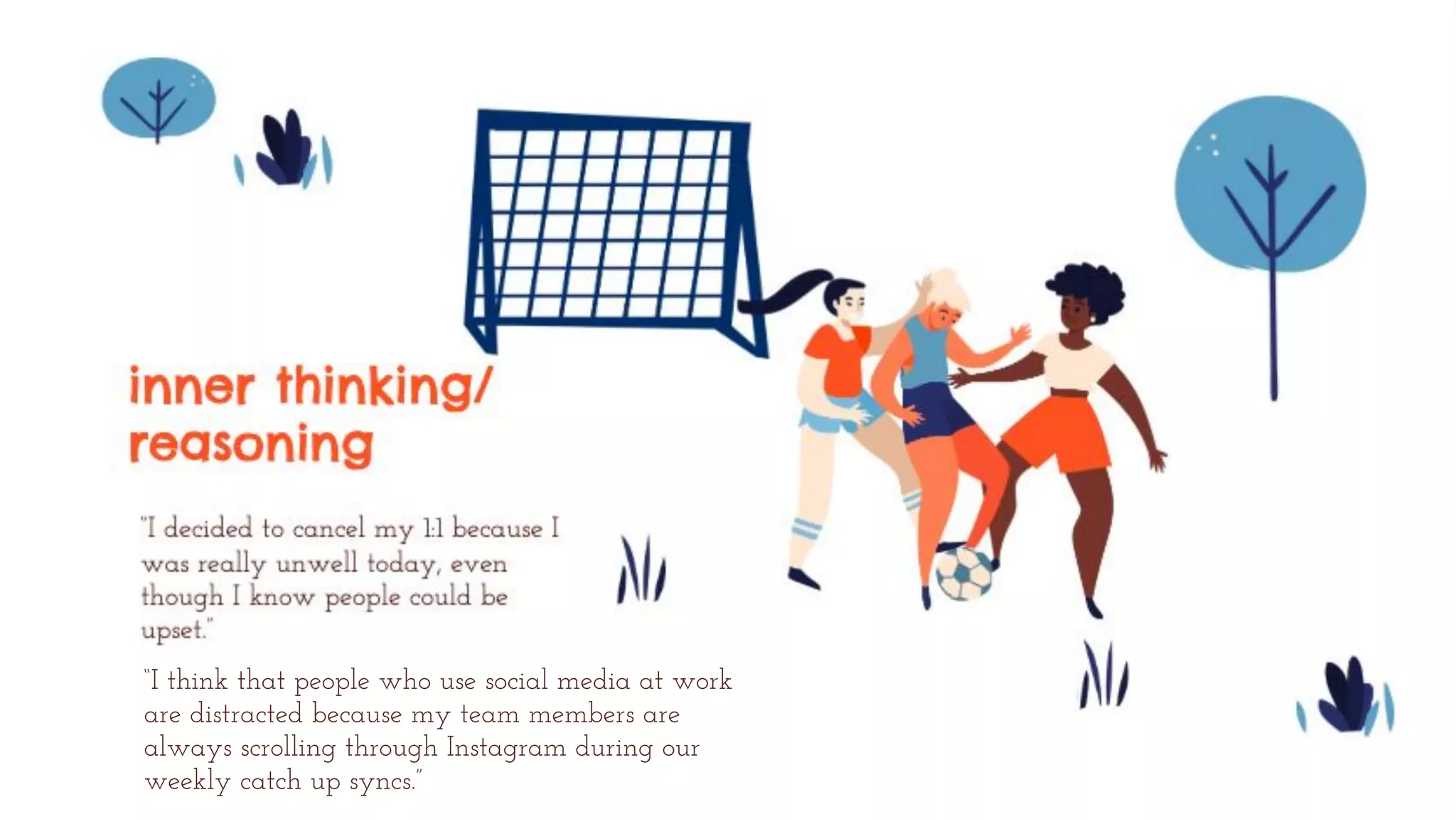
“I think that people who use social media at work
are distracted because my team members are
always scrolling through Instagram during our
weekly catch up syncs.”
Take-home question
Over the next few days, try to be more
aware at how you listen (or don’t listen) in
‘user’ interviews. How often do you interrupt?
How often do you shut down when the
conversation isn’t according to plan?
For Researchers
For all
designers
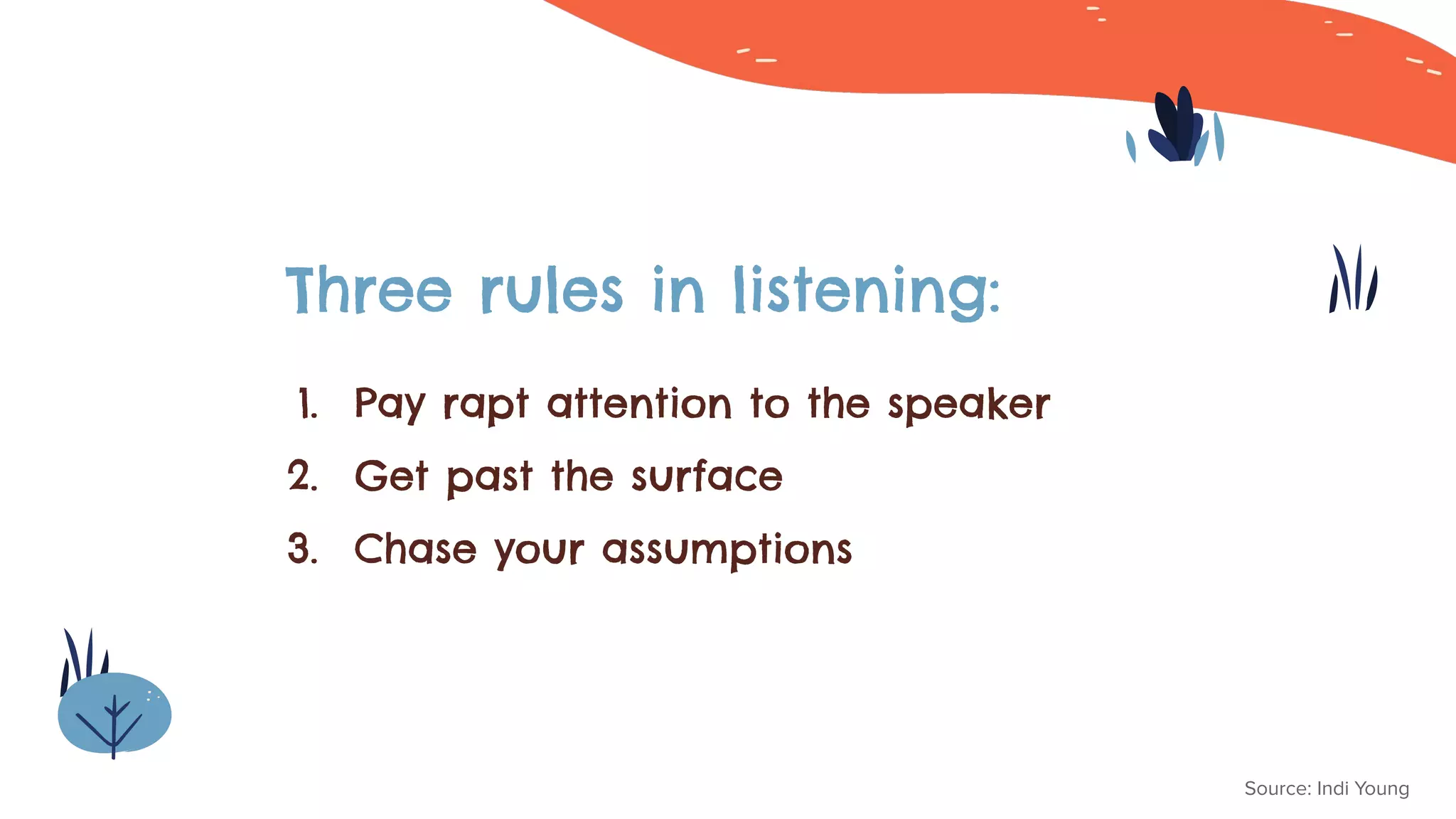
Three rules in listening:
Source: Indi Young
1. Pay rapt attention to the speaker
2. Get past the surface
3. Chase your assumptions
I asked a Product
Manager
I respected...
“What are some of your biggest
challenges in communicating and
collaborating with product
designers?”
“Being practical vs ideal. Sometimes the idea or
solution being explored by designers may be too far
fetched based on the current team’s capability.
Hence this may feel like inefficient use of time and
effort to solve the immediate problem.”
—Adi Alimin,
Vice President, Platform Products
Traveloka HQ
“A lot of designers talk about how PM's just shove
requirements down to them, and are not so involved
in the development process from the start.
Would you be able to share your perspective as to
why this happens and how this communication
breakdown can improve from a PM's perspective?”
“I think this may be due to lack of regular
communication between PM and designers. Without
this, PMs cannot share what they are thinking beyond
the current/active/ongoing project hence the
designers may feel they are only approached when
the project is about to start. In that case, the room
for discussion or brainstorming may unfortunately
already be too short hence the tension appears.”
—Adi Alimin,
Vice President, Platform Products
Traveloka HQ
“As a PM yourself, what are some
assumptions you make when
communicating and collaborating
with designers?
Are there some skills or values you
expect from them?”
“That designers come from specialized field while PMs are
generalist. They are artist that would like to delight and help users
with their works. On the other hand, PMs are very practical. I need
to try to absorb designers’ thought, recalibrate my own thought
and find the balance or win-win solution if there is a gap
between us. Skills/values expected from designers: be open
minded and iterative in finding the solution.
Over the years, I’ve learnt to be more patient and trying to give
more context of what I am trying to achieve or solve. By doing
this, I feel Designers can understand the why better, hence
empathise, and then give more ideas that may be really useful.”
—Adi Alimin,
Vice President, Platform Products
Traveloka HQ
Take-home question
In your next stakeholder listening session,
instead of “what do you want” or “why do you
need this”, try asking,
“What’s been keeping you up at night?
What’s been on your mind lately?
How are you feeling about the project?”
For Designers
For leaders
For leaders and
team members
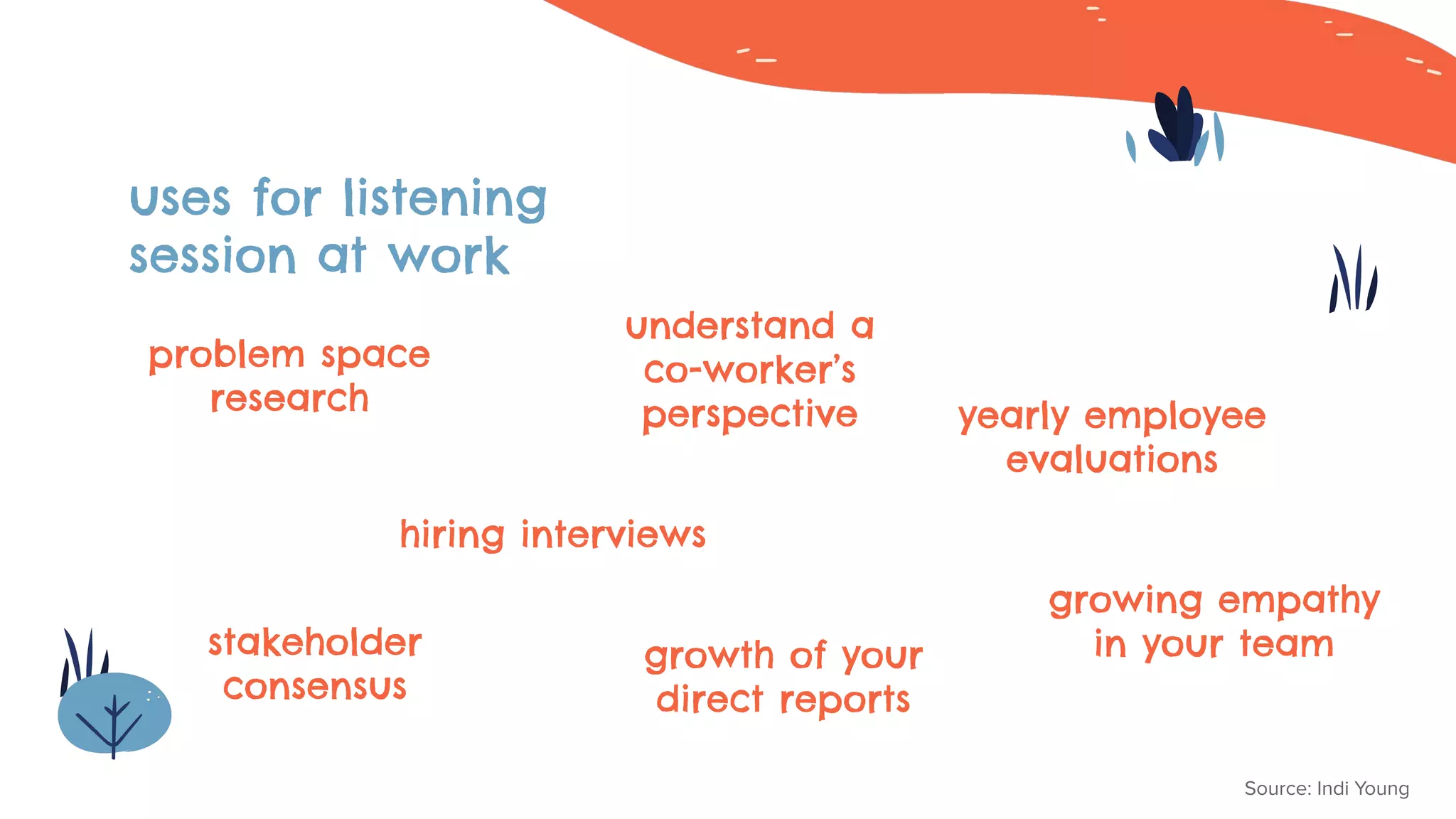
uses for listening
session at work
hiring interviews
problem space
research
understand a
co-worker’s
perspective
stakeholder
consensus
growth of your
direct reports
yearly employee
evaluations
Source: Indi Young
growing empathy
in your team
Take-home question
When was the last time you felt heard?
Recall why you felt so safe and heard and
use it to share with your team lead if there
is space to provide that feedback.
For Team
Members
Take-home question
When was the last time you felt heard?
Recall why you felt so safe and heard and
apply the same principles to your direct
reports. Learn to ask “Is there anything else
you would like to talk about?”
For Leaders
Ways listening
deeply has helped
me
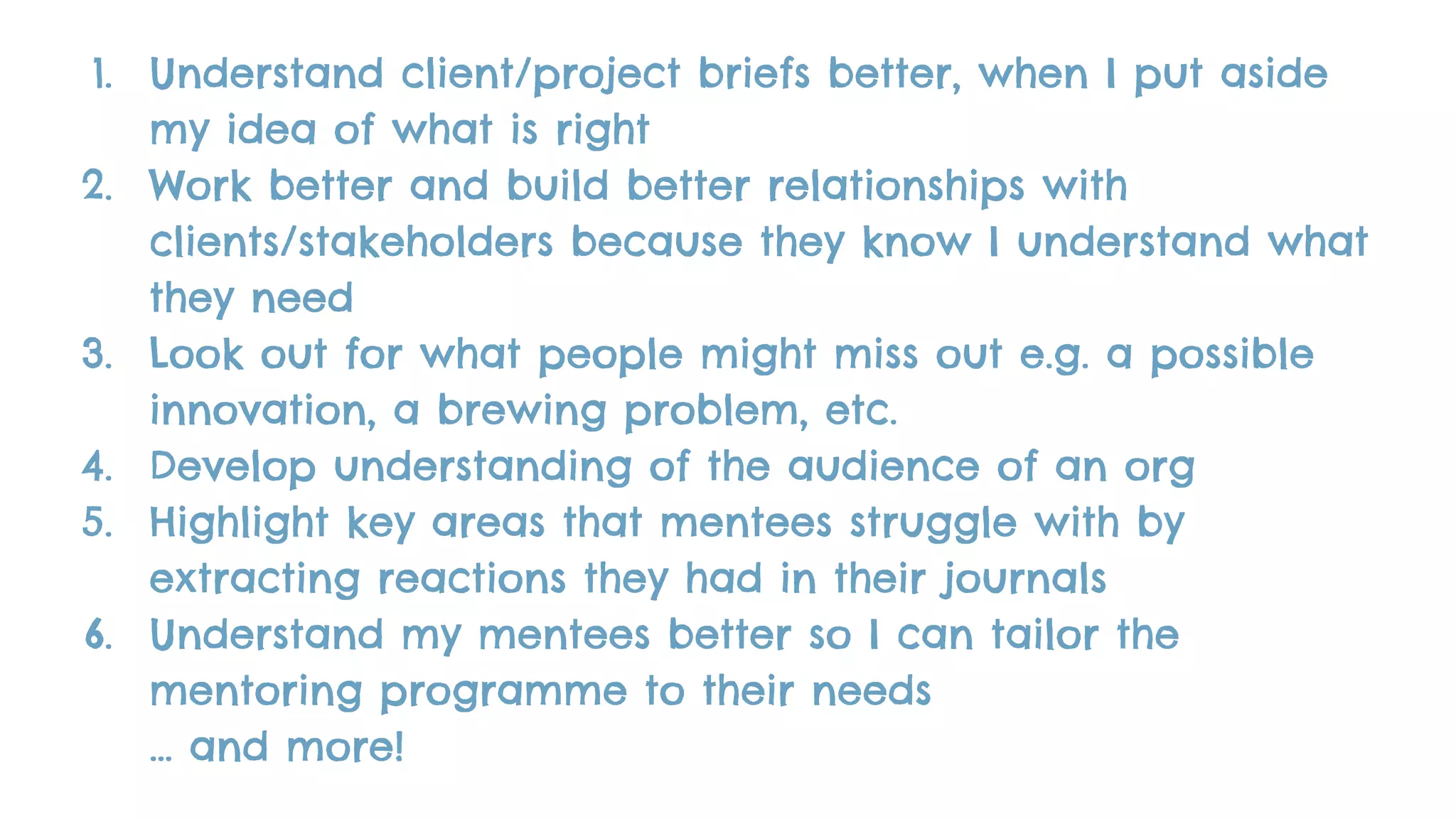
1. Understand client/project briefs better, when I put aside
my idea of what is right
2. Work better and build better relationships with
clients/stakeholders because they know I understand what
they need
3. Look out for what people might miss out e.g. a possible
innovation, a brewing problem, etc.
4. Develop understanding of the audience of an org
5. Highlight key areas that mentees struggle with by
extracting reactions they had in their journals
6. Understand my mentees better so I can tailor the
mentoring programme to their needs
… and more!
Feeling heard is a gift.
When was the last time
you felt heard?
Dig deeper for the
reasons and pass
this gift on.
It will transform
the way you
work.
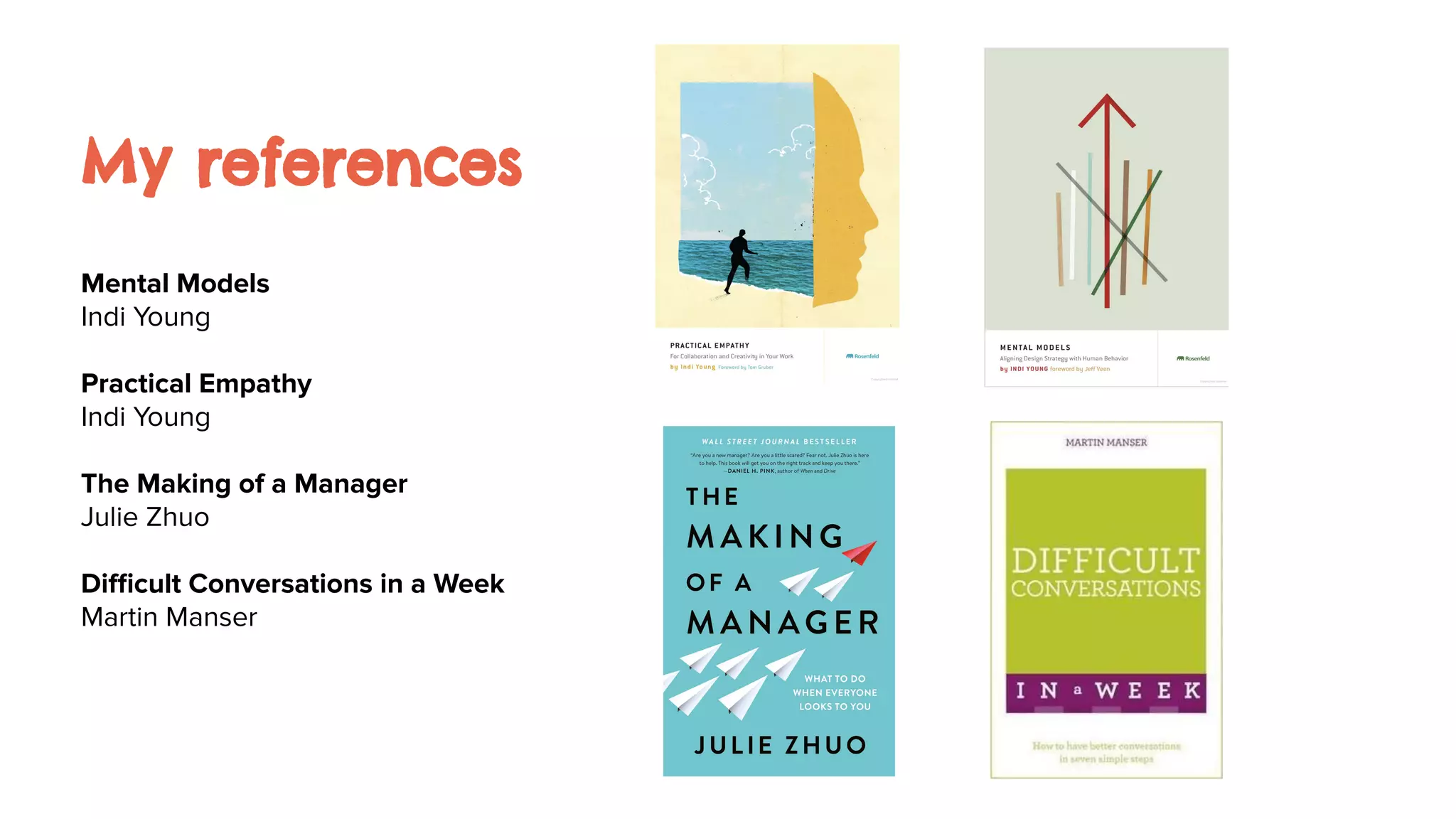
My references
Mental Models
Indi Young
Practical Empathy
Indi Young
The Making of a Manager
Julie Zhuo
Difficult Conversations in a Week
Martin Manser
Thank you for listening.
Huge thanks to Indi Young for her
methodology, mentoring and insights,
and Tafida Negm for her super helpful
feedback.
More questions?
peilingchin@gmail.com
www.commaconsultancy.co

How listening deeply can transform you into a better leader, designer, researcher and team member

  • 1.
    listening deeply Illustration by www.kellerdesign.com.my How cantransform you into a better designer, researcher, teammate and leader
  • 2.
  • 3.
    Photo by LukeEllis-Craven on Unsplash When was the last time you felt heard?
  • 4.
    1. Ways wealready listen 2. Why listen deeply? 3. Before you can listen deeply 4. How you can listen deeply 5. Ways listening deeply has helped me Illustration by www.kellerdesign.com.my
  • 5.
  • 6.
    thinking of whatwe want to say in response, instead of truly listening - wonder why my manager invited me for a sudden meeting - think of 100 different scenarios and how to reply my manager - imagine worst case scenario when sharing performance review results and how to counter argument from my direct report
  • 7.
    thinking of whatwe want to say in response - social banter to ease tension - make them laugh - make them feel better - impress them Source: Indi Young
  • 8.
    relationship affects how youlisten Adapted from Indi Young timid ... make assumptions instead of asking ... feels impolite to dig deeper ... might annoy the speaker ... speaker might have authority … past unpleasant experiences with the person … or looking down on a person more junior than we are, whether we admit it or not, causing us to shut down
  • 9.
  • 10.
    so that wecan develop empathy
  • 12.
    so that wecan develop empathy empathy is so powerful. it creates a connection. it moves conversations. it can cause action. it lasts beyond the conversation. it builds relationship.
  • 13.
    The cost ofnot listening deeply
  • 14.
    ● we fillourselves with assumptions and are led by them ● leaders breed an unconducive environment for trust to grow ● teams don’t have a safe space to be open ● team motivation and morale are affected, impacting work quality ● business performance and innovation can be highly impacted by lack of employee engagement … and more!
  • 15.
    “Each person hasspoken but failed to listen. It’s true that awareness of other people’s perspectives allows you to develop much stronger solutions together. Knowing someone’s perspective involves empathy. Empathy requires listening. It is empathy that will have a huge impact on how you work ... brings balance to your business.” —Indi Young— Author of Practical Empathy Co-founder of Adaptive Path
  • 16.
  • 17.
    EMPATHY IS NOT ‘SENSITIVITY’NOR EMOTION Source: Indi Young
  • 18.
  • 20.
  • 21.
    here’s where youdecide if you want to listen deeply it’s not going to be perfect on your first try. you don’t give up easily. it’s a habit you need to form. put aside your idea of what is right for the person, not because you are wrong, but because this attitude hinders you from listening deeply without cognition. stop talking about yourself. it’s about the other person. you listen so that you can understand.
  • 22.
  • 23.
    For UX orDesign Researchers
  • 24.
  • 25.
  • 26.
    Yup, ✓ no listof questions ✓ no probing ✓ no more “great! what about this...?” ✓ no one-upping the other person
  • 27.
    three things tolisten for Source: Indi Young
  • 28.
    Surface Opinion Preference Explanation Statement of fact Generality/Generalization Depth Innerthinking/Reasoning Reactions Guiding principle Cognitive empathy cannot form here Source: Indi Young
  • 29.
    inner thinking, reasoning- thought process, why’s and wherefores, decision-making and indecision reaction - emotions, feelings that causes an action, decision, or thought process guiding principle - rule, philosophy, or foundational instructions for making decisions Source: Indi Young
  • 30.
    “I think thatpeople who use social media at work are distracted because my team members are always scrolling through Instagram during our weekly catch up syncs.”
  • 33.
    Take-home question Over thenext few days, try to be more aware at how you listen (or don’t listen) in ‘user’ interviews. How often do you interrupt? How often do you shut down when the conversation isn’t according to plan? For Researchers
  • 34.
  • 35.
    Three rules inlistening: Source: Indi Young 1. Pay rapt attention to the speaker 2. Get past the surface 3. Chase your assumptions
  • 36.
    I asked aProduct Manager I respected...
  • 37.
    “What are someof your biggest challenges in communicating and collaborating with product designers?”
  • 38.
    “Being practical vsideal. Sometimes the idea or solution being explored by designers may be too far fetched based on the current team’s capability. Hence this may feel like inefficient use of time and effort to solve the immediate problem.” —Adi Alimin, Vice President, Platform Products Traveloka HQ
  • 39.
    “A lot ofdesigners talk about how PM's just shove requirements down to them, and are not so involved in the development process from the start. Would you be able to share your perspective as to why this happens and how this communication breakdown can improve from a PM's perspective?”
  • 40.
    “I think thismay be due to lack of regular communication between PM and designers. Without this, PMs cannot share what they are thinking beyond the current/active/ongoing project hence the designers may feel they are only approached when the project is about to start. In that case, the room for discussion or brainstorming may unfortunately already be too short hence the tension appears.” —Adi Alimin, Vice President, Platform Products Traveloka HQ
  • 41.
    “As a PMyourself, what are some assumptions you make when communicating and collaborating with designers? Are there some skills or values you expect from them?”
  • 42.
    “That designers comefrom specialized field while PMs are generalist. They are artist that would like to delight and help users with their works. On the other hand, PMs are very practical. I need to try to absorb designers’ thought, recalibrate my own thought and find the balance or win-win solution if there is a gap between us. Skills/values expected from designers: be open minded and iterative in finding the solution. Over the years, I’ve learnt to be more patient and trying to give more context of what I am trying to achieve or solve. By doing this, I feel Designers can understand the why better, hence empathise, and then give more ideas that may be really useful.” —Adi Alimin, Vice President, Platform Products Traveloka HQ
  • 43.
    Take-home question In yournext stakeholder listening session, instead of “what do you want” or “why do you need this”, try asking, “What’s been keeping you up at night? What’s been on your mind lately? How are you feeling about the project?” For Designers
  • 44.
  • 45.
  • 46.
    uses for listening sessionat work hiring interviews problem space research understand a co-worker’s perspective stakeholder consensus growth of your direct reports yearly employee evaluations Source: Indi Young growing empathy in your team
  • 47.
    Take-home question When wasthe last time you felt heard? Recall why you felt so safe and heard and use it to share with your team lead if there is space to provide that feedback. For Team Members
  • 48.
    Take-home question When wasthe last time you felt heard? Recall why you felt so safe and heard and apply the same principles to your direct reports. Learn to ask “Is there anything else you would like to talk about?” For Leaders
  • 49.
  • 50.
    1. Understand client/projectbriefs better, when I put aside my idea of what is right 2. Work better and build better relationships with clients/stakeholders because they know I understand what they need 3. Look out for what people might miss out e.g. a possible innovation, a brewing problem, etc. 4. Develop understanding of the audience of an org 5. Highlight key areas that mentees struggle with by extracting reactions they had in their journals 6. Understand my mentees better so I can tailor the mentoring programme to their needs … and more!
  • 51.
    Feeling heard isa gift. When was the last time you felt heard? Dig deeper for the reasons and pass this gift on. It will transform the way you work.
  • 52.
    My references Mental Models IndiYoung Practical Empathy Indi Young The Making of a Manager Julie Zhuo Difficult Conversations in a Week Martin Manser
  • 53.
    Thank you forlistening. Huge thanks to Indi Young for her methodology, mentoring and insights, and Tafida Negm for her super helpful feedback. More questions? peilingchin@gmail.com www.commaconsultancy.co