How Encryption Works
Introduction to How Encryption Works


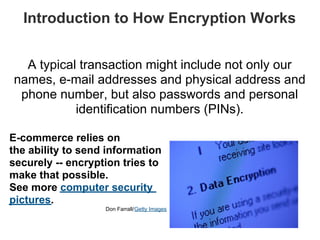
  A typical transaction might include not only our
names, e-mail addresses and physical address and
 phone number, but also passwords and personal
           identification numbers (PINs).

E-commerce relies on
the ability to send information
securely -- encryption tries to
make that possible.
See more computer security
pictures.
                   Don Farrall/Getty Images
Security Encryption Systems

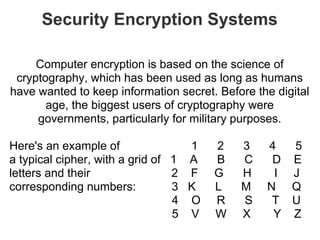
     Computer encryption is based on the science of
 cryptography, which has been used as long as humans
have wanted to keep information secret. Before the digital
       age, the biggest users of cryptography were
     governments, particularly for military purposes.

Here's an example of               1   2    3    4  5
a typical cipher, with a grid of 1 A   B    C     D E
letters and their                2 F   G    H     I J
corresponding numbers:           3 K   L    M    N Q
                                 4 O   R    S     T U
                                 5 V   W    X     Y Z
Symmetric Key


 In symmetric-key encryption, each computer has a secret
  key (code) that it can use to encrypt a packet of information
    before it is sent over the network to another computer.
Symmetric-key requires that you know which computers will be
 talking to each other so you can install the key on each one.
 Symmetric-key encryption is essentially the same as a secret
  code that each of the two computers must know in order to
decode the information. The code provides the key to decoding
                          the message.
Public Key Encryption


   In November 1976, a paper published in the journal IEEE
 Transactions on Information Theory, titled "New Directions in
    Cryptography," addressed this problem and offered up a
              solution: public-key encryption.
    Also known as asymmetric-key encryption, public-key
encryption uses two different keys at once -- a combination of a
                 private key and a public key.
SSL and TLS

     A popular implementation of public-key encryption is
  the Secure Sockets Layer (SSL). Originally developed by
Netscape, SSL is an Internet security protocol used by Internet
 browsers and Web servers to transmit sensitive information.
SSL has become part of an overall security protocol known as
              Transport Layer Security (TLS).

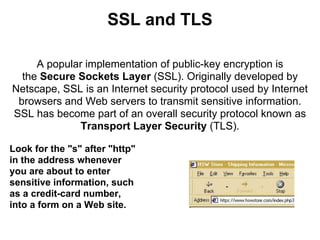
Look for the "s" after "http"
in the address whenever
you are about to enter
sensitive information, such
as a credit-card number,
into a form on a Web site.

How encryption works

  • 1.
  • 2.
    Introduction to HowEncryption Works A typical transaction might include not only our names, e-mail addresses and physical address and phone number, but also passwords and personal identification numbers (PINs). E-commerce relies on the ability to send information securely -- encryption tries to make that possible. See more computer security pictures. Don Farrall/Getty Images
  • 3.
    Security Encryption Systems Computer encryption is based on the science of cryptography, which has been used as long as humans have wanted to keep information secret. Before the digital age, the biggest users of cryptography were governments, particularly for military purposes. Here's an example of 1 2 3 4 5 a typical cipher, with a grid of 1 A B C D E letters and their 2 F G H I J corresponding numbers: 3 K L M N Q 4 O R S T U 5 V W X Y Z
  • 4.
    Symmetric Key Insymmetric-key encryption, each computer has a secret key (code) that it can use to encrypt a packet of information before it is sent over the network to another computer. Symmetric-key requires that you know which computers will be talking to each other so you can install the key on each one. Symmetric-key encryption is essentially the same as a secret code that each of the two computers must know in order to decode the information. The code provides the key to decoding the message.
  • 5.
    Public Key Encryption In November 1976, a paper published in the journal IEEE Transactions on Information Theory, titled "New Directions in Cryptography," addressed this problem and offered up a solution: public-key encryption. Also known as asymmetric-key encryption, public-key encryption uses two different keys at once -- a combination of a private key and a public key.
  • 6.
    SSL and TLS A popular implementation of public-key encryption is the Secure Sockets Layer (SSL). Originally developed by Netscape, SSL is an Internet security protocol used by Internet browsers and Web servers to transmit sensitive information. SSL has become part of an overall security protocol known as Transport Layer Security (TLS). Look for the "s" after "http" in the address whenever you are about to enter sensitive information, such as a credit-card number, into a form on a Web site.