How effective is innovation support for SMEs? An analysis of the region of Upper Austria
1.
Technovation 22 (2002)147–159
www.elsevier.com/locate/technovation
How effective is innovation support for SMEs? An analysis of the
region of Upper Austria
Alexander Kaufmann a,*
, Franz Tödtling b
a
Austrian Research Centers Seibersdorf, Systems Research Technology–Economy–Environment, A-2444 Seibersdorf, Austria
b
Department of City and Regional Development, University of Economics and Business Administration, Roßauer Lände 23,
A-1090 Vienna, Austria
Abstract
SMEs are confronted with particular problems constraining their innovation activities. How their needs are fulfilled by support
instruments has been investigated in a recent European research project. The results for the region of Upper Austria lead to the
conclusion that some of the support is mistargeted, disregarding certain indicated or latent deficiencies of SMEs: direct financial
support concentrates on research and development, neglecting the commercialization of innovations. In general, high-technology
innovation projects are preferred, less technologically advanced or innovative firms lack adequate support. The spillover effects of
technology centres are limited. The problem that most SMEs hardly interact with knowledge providers from outside the business
sector (e.g., universities) is not reduced by the support instruments. Furthermore, they perform insufficiently the function of interfaces
to innovation-related resources and information from outside the region. There is a lack of proactive consultancy concerning strategic,
organizational, and technological weaknesses which is necessary because often the firms are not aware of such deficiencies. 2002
Elsevier Science Ltd. All rights reserved.
Keywords: SME; Innovation support instrument; Upper Austria
1. Introduction
Innovation is one of the most important strategies of
competition, both for small and large firms. It is often
argued that SMEs innovate in specific ways, different
from the innovation process in large firms. While there
are certain size-specific features, the heterogeneity of the
SME sector prevents simple generalizations. Regarding
innovative performance, the heterogeneity is caused by
a mix of factors. The most important are:
앫 The technological level. Higher-technology and
“technology-driven” (Hassink, 1996) firms are more
active in product innovation, especially as far as pro-
ducts which are new to the market are concerned.
Lower-technology firms, on the contrary, focus more
on process innovations and cost reduction.
* Corresponding author. Tel.: +43-2254-780-3889; fax: +43-2254-
780-3888.
E-mail address: alexander.kaufmann@arcs.ac.at (A. Kaufmann).
0166-4972/02/$ - see front matter 2002 Elsevier Science Ltd. All rights reserved.
PII: S0166-4972(00)00081-X
앫 The market relations. The more dependent a firm is
on dominant customers, the more likely is the
incremental character of their innovation activities.
Most clients tend to stick to already known solutions
and applications and are hardly willing to assess
unfamiliar innovations (von Hippel, 1988).
앫 The strategies of competition. Competition through
improved quality and new functions favours inno-
vation whereas price competition is less stimulating
(Smallbone et al., 2000). Competition based on design
leads to frequent product innovations, but they are
usually incremental.
This heterogeneity is one of the reasons why there are
contradictory results comparing the levels of innovative-
ness between SMEs and large firms. Some studies have
found evidence that SMEs are generally more innovative
(Pavitt et al., 1987; Acs and Audretsch, 1990), whereas
according to other studies large firms appeared to be
more innovative (Community Innovation Survey,
1997/98; Craggs and Jones, 1998; Kaufmann and
Tödtling, 1999). The ongoing process of globalization,
2.
148 A. Kaufmann,F. Tödtling / Technovation 22 (2002) 147–159
however, raises the importance of innovation in the
whole SME sector, because it makes it possible for com-
petition to invade formerly safe market niches (Malecki
and Tödtling, 1995; Smallbone et al., 2000).
The region is especially important in the innovation
process of SMEs. Their external relations are more con-
fined to the region than those of large firms, a finding
which has also been identified by the REGIS project
(Cooke et al., 2000) and other research efforts
(Sternberg, 2000; Fritsch et al., 1998). The region is a
highly relevant support space for the innovation process
of firms because of the necessity to have face-to-face
interaction to exchange tacit knowledge and to collabor-
ate in joint innovation projects. Another advantage of
proximity is the spatially limited mobility of workforce
and graduates from schools, both very important mech-
anisms of knowledge transfer to firms. While these are
general arguments in favour of the regional level of
innovation networks, there are specific features of SMEs
which make the region comparatively more important
for them than for large firms. SMEs are usually less cap-
able of searching for and using codified knowledge
(scientific in particular) which forces them to rely more
on personal ways of transferring this knowledge and on
learning-by-doing and -interacting. Furthermore, it is
more difficult for them to apply formal contracts, relying
more on trust-based, informal relations instead. The
exact nature of a region’s support for the innovation pro-
cess of firms depends on the respective institutional set-
ting (e.g., universities and other research organizations,
vocational training institutions, technology centres and
transfer agencies) and the structure of the regional econ-
omy (dominant industries, availability of service firms
and adequate suppliers, organizations providing inno-
vation finance). The heterogeneity of the SME sector
makes it very difficult to target innovation support for
SMEs in a way that they match the specific problems
and needs of very different firms. Through a regional
innovation policy innovation support could be designed
to specifically target the particular needs of firms in the
respective region.
Data from a research project — SME Policy and the
Regional Dimension of Innovation (SMEPOL, see
acknowledgements) — enable us to assess better if SME
innovation support targets the real problems of the firms
as well as the right firms, i.e., those SMEs which need
support most or have the potential for the largest
improvement in innovativeness. The research objectives
of the SMEPOL project were to evaluate instruments
supporting innovation in the SME sector1
of certain Eur-
opean regions — the North and South-East of Norway,
Upper Austria, central Denmark, Lombardy and Apulia
1
“SME” is defined as a firm with less than 250 employees and no
participation of a larger company accounting for more than 25%.
in Italy, Limburg in The Netherlands, Wallonia, the
region of Valencia, and the Lee Valley region of London
and the adjacent outer metropolitan area. For each
region, effects, strengths, and weaknesses of selected
instruments — both regional instruments as well as the
regional effects of national instruments — were investi-
gated in order to deduce good-practice policy lessons for
regional SME-innovation support. Within the SMEPOL
project a broad range of support instruments in very
diverse and specific regional settings in eight European
countries were analysed. In this article we will deal with
one case in detail — the region of Upper Austria.
2. The study region
The Austrian region which has been investigated in
the SMEPOL project is the province of Upper Austria,
one of the nine provinces (“Bundesländer”) of the
Austrian state. The region borders on Germany and the
Czech Republic, its population is 1.4 million. Formally
the province has a wide range of competences for econ-
omic policy. In fact, however, the room for autonomous
political activities is constrained by the small financial
capacity compared with the state of Austria. Upper Aus-
tria has an industrial core region formed by the three
cities of Linz (the capital of the province), Wels, and
Steyr. Outside this core area there are peripheral areas
in the north and south of Upper Austria but also several
smaller industrial centres. The province has a long
manufacturing tradition based on metal/steel-products
and machinery. These industries are still very important,
but today, the industrial structure is more diversified,
comprising also transport, mining, and chemicals. Dur-
ing the Second World War, Germany had established
large metal-and-steel and chemical plants for military
needs. After the war they were extended to vertically
integrated manufacturing entities which were huge for
Austrian standards. These state-owned companies had an
important function in the Austrian deficit-spending pol-
icy to fight recession after 1973. Employment was the
more important objective than competitiveness. Due to
labour hoarding the nationalized companies’ pro-
ductivity decreased strongly. At the end of the 1980s the
structural weaknesses resulted in a serious crisis of the
nationalized sector. Finally, the conglomerates had to be
split up and privatized, some parts were sold to foreign
companies. Firms were downsized strongly and, as a
consequence, employment decreased significantly lead-
ing to serious labour market problems in the early 1990s.
Overall, the recovery after the crisis has been successful,
but the metal-and-steel sector and, as a result, the whole
manufacturing sector is smaller today. Despite the pro-
cess of restructuring, Upper Austria has been and is still
one of the most important industrial areas in Austria
(Lackinger, 1997).
3.
149
A. Kaufmann, F.Tödtling / Technovation 22 (2002) 147–159
The regional government of Upper Austria is very
active regarding industrial, technology, and innovation
policy. There is a special organization responsible for
technology policy and investment marketing in the
region, the Technology and Marketing Corporation in
Linz. It has formulated a strategic concept for the tech-
nology policy in Upper Austria focusing in particular on
strengthening applied R&D, intensified collaboration in
clusters (metal and steel, machinery, vehicles), and
improving technology transfer (Oberösterreichische
Technologie- und Marketinggesellschaft, 1998). The
province and certain municipalities try to support the
technology- and innovation-infrastructure in Upper Aus-
tria, in particular concentrating on technology centres
and technical colleges. The most important institutions
in the so-called Upper Austrian Technology Network are
the six technology centres. Most of them are incubation
centres or business parks. Only two centres are also
engaged in research. Another element of the technology-
and innovation-related system are the recently estab-
lished three technical colleges (“Fachhochschulen”).
But the network also has weak points. The regional uni-
versity, located in Linz, is relatively small compared to
the major university locations in Austria, Vienna and
Graz, and it is not specialized in technology. There are
also no major contract research organizations as in other
parts of Austria. Other institutional deficiencies in the
system concern technology transfer services and inno-
vation management consultancy.
3. The innovation process of SMEs and typical
problems
This chapter is a summary of typical features of the
innovation process in SMEs, based on literature and
some key results from the Austrian SMEPOL-survey
(Kaufmann and Tödtling, 1999). Before we present the
results of the data analysis, however, it is necessary to
describe some technical details of the survey: the survey
in Upper Austria, covering the manufacturing sector as
well as producer services, was conducted in 1998. A
total of 204 firms answered which corresponds to a
response rate of 18%, 140 of them were classified as
SMEs. The distribution of the size of firms (in terms of
employment) within the sample of respondents corre-
sponds approximately to the regional economy. As far
as the industrial structure is concerned, the metal-and-
steel industry and metal products are overrepresented
while chemicals, textiles, and clothes are underrepres-
ented in the sample.
Due to the heterogeneity of the SME sector it is
impossible to produce an exhaustive list of innovation
related needs which applies to all kinds of SMEs. How-
ever, there are some general aspects of the innovation
process which are valid for most SMEs, because they
are directly or indirectly size related.
3.1. Resources and strategies of innovation
SMEs innovate with higher resource intensity than
large firms, especially regarding human resources. In
Upper Austria the average innovation budget in relation
to turnover is 11.0%, the average innovation staff in
relation to employment is 15.6% in the case of SMEs.
Large firms, for comparison, have average ratios of
10.3% and 8.3%, respectively. SMEs usually cannot be
organized in a way which allows them to benefit from
specialization to the same extent as larger firms. This is
an important disadvantage of small firms, because they
are particularly confronted with a limited resource base
anyway, regarding capital as well as time and know-how
of the employees.
SMEs are less often engaged in research than large
firms. In Upper Austria, research is performed by only
12.9% of the SMEs compared to 31.3% of the large
firms. Of course, there are highly research-intensive
SMEs, but in general, SMEs are confronted with serious
size-specific barriers restricting the potential to do
research: lack of financial resources, a small product
range restricting the possibility to substitute for the lack
of sales and profits through other products (“cash cows”)
to the same extent as large firms, too few or insuf-
ficiently qualified personnel, lack of time of the key per-
sons who are preoccupied with day-to-day work, diffi-
culties in adopting high technology, a lack of advanced
technical know-how, and limited search capabilities,
especially as far as scientific knowledge is concerned.
SMEs are less able to shape and influence the external
environment than large firms (Smallbone et al., 2000).
One of the consequences — as far as established firms
are concerned, not start-ups — is a tendency to innovate
in a reactive or defensive way. Customers, in particular,
play an important role in guiding the innovation activi-
ties of their suppliers (von Hippel, 1988). Depending on
the clients’ wishes and specifications makes it difficult
to go beyond incremental innovation, however. In Upper
Austria the most frequent innovation strategies are spe-
cialization on niches and improving quality (Table 1).
Due to the limited resources and marketing capacities it
is, of course, more difficult for SMEs to try to enter into
or open up new markets than for large firms. Within the
Table 1
Innovation strategiesa
% of SMEs % of large firms
Diversification into new markets 18.6 23.4
Quality improvement 52.1 43.8
Specialization on a market niche 58.6 53.1
Cost reduction, productivity 42.1 67.2
increase
a
Source: SMEPOL-survey Upper Austria.
4.
150 A. Kaufmann,F. Tödtling / Technovation 22 (2002) 147–159
SME sector, only in the case of firms engaged in
research is the offensive strategy of diversification more
frequent. The differences between other types of SMEs
are negligible in this respect.
3.2. External relations in the innovation process
It is quite frequent for firms — SMEs as well as large
firms — to have external relations with business organi-
zations contributing to their innovation activities. The
data presented in Table 2 correspond to the results of
other studies (e.g., Fritsch and Lukas, 1997; Sternberg,
1998; Kaufmann and Tödtling, 2000a) showing that the
innovation relationships of firms are predominantly
within the business sector, customers and suppliers being
most important, less service firms and horizontal
relations. A limited number of durable and selective
user–producer relationships are usually shaping and
restricting most of the product innovation activities of
firms — especially small firms — because any change
is costly implying the loss of accumulated informational
capital (Lundvall, 1992). Furthermore, customers are
often unwilling or not ready to assess unfamiliar inno-
vations or to formulate an explicit need for them (von
Hippel, 1988), which also restricts the ability of the sup-
pliers to engage in more radical innovation projects.
While SMEs are hardly less active than large firms as
far as interactions within the business sector are con-
cerned, there is a far more significant difference regard-
ing knowledge providers, both from science and tech-
nology. SMEs are rarely interacting with universities,
contract research organizations, technology centres, and
training institutions (see also Cooke et al., 2000). Even
if one considers that large firms too are not often inter-
acting with these institutions, this is a specifically serious
weakness of the SME sector. Without relations beyond
the business sector, information and knowledge tends to
be restricted to the well-known market leading to depen-
dency either on strong business partners — usually
dominant customers — or small markets for specialized
Table 2
External relations in the innovation processa
% of SMEs having % of large firms having
any kind of relations cooperations any kind of relations cooperations
Customers 78.6 48.6 87.5 53.1
Suppliers 60.7 40.7 79.7 39.1
Other firms (horizontal relations) 27.1 10.0 37.5 15.6
Service firms 34.3 15.0 46.9 20.3
Universities 27.9 7.9 71.9 37.5
Other research organizations 14.3 5.7 46.9 21.9
Technology centres 13.6 5.7 39.1 14.1
Training institutions 15.7 5.0 35.9 12.5
a
Source: SMEPOL-survey Upper Austria.
products or services, without being able to substitute for
other products if this market crumbles. A statistical
analysis of data from a survey on innovation systems
in several European regions (Kaufmann and Tödtling,
2000b) leads to the conclusion that it is particularly the
interaction with science that stimulates more advanced
innovation, i.e., products which are new to the market
and not only imitations or modifications. Of course, there
are differences between types of SMEs in this respect.
The technological level of a firm is one of the most
decisive characteristics distinguishing between different
levels of willingness or the ability to cooperate (Keeble
et al., 1997). In Upper Austria the most active SMEs
regarding innovation cooperation with science partners
are high-technology firms, firms engaged in research,
and firms applying relatively more resources (funds as
well as manpower) to innovation activities than the aver-
age.
However, it is not only the lack of relations with inno-
vation partners from science and technology which con-
strains positive external influences on the innovation
process of firms, this can also be due to the character of
the relations. Only few of them are cooperative relations
in joint innovation projects with intensive collaboration
and information exchange according to shared objec-
tives. The frequency of “real” cooperations with science
institutions in particular is negligible (Table 2). A study
on innovation cooperations in certain German regions
(Fritsch and Lukas, 1997) contains some evidence that
joint R&D projects might have become more important
today — it was found that R&D cooperations were more
frequent than research contracts — but nevertheless, the
most frequent form of relation between industry and
science was still the use of equipment and laboratories
(without further interaction). This is a serious weakness,
if one recognizes the importance of the exchange and
joint creation of knowledge in industry–science
cooperations for the stimulation of innovation, especially
in the early phases of an innovation process when new
ideas are created and new concepts developed (Fritsch
and Schwirten, 1998).
5.
151
A. Kaufmann, F.Tödtling / Technovation 22 (2002) 147–159
An important reason for the lack of relations with
innovation partners outside the business sector is the
small number of employees in SMEs who are able to act
as nodes establishing and maintaining links to innovation
networks. This restricts the potential to search for and
collect innovation-related information and to collaborate
in cooperative innovation projects. There is a lack of
experienced employees as well as a lack of time in the
case of the few adequately qualified persons due to rou-
tine and administrative work. Market research, for
example, is very rare in Upper Austrian SMEs (17%).
Therefore, the danger of a “lock-in” is greater in the case
of SMEs than large firms. Large firms, on the contrary,
can establish and maintain relations to a broader range
of sources of information and cooperation partners. In
Upper Austria large firms are particularly more often
engaged in innovation cooperations outside the region,
in Austria as well as abroad, and with partners from
science and technology.
SMEs focus more on the region than large firms as
far as external relations in the innovation process are
concerned. In Upper Austria this applies primarily to the
firms’ business relations — customers, suppliers, and
horizontal relations — whereas in the case of service
firms and technology centres the large firms, too, rely
more on regional institutions. Only universities are more
important on the national level, because the most
important universities are located outside Upper Austria.
A too dominant focus on the region limits the scope of
available technical information, technologies, and
accessible markets. In Upper Austria the region-centred
view is particularly pronounced in the case of traditional
industries and the service sector. There is also the prob-
lem of a lack of adequate innovation partners to cooper-
ate with due to the limited scope of the region. In Upper
Austria this is one of the most frequent reasons of SMEs
not to cooperate. Of course, there are exceptions to the
modest networking activity like highly specialized tech-
nologically advanced SMEs which are small as well as
export-oriented and embedded into international net-
works. Technology intensive firms are usually more
involved in innovation networks, both on local and inter-
national levels (Keeble et al., 1997).
Personal face-to-face interaction is important in the
innovation process due to the role of tacit knowledge in
addition to more easily transferable codified knowledge
(Lundvall and Borrás, 1998), the fact that many inno-
vation-related interdependencies cannot be traded
(Storper 1995, 1997), and the necessity of durable trust-
based relations as a precondition to exchange valuable
knowledge (De Bresson and Walker, 1991; Cooke and
Morgan, 1993). The advantages of proximity and insti-
tutional settings specifically adequate to serve the needs
of the regional economy are the reasons why the region
is an important spatial level in innovation systems
(Braczyk et al., 1998; Cooke et al., 2000). However, the
close interaction in local production systems (Garofoli,
1991; Pyke and Sengenberger, 1992; Asheim, 1996),
innovative milieux (Aydalot and Keeble, 1988; Maillat,
1991), or high tech regions (Saxenian, 1994; Castells and
Hall, 1994; Tödtling, 1994) can also lead to negative
consequences. The structure of innovation networks can
become rigid, long established routines in innovation
processes can restrict more innovative or radical product
development activities. Such a “lock-in” situation can
only be avoided if companies have a well-developed
absorptive capacity regarding external research results
and if they maintain flexible interaction (“weak ties”)
with a wide range of innovation partners (Granovetter,
1973; Grabher, 1993; Meyer-Krahmer and Schmoch,
1998). Involvement in distant networks is important for
any innovative milieu to avoid paralysis (Camagni,
1991).
3.3. Innovation barriers
The most frequently indicated barriers constraining
innovation are financial — lack of funds for innovation,
too high risk of innovation projects, too expensive tech-
nology. This applies both to SMEs and large firms. Man-
power is the second most frequent bottleneck, either
because adequately qualified personnel are missing or
there is a lack of time available for innovation activities.
This kind of problem is slightly more frequent in the
SME sector. In contrast, technological barriers like
insufficient technical know-how or unavailable tech-
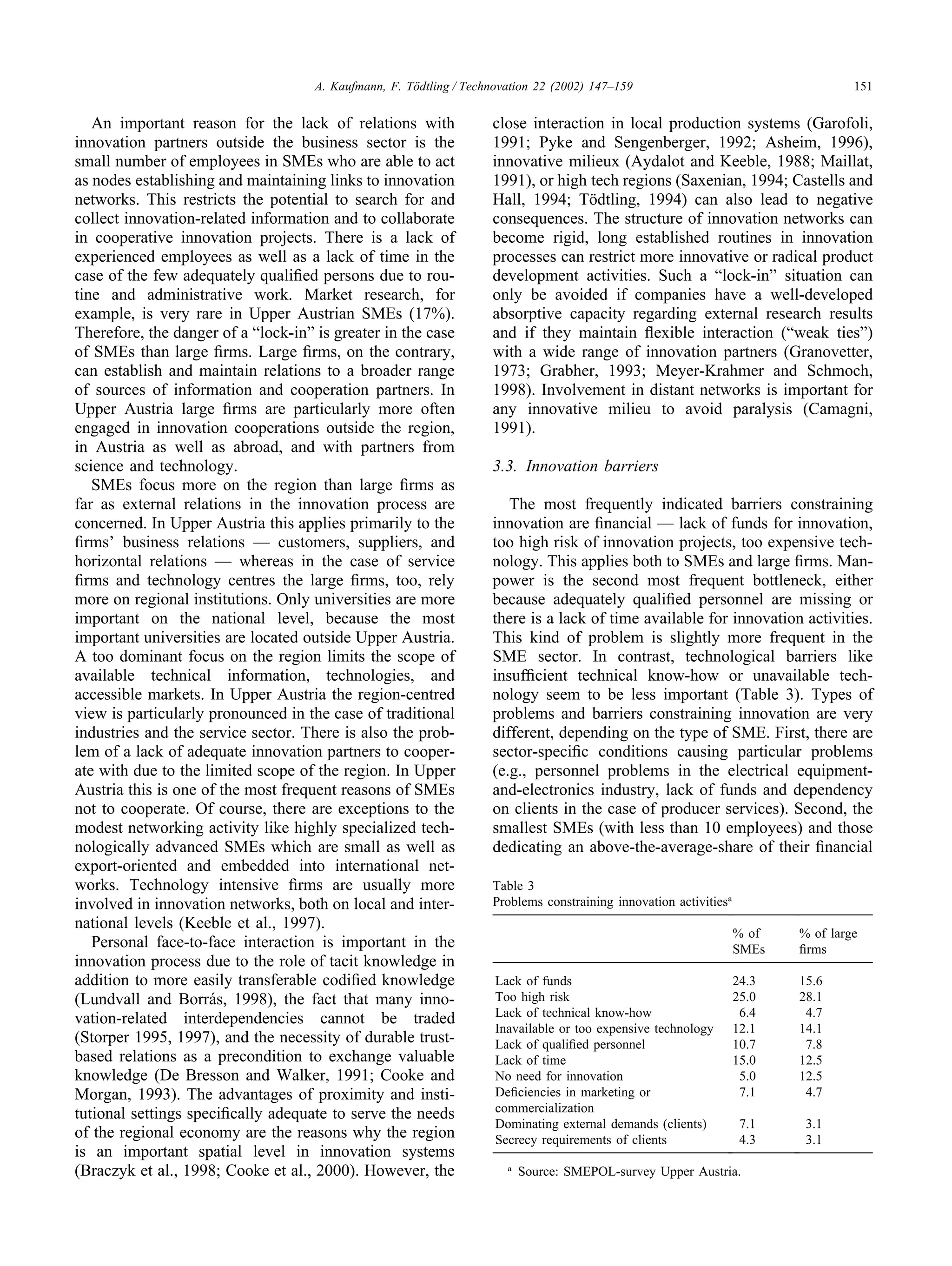
nology seem to be less important (Table 3). Types of
problems and barriers constraining innovation are very
different, depending on the type of SME. First, there are
sector-specific conditions causing particular problems
(e.g., personnel problems in the electrical equipment-
and-electronics industry, lack of funds and dependency
on clients in the case of producer services). Second, the
smallest SMEs (with less than 10 employees) and those
dedicating an above-the-average-share of their financial
Table 3
Problems constraining innovation activitiesa
% of % of large
SMEs firms
Lack of funds 24.3 15.6
Too high risk 25.0 28.1
Lack of technical know-how 6.4 4.7
Inavailable or too expensive technology 12.1 14.1
Lack of qualified personnel 10.7 7.8
Lack of time 15.0 12.5
No need for innovation 5.0 12.5
Deficiencies in marketing or 7.1 4.7
commercialization
Dominating external demands (clients) 7.1 3.1
Secrecy requirements of clients 4.3 3.1
a
Source: SMEPOL-survey Upper Austria.
6.
152 A. Kaufmann,F. Tödtling / Technovation 22 (2002) 147–159
resources to innovation are especially confronted with
financial constraints. Third, manpower bottlenecks seem
to be most serious in the case of firms engaged in
research. Finally, problems are in general more serious
in the case of lower-technology than higher-technology
firms.
The dominant role of the entrepreneur or the owner
of a small firm can lead to a narrow strategic perspective,
in particular when he/she lacks formal training or quali-
fications (Smallbone et al., 2000). Strategic deficiencies
and organizational weaknesses of SMEs are of central
importance constraining innovation. A related problem
is the narrow focus of many SMEs on their customers,
making their innovation process dependent on them. Fre-
quently this is reinforced by the neglect of systematic
search activities concerning new market opportunities. It
is important not to neglect other types of problems than
financial or technical which are constraining innovation.
Often firms do not sufficiently recognize them. Insuf-
ficient awareness of deficiencies seems to concern prim-
arily innovation partnerships, strategies, and market
information and research. It is especially the value of
cooperation for innovativeness which is underassessed
by many SMEs. In Upper Austria the most frequent rea-
son for SMEs not interacting is “no need”. In addition,
market research activities are rarely performed. The
problem “lack of time” is usually better recognized. It
was frequently indicated in the survey that the daily
work-overload of very few persons or even a single per-
son in SMEs impedes or delays innovation projects. It
seems to be less often recognized, however, that organi-
zational improvements could lead to an increase in the
time available for innovation activities.
4. Support services offered by the investigated
instruments
4.1. Regional technology centres
From the six technology centres in Upper Austria two
are research-oriented — Software Park Hagenberg
(SWP) and Research and Training Centre for Labour and
Technology Steyr (FAZAT). The other four — Incu-
bation and Technology Centre Wels, Technology Centre
Linz, Technology Centre Innviertel in Braunau, Tech-
nology Centre Salzkammergut in Lenzing — are mainly
incubation centres and business parks.
The technology centre which is most explicitly R&D-
oriented is the Software Park Hagenberg (SWP), located
close to the capital of Linz. It is a technology and
research centre for software development, industrial
mathematics, and related services, exclusively focusing
on this technology field. The SWP was founded in 1987,
initiated by a department of the University of Linz
(Research Institute for Symbolic Computation). It soon
expanded, attracting firms to this location. Today the
centre comprises three types of institutions — university
departments, a technical college, and firms. Accordingly,
the innovation-related activities cover research, higher
education and training, and applied industrial develop-
ment. Research is primarily done by the three depart-
ments of the University of Linz which are partly located
in Hagenberg, teaching by the technical college (offering
the courses Media Engineering and Media Design and
Software Engineering), and industrial development pro-
jects by the firms. The 27 companies in the park are
predominantly very small. Most of them have up to three
employees, some are even only one-person firms. Most
of the firms are spin-offs of former research projects.
Besides these small companies there are two research
laboratories of major Austrian electronics companies
located in the park. The most important source of income
is contract research and development. Higher education
receives federal funds, but additional subsidies are rare.
Currently, there are approximately 100 persons working
in the park. This number comprises both the employees
of the firms and the personnel of the research institutes.
The technical college has about 300 students. Net-
working between scientific institutes, research labora-
tories, firms, and the technical college is an important
organizational principle of the centre.
The Research and Training Centre for Labour and
Technology (FAZAT) is located in one of the old indus-
trial areas of Austria — in Steyr. During the 1980s the
region of Steyr faced serious economic problems of
industrial decline, partly caused by the crisis of a major
Austrian company of the vehicles industry (Steyr-
Daimler-Puch). One of the revival strategies for the
region was the establishment of a technology centre in
Steyr in 1989. The original plan of an incubation centre
was soon extended to the more ambitious project of a
technology centre including a technical college. Today
the FAZAT hosts one of the four technical college
courses in Upper Austria (Manufacturing and Manage-
ment Technique, with about 80 students per year). The
incubation centre, however, is rather small with only six
firms, mainly active in automation and telematics.
Mainly due to the scarce space at the location it is
intended that R&D projects are hosted by the FAZAT
until they are applicable or can be introduced into the
market. Then the initiative has to be run as a separate
organization and, after some time, should be relocated.
There are also close links to science. In the field of pro-
cess automation (especially robotics) the Institute for
Flexible Automatization of the Technical University of
Vienna has a contract research subsidiary in the FAZAT,
employing 30 persons — engineers as well as scientists.
For the establishment of the FAZAT most subsidies were
provided by the municipality of Steyr. To a lesser extent
the province of Upper Austria and federal ministries
have provided subsidies. However, the public contri-
7.
153
A. Kaufmann, F.Tödtling / Technovation 22 (2002) 147–159
bution is continuously decreasing, reinforcing the impor-
tance of contract research and consulting as sources of
funds.
In contrast to these R&D-oriented institutions the
other four technology centres in Upper Austria concen-
trate on providing facilities to small firms and start-ups.
They rarely perform additional functions like innovation
consultancy or technical services. These centres are
located in Linz (with 46 firms and organizations), Wels
(39 firms), Braunau (28 firms), and Lenzing (seven
firms). Most of the centres have been established only
recently and are still in a phase of expansion. The firms
located there are young (start-ups), usually very small
(less than 10 employees), and belong predominantly to
software, data processing, and consulting services. There
are hardly any manufacturing companies and only a few
high-tech firms. The R&D intensity is rather low. A gen-
eral feature of all centres is the necessity of being self-
supporting. The role of the public sector is very limited,
subsidies are of little importance. The consequences are
small staffs available for the centre management and
market-oriented activities. Services or functions which
are less profitable are not performed, which restricts the
potential of these centres to support innovation activities
of firms internal and external to the centre.
4.2. Direct financial innovation support
The Austrian Industrial Research Promotion Fund
(Forschungsförderungsfonds für die gewerbliche Wirt-
schaft, FFF),2
located in Vienna, supports research and
development projects of firms. It concentrates on the
early phases of the innovation process, i.e., research and
development of prototypes. The FFF is an autonomous
funding institution under the control of the Austrian
Ministry for Economic Affairs. The executive board
consists of representatives of the Austrian “social part-
ners” (trade union, chamber of labour, chamber of
commerce) and major Austrian companies.
Basically, the FFF pursues a bottom-up strategy which
means that the firms themselves decide on the techno-
logies and markets which are the basis for and the targets
of their innovations. The FFF does not define formal
technology focus areas. Nevertheless, the FFF is not
indifferent with regard to technologies and levels of
innovativeness. The actual support activity targets high-
technology, very risky R&D projects, and more than
incremental innovations. As far as SMEs and start-ups
are concerned, projects which improve the technological
level of these firms are significantly preferred. This leads
to a situation where certain technological fields are pre-
2
All data regarding innovation support are based on the annual
reports of the FFF (Forschungsförderungsfonds für die gewerbliche
Wirtschaft, 1990–97).
dominant in receiving support. These fields are
microelectronics and information technologies (21% of
total funds and 16% of supported projects), pharmaceut-
ical technologies (9% of funds and 2% of projects), and
advanced materials (7% of funds as well as of projects).
The Austrian industries most frequently benefiting from
FFF support are machinery, information and communi-
cation technologies, data processing, medical, measure-
ment and optical technologies, and chemicals. These are
industries with a significant or even predominant share
of high-technology firms. Overall, the technologically
advanced sector has much more weight in the FFF
scheme than in the Austrian economy. Accordingly,
more mature industries like metal products, textiles, fur-
niture and food can hardly benefit from FFF support.
Small and medium-sized firms with less than 250
employees account for nearly 75% of the supported
firms, but it has to be considered that this is clearly less
than the share of SMEs in the Austrian economy. Fur-
thermore, SMEs received only half of the funds provided
by the FFF. Actually, SMEs are not the primary target
of the FFF-support activities.
The FFF uses a mix of three instruments: non-repay-
able grants, loans with low interest rates, and guarantees.
The favoured conditions of the loans comprise low inter-
est rates (3% p.a.) and the abstention from securities.
The average project support consists of 60% loans and
40% grants. The actual composition varies, depending
on risk, technological advance, and economic situation
of the firm. This means that a newly established firm
pursuing a high-risk and technologically ambitious inno-
vation project will receive a higher percentage of the
support in the form of grants. In the past few years,
guarantees have gained relative importance, the share of
loans has decreased slightly, whereas the share of grants
has remained rather constant.
The limit to what extent a project is going to be sup-
ported by the FFF is 50% of the project volume (the
total costs of the R&D project). The other half has to
be financed by the applicant himself. The projects are
evaluated according to a fixed rating procedure applying
technical (e.g., novelty, R&D risk, feasibility, func-
tionality, technological up-grading) and economic
(performance, marketing experience and perspectives,
commercialization strategies) criteria with different
weights. The criteria are not defined in a very detailed
way, there is room for interpretation. The evaluation is
done in-house, external experts are not involved. The
decision to support a project and the extent of support
has to be taken within 6–8 weeks, which is relatively
fast. The primary evaluation might seem to be superficial
therefore, but the FFF has two possibilities within 1 year
to stop funding if the progress of the project is insuf-
ficient. One year is the maximum length of any project
before a new evaluation has to be done in order to con-
tinue a longer-lasting project. The first half of the sup-
8.
154 A. Kaufmann,F. Tödtling / Technovation 22 (2002) 147–159
port is paid at the beginning of the project, the second
half when 50% of the total project volume has been
spent. If a project fails in a technical respect, then it is
possible to transform loans into grants. This is not poss-
ible in the case of a commercial failure.
In 1997 the FFF provided 169.1 million EURO for
innovation project support — 58.8 million EURO as
grants, 79.0 million EURO as loans, and 31.4 million
EURO as guarantees. Projects accepted for support and
funds provided have been continuously rising since
1994. The rate of project acceptance has been rather
stable, around 75%. The average funds provided by the
FFF per project have increased, especially since 1995 up
to 180,000 EURO.
The share of Upper Austrian firms in receiving FFF
support (23% of the projects as well as the funds) equals
the share of Upper Austria’s manufacturing sector in the
national gross product of manufacturing (22%). Indus-
tries which benefit most from FFF support like machin-
ery and chemicals are very important in Upper Austria.
The FFF is a well known institution in Austria, there-
fore the organization does not engage in the active acqui-
sition of new applicants. Many companies have estab-
lished a long-term relation to the FFF. Approximately
half of the applicants per year had already been sup-
ported by the FFF before (the so-called “regular
customers”). The other half consists of new applicants.
The FFF has obviously established long-term links to
some firms which are usually high-tech-oriented and
innovate continuously. This reduces the capacity of the
fund to act as a stimulator for new and additional inno-
vation activities by firms which were not innovative at
all in the past or want to increase the technological level
of their innovation activities.
In the following chapter the results of the analysis of
innovation support for SMEs in Upper Austria will be
presented which point to some inadequacies of direct
financial support and technology centres.
5. Types of mistargeted innovation support
regarding SMEs
Under the term “mistargeting” we understand the
problem of insufficient effectiveness of support activities
due to the mismatch between support offered and needed
or benefiting firms and firms needing support.
앫 Firstly, there can be a mismatch between the support
offered and needed, i.e., the support instrument does
not target the most serious problems constraining the
innovation activities of SMEs. In this case the instru-
ment is inefficient as far as the targeted problems are
concerned, because the improvement of innovative
capabilities would be higher if the instrument would
concentrate on the more serious problems instead.
앫 Secondly, there can be a mismatch of firms which are
targeted and firms which need support. In this case
those problems which are the most important inno-
vation barriers are correctly targeted, but not in the
case of those SMEs where the problems are most seri-
ous or urgent or where the largest improvement in
innovativeness can be induced. Such an instrument is
inefficient as far as the targeted types of SMEs are
concerned. In order to increase efficiency, support has
to be reorientated towards firms where a stronger
improvement of innovativeness can be expected. Usu-
ally these will be the less or not innovative SMEs.
This form of mismatch is difficult to analyse, how-
ever, because it requires one to assess the expected
improvements of innovative capabilities.
The aim of innovation support is to improve the innov-
ative performance of firms. Innovative performance,
however, cannot be improved directly, but only via pro-
viding certain inputs to the innovation process. Inno-
vation inputs comprise a wide range of hard and soft
factors, often including process and organizational inno-
vations, which together enable a firm to succeed in pro-
duct and service innovation. It is not only finance, tech-
nology, and technical know-how which matter, but also
consultancy regarding marketing, innovation manage-
ment, strategy formulation, and so on. As a consequence,
it is often difficult to isolate the effects of support instru-
ments from other factors contributing to a better innov-
ative performance of a firm.
The results from the Upper Austrian SMEPOL inves-
tigation contain evidence for mistargeted innovation sup-
port. The most significant weaknesses will be described
in this chapter.
Technology centres in Upper Austria are hardly used
by external SMEs in the region. Mostly the services of
the centres are used only by the firms which are located
there. The centres confine themselves, intentionally or
actually, to the function of incubators (see also Öster-
reichisches Institut für Raumplanung, 1998). In addition,
most firms located in the centres see them as facility
providers and do not indicate further services supporting
their innovation activities.
Table 4 shows that the use of technology centres is
less frequent than the participation in direct support pro-
grammes. In particular, there are too few external clients
of technology centres. According to the survey data the
spillover effects to SMEs in the region are negligible. In
comparison, relations to the centres are more frequent in
the category of large firms.
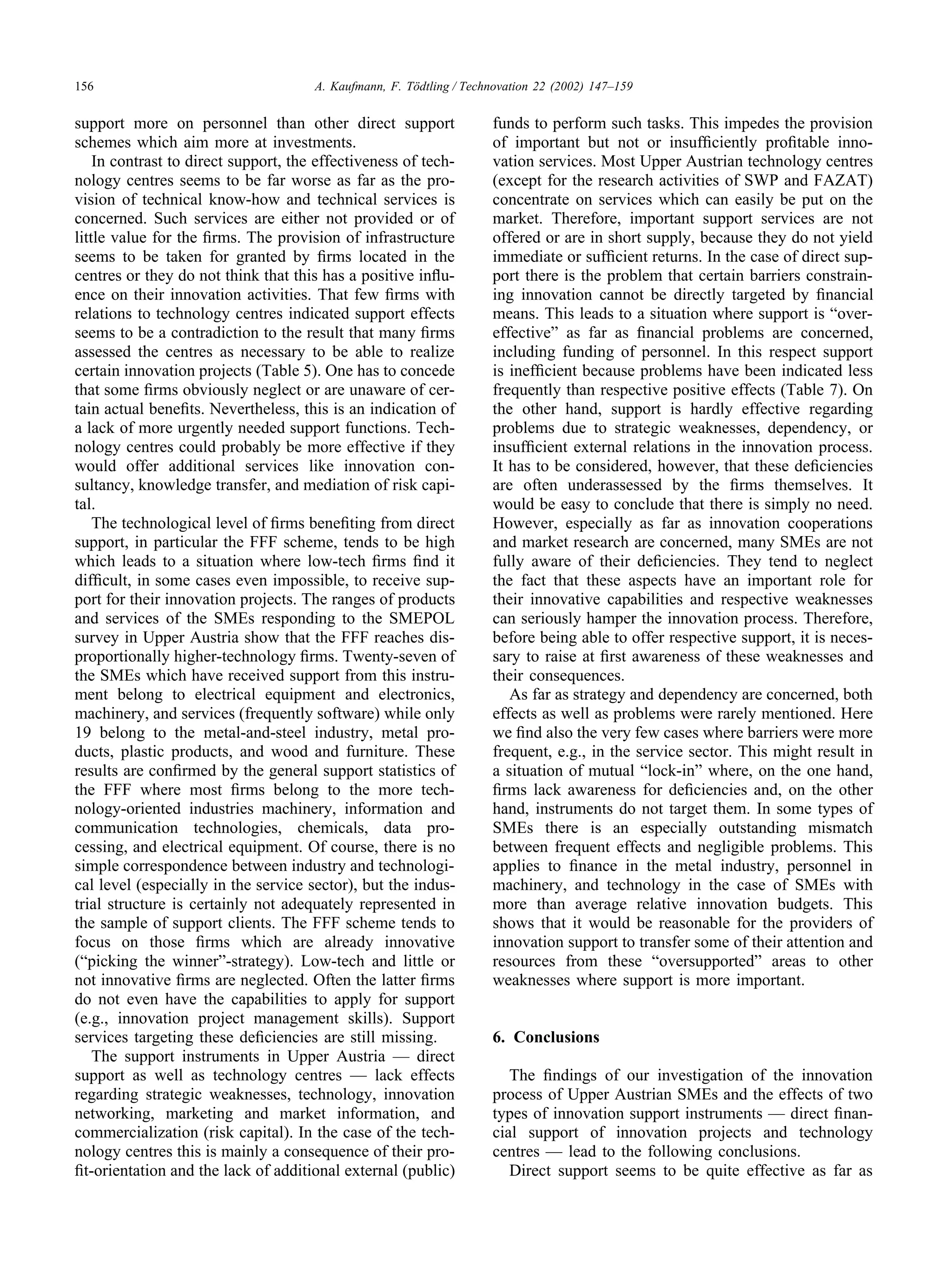
How do the firms themselves assess the necessity of
the received support for the realization of the respective
innovation project? A significant number of Upper
Austrian SMEs indicated that the received support was
not required for this purpose (Table 5). This can be taken
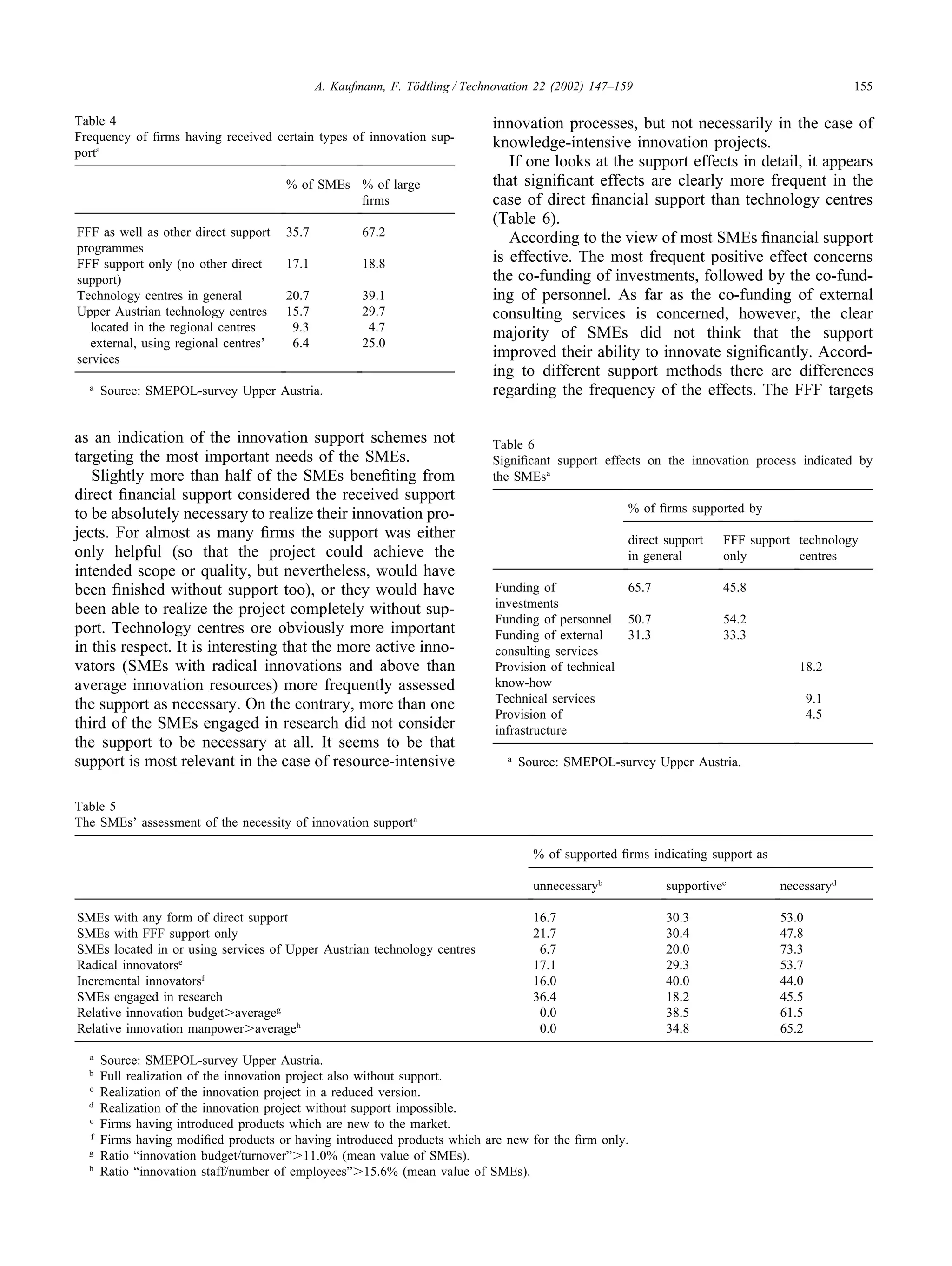
9.
155
A. Kaufmann, F.Tödtling / Technovation 22 (2002) 147–159
Table 4
Frequency of firms having received certain types of innovation sup-
porta
% of SMEs % of large
firms
FFF as well as other direct support 35.7 67.2
programmes
FFF support only (no other direct 17.1 18.8
support)
Technology centres in general 20.7 39.1
Upper Austrian technology centres 15.7 29.7
located in the regional centres 9.3 4.7
external, using regional centres’ 6.4 25.0
services
a
Source: SMEPOL-survey Upper Austria.
as an indication of the innovation support schemes not
targeting the most important needs of the SMEs.
Slightly more than half of the SMEs benefiting from
direct financial support considered the received support
to be absolutely necessary to realize their innovation pro-
jects. For almost as many firms the support was either
only helpful (so that the project could achieve the
intended scope or quality, but nevertheless, would have
been finished without support too), or they would have
been able to realize the project completely without sup-
port. Technology centres ore obviously more important
in this respect. It is interesting that the more active inno-
vators (SMEs with radical innovations and above than
average innovation resources) more frequently assessed
the support as necessary. On the contrary, more than one
third of the SMEs engaged in research did not consider
the support to be necessary at all. It seems to be that
support is most relevant in the case of resource-intensive
Table 5
The SMEs’ assessment of the necessity of innovation supporta
% of supported firms indicating support as
unnecessaryb
supportivec
necessaryd
SMEs with any form of direct support 16.7 30.3 53.0
SMEs with FFF support only 21.7 30.4 47.8
SMEs located in or using services of Upper Austrian technology centres 6.7 20.0 73.3
Radical innovatorse
17.1 29.3 53.7
Incremental innovatorsf
16.0 40.0 44.0
SMEs engaged in research 36.4 18.2 45.5
Relative innovation budget⬎averageg
0.0 38.5 61.5
Relative innovation manpower⬎averageh
0.0 34.8 65.2
a
Source: SMEPOL-survey Upper Austria.
b
Full realization of the innovation project also without support.
c
Realization of the innovation project in a reduced version.
d
Realization of the innovation project without support impossible.
e
Firms having introduced products which are new to the market.
f
Firms having modified products or having introduced products which are new for the firm only.
g
Ratio “innovation budget/turnover”⬎11.0% (mean value of SMEs).
h
Ratio “innovation staff/number of employees”⬎15.6% (mean value of SMEs).
innovation processes, but not necessarily in the case of
knowledge-intensive innovation projects.
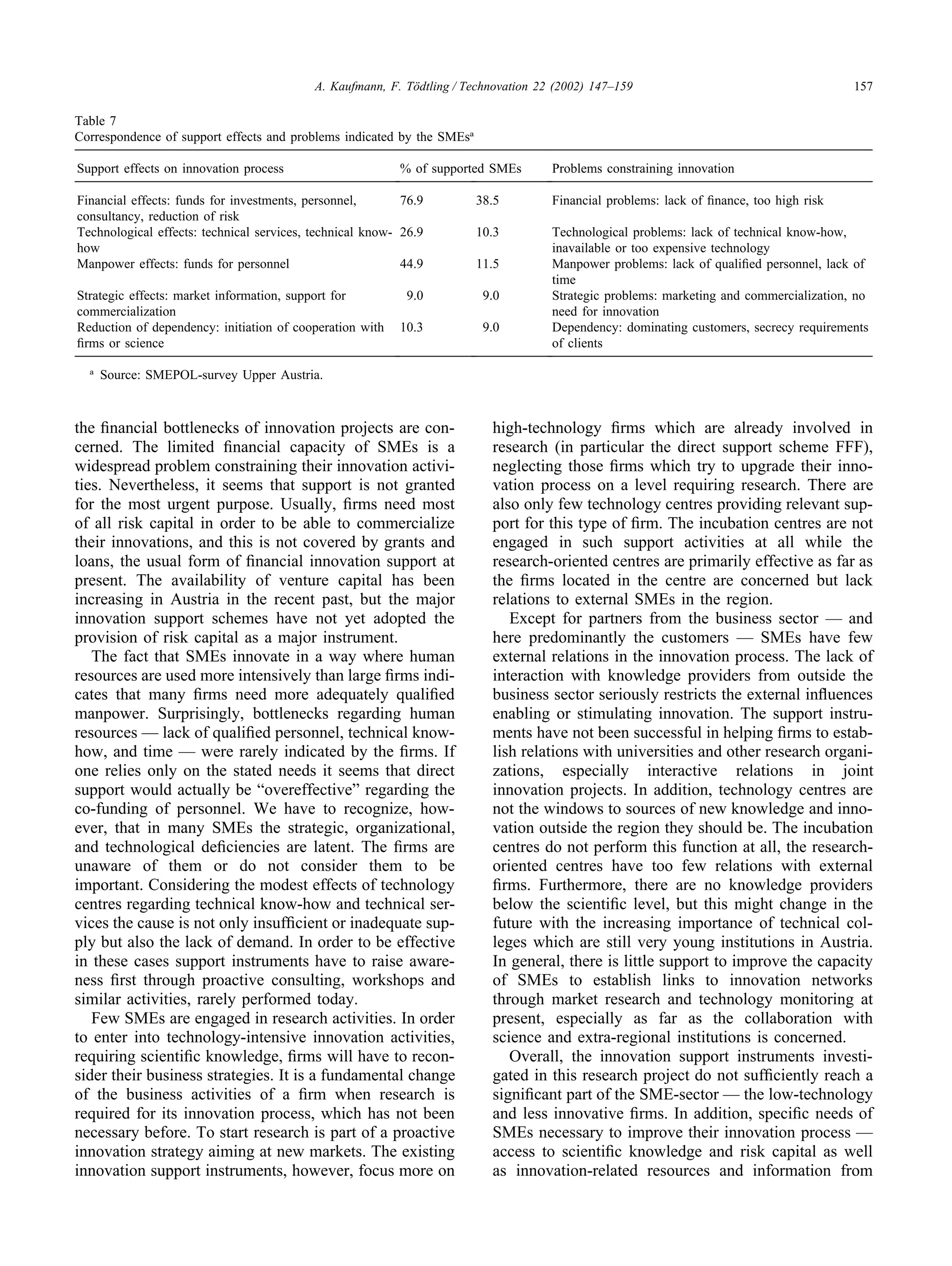
If one looks at the support effects in detail, it appears
that significant effects are clearly more frequent in the
case of direct financial support than technology centres
(Table 6).
According to the view of most SMEs financial support
is effective. The most frequent positive effect concerns
the co-funding of investments, followed by the co-fund-
ing of personnel. As far as the co-funding of external
consulting services is concerned, however, the clear
majority of SMEs did not think that the support
improved their ability to innovate significantly. Accord-
ing to different support methods there are differences
regarding the frequency of the effects. The FFF targets
Table 6
Significant support effects on the innovation process indicated by
the SMEsa
% of firms supported by
direct support FFF support technology
in general only centres
Funding of 65.7 45.8
investments
Funding of personnel 50.7 54.2
Funding of external 31.3 33.3
consulting services
Provision of technical 18.2
know-how
Technical services 9.1
Provision of 4.5
infrastructure
a
Source: SMEPOL-survey Upper Austria.
10.
156 A. Kaufmann,F. Tödtling / Technovation 22 (2002) 147–159
support more on personnel than other direct support
schemes which aim more at investments.
In contrast to direct support, the effectiveness of tech-
nology centres seems to be far worse as far as the pro-
vision of technical know-how and technical services is
concerned. Such services are either not provided or of
little value for the firms. The provision of infrastructure
seems to be taken for granted by firms located in the
centres or they do not think that this has a positive influ-
ence on their innovation activities. That few firms with
relations to technology centres indicated support effects
seems to be a contradiction to the result that many firms
assessed the centres as necessary to be able to realize
certain innovation projects (Table 5). One has to concede
that some firms obviously neglect or are unaware of cer-
tain actual benefits. Nevertheless, this is an indication of
a lack of more urgently needed support functions. Tech-
nology centres could probably be more effective if they
would offer additional services like innovation con-
sultancy, knowledge transfer, and mediation of risk capi-
tal.
The technological level of firms benefiting from direct
support, in particular the FFF scheme, tends to be high
which leads to a situation where low-tech firms find it
difficult, in some cases even impossible, to receive sup-
port for their innovation projects. The ranges of products
and services of the SMEs responding to the SMEPOL
survey in Upper Austria show that the FFF reaches dis-
proportionally higher-technology firms. Twenty-seven of
the SMEs which have received support from this instru-
ment belong to electrical equipment and electronics,
machinery, and services (frequently software) while only
19 belong to the metal-and-steel industry, metal pro-
ducts, plastic products, and wood and furniture. These
results are confirmed by the general support statistics of
the FFF where most firms belong to the more tech-
nology-oriented industries machinery, information and
communication technologies, chemicals, data pro-
cessing, and electrical equipment. Of course, there is no
simple correspondence between industry and technologi-
cal level (especially in the service sector), but the indus-
trial structure is certainly not adequately represented in
the sample of support clients. The FFF scheme tends to
focus on those firms which are already innovative
(“picking the winner”-strategy). Low-tech and little or
not innovative firms are neglected. Often the latter firms
do not even have the capabilities to apply for support
(e.g., innovation project management skills). Support
services targeting these deficiencies are still missing.
The support instruments in Upper Austria — direct
support as well as technology centres — lack effects
regarding strategic weaknesses, technology, innovation
networking, marketing and market information, and
commercialization (risk capital). In the case of the tech-
nology centres this is mainly a consequence of their pro-
fit-orientation and the lack of additional external (public)
funds to perform such tasks. This impedes the provision
of important but not or insufficiently profitable inno-
vation services. Most Upper Austrian technology centres
(except for the research activities of SWP and FAZAT)
concentrate on services which can easily be put on the
market. Therefore, important support services are not
offered or are in short supply, because they do not yield
immediate or sufficient returns. In the case of direct sup-
port there is the problem that certain barriers constrain-
ing innovation cannot be directly targeted by financial
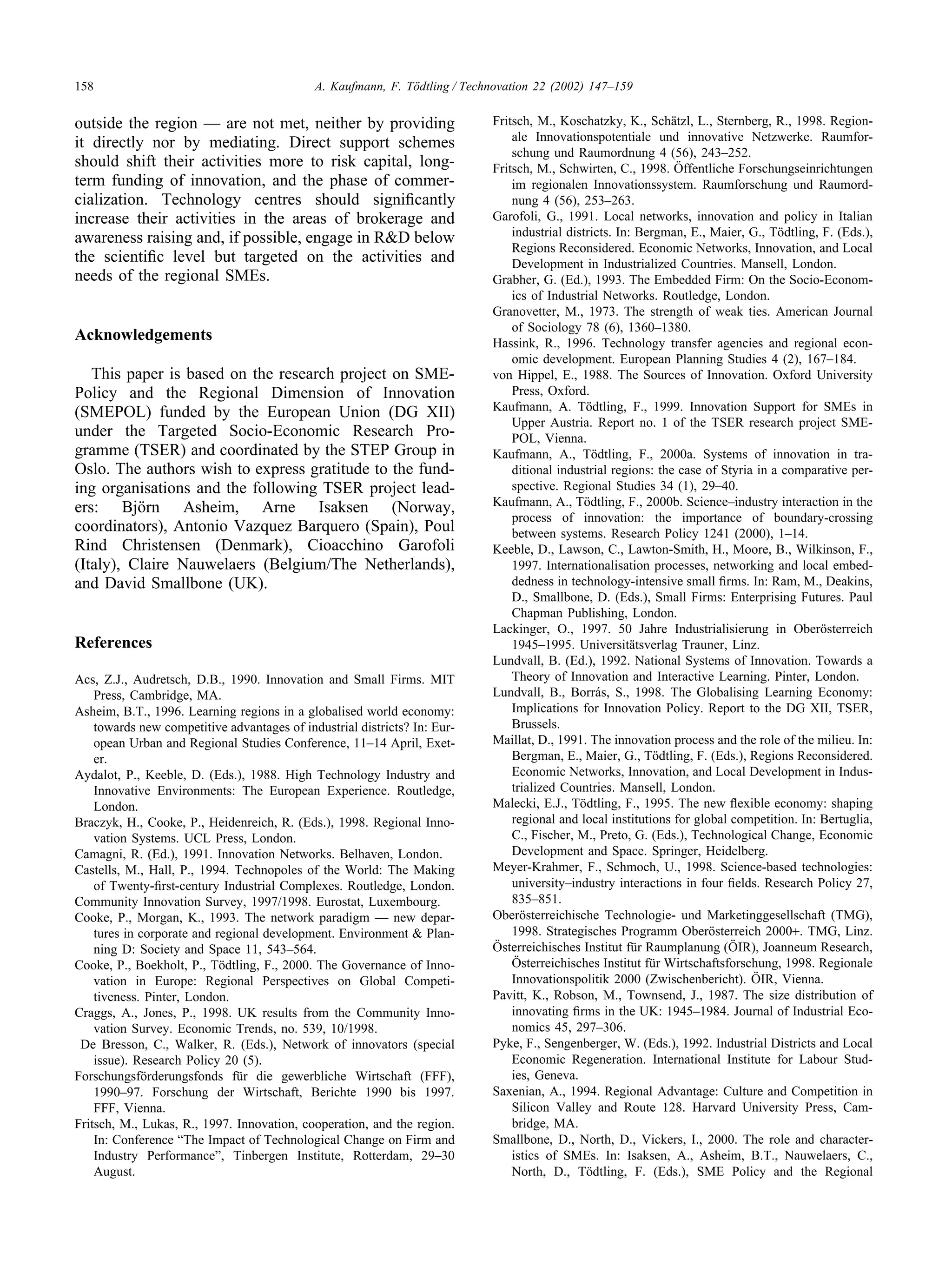
means. This leads to a situation where support is “over-
effective” as far as financial problems are concerned,
including funding of personnel. In this respect support
is inefficient because problems have been indicated less
frequently than respective positive effects (Table 7). On
the other hand, support is hardly effective regarding
problems due to strategic weaknesses, dependency, or
insufficient external relations in the innovation process.
It has to be considered, however, that these deficiencies
are often underassessed by the firms themselves. It
would be easy to conclude that there is simply no need.
However, especially as far as innovation cooperations
and market research are concerned, many SMEs are not
fully aware of their deficiencies. They tend to neglect
the fact that these aspects have an important role for
their innovative capabilities and respective weaknesses
can seriously hamper the innovation process. Therefore,
before being able to offer respective support, it is neces-
sary to raise at first awareness of these weaknesses and
their consequences.
As far as strategy and dependency are concerned, both
effects as well as problems were rarely mentioned. Here
we find also the very few cases where barriers were more
frequent, e.g., in the service sector. This might result in
a situation of mutual “lock-in” where, on the one hand,
firms lack awareness for deficiencies and, on the other
hand, instruments do not target them. In some types of
SMEs there is an especially outstanding mismatch
between frequent effects and negligible problems. This
applies to finance in the metal industry, personnel in
machinery, and technology in the case of SMEs with
more than average relative innovation budgets. This
shows that it would be reasonable for the providers of
innovation support to transfer some of their attention and
resources from these “oversupported” areas to other
weaknesses where support is more important.
6. Conclusions
The findings of our investigation of the innovation
process of Upper Austrian SMEs and the effects of two
types of innovation support instruments — direct finan-
cial support of innovation projects and technology
centres — lead to the following conclusions.
Direct support seems to be quite effective as far as
11.
157
A. Kaufmann, F.Tödtling / Technovation 22 (2002) 147–159
Table 7
Correspondence of support effects and problems indicated by the SMEsa
Support effects on innovation process % of supported SMEs Problems constraining innovation
Financial effects: funds for investments, personnel, 76.9 38.5 Financial problems: lack of finance, too high risk
consultancy, reduction of risk
Technological effects: technical services, technical know- 26.9 10.3 Technological problems: lack of technical know-how,
how inavailable or too expensive technology
Manpower effects: funds for personnel 44.9 11.5 Manpower problems: lack of qualified personnel, lack of
time
Strategic effects: market information, support for 9.0 9.0 Strategic problems: marketing and commercialization, no
commercialization need for innovation
Reduction of dependency: initiation of cooperation with 10.3 9.0 Dependency: dominating customers, secrecy requirements
firms or science of clients
a
Source: SMEPOL-survey Upper Austria.
the financial bottlenecks of innovation projects are con-
cerned. The limited financial capacity of SMEs is a
widespread problem constraining their innovation activi-
ties. Nevertheless, it seems that support is not granted
for the most urgent purpose. Usually, firms need most
of all risk capital in order to be able to commercialize
their innovations, and this is not covered by grants and
loans, the usual form of financial innovation support at
present. The availability of venture capital has been
increasing in Austria in the recent past, but the major
innovation support schemes have not yet adopted the
provision of risk capital as a major instrument.
The fact that SMEs innovate in a way where human
resources are used more intensively than large firms indi-
cates that many firms need more adequately qualified
manpower. Surprisingly, bottlenecks regarding human
resources — lack of qualified personnel, technical know-
how, and time — were rarely indicated by the firms. If
one relies only on the stated needs it seems that direct
support would actually be “overeffective” regarding the
co-funding of personnel. We have to recognize, how-
ever, that in many SMEs the strategic, organizational,
and technological deficiencies are latent. The firms are
unaware of them or do not consider them to be
important. Considering the modest effects of technology
centres regarding technical know-how and technical ser-
vices the cause is not only insufficient or inadequate sup-
ply but also the lack of demand. In order to be effective
in these cases support instruments have to raise aware-
ness first through proactive consulting, workshops and
similar activities, rarely performed today.
Few SMEs are engaged in research activities. In order
to enter into technology-intensive innovation activities,
requiring scientific knowledge, firms will have to recon-
sider their business strategies. It is a fundamental change
of the business activities of a firm when research is
required for its innovation process, which has not been
necessary before. To start research is part of a proactive
innovation strategy aiming at new markets. The existing
innovation support instruments, however, focus more on
high-technology firms which are already involved in
research (in particular the direct support scheme FFF),
neglecting those firms which try to upgrade their inno-
vation process on a level requiring research. There are
also only few technology centres providing relevant sup-
port for this type of firm. The incubation centres are not
engaged in such support activities at all while the
research-oriented centres are primarily effective as far as
the firms located in the centre are concerned but lack
relations to external SMEs in the region.
Except for partners from the business sector — and
here predominantly the customers — SMEs have few
external relations in the innovation process. The lack of
interaction with knowledge providers from outside the
business sector seriously restricts the external influences
enabling or stimulating innovation. The support instru-
ments have not been successful in helping firms to estab-
lish relations with universities and other research organi-
zations, especially interactive relations in joint
innovation projects. In addition, technology centres are
not the windows to sources of new knowledge and inno-
vation outside the region they should be. The incubation
centres do not perform this function at all, the research-
oriented centres have too few relations with external
firms. Furthermore, there are no knowledge providers
below the scientific level, but this might change in the
future with the increasing importance of technical col-
leges which are still very young institutions in Austria.
In general, there is little support to improve the capacity
of SMEs to establish links to innovation networks
through market research and technology monitoring at
present, especially as far as the collaboration with
science and extra-regional institutions is concerned.
Overall, the innovation support instruments investi-
gated in this research project do not sufficiently reach a
significant part of the SME-sector — the low-technology
and less innovative firms. In addition, specific needs of
SMEs necessary to improve their innovation process —
access to scientific knowledge and risk capital as well
as innovation-related resources and information from
12.
158 A. Kaufmann,F. Tödtling / Technovation 22 (2002) 147–159
outside the region — are not met, neither by providing
it directly nor by mediating. Direct support schemes
should shift their activities more to risk capital, long-
term funding of innovation, and the phase of commer-
cialization. Technology centres should significantly
increase their activities in the areas of brokerage and
awareness raising and, if possible, engage in R&D below
the scientific level but targeted on the activities and
needs of the regional SMEs.
Acknowledgements
This paper is based on the research project on SME-
Policy and the Regional Dimension of Innovation
(SMEPOL) funded by the European Union (DG XII)
under the Targeted Socio-Economic Research Pro-
gramme (TSER) and coordinated by the STEP Group in
Oslo. The authors wish to express gratitude to the fund-
ing organisations and the following TSER project lead-
ers: Björn Asheim, Arne Isaksen (Norway,
coordinators), Antonio Vazquez Barquero (Spain), Poul
Rind Christensen (Denmark), Cioacchino Garofoli
(Italy), Claire Nauwelaers (Belgium/The Netherlands),
and David Smallbone (UK).
References
Acs, Z.J., Audretsch, D.B., 1990. Innovation and Small Firms. MIT
Press, Cambridge, MA.
Asheim, B.T., 1996. Learning regions in a globalised world economy:
towards new competitive advantages of industrial districts? In: Eur-
opean Urban and Regional Studies Conference, 11–14 April, Exet-
er.
Aydalot, P., Keeble, D. (Eds.), 1988. High Technology Industry and
Innovative Environments: The European Experience. Routledge,
London.
Braczyk, H., Cooke, P., Heidenreich, R. (Eds.), 1998. Regional Inno-
vation Systems. UCL Press, London.
Camagni, R. (Ed.), 1991. Innovation Networks. Belhaven, London.
Castells, M., Hall, P., 1994. Technopoles of the World: The Making
of Twenty-first-century Industrial Complexes. Routledge, London.
Community Innovation Survey, 1997/1998. Eurostat, Luxembourg.
Cooke, P., Morgan, K., 1993. The network paradigm — new depar-
tures in corporate and regional development. Environment & Plan-
ning D: Society and Space 11, 543–564.
Cooke, P., Boekholt, P., Tödtling, F., 2000. The Governance of Inno-
vation in Europe: Regional Perspectives on Global Competi-
tiveness. Pinter, London.
Craggs, A., Jones, P., 1998. UK results from the Community Inno-
vation Survey. Economic Trends, no. 539, 10/1998.
De Bresson, C., Walker, R. (Eds.), Network of innovators (special
issue). Research Policy 20 (5).
Forschungsförderungsfonds für die gewerbliche Wirtschaft (FFF),
1990–97. Forschung der Wirtschaft, Berichte 1990 bis 1997.
FFF, Vienna.
Fritsch, M., Lukas, R., 1997. Innovation, cooperation, and the region.
In: Conference “The Impact of Technological Change on Firm and
Industry Performance”, Tinbergen Institute, Rotterdam, 29–30
August.
Fritsch, M., Koschatzky, K., Schätzl, L., Sternberg, R., 1998. Region-
ale Innovationspotentiale und innovative Netzwerke. Raumfor-
schung und Raumordnung 4 (56), 243–252.
Fritsch, M., Schwirten, C., 1998. Öffentliche Forschungseinrichtungen
im regionalen Innovationssystem. Raumforschung und Raumord-
nung 4 (56), 253–263.
Garofoli, G., 1991. Local networks, innovation and policy in Italian
industrial districts. In: Bergman, E., Maier, G., Tödtling, F. (Eds.),
Regions Reconsidered. Economic Networks, Innovation, and Local
Development in Industrialized Countries. Mansell, London.
Grabher, G. (Ed.), 1993. The Embedded Firm: On the Socio-Econom-
ics of Industrial Networks. Routledge, London.
Granovetter, M., 1973. The strength of weak ties. American Journal
of Sociology 78 (6), 1360–1380.
Hassink, R., 1996. Technology transfer agencies and regional econ-
omic development. European Planning Studies 4 (2), 167–184.
von Hippel, E., 1988. The Sources of Innovation. Oxford University
Press, Oxford.
Kaufmann, A. Tödtling, F., 1999. Innovation Support for SMEs in
Upper Austria. Report no. 1 of the TSER research project SME-
POL, Vienna.
Kaufmann, A., Tödtling, F., 2000a. Systems of innovation in tra-
ditional industrial regions: the case of Styria in a comparative per-
spective. Regional Studies 34 (1), 29–40.
Kaufmann, A., Tödtling, F., 2000b. Science–industry interaction in the
process of innovation: the importance of boundary-crossing
between systems. Research Policy 1241 (2000), 1–14.
Keeble, D., Lawson, C., Lawton-Smith, H., Moore, B., Wilkinson, F.,
1997. Internationalisation processes, networking and local embed-
dedness in technology-intensive small firms. In: Ram, M., Deakins,
D., Smallbone, D. (Eds.), Small Firms: Enterprising Futures. Paul
Chapman Publishing, London.
Lackinger, O., 1997. 50 Jahre Industrialisierung in Oberösterreich
1945–1995. Universitätsverlag Trauner, Linz.
Lundvall, B. (Ed.), 1992. National Systems of Innovation. Towards a
Theory of Innovation and Interactive Learning. Pinter, London.
Lundvall, B., Borrás, S., 1998. The Globalising Learning Economy:
Implications for Innovation Policy. Report to the DG XII, TSER,
Brussels.
Maillat, D., 1991. The innovation process and the role of the milieu. In:
Bergman, E., Maier, G., Tödtling, F. (Eds.), Regions Reconsidered.
Economic Networks, Innovation, and Local Development in Indus-
trialized Countries. Mansell, London.
Malecki, E.J., Tödtling, F., 1995. The new flexible economy: shaping
regional and local institutions for global competition. In: Bertuglia,
C., Fischer, M., Preto, G. (Eds.), Technological Change, Economic
Development and Space. Springer, Heidelberg.
Meyer-Krahmer, F., Schmoch, U., 1998. Science-based technologies:
university–industry interactions in four fields. Research Policy 27,
835–851.
Oberösterreichische Technologie- und Marketinggesellschaft (TMG),
1998. Strategisches Programm Oberösterreich 2000+. TMG, Linz.
Österreichisches Institut für Raumplanung (ÖIR), Joanneum Research,
Österreichisches Institut für Wirtschaftsforschung, 1998. Regionale
Innovationspolitik 2000 (Zwischenbericht). ÖIR, Vienna.
Pavitt, K., Robson, M., Townsend, J., 1987. The size distribution of
innovating firms in the UK: 1945–1984. Journal of Industrial Eco-
nomics 45, 297–306.
Pyke, F., Sengenberger, W. (Eds.), 1992. Industrial Districts and Local
Economic Regeneration. International Institute for Labour Stud-
ies, Geneva.
Saxenian, A., 1994. Regional Advantage: Culture and Competition in
Silicon Valley and Route 128. Harvard University Press, Cam-
bridge, MA.
Smallbone, D., North, D., Vickers, I., 2000. The role and character-
istics of SMEs. In: Isaksen, A., Asheim, B.T., Nauwelaers, C.,
North, D., Tödtling, F. (Eds.), SME Policy and the Regional
13.
159
A. Kaufmann, F.Tödtling / Technovation 22 (2002) 147–159
Dimension of Innovation. Final report of the TSER-research project
SMEPOL, Oslo.
Sternberg, R., 1998. Innovierende Industrieunternehmen und ihre Ein-
bindung in intraregionale versus interregionale Netzwerke. Raum-
forschung und Raumordnung 4 (56), 288–298.
Sternberg, R., 2000. Innovation networks and regional development —
evidence from the European Regional Innovation Survey (ERIS):
theoretical concepts, methodological approach, empirical basis and
introduction of the theme issue. European Planning Studies 8 (4),
389–407.
Storper, M., 1995. The resurgence of regional economies, ten years
later: the region as a nexus of untraded interdependencies. Euro-
pean Urban and Regional Studies 2, 191–221.
Storper, M., 1997. The Regional World: Territorial Development in a
Global Economy. Guilford Press, New York.
Tödtling, F., 1994. Regional networks of high-technology firms — the
case of the Greater Boston region. Technovation 14 (5), 323–343.
Alexander Kaufmann obtained his Mag. and
Dr. degrees from the Vienna University of Eco-
nomics and Business Administration. Since
1996 he was scientific collaborator of the
Department of City and Regional Development
at the same university. Recently he has changed
jobs, working as a researcher at the Austrian
Research Centers Seibersdorf in the division
Systems Research Technology–Economy–
Environment. His research interest concerns
innovation, technology, and economic develop-
ment and organization. In several, partly Euro-
pean, research projects he has been analysing the systemic interaction in
the process of innovation, especially between science and industry, the
role of regional innovation systems, and the consequences of ICTs for the
organization of innovation networks. Results from these projects have
been published in journals like Regional Studies and Research Policy.
Franz Tödtling is Professor at the Department
of City and Regional Development, Vienna Uni-
versity of Economics and Business Adminis-
tration. He has been doing research on industrial
change, innovation, as well as on regional devel-
opment and policy. He has been involved in a
number of international projects and research
cooperations funded by the US National Science
Foundation, the European Science Foundation
and the European Framework Program. Publi-
cations include “Regions Reconsidered: Net-
works, Innovations and Local Development in
Industrialised Countries” (edited jointly with E. Bergman and G. Maier,
Mansell, London, 1991), and “The Governance of Innovation in Europe”
(jointly with Ph. Cooke and P. Boekholt, Pinter, London, 2000). Franz
Tödtling has also published in a number of professional journals such as
Regional Studies, Environment and Planning, Papers of the Regional
Science Association, European Planning Studies, Research Policy, and
Technovation.