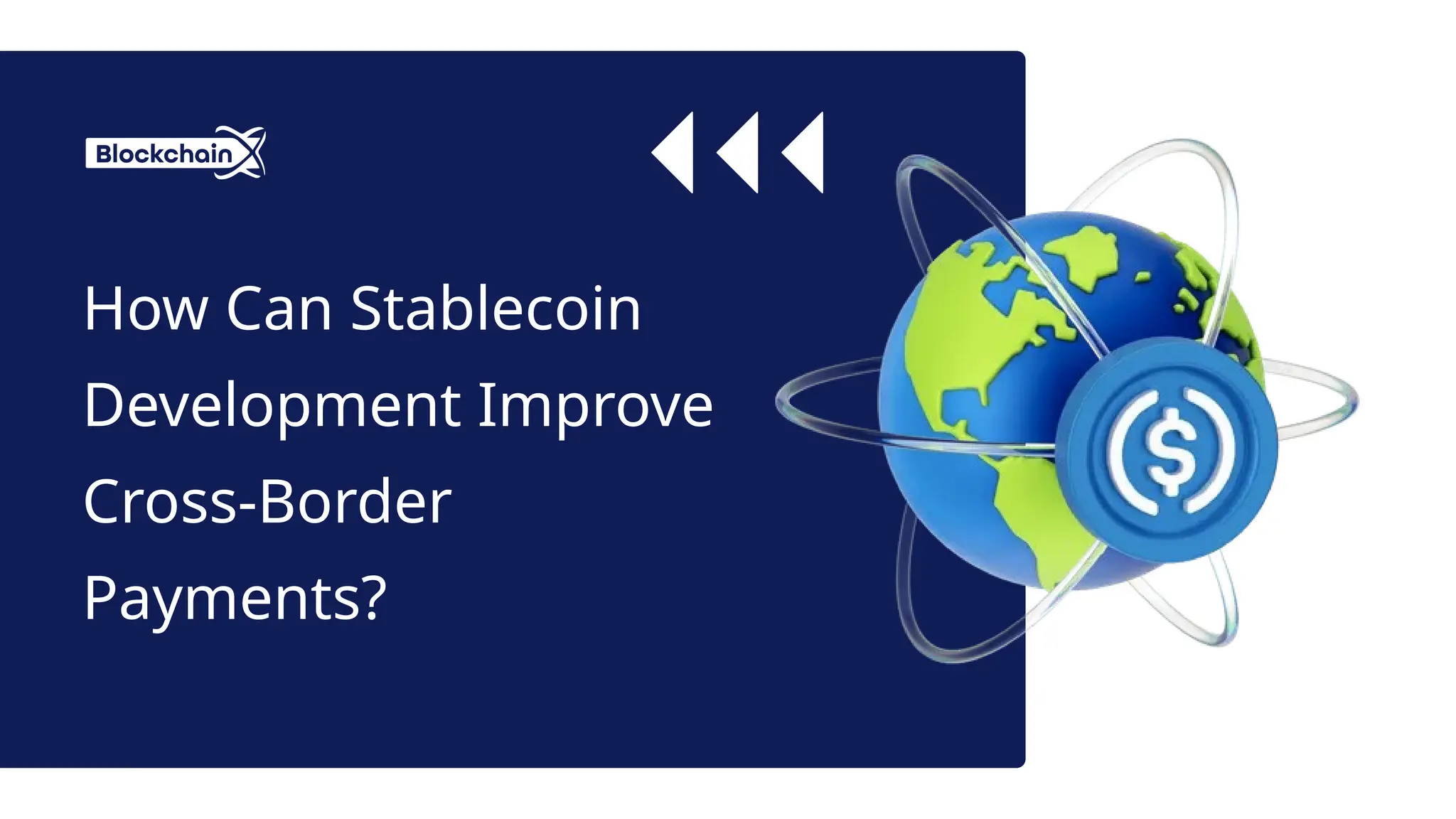
How Can Stablecoin
Development Improve
Cross-Border
Payments?
INTRODUCTIO
N
Cross-border payments form the most important part of global trade,
remittances, and financial services. Then again, traditional systems often
dock high charges, have the longest settlement time, and carry steps for
currency conversion.
With newer clients demanding faster and cheaper alternatives, stablecoins
have emerged to serve as a transformative factor in cross-border transfers.
OVERVIEW OF STABLECOIN
DEELOPMENT
Stablecoins are a kind of cryptocurrency tied to stable assets such as national
currencies (USD, EUR) or commodities (gold). This price stability renders them
more reliable for payments than the highly volatile cryptocurrencies like Bitcoin.
Stablecoin Development activities on stablecoins are oriented toward secure,
scalable, and transparent digital assets that can be integrated systematically into
payment systems. Using blockchain technology, these coins settle instantly,
charge lower fees, and transcend boundaries.
QUICK SETTLEMENTS
Due to the system of intermediaries and clearing, traditional bank transfers and international wire payments generally take
anywhere from 2 to 5 business days. On the other hand, the stablecoin system will facilitate transaction settlements within
minutes and sometimes seconds on blockchain networks. The speed of settlement acts on the cash-flow of businesses that
require immediate settlements. It gives a further push to the efficiency of remittances and international trade.
How Stablecoin Development
Transforms Cross-Border Payments
LOWER COSTS
Banks and remittance providers might charge from as much as 5% to 10% fees on money transfers across borders. Stablecoins
bring these costs down by removing intermediaries and placing trust onto decentralized networks. This, thus, enables individuals
and businesses to move funds almost at a fraction of what they would usually pay. For migrant workers who send home
remittances, the savings will matter enormously.
ZERO-FOUNDATION CURRENCY CONVERSION
Traditional banking with currency conversion implies several exchange rates, miscellaneous surcharges and prolonged delays.
Stablecoins alleviate this with their status as a universal digital currency, and their users do not need to exchange funds. As one
example, a US user can simply transfer USD-pegged stablecoins to someone abroad without having to use expensive
intermediaries. This will guarantee a transfer that is seamless and predictable.
TRANSPARENCY & SECURITY
The transactions of the stablecoin are carried via blockchain technology, which logs every single transfer on a public ledger.
Hence, there is a transparent system where all transactions can be traced and cannot be altered. Larger security features,
including cryptographic encryption and risk resistance to fraud, make them safer than many traditional ways. Businesses, as well
as regulators, have much greater compliance visibility.
FINANCIAL INCLUSION
Across the globe, billions of people remain either unbanked or underbanked, meaning they lack access to conventional financial
institutions. Using stablecoins, it is an easy operation for an individual with a smartphone and an internet connection to send and
receive money anywhere across the globe. Doing so opens financial services to populations in developing countries where banks
are a rarity. This also opens up the avenues to greater economic participation and inclusion.
Led by blockchain, the evolution is toward efficient and transparent payment systems,
stablecoins acting as a pivot of change. With support from governments and financial
institutions, stablecoins-integration with CBDCs-could fulfill that role. Their use could
be extended beyond remittances toward international trade, e-commerce, and DeFi
applications.
Under proper regulation, stablecoins could become the mainstream avenue that
bankfiance connects to the digital economy, enabling a cross-border transaction that
is faster, cheaper, and increasingly accessible to ordinary people in the world.
Future of Cross-Border Payments with
Stablecoins
Because of the development of Stablecoin, the cross-border movement of money is
changing in character and presents various scenarios. A stable coin would address
issues plaguing international payments such as speed, cost, and global accessibility.
With increasing adoption, they will be instrumental in laying the path of the future of
global finance-the avenue through which businesses, individuals, and economies are
opened worldwide.
Conclusion
CONTACT US
7708889555
contact@blockchainx.tech
https://
www.blockchainx.tech/

How Can Stablecoin Development Improve Cross-Border Payments

  • 1.
    How Can Stablecoin DevelopmentImprove Cross-Border Payments?
  • 2.
    INTRODUCTIO N Cross-border payments formthe most important part of global trade, remittances, and financial services. Then again, traditional systems often dock high charges, have the longest settlement time, and carry steps for currency conversion. With newer clients demanding faster and cheaper alternatives, stablecoins have emerged to serve as a transformative factor in cross-border transfers.
  • 3.
    OVERVIEW OF STABLECOIN DEELOPMENT Stablecoinsare a kind of cryptocurrency tied to stable assets such as national currencies (USD, EUR) or commodities (gold). This price stability renders them more reliable for payments than the highly volatile cryptocurrencies like Bitcoin. Stablecoin Development activities on stablecoins are oriented toward secure, scalable, and transparent digital assets that can be integrated systematically into payment systems. Using blockchain technology, these coins settle instantly, charge lower fees, and transcend boundaries.
  • 4.
    QUICK SETTLEMENTS Due tothe system of intermediaries and clearing, traditional bank transfers and international wire payments generally take anywhere from 2 to 5 business days. On the other hand, the stablecoin system will facilitate transaction settlements within minutes and sometimes seconds on blockchain networks. The speed of settlement acts on the cash-flow of businesses that require immediate settlements. It gives a further push to the efficiency of remittances and international trade. How Stablecoin Development Transforms Cross-Border Payments LOWER COSTS Banks and remittance providers might charge from as much as 5% to 10% fees on money transfers across borders. Stablecoins bring these costs down by removing intermediaries and placing trust onto decentralized networks. This, thus, enables individuals and businesses to move funds almost at a fraction of what they would usually pay. For migrant workers who send home remittances, the savings will matter enormously.
  • 5.
    ZERO-FOUNDATION CURRENCY CONVERSION Traditionalbanking with currency conversion implies several exchange rates, miscellaneous surcharges and prolonged delays. Stablecoins alleviate this with their status as a universal digital currency, and their users do not need to exchange funds. As one example, a US user can simply transfer USD-pegged stablecoins to someone abroad without having to use expensive intermediaries. This will guarantee a transfer that is seamless and predictable. TRANSPARENCY & SECURITY The transactions of the stablecoin are carried via blockchain technology, which logs every single transfer on a public ledger. Hence, there is a transparent system where all transactions can be traced and cannot be altered. Larger security features, including cryptographic encryption and risk resistance to fraud, make them safer than many traditional ways. Businesses, as well as regulators, have much greater compliance visibility.
  • 6.
    FINANCIAL INCLUSION Across theglobe, billions of people remain either unbanked or underbanked, meaning they lack access to conventional financial institutions. Using stablecoins, it is an easy operation for an individual with a smartphone and an internet connection to send and receive money anywhere across the globe. Doing so opens financial services to populations in developing countries where banks are a rarity. This also opens up the avenues to greater economic participation and inclusion.
  • 7.
    Led by blockchain,the evolution is toward efficient and transparent payment systems, stablecoins acting as a pivot of change. With support from governments and financial institutions, stablecoins-integration with CBDCs-could fulfill that role. Their use could be extended beyond remittances toward international trade, e-commerce, and DeFi applications. Under proper regulation, stablecoins could become the mainstream avenue that bankfiance connects to the digital economy, enabling a cross-border transaction that is faster, cheaper, and increasingly accessible to ordinary people in the world. Future of Cross-Border Payments with Stablecoins
  • 8.
    Because of thedevelopment of Stablecoin, the cross-border movement of money is changing in character and presents various scenarios. A stable coin would address issues plaguing international payments such as speed, cost, and global accessibility. With increasing adoption, they will be instrumental in laying the path of the future of global finance-the avenue through which businesses, individuals, and economies are opened worldwide. Conclusion
  • 9.