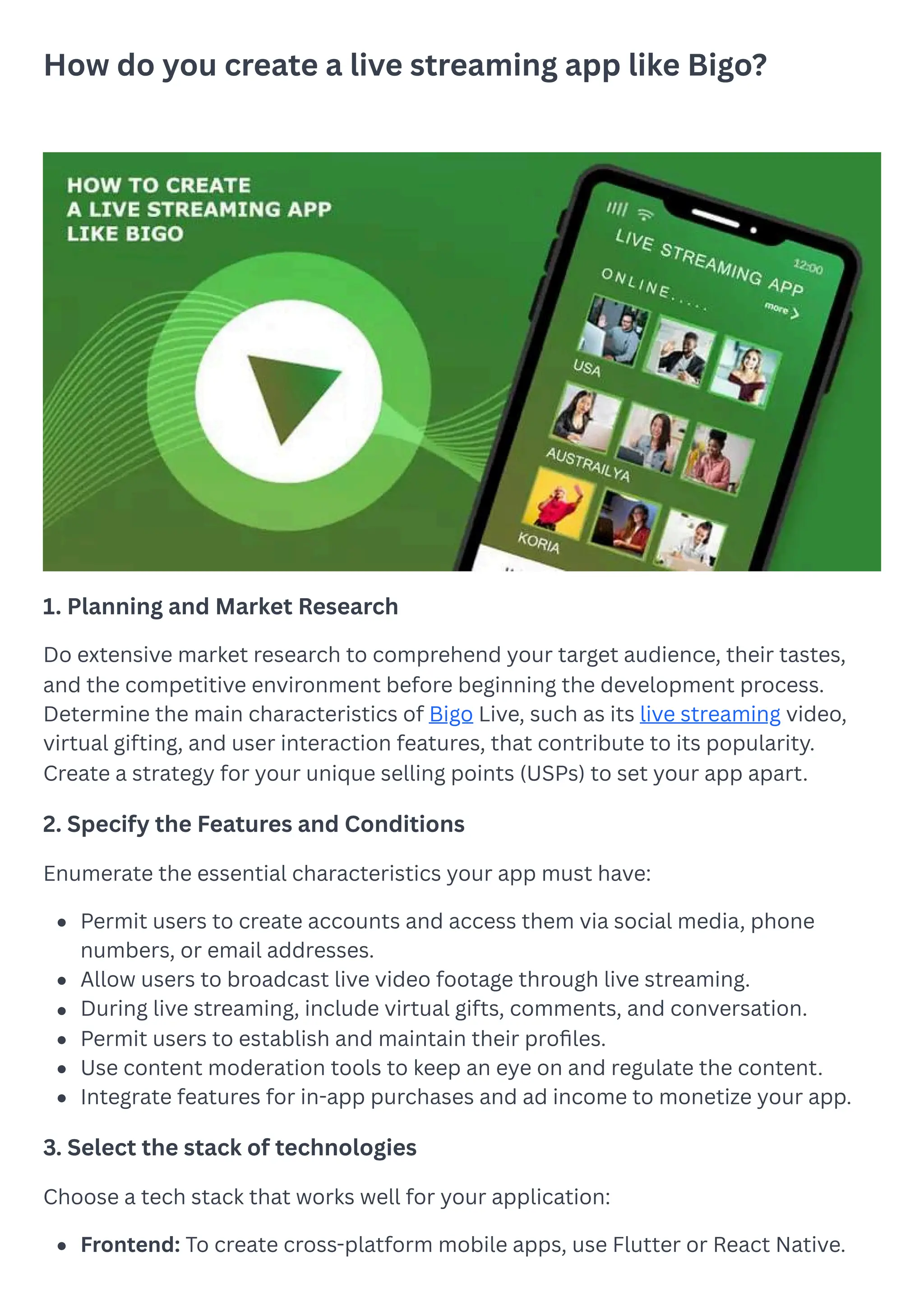
How do you create a live streaming app like Bigo?
1. Planning and Market Research
Do extensive market research to comprehend your target audience, their tastes,
and the competitive environment before beginning the development process.
Determine the main characteristics of Bigo Live, such as its live streaming video,
virtual gifting, and user interaction features, that contribute to its popularity.
Create a strategy for your unique selling points (USPs) to set your app apart.
2. Specify the Features and Conditions
Enumerate the essential characteristics your app must have:
3. Select the stack of technologies
Choose a tech stack that works well for your application:
Permit users to create accounts and access them via social media, phone
numbers, or email addresses.
Allow users to broadcast live video footage through live streaming.
During live streaming, include virtual gifts, comments, and conversation.
Permit users to establish and maintain their profiles.
Use content moderation tools to keep an eye on and regulate the content.
Integrate features for in-app purchases and ad income to monetize your app.
Frontend: To create cross-platform mobile apps, use Flutter or React Native.
4. Design of User Interface/UX
Create a compelling and easy-to-use user interface. A smooth user experience with
simple navigation, engaging images, and interactive features should be the main
goal. The design of the UI/UX can be aided by programs like Adobe XD, Figma, or
Sketch.
5. Progress
Establish servers, databases, and APIs by beginning with backend development.
Then, utilizing SDKs like Agora or Twilio, integrate live streaming functionality with
frontend development. Make sure you have strong privacy and data protection
safeguards in place.
6. Examining
Make sure your software is fully tested for security, usability, performance, and
functionality. To find any defects or problems, do manual testing in addition to
using automated testing tools like Selenium or Appium.
7. Implementation
Release the software in stores like the Apple Software Store and Google Play Store
after it has been thoroughly tested and polished. Make sure all conditions are
satisfied for a successful launch, and get ready for app store standards.
8. Promotion and Deployment
Make a marketing plan to advertise your app. To reach your target demographic,
use influencers, social media, and advertising. Provide rewards to early adopters in
order to gain traction.
9. Upkeep and Modifications
Once your app is out, keep an eye on user reviews and analytics to make it better.
Regular updates should be released to improve speed, add new features, and
correct bugs.
In summary
Backend: For server-side activities, use Django or Node.js.
Database: Firebase or MongoDB for storing data in real time.
Streaming: To enable live streaming, use the RTMP or WebRTC protocols.
Cloud services: For hosting and scaling, use Google Cloud or AWS.
Creating an app such as Bigo Live necessitates meticulous planning, a strong
technological foundation, and ongoing development. You can develop a
competitive live streaming app that attracts users and makes a splash in the
market by following these steps.

How Can I Make a Bigo-Like Live Streaming App?

  • 1.
    How do youcreate a live streaming app like Bigo? 1. Planning and Market Research Do extensive market research to comprehend your target audience, their tastes, and the competitive environment before beginning the development process. Determine the main characteristics of Bigo Live, such as its live streaming video, virtual gifting, and user interaction features, that contribute to its popularity. Create a strategy for your unique selling points (USPs) to set your app apart. 2. Specify the Features and Conditions Enumerate the essential characteristics your app must have: 3. Select the stack of technologies Choose a tech stack that works well for your application: Permit users to create accounts and access them via social media, phone numbers, or email addresses. Allow users to broadcast live video footage through live streaming. During live streaming, include virtual gifts, comments, and conversation. Permit users to establish and maintain their profiles. Use content moderation tools to keep an eye on and regulate the content. Integrate features for in-app purchases and ad income to monetize your app. Frontend: To create cross-platform mobile apps, use Flutter or React Native.
  • 2.
    4. Design ofUser Interface/UX Create a compelling and easy-to-use user interface. A smooth user experience with simple navigation, engaging images, and interactive features should be the main goal. The design of the UI/UX can be aided by programs like Adobe XD, Figma, or Sketch. 5. Progress Establish servers, databases, and APIs by beginning with backend development. Then, utilizing SDKs like Agora or Twilio, integrate live streaming functionality with frontend development. Make sure you have strong privacy and data protection safeguards in place. 6. Examining Make sure your software is fully tested for security, usability, performance, and functionality. To find any defects or problems, do manual testing in addition to using automated testing tools like Selenium or Appium. 7. Implementation Release the software in stores like the Apple Software Store and Google Play Store after it has been thoroughly tested and polished. Make sure all conditions are satisfied for a successful launch, and get ready for app store standards. 8. Promotion and Deployment Make a marketing plan to advertise your app. To reach your target demographic, use influencers, social media, and advertising. Provide rewards to early adopters in order to gain traction. 9. Upkeep and Modifications Once your app is out, keep an eye on user reviews and analytics to make it better. Regular updates should be released to improve speed, add new features, and correct bugs. In summary Backend: For server-side activities, use Django or Node.js. Database: Firebase or MongoDB for storing data in real time. Streaming: To enable live streaming, use the RTMP or WebRTC protocols. Cloud services: For hosting and scaling, use Google Cloud or AWS.
  • 3.
    Creating an appsuch as Bigo Live necessitates meticulous planning, a strong technological foundation, and ongoing development. You can develop a competitive live streaming app that attracts users and makes a splash in the market by following these steps.