“ Describing the Internet as the Network of Networks is like calling the Space Shuttle, a thing that flies.” John Lester
Hour 1 Understanding HTML and XHTML
Hour 1 Objectives Describe the Internet and its associated key terms Describe the World Wide Web and its associated key terms Identify the types and purposes of Web sites Discuss Web browsers and identify their purpose
Hour 1 Objectives Define Hypertext Markup Language (HTML) and the standards used for Web development Discuss the use of Cascading Style Sheets in Web development Define Dynamic Hypertext Markup Language (DHTML) and describe its relationship to HTML Define Extensible Hypertext Markup Language (XHTML) and describe its relationship to HTML
Hour 1 Objectives Describe tools used to create HTML documents Discuss the five phases of the Web development life cycle Describe Web site design and the purpose of each Web site structure Describe the importance of testing throughout the Web development life cycle
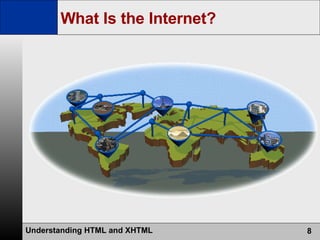
What Is the Internet? The Internet   is a worldwide collection of computer networks that links millions of computers used by businesses, the government, educational institutions, organizations, and individuals using modems, telephone lines, television cables, and other communications devices and media
What is the Internet? A network is a group of two or more computers that are connected together to share resources and information The Internet backbone is a collection of high-speed data lines that connect major computer systems located around the world An Internet Service Provider (ISP) is a company that has a permanent connection to the Internet backbone
What Is the Internet?
What Is the World Wide Web? The World Wide Web, also called the Web, is the part of the Internet that supports multimedia and consists of a collection of linked documents
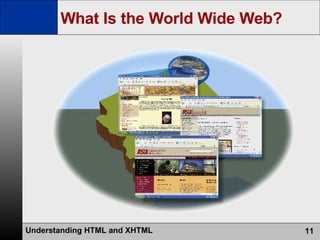
What is the World Wide Web? Hypertext Transfer Protocol (HTTP) is a set of rules for exchanging text, graphics, sound, and other multimedia files Web pages are pages of information on the Web A Web site is a related collection of Web pages A home page is the first document users see when they access a Web site
What Is the World Wide Web?
Web Servers Web pages are stored on a Web server, or host, which is a computer that stores and sends (serves) requested Web pages and other files Publishing is copying Web pages and other files to a Web server
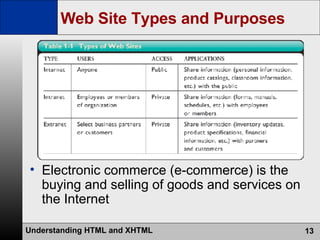
Web Site Types and Purposes Electronic commerce (e-commerce) is the buying and selling of goods and services on the Internet
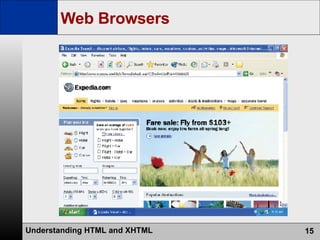
Web Browsers A Web browser, also called a browser, is a program that interprets and displays Web pages and enables you to view and interact with a Web page Mozilla Firefox and Microsoft Internet Explorer A Uniform Resource Locator (URL) is the address of a document or other file accessible on the Internet http://www.siskiyous.edu/current.htm A hyperlink, also called a link, is an element used to connect one Web page to another
Web Browsers
What Is Hypertext Markup Language? Web pages are created using Hypertext Markup Language (HTML), which is the authoring language used to create documents on the World Wide Web
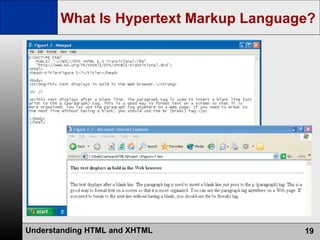
What Is Hypertext Markup Language? HTML uses a set of special instructions called tags or markup to define the structure and layout of a Web document and specify how the page is displayed in a browser
What Is Hypertext Markup Language? HTML is platform independent, meaning you can create, or code, an HTML file on one type of computer and then use a browser on another type of computer to view that file as a Web page
What Is Hypertext Markup Language?
HTML Elements
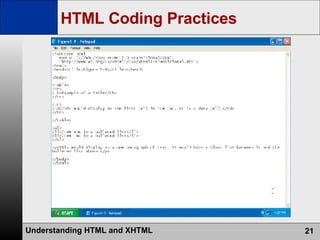
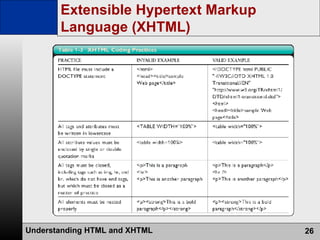
HTML Coding Practices
HTML Versions HTML has gone through several versions, each of which expands the capabilities of HTML The most recent version of HTML is HTML 4.01
Cascading Style Sheets With Cascading Style Sheets (CSS), you write code that allows you to control an element within a single Web page or throughout the entire Web site Recommended for large Web sites
Dynamic HTML (DHTML) Dynamic HTML (DHTML) describes a combination of HTML tags, CSS, and a scripting language such as JavaScript DHTML allows users to create interactive, animated Web pages
Extensible Hypertext Markup Language (XHTML) Extensible Markup Language (XML) is a markup language that uses tags to describe the structure and content of a document, not the format Extensible Hypertext Markup Language (XHTML) is a reformulation of HTML so it conforms to Extensible Markup Language (XML) rules
Extensible Hypertext Markup Language (XHTML)
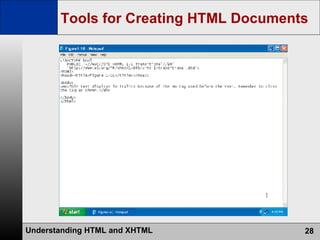
Tools for Creating HTML Documents A text editor is a program that allows a user to enter, change, save, and print text, such as HTML An HTML editor is a program that provides basic text-editing functions, as well as more advanced features, such as color-coding for various HTML tags, menus to insert HTML tags, and spell checkers A WYSIWYG editor is a program that provides a graphical user interface that allows a developer to preview the Web page during its development
Tools for Creating HTML Documents
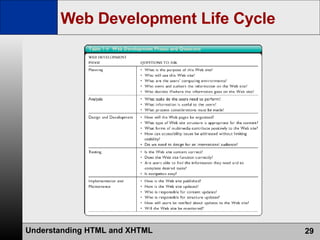
Web Development Life Cycle
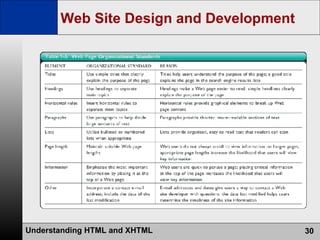
Web Site Design and Development
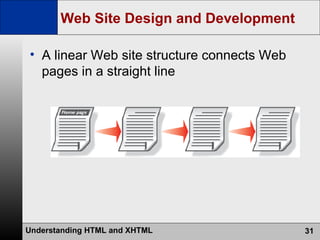
Web Site Design and Development A linear Web site structure connects Web pages in a straight line
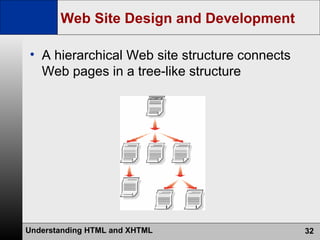
Web Site Design and Development A hierarchical Web site structure connects Web pages in a tree-like structure
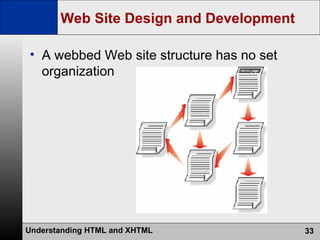
Web Site Design and Development A webbed Web site structure has no set organization
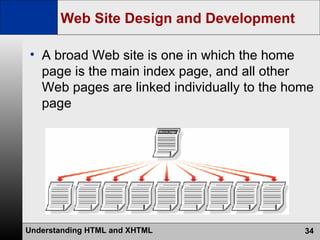
Web Site Design and Development A broad Web site is one in which the home page is the main index page, and all other Web pages are linked individually to the home page
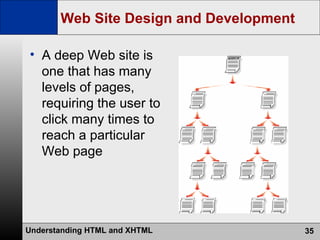
Web Site Design and Development A deep Web site is one that has many levels of pages, requiring the user to click many times to reach a particular Web page
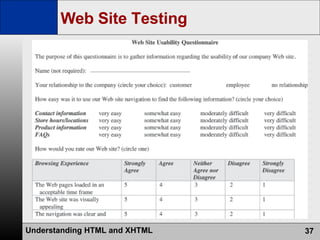
Web Site Testing Usability is the measure of how well a product, such as a Web site, allows a user to accomplish his or her goals Usability testing is a method by which users of a Web site or other product are asked to perform certain tasks in an effort to measure the product’s ease-of-use and the user’s perception of the experience
Web Site Testing
Hour 1 Summary Describe the Internet and its associated key terms Describe the World Wide Web and its associated key terms Identify the types and purposes of Web sites Discuss Web browsers and identify their purpose
Hour 1 Summary Define Hypertext Markup Language (HTML) and the standards used for Web development Discuss the use of Cascading Style Sheets in Web development Define Dynamic Hypertext Markup Language (DHTML) and describe its relationship to HTML Define Extensible Hypertext Markup Language (XHTML) and describe its relationship to HTML
Hour 1 Summary Describe tools used to create HTML documents Discuss the five phases of the Web development life cycle Describe Web site design and the purpose of each Web site structure Describe the importance of testing throughout the Web development life cycle
Hour 1 Complete Understanding HTML and XHTML

Hour 01

  • 1.
    “ Describing theInternet as the Network of Networks is like calling the Space Shuttle, a thing that flies.” John Lester
  • 2.
    Hour 1 UnderstandingHTML and XHTML
  • 3.
    Hour 1 ObjectivesDescribe the Internet and its associated key terms Describe the World Wide Web and its associated key terms Identify the types and purposes of Web sites Discuss Web browsers and identify their purpose
  • 4.
    Hour 1 ObjectivesDefine Hypertext Markup Language (HTML) and the standards used for Web development Discuss the use of Cascading Style Sheets in Web development Define Dynamic Hypertext Markup Language (DHTML) and describe its relationship to HTML Define Extensible Hypertext Markup Language (XHTML) and describe its relationship to HTML
  • 5.
    Hour 1 ObjectivesDescribe tools used to create HTML documents Discuss the five phases of the Web development life cycle Describe Web site design and the purpose of each Web site structure Describe the importance of testing throughout the Web development life cycle
  • 6.
    What Is theInternet? The Internet is a worldwide collection of computer networks that links millions of computers used by businesses, the government, educational institutions, organizations, and individuals using modems, telephone lines, television cables, and other communications devices and media
  • 7.
    What is theInternet? A network is a group of two or more computers that are connected together to share resources and information The Internet backbone is a collection of high-speed data lines that connect major computer systems located around the world An Internet Service Provider (ISP) is a company that has a permanent connection to the Internet backbone
  • 8.
    What Is theInternet?
  • 9.
    What Is theWorld Wide Web? The World Wide Web, also called the Web, is the part of the Internet that supports multimedia and consists of a collection of linked documents
  • 10.
    What is theWorld Wide Web? Hypertext Transfer Protocol (HTTP) is a set of rules for exchanging text, graphics, sound, and other multimedia files Web pages are pages of information on the Web A Web site is a related collection of Web pages A home page is the first document users see when they access a Web site
  • 11.
    What Is theWorld Wide Web?
  • 12.
    Web Servers Webpages are stored on a Web server, or host, which is a computer that stores and sends (serves) requested Web pages and other files Publishing is copying Web pages and other files to a Web server
  • 13.
    Web Site Typesand Purposes Electronic commerce (e-commerce) is the buying and selling of goods and services on the Internet
  • 14.
    Web Browsers AWeb browser, also called a browser, is a program that interprets and displays Web pages and enables you to view and interact with a Web page Mozilla Firefox and Microsoft Internet Explorer A Uniform Resource Locator (URL) is the address of a document or other file accessible on the Internet http://www.siskiyous.edu/current.htm A hyperlink, also called a link, is an element used to connect one Web page to another
  • 15.
  • 16.
    What Is HypertextMarkup Language? Web pages are created using Hypertext Markup Language (HTML), which is the authoring language used to create documents on the World Wide Web
  • 17.
    What Is HypertextMarkup Language? HTML uses a set of special instructions called tags or markup to define the structure and layout of a Web document and specify how the page is displayed in a browser
  • 18.
    What Is HypertextMarkup Language? HTML is platform independent, meaning you can create, or code, an HTML file on one type of computer and then use a browser on another type of computer to view that file as a Web page
  • 19.
    What Is HypertextMarkup Language?
  • 20.
  • 21.
  • 22.
    HTML Versions HTMLhas gone through several versions, each of which expands the capabilities of HTML The most recent version of HTML is HTML 4.01
  • 23.
    Cascading Style SheetsWith Cascading Style Sheets (CSS), you write code that allows you to control an element within a single Web page or throughout the entire Web site Recommended for large Web sites
  • 24.
    Dynamic HTML (DHTML)Dynamic HTML (DHTML) describes a combination of HTML tags, CSS, and a scripting language such as JavaScript DHTML allows users to create interactive, animated Web pages
  • 25.
    Extensible Hypertext MarkupLanguage (XHTML) Extensible Markup Language (XML) is a markup language that uses tags to describe the structure and content of a document, not the format Extensible Hypertext Markup Language (XHTML) is a reformulation of HTML so it conforms to Extensible Markup Language (XML) rules
  • 26.
  • 27.
    Tools for CreatingHTML Documents A text editor is a program that allows a user to enter, change, save, and print text, such as HTML An HTML editor is a program that provides basic text-editing functions, as well as more advanced features, such as color-coding for various HTML tags, menus to insert HTML tags, and spell checkers A WYSIWYG editor is a program that provides a graphical user interface that allows a developer to preview the Web page during its development
  • 28.
    Tools for CreatingHTML Documents
  • 29.
  • 30.
    Web Site Designand Development
  • 31.
    Web Site Designand Development A linear Web site structure connects Web pages in a straight line
  • 32.
    Web Site Designand Development A hierarchical Web site structure connects Web pages in a tree-like structure
  • 33.
    Web Site Designand Development A webbed Web site structure has no set organization
  • 34.
    Web Site Designand Development A broad Web site is one in which the home page is the main index page, and all other Web pages are linked individually to the home page
  • 35.
    Web Site Designand Development A deep Web site is one that has many levels of pages, requiring the user to click many times to reach a particular Web page
  • 36.
    Web Site TestingUsability is the measure of how well a product, such as a Web site, allows a user to accomplish his or her goals Usability testing is a method by which users of a Web site or other product are asked to perform certain tasks in an effort to measure the product’s ease-of-use and the user’s perception of the experience
  • 37.
  • 38.
    Hour 1 SummaryDescribe the Internet and its associated key terms Describe the World Wide Web and its associated key terms Identify the types and purposes of Web sites Discuss Web browsers and identify their purpose
  • 39.
    Hour 1 SummaryDefine Hypertext Markup Language (HTML) and the standards used for Web development Discuss the use of Cascading Style Sheets in Web development Define Dynamic Hypertext Markup Language (DHTML) and describe its relationship to HTML Define Extensible Hypertext Markup Language (XHTML) and describe its relationship to HTML
  • 40.
    Hour 1 SummaryDescribe tools used to create HTML documents Discuss the five phases of the Web development life cycle Describe Web site design and the purpose of each Web site structure Describe the importance of testing throughout the Web development life cycle
  • 41.
    Hour 1 CompleteUnderstanding HTML and XHTML