HISTORY of GEOMETRY
Early Geometry
• Geometry is the branch of mathematics
that studies shapes and their relationships
to each other.
• 2000 BC – Scotland, Carved Stone Balls
exhibit a variety of symmetries including all
of the symmetries of Platonic solids.
Early Geometry
• 1800 BC – Moscow Mathematical Papyrus,
findings volume of a frustum
Early Geometry
• 1650 BC – Rhind Mathematical Papyrus,
copy of a lost scroll from around 1850 BC,
the scribe Ahmes presents one of the first
known approximate values of π at 3.16,
the first attempt at squaring the circle,
earliest known use of a sort of cotangent,
and knowledge of solving first order linear
equations
Indian Geometry
• people were using geometry to construct
elaborate ceremonial altars to the Hindu
gods throughout the Indian subcontinent
• instructions used to construct these alters
were recorded in a series of books called
the Sulba Sutras
Indian Geometry
• developed a method for calculating the
mathematical constant pi
• estimated the square root of two,
• wrote down the earliest known statement
of what would later come to be known as
the Pythagorean theorem
Indian Geometry
• describe ways to create various geometric
shapes with the same area
Chinese Geometry
• earliest evidence of a systematic
organization of regular shapes reproduced
on material objects
• Painted motifs displaying geometrical
patterns such as symmetrical
arrangements of triangles, lozenges, or
circles have been found on pottery pieces
unearthed at Banpo
Chinese Geometry
• Mo Jing - the oldest existent book on
geometry in China
• described various aspects of many fields
associated with physical science
• 'atomic' definition of the geometric point,
stating that a line is separated into parts
Chinese Geometry
• The Nine Chapters on the Mathematical
Art
– finding surface areas for squares and circles
– volumes of solids in various three-dimensional
shapes
– illustrated proof for the Pythagorean theorem
– properties of the right angle triangle and the
Pythagorean theorem
– calculated pi as 3.14159 using a 3072 sided
polygon
Chinese Geometry
• The Nine Chapters on the Mathematical
Art
Greek Geometry
• developed the idea of the "axiomatic
method"
• Thales of Miletus
– five geometric propositions for which he
wrote deductive proofs
• Euclid
– The Elements began with definitions of terms,
fundamental geometric principles (called
axioms or postulates), and general
quantitative principles
Greek Geometry
• Archimedes
– greatest of the Greek mathematicians
– developed methods very similar to the
coordinate systems of analytic geometry
– limiting process of integral calculus
Islamic Geometry
• establishment of the House of Wisdom in
Baghdad
• development of algebraic geometry
• Al-Mahani - conceived the idea of reducing
geometrical problems such as duplicating
the cube to problems in algebra
• Al-Karaji - completely freed algebra from
geometrical operations and replaced them
with the arithmetical type of operations
Islamic Geometry
• Thābit ibn Qurra - theorems in spherical
trigonometry, analytic geometry, and non-
Euclidean geometry
–one of the first reformers of the
Ptolemaic system
–mechanics he was a founder of statics
–arithmetical operations applied to ratios
of geometrical quantities
–generalization of the Pythagorean
theorem to all triangles
Islamic Geometry
• Ibrahim ibn Sinan - method of integration
more general than that of Archimedes
• al-Quhi - revival and continuation of Greek
higher geometry in the Islamic world
• Ibn al-Haytham - studied optics and
investigated the optical properties of
mirrors made from conic sections
Modern Geometry
• René Descartes and Pierre de Fermat -
creation of analytic geometry, or geometry
with coordinates and equations
• Girard Desargues - systematic study of
projective geometry
– the study of geometry without measurement,
just the study of how points align with each
other
Modern Geometry
• development of Calculus - beginning of a
new field of mathematics now called
analysis
• Non-Eudcledian Geometry
– Omar Khayyám - proof of properties of figures
in non-Euclidean geometries
– Gauss, Johann Bolyai, and Lobatchewsky -
develop a self-consistent geometry in which
the fifth Eucledian postulate was false
Modern Geometry
• Non-Eudcledian Geometry
– Bernhard Riemann - had applied methods of
calculus in a ground-breaking study of the
intrinsic geometry of all smooth surfaces
Modern Geometry
• Introduction of mathematical rigor
– separation of logical reasoning from intuitive
understanding of physical space
– Hilbert's axioms - David Hilbert
• Topology
– method of studying calculus- and analysis-
related concepts
– properties of more general figures (such as
connectedness and boundaries)
20th Century Geometry
• Algebraic Geometry
– study of curves and surfaces over finite fields
– André Weil, Alexander Grothendieck, and
Jean-Pierre Serre
• Finite Geometry
– study of spaces with only finitely many points
– found applications in coding theory and
cryptography
20th Century Geometry
• Computational Geometry / Digital
Geometry
– geometric algorithms, discrete
representations of geometric data
HISTORY of TRIGONOMETRY
Development and Early Trigonometry
• Trigonometry
– came from the Greek words, trigonon
(triangle) and metron (measure)
• Ancient Egyptians and Babylonians -
theorems on the ratios of the sides of
similar triangles
• Babylonian astronomers - detailed records
on the rising and setting of stars, the
motion of the planets, and the solar and
lunar eclipses
Development and Early Trigonometry
• Egyptians - used a primitive form of
trigonometry for building pyramids in the
2nd millennium BC.
• Ancient Greek and Hellenistic
mathematicians made use of the chord.
– A chord's perpendicular bisector passes
through the center of the circle and bisects
the angle
Development and Early Trigonometry
• Euclid and Archimedes
– propositions twelve and thirteen of Book Two
of the Elements are the laws of cosines for
obtuse and acute angles
– Theorems on the lengths of chords are
applications of the law of sines
– theorem on broken chords is equivalent to
formulas for sines of sums and differences of
angles
Development and Early Trigonometry
• Hipparchus of Nicaea
– "the father of trigonometry"
– compilation of first trigonometric table
• Aristarchus of Samos - "On the Sizes and
Distances of the Sun and Moon" (ca. 260
BC)
Development and Early Trigonometry
• Menelaus of Alexandria (ca. 100 AD) -
"Sphaerica"
–In Book I, he established a basis for
spherical triangles analogous to the
Euclidean basis for plane triangles.
–Htwo spherical triangles are congruent if
corresponding angles are equal
–the sum of the angles of a spherical
triangle is greater than 180°
Development and Early Trigonometry
• Menelaus of Alexandria (ca. 100 AD) -
"Sphaerica"
–Book II of Sphaerica applies spherical
geometry to astronomy.
–Book III contains the "theorem of
Menelaus".
–"rule of six quantities"
• given any line that transverses (crosses)
the three sides of a triangle (one of them
will have to be extended), six segments
are cut off on the sides. The product of
three non-adjacent segments is equal to
the product of the other three
Development and Early Trigonometry
• Pythagoras discovered many of the
properties of what would become
trigonometric functions.
Development and Early Trigonometry
• Siddhantas
– defined the sine as the modern relationship
between half an angle and half a chord
– defining the cosine, versine, and inverse sine
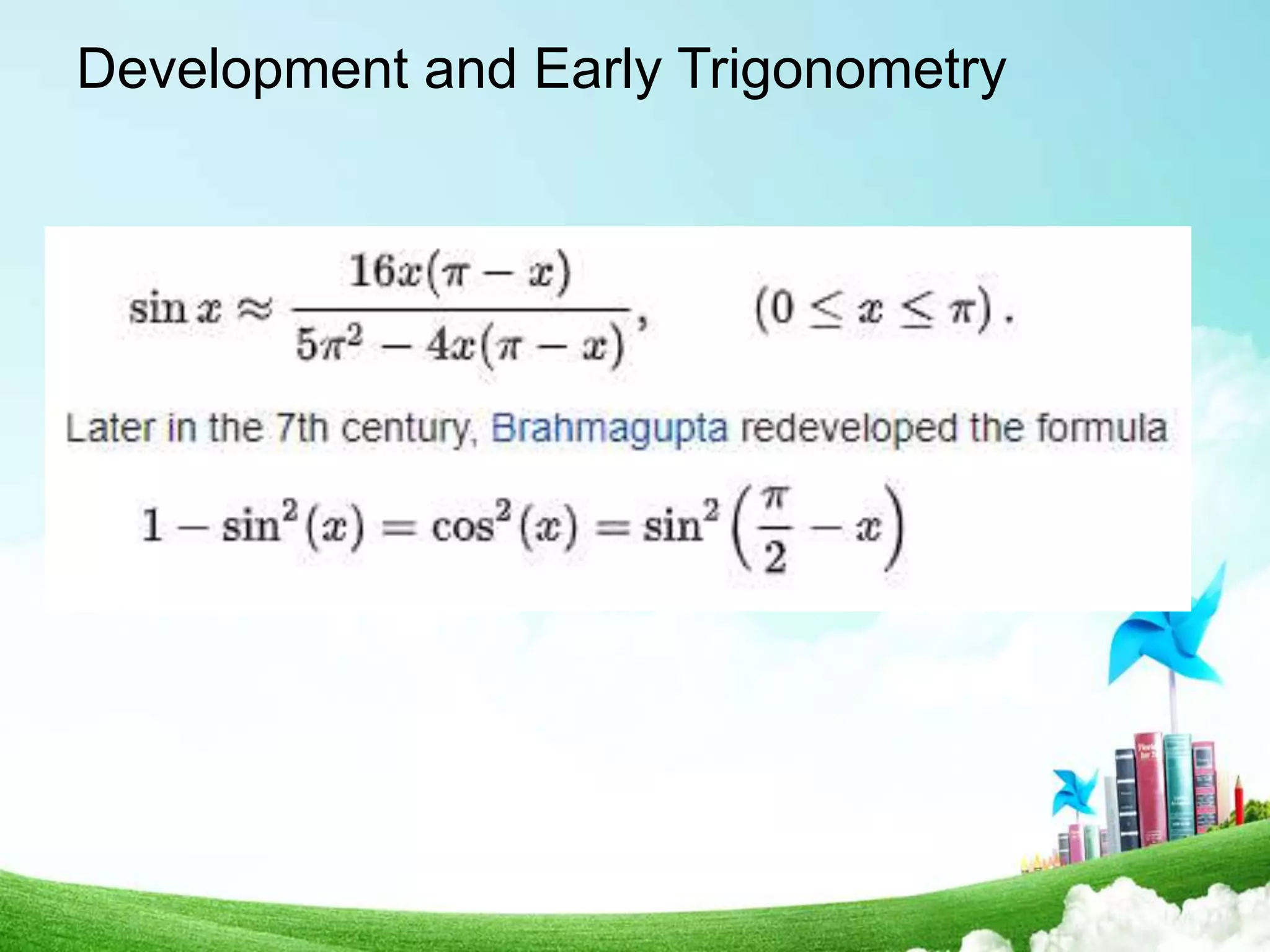
• Bhaskara I
– produced a formula for calculating the sine of
an acute angle without the use of a table
– approximation formula for sin(x)
Development and Early Trigonometry
• Madhava
– developed the concepts of the power series
and Taylor series
– produced the power series expansions of
sine, cosine, tangent, and arctangent
– power series of π and the angle, radius,
diameter, and circumference of a circle in
terms of trigonometric functions
Development and Early Trigonometry
• Muhammad ibn Mūsā al-Khwārizmī
– produced accurate sine and cosine tables,
and the first table of tangents
– pioneer in spherical trigonometry
• Habash al-Hasib al-Marwazi
– produced the first table of cotangents
• Muhammad ibn Jābir al-Harrānī al-Battānī
– discovered the reciprocal functions of secant
and cosecant
– produced the first table of cosecants for each
degree from 1° to 90°
Development and Early Trigonometry
• l-Jayyani
– wrote The book of unknown arcs of a sphere
– contains formulae for right-handed triangles,
– the general law of sines
– the solution of a spherical triangle by means
of the polar triangle
Development and Early Trigonometry
• method of triangulation
– first developed by Muslim mathematicians
– applied to practical uses
• Omar Khayyám
– solved cubic equations using approximate
numerical solutions found by interpolation in
trigonometric tables
Development and Early Trigonometry
• Nasīr al-Dīn al-Tūsī
– first to treat trigonometry as a mathematical
discipline independent from astronomy
– he developed spherical trigonometry into its
present form
– listed the six distinct cases of a right-angled
triangle in spherical trigonometry
Development and Early Trigonometry
• Nasīr al-Dīn al-Tūsī
– first to treat trigonometry as a mathematical
discipline independent from astronomy
– he developed spherical trigonometry into its
present form
– listed the six distinct cases of a right-angled
triangle in spherical trigonometry
• Jamshīd al-Kāshī
– provided the first explicit statement of the law
of cosines in a form suitable for triangulation
Development and Early Trigonometry
• Levi ben Gershon (Gersonides)
– wrote On Sines, Chords and Arcs
• "toleta de marteloio"
– used by sailors in the Mediterranean Sea
during the 14th-15th Centuries to calculate
navigation courses
• Leonhard Euler
– Introductio in analysin infinitorum
– mostly responsible for establishing the
analytic treatment of trigonometric functions in
Europe
Development and Early Trigonometry
• Brook Taylor
– general Taylor series
– gave the series expansions and
approximations for all six trigonometric
functions

HISTORY of GEOMETRY.ppt

  • 1.
  • 2.
    Early Geometry • Geometryis the branch of mathematics that studies shapes and their relationships to each other. • 2000 BC – Scotland, Carved Stone Balls exhibit a variety of symmetries including all of the symmetries of Platonic solids.
  • 3.
    Early Geometry • 1800BC – Moscow Mathematical Papyrus, findings volume of a frustum
  • 4.
    Early Geometry • 1650BC – Rhind Mathematical Papyrus, copy of a lost scroll from around 1850 BC, the scribe Ahmes presents one of the first known approximate values of π at 3.16, the first attempt at squaring the circle, earliest known use of a sort of cotangent, and knowledge of solving first order linear equations
  • 5.
    Indian Geometry • peoplewere using geometry to construct elaborate ceremonial altars to the Hindu gods throughout the Indian subcontinent • instructions used to construct these alters were recorded in a series of books called the Sulba Sutras
  • 6.
    Indian Geometry • developeda method for calculating the mathematical constant pi • estimated the square root of two, • wrote down the earliest known statement of what would later come to be known as the Pythagorean theorem
  • 7.
    Indian Geometry • describeways to create various geometric shapes with the same area
  • 8.
    Chinese Geometry • earliestevidence of a systematic organization of regular shapes reproduced on material objects • Painted motifs displaying geometrical patterns such as symmetrical arrangements of triangles, lozenges, or circles have been found on pottery pieces unearthed at Banpo
  • 9.
    Chinese Geometry • MoJing - the oldest existent book on geometry in China • described various aspects of many fields associated with physical science • 'atomic' definition of the geometric point, stating that a line is separated into parts
  • 10.
    Chinese Geometry • TheNine Chapters on the Mathematical Art – finding surface areas for squares and circles – volumes of solids in various three-dimensional shapes – illustrated proof for the Pythagorean theorem – properties of the right angle triangle and the Pythagorean theorem – calculated pi as 3.14159 using a 3072 sided polygon
  • 11.
    Chinese Geometry • TheNine Chapters on the Mathematical Art
  • 12.
    Greek Geometry • developedthe idea of the "axiomatic method" • Thales of Miletus – five geometric propositions for which he wrote deductive proofs • Euclid – The Elements began with definitions of terms, fundamental geometric principles (called axioms or postulates), and general quantitative principles
  • 13.
    Greek Geometry • Archimedes –greatest of the Greek mathematicians – developed methods very similar to the coordinate systems of analytic geometry – limiting process of integral calculus
  • 14.
    Islamic Geometry • establishmentof the House of Wisdom in Baghdad • development of algebraic geometry • Al-Mahani - conceived the idea of reducing geometrical problems such as duplicating the cube to problems in algebra • Al-Karaji - completely freed algebra from geometrical operations and replaced them with the arithmetical type of operations
  • 15.
    Islamic Geometry • Thābitibn Qurra - theorems in spherical trigonometry, analytic geometry, and non- Euclidean geometry –one of the first reformers of the Ptolemaic system –mechanics he was a founder of statics –arithmetical operations applied to ratios of geometrical quantities –generalization of the Pythagorean theorem to all triangles
  • 16.
    Islamic Geometry • Ibrahimibn Sinan - method of integration more general than that of Archimedes • al-Quhi - revival and continuation of Greek higher geometry in the Islamic world • Ibn al-Haytham - studied optics and investigated the optical properties of mirrors made from conic sections
  • 17.
    Modern Geometry • RenéDescartes and Pierre de Fermat - creation of analytic geometry, or geometry with coordinates and equations • Girard Desargues - systematic study of projective geometry – the study of geometry without measurement, just the study of how points align with each other
  • 18.
    Modern Geometry • developmentof Calculus - beginning of a new field of mathematics now called analysis • Non-Eudcledian Geometry – Omar Khayyám - proof of properties of figures in non-Euclidean geometries – Gauss, Johann Bolyai, and Lobatchewsky - develop a self-consistent geometry in which the fifth Eucledian postulate was false
  • 19.
    Modern Geometry • Non-EudcledianGeometry – Bernhard Riemann - had applied methods of calculus in a ground-breaking study of the intrinsic geometry of all smooth surfaces
  • 20.
    Modern Geometry • Introductionof mathematical rigor – separation of logical reasoning from intuitive understanding of physical space – Hilbert's axioms - David Hilbert • Topology – method of studying calculus- and analysis- related concepts – properties of more general figures (such as connectedness and boundaries)
  • 21.
    20th Century Geometry •Algebraic Geometry – study of curves and surfaces over finite fields – André Weil, Alexander Grothendieck, and Jean-Pierre Serre • Finite Geometry – study of spaces with only finitely many points – found applications in coding theory and cryptography
  • 22.
    20th Century Geometry •Computational Geometry / Digital Geometry – geometric algorithms, discrete representations of geometric data
  • 23.
  • 24.
    Development and EarlyTrigonometry • Trigonometry – came from the Greek words, trigonon (triangle) and metron (measure) • Ancient Egyptians and Babylonians - theorems on the ratios of the sides of similar triangles • Babylonian astronomers - detailed records on the rising and setting of stars, the motion of the planets, and the solar and lunar eclipses
  • 25.
    Development and EarlyTrigonometry • Egyptians - used a primitive form of trigonometry for building pyramids in the 2nd millennium BC. • Ancient Greek and Hellenistic mathematicians made use of the chord. – A chord's perpendicular bisector passes through the center of the circle and bisects the angle
  • 26.
    Development and EarlyTrigonometry • Euclid and Archimedes – propositions twelve and thirteen of Book Two of the Elements are the laws of cosines for obtuse and acute angles – Theorems on the lengths of chords are applications of the law of sines – theorem on broken chords is equivalent to formulas for sines of sums and differences of angles
  • 27.
    Development and EarlyTrigonometry • Hipparchus of Nicaea – "the father of trigonometry" – compilation of first trigonometric table • Aristarchus of Samos - "On the Sizes and Distances of the Sun and Moon" (ca. 260 BC)
  • 28.
    Development and EarlyTrigonometry • Menelaus of Alexandria (ca. 100 AD) - "Sphaerica" –In Book I, he established a basis for spherical triangles analogous to the Euclidean basis for plane triangles. –Htwo spherical triangles are congruent if corresponding angles are equal –the sum of the angles of a spherical triangle is greater than 180°
  • 29.
    Development and EarlyTrigonometry • Menelaus of Alexandria (ca. 100 AD) - "Sphaerica" –Book II of Sphaerica applies spherical geometry to astronomy. –Book III contains the "theorem of Menelaus". –"rule of six quantities"
  • 30.
    • given anyline that transverses (crosses) the three sides of a triangle (one of them will have to be extended), six segments are cut off on the sides. The product of three non-adjacent segments is equal to the product of the other three
  • 32.
    Development and EarlyTrigonometry • Pythagoras discovered many of the properties of what would become trigonometric functions.
  • 33.
    Development and EarlyTrigonometry • Siddhantas – defined the sine as the modern relationship between half an angle and half a chord – defining the cosine, versine, and inverse sine • Bhaskara I – produced a formula for calculating the sine of an acute angle without the use of a table – approximation formula for sin(x)
  • 34.
  • 35.
    Development and EarlyTrigonometry • Madhava – developed the concepts of the power series and Taylor series – produced the power series expansions of sine, cosine, tangent, and arctangent – power series of π and the angle, radius, diameter, and circumference of a circle in terms of trigonometric functions
  • 36.
    Development and EarlyTrigonometry • Muhammad ibn Mūsā al-Khwārizmī – produced accurate sine and cosine tables, and the first table of tangents – pioneer in spherical trigonometry • Habash al-Hasib al-Marwazi – produced the first table of cotangents • Muhammad ibn Jābir al-Harrānī al-Battānī – discovered the reciprocal functions of secant and cosecant – produced the first table of cosecants for each degree from 1° to 90°
  • 37.
    Development and EarlyTrigonometry • l-Jayyani – wrote The book of unknown arcs of a sphere – contains formulae for right-handed triangles, – the general law of sines – the solution of a spherical triangle by means of the polar triangle
  • 38.
    Development and EarlyTrigonometry • method of triangulation – first developed by Muslim mathematicians – applied to practical uses • Omar Khayyám – solved cubic equations using approximate numerical solutions found by interpolation in trigonometric tables
  • 39.
    Development and EarlyTrigonometry • Nasīr al-Dīn al-Tūsī – first to treat trigonometry as a mathematical discipline independent from astronomy – he developed spherical trigonometry into its present form – listed the six distinct cases of a right-angled triangle in spherical trigonometry
  • 40.
    Development and EarlyTrigonometry • Nasīr al-Dīn al-Tūsī – first to treat trigonometry as a mathematical discipline independent from astronomy – he developed spherical trigonometry into its present form – listed the six distinct cases of a right-angled triangle in spherical trigonometry • Jamshīd al-Kāshī – provided the first explicit statement of the law of cosines in a form suitable for triangulation
  • 41.
    Development and EarlyTrigonometry • Levi ben Gershon (Gersonides) – wrote On Sines, Chords and Arcs • "toleta de marteloio" – used by sailors in the Mediterranean Sea during the 14th-15th Centuries to calculate navigation courses • Leonhard Euler – Introductio in analysin infinitorum – mostly responsible for establishing the analytic treatment of trigonometric functions in Europe
  • 42.
    Development and EarlyTrigonometry • Brook Taylor – general Taylor series – gave the series expansions and approximations for all six trigonometric functions