HISTORY OF COGNITIVE PSYCHOLOGY
ANCIENT TIMES TILL THE COGNITIVE REVOLUTION
EMPIRICISM
◼Empiricism rests on the tenet that knowledge comes from an
individual’s own experience.
◼Empiricists recognize the role of genetics but hold that human
nature is changeable, malleable.
◼People are the way they are largely because of previous
learning
… EMPIRICISM
◼Empiricists believe that experience and learning determine
behaviour and individual differences.
◼Environment therefore plays a powerful role in determining
one’s intellectual (and other) abilities
NATIVISM
◼Nativists emphasize the role of constitutional factors in the
acquisition of abilities and tendencies
◼Nativists attribute individual differences to original biologically
endowed capabilities.
◼The debate between empiricists and nativists is still on today!
PLATO
◼Nativist
◼Storing something in
memory is like writing on a
wax tablet
◼Mind is like an aviary with
birds flying about, and
memory retrieval is like trying
to catch a specific bird –
sometimes, you do,
sometimes, you don’t.
ARISTOTLE
◼Empiricist
◼Spoke about memory and
illusions
RENE DESCARTES (1569 – 1650)
◼ Nativist and Rationalist
◼ Human reason is unique.
◼ Insights more certain than
experience
◼ Introduced idea of mental
objects / structures (physical
and symbolic)
◼ Views are still influential
DAVID HUME (1711 – 1776)
◼Empiricist
◼Ideas are based on
experience of external
world and internal
reflections – together
form simple ideas
◼Reason combines simple
ideas into complex ones.
◼Ideas are associated via
similarity and contiguity
…HUME
◼“post hoc ergo proptor hoc”
(after therefore because)
◼Goal of science: “to know the
different operations of the
mind, to separate them from
each other, to class them
under their proper heads”
◼Introduced operations of the
mind – comparison and
association.
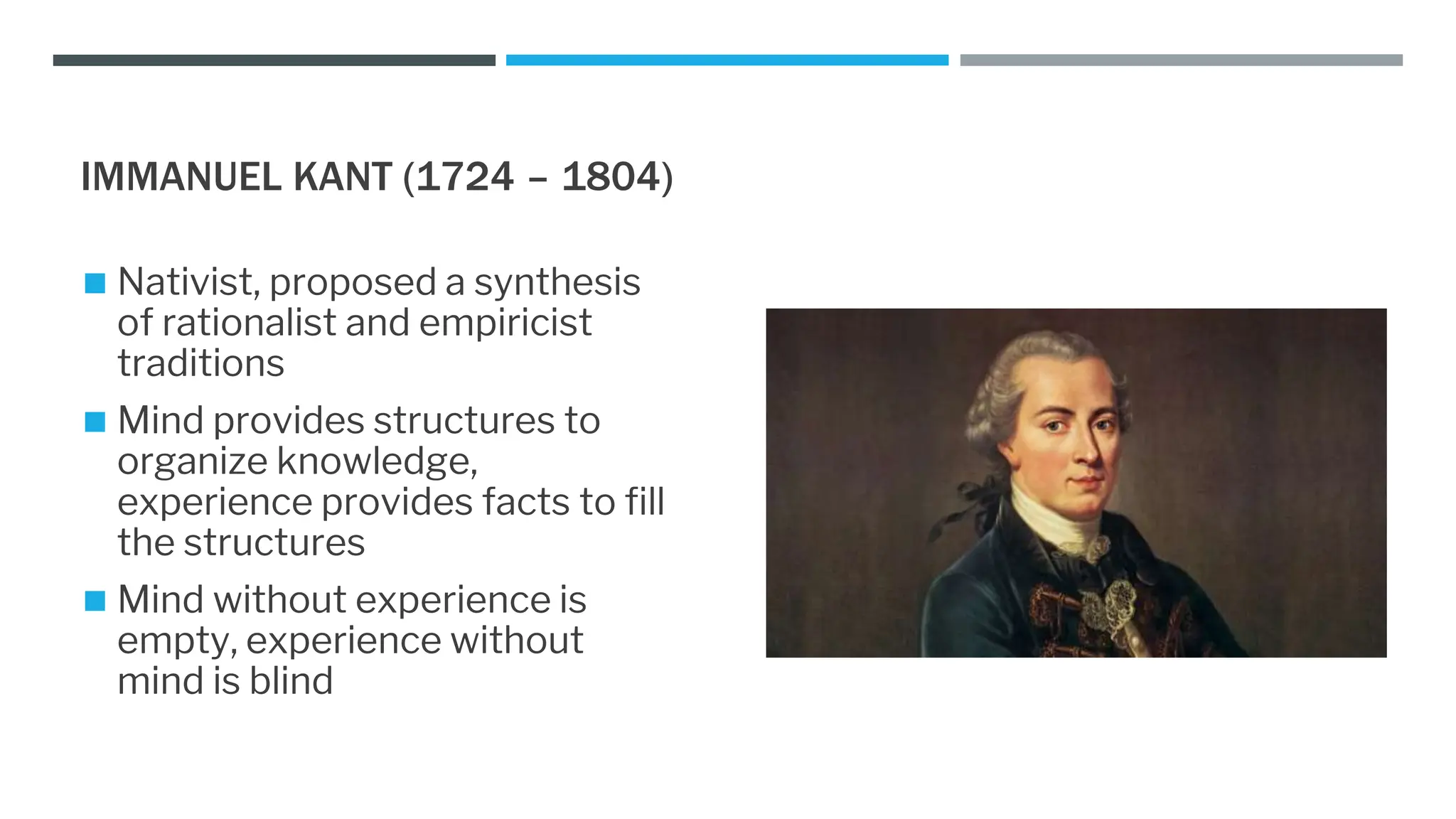
IMMANUEL KANT (1724 – 1804)
◼ Nativist, proposed a synthesis
of rationalist and empiricist
traditions
◼ Mind provides structures to
organize knowledge,
experience provides facts to fill
the structures
◼ Mind without experience is
empty, experience without
mind is blind
…KANT
◼ Three kinds of structures:
◼ Dimensions – because of this, we
experience objects as extended in
time and space
◼ Categories – abstract
characterizations of the
relationship among objects
◼ Schemas – generic concepts
used to describe the general
properties of a class of objects
(unit of knowledge)
JOHN LOCK
◼Empiricist
◼Like Hume, spoke about two
ideas/ experiences
becoming joined together
simply through contiguity
JOHN STUART MILL
◼Empiricist
◼Followed in Aristotle’s tradition
◼suggested that internal
representation is of three types:
◼(1) direct sensory events;
◼(2) events that are stored in
memory; and
◼(3) transformation of these
events in the thinking process
FROM THEN TO NOW
◼Were not interested in mental processes as cognitive
psychologists are today
◼However, we will be referencing back to them as we
study memory, thinking, reasoning, mental
representation, problem solving.
◼Gave the foundations to classical conditioning as well
… FROM THEN TO NOW
◼Till 1870s no one even asked whether these opinions, questions
could be answered through research.
◼But when people began doing so, experimental psychology was
born!
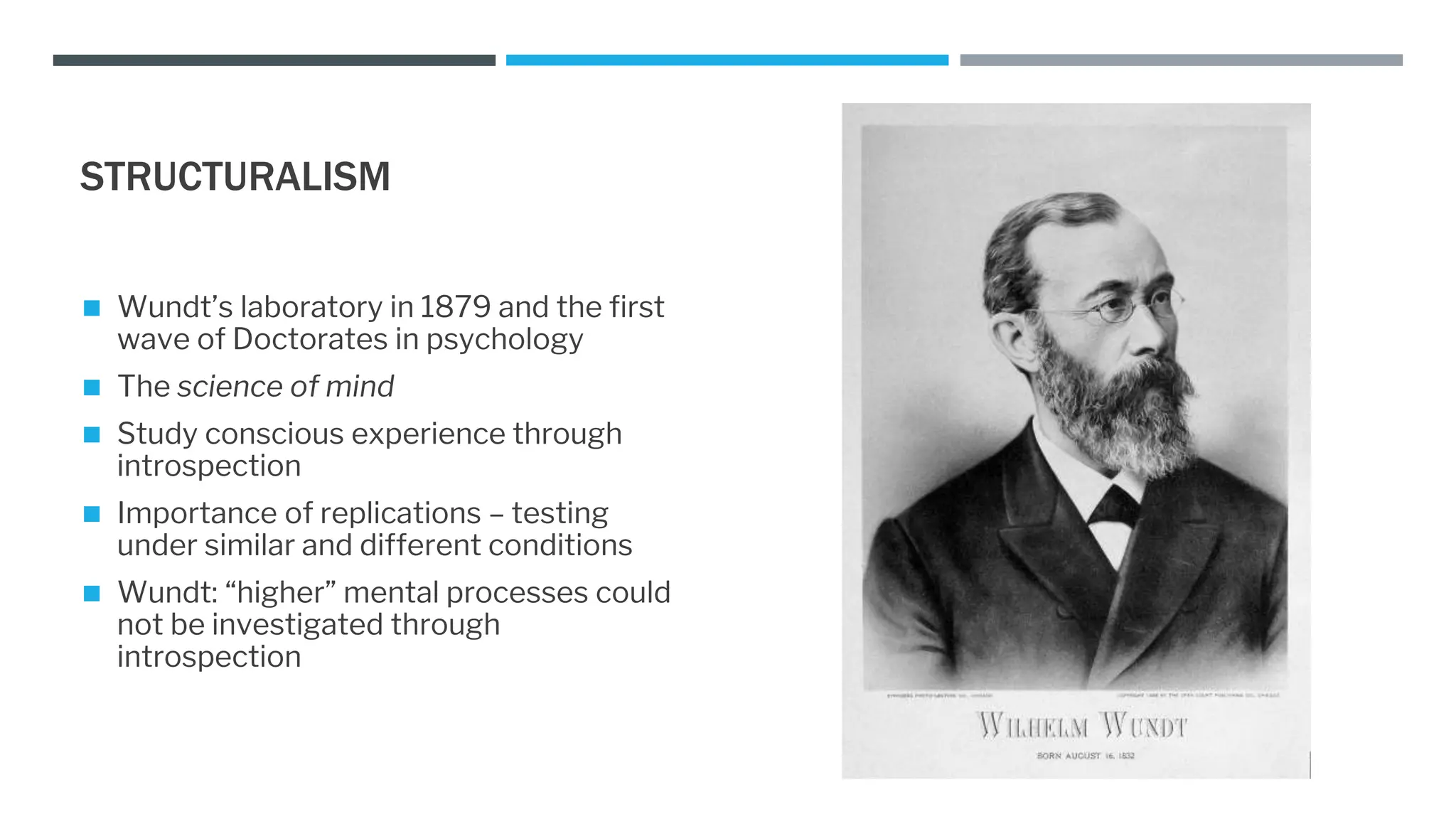
STRUCTURALISM
◼ Wundt’s laboratory in 1879 and the first
wave of Doctorates in psychology
◼ The science of mind
◼ Study conscious experience through
introspection
◼ Importance of replications – testing
under similar and different conditions
◼ Wundt: “higher” mental processes could
not be investigated through
introspection
…STRUCTRALISM
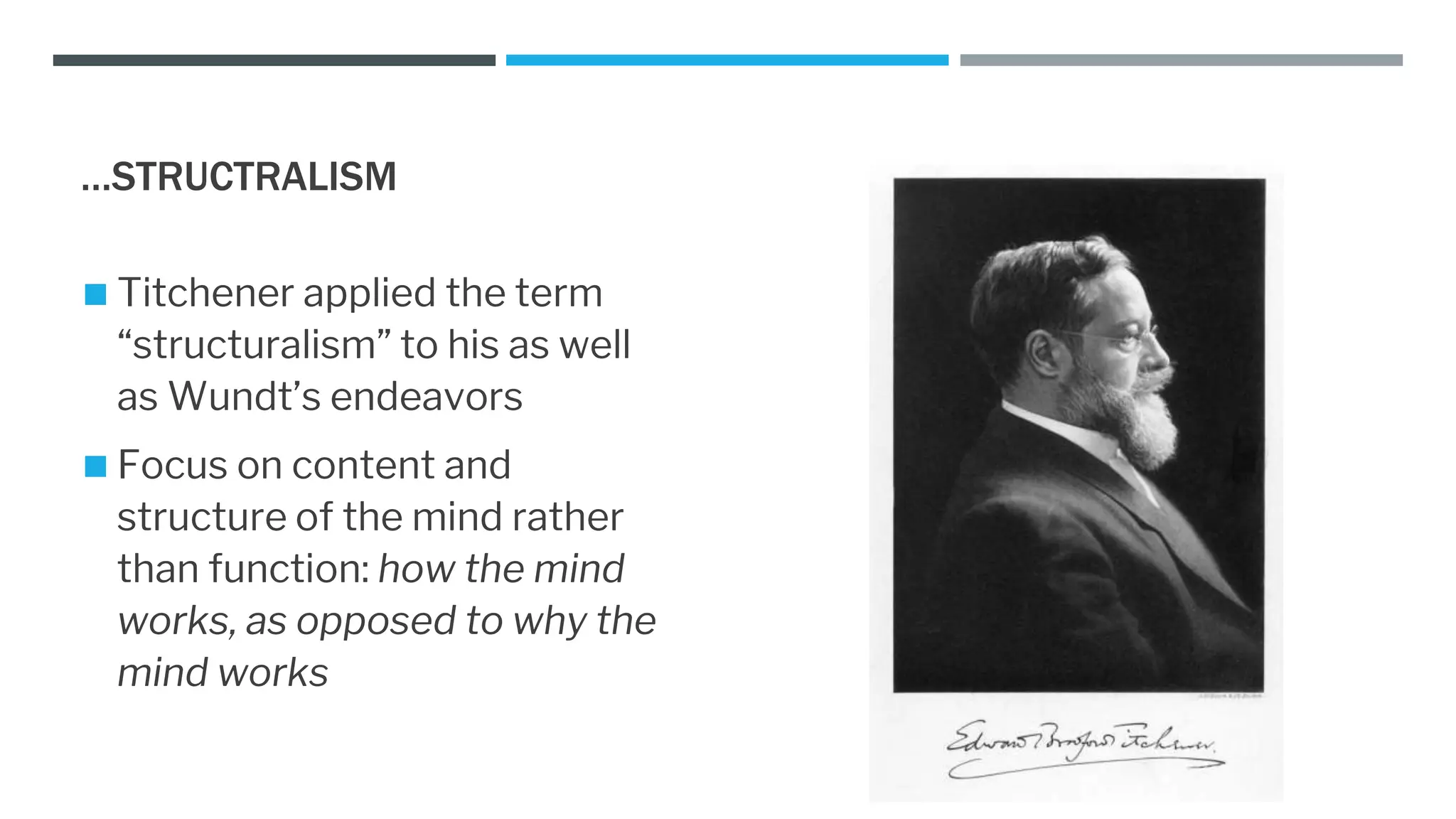
◼ Titchener applied the term
“structuralism” to his as well
as Wundt’s endeavors
◼ Focus on content and
structure of the mind rather
than function: how the mind
works, as opposed to why the
mind works
…STRUCTURALISM
◼Ebbinghaus (1913) studied
memory using over 2000
nonsense syllables (to avoid
previous associations) and
himself as a subject
…STRUCTURALISM
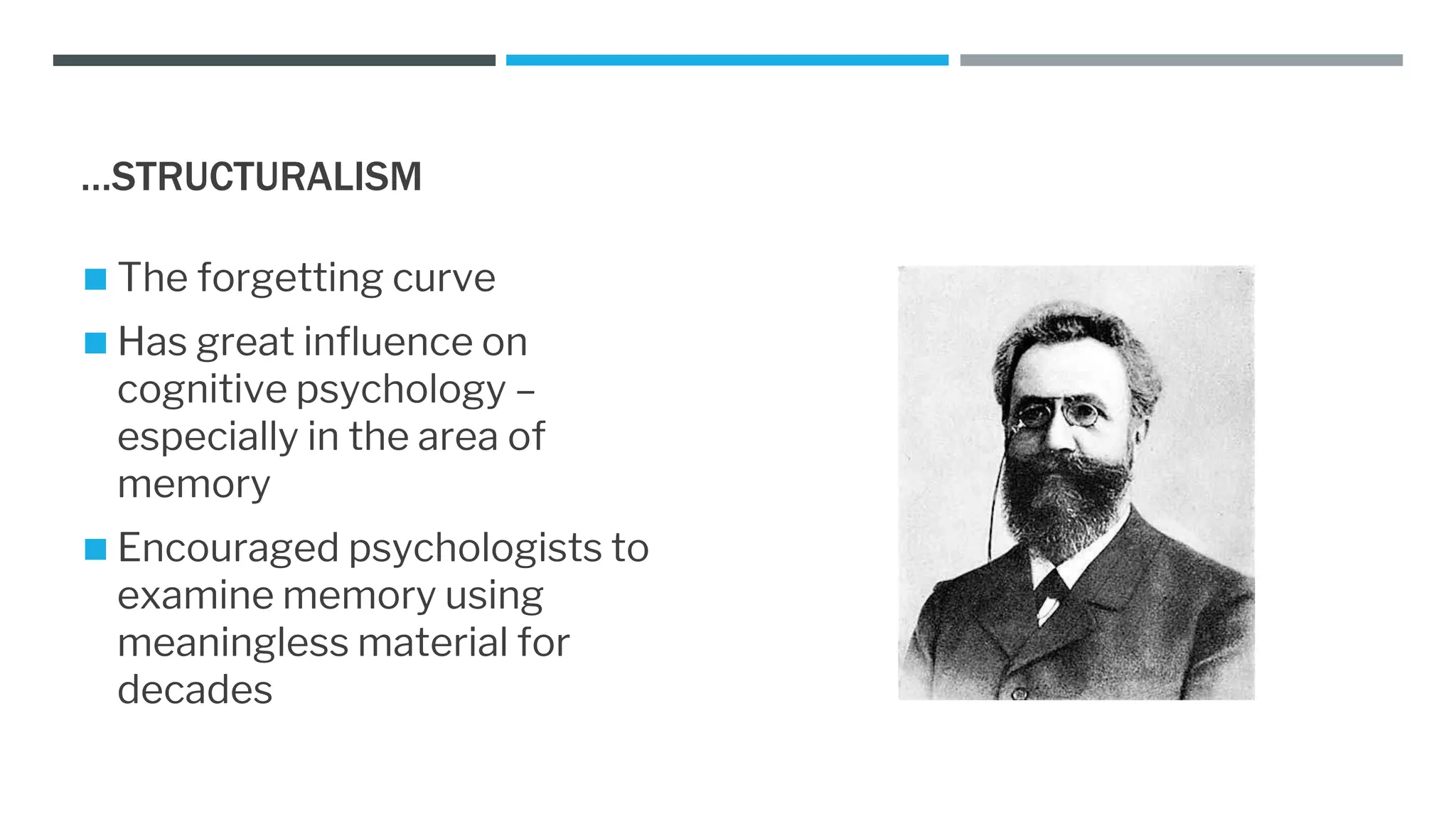
◼ The forgetting curve
◼ Has great influence on
cognitive psychology –
especially in the area of
memory
◼ Encouraged psychologists to
examine memory using
meaningless material for
decades
FUNCTIONALISM
◼ William James’ “Principles of
Psychology” 1890
◼ Human mind is active and inquiring
◼ Talks about perception, attention,
reasoning, and the tip-of-the-tongue
phenomenon
◼ Also talks about two different kinds
of memory and distinguished
between memory structure and
memory process – the foreshadow
of the AS model!
… FUNCTIONALISM
◼ Assumed that the way the mind
works has a great deal to do with its
function
◼ Habit as the flywheel of society – a
mechanism basic to keeping out
behaviour within bounds
◼ Dewey and Thorndike: the most
important thing that the mind did
was to allow the individual to adapt
to the environment
BEHAVIOURISM
◼ Study of behaviour
◼ Observable, objective events
◼ Banished all “mental
language” from use
◼ No significant contribution
to mental processes
BEHAVIOURISM
◼ Still, contributed method for
studying cognition
◼ Stressed the
importance of
defining concepts
◼ Stressed importance
of experimental
control
…BEHAVIOURISM
◼ Skinner argued that
“mentalistic” entities as images,
sensations and thoughts
should not be excluded just
because they are difficult to
study
◼ They need to be studied, but
did not believe they were to be
treated differently from
observable behaviour
…BEHAVIOURISM
◼ Argued against the existence
of mental representation as
anything more than a copy of
the environment
◼ A simple functional analysis of
the relationship between
stimuli and behaviours can be
used to study mental events
… BEHAVIOURISM
◼ Other behavioursts like
Tolman were more accepting
of mental representation
◼ Tolman believed that even
rats have goals and
expectations
◼ demonstrated that animals
have both expectations and
internal representations that
guided their behaviour
GESTALT PSYCHOLOGY
◼ Gestalt – form, configuration, shape
◼ Objected to introspection
◼ Carried out most early research on
perception and problem solving
◼ Stated the observer did not
construct a coherent perception
from simple, elementary sensory
aspects of an experience, but
instead apprehended the total
structure of an experience as a
whole.
…GESTALT PSYCHOLOGY
◼ Structuralism, functionalism,
and behaviourism offer
incomplete accounts of
psychological and in particular
cognitive experience.
◼ Chose to study subjective
experience of stimuli and
focus on how people use or
impose structure on their
experiences
…GESTALT PSYCHOLOGY
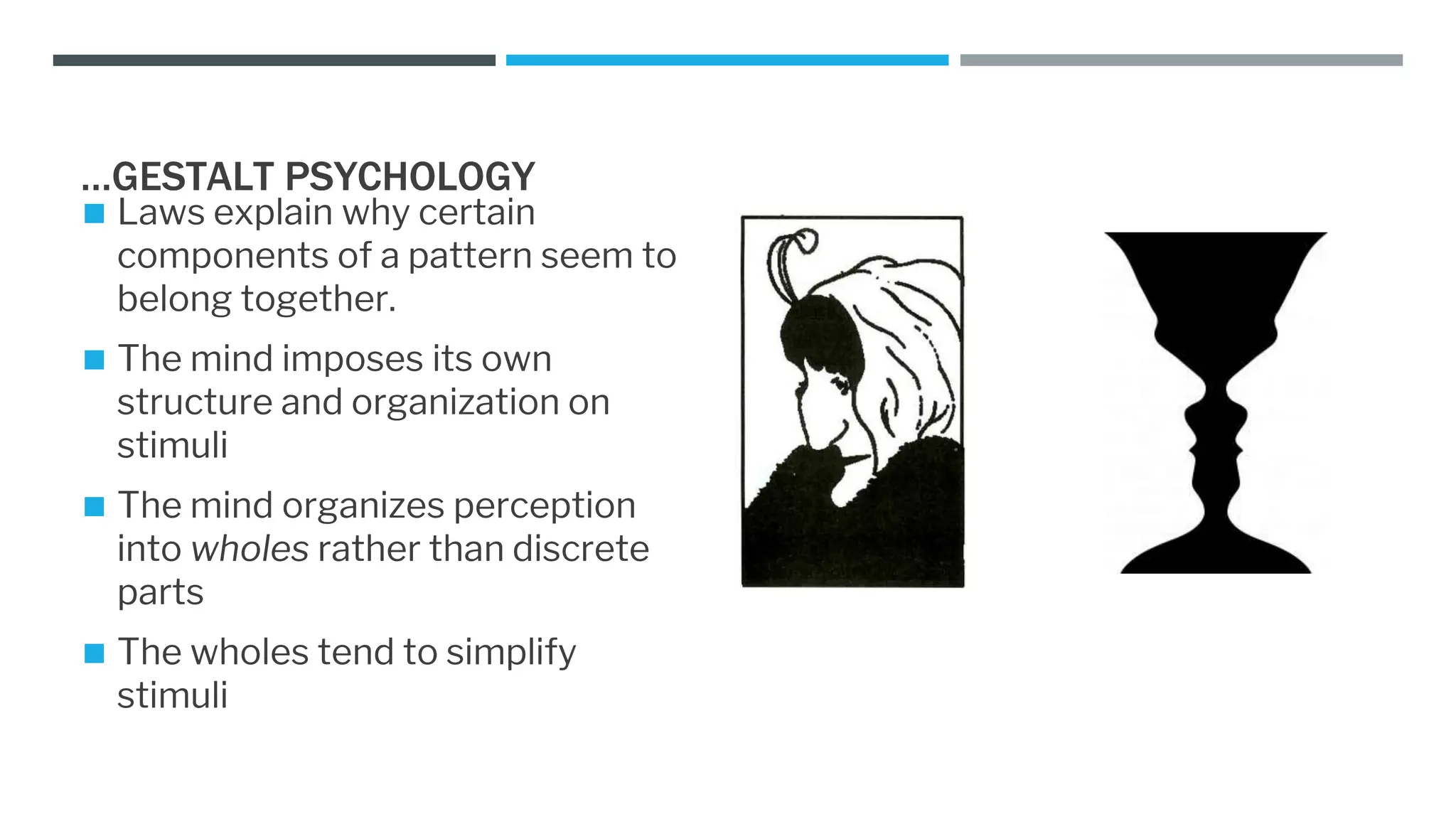
◼ Laws explain why certain
components of a pattern seem to
belong together.
◼ The mind imposes its own
structure and organization on
stimuli
◼ The mind organizes perception
into wholes rather than discrete
parts
◼ The wholes tend to simplify
stimuli
…GESTALT PSYCHOLOGY
◼Emphasized the role of the
mind
◼Believed ‘insight’ played a
big role in learning
◼Foreshadowed the most
common theory of steps in
creativity
BARTLETT
◼ Rejected Ebbinghaus’ experimental
method
◼ Used meaningful material – lengthy
stories
◼ Examined how people’s mental
influenced their later recall of the
material
◼ Proposed that memory is a
reconstructive process involving
interpretations and transformations of
the original material
GENETIC EPISTEMOLOGY
◼ Piaget conducted studies on
cognitive development of
infants, children, and adolescents
◼ Sought to describe the
intellectual structures
underlying cognitive experience
at different
developmental points through
the genetic
epistemology approach
(That nature sets the timetable and the unfolding of
development happens within these genetic bounds but
with interaction of the environment – similar to
Eriksons’ epigenetic principle)
…GENETIC EPISTEMOLOGY
◼ Largely sympathetic to the
gestalt idea that the relationship
between parts and wholes is
complex
◼ Noted that there exists a
qualitative difference in the
cognitive processes between
children and adults
◼ Has major influence on cognitive
psychology
STUDY OF INDIVIDUAL DIFFERENCES
◼ Galton wondered whether
intellectual traits could be
inherited
◼ Questioned the role
of genetics on
intelligence
◼ Developed statistical tests to
answer his questions
…STUDY OF INDIVIDUAL DIFFERENCES
◼ Studied a variety of cognitive
abilities
like mental imagery
◼ Noted individual differences in
these
◼ Left a legacy in
terms of inventions,
tests, questionnaires, and
statistical techniques
THE COGNITIVE REVOLUTION
◼While experimental psychologists were rethinking the
definition of psychology, other important developments were
occurring elsewhere.
◼Human factors engineering – a product of WWII – design to suit
the human machine
◼Increased insight into communication systems and their
passage, interpretation, and use by humans
THE COGNITIVE REVOLUTION
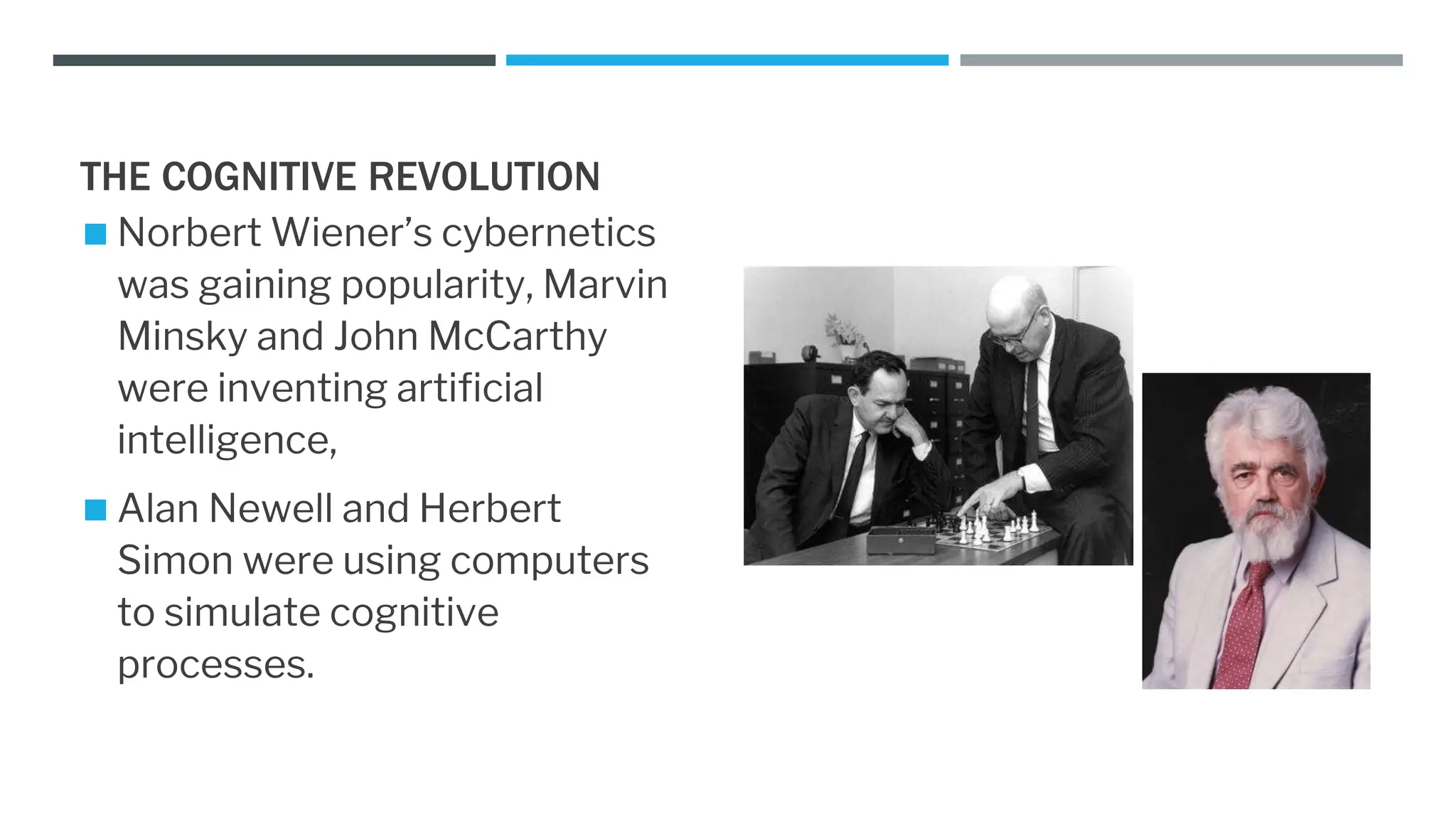
◼ Norbert Wiener’s cybernetics
was gaining popularity, Marvin
Minsky and John McCarthy
were inventing artificial
intelligence,
◼ Alan Newell and Herbert
Simon were using computers
to simulate cognitive
processes.
THE COGNITIVE REVOLUTION
◼ It was also in 1956 that Jerry
Bruner, Jackie Goodenough and
George Austin published A
Study of Thinking which took
seriously the notion of cognitive
strategies.
◼ 1956 signal-detection theory
was applied to perception by
Tanner, Swets, Birdsall and
others at Michigan
… THE COGNITIVE REVOLUTION
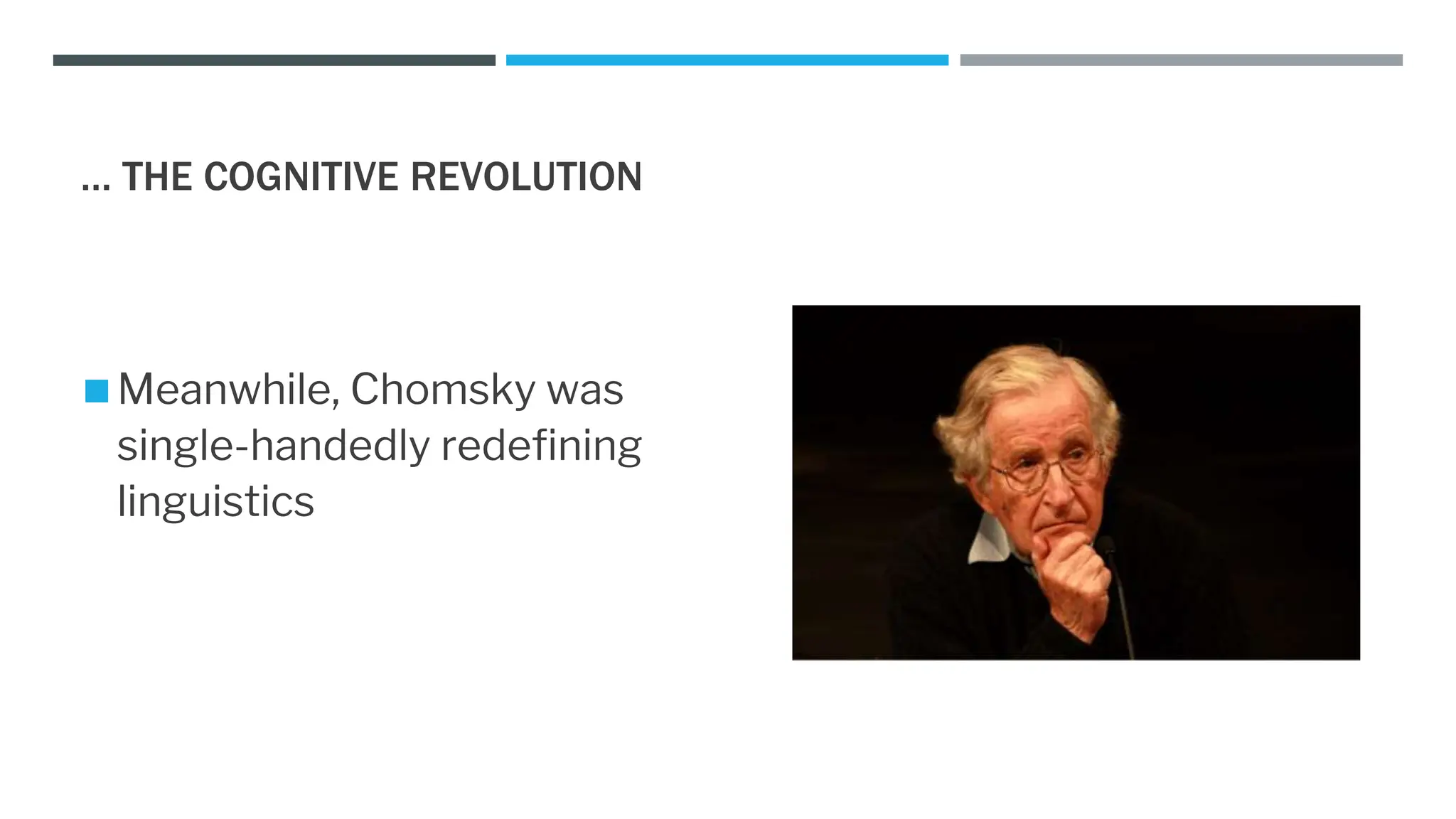
◼Meanwhile, Chomsky was
single-handedly redefining
linguistics
… THE COGNITIVE REVOLUTION
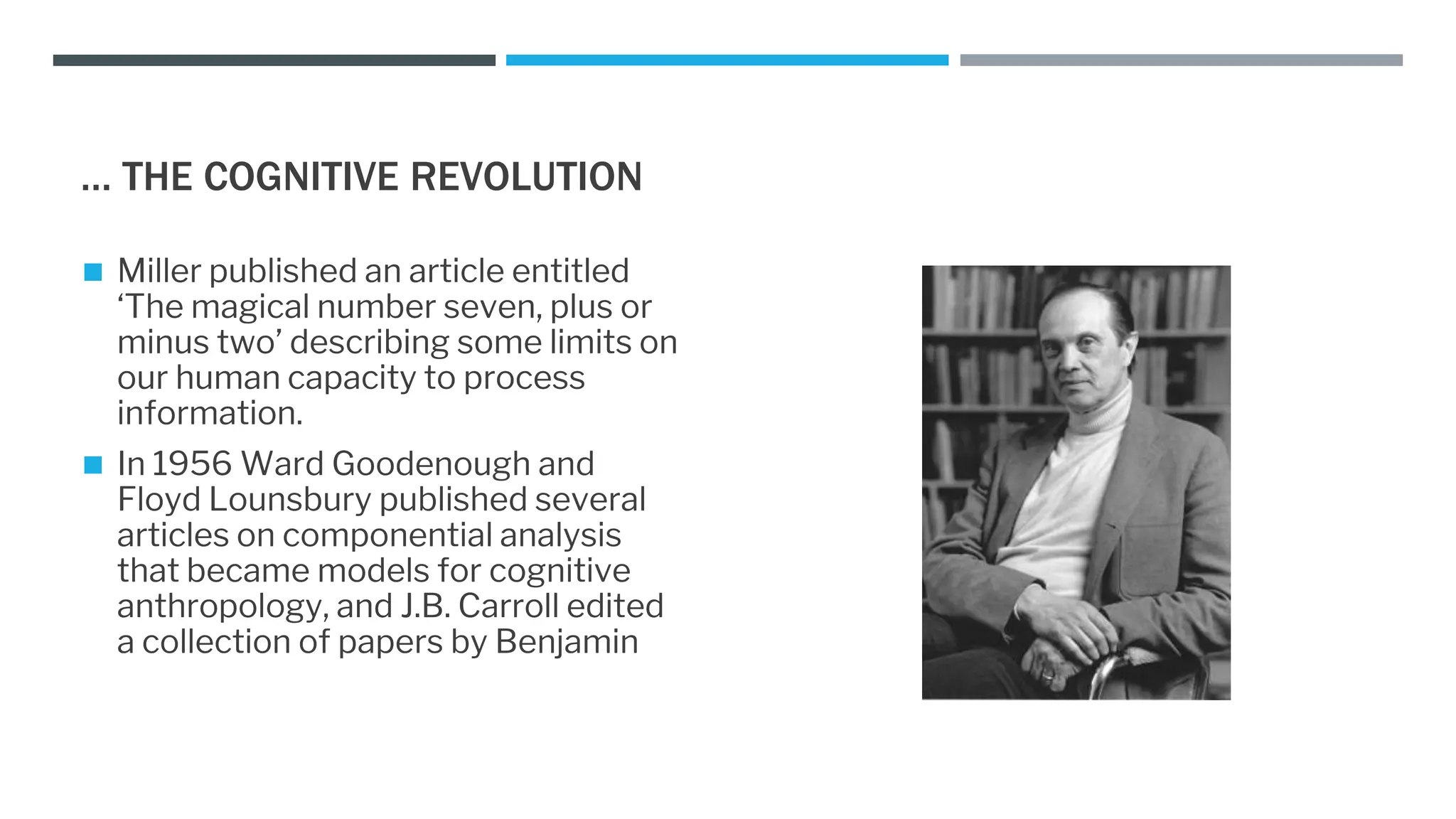
◼ Miller published an article entitled
‘The magical number seven, plus or
minus two’ describing some limits on
our human capacity to process
information.
◼ In 1956 Ward Goodenough and
Floyd Lounsbury published several
articles on componential analysis
that became models for cognitive
anthropology, and J.B. Carroll edited
a collection of papers by Benjamin
… THE COGNITIVE REVOLUTION
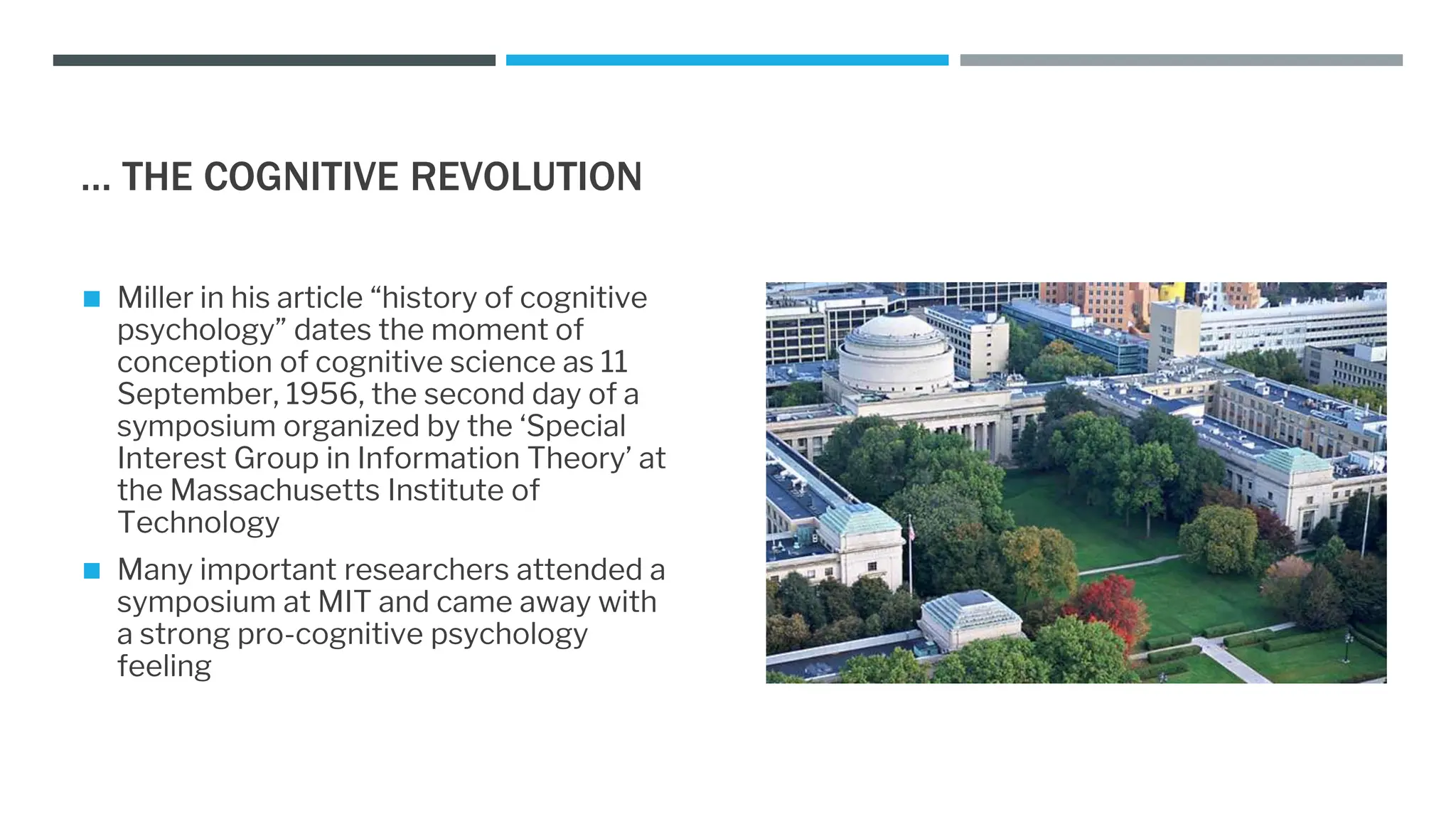
◼ Miller in his article “history of cognitive
psychology” dates the moment of
conception of cognitive science as 11
September, 1956, the second day of a
symposium organized by the ‘Special
Interest Group in Information Theory’ at
the Massachusetts Institute of
Technology
◼ Many important researchers attended a
symposium at MIT and came away with
a strong pro-cognitive psychology
feeling
PRESENT TIMES
THIS IS WHAT YOU AS STUDENTS WILL COLLABORATE AND COMPLETE
SOME IMPORTANT CURRENT TRENDS
◼ Artificial Intelligence has entered everyday life and deep learning systems
are being investigated
◼ Cognitive neuroscience is becoming more central to all branches of
psychology and soon the cognitive science-cognitive neuroscience
differentiation may not exist
◼ There is increasing prominence of statistical models based on Bayesian
probability theory; a move away from the General Linear Model (will help us
understand more about mind/brain engine… they are applied in robotics
and are making autonomous vehicles possible
SOME IMPORTANT CURRENT TRENDS
◼Increasing emphasis on embodiment; how the brain uses
information from the sensory systems and interaction with the
world to perform complex tasks
◼Greater emphasis on social cognition; role of neurochemistry in
social decision making for instance.
◼Linguistic diversity and the development of new languages; the
emojis for instance
READ MORE ABOUT
◼The human connectome project
RETURN TO PRESENT!
END OF HISTORY

History of cognitive psychology 2020.pptx

  • 1.
    HISTORY OF COGNITIVEPSYCHOLOGY ANCIENT TIMES TILL THE COGNITIVE REVOLUTION
  • 2.
    EMPIRICISM ◼Empiricism rests onthe tenet that knowledge comes from an individual’s own experience. ◼Empiricists recognize the role of genetics but hold that human nature is changeable, malleable. ◼People are the way they are largely because of previous learning
  • 3.
    … EMPIRICISM ◼Empiricists believethat experience and learning determine behaviour and individual differences. ◼Environment therefore plays a powerful role in determining one’s intellectual (and other) abilities
  • 4.
    NATIVISM ◼Nativists emphasize therole of constitutional factors in the acquisition of abilities and tendencies ◼Nativists attribute individual differences to original biologically endowed capabilities. ◼The debate between empiricists and nativists is still on today!
  • 5.
    PLATO ◼Nativist ◼Storing something in memoryis like writing on a wax tablet ◼Mind is like an aviary with birds flying about, and memory retrieval is like trying to catch a specific bird – sometimes, you do, sometimes, you don’t.
  • 6.
  • 7.
    RENE DESCARTES (1569– 1650) ◼ Nativist and Rationalist ◼ Human reason is unique. ◼ Insights more certain than experience ◼ Introduced idea of mental objects / structures (physical and symbolic) ◼ Views are still influential
  • 8.
    DAVID HUME (1711– 1776) ◼Empiricist ◼Ideas are based on experience of external world and internal reflections – together form simple ideas ◼Reason combines simple ideas into complex ones. ◼Ideas are associated via similarity and contiguity
  • 9.
    …HUME ◼“post hoc ergoproptor hoc” (after therefore because) ◼Goal of science: “to know the different operations of the mind, to separate them from each other, to class them under their proper heads” ◼Introduced operations of the mind – comparison and association.
  • 10.
    IMMANUEL KANT (1724– 1804) ◼ Nativist, proposed a synthesis of rationalist and empiricist traditions ◼ Mind provides structures to organize knowledge, experience provides facts to fill the structures ◼ Mind without experience is empty, experience without mind is blind
  • 11.
    …KANT ◼ Three kindsof structures: ◼ Dimensions – because of this, we experience objects as extended in time and space ◼ Categories – abstract characterizations of the relationship among objects ◼ Schemas – generic concepts used to describe the general properties of a class of objects (unit of knowledge)
  • 12.
    JOHN LOCK ◼Empiricist ◼Like Hume,spoke about two ideas/ experiences becoming joined together simply through contiguity
  • 13.
    JOHN STUART MILL ◼Empiricist ◼Followedin Aristotle’s tradition ◼suggested that internal representation is of three types: ◼(1) direct sensory events; ◼(2) events that are stored in memory; and ◼(3) transformation of these events in the thinking process
  • 14.
    FROM THEN TONOW ◼Were not interested in mental processes as cognitive psychologists are today ◼However, we will be referencing back to them as we study memory, thinking, reasoning, mental representation, problem solving. ◼Gave the foundations to classical conditioning as well
  • 15.
    … FROM THENTO NOW ◼Till 1870s no one even asked whether these opinions, questions could be answered through research. ◼But when people began doing so, experimental psychology was born!
  • 16.
    STRUCTURALISM ◼ Wundt’s laboratoryin 1879 and the first wave of Doctorates in psychology ◼ The science of mind ◼ Study conscious experience through introspection ◼ Importance of replications – testing under similar and different conditions ◼ Wundt: “higher” mental processes could not be investigated through introspection
  • 17.
    …STRUCTRALISM ◼ Titchener appliedthe term “structuralism” to his as well as Wundt’s endeavors ◼ Focus on content and structure of the mind rather than function: how the mind works, as opposed to why the mind works
  • 18.
    …STRUCTURALISM ◼Ebbinghaus (1913) studied memoryusing over 2000 nonsense syllables (to avoid previous associations) and himself as a subject
  • 19.
    …STRUCTURALISM ◼ The forgettingcurve ◼ Has great influence on cognitive psychology – especially in the area of memory ◼ Encouraged psychologists to examine memory using meaningless material for decades
  • 20.
    FUNCTIONALISM ◼ William James’“Principles of Psychology” 1890 ◼ Human mind is active and inquiring ◼ Talks about perception, attention, reasoning, and the tip-of-the-tongue phenomenon ◼ Also talks about two different kinds of memory and distinguished between memory structure and memory process – the foreshadow of the AS model!
  • 21.
    … FUNCTIONALISM ◼ Assumedthat the way the mind works has a great deal to do with its function ◼ Habit as the flywheel of society – a mechanism basic to keeping out behaviour within bounds ◼ Dewey and Thorndike: the most important thing that the mind did was to allow the individual to adapt to the environment
  • 22.
    BEHAVIOURISM ◼ Study ofbehaviour ◼ Observable, objective events ◼ Banished all “mental language” from use ◼ No significant contribution to mental processes
  • 23.
    BEHAVIOURISM ◼ Still, contributedmethod for studying cognition ◼ Stressed the importance of defining concepts ◼ Stressed importance of experimental control
  • 24.
    …BEHAVIOURISM ◼ Skinner arguedthat “mentalistic” entities as images, sensations and thoughts should not be excluded just because they are difficult to study ◼ They need to be studied, but did not believe they were to be treated differently from observable behaviour
  • 25.
    …BEHAVIOURISM ◼ Argued againstthe existence of mental representation as anything more than a copy of the environment ◼ A simple functional analysis of the relationship between stimuli and behaviours can be used to study mental events
  • 26.
    … BEHAVIOURISM ◼ Otherbehavioursts like Tolman were more accepting of mental representation ◼ Tolman believed that even rats have goals and expectations ◼ demonstrated that animals have both expectations and internal representations that guided their behaviour
  • 27.
    GESTALT PSYCHOLOGY ◼ Gestalt– form, configuration, shape ◼ Objected to introspection ◼ Carried out most early research on perception and problem solving ◼ Stated the observer did not construct a coherent perception from simple, elementary sensory aspects of an experience, but instead apprehended the total structure of an experience as a whole.
  • 28.
    …GESTALT PSYCHOLOGY ◼ Structuralism,functionalism, and behaviourism offer incomplete accounts of psychological and in particular cognitive experience. ◼ Chose to study subjective experience of stimuli and focus on how people use or impose structure on their experiences
  • 29.
    …GESTALT PSYCHOLOGY ◼ Lawsexplain why certain components of a pattern seem to belong together. ◼ The mind imposes its own structure and organization on stimuli ◼ The mind organizes perception into wholes rather than discrete parts ◼ The wholes tend to simplify stimuli
  • 30.
    …GESTALT PSYCHOLOGY ◼Emphasized therole of the mind ◼Believed ‘insight’ played a big role in learning ◼Foreshadowed the most common theory of steps in creativity
  • 31.
    BARTLETT ◼ Rejected Ebbinghaus’experimental method ◼ Used meaningful material – lengthy stories ◼ Examined how people’s mental influenced their later recall of the material ◼ Proposed that memory is a reconstructive process involving interpretations and transformations of the original material
  • 32.
    GENETIC EPISTEMOLOGY ◼ Piagetconducted studies on cognitive development of infants, children, and adolescents ◼ Sought to describe the intellectual structures underlying cognitive experience at different developmental points through the genetic epistemology approach (That nature sets the timetable and the unfolding of development happens within these genetic bounds but with interaction of the environment – similar to Eriksons’ epigenetic principle)
  • 33.
    …GENETIC EPISTEMOLOGY ◼ Largelysympathetic to the gestalt idea that the relationship between parts and wholes is complex ◼ Noted that there exists a qualitative difference in the cognitive processes between children and adults ◼ Has major influence on cognitive psychology
  • 34.
    STUDY OF INDIVIDUALDIFFERENCES ◼ Galton wondered whether intellectual traits could be inherited ◼ Questioned the role of genetics on intelligence ◼ Developed statistical tests to answer his questions
  • 35.
    …STUDY OF INDIVIDUALDIFFERENCES ◼ Studied a variety of cognitive abilities like mental imagery ◼ Noted individual differences in these ◼ Left a legacy in terms of inventions, tests, questionnaires, and statistical techniques
  • 36.
    THE COGNITIVE REVOLUTION ◼Whileexperimental psychologists were rethinking the definition of psychology, other important developments were occurring elsewhere. ◼Human factors engineering – a product of WWII – design to suit the human machine ◼Increased insight into communication systems and their passage, interpretation, and use by humans
  • 37.
    THE COGNITIVE REVOLUTION ◼Norbert Wiener’s cybernetics was gaining popularity, Marvin Minsky and John McCarthy were inventing artificial intelligence, ◼ Alan Newell and Herbert Simon were using computers to simulate cognitive processes.
  • 38.
    THE COGNITIVE REVOLUTION ◼It was also in 1956 that Jerry Bruner, Jackie Goodenough and George Austin published A Study of Thinking which took seriously the notion of cognitive strategies. ◼ 1956 signal-detection theory was applied to perception by Tanner, Swets, Birdsall and others at Michigan
  • 39.
    … THE COGNITIVEREVOLUTION ◼Meanwhile, Chomsky was single-handedly redefining linguistics
  • 40.
    … THE COGNITIVEREVOLUTION ◼ Miller published an article entitled ‘The magical number seven, plus or minus two’ describing some limits on our human capacity to process information. ◼ In 1956 Ward Goodenough and Floyd Lounsbury published several articles on componential analysis that became models for cognitive anthropology, and J.B. Carroll edited a collection of papers by Benjamin
  • 41.
    … THE COGNITIVEREVOLUTION ◼ Miller in his article “history of cognitive psychology” dates the moment of conception of cognitive science as 11 September, 1956, the second day of a symposium organized by the ‘Special Interest Group in Information Theory’ at the Massachusetts Institute of Technology ◼ Many important researchers attended a symposium at MIT and came away with a strong pro-cognitive psychology feeling
  • 42.
    PRESENT TIMES THIS ISWHAT YOU AS STUDENTS WILL COLLABORATE AND COMPLETE
  • 43.
    SOME IMPORTANT CURRENTTRENDS ◼ Artificial Intelligence has entered everyday life and deep learning systems are being investigated ◼ Cognitive neuroscience is becoming more central to all branches of psychology and soon the cognitive science-cognitive neuroscience differentiation may not exist ◼ There is increasing prominence of statistical models based on Bayesian probability theory; a move away from the General Linear Model (will help us understand more about mind/brain engine… they are applied in robotics and are making autonomous vehicles possible
  • 44.
    SOME IMPORTANT CURRENTTRENDS ◼Increasing emphasis on embodiment; how the brain uses information from the sensory systems and interaction with the world to perform complex tasks ◼Greater emphasis on social cognition; role of neurochemistry in social decision making for instance. ◼Linguistic diversity and the development of new languages; the emojis for instance
  • 45.
    READ MORE ABOUT ◼Thehuman connectome project
  • 46.