Highway Engineering
LECTURE BY:
AKSHATHA B AB E, M.TECH, MISTE.
ASSISTANT PROFESSOR
DEPT. OF CIVIL ENGINEERING
1
Module 2: Unit2: Highway Geometric Design
DESIGN OF VERTICAL ALIGNMENT
In order to have smooth vehicle movements on the roads, the changes in the
gradient should be smoothened out by the vertical curves.
The vertical alignment is the elevation or profile of the centre line of the
road. The vertical alignment consists of grades and vertical curves.
The vertical alignment of a highway influences
1) Vehicle Speed
2) Acceleration and Deceleration
3) Stopping Distance
4) Sight Distance
5) Comfort While Travelling at High Speeds
6) Vehicle Operation Cost.
2
Gradient
 Gradient is the rate of rise or fall along the length of the road with respect
to the horizontal.
 It is expressed as a ratio of 1 in x (1 vertical unit to x horizontal units).
 The gradient is also expressed as percentages such as n%, the slope being
n vertical units to 100 horizontal units
Types of gradient
a) Ruling Gradient
b) Limiting Gradient
c) Exceptional Gradient
d) Minimum Gradient
4
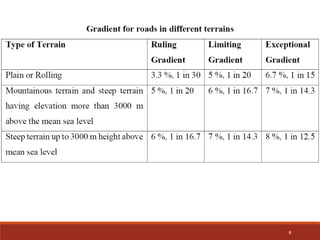
Ruling gradient
 The ruling gradient or the design gradient is the maximum gradient with
which the designer attempts to design the vertical profile of the road.
 This depends on the terrain, length of the grade, speed, pulling power of
the vehicle and the presence of the horizontal curve.
 In plain terrain, it may be possible to provide at gradients, but in hilly
terrain it is not economical and sometimes not possible also.
The IRC has recommended ruling gradient values of
a) 1 in 30 on plain and rolling terrain
b) 1 in 20 on mountainous terrain
c) 1 in 16.7 on steep terrain.
5
Limiting gradient
 Where topography of a place compels adopting steeper gradient than the
ruling gradient, 'limiting gradient' is used in view of enormous increase
in cost in constructing roads with gentler gradients.
 However, the length of continuous grade line steeper than ruling gradient
should be limited.
 On rolling terrain and on hill roads, it may be frequently necessary to
exceed ruling gradient and adopt limiting gradient, but care should be
taken to separate such stretches of steep gradients by providing either a
level road or a road with easier grade.
6
Exceptional gradient
 In some extra ordinary situations, it may be unavoidable to provide still
steeper gradients than limiting gradient at least for short stretches and in
such cases the steeper gradient up to 'exceptional gradient' may be
provided.
 However, the exceptional gradient should be strictly limited only for
short stretches not exceeding about 100 m at a stretch.
7
Minimum gradient
 This is important only at locations where surface drainage is important.
Camber will take care of the lateral drainage.
 The road with zero gradient passing through level land and open side
drains are provided with a gradient of 1 in 400.
 A minimum of 1 in 500 may be sufficient to drain water in concrete
drains or gutter, on inferior surface of drains 1 in 200 or 0.5%, on kutcha
open drains steeper slope up to 1 in 100 or 1 % may be provided
8
9
Vertical Curves
Due to changes in grade in the vertical alignment of highway, it is necessary
to introduce vertical curve at the intersections of different grades to
smoothen out the vertical profile and thus ease off the changes in gradients
for the fast moving vehicles.
The vertical curves used in highway may be classified into two categories:
(a) Summit curves or crest curves with convexity upwards
(b) Valley curves or sag curves with concavity upwards
10
Summit curves
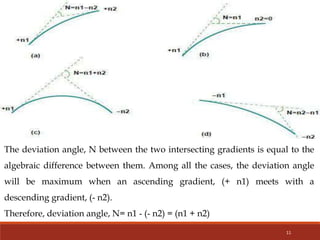
Summit curves with convexity upwards are formed in any one of the cases
as given below
a) When a positive gradient meets another positive gradient
b) When positive gradient meets a at gradient
c) When an ascending gradient meets a descending gradient.
d) When a descending gradient meets another descending gradient
11
The deviation angle, N between the two intersecting gradients is equal to the
algebraic difference between them. Among all the cases, the deviation angle
will be maximum when an ascending gradient, (+ n1) meets with a
descending gradient, (- n2).
Therefore, deviation angle, N= n1 - (- n2) = (n1 + n2)
12
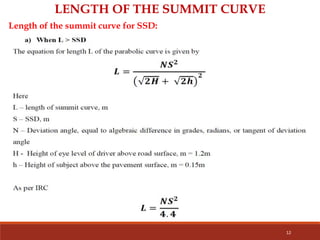
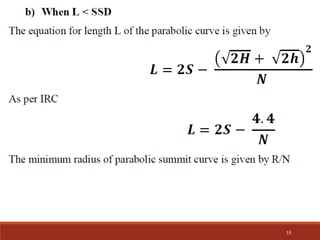
LENGTH OF THE SUMMIT CURVE
Length of the summit curve for SSD:
13
14
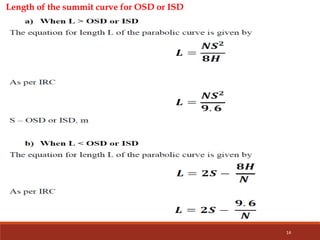
Length of the summit curve for OSD or ISD
15
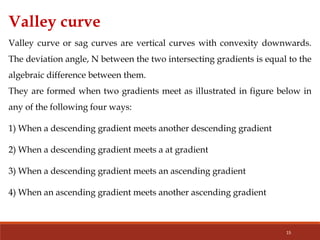
Valley curve
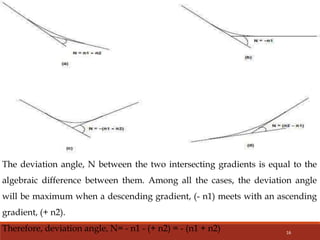
Valley curve or sag curves are vertical curves with convexity downwards.
The deviation angle, N between the two intersecting gradients is equal to the
algebraic difference between them.
They are formed when two gradients meet as illustrated in figure below in
any of the following four ways:
1) When a descending gradient meets another descending gradient
2) When a descending gradient meets a at gradient
3) When a descending gradient meets an ascending gradient
4) When an ascending gradient meets another ascending gradient
16
The deviation angle, N between the two intersecting gradients is equal to the
algebraic difference between them. Among all the cases, the deviation angle
will be maximum when a descending gradient, (- n1) meets with an ascending
gradient, (+ n2).
Therefore, deviation angle, N= - n1 - (+ n2) = - (n1 + n2)
17
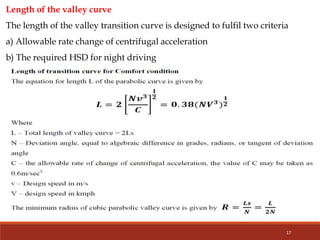
Length of the valley curve
The length of the valley transition curve is designed to fulfil two criteria
a) Allowable rate change of centrifugal acceleration
b) The required HSD for night driving
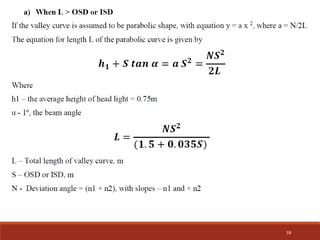
18
19
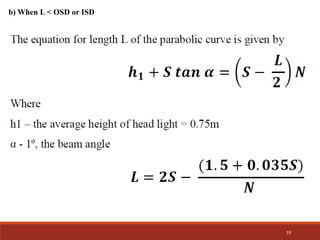
b) When L < OSD or ISD
END
20

Highway Vertical Alignment

  • 1.
    Highway Engineering LECTURE BY: AKSHATHAB AB E, M.TECH, MISTE. ASSISTANT PROFESSOR DEPT. OF CIVIL ENGINEERING 1 Module 2: Unit2: Highway Geometric Design
  • 2.
    DESIGN OF VERTICALALIGNMENT In order to have smooth vehicle movements on the roads, the changes in the gradient should be smoothened out by the vertical curves. The vertical alignment is the elevation or profile of the centre line of the road. The vertical alignment consists of grades and vertical curves. The vertical alignment of a highway influences 1) Vehicle Speed 2) Acceleration and Deceleration 3) Stopping Distance 4) Sight Distance 5) Comfort While Travelling at High Speeds 6) Vehicle Operation Cost. 2
  • 3.
    Gradient  Gradient isthe rate of rise or fall along the length of the road with respect to the horizontal.  It is expressed as a ratio of 1 in x (1 vertical unit to x horizontal units).  The gradient is also expressed as percentages such as n%, the slope being n vertical units to 100 horizontal units Types of gradient a) Ruling Gradient b) Limiting Gradient c) Exceptional Gradient d) Minimum Gradient
  • 4.
    4 Ruling gradient  Theruling gradient or the design gradient is the maximum gradient with which the designer attempts to design the vertical profile of the road.  This depends on the terrain, length of the grade, speed, pulling power of the vehicle and the presence of the horizontal curve.  In plain terrain, it may be possible to provide at gradients, but in hilly terrain it is not economical and sometimes not possible also. The IRC has recommended ruling gradient values of a) 1 in 30 on plain and rolling terrain b) 1 in 20 on mountainous terrain c) 1 in 16.7 on steep terrain.
  • 5.
    5 Limiting gradient  Wheretopography of a place compels adopting steeper gradient than the ruling gradient, 'limiting gradient' is used in view of enormous increase in cost in constructing roads with gentler gradients.  However, the length of continuous grade line steeper than ruling gradient should be limited.  On rolling terrain and on hill roads, it may be frequently necessary to exceed ruling gradient and adopt limiting gradient, but care should be taken to separate such stretches of steep gradients by providing either a level road or a road with easier grade.
  • 6.
    6 Exceptional gradient  Insome extra ordinary situations, it may be unavoidable to provide still steeper gradients than limiting gradient at least for short stretches and in such cases the steeper gradient up to 'exceptional gradient' may be provided.  However, the exceptional gradient should be strictly limited only for short stretches not exceeding about 100 m at a stretch.
  • 7.
    7 Minimum gradient  Thisis important only at locations where surface drainage is important. Camber will take care of the lateral drainage.  The road with zero gradient passing through level land and open side drains are provided with a gradient of 1 in 400.  A minimum of 1 in 500 may be sufficient to drain water in concrete drains or gutter, on inferior surface of drains 1 in 200 or 0.5%, on kutcha open drains steeper slope up to 1 in 100 or 1 % may be provided
  • 8.
  • 9.
    9 Vertical Curves Due tochanges in grade in the vertical alignment of highway, it is necessary to introduce vertical curve at the intersections of different grades to smoothen out the vertical profile and thus ease off the changes in gradients for the fast moving vehicles. The vertical curves used in highway may be classified into two categories: (a) Summit curves or crest curves with convexity upwards (b) Valley curves or sag curves with concavity upwards
  • 10.
    10 Summit curves Summit curveswith convexity upwards are formed in any one of the cases as given below a) When a positive gradient meets another positive gradient b) When positive gradient meets a at gradient c) When an ascending gradient meets a descending gradient. d) When a descending gradient meets another descending gradient
  • 11.
    11 The deviation angle,N between the two intersecting gradients is equal to the algebraic difference between them. Among all the cases, the deviation angle will be maximum when an ascending gradient, (+ n1) meets with a descending gradient, (- n2). Therefore, deviation angle, N= n1 - (- n2) = (n1 + n2)
  • 12.
    12 LENGTH OF THESUMMIT CURVE Length of the summit curve for SSD:
  • 13.
  • 14.
    14 Length of thesummit curve for OSD or ISD
  • 15.
    15 Valley curve Valley curveor sag curves are vertical curves with convexity downwards. The deviation angle, N between the two intersecting gradients is equal to the algebraic difference between them. They are formed when two gradients meet as illustrated in figure below in any of the following four ways: 1) When a descending gradient meets another descending gradient 2) When a descending gradient meets a at gradient 3) When a descending gradient meets an ascending gradient 4) When an ascending gradient meets another ascending gradient
  • 16.
    16 The deviation angle,N between the two intersecting gradients is equal to the algebraic difference between them. Among all the cases, the deviation angle will be maximum when a descending gradient, (- n1) meets with an ascending gradient, (+ n2). Therefore, deviation angle, N= - n1 - (+ n2) = - (n1 + n2)
  • 17.
    17 Length of thevalley curve The length of the valley transition curve is designed to fulfil two criteria a) Allowable rate change of centrifugal acceleration b) The required HSD for night driving
  • 18.
  • 19.
    19 b) When L< OSD or ISD
  • 20.